18th-century household linen management and its 21st-century historic house equivalent
For the modern historic house museum collections staff, the care and cleaning of our spaces and objects are some of the most important tasks we do. Proper dusting and routine cleaning helps preserve historic objects, vacuuming floors and wiping down woodwork help to maintain our historic interiors, and rotation of sensitive works help to prolong their life through limited light exposure and other environmental impacts.
In January and February each year, when the Historic Kenmore and Ferry Farm sites are typically closed to the public, the curatorial staff is able to access the spaces to conduct inventories and condition assessments of objects…and to clean. Spring cleaning at the Washington House this year involved quite a bit of teamwork between our curatorial and buildings & grounds staff—fresh coats of whitewash went up on high-traffic areas of this historic recreation, and the wooden floors were vacuumed, spot-cleaned, and mopped to remove built-up dirt from tours and other activities.
Low-post bedstead in the Hall Back Room piled high with reproduction bedding.
Maintaining the bedsteads of the Washington House is an ongoing task for our interpretive staff, as they tidy and straighten the sheets and pillows that are moved about by visitors (something we encourage and celebrate!) during their immersive tour experiences. This year, as we (the curatorial staff) conducted our spring-cleaning routine, we tightened the bedstead ropes and refreshed the bedding to prep the house for another busy year. But as we went about conducting our room-by-room inventories and pulling bedding out for washing or airing, we uncovered an issue: many of our modern museum object labels for the sheets and pillowcases had become unreadable.
White linen reproduction bedsheet with its twill tape label (sans number).
Marking textiles in a museum collection typically entails a small length of twill (woven cloth) tape, a handwritten or applied object number, and small stitches to attach the tape to the textile object. But for our reproduction bed linens on the bedsteads of the Washington House, these labels no longer were readable due to laundering—the “permanent” number used just didn’t last. So what are our options?
As we like to do, we turned to the past for an understanding of what might be a better, but still historically accurate method for marking our linens. One such resource we turned to was cookery and household books of the period. The Workwoman’s Guide, for example, includes a number of receipts (or instructions) for making marking ink as well as detailed instructions for marking household linens with thread. In marking of linens, according to the author (A Lady), the textile would be marked with either the husband’s initials or the wife’s first name along with husbands initials, followed by an abbreviation of the type of article, and finally by the number and a date marker (last two digits of the year, for instance).
Receipt for “Permanent Ink for Marking Linen.” from The workwoman’s guide : containing instructions to the inexperienced in cutting out and completing those articles of wearing apparel, &c. which are usually made at home : also, explanations on upholstery, straw- platting, bonnet-making, knitting, &c. By A Lady (1838) via Smithsonian Libraries and Archives on Archive.org
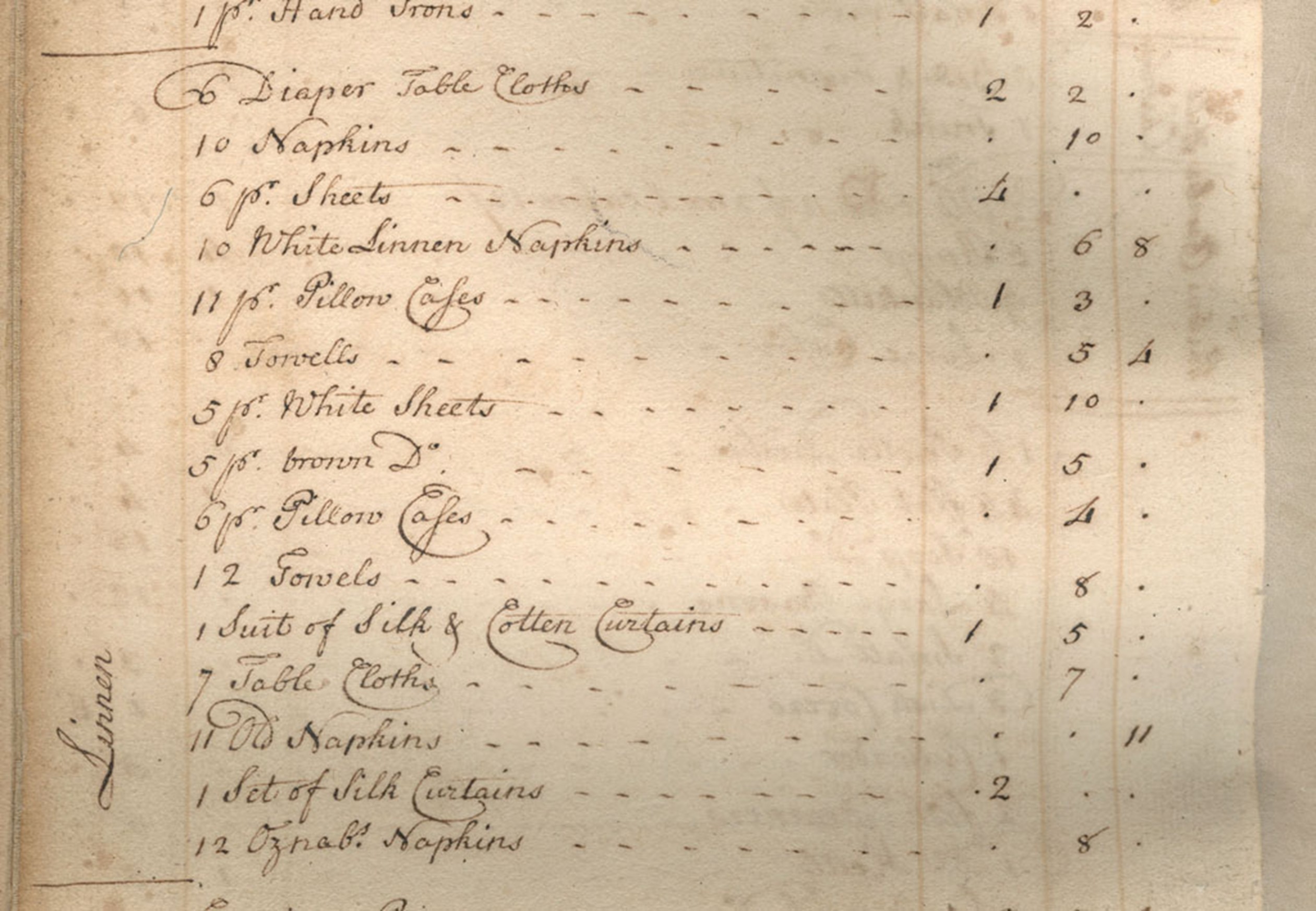
Existing household linens in museum collections and references in the written record indicate that some were in fact marked with numbers or initials/names (or both) to enable the items to be tracked and inventoried, although the exact combination of numbers and letters seem to vary, likely based on a complexities of the household and its linen inventory. The probate inventory taken after Augustine Washington’s death in 1743 records a variety of household textiles at Ferry Farm, including tablecloths, napkins, pillowcases, sheets, and towels. The appraisers, however, make no note of whether these textiles were marked in any way (just noting materials or other descriptors and quantity).
Excerpt of 1743 probate inventory of Augustine Washington listing “Linnen,” including 6 Diaper Table Cloths, 10 Napkins, 6 pr Sheets, 10 White Linnen Napkins, 11 pr Pillow Cases, 8 Towells, 5 pr White Sheets, 5 pr brown Do. [Sheets], 6 pr Pillow Cases, 12 Towels, 7 Table Cloths, 11 Old Napkins, and 12 Oznabs Napkins. Inventory submitted 1 July 1743 to King George County court.
The archaeological record of Ferry Farm includes a number of implements related to sewing, as touched upon in past blog posts such as this one or this one about thimbles. Our own museum collections house a few 18th or early 19th century sheets or other household linens, some of which have been marked in ink or stitching with (unidentified) owners’ initials/names and dates, much in keeping with the instructions outlined in period references such as The Workwoman’s Guide and other household manuals.
Sample layout and makeup of marks to include owner’s initials, item identification, number, and date. Excerpt from The workwoman’s guide (1838) via Smithsonian Libraries and Archives on Archive.org
So, for our modern museum inventory management purposes, I think we’ll be skipping the caustic nitrate of silver or crunchy cochineal beetles for coloring and stick to the needle and thread method of marking our reproduction bedding and other textiles. As suggested by A Lady, the Washington House marks will include both Mary and Augustine Washington’s initials along with notations of item type (such as WS for the five pairs of White Sheets listed in the 1743 inventory) and date of creation (for many of these reproduction linens, that would be 2018 or 2019). I’ll be getting my needle and thread ready so that next year’s inventory and spring cleaning will hopefully be easy-breezy.
Archaeology is trash. There, I said it. Before you call Mr. Jones and have me thrown in a pit of snakes, let me explain. Generally speaking, archaeology focuses on understanding the past through the items that people left behind, i.e., their trash. Most of the things we find are left around because they were broken or no longer needed. Disposal of these items looked much different before modern garbage collection as we know it today. Rather than trashcans and landfills, trash was often thrown outside of the home or workspace near windows and doors or any other designated disposal areas. These areas, also known as middens, usually have a high number of artifacts and are top-tier when it comes to understanding a site. So, in other words, archaeology is trash, and we love it.
Most people can get behind the archaeologists saving the trash that’s hundreds or thousands of years old, but things are a little different when it comes to saving more modern materials like plastic. When visitors or volunteers see things like plastic bottle caps or food wrappers in our bags to bring back to the lab, they usually have a few questions. Like, “Did you mean to keep this?” Or “Why are you keeping this trash?” Here at Ferry Farm, we don’t pick favorites, every bit of trash can tell us something about the site and how it has been used.
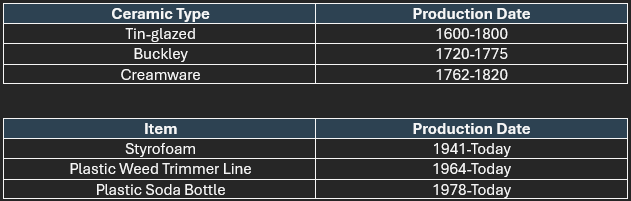
One-way modern materials can help us understand a site is by helping us determine the Terminus Post Quem (TPQ), or “time after which,” of a layer. The TPQ is determined by identifying the earliest production date of the most recently produced item. For layers deposited before the widespread use of plastics, ceramics are usually used for determining the TPQ because they are datable (temporally, not romantically) since most have very specific production dates, and they also hold up pretty well under ground. For example, when looking at the ceramics in a layer with tin-glazed wares, Buckley, and creamware, the TPQ would be 1762 since that is the earliest production date of the most recently produced ceramic (creamware). All the items in the layer had to have been deposited after that date.
The same idea works with modern synthetic materials like plastics, which are usually found at sites that have been used within the last 100 years. If there were to be some plastic soda bottles, weed eater line, and styrofoam in a layer, the TPQ would be 1978. While these materials may also be items you have in your home, not thought to be worth collecting and preserving, their presence in a layer helps provide a date. They can also tell us if an earlier layer was disturbed.
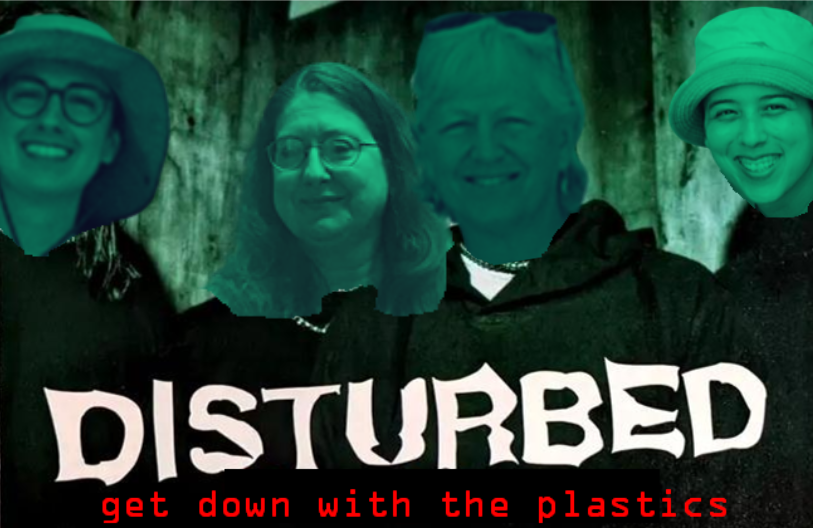
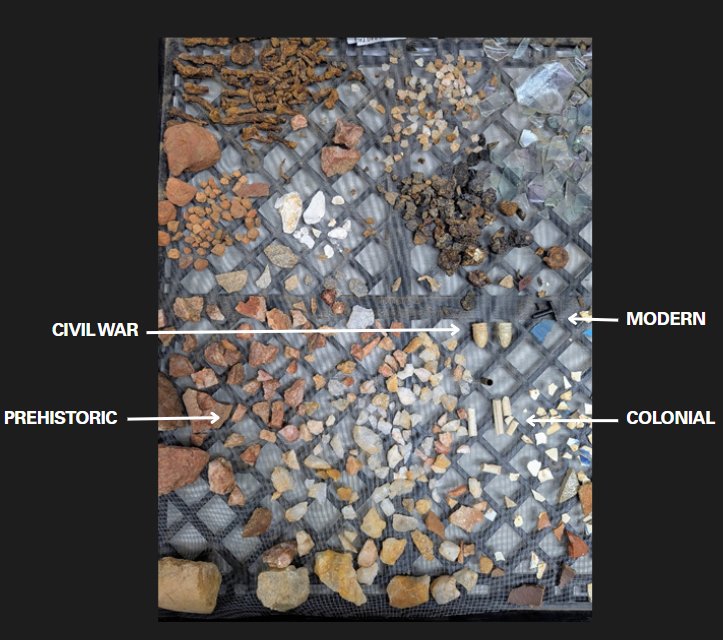
When archaeologists talk about disturbed layers, we aren’t judging their emotional state or love of 2000s heavy metal. Instead, when a layer is described as disturbed, that means there was some sort of activity happening after the initial deposition that affected that layer. During last season’s dig, there were layers with a mix of colonial, prehistoric, and modern materials that indicated that the area was disturbed by some subsequent activity. The information gathered by the presence of modern materials is important for the interpretation of the site and its use over time.
Example of a disturbed layer– Artifacts include prehistoric flakes and fire-cracked rock, colonial items like tobacco pipe stems, Civil War Minie balls, and modern-day plastics
Now that we know why we keep this so-called modern trash. Here are a few examples of how the presence of these items helped our archaeologists understand a part of our site.
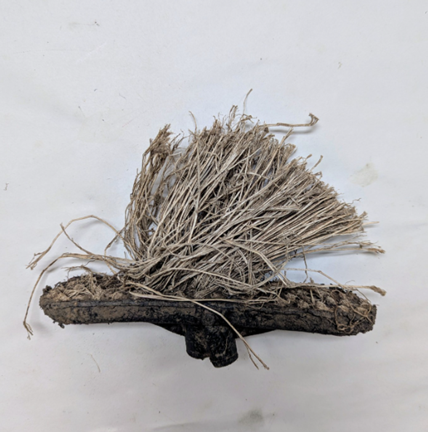
My favorite example happened during last year’s dig. One of our crew, Abbie, was preparing a feature for photographs and had to keep clipping pesky hairlike roots that were in the way. After a bit of excavating, it turns out the “roots” were bristles from a plastic broom. The broom dated the feature fill to the late 20th century and got to the root of the hairy soil issue.
Pesky broom in feature
Our staff has numerous examples of these modern materials being used to help identify previous archaeology as well, from candy wrappers at the bottom of shovel test pits and trenches to an entire trowel! While things like plastic trash bags and food containers aren’t the most exciting to find, they play a part in interpreting the history of activities on the site.
Once something is left behind, it becomes part of the archaeological record, whether it was 10,000 years ago or yesterday’s lunch. What does your trash say about you?
Some of the most delicate objects in our collection are our archives. Paper and other document materials like vellum and parchment are very sensitive materials that can be irreversibly damaged simply by light. This makes it very difficult to display or put on exhibit for extended periods despite our comprehensive policies for conserving and preserving documents; exhibition has always been unfeasible. To remedy this, we have been working on getting archival-safe, high-quality images of our important documents online for everyone to access. So, while you might not see the documents in person, you can still explore, read, and learn about these important papers while we preserve them for future generations.
Until we launch our online archives, I wanted to give everyone a sneak peek at a few of our incredible pieces.
One of our oldest documents in the collection is a Land Grant signed by William Gooch on September 28, 1730, written on vellum. William Gooch was a colonial administrator who served as governor of Virginia from 1727 to 1749. The grant is not in the best condition, but it reads that it grants 400 acres in Spotsylvania County to Paul Plunkepee. This grant is officially recorded as Land Office Patents, No. 14, 1728-1732, page 40, and is available at the Library of Virginia.
Land grant to Paul Plunkepee signed by William Gooch. 28 September 1730.Land grant to Paul Plunkepee signed by William Gooch. 28 September 1730.Sir William Gooch, 1st Baronet, was a British Army officer and colonial administrator who served as the governor of Virginia from 1727 to 1749.
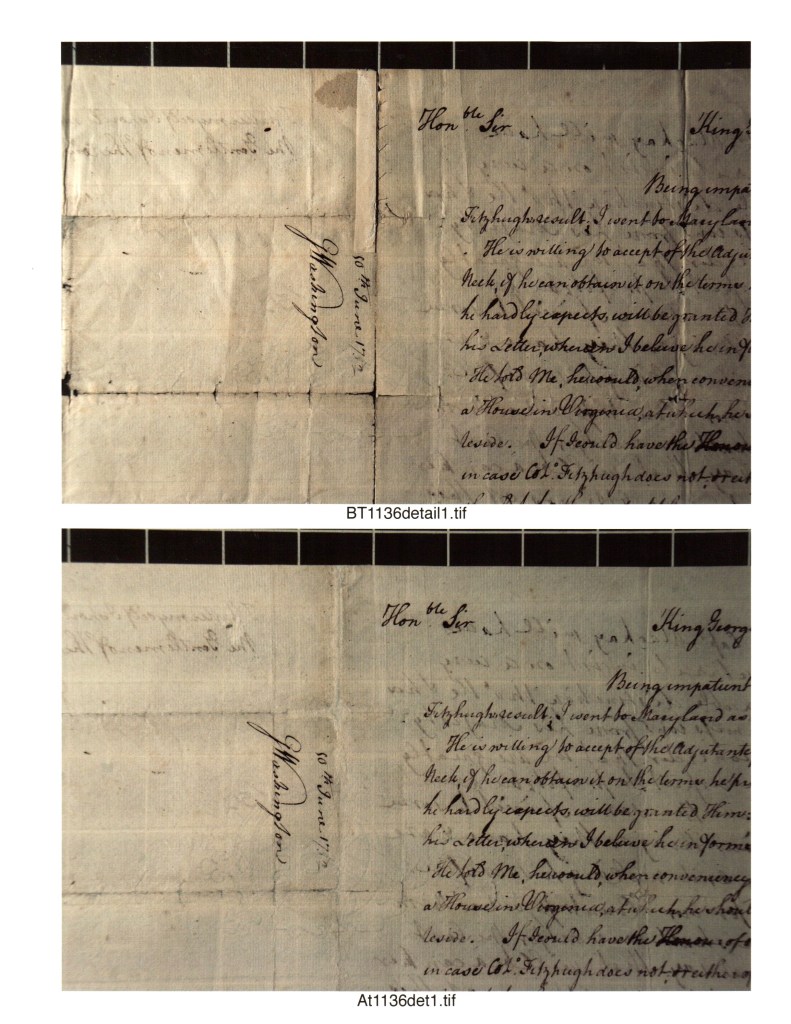
One of our most unique documents is a letter from George Washington to Lieutenant Governor Robert Dinwiddie, written on June 10, 1752, when he was twenty. Robert Dinwiddie served as Lieutenant Governor of Virginia from 1751 to 1758. In the letter, George requests his first military appointment to the open adjutancy of the Northern Neck or other district. George’s half-brother Lawrence had been appointed Adjutant General of the colony in 1743. Due to his illness and eventual death, the adjutant was to be divided into smaller districts (i.e., Northern Neck).
Dinwiddie declined the appointment but assigned George to an envoy position that winter to confront the French, who had recently built a fort on what Dinwiddie considered British land. Additionally, George met with the Iroquois Confederacy to make peace and obtain intelligence about the French.
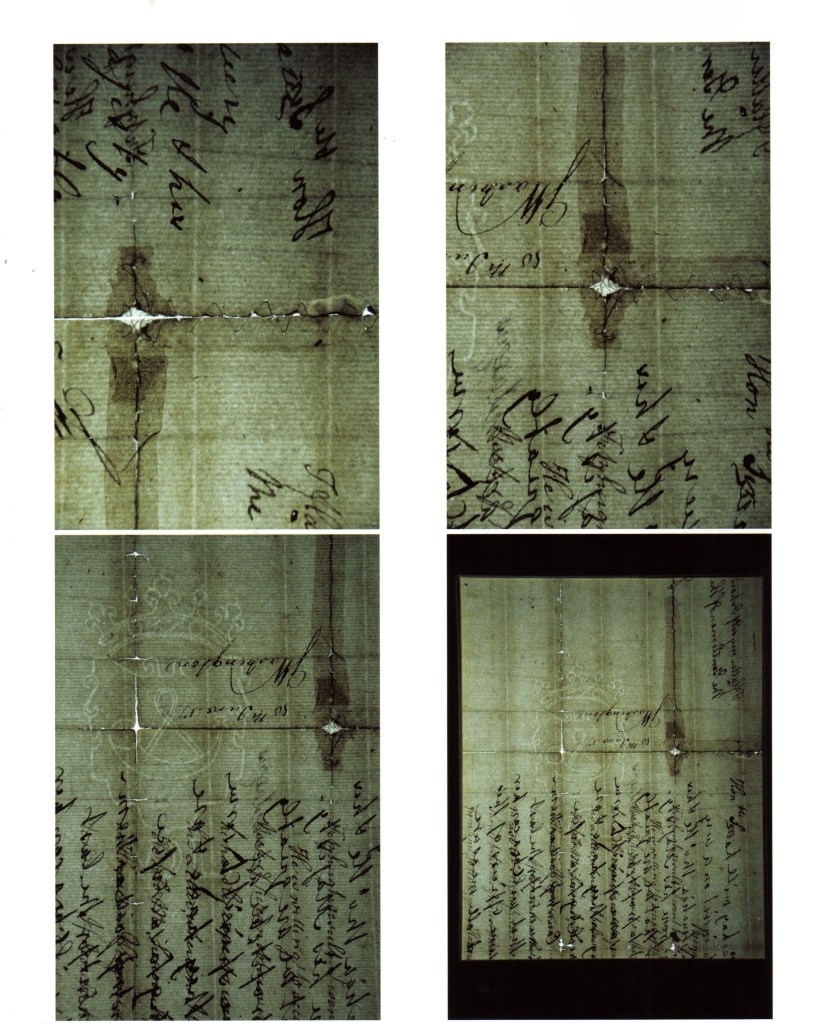
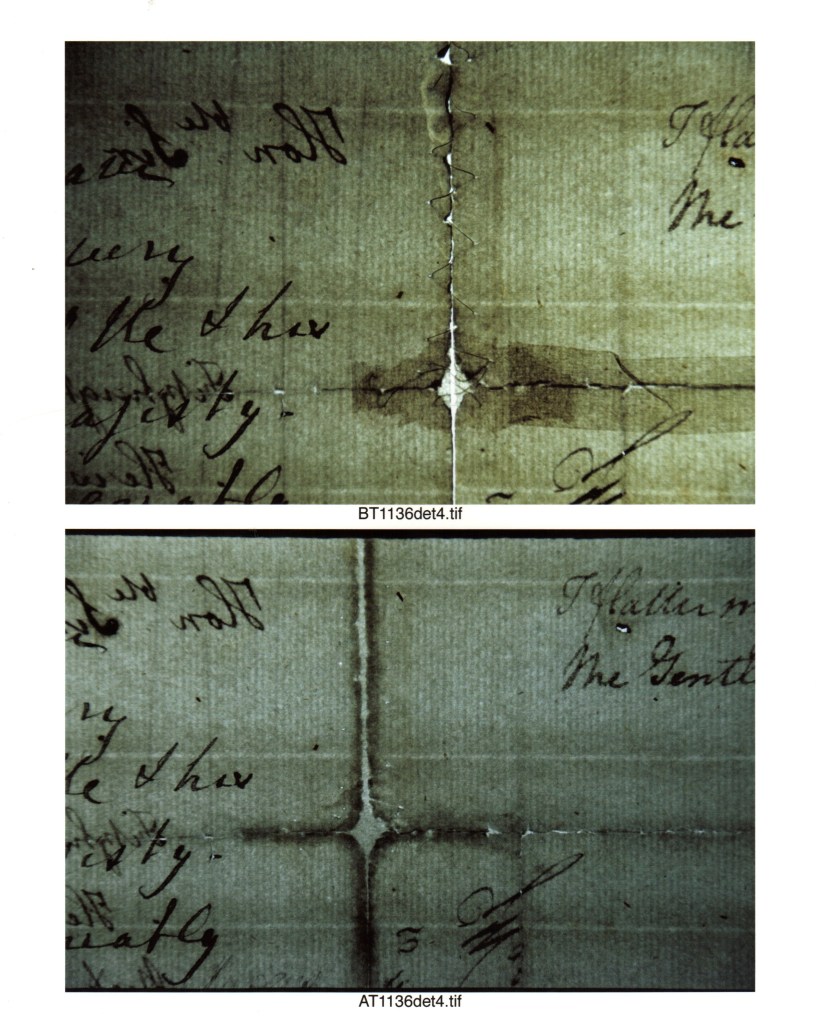
Letter from George Washington to Robert Dinwiddie, 10 June 1752Letter from George Washington to Robert Dinwiddie, 10 June 1752
This amazing letter pinpoints the beginning of George Washington’s illustrious military career, which would eventually culminate in him becoming the first President of the new United States of America. The letter is in great condition after meticulous conservation work, which included repairs with Japanese tissue called tengucho and wheat starch paste called jin shofu. It was then cleaned and flattened, and the iron gall ink stabilized.
A transcript of the letter can be found on the National Archives website at Founders Online.
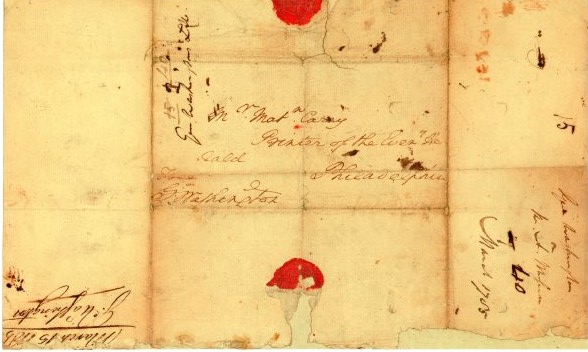
Next are two letters between George Washington and Irish-born publisher Matthew Carey. Matthew Carey moved to America in 1784 and settled in Philadelphia, where he established a publishing business and bookshop with $400 given to him by the Marquis de Lafayette. Carey’s first publication was The Pennsylvania Herald in 1785, followed by two of the first successful American magazines, The Columbian Magazine and The American Magazine in 1786 and 1787.
1824 portrait of Lafayette by Ary Scheffer is currently in the U.S. House of RepresentativesMathew Carey was an Irish-born American publisher and economist who lived and worked in Philadelphia, Pennsylvania.
In George’s first letter to Carey in 1785, he requests a subscription to Carey’s newspaper but asks him to send the newspaper disguised as an ordinary letter because George has been having problems with the post office delivering his newspapers . George thinks his papers may not have been delivered because “persons who wishing to read News Papers without being of the expence [sic] of paying for them, make free with those which are addressed to others.”
Letter from George Washington to Matthew Carey, 1 March 1785Letter from George Washington to Matthew Carey, 1 March 1785
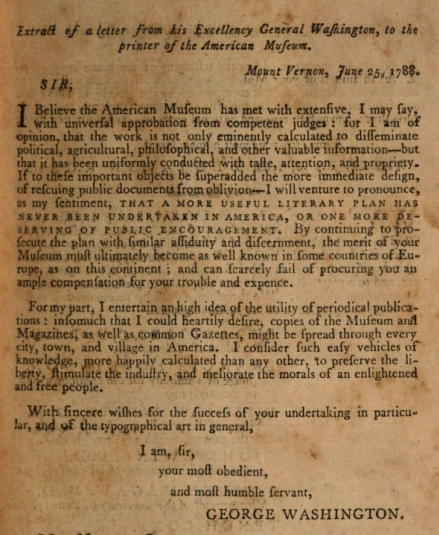
The second letter between George and Matthew is dated June 25, 1788. The year before, Carey launched “The American Museum” magazine. It was a literary museum that reprinted significant historical documents on American history and original essays on politics, commerce, and culture. The magazine got a positive response, but Carey was finding it expensive to distribute the magazine across the country, so he asked George, one of his first subscribers, to write an endorsement for the magazine that would help attract new subscribers.[2]
Washington responded immediately, seizing the opportunity offered by Carey to express his belief that the free dissemination of information and ideas was vital to preserving American liberty. ‘I could heartily desire,’ Washington wrote, that ‘copies of the Museum and Magazines, as well as common Gazettes, might be spread through every city, town & village in America – I consider such easy vehicles of knowledge, more happily calculated that any other, to preserve the liberty, stimulate the industry and meliorate the morals of an enlightened and free People.”
Letter from George Washington to Matthew Carey, 25 June 1788Letter from George Washington to Matthew Carey, 25 June 1788Extract of a letter from his Excellency General Washington, to the printer of the American Museum
Carey published Washington’s endorsement in the next issue of his magazine—his marks for the typesetter can be seen in the original Washington letter. The result was a flood of new subscriptions that allowed Carey to continue publishing The American Museum for another four years.
Transcripts of the letters can be found on the National Archives website at FoundersOnline.
These are just a few of the amazing documents in our collection, which we hope to bring you soon so that you can explore them yourself. Check back often, and we will keep you updated on our progress with our digitization project.
Heather Baldus
Collections Manager
Bibliography
Edd Applegate (August 17, 2012). The rise of Advertising in the United States: A History of Innovation to 1960. Scarecrow Press. p.25.
As you drive down the road, sometimes, there are enough signs to make your head spin. It can be tempting to just drive by these stark white cast iron road markers with black text when you see them. Even so, sometimes you can’t help but let a word or a phrase catch your eye, sparking curiosity as you continue on with your travels.
“Highway markers near Seven Pines, VA” courtesy of the Library of Virginia. (Virginia State Chamber of Commerce)
The Virginia Highway Marker program is the oldest one of its kind in the United States (Virginia Department of Transportation, n.d.). In 1927, State Route 1 was freshly paved and ready for new motor vehicles to coast down from Washington, DC to Richmond. (Virginia Department of Transportation, 2006).
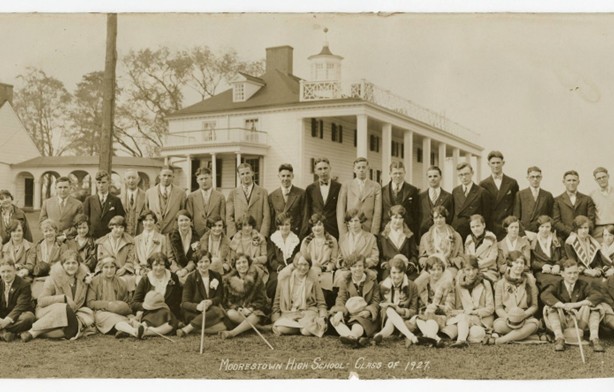
Drivers were given a red carpet to travel straight to what many viewed as the birthplace of our nation, George Washington’s Mount Vernon. Thousands began their pilgrimage. Hotels, motels, gas stations, and attractions began to pop up along the path.
“Moorestown High School Class of 1927” posing in front of Mount Vernon
With all these new travelers who appreciated their state’s history, William E. Carson of the Conservation and Economic Development Commission erected several markers along the road, designating historic areas of interest and turning the roads into an attraction. (Virginia Department of Transportation, n.d.).
Fabricating the markers was a beast to tackle since the traditional method of construction would have been granite. Unfortunately, the stone was a bit too pricy and was also found to be difficult to read at the lightning-fast 25 mph speed limit. Aluminum was an option for its lightweight and non-corrosive nature, and in fact, many early signs were manufactured from the metal, although they were quickly found to crack easily. They were replaced with cast iron, and cast metal has been the preferred method of construction ever since (Rachal, 1949).
Two of our three markers were first seen in the early years of the program. The oldest of our three was also the one that had the least amount of time in the light. The Accokeek Iron Furnace marker (E-49) is located off Courthouse Rd in Stafford near an archaeological dig site owned by the George Washington Foundation. The modern iteration was erected in 1998.
Accokeek Iron Furnace: The Principio Company constructed the Accokeek Iron Furnace nearby about 1726 on land leased from Augustine Washington (father of George Washington), who became a partner. After Washington’s death in 1743, his son Lawrence inherited his interest in the company and the furnace. When he in turn died ten years later, his share descended first to his brother Augustine Washington Jr. and later to William Augustine Washington. The archaeological site is a rare example of an 18th-century Virginia industrial enterprise. It includes the furnace location, the wheel pit and races, a retaining wall made of slag, an extensive slag dump, and mine pits.
This text is not what was written prior to 1930. Those signs were brief, containing only a sentence or two for motorists to read as they drove by. Between 1927 and 1930, though, cars sped up. Where they were once going 25 mph, they were soon going 40 mph or even rocketing 50 mph down the highways!
Trying to read the markers while driving quickly became impossible. The Commission’s solution? Publish a booklet with each highway marker printed and arranged neatly for passengers to read as they traveled. All you had to remember was the marker’s number or title. The first of these booklets were distributed in early 1930, free of charge (Rachal, 1949).
This edition contains the earliest record of the Accokeek marker, then titled “Ancient Iron Furnace,” and reading only: “Here on Accokeek Run were iron mines and a furnace in which Augustine Washington, father of George Washington, began to smelt iron in 1727.”
Unfortunately for our little marker, this was the last time it could be featured in the booklet. Disaster struck in late 1930. Engineer P. W. Snead wrote to the Commission on December 19th to report that the sign was found that morning, knocked from its post, and shattered. The commission wrote back a few days later, asking for the aluminum pieces to be gathered and sent back since the factory would refund them for the parts. (Library of Virginia Archives, 1930). The Accokeek marker was not restored until 1998, 68 years later, as part of a federal grant, according to the manager of the highway marker program, Jennifer Loux.
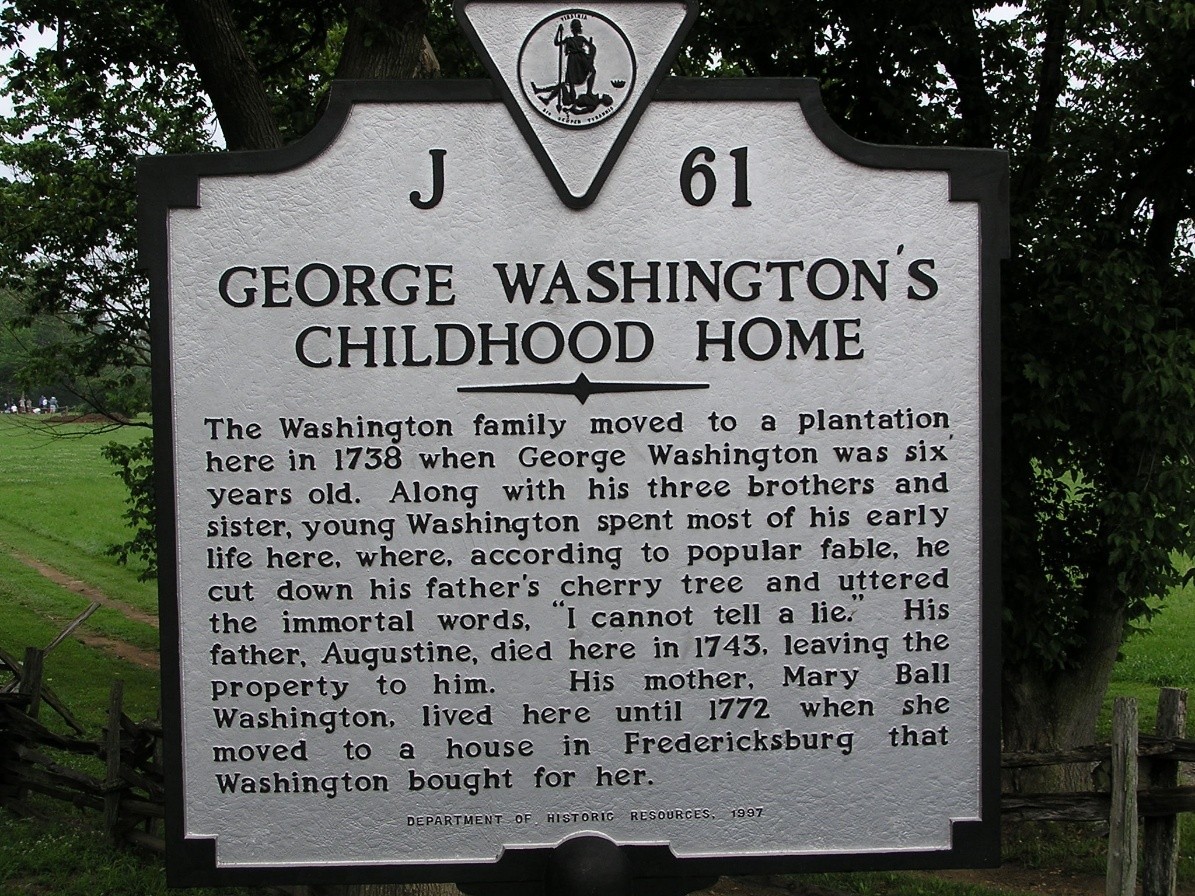
The “Washington’s Boyhood Home” marker is also found in the booklet’s first edition, and its modern counterpart is now at the entrance to Ferry Farm. Although there are no records of the sign being damaged prior to its replacement in 1997, after exposure to the elements for almost 70 years, it was probably time for a refresh.
Alternatively, the motivation for the marker’s replacement (likely from the same federal grant) may have come from historical inaccuracies. The original text of the marker reads:
“Washington’s Boyhood Home: At this place, the Ferry Farm, George Washington lived most of the time from 1739 to 1747. Here, according to tradition, he cut down the cherry tree. Washington’s father died here in 1743. The farm was his share of the paternal estate.”
We now believe that the Cherry Tree story was likely an exaggeration or a myth, and so the verbiage was changed on the modern marker. Many old highway markers contained inaccurate information, as is often the case with many historical resources. As technology and research evolve over time, so does what we know. Another example of this never made it to the press, but early drafts of the marker’s text include his attendance at the “Old Field School.” We have since learned that there is no documentation of Washington ever attending a formal school in his life.
The current marker was installed in 1997, the same year the George Washington Foundation obtained the property, and the sign continues to greet visitors to this day.
George Washington’s Childhood Home: The Washington family moved to a plantation here in 1738 when George Washington was six years old. Along with his three brothers and sister, young Washington spent most of his early life here, where, according to popular fable, he cut down his father’s cherry tree and uttered the immortal words, “I cannot tell a lie.” His father, Augustine, died here in 1743, leaving the property to him. His mother, Mary Ball Washington, lived here until 1772 when she moved to a house in Fredericksburg that Washington bought for her.
Our third marker is different, having not been placed until 1995. At this point in time, the highway marker program had been passed around, with different organizations all bearing the burden of putting up new signs and maintaining the old ones. It first passed hands in 1949 to the Virginia Department of Highways, who, after a year, handed the responsibility off to the Virginia State Library. In 1966, it was traded again and is now operated by the Virginia Department of Historic Resources in collaboration with the Department of Transportation (Virginia Department of Historic Resources, n.d.).
Former director of the Kenmore Association (now the George Washington Foundation) Vernon Edenfield wrote to the DHR proposing the marker. The Association paid for the manufacturing out of pocket. You can now visit it along Caroline St, four blocks from Kenmore, in front of Fielding Lewis’ storefront.
Kenmore: Four blocks west stands Kenmore, built in 1775 by Col. Fielding Lewis for his wife, Betty, sister of George Washington. Near here, between Kenmore and the Rappahannock River, stood Lewis’s warehouses and docks. Kenmore’s intricate plasterwork is the finest in the country. Among 19th-century owners and occupants were Samuel Gordon, who named it Kenmore, and William Key Howard Jr., who restored and embellished the mansion’s plasterwork. Washington and other Revolutionary leaders often visited, and during the Civil War, Union troops used it as a hospital. The Garden Club of Virginia, starting in 1929, rehabilitated Kenmore’s gardens as its first restoration project.
Although you might think after nearly 100 years of recording and presenting history that the Virginia Highway Marker program has run out of ideas, you can’t be further from the truth. New markers are being planned constantly, and more gaps in history are being filled each year. In Fredericksburg alone, there are plenty more markers commemorating the city’s rich history. If you feel there is an opportunity for a new marker somewhere, you can submit a proposal through the DHR’s website.
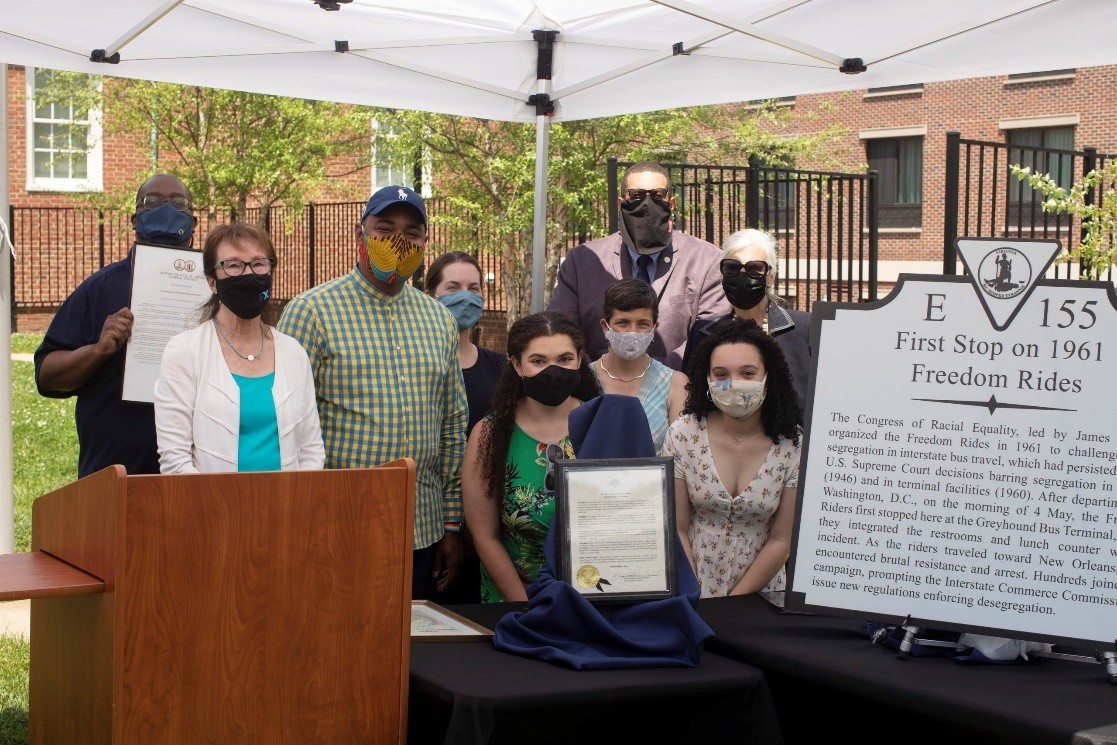
The unveiling of the new Freedom Rides marker in 2021 at the site of the old Greyhound bus depot on Princess Anne St, which was proposed by staff and students from the University of Mary Washington
History can be found anywhere if you know where to look, and the Virginia highway markers are a testament to that. Be sure to keep an eye out for them on your next drive!
Prats, J. J. (2010, October 23). State Historical Markers Numbering Plans. Retrieved from The Historical marker Database: https://www.hmdb.org/m.asp?m=2
Rachal, W. M. (1949). Historical Markers on Virginia Highways. State and Local History News, 151-153.
Virginia Department of Transportation. (2006). A History of Roads in Virginia: “The Most Convenient Wayes”. Richmond: Virginia Department of Transportation Office of Public Affairs.
Virginia Department of Transportation. (n.d.). Historical Markers. Retrieved from Directional Signing Program: https://vaidsp.com/historicalmarkers/
Virginia State Chamber of Commerce, a. L. (n.d.). Highway markers near Seven Pines, Va. Picture Collection.
As the United States and historic sites across the country, including the George Washington Foundation, prepare to commemorate the nation’s 250th anniversary next year, it might be easy for the eightieth anniversary of the end of World War II to become an afterthought. After all, the interpretation of Historic Kenmore focuses on the Revolutionary era; the home was already the better part of 200 years old in 1945. But the histories of Kenmore and Fredericksburg are as intricately intertwined with the Second World War as they are with the War of Independence, and the legacies of both conflicts resonate today.
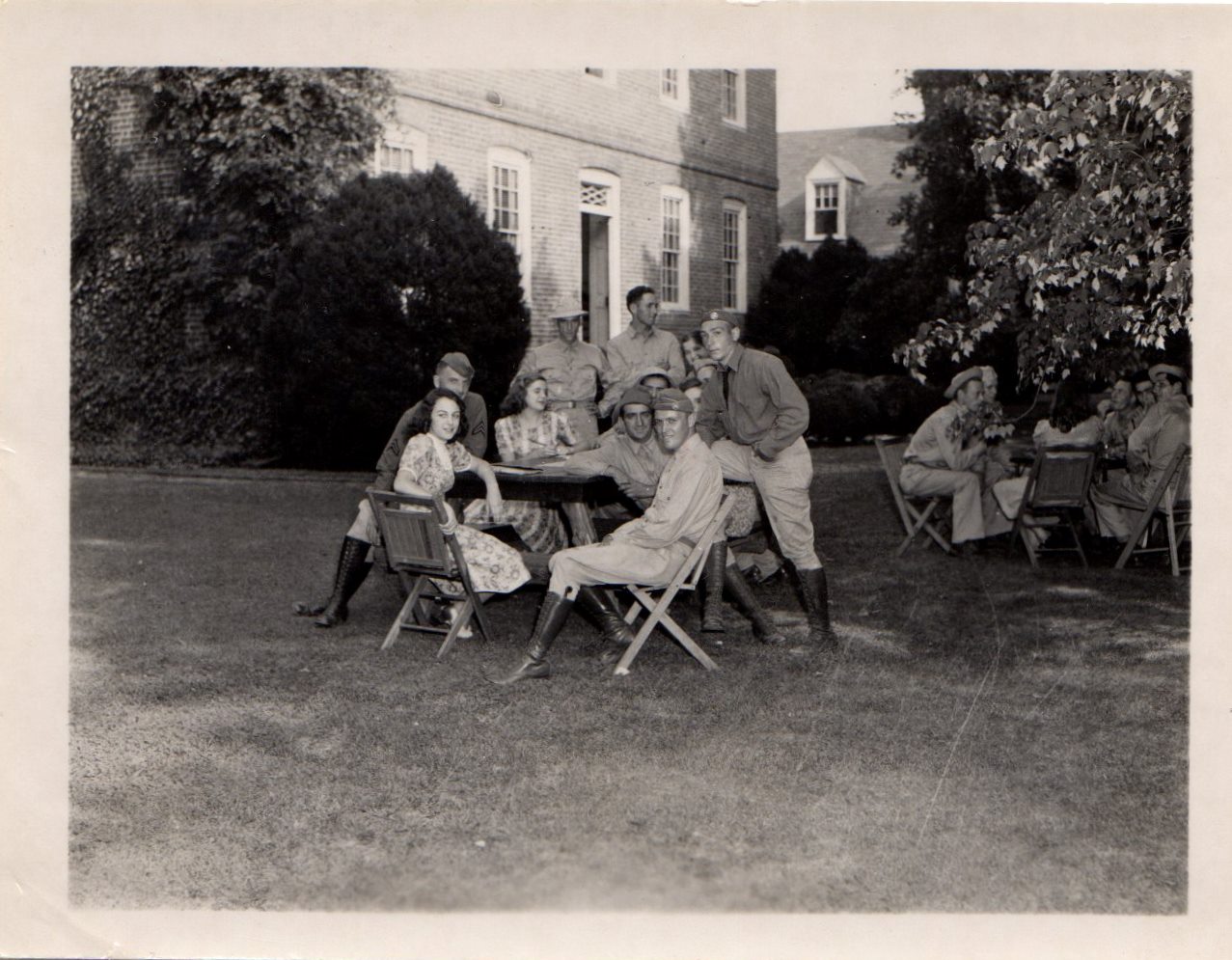
Soldiers being hosted on lawn of Kenmore
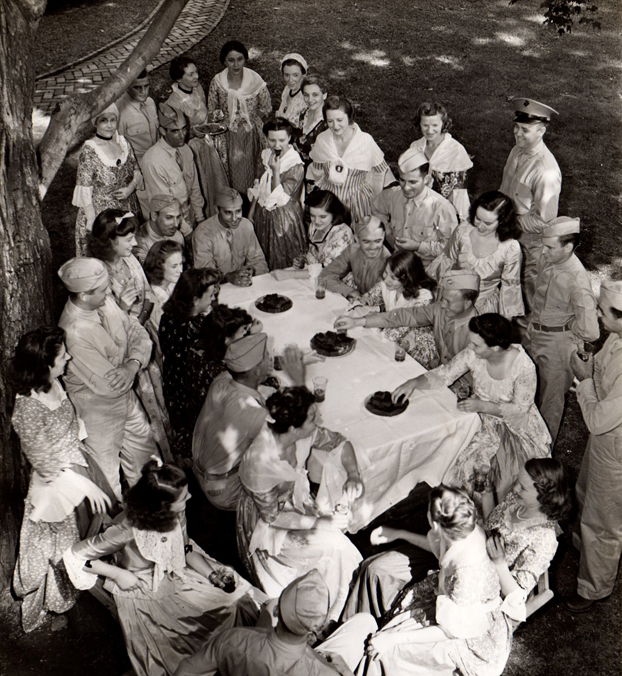
Like many Americans, the women of the Kenmore Association sought during the war years to demonstrate pride in their nation and support for its troops. Annie Fleming Smith, then national secretary of the Association, showed her appreciation for the country’s military by opening Kenmore’s doors to thousands of service members stationed in the Fredericksburg area. The Association took them “through the mansion and served them iced tea and gingerbread.” It hosted lawn parties and entertained soldiers early in the day and late at night. Hosts told everyone in uniform “who passed over the Kenmore steps…about George Washington, and other great men, passing over these very same steps.”
Kenmore hosted soldiers with gingerbread and iced tea.
Smith regarded the Association’s commitment to “making our American boys feel at home in a home of the Washingtons” as Kenmore’s way of contributing “to the defense of the nation.” She also hoped that visits to Kenmore would crystalize in servicemen a commitment to the U.S. ideals of freedom and democracy.
The commitment to helping the recently transplanted soldiers feel comfortable in town was admirable; however, there are no records of Smith or Kenmore welcoming Black servicemen, stationed along with their white counterparts at what was then A.P. Hill Military Reservation and other nearby military installations. Smith and other members of the Kenmore Association, along with whites across Fredericksburg, the South, and the country, apparently did not see any conflict between simultaneous support for liberty, as embedded in the founding documents of the United States, and a racist social system.
The 366th Infantry Regiment
So how, in segregated Fredericksburg, did Black service members spend their leisure time? If the city’s white-led institutions, including Kenmore, did not welcome African Americans serving their country, Black Fredericksburgers proved happy to host the men fighting the Double V campaign—victory over fascism abroad and victory over racism and discrimination at home. Indeed, at least two Black fraternal organizations in Fredericksburg provided recreational opportunities to African American soldiers during World War II.
The city’s Black Odd Fellows lodge (located at 301 Charles Street), “under auspices of the Citizens Committee of Local Negros,” hosted at least one dance for African American soldiers from A.P. Hill. This dance, held in February 1942, came shortly after white officials implicated Black servicemen stationed at A.P. Hill and Fort Belvoir in a “near-riot” that began after a Fredericksburg police officer attempted to arrest a Black soldier for public intoxication.
Following the altercation between the soldiers and the city’s police, during which white officers beat a Black soldier and threw a tear gas grenade, the Free Lance-Star published a letter to the editor from local NAACP leaders calling for the establishment of a Black USO—since the white USO barred Black soldiers from entering— and more leisure opportunities for African American soldiers in the city.
Other efforts to make the city more welcoming to Black service members followed. In May of that year, a group of Black Fredericksburgers requested that “the city furnish recreational facilities, showers, soap and towels for colored troops stationed at Camp A. P. Hill.” According to the letter containing this request submitted to the City Council, “there were slightly over a hundred colored soldiers now stationed at Camp A. P. Hill and that there were no recreational facilities at Camp A. P. Hill or in the City of Fredericksburg for these colored troops.”
Rappahannock Lodge 229 of the Independent Benevolent Protective Order Elks of the World in April 2008. The lodge was home to Fredericksburg’s Black USO in 1943 and 1944. Rappahannock Lodge 229 of the Independent Benevolent Protective Order Elks of the World in March 2024. 1103 Winchester Street is just a block from Historic Kenmore.Historic plaque at former Rappahannock Elks Lodge 229
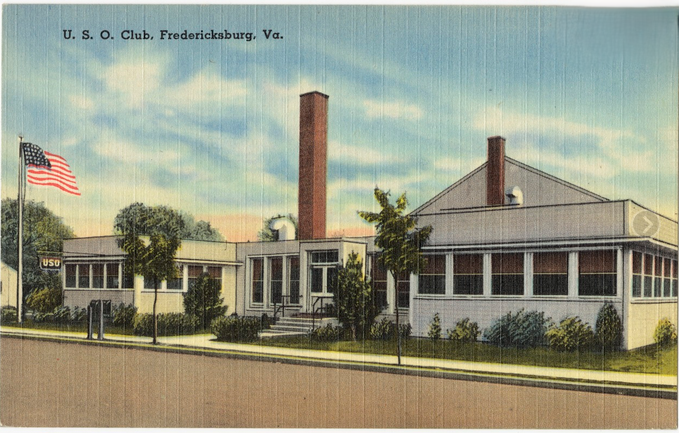
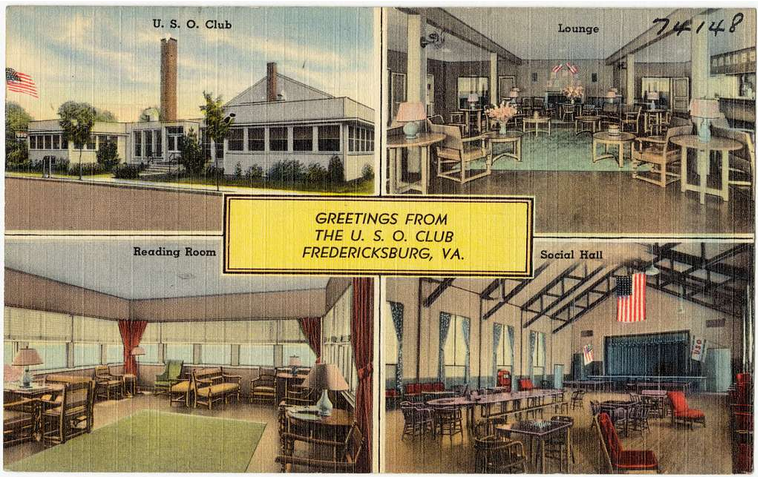
Eventually, the efforts of Black soldiers’ advocates succeeded: The Black USO sought by the NAACP leaders opened in June 1943 at Rappahannock Lodge 229 of the Independent Benevolent Protective Order Elks of the World (otherwise known as the African American Elks). Lodge 229 was at 1103 Winchester Street, just a block from Historic Kenmore. Across the world, USOs gave “troops somewhere to play cards, dance and socialize while taking a break from their duties.” Each USO facility was supposed to be “open to all men in uniform,” regardless of race, but in practice, centers were often segregated. Fredericksburg’s white USO opened in January 1942 at 408 Canal Street, which is today the Dorothy Hart Community Center.
USO Club, Fredericksburg, VaUSO Club, Fredericksburg, Va
Although Fredericksburg’s Black USO closed the following April, reportedly because of low attendance, another Black USO was completed in Caroline County in December of 1943 and was still operating in 1945.
USO, Caroline County USO, Caroline County
However, the presence of these recreational facilities did not resolve tensions between white area residents and visiting Black service members. In the fall of 1943, while the Fredericksburg USO was open, A.P. Hill Military Reservation was home to the 366th Infantry Regiment, a Black unit. When members of the 366th chaffed against racism—for instance, by evicting the driver of a bus who instructed the soldiers to move to the back of the vehicle and finishing the drive back to A.P. Hill from Fredericksburg themselves—local whites reacted with fear. By November, the city’s white residents worried that the soldiers planned to “‘clean up the town on the first’” of December in objection to Jim Crow laws and segregation. Whites expressed relief when the unit shipped out before that date.
During World War II, the Kenmore Association opened its doors to white soldiers to share the stories of those Americans “who planned the principles, which is the beacon light of the world today.” Eight decades ago, the world’s democracies fought for those principles and defeated the forces of totalitarianism abroad, but racism endured at home. While progress has been made in the United States regarding the assertion “that all men are created equal,” the struggle against inequality continues.
Adam Nubbe
Manager of School & Youth Programs
Bibliography
Fredericksburg City Council. (1942, January). Fredericksburg City Council Minutes Vol 28. Fredericksburg, Virginia, USA.
Hall, D. (1943, November 27). Fearful Whites Relieved as 366th Leaves Virginia. Baltimore Afro-American, p. 21.
We have a lot of silver in our collections, ranging from candlesticks to teapots to spoons. With all the silver, I have become familiar with eighteenth-century silversmith marks, but I have never explored the artisans behind the marks.
I was pleasantly surprised to find at least four women silversmiths represented through various pieces. These four women were all London-based traders within an active community of women artisans in luxury trades. I wanted to discover how these women entered this male-dominated trade and registered their marks. (City Women, 2025)
First, we need a little background to understand how the silversmith trade worked in eighteenth-century England.
The Trade
In the eighteenth century, English silversmiths were much more regulated than American silversmiths due to having around a four-hundred-year head start in establishing trade organization. However, no one on either side of the ocean would have been considered a master craftsman without a long multi-year apprenticeship.
Silver plating workshop from Diderot’s Encyclopédie
While this was a rare path for girls, these four women were introduced to silversmith work through their families without formal apprenticeships. However, that doesn’t mean they didn’t spend years becoming expert artisans and learning to run a successful business from their fathers, brothers, and husbands.
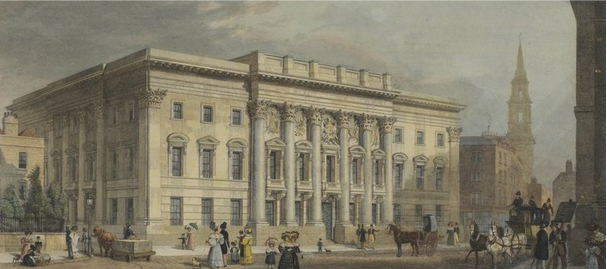
When a silversmith obtained their “free” status, it meant they could sell their ware in the city of London. To earn this status, the silversmith had to be granted a hallmark from a Livery, like the Goldsmith’s Company. Women were only granted a mark if they were the widows of a silversmith. (Rue Pigalle, 2025)
Worshipful Company of Goldsmith in the city of London, current building in late 19th century. The company has been occupying this spot since 1339.
The Marks
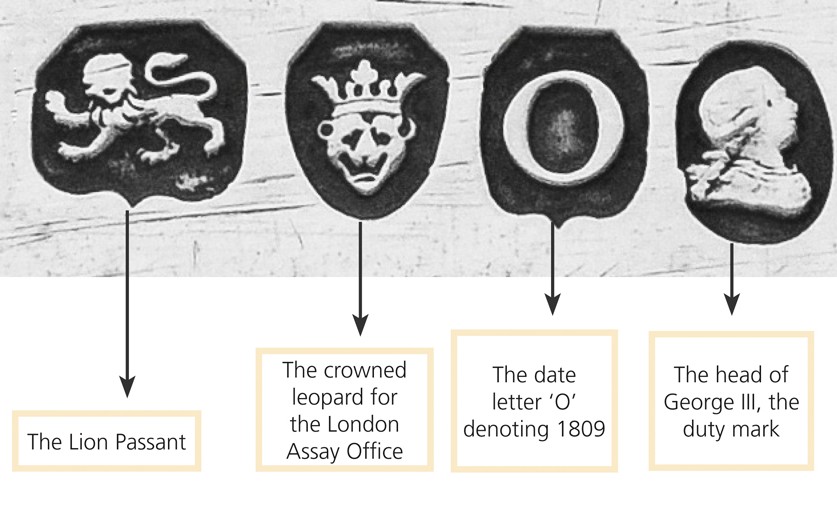
In eighteenth-century England, the silversmith could sell the articles they made only after the pieces had been assayed and stamped with appropriate hallmarks. (Ford, 2018)
Explanation of silver marks
One hallmark is the symbol of the guildhall where it was assayed. Each location had a different image, like a London goldsmith guild’s head of a leopard, and has been used for over seven centuries.
Another is the maker’s mark, which has been required since 1363. This mark is now always the marker’s initials, but one was more often a trade symbol.
The mark of English sterling standard fineness—a lion passant—has been used since 1544 to certify that the metal is 92.5 percent pure silver. (Ford, 2018)
There is also a date mark indicated by a letter representing a year.
Finally, duty marks on silver from 1784 to 1890 reflect the tax on precious metals with the profile of George III or Victoria. (Arkell, 2025)
The Silversmiths
Hester Bateman
One of the most well-known eighteenth-century London silversmiths is Hester Bateman. She became the matriarch of the renowned Bateman family silversmithing company.
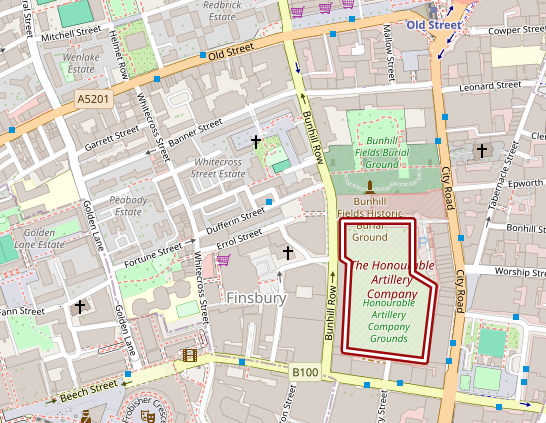
She was born Hester Nedem in London in 1708. She grew up poor with little formal education. In 1732, she married John Bateman, a goldsmith and chain maker. John died in 1760 of tuberculosis and left Hester his tools in his will. Hester took over the shop located at 107 Bunhill Row and registered her mark at London Goldsmith’s Hall on April 16, 1761. (Bly, 2008)
Hester Bateman’s shop was located at 107 Bunhill Row, Islington, London
She continued to run the business for over thirty years, bringing two sons, one daughter (Letitia Clarke), and a daughter-in-law (Ann Bateman) into it. (Eagle and Pearl, 2025) The Bateman silversmith company specialized in household silver, such as flatware, cruet stands, and fashionable tea and coffee sets. (Slavid, 2021) The company’s work is characterized by bright-cut engraving and piercing in the neoclassical style.
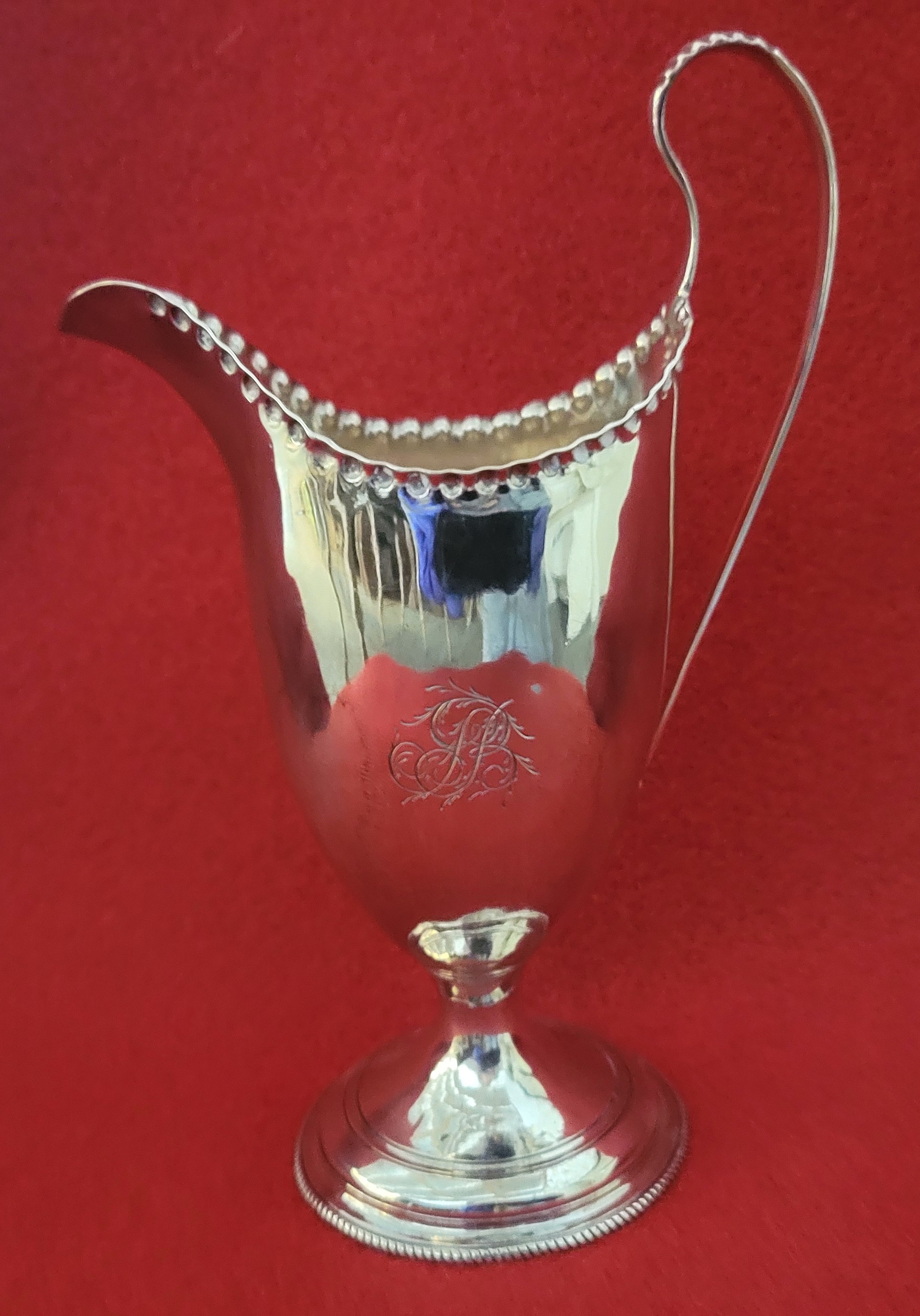
Trade card for Leticia Clarke who was Hester Bateman’s daughter Silver cruet stand with Hester Bateman maker’s mark, c.1780Hester Bateman makers mark, 1781-1782Hester Bateman maker’s markHester Bateman makers markSmall silver cream pot by Hester Bateman, 1784-1785
The key to Hester’s success was adopting and integrating modern technologies, taking advantage of new cost-effective manufacturing processes to supply elegant wares to the middle class. (Slavid, 2021) One of the new cost-effective processes they used was the “Sheffield Plate,” developed in the 1740s. It is a fusion of copper and sterling silver to create gauge sheet silver, which can be punched and pierced by machines and is cheaper to produce than solid silver. (Campbell, 2006)
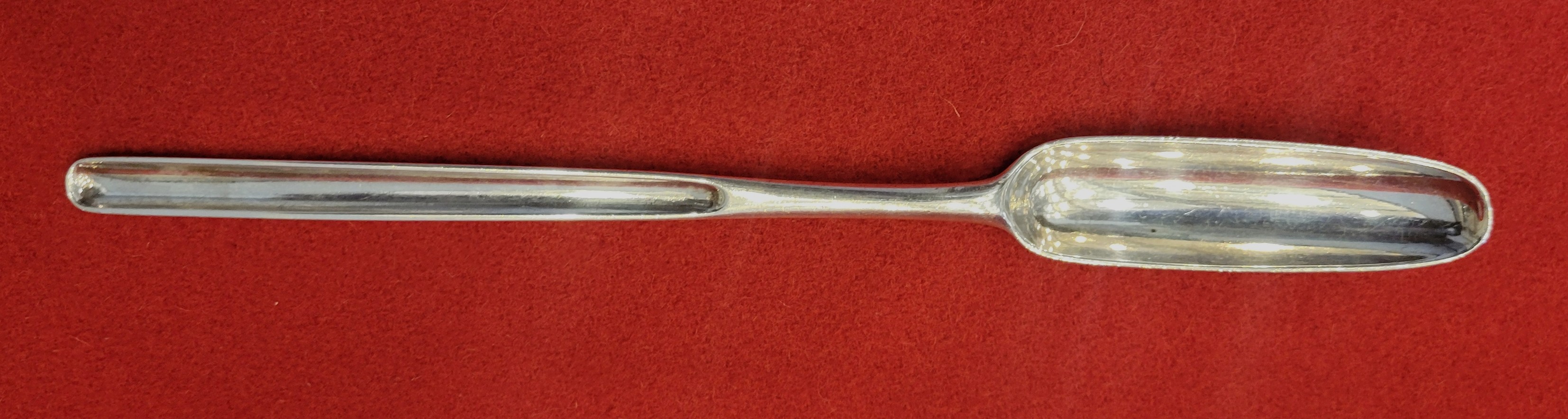
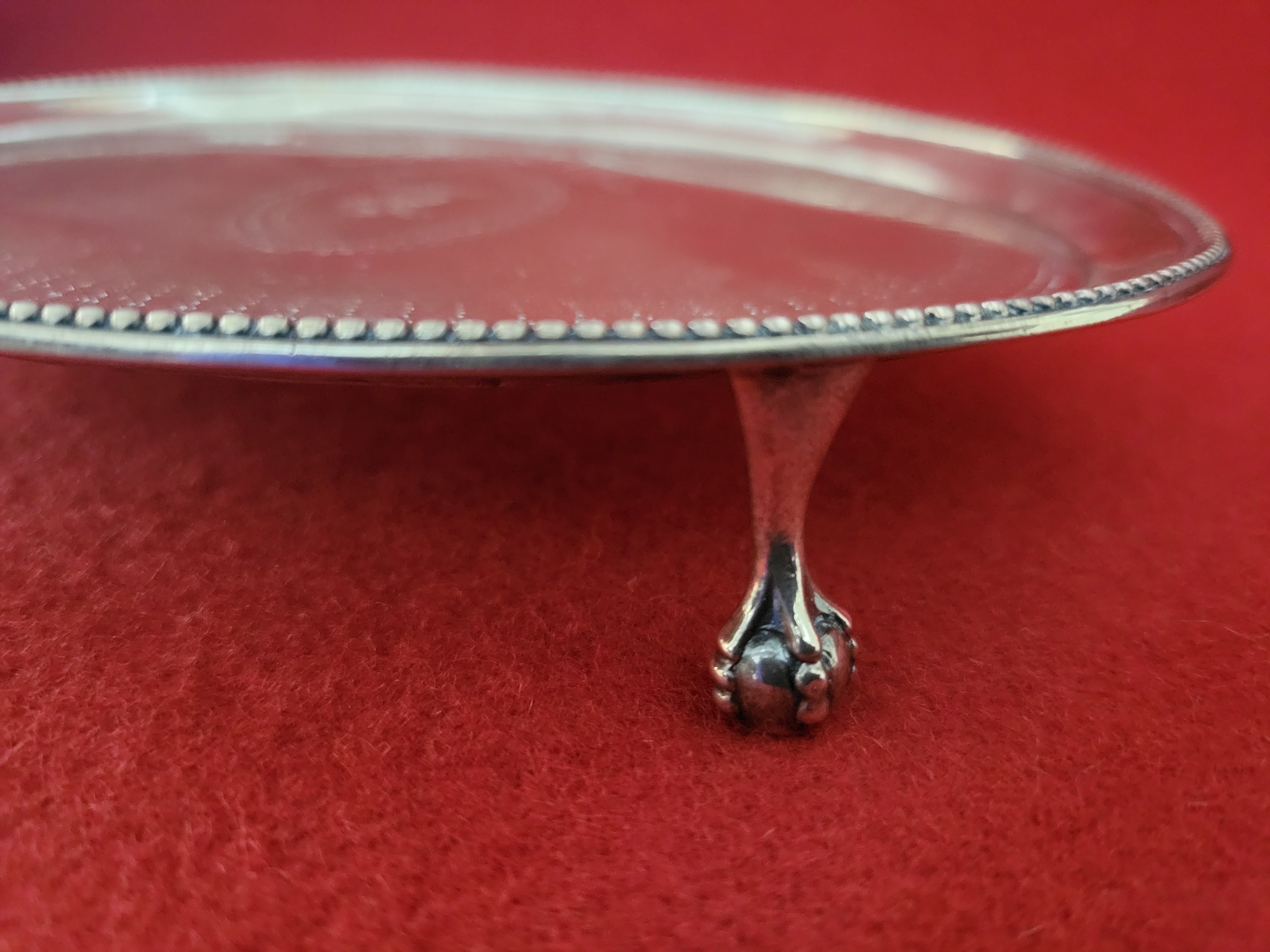
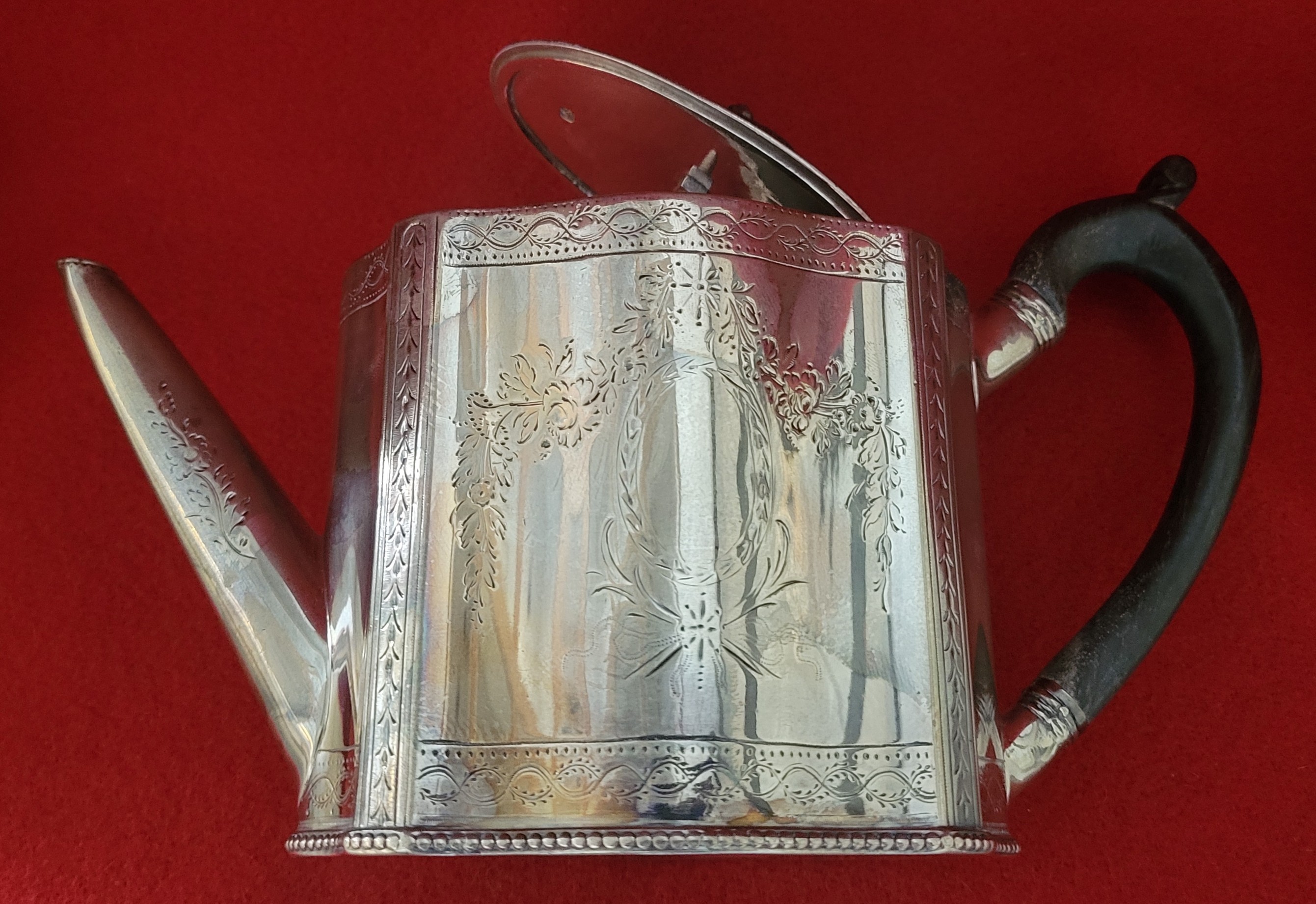
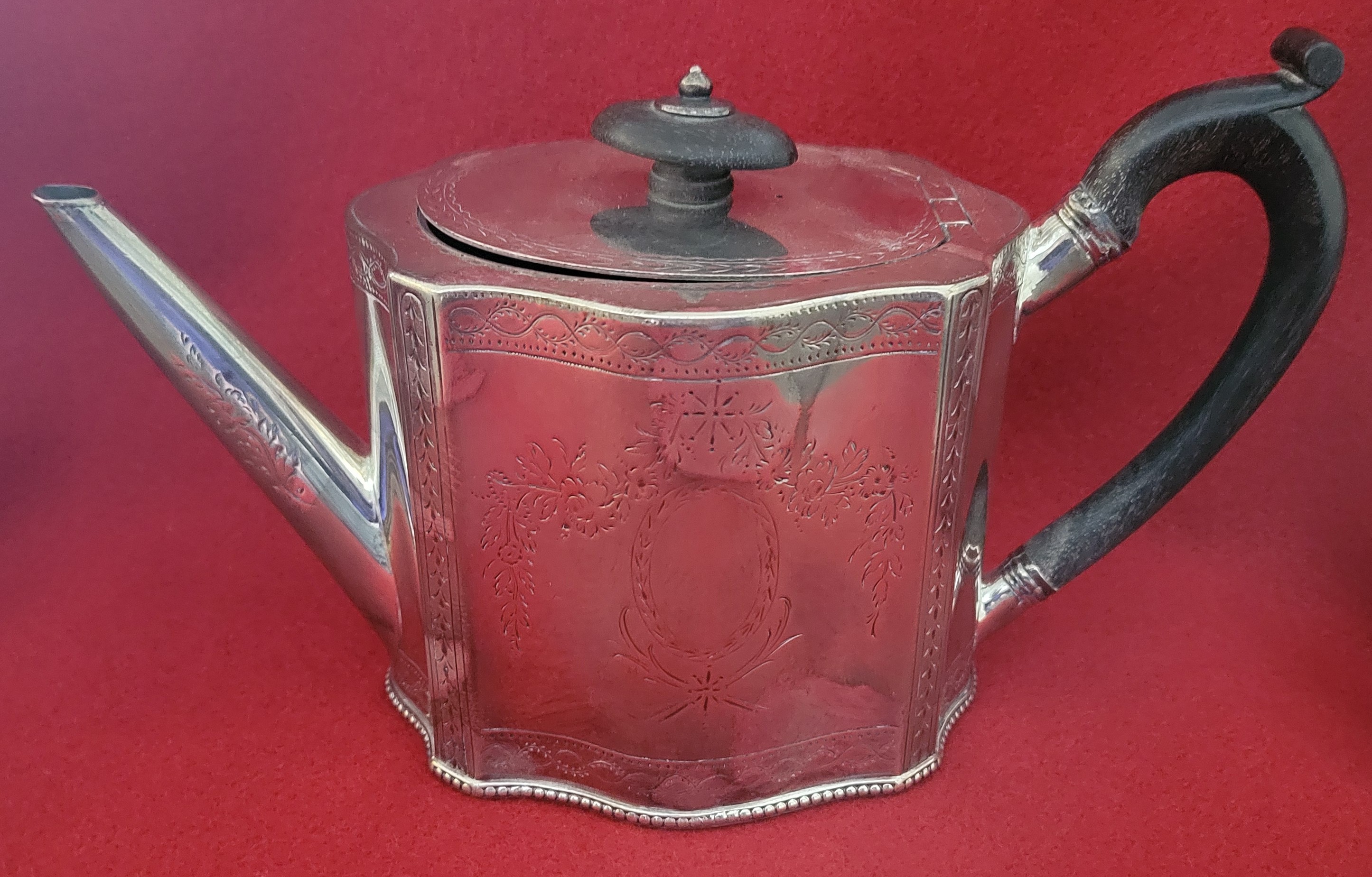
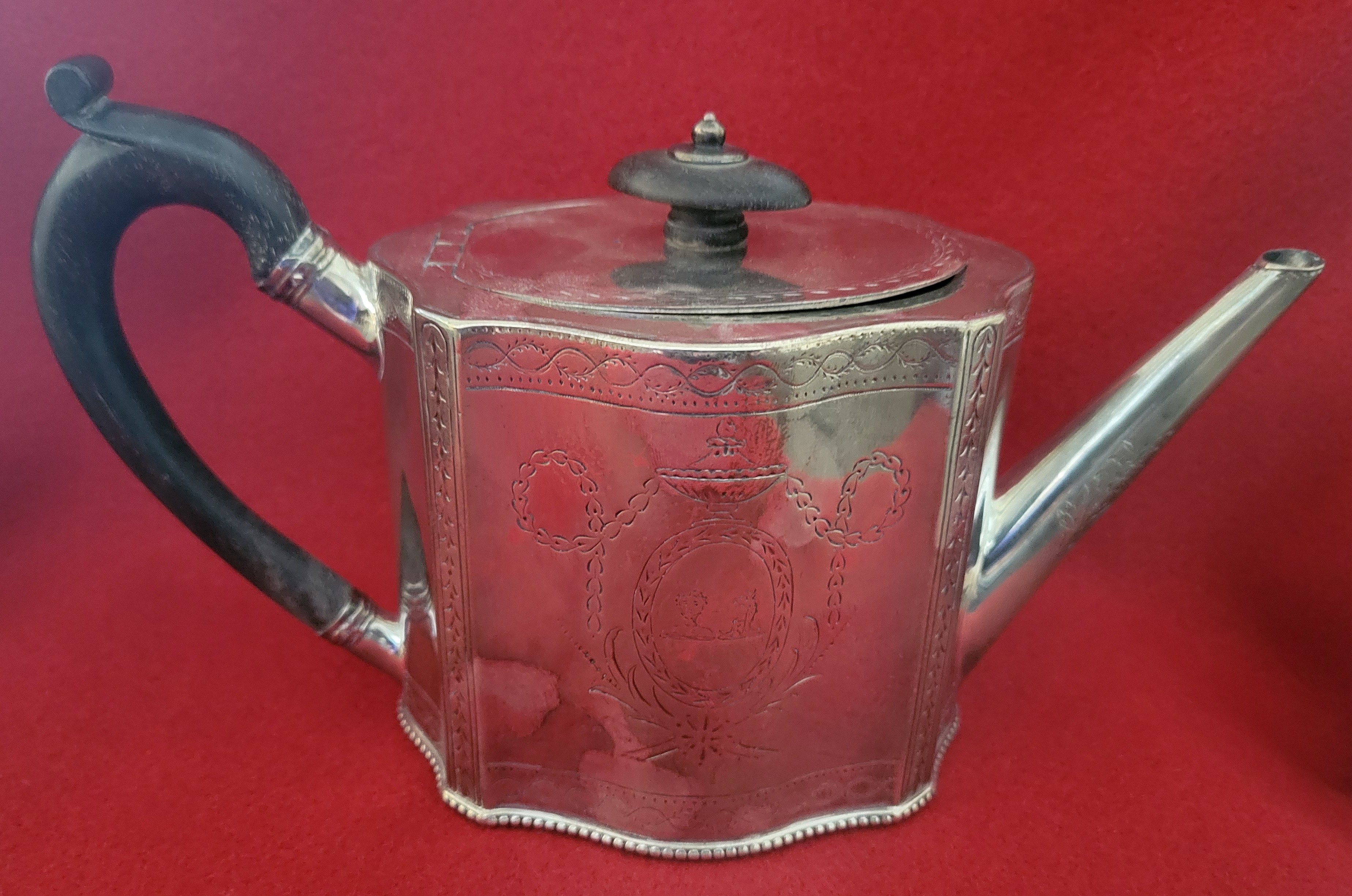
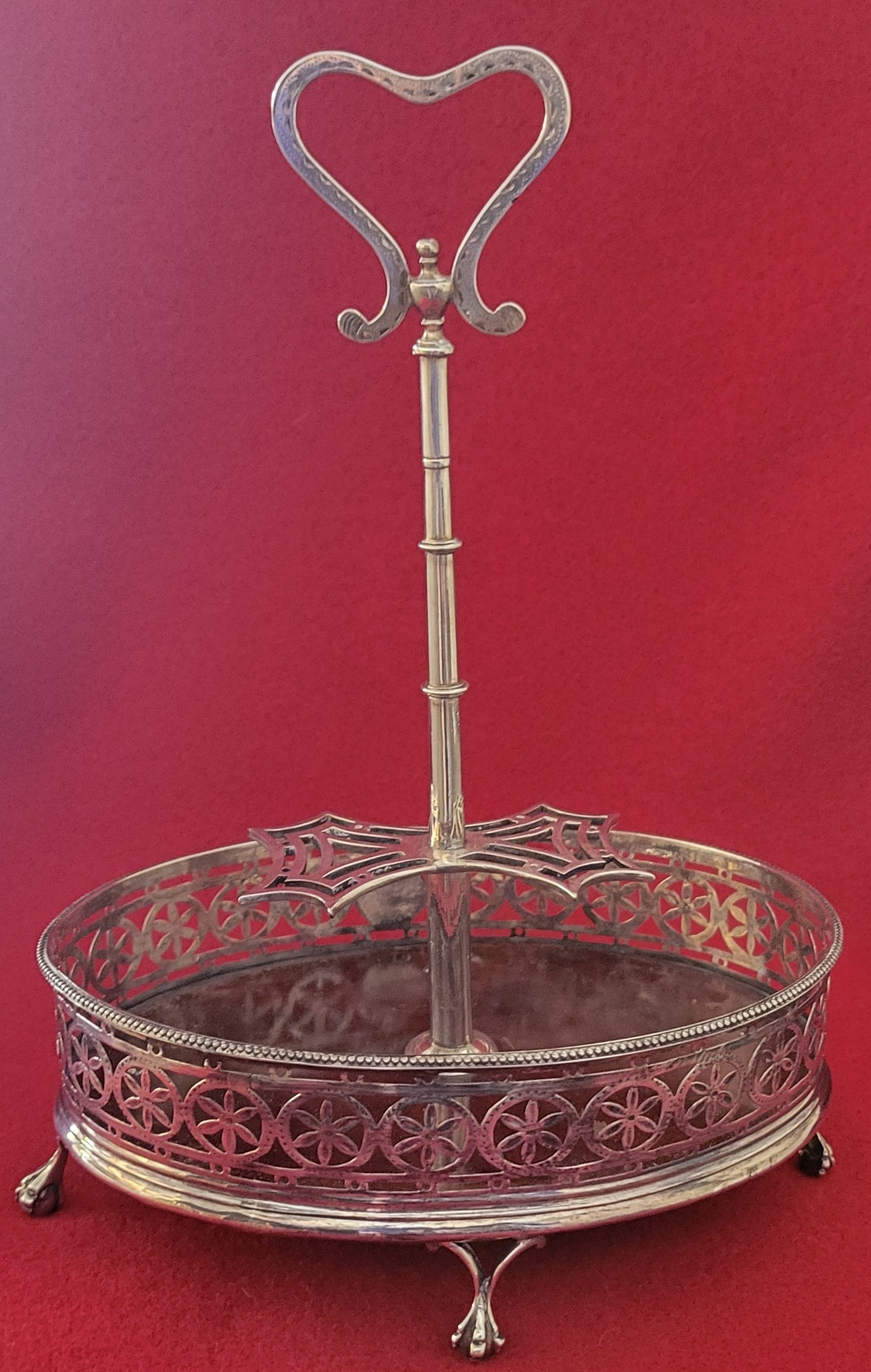
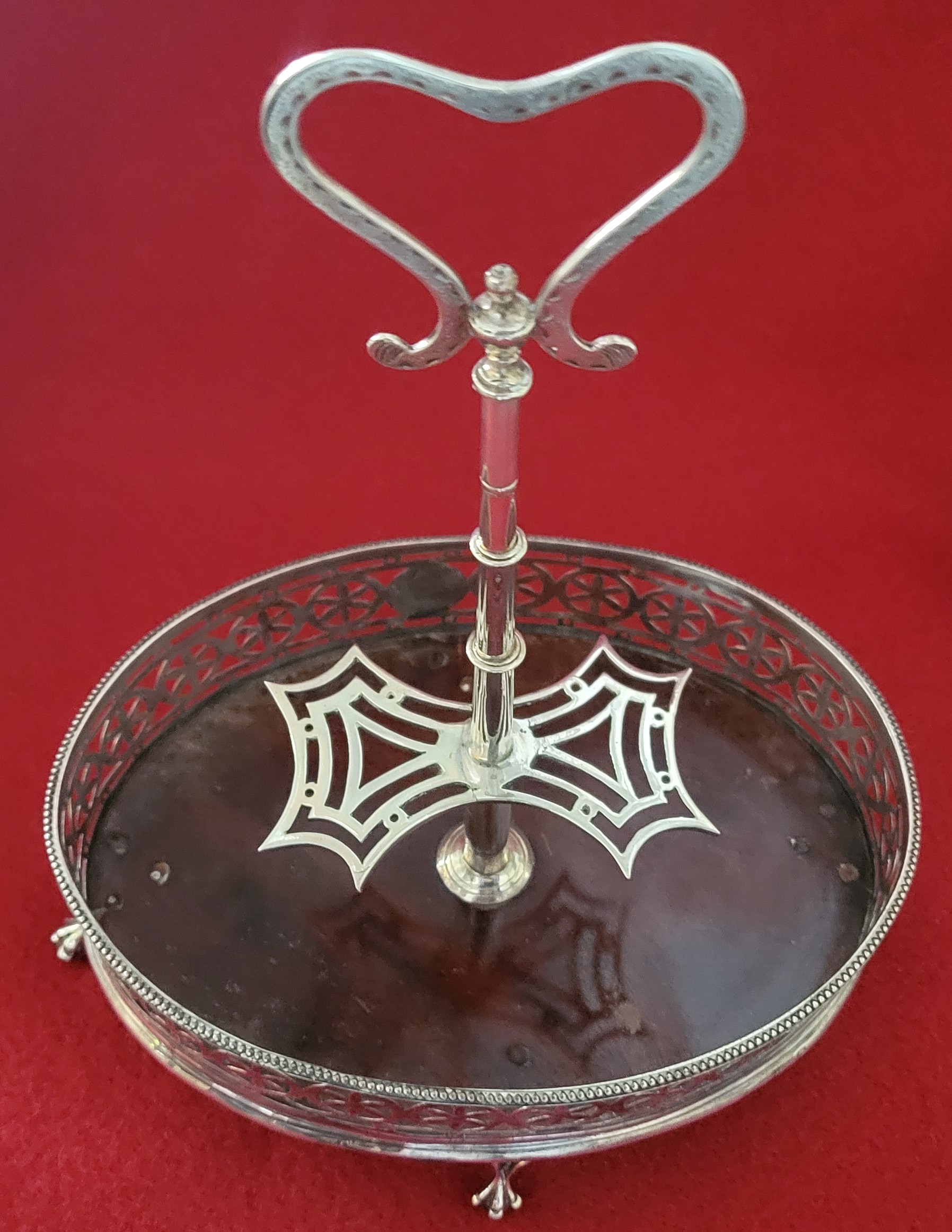
Silver Marrow Scoop by Hester Bateman, 1774-1776Silver Marrow Scoop by Hester Bateman, 1774-1776Silver Marrow Scoop by Hester Bateman, 1774-1776Silver tea stand with beaded edge, ball and claw feet and engraved griffin head, Hester Bateman, 1785-1786Silver tea stand with beaded edge, ball and claw feet and engraved griffin head, Hester Bateman, 1785-1786Silver tea stand with beaded edge, ball and claw feet and engraved griffin head, Hester Bateman, 1785-1786Small silver cream pot by Hester Bateman, 1784-1785Small silver cream pot by Hester Bateman, 1784-1785Silver teapot by Hester Bateman, 1781-1782Silver teapot by Hester Bateman, 1781-1782Silver teapot by Hester Bateman, 1781-1782Silver teapot by Hester Bateman, 1781-1782Silver cruet stand with glass bottles by Hester Bateman, c. 1780.Silver cruet stand with glass bottles by Hester Bateman, c. 1780.Silver cruet stand with glass bottles by Hester Bateman, c. 1780.Silver cruet stand with glass bottles by Hester Bateman, c. 1780.
Hester retired in 1790 and was succeeded by her sons, who registered their hallmarks in December 1790. The Bateman family company continued for another fifty years, closing under William Bateman in 1843. (Campbell, 2006)
Ann Bateman
One of the renowned Bateman silversmith family members was Ann Bateman, daughter-in-law of Hester, who was married to her son Jonathan.
Better look at maker’s mark by Peter and Ann Bateman
She registered her first mark in 1791, the year her husband died. She then worked in partnership with her brother-in-law Peter and eventually her son in 1800. Her works were popular tableware in fashionable neoclassical styles. (Bly, 2008)
Sugar baskets; 1794; Minneapolis Institute of ArtSilver teaspoon by Ann, Peter and William Bateman, 1800Silver teaspoon by Ann, Peter and William Bateman, 1800Coaster by Ann, Peter and William Bateman, 1780-1800Coaster by Ann, Peter and William Bateman, 1780-1800Coaster by Ann, Peter and William Bateman, 1780-1800
Elizabeth Godfrey
Elizabeth was born in London, the daughter of Simon Pantin, a prominent silversmith. She was believed to have been trained in her father’s workshop. She married two silversmiths; her first husband was Abraham Buteux, a French goldsmith.
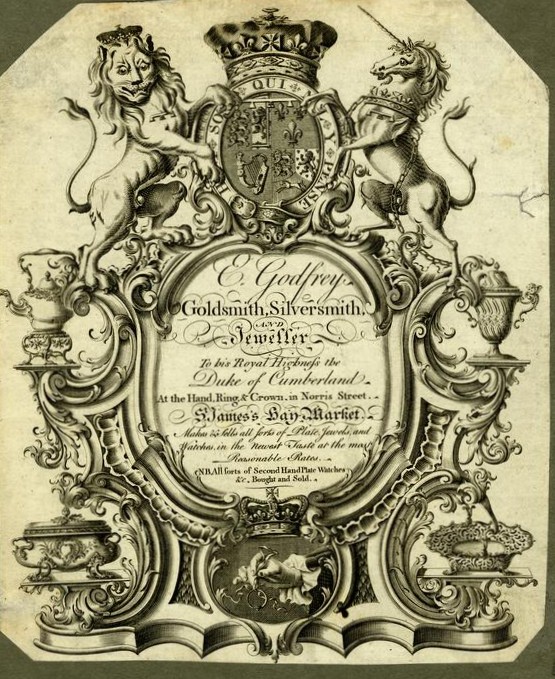
Trade card for Elizabeth GodfreyElizabeth Godfrey maker’s mark registration
Abraham died in 1731, and she registered her first mark as Elizabeth Buteux for her shop in Norris Street. She continued her first husband’s business until her marriage to Benjamin Godfrey in 1732. Upon Benjamin’s death in 1741, she registered a second mark as Elizabeth Godfrey. (Arts, 2025) She is described on her trade card as “Goldsmith, Silversmith, Jeweller, [who] makes and sells all sorts of plates, jewels, and watches, in the newest taste at the most reasonable rates.” (Mrkusic, 2014)
Elizabeth Godfrey’s shop in Norris Street, Piccadilly, LondonElizabeth Godfrey maker’s mark
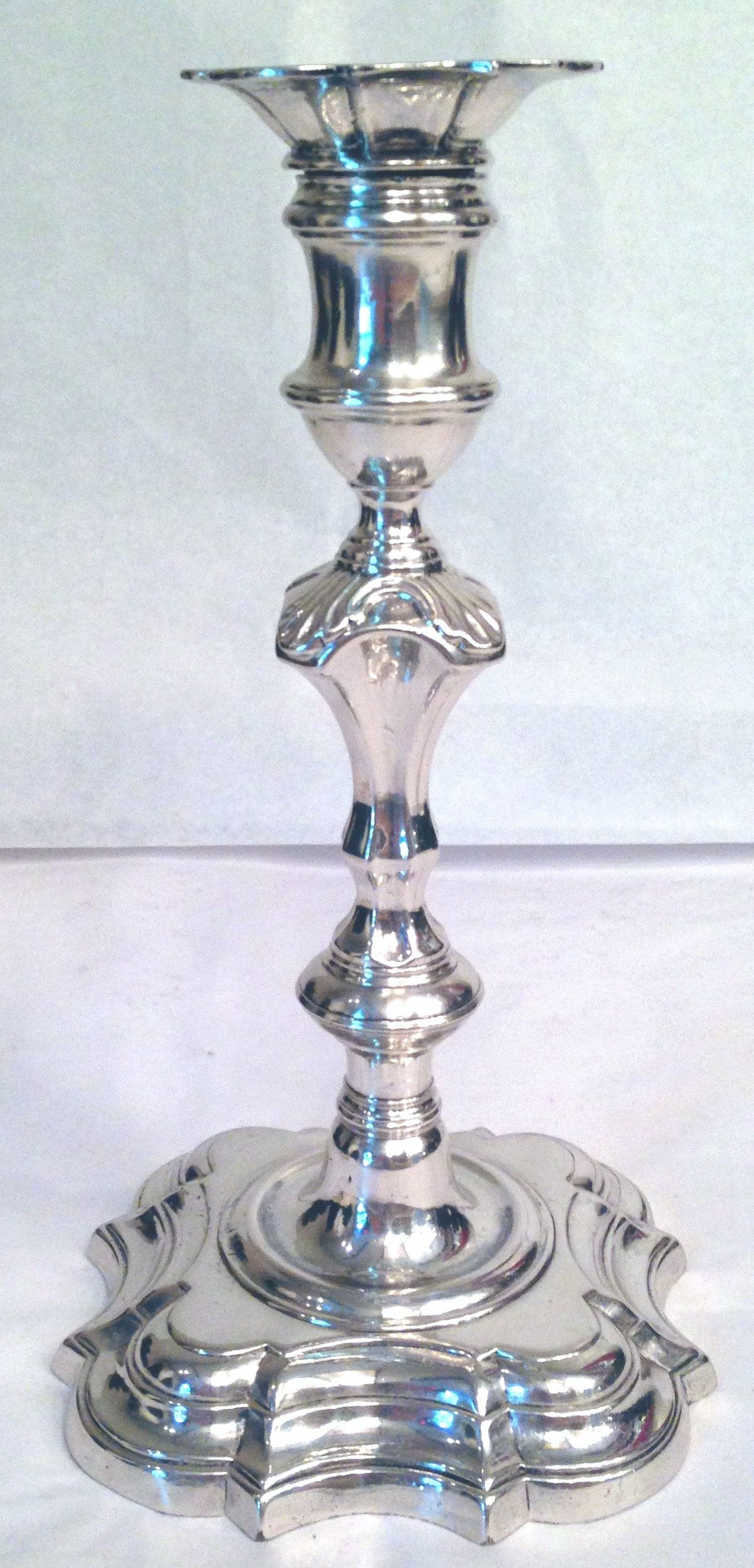
After her second husband’s death, she took charge of the company and began producing silver pieces in the fashionable Rococo style. This earned her many loyal patrons, including the Duke of Cumberland. (Skerry, 2018)
Silver candlestick by Elizabeth Godfrey, 1744Silver candlestick by Elizabeth Godfrey, 1744
Elizabeth Godfrey passed away in London around 1758. (NMWA, 2025)
Susanna Barker
Our last silversmith is Susanna Barker. Unfortunately, little information about her life exists, and only a few museums have her works. Barker was classified as a small worker, which means she produced small-scale pieces of precious metals. (The Goldsmiths’ Centre, 2025)
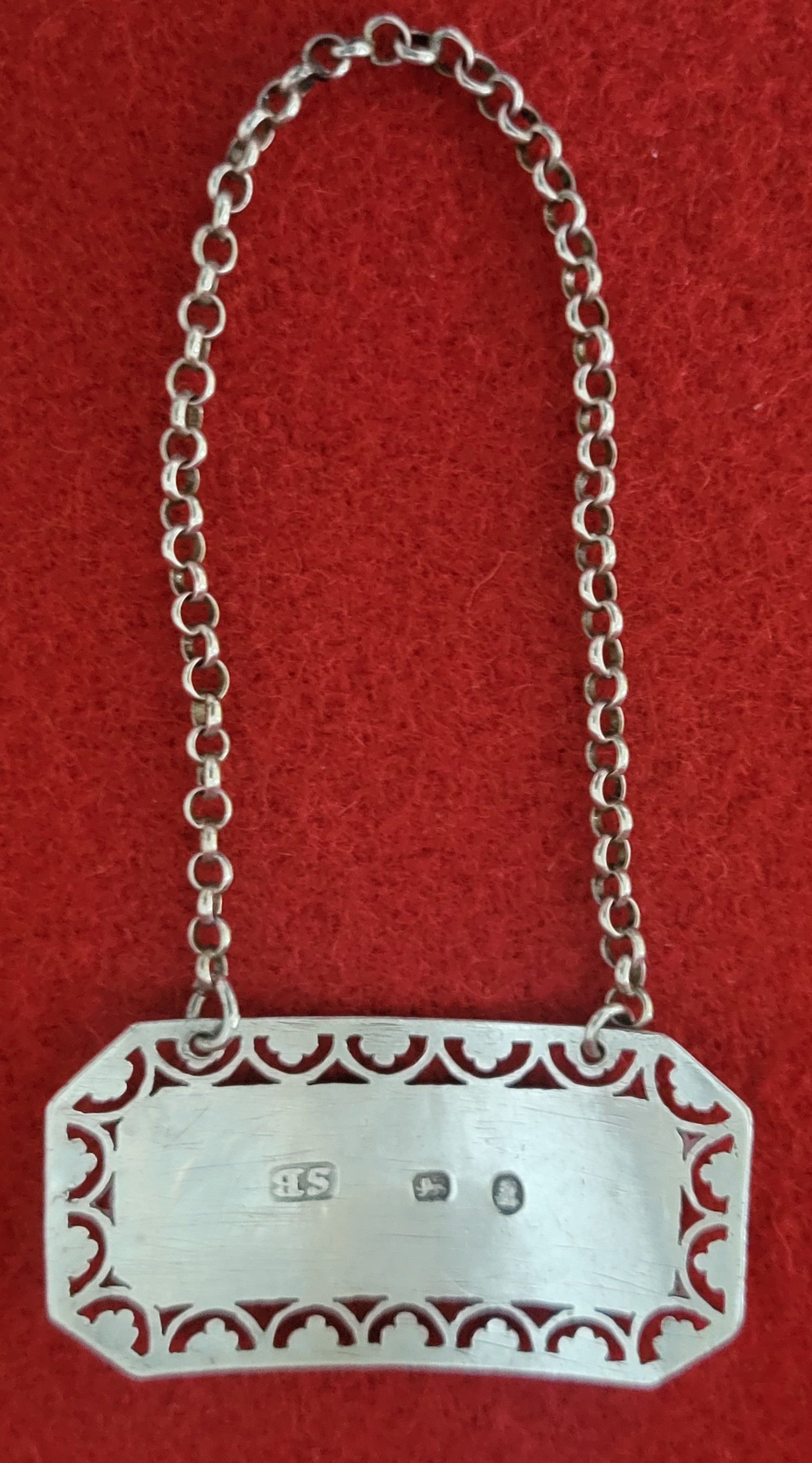
Silver bottle ticket engraved “Madeira” by Susanna Barker, 17778-1793Silver bottle ticket engraved “Madeira” by Susanna Barker, 17778-1793
She worked at 29 Gutter Lane and registered her first mark on 25 June 1778, second on 12 August 1789, and third on 26 August 1778.
Susanna Barker worked at 29 Gutter Lane. Gutter Lane was listed on Agas map of London c. 1560s was described by English historian John Stow (1598) how “fine siluer, such as was then made into foyle” was commonly known as “siluer of Guthuron’s lane”Susanna Barker worked at 29 Gutter Lane, Cheapside, London
Women’s work throughout history has sometimes been overshadowed, undervalued, or not recorded. However, with these solid silver markings, the ladies cemented themselves into the history of the arts.
Arts, N. M. (2025, January 21). Elizabeth Godfrey. Retrieved from National Museum of Women in the Arts: https://nmwa.org
Bly, J. (2008). Discovering Hallmarks on English Silver. London: Shire Publications.
Campbell, G. (2006). The Gove Encyclopedia of Decorative Arts, Volume 1. Oxford: Oxford University Press.
City Women. (2025, January 21). City Women in the 18th Century: An Outdoor Exhibition of Women Traders in Cheapside. Retrieved from City Women: https//citywomen.hist.cam.ac.uk
Skerry, J. E. (2018). Beyond the working dates: reconstructing the life and career of Elizabeth Patin Buteux Godfrey. Silver Studies. The Journal of the Silver Society, 75-88.
Figure 1: Washington’s words to the Newport congregation (George Washington Institute for Religious Freedom)
The quote, “To Bigotry, No Sanction, To Persecution No Assistance” appears in a 1790 letter written by George Washington to the Hebrew Congregation in Newport, RI (Fig 1). Of all the words Washington committed to paper, these rank amongst the most important, yet he merely adapted them from a letter sent by the Congregation itself.
By 1790, Jewish communities in the newly formed United States desired to confirm their place in society and the freedoms promised under the founding documents. Washington’s visit to Newport, RI, that year allowed direct access to a government representative for a community seeking reassurance. Their letter moved Washington, yet he was no stranger to the lives and likely concerns of the wider Jewish American community.
The Jewish Diaspora and Settlement in the Americas
For those unfamiliar with the Jewish diaspora (Def: the dispersion of a people from their original homeland, in this case, Israel, through forced or voluntary migration), the current Jewish population of the United States largely consists of Ashkenazi Jews whose ancestors settled in central and eastern Europe before immigrating to the States. While some Ashkenazim moved to the Americas during the colonial period, the majority emigrated during the late 1800s and early 1900s. Nonetheless, Jews have lived in the Americas since the 1500s, they simply belonged to another sect of the diaspora.
Sephardic Jews descend from those who settled on the Iberian Peninsula. Infamously pushed out of the region or forced to convert during the Inquisition, many initially sought refuge in Portugal (briefly), North Africa, the Ottoman Empire, and the Netherlands. As restrictions in some of these areas increased, numerous families forged proof of Christian ancestry to emigrate to Brazil and the Spanish colonies before seeking more religious freedom in British territories.
Here, those who had seemingly converted, but continued to practice as Crypto-Jews, shed their Catholic personas and openly embraced their ethnoreligious identity. Aaron Lopez (1731-1782), called the “Merchant Prince of Newport,” serves as one example (Fig 2). Born Duarte Lopez in Portugal, he moved his wife Anna and daughter Catherine to Newport, RI, in 1752, where they reclaimed their Jewish identities under the names Aaron, Abigail, and Sarah.
Several organized Jewish communities ultimately emerged in New York City, Newport, Philadelphia, Charleston, and Savannah. These areas proved ideal due to their nature as trade centers and rules, allowing more religious, political, and business freedom for non-Christians. Still, Jews lived and worked throughout the thirteen colonies as active members of the wider community, and many crossed paths with George Washington and those he knew.
Colonial Virginia
Jewish history in Virginian territory began when Joachim Gaunse, a Bohemian metallurgist, joined the Roanoke Colony in 1585. However, he escaped the fate of the Lost Colony by returning to England in 1586. A later instance of Jewish settlement occurred when Elias Legarde/o arrived in the Jamestown area in 1621. After that, small, scattered groups emerged throughout the colony, and the first Jews in the greater Fredericksburg area arrived by 1652. Nonetheless, they could not hold citizenship or public office as these statuses required oaths invoking the Christian faith.
Jewish presence in Fredericksburg and other cities meant that Washington and his associates lived and worked alongside Jewish community members all their lives. In staying active in the community, many Jewish men, including the majority mentioned in this blog, joined the Masons. Specifically, (H)ezekiel Levy appears in Fredericksburg Lodge No. 4’s records as the sole Jewish member in 1776. As Washington maintained a life membership with his mother lodge from 1752 onwards, the two men potentially knew each other (Fig. 3).
Figure 3: Masonic Lodge #4 – founded 1753, built 1816
Other Jewish residents of Fredericksburg and businessmen likely crossed paths with Fielding Lewis. The Gratz brothers of Philadelphia, Barnard, and Michael, built a business network that spread across the colonies (Fig 4). They supplied Virginian troops during the French & Indian War and set up trade in Fredericksburg by 1776, where their associate Joseph Myers handled business affairs. Henry Mitchell, a one-time friend of the Lewises, counted amongst those who did business with the Gratzes and Myers. Like their gentile counterparts, however, Jewish merchants engaged in all aspects of the economy. This included the Atlantic and domestic slave trade, from which they profited, advanced, and purchased individuals.
Figure 4: Barnard Gratz (Michael Jesselson) & Michael Gatz (Rosenbach Museum and Library)Figure 4: Barnard Gratz (Michael Jesselson) & Michael Gatz (Rosenbach Museum and Library)
As Washington’s career took off, he came into closer contact with Jewish Virginians. Jacob Myer and Michael Franks served alongside Washington in the build-up to the French & Indian War, and the latter fought at the Battle of Fort Necessity (July 3, 1754). In 1769, Washington sought the services of Williamsburg’s Dr. John de Sequeyra for his stepdaughter Patsy Custis’ epilepsy (Fig. 5). Sequeyra, a well-respected physician, arrived in Virginia in 1745, wrote about diseases found in the region and served as the first visiting physician at, and later director of, Williamsburg’s Public Hospital. While Thomas Jefferson often receives credit for popularizing tomatoes as edible, Jefferson himself credited Sequeyra.
Figure 5: Dr. John de Sequeyra (Winterthur Museum)
American Revolution
Like the colonists typically pictured during the war, the American Revolution brought turmoil to Jewish communities. The majority supported the cause of independence, with leading merchants voicing dissent from the 1765 imposition of the Stamp Act. Others remained loyal to the crown as they knew where they stood in society. Regardless of which side they chose, Jews aided their cause as soldiers, merchants, and suppliers. Still, the war brought division, death, and poverty to many families.
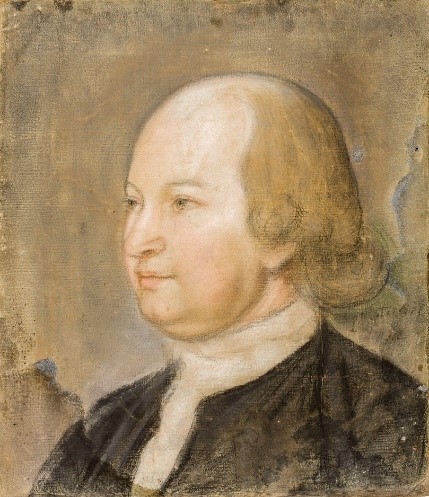
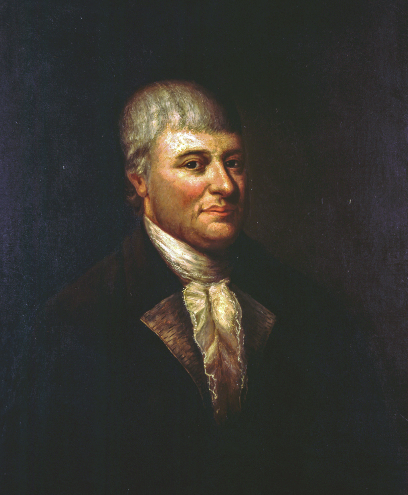
Figure 6: Issac Touro (Peabody Essex Museum) and Moses Michael Hays (Freemason Grand Lodge of Massachusetts) Figure 6: Issac Touro (Peabody Essex Museum) and Moses Michael Hays (Freemason Grand Lodge of Massachusetts)
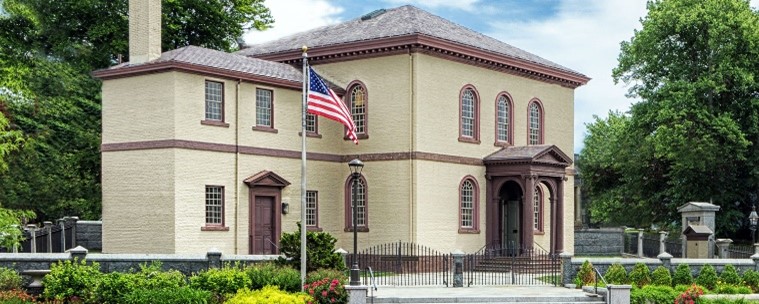
The Touro-Hays family illustrates one such division. Issac Touro, head of the Newport Congregation, remained loyal to the British while his brother-in-law, merchant-banker Moses Michael Hays, sided with the Patriots (Fig 6). Despite holding opposing views, the two men used their positions to take a stand for the larger Jewish community. In 1775, Hays refused to sign a declaration of loyalty to the patriot cause until the authors removed the phrase “upon the true faith of a Christian.” When the British occupied Newport the following year, Hays, along with most of the congregation, fled while Issac remained behind. Using his connections, Touro ensured that the British left Newport’s synagogue largely untouched. Today, it stands as the oldest surviving synagogue in North America and answers to the name “Touro Synagogue” (Fig. 7). When it became clear that the British would lose, however, Touro moved his family to the Caribbean. The two sides of the family would only reunite after 1783, when Issac died, and his widow Reyna returned from Jamaica with their children to live with her brother Michael.
Figure 7: Touro Synagogue (Touro Synagogue)
In all, approximately a third of the Jewish population served during the American Revolution from Bunker Hill to Yorktown. This included the lowest positions up to the rank of Lieutenant-Colonel, which Solomon Bush of Philadelphia held. This period additionally saw public office open to Jews, with numerous individuals serving on committees. The first known Jewish fatality of the war occurred on August 1, 1776, in South Carolina when Francis Salvador fell to the British-allied Cherokee during a skirmish. Two years prior, the colony elected him a delegate to the Provincial Congress; the highest political position held by a Jew at the time.
Many who served as merchants and financiers devoted their assets, like Fielding Lewis, to the cause. As ship owners, many outfitted privateers and helped run blockades. Haym Salomon, a Polish-born Jew from Philadelphia, served as the Continental Congress’ main financier, an agent to the French consul, paymaster for the French forces, and worked closely with Superintendent of Finance, Robert Morris (Fig. 8). Salomon committed his entire fortune to the war effort, and his most significant contribution came when he raised the funds for the Yorktown campaign at the personal request of Washington. Like many individuals, he never received reimbursement from the government and ultimately died penniless.
Figure 8: Haym Salomon (U.S. National Archives and Records Administration)
Early America
In the wake of independence, the United States faced uncharted territory. For minority groups, these uncertainties proved even more concerning. The arguments for revolution and documents written to establish the new nation spoke to religious freedom and social equality, but how far that stretched remained debatable.
In 1786, Thomas Jefferson took steps to ensure these freedoms by writing the Virginia Statute for Establishing Religious Freedom. Passed into law, the bill affirmed the right to choose one’s faith along with the separation of church and state in Virginia. Several years later, in 1789, Kahal Kadosh Beth Shalome became Virginia’s first established Jewish congregation. Jefferson’s stance on religious freedom would ultimately inspire Commodore Uriah Levy to purchase and preserve Monticello.
At this time, we return to where we started. In 1790, Washington made a trip to Rhode Island to acknowledge their ratification of the Constitution. On August 18, while Washington met officials and residents of Newport, Moses Seixas of the Jewish congregation read aloud a letter expressing gratitude to the President and government while expressing hope for tolerance and equality (Fig. 9). Its key passage reads:
“…erected by the Majesty of the People – a Government, which to bigotry gives no sanction, to persecution no assistance – but generously affording to all Liberty of conscience, and immunities of Citizenship: deeming every one, of whatever Nation, tongue, or language equal parts of the great governmental Machine…”
Figure 9: Letter from the Hebrew Congregation of Newport (Library of Congress)
In writing the letter, the congregation wished to express their hopes for the future and receive assurance from their head of state that this future existed. On August 21, Washington replied to the letter thanking them for the “cordial welcome [he] experienced…from all…citizens” while reflecting on the difficulties of the past and how the future promised security. Then, using the congregation’s own words, he wrote that:
“It is now no more that toleration is spoken of as if it were the indulgence of one class of people…for, happily, the Government of the United States…gives to bigotry no sanction, to persecution no assistance…”
Washington closed his letter by wishing that “every one shall sit in safety under his own vine and fig tree and there shall be none to make him afraid.” The following year saw the ratification of the Bill of Rights, which further solidified religious freedom and equality.
Despite efforts made during the founding era and successive periods, antisemitism has never gone away. Now, more than ever, we must work to uphold that the wishes, freedom, and security of those who served the United States since its founding.
There once stood a large horse chestnut tree on the corner of Fauquier and Charles Street in Fredericksburg. It was noted as one of the thirteen legendary Washington horse chestnut trees planted by George himself. By the 1930s, it was becoming clear that the tree needed some help, so the Daughters of the American Revolution (DAR) took up the cause to protect this historic tree.
Washington’s Horse Chestnut TreeGroup of ladies and small child posing in front of horse chestnut tree, ca. 1930s
The tree legend states that George, while visiting his mother in June 1788 in Fredericksburg, decided to plant thirteen horse chestnut trees from her house to his sister’s house, Kenmore, just a few blocks away. This provided a scenic path for his mother when she visited her daughter Betty. These trees commemorated the thirteen original states.
Mary Washington’s House, c. 1930sAmerica’s Historic Horse-Chestnut TreeMap showing the distance between Mary Washington’s house and Kenmore…following the potential path of the horse chestnut trees.
It is a great story. It is patriotic and nostalgic, showing George as a man of the earth with his love of trees, gardening, and horticulture. He planted these trees for a future America to remember the struggles to create this country and the precious nature of our land that we must protect. But is it true? Did George plant that tree? What is the evidence?
The horse chestnut tree is a native of the Balkans region (Albania, Bulgaria, Greece, and Northern Macedonia). It made its way to Europe and England during the seventeenth century, noted as growing in South Lambeth, London, and being planted by Sir Christopher Wren at Hampton Court.
Horse chestnut trees Bush Park, Hampton Court, England planted by Christopher Wren in 1669-1670.
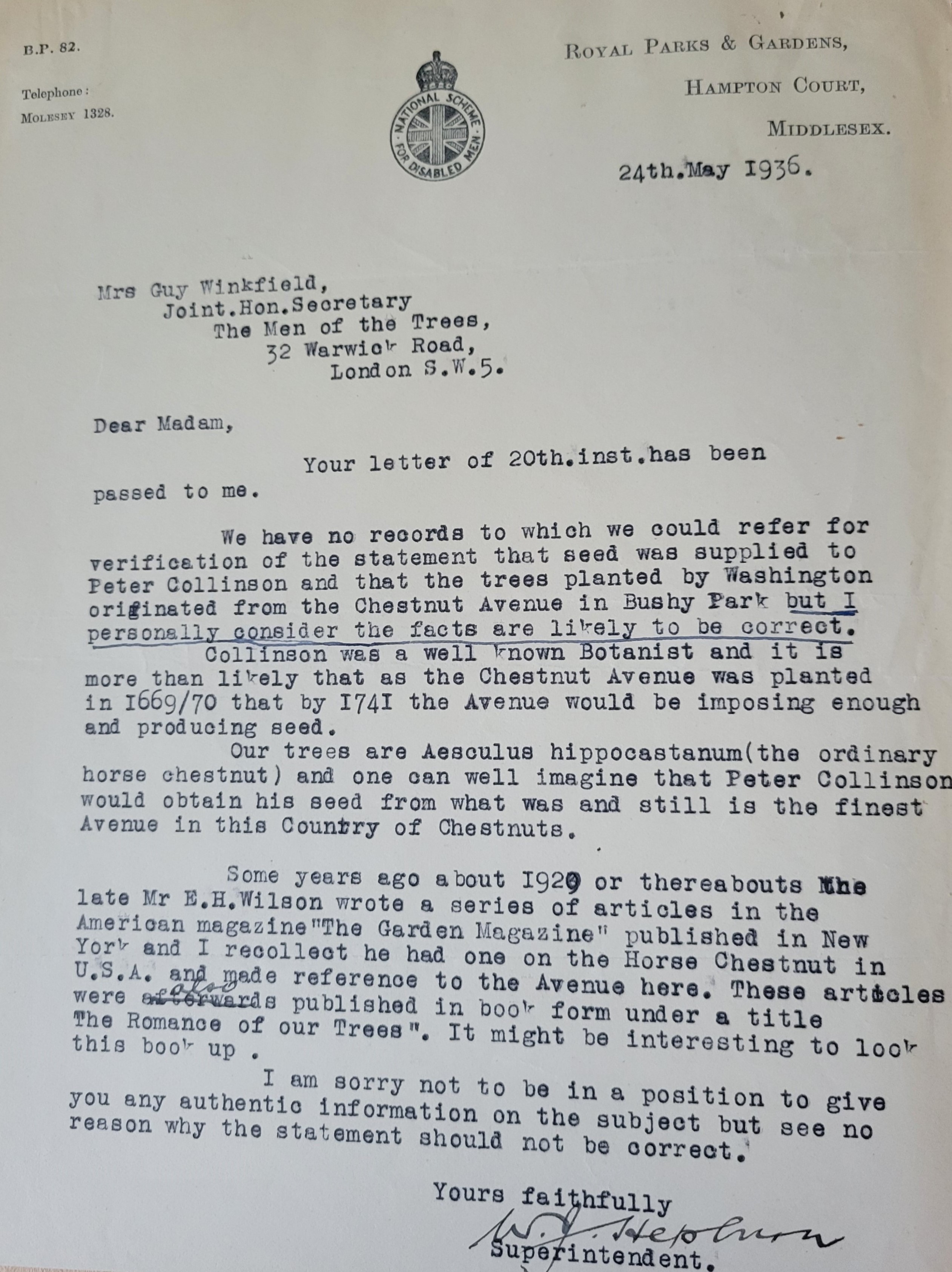
There is documented evidence of some horse chestnut trees crossing the Atlantic to Mr. John Bartram, one of America’s first botanists in the 1740s. In a letter from Peter Collinson, an English botanist, dated September 16, 1741, he wrote to Bartram, “I have sent some Horse-Chestnuts which are ripe earlier than usual; hope they will come fit for planting.”. Bartram acknowledged receiving them and stated that most were blue-molded, and only one germinated and grew. Over twenty years later, Bartram updated Callison on the success of the lone seedling, writing, “But what delights me is that our horse chestnut has flowered. I think it must excel in America.”
Letter from Royal Parks and Gardens, Hampton Court, May 24 1936
Bartram’s Gardens in Philadelphia was quite popular and visited by many founding fathers while working there. George visited the gardens twice in the summer of 1787 while in the town during the Constitutional Convention, noting, “Sunday, June 10, 1787, breakfasted at Mr. Powell’s and in company with him rid to see the Botanical Gardens of Mr. Bartram, which, though stored with many curious plants, shrubs, and trees, many of which are exotics, was not laid off with much taste, nor was it large.”
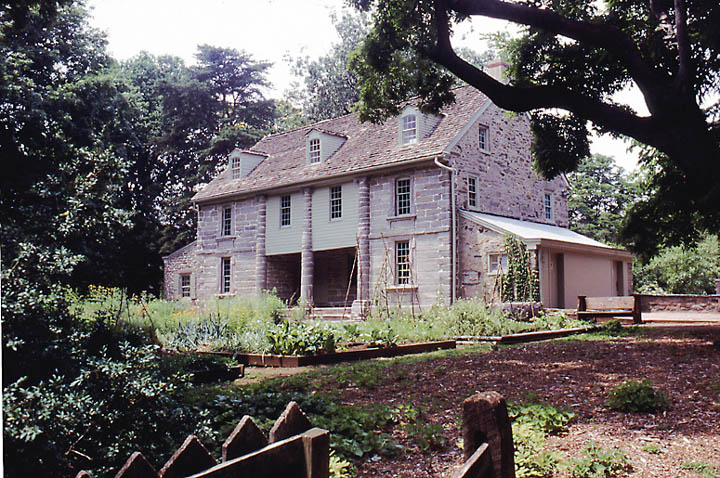
John Bartram’s house and upper garden at Bartram’s Garden
Why mention this? In some versions of the story, Washington got his horse chestnut trees from this garden, but there is no evidence that the legendary trees were obtained from this famous historic garden. George only made two diary entries about horse chestnut trees on April 13, 1785, writing, “Received from Col. Henry Lee of Westmoreland 12 horse chestnut trees (small) and an equal number of tree boxes. They appeared to have been some time out of the ground. Planted 4 of the Chestnuts on my serpentine walk – two on the east end and the rest in the vineyard.” And again, on April 2, 1788, wrote, “Transplanted from a box in the garden, thirteen plants of the horse chestnut into shrubberies by the garden walls.”
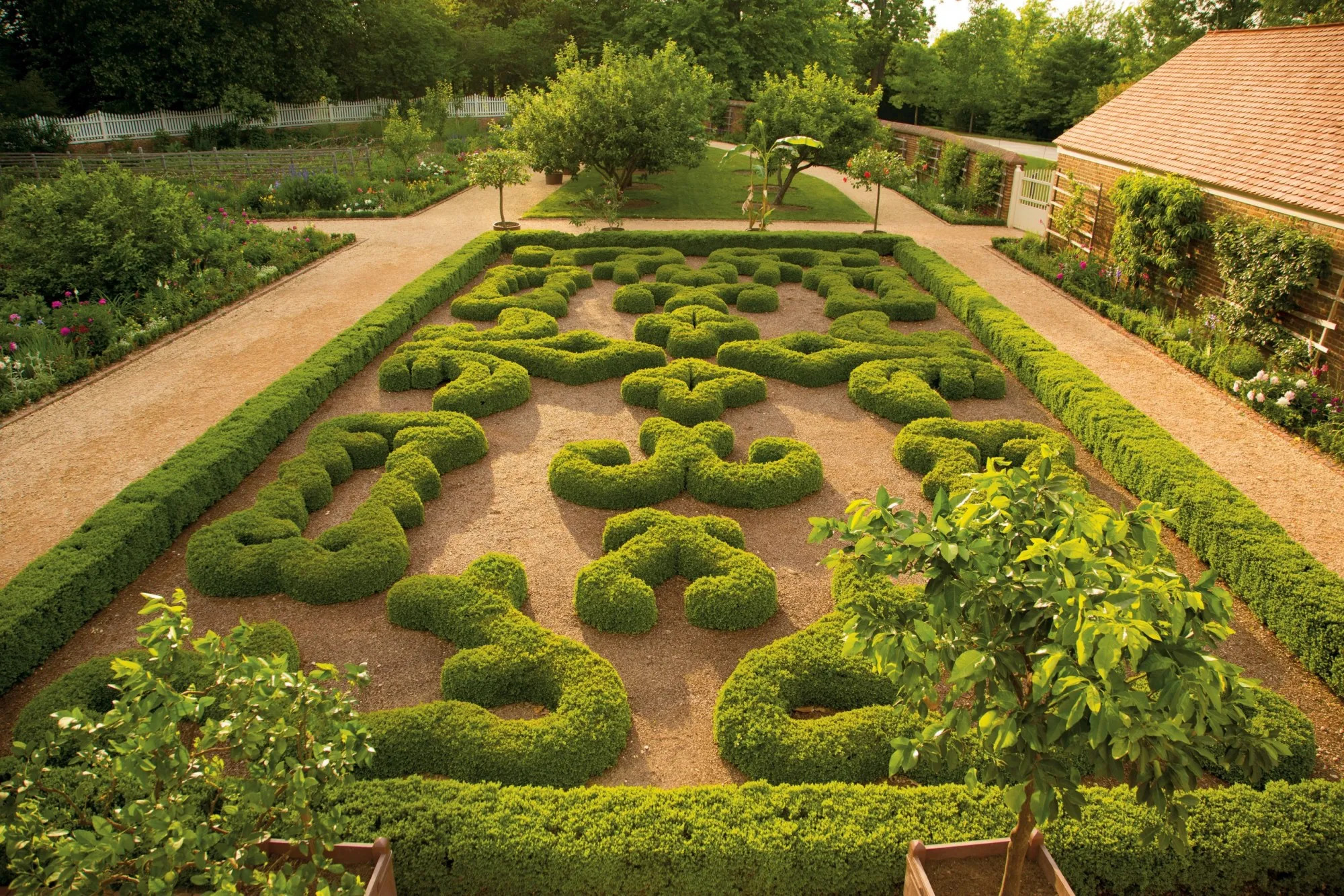
Fruit Garden and nursery at Mount VernonSmall botanical garden at Mount VernonUpper garden at Mount Vernon
The entry shows evidence of planting the famous Washington trees, right? No, because George was at Mount Vernon in April and didn’t leave for Fredericksburg to visit his mother until June 10, 1788.
But could he have had them sent down and have them planted before he came to see his mother? Yes, but the story says that George planted these trees with his own hand. Additionally, it would be odd for George to mention planting the trees while in residence at Mount Vernon and not say that they were in his mother’s garden in Fredericksburg. Washington was a diligent diarist but never mentioned planting thirteen horse chestnut trees in his mother’s garden.
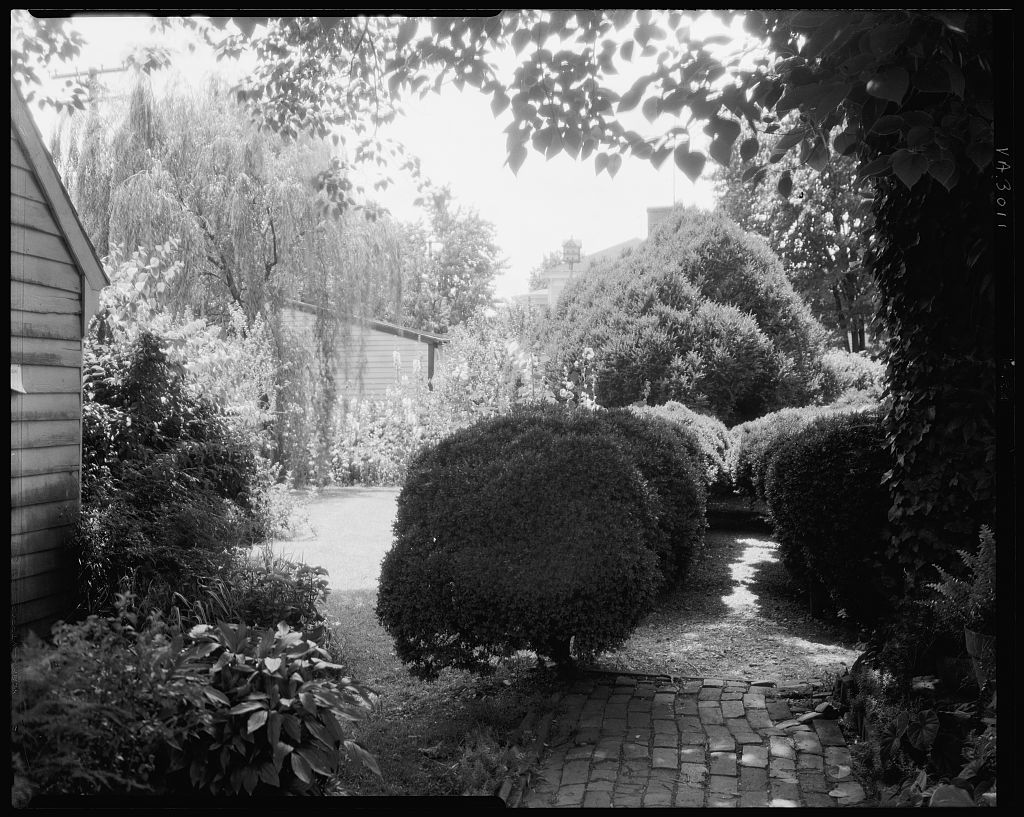
Mary Washington’s house gardens, Fredericksburg.
Further, no known letters from George, Mary, or Betty mention any horse chestnut trees between Mary’s gardens and Betty’s Kenmore.
Spring time in the gardens at Kenmore Plantation (can you spot the cat?)
This was all the primary source evidence I could find relating to George and any horse chestnut trees. So, I looked further into the story to see what other evidence was being used to verify that this tree was indeed one of the thirteen Washington trees.
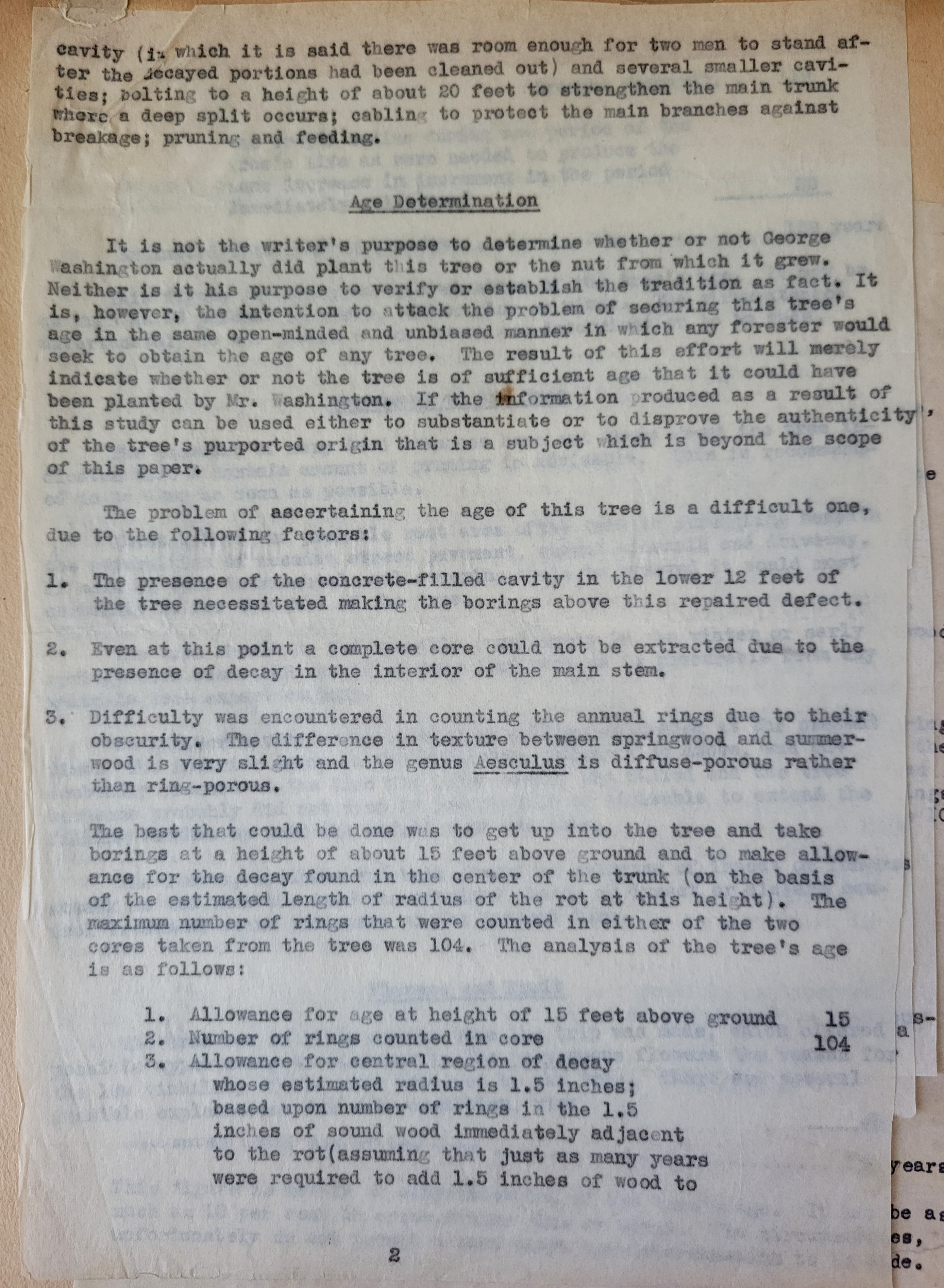
As I said in the beginning, by the 1930s, many, including the DAR, were trying hard to save this lone surviving chestnut tree. With their extensive reach, they got Fred H. Arnold, the Assistant Forester for the National Park Service, to do an age-determination test on the tree in May of 1934. Mr. Arnold noted some issues with the test, stating that the lower twelve feet of the tree was filled with concrete, so the coring sample had to be taken above this “repaired defect”. Even then, a complete coring sample could not be extracted due to decay in the interior of the main stem. Additionally, Mr. Arnold said that it was very difficult to count the annual rings due to their obscurity because the texture difference between the springwood and summerwood for the horse chestnut tree (genus Aesculus) is very slight. Taking into account all this, Mr. Arnold estimated the tree to be around 139 years old with as much as 10% in error, either plus or minus, which would put the date it was planted somewhere between 1781 and 1809, which means that the tree is indeed old and could have been planted during Washington’s time in Fredericksburg.
Age Determination, May 6 1934
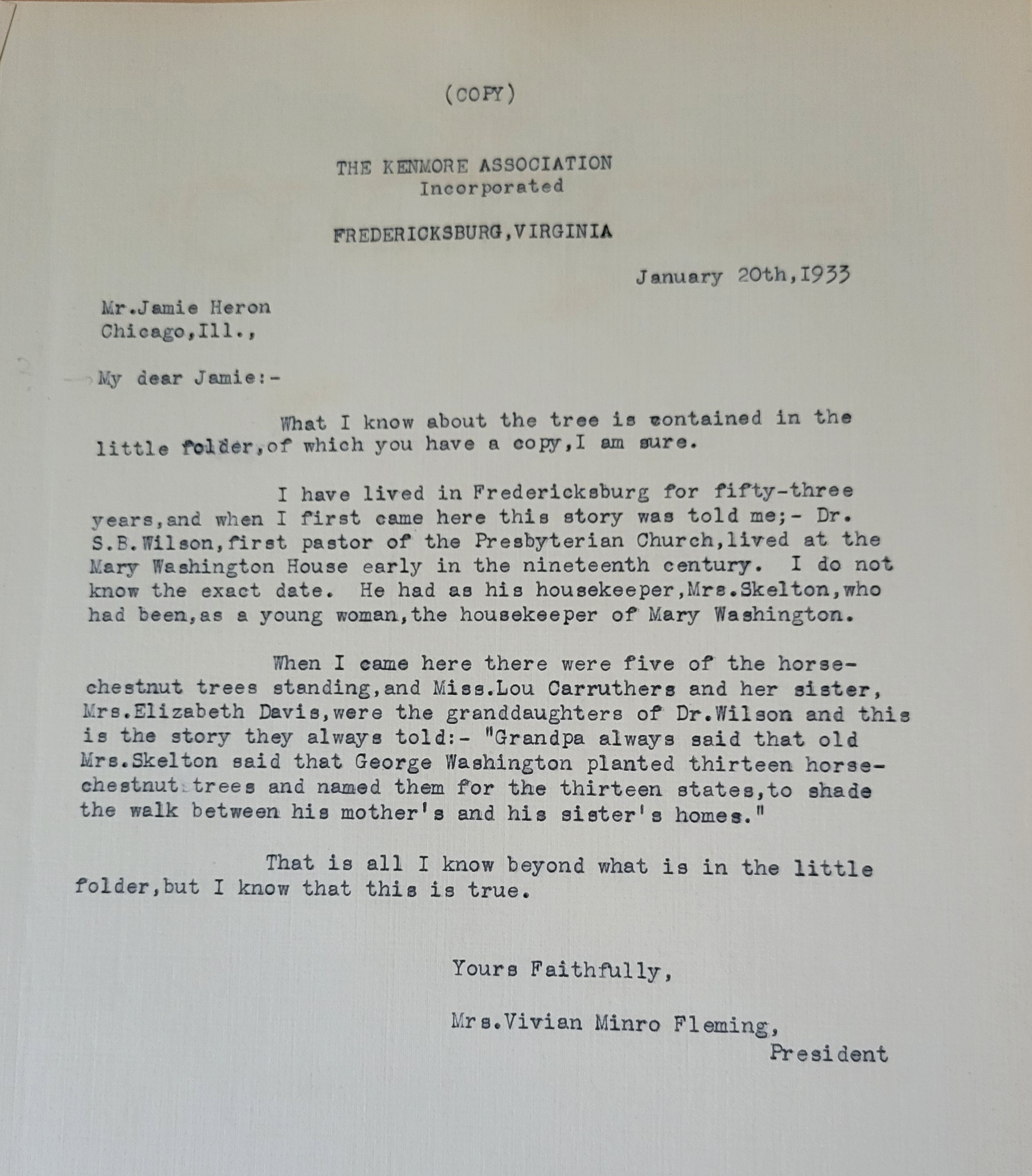
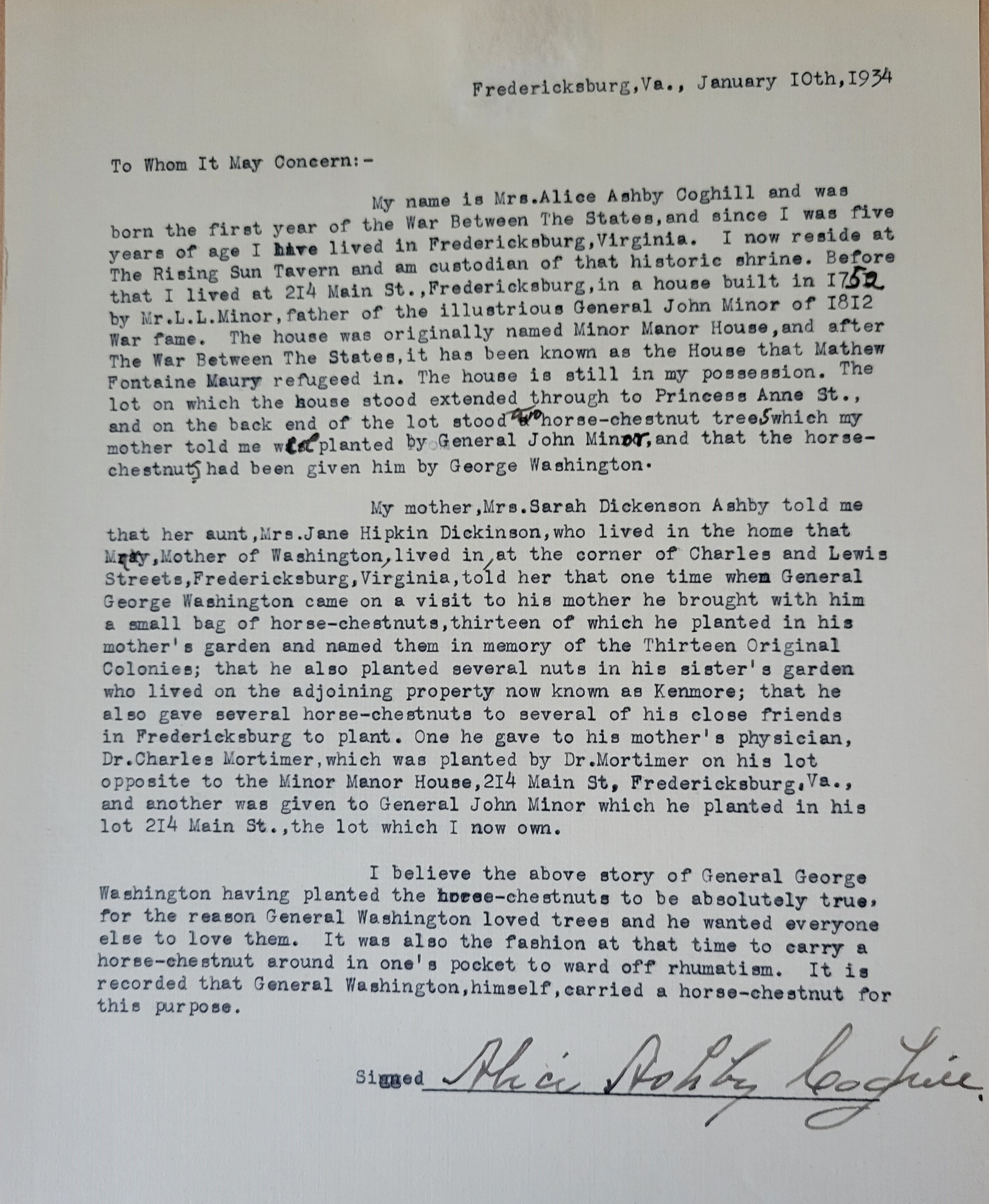
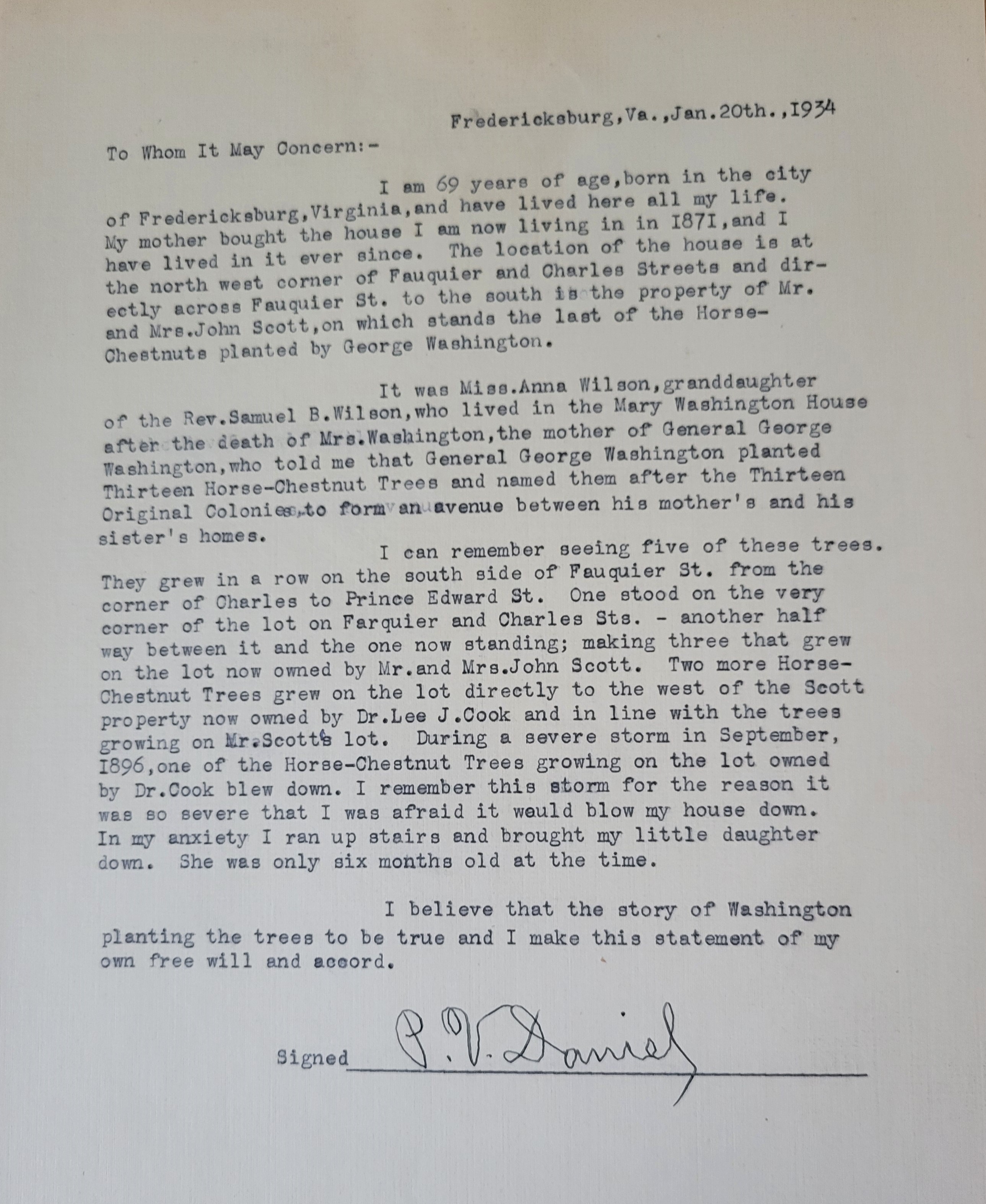
Lastly, local historian James Henry Heron collected local citizens’ recollections of the tree and the story. Mrs. Lilias Hamilton Scott, the wife of Mr. John Scott, who owned the lot on which the tree stands, wrote that her grandmother (Mrs. Janet Scott Hamilton) stated her great-grandmother (Mrs. Francis Scott) resided in Fredericksburg in 1788 and was Mary Washington’s neighbor and intimate friend. She said the trees were planted by Washington.
Letter from Mrs. Lilias Hamilton Scott, January 10 1934Letter from Mrs. Vivian (Emily) Fleming Smith, January 20 1933Letter from Mrs. Alice Ashby Coghill, January 10 1934Letter from PV Daniel, January 1- 1934
Mrs. Vivian Minor Fleming traces the story back to Miss Lou Carruthers, her sister Mrs. Davis, and their grandfather Rev. S.B. Wilson’s housekeeper, Mrs. Polly Skelton, who had previously been a housekeeper for Mary. Mr. P.V. Daniel, who remembers five of the original thirteen trees, lived across the street from the remaining one for over sixty years and said Miss Anna Wilson, granddaughter of Rev. S.B. Wilson, told him the story. Mrs. Alice Ashby Coghill says her aunt, Mrs. James Hipkin Dickinson, who lived at Mary Washington House after Rev. S.B. Wilson said Washington planted the trees and passed out horse chestnuts to friends. While I have no doubt these people are truthful in their recollections, they do not offer any definite evidence. They merely document that the legend was a well-known story but not that it was true.
Regardless, the much-loved old tree was rightfully given proper emergency care with a donation and service from Senator Martin L. Davey from Ohio and The Davey Tree Expert Company. The famous tree lived happily for over another half century before being taken down in 2004.
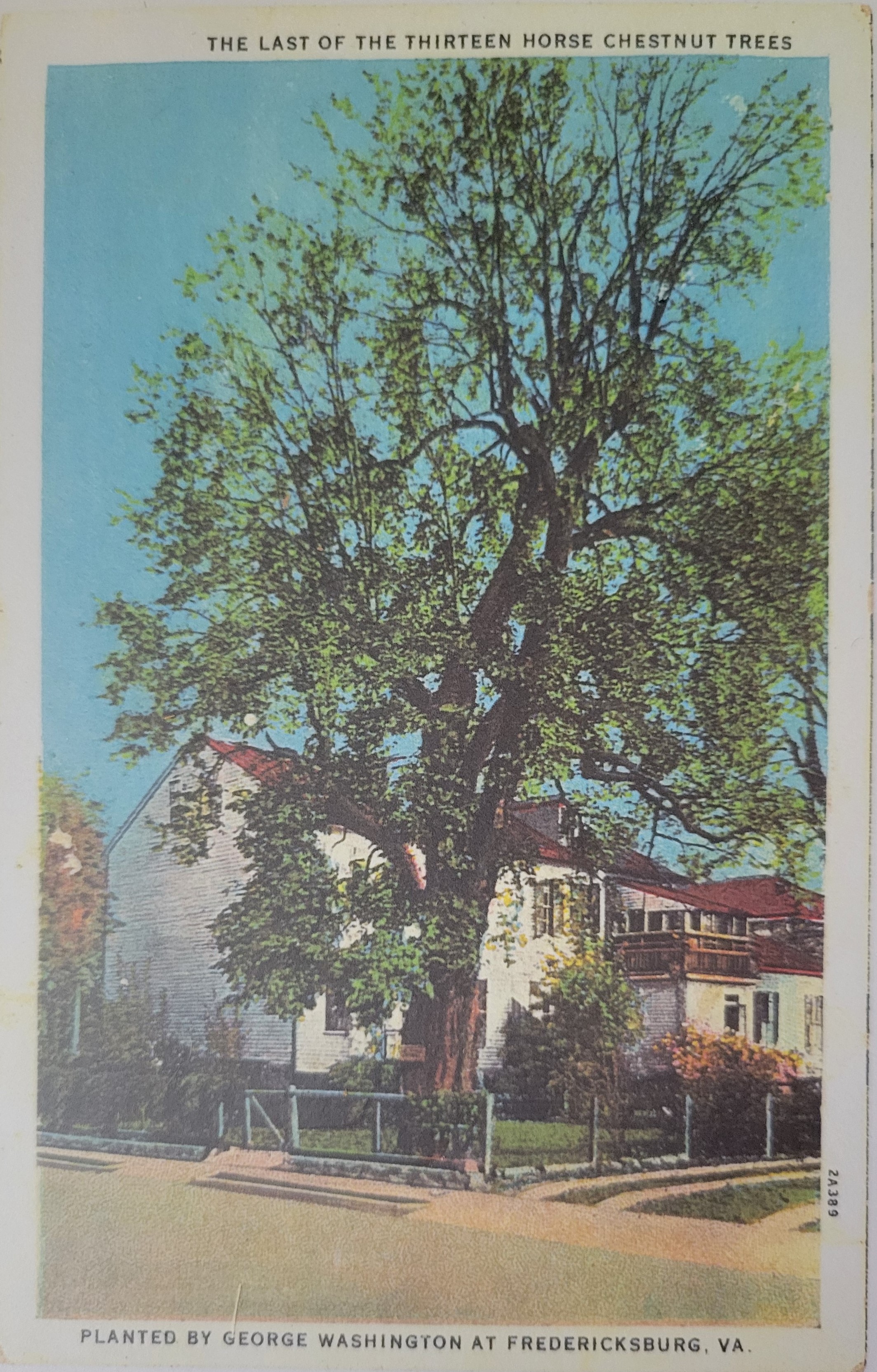
The Last of the Thirteen Horse Chestnut Trees postcard, ca. 1930sWashington’s horse chestnut tree being removed, 2004
Whether this tree was planted by George along with twelve others will probably never be conclusively proven. Were the people wrong to save the tree all those years ago without better evidence? Absolutely not. They saved a beautiful 200-year-old horse chestnut tree with a legendary attachment to George Washington, but they also saved a bit of their own past, nostalgia, and pride in their own town’s history.
While the house at Historic Kenmore has been faithfully restored to its circa 1775 appearance, the road to that final result was a pretty dirty one. As in plaster dust, paint fumes, and all manner of dirt and debris. Back in the late 1980s and early 1990s, the first forays into the research for and the subsequent writing of a Historic Structure Report (HSR) took place. This project entailed a number of architectural historians selectively pulling up floorboards and peeking behind plaster walls to more fully understand how the house was originally built, its current condition, and its history of change over time. This important document provided us with a clear understanding of Kenmore’s architectural history, was the guiding document for a decade-long restoration of the structure, and also gave us a collection of architectural fragments and individual artifact finds that continue to help us understand the material world of those who lived and labored at Kenmore through the centuries.
In a past blog post, we learned a bit about rats as collectors and examined a rat’s nest that was discovered during that HSR investigative period. If you haven’t looked at the video of the unpacking of that nest, here it is. (In that nest, there were assorted papers, fibers, and other fluffy goodies dating to around the turn of the 20th century.) But the nest wasn’t the only thing uncovered during that HSR peeking and prodding process.
Enter the “Above Ground Archaeology” or “Interior Archaeology” collection. These eclectic artifacts were carefully collected, numbered according to their context or find location, bagged, documented on a list, and lovingly packed away in our ubiquitous Hollinger boxes. Over the years, some of the artifacts were pulled by curators for exhibition in the Kenmore galleries, but most were stowed away in their boxes for long-term preservation and research purposes.
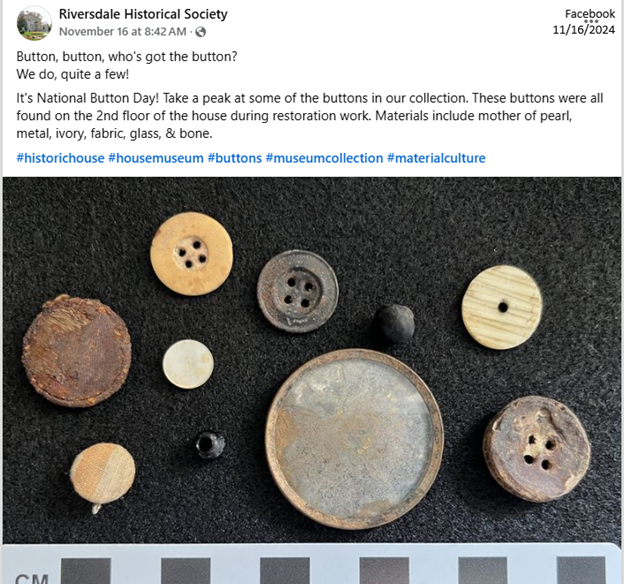
The use of found objects in historic structures to help illuminate the material world of the building’s residents and workers is not a revolutionary concept. Colonial Williamsburg, for instance, in their recent restoration of the historic Bray School, removed modern plaster walls, revealing not only structural information but also artifacts: “We are collecting building fragments and objects found in the walls…These items shed light on the building’s original finishes and various inhabitants since 1760.” Riversdale Historical Society has been showcasing some of their “found” artifacts on Facebook — most recently posting a set of buttons for National Button Day.
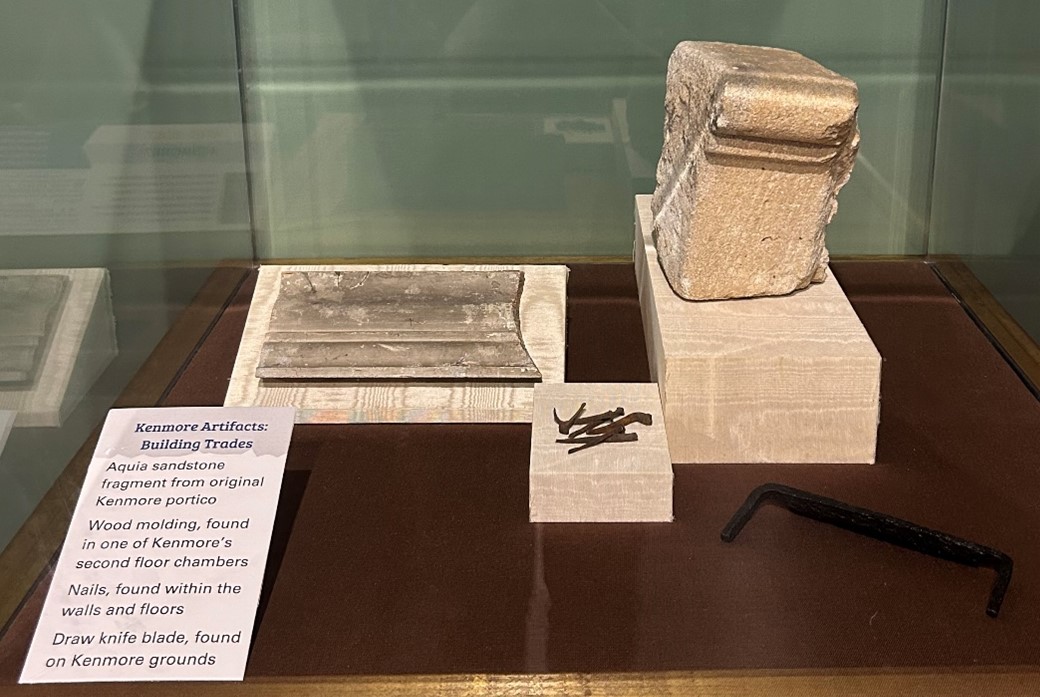
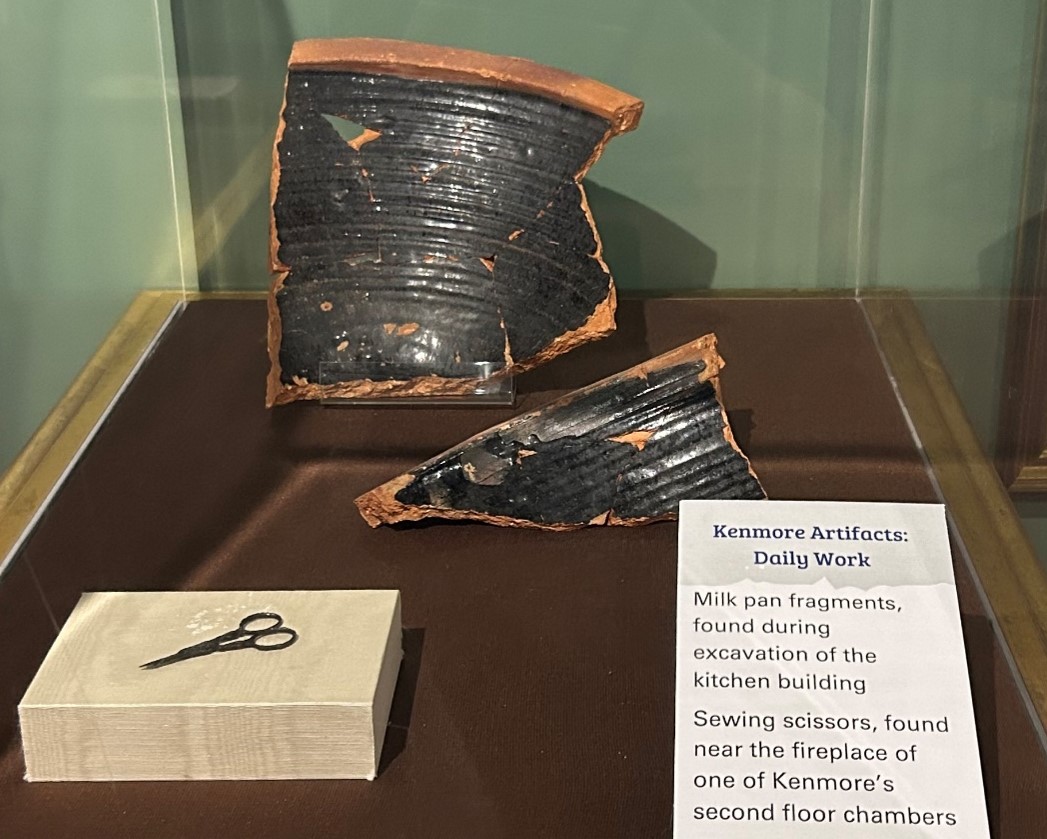
Recently, we pulled a few of Kenmore’s artifacts into exhibit cases in our refreshed orientation exhibit in the Bissell Gallery of the Crowninshield Education Center at Historic Kenmore. Together with in-ground archaeology, these exhibit cases help us illustrate the built environment and the wares known and used at the site.
Case in the orientation exhibit at Historic Kenmore – including molding fragments and nails found during the HSR investigationsCase in the orientation exhibit at Historic Kenmore – including the tiny (sewing) scissors found near one of the second-floor fireplaces.
In 2010, then Intern Ashley Dean (University of Mary Washington) was tasked with inventorying the three boxes of artifacts, and for that, we are extremely grateful. What resulted from that inventory project was a 12-page list of artifacts that formed the center of this rejuvenated research initiative. The artifacts in these boxes range from architectural elements (plaster fragments, nails, wallpaper bits) to broken household goods (bottle glass, ceramic pieces) to whole objects (beads and a pair of sewing scissors). When first bagged and numbered, these artifacts were recorded by location context—based on the mapping system then being used in the architectural investigations of the house, with room numbers ranging from B001 in the cellar (or basement level) to 301 being the attic (or 3rd floor) of the house.
Attic (Room 301) mapping
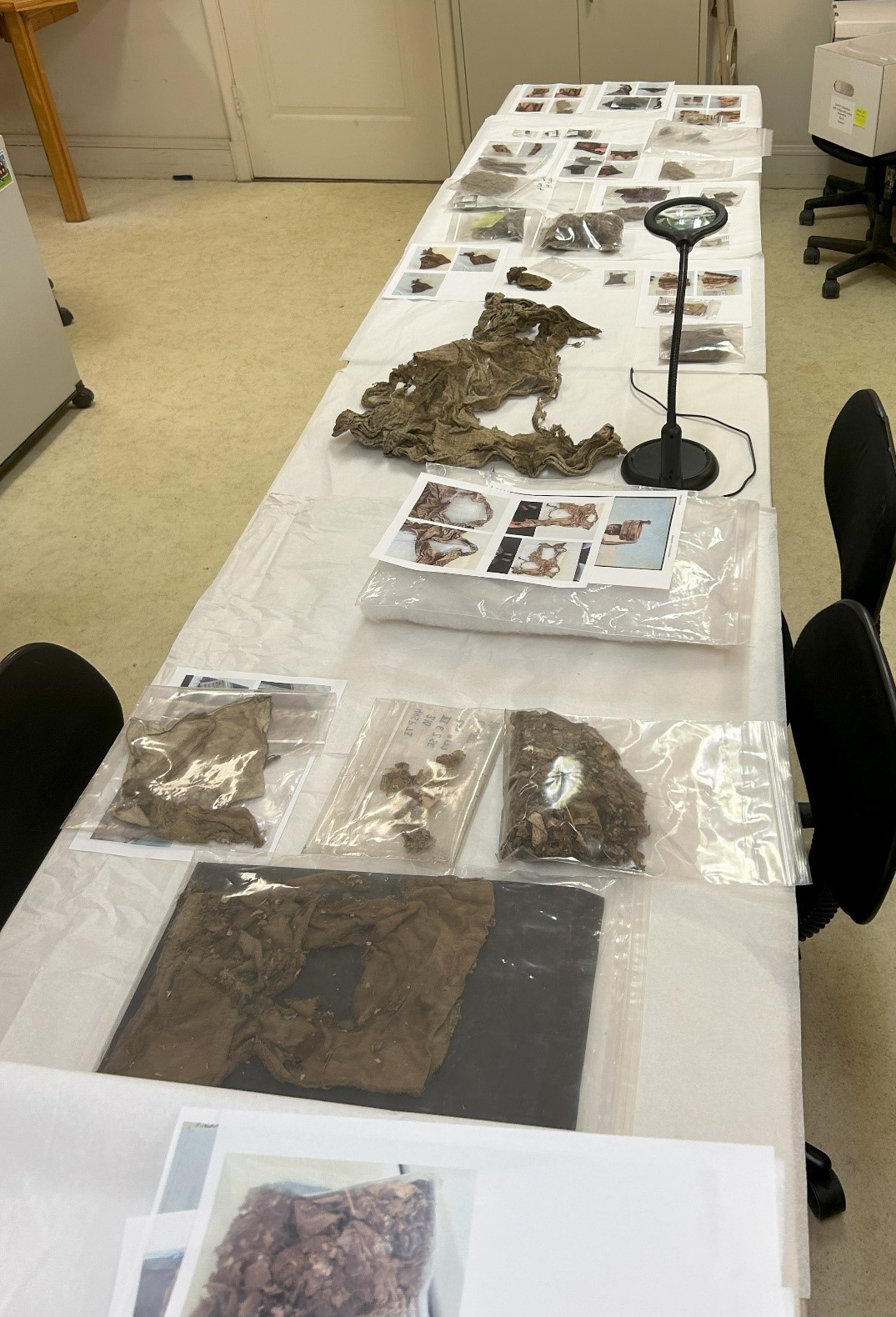
Fast forward to 2024, the artifacts were again reviewed, and the idea blossomed to plan a textile assessment of all the small scraps of fabrics that had been collected. According to our in-house review, we could tell that they dated to a variety of periods and ranged in their likely original use, from costumes to household linens.
Selection of textile fragments in the Kenmore Above Ground Archaeology collection (July 2024)
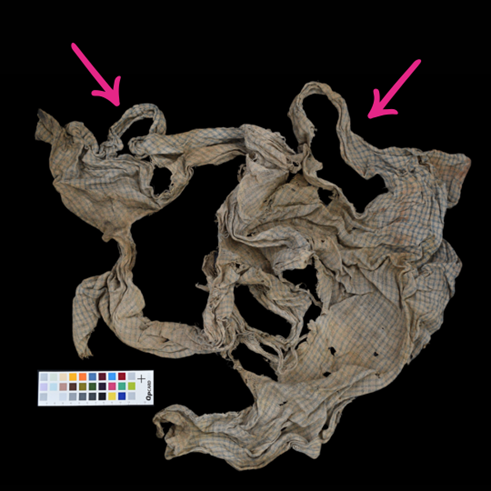
One particularly large artifact proved the most intriguing — a pile of blue and white check fabric. The indeterminate ball of checked fabric piqued the interest of staff and now serves as the starting point for a multi-year conservation assessment and interpretation project. A few months after our in-house assessment, we hosted a textile conservator who conducted a baseline review of the textile fragments and more fully examined the artifact for potential treatment. She had a rapt audience that morning!
Textile fragments in the archaeology lab, awaiting the arrival of the textile conservatorTextile conservator Colleen Callahan examining what we had determined to be a child’s full apron or pinafore
And just a few weeks ago, the textile artifact, which looks to be a full child’s apron or pinafore, was transported to the conservation lab for treatment and further research.
Check fabric before conservation. Armholes visible along upper portion.
The found artifacts from Historic Kenmore have not yet been able to fully share their stories. We look forward to beginning to delve more into their manufacture, use, and re-use by the generations of people who wore them, worked with them, saved them, hid them, and otherwise interacted with the artifacts and the spaces in which they were found.
A lot of people have told me that they want or wanted to become archaeologists. I always find this flattering. Yours truly was only in my single digits when I declared the same to my family and anyone who would listen. After reading every National Geographic magazine I could get my hands on, ‘excavating’ abandoned houses and bottle dumps on or near the property where I grew up, and too many years of schooling than I am willing to admit…. here I am today. I am an archaeologist of 25 years. That being said, it is not an easy profession to get into. To wedge your way into this field, it is recommended you have an obsession with learning, stubbornness equal to a Black Friday shopper outside a Target in 20-degree temperatures at 3 am the night before, a hefty amount of luck, the willingness to obsess over dead people’s broken garbage, and just to be sure it would help if you’re at least a little bit mad.
Happy archeologists!
Now, I am an archaeology lab manager in our museum, which means I enjoy the comfort of climate control, access to bathrooms, an office, and a place to store my breakfasts and lunches. But, like most archaeologists, I had to cut my teeth in the field (digging outside), which lacked all the above amenities. This is where many archaeologists figure out if they genuinely want to go through with the folly they have embarked upon. Many decide they do not and switch majors. Good for them; they likely make more money than most archaeologists. But could it really be that bad? Isn’t it fun finding cool stuff? Yes, of course. But here are all the obstacles those noble field archaeologists face daily:
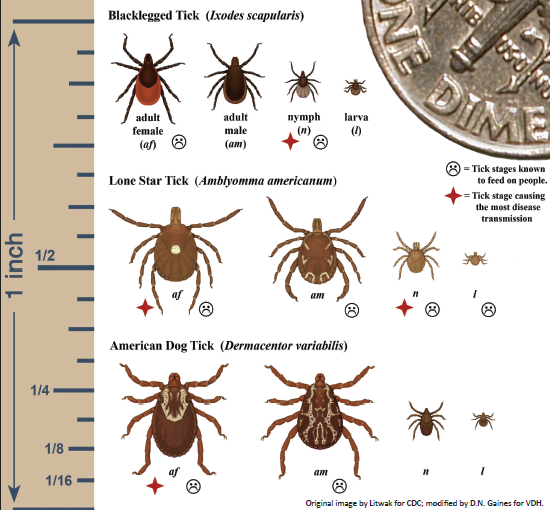
Bugs. Lots of them. Bugs have taken down many of my brave colleagues. Forget the snakes (Unlike Indiana Jones, most of us like snakes) and spiders. I am talking about chiggers and ticks. No one gets just one chigger bite. They hang out in gangs of hundreds, and you will not know they have bitten you until they have had their fill of your yummy body juices and peace-ed out. Hours later, you’ll notice around your ankles and waistband the unbelievable itching of dozens of bites that will haunt you for weeks. Ticks are worse. Way worse. Ticks carry diseases that can be very serious, including Lyme and Rocky Mountain Spotted Fever, both of which should be avoided at all costs. Don’t forget bees, hornets, and wasps. No archaeologist worth their salt is without a harrowing tale of valiantly battling or running the heck away from a swam of ticked-off single-minded, murderous, flying, stingy wingy thingies.
Ticks of VirginiaLyme Disease symptoms
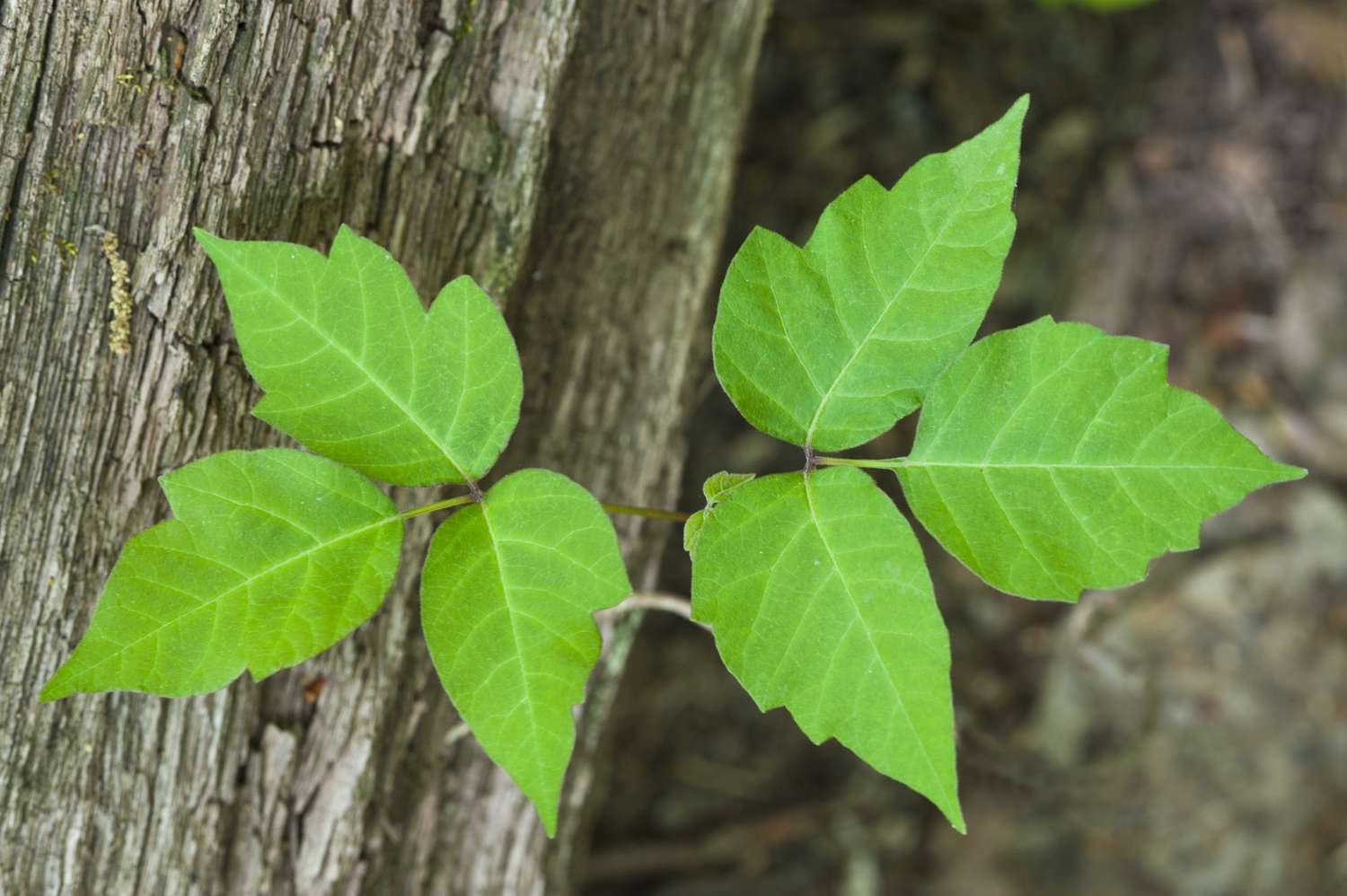
Plants that will make you wish you were never born. Let’s start with some annoying and inconvenient but not diabolical plants: Those with thorns. After being told by your crew chief that you need to hack your way through a six-foot-tall thicket of blackberries, multiflora rose, devil’s walking sticks (Yep, that’s a thing), cacti, or thistles in order to dig one tiny shovel test pit you WILL begin to question your life’s choices. However, for those who are allergic to poison ivy, oak, and/or sumac (and it’s most of us), your field career will be a constant battle where your enemy has highly transmittable and very toxic poison juices in every single part of them (even the roots) while you are armed with a bottle of calamine lotion. Those field archaeologists who do not get poison ivy will make fun of you and flaunt their superpowers, but just remember they’ll get theirs because the more you’re exposed to these plants, the more likely you are to feel their wrath.
Poison IvyPoison SumacDevil’s Walking Stick
Ancient Curses. No, you should NOT read that inscription on the 3,000-year-old tablet found in that tomb with all the warnings engraved on the entrance. If I had a nickel every time I had to tell a member of my crew to drop that darn ancient idol that’s started to glow red inside and run, I’d be able to pay off my student debts. Just kidding, that will never happen.
Unbroken seal of King Tut’s tomb…maybe just leave it.
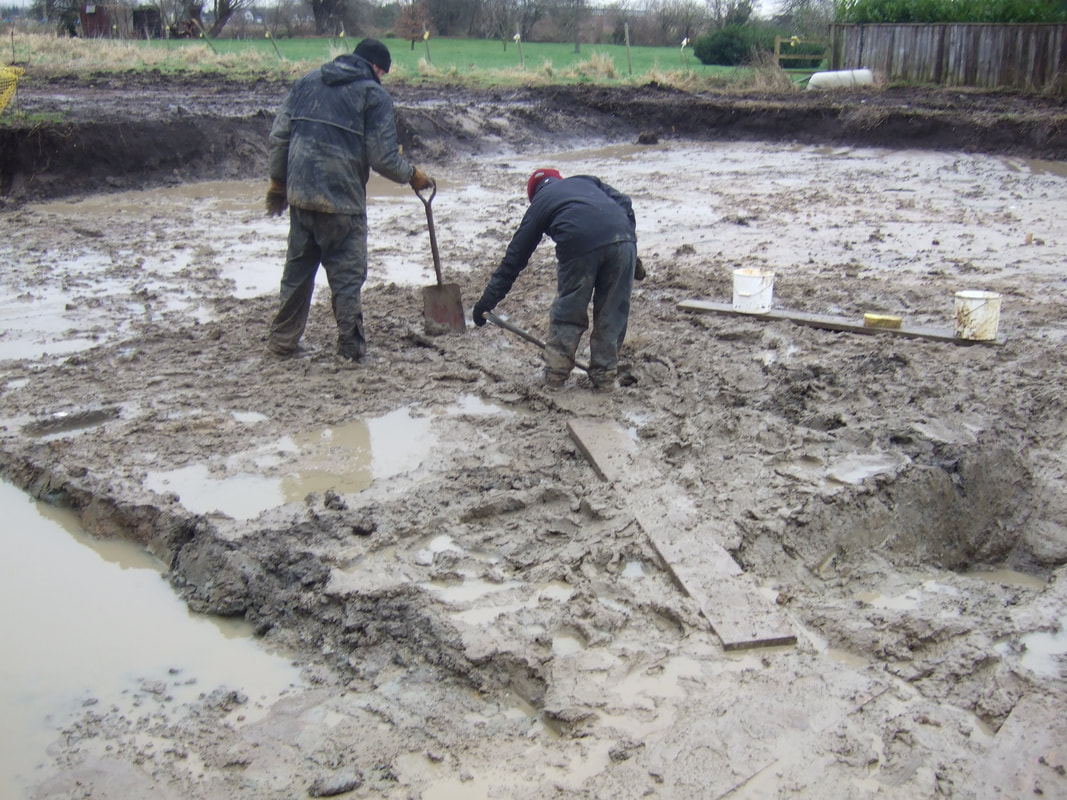
This one is very serious and should never be taken lightly by anyone working outdoors because they take anyone by surprise just like that. Dehydration, heat stroke/exhaustion, sunburn, and frostbite. Field archeologists must dig in almost all conditions and all seasons. They are wind-worn and road-weary, and you should not mess with anyone who can dig dozens of holes a day in temperatures above 100 or below freezing.
Virginia can get very hot and humid in the summer, stay hydrated.Glacial archaeology at Ötzi in 1991 Sometimes it miserably wet (particularly in England)
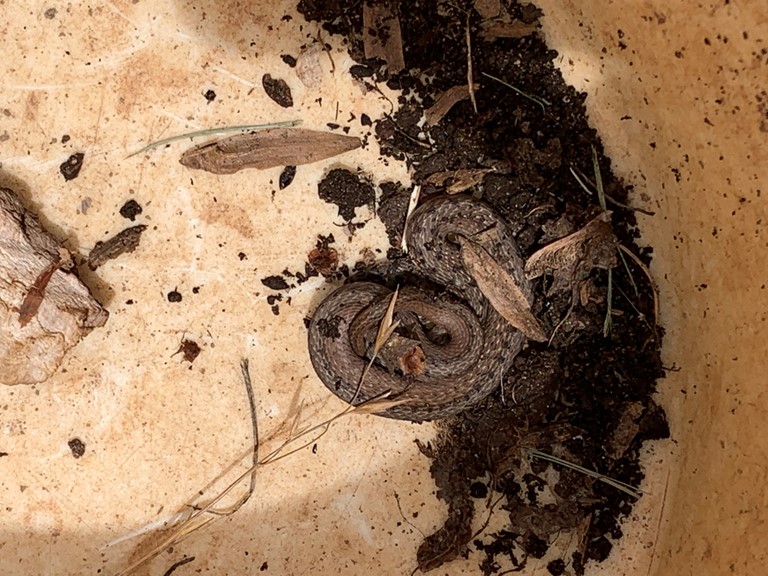
Animals. I’m not talking just about the wild ones. I’ve only ever seen a bear in the woods once, just a few harmless snakes and maybe a couple of bucks that gave me the side eye. But I have had years knocked off my life by pheasants or tiny fawns exploding out of the brush a foot away from me. For the most part, pets are not an issue, and petting a friendly dog or cat is a welcome reprieve from digging holes. Livestock, however, would scare my crews. I grew up on a farm, so I knew what animals didn’t want to snuggle. Here’s the thing, though. Cows are bored and extremely curious when something or someone spices up their daily routine. It’s hard for someone from the city to calmly stare down a herd of Holsteins weighing 1,500 pounds each while they barrel towards you. But all they want is to sniff you, rifle through your dig kit, and lick your equipment because it’s salty. Annoyingly, they will also eat the plastic flagging tape that you carefully tied up to mark your transect line. So will deer, fun fact.
Friend found during dig at Ferry Farm…they were saved and moved to a more peaceful spot.Just investigating the work.Judy Jobrack, GWF Archaeology Field Director dog Coco stops by sometimes to supervise.
Unexploded ordinance (UXO). Gunpowder does not necessarily become so old that it won’t go boom any longer. It actually becomes less and less stable. Sure, that cannonball you found is cool. Sure, it’s super old. Stay. Away. From. It. Military bases and old battlefields are ripe with potentially dangerous mortars, shells, grenades, and bullets. Unfortunately, here in Virginia, there are cases of collectors who have brought finds home from Civil War battlefields only to find out the hard way that these artifacts can still do a lot of harm. That being said, you’d be surprised at all the places archaeologists have found things that can explode. I worked on a project in a former neighborhood, so imagine our surprise when a pit in the backyard of a house was found to contain dozens of WWII live .50 caliber antiaircraft ammunition. One thing you learn very quickly as an archaeologist is that some people are weird, and they do weird things you will never be able to explain. The fancy word for this is idiosyncratic behavior, and it’s one of my favorite terms. It’s the academic way to throw up your hands and say, “I got nothing.” So, if you find any UXO, contact local law enforcement; they know what to do with it.
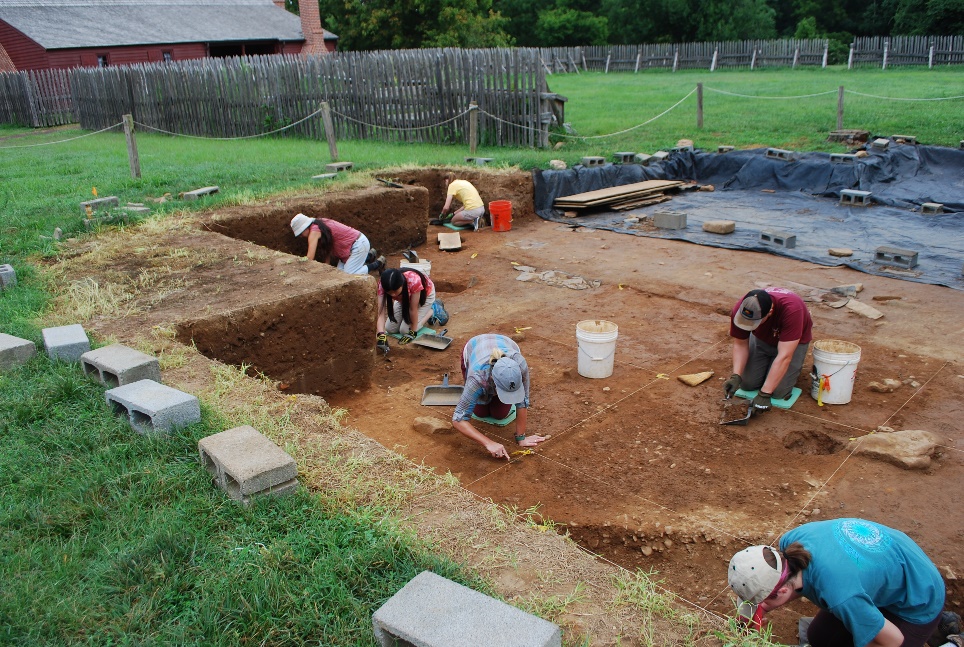
Collapsed excavation units. Unstable excavation walls are no joke. I’ve personally had one collapse on me, and while I was fine, it was still frightening. Shoring up walls and expanding out before digging deeper can mitigate these issues, but there are many types of soils, and they’re not created equal, so never overestimate the strength of your walls. Don’t become an artifact yourself.
Digs can get pretty deep and the sides need to stabilized. Another deep dig
Soil contamination/hazardous waste. Archaeologists occasionally run into hazardous waste, which is bad—enough said. Arsenic was a major embalming ingredient in the 19th century, and since archaeologists are frequently called in to identify and remove burials, arsenic is a significant consideration. It was also used to make a beautiful green color called Scheel’s green, which was used in dying such things as fabric, book covers, and wallpaper. Imagine wearing a gorgeous Victorian-era dress while reading a book and sitting in a wallpapered room all dyed green with copious quantities of poison. Green is my favorite color but hold the early death, please. Mercury was considered a type of cure and used to treat various ailments such as syphilis, toothaches, melancholy, worms, tuberculosis, constipation, and apoplexy, to name a few. It was in perfumes, lotions, soaps, hats, etc….and just like arsenic, it doesn’t go away in the soil. And if you’re above a certain age, you definitely remember those mercury thermometers that, when broken, produced magical fun silver balls you could roll across the floor until your mother caught you. Another principal offender is lead. Humans discovered how awesome lead was thousands of years ago. Please don’t personally verify this, but somehow, the Romans found that degraded lead was sweet, so they put it in substandard wine to jazz it up a bit. Lead was also used in cosmetics until embarrassingly recently to produce that immaculate white complexion valued by the upper crust. YOLO. Lead was also used in water pipes, paint, glassware, ceramic glazes, and later in plastics and gasoline. There is so much lead in our environment now that even non-archaeologists are in danger of exposure. I could go on and on, but it’s time to move to…
Medicinal bottle with mercury found at Ferry FarmUranium glass teacuplead-glazed bowlLeaded crystal vaseLead vase under black light
Enraged locals and/or property owners. We get it. No one wants that pipeline/highway/gas line/sewer to go through their property. And when it does, the archaeologists have to test that area. But please don’t run out of your house while visibly carrying a firearm and threaten the archaeologists. We are the lowest entity on this unpleasant totem pole and unfortunately the first people you’ll see trapsing over your land and digging holes. This was not our idea; it was our job. Working on these projects is the worst because people are understandably angry and want to vent, but this is not the way to do it. Ironically, one of the only things that can stop that pipeline from going through your horse pasture is if we find some amazing archaeological site with immense cultural significance. This will force a rerouting of the project, so your neighbors will have to deal with the headache.
Dealing with enraged locals is a delicate situation
This is not by any means intended as an exhaustive list, but I’ve already greatly exceeded my word count for this blog. You get the idea. So why, you may ask, does anyone become an archaeologist? Quite simply put, every job has its hassles, some more than others, but most archaeologists really (and I mean REALLY) love archaeology. The jobs in archaeology may not fit the stereotypes (full disclosure: most of us adore Indiana Jones, though). Archaeology is rarely glamorous; it can be dangerous or frustrating, but it is, above all else, AWESOME. Being a part of uncovering human history and sharing information never gets old, and I wouldn’t trade my job for any other.