It’s the most wonderful time of the year! There’ll be dirt out for screening, ceramics for cleaning, and lots of good cheer…. Okay, sorry, that might be a little too far. But it is a super exciting part of the year here at Ferry Farm, George Washington’s Boyhood Home. We have officially started this summer’s dig season!
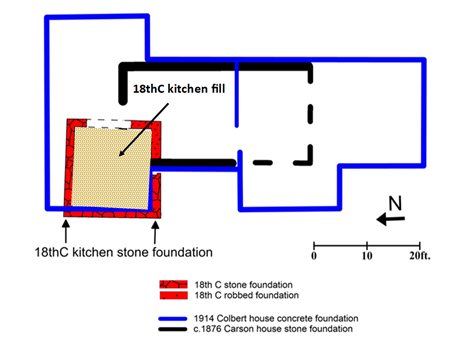
Building off of the previous two years’ exploration of the kitchen site, we are revisiting the 18th-century kitchen cellar again this year. While last year’s dig focused on locating and exposing the kitchen’s stone wall foundations, our focus this year will be excavating the fill within the cellar walls that had been deposited as a result of a fire sometime in the 1740s. The fire caused the building to collapse in on itself, filling the cellar space with ash and debris.
Excavating sites like this are very exciting because they represent preserved moments in time, leaving the possibility to find artifacts left in situ or in place, when the fire occurred. It is likely that most of the artifacts excavated will have evidence of the extreme heat caused by the fire. Toasty artifacts from the 2023 preliminary kitchen exploration have been washed and catalogued, showing damage to artifacts, such as glass bottles and ceramic storage vessels, ranging from being slightly charred and burnt to being completely melted. Toasty or not, these artifacts will help us nail down the date of the fire and what was being stored in the kitchen cellar when it went up in flames.
18thc kitchen cellar fill area within stone foundation to be excavated this seasonPortion of burnt cellar fill uncovered during the 2023 excavation season.
Our 18th-century kitchen, unfortunately, lies beneath the foundations of two farmhouses with full cellars dating from the 19th and 20th centuries. The construction of these homes severely impacted the kitchen structure and its burnt cellar fill, making it difficult for our archaeologists to accurately interpret the kitchen’s architectural features. A small portion of the kitchen cellar fill was also the subject of previous archaeological excavations in the 1990s, so we are not the first team to sample the fill. But in the interest of site preservation, the kitchen remnants were covered over twenty-five years ago with protective geofabric, and the farmhouse cellars backfilled completely with sand.
Luckily, we had the help of an excavator at the beginning of this season to remove the five feet of protective sand covering the kitchen cellar fill so we could get to the fun stuff sooner! But our fun isn’t restricted to the cellar, as we still have multiple 5” x 5” units around the outside of the kitchen foundations to investigate. Our team is still trying to locate the midden (trash deposits) and fireplace associated with the kitchen, as well as additional architectural evidence that would give an idea of the overall form and dimensions of the complete kitchen structure.
Excavator carefully removing the sand covering the cellar fill under the watchful eye of GWF archaeologists. The concrete wall foundations seen in the photo are the remnants of the 1914 farmhouse built atop the kitchen foundation. Exposing the cellar fill
Every excavation year brings new and exciting finds as we sift through thousands of years of site habitation. Come visit us while we dig weekdays from opening until 3:30 pm through July 11th. Hope to see you there!
Linum (“Flax”) and oleum (“oil”) – Fashionable and Affordable
As a Historic Preservation student at the University of Mary Washington, I’ve grown to appreciate almost all aspects of materiality. Over the past four years, my education has taught me to look closely at the built environment around me.
Two years ago, I stumbled across a book about mid-century kitchens, which discussed modern flooring’s ugly duckling: linoleum. From this, I developed an appreciation for linoleum and vinyl flooring and an equal obsession with spotting them.
Most people wouldn’t put Linoleum at the top of their list of favored materials. After all, historically, it’s been labeled as cheap, tacky, and ugly. However, linoleum has been an important part of modern living since the late 19th century. While the patterns most people initially thought of weren’t very attractive (that one red brick style), their initial creation changed the game for durable materials in a household and single-handedly became a hospital favorite.
Linoleum was first invented by Frederick Walton in Chiswick, England, when he discovered that oxidized linseed oil could replace rubber when mixing the oil with cork and other fibers. This process was sped up by heating the oil with lead and zinc, which formed a sticky paste that would be mixed with sawdust or cork to keep the cloth from becoming tacky. Shortly after receiving a patent in 1864, Walton opened the American Linoleum Manufacturing Company on Staten Island, New York, in 1872, with the nearby town named Linoliumville in its honor.
Fred Walton, creator of Linoleum
The genius of linoleum was/is its durability and ability to be mass-produced cheaply. Additionally, the material could be customized using pigments to create virtually any pattern, which aided in its early popularity in homes. Early linoleum was commonly produced in printed, marbled, inlaid, or plain patterns, with these distinct designs often serving as time machines to gauge when the flooring was installed. Putting aside the aesthetics, linoleum is most likely to be seen in high-traffic areas, such as hallways, kitchens, and mudrooms, due to its long-term durability.
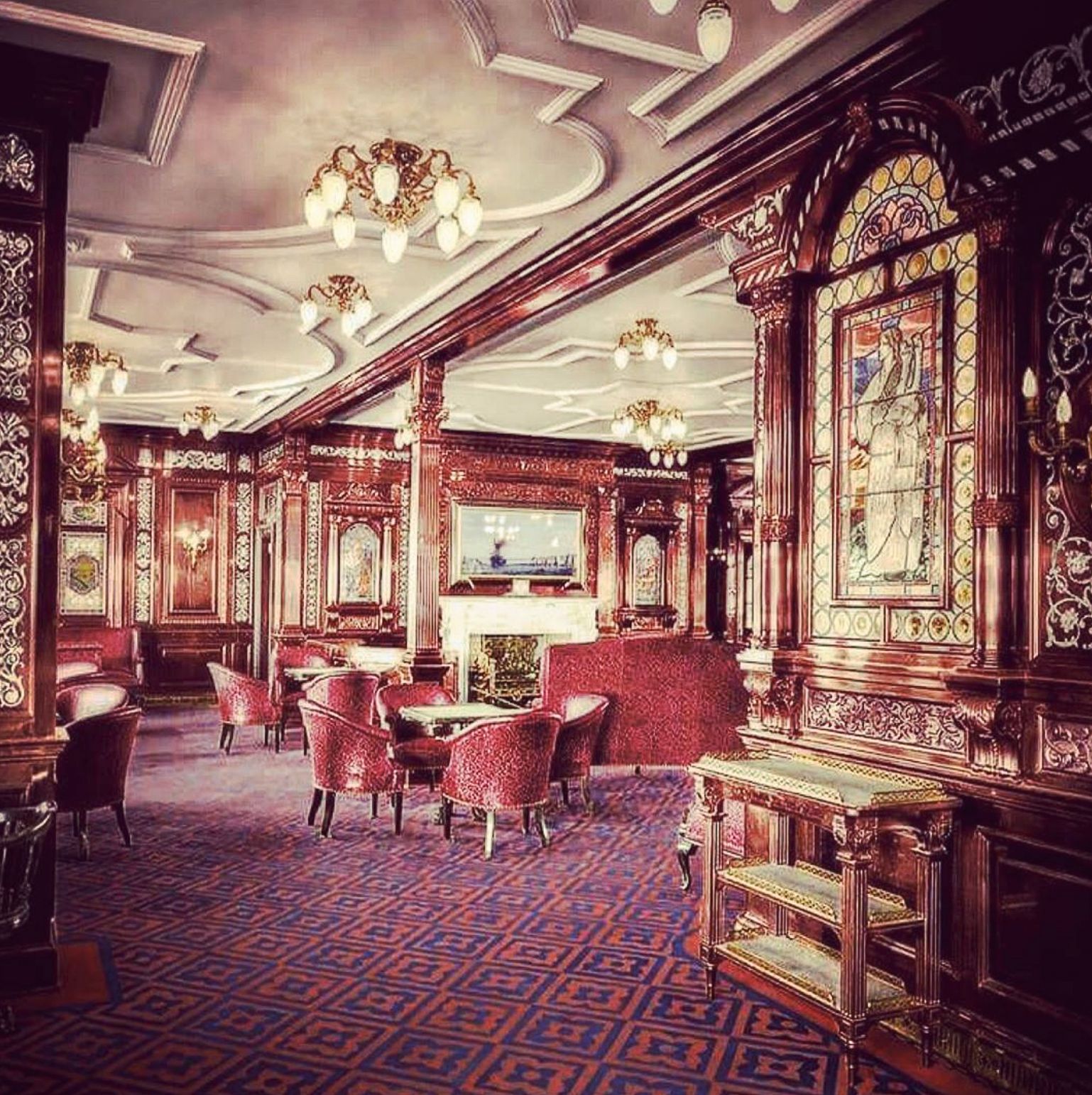
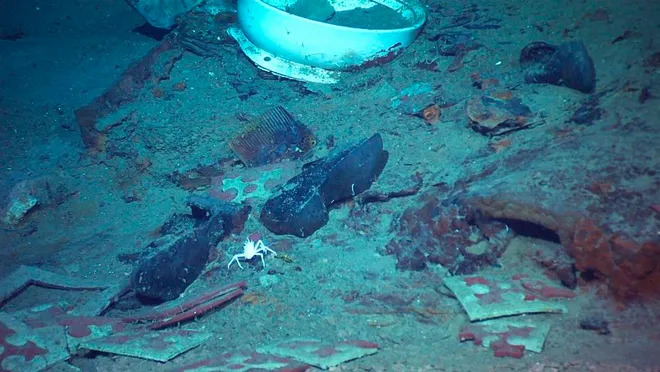
A well-installed linoleum is waterproof and surprisingly antibacterial, which is why, since its invention, linoleum has been commonly used in hospitals. The flooring was also popular among naval vessels in the early twentieth century, with battleships and luxury cruisers taking advantage of the material. In fact, the RMS Titanic used inlaid linoleum flooring for a significant portion of its decks, which can be seen in past photos and even on the sea floor today.
First Class Smoking Lounge on R.M.S. Titanic with lovely blue and red tiles, ca. 19122004 image of wreckage from the Titanic, showing linoleum floor tiles taken by the Institute for Exploration and Center for Archaeological Oceanography/University of Rhode Island/NOAA Office of Ocean Exploration
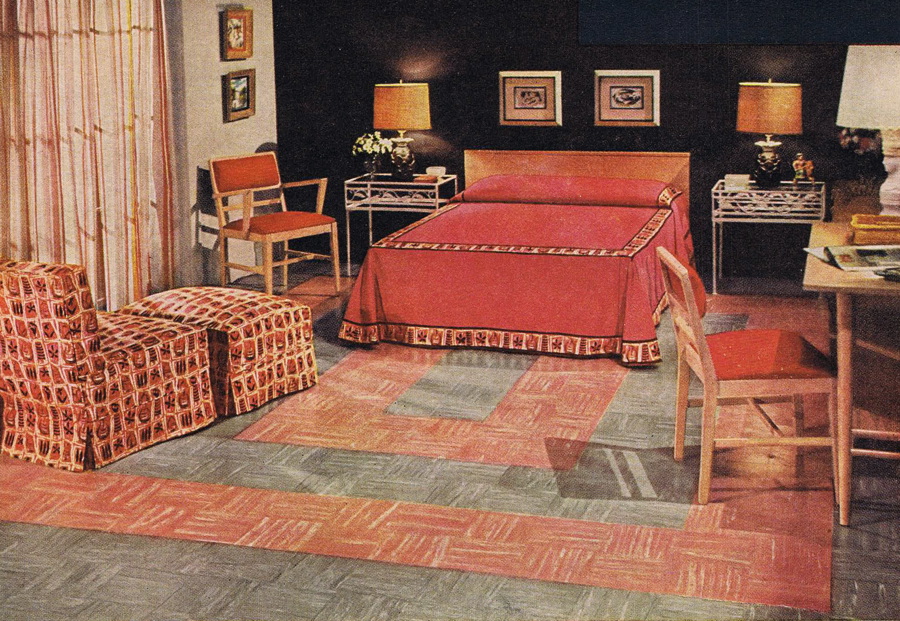
The manufacturing boom of the mid-twentieth century brought modern materials and technologies to the average household, including the popularization of linoleum in common spaces. Kitchens and high-traffic areas would continue to have the flooring material. However, living rooms, eating spaces, and even walls would start to display colorful and flashy patterns. This popularity would be short-lived, as the 1950s brought vinyl flooring, an extremely similar product, but was pushed as a newer and more “fashionable” alternative to linoleum.
An image of a bedroom from a 1952 advertisement for linoleum flooring
Despite the initial falloff, linoleum has made a surprising comeback in homes within the last few years. It’s understandable, as per square foot, the material is very affordable and easy to clean, not to mention that rising interest in the conservation of historic homes has led to the preservation and replication of historic linoleum. Most often, the damage to the material features is rips and cracks, which are easily repaired with patching and a fresh coat of sealant.
I don’t write any of this intending that you agree with me. However, I believe that linoleum reflects the best of modern materiality. It’s low-cost, eco-friendly, durable, and easy to customize, allowing lower-income homes to decorate their spaces economically and colorfully. While spotting linoleum in older buildings may be rare due to being covered with changing fashion trends (we are all familiar with carpet over beautiful hardwood floors), preserving it is just as important as any other part of the built environment.
Helena Samson
Fleming Smith Scholar, UMW Class of 2025
Linoleum’s Forebearer “Fancy Pattern-Cloth” – Eighteenth Century Floorcloths
The future of home restoration and preservation will involve saving certain building materials, such as wood, stone, brick, and decorative elements, like linoleum. While humble and even ridiculed (you know the pattern), linoleum will eventually be treasured as a lasting historical remnant, helping future preservationists add context and depth to restorations.
Classic linoleum, everyone seemed to have despite not wanting to admit it.
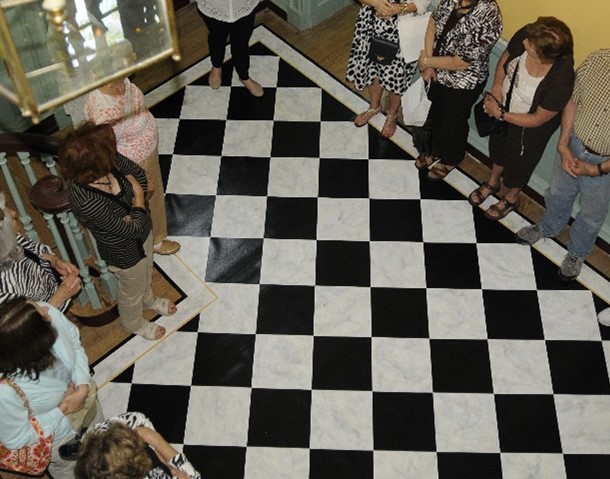
Unfortunately, in eighteenth-century historical preservation, we are rarely lucky enough to find samples of the predecessor of linoleum, the floorcloth. The floorcloth was a relatively common floor covering in eighteenth-century Virginia homes. It was made from woven cloth, usually heavy and sturdy, like linen or cotton canvas. This canvas was then stretched, several layers of oil paint applied, and covered in varnish. This floorcloth could be painted in any fashionable design, as seen in John Carwitham’s book published in 1739, with the replica marble being one of the favorites.
Behold my fancy flooring, m’lady – design plate from John Carwitham’s “Various kinds of floor decorations”, 1739Marble floorcloth in entryway at Kenmore. The floorcloth was made in 1980 and has been stripped and repainted once…it is holding up nicely.
Like linoleum, floorcloth was prized because it was customizable, durable, easily cleaned, and repairable. It could also be cut down and used in other areas like kitchens or closets after it lost its fashionability or was replaced with carpet. It was so versatile that it basically reused itself out of existence.
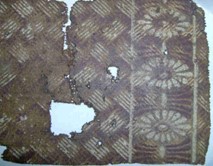
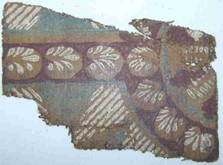
While no known complete examples of eighteenth-century floorcloths exist, bits and pieces have been found, offering insight into their construction and functionality in the home. Coincidentally, here at Kenmore, we found remnants of a floorcloth under the floorboards in the attic during a period of restoration in 1989. Small samples from the remnants were taken for analysis:
Floorcloth remnant found in Kenmore’s atticFloorcloth remnant found in Kenmore’s attic
Base layer – yellow preparatory layers of lead white and yellow ochre ground in linseed oil. The uneven distribution of the large, clumped pigments suggests it was hand-ground paint.
Black paint is found in the third layer above the ground coatings with remnants of plant resin varnish, followed by a green design layer. This could mean the black paint was the original design, and it was repainted after varnish and the green design were put on top.
Green-painted areas – made up of white lead, Prussian blue, yellow ochre, and calcium carbonate.
White paint – composed primarily of white lead and calcium carbonate
We can draw a few conclusions from this paint analysis. One, the floorcloth was well used but eventually worked its way down the list of favored household furnishings, whether from wear and tear or fashionability. Either way, it was ultimately rolled up and stored out of sight, and lucky for us, forgotten.
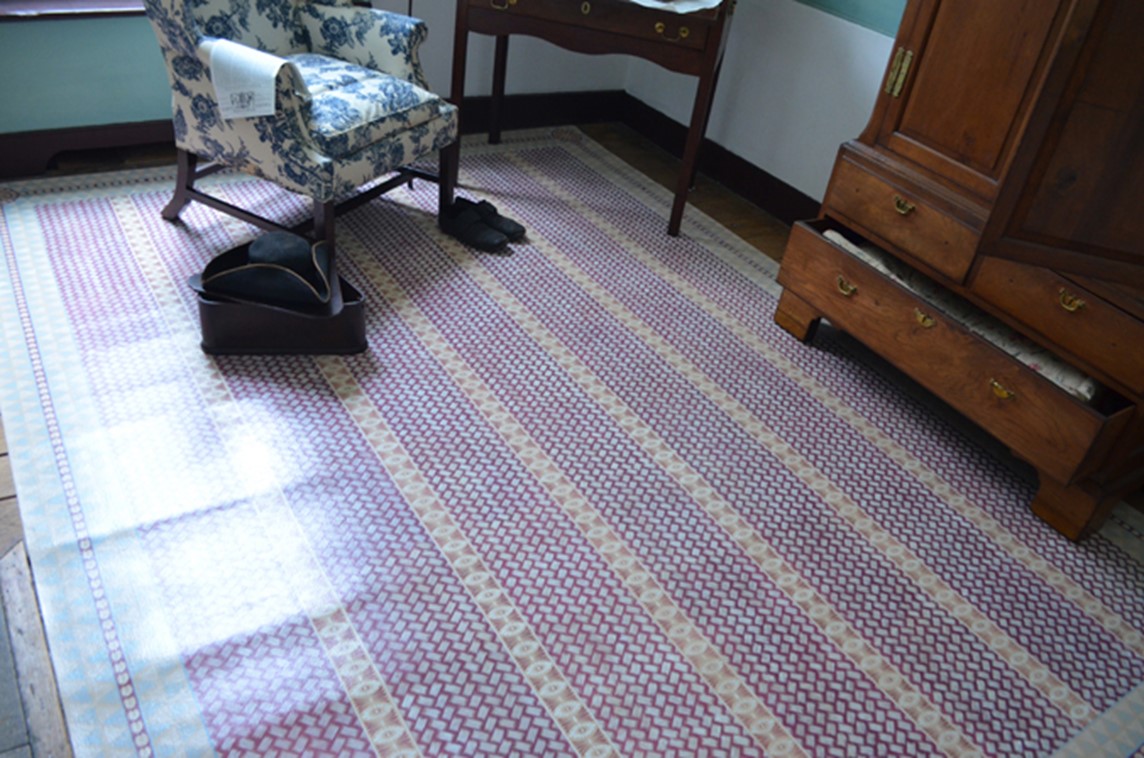
Second, the white paint sample did not contain zinc white, which was used after 1840, and the green paint sample did not contain chrome green, which means it was likely produced before 1816, when chrome yellow pigments were commercially available. So, while we can’t verify that it was a Lewis family floorcloth, it is a very early example of the floor covering. It inspired the floorcloth reproduced for Fielding’s office in Kenmore, which you can read about in our previous post, “What Was Old Is New Again”.
Beautiful reproduction floorcloth hand-painted by Black Dog Gallery, Yorktown.
Today, thanks to linoleum, we can choose affordable, durable, and even fashionable flooring materials. Linoleum is the evolution of floorcloths with similar goals and functionality. However, while floorcloths didn’t usually survive, linoleum will follow us through history and deserves to be preserved even if it leads to awkward questions about style and décor.
Oh, there will be questions.
Heather Baldus
Collections Manager
Bibliography
Kaldewei, G. (2000). Linoleum: History, design, Architecture, 1882-2000. Hatje Cantz ; Distribution in the US, DAP, Distributed Art Publishers.
Landreau, A.N. (1976). America underfoot: A history of floor coverings from colonial times to the present. Published for the Smithsonian Institution Traveling Exhibition Service by the Smithsonian Institution Press.
Weissman, J.R., & Lavitt, W. (1994). Labors of love: America’s textiles and Needlework, 1650-1930. Wings Book: Distributed by Outlet Book Co.
Buck, Susan L. Floorcloth Fragments Cross-Section Microscopy Report, Kenmore, Fredericksburg, Virginia. (2006)
18th-century household linen management and its 21st-century historic house equivalent
For the modern historic house museum collections staff, the care and cleaning of our spaces and objects are some of the most important tasks we do. Proper dusting and routine cleaning helps preserve historic objects, vacuuming floors and wiping down woodwork help to maintain our historic interiors, and rotation of sensitive works help to prolong their life through limited light exposure and other environmental impacts.
In January and February each year, when the Historic Kenmore and Ferry Farm sites are typically closed to the public, the curatorial staff is able to access the spaces to conduct inventories and condition assessments of objects…and to clean. Spring cleaning at the Washington House this year involved quite a bit of teamwork between our curatorial and buildings & grounds staff—fresh coats of whitewash went up on high-traffic areas of this historic recreation, and the wooden floors were vacuumed, spot-cleaned, and mopped to remove built-up dirt from tours and other activities.
Low-post bedstead in the Hall Back Room piled high with reproduction bedding.
Maintaining the bedsteads of the Washington House is an ongoing task for our interpretive staff, as they tidy and straighten the sheets and pillows that are moved about by visitors (something we encourage and celebrate!) during their immersive tour experiences. This year, as we (the curatorial staff) conducted our spring-cleaning routine, we tightened the bedstead ropes and refreshed the bedding to prep the house for another busy year. But as we went about conducting our room-by-room inventories and pulling bedding out for washing or airing, we uncovered an issue: many of our modern museum object labels for the sheets and pillowcases had become unreadable.
White linen reproduction bedsheet with its twill tape label (sans number).
Marking textiles in a museum collection typically entails a small length of twill (woven cloth) tape, a handwritten or applied object number, and small stitches to attach the tape to the textile object. But for our reproduction bed linens on the bedsteads of the Washington House, these labels no longer were readable due to laundering—the “permanent” number used just didn’t last. So what are our options?
As we like to do, we turned to the past for an understanding of what might be a better, but still historically accurate method for marking our linens. One such resource we turned to was cookery and household books of the period. The Workwoman’s Guide, for example, includes a number of receipts (or instructions) for making marking ink as well as detailed instructions for marking household linens with thread. In marking of linens, according to the author (A Lady), the textile would be marked with either the husband’s initials or the wife’s first name along with husbands initials, followed by an abbreviation of the type of article, and finally by the number and a date marker (last two digits of the year, for instance).
Receipt for “Permanent Ink for Marking Linen.” from The workwoman’s guide : containing instructions to the inexperienced in cutting out and completing those articles of wearing apparel, &c. which are usually made at home : also, explanations on upholstery, straw- platting, bonnet-making, knitting, &c. By A Lady (1838) via Smithsonian Libraries and Archives on Archive.org
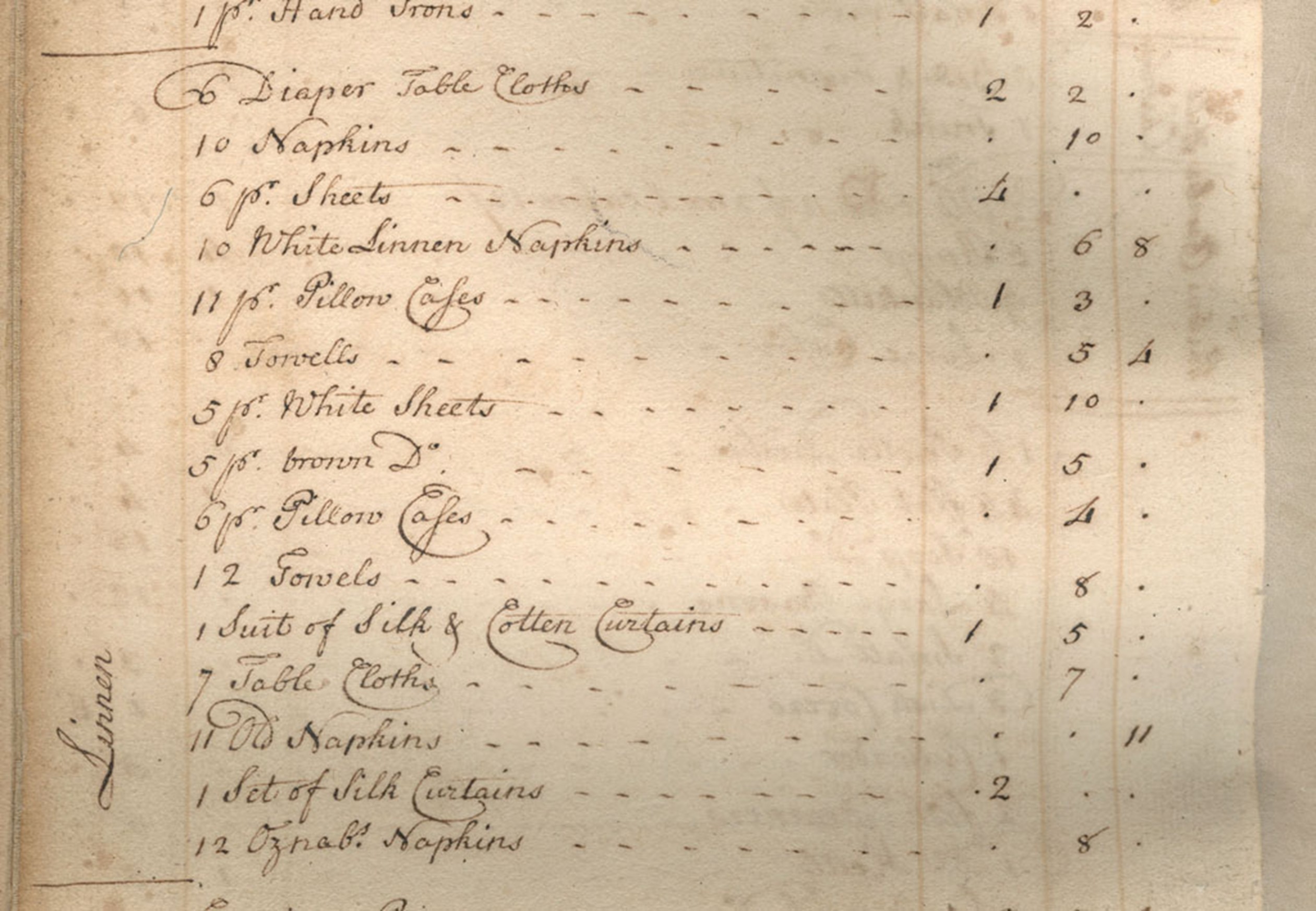
Existing household linens in museum collections and references in the written record indicate that some were in fact marked with numbers or initials/names (or both) to enable the items to be tracked and inventoried, although the exact combination of numbers and letters seem to vary, likely based on a complexities of the household and its linen inventory. The probate inventory taken after Augustine Washington’s death in 1743 records a variety of household textiles at Ferry Farm, including tablecloths, napkins, pillowcases, sheets, and towels. The appraisers, however, make no note of whether these textiles were marked in any way (just noting materials or other descriptors and quantity).
Excerpt of 1743 probate inventory of Augustine Washington listing “Linnen,” including 6 Diaper Table Cloths, 10 Napkins, 6 pr Sheets, 10 White Linnen Napkins, 11 pr Pillow Cases, 8 Towells, 5 pr White Sheets, 5 pr brown Do. [Sheets], 6 pr Pillow Cases, 12 Towels, 7 Table Cloths, 11 Old Napkins, and 12 Oznabs Napkins. Inventory submitted 1 July 1743 to King George County court.
The archaeological record of Ferry Farm includes a number of implements related to sewing, as touched upon in past blog posts such as this one or this one about thimbles. Our own museum collections house a few 18th or early 19th century sheets or other household linens, some of which have been marked in ink or stitching with (unidentified) owners’ initials/names and dates, much in keeping with the instructions outlined in period references such as The Workwoman’s Guide and other household manuals.
Sample layout and makeup of marks to include owner’s initials, item identification, number, and date. Excerpt from The workwoman’s guide (1838) via Smithsonian Libraries and Archives on Archive.org
So, for our modern museum inventory management purposes, I think we’ll be skipping the caustic nitrate of silver or crunchy cochineal beetles for coloring and stick to the needle and thread method of marking our reproduction bedding and other textiles. As suggested by A Lady, the Washington House marks will include both Mary and Augustine Washington’s initials along with notations of item type (such as WS for the five pairs of White Sheets listed in the 1743 inventory) and date of creation (for many of these reproduction linens, that would be 2018 or 2019). I’ll be getting my needle and thread ready so that next year’s inventory and spring cleaning will hopefully be easy-breezy.
Some of the most delicate objects in our collection are our archives. Paper and other document materials like vellum and parchment are very sensitive materials that can be irreversibly damaged simply by light. This makes it very difficult to display or put on exhibit for extended periods despite our comprehensive policies for conserving and preserving documents; exhibition has always been unfeasible. To remedy this, we have been working on getting archival-safe, high-quality images of our important documents online for everyone to access. So, while you might not see the documents in person, you can still explore, read, and learn about these important papers while we preserve them for future generations.
Until we launch our online archives, I wanted to give everyone a sneak peek at a few of our incredible pieces.
One of our oldest documents in the collection is a Land Grant signed by William Gooch on September 28, 1730, written on vellum. William Gooch was a colonial administrator who served as governor of Virginia from 1727 to 1749. The grant is not in the best condition, but it reads that it grants 400 acres in Spotsylvania County to Paul Plunkepee. This grant is officially recorded as Land Office Patents, No. 14, 1728-1732, page 40, and is available at the Library of Virginia.
Land grant to Paul Plunkepee signed by William Gooch. 28 September 1730.Land grant to Paul Plunkepee signed by William Gooch. 28 September 1730.Sir William Gooch, 1st Baronet, was a British Army officer and colonial administrator who served as the governor of Virginia from 1727 to 1749.
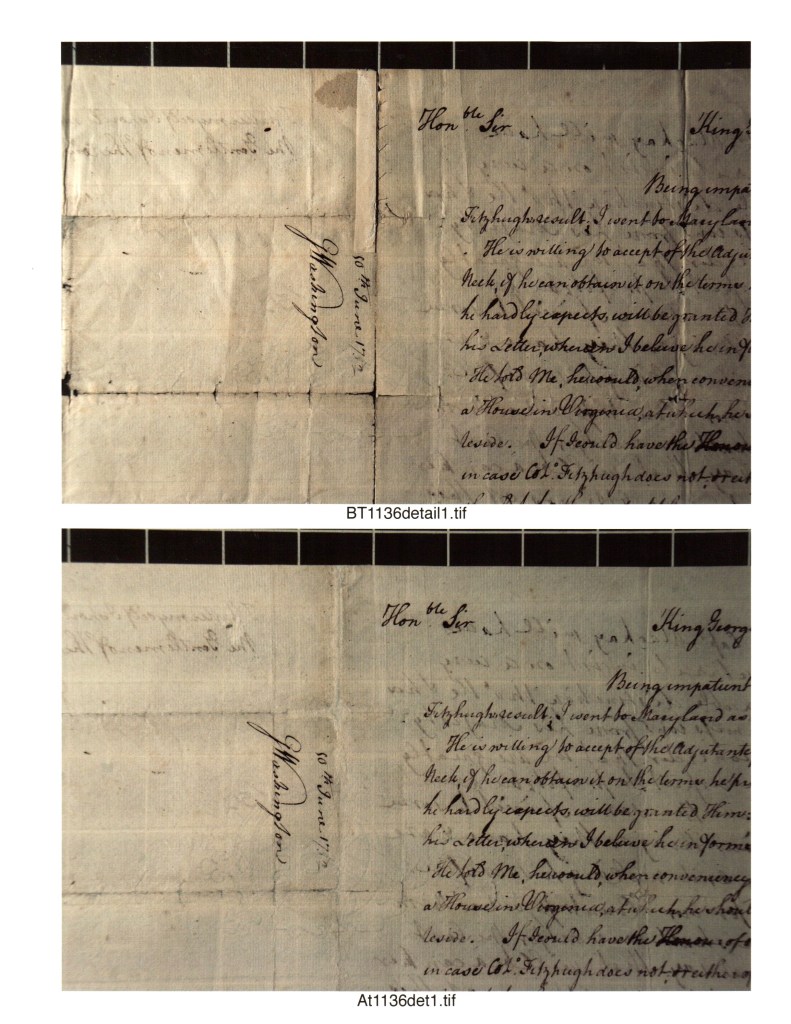
One of our most unique documents is a letter from George Washington to Lieutenant Governor Robert Dinwiddie, written on June 10, 1752, when he was twenty. Robert Dinwiddie served as Lieutenant Governor of Virginia from 1751 to 1758. In the letter, George requests his first military appointment to the open adjutancy of the Northern Neck or other district. George’s half-brother Lawrence had been appointed Adjutant General of the colony in 1743. Due to his illness and eventual death, the adjutant was to be divided into smaller districts (i.e., Northern Neck).
Dinwiddie declined the appointment but assigned George to an envoy position that winter to confront the French, who had recently built a fort on what Dinwiddie considered British land. Additionally, George met with the Iroquois Confederacy to make peace and obtain intelligence about the French.
Letter from George Washington to Robert Dinwiddie, 10 June 1752Letter from George Washington to Robert Dinwiddie, 10 June 1752
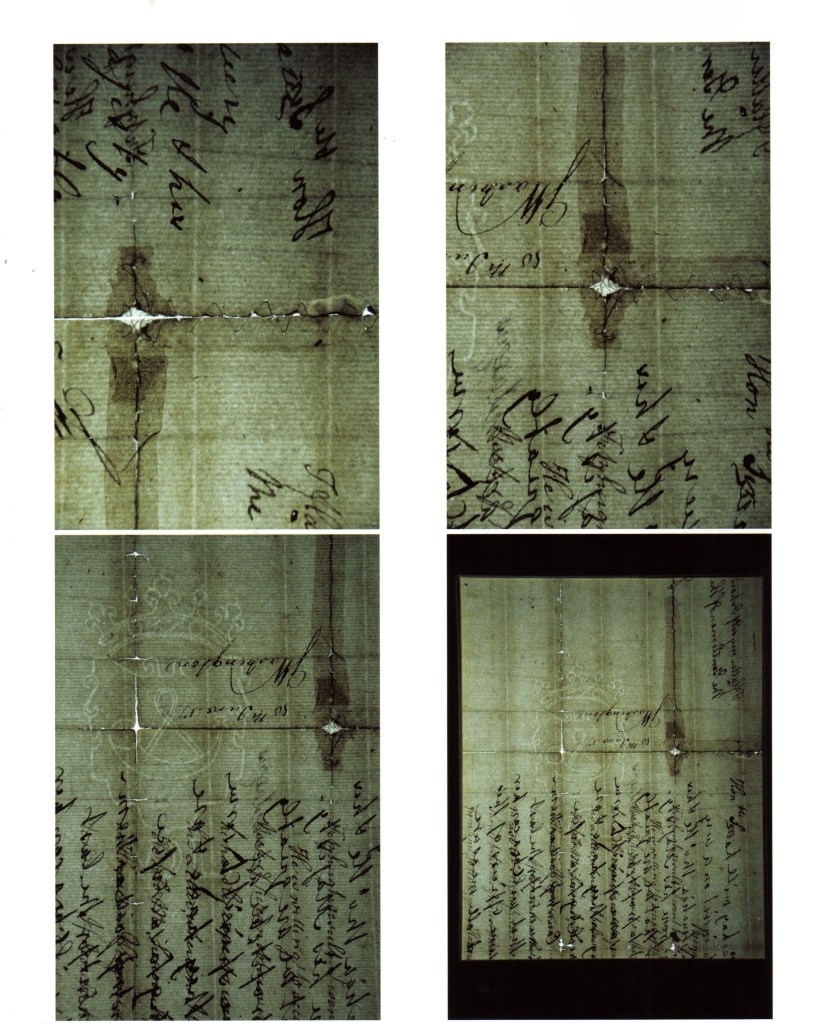
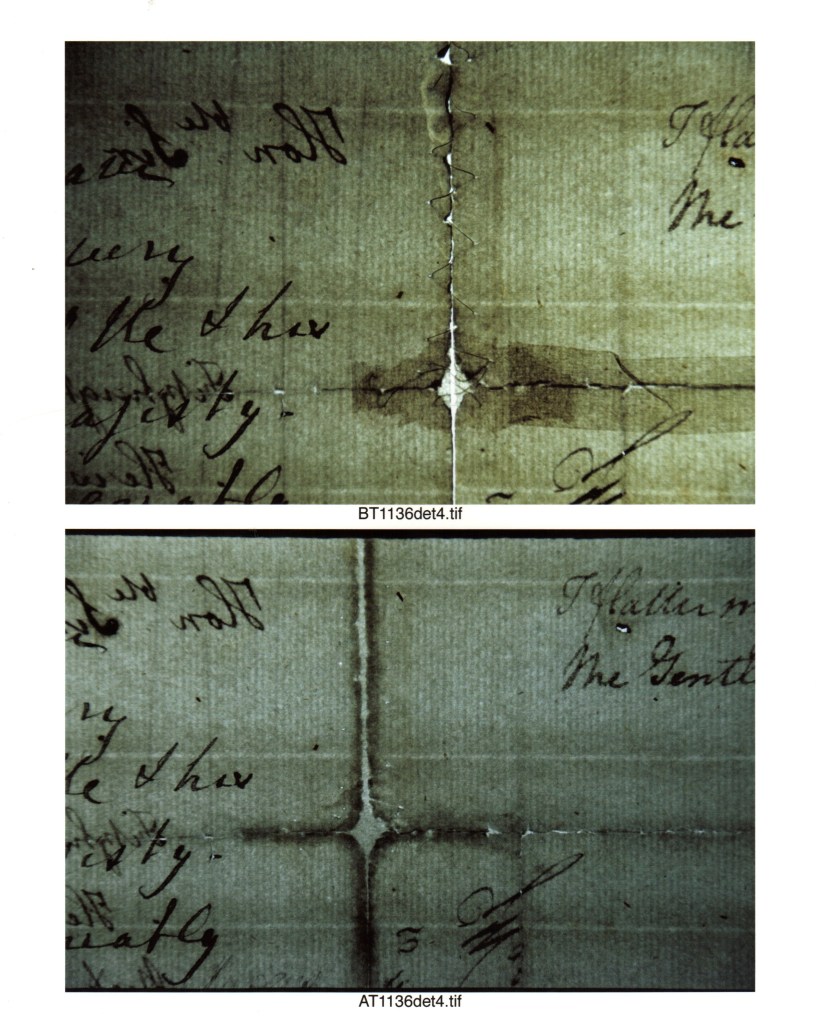
This amazing letter pinpoints the beginning of George Washington’s illustrious military career, which would eventually culminate in him becoming the first President of the new United States of America. The letter is in great condition after meticulous conservation work, which included repairs with Japanese tissue called tengucho and wheat starch paste called jin shofu. It was then cleaned and flattened, and the iron gall ink stabilized.
A transcript of the letter can be found on the National Archives website at Founders Online.
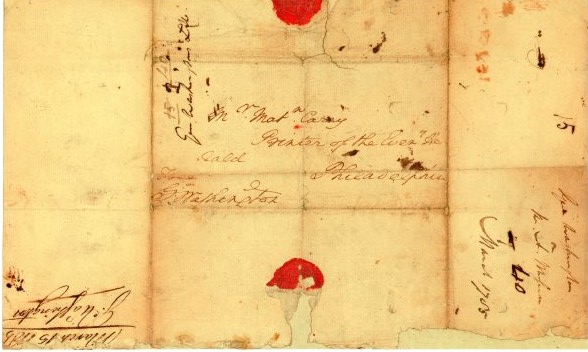
Next are two letters between George Washington and Irish-born publisher Matthew Carey. Matthew Carey moved to America in 1784 and settled in Philadelphia, where he established a publishing business and bookshop with $400 given to him by the Marquis de Lafayette. Carey’s first publication was The Pennsylvania Herald in 1785, followed by two of the first successful American magazines, The Columbian Magazine and The American Magazine in 1786 and 1787.
1824 portrait of Lafayette by Ary Scheffer is currently in the U.S. House of RepresentativesMathew Carey was an Irish-born American publisher and economist who lived and worked in Philadelphia, Pennsylvania.
In George’s first letter to Carey in 1785, he requests a subscription to Carey’s newspaper but asks him to send the newspaper disguised as an ordinary letter because George has been having problems with the post office delivering his newspapers . George thinks his papers may not have been delivered because “persons who wishing to read News Papers without being of the expence [sic] of paying for them, make free with those which are addressed to others.”
Letter from George Washington to Matthew Carey, 1 March 1785Letter from George Washington to Matthew Carey, 1 March 1785
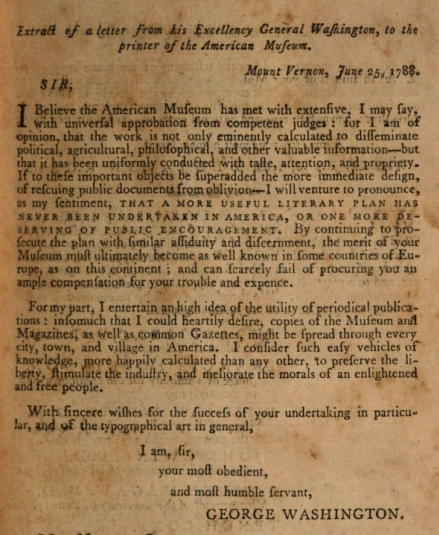
The second letter between George and Matthew is dated June 25, 1788. The year before, Carey launched “The American Museum” magazine. It was a literary museum that reprinted significant historical documents on American history and original essays on politics, commerce, and culture. The magazine got a positive response, but Carey was finding it expensive to distribute the magazine across the country, so he asked George, one of his first subscribers, to write an endorsement for the magazine that would help attract new subscribers.[2]
Washington responded immediately, seizing the opportunity offered by Carey to express his belief that the free dissemination of information and ideas was vital to preserving American liberty. ‘I could heartily desire,’ Washington wrote, that ‘copies of the Museum and Magazines, as well as common Gazettes, might be spread through every city, town & village in America – I consider such easy vehicles of knowledge, more happily calculated that any other, to preserve the liberty, stimulate the industry and meliorate the morals of an enlightened and free People.”
Letter from George Washington to Matthew Carey, 25 June 1788Letter from George Washington to Matthew Carey, 25 June 1788Extract of a letter from his Excellency General Washington, to the printer of the American Museum
Carey published Washington’s endorsement in the next issue of his magazine—his marks for the typesetter can be seen in the original Washington letter. The result was a flood of new subscriptions that allowed Carey to continue publishing The American Museum for another four years.
Transcripts of the letters can be found on the National Archives website at FoundersOnline.
These are just a few of the amazing documents in our collection, which we hope to bring you soon so that you can explore them yourself. Check back often, and we will keep you updated on our progress with our digitization project.
Heather Baldus
Collections Manager
Bibliography
Edd Applegate (August 17, 2012). The rise of Advertising in the United States: A History of Innovation to 1960. Scarecrow Press. p.25.
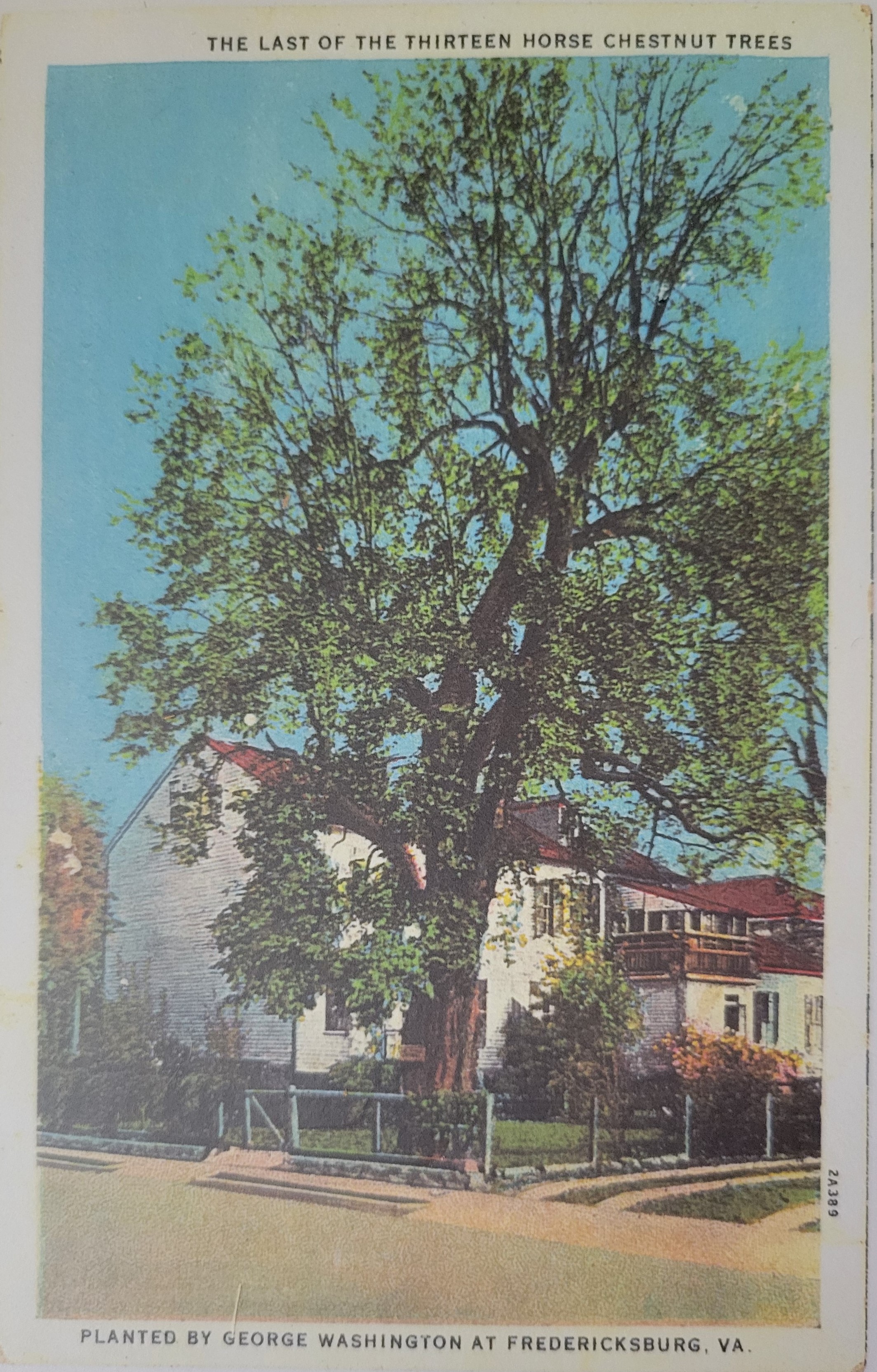
There once stood a large horse chestnut tree on the corner of Fauquier and Charles Street in Fredericksburg. It was noted as one of the thirteen legendary Washington horse chestnut trees planted by George himself. By the 1930s, it was becoming clear that the tree needed some help, so the Daughters of the American Revolution (DAR) took up the cause to protect this historic tree.
Washington’s Horse Chestnut TreeGroup of ladies and small child posing in front of horse chestnut tree, ca. 1930s
The tree legend states that George, while visiting his mother in June 1788 in Fredericksburg, decided to plant thirteen horse chestnut trees from her house to his sister’s house, Kenmore, just a few blocks away. This provided a scenic path for his mother when she visited her daughter Betty. These trees commemorated the thirteen original states.
Mary Washington’s House, c. 1930sAmerica’s Historic Horse-Chestnut TreeMap showing the distance between Mary Washington’s house and Kenmore…following the potential path of the horse chestnut trees.
It is a great story. It is patriotic and nostalgic, showing George as a man of the earth with his love of trees, gardening, and horticulture. He planted these trees for a future America to remember the struggles to create this country and the precious nature of our land that we must protect. But is it true? Did George plant that tree? What is the evidence?
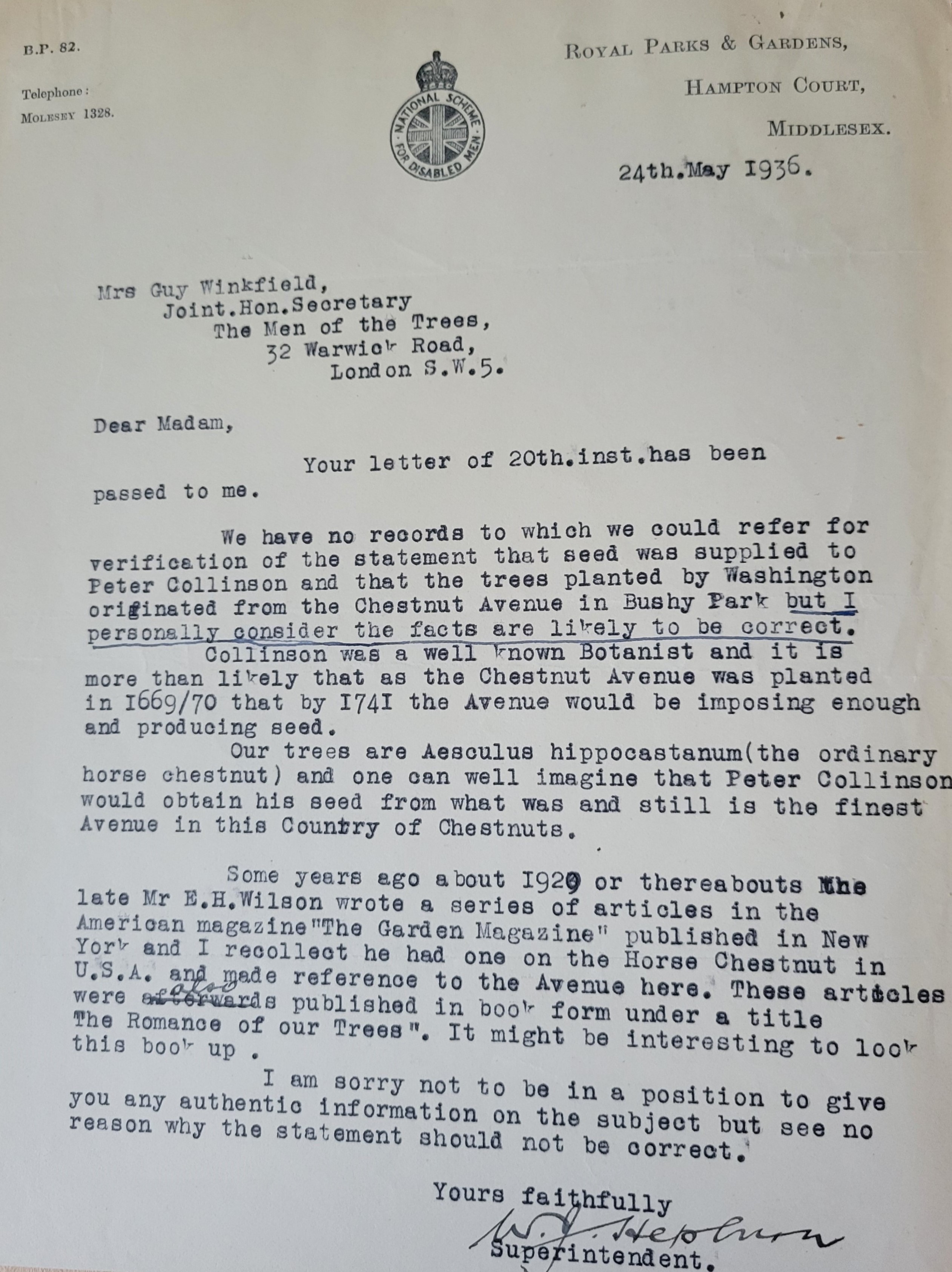
The horse chestnut tree is a native of the Balkans region (Albania, Bulgaria, Greece, and Northern Macedonia). It made its way to Europe and England during the seventeenth century, noted as growing in South Lambeth, London, and being planted by Sir Christopher Wren at Hampton Court.
Horse chestnut trees Bush Park, Hampton Court, England planted by Christopher Wren in 1669-1670.
There is documented evidence of some horse chestnut trees crossing the Atlantic to Mr. John Bartram, one of America’s first botanists in the 1740s. In a letter from Peter Collinson, an English botanist, dated September 16, 1741, he wrote to Bartram, “I have sent some Horse-Chestnuts which are ripe earlier than usual; hope they will come fit for planting.”. Bartram acknowledged receiving them and stated that most were blue-molded, and only one germinated and grew. Over twenty years later, Bartram updated Callison on the success of the lone seedling, writing, “But what delights me is that our horse chestnut has flowered. I think it must excel in America.”
Letter from Royal Parks and Gardens, Hampton Court, May 24 1936
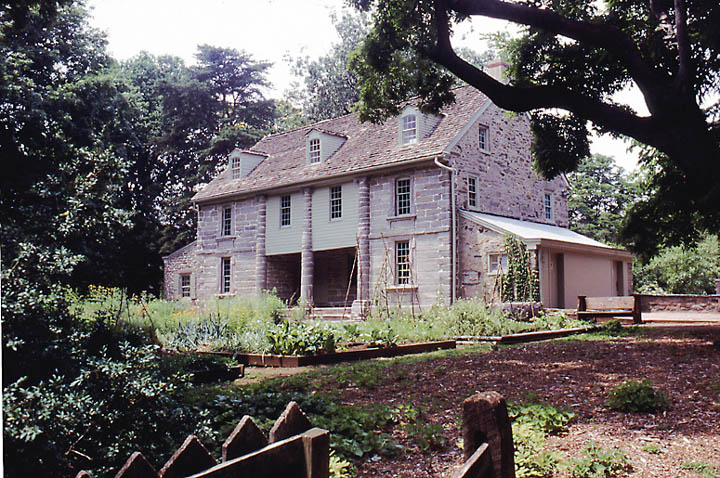
Bartram’s Gardens in Philadelphia was quite popular and visited by many founding fathers while working there. George visited the gardens twice in the summer of 1787 while in the town during the Constitutional Convention, noting, “Sunday, June 10, 1787, breakfasted at Mr. Powell’s and in company with him rid to see the Botanical Gardens of Mr. Bartram, which, though stored with many curious plants, shrubs, and trees, many of which are exotics, was not laid off with much taste, nor was it large.”
John Bartram’s house and upper garden at Bartram’s Garden
Why mention this? In some versions of the story, Washington got his horse chestnut trees from this garden, but there is no evidence that the legendary trees were obtained from this famous historic garden. George only made two diary entries about horse chestnut trees on April 13, 1785, writing, “Received from Col. Henry Lee of Westmoreland 12 horse chestnut trees (small) and an equal number of tree boxes. They appeared to have been some time out of the ground. Planted 4 of the Chestnuts on my serpentine walk – two on the east end and the rest in the vineyard.” And again, on April 2, 1788, wrote, “Transplanted from a box in the garden, thirteen plants of the horse chestnut into shrubberies by the garden walls.”
Fruit Garden and nursery at Mount VernonSmall botanical garden at Mount VernonUpper garden at Mount Vernon
The entry shows evidence of planting the famous Washington trees, right? No, because George was at Mount Vernon in April and didn’t leave for Fredericksburg to visit his mother until June 10, 1788.
But could he have had them sent down and have them planted before he came to see his mother? Yes, but the story says that George planted these trees with his own hand. Additionally, it would be odd for George to mention planting the trees while in residence at Mount Vernon and not say that they were in his mother’s garden in Fredericksburg. Washington was a diligent diarist but never mentioned planting thirteen horse chestnut trees in his mother’s garden.
Mary Washington’s house gardens, Fredericksburg.
Further, no known letters from George, Mary, or Betty mention any horse chestnut trees between Mary’s gardens and Betty’s Kenmore.
Spring time in the gardens at Kenmore Plantation (can you spot the cat?)
This was all the primary source evidence I could find relating to George and any horse chestnut trees. So, I looked further into the story to see what other evidence was being used to verify that this tree was indeed one of the thirteen Washington trees.
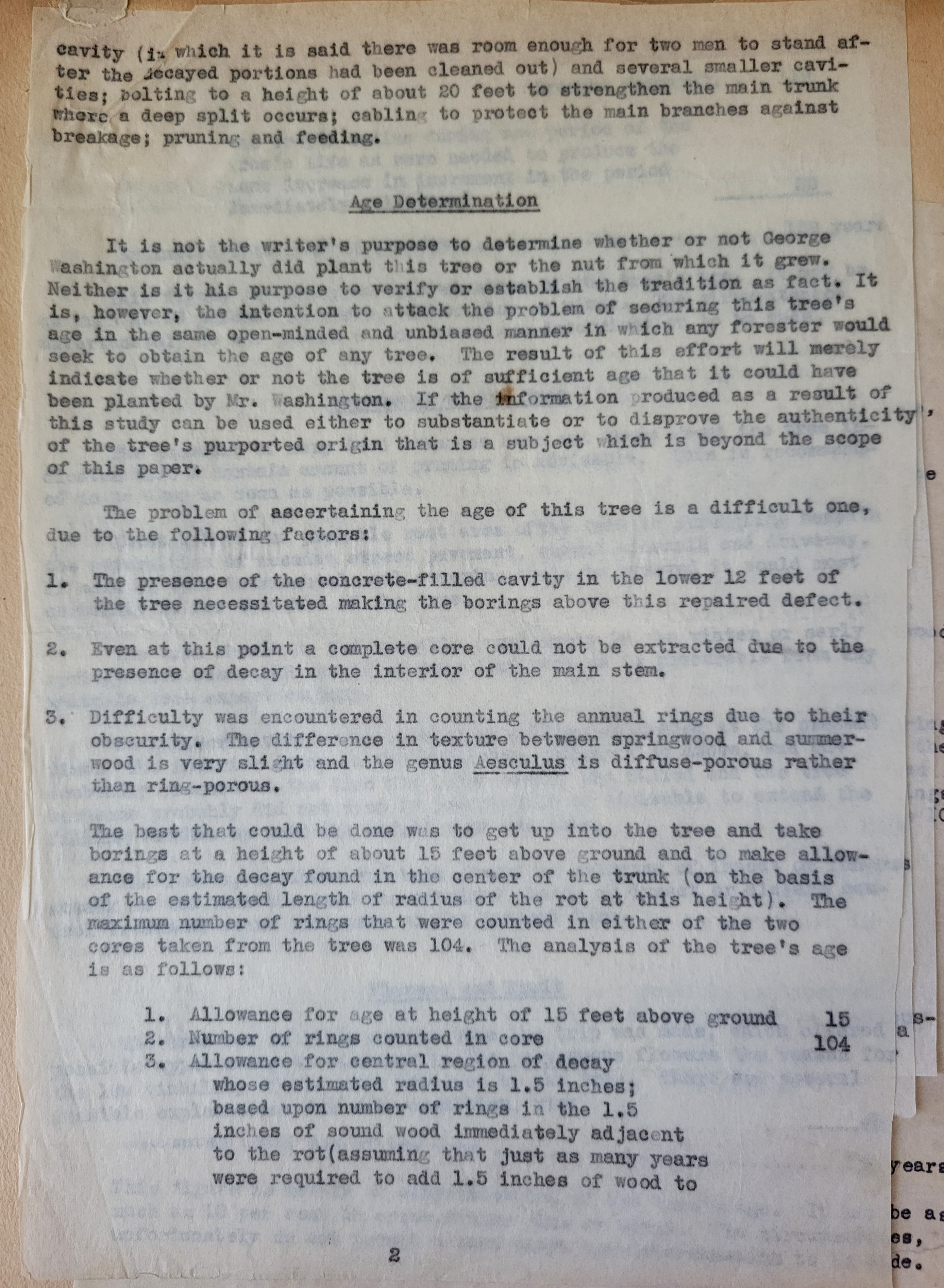
As I said in the beginning, by the 1930s, many, including the DAR, were trying hard to save this lone surviving chestnut tree. With their extensive reach, they got Fred H. Arnold, the Assistant Forester for the National Park Service, to do an age-determination test on the tree in May of 1934. Mr. Arnold noted some issues with the test, stating that the lower twelve feet of the tree was filled with concrete, so the coring sample had to be taken above this “repaired defect”. Even then, a complete coring sample could not be extracted due to decay in the interior of the main stem. Additionally, Mr. Arnold said that it was very difficult to count the annual rings due to their obscurity because the texture difference between the springwood and summerwood for the horse chestnut tree (genus Aesculus) is very slight. Taking into account all this, Mr. Arnold estimated the tree to be around 139 years old with as much as 10% in error, either plus or minus, which would put the date it was planted somewhere between 1781 and 1809, which means that the tree is indeed old and could have been planted during Washington’s time in Fredericksburg.
Age Determination, May 6 1934
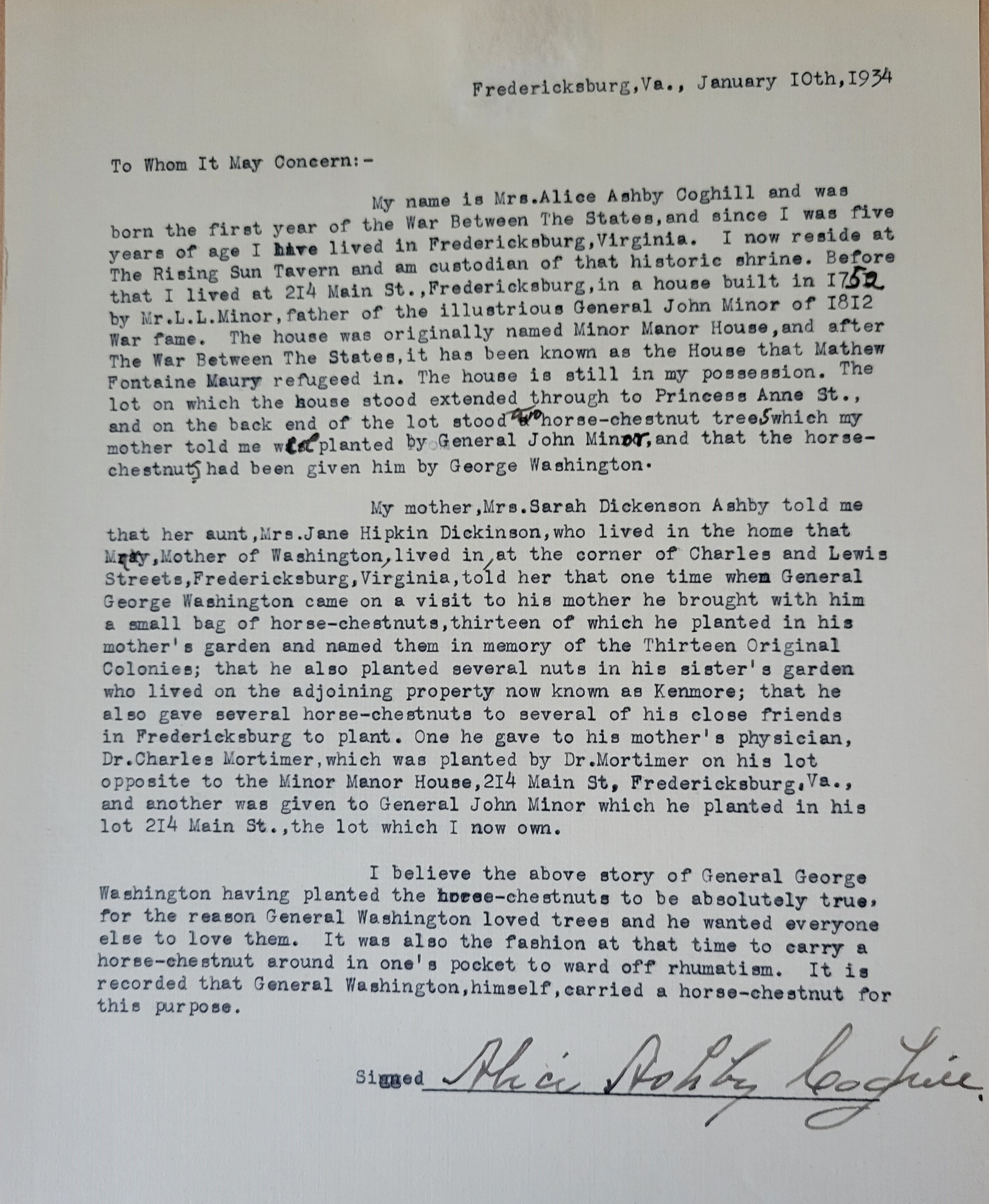
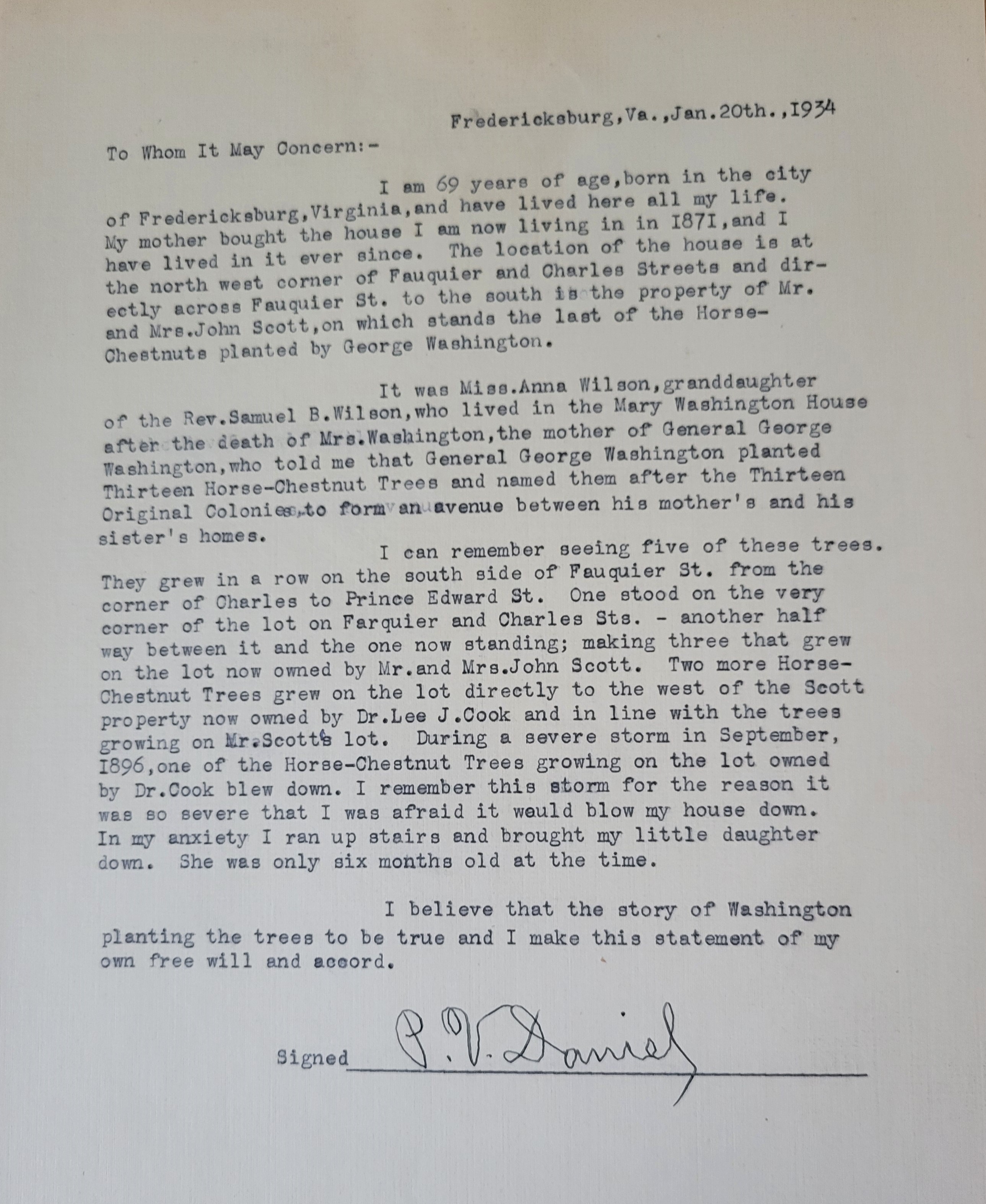
Lastly, local historian James Henry Heron collected local citizens’ recollections of the tree and the story. Mrs. Lilias Hamilton Scott, the wife of Mr. John Scott, who owned the lot on which the tree stands, wrote that her grandmother (Mrs. Janet Scott Hamilton) stated her great-grandmother (Mrs. Francis Scott) resided in Fredericksburg in 1788 and was Mary Washington’s neighbor and intimate friend. She said the trees were planted by Washington.
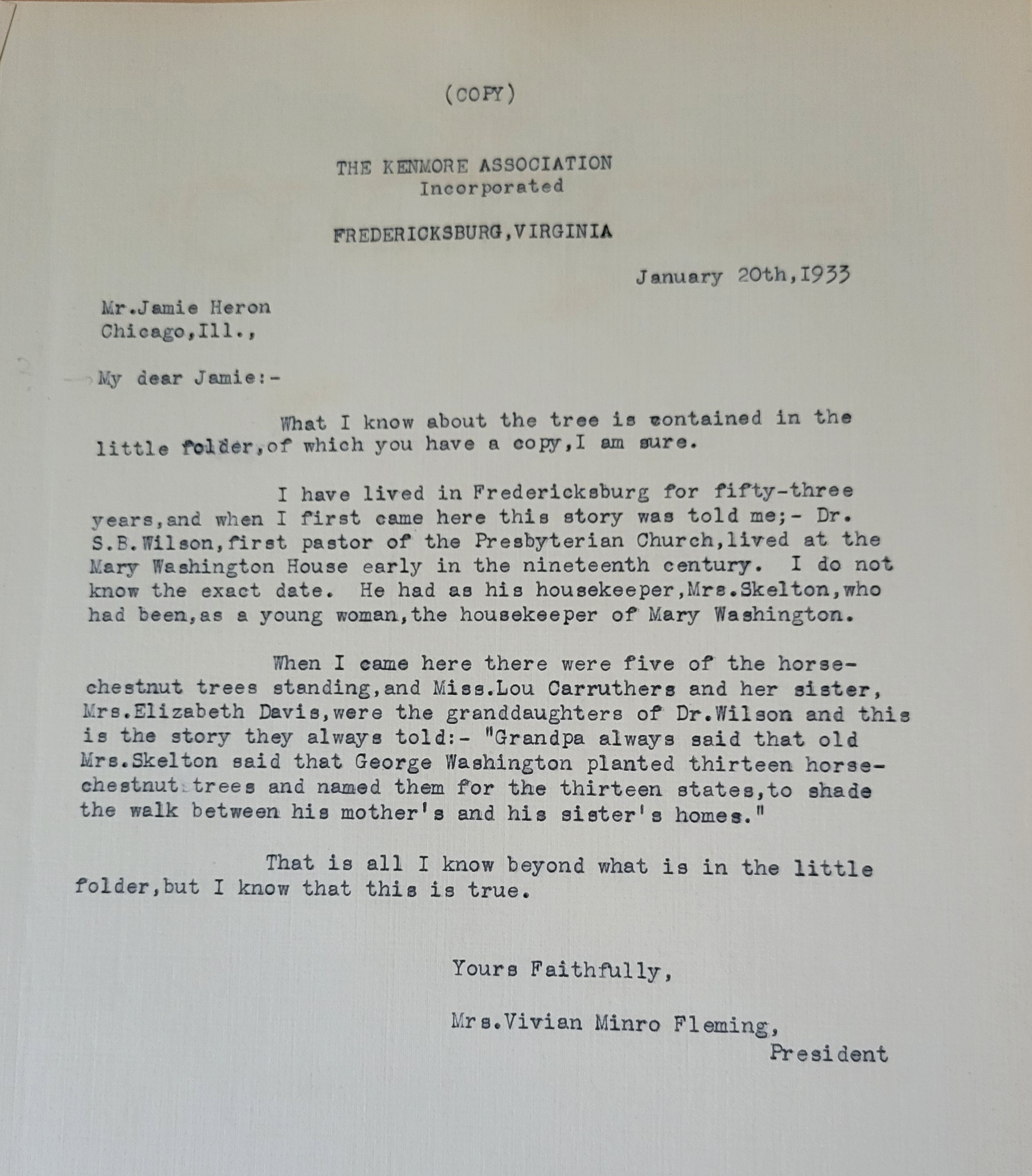
Letter from Mrs. Lilias Hamilton Scott, January 10 1934Letter from Mrs. Vivian (Emily) Fleming Smith, January 20 1933Letter from Mrs. Alice Ashby Coghill, January 10 1934Letter from PV Daniel, January 1- 1934
Mrs. Vivian Minor Fleming traces the story back to Miss Lou Carruthers, her sister Mrs. Davis, and their grandfather Rev. S.B. Wilson’s housekeeper, Mrs. Polly Skelton, who had previously been a housekeeper for Mary. Mr. P.V. Daniel, who remembers five of the original thirteen trees, lived across the street from the remaining one for over sixty years and said Miss Anna Wilson, granddaughter of Rev. S.B. Wilson, told him the story. Mrs. Alice Ashby Coghill says her aunt, Mrs. James Hipkin Dickinson, who lived at Mary Washington House after Rev. S.B. Wilson said Washington planted the trees and passed out horse chestnuts to friends. While I have no doubt these people are truthful in their recollections, they do not offer any definite evidence. They merely document that the legend was a well-known story but not that it was true.
Regardless, the much-loved old tree was rightfully given proper emergency care with a donation and service from Senator Martin L. Davey from Ohio and The Davey Tree Expert Company. The famous tree lived happily for over another half century before being taken down in 2004.
The Last of the Thirteen Horse Chestnut Trees postcard, ca. 1930sWashington’s horse chestnut tree being removed, 2004
Whether this tree was planted by George along with twelve others will probably never be conclusively proven. Were the people wrong to save the tree all those years ago without better evidence? Absolutely not. They saved a beautiful 200-year-old horse chestnut tree with a legendary attachment to George Washington, but they also saved a bit of their own past, nostalgia, and pride in their own town’s history.
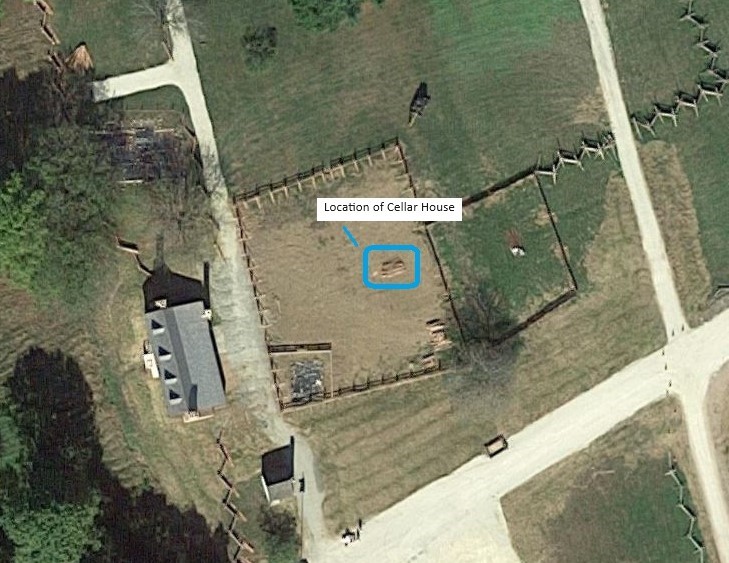
If you have visited Ferry Farm recently or follow us on social media, you may have noticed the construction of two buildings near the Washington House. These new structures represent those that stood in these spots during George Washington’s time and were constructed using 18th-century methods. Identified through archaeology, their reconstructions allow us to tell better the stories of the people who lived and worked at Ferry Farm. We have previously blogged about the Quarter, a building for housing enslaved individuals owned by the Washingtons. For this blog, we will look at an integral structure located behind the Washington dwelling: the Cellar House.
The Cellar House
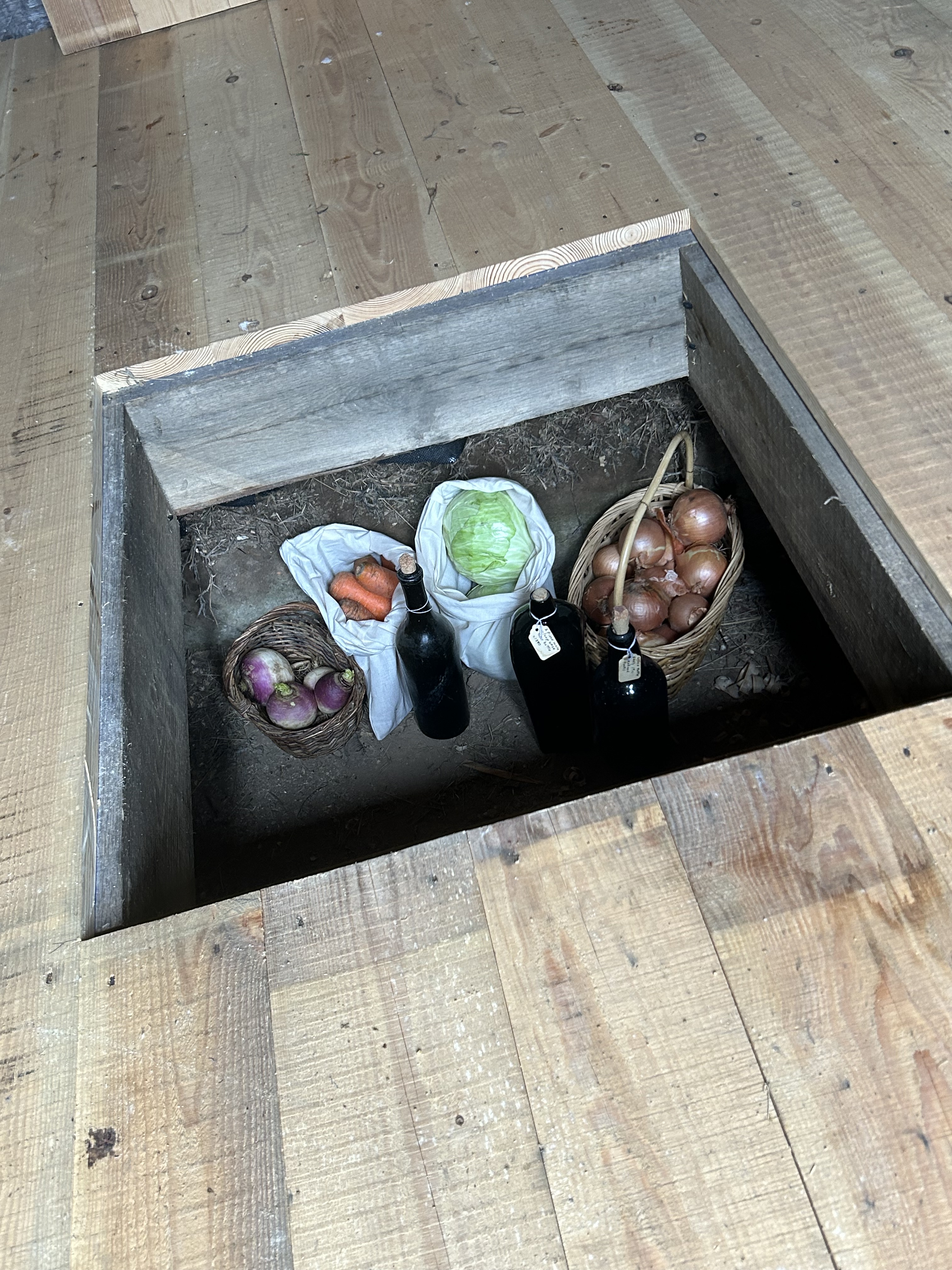
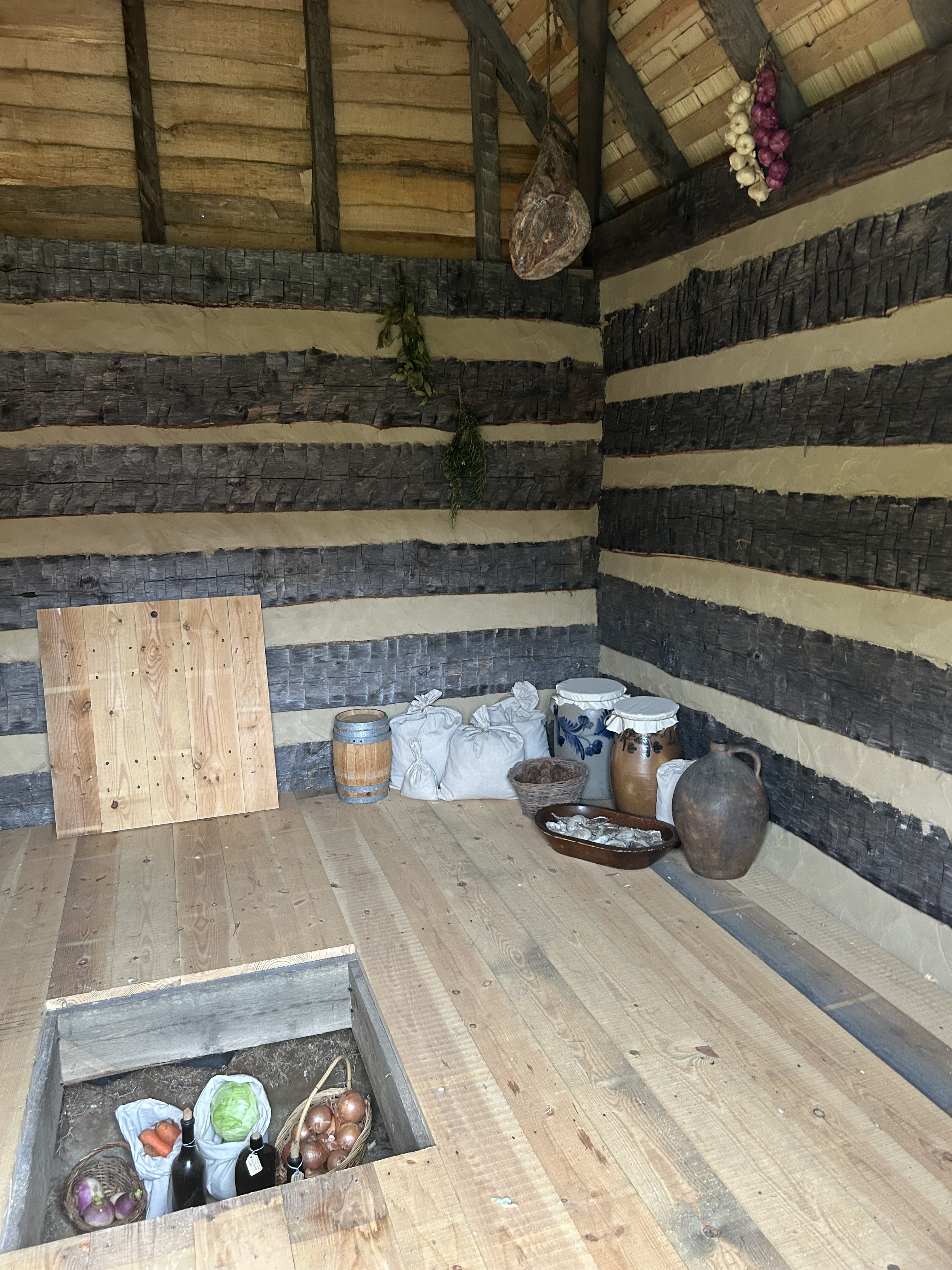
What is a cellar house, you may ask? While explaining it to my 7-year-old son, I told him it is neither a cellar nor a house (by modern standards). At this point, he threw up his arms and gave me up for an imbecilic parent. However, this structure was extremely important for large farms in the 18th century. Picture a simple timber and daub (fancy word for hardened clay) building with four walls, one door, high rafters, no windows, and a three-foot-deep pit beneath its floorboards. It is not fancy or decorative by any standards, yet this building holds preserved food that feeds dozens of people at Ferry Farm during seasons when fresh food is unavailable.
Location of the Cellar House on the Ferry Farm property
Let’s do a brief overview of food preservation during the Washington time period since it has already been touched on in previous blogs. Keeping food from going bad varies from region to region, depending on your climate (combinations of cold, wet, dry, or hot). The hot and humid months in Virginia posed quite a problem for colonists. These conditions do not lend themselves to easy food preservation. Plainly speaking, the East Coast Southern States drew the short straw when it came to keeping food consumable in the long term. As they say, “Where there’s a will, there’s a way,” and Virginians had a wide variety of cards in their deck for keeping food from rotting. Salt, sugar, wood ash, alcohol, vinegar (which was formerly alcohol), and other substances were utilized along with methods including smoking, fermenting, and dehydrating. However, even the best food preservation methods are useless if the resulting food is not stored correctly.
The cellar house could store many different types of foods and beverages, depending on where one kept them in the building. The rafters were ideal for cured meats such as hams, keeping them high and dry. Hooks on the walls held bunches of drying herbs, garlic, and onions. The shelves were perfect for baskets and small crocks of food, while the floor was sturdy for storing large casks or jugs of ale and cider, sacks of grain, and bushels of hardy vegetables and fruits. The pit beneath the floorboards, a glorified ‘cellar,’ was a few degrees cooler in the hot months and a few degrees warmer during the cold season. However, the difference between spoilage and edibility could hinge on maybe 10 degrees, making the subfloor pit essential for colonists who needed to keep some food cooler in summer but warmer (not freezing solid) in winter. Basically, the role the cellar house played varied by the seasons as a revolving door of foods came and went.
Inside of Cellar HouseInside of Cellar House
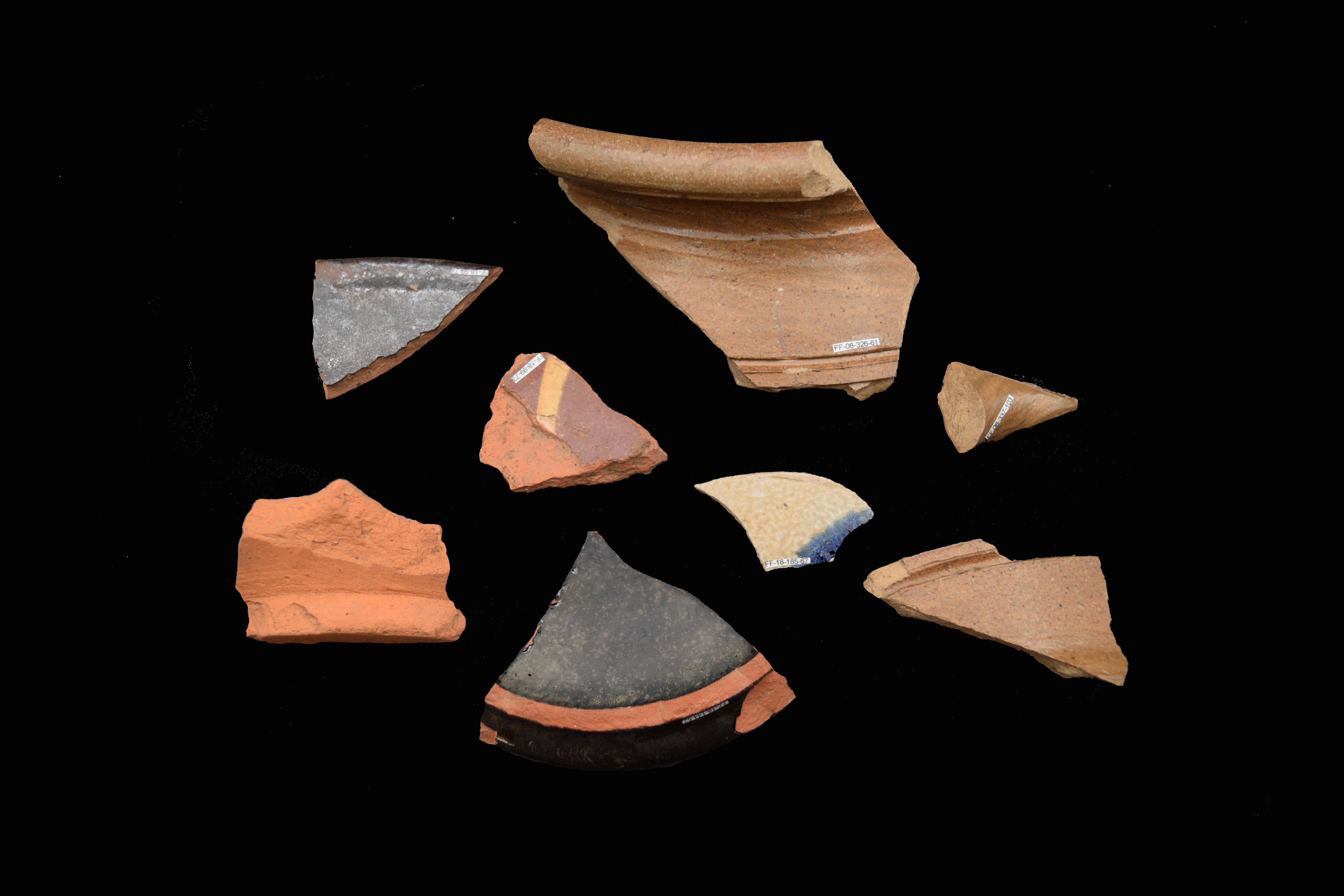
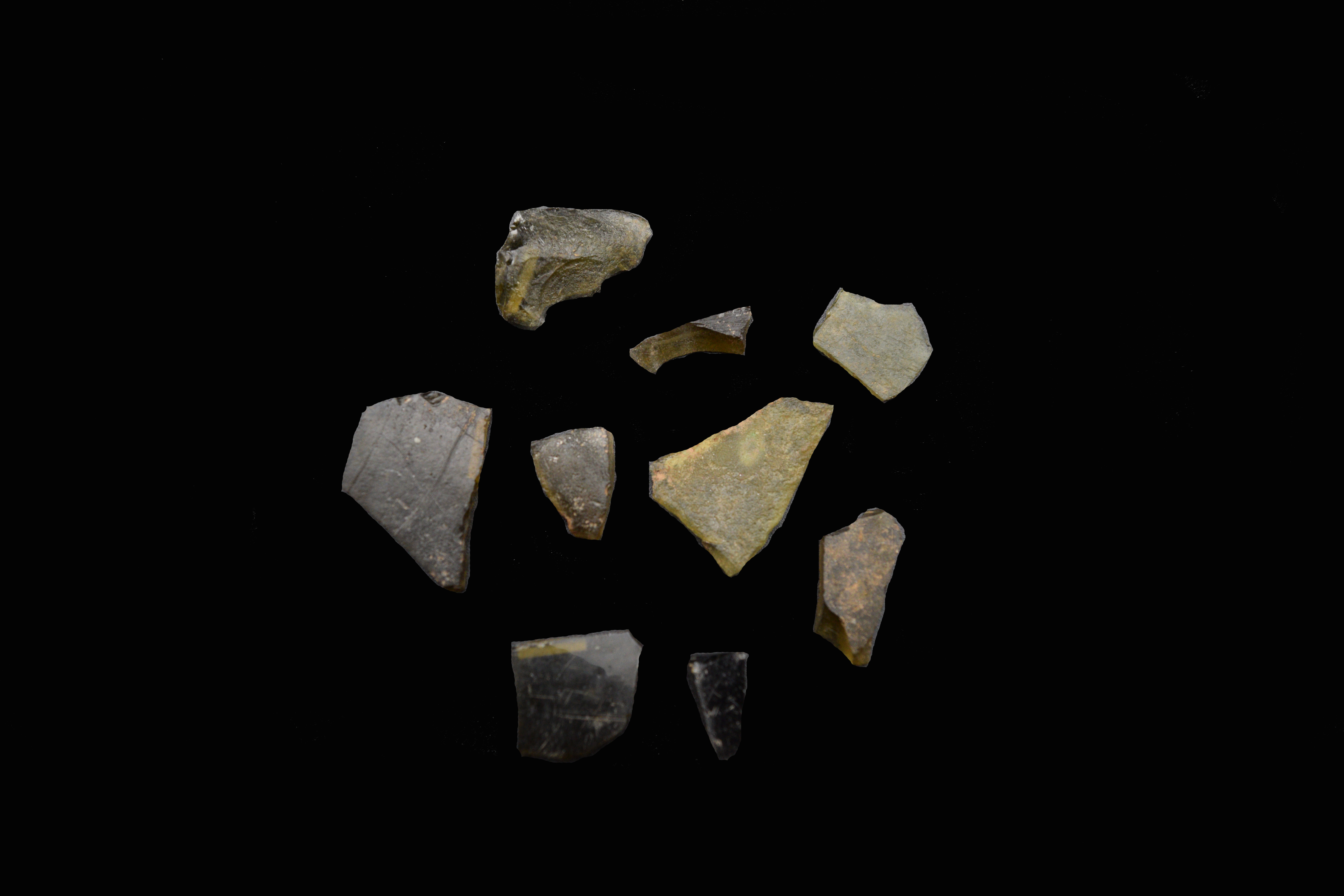
When archaeologists at Ferry Farm excavated the area underneath and around where the cellar house would have been, we found artifacts indicative of such a structure. Namely, very few items would have been found inside and around a dwelling, such as tea and tablewares, byproducts of meals, and valuable personal items. Large storage vessels, metal hooks for hanging food, and wrought nails and daub used to build the structure dominate the cellar house artifacts. The only notable personal items recovered were fragments of smoking pipes. That’s right, the smoke break was a thing even among enslaved workers stacking food inside the cellar house.
Ceramics from the Cellar HouseFaunal finds from the Cellar HouseGlass finds from the Cellar House
The cellar house is currently fully constructed, but we have yet to populate it with all of the storage vessels, food, smoking pipes, and other accouterments of a storage building. Eventually, visitors will be able to look into this building and take a trip back to the mid-eighteenth century with crocks, jugs, bottles, sacks, barrels, and baskets full of food and drink. All of which will be informed by the historic records and the artifacts recovered by our archaeologists, as with all the reconstructed buildings at Ferry Farm. Then, perhaps when I show the building to my son, he’ll see its importance: part pantry, part colonial refrigerator, and all cellar house.
If you have visited Ferry Farm recently or follow us on social media, you may have noticed the construction of two buildings near the Washington House. These new structures represent ones that stood in these spots during George Washington’s time. Identified through archaeology, their reconstructions allow us to better tell the stories of the people who lived and worked at Ferry Farm. For this blog, we will look at the structure adjacent to the Washington House along the embankment overlooking the Rappahannock: The Quarter.
What’s in a Name?
First, we need to define what we mean when we call the structure “the Quarter.” Regarding enslaved life, the term “quarter” can refer to several different situations. Generally, it refers to a structure that housed enslaved individuals with “quarter,” equating to a living space or personal quarters. The term has nothing to do with the number and makeup of the occupants or the appearance of the building. The other use for the term refers to a group of enslaved people. Augustine Washington’s probate inventory lists seven enslaved people at Ferry Farm’s “satellite quarter” (Fig. 1). In this use, it does not refer to a single physical structure but rather a group of people and their housing unit that moved around. “The Quarter” uses the term for a single structure, identified through archaeology, that housed an enslaved family in the heart of the Ferry Farm plantation.
Figure 1: Section of Augustine’s probate inventory listing individuals at the satellite “quarter”
Enslaved Housing
Living conditions varied widely across the Mid-Atlantic and even within a single plantation. Customarily, enslaved people lived where they worked. Work yard structures included living quarters above the workspace while the fields had structures akin to dormitories that housed people divided by biological sex. In certain cases, independent structures may have served as housing for single family units (Fig. 2). Those that lived within these spaces generally held high ranking positions within the hierarchy established by enslavers. Housing generally stood outside public view and in areas convenient to the work undertaken by the inhabitants. Quarters within sight of the public served as status symbols for the gentry.
Figure 2: 1860 engraving depicting single quarters in South Carolina (Slavery Images)
Identifying quarters today largely comes from historic records, oral history, archaeology, and architectural features. All of this can help establish a range of appearances for such structures. When a building no longer remains standing, these observations can be compared to artifacts uncovered at the site to determine its identity. Sub-floor storage pits, often located near hearths, serve as key architectural identifiers, while artifacts that reflect African diaspora culture, outdated items, and evidence of labor help pinpoint the identities of the inhabitants. Quarters served as the only personal spaces allotted to enslaved people, so any artifacts recovered can speak to their personal identities rather than those defined by Virginia colonials.
Archaeological Evidence
The excavation of the Quarter occurred in 2003, and research in successive years helped to identify its role and understand the lives of its inhabitants.
Architecture: When excavated, little remained of the Quarter, but the architectural elements present and absent provided enough information to understand its appearance. Archaeologists recovered small quantities of Aquia sandstone around the quarter indicating it may have had a light stone foundation and hearth. The main impact it had on the ground surface occurred through the creation of a sub-floor pit. These pits frequently appeared in quarters and served as storage areas for the occupants’ personal effects. Unfortunately, a tree later intruded a portion of the pit and the surrounding area thus making it difficult to study (Fig. 3). Other architectural elements included an abundance of nails and an absence of window glass (Fig. 4). This indicates the building had clapboard siding and likely shuttered windows in place of glass ones.
Figure 3: Quarter Excavation SiteFigure 4: Nail distribution around Quarter
Tableware (Fig. 5): Within the eighteenth-century contexts, we recovered many ceramics and utensils of European origin. White-salt glazed stoneware dishes and dog-nosed spoons represent styles in decline by the 1740s. This indicates that the enslaved occupants either received hand-me-downs from the Washingtons, a common practice, or purchased used items in the local market. A colonoware bowl served as an exception. A local ceramic type attributed to free and enslaved black communities, colonoware production mixed African ceramic techniques with European vessel forms.
Figure 5: Tableware (L-R white salt glazed stoneware, dog-nosed spoon handle, colonoware bowl, table knives)
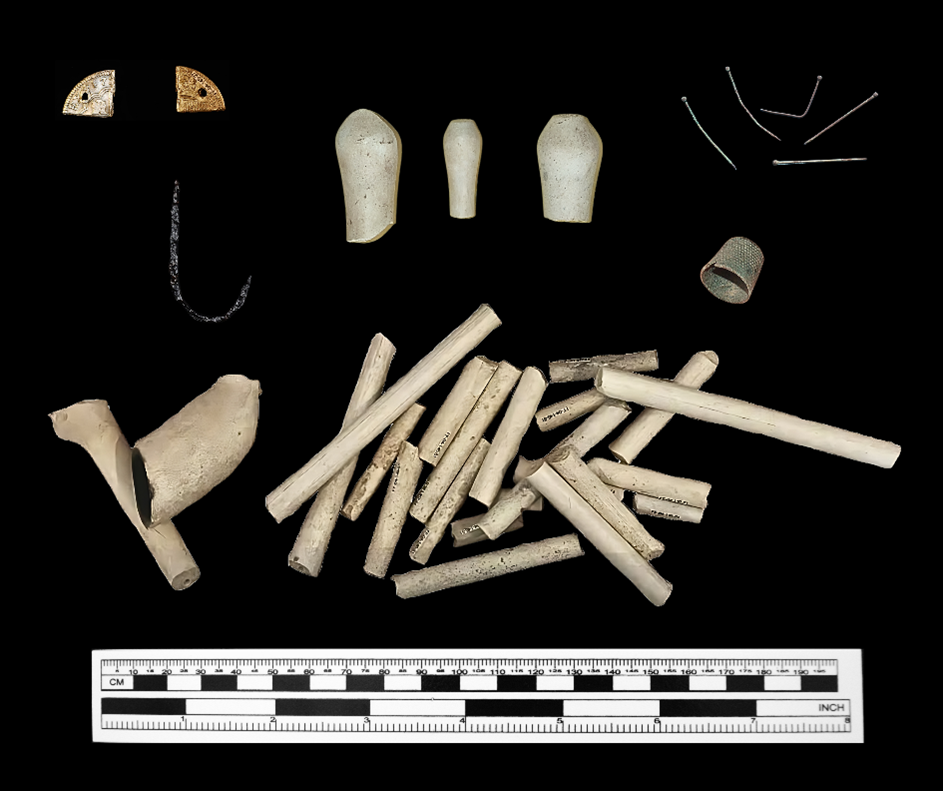
Small Finds (Fig. 6): Analysis of the artifacts revealed the personal effects of the occupants, their possible identities, and the labor they carried out. Wig curlers appear frequently throughout Ferry Farm, but the recovery of several at the Quarter indicates that the individual(s) tasked with maintaining the Washington wigs may have lived within. Sewing implements, such as thimbles, reflect labor carried out by enslaved women and girls either for the Washingtons or for themselves. A common practice in colonial Virginia saw each enslaved person receive a ration of cloth from which they fashioned their own clothing. Straight pins further indicate the presence of female occupants as these pins held their garments, such as bed gowns, together. Both genders used the numerous tobacco pipes recovered. The fishhook speaks to an entirely personal activity, as enslaved communities often supplemented their food rations by fishing. The pierced coin serves as the artifact most indicative of enslaved culture. Piercing a coin allowed the owner to keep it on their person as a form of adornment. Such coins often served as talismans, though they could re-enter the economic world as needed.
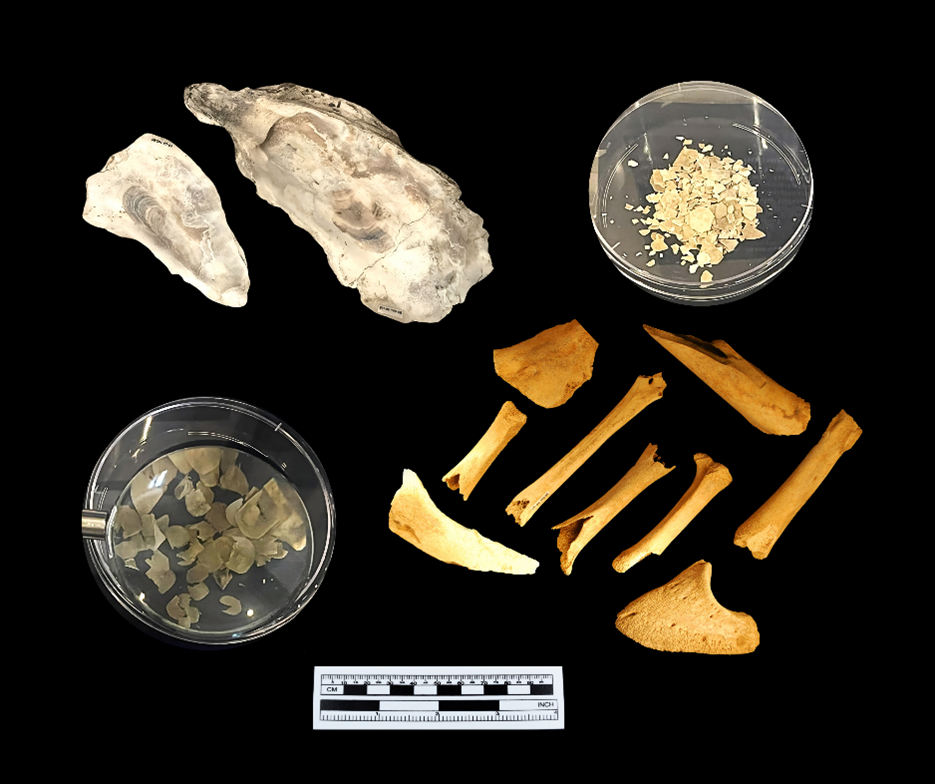
Diet (Fig. 7): Faunal remains found at the Quarter supplement the information provided by the fishhook. As expected, we identified several fish species including types of perch, catfish, and sunfish which lived in the Rappahannock at that time. Other animals included cattle, chickens, pigs, opossum, and shellfish, such as oysters. This mix of domestic and wild species indicates that the Quarter’s occupants supplemented the rations supplied by the Washingtons. The enslaved commonly achieved this by maintaining small gardens and raising chickens, hunting, fishing, and foraging. While we did not recover any plant remains, those consumed by the inhabitants likely reflected a similar mix of wild and domestic species.
Figure 7: Faunal (L-R Oyster shells, eggshells under microscope, fish scales/bones under microscope, various mammal bones)
Reconstruction and Interpretation
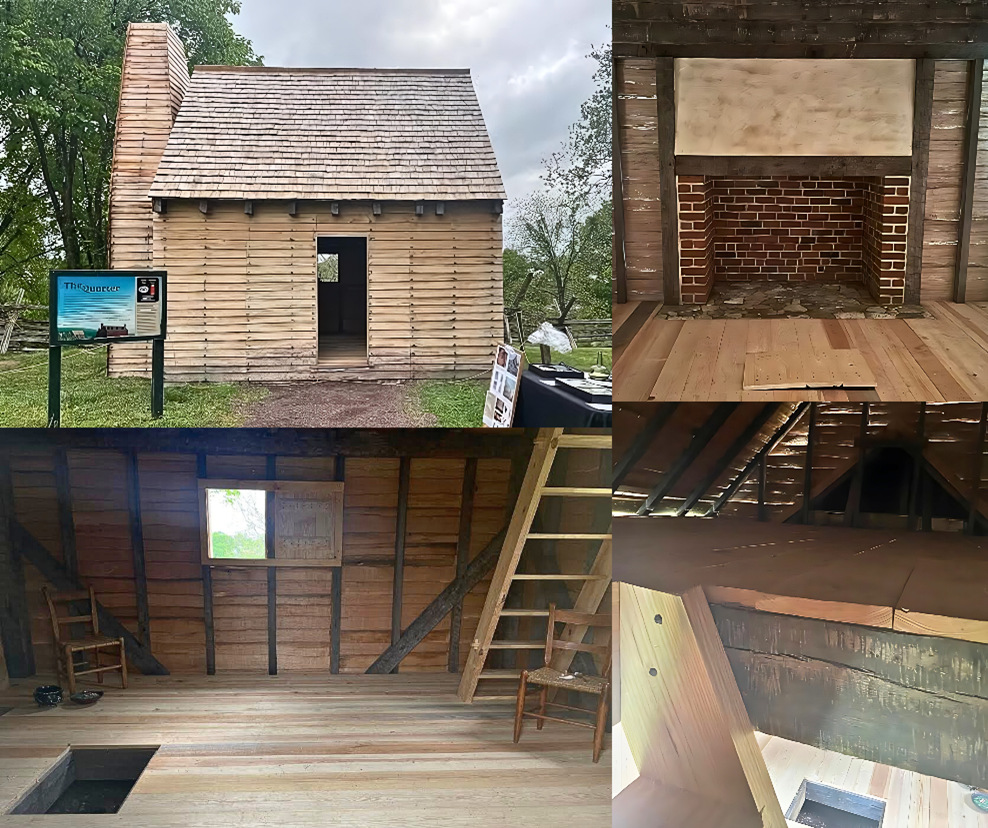
The reconstruction of the Quarter combined our archaeological evidence with the historic knowledge of enslaved housing (Fig. 8). The finished Quarter measures 16’x14’ which aligns with standard measurements for single-family quarters. From our archaeology, it has clapboard siding, sliding shutters in place of glass windows, a subfloor pit, and sandstone hearth. Information on contemporary quarters led to the inclusion of a loft and a daub lined wood chimney. Architects used eighteenth-century techniques to reconstruct the building.
Figure 8: The Quarter, various views
From our findings, we concluded that the quarter housed a single family. At least one of these individuals held a high-ranking position within the labor hierarchy allotted these living arrangements (Fig. 9). The structure’s proximity to the Washington House and work yard indicates the occupants worked within these spaces. The position on the bluff overlooking the Rappahannock meant that this quarter, unlike others, lay in view of the public. “The prominent placement of this structure on the landscape may mean that it was used to reinforce Washington’s prominent social standing in colonial Virginia.”
Figure 9: Portion of Augustine’s probate inventory listing individuals at Ferry Farm; some may have called the Quarter home
The Quarter will open to visitors this fall, and visitors will be able to read about and visualize the lives of those who lived within. Like the Washington House, everything that furnishes the Quarter will be interactive and reflect archaeological finds. Planning remains ongoing for this, but when complete, visitors may find outdated tableware, evidence of meals, tools for labor, and personal effects.
Emma Schlauder
Research Archaeologist
Bibliography

Augustine Washington Probate Inventory, 1743

Carson, Cary & Carl Lounsbury (editors)                                                                                                  2013     The Chesapeake House: Architectural Investigation by Colonial Williamsburg. The University of North Carolina Press, Chapel Hill, NC.

Katz-Hyman, Martha B. & Kym S. Rice (editors)                                                                                       2011     World of a Slave: Encyclopedia of the Material Life of Slaves in the United States. Greenwood, Santa Barbara, CA.

Lanier, Gabrielle M. & Bernard L. Vlach                                                                                                     1997     Everyday Architecture of the Mid-Atlantic: Looking at Buildings and Landscapes. The John Hopkins University Press, Baltimore, MD.

Lounsbury, Carl R. (editor)                                                                                                                  1994     An Illustrated Glossary of Early Southern Architecture and Landscape. University Press of Virginia, Charlottesville, VA.

Samford, Patricia                                                                                                                                       1996     The Archaeology of African-American Slavery and Material Culture. William & Mary Quarterly 53(1): 87-114.

2000     Power Runs in Many Channels: Subfloor Pits and West African-Based Spiritual Traditions in Colonial Virginia. Doctoral Dissertation, Department of Anthropology, University of North Carolina, Chapel Hill. University Microfilms International, Ann Arbor, MI.

Stilgoe, John R.                                                                                                                                          1982     Common Landscapes of America, 1580-1845. Yale University Press, New Haven, CT.

Wells, Camille                                                                                                                                        1993     The Planter’s Prospect: Houses, Outbuildings, and Rural Landscapes in Eighteenth Century Virginia. Winterthur Portfolio 28(1): 1-31.

Vlach, John M.                                                                                                                                           1993     Back of the Big House: the Architecture of Plantation Slavery. The University of North Carolina Press, Chapel Hill, NC.
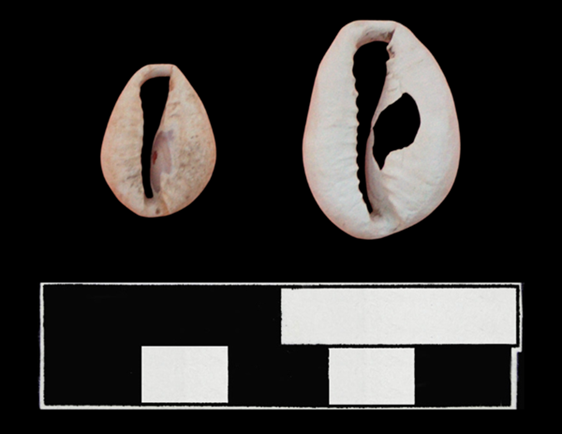
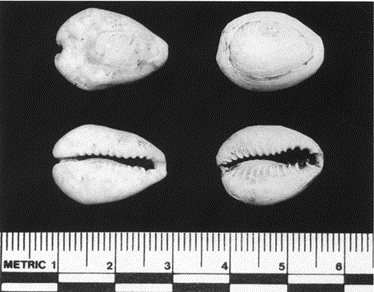
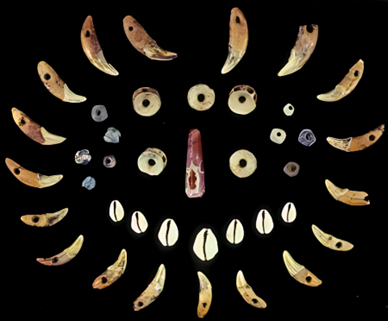
Many readers will undoubtedly recognize these two artifacts (Fig. 1). Known as cowrie shells, these artifacts have become synonymous with slavery and serve as identifiers for the presence of free and enslaved Black individuals in the Americas. Still, the role of cowries in the 18th century goes far beyond that of a marker.
Origin
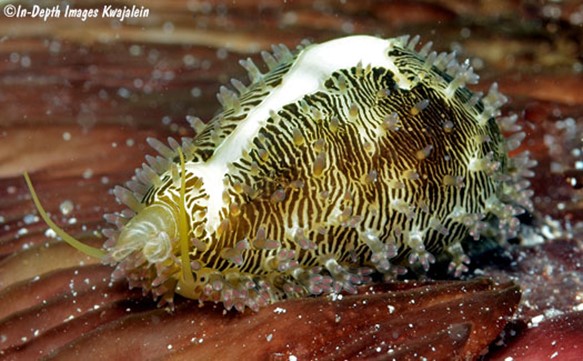
Cowries (Cypraeidae), a taxonomic family of sea snail, live throughout the world (Fig. 2). However, the species with the most relevance to the 1700s reside in the Indo-Pacific region, particularly in the waters around the Maldives. They include Monetaria annulus (alt. Cypraea annulus, Annulus Linnaeus) and Monetaria moneta (Fig. 3). Even if your Latin proves non-existent, each species’ genus, along with M. moneta’s epithet, easily identifies the original role cowries played in human hands – money.
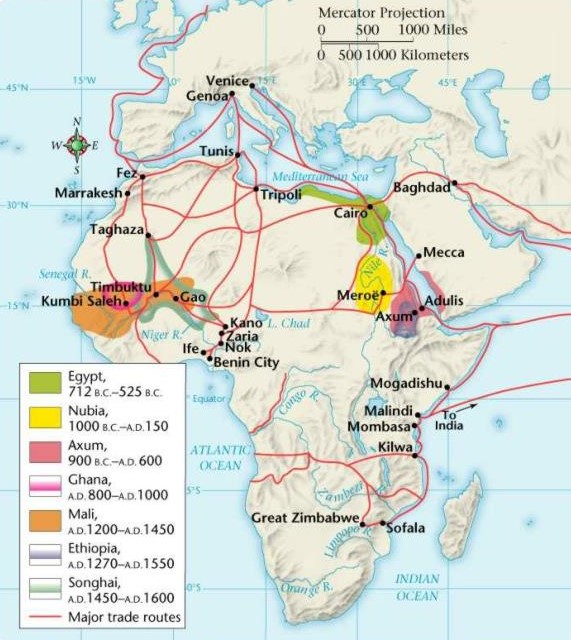
Centuries before the 1700s, West Africa thrived as a region of independent kingdoms and tribes. With these groups engaged in trade, they required a shared currency that served as a medium of exchange and a store of value. In choosing cowries as currency in the fourteenth century, West Africa continued a long history of groups throughout the world using shell money. Through pre-existing trade routes to the Indo-Pacific, West Africans could easily import the shells via other parts of Africa and had them transported across the Sahara. As the cowries used did not reside in West Africa and proved difficult to forge, the market had built in protections against hyperinflation and counterfeits.
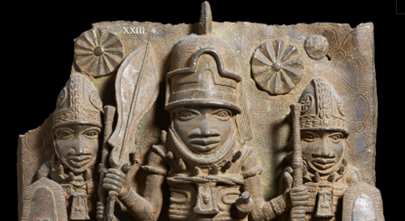
Once in West Africa, the shells served as the basis of the region’s economies. Still, the shells took on several cultural roles. To keep cowries on hand, the shells often underwent modifications, including slicing off the rounded side of the shell or piercing them (Fig. 4). This allowed for stringing them together and weaving into hair or onto clothing. While done for practical reasons, this led cowries to enter the world of personal adornment. With this, their role expanded to symbols of status, fertility, and beauty while further appearing on ceremonial garb (Fig. 5).
Figure 5: Benin Bronze plaque; 16th-17th century. The warriors on either side of the central figure wear helmets decorated with cowries British Museum
Atlantic Trade Routes
Europe and Africa had a long history of trade and exchange networks prior to the late 1400s, but the boom of global exploration led to an immediate escalation of these market connections. With European nations expanding their territories abroad and seeking to gain resources not found within their borders, they developed a need to break into the African markets while establishing permanent trade posts in the region. To achieve this, Europeans needed to supply goods that were in demand, and their minds set upon cowries.
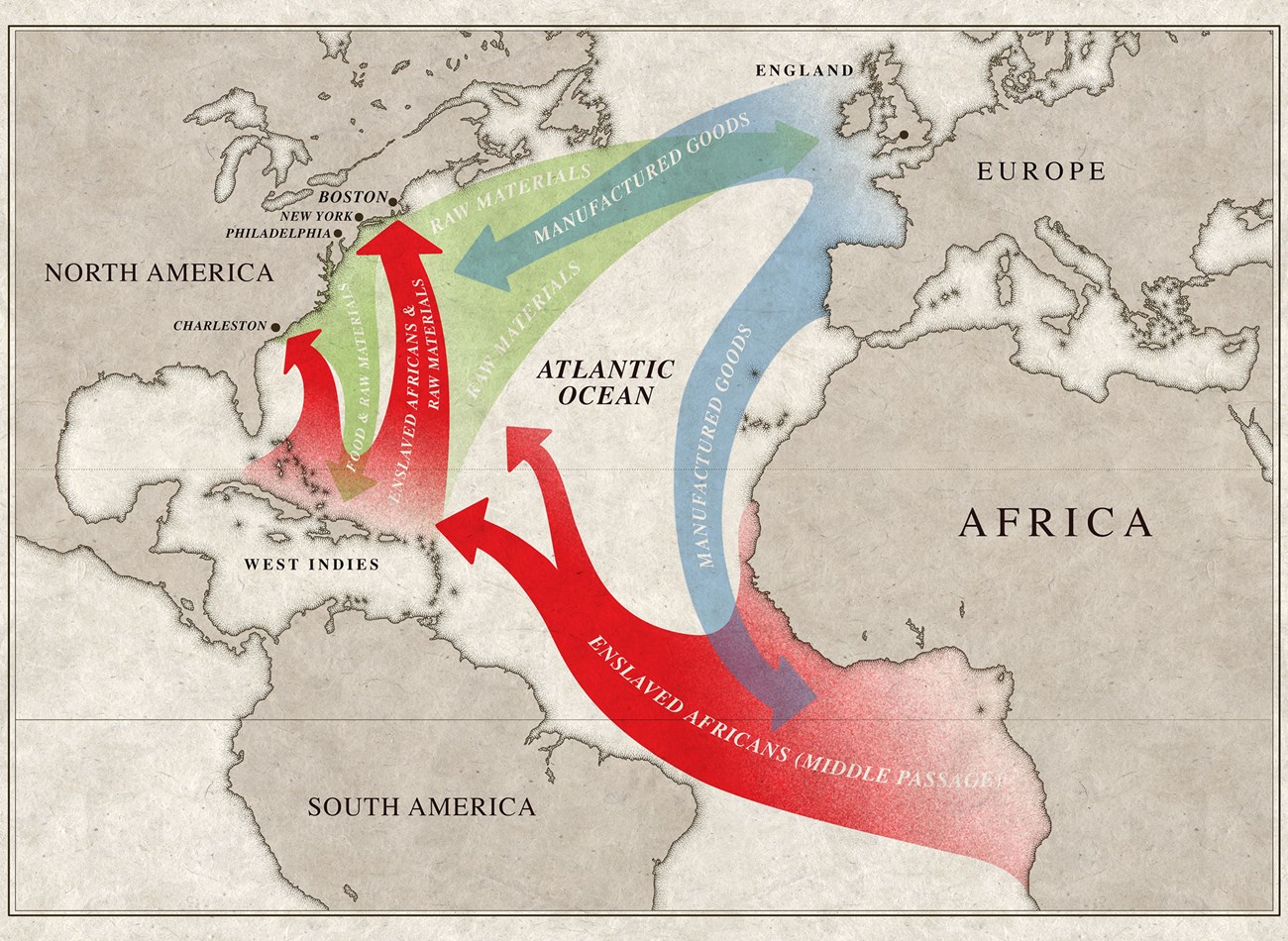
Map by Adrian Kitzinger from Sahel: Art and Empires on the Shore of the Sahara West African Kingdoms and Trading StatesMap centered on the Atlantic Ocean with colored arrows showing movement of Enslaved Africans to the Americas, Raw Materials from Americas, and Manufactured goods from Europe Map showing the primary movement of Enslaved Africans, raw materials, and manufactured goods
While an item of currency and self-adornment to West Africans, cowries became a commodity in the hands of European, and later American, merchants. With cowries, merchants could navigate the local economy and barter for desired goods. Inevitably, this included kidnapped Africans. In his memoir, Olaudah Equiano (c. 1745-1797), a famed writer and abolitionist, recalled how one enslaver sold him to another for 172 “little white shells” while still in Africa. An examination of eighteenth-century shipping records reveals that cowries ranked amongst the most common goods transported to West Africa and used to trade for captives (Fig 6). For Africans who then faced the Middle Passage, they forcibly traveled aboard these same ships that in turn provided West Africa with the currency driving the economy and their enslavement — cowries.
Figure 6: List of goods imported to the Isle of Man via Rotterdam for trade in Africa, 1761 Manx National Heritage
Cowries in the Americas
Indo-Pacific cowries arrived in the Americas through several carriers, but ultimately all traveled on slave ships. In trading cowries to West Africa, foreign merchants supplied both types even though the market preferred M. moneta. As such, they often had leftover M. annulus which remained onboard as cargo and ballast when the ships continued their trans-Atlantic journeys. Once in the Americas, some captains elected to dump or sell off the remaining cowries rather than transport them back across the Atlantic. Cowries additionally arrived in the Americas on the bodies of kidnapped Africans. While common practice involved stripping captives in Africa, primary accounts report individuals retained beads and shells in their hair and as necklaces. Enslavers further distributed beads, and likely shells, as pacifiers during the Middle Passage.
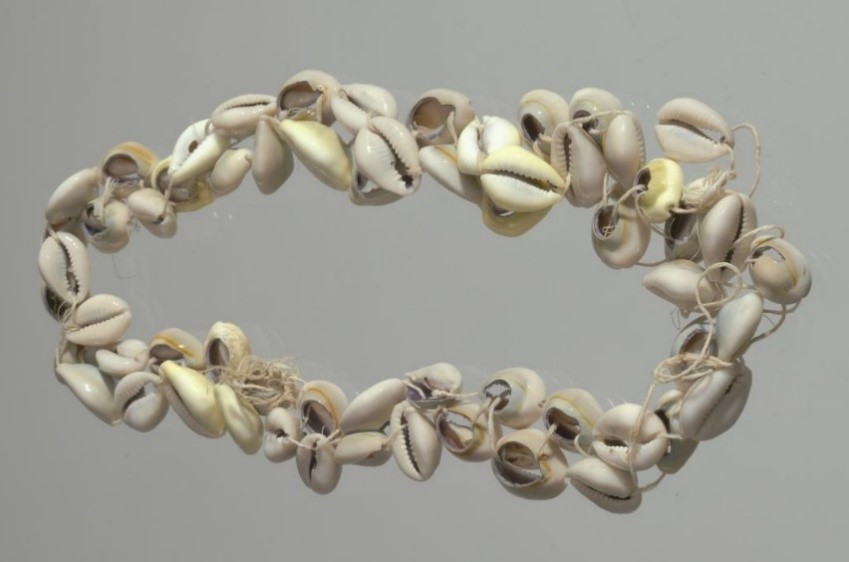
Once in the Americas, cowries largely remained within Black communities though they did face geographical restrictions. For Virginia, archaeological distribution of the shells, mainly M. annulus, places them within the Tidewater region. Higher counts of shells appear in urban areas (Yorktown = 252) while plantations typically only have a few. Although Virginia’s current archaeological cowrie count falls above 353, this remains too few to support the traditional role as currency. Instead, the shells continued in roles of adornment and ritual with added symbolism of cultural loss, memory, and survival. Outside random finds in areas associated with enslavement, cowries recovered in the Americas have derived from burials, spirit caches, and sub-floor pits (Fig. 7).
Figure 7: Necklace recovered from an enslaved burial ground at Newton Plantation, BarbadosJerome Handler
At Ferry Farm
Over the course of our twenty-plus year excavation, two cowries have appeared at Ferry Farm. Found in contexts located around the Washington House, including one in a root cellar, our shells represent M. annulus and have undergone modification to allow for stringing or weaving (Fig. 8). As with findings in previous studies, we believe these shells took on cultural roles through self-adornment. Despite not knowing the identity of the shells’ owner(s), the cowries provide enough information to form an interpretation of who they belonged to and how they arrived at Ferry Farm.
Figure 8: Ferry Farm cowries with modifications visible
As their contexts of origin line up with the Washington House, the enslaved individuals who left them behind likely lived and worked close to the Washington family. This places them within the working realm of the house or the nearby work yard. For accommodation, the owner(s) may have occupied the Quarter adjacent to the Washington house or lived in one of the work yard’s support buildings.
Regarding the arrival of cowries on the plantation, this likely happened through the movement and exchange of people and goods. To provide the labor required to meet their goals, enslavers moved those they enslaved between different plantations as needed and expanded their workforce through the enslavement of more people or hiring of persons enslaved by others. This could account for the arrival of cowries at Ferry Farm. Alternatively, Ferry Farm’s proximity to the (port) city of Fredericksburg meant the enslaved community had access to a regional economy and trans-Atlantic vessels. Either network may have transported cowries to the city, but it additionally meant that Fredericksburg served as a meeting and trade point for those enslaved in the region.
Legacy
Cowries have a long and nuanced history in the Atlantic World. Beginning as a unit of currency and cultural symbol, cowries fell prey to the demands of the market, taking on a new role in the hands of foreign merchants. What once served to strengthen economies and nations suddenly worked to strip away the very people who inhabited West Africa. For those who endured enslavement, the cowries that accompanied them became symbols of a stolen home, a continuation of culture, and a determination to survive. Today, cowries remain important items in African and African American cultures by symbolizing their history as currency, continuing in self-adornment and ritual roles, and appearing prominently in works of art (Fig. 9-11).
Alpern, Stanley B.                                                                                                                                                  1995     What Africans Got for Their Slaves: A Master List of European Trade Goods. History in Africa 22: 5-43

Equiano, Olaudah                                                                                                                                    1789     The Interesting Narrative of the Life of Olaudah Equiano, Or Gustavus Vassa, The African. Written By Himself. London, UK

Handler, Jerome S.                                                                                                                                                            2006     On the Transportation of Material Goods by Enslaved Africans During the Middle Passage: Preliminary findings from Documentary Sources. African Diaspora Archaeology Newsletter 9 (4): 1-22 (Article 16).

2007     From Cambay in India to Barbados in the Caribbean: Two Unique Beads from a Plantation Slave Cemetery. African Diaspora Archaeology Newsletter 10(1): 1-10 (Article 1)

Heath, Barbara J.                                                                                                                                                2016     Cowrie Shells, Global Trade, and Local Exchange: Piecing Together the Evidence for Colonial Virginia. Historical Archaeology 50 (2): 17-46.

National Museum of African American History & Culture                                                                        n.d.     Cowrie Shells and Trade Power. National Museum of African American History & Culture, Smithsonian, Washington D.C. <https://nmaahc.si.edu/cowrie-shells-and-trade-power>. Accessed 3 June 2024.

Ogundiran, Akinwumi                                                                                                                                                            2002     Of Small Things Remembered: Beads, Cowries, and Cultural Translations of the Atlantic Experience in Yorubaland. The International Journal of African Historical Studies 35 (2/3): 427-457.

Pallaver, Karin                                                                                                                                                 2023     Cowries, the currency that powered West Africa. ReThink Quarterly 7 <https://rethinkq.adp.com/artifact-cowries-west-africa/>. Accessed 3 June 2024.

Pearce, Laurie E.                                                                                                                                              1992     The Cowrie Shell in Virginia: A Critical Evaluation of Potential Archaeological Significance. Master’s thesis, Department of Anthropology, College of William & Mary. University Microfilms International, Ann Arbor, MI.

Radburn, Nicholas J.                                                                                                                                       2009     William Davenport, the Slave Trade, and Merchant Enterprise in Eighteenth-Century Liverpool. Master’s thesis, Department of History, Victoria University of Wellington, Wellington, New Zealand.

Samford, Patricia                                                                                                                                              1994     Searching for West African Cultural Meanings in the Archaeological Record. African Diaspora Newsletter 1 (3): 1-3 (Article 2).
In 2020, many of us spent a great majority of our time at home. This gave us the opportunity to get creative and explore new hobbies. One such hobby that became a viral sensation, plastered across social media, food blogs, and television news outlets, was that of baking bread. Bread has been around in some form for nearly as long as human civilization, although before industrialization, it was a means to survive, not just a fun challenge for the amateur baker. So here is a crumb of history on bread and what this glutinous baked good was like in Colonial America.
To start with the basics, bread is made up of 3 simple ingredients: Flour, water, and a leavening agent. Typically salt and some kind of sweetening, like sugar or honey, are also added. Everything else is extra.
Wheat flour was (and still is) the most common ingredient used for bread. Wheat quickly became a desirable crop in Colonial America. We can infer wheat was grown on Lewis family land based on documentation of family members paying for goods in wheat. Biological remains in the ground found by archaeologists at Ferry Farm suggest wheat was planted there too. Wheat and other crops were planted, cared for, and harvested by enslaved laborers on both plantations. Wheat specifically was a difficult crop to care for, requiring vast knowledge and careful timing to produce a fruitful harvest. Wheat is a form of grass, usually not well digested or particularly nutritious to humans. When wheat is ground into flour, put through the fermentation process of breadmaking, and baked, it becomes far more digestible, nutritious, and caloric for people to eat. For most of Europe’s history, bread was about half of calorie intake for poorer classes, and wheat still makes up about 20% of people’s diets today.
In the early 18th century, sieves made of fine Chinese silk that allowed for separating the bran from the wheat seed made whiter flour easier to obtain. Although the bran is the most nutritious part of wheat, it quickly became associated with the poor and lower classes in many Western European cultures. White bread was a sign of wealth. This led to bakers putting additives like alum, lime, and chalk into bread to make it whiter. Despite British Parliament passing laws regulating ingredients allowed in bread, it continued to be an ongoing issue throughout the 18th and 19th centuries.[1] Even with contemporary knowledge about the benefits of whole grains, 70% of bread baked today is white, based on this century old principle of white flour’s superiority.[2]
By the time Colonial America comes into the picture, bread is engrained into life. This is so much so that most 18th century cookbooks do not have bread recipes in them as it is assumed everyone already knows how to make basic table bread. That’s right, Hannah Glasse does not have a simple bread recipe in The Art of Cookery. It is just the three simple ingredients worked into a dough with the hands that is set aside to rise, then baked until a strong crust forms, after all. This is something foreign to us in a time when sliced bread is $1.99 in the supermarket. There is no need for us to spend hours baking bread ourselves in this modern age, but when you made bread every week or every day, it was something as simple as getting dressed or brushing our teeth is now.
Kneading bread dough in a wooden dough bowl.
In urban areas, bakers were trained in the art of breadmaking, but in rural places, it was left to the individual household to make their own bread. Trained or not, the science behind breadmaking on a molecular level was not understood until the 19th century. What they did know was that they needed a leavening, or rising, agent in their bread to ensure it rose properly. Leavened bread came into existence in Egypt about 6,000 years ago. Bread could be made without a rising agent, but it would be a completely different texture. In the 18th century, leavening agents came from a few different places. Barm is the frothy substance on the top of beer after production and is the perfect rising agent for bread, making connections between bakers and brewers in urban areas imperative. Also, just leaving dough to sit for a day or two to collect the bacteria in the air, from the kneader’s hands, and from the dough bowl with leftover dough bits can also be enough to leaven a batch of dough.[3] This method of collecting bacteria from the dough’s surroundings is reminiscent of creating a sourdough starter.
Loaves of bread were placed into a bake oven, a large cast iron Dutch oven, or on a hot hearth. Regulating temperature was up to the expertise of the cook or baker, there was no temperature dial like we have on our modern oven. And despite this, when the temperature is kept controlled, the baking process takes about the same amount of time as it does in a modern oven. The physical baking process is about the same both ways.
Bread cooking in dutch oven.Bread cooking in dutch oven on the hearth
Whether you prefer white or whole wheat bread, I hope this entry has given you a grain of insight on the importance of bread throughout history. Breaking the bread down in this article may make it sound simple, but I will say from experience that getting the dough smooth, the crust tender, and the crumb coat correct is no easy task. Put that loaf over coals from the hearth and you add a whole new element of challenge. Reflect on the enslaved cook at Kenmore or Ferry Farm who was responsible for not only making bread, but three meals a day, along with planning and prepping ingredients for future meals. Cooking and baking in an 18th century kitchen were physically and mentally challenging, making it one of many difficult jobs for those enslaved on southern plantations. I suggest everyone try baking a loaf for themselves. To me, it is a task that humanizes food production and reminds us of its delicate nature now and throughout time.
Loaves of bread made on the hearth at Kenmore for Taste Through Time program.
Archaeologists tend to have strong feelings about ceramics. Ceramics can play a major role in interpreting a site, as their materials often reflect their function. This can be helpful when determining how a site was used. For instance, finding an abundance of redwares and stonewares could indicate a primarily utilitarian site like what would have been used in our Cellar House whereas porcelain and refined earthenwares may reflect a more domestic space. So, it really isn’t surprising that we feel some type of way about these artifacts.
Redware and stoneware storage vessels Porcelain and refined earthenware tablewares
But don’t let that fool you. Archaeologists have feelings about ceramics based solely on their appearance as well. It has come to my attention that Whieldon Ware just might hold the title as the most polarizing ceramic type as of late. These feelings were made very apparent during our recent acquisition of some Whieldon Ware pieces. Most either love or hate it; rarely is there an in-between. Before we get into the ceramic and its distinct look that conjures images of either vomit or a work of art (depending on whom you ask), let’s go over a little background on its creator, Thomas Whieldon.
Thomas Whieldon was an influential English potter producing examples of early creamware beginning in the mid-18th century. He gained popularity for his innovative shapes and decoration, which can be seen on various figurines, dishes, and other vessels. Whieldon is also well known for his partnership with the MVP of the ceramics world, Josiah Wedgwood, Mr. Creamware himself. Together, they developed advances in the realm of refined earthenware, like the perfecting of the green glaze as seen on the pineappleware we have found at Ferry Farm (Wedgwood & Ormsbee, 1947).
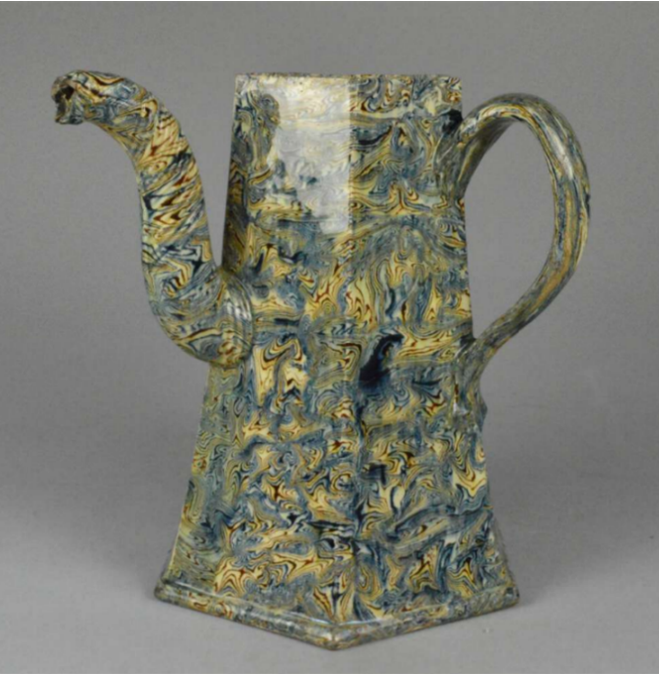
Whieldon agate ware coffee pot. Source: British MuseumWhieldon figurine. Source: The British Museum.
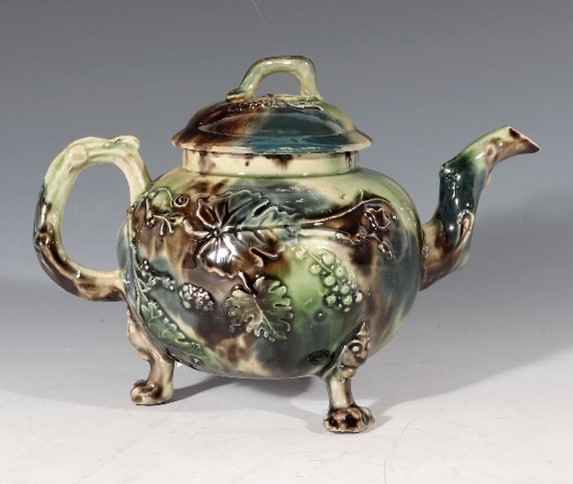
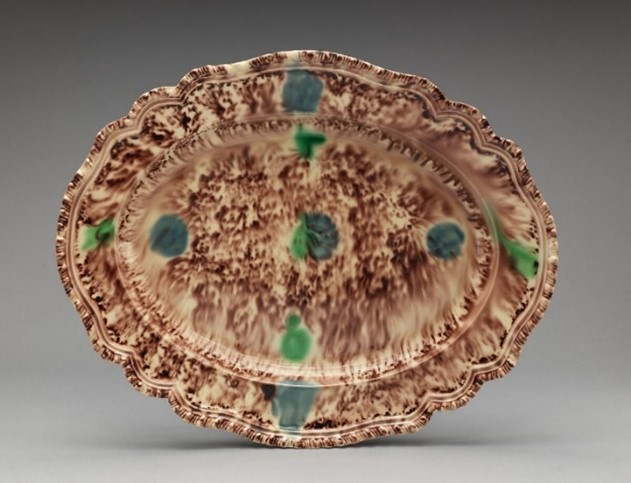
With that said, what we commonly think of when referring to Whieldon Ware is Whieldon’s tortoiseshell or clouded wares. These were created by sponging metal oxides on cream-colored earthenware and then adding a clear lead glaze. The mixing of the metal oxides with the liquid glaze caused the colors to blend and streak, creating splotches of green, yellow, purple, blue, and brown, depending on the types of metal oxides used (Gallagher, 2015). This resulted in a clouded or tortoiseshell decoration. Due to the nature of the technique, no two pieces look exactly the same. For Whieldon lovers like myself, the uniqueness of each piece gives it its charm.
Examples of Whieldon’s tortoiseshell/clouded ware with similar decoration to sherds found at Ferry Farm – Teapot. Source: Earle D. Vandekar of Knightsbridge, IncExamples of Whieldon’s tortoiseshell/clouded ware with similar decoration to sherds found at Ferry Farm – Platter. Source: Met Museum
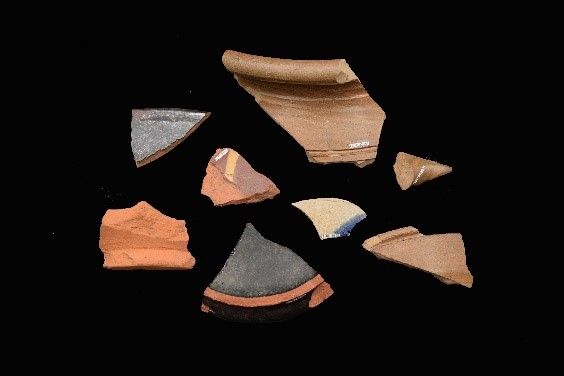
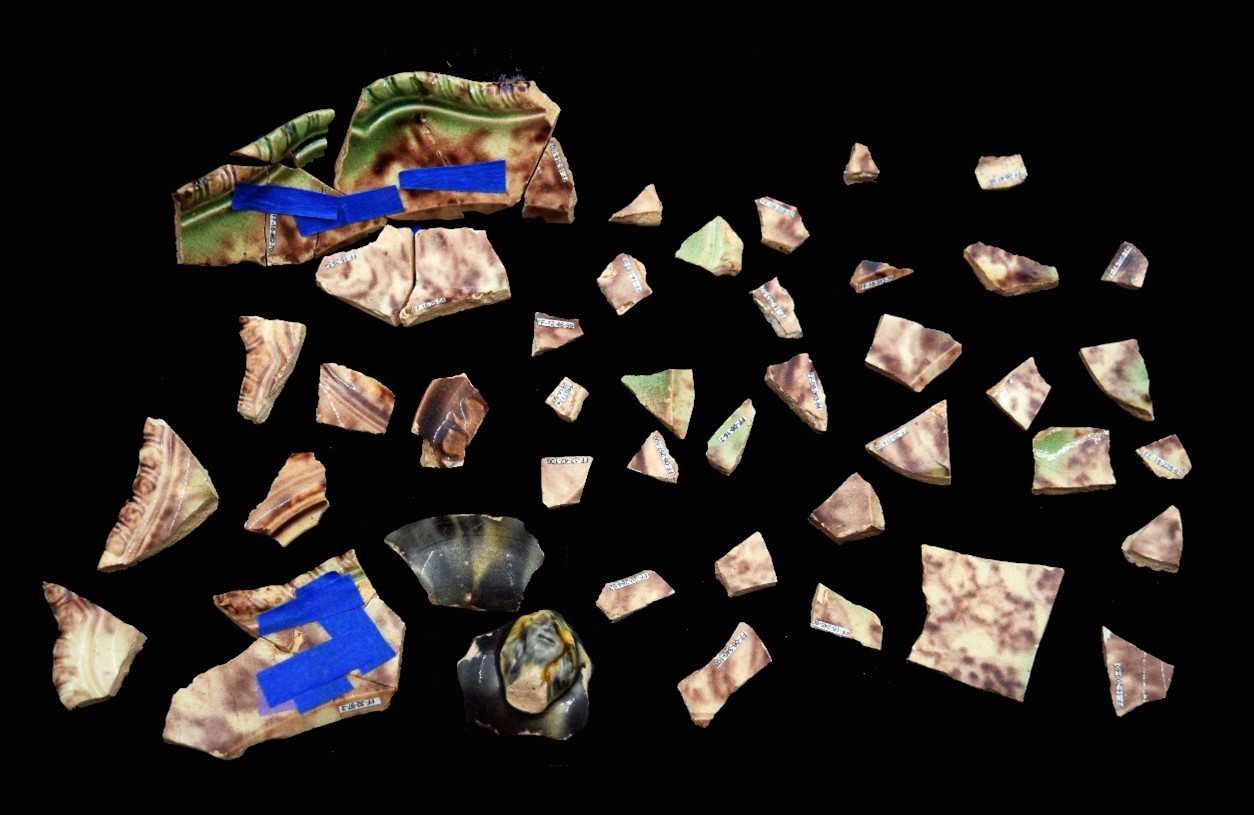
Now that we know more about Whieldon Ware and how some of us feel about it today, let’s talk about how Mary Washington may have felt about it. I firmly believe that she was not team Vomit Ware and instead found the decoration quite desirable. Our excavations have found evidence of at least four Whieldon Ware plates, a teapot, teacup, and other medium-sized holloware vessels at Ferry Farm. Considering the short-lived popularity of the type, lasting only from 1740-1775, we can be quite certain that it was Mary who was buying these items.
Some Whieldon Ware vessel mends and sherds excavated at Ferry Farm
Toward the end of the 1770’s, Whieldon Ware quickly went out of style and was replaced by Wedgwood’s new, improved creamware and its more subtle decoration. While it may have gone out of style, potters continued to replicate the technique for many years, which makes it difficult to attribute all examples of the type to Whieldon himself. After 1780, he retired from the business, demolished his factory, built an ornamental garden in its place, and spent the rest of his years as a sheriff (Hildyard, 2005; The London Gazette, 1785).
So, there you have it, the very brief story of Whieldon and his wares.
While Mary Washington and a couple of us in the lab are Team Whieldon all day, every day (or at least the days concerning Whieldon), the majority are a hard pass. Where do you stand? Are you Team Whieldon or team Whieldout?
Danielle Arens
GWF Archaeologist
References
Gallagher, B. (2015). British Ceramics 1675-1825: The Mint Museum. Charlotte: The Mint Museum.
Hildyard, R. (2005). English Pottery 1620-1840. London: V&A Publications.
The London Gazette. (1785, November 12). The London Gazette(12699), p. 522.
Wedgwood, J., & Ormsbee, T. H. (1947). Staffordshire Pottery. New York: Robert M. McBride & Company.