Tantalizing evidence of historic furniture use exists within the soils of George Washington’s Ferry Farm and that evidence gives us a more complete view of how the Washington family lived in the 1700s. The hundreds of items archaeologists and students have uncovered represent the remains of furniture broken or embellishments lost. The ruthless outdoor elements leave scant vestiges of furniture’s former glory. Wood disintegrates into soil, so these relics typically include only iron and brass hardware, such as drawer pulls, casters, bolts, keyhole escutcheons, or hinges. Over half of the hardware found consists of brass tacks. Such brass studs were often used in furniture upholstery, but were also popular for saddles, trunks, even antique wig stands: anytime a leather covering was added to a wooden frame or base.
One particularly interesting brass hinge was unearthed in 2007 and boasts an exciting past. This hinge, part of a folding card table, was a crucial element in the popular Virginia domestic pastime of playing games such as backgammon, chess, and cards. Card tables provided a luxurious accessory for popular social entertaining and were part of a well-appointed home. Providing guests with such pleasant amusements reflected well upon the Washington family.

Archaeological investigations sponsored by The George Washington Foundation have uncovered evidence that demonstrates that the Washingtons’ mid-1700s home was filled with fashionable accessories to enhance social bonding. These tools included tea wares, stemmed drinking glasses, glass decanters, fashionable dining utensils, and smoking pipes. The recovery of a card table hinge provides another element of their well-equipped home.
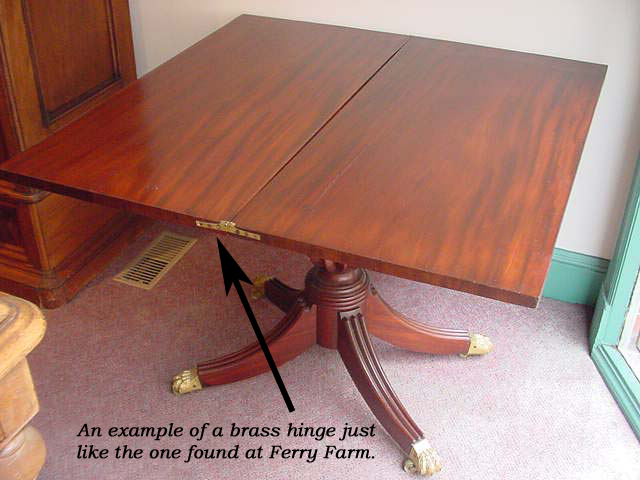
Gentleman often played card games together, but occasionally women joined the amusement as well (Porter and Porter 1782:466-467). Playing cards allowed ladies and gentlemen a refined form of amusement in a convivial atmosphere, without raising critical eyebrows from discerning social commentators in Virginia. These games were occasions in which mixed company – men and women – could enjoy companionship and pass the time in a genial way. It was one of the few entertainments in which men and women could directly compete (Sturtz 1996:169-171). Lucy Byrd’s acumen prompted her husband William to cheat on at least one occasion (Sturtz 1996:172-173, 175-176).
Such benign competition also allowed players to showcase their skills. William Byrd II thought that such games provided an effective antidote to “disagreeable” company, as it allowed the time spent with tiresome guests to pass quickly (Sturtz 1996:175). Tea or stronger beverages might lubricate such gatherings, which enhanced social bonds.

If card games included a little wager, they were all the more thrilling. Self-assured gambling and an indifference to losing money demonstrated a gentleman’s independence from monetary anxiety (Isaac 1974:352; Koda and Bolton 2006:100; Sturtz 1996:166). Such competitive confidence went a long way towards refuting any rumors of financial stress from which a gentleman might be suffering in the community.
In the years leading to the American Revolution, these occasions were increasingly viewed as a source of social disorder (Isaac 1974:358-359), but such amusements remained popular social events in Virginia.
Cards were a popular Virginia pastime and specific furniture such as folding card tables existed as luxurious accessories to support this pasttime (Isaac 1974:352). Hospitality was an important part of these occasions (Isaac 1974:352) and the folding card table made the game and the hospitality possible. Applying knowledge of the past to particular objects like a card table hinge excavated at Ferry Farm gives us a more complete picture of the lives led by the Washington family here in the 18th century.
Laura Galke, Archaeologist
Site Director/Small Finds Analyst
References Cited
Porter, James and William Porter
1782 Letters Addressed to Two Young Married Ladies, on the Most Interesting Subjects. The Critical Review, or, Annals of Literature. British Periodicals. Printed for J. Dodsley, London.
Goodison, Nicholas
1975 The Victoria and Albert Museum’s Collection of Metal-Work Pattern Books. Furniture History 11:1-30.
Issac, Rhys
1974 Evangelical Revolt: The Nature of the Baptists’ Challenge to the Traditional Order in Virginia, 1765-1775. The William and Mary Quarterly 31(3):345-368.
Koda, Harold and Andrew Bolton
2006 Dangerous Liaisons: Fashion and Furniture in the Eighteenth Century. The Metropolitan Museum of Art, New York.