In this video, we show you how archaeologists piece together artifacts in order to learn about the object and, most importantly, the people who used the object.
Tag: archaeology lab
-
Video: UV Light in Museums
Ultraviolet light is an important and useful tool within the museum world. In this video, we show you how archaeologists and curators use UV light in their work with artifacts and historic objects.
-
Video: Inside the Archaeology Lab – Labeling Artifacts
Archaeologists spend much more of their time working to determine the significance of an object than actually finding the object through excavation. This analytical work is done in an archaeology lab, where t is vital to keep the artifacts organized. This video shows how artifacts are labeled to help make sure nothing gets lost.
Learn more about archaeology at Ferry Farm at http://bit.ly/1Ob37in.
-
Video: Tricks of the Trade – Archaeology Lab Edition
Sometimes, it can be a challenge to precisely identify an artifact. When faced with this challenge, archaeologists working in the lab put their five senses to work and call upon some interesting ‘tricks of the trade’ to make those difficult identifications.
Learn more about archaeology and being an archaeologist during Archaeology Day at Ferry Farm on Monday, February 15 from 10:00 a.m. – 4:00 p.m. Visit http://www.ferryfarm.org for event details.
-
After Digging: What Happens in the Archaeology Lab?
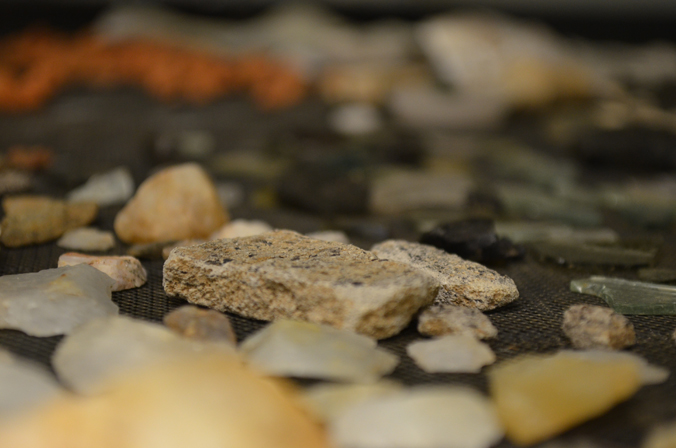
Artifacts excavated at George Washington’s Ferry Farm. Here at Ferry Farm for the last 13 years, professional archaeologists have been exploring the local landscape, digging hundreds of excavation units in their quest to reveal the history of all those who lived here, including, of course, the Washington family. Their investigative efforts have resulted in a multitude of artifacts dating from the earliest prehistoric Native American occupation of this riverine site, through the Colonial and Civil War periods, all the way to a 1990s occupation of the farm.
So, what happens to all the artifacts that are uncovered and dug up with trowels and shovels? All of those items are important pieces to the puzzle of reconstructing the history of this site, but only if they are cleaned up and recognizable. That is the purpose of the archaeology lab here at George Washington’s Ferry Farm. With the help of both professional staff and dedicated volunteers, every single artifact that has come out of the ground is washed, dried, identified, labelled, and, finally, catalogued into a searchable computer database.
The archaeology lab is located within the Ferry Farm Visitor Center which houses museum exhibits, storage rooms for the artifacts, and other administrative offices. Visitors making their way through the exhibits can check out our lab spaces through large windows, allowing them a peek into our work spaces and giving them the ability to see the different processes the artifacts go through.
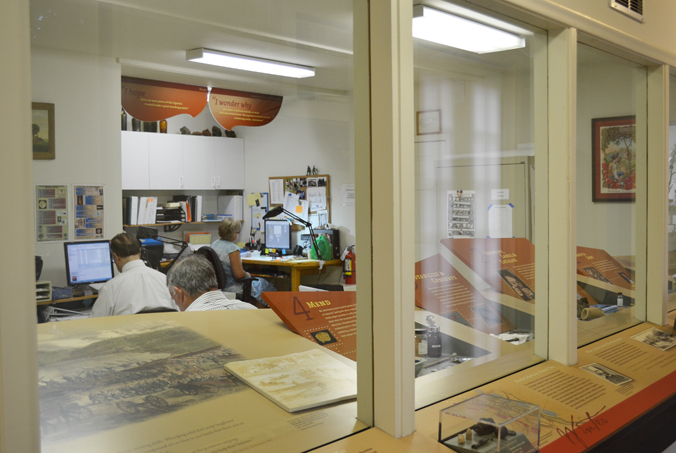
The visitor’s view of the Archaeology Lab. While archaeological excavations at Ferry Farm take place every year, actual digging occurs only three months out of the year. Artifact processing and analysis in the lab goes on for 12 months out of the year. Archaeologists often say that “1 day in the field equals 3 days in the lab” and, in general, that adage is true. Once the artifact bags come into the lab, it can be six months to one year or more before an entire artifact collection is completely processed.
So where does it all start? Well, in the wet lab…
Wet Lab
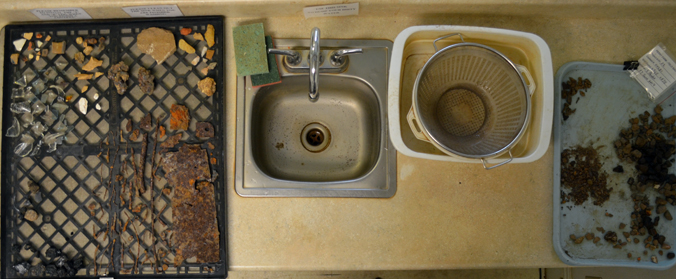
Where artifacts are washed inside the Wet Lab. The wet lab is a small room where the artifacts are washed and dried. It is fitted out with two sinks – the artifacts are washed only with water – and a countertop to provide space for the washing process. Toothbrushes, dental picks, pipe cleaners, washtubs, and other cleaning tools are handily arranged for easy access by the staff.
The washing process is pretty straightforward. The artifacts, covered with dirt from the field excavation, are poured out of the bag onto a tray. The washer separates the different items on the tray and proceeds to carefully wash them with a tooth brush and water. After a quick rinse, the washed items are placed on a tray covered with mesh and the tray is placed in a drying rack. The washing process can be seen in this video. The artifacts stay on the drying racks for at least a week to make sure they are completely dried before being bagged. Large windows allow visitors to watch this process and to see the “treasures from the earth” as they are uncovered and completely revealed, often for the first time in 200 years or more!
Dry Lab
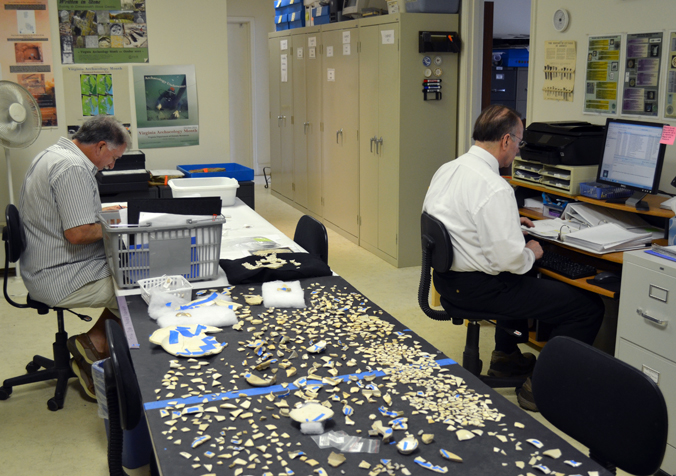
Volunteers work in the Dry Lab. The dry lab is a larger space containing desk space for the staff, the small finds cabinets, and long tables used for labeling and other projects. It is here that the dried artifacts are placed into acid-free plastic bags, catalogued, and then labelled by the staff and volunteers. Our staff spends quite a bit of time cataloguing the artifacts, which involves identifying, counting, measuring, and weighing all the artifacts. The cataloging process can be seen in this video. Each artifact is labeled with identifying information and the address of the exact location where it was found on the site. Research is always an ongoing activity as identifying and dating specific artifacts helps in understanding Ferry Farm’s past and the people who once occupied this ground.
Time is also spent on the mending, conservation, and analysis of artifact collections. The small finds cabinets contain hundreds of unique artifacts that are studied because of their personal relationships to the individuals that lived here. Long term projects, such as our current white-salt glazed ceramic mending, take place in the dry lab space, where a table covered with hundreds of ceramic sherds awaits matching. And as with the wet lab, museum visitors can look through the windows and observe all the projects being currently worked on.
Having an archaeology lab on site is very convenient for the archaeologists that work at Ferry Farm as it allows them easy access to the artifacts at all stages of their processing. Future plans for Ferry Farm rely on knowing what has been found here and weaving together that data with the historical record. It also gives the public an exciting chance to see all the work that goes into getting the artifacts ready for further research.
Judy Jobrack, Archaeologist
Assistant Lab Supervisor -
Video: Inside the Archaeology Lab – Cataloging Artifacts
Archaeologists spend much more of their time working to determine the significance of an object than actually finding the object through excavation. This analytical work is done in an archaeology lab. First, artifacts must be washed, which you can see here. Then, the artifacts are cataloged as the video below shows.
Learn more about archaeology at Ferry Farm here.
-
Video: Inside the Archaeology Lab – Washing Artifacts
Archaeologists spend much more of their time working to determine the significance of an object than actually finding the object through excavation. This analytical work is done in an archaeology lab. Before analysis can begin, the newly uncovered artifacts have to be thoroughly washed. This video shows how.
Learn more about archaeology at Ferry Farm here.
-
What Is This Artifact?
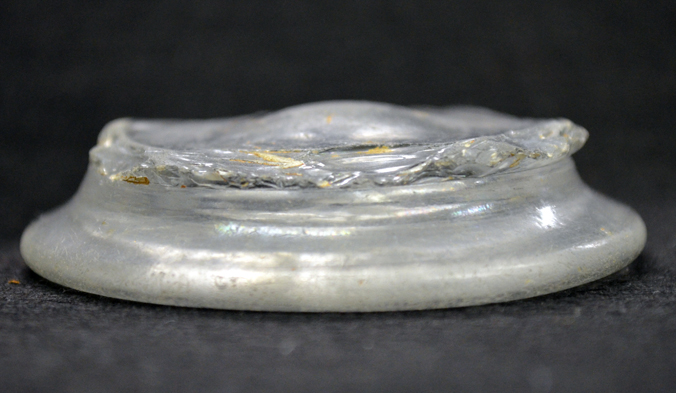
Archaeologists are occasionally confronted with ‘mystery artifacts’ that either cannot be identified or have been altered to serve a purpose other than what was originally intended. Recently, in our small finds collection, we identified an artifact transformed in just such a way. Someone intentionally chipped away the edges of this 18th century leaded glass base for a cup or mug to form a disc. In addition, they also smoothed out the broken edges so they are no longer sharp.


For the moment, the object’s purpose is and, may always remain, a mystery. Use-wear on the base’s interior may hint at how it was used after alteration. Numerous scratches in the glass are present on the ‘kick up’- a small bump on the inside of the glass formed when it was hand blown.
This is not wear that typically accumulates during the life of a drinking vessel so we know the wear occurred after modification. Oddly enough, while pondering possible uses, a staff member here at Ferry Farm turned it upside down and spun the disc on the table. It whirled around perfectly like a top right where the glass exhibited the extreme wear! Take a look at this video for more detail in how the glass has been broken and smoothed and see how the modified base spins like a top.
While this is only speculation, it is possible that we are looking at an improvised toy. Perhaps a child living at Ferry Farm converted this broken glass into a toy top and played with it for many happy hours before it was lost or discarded and found its way into the archaeological record. We can only assume the child would laugh if they knew that archaeologists would be brooding over their whimsical plaything hundreds of years later.
Mara Kaktins, Archaeologist
Ceramics & Glass Specialist -
Mending Those Humble Sherds
What do archaeologists do with the broken ceramic and glass artifacts after these objects have been excavated, cleaned, and catalogued? They are cool to look at but what do these little pieces actually tell us about the past? How can we use them to understand the lives of those who purchased, used, and eventually discarded them?
One method is by mending the sherds (‘sherd’ is the term we use to describe broken pieces of ceramic and glass) to re-create the vessels. We mend by spreading out all of the fragments on a table and carefully seeing which ones fit together. Then, we use non-damaging tape to join the pieces temporarily. If deemed appropriate, we might decide to carefully glue the sherds together – with removable archival glue, of course!
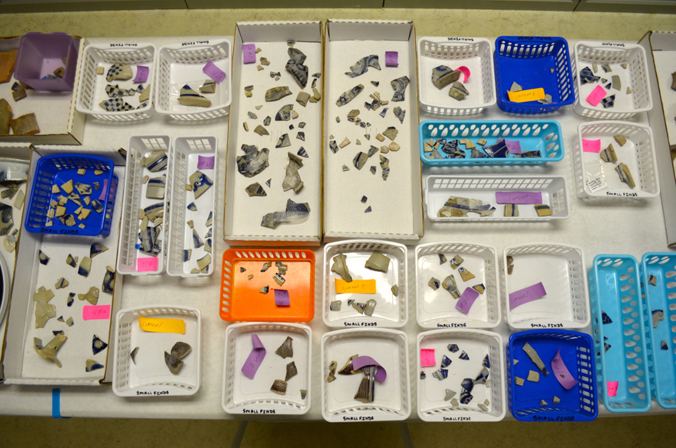
Sherds to be mending in the Archaeology Lab at George Washington’s Ferry Farm As archaeologists mend and a vessel takes shape, we can determine a number of details about the object we couldn’t when it was just a pile of broken stuff! First, we can figure out what type of vessel it was and what its uses were. Determining the vessel type helps us figure out what activities took place in a given excavation area. Cooking vessels mean the area was used for food preparation. Plates, bowls, and cups show the area was used for dining while crocks indicate a storage area.
Second, we can determine how much a mended vessel was used by the “use-wear” present on it. For instance, a chamber pot kept under a bed and drawn out from its storage place a couple of times a day will start to exhibit wear marks on the base where it is dragged across the floor. These grooves usually run parallel with the handle. The longer the pot is used the more wear it acquires. The same goes for knife-marks on dinner plates or stir-marks in drinking vessels. However, it is difficult to truly examine the use of a chamber pot using just one sherd. It is preferable to have as much of a whole vessel as possible, so we must mend!
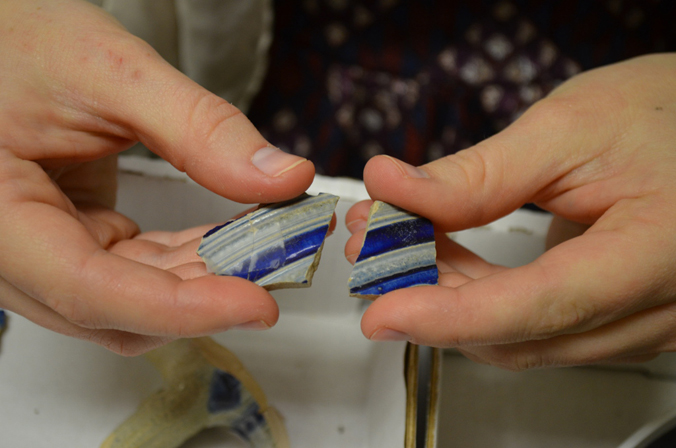
Yay! They match! Within the archaeological community, the general opinion is that mending is a fun activity. It definitely is! What is more fun than taking ancient fragments long-ago discarded by their owners and creating tankards, porringers, teapots, jugs, and all manner of other vessels that say something about who used them? It is one thing to show someone a sherd of porcelain and say “George Washington’s mother may have owned this” and quite another to show them a mended teapot and declare “George Washington was served tea from this very pot!” That being said, mending is also frustrating at times. Imagine taking 100 puzzles, mixing them all together, throwing away 90 percent of the pieces, and then trying to work the puzzles! This is basically mending in a nutshell. Some of us stare at the sherds for so long that we see them when we close our eyes or go to sleep! Now, that’s dedication!
It is rare that an entire vessel can be completely reconstructed. When an object is broken, perhaps all of the fragments do not get swept up and deposited in the same place. Areas where people lived sometimes become agricultural fields and are plowed for decades or longer, resulting in fragments of vessels being further broken and scattered about the landscape. Insects and animals move artifacts when burrowing in the soil, a process termed ‘bioturbation’. We do the best we can with the artifacts we’ve recovered.
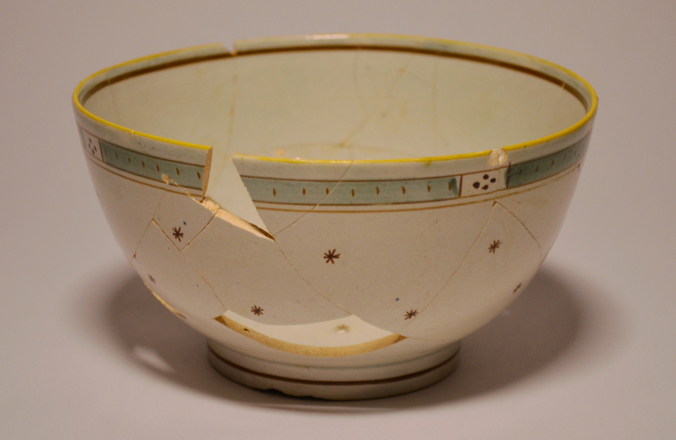
Pearlware waste or ‘slop’ bowl. Hand painted. Made in England between 1795 and 1830. Excavated at Historic Kenmore. This bowl would have been used during the tea ceremony as a receptacle for spent tea leaves or unwanted cold tea before refilling a cup with hot tea. Still, archaeologists really love when we mend a vessel to near perfection and put it on display for the public along with all the information we’ve learned from it. We’ve actually just finished mending German Westerwald stonewares and we’ll share some of that project’s results in the not-too-distant future. Soon, we’ll be moving onto English white stonewares. On your next visit to Ferry Farm, you’ll likely see a mending project on display in our laboratory and maybe some of our talented staff working hard to unlock the secrets contained within those humble sherds!
Mara Kaktins
Archaeologist/Ceramics and Glass Specialist