The dig is in full swing, and we are a little over halfway through our 11-week dig season. Over the past few weeks, we have made lots of new exciting discoveries, and as you may have noticed, added quite a few new faces to our crew.
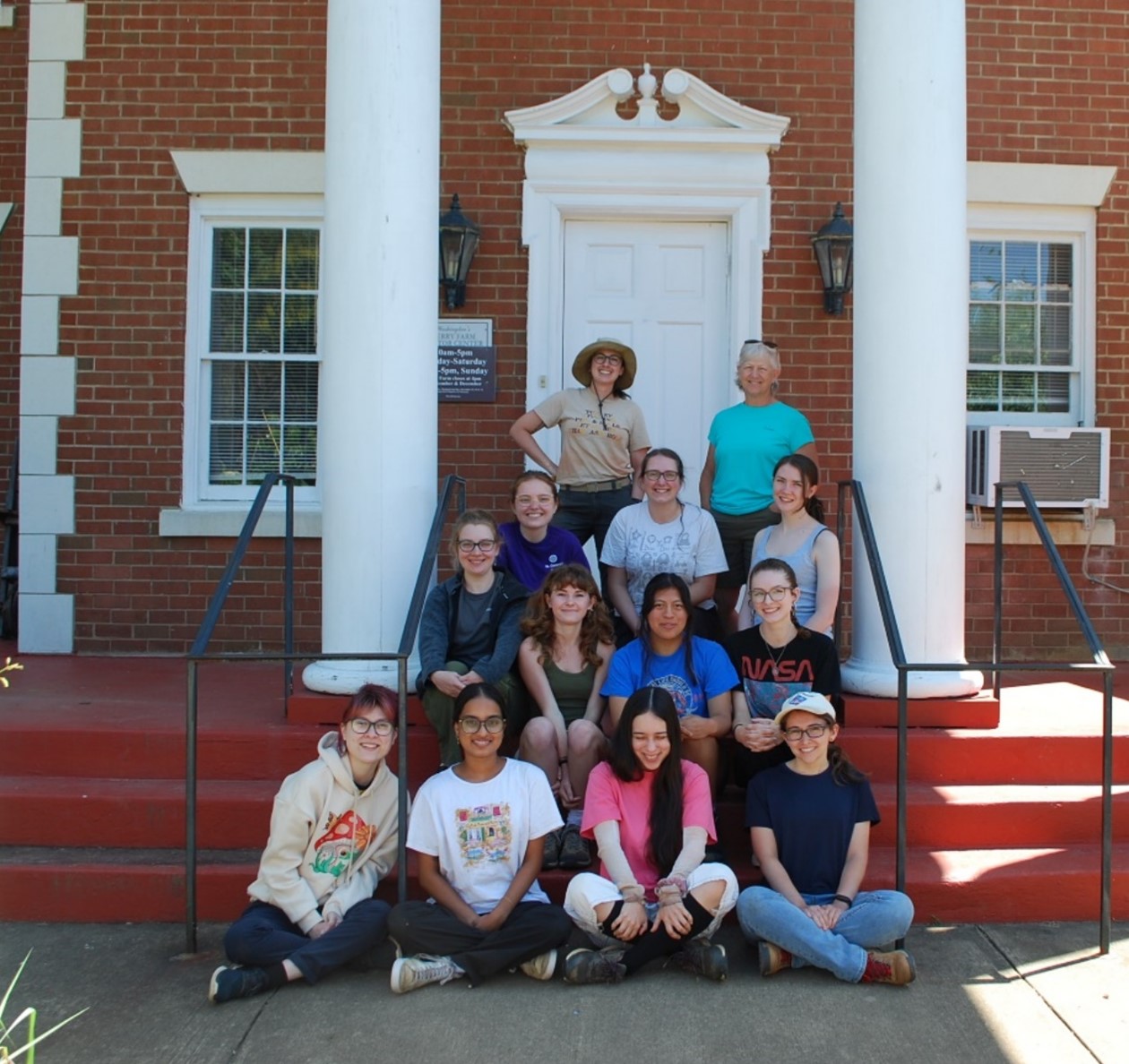
Hosting a field school from the University of South Florida as well as interns from colleges and universities around the country has more than doubled our crew this season. While this is definitely awesome in itself, the fact that the entire field school and crew are women makes this year’s dig stand out even more. Now before we get into why an all women dig is so impressive, lets meet our crew.
Front Row Left to Right: Alaina, Srin, Sarah, Sofia. Second Row: Abbie, Amelie, Rosie, Lindsay. Third Row: Kate, Rachel, Kellina. Back Row: Danielle, Judy.
Srinidhi
“Srinidhi is from Lithia, Florida. She just recently graduated from the University of South Florida with a bachelor’s degree in history. She plans on attending graduate school sometime in the future. Outside of school, Srinidhi enjoys reading high fantasy novels, playing video games, and hanging out with her dog, Felix.”
Lindsay Marrion
“Lindsay Marrion, from Niceville, Florida, attends the University of South Florida for English and Art History. She hopes to continue her education in graduate school, with dreams of working in academia one day. Outside of school, Lindsay in as avid reader and writer, and she loves an adventure of any kind.”
Alaina Scapicchio
“Alaina Scapicchio is a doctoral student at the University of South Florida in Tampa. She did her first field school at Ferry Farm in 2018 and now she is the graduate assistant for this year’s field school. Her dissertation is focused on public memory and the commemoration of witch trials in colonial America. She is the owner of two senior citizen fat cats named Tazz and Amira who she misses very much.”
Sofia Almeida
“Sofia Almeida is an incoming History PhD student at the University of South Florida. She recently completed her MA thesis on the digitization of historic Black cemeteries in Florida. Moving forward she is interested in American history, historic archaeology, and memory. Outside of school, she enjoys reading, playing guitar, and going on adventures with friends.”
Amelie
“Amelie is from Tucson, Arizona and is studying Biology, French, and Anthropology at the University of Arizona. She enjoys reading, hiking, and weightlifting and aspires to travel the world.”
Rosie Muraca
“Rosie Muraca is from Fredericksburg, VA. This is her first time working as a field student. She plans to attend Mount Holyoke College in the spring. When she is not digging, she is spending time with her two cats.”
Kellina
“Kellina is a rising junior at Yale University. She is an anthropology major from Spotsylvania, VA and she hopes to work in museum conservation. Spending the summer at the Ferry Farm archaeological dig has given her a better understanding of artifacts prior to their museum life and deepened her understanding of American history.”
Kate McDonald
“Kate McDonald Yaun is a rising freshman at Sewanee: The University of the South. She is studying Environment Arts and Humanities. Her hobbies include playing her viola, reading, and spending time outdoors.”
Abbie Wood
“Abbie Wood graduated from UVA in 2023 with a B.S. in Anthropology and a B.S. in Archaeology. This is her second dig season at Ferry Farm and the fourth overall, following a collections management museum internship. She has a passionate interest in caring for artifacts and history.”
Sarah
“Sarah came to Ferry Farm as a student of Virginia Commonwealth University in the summer of 2014. She has participated in half a dozen summer digs as an intern at Ferry Farm since then. Her favorite artifacts consist of the more personal items people had such as buttons, beads, sewing pins and Ferry Farm’s famous and abundant collection of colonial wig hair curlers.”
So back to why an all women crew is so awesome. Well, our crew illustrates how women are gaining ground in a previously male dominated field. Historically, many professional positions in archaeology were held by men, but times are changing.
Hopefully we will see some of these faces again somewhere down the archaeology pipeline, or wherever their futures may take them.
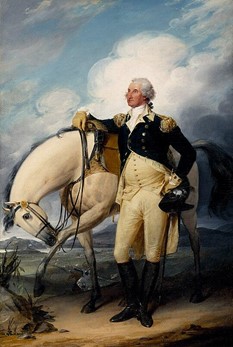
Think about a portrait or painting of George Washington. What is a common element in the paintings? His uniform, yes, he is indeed painted quite a bit in his impressive military uniform. But how about a horse? George is often painted riding beautiful horses with a quiet dignity and noble appearance we expect from the father of our country.
Washington at Verplanck’s Point by John Trumbull, Source: Winterthur
However, the horses in these paintings are not mere symbols of wealth or power. They are depicted with George because, from a tender age, his life has been intertwined with these creatures. As a surveyor, soldier, landowner, farmer, gentry, commander-in-chief, and president, he was inextricably linked with horses, not just as a mode of transportation but as a vital part of his daily life.
And it all started at Ferry Farm…
George moved to Ferry Farm around 1738 at the age of six. His father, Augustine Washington, was a member of the “planter class,” or Colonial American gentry. This meant he was a prominent member of society, involved in politics, and owned lots of land. Augustine purchased 150 acres across the river from Fredericksburg and later added an additional 450-acre parcel. In total, he owned Little Hunting Creek, Pope’s Creek, and the Ferry Farm properties.
The point? Augustine needed help because there were places to be, people to see, and fields to farm. So, horses were a fundamental necessity for the Washington family, and George would have grown up around them, taking care of them and learning to ride.
We have two great sources that give us some understanding of the horse situation at Ferry Farm. First, in 1743, the Washington patriarch died, leaving behind a widow, an 11-year-old George, and a probate inventory. On page two of the inventory, three horses and one mare are listed.
Augustine Washington Probate Inventory, 1743
Secondly, some pretty cool horse tack dating from the Washington occupation has been found during various archeological digs.
The Finds
One of the most universally known horse tack, essential for all horse maintenance – is the horseshoe. The horseshoe was used to protect the hooves because “…being rendered subservient to the use of man…applied to severe and continued labour, and compelled to tread frequently…on the irregular and stony surface of the roads, it became necessary to secure his feet from ruin by strengthening them with the iron band which we call a shoe” (Vial de Saint Bel, 1793). These shoes were handmade with no standardization across makers in shape, narrowness, or thickness. (Hume, 2001). This makes it difficult to pinpoint and assign a time on shape alone.
Our horseshoe was found in the second cellar of the Washington Home. It is quite wide between the branches (the curving sides), and the toe seems to straighten a bit at the center. The crease (the groove that runs down the sides) gives enough depth to allow the shoe to be firmly attached to the hoof with six nails (which we found a few originals). (University of Zurich, 2024) This find illustrates that there was active shoeing and horse maintenance going on at the farm. Additionally, these horses were ridden or used for farm work because shoes were used to protect the hooves from the wear and tear of hard roads, distribute the horse’s weight evenly on uneven ground, and provide traction on various surfaces.
Horseshoe with original nails
Another artifact found in the cellar of the Washington Home, the stirrup, further demonstrates horse riding as a family necessity. (Cofield, 2014)
Stirrup
The stirrups are used as foot support for the rider, and they hang from a saddle on straps known as stirrup leathers. Basic stirrups are made of three parts the eyes for the stirrup leathers to attach the stirrup to the saddle, a platform or base where the rider places their foot, and arms which connect the eye to the base. (Cofield, 2014)
Examples of Stirrup Forms Source: Diagnostic Artifacts in Maryland
Horseback riding master and author VS Littauer described the Forward Seat as a stirrup-centric approach versus traditional riding’s seat-centric. He argued riding without stirrups taught people to grip with the knee, which he considered a dangerous habit and likely to stiffen the rider. With stirrups, you can ride with a looser knee, letting your weight flow PAST your knee and into the stirrup. That is a more secure approach than riding with the thigh and knee. (Littauer, 1962)
Captain Vladimir Littauer – Forward Seat Riding,1947
Stirrups allow the rider’s legs to absorb up/down motion by allowing them to stand in matching balance with the horse, which makes riding longer distances more comfortable. Augustine certainly had to travel a great distance to check on his properties and perform his civic duties, like serving as a justice of the peace and sheriff for the county of Westmoreland.
One final utilitarian bit of horse tack found again in the cellar is a mullen mouth bit or snaffle bit. This bit consists of two rings on each side of a half-moon-shaped bar with no joint. The bit applies even pressure on the horse’s tongue and bars (gums) and allows the horse’s lips to feel the pressure from the bit and side rings. The bit, bridle, and reins function to create communication between the rider and the horse.
Mouth Bit
The Washington children would have used bits to learn to control. They would have learned how to work with the horse in a cooperative way that would create an effortless and seamless ride. George used this skill of communication and intuition to become a great rider. As Thomas Jefferson reminisced in a letter in 1814, “his person, you know, was fine, his stature exactly what one would wish, his deportment easy, erect, and noble; the best horseman of his age, and the most graceful figure that could be seen on horseback.” (National Archives, n.d.)
Lastly, just south of “The Quarter,” we uncovered around twenty leather ornaments. They were used to decorate the leather straps, nosebands, harnesses, and reins of horses. We wrote a post about them earlier explaining their purpose, which was purely aesthetic. Horse tack could be made without these pieces, but where is the fun in that? These flashy accessories were a great way to grab the attention of the public and hint at how fashionable and elegant you were as you trotted through town.
Ferry Farm leather ornaments dating from the 1700sThis copper-alloy mount dates from the mid-to-late 1700s
These artifacts illustrate that not only were horses actively used by the family, but it also fostered an environment where young George would have taken his first steps into learning about horsemanship. This knowledge and skill would help him in his future careers of surveying the Shenandoah Valley, as a lieutenant colonel during the French and Indian War, as a farmer and landowner at Mount Vernon, as a representative in the House of Burgesses, as commander-and-chief of the Continental Army and finally President of the United States.
Come see our new pop-up exhibit at Ferry Farm, where all these wonderful artifacts are displayed and put together with the help of our Fleming-Smith scholar, Sarah Moore.
Not every president gets their birthday celebrated every year with a federal holiday, but George Washington, a favorite of his countrymen and the first president, has had that privilege since 1879. But one year was a little different from the others: 1932. It marked Washington’s 200th birthday, and the United States was going to make a big deal about it.
In honor of the upcoming birthday, we decided to look at some of the memorabilia in our collection created to celebrate and educate the American public.
George Washington Bicentennial Commission
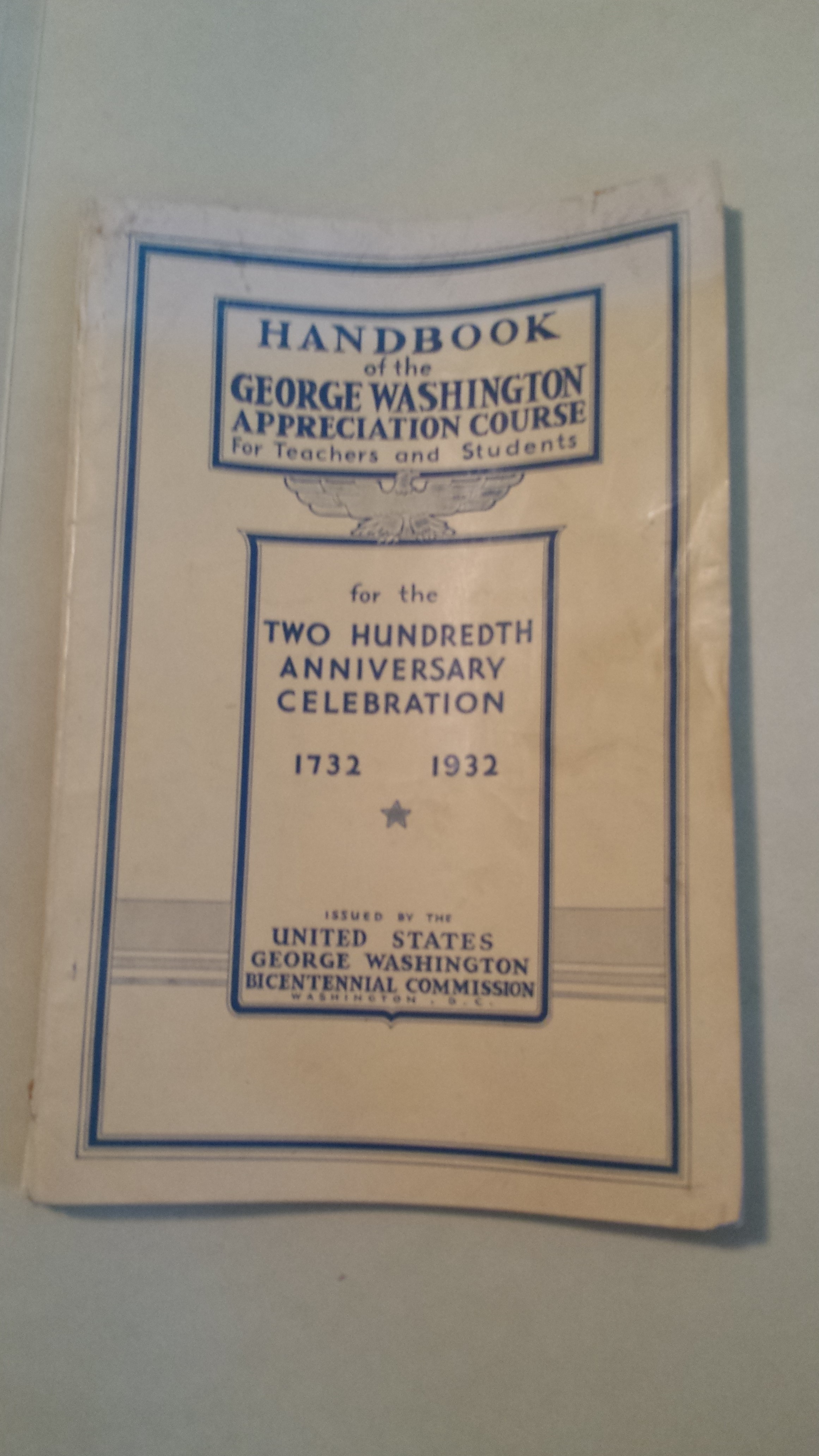
The planning for this celebration started early when Calvin Coolidge signed a joint resolution that established a commission to oversee the bicentennial ceremonies on Dec 2, 1924. The resolution was to mark the occasion of the birthday across the country and increase the understanding of Washington. (George Washington Bicentennial Commission, 1932) Under the direction of Representative Sol Bloom, an experienced entertainment promoter who got his start at the 1893 World’s Colombian Exposition, the committee initiated thousands of events, released educational resources for students, and had plays written in honor of Washington. (Larson, 2004)
Handbook of the George Washington Appreciation Course for Teachers and Students“Washington Takes the Risk”, including George Washington, Fielding Lewis, and Betty Washington Lewis
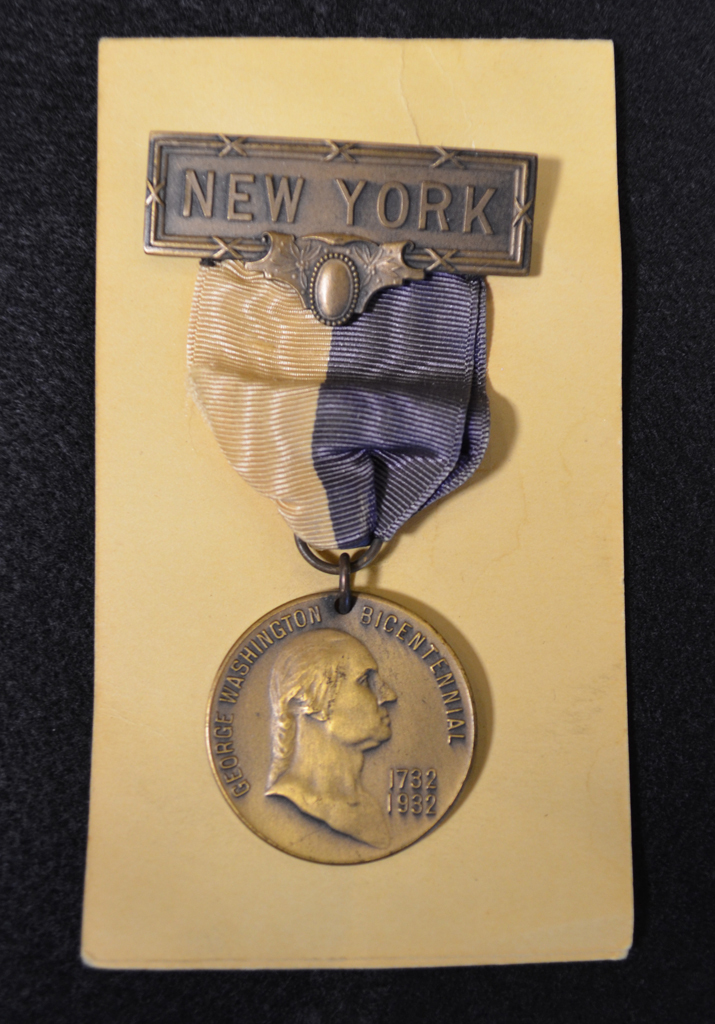
The commission additionally worked with over 250,000 local commissions to organize special events at not only a federal level but a state and city too. (The Washington Post, 1932) Special volunteers and prominent local people were often given commemorative metals as thanks for their service. We have one from the state of New York. It is a circular bronze medal attached to a blue and white ribbon. The back of the medal states, “1779 / Planned Sullivan / Clinton Campaign 1782 / Newburgh Temple Hill / Refused a crown / 1789 April 30th / New York City / Inaugurated first / President of the / United States.”
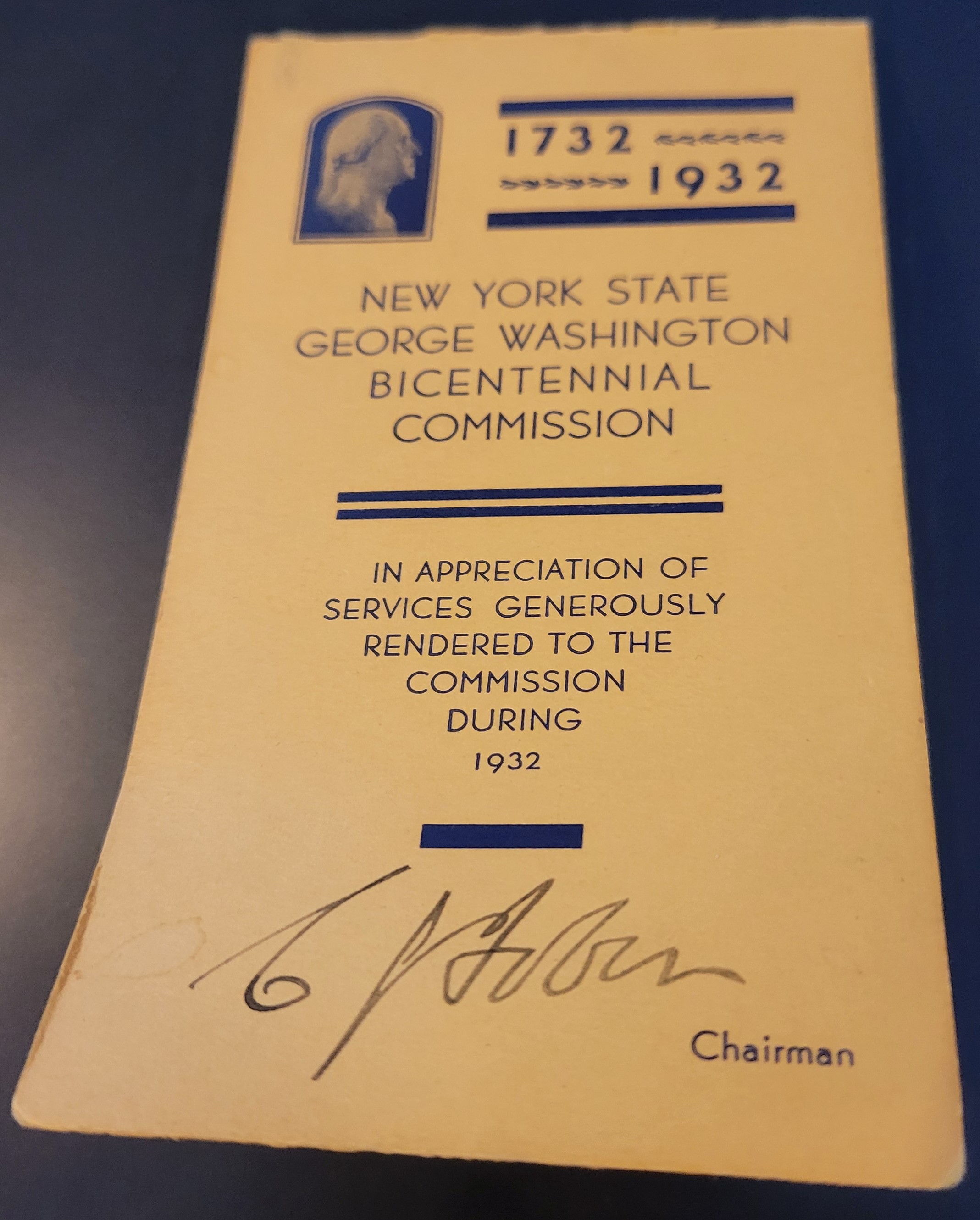
The medal is encased in a paper envelope with “New York State / George Washington Bicentennial Commission / In appreciation of / Services generously / Rendered to the / Commission / During / 1932” written on the front along with the signature Charles Tobin, chairman representing New York state on the Bicentennial Commission.
New York State George Washington Bicentennial Commission, 1932New York State George Washington Bicentennial Commission Medal, 1932New York State George Washington Bicentennial Commission Medal, 1932
Historical Context Help: The Sullivan-Clinton campaign was ordered by George Washington in response to the 1778 attacks by the Iroquois and British in central New York. Newburgh Temple Hill was a Continental Army encampment near Washington’s headquarters, where he gave a speech to quell the mass of soldiers who were getting ready to mutiny and attack Congress to get their promised back pay and pensions. Finally, in 1789, George was sworn in as President at Federal Hall in New York City.
The U.S. Post Office became involved in the commemoration of George with the release of a dozen stamps celebrating his life. The stamps were incredibly popular, and when they were first released for sale in D.C., there was a crowd of 50,000 people waiting to get their set of stamps. (The Washington Post, 1932)
Commemoration celebrating George Washington’s visit to Kenmore on April 8, 1791, as part of the birthday celebrations. Note the stamps. Commemoration of George Washington’s birth at Wakefield. Note the stamps.
Marketing George
Private companies even got in on Washington-mania by releasing all types of souvenirs like postcards, pins, coins, bottles, calendars, cigar box covers, books and pamphlets, hat stands, billheads, stationary, cartes-de-visite, playing cards, and puzzles. (Subseries 5.8. Washington’s Birthday, Bicentennial Souvenirs, 1931-1932 , 2024)
We have two bottles created for the Bicentennial celebration. The green water bottle has a likeness of George with “Washington/Bicentennial” underneath the image and 1732 and 1932 written on the sides. The water bottle was produced by the Hemingway Glass Company in Muncie, Indiana.
The clear pear-shaped bottle is embossed on one side with a cherry tree and the dates “1732 and 1932”. On the other, with a profile of Washington. It was created by the Owens-Illinois Glass Co. of Huntington, West Virginia.
Bicentennial bottle with George Washington profile. Owens-Illinois Glass Co., 1932. Bicentennial bottle with cherry tree. Owens-Illinois Glass Co., 1932
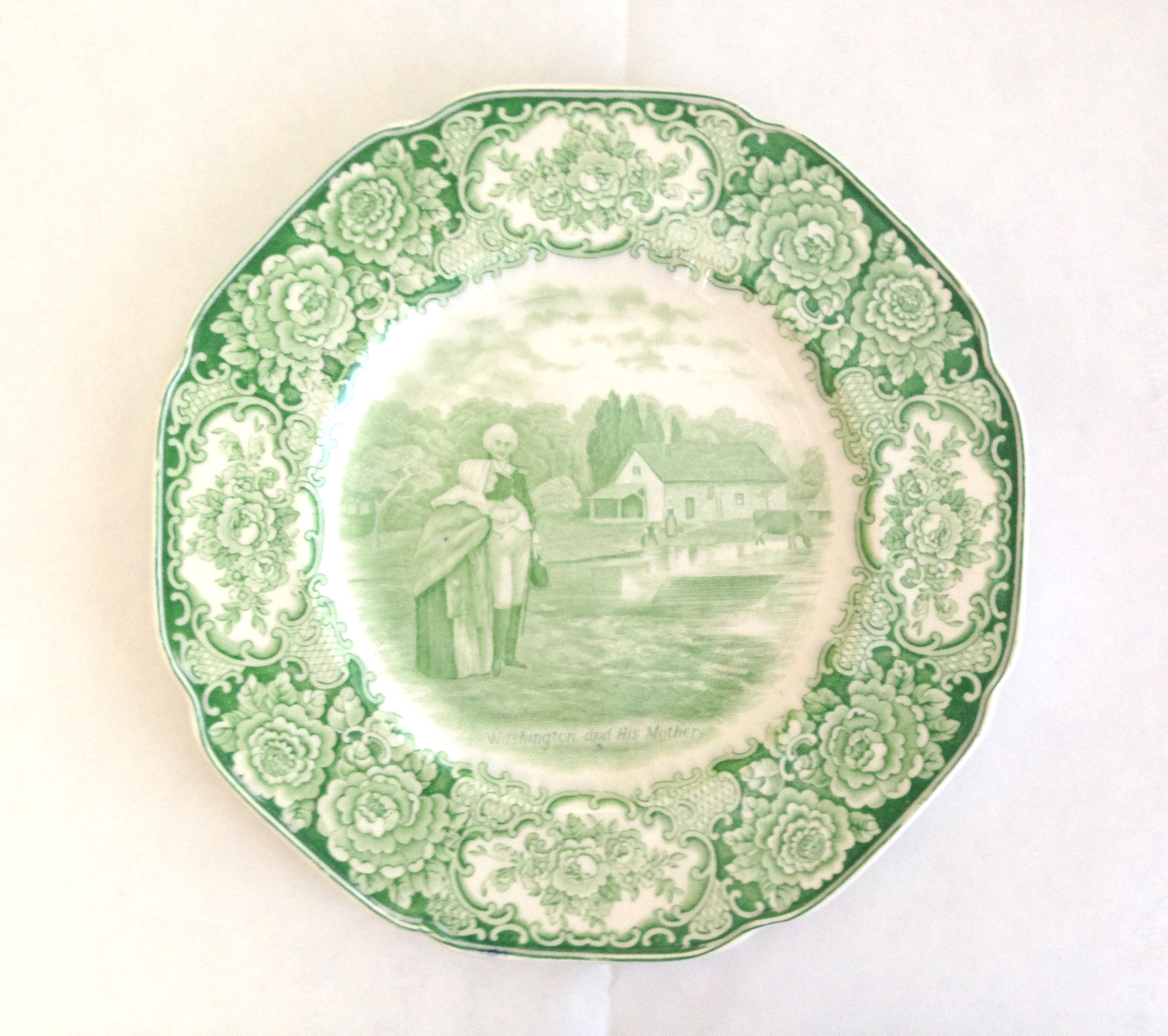
Plates were another big commemorative item. We have three plates issued by Crown Ducal, with the same scene of “Washington and his Mother” based on the print of the same name. On the back with the Crown Ducal crest, it says, “George Washington Bicentenary Memorial Plates / 1732-1932 / First in War / First in Peace / First in the hearts of his countrymen”. Crown Ducal released a series of twelve plates documenting Washington’s life. Of course, we are a little biased and like the one with his mother, Mary Ball Washington, the best.
Some companies even brought in Mrs. Martha Washington, like this set of plates from the Capital Souvenir Company. These are two round commemorative plates depicting George and Martha Washington, both with an elaborate floral gilded border.
George and Martha plate set, Capital Souvenir Company, 1932. George and Martha plate set, Capital Souvenir Company, 1932.
Fun Bicentennial Fact: On the eve of the birthday, Sears Roebuck was awarded a commission by the U.S. government to create a full-scale replica of Mount Vernon at the Exposition Coloniale Internationale in Paris. The agreed-upon price was around $75,000, and every detail of the home was reproduced from brass hardware, mantelpieces, and even cabinets. After the exposition, the house was bought by an American doctor working in Paris, and it was relocated to Vaucresson (a western suburb of Paris). It still stands today as a private residence and was even on the market in 2012 for 27 million dollars.
George Washington’s Mount Vernon in Paris, France,1932George’s Mount Vernon in Vaucresson, France today
Sears Roebuck also built the exact replica in Prospect Park, Brooklyn, NYC for the Bicentennial Commission. However, the house was not taken care of and boarded up and abandoned until it was eventually torn down. (The Brooklyn Daily Eagle, 1933)
Sears’ role in the reconstruction of Mount Vernon led to interest in their kit homes. In 1932, they offered a house in their catalog, loosely based on Mount Vernon. This model was oddly called “The Jefferson”.
Sears Roebuck house kit “The Jefferson” which strangely resembles Mount Vernon.
While we may not have as many George souvenirs, we are still putting on a big birthday party to celebrate George Washington and his time at Ferry Farm.
The party is on Monday, February 19th from 10am – 3 pm. While enjoying the grounds of Ferry Farm, you can take a selfie with “George Washington,” participate in our annual stone-throwing contest, play colonial games, and eat birthday cupcakes (while supplies last).
Additionally, guests can enjoy several educational stations, take an abbreviated Washington House tour, and talk with archaeologists, historians, and other experts to learn about Ferry Farm and the Washington Family.
Heather Baldus
Collections Manager
References
George Washington Bicentennial Commission. (1932). History of the George Washington Bicentennial Celebration. Washington D.C.
Larson, E. (2004). The Devil in the White City: Murder, Magic, and Madness at the Fair That Changed America. New York City: Knopf Doubleday Publishing Group.