Lives and Legacies

Tag: architectural artifact

  • Above Ground Archaeology – Cool Finds Revealed During Restoration

    While the house at Historic Kenmore has been faithfully restored to its circa 1775 appearance, the road to that final result was a pretty dirty one.  As in plaster dust, paint fumes, and all manner of dirt and debris.  Back in the late 1980s and early 1990s, the first forays into the research for and the subsequent writing of a Historic Structure Report (HSR) took place.  This project entailed a number of architectural historians selectively pulling up floorboards and peeking behind plaster walls to more fully understand how the house was originally built, its current condition, and its history of change over time.  This important document provided us with a clear understanding of Kenmore’s architectural history, was the guiding document for a decade-long restoration of the structure, and also gave us a collection of architectural fragments and individual artifact finds that continue to help us understand the material world of those who lived and labored at Kenmore through the centuries.

    In a past blog post, we learned a bit about rats as collectors and examined a rat’s nest that was discovered during that HSR investigative period. If you haven’t looked at the video of the unpacking of that nest, here it is. (In that nest, there were assorted papers, fibers, and other fluffy goodies dating to around the turn of the 20th century.)  But the nest wasn’t the only thing uncovered during that HSR peeking and prodding process.

    Of Mice and Men: A brief exploration of rodents’ history in America

    The Unlikely Curator: What a Rodent’s Nest Reveals about Historic Kenmore

    Exploring the Rat’s Nest

    Enter the “Above Ground Archaeology” or “Interior Archaeology” collection.  These eclectic artifacts were carefully collected, numbered according to their context or find location, bagged, documented on a list, and lovingly packed away in our ubiquitous Hollinger boxes.  Over the years, some of the artifacts were pulled by curators for exhibition in the Kenmore galleries, but most were stowed away in their boxes for long-term preservation and research purposes.

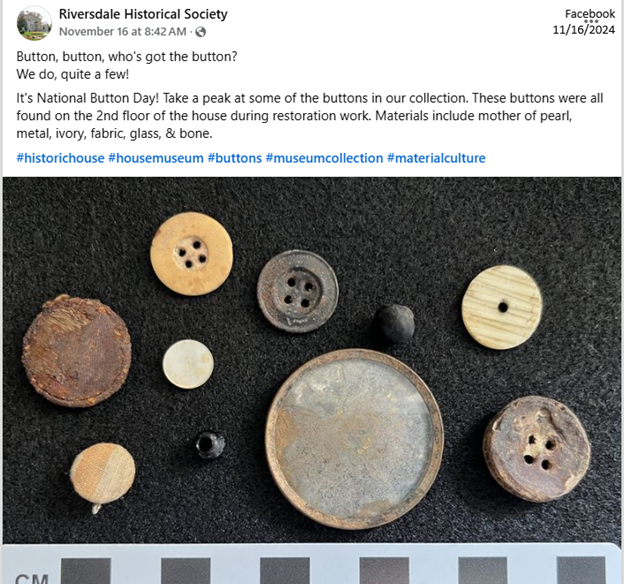
    The use of found objects in historic structures to help illuminate the material world of the building’s residents and workers is not a revolutionary concept.  Colonial Williamsburg, for instance, in their recent restoration of the historic Bray School, removed modern plaster walls, revealing not only structural information but also artifacts: “We are collecting building fragments and objects found in the walls…These items shed light on the building’s original finishes and various inhabitants since 1760.”  Riversdale Historical Society has been showcasing some of their “found” artifacts on Facebook — most recently posting a set of buttons for National Button Day.
    Colonial Williamsburg: The Bray School Project

    Riversdale Historical Society, Facebook Post, 16 November 2024

    Recently, we pulled a few of Kenmore’s artifacts into exhibit cases in our refreshed orientation exhibit in the Bissell Gallery of the Crowninshield Education Center at Historic Kenmore.  Together with in-ground archaeology, these exhibit cases help us illustrate the built environment and the wares known and used at the site.
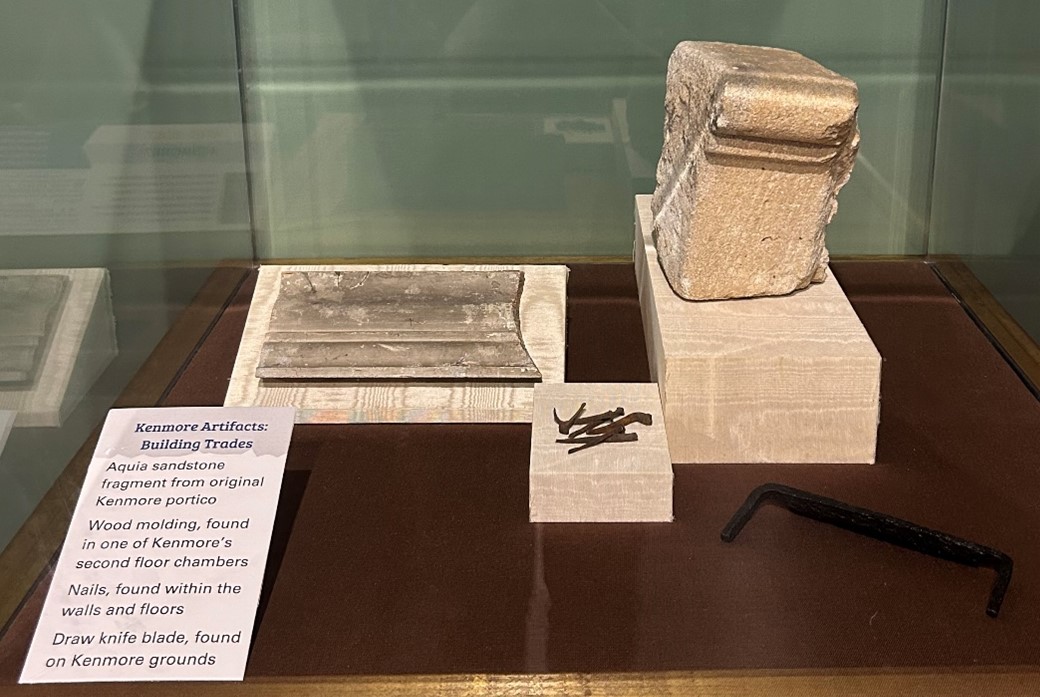
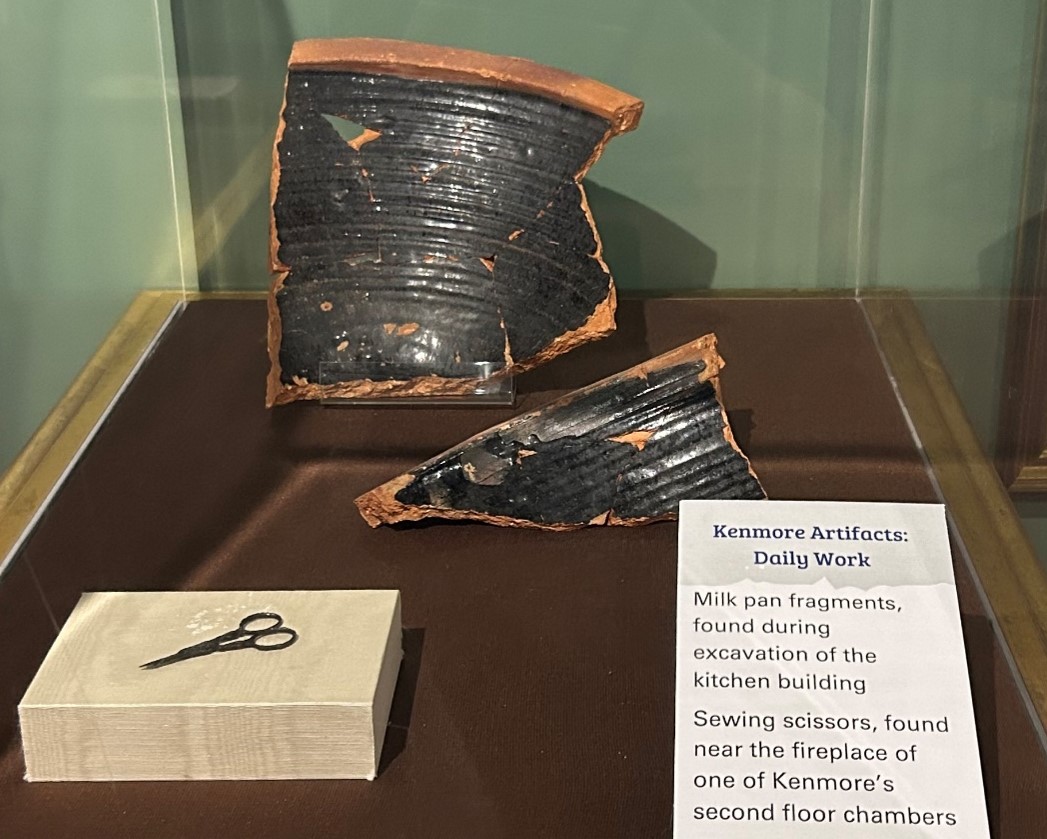
    In 2010, then Intern Ashley Dean (University of Mary Washington) was tasked with inventorying the three boxes of artifacts, and for that, we are extremely grateful.  What resulted from that inventory project was a 12-page list of artifacts that formed the center of this rejuvenated research initiative.  The artifacts in these boxes range from architectural elements (plaster fragments, nails, wallpaper bits) to broken household goods (bottle glass, ceramic pieces) to whole objects (beads and a pair of sewing scissors).  When first bagged and numbered, these artifacts were recorded by location context—based on the mapping system then being used in the architectural investigations of the house, with room numbers ranging from B001 in the cellar (or basement level) to 301 being the attic (or 3rd floor) of the house.

    Attic (Room 301) mapping

    Fast forward to 2024, the artifacts were again reviewed, and the idea blossomed to plan a textile assessment of all the small scraps of fabrics that had been collected.  According to our in-house review, we could tell that they dated to a variety of periods and ranged in their likely original use, from costumes to household linens. 

    Selection of textile fragments in the Kenmore Above Ground Archaeology collection (July 2024)

    One particularly large artifact proved the most intriguing — a pile of blue and white check fabric.  The indeterminate ball of checked fabric piqued the interest of staff and now serves as the starting point for a multi-year conservation assessment and interpretation project.  A few months after our in-house assessment, we hosted a textile conservator who conducted a baseline review of the textile fragments and more fully examined the artifact for potential treatment.  She had a rapt audience that morning!
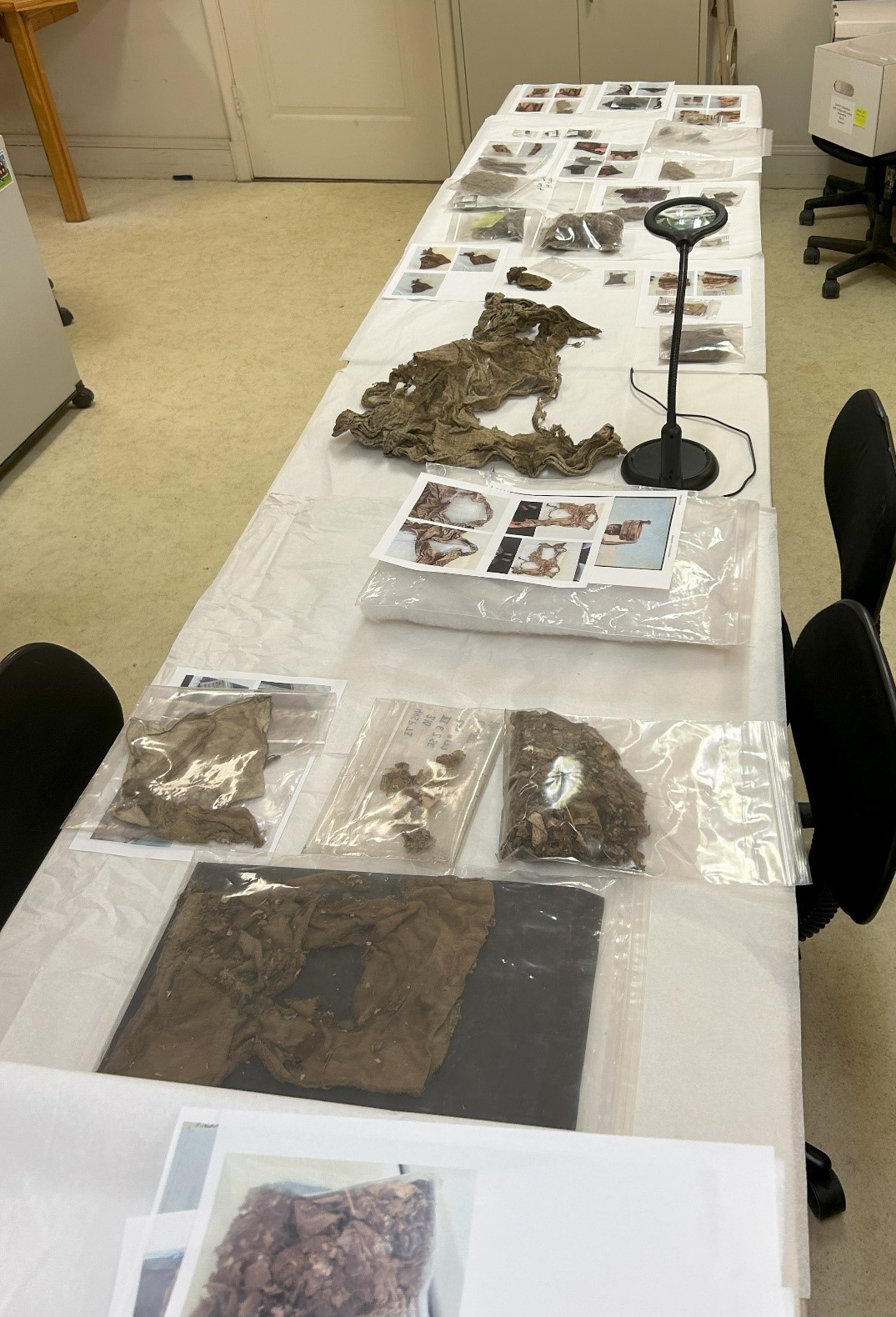
    And just a few weeks ago, the textile artifact, which looks to be a full child’s apron or pinafore, was transported to the conservation lab for treatment and further research. 
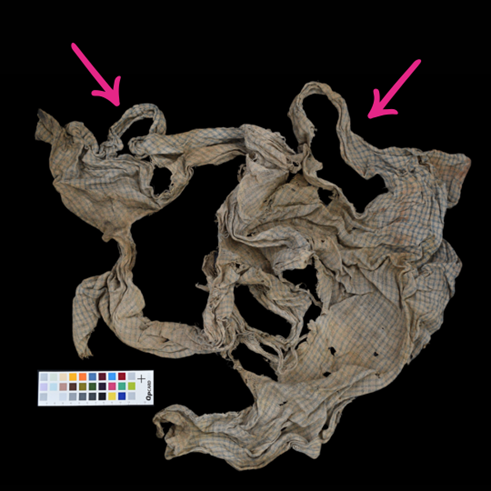
    Check fabric before conservation. Armholes visible along upper portion.

    The found artifacts from Historic Kenmore have not yet been able to fully share their stories.  We look forward to beginning to delve more into their manufacture, use, and re-use by the generations of people who wore them, worked with them, saved them, hid them, and otherwise interacted with the artifacts and the spaces in which they were found.


    Gretchen Pendleton

    Aldrich Director of Curatorial Operations
  • Mickey Owen Was Found in the Plaster!: A Look at Some Curious Inclusions Found in Plaster from Historic Kenmore

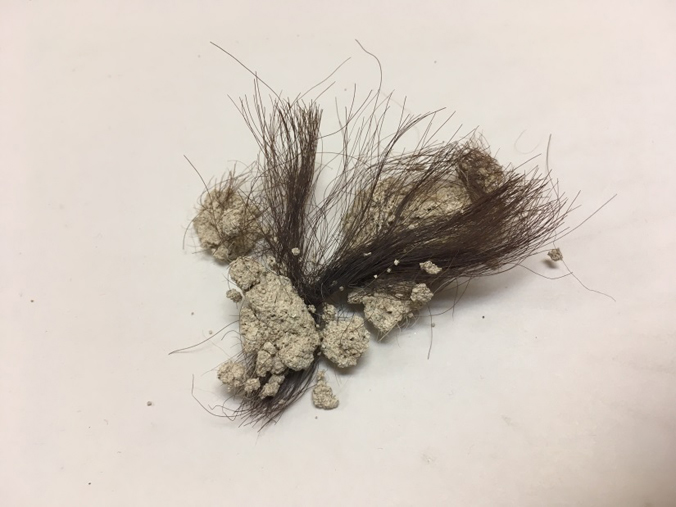
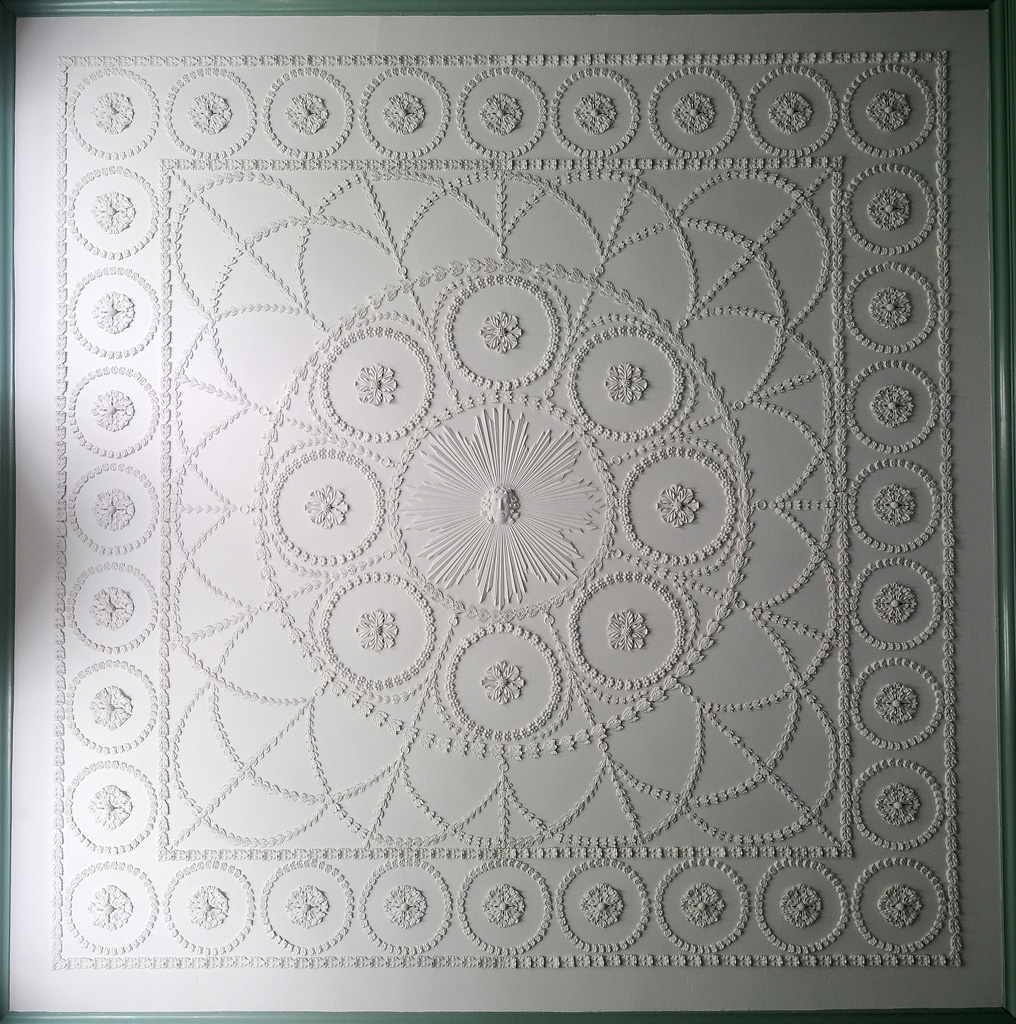
    Historic Kenmore is known for the unique decorative plasterwork seen on many of its ceilings. However, some of its most unusual pieces of plaster were discovered during repair work being done in 1989. These were pieces of plaster that contained large clumps of animal hair and newspaper. An inspection of this plaster, considering an architectural artifact, in the Archaeology Lab has led to several theories about the reasons for these unconventional inclusions. But before we discuss these, it is important to first understand how historic plaster was made and used.

    chamber-ceiling
    Decorative plasterwork ceiling in the bed chamber at Historic Kenmore.

    Plaster was one of the main finishes for interior walls in the United States until the introduction of drywall in the mid-20th century. The two main types produced were lime plaster and gypsum plaster. Lime plaster was made of water, lime, sand, and a fibrous material. The lime could be derived from limestone or oyster shells. The plaster found in Kenmore was probably made from oyster shells from the Rappahannock River, instead of limestone which is not native to this region. The fibrous material was some sort of animal hair such as horsehair, cow hair, hog hair, or even yak hair.[1] Gypsum plaster was introduced in the early 19th century and was often used in conjunction with lime plaster. Gypsum plaster did not require a fibrous binder and would eventually replace lime plaster as a finish coat.

    Plaster was applied in a three-coat process. First was the scratch coat, which had the highest hair content of the three coats. This coat was applied to lathe board causing the plaster to ‘key’ (adhere) into the spaces between the lathes. Next, was the brown coat, which was dark in color due to its high content of sand. The last coat to be applied was the finish coat. This coat contained no hair, little sand, and a slightly higher lime content to create a smooth white finish.[2]

    Now that we have a better understanding of how plaster is produced, let’s take a closer look at the unique pieces found at Kenmore. As discussed earlier, it is not unusual to find animal hair in plaster; however, the pieces pulled from Kenmore have exceptionally large clumps of hair not normally seen. Hair was added to plaster to act as a binder. It helped to hold the plaster together, reduce shrinkage, and improve strength.[3] Contrary to what one may believe, the process for obtaining hair for plaster was very selective. The hair had to be long, freshly cut, clean, non-greasy, and dry in order to be used in plaster. It also does not appear that people used hair from their own animals; instead, they bought hair from a tanner’s yard or a merchant. When choosing a hair type, horsehair was favored for its length and strength compared to cow or hog hair. [4]  However, horsehair was probably the most expensive and difficult to obtain out of the three.

    Plaster 01
    A piece of Kenmore plaster that contains a large clump of animal hair.

    Once the hair was acquired, it was mixed with the plaster. During this process, it was important to evenly distribute the hair throughout the plaster.[5] This was where the tradesmen making the plaster pieces found at Kenmore made a mistake. They did not distribute the hair properly causing the large clumps that we see. This caused problems when applying the plaster as well as limited the plaster’s strength.[6] Therefore, it can be concluded that the person making this plaster may not have been trained in plasterwork or was a worker under a tradesman who did not follow directions properly. Perhaps this is some experimental plaster made by William Key Howard, Jr. before he started his restoration of the decorative plasterwork on the ceilings of Kenmore in the post-Civil War period.

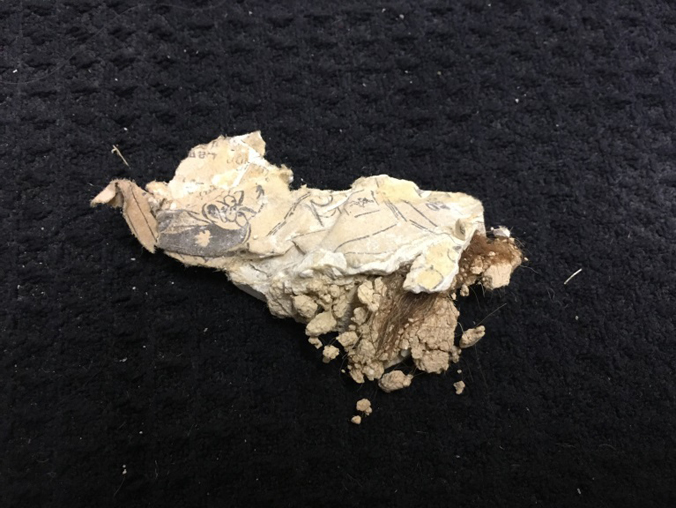
    The next interesting inclusion found in the Kenmore plaster was pieces of newspaper. Newspaper was not used historically for the manufacture of plaster; however, a dozen or so pieces of plaster pulled from Kenmore included newspaper fragments. The newspaper appears to have been torn or balled up and then covered in plaster. A skilled tradesman would not have made or applied plaster in this way. From this, we can conclude that whoever applied this plaster was not trained.

    Plaster 02
    A piece of Kenmore plaster that contains both animal hair and newspaper.

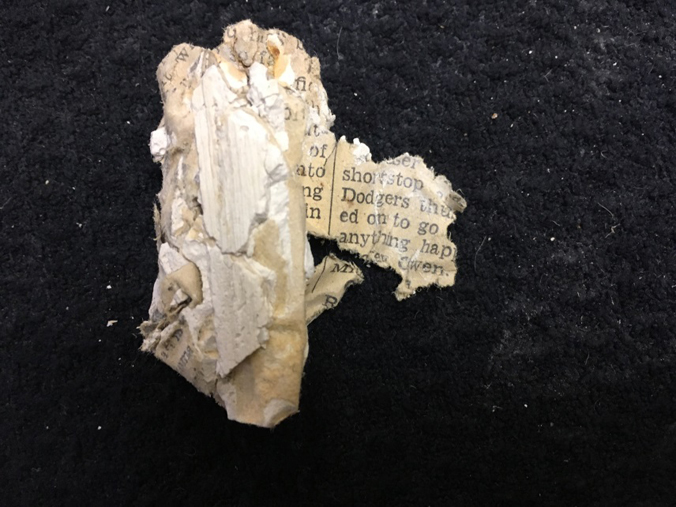
    From inspection of the newspaper, perhaps we can learn a little more about who may have done this. Unfortunately, no dates can be found on the newspaper pieces to give a specific time frame. However, from careful inspection of the incomplete newspaper pieces, it appears that many of the pieces are from the comics or the sports section. On one of the small pieces the words Dodgers, shortstop, and Mickey Owen can be identified. From this, it can be assumed that the paper dates between 1941-1945, the years in which Mickey Owen played for the Brooklyn Dodgers baseball team. The Brooklyn Dodgers experienced winning seasons in both 1941 and 1942, due to the skill of Mickey Owen and his teammates.[7] Therefore, it is likely that the newspaper article came from one of these two years. The time frame can also be limited to the months encompassing baseball season (April to October).

    Plaster 03
    Kenmore plaster bit containing newspaper that mentions Mickey Owen playing for the Dodgers.

    With a probable date range for the plaster pieces, we can begin to look at who occupied Kenmore at the time and why they might have made plaster in this way. In 1922, Kenmore was purchased by the Kenmore Association and was operating as a museum by the 1940s. In the early ‘40s, the Kenmore Association was concluding one of its restorations. A possible theory for the inclusion of newspaper in the plaster is that this plaster was used to patch a hole during the restoration. The small amount of plaster found with newspaper inclusions and the way the newspaper is distributed throughout the plaster, with most of the newspaper layered on the bottom and consecutive layers of plaster seen on top, does point to a possible patch job,.

    From the Kenmore 1941 correspondence records, a few references to repair work inside the house were found. In June of 1941, there is a reference to rewiring being done in the house. There is also mention of fire alarms being installed so that they do not show. Finally, the interior walls and ceilings were painted. On the receipt, the painter lists that some of the walls had to be mended. This is the most probable repair in which the newspaper would have been used as a patch. The hired painter was likely not trained in making/repairing historic plaster. This tradesman probably wanted a quick fix and layered newspaper over the spot and plastered over that in order to finish the paint job.

    While plaster may not be the most exciting building material to study, it can give a lot of useful insight into the construction and repair of a house. Conclusions about the people commissioning and conducting the work can be derived from the composition and application of plaster. With a little investigation, even unusual inclusions in the plaster can lead to some surprising discoveries about the people who lived and worked at Kenmore and about the life story of Kenmore itself.

    Tessa Honeycutt, UMW Student
    Fleming Smith Scholar

    [1] Henry, Allison, and John Stewart. Practical Building Conservation: Mortars, Plasters and Renders. Ashgate, 2009.

    [2] Practical Building Conservation

    [3] Practical Building Conservation

    [4] Hodgson, Frederick Thomas. Plaster and Plastering: Mortars and Cements, How to Make and How to Use. New York: The Industrial Publication Company, 1901

    [5] Ibid.

    [6] Practical Building Conservation

    [7] Ibid.