Lives and Legacies

Tag: architectural artifacts

  • Above Ground Archaeology – Cool Finds Revealed During Restoration

    While the house at Historic Kenmore has been faithfully restored to its circa 1775 appearance, the road to that final result was a pretty dirty one.  As in plaster dust, paint fumes, and all manner of dirt and debris.  Back in the late 1980s and early 1990s, the first forays into the research for and the subsequent writing of a Historic Structure Report (HSR) took place.  This project entailed a number of architectural historians selectively pulling up floorboards and peeking behind plaster walls to more fully understand how the house was originally built, its current condition, and its history of change over time.  This important document provided us with a clear understanding of Kenmore’s architectural history, was the guiding document for a decade-long restoration of the structure, and also gave us a collection of architectural fragments and individual artifact finds that continue to help us understand the material world of those who lived and labored at Kenmore through the centuries.

    In a past blog post, we learned a bit about rats as collectors and examined a rat’s nest that was discovered during that HSR investigative period. If you haven’t looked at the video of the unpacking of that nest, here it is. (In that nest, there were assorted papers, fibers, and other fluffy goodies dating to around the turn of the 20th century.)  But the nest wasn’t the only thing uncovered during that HSR peeking and prodding process.

    Of Mice and Men: A brief exploration of rodents’ history in America

    The Unlikely Curator: What a Rodent’s Nest Reveals about Historic Kenmore

    Exploring the Rat’s Nest

    Enter the “Above Ground Archaeology” or “Interior Archaeology” collection.  These eclectic artifacts were carefully collected, numbered according to their context or find location, bagged, documented on a list, and lovingly packed away in our ubiquitous Hollinger boxes.  Over the years, some of the artifacts were pulled by curators for exhibition in the Kenmore galleries, but most were stowed away in their boxes for long-term preservation and research purposes.

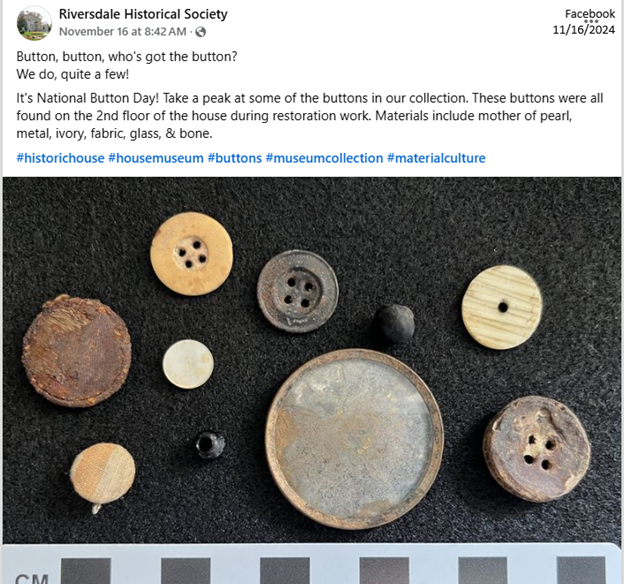
    The use of found objects in historic structures to help illuminate the material world of the building’s residents and workers is not a revolutionary concept.  Colonial Williamsburg, for instance, in their recent restoration of the historic Bray School, removed modern plaster walls, revealing not only structural information but also artifacts: “We are collecting building fragments and objects found in the walls…These items shed light on the building’s original finishes and various inhabitants since 1760.”  Riversdale Historical Society has been showcasing some of their “found” artifacts on Facebook — most recently posting a set of buttons for National Button Day.
    Colonial Williamsburg: The Bray School Project

    Riversdale Historical Society, Facebook Post, 16 November 2024

    Recently, we pulled a few of Kenmore’s artifacts into exhibit cases in our refreshed orientation exhibit in the Bissell Gallery of the Crowninshield Education Center at Historic Kenmore.  Together with in-ground archaeology, these exhibit cases help us illustrate the built environment and the wares known and used at the site.
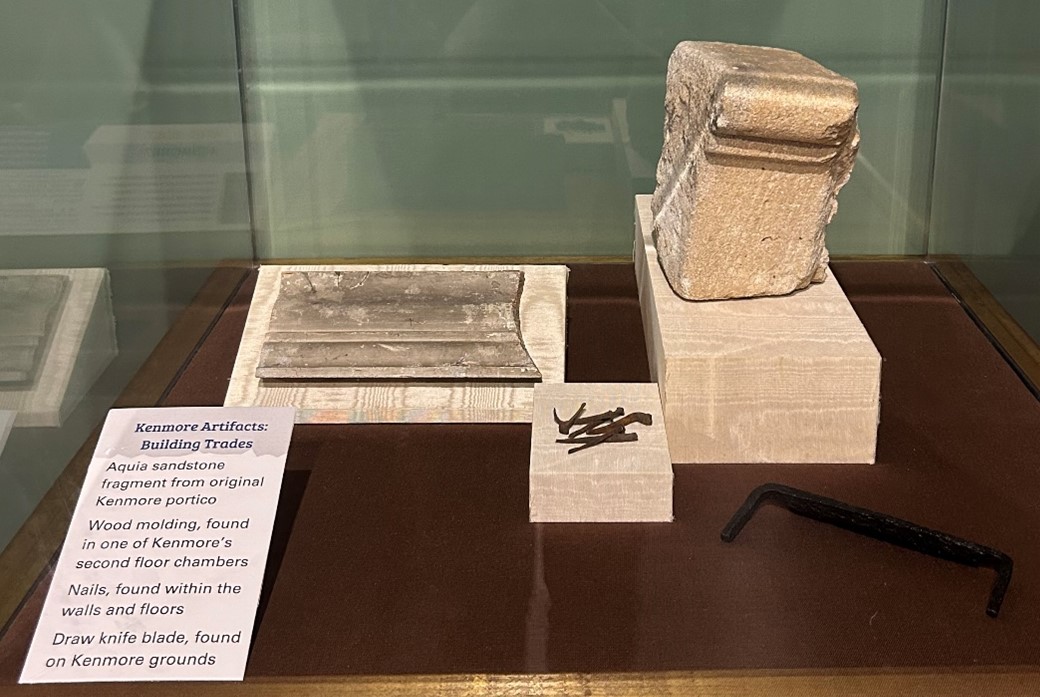
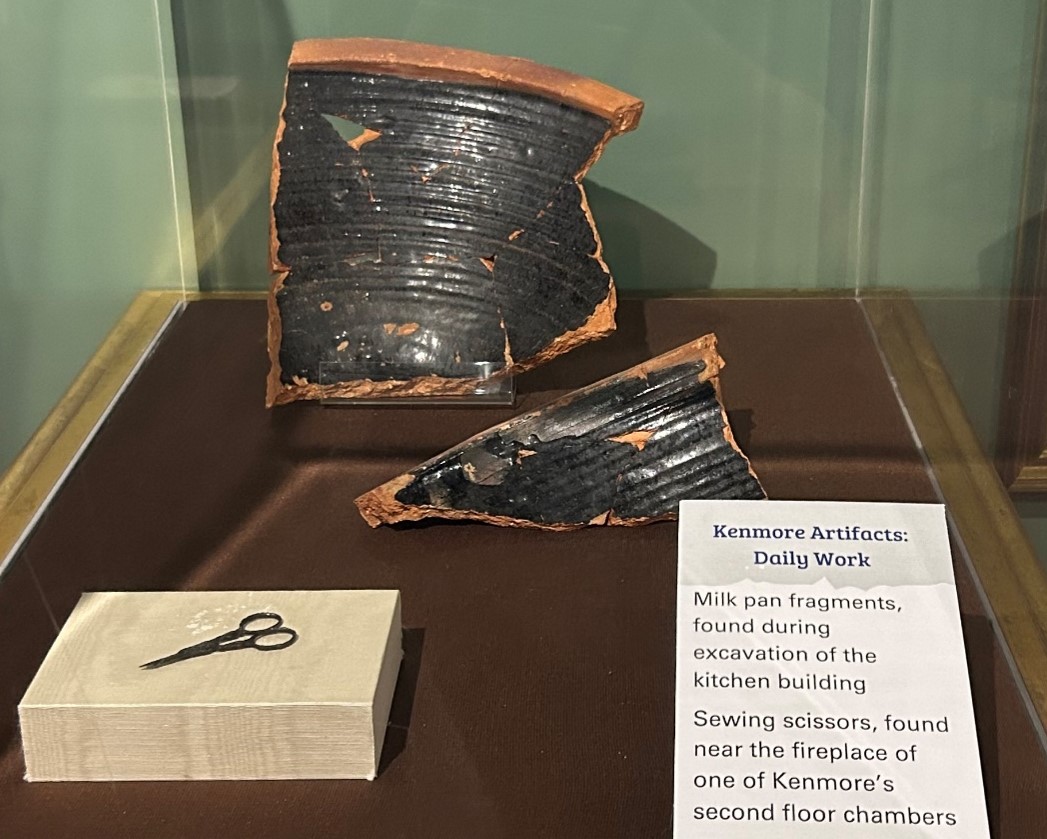
    In 2010, then Intern Ashley Dean (University of Mary Washington) was tasked with inventorying the three boxes of artifacts, and for that, we are extremely grateful.  What resulted from that inventory project was a 12-page list of artifacts that formed the center of this rejuvenated research initiative.  The artifacts in these boxes range from architectural elements (plaster fragments, nails, wallpaper bits) to broken household goods (bottle glass, ceramic pieces) to whole objects (beads and a pair of sewing scissors).  When first bagged and numbered, these artifacts were recorded by location context—based on the mapping system then being used in the architectural investigations of the house, with room numbers ranging from B001 in the cellar (or basement level) to 301 being the attic (or 3rd floor) of the house.

    Attic (Room 301) mapping

    Fast forward to 2024, the artifacts were again reviewed, and the idea blossomed to plan a textile assessment of all the small scraps of fabrics that had been collected.  According to our in-house review, we could tell that they dated to a variety of periods and ranged in their likely original use, from costumes to household linens. 

    Selection of textile fragments in the Kenmore Above Ground Archaeology collection (July 2024)

    One particularly large artifact proved the most intriguing — a pile of blue and white check fabric.  The indeterminate ball of checked fabric piqued the interest of staff and now serves as the starting point for a multi-year conservation assessment and interpretation project.  A few months after our in-house assessment, we hosted a textile conservator who conducted a baseline review of the textile fragments and more fully examined the artifact for potential treatment.  She had a rapt audience that morning!
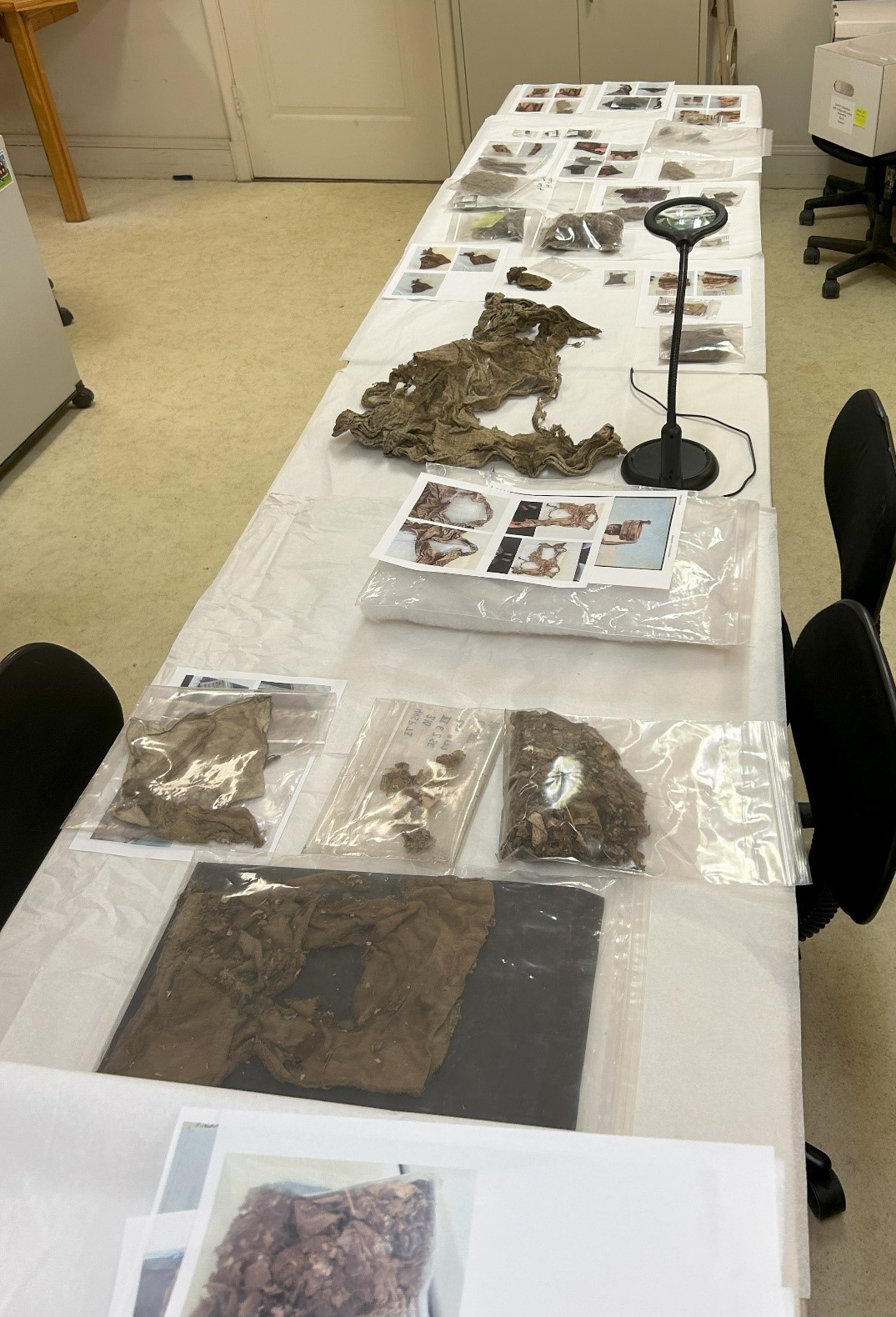
    And just a few weeks ago, the textile artifact, which looks to be a full child’s apron or pinafore, was transported to the conservation lab for treatment and further research. 
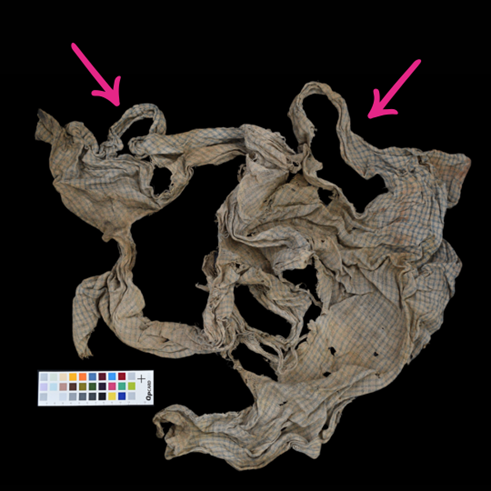
    Check fabric before conservation. Armholes visible along upper portion.

    The found artifacts from Historic Kenmore have not yet been able to fully share their stories.  We look forward to beginning to delve more into their manufacture, use, and re-use by the generations of people who wore them, worked with them, saved them, hid them, and otherwise interacted with the artifacts and the spaces in which they were found.


    Gretchen Pendleton

    Aldrich Director of Curatorial Operations
  • How to Do Archaeology During a Pandemic

    Like so many of you, in the middle of March this year, nearly all employees of George Washington’s Ferry Farm & Historic Kenmore began working from home and did not return to our offices for two and a half months.  We expected a lengthy time away and, as such, prepared as best we could for the change.  For some departments, the change mainly involved figuring out access to digital files but, since our jobs revolve around physical artifacts, we archaeologists had to do a little improvising.

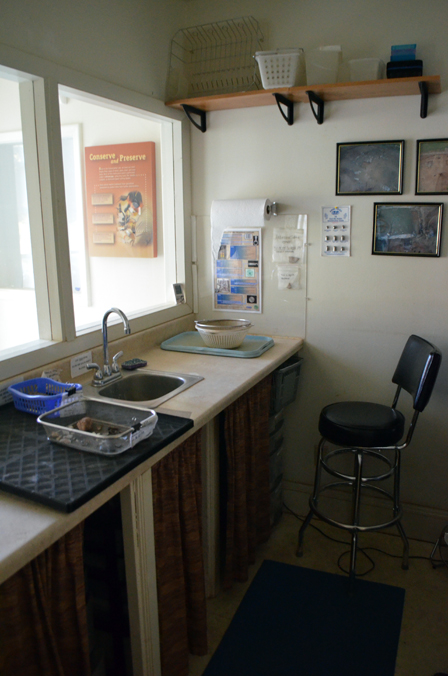
    The ‘wet lab’ where artifacts are washed before cataloging and analysis sits quietly unused at George Washington’s Ferry Farm during the COVID-19 pandemic of 2020.

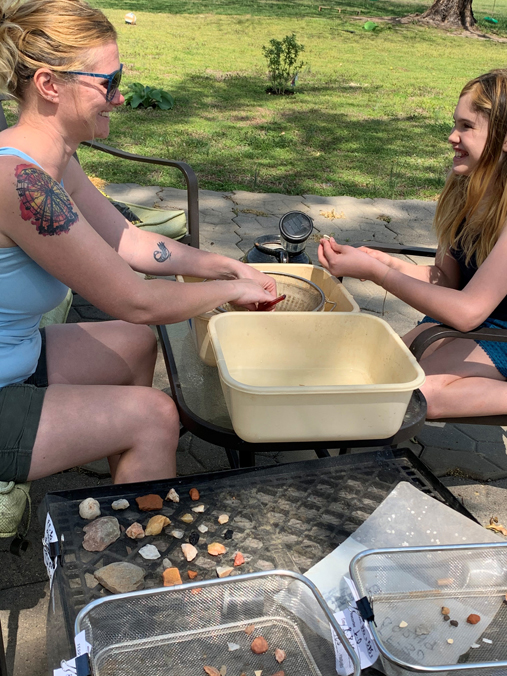
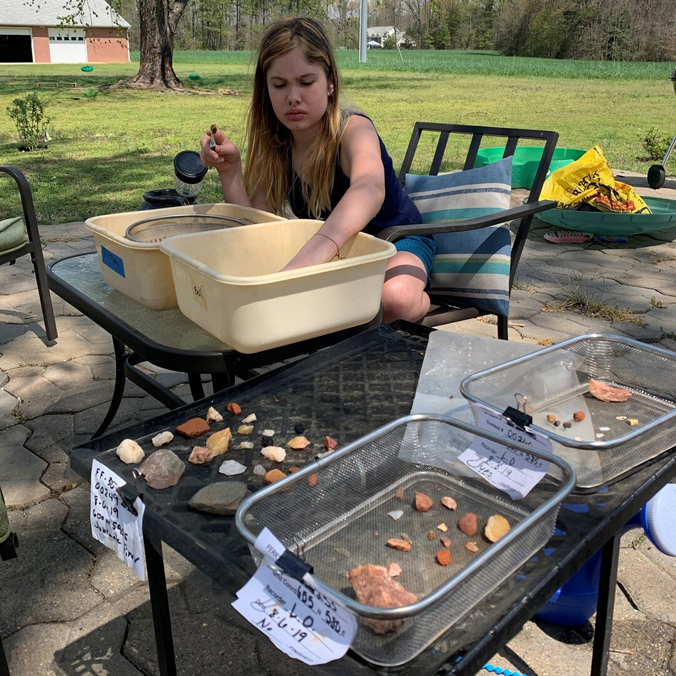
    First, while it’s normally not a “best practice” to take artifacts home, we really had no choice if we were going to remain productive.  This meant I as archaeology lab supervisor and that Elyse and Judy, archaeology lab technicians , all had to create what essentially amounted to an a archaeology lab in each of our homes.  Elyse and Judy need space to wash, label, and catalogue artifacts while I needed space to analyze artifacts while simultaneously keeping them away from my extremely inquisitive preschooler! I mostly succeeded in that last task. Elyse actually enlisted the help of her older and amazing daughter June with washing artifacts.  As so many of us found out in 2020, working and parenting from home is not easy but Elyse and I adapted well, I think.

    Elyse Adams, archaeology lab technician, and her daughter June wash artifacts at home.

    It should also be noted, however, that keeping artifacts away from all of our many, many dogs and cats proved challenging as well.   While my cats were thrilled (well, as thrilled as cats can get, at least) that I was home all day, they were occasionally of the opinion that the Washington-era porcelain sherds I was researching looked much better on the floor.

    Despite these challenges, we got the job done and eventually returned to the lab at Ferry Farm having accomplished quite a bit.

    Life inside Ferry Farm’s archaeology lab looks quite different now, too, compared to this time in 2019. Since the lab is relatively close quarters, we instituted a rigorous cleaning schedule, spaced our work areas out as much as possible, and started taking temperatures every day.  Our beloved volunteers have not come back (Shout out to our volunteers! You guys are awesome!) because we needed to limit the number of people working in the lab to only myself, Elyse, and Judy.

    One of the coolest features of our lab is the huge viewing window through which visitors could see real live archaeologists at work.  While Ferry Farm is now open to the public for tours, the visitor center remains closed and there’s no longer any inquisitive folks peering at us through the glass. It’s a surprisingly lonely feeling not to glance up from our work occasionally to see visitors watching what we’re doing.  We also put a temporary halt on lab tours that we do occasionally during special events or children’s camps at Ferry Farm.  Both of these changes are a bummer because we really liked the interaction we had with visitors. That being said, we’re optimistic that someday life will return to normal eventually and we’ll be able to share our lab with the public once again.  When that time does finally comes, please visit and check out the archaeology lab at George Washington’s Ferry Farm. We miss you!

    Mara Kaktins, Archaeologist
    Archaeology Lab Supervisor

  • The Unlikely Curator: What a Rodent’s Nest Reveals about Historic Kenmore

    Rodents are usually seen as one of a museum’s greatest enemies. They damage valuable artifacts and buildings, leave a mess wherever they go, and frighten unsuspecting visitors. Like most museums, Historic Kenmore does its best to make sure no pests make their home in the 18th century plantation house. But, before it became a museum in the early 20th century, Kenmore was not always rodent-free.

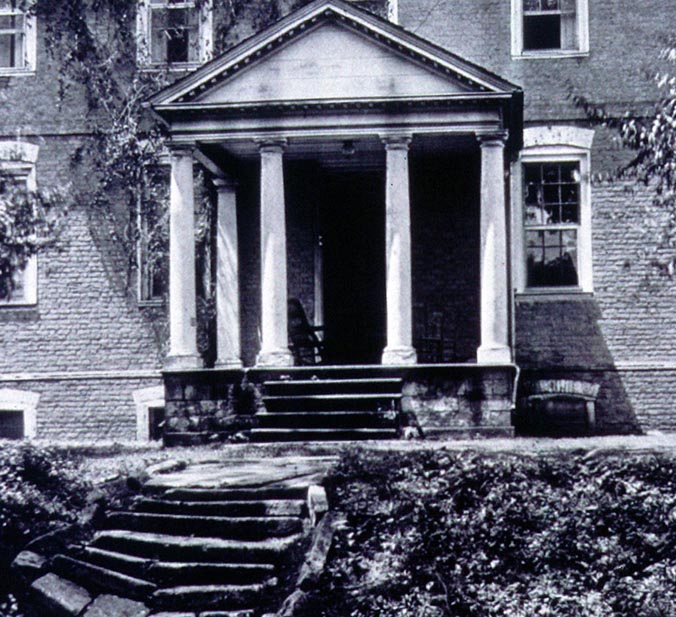
    Kenmore's East Portico
    The east portico of Historic Kenmore shows some neglect to the house and its surroundings. The Howard family, who lived in Kenmore for a long period following the Civil War and was perhaps living in the house when our rodent of interest built its nest, invested a lot of money in refurbishing the house.

    In 1989, archaeologists found a mouse or rat’s nest during an investigation of Kenmore’s walls and floors for architectural artifacts. In a recent video, our archeologists and curators carefully picked apart the nest found so long ago and made a cursory analysis of its parts.  This blog post delves more deeply into the history revealed by this rodent – Kenmore’s unlikely curator – and its nest.

    The “indoor excavation” at Kenmore in 1989 provided present-day archaeologists at the Foundation a unique opportunity to study artifacts that rarely survive in the elements. Whatever rodent built this nest was a skilled architect in its own right, tightly weaving together bits of cloth, paper, and miscellaneous fluff from around the house to create a soft, structurally sound home of its own. The material came from dozens of sources, each giving insight to life at Kenmore in the late 1800s and early 1900s.

    Fabric
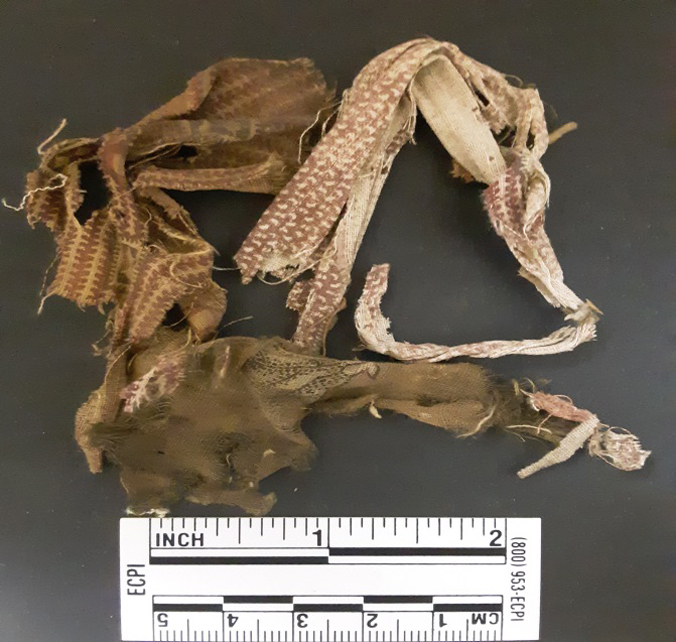
    Patterned fabric from the nest

    When it comes to fabrics, both the people living at Kenmore and the rodent had pretty good taste. While most of the cloth from the nest was a neutral white, beige, or brown, several scraps featured patterns popular from the late 19th through the early 20th century, like a red cloth with cream specks, and another with red and yellow flowers. Most of the cloth in the nest probably came from sheets, towels, or rags, but the few patterned scraps may have once been part of a dress or apron. A few threads are woven around a stiff, curved string, perhaps as part of an eyelet or fastener on a piece of clothing.  Other fibers came from webbing used in upholstering furniture. The rest of the threads, yarn, and fibers are too small to tell where they came from, but it’s clear that the resident rodent had plenty of textiles from which to choose.

    Newspaper 1
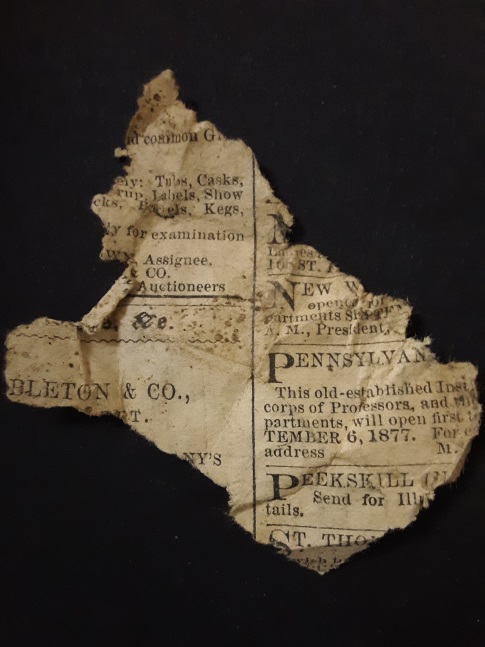
    A series of newspaper ads includes a date of September 6, 1877.

    Newspaper 2
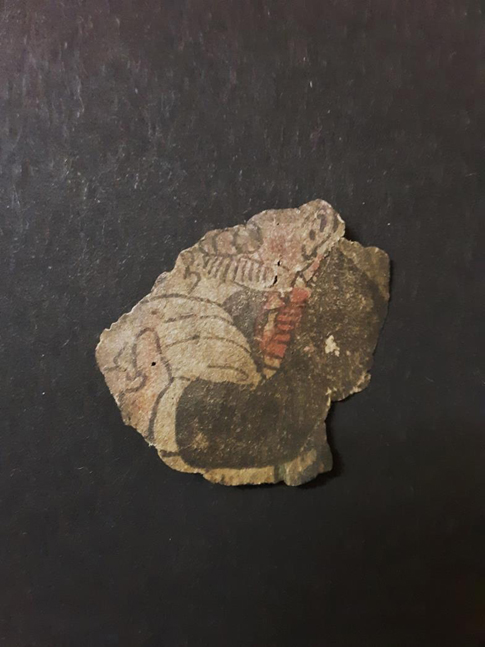
    A scrap of a cartoon features an old man carrying what appears to be a baby.

    A few other gnawings in the nest were less comfortable than threads and cloth. A bit of nutshell, wood splinters, tiny rib bones, and even two insect wings were part of the rodent’s eclectic collection. While these finds make up a small portion of the nest, it appears that the rodent had quite a literary bent. Over a hundred tiny scraps of paper lined the nest. About half of them were marked, while the others have print from books and newspapers. Some of the pieces are so small that not even an entire letter can be seen, but a few are large enough to make out some sentences, determine date of publication, or even identify the book from which the scrap came.

    Newspaper 3
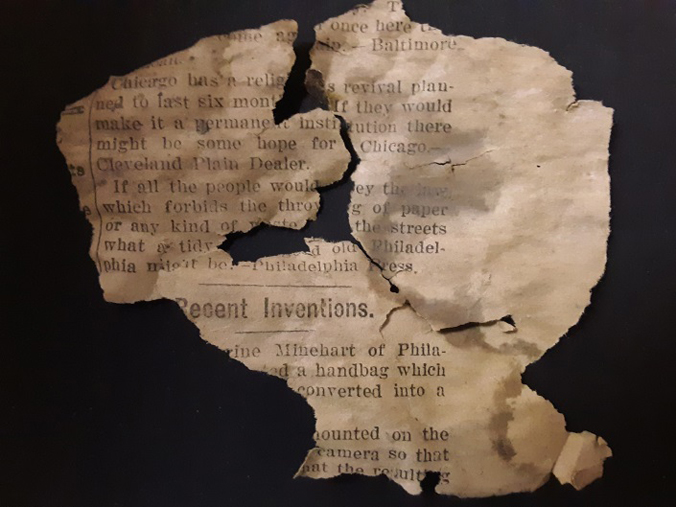
    A section entitled “Recent Inventions” includes a convertible handbag and seat patented in 1915.

    Newspaper 4
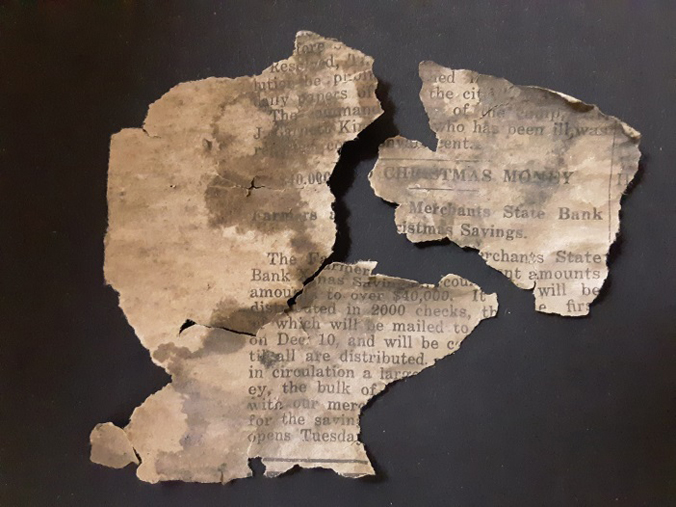
    An advertisement on the opposite side of the newspaper discusses Christmas Savings funds from Farmers and Merchants State Bank.

    One newspaper scrap advertises Christmas saving funds from the Farmer’s and Merchant’s State Bank. On the other side under “Recent Inventions,” Katherine Minehart’s “Combined Hand-bag and Seat” from 1915 is described. A much earlier bit of newspaper announces the opening of a store on September 6, 1877. The scrap from a book may be even older. The words on both sides are Christian lyrics, and were compiled into a book called Union Hymns by the American Sunday School Union. The book and several editions were published in 1835, 1845, and 1860.

    Given the short lifespan of most rodents (around 1-7 years), it’s most likely that the nest builder lived in the early 20th century, and scampered off with bits and pieces of discarded old paper and fabric. Except for a few newspapers, this rodent tended to use items with a past. The absence of any plastic in the nest indicates that it probably wasn’t built much past the early 1900s.  Indeed, since the latest scrap found in the nest dated from 1915, the nest itself would have been built in that year or thereafter, just a few years before the house began its transformation into a museum focusing on the lives of 18th century patriots Betty and Fielding Lewis.

    The stories of those who lived at Kenmore after the Civil War are not as detailed, but thanks to an unlikely curator, we are given a glimpse into the wardrobes and literary tastes of Kenmore’s late Victorian-era inhabitants.

    Abby Phelps, UMW Student
    Fleming Smith Scholar

  • An Unlikely Curator: Inside a Historic Rodent’s Nest [Video]

    In this video, we pick apart a rodent’s nest discovered by archaeologists investigating Historic Kenmore’s walls and floors for architectural artifacts. Like most museums, we take extensive pest prevention measures today but, back when it was an actual home, Kenmore was not always rodent-free. This nest revealed some fascinating history and told us a bit about Kenmore itself.

    (NOTE: The video was filmed long before COVID-19 physical distancing requirements.)