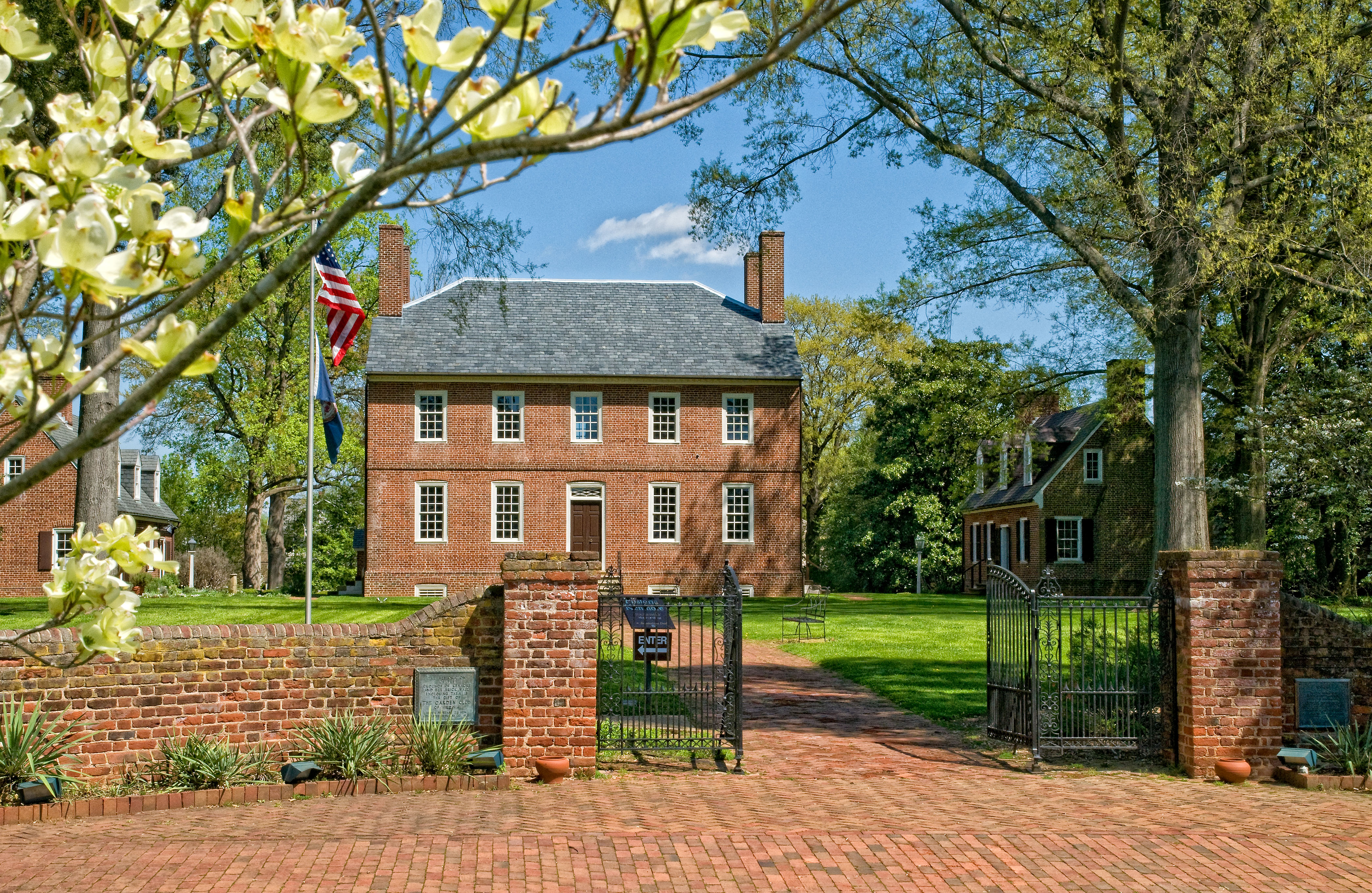
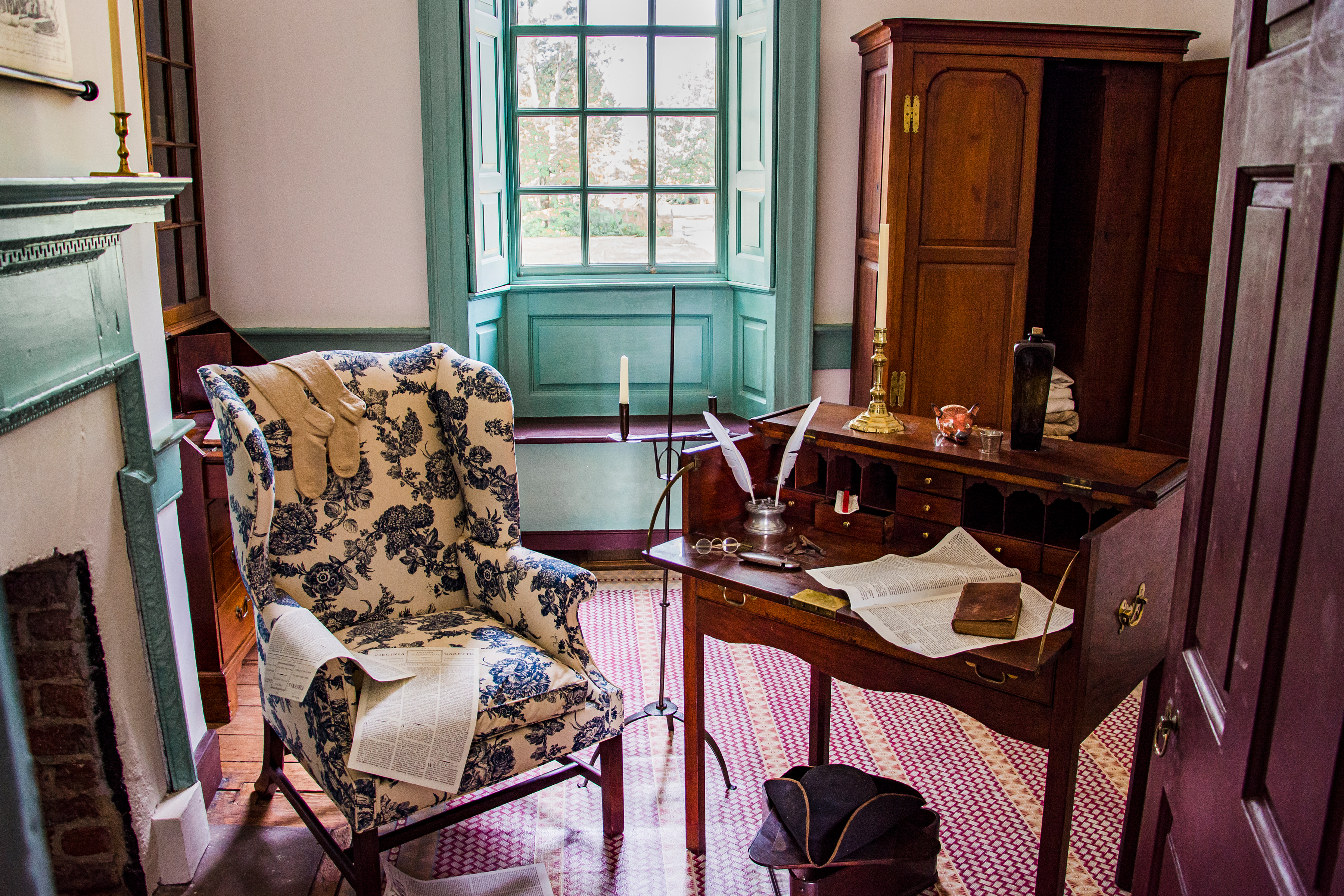
Postcards were a staple of vacations. Collected and sent back to friends and family so they could be part of your adventures. Many of us can remember trying to pick up postcards on the first day of vacation to get them in the mail quickly so they would arrive back home before you.
Postcards were created in the mid-nineteenth century, and through the decades, they were mass-produced with popular scenic images and were inexpensive, so many people picked up postcards to document their vacations rather than taking pictures. Their popularity and collectability mean that boxes and boxes of old postcards can be found in antique stores and flea markets.
While postcards are amusing souvenirs and a source of nostalgia, they can also offer us important insights into the evolution of historic sites and cities. Postcards of Kenmore have helped us document the restoration of the house, the development of the property, and past interpretations, even providing documentation of collection items for which we may not have records.
For your enjoyment, I’ve selected some of my favorite postcards to showcase how they’ve documented the historical restoration and interpretation of Kenmore.
Exterior: Pre-Restoration
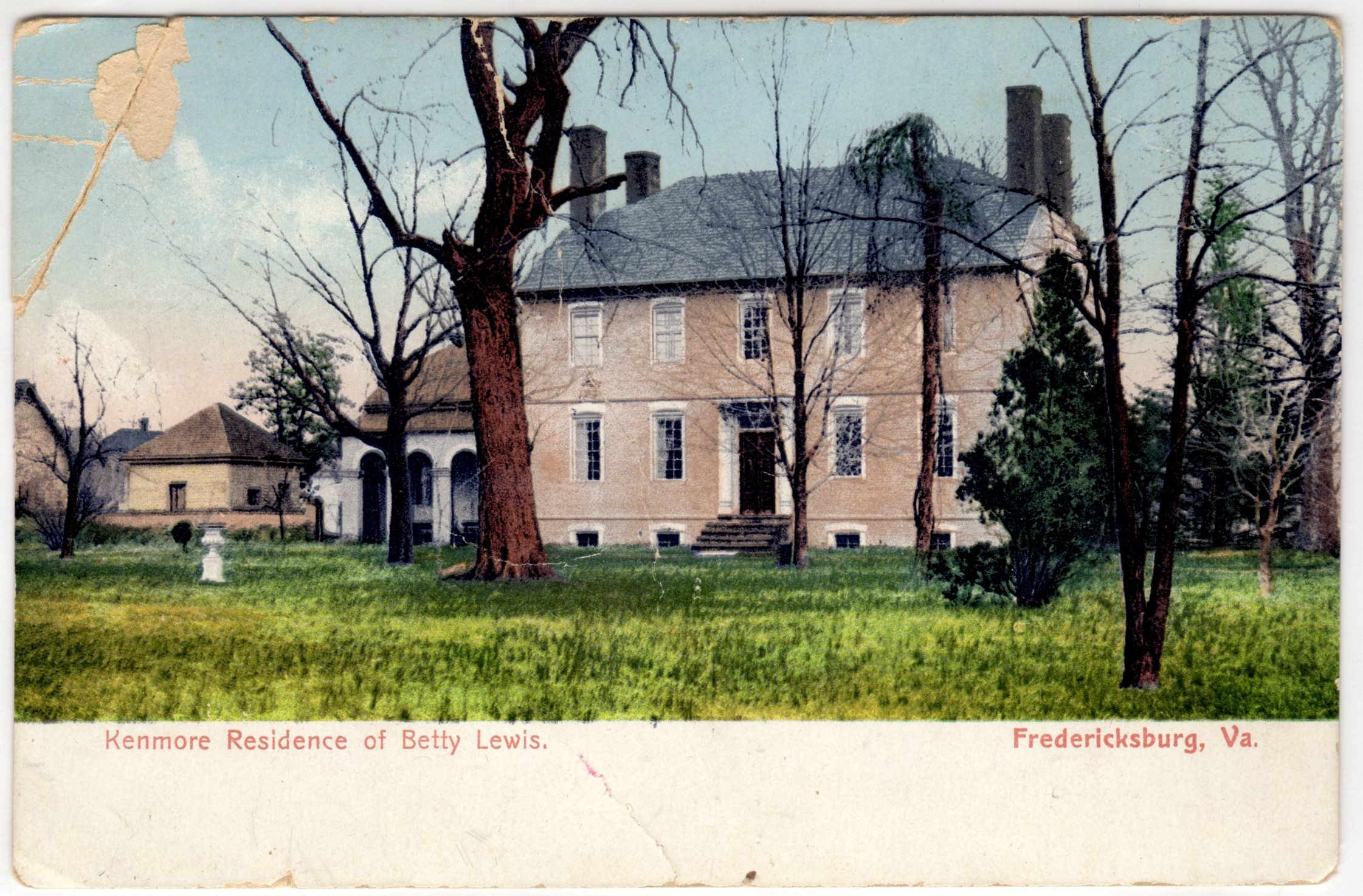
Kenmore has always been quite the showpiece, even when it was privately owned. One of the earliest postcards of Kenmore’s exterior is dated 1908, as indicated by the postmark. The Howard family owned the house until it was acquired by E.G. Heflin around 1914.
The postcard shows the house from the Washington Avenue side (west elevation) and provides a glimpse of the properties before any restoration work. The old kitchen can be seen on the north side of the house, while the exact date it was built is unknown; we know it was built in the late 1880s or early 1890s. It was torn down in 1929.
Additionally, the exterior brick has been painted, along with the lintel, which was removed in 1929. We can see the paintwork better in the second color postcard.
Interior
Entrance Hall
One of the earliest postcards we have of the entrance hall, around 1923. One of the most notable things is the plasterwork on the ceiling. If you see current pictures of the entrance, you will notice that this plasterwork no longer exists. The plasterwork was done by former resident William Key Howard, Jr., when he was restoring the original ceiling in the other rooms. In 1930, the Association decided to remove the plasterwork because it was not original to the Lewis family. Mr. Howard Jr. was not happy when he found out that the plasterwork had been destroyed and called it an act of vandalism.
Additionally, we can see next to the tall case clock a door that leads into the drawing room, which no longer exists. It was decided that this was not the original placement, and the door was moved directly across from the office door in 1930.
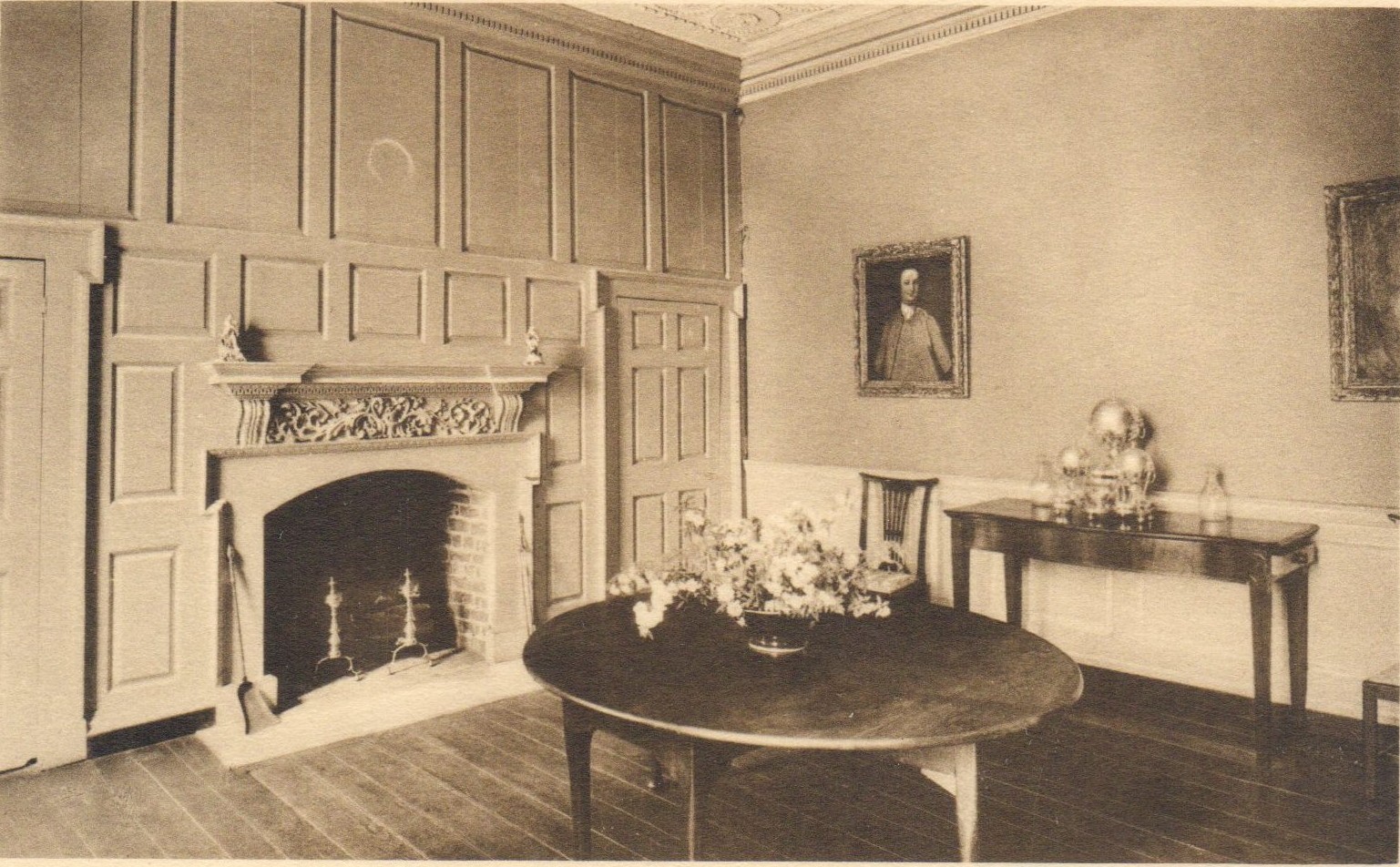
Chamber/NW room, first floor
While we currently interpret the NW room on the first floor as the chamber, the ladies referred to it as the Dining Room. We can see a round table, a sideboard, two chairs, and two portraits, plus a large silver tea urn. The postcard dates from the late 1930s because we know from our records that most of these pieces were donated in 1935. We still have all these objects in the collection, but the only things currently on display to the public are the round table in the dining room and the chairs in the drawing room. All other pieces are in storage.
Dining Room/NE room, first floor
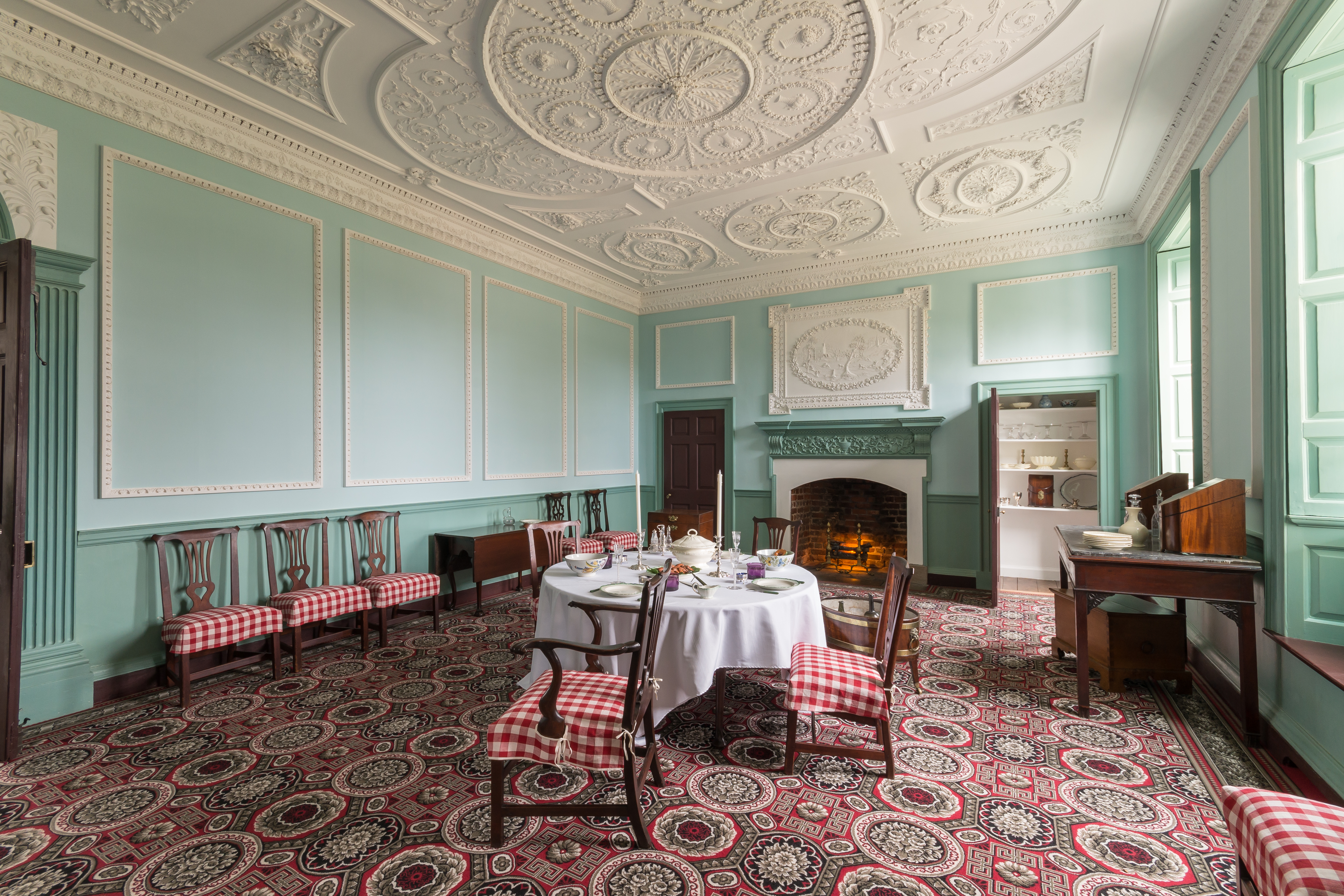
We currently refer to the NE room on the first floor as the dining room. It has undergone many changes, with Gothic arches added to the closets during the 19th century, and has been restored to its original shape. Not everything in the postcard is still in our collection, but you can see the square table still on display in the dining room, and Betty’s portrait is now in the drawing room.
On the left is the Dining Room during the Howard occupation around the 1890s, and on the right, the Dining Room todayThe Dining Room after the Kenmore Association’s restoration, c. 1940s
Drawing Room/SE room, first floor
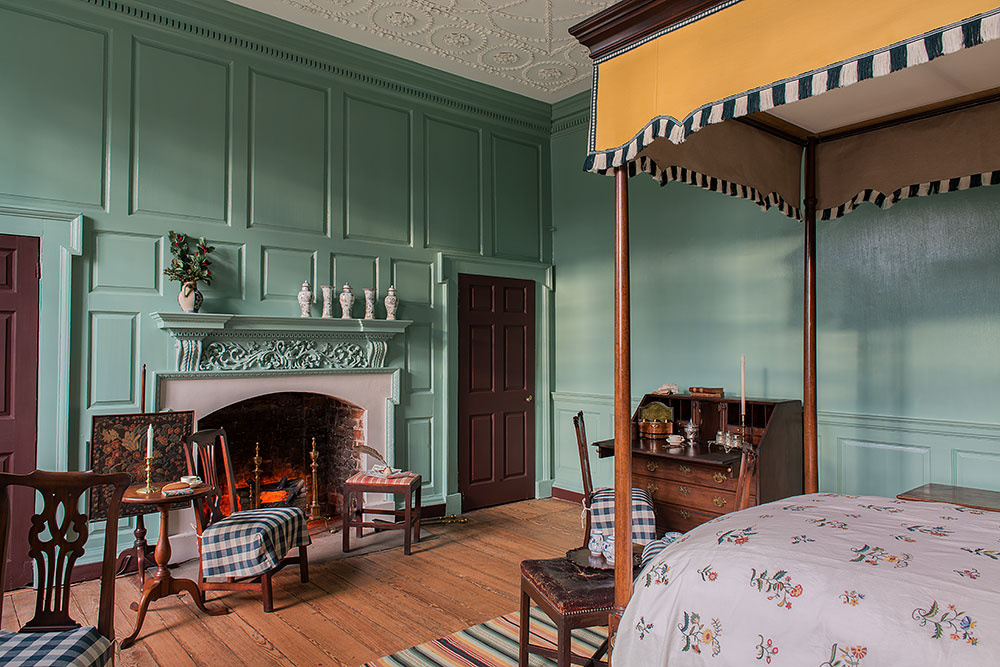
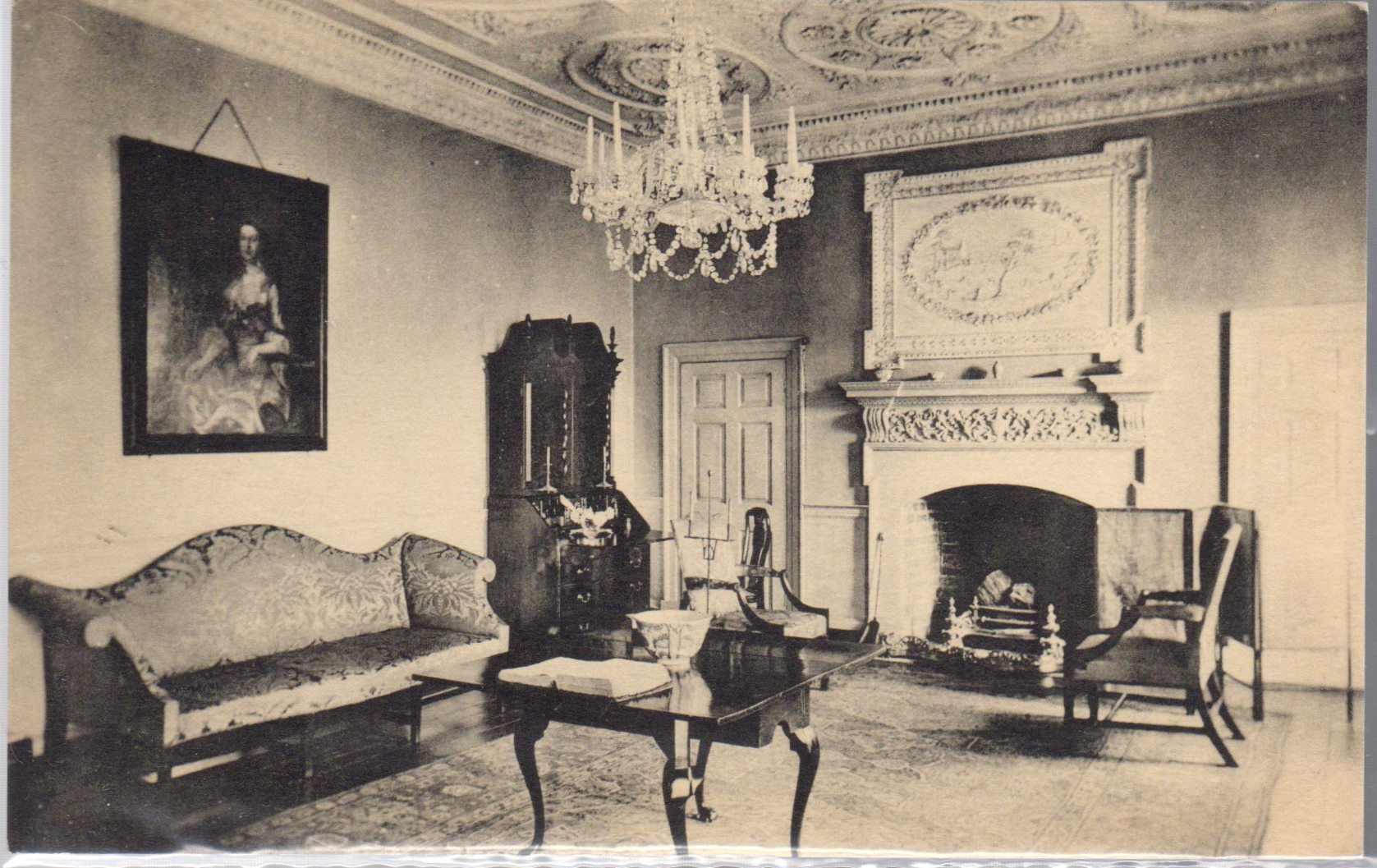
The drawing room was previously known as the library and also served as a chamber for a while in the 1980s. By the window, you can see Betty’s desk in the older postcard (c.1940s), which is still on display, but in the chamber. We still have the tea set on display where it was in the chamber, but it is currently in storage.
On the left is the Drawing Room during the Howard occupation around the 1890s, and on the right is the Drawing Room nowDrawing Room, c.1940sIn the 1980s the Drawing Room was turned into a bedroom
Office/SW room, first floor
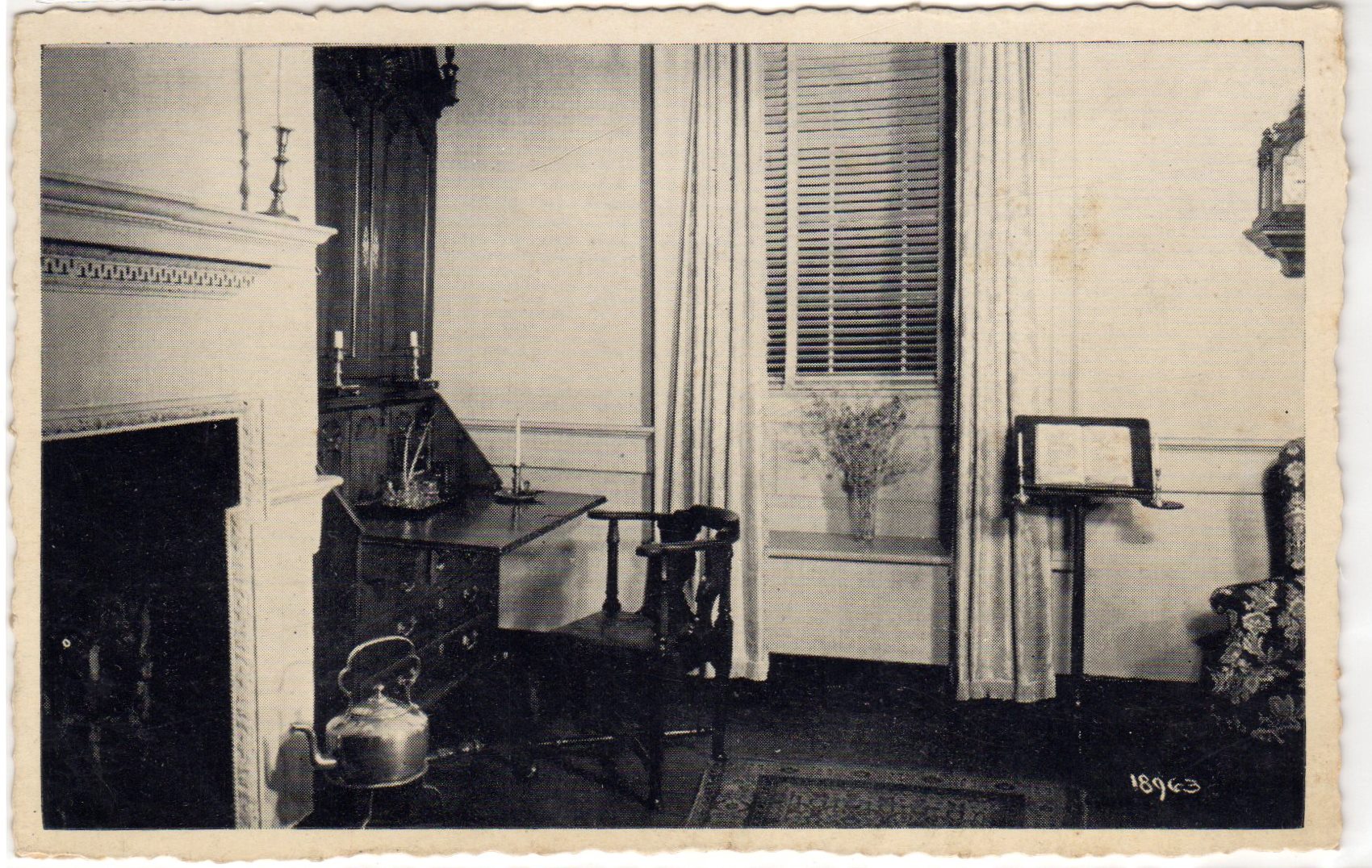
Fielding’s office has been displayed as a sitting room and a kids’ room. We don’t have many of the objects in the postcards still in the collection, except the corner chair, which now has a check seat, and the music stand, which is too fragile at the moment for display.
2nd floor
We currently do not offer tours of the upstairs area because we don’t put too much stress on our lovely plaster ceilings. The Kenmore Association interpreted the upstairs as individual bedrooms for the family, which is not the most historically accurate version.
Hallway/ 2nd floor
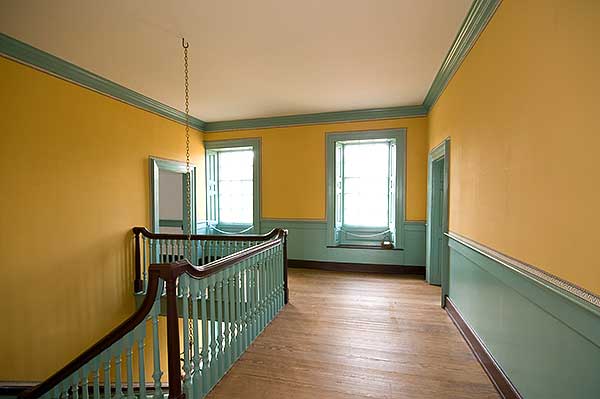
Besides the paint color, the hallways upstairs remain structurally the same. The ladies have Betty’s desk on display, with the Hammond quilt above. We still have the Hammond quilt; fortunately, we removed it from the frame, but it is a massive quilt and is not currently on display. However, it is in excellent condition. As for the tall case clock, chandelier, and curtains, they have been lost to history.
“Mary Washington Bedroom”/NE room/2nd floor
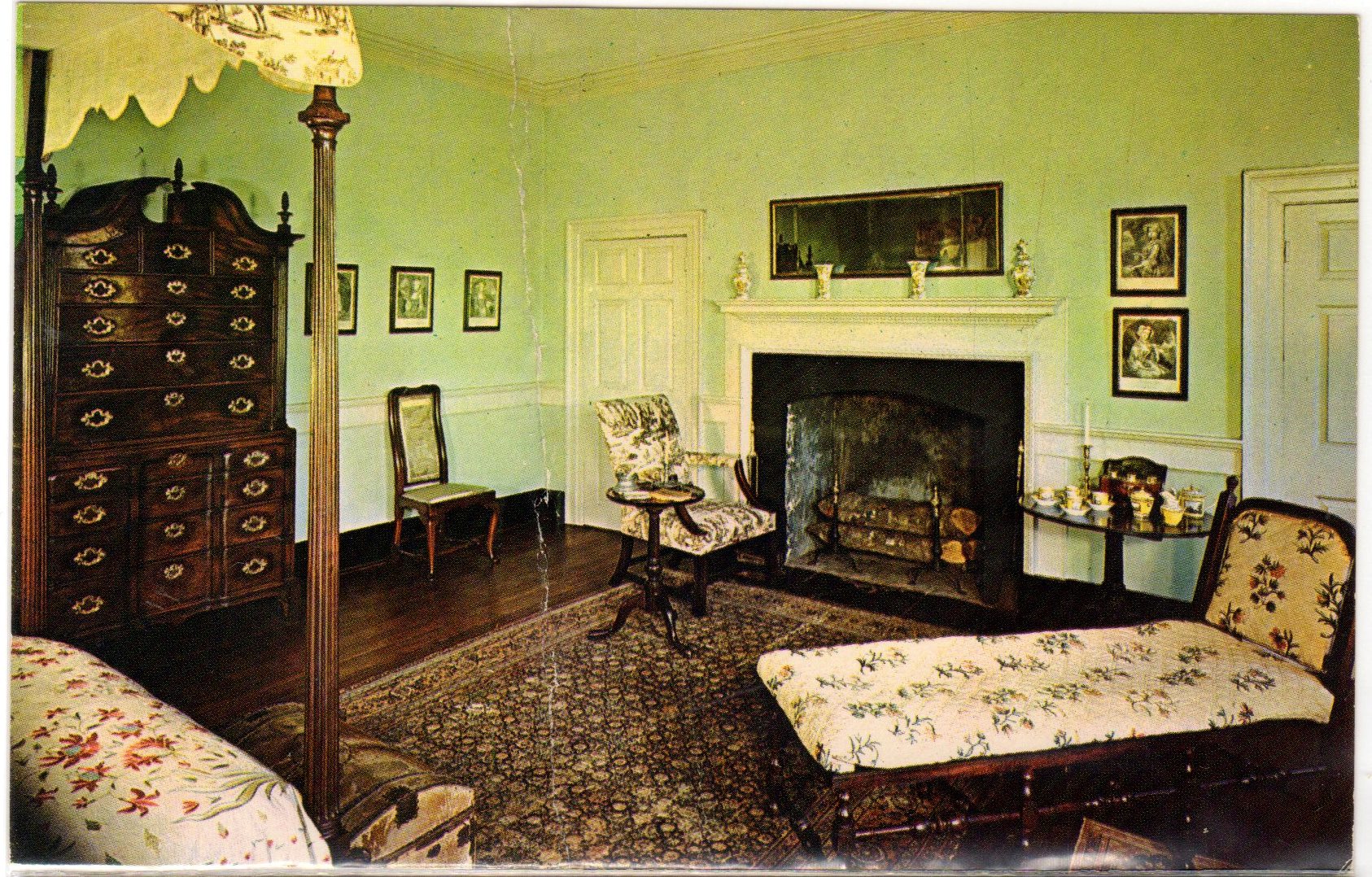
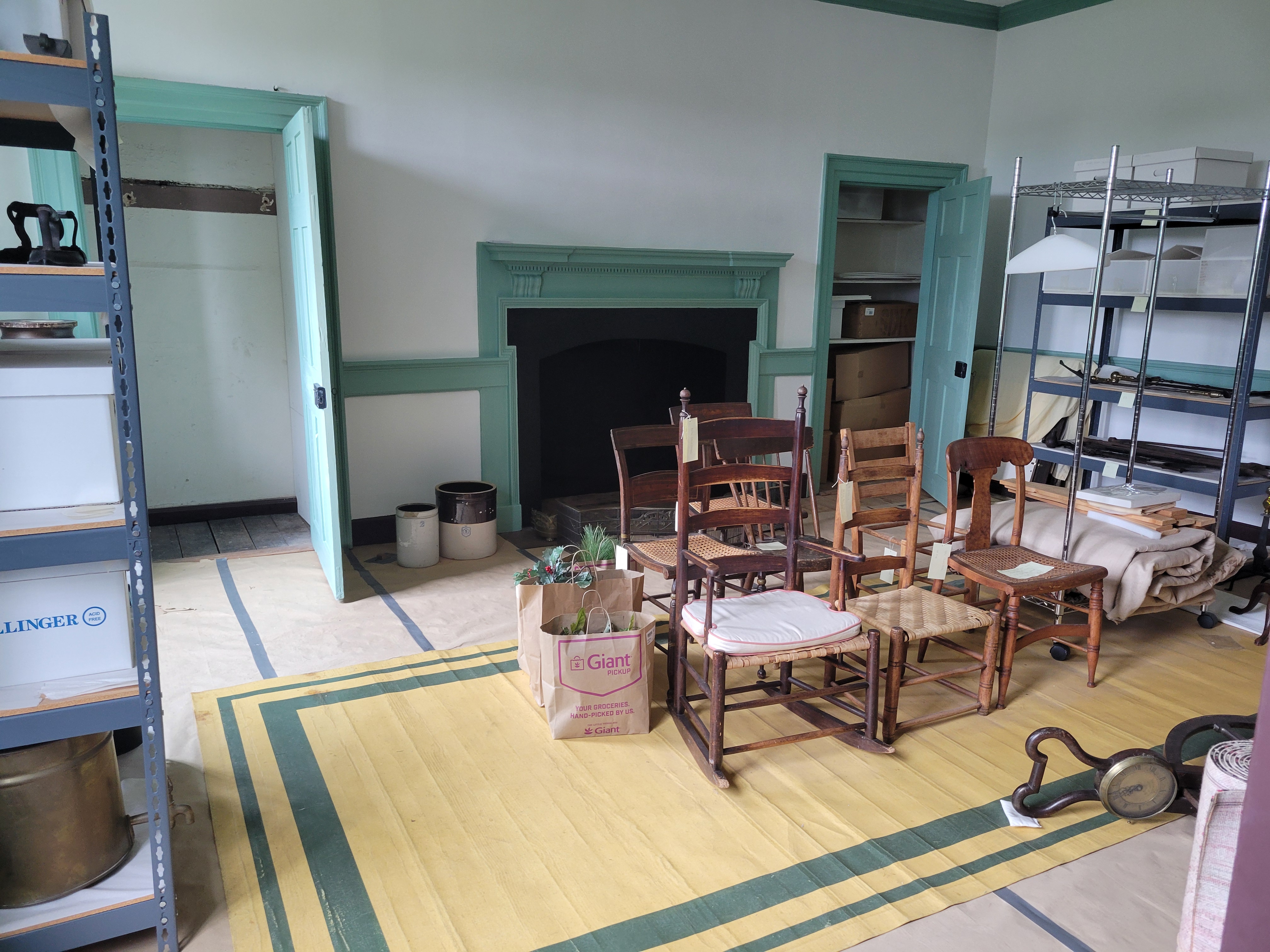
We have no evidence that Mary ever had a dedicated bedroom at Betty’s house, and it seems unlikely with the size of the Lewis family. We do still have some of the pieces in the collection. The tea box is currently on display in the chamber, and the yellow tea set has been displayed intermittently over the years. The two calendar prints hung on the wall are now downstairs in the drawing room. Lastly, the chaise lounge was loaned to the foundation by the Metropolitan Museum of Art in the 1930s (subsequently purchased in 1968) and is currently in storage, as there is no evidence that the Lewis family owned many northern furniture pieces.
“Mary’s Bedroom” is currently storage with temporary covering to protect the original floors.
“Guest Bedroom”/NW room/2nd floor
Much like “Mary’s bedroom,” it is very unlikely that the Lewis family had a “guest room,” with as large as the family was, it would have been a waste of space. The bed still resides in our collection, disassembled and in storage.
“Betty’s bedroom”/SE room/2nd floor
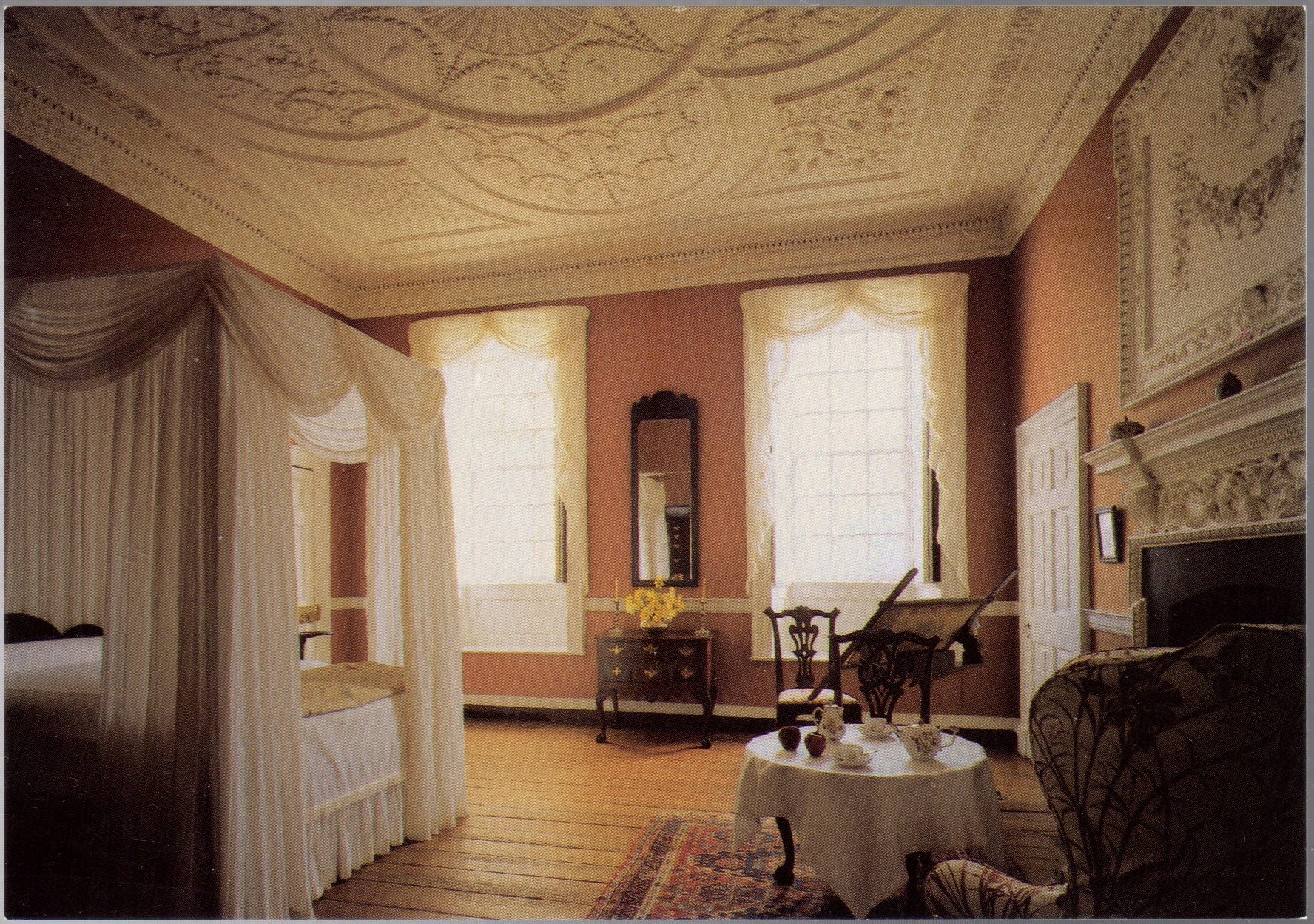
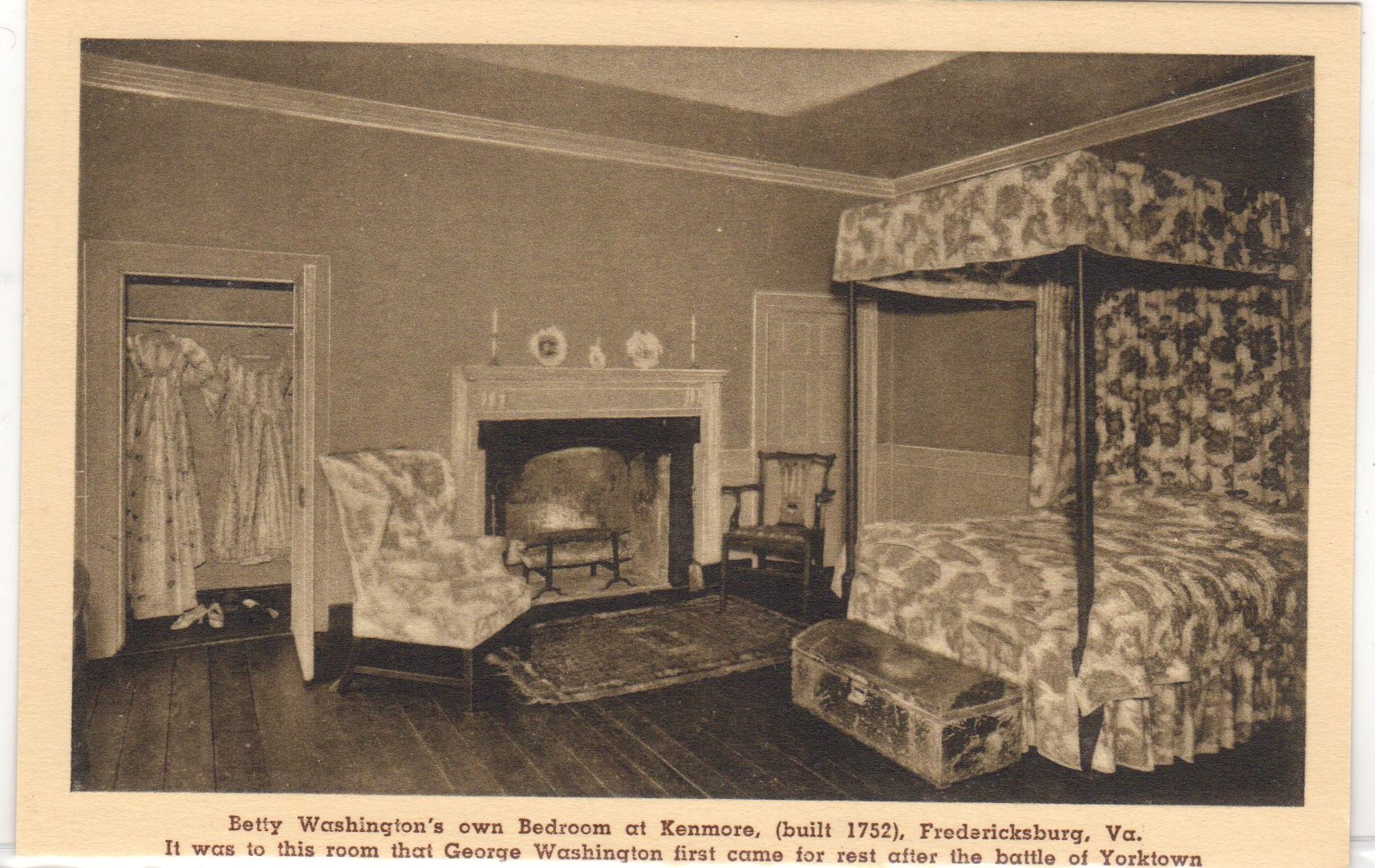
Again, during the Lewis occupation in the 18th century, individual bedrooms were not common, except for the head of the family. Not many of the objects in the postcard are still in our collection, except for the bed, which is now in the chamber downstairs, and the William Walker, Jr. armchair, which is currently off display, but we do have another one in the dining room.
“Betty’s bedroom (2nd floor SE) is currently used as storage…and some Twelfth Night decorations
“Boy’s Room”/SW room/2nd floor
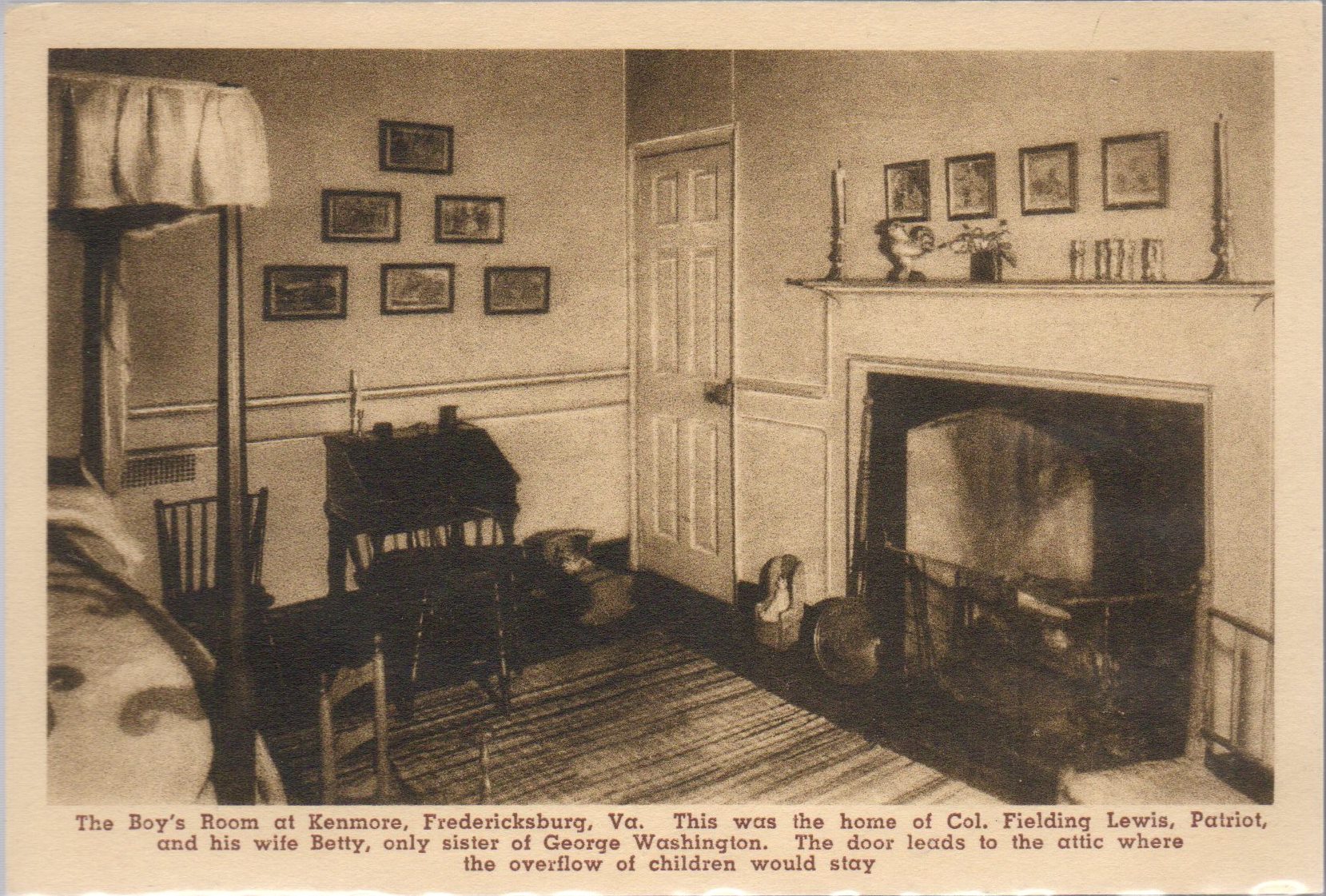
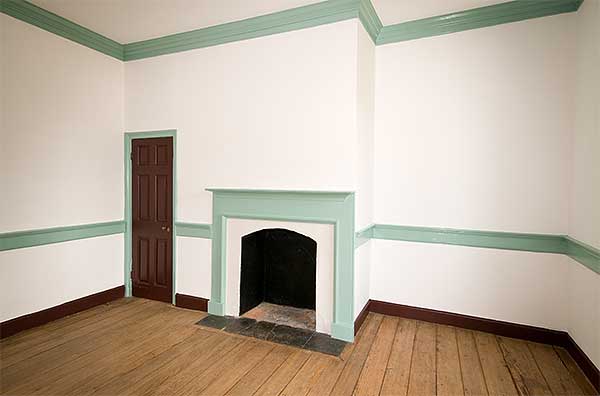
The last room upstairs is smaller than the other rooms and has access to the attic. The ladies used this as the boys’ room, but as we discussed, with the other rooms, it is unlikely that this was accurate. We do still have many of the pieces’ pictures, but the only one currently on display is the slant-top desk in the Visitors Center.
We are heading into the final stretch of this year’s exploration of the 18th-century kitchen at George Washington’s Ferry Farm, and it definitely hasn’t disappointed! The finds are getting bigger and better as we continue excavating deeper into the cellar and expand our look into the surrounding area. We have made a ton of progress that wouldn’t have been possible without the help of our crew of the George Washington Foundation staff, interns, and University of South Florida field school students. While there are still a few weeks before the official end of the dig on July 11. Just in case you missed them, here are some quick introductions and fun finds from the 2025 field school and crew.
Left to right: Judy, Danielle, Abby, Sarah, Alaina, Alaina S., Sofia, Addie
Field School
“Hi, my name is Alaina Scapicchio, and I am a Ph.D. candidate in the Department of History at the University of South Florida. This is my third summer digging at Ferry Farm. My favorite moment of the summer was excavating a partially intact pig jaw!”
-Alaina
“Hi! My name is Addie, I am a history and anthropology student at the University of South Florida. My favorite artifact to find are the animal bones.”
-Addie
“Hi, my name is Alaina. I am studying history at USF. My favorite part of the field school was digging in the kitchen because of how many cool artifacts we found. My favorite artifact was the piece of the Bartmann jug!”
-Alaina
“Sofia Almeida is a first-year History PhD student at the University of South Florida. Her research focuses on historic cemeteries, public history, and memory. One of her favorite parts of field school was digging in the kitchen cellar. One of her favorite artifacts this season was a decorated fragment of Staffordshire ceramic.”
-Sofia
GWF Interns
“Hey! My name is Abby! I am a recent graduate from UVA and am planning to pursue a career in archaeology. I enjoy reading and playing Ultimate Frisbee in my free time. My favorite artifact that I helped find this season was a projectile point with jagged edges.”
-Abby
“Hey all, my name’s Max Puckett. I’m a senior at the University of Mary Washington, currently pursuing a BA in Historic Preservation. In my spare time, I like to cook, research, and read. I’ve really loved this field season so far- we are pulling out a ton of interesting and exciting artifacts.”
-Max
Sarah came to Ferry Farm as a VCU student in the summer of 2014 and has been in over half a dozen summer digs since then. This year’s dig is very special to her because it is focused on the cellar of the Washington kitchen. Her favorite artifacts from this dig are the ones that can actually be paired and mended with each other because much of what collapsed in the kitchen fire was left in place and not scattered or missing.
-Sara
GWF Staff
I have been involved with the Ferry Farm Archaeology Department since 2012, when my youngest twins graduated from high school. I started out as a volunteer but then took on a part-time position cataloguing artifacts from the summer digs, which then turned into a full-time job as a lab assistant. I have been co-field director since 2019. I have a BA in Anthropology and an MA in Historical Archaeology, with past jobs in cultural resource management and historic sites, such as Mount Vernon. Though I really enjoy pulling out the handfuls of wine bottle necks and bases, I do find it more awe-inspiring when we pick out the tiniest and fragile eggshell fragments among the rubble and debris inside the kitchen cellar.
-Judy Jobrack
“Hello! I’m Danielle, and I have been at Ferry Farm since 2022, first as an intern and then lab assistant and co-field director. As a UMW Historic Preservation alum, I love all things old, both above ground and below, so this year’s dig has been particularly exciting with all the architectural bits we have been finding. With that said, I think my favorite artifact so far has been a brass/copper button –metal with verdigris is just so cool!”
-Danielle Arens
Though some of our crew is leaving, the rest of us will be digging every weekday until July 11, so be sure to come say hi and see what new things we have uncovered!
A Personal Look At Civil War Soldiers As Told Through Artifacts
Ferry Farm is most well-known as the Boyhood home of George Washington. While our primary emphasis of interpretation and research has focused on young George and his family’s life on this farm, Ferry Farm has many other stories to tell. The American Civil War had a major impact on the Ferry Farm community, changing both the landscape and the lives of those who lived here. This blog will look at how our archaeological efforts have brought to light artifacts that reflect the experiences of the soldiers that were stationed on the “old Washington Farm.”
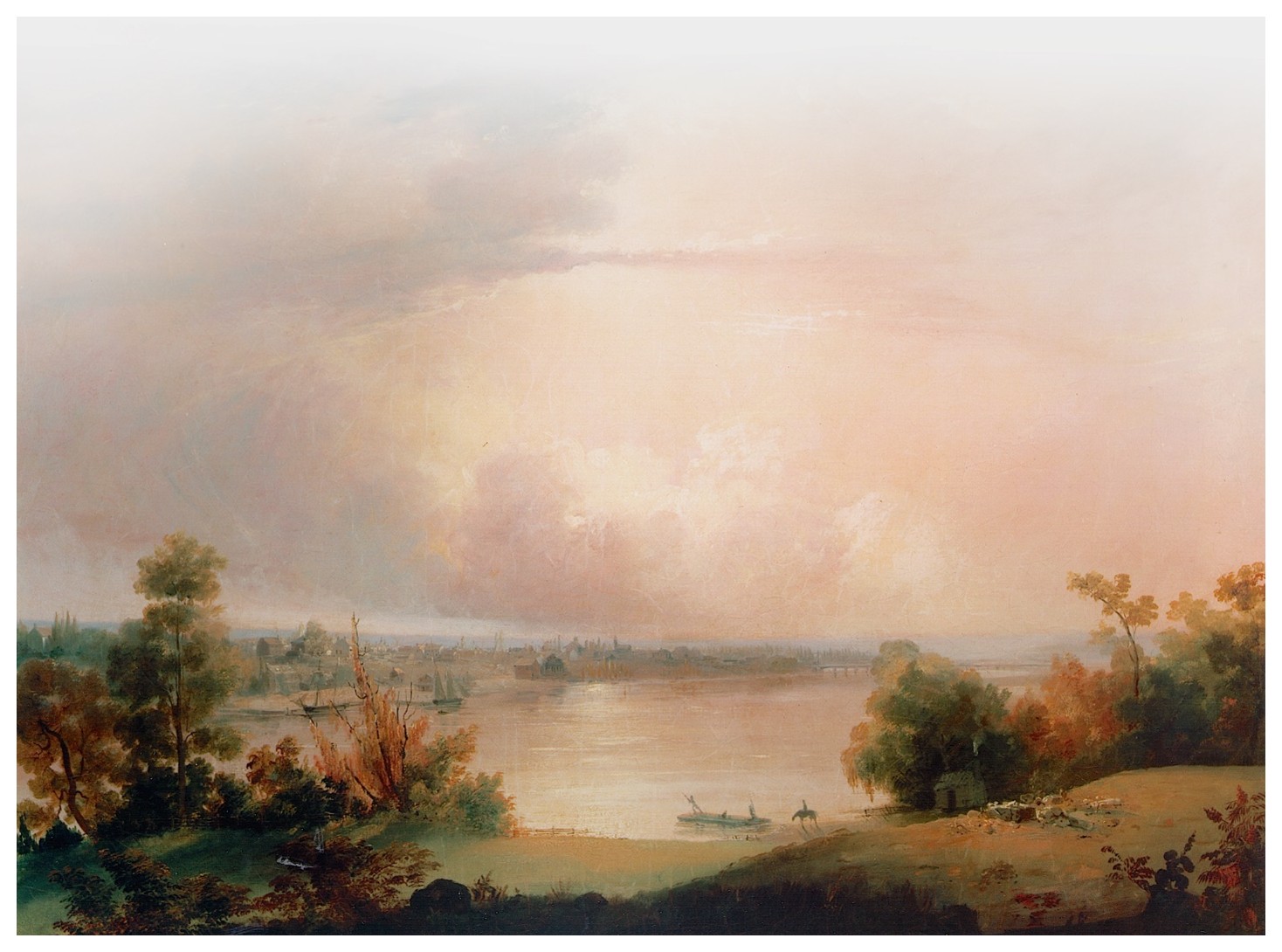
Washington House at Ferry Farm“The Old Mansion of the Washington Family” (1833) by John Gadsby Chapman shows the foundation stones of the house where George grew up at Ferry Farm and trees along the riverbank.
The Washington house and its outbuildings gradually fell into disrepair until by the mid-1830s there was no trace of them on the landscape. But the soldiers still knew the significance of the site. In April 1862, the Civil War came full force to Fredericksburg and to Ferry Farm. Federal Forces took over and occupied the City of Fredericksburg behind the retreating Confederate Army. Encampments and gun emplacements were established all along our side of the river and throughout Stafford County as the army set about maintaining control of the city across the river. Engineers were set to the task of rebuilding the railroad bridge and erecting pontoon bridges, including one at the end of Ferry Road.
Looking over Fredericksburg by Alfred R. Waud
This spring deployment and the military occupation of Ferry Farm was relatively quiet and uneventful. There is no evidence of a large, formal camp at Ferry Farm, but soldiers were stationed here to protect one of the pontoon bridges that ran from the bottom land of Ferry Farm across to the city of Fredericksburg. In August of 1862, the army suddenly retreated from the city and the surrounding countryside to defend Washington, D.C.
In November of the same year, the full force of the Union Army returned to Stafford County in preparation for the retaking of Fredericksburg and their expected march to take over Richmond. Instead, the Federals suffered a devastating defeat at the Battle of Fredericksburg in December and retreated to the north side of the river for winter camp. Now, Ferry Farm was being used more actively as a staging ground for multiple troop movements, bivouacs for soldiers guarding the pontoon bridges, and as a defensive line for the Federal troops.
A defensive trench, or rifle pit, with an adjoining berm to protect soldiers from gunfire originating on the Fredericksburg side of the river, was dug across the edge of the upper river terrace, stretching north-south from the edge of the stream gully through the remains of the Washington house. A small extension on the south end of the trench was dug out to connect it to the now-exposed cellar.
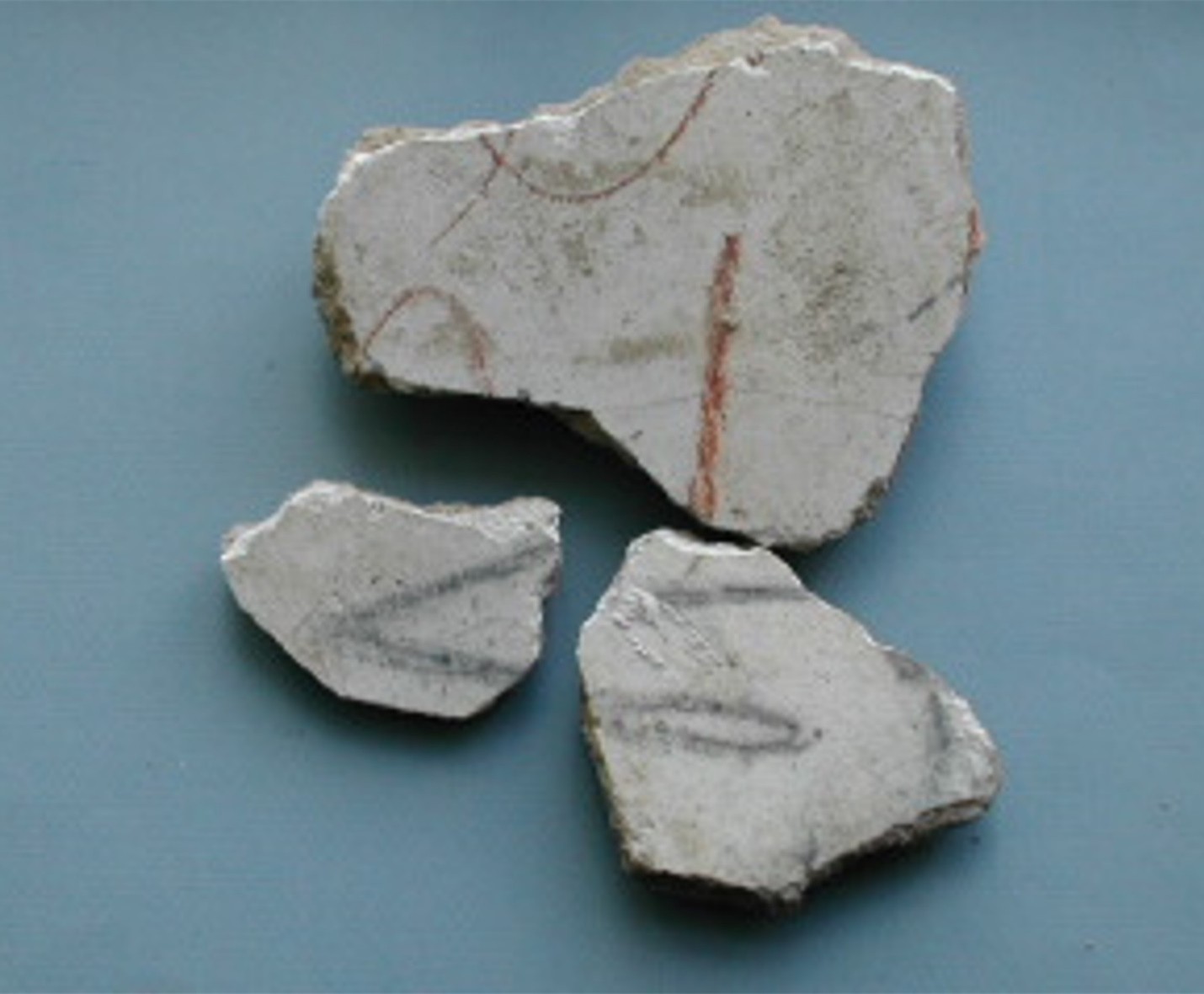
Artifacts found within the cellar trench fill reflect the extensive use of the house ruins by soldiers during both occupations. In the spring and summer, they used the farmhouse as their headquarters, writing on the plaster walls and leaving graffiti in pencil and charcoal on hundreds of plaster fragments that have been excavated and preserved.
Plaster fragments with graffiti
Various artifacts were abandoned when they left, including canteens, bullets, gun parts, and writing tools. But this blog isn’t about buttons, bullets, and buckles. It’s about the items the soldiers found more dear. Objects they made or relied on for small comforts.
So, on a more personal level, what was everyday life like for the Union soldiers stationed here during the Civil War? When they weren’t directly experiencing the brutal and intense combat fighting on the front, it was a routine-filled life of constant drilling, standing watches, maintaining equipment, and finding imaginative ways to entertain themselves in the camps. But camp life had its own struggles and hardships. Poor shelter, food, and hygiene, along with low immunity rates to communicable diseases, all contributed to high rates of sickness and disease. Add to that boredom and homesickness, and camp life was a private’s first test of survival.
It was very important for the soldiers to recognize that they were standing on the very ground that their hero, George Washington, once stood on. Those sentiments were expressed in a speech by Private Edwin Jones of the 6th Wisconsin when he said, “We are assembled on sacred soil…It was while living on this plantation, under the direction and blessed with the teaching of a noble mother, that George Washington learned those lessons…fitting him for leadership in war and peace, to lay the foundation of the mighty Nation that we today are fighting to preserve.”
On a more personal note, we know soldiers spent a lot of idle time playing games among themselves. Dice, card games, chess, checkers, and gambling were all very popular, and remnants of these activities are found on all Civil War sites. At Ferry Farm, we have a collection of gaming pieces, including this bone die and a gaming piece crafted from a Minié ball, which could have been used to play chess, checkers, or as markers in a game of chance.
Bone die, one of the many gaming pieces uncoveredGaming pieces crafted from a Minié ball
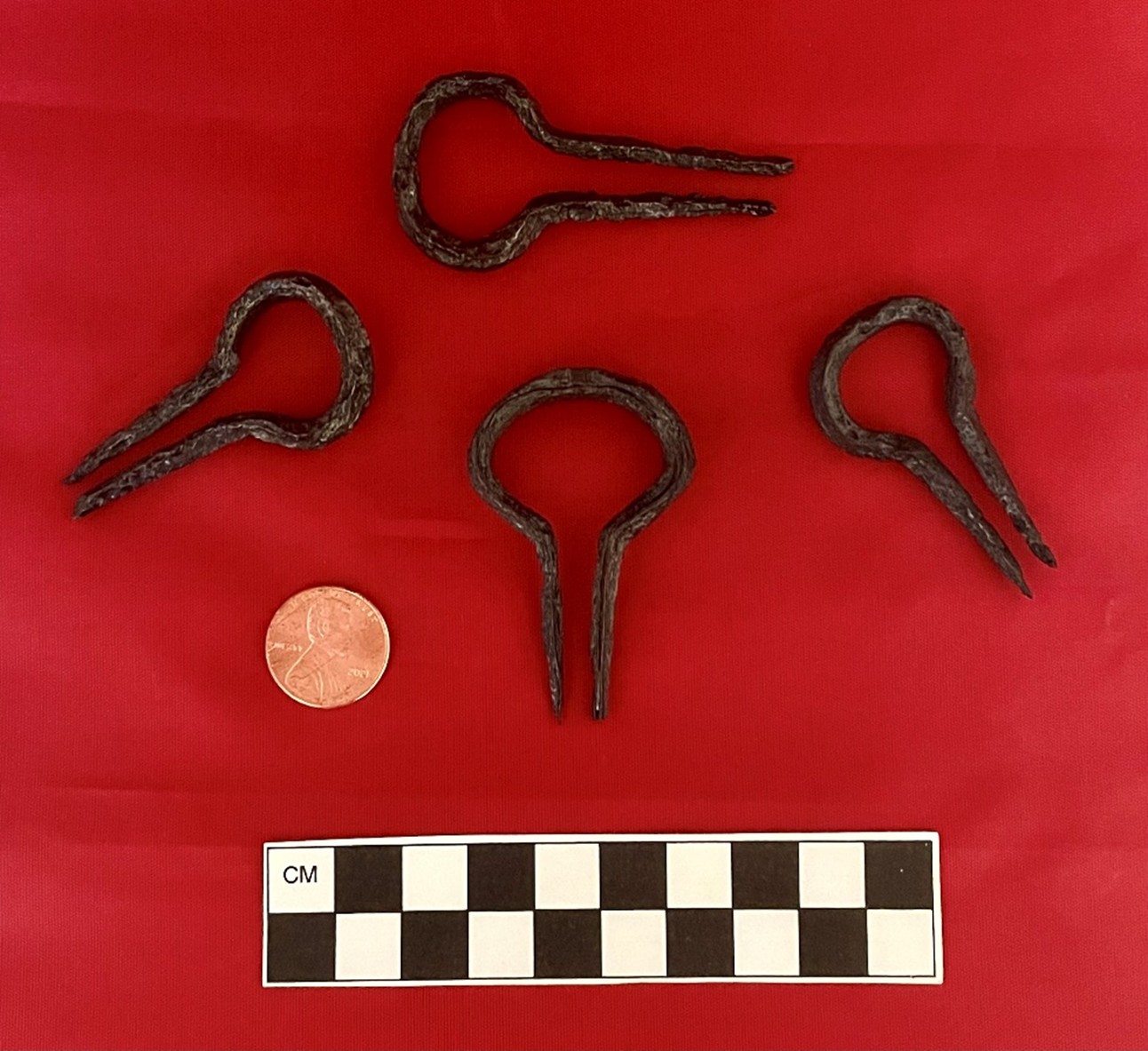
And we can’t forget about the importance of music in camp life. Music was a common and welcome pastime activity for troops. Fiddles, guitars, fifes, harmonicas, and accordions all came out at night to entertain the soldiers who relished listening to songs about home and the worries of war. Jaw harps were inexpensive and easily portable, which made them very popular with soldiers. Our jaw harps, one of which was recovered from the civil war trench, is of the style known as a Gloucester type, one of the most common designs in America during Colonial times and after the Revolution.
“Gloucester type” jaw harp
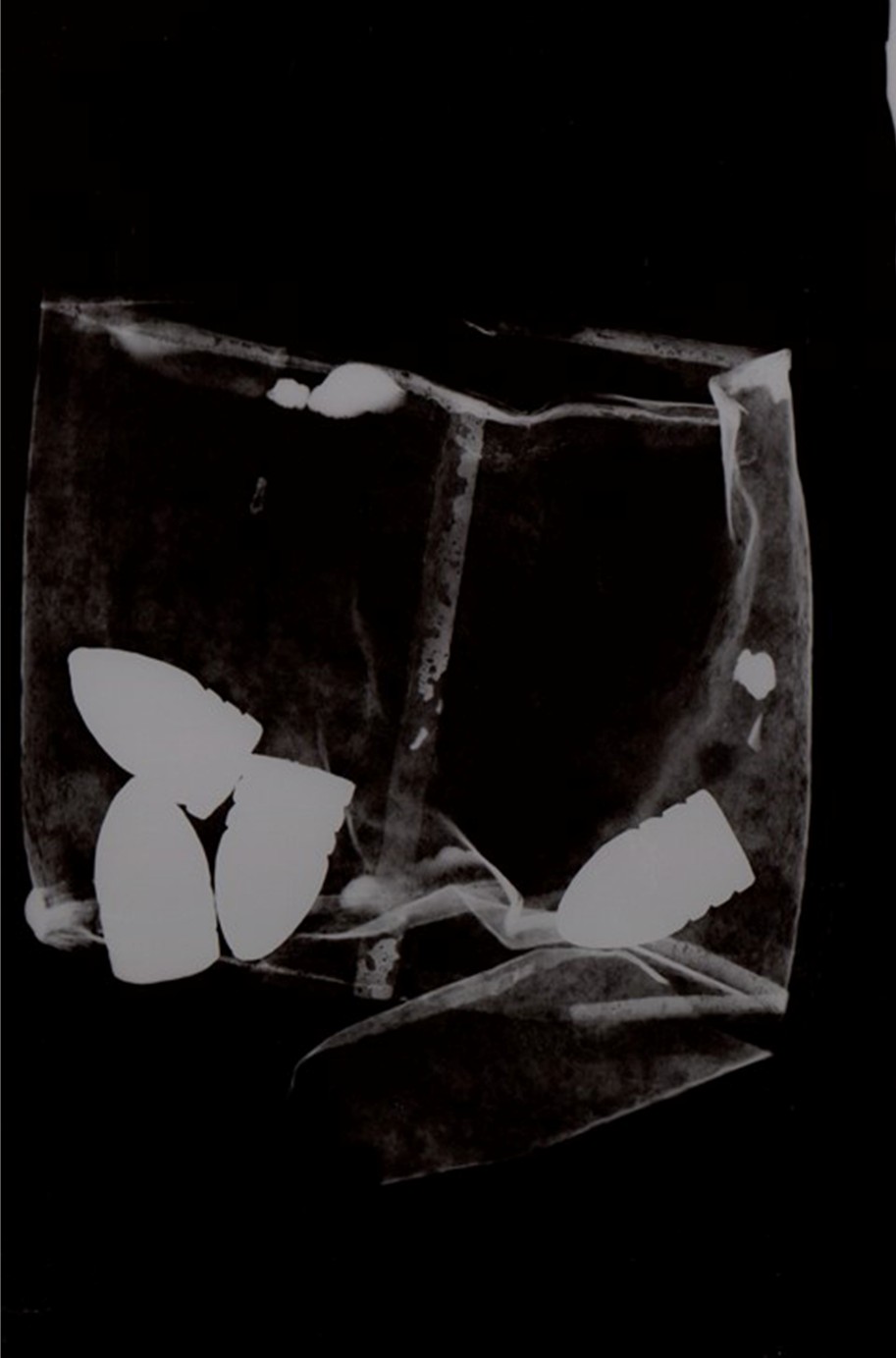
Nothing is normal about wartime. Many people were forced to improvise, and it’s very hard to determine why a soldier placed four unfired Minié balls in this tin can, which was revealed through X-ray. Did he lose his ammo case? Was it just idle behavior? Were these bullets saved to be turned into gaming pieces? This is the type of artifact that raises more questions than answers.
A tin can filled with four unfired Minié balls, X-Ray of tin can with four unfired Minié balls
Literacy – Ink Bottle/Pen nib:
Literacy among Civil War soldiers was very high, and much of what we know about daily camp life comes from the letters written and received by the soldiers themselves. Letter-writing to loved ones at home allowed the soldier to keep up with local news, forward monetary and business instructions to those left running the household or farm, and relay war news to their family.
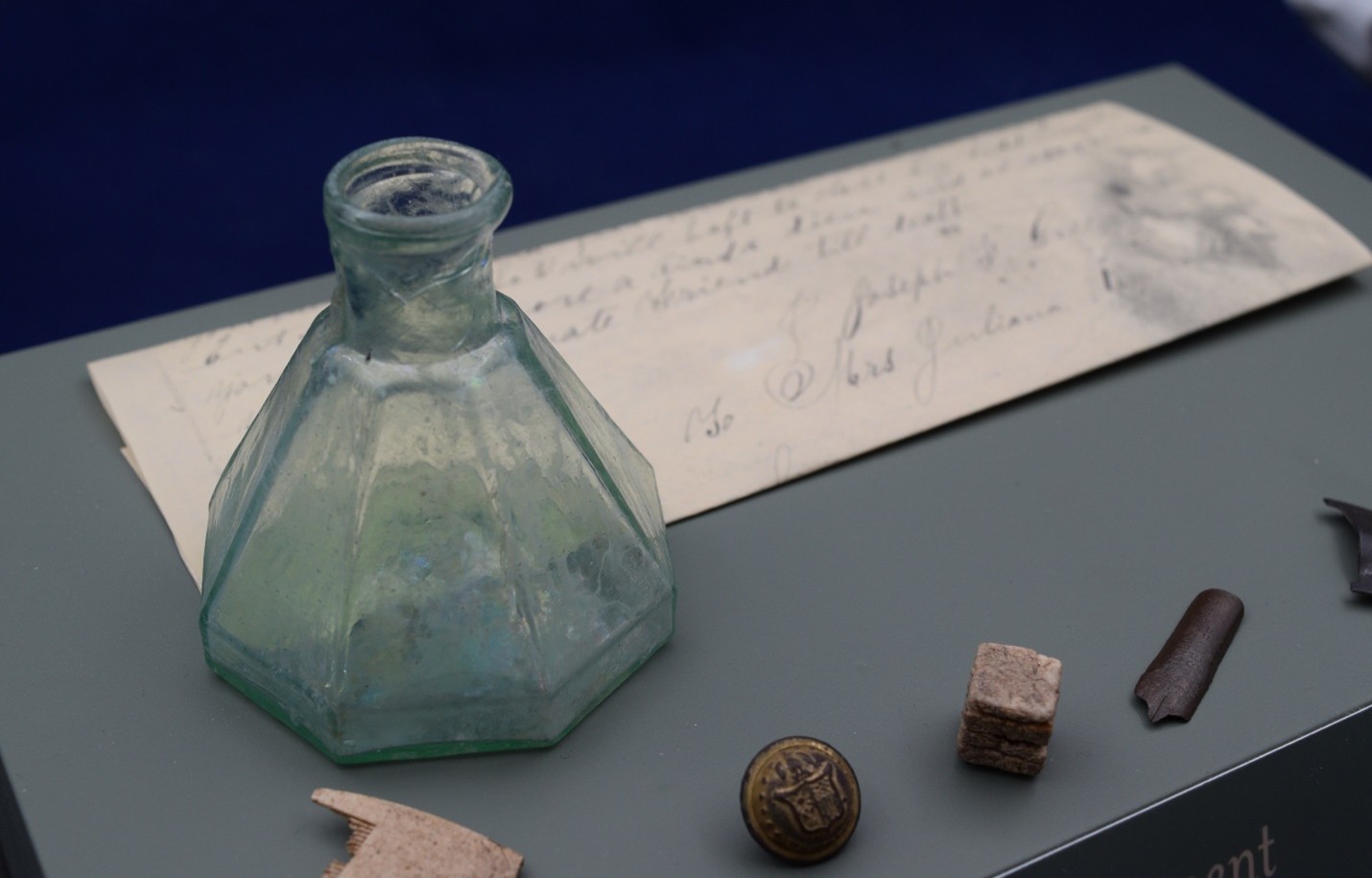
A complete ink bottle and pen nib recovered from the site evidences the desire for correspondence, both official and personal. The ink bottle itself was found in the Bray cellar hole, which the Union soldiers used as a defensive dugout to avoid Confederate sharp shooters. We can just picture a group of soldiers huddled down inside the cellar, building a small campfire to stay warm, and writing letters home to their families. Was it a hasty departure that left this bottle in the cellar, or perhaps the owner expected to return but didn’t. As archaeologists, we can’t answer all these questions, but we know it was used during the Civil War by a Union soldier and was found in a location many soldiers never wanted to be stuck in.
This particular ink bottle is an ‘umbrella’ shape, one of the most ubiquitous ink bottle forms from this era. The bottle was typically meant for single use and would have been made in one of the numerous American glasshouses present during the 19th century. It was then filled with ink, affixed with a label, and marketed for single use.
“umbrella” shaped ink bottle and small pen nib
This small pen nib is stamped with a maker’s mark and style name. The Esterbrook Company started making nibs, including the “Relief” style, in 1858 in Camden, New Jersey, and became one of the largest manufacturers of this product in the US. The nib was part of a dip pen, which consisted of a handle made of various materials and the replaceable nib.
The first evidence of self-care in the trenches takes the form of a small double-sided bone comb. Combs were made from an assortment of materials, including bone, ivory, gutta perch, and steel, and were used for grooming the moustache and hair. But their fine teeth were also handy in capturing the pesky lice that were endemic to camp life among men marching and living together in close quarters. This comb would have been an essential component of any soldier’s personal kit.
small double-sided bone comb
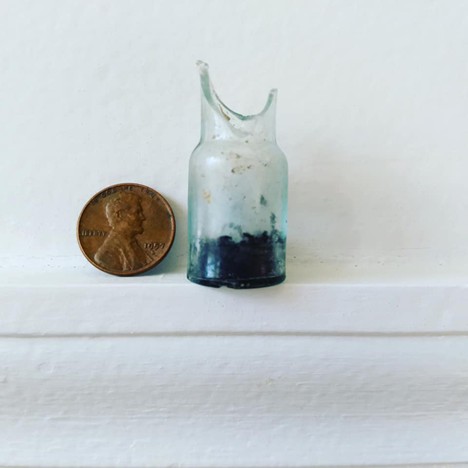
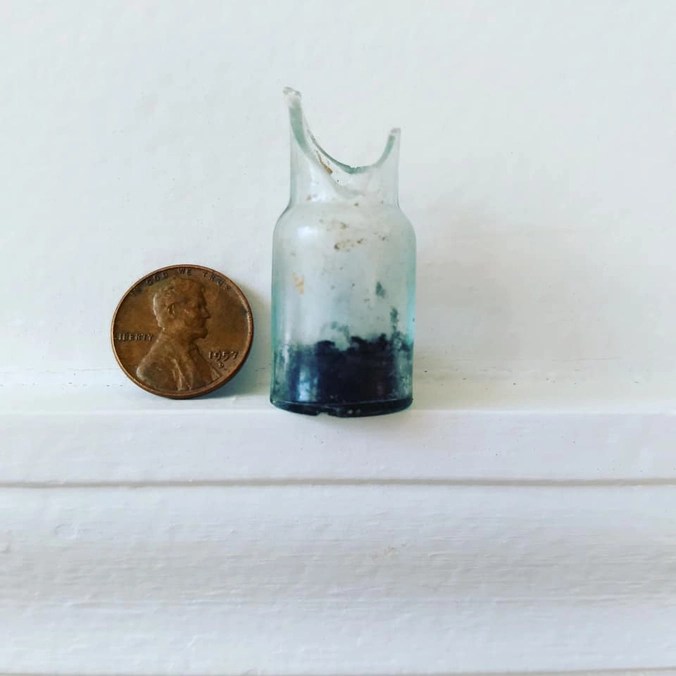
Our second evidence of self-care is this intriguing bottle. It is not so much interesting because of what it is – it’s a very common medicine style bottle for the mid-19th century– but rather what’s inside. Clearly visible within the bottle is a hard black substance, and for years, we’ve wondered what the substance may be.
Mercury bottle, mercury was used for a variety of medicinal reasons at the time
So we chipped off a little fragment of the substance and sent it to Ruth Ann Armitage, our chemist friend at Eastern Michigan University. The sample was analyzed using scanning electron microscopy to map out specifically what elements were present in the sample. Our sample was also run through DART (direct in real time) mass spectrometry. This technique is good at detecting organic components within a substance.
Almost immediately, Dr Armitage responded, and we weren’t disappointed: “Did you know there’s mercury in this?” Nope, we did not.
However, this discovery was not too surprising given the use of mercury in many medicines for thousands of years. Nowadays, it’s common knowledge that you shouldn’t drink mercury…or touch it…or inhale it, but for a long time, mercury was seen as a potent healing metal, and it was readily rubbed on skin, consumed, and vaporized for immediate effect on the lungs.
And while all these treatments using mercury did little to address the body’s underlying medical problem, mercury did cause an immediate bodily response, which convinced people it was working to cure their ailments. When applied topically, it burned. When introduced into the body, it caused a person to sweat, salivate, and have diarrhea. The mucous membranes also went into overdrive, leading many to believe that the bad stuff in your system making you sick was being purged by the mercury. The reality, of course, was that the body was trying desperately to rid itself of poison.
So, if the residue inside our bottle was medicine, what was its exact formula? All we can say at this point is that it was mercury-based and that it could have been in either liquid or pill form. Common Civil War-era uses for mercury-based medicines were for treating skin sores and lacerations, internal and external parasite infections, syphilis, and constipation, to name but a few. On a side note, an almost identical bottle also containing mercury was found across the river in Fredericksburg at a site that was well known to be a Union field hospital. It was found in a knapsack discarded in a trench that included amputated limbs.
Lastly, we’d like to highlight one of our favorite artifacts, a tiny hatchet about two and a half inches long, recovered from the bottom of the Civil War trench. For such a diminutive object, it speaks quite loudly to our local history in Fredericksburg, Virginia. Initially, earlier archaeologists at Ferry Farm assumed it was a pewter toy souvenir given out or sold in 1932, when our country and Fredericksburg celebrated the 200th anniversary of George’s birth. Indeed, cheap pewter toys were very popular during this time period.
Lead toy hatchet found in Civil War-era trench with traces of tin and nickel. Lead toy hatchet found in Civil War-era trench with traces of tin and nickel.
A recent reexamination of all the artifacts from the context where the hatchet was found revealed that nothing from that stratum had any 20th-century artifacts in it, nor did the two strata above it. In fact, the youngest artifacts from these strata were all mid-19th century. Additionally, although the archaeologists who excavated the hatchet didn’t know it at the time, the excavation unit from which the hatchet came sat right inside the Civil War-era trench.
This revelation shut the door on our ‘it’s a 20th-century souvenir’ narrative but opened the door to an even cooler one. A close examination of the hatchet showed that it didn’t have mold seams, which are always present on cast pewter toys. Furthermore, for some reason, it had one smooth side and one textured side, leading us to believe that it was handmade, not machine-cast. This was supported by a thorough internet search to find an identical toy hatchet, which came up empty, further supporting our new theory that this piece was a one of a kind. The textured side resembled the grain of wood, so we surmised it had been cast in a simple hand-carved wooden mold. All of these clues, combined with its location within a Civil War trench, made us suspect that the hatchet was crafted by a soldier, likely from a lead Minié ball. The hatchet is likely ‘trench art’, which is defined as objects of art either made by soldiers, POWs, or by civilians to create mementos of the war experience.
To further support our identification of the hatchet as trench art, we took the artifact to the Virginia Department of Historic Resources, where Katherine Ridgeway analyzed it using XRF, or X-ray fluorescence analysis. This non-destructive technique determines the composition of metal. We also brought along a few Minié balls recovered from the same unit for comparison. It turned out that what we thought was a pewter hatchet was actually a lead hatchet with a similar compositional profile to Minié balls, which are mostly lead with trace amounts of other metals such as tin and nickel.
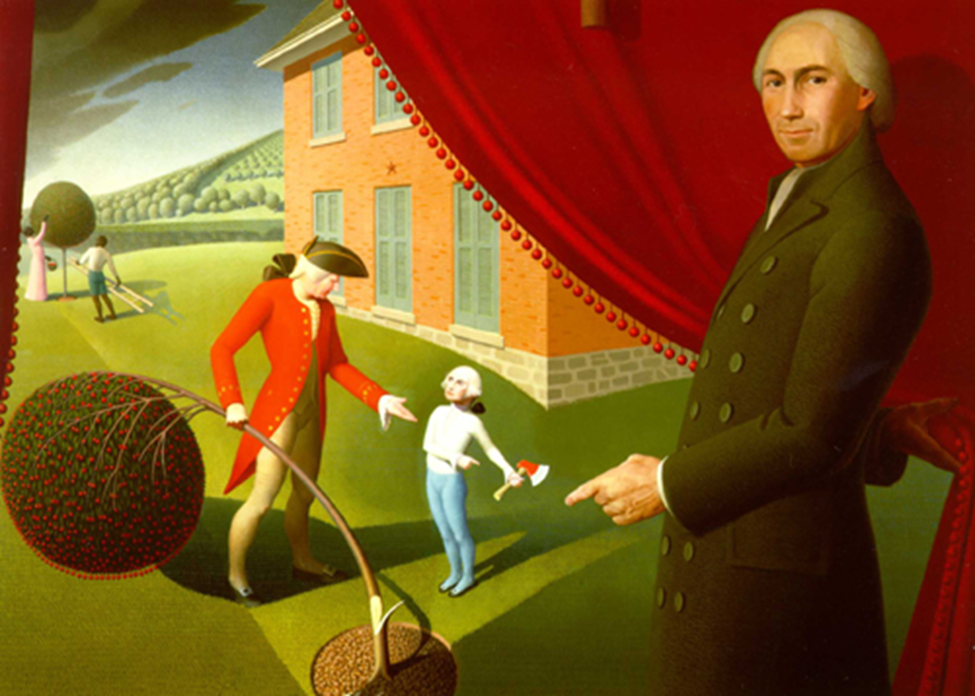
One can just imagine a bored Union soldier whittling the mold and then melting down some of his bullets to pour into it. He likely chose the hatchet form because of the famous cherry tree story, in which young George Washington owned up to hacking his father’s cherry tree with a hatchet by proclaiming, ‘I cannot tell a lie.’ The soldier would have been well-versed in the Washington cherry tree myth at Ferry Farm, created by Mason Locke Weems in his first biography of Washington, published in 1800. By the 1860s, the story was nationally known. Additionally, letters Union soldiers wrote while encamped at Ferry Farm indicate they knew the site’s connection to Washington. They even went so far as to send home cherry seeds for their families.
Grant Wood — Parson Weems’ Fable (1939)
While the identification of the hatchet is now secured, we have so many more questions. Who was this soldier? How many hatchets did he make, and why did this one come to be left behind in his trench? Was it a souvenir for himself, or did he send one home to his family, or share with fellow soldiers? Did he survive the war? Unfortunately, these are mysteries that will likely never be solved, but that make for great pondering.
It’s the most wonderful time of the year! There’ll be dirt out for screening, ceramics for cleaning, and lots of good cheer…. Okay, sorry, that might be a little too far. But it is a super exciting part of the year here at Ferry Farm, George Washington’s Boyhood Home. We have officially started this summer’s dig season!
Building off of the previous two years’ exploration of the kitchen site, we are revisiting the 18th-century kitchen cellar again this year. While last year’s dig focused on locating and exposing the kitchen’s stone wall foundations, our focus this year will be excavating the fill within the cellar walls that had been deposited as a result of a fire sometime in the 1740s. The fire caused the building to collapse in on itself, filling the cellar space with ash and debris.
Excavating sites like this are very exciting because they represent preserved moments in time, leaving the possibility to find artifacts left in situ or in place, when the fire occurred. It is likely that most of the artifacts excavated will have evidence of the extreme heat caused by the fire. Toasty artifacts from the 2023 preliminary kitchen exploration have been washed and catalogued, showing damage to artifacts, such as glass bottles and ceramic storage vessels, ranging from being slightly charred and burnt to being completely melted. Toasty or not, these artifacts will help us nail down the date of the fire and what was being stored in the kitchen cellar when it went up in flames.
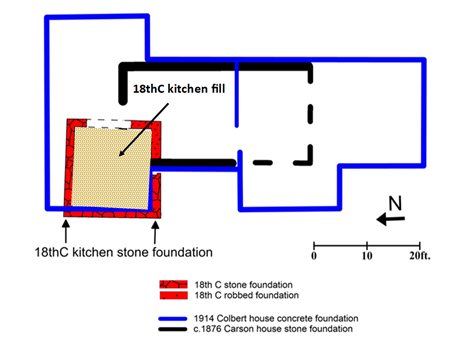
18thc kitchen cellar fill area within stone foundation to be excavated this seasonPortion of burnt cellar fill uncovered during the 2023 excavation season.
Our 18th-century kitchen, unfortunately, lies beneath the foundations of two farmhouses with full cellars dating from the 19th and 20th centuries. The construction of these homes severely impacted the kitchen structure and its burnt cellar fill, making it difficult for our archaeologists to accurately interpret the kitchen’s architectural features. A small portion of the kitchen cellar fill was also the subject of previous archaeological excavations in the 1990s, so we are not the first team to sample the fill. But in the interest of site preservation, the kitchen remnants were covered over twenty-five years ago with protective geofabric, and the farmhouse cellars backfilled completely with sand.
Luckily, we had the help of an excavator at the beginning of this season to remove the five feet of protective sand covering the kitchen cellar fill so we could get to the fun stuff sooner! But our fun isn’t restricted to the cellar, as we still have multiple 5” x 5” units around the outside of the kitchen foundations to investigate. Our team is still trying to locate the midden (trash deposits) and fireplace associated with the kitchen, as well as additional architectural evidence that would give an idea of the overall form and dimensions of the complete kitchen structure.
Excavator carefully removing the sand covering the cellar fill under the watchful eye of GWF archaeologists. The concrete wall foundations seen in the photo are the remnants of the 1914 farmhouse built atop the kitchen foundation. Exposing the cellar fill
Every excavation year brings new and exciting finds as we sift through thousands of years of site habitation. Come visit us while we dig weekdays from opening until 3:30 pm through July 11th. Hope to see you there!
Linum (“Flax”) and oleum (“oil”) – Fashionable and Affordable
As a Historic Preservation student at the University of Mary Washington, I’ve grown to appreciate almost all aspects of materiality. Over the past four years, my education has taught me to look closely at the built environment around me.
Two years ago, I stumbled across a book about mid-century kitchens, which discussed modern flooring’s ugly duckling: linoleum. From this, I developed an appreciation for linoleum and vinyl flooring and an equal obsession with spotting them.
Most people wouldn’t put Linoleum at the top of their list of favored materials. After all, historically, it’s been labeled as cheap, tacky, and ugly. However, linoleum has been an important part of modern living since the late 19th century. While the patterns most people initially thought of weren’t very attractive (that one red brick style), their initial creation changed the game for durable materials in a household and single-handedly became a hospital favorite.
Linoleum was first invented by Frederick Walton in Chiswick, England, when he discovered that oxidized linseed oil could replace rubber when mixing the oil with cork and other fibers. This process was sped up by heating the oil with lead and zinc, which formed a sticky paste that would be mixed with sawdust or cork to keep the cloth from becoming tacky. Shortly after receiving a patent in 1864, Walton opened the American Linoleum Manufacturing Company on Staten Island, New York, in 1872, with the nearby town named Linoliumville in its honor.
Fred Walton, creator of Linoleum
The genius of linoleum was/is its durability and ability to be mass-produced cheaply. Additionally, the material could be customized using pigments to create virtually any pattern, which aided in its early popularity in homes. Early linoleum was commonly produced in printed, marbled, inlaid, or plain patterns, with these distinct designs often serving as time machines to gauge when the flooring was installed. Putting aside the aesthetics, linoleum is most likely to be seen in high-traffic areas, such as hallways, kitchens, and mudrooms, due to its long-term durability.
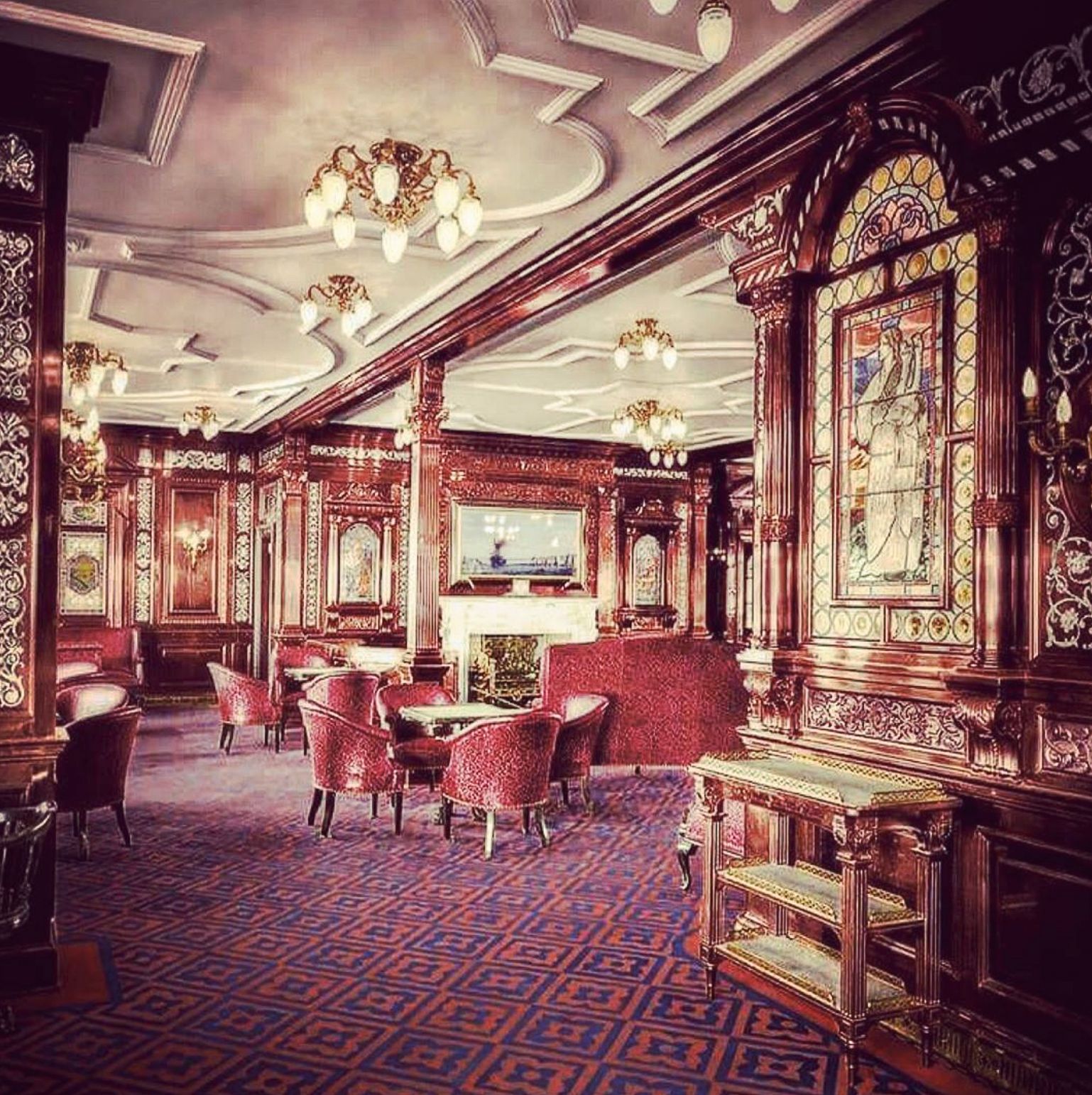
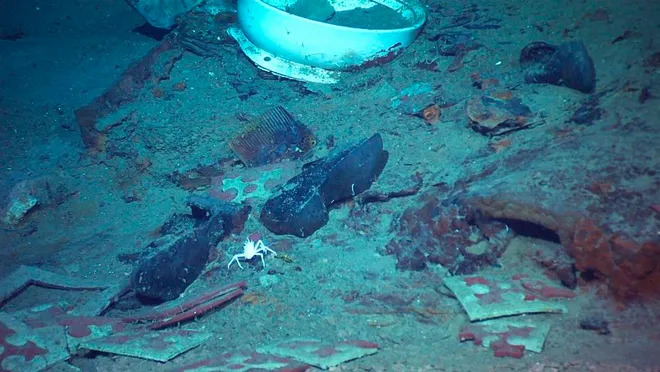
A well-installed linoleum is waterproof and surprisingly antibacterial, which is why, since its invention, linoleum has been commonly used in hospitals. The flooring was also popular among naval vessels in the early twentieth century, with battleships and luxury cruisers taking advantage of the material. In fact, the RMS Titanic used inlaid linoleum flooring for a significant portion of its decks, which can be seen in past photos and even on the sea floor today.
First Class Smoking Lounge on R.M.S. Titanic with lovely blue and red tiles, ca. 19122004 image of wreckage from the Titanic, showing linoleum floor tiles taken by the Institute for Exploration and Center for Archaeological Oceanography/University of Rhode Island/NOAA Office of Ocean Exploration
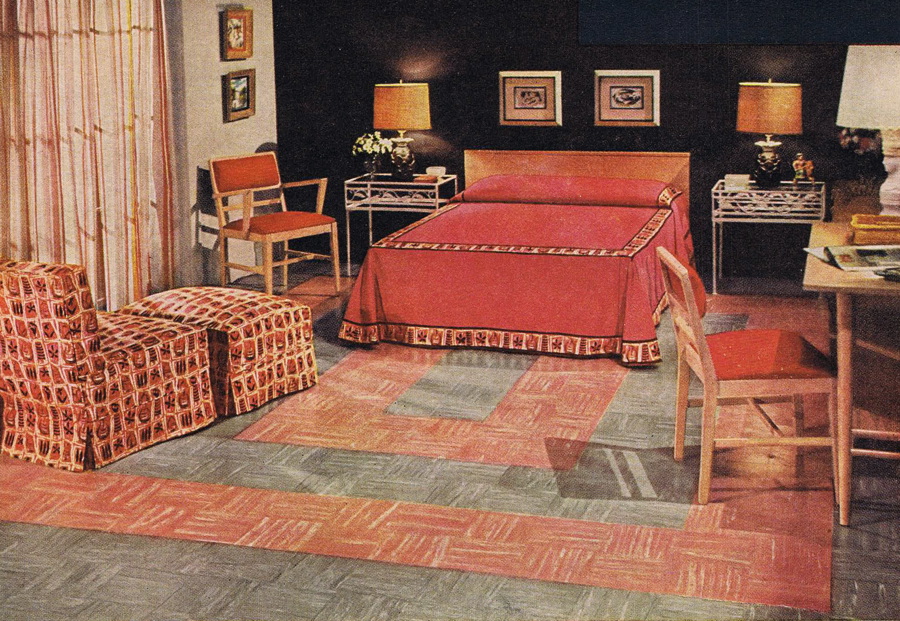
The manufacturing boom of the mid-twentieth century brought modern materials and technologies to the average household, including the popularization of linoleum in common spaces. Kitchens and high-traffic areas would continue to have the flooring material. However, living rooms, eating spaces, and even walls would start to display colorful and flashy patterns. This popularity would be short-lived, as the 1950s brought vinyl flooring, an extremely similar product, but was pushed as a newer and more “fashionable” alternative to linoleum.
An image of a bedroom from a 1952 advertisement for linoleum flooring
Despite the initial falloff, linoleum has made a surprising comeback in homes within the last few years. It’s understandable, as per square foot, the material is very affordable and easy to clean, not to mention that rising interest in the conservation of historic homes has led to the preservation and replication of historic linoleum. Most often, the damage to the material features is rips and cracks, which are easily repaired with patching and a fresh coat of sealant.
I don’t write any of this intending that you agree with me. However, I believe that linoleum reflects the best of modern materiality. It’s low-cost, eco-friendly, durable, and easy to customize, allowing lower-income homes to decorate their spaces economically and colorfully. While spotting linoleum in older buildings may be rare due to being covered with changing fashion trends (we are all familiar with carpet over beautiful hardwood floors), preserving it is just as important as any other part of the built environment.
Helena Samson
Fleming Smith Scholar, UMW Class of 2025
Linoleum’s Forebearer “Fancy Pattern-Cloth” – Eighteenth Century Floorcloths
The future of home restoration and preservation will involve saving certain building materials, such as wood, stone, brick, and decorative elements, like linoleum. While humble and even ridiculed (you know the pattern), linoleum will eventually be treasured as a lasting historical remnant, helping future preservationists add context and depth to restorations.
Classic linoleum, everyone seemed to have despite not wanting to admit it.
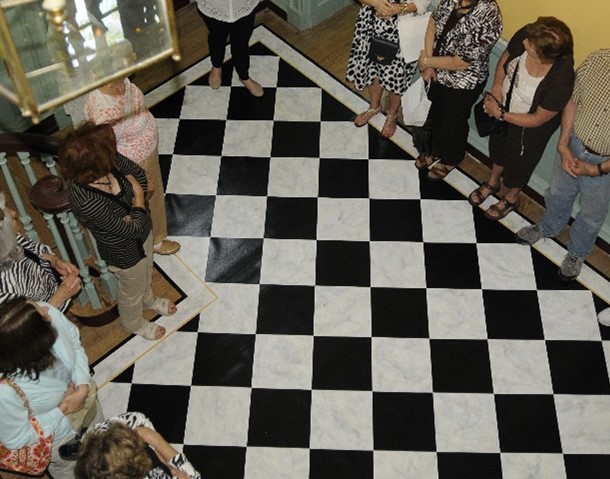
Unfortunately, in eighteenth-century historical preservation, we are rarely lucky enough to find samples of the predecessor of linoleum, the floorcloth. The floorcloth was a relatively common floor covering in eighteenth-century Virginia homes. It was made from woven cloth, usually heavy and sturdy, like linen or cotton canvas. This canvas was then stretched, several layers of oil paint applied, and covered in varnish. This floorcloth could be painted in any fashionable design, as seen in John Carwitham’s book published in 1739, with the replica marble being one of the favorites.
Behold my fancy flooring, m’lady – design plate from John Carwitham’s “Various kinds of floor decorations”, 1739Marble floorcloth in entryway at Kenmore. The floorcloth was made in 1980 and has been stripped and repainted once…it is holding up nicely.
Like linoleum, floorcloth was prized because it was customizable, durable, easily cleaned, and repairable. It could also be cut down and used in other areas like kitchens or closets after it lost its fashionability or was replaced with carpet. It was so versatile that it basically reused itself out of existence.
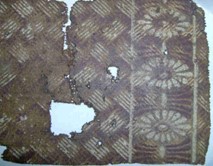
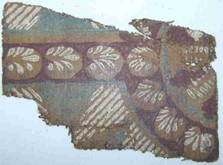
While no known complete examples of eighteenth-century floorcloths exist, bits and pieces have been found, offering insight into their construction and functionality in the home. Coincidentally, here at Kenmore, we found remnants of a floorcloth under the floorboards in the attic during a period of restoration in 1989. Small samples from the remnants were taken for analysis:
Floorcloth remnant found in Kenmore’s atticFloorcloth remnant found in Kenmore’s attic
Base layer – yellow preparatory layers of lead white and yellow ochre ground in linseed oil. The uneven distribution of the large, clumped pigments suggests it was hand-ground paint.
Black paint is found in the third layer above the ground coatings with remnants of plant resin varnish, followed by a green design layer. This could mean the black paint was the original design, and it was repainted after varnish and the green design were put on top.
Green-painted areas – made up of white lead, Prussian blue, yellow ochre, and calcium carbonate.
White paint – composed primarily of white lead and calcium carbonate
We can draw a few conclusions from this paint analysis. One, the floorcloth was well used but eventually worked its way down the list of favored household furnishings, whether from wear and tear or fashionability. Either way, it was ultimately rolled up and stored out of sight, and lucky for us, forgotten.
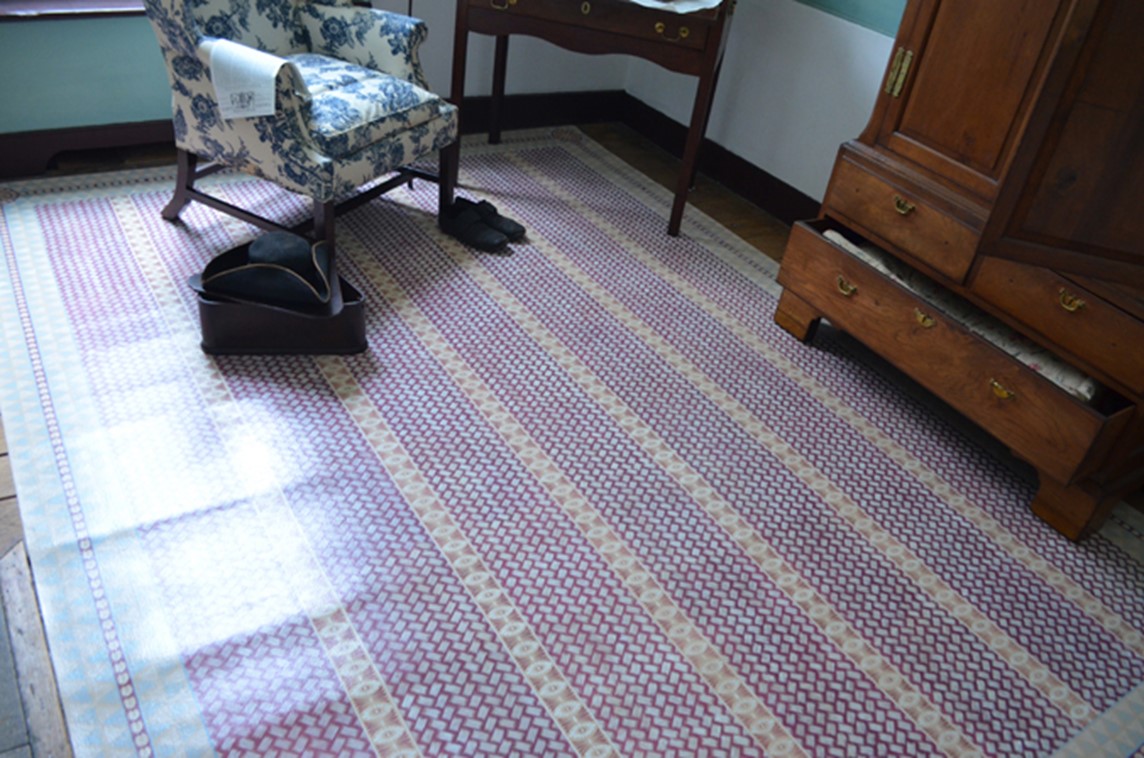
Second, the white paint sample did not contain zinc white, which was used after 1840, and the green paint sample did not contain chrome green, which means it was likely produced before 1816, when chrome yellow pigments were commercially available. So, while we can’t verify that it was a Lewis family floorcloth, it is a very early example of the floor covering. It inspired the floorcloth reproduced for Fielding’s office in Kenmore, which you can read about in our previous post, “What Was Old Is New Again”.
Beautiful reproduction floorcloth hand-painted by Black Dog Gallery, Yorktown.
Today, thanks to linoleum, we can choose affordable, durable, and even fashionable flooring materials. Linoleum is the evolution of floorcloths with similar goals and functionality. However, while floorcloths didn’t usually survive, linoleum will follow us through history and deserves to be preserved even if it leads to awkward questions about style and décor.
Oh, there will be questions.
Heather Baldus
Collections Manager
Bibliography
Kaldewei, G. (2000). Linoleum: History, design, Architecture, 1882-2000. Hatje Cantz ; Distribution in the US, DAP, Distributed Art Publishers.
Landreau, A.N. (1976). America underfoot: A history of floor coverings from colonial times to the present. Published for the Smithsonian Institution Traveling Exhibition Service by the Smithsonian Institution Press.
Weissman, J.R., & Lavitt, W. (1994). Labors of love: America’s textiles and Needlework, 1650-1930. Wings Book: Distributed by Outlet Book Co.
Buck, Susan L. Floorcloth Fragments Cross-Section Microscopy Report, Kenmore, Fredericksburg, Virginia. (2006)
Archaeology is trash. There, I said it. Before you call Mr. Jones and have me thrown in a pit of snakes, let me explain. Generally speaking, archaeology focuses on understanding the past through the items that people left behind, i.e., their trash. Most of the things we find are left around because they were broken or no longer needed. Disposal of these items looked much different before modern garbage collection as we know it today. Rather than trashcans and landfills, trash was often thrown outside of the home or workspace near windows and doors or any other designated disposal areas. These areas, also known as middens, usually have a high number of artifacts and are top-tier when it comes to understanding a site. So, in other words, archaeology is trash, and we love it.
Most people can get behind the archaeologists saving the trash that’s hundreds or thousands of years old, but things are a little different when it comes to saving more modern materials like plastic. When visitors or volunteers see things like plastic bottle caps or food wrappers in our bags to bring back to the lab, they usually have a few questions. Like, “Did you mean to keep this?” Or “Why are you keeping this trash?” Here at Ferry Farm, we don’t pick favorites, every bit of trash can tell us something about the site and how it has been used.
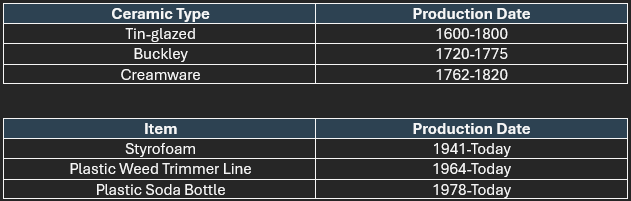
One-way modern materials can help us understand a site is by helping us determine the Terminus Post Quem (TPQ), or “time after which,” of a layer. The TPQ is determined by identifying the earliest production date of the most recently produced item. For layers deposited before the widespread use of plastics, ceramics are usually used for determining the TPQ because they are datable (temporally, not romantically) since most have very specific production dates, and they also hold up pretty well under ground. For example, when looking at the ceramics in a layer with tin-glazed wares, Buckley, and creamware, the TPQ would be 1762 since that is the earliest production date of the most recently produced ceramic (creamware). All the items in the layer had to have been deposited after that date.
The same idea works with modern synthetic materials like plastics, which are usually found at sites that have been used within the last 100 years. If there were to be some plastic soda bottles, weed eater line, and styrofoam in a layer, the TPQ would be 1978. While these materials may also be items you have in your home, not thought to be worth collecting and preserving, their presence in a layer helps provide a date. They can also tell us if an earlier layer was disturbed.
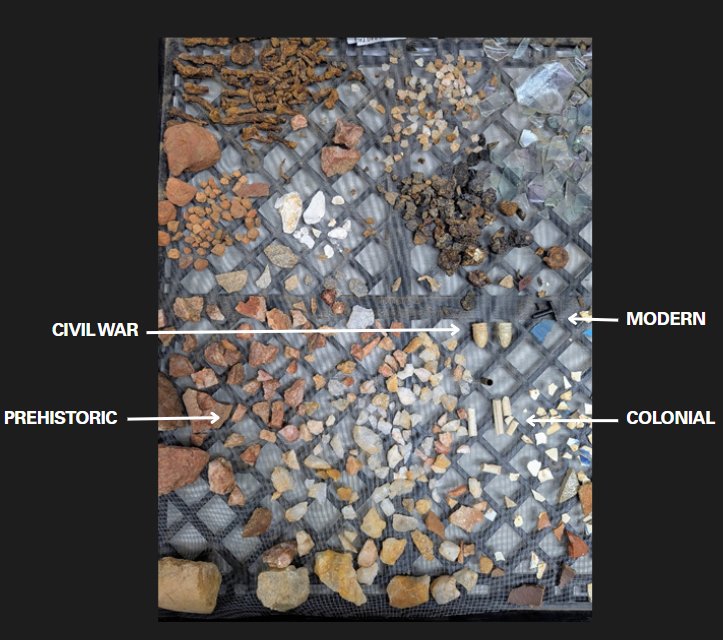
When archaeologists talk about disturbed layers, we aren’t judging their emotional state or love of 2000s heavy metal. Instead, when a layer is described as disturbed, that means there was some sort of activity happening after the initial deposition that affected that layer. During last season’s dig, there were layers with a mix of colonial, prehistoric, and modern materials that indicated that the area was disturbed by some subsequent activity. The information gathered by the presence of modern materials is important for the interpretation of the site and its use over time.
Example of a disturbed layer– Artifacts include prehistoric flakes and fire-cracked rock, colonial items like tobacco pipe stems, Civil War Minie balls, and modern-day plastics
Now that we know why we keep this so-called modern trash. Here are a few examples of how the presence of these items helped our archaeologists understand a part of our site.
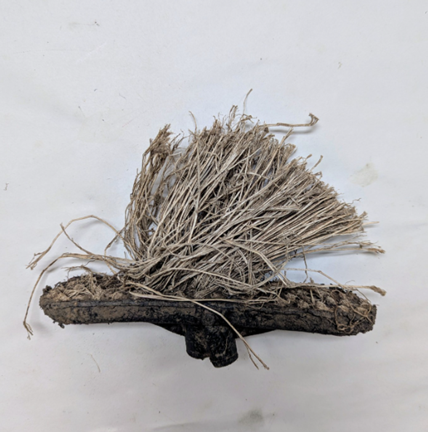
My favorite example happened during last year’s dig. One of our crew, Abbie, was preparing a feature for photographs and had to keep clipping pesky hairlike roots that were in the way. After a bit of excavating, it turns out the “roots” were bristles from a plastic broom. The broom dated the feature fill to the late 20th century and got to the root of the hairy soil issue.
Pesky broom in feature
Our staff has numerous examples of these modern materials being used to help identify previous archaeology as well, from candy wrappers at the bottom of shovel test pits and trenches to an entire trowel! While things like plastic trash bags and food containers aren’t the most exciting to find, they play a part in interpreting the history of activities on the site.
Once something is left behind, it becomes part of the archaeological record, whether it was 10,000 years ago or yesterday’s lunch. What does your trash say about you?
We have a lot of silver in our collections, ranging from candlesticks to teapots to spoons. With all the silver, I have become familiar with eighteenth-century silversmith marks, but I have never explored the artisans behind the marks.
I was pleasantly surprised to find at least four women silversmiths represented through various pieces. These four women were all London-based traders within an active community of women artisans in luxury trades. I wanted to discover how these women entered this male-dominated trade and registered their marks. (City Women, 2025)
First, we need a little background to understand how the silversmith trade worked in eighteenth-century England.
The Trade
In the eighteenth century, English silversmiths were much more regulated than American silversmiths due to having around a four-hundred-year head start in establishing trade organization. However, no one on either side of the ocean would have been considered a master craftsman without a long multi-year apprenticeship.
Silver plating workshop from Diderot’s Encyclopédie
While this was a rare path for girls, these four women were introduced to silversmith work through their families without formal apprenticeships. However, that doesn’t mean they didn’t spend years becoming expert artisans and learning to run a successful business from their fathers, brothers, and husbands.
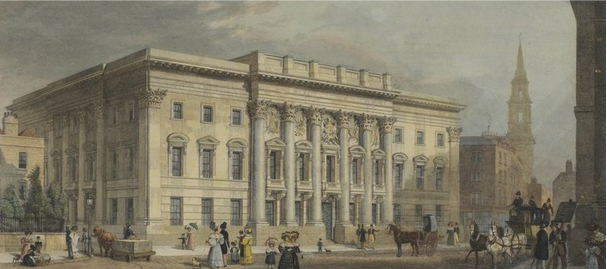
When a silversmith obtained their “free” status, it meant they could sell their ware in the city of London. To earn this status, the silversmith had to be granted a hallmark from a Livery, like the Goldsmith’s Company. Women were only granted a mark if they were the widows of a silversmith. (Rue Pigalle, 2025)
Worshipful Company of Goldsmith in the city of London, current building in late 19th century. The company has been occupying this spot since 1339.
The Marks
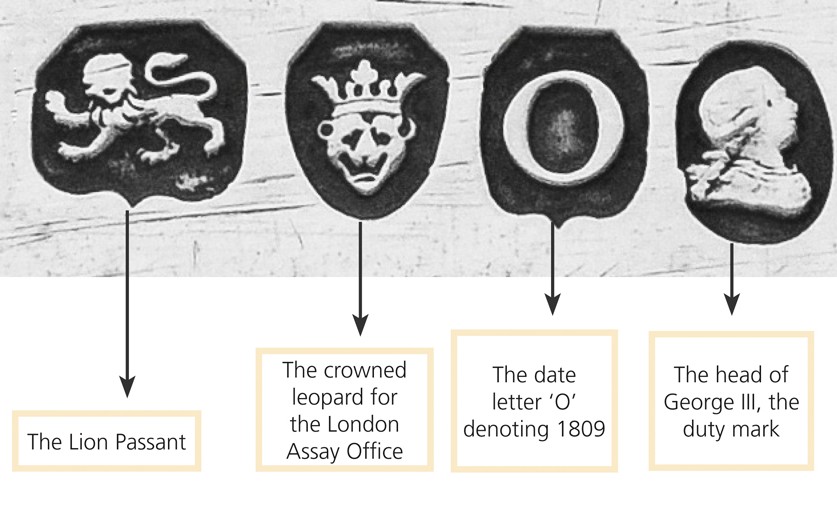
In eighteenth-century England, the silversmith could sell the articles they made only after the pieces had been assayed and stamped with appropriate hallmarks. (Ford, 2018)
Explanation of silver marks
One hallmark is the symbol of the guildhall where it was assayed. Each location had a different image, like a London goldsmith guild’s head of a leopard, and has been used for over seven centuries.
Another is the maker’s mark, which has been required since 1363. This mark is now always the marker’s initials, but one was more often a trade symbol.
The mark of English sterling standard fineness—a lion passant—has been used since 1544 to certify that the metal is 92.5 percent pure silver. (Ford, 2018)
There is also a date mark indicated by a letter representing a year.
Finally, duty marks on silver from 1784 to 1890 reflect the tax on precious metals with the profile of George III or Victoria. (Arkell, 2025)
The Silversmiths
Hester Bateman
One of the most well-known eighteenth-century London silversmiths is Hester Bateman. She became the matriarch of the renowned Bateman family silversmithing company.
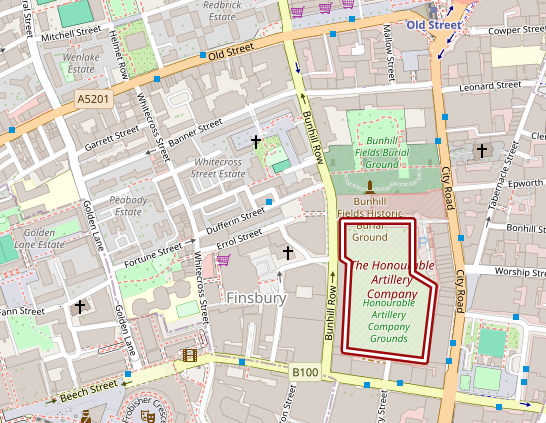
She was born Hester Nedem in London in 1708. She grew up poor with little formal education. In 1732, she married John Bateman, a goldsmith and chain maker. John died in 1760 of tuberculosis and left Hester his tools in his will. Hester took over the shop located at 107 Bunhill Row and registered her mark at London Goldsmith’s Hall on April 16, 1761. (Bly, 2008)
Hester Bateman’s shop was located at 107 Bunhill Row, Islington, London
She continued to run the business for over thirty years, bringing two sons, one daughter (Letitia Clarke), and a daughter-in-law (Ann Bateman) into it. (Eagle and Pearl, 2025) The Bateman silversmith company specialized in household silver, such as flatware, cruet stands, and fashionable tea and coffee sets. (Slavid, 2021) The company’s work is characterized by bright-cut engraving and piercing in the neoclassical style.
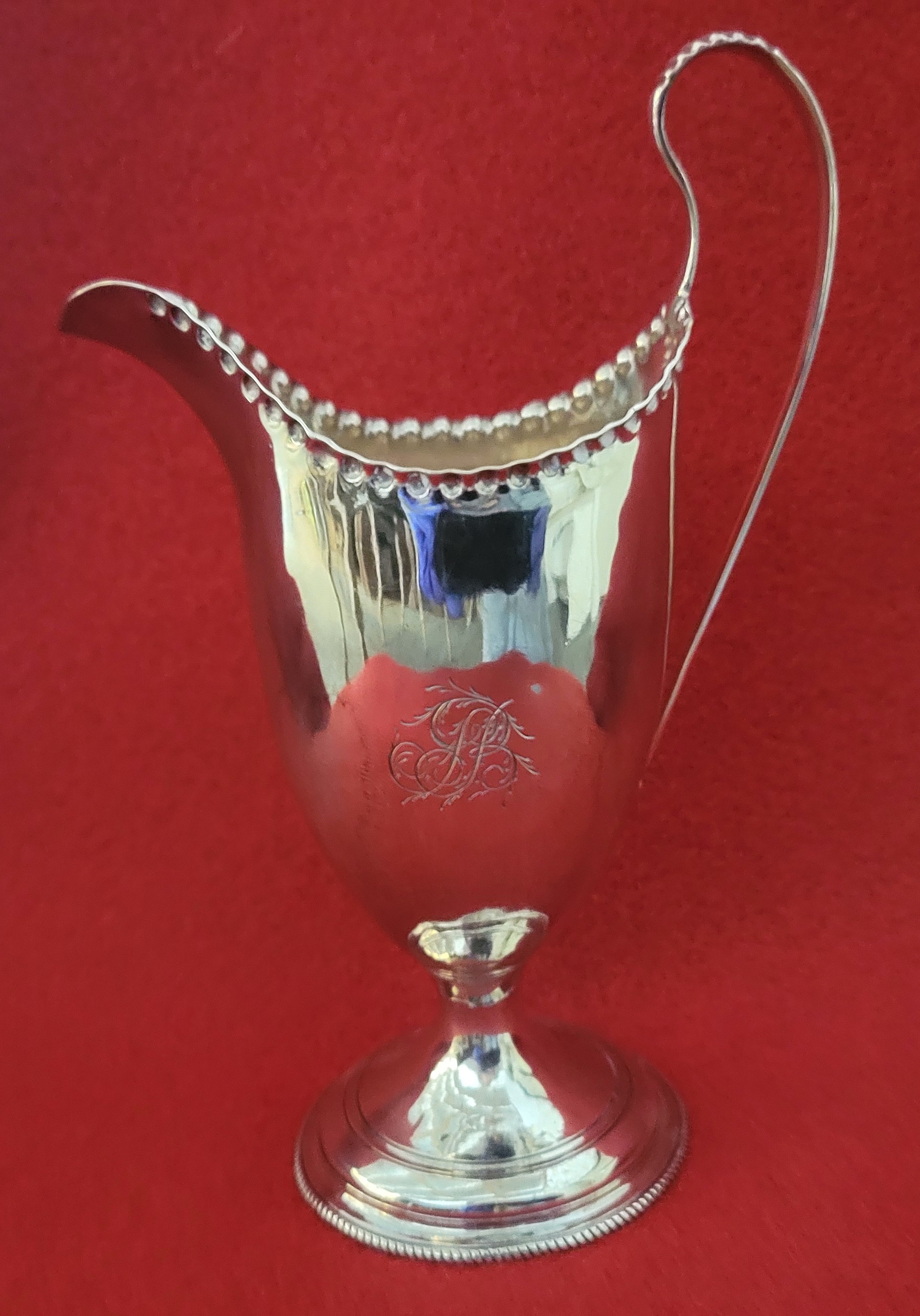
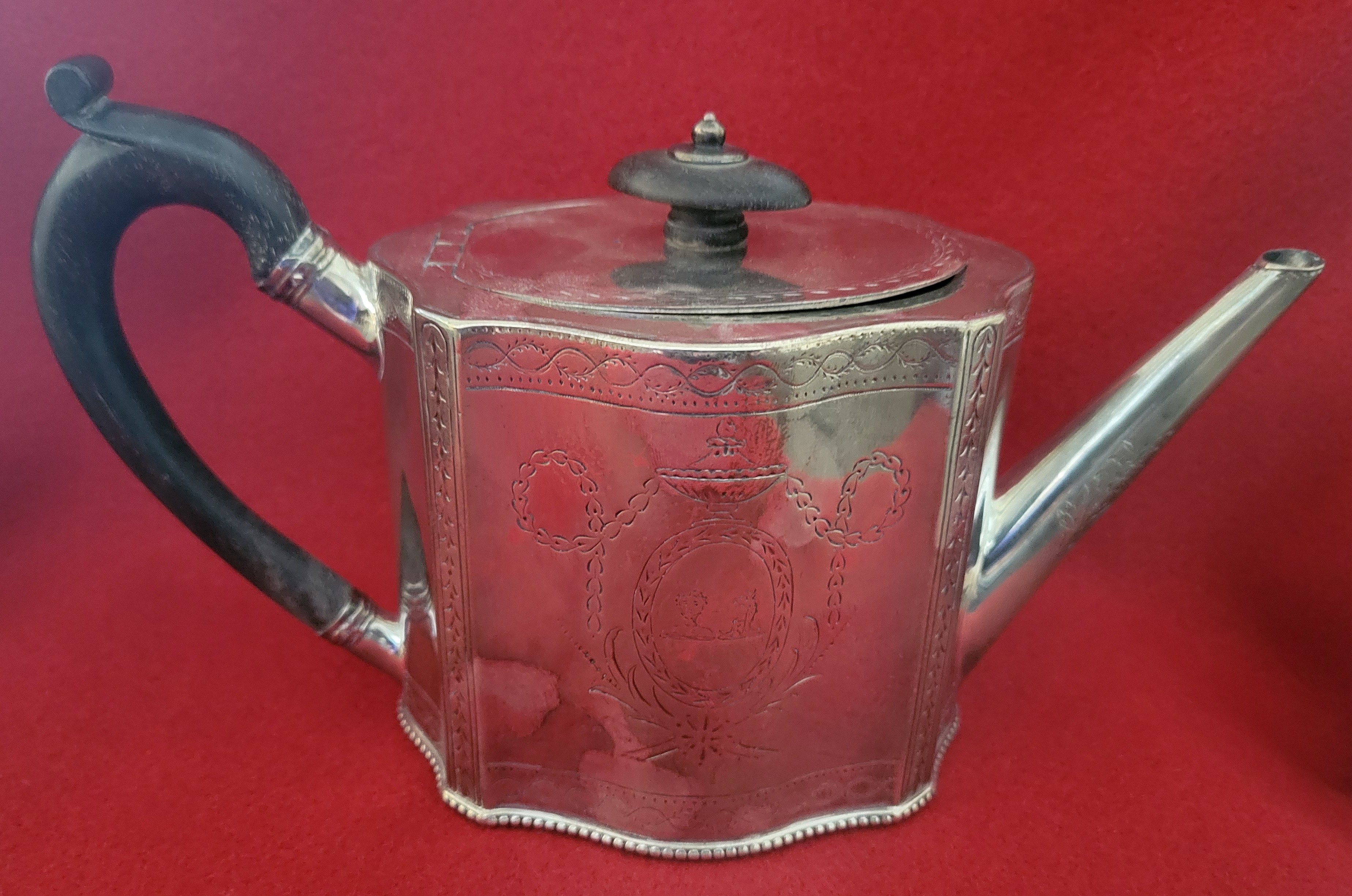
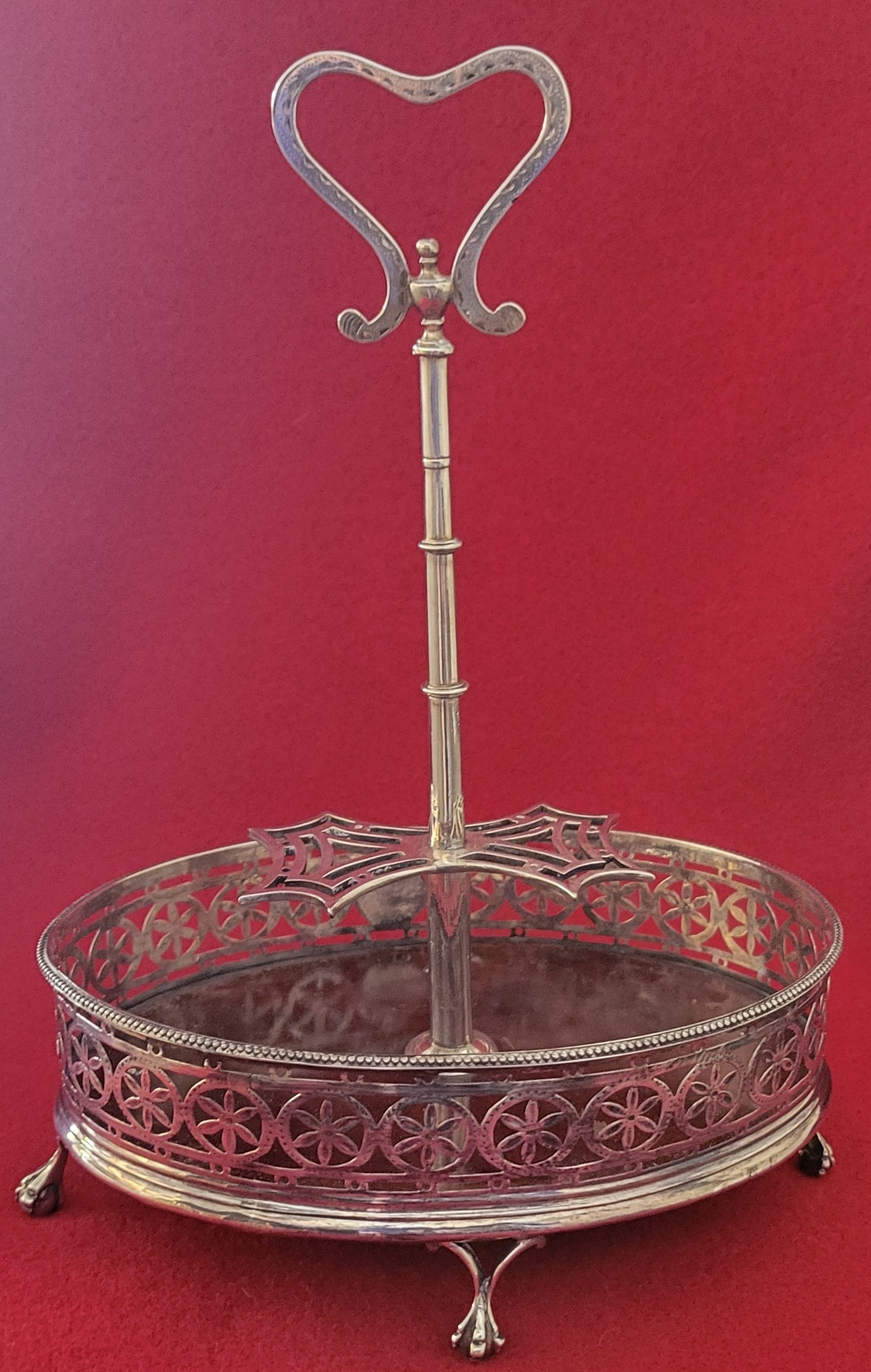
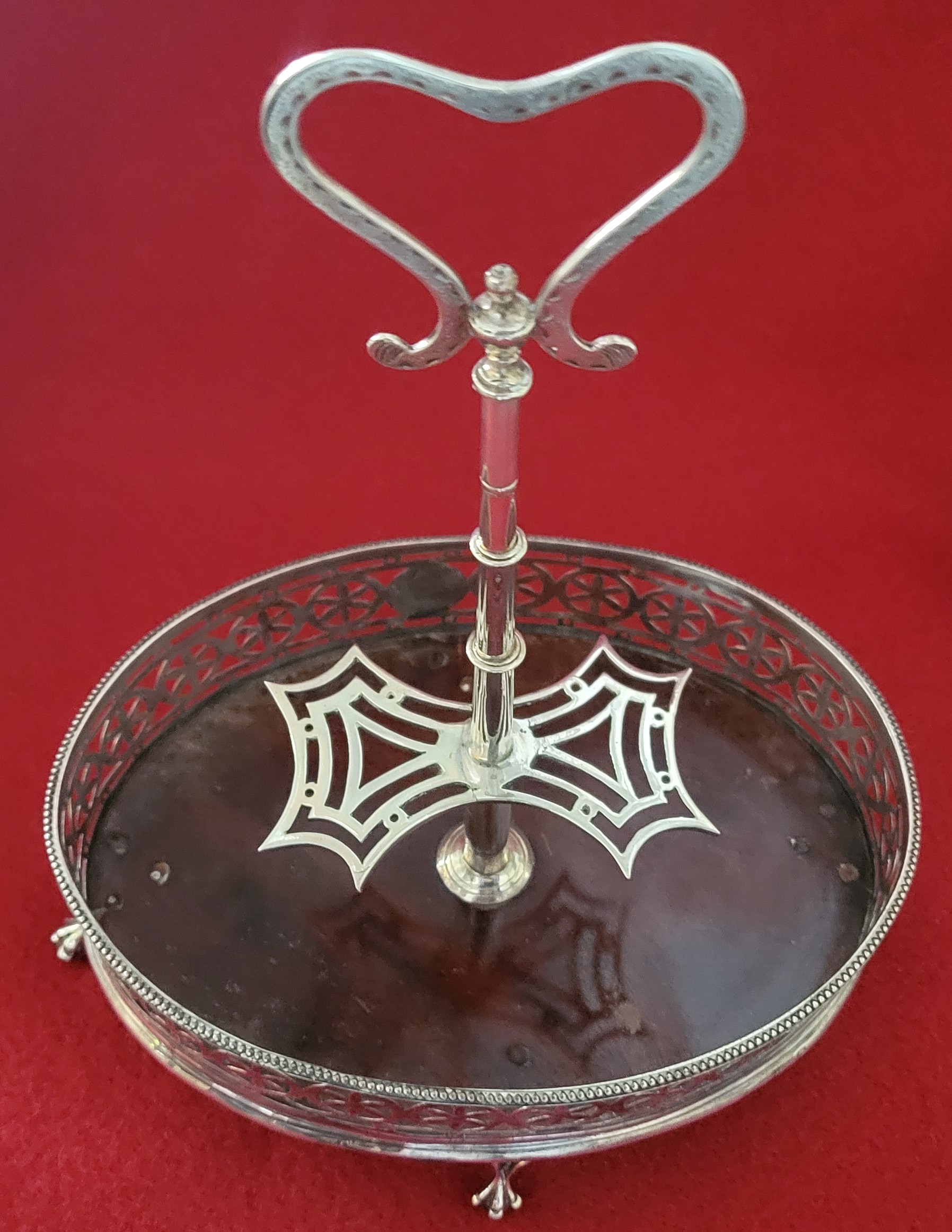
Trade card for Leticia Clarke who was Hester Bateman’s daughter Silver cruet stand with Hester Bateman maker’s mark, c.1780Hester Bateman makers mark, 1781-1782Hester Bateman maker’s markHester Bateman makers markSmall silver cream pot by Hester Bateman, 1784-1785
The key to Hester’s success was adopting and integrating modern technologies, taking advantage of new cost-effective manufacturing processes to supply elegant wares to the middle class. (Slavid, 2021) One of the new cost-effective processes they used was the “Sheffield Plate,” developed in the 1740s. It is a fusion of copper and sterling silver to create gauge sheet silver, which can be punched and pierced by machines and is cheaper to produce than solid silver. (Campbell, 2006)
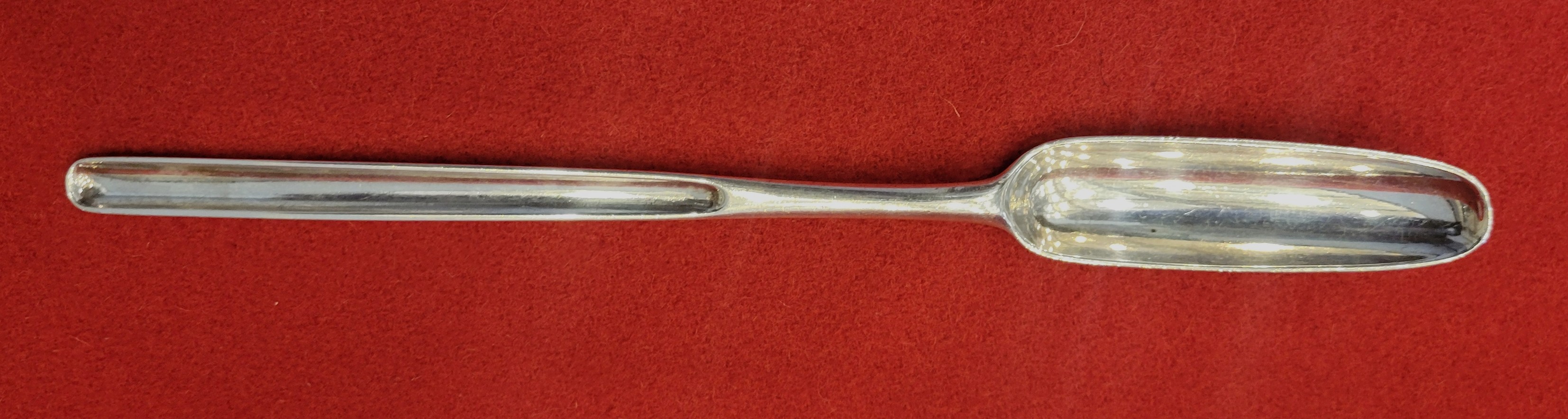
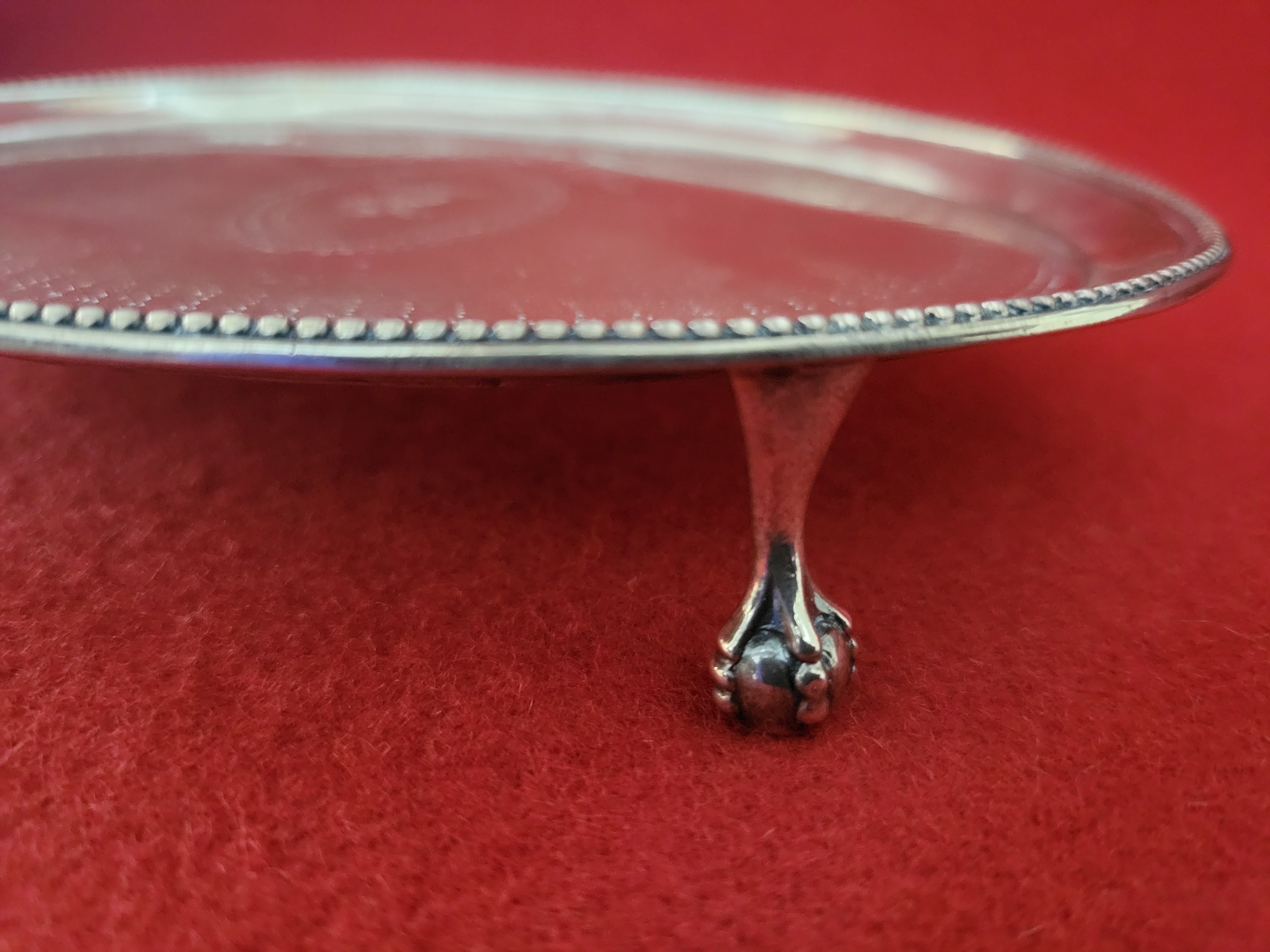
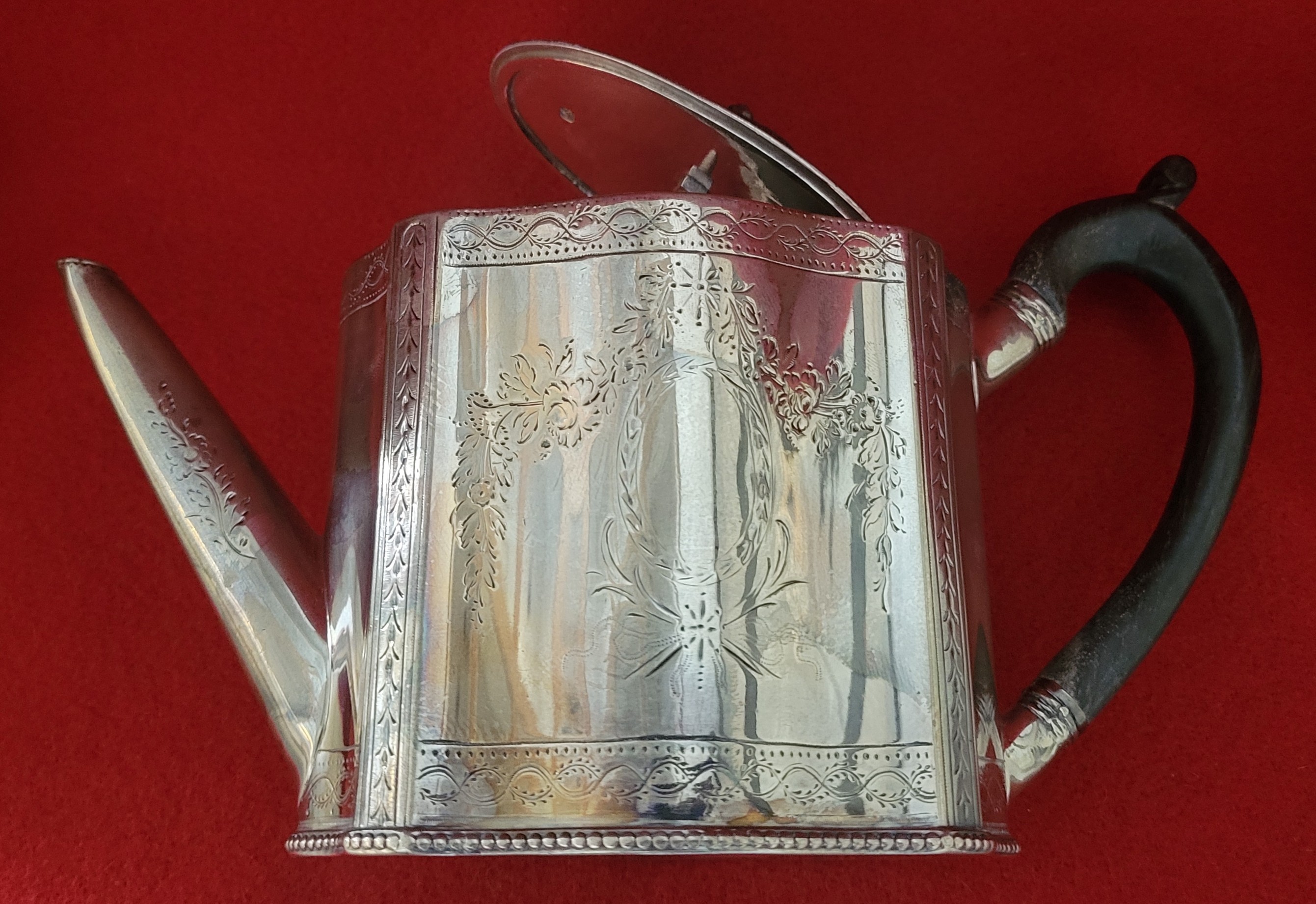
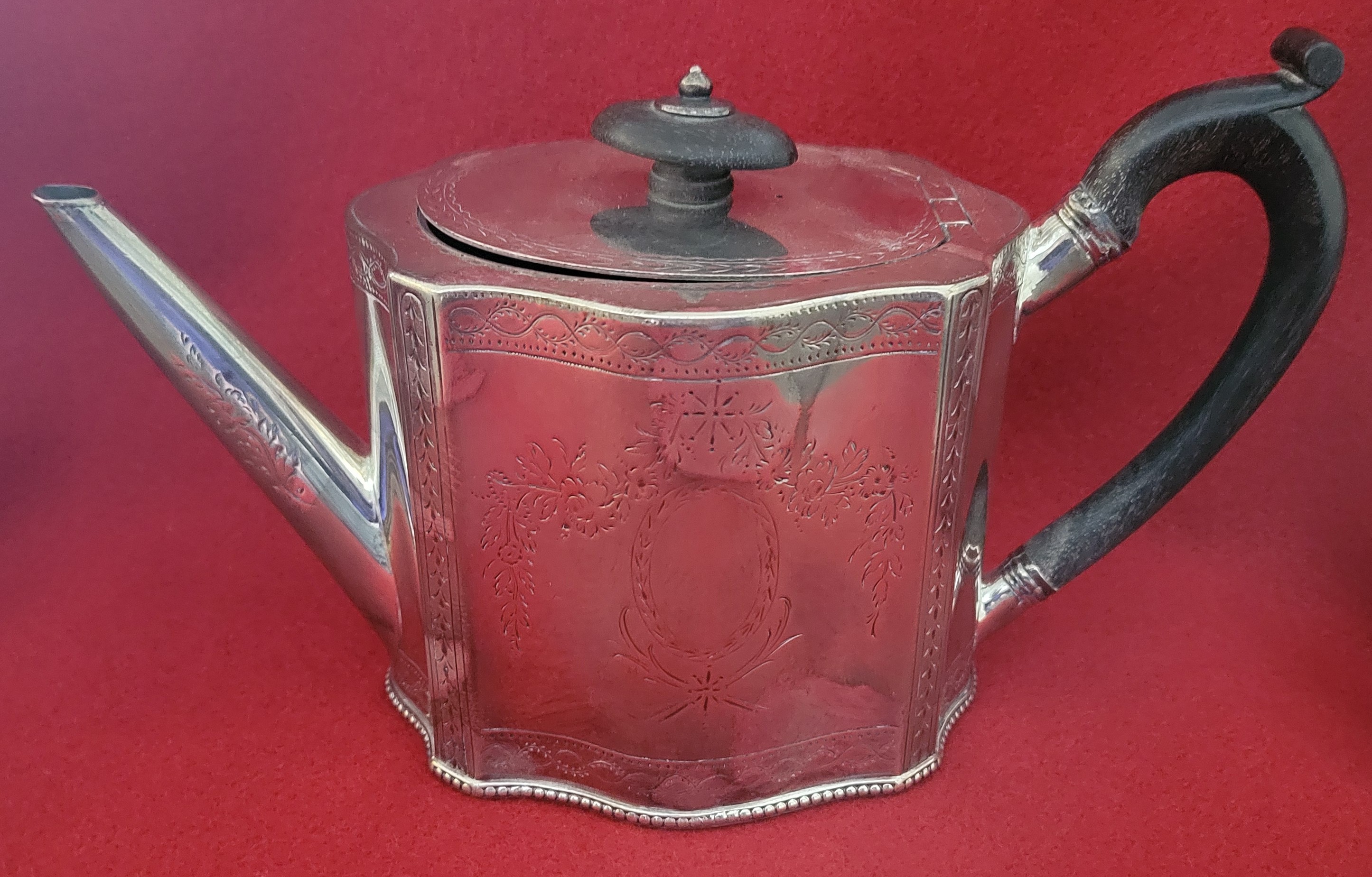
Silver Marrow Scoop by Hester Bateman, 1774-1776Silver Marrow Scoop by Hester Bateman, 1774-1776Silver Marrow Scoop by Hester Bateman, 1774-1776Silver tea stand with beaded edge, ball and claw feet and engraved griffin head, Hester Bateman, 1785-1786Silver tea stand with beaded edge, ball and claw feet and engraved griffin head, Hester Bateman, 1785-1786Silver tea stand with beaded edge, ball and claw feet and engraved griffin head, Hester Bateman, 1785-1786Small silver cream pot by Hester Bateman, 1784-1785Small silver cream pot by Hester Bateman, 1784-1785Silver teapot by Hester Bateman, 1781-1782Silver teapot by Hester Bateman, 1781-1782Silver teapot by Hester Bateman, 1781-1782Silver teapot by Hester Bateman, 1781-1782Silver cruet stand with glass bottles by Hester Bateman, c. 1780.Silver cruet stand with glass bottles by Hester Bateman, c. 1780.Silver cruet stand with glass bottles by Hester Bateman, c. 1780.Silver cruet stand with glass bottles by Hester Bateman, c. 1780.
Hester retired in 1790 and was succeeded by her sons, who registered their hallmarks in December 1790. The Bateman family company continued for another fifty years, closing under William Bateman in 1843. (Campbell, 2006)
Ann Bateman
One of the renowned Bateman silversmith family members was Ann Bateman, daughter-in-law of Hester, who was married to her son Jonathan.
Better look at maker’s mark by Peter and Ann Bateman
She registered her first mark in 1791, the year her husband died. She then worked in partnership with her brother-in-law Peter and eventually her son in 1800. Her works were popular tableware in fashionable neoclassical styles. (Bly, 2008)
Sugar baskets; 1794; Minneapolis Institute of ArtSilver teaspoon by Ann, Peter and William Bateman, 1800Silver teaspoon by Ann, Peter and William Bateman, 1800Coaster by Ann, Peter and William Bateman, 1780-1800Coaster by Ann, Peter and William Bateman, 1780-1800Coaster by Ann, Peter and William Bateman, 1780-1800
Elizabeth Godfrey
Elizabeth was born in London, the daughter of Simon Pantin, a prominent silversmith. She was believed to have been trained in her father’s workshop. She married two silversmiths; her first husband was Abraham Buteux, a French goldsmith.
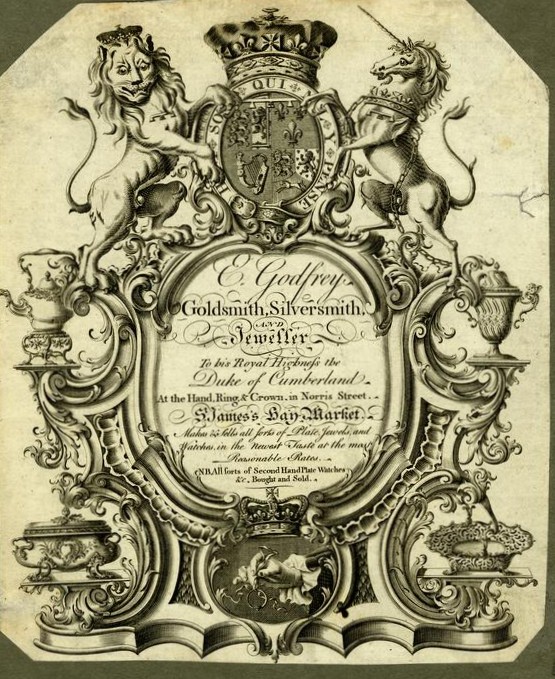
Trade card for Elizabeth GodfreyElizabeth Godfrey maker’s mark registration
Abraham died in 1731, and she registered her first mark as Elizabeth Buteux for her shop in Norris Street. She continued her first husband’s business until her marriage to Benjamin Godfrey in 1732. Upon Benjamin’s death in 1741, she registered a second mark as Elizabeth Godfrey. (Arts, 2025) She is described on her trade card as “Goldsmith, Silversmith, Jeweller, [who] makes and sells all sorts of plates, jewels, and watches, in the newest taste at the most reasonable rates.” (Mrkusic, 2014)
Elizabeth Godfrey’s shop in Norris Street, Piccadilly, LondonElizabeth Godfrey maker’s mark
After her second husband’s death, she took charge of the company and began producing silver pieces in the fashionable Rococo style. This earned her many loyal patrons, including the Duke of Cumberland. (Skerry, 2018)
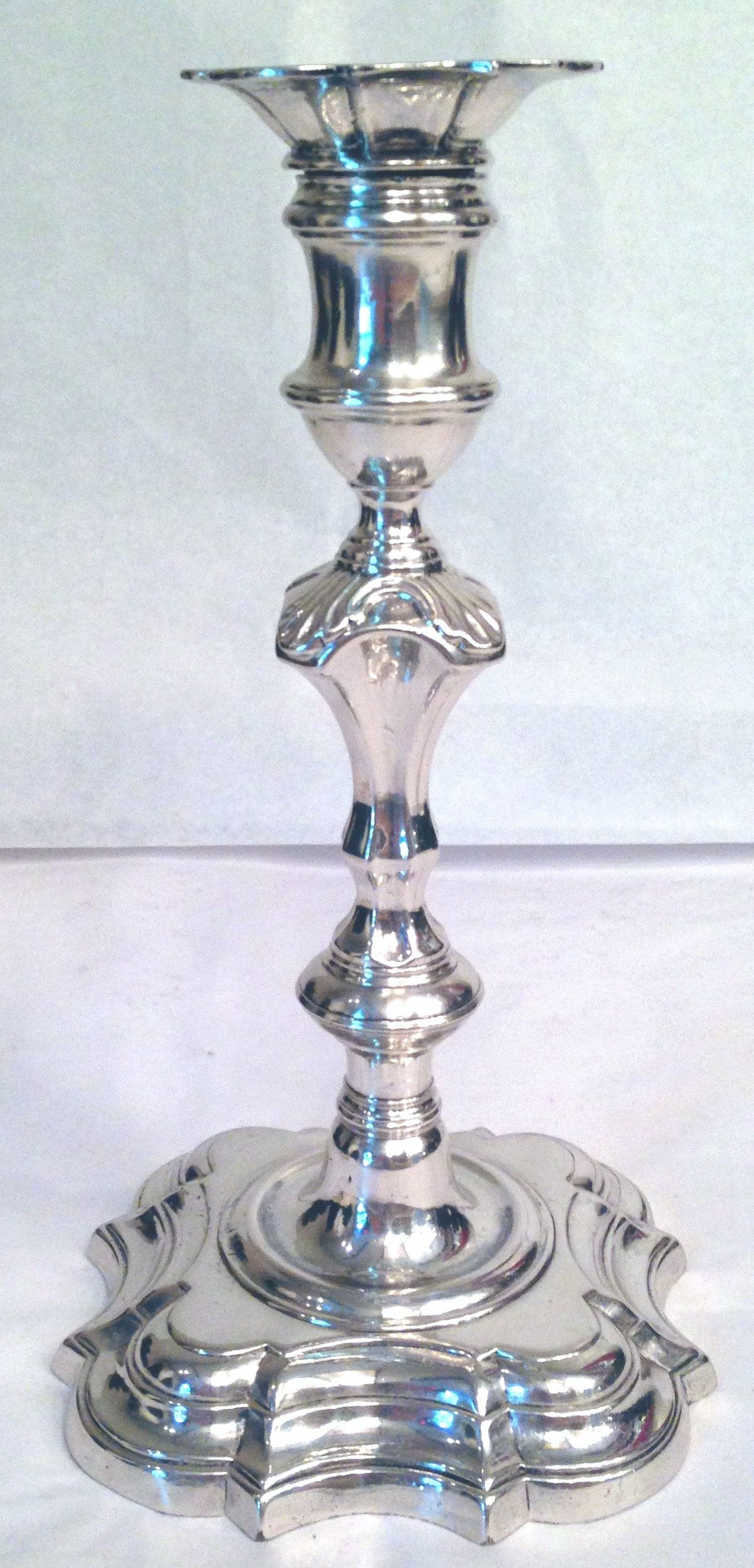
Silver candlestick by Elizabeth Godfrey, 1744Silver candlestick by Elizabeth Godfrey, 1744
Elizabeth Godfrey passed away in London around 1758. (NMWA, 2025)
Susanna Barker
Our last silversmith is Susanna Barker. Unfortunately, little information about her life exists, and only a few museums have her works. Barker was classified as a small worker, which means she produced small-scale pieces of precious metals. (The Goldsmiths’ Centre, 2025)
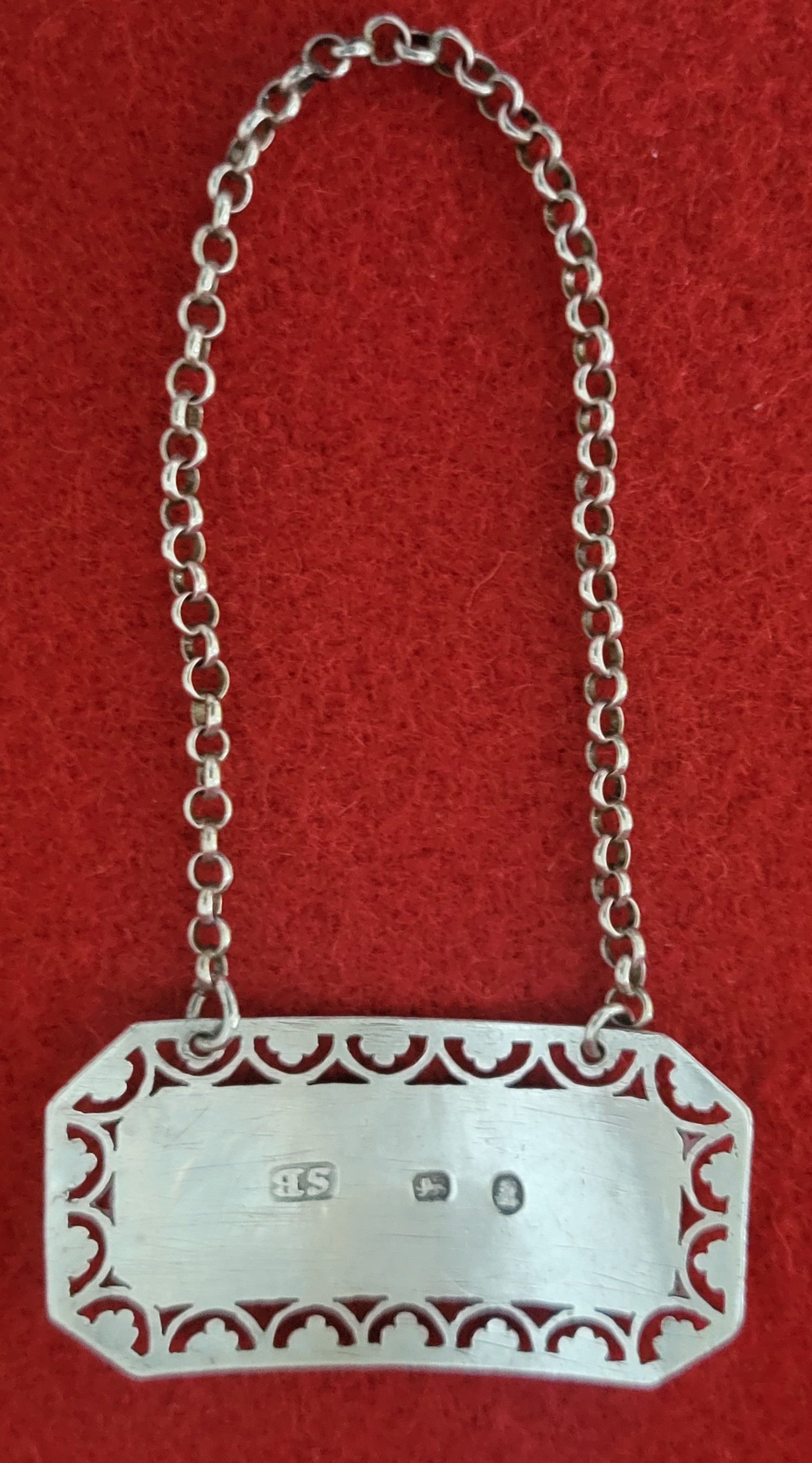
Silver bottle ticket engraved “Madeira” by Susanna Barker, 17778-1793Silver bottle ticket engraved “Madeira” by Susanna Barker, 17778-1793
She worked at 29 Gutter Lane and registered her first mark on 25 June 1778, second on 12 August 1789, and third on 26 August 1778.
Susanna Barker worked at 29 Gutter Lane. Gutter Lane was listed on Agas map of London c. 1560s was described by English historian John Stow (1598) how “fine siluer, such as was then made into foyle” was commonly known as “siluer of Guthuron’s lane”Susanna Barker worked at 29 Gutter Lane, Cheapside, London
Women’s work throughout history has sometimes been overshadowed, undervalued, or not recorded. However, with these solid silver markings, the ladies cemented themselves into the history of the arts.
Arts, N. M. (2025, January 21). Elizabeth Godfrey. Retrieved from National Museum of Women in the Arts: https://nmwa.org
Bly, J. (2008). Discovering Hallmarks on English Silver. London: Shire Publications.
Campbell, G. (2006). The Gove Encyclopedia of Decorative Arts, Volume 1. Oxford: Oxford University Press.
City Women. (2025, January 21). City Women in the 18th Century: An Outdoor Exhibition of Women Traders in Cheapside. Retrieved from City Women: https//citywomen.hist.cam.ac.uk
Skerry, J. E. (2018). Beyond the working dates: reconstructing the life and career of Elizabeth Patin Buteux Godfrey. Silver Studies. The Journal of the Silver Society, 75-88.
While the house at Historic Kenmore has been faithfully restored to its circa 1775 appearance, the road to that final result was a pretty dirty one. As in plaster dust, paint fumes, and all manner of dirt and debris. Back in the late 1980s and early 1990s, the first forays into the research for and the subsequent writing of a Historic Structure Report (HSR) took place. This project entailed a number of architectural historians selectively pulling up floorboards and peeking behind plaster walls to more fully understand how the house was originally built, its current condition, and its history of change over time. This important document provided us with a clear understanding of Kenmore’s architectural history, was the guiding document for a decade-long restoration of the structure, and also gave us a collection of architectural fragments and individual artifact finds that continue to help us understand the material world of those who lived and labored at Kenmore through the centuries.
In a past blog post, we learned a bit about rats as collectors and examined a rat’s nest that was discovered during that HSR investigative period. If you haven’t looked at the video of the unpacking of that nest, here it is. (In that nest, there were assorted papers, fibers, and other fluffy goodies dating to around the turn of the 20th century.) But the nest wasn’t the only thing uncovered during that HSR peeking and prodding process.
Enter the “Above Ground Archaeology” or “Interior Archaeology” collection. These eclectic artifacts were carefully collected, numbered according to their context or find location, bagged, documented on a list, and lovingly packed away in our ubiquitous Hollinger boxes. Over the years, some of the artifacts were pulled by curators for exhibition in the Kenmore galleries, but most were stowed away in their boxes for long-term preservation and research purposes.
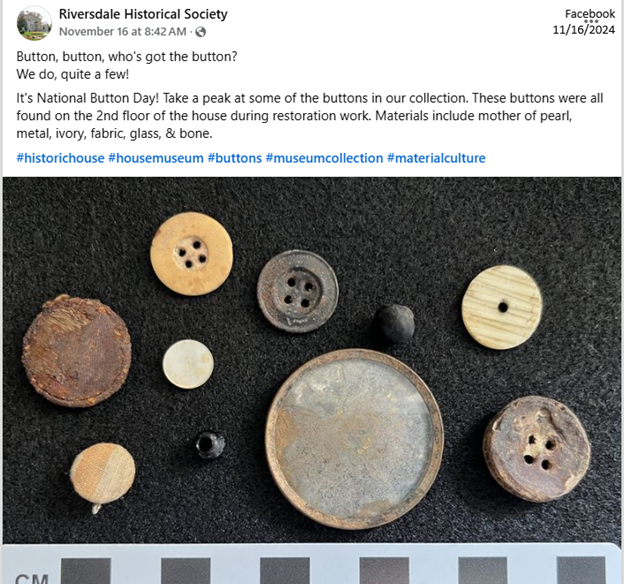
The use of found objects in historic structures to help illuminate the material world of the building’s residents and workers is not a revolutionary concept. Colonial Williamsburg, for instance, in their recent restoration of the historic Bray School, removed modern plaster walls, revealing not only structural information but also artifacts: “We are collecting building fragments and objects found in the walls…These items shed light on the building’s original finishes and various inhabitants since 1760.” Riversdale Historical Society has been showcasing some of their “found” artifacts on Facebook — most recently posting a set of buttons for National Button Day.
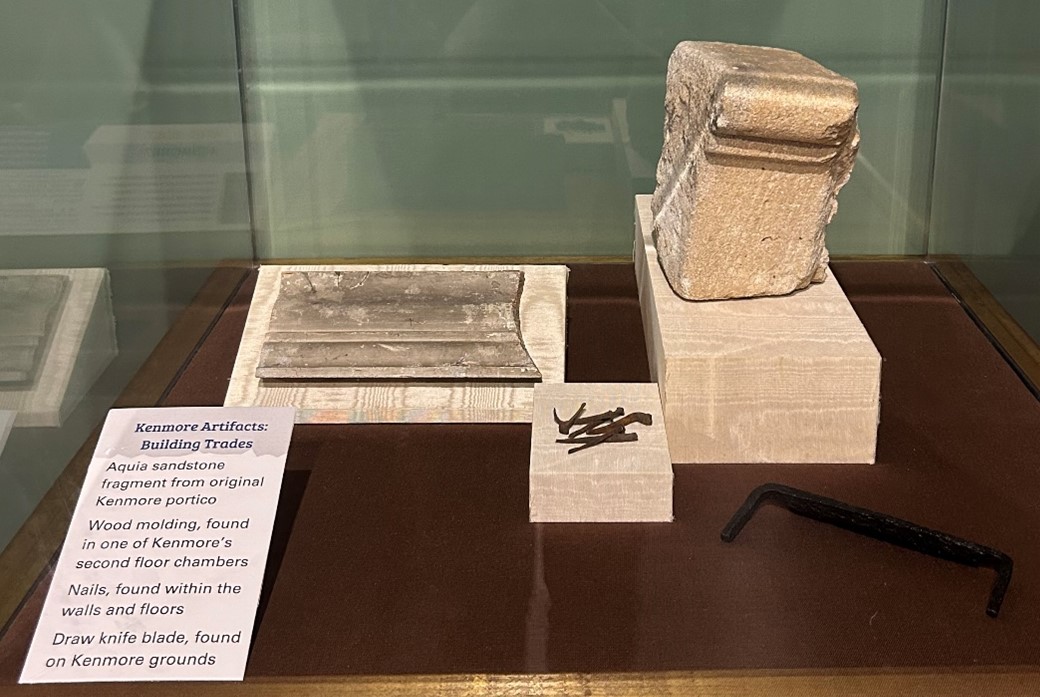
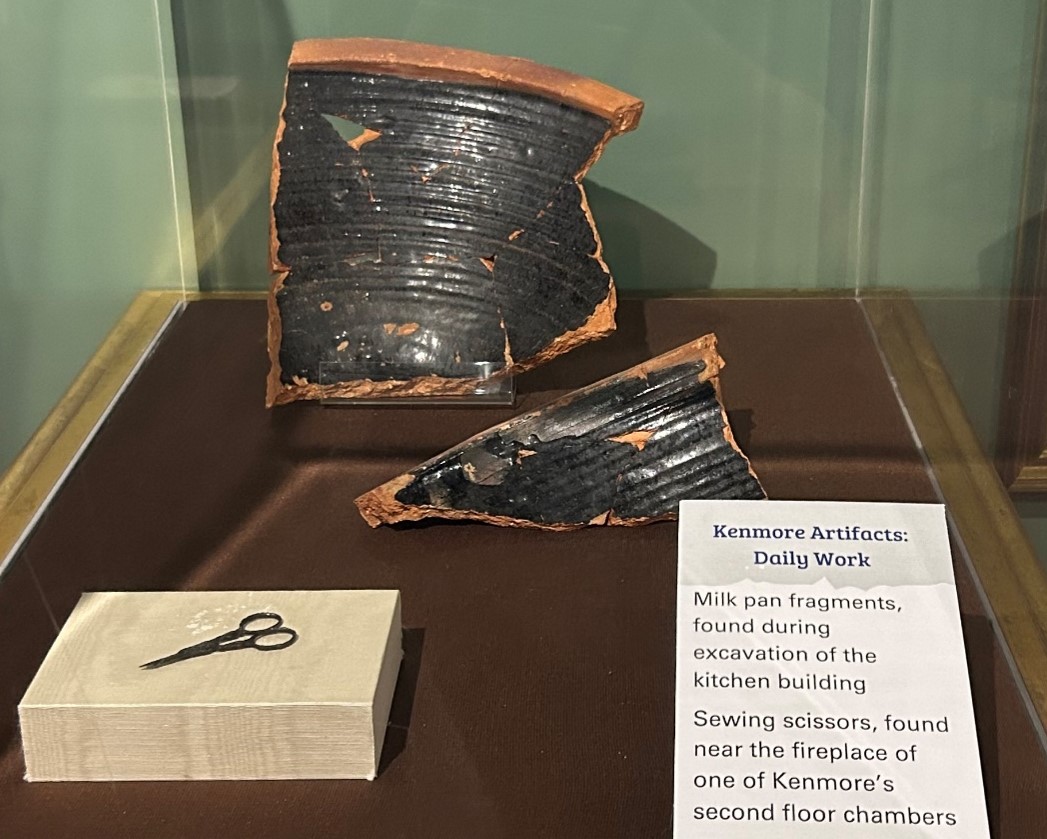
Recently, we pulled a few of Kenmore’s artifacts into exhibit cases in our refreshed orientation exhibit in the Bissell Gallery of the Crowninshield Education Center at Historic Kenmore. Together with in-ground archaeology, these exhibit cases help us illustrate the built environment and the wares known and used at the site.
Case in the orientation exhibit at Historic Kenmore – including molding fragments and nails found during the HSR investigationsCase in the orientation exhibit at Historic Kenmore – including the tiny (sewing) scissors found near one of the second-floor fireplaces.
In 2010, then Intern Ashley Dean (University of Mary Washington) was tasked with inventorying the three boxes of artifacts, and for that, we are extremely grateful. What resulted from that inventory project was a 12-page list of artifacts that formed the center of this rejuvenated research initiative. The artifacts in these boxes range from architectural elements (plaster fragments, nails, wallpaper bits) to broken household goods (bottle glass, ceramic pieces) to whole objects (beads and a pair of sewing scissors). When first bagged and numbered, these artifacts were recorded by location context—based on the mapping system then being used in the architectural investigations of the house, with room numbers ranging from B001 in the cellar (or basement level) to 301 being the attic (or 3rd floor) of the house.
Attic (Room 301) mapping
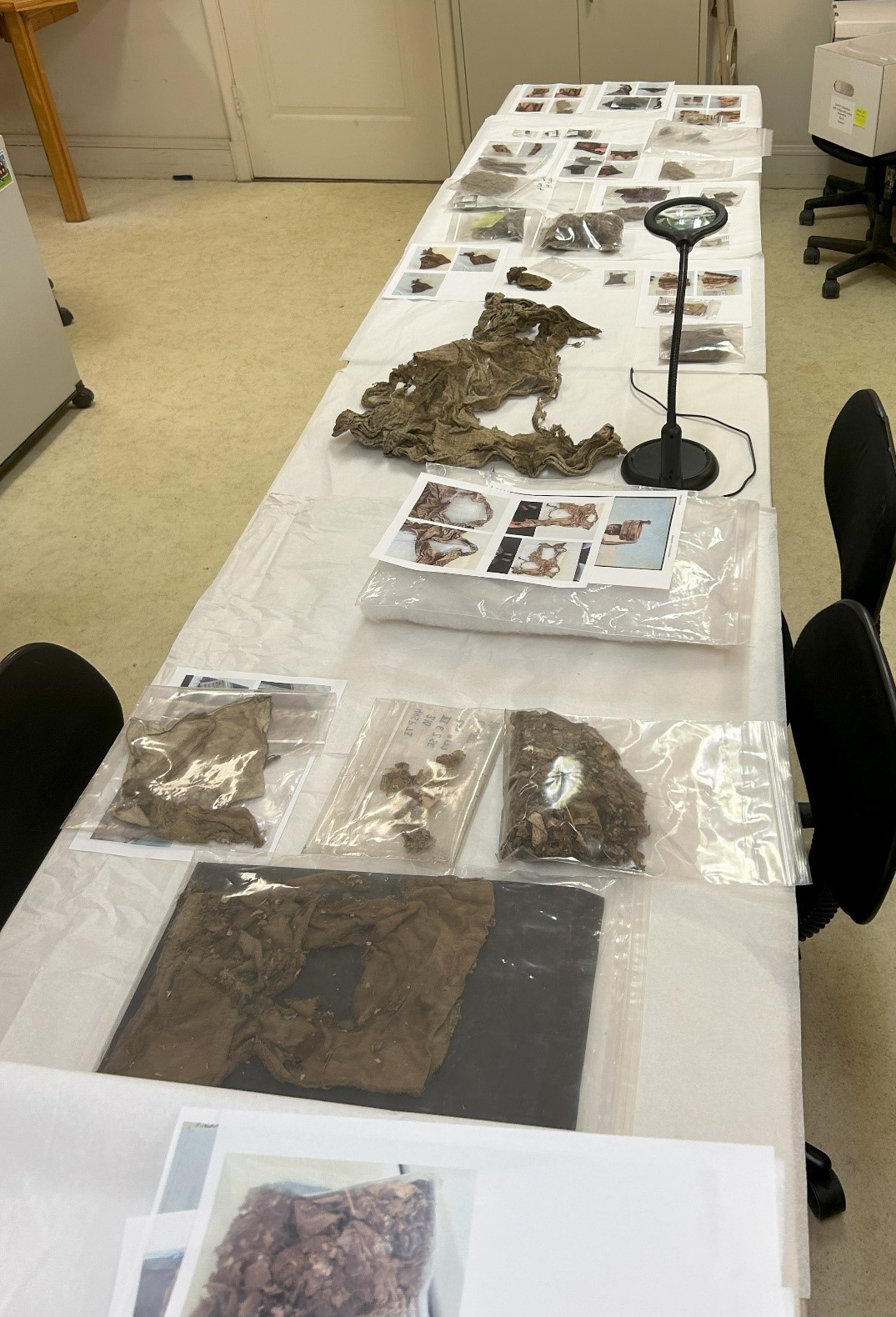
Fast forward to 2024, the artifacts were again reviewed, and the idea blossomed to plan a textile assessment of all the small scraps of fabrics that had been collected. According to our in-house review, we could tell that they dated to a variety of periods and ranged in their likely original use, from costumes to household linens.
Selection of textile fragments in the Kenmore Above Ground Archaeology collection (July 2024)
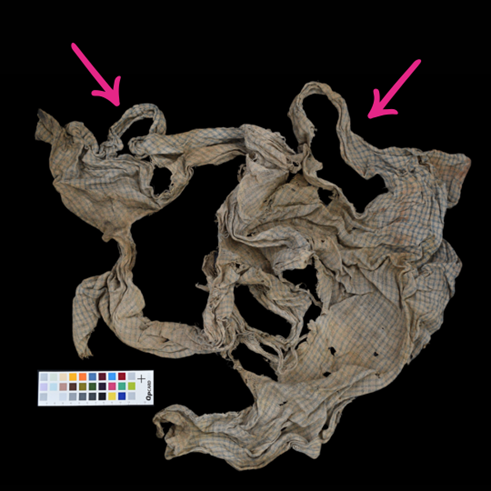
One particularly large artifact proved the most intriguing — a pile of blue and white check fabric. The indeterminate ball of checked fabric piqued the interest of staff and now serves as the starting point for a multi-year conservation assessment and interpretation project. A few months after our in-house assessment, we hosted a textile conservator who conducted a baseline review of the textile fragments and more fully examined the artifact for potential treatment. She had a rapt audience that morning!
Textile fragments in the archaeology lab, awaiting the arrival of the textile conservatorTextile conservator Colleen Callahan examining what we had determined to be a child’s full apron or pinafore
And just a few weeks ago, the textile artifact, which looks to be a full child’s apron or pinafore, was transported to the conservation lab for treatment and further research.
Check fabric before conservation. Armholes visible along upper portion.
The found artifacts from Historic Kenmore have not yet been able to fully share their stories. We look forward to beginning to delve more into their manufacture, use, and re-use by the generations of people who wore them, worked with them, saved them, hid them, and otherwise interacted with the artifacts and the spaces in which they were found.
A lot of people have told me that they want or wanted to become archaeologists. I always find this flattering. Yours truly was only in my single digits when I declared the same to my family and anyone who would listen. After reading every National Geographic magazine I could get my hands on, ‘excavating’ abandoned houses and bottle dumps on or near the property where I grew up, and too many years of schooling than I am willing to admit…. here I am today. I am an archaeologist of 25 years. That being said, it is not an easy profession to get into. To wedge your way into this field, it is recommended you have an obsession with learning, stubbornness equal to a Black Friday shopper outside a Target in 20-degree temperatures at 3 am the night before, a hefty amount of luck, the willingness to obsess over dead people’s broken garbage, and just to be sure it would help if you’re at least a little bit mad.
Happy archeologists!
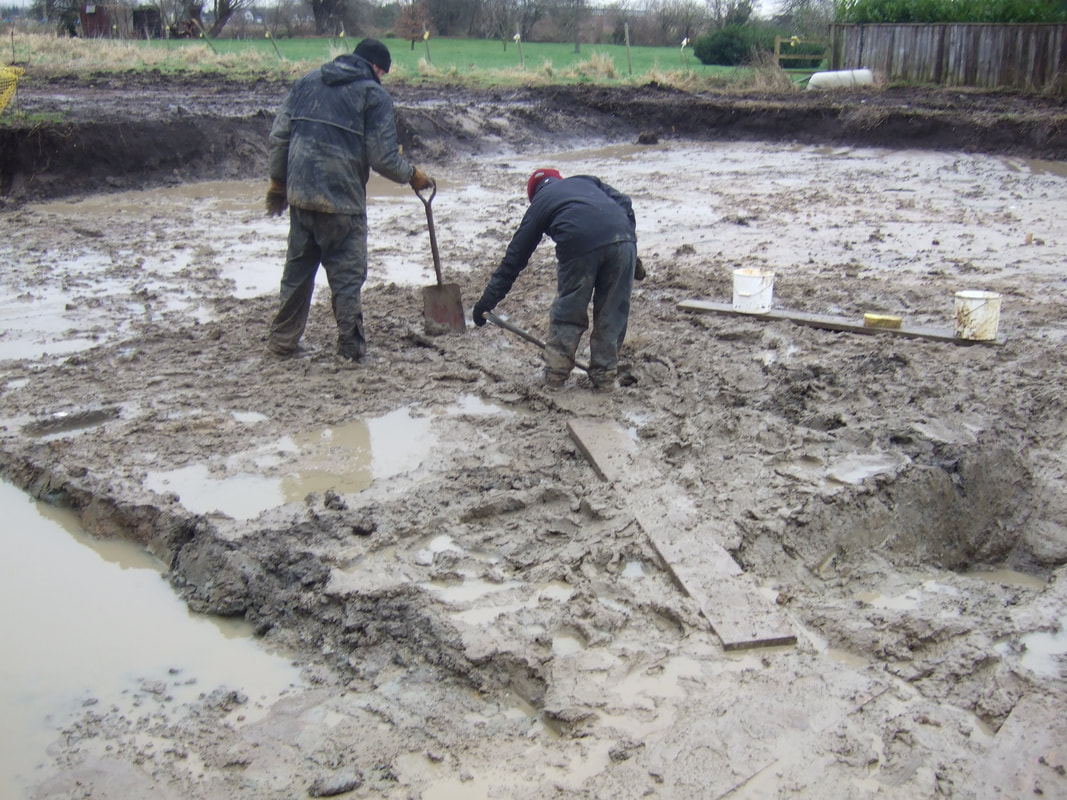
Now, I am an archaeology lab manager in our museum, which means I enjoy the comfort of climate control, access to bathrooms, an office, and a place to store my breakfasts and lunches. But, like most archaeologists, I had to cut my teeth in the field (digging outside), which lacked all the above amenities. This is where many archaeologists figure out if they genuinely want to go through with the folly they have embarked upon. Many decide they do not and switch majors. Good for them; they likely make more money than most archaeologists. But could it really be that bad? Isn’t it fun finding cool stuff? Yes, of course. But here are all the obstacles those noble field archaeologists face daily:
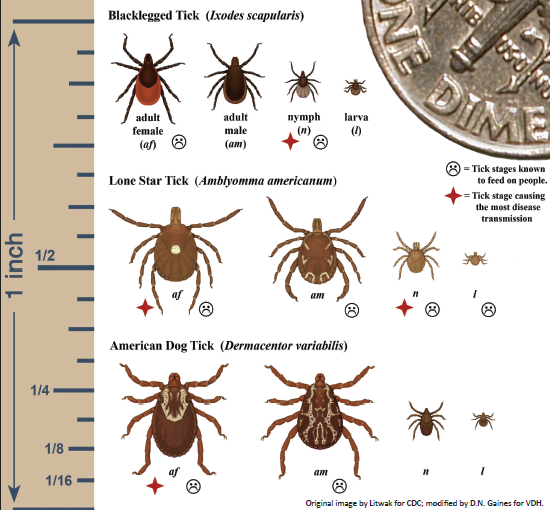
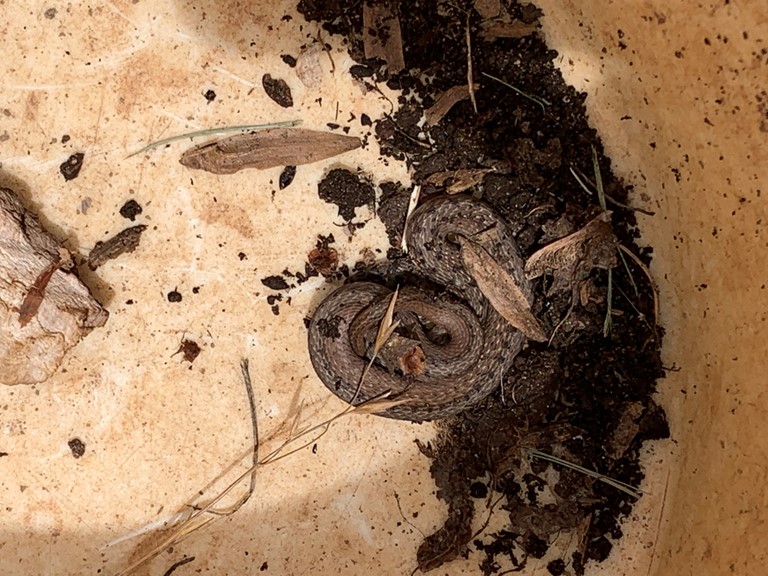
Bugs. Lots of them. Bugs have taken down many of my brave colleagues. Forget the snakes (Unlike Indiana Jones, most of us like snakes) and spiders. I am talking about chiggers and ticks. No one gets just one chigger bite. They hang out in gangs of hundreds, and you will not know they have bitten you until they have had their fill of your yummy body juices and peace-ed out. Hours later, you’ll notice around your ankles and waistband the unbelievable itching of dozens of bites that will haunt you for weeks. Ticks are worse. Way worse. Ticks carry diseases that can be very serious, including Lyme and Rocky Mountain Spotted Fever, both of which should be avoided at all costs. Don’t forget bees, hornets, and wasps. No archaeologist worth their salt is without a harrowing tale of valiantly battling or running the heck away from a swam of ticked-off single-minded, murderous, flying, stingy wingy thingies.
Ticks of VirginiaLyme Disease symptoms
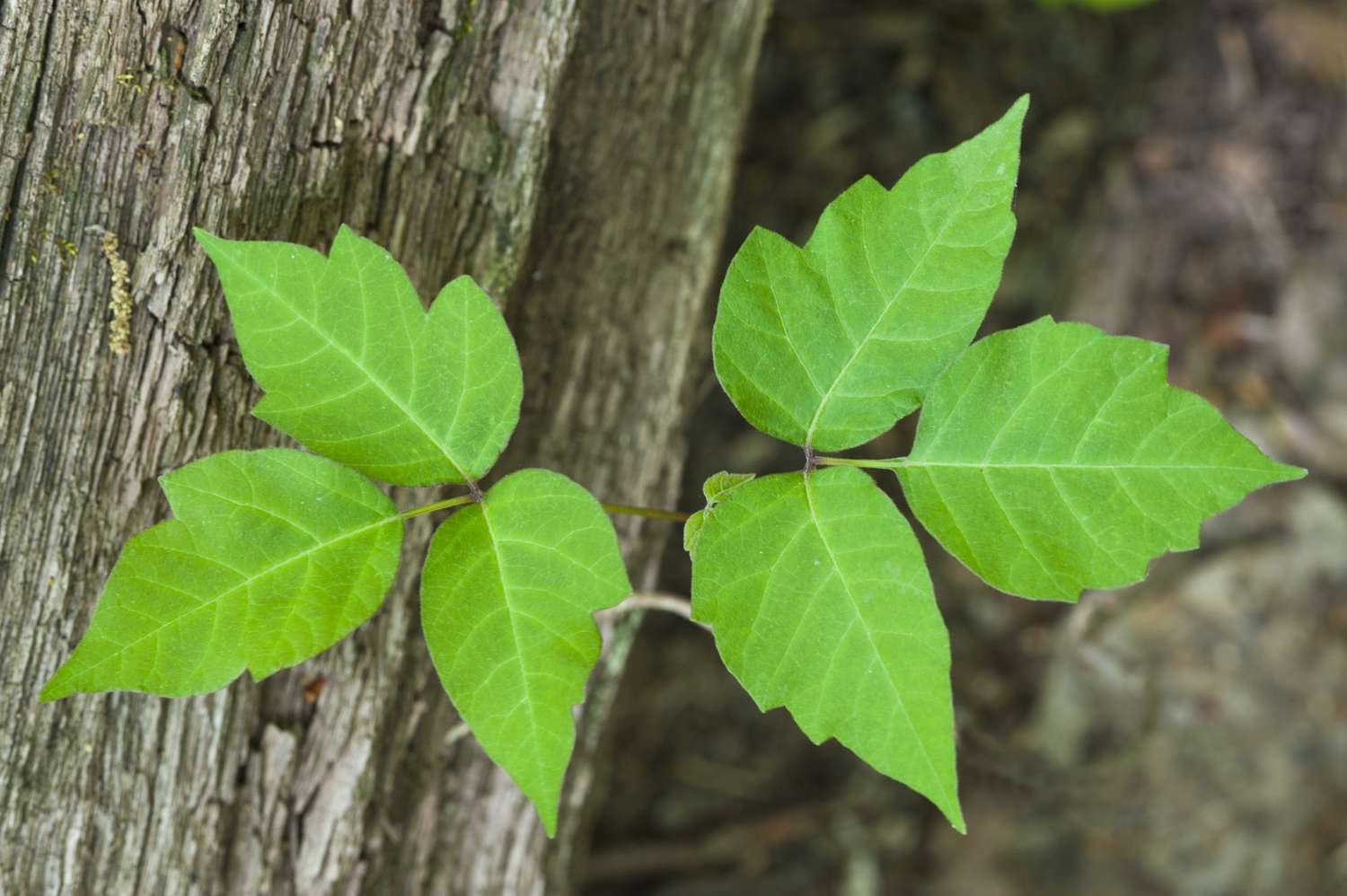
Plants that will make you wish you were never born. Let’s start with some annoying and inconvenient but not diabolical plants: Those with thorns. After being told by your crew chief that you need to hack your way through a six-foot-tall thicket of blackberries, multiflora rose, devil’s walking sticks (Yep, that’s a thing), cacti, or thistles in order to dig one tiny shovel test pit you WILL begin to question your life’s choices. However, for those who are allergic to poison ivy, oak, and/or sumac (and it’s most of us), your field career will be a constant battle where your enemy has highly transmittable and very toxic poison juices in every single part of them (even the roots) while you are armed with a bottle of calamine lotion. Those field archaeologists who do not get poison ivy will make fun of you and flaunt their superpowers, but just remember they’ll get theirs because the more you’re exposed to these plants, the more likely you are to feel their wrath.
Poison IvyPoison SumacDevil’s Walking Stick
Ancient Curses. No, you should NOT read that inscription on the 3,000-year-old tablet found in that tomb with all the warnings engraved on the entrance. If I had a nickel every time I had to tell a member of my crew to drop that darn ancient idol that’s started to glow red inside and run, I’d be able to pay off my student debts. Just kidding, that will never happen.
Unbroken seal of King Tut’s tomb…maybe just leave it.
This one is very serious and should never be taken lightly by anyone working outdoors because they take anyone by surprise just like that. Dehydration, heat stroke/exhaustion, sunburn, and frostbite. Field archeologists must dig in almost all conditions and all seasons. They are wind-worn and road-weary, and you should not mess with anyone who can dig dozens of holes a day in temperatures above 100 or below freezing.
Virginia can get very hot and humid in the summer, stay hydrated.Glacial archaeology at Ötzi in 1991 Sometimes it miserably wet (particularly in England)
Animals. I’m not talking just about the wild ones. I’ve only ever seen a bear in the woods once, just a few harmless snakes and maybe a couple of bucks that gave me the side eye. But I have had years knocked off my life by pheasants or tiny fawns exploding out of the brush a foot away from me. For the most part, pets are not an issue, and petting a friendly dog or cat is a welcome reprieve from digging holes. Livestock, however, would scare my crews. I grew up on a farm, so I knew what animals didn’t want to snuggle. Here’s the thing, though. Cows are bored and extremely curious when something or someone spices up their daily routine. It’s hard for someone from the city to calmly stare down a herd of Holsteins weighing 1,500 pounds each while they barrel towards you. But all they want is to sniff you, rifle through your dig kit, and lick your equipment because it’s salty. Annoyingly, they will also eat the plastic flagging tape that you carefully tied up to mark your transect line. So will deer, fun fact.
Friend found during dig at Ferry Farm…they were saved and moved to a more peaceful spot.Just investigating the work.Judy Jobrack, GWF Archaeology Field Director dog Coco stops by sometimes to supervise.
Unexploded ordinance (UXO). Gunpowder does not necessarily become so old that it won’t go boom any longer. It actually becomes less and less stable. Sure, that cannonball you found is cool. Sure, it’s super old. Stay. Away. From. It. Military bases and old battlefields are ripe with potentially dangerous mortars, shells, grenades, and bullets. Unfortunately, here in Virginia, there are cases of collectors who have brought finds home from Civil War battlefields only to find out the hard way that these artifacts can still do a lot of harm. That being said, you’d be surprised at all the places archaeologists have found things that can explode. I worked on a project in a former neighborhood, so imagine our surprise when a pit in the backyard of a house was found to contain dozens of WWII live .50 caliber antiaircraft ammunition. One thing you learn very quickly as an archaeologist is that some people are weird, and they do weird things you will never be able to explain. The fancy word for this is idiosyncratic behavior, and it’s one of my favorite terms. It’s the academic way to throw up your hands and say, “I got nothing.” So, if you find any UXO, contact local law enforcement; they know what to do with it.
Collapsed excavation units. Unstable excavation walls are no joke. I’ve personally had one collapse on me, and while I was fine, it was still frightening. Shoring up walls and expanding out before digging deeper can mitigate these issues, but there are many types of soils, and they’re not created equal, so never overestimate the strength of your walls. Don’t become an artifact yourself.
Digs can get pretty deep and the sides need to stabilized. Another deep dig
Soil contamination/hazardous waste. Archaeologists occasionally run into hazardous waste, which is bad—enough said. Arsenic was a major embalming ingredient in the 19th century, and since archaeologists are frequently called in to identify and remove burials, arsenic is a significant consideration. It was also used to make a beautiful green color called Scheel’s green, which was used in dying such things as fabric, book covers, and wallpaper. Imagine wearing a gorgeous Victorian-era dress while reading a book and sitting in a wallpapered room all dyed green with copious quantities of poison. Green is my favorite color but hold the early death, please. Mercury was considered a type of cure and used to treat various ailments such as syphilis, toothaches, melancholy, worms, tuberculosis, constipation, and apoplexy, to name a few. It was in perfumes, lotions, soaps, hats, etc….and just like arsenic, it doesn’t go away in the soil. And if you’re above a certain age, you definitely remember those mercury thermometers that, when broken, produced magical fun silver balls you could roll across the floor until your mother caught you. Another principal offender is lead. Humans discovered how awesome lead was thousands of years ago. Please don’t personally verify this, but somehow, the Romans found that degraded lead was sweet, so they put it in substandard wine to jazz it up a bit. Lead was also used in cosmetics until embarrassingly recently to produce that immaculate white complexion valued by the upper crust. YOLO. Lead was also used in water pipes, paint, glassware, ceramic glazes, and later in plastics and gasoline. There is so much lead in our environment now that even non-archaeologists are in danger of exposure. I could go on and on, but it’s time to move to…
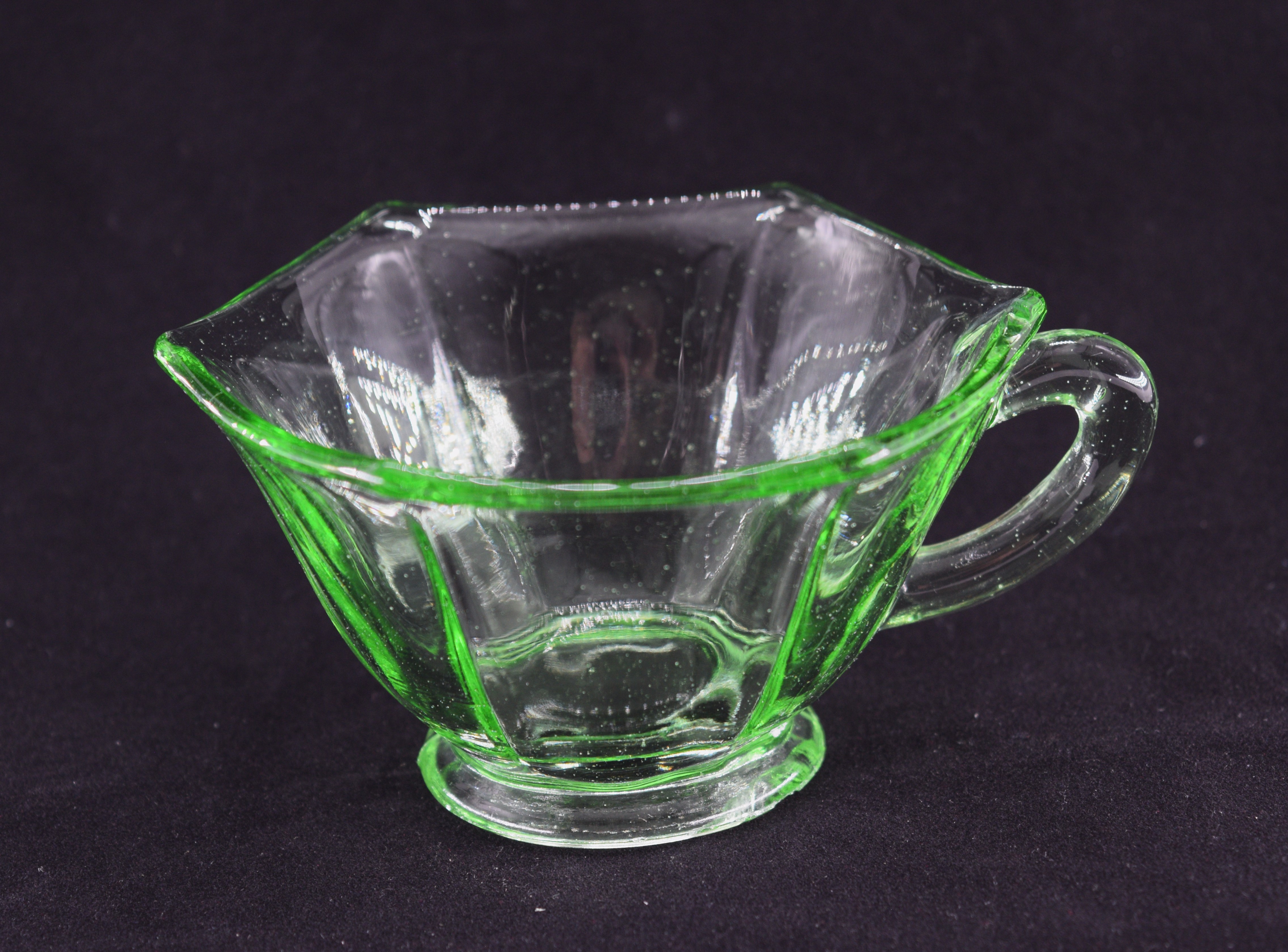
Medicinal bottle with mercury found at Ferry FarmUranium glass teacuplead-glazed bowlLeaded crystal vaseLead vase under black light
Enraged locals and/or property owners. We get it. No one wants that pipeline/highway/gas line/sewer to go through their property. And when it does, the archaeologists have to test that area. But please don’t run out of your house while visibly carrying a firearm and threaten the archaeologists. We are the lowest entity on this unpleasant totem pole and unfortunately the first people you’ll see trapsing over your land and digging holes. This was not our idea; it was our job. Working on these projects is the worst because people are understandably angry and want to vent, but this is not the way to do it. Ironically, one of the only things that can stop that pipeline from going through your horse pasture is if we find some amazing archaeological site with immense cultural significance. This will force a rerouting of the project, so your neighbors will have to deal with the headache.
Dealing with enraged locals is a delicate situation
This is not by any means intended as an exhaustive list, but I’ve already greatly exceeded my word count for this blog. You get the idea. So why, you may ask, does anyone become an archaeologist? Quite simply put, every job has its hassles, some more than others, but most archaeologists really (and I mean REALLY) love archaeology. The jobs in archaeology may not fit the stereotypes (full disclosure: most of us adore Indiana Jones, though). Archaeology is rarely glamorous; it can be dangerous or frustrating, but it is, above all else, AWESOME. Being a part of uncovering human history and sharing information never gets old, and I wouldn’t trade my job for any other.
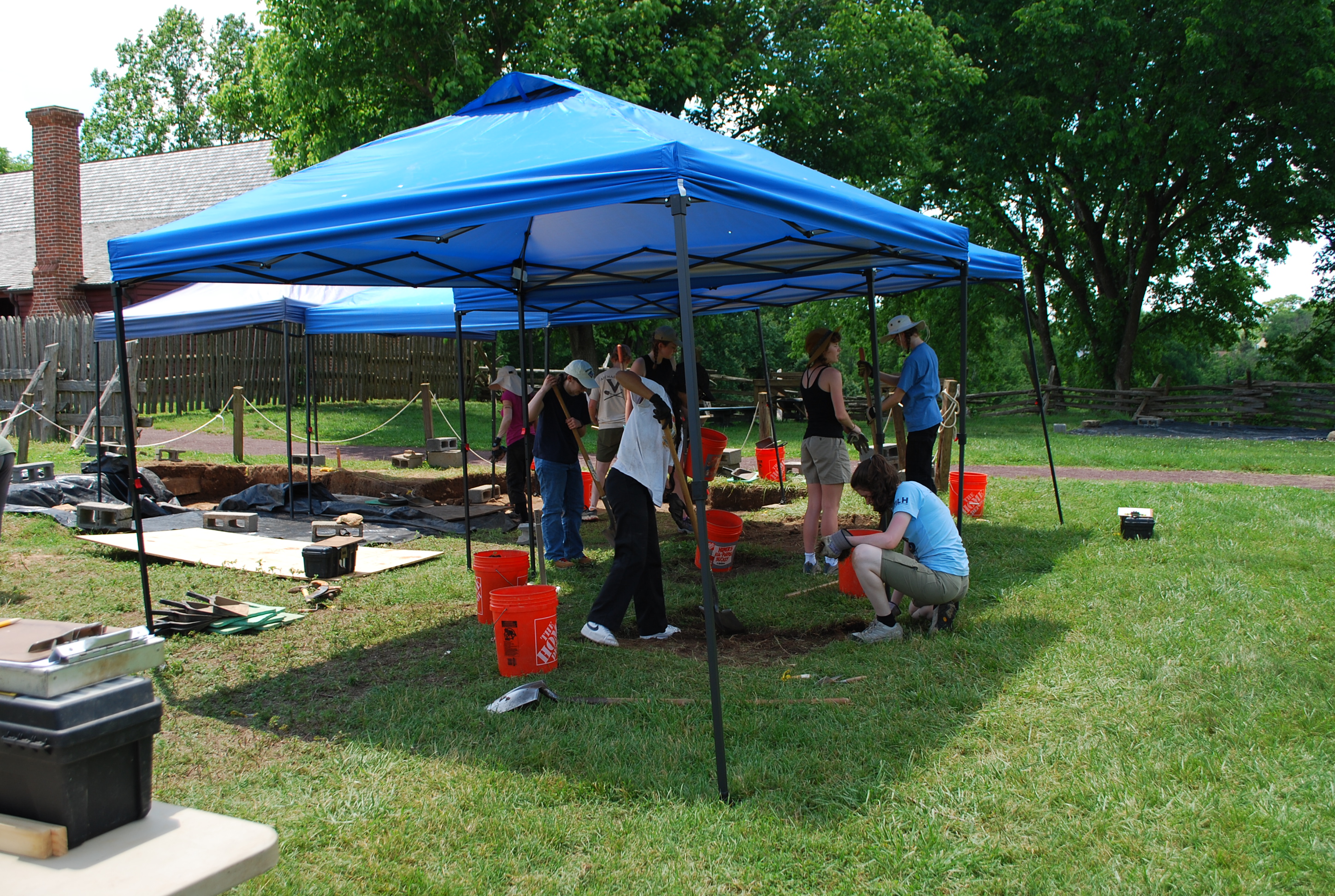
October just happens to be Virginia Archaeology Month, and what better way to celebrate than to recap this summer’s excavation at George Washington’s Boyhood Home at Ferry Farm.
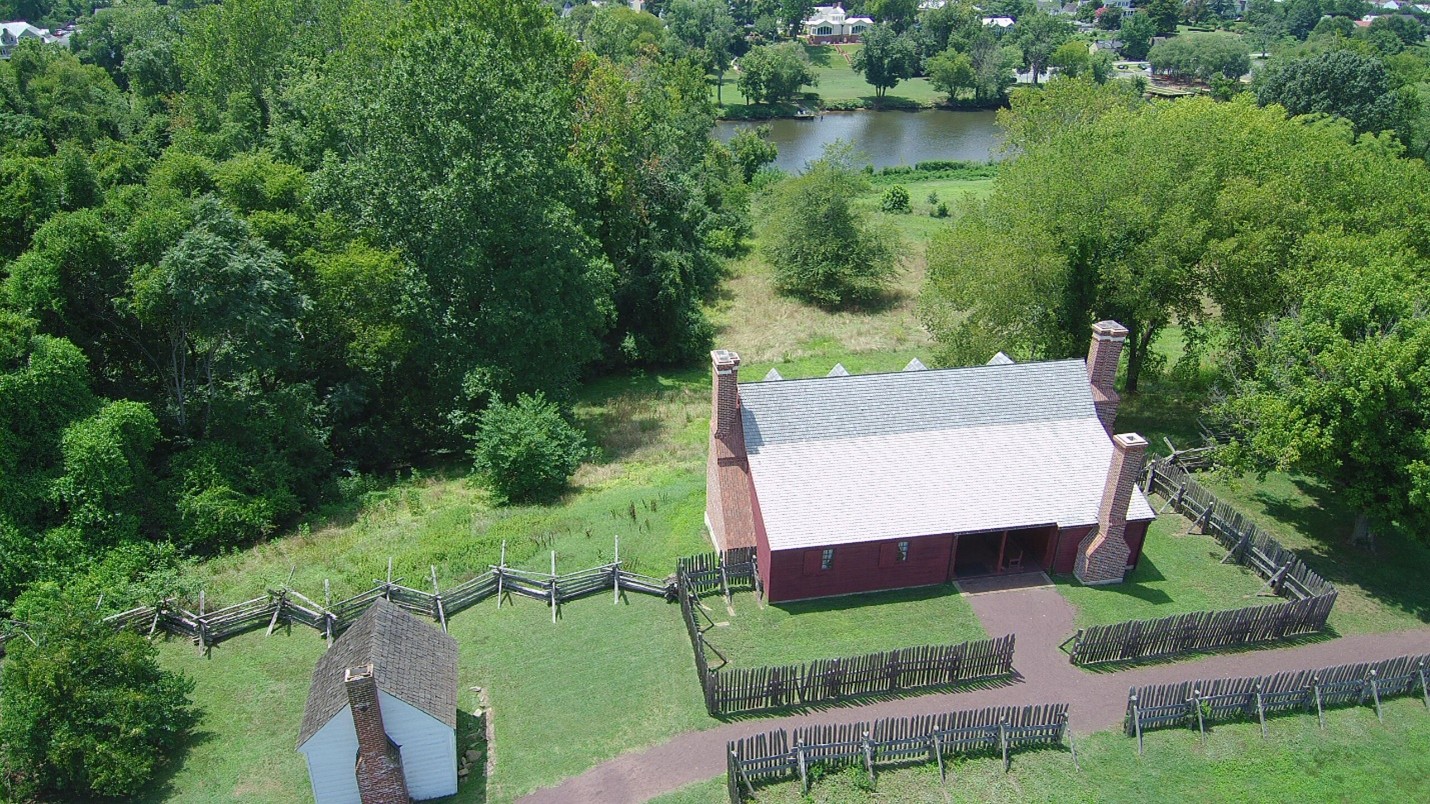
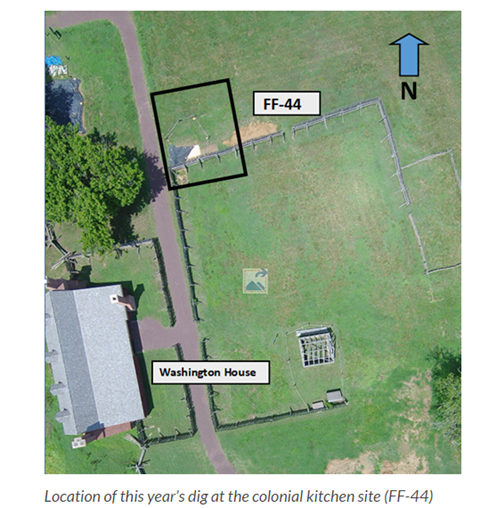
You might remember from our dig preview, that this year’s dig (FF-44) focused on the continued exploration of the 18th-century kitchen site located just northeast of the main house. In 2023, our limited investigations uncovered just a small section of the kitchen’s stone foundation and cellar, giving us a sneak preview of the conditions and parameters of future site work. Armed with this knowledge, our aims this year were to uncover more of the original foundation walls of the kitchen cellar, to uncover additional architectural evidence of the kitchen outbuilding, and explore the surrounding landscape for features. So, did we do it?
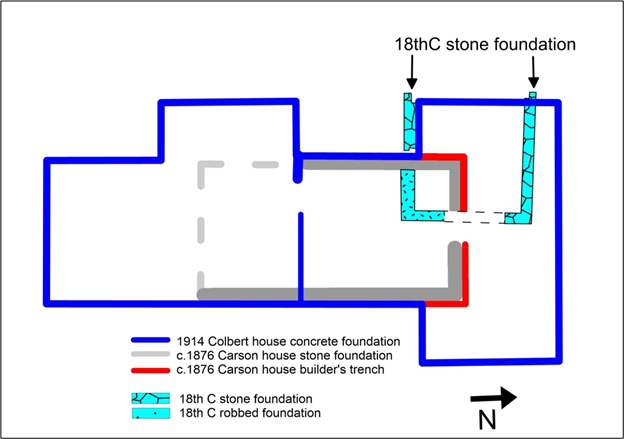
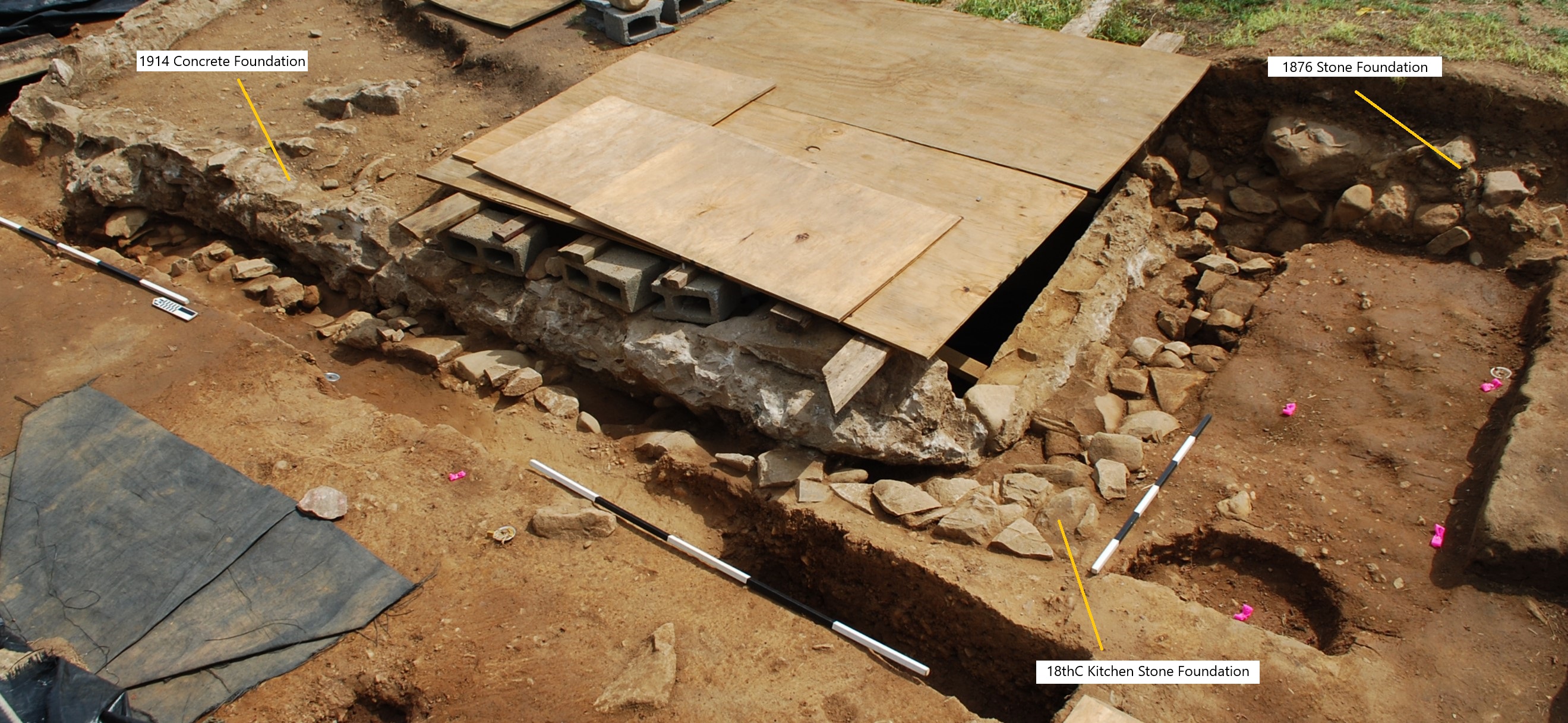
Location of the 18th century kitchen foundation in relation to two later farmhouses dating to 1876 and 1914.
We did! But before we get to the fun discoveries, let’s go over how we got there. As far as sites go here at Ferry Farm, this one has been through a lot. Not only did the original 16’ by 16’ kitchen building burn and collapse in on itself in the middle of the 18th century, but it also had two subsequent farmhouses built on top of it that were either moved, damaged in a fire, or demolished all within the last 150 years. A previous archaeology project on the site introduced another element of complexity in understanding the depositional sequence of fills on the earlier 18th-century site, which had obviously been heavily disturbed by all these later events.
All this led to an interesting excavation. Since a significant portion of the site had previously been excavated in the 1990s, a sizable amount of our site time was spent re-excavating backfilled archaeology units with the purpose of exposing unexcavated layers around the site. Not only would these unexcavated layers allow us to gather new data, but it would also give us the opportunity to better understand the findings as recorded in the earlier reports.
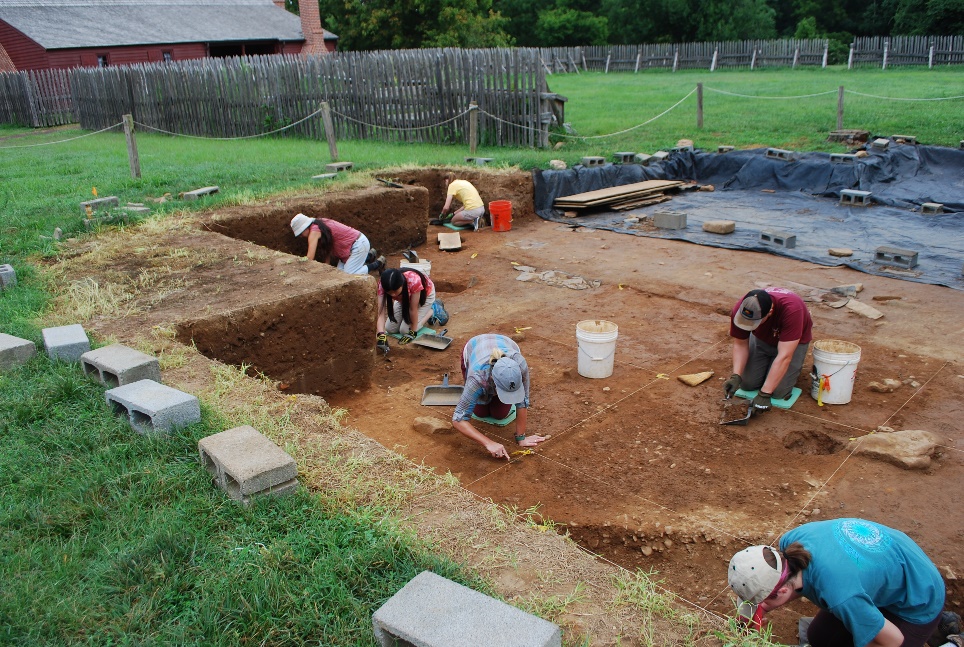
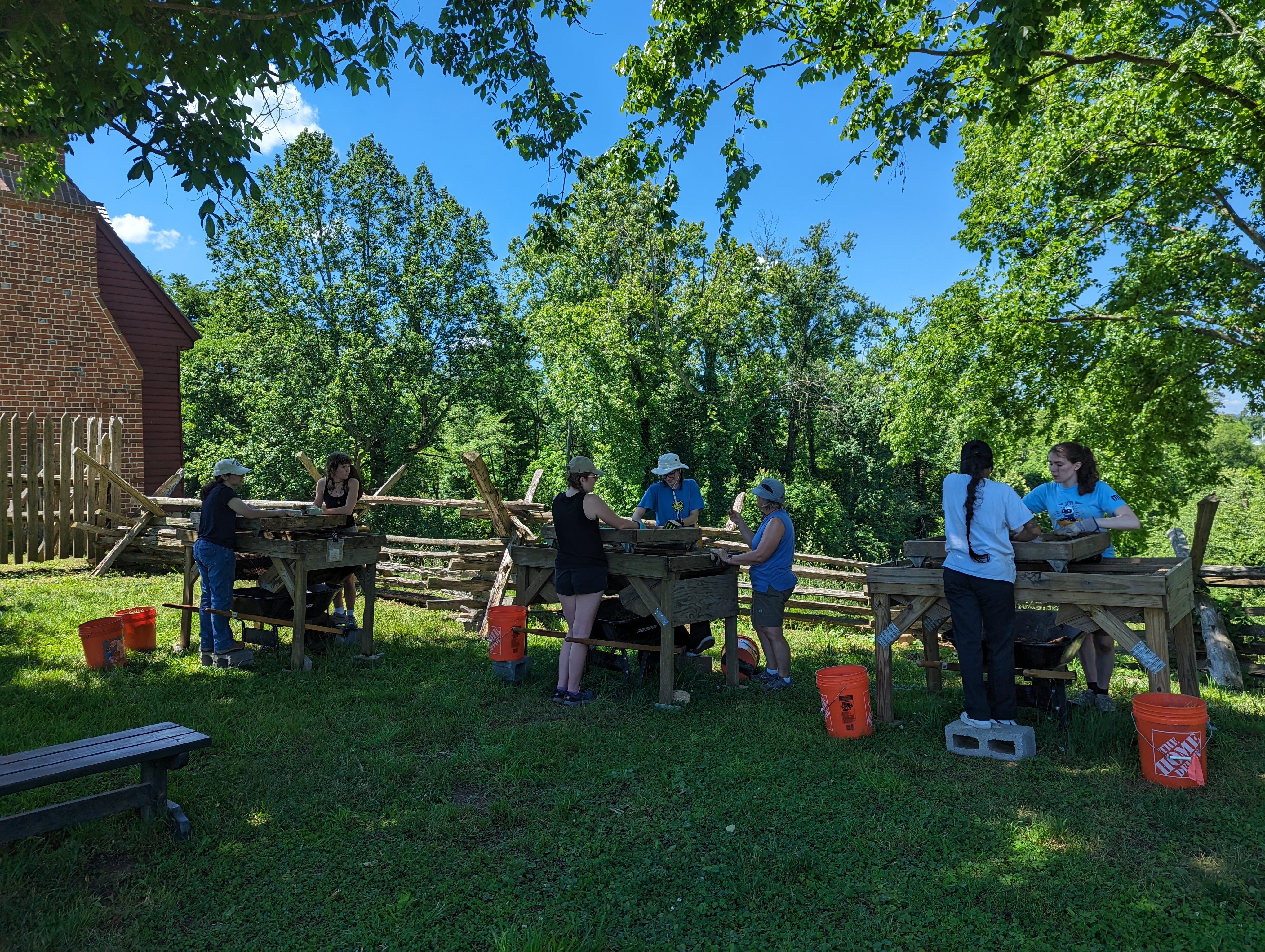
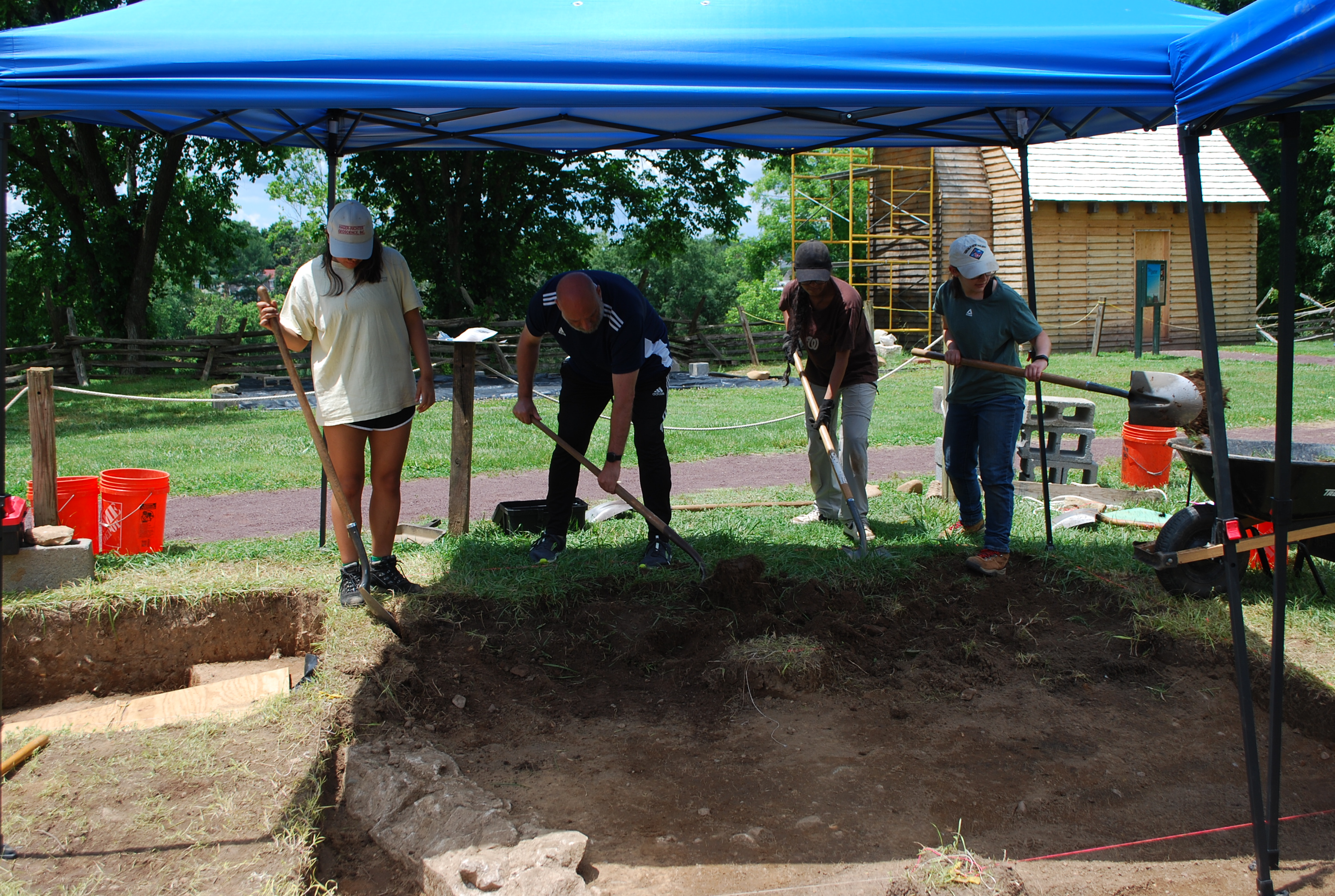
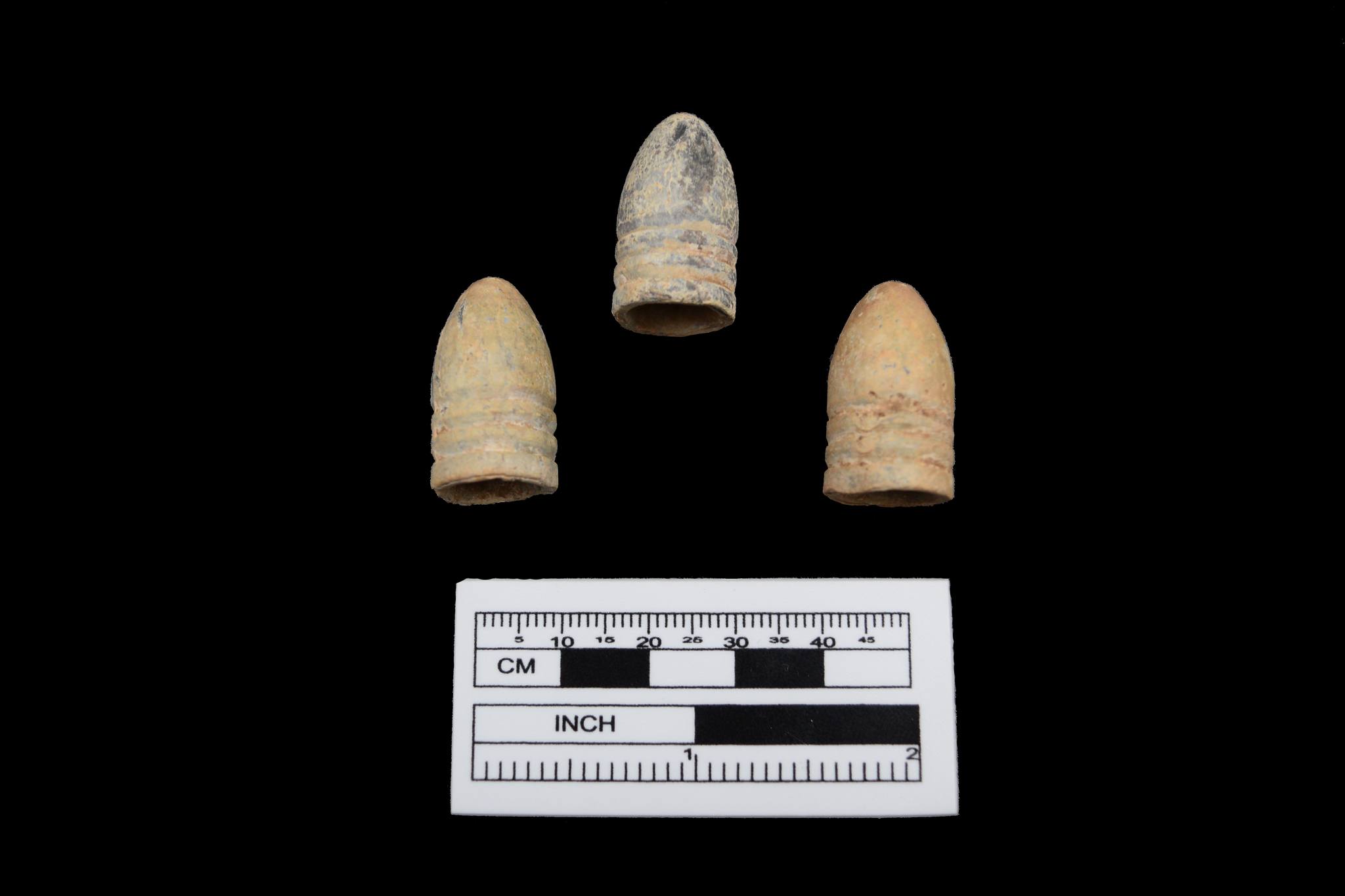
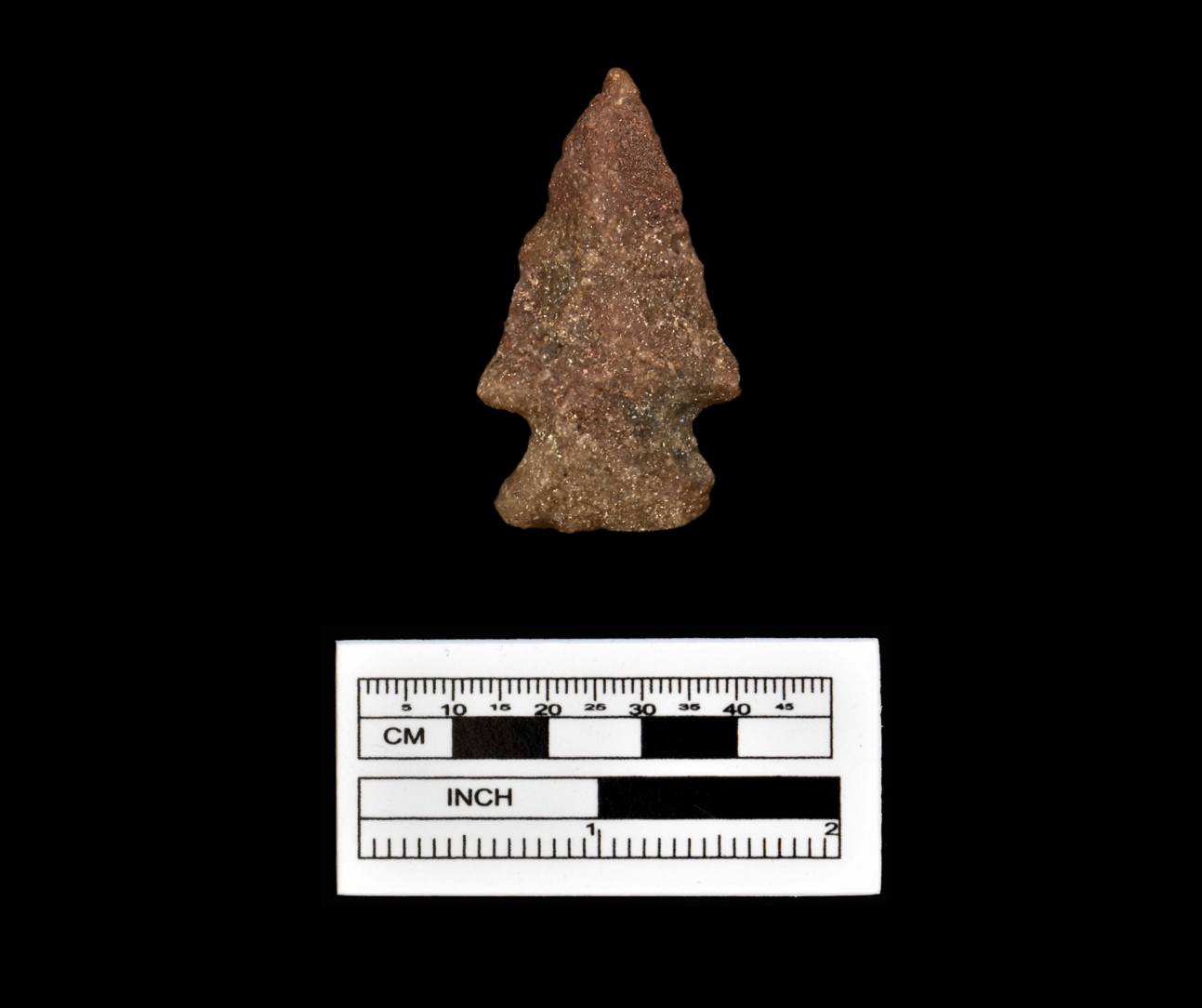
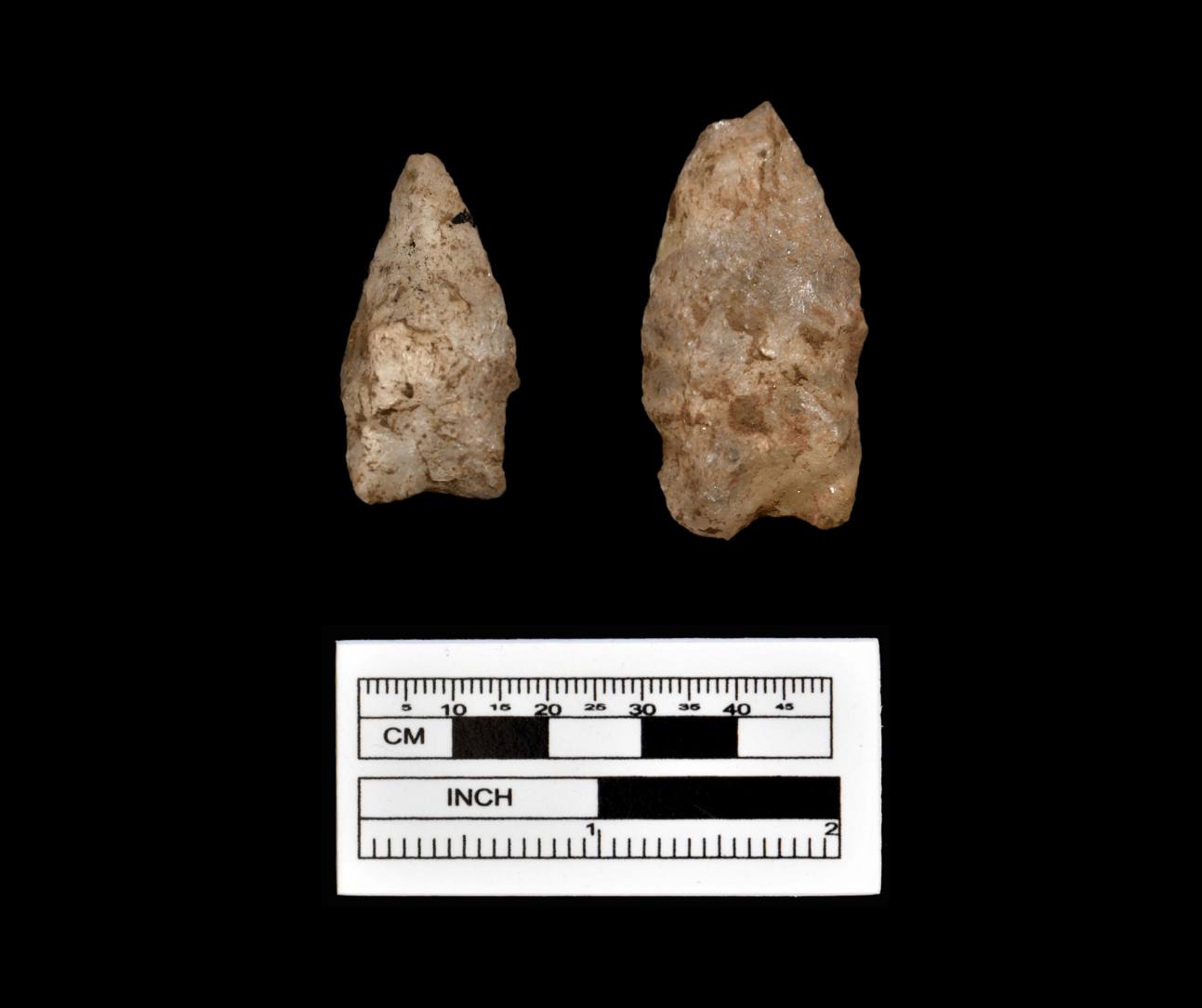
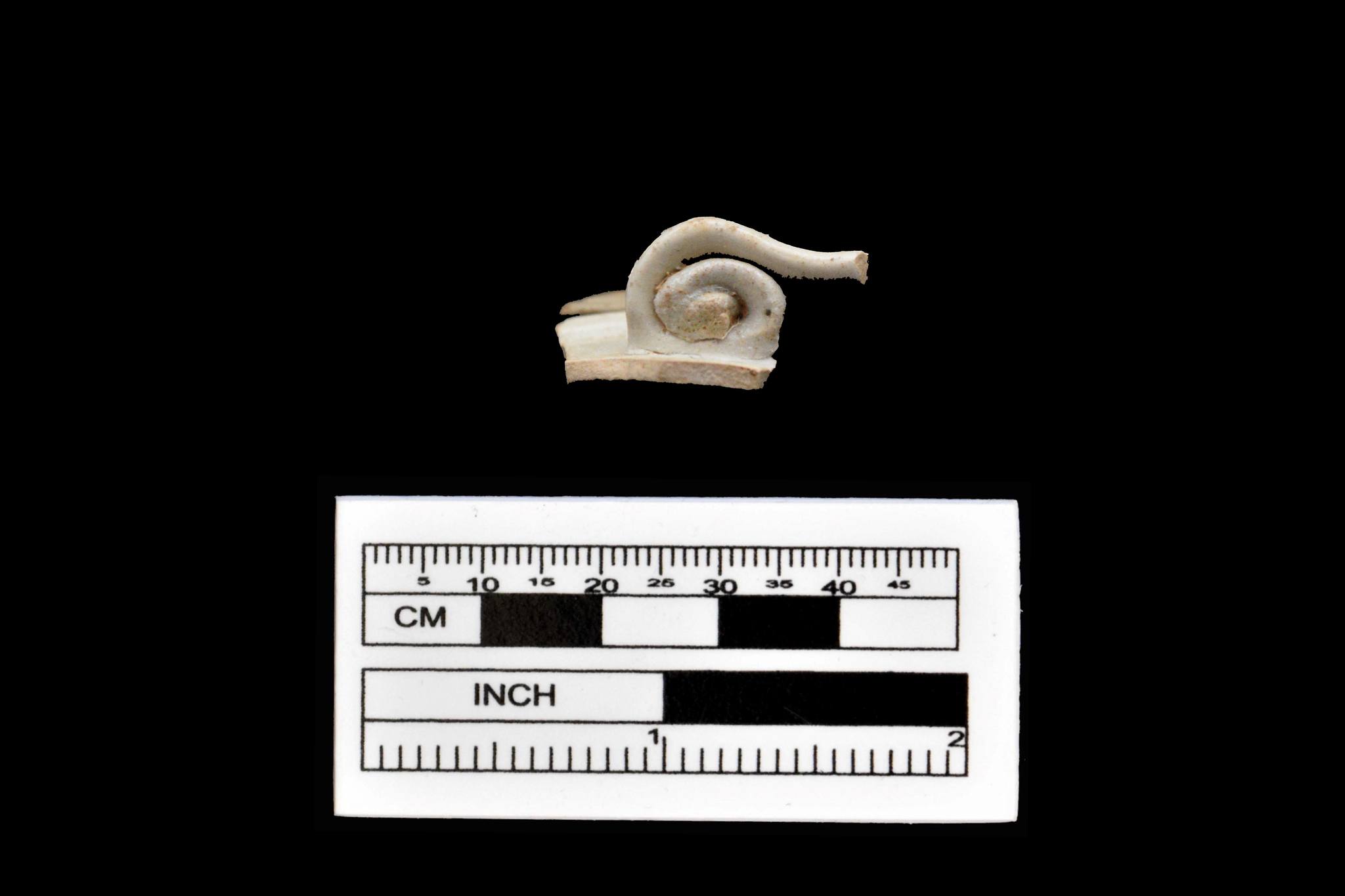
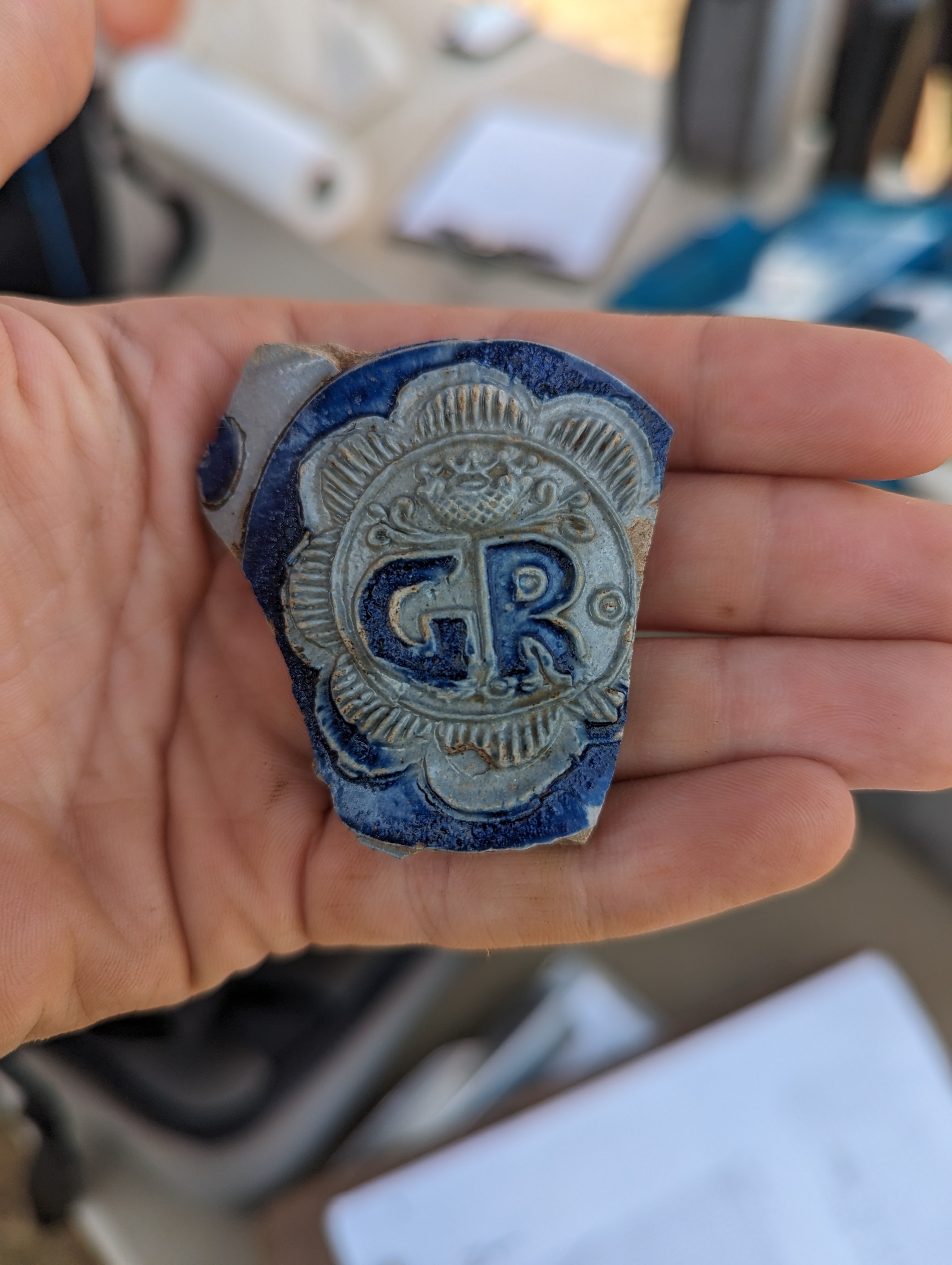
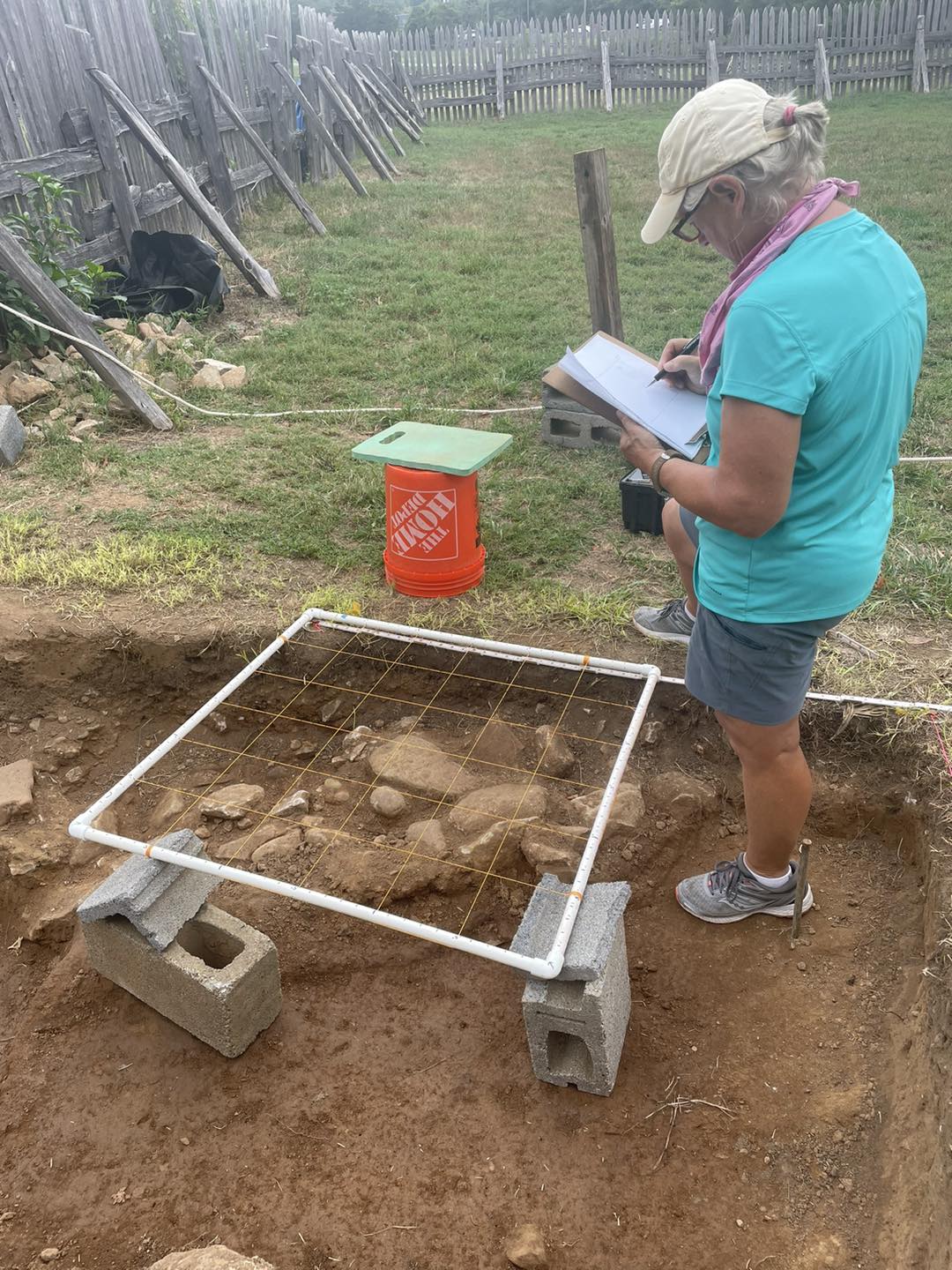
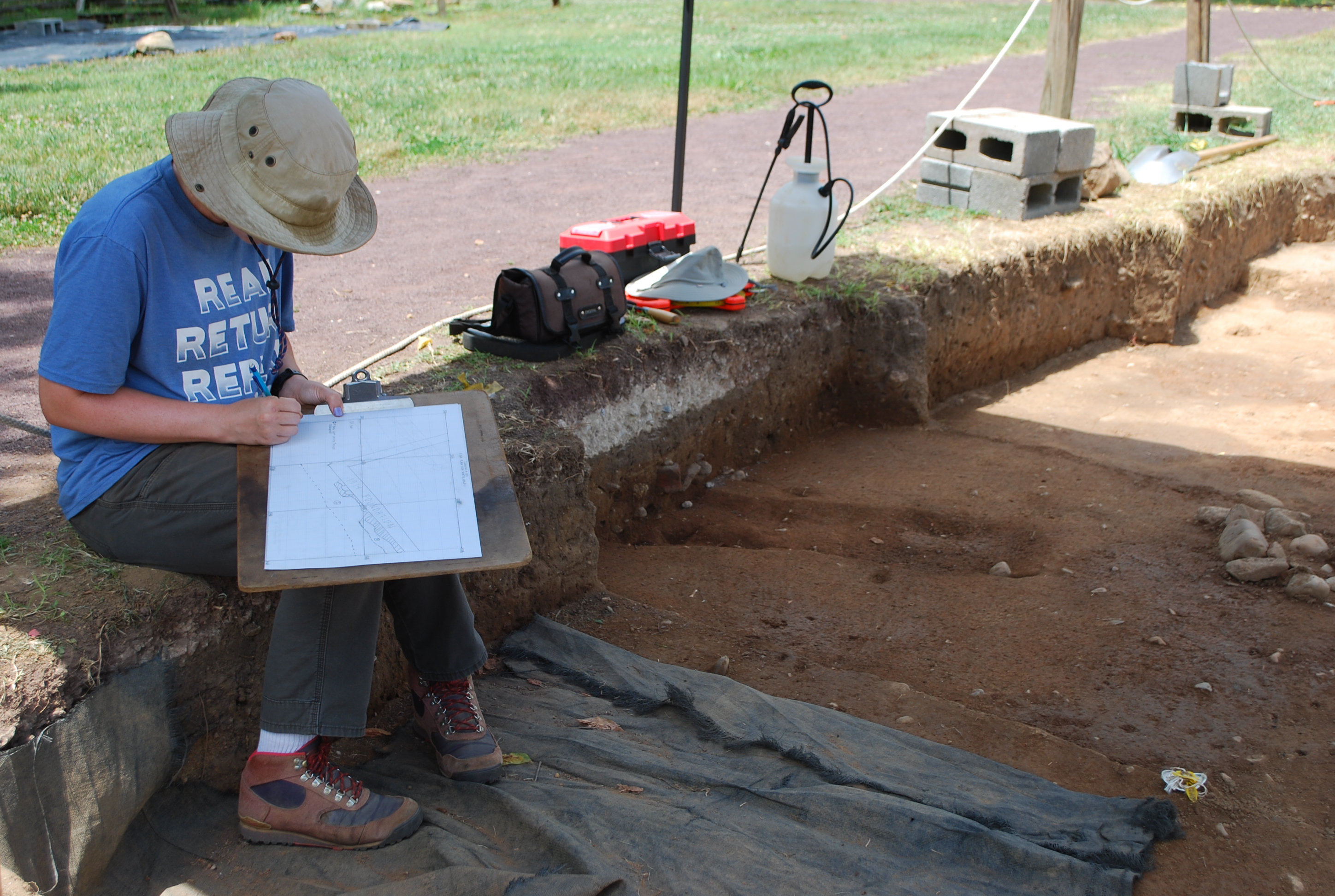
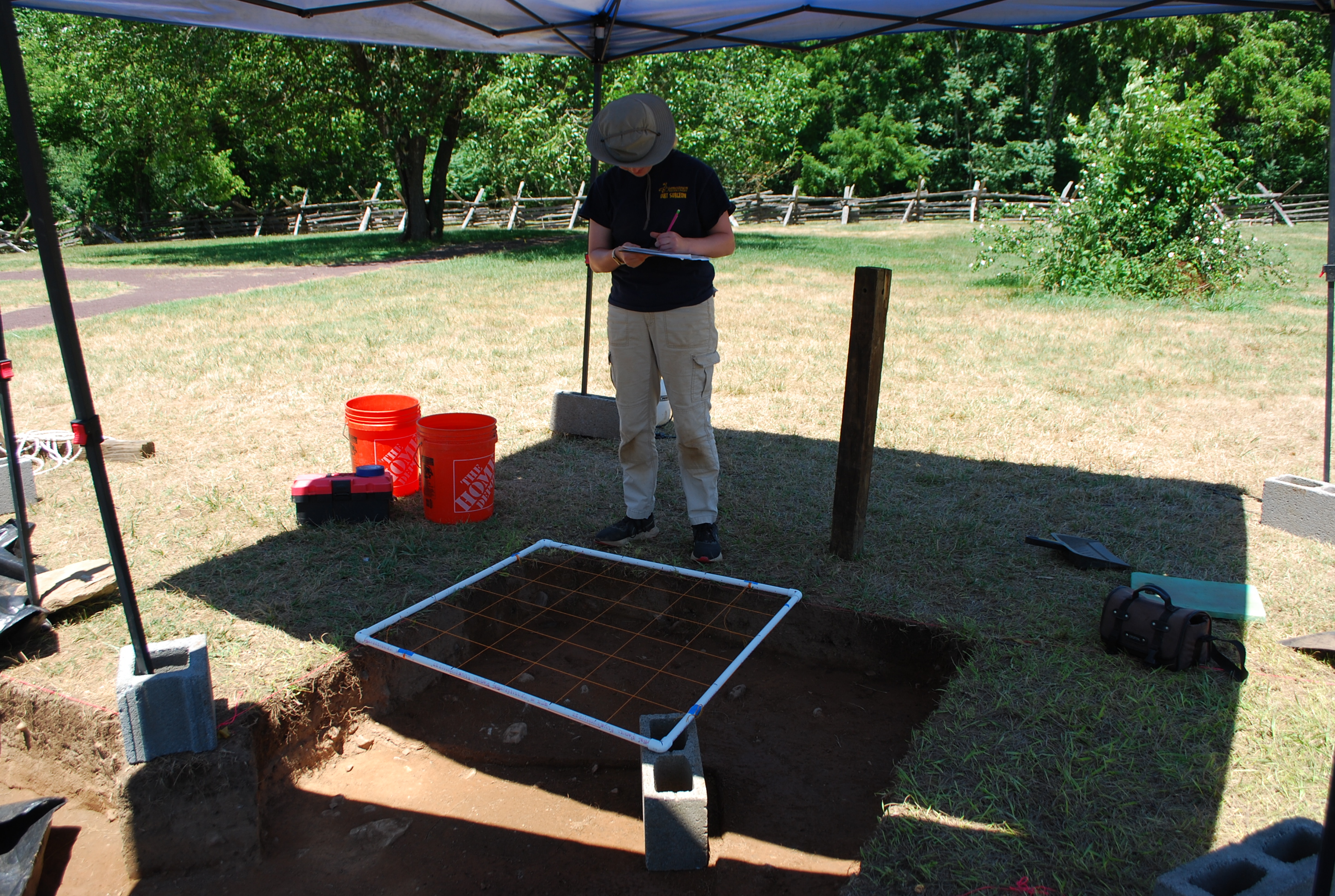
With the help of our wonderful field school students and interns, we opened a total of twenty-seven 5’x5’ units across the kitchen site. Sifting through the dirt, hundreds of artifacts were found dating to all occupations of Ferry Farm. Super cool finds that date to the 18th-century period of use for the kitchen included tobacco pipe fragments, wine bottle sherds, and a variety of ceramics, including English stoneware, Chinese porcelain, and a German Westerwald ‘GR’ sherd. The prehistoric Native American occupations of the site were represented by an unusually high number of projectile points found (8 and counting!), dating to both the Early Archaic (8000 BC – 6500 BC) and Early Woodland (1100 BC – 500 BC) periods. Civil War bullets came up in our screens, of course, as did 20th-century plastic, tools, toys, and bottle caps.
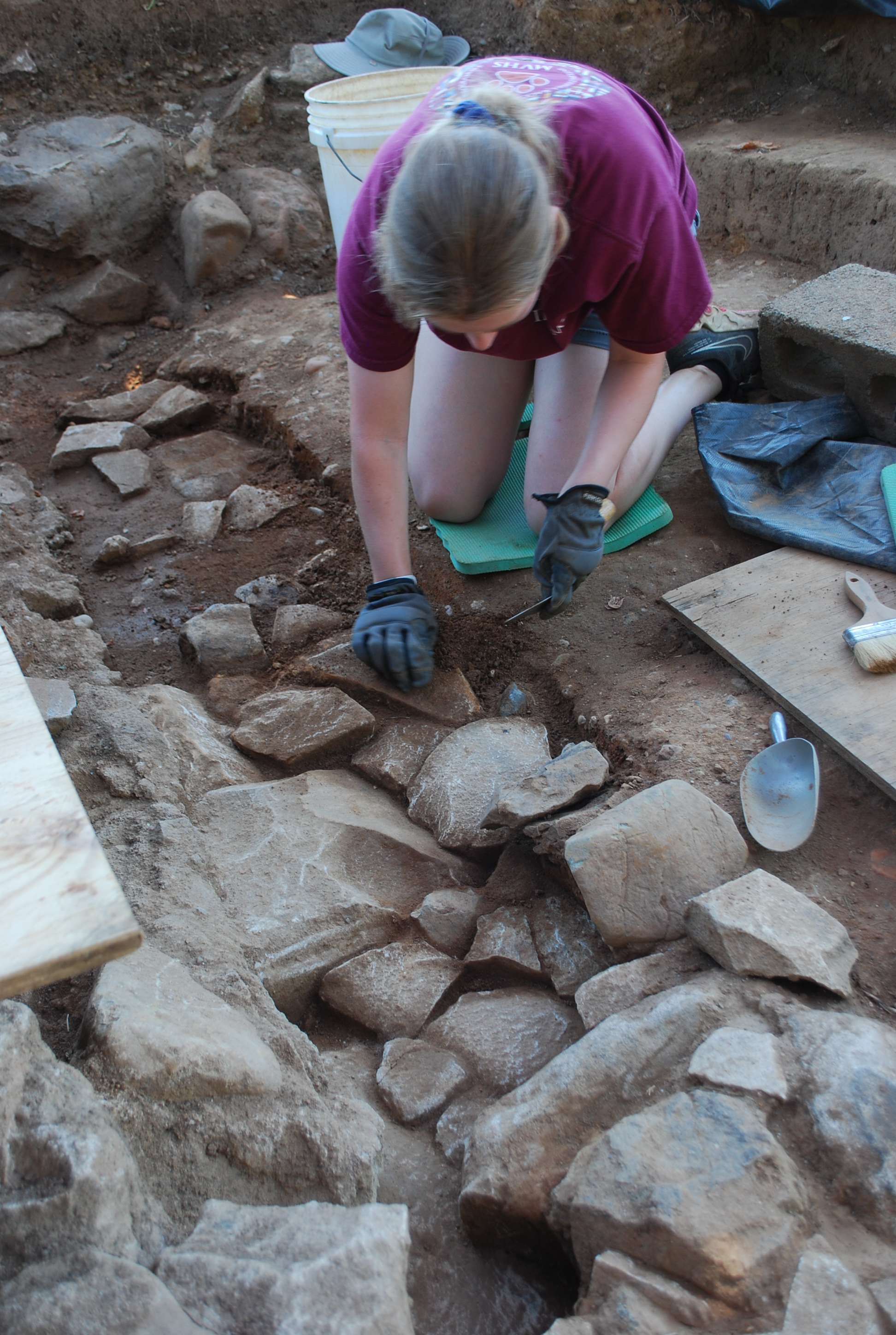
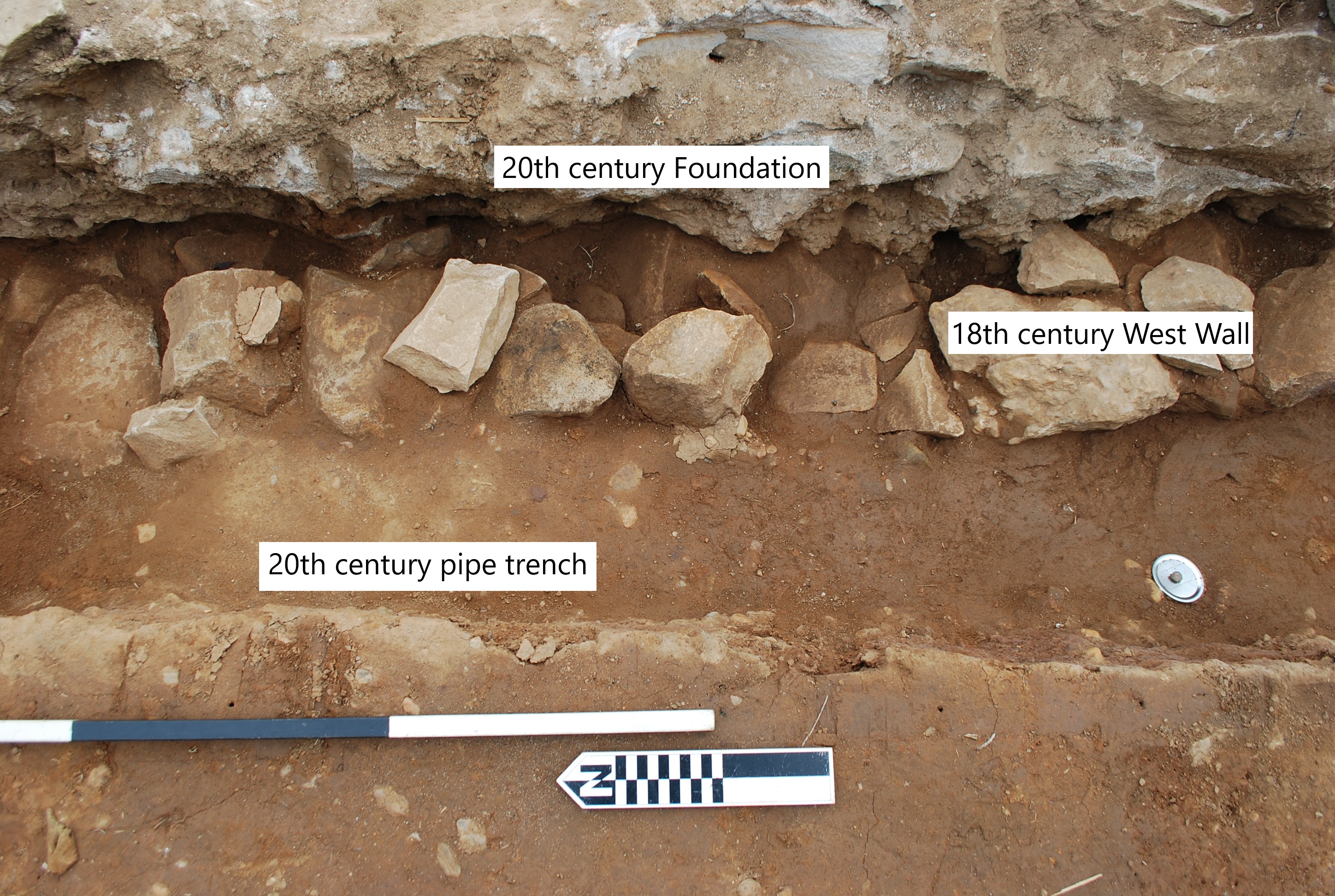
But when it comes to finds, our most exciting discovery did not turn up in our sifting screens. In fact, it was discovering that the western foundation wall of the kitchen cellar, thought to have been demolished, still survived! During the 1990s excavations, the archaeologists did not see this portion of the stone foundation and assumed the construction of the 1914 Colbert house had destroyed it. Fortunately for us, it was hiding under a 20th century utility pipe and trench and lay directly adjacent to the Colbert concrete foundation. Now we have all four foundation walls that we hope to fully uncover next year.
Exposed south and west stone walls of the colonial kitchen lie adjacent to and just outside of the 1914 concrete foundation wall. Judy Jobrack cleaning the newly exposed west wallAbbie Wood cleaning the south wall of the kitchenWest wall of colonial kitchen that was hiding under the pipe trench
Our excavation units surrounding the kitchen foundation have not, as of yet, exposed additional building features associated with the kitchen outbuilding, such as foundations or fireplaces. That search will continue next year as we continue taking those units down and expanding our site area. Features exposed in the 1990s dig, but not excavated by them or us, such as possible post holes and trash middens, also await our return in 2025, when we plan on finishing their excavation.
Each year’s excavation is built on the work accomplished in the previous years. With the incredible amount of work done this past summer of exposing the original kitchen foundation, as well as the later farmhouse foundations, removing old fill, and opening up the adjacent landscape, we are looking forward to expanding our investigations of the kitchen site next year. Stay tuned as we unravel the mysteries that are here at Ferry Farm, George Washington’s Boyhood Home.