Lives and Legacies

Tag: Augustine Washington

  • Pull Over!! The Virginia Highway Historical Markers of The George Washington Foundation

    As you drive down the road, sometimes, there are enough signs to make your head spin.  It can be tempting to just drive by these stark white cast iron road markers with black text when you see them.  Even so, sometimes you can’t help but let a word or a phrase catch your eye, sparking curiosity as you continue on with your travels.

    “Highway markers near Seven Pines, VA” courtesy of the Library of Virginia. (Virginia State Chamber of Commerce)

    The Virginia Highway Marker program is the oldest one of its kind in the United States (Virginia Department of Transportation, n.d.).  In 1927, State Route 1 was freshly paved and ready for new motor vehicles to coast down from Washington, DC to Richmond. (Virginia Department of Transportation, 2006).

    Drivers were given a red carpet to travel straight to what many viewed as the birthplace of our nation, George Washington’s Mount Vernon. Thousands began their pilgrimage. Hotels, motels, gas stations, and attractions began to pop up along the path.
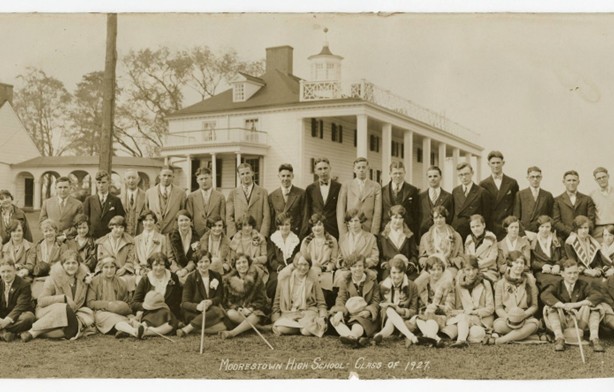
    “Moorestown High School Class of 1927” posing in front of Mount Vernon

    With all these new travelers who appreciated their state’s history, William E. Carson of the Conservation and Economic Development Commission erected several markers along the road, designating historic areas of interest and turning the roads into an attraction. (Virginia Department of Transportation, n.d.).

    Fabricating the markers was a beast to tackle since the traditional method of construction would have been granite.  Unfortunately, the stone was a bit too pricy and was also found to be difficult to read at the lightning-fast 25 mph speed limit.  Aluminum was an option for its lightweight and non-corrosive nature, and in fact, many early signs were manufactured from the metal, although they were quickly found to crack easily.  They were replaced with cast iron, and cast metal has been the preferred method of construction ever since (Rachal, 1949).

    Two of our three markers were first seen in the early years of the program. The oldest of our three was also the one that had the least amount of time in the light.  The Accokeek Iron Furnace marker (E-49) is located off Courthouse Rd in Stafford near an archaeological dig site owned by the George Washington Foundation. The modern iteration was erected in 1998.

    Accokeek Iron Furnace: The Principio Company constructed the Accokeek Iron Furnace nearby about 1726 on land leased from Augustine Washington (father of George Washington), who became a partner. After Washington’s death in 1743, his son Lawrence inherited his interest in the company and the furnace. When he in turn died ten years later, his share descended first to his brother Augustine Washington Jr. and later to William Augustine Washington. The archaeological site is a rare example of an 18th-century Virginia industrial enterprise. It includes the furnace location, the wheel pit and races, a retaining wall made of slag, an extensive slag dump, and mine pits.

    This text is not what was written prior to 1930. Those signs were brief, containing only a sentence or two for motorists to read as they drove by.  Between 1927 and 1930, though, cars sped up.  Where they were once going 25 mph, they were soon going 40 mph or even rocketing 50 mph down the highways!

    Trying to read the markers while driving quickly became impossible. The Commission’s solution? Publish a booklet with each highway marker printed and arranged neatly for passengers to read as they traveled.  All you had to remember was the marker’s number or title.  The first of these booklets were distributed in early 1930, free of charge (Rachal, 1949).

    This edition contains the earliest record of the Accokeek marker, then titled “Ancient Iron Furnace,” and reading only: “Here on Accokeek Run were iron mines and a furnace in which Augustine Washington, father of George Washington, began to smelt iron in 1727.”

    Unfortunately for our little marker, this was the last time it could be featured in the booklet. Disaster struck in late 1930. Engineer P. W. Snead wrote to the Commission on December 19th to report that the sign was found that morning, knocked from its post, and shattered.  The commission wrote back a few days later, asking for the aluminum pieces to be gathered and sent back since the factory would refund them for the parts.  (Library of Virginia Archives, 1930). The Accokeek marker was not restored until 1998, 68 years later, as part of a federal grant, according to the manager of the highway marker program, Jennifer Loux.

    The “Washington’s Boyhood Home” marker is also found in the booklet’s first edition, and its modern counterpart is now at the entrance to Ferry Farm.  Although there are no records of the sign being damaged prior to its replacement in 1997, after exposure to the elements for almost 70 years, it was probably time for a refresh.

    Alternatively, the motivation for the marker’s replacement (likely from the same federal grant) may have come from historical inaccuracies. The original text of the marker reads:

    “Washington’s Boyhood Home: At this place, the Ferry Farm, George Washington lived most of the time from 1739 to 1747. Here, according to tradition, he cut down the cherry tree. Washington’s father died here in 1743. The farm was his share of the paternal estate.”

    We now believe that the Cherry Tree story was likely an exaggeration or a myth, and so the verbiage was changed on the modern marker. Many old highway markers contained inaccurate information, as is often the case with many historical resources. As technology and research evolve over time, so does what we know. Another example of this never made it to the press, but early drafts of the marker’s text include his attendance at the “Old Field School.” We have since learned that there is no documentation of Washington ever attending a formal school in his life.

    The current marker was installed in 1997, the same year the George Washington Foundation obtained the property, and the sign continues to greet visitors to this day.
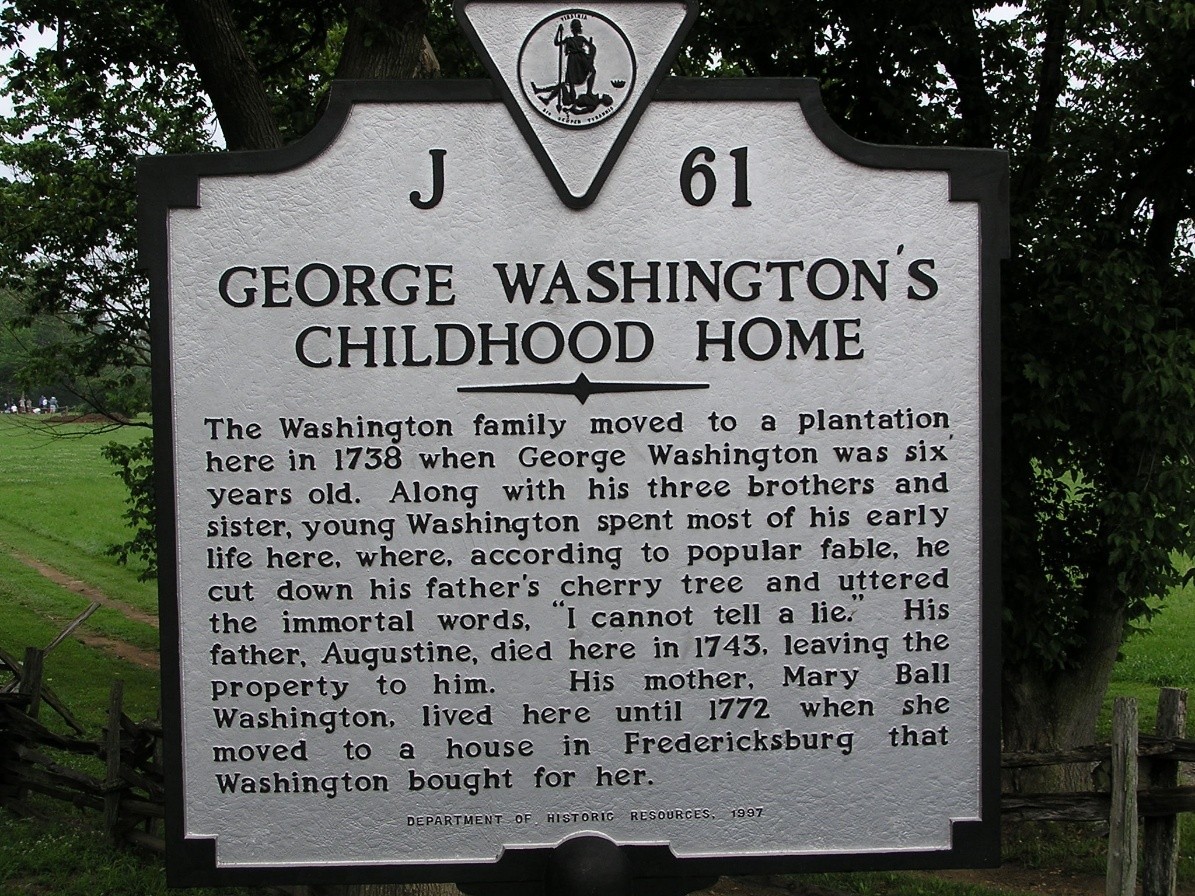
    George Washington’s Childhood Home: The Washington family moved to a plantation here in 1738 when George Washington was six years old. Along with his three brothers and sister, young Washington spent most of his early life here, where, according to popular fable, he cut down his father’s cherry tree and uttered the immortal words, “I cannot tell a lie.” His father, Augustine, died here in 1743, leaving the property to him. His mother, Mary Ball Washington, lived here until 1772 when she moved to a house in Fredericksburg that Washington bought for her.

    Our third marker is different, having not been placed until 1995.  At this point in time, the highway marker program had been passed around, with different organizations all bearing the burden of putting up new signs and maintaining the old ones.  It first passed hands in 1949 to the Virginia Department of Highways, who, after a year, handed the responsibility off to the Virginia State Library.  In 1966, it was traded again and is now operated by the Virginia Department of Historic Resources in collaboration with the Department of Transportation (Virginia Department of Historic Resources, n.d.).

    Former director of the Kenmore Association (now the George Washington Foundation) Vernon Edenfield wrote to the DHR proposing the marker. The Association paid for the manufacturing out of pocket. You can now visit it along Caroline St, four blocks from Kenmore, in front of Fielding Lewis’ storefront.

    Kenmore: Four blocks west stands Kenmore, built in 1775 by Col. Fielding Lewis for his wife, Betty, sister of George Washington. Near here, between Kenmore and the Rappahannock River, stood Lewis’s warehouses and docks. Kenmore’s intricate plasterwork is the finest in the country. Among 19th-century owners and occupants were Samuel Gordon, who named it Kenmore, and William Key Howard Jr., who restored and embellished the mansion’s plasterwork. Washington and other Revolutionary leaders often visited, and during the Civil War, Union troops used it as a hospital. The Garden Club of Virginia, starting in 1929, rehabilitated Kenmore’s gardens as its first restoration project.

    Although you might think after nearly 100 years of recording and presenting history that the Virginia Highway Marker program has run out of ideas, you can’t be further from the truth.  New markers are being planned constantly, and more gaps in history are being filled each year. In Fredericksburg alone, there are plenty more markers commemorating the city’s rich history.  If you feel there is an opportunity for a new marker somewhere, you can submit a proposal through the DHR’s website.
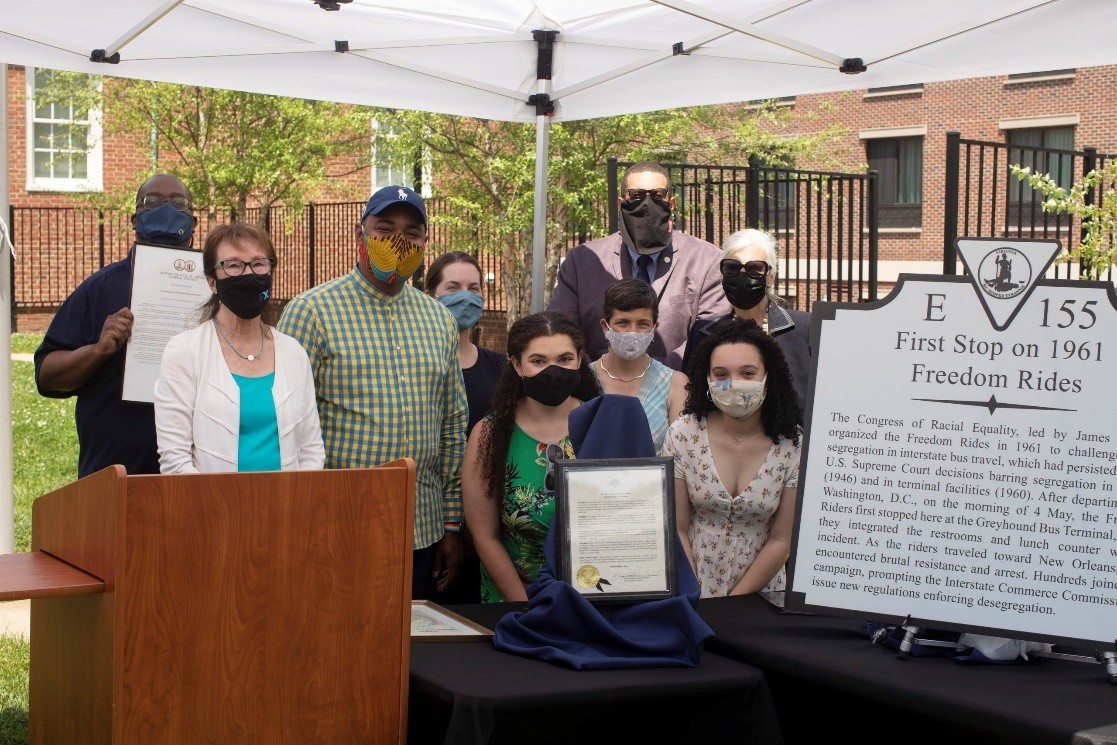
    The unveiling of the new Freedom Rides marker in 2021 at the site of the old Greyhound bus depot on Princess Anne St, which was proposed by staff and students from the University of Mary Washington

    History can be found anywhere if you know where to look, and the Virginia highway markers are a testament to that.  Be sure to keep an eye out for them on your next drive!

    Sarah Alden

    Manager of Visitor Services and Interpretation


    Bibliography

    Laiacona, J. (2021, May 4). Marker Furthers UMW Mission on Freedom Rides’ 60th Anniversary. Retrieved from University of Mary Washington: https://www.umw.edu/news/2021/05/04/marker-furthers-umw-mission-on-freedom-rides-60th-anniversary/

    Library of Virginia Archives. (1930). Virginia

    Mount Vernon. (n.d.). Historic Preservation at Mount Vernon. Retrieved from George Washington’s Mount Vernon: https://www.mountvernon.org/preservation/historic-preservation-at-mount-vernon#main-content

    Prats, J. J. (2010, October 23). State Historical Markers Numbering Plans. Retrieved from The Historical marker Database: https://www.hmdb.org/m.asp?m=2

    Rachal, W. M. (1949). Historical Markers on Virginia Highways. State and Local History News, 151-153.

    Virginia Department of Historic Resources. (n.d.). Historic Markers. Retrieved from Virginia Department of Historic Resources: https://www.dhr.virginia.gov/programs/highway-markers/

    Virginia Department of Transportation. (2006). A History of Roads in Virginia: “The Most Convenient Wayes”. Richmond: Virginia Department of Transportation Office of Public Affairs.

    Virginia Department of Transportation. (n.d.). Historical Markers. Retrieved from Directional Signing Program: https://vaidsp.com/historicalmarkers/

    Virginia State Chamber of Commerce, a. L. (n.d.). Highway markers near Seven Pines, Va. Picture Collection.

  • Expanding Ferry Farm: The Quarter

    If you have visited Ferry Farm recently or follow us on social media, you may have noticed the construction of two buildings near the Washington House. These new structures represent ones that stood in these spots during George Washington’s time. Identified through archaeology, their reconstructions allow us to better tell the stories of the people who lived and worked at Ferry Farm. For this blog, we will look at the structure adjacent to the Washington House along the embankment overlooking the Rappahannock: The Quarter.

    What’s in a Name?

                First, we need to define what we mean when we call the structure “the Quarter.” Regarding enslaved life, the term “quarter” can refer to several different situations. Generally, it refers to a structure that housed enslaved individuals with “quarter,” equating to a living space or personal quarters. The term has nothing to do with the number and makeup of the occupants or the appearance of the building. The other use for the term refers to a group of enslaved people. Augustine Washington’s probate inventory lists seven enslaved people at Ferry Farm’s “satellite quarter” (Fig. 1). In this use, it does not refer to a single physical structure but rather a group of people and their housing unit that moved around. “The Quarter” uses the term for a single structure, identified through archaeology, that housed an enslaved family in the heart of the Ferry Farm plantation.  

    Figure 1: Section of Augustine’s probate inventory listing individuals at the satellite “quarter”

    Enslaved Housing

                Living conditions varied widely across the Mid-Atlantic and even within a single plantation. Customarily, enslaved people lived where they worked. Work yard structures included living quarters above the workspace while the fields had structures akin to dormitories that housed people divided by biological sex. In certain cases, independent structures may have served as housing for single family units (Fig. 2). Those that lived within these spaces generally held high ranking positions within the hierarchy established by enslavers. Housing generally stood outside public view and in areas convenient to the work undertaken by the inhabitants. Quarters within sight of the public served as status symbols for the gentry.

    Figure 2: 1860 engraving depicting single quarters in South Carolina (Slavery Images)

                Identifying quarters today largely comes from historic records, oral history, archaeology, and architectural features. All of this can help establish a range of appearances for such structures. When a building no longer remains standing, these observations can be compared to artifacts uncovered at the site to determine its identity. Sub-floor storage pits, often located near hearths, serve as key architectural identifiers, while artifacts that reflect African diaspora culture, outdated items, and evidence of labor help pinpoint the identities of the inhabitants. Quarters served as the only personal spaces allotted to enslaved people, so any artifacts recovered can speak to their personal identities rather than those defined by Virginia colonials.

    Archaeological Evidence

                The excavation of the Quarter occurred in 2003, and research in successive years helped to identify its role and understand the lives of its inhabitants.

    • Architecture: When excavated, little remained of the Quarter, but the architectural elements present and absent provided enough information to understand its appearance. Archaeologists recovered small quantities of Aquia sandstone around the quarter indicating it may have had a light stone foundation and hearth. The main impact it had on the ground surface occurred through the creation of a sub-floor pit. These pits frequently appeared in quarters and served as storage areas for the occupants’ personal effects. Unfortunately, a tree later intruded a portion of the pit and the surrounding area thus making it difficult to study (Fig. 3). Other architectural elements included an abundance of nails and an absence of window glass (Fig. 4). This indicates the building had clapboard siding and likely shuttered windows in place of glass ones.
    Figure 3: Quarter Excavation Site
    Figure 4: Nail distribution around Quarter
    • Tableware (Fig. 5): Within the eighteenth-century contexts, we recovered many ceramics and utensils of European origin. White-salt glazed stoneware dishes and dog-nosed spoons represent styles in decline by the 1740s. This indicates that the enslaved occupants either received hand-me-downs from the Washingtons, a common practice, or purchased used items in the local market. A colonoware bowl served as an exception. A local ceramic type attributed to free and enslaved black communities, colonoware production mixed African ceramic techniques with European vessel forms.
    Figure 5: Tableware (L-R white salt glazed stoneware, dog-nosed spoon handle, colonoware bowl, table knives)
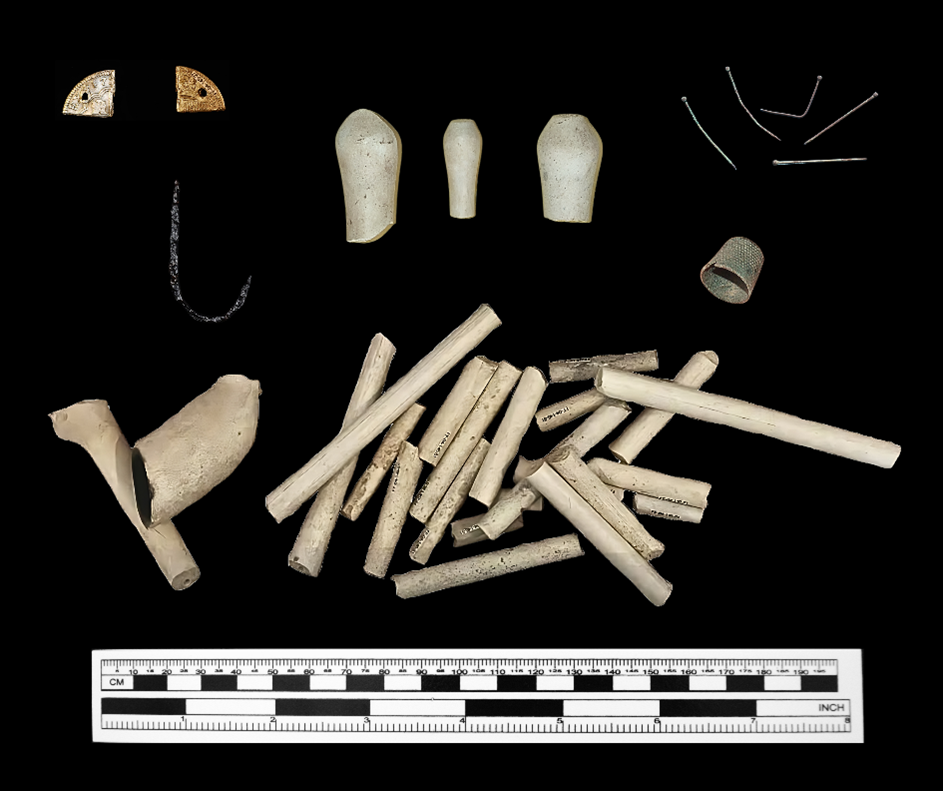
    • Small Finds (Fig. 6): Analysis of the artifacts revealed the personal effects of the occupants, their possible identities, and the labor they carried out. Wig curlers appear frequently throughout Ferry Farm, but the recovery of several at the Quarter indicates that the individual(s) tasked with maintaining the Washington wigs may have lived within. Sewing implements, such as thimbles, reflect labor carried out by enslaved women and girls either for the Washingtons or for themselves. A common practice in colonial Virginia saw each enslaved person receive a ration of cloth from which they fashioned their own clothing. Straight pins further indicate the presence of female occupants as these pins held their garments, such as bed gowns, together. Both genders used the numerous tobacco pipes recovered. The fishhook speaks to an entirely personal activity,  as enslaved communities often supplemented their food rations by fishing. The pierced coin serves as the artifact most indicative of enslaved culture. Piercing a coin allowed the owner to keep it on their person as a form of adornment. Such coins often served as talismans, though they could re-enter the economic world as needed.
    Figure 6: Small Finds (L-R mirrored pierced coin, fishhook, wig curlers, thimble, straight pins, tobacco pipe fragments)
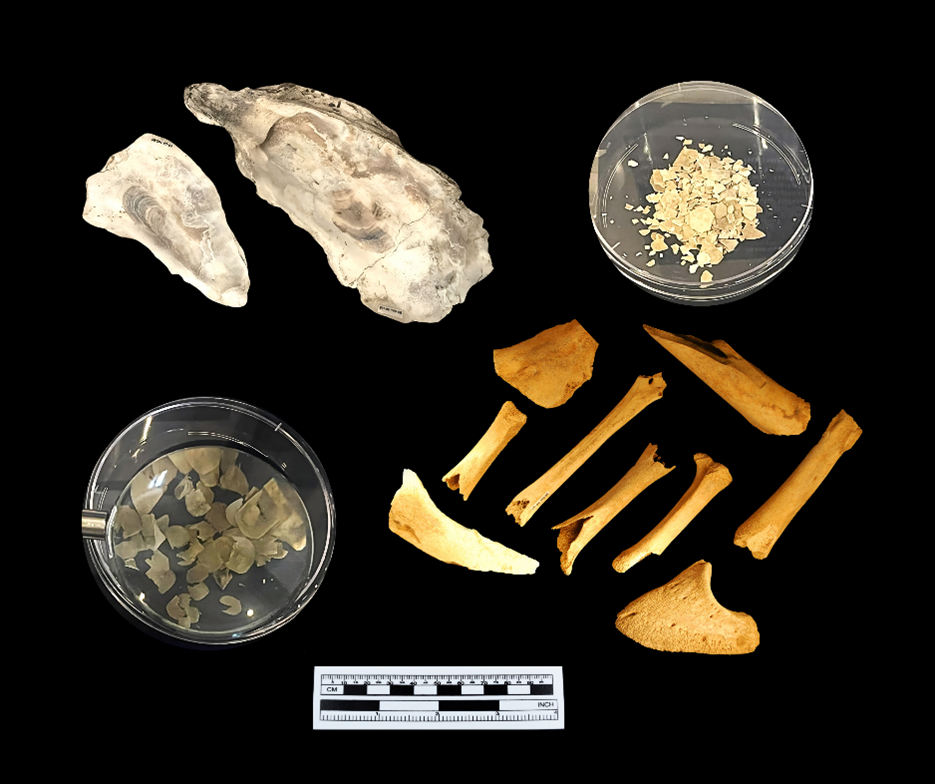
    • Diet (Fig. 7): Faunal remains found at the Quarter supplement the information provided by the fishhook. As expected, we identified several fish species including types of perch, catfish, and sunfish which lived in the Rappahannock at that time. Other animals included cattle, chickens, pigs, opossum, and shellfish, such as oysters. This mix of domestic and wild species indicates that the Quarter’s occupants supplemented the rations supplied by the Washingtons. The enslaved commonly achieved this by maintaining small gardens and raising chickens, hunting, fishing, and foraging. While we did not recover any plant remains, those consumed by the inhabitants likely reflected a similar mix of wild and domestic species.
    Figure 7: Faunal (L-R Oyster shells, eggshells under microscope, fish scales/bones under microscope, various mammal bones)

    Reconstruction and Interpretation

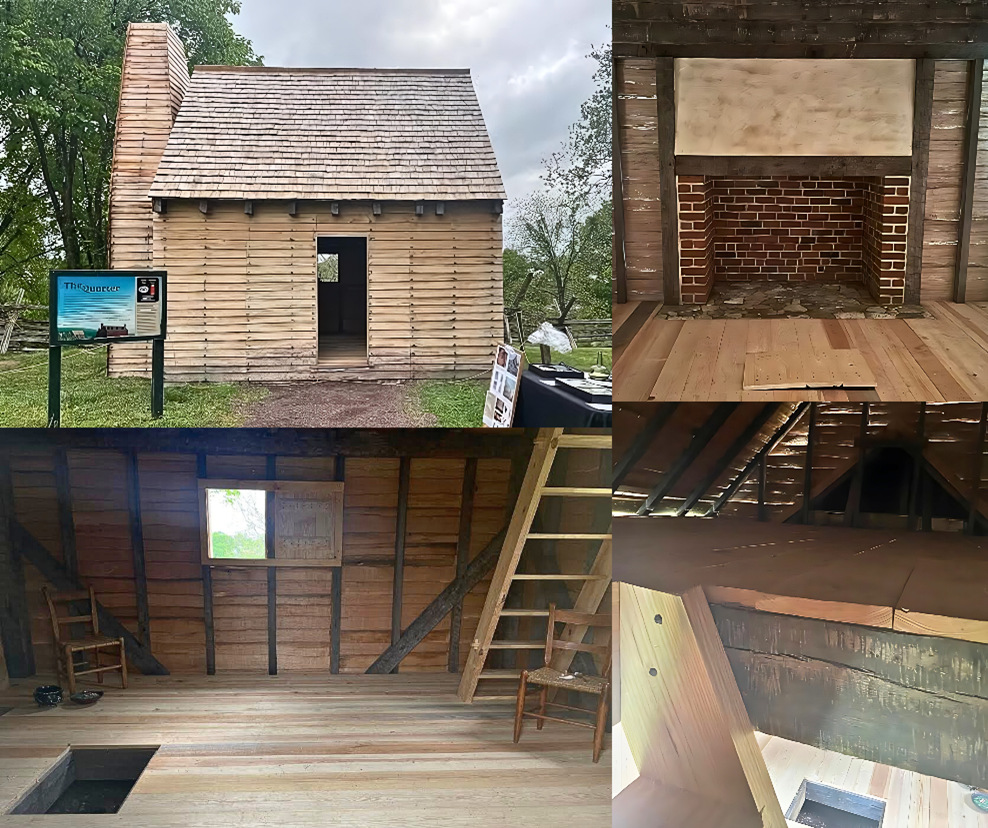
                The reconstruction of the Quarter combined our archaeological evidence with the historic knowledge of enslaved housing (Fig. 8). The finished Quarter measures 16’x14’ which aligns with standard measurements for single-family quarters. From our archaeology, it has clapboard siding, sliding shutters in place of glass windows, a subfloor pit, and sandstone hearth. Information on contemporary quarters led to the inclusion of a loft and a daub lined wood chimney. Architects used eighteenth-century techniques to reconstruct the building.

    Figure 8: The Quarter, various views

                From our findings, we concluded that the quarter housed a single family. At least one of these individuals held a high-ranking position within the labor hierarchy allotted these living arrangements (Fig. 9). The structure’s proximity to the Washington House and work yard indicates the occupants worked within these spaces. The position on the bluff overlooking the Rappahannock meant that this quarter, unlike others, lay in view of the public.  “The prominent placement of this structure on the landscape may mean that it was used to reinforce Washington’s prominent social standing in colonial Virginia.”     

    Figure 9: Portion of Augustine’s probate inventory listing individuals at Ferry Farm; some may have called the Quarter home

    The Quarter will open to visitors this fall, and visitors will be able to read about and visualize the lives of those who lived within. Like the Washington House, everything that furnishes the Quarter will be interactive and reflect archaeological finds. Planning remains ongoing for this, but when complete, visitors may find outdated tableware, evidence of meals, tools for labor, and personal effects.

    Emma Schlauder

    Research Archaeologist


    Bibliography
    
    Augustine Washington Probate Inventory, 1743
    
    Carson, Cary & Carl Lounsbury (editors)                                                                                                  2013     The Chesapeake House: Architectural Investigation by Colonial Williamsburg. The University of North Carolina Press, Chapel Hill, NC.
    
    Katz-Hyman, Martha B. & Kym S. Rice (editors)                                                                                       2011     World of a Slave: Encyclopedia of the Material Life of Slaves in the United States. Greenwood, Santa Barbara, CA.
    
    Lanier, Gabrielle M. & Bernard L. Vlach                                                                                                     1997     Everyday Architecture of the Mid-Atlantic: Looking at Buildings and Landscapes. The John Hopkins University Press, Baltimore, MD.
    
    Lounsbury, Carl R. (editor)                                                                                                                  1994     An Illustrated Glossary of Early Southern Architecture and Landscape. University Press of Virginia, Charlottesville, VA.
    
    Samford, Patricia                                                                                                                                       1996     The Archaeology of African-American Slavery and Material Culture. William & Mary Quarterly 53(1): 87-114.
    
    2000     Power Runs in Many Channels: Subfloor Pits and West African-Based Spiritual Traditions in Colonial Virginia. Doctoral Dissertation, Department of Anthropology, University of North Carolina, Chapel Hill. University Microfilms International, Ann Arbor, MI.                                                                                                                                           
    
    Stilgoe, John R.                                                                                                                                          1982     Common Landscapes of America, 1580-1845. Yale University Press, New Haven, CT.
    
    Wells, Camille                                                                                                                                        1993     The Planter’s Prospect: Houses, Outbuildings, and Rural Landscapes in Eighteenth Century Virginia. Winterthur Portfolio 28(1): 1-31.
    
    Vlach, John M.                                                                                                                                           1993     Back of the Big House: the Architecture of Plantation Slavery. The University of North Carolina Press, Chapel Hill, NC.
    
  • Horsing Around: Archeological Finds at Ferry Farm

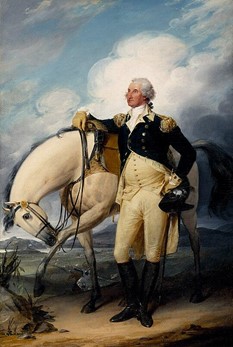
    Think about a portrait or painting of George Washington.  What is a common element in the paintings?  His uniform, yes, he is indeed painted quite a bit in his impressive military uniform. But how about a horse?  George is often painted riding beautiful horses with a quiet dignity and noble appearance we expect from the father of our country. 

    Washington at Verplanck’s Point by John Trumbull, Source: Winterthur

    However, the horses in these paintings are not mere symbols of wealth or power. They are depicted with George because, from a tender age, his life has been intertwined with these creatures. As a surveyor, soldier, landowner, farmer, gentry, commander-in-chief, and president, he was inextricably linked with horses, not just as a mode of transportation but as a vital part of his daily life.

    And it all started at Ferry Farm…

    George moved to Ferry Farm around 1738 at the age of six. His father, Augustine Washington, was a member of the “planter class,” or Colonial American gentry. This meant he was a prominent member of society, involved in politics, and owned lots of land. Augustine purchased 150 acres across the river from Fredericksburg and later added an additional 450-acre parcel.  In total, he owned Little Hunting Creek, Pope’s Creek, and the Ferry Farm properties. 

    The point?  Augustine needed help because there were places to be, people to see, and fields to farm.  So, horses were a fundamental necessity for the Washington family, and George would have grown up around them, taking care of them and learning to ride.

    We have two great sources that give us some understanding of the horse situation at Ferry Farm. First, in 1743, the Washington patriarch died, leaving behind a widow, an 11-year-old George, and a probate inventory. On page two of the inventory, three horses and one mare are listed.

    Augustine Washington Probate Inventory, 1743

    Secondly, some pretty cool horse tack dating from the Washington occupation has been found during various archeological digs.

    The Finds

    One of the most universally known horse tack, essential for all horse maintenance – is the horseshoe.  The horseshoe was used to protect the hooves because “…being rendered subservient to the use of man…applied to severe and continued labour, and compelled to tread frequently…on the irregular and stony surface of the roads, it became necessary to secure his feet from ruin by strengthening them with the iron band which we call a shoe” (Vial de Saint Bel, 1793).  These shoes were handmade with no standardization across makers in shape, narrowness, or thickness. (Hume, 2001).  This makes it difficult to pinpoint and assign a time on shape alone.

    Farrier Shoeing a Horse by Marechal Ferrant et Operant Source: The Wellcome Collection

    Our horseshoe was found in the second cellar of the Washington Home. It is quite wide between the branches (the curving sides), and the toe seems to straighten a bit at the center. The crease (the groove that runs down the sides) gives enough depth to allow the shoe to be firmly attached to the hoof with six nails (which we found a few originals). (University of Zurich, 2024)  This find illustrates that there was active shoeing and horse maintenance going on at the farm.  Additionally, these horses were ridden or used for farm work because shoes were used to protect the hooves from the wear and tear of hard roads, distribute the horse’s weight evenly on uneven ground, and provide traction on various surfaces. 

    Horseshoe with original nails

    Another artifact found in the cellar of the Washington Home, the stirrup, further demonstrates horse riding as a family necessity. (Cofield, 2014) 

    Stirrup

    The stirrups are used as foot support for the rider, and they hang from a saddle on straps known as stirrup leathers.   Basic stirrups are made of three parts the eyes for the stirrup leathers to attach the stirrup to the saddle, a platform or base where the rider places their foot, and arms which connect the eye to the base. (Cofield, 2014)

    Examples of Stirrup Forms Source: Diagnostic Artifacts in Maryland

    Horseback riding master and author VS Littauer described the Forward Seat as a stirrup-centric approach versus traditional riding’s seat-centric. He argued riding without stirrups taught people to grip with the knee, which he considered a dangerous habit and likely to stiffen the rider. With stirrups, you can ride with a looser knee, letting your weight flow PAST your knee and into the stirrup. That is a more secure approach than riding with the thigh and knee. (Littauer, 1962)

    Captain Vladimir Littauer – Forward Seat Riding,1947

    Stirrups allow the rider’s legs to absorb up/down motion by allowing them to stand in matching balance with the horse, which makes riding longer distances more comfortable. Augustine certainly had to travel a great distance to check on his properties and perform his civic duties, like serving as a justice of the peace and sheriff for the county of Westmoreland. 

    One final utilitarian bit of horse tack found again in the cellar is a mullen mouth bit or snaffle bit. This bit consists of two rings on each side of a half-moon-shaped bar with no joint.  The bit applies even pressure on the horse’s tongue and bars (gums) and allows the horse’s lips to feel the pressure from the bit and side rings.  The bit, bridle, and reins function to create communication between the rider and the horse.

    Mouth Bit

    The Washington children would have used bits to learn to control.  They would have learned how to work with the horse in a cooperative way that would create an effortless and seamless ride.  George used this skill of communication and intuition to become a great rider.  As Thomas Jefferson reminisced in a letter in 1814, “his person, you know, was fine, his stature exactly what one would wish, his deportment easy, erect, and noble; the best horseman of his age, and the most graceful figure that could be seen on horseback.” (National Archives, n.d.)

    Lastly, just south of “The Quarter,” we uncovered around twenty leather ornaments.   They were used to decorate the leather straps, nosebands, harnesses, and reins of horses.  We wrote a post about them earlier explaining their purpose, which was purely aesthetic. Horse tack could be made without these pieces, but where is the fun in that?  These flashy accessories were a great way to grab the attention of the public and hint at how fashionable and elegant you were as you trotted through town.    


    These artifacts illustrate that not only were horses actively used by the family, but it also fostered an environment where young George would have taken his first steps into learning about horsemanship.  This knowledge and skill would help him in his future careers of surveying the Shenandoah Valley, as a lieutenant colonel during the French and Indian War, as a farmer and landowner at Mount Vernon, as a representative in the House of Burgesses, as commander-and-chief of the Continental Army and finally President of the United States. 

    Come see our new pop-up exhibit at Ferry Farm, where all these wonderful artifacts are displayed and put together with the help of our Fleming-Smith scholar, Sarah Moore.


    References

    Cofield, S. R. (2014, May 14). Stirrups. Retrieved from Diagnostic Artifacts in Maryland: https://apps.jefpat.maryland.gov/diagnostic/SmallFinds/Stirrups/index-stirrups.html

    Hume, I. N. (2001). A Guide to Artifacts of Colonial America. New York: Vintage Books.

    Littauer, V. S. (1962). The Development of Modern Riding. Washington D.C.: D.Van Nostrand Company, Inc.

    National Archives. (n.d.). Thomas Jefferson to Walter Jones, 2 January 1814. Retrieved from Founders Online: https://founders.archives.gov/documents/Jefferson/03-07-02-0052

    University of Zurich. (2024). Fullering. Retrieved from E-Hoof: https://e-hoof.com/glossary/en/fullering/

    Vial de Saint Bel, C. (1793). Lectures on the Elements of Farriery. London: Veterinary College, London.

  • Exploring Nature at Ferry Farm

    In April 1738, an advertisement in the Virginia Gazette described the 100 acres of land later purchased by Augustine Washington as “a beautiful situation” with “a very handsome dwelling house.” Located about 2 miles below the falls of the Rappahannock and near the public ferry, this unique landscape became George Washington’s boyhood home. 

    “The Old Mansion of the Washington Family” (1833) by John Gadsby Chapman shows the foundation stones of the Washington house and the surrounding river landscape.

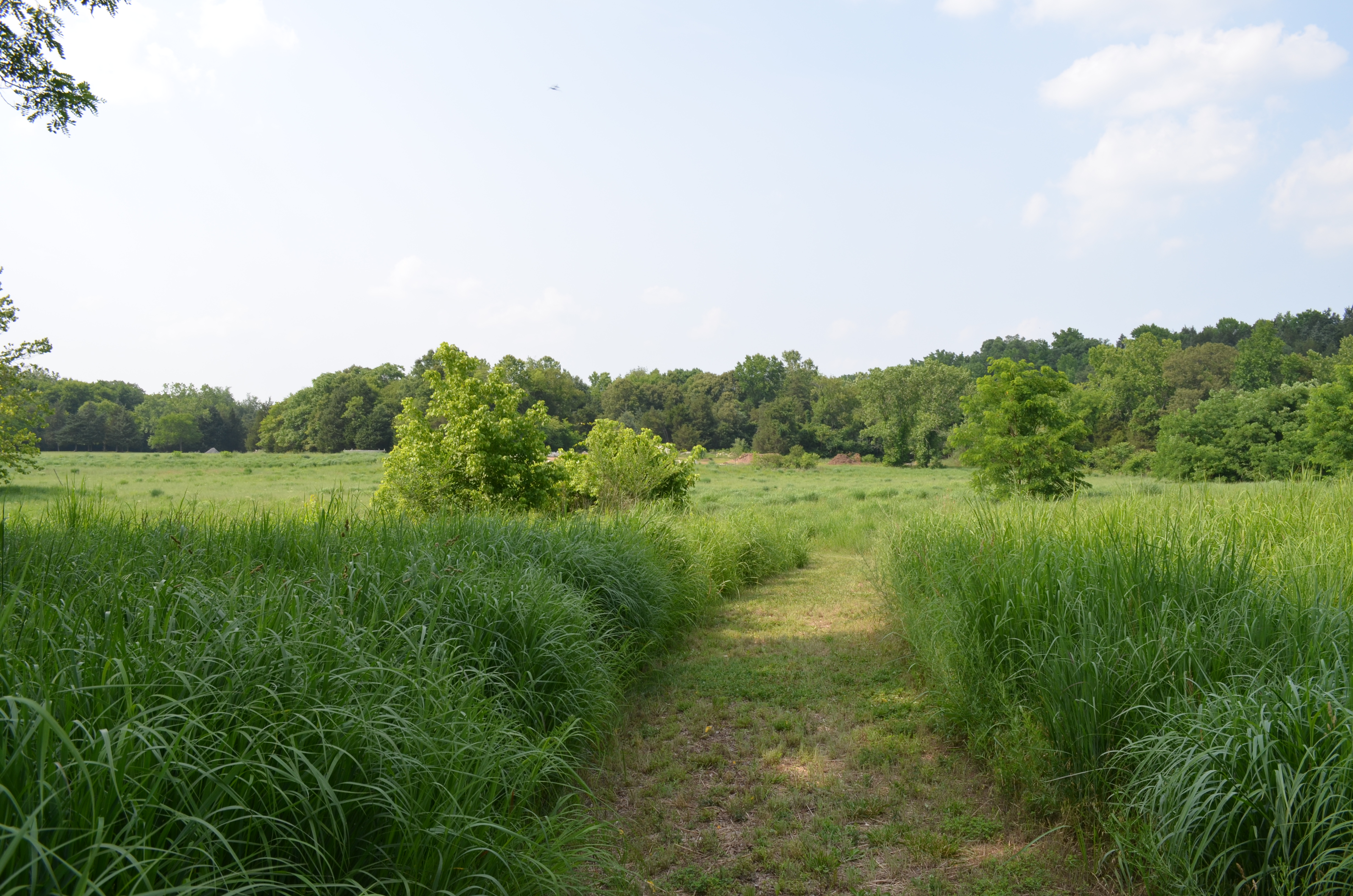
    Steeped in the legends of our nation’s first Founding Father, Ferry Farm is of course a popular destination for those looking to immerse themselves in history and walk in young George’s footsteps. At the same time, visitors to Ferry Farm have the unique opportunity to explore the natural landscape and learn more about local wildlife. Whether you are meandering along the wooded river trails, traipsing through the demonstration garden, or observing the drama of the Rappahannock from the river bluff, visitors can understand why this location was once described as a “beautiful situation.”

    The front door of the Washington House overlooks the river flood plain on a sunny summer day.

    Visitors to Ferry Farm can traverse through a variety of habitats during their visit, including the open lawns surrounding the Washington House, native plant and wildflower meadows, and hardwood bottomlands (ie. river swamps). These trails and natural features are home to a menagerie of wildlife, including commonly spotted critters like deer, groundhogs, foxes, and bald eagles. 

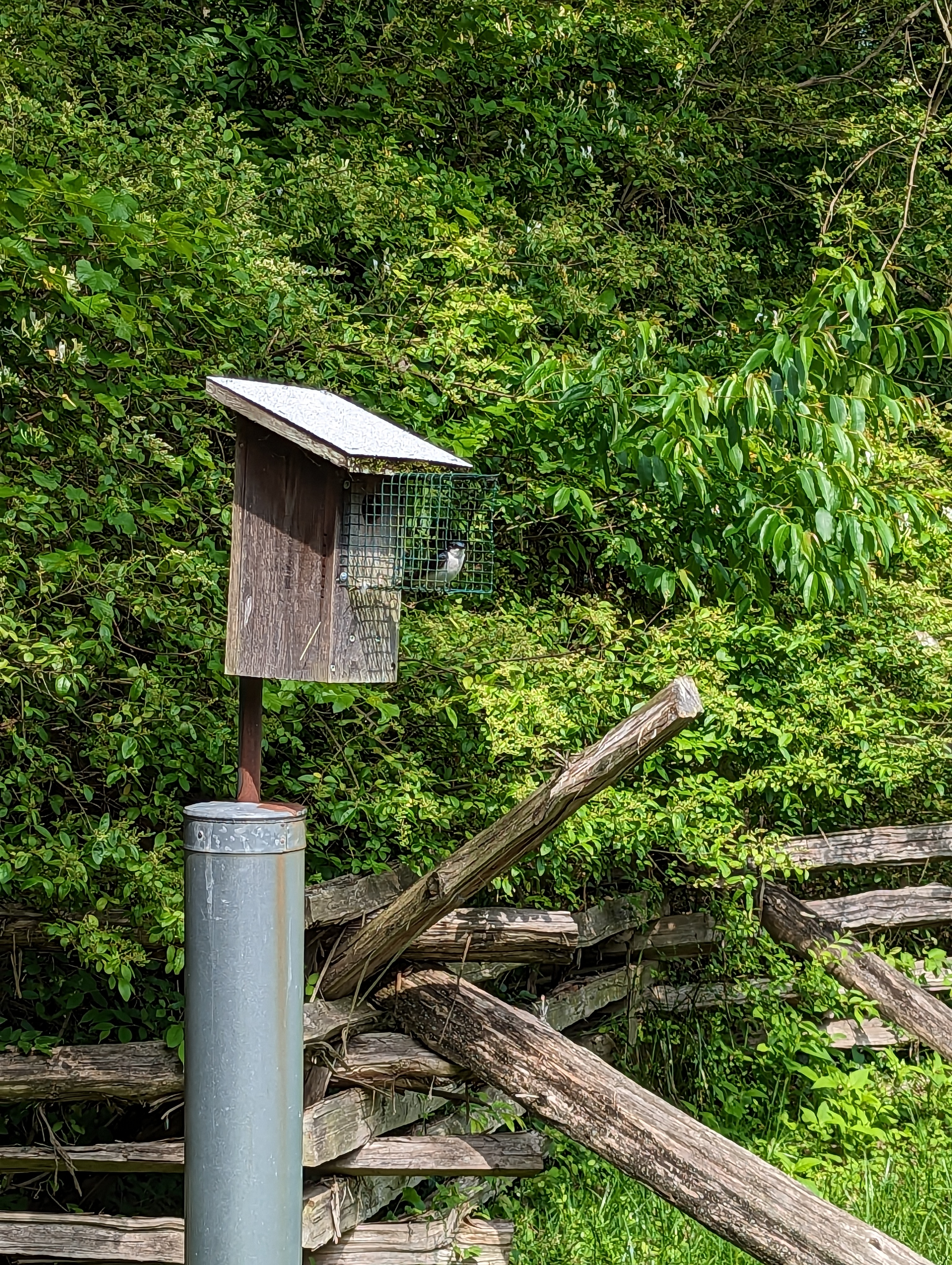
    While bald eagles may be the most patriotic bird swooping over our property, Ferry Farm is a prime birding location for all kinds of species. Over the years, several local birding groups have surveyed the property. (Read more about past bird surveys at Ferry Farm here and here.) At Ferry Farm, we are lucky to also have a bluebird trail maintained by The Virginia Bluebird Society. While walking the grounds, guests can enjoy the sights and sounds of Eastern Bluebirds and other native bird species as they flit about the bluebird boxes.

    An adult male Eastern Bluebird sporting his trademark blue feathers. Source: https://www.allaboutbirds.org/guide/Eastern_Bluebird/overview

    The Virginia Bluebird Society (VBS) was founded in 1996 to help promote, protect, and support native cavity bird species in Virginia. What originally began as 3 trails and 47 nest boxes expanded to a network of trails that, in 2020, encompassed 431 trails and 4,752 nest boxes.VBS trains a dedicated force of volunteers who monitor the boxes and record invaluable data. From April to August, volunteers walk the Ferry Farm trails checking on our 10 boxes and monitoring nest activity. In addition to bluebirds, other native cavity nesters such as tree swallows, chickadees, and house wrens may also make their home in these boxes. Last year at Ferry Farm, 28 bluebirds and 8 tree swallows fledged. We are incredibly grateful to the Virginia Bluebird Society for all their hard work and are excited to see how many birds fledge at Ferry Farm this year! 

    Look closely and you’ll spot a tree swallow perched outside a Ferry Farm nest box! Two predator guards, a Snake Guard and a Cat/Raccoon Guard, are installed to help prevent predators from accessing the boxes. The metal mesh on the front of the box makes it harder for curious paws to reach inside the nest, and the metal cylinder covering the mounting post prevents snakes from scaling the post.

    If you visit Ferry Farm this summer, make sure to bring your bird book and binoculars and keep an eye on the sky as you explore the natural landscape!

    Ann Waters

    Director of Education

  • “Mark’d with Gunpowder”: Tattoos in Early America

    Recently, I came across an interesting notice in an early edition of the Virginia Gazette.  On June 9, 1738, Augustine Washington, George Washington’s father, placed a notice in the newspaper about one of his indentured servants running away.  The notice read…

    “RAN away from Capt. McCarty’s Plantation, on Pope’s Creek, in Westmoreland County, a Servant Man belonging to me the Subscriber, in Prince William County; his Christian Name is John, but Sirname [sic] forgot, is pretty tall, a Bricklayer by Trade, and is a Kentishman; he came to Patowmack, in the Forward, Capt. Major, last Year; is suppos’d to have the Figure of our Saviour mark’d with Gunpowder on one of his Arms. He went away about the 20th of April last, in Company with three other Servants…”

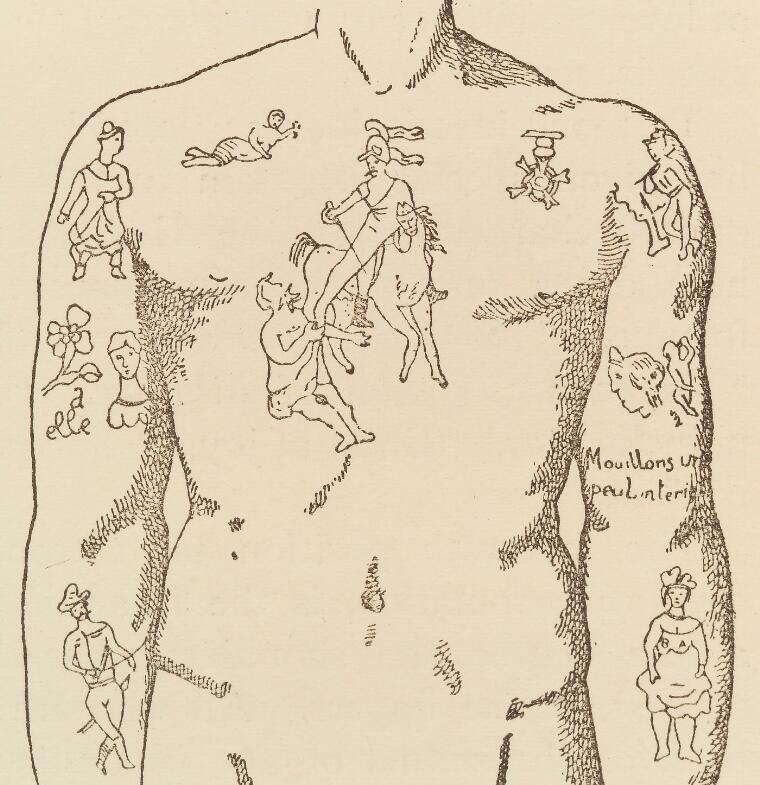
    The notice then described the three other indentured servants, ostensibly belonging to McCarty. First, sailor Richard Martin was “a middle siz’d Man, fresh colour’d, and 22 Years of Age.” Next, tailor Edward Ormsby was “a small thin Fellow, of a swarthy Complexion . . . has a Hesitation or Stammering in his Speech, and being an Irishman, has a good deal of the Brogue.” Finally, carpenter Richard Kibble was “a middle siz’d young Fellow, has several Marks made with Gunpowder on his Arms, but particularly one on his Breast, being the Figures of a Woman and a Cherry Tree.”

    I found the inclusion of the tattoos’ descriptions fascinating and the spark to many questions. How common was tattooing in Colonial America?  Who was most likely to have tattoos? What kind were popular? Where were they placed on the body? And finally, why did colonial people choose to permanently mark their bodies in this fashion?

    Notice of runaway indentured servants placed by Augustine Washington in the Virginia Gazette on June 9, 1738.

    Tattoos in Early America

    Tattooing is as old as the human race itself.  Anthropologists place its origins sometime in the pre-historic Paleolithic era or “before the wide dispersal of man.”[1] Tattooing has been practiced in early societies and indigenous cultures for thousands of years

    Unfortunately, documentation of tattoos from the 18th century is scarce, and finding information about tattooing in early America is nearly impossible.  Two records I did find helpful were the Seamen’s Protection Certificate Applications (SPC-A) and various runaway indentured servant and convict notices in the Virginia Gazette.

    Sailors

    The SPC-A were applications made by seamen under the Act for Relief and Protection of American Seamen of 1796.  The act was passed to protect American seamen from impressment into the British Royal Navy in the years that led up to the War of 1812.  Each sailor who served on a United States vessel applied for a certificate of protection, which included a detailed physical description that encompassed any tattoos

    The applications range from sailors of 12-years-old with one tattoo to 59-years-old with several detailed designs.  Tattoos on the “17 and under” tended to be pretty standard symbols like personal initials, initials of loved ones, or small maritime and religious marks like anchors and crucifixes.  These were boys probably just starting their careers as sailors and had not yet had the time or the travels to collect a more complex range of tattoos.

    For the more seasoned sailor, initials, names, words, and letters seemed to be the most common and sought after tattoos with 38% of all reported from 1796-1818 falling into this category.[2]  Second most common was the 21% of sailors who reported some type of sea-themed tattoo from simple anchors and compasses to more complex ships, mermaids, and sea creatures. 

    Surprisingly, coming in at 8% were symbols of love with around 200 tattoos.  These included but were not limited to hearts, linked hearts, hearts and darts, hearts and arrows, hearts with initials and dates, bleeding hearts, and hearts with doves.[3]  Patriotic and political tattoos were prevalent as well, particularly with men born in or before 1776.  These designs included flags, eagles, clusters of stars, “1776”, and words such as “Independence” and “Liberty”.[4]  Religious symbols represented around 8% of tattoos and another 4% were miscellaneous depictions of people and animals or other crude drawings. 

    Around 95% of tattoos were found on sailors’ hands or arms.  This became much less common during the 20th century when areas like the chest, shoulders, back, and legs grew in popularity, providing a bigger canvas while also being easier to cover.

    Indentured Servants & Convicts

    Another source for my survey of colonial tattoo use was newspaper notices alerting the populace to runaway indentured servants and wayward convicts.  Fifteen different notices examined from the Virginia Gazette between 1737 and 1768 described a runaway’s tattoos.  For these 14 men and one woman, the tattoos ranged from initials made with gunpowder to a complicated floral design in blue ink. 

    The woman, a “convict servant” named Winnifred Thomas, was described as mark’d on the Inside of her Right Arm, with Gun-powder, W.T. and the Date of the Year underneath.”  It is a fair assumption that the tattooed W.T. were her initials and may have been done for identification purposes.

    Of the 14 men, 11 had lettering of some sort, whether their initials or the name of a loved one. Convict servant William Roberts, for example, had tattooed on his arm the name “Mary Roberts” along with “Letters on one of his Hands, mark’d with Gun-powder, and on one of his Arms a darted Heart.”

    Six of the men had designs ranging from floral patterns to bleeding hearts to religious iconography.  Christopher Lewellen, a runaway indentured servant, had “a great many letters and Flowers mark’d on his Arms in Blue, with the letters C L on one of his Hands, very dull.” John Peters, also an indentured servant, was “mark’d on the middle of his Breast, with the Picture of a Woman and several Children before her” plus “on one Arm, a crucifix,” and “on the other, the Jerusalem Arms.”

    The placement of the tattoos tended to be on the arms, wrists, or hands with all 15 having at least one mark on these extremities.  Only two men were described as having marks on their chest in addition to their arms.

    A French glazier, thief, deserter from army. The chief figure tattooed on his chest is St. George. Credit: Public Domain / Wellcome Collection

    Conclusions

    There is minimal information available that documents tattooing and tattoos in Colonial America.  What information we can glimpse is from records that were mainly descriptive markers of the subject.  The personal history and individual intent of the tattoos are lost to time. 

    We can surmise from the data that the people who marked their skin with gunpowder or ink tended to be those on the margins of society.  At the time, these were people deemed to be in the lower rungs of society or people in positions of servitude.  They could mark their bodies without their social position being questioned because they were already positioned at the bottom. 

    Why might they mark themselves in society when already marginalized? There are a few possible reasons.  First, the tattoos could have been forced upon them.   It was common for soldiers to get tattoos as a form of identification.  It would have been a convenient and permanent way to mark convicts, indentured servants, enslaved workers, and others in servitude, hindering potential escapes and creating easier captures. 

    Second, tattoos created comradery and a sense of belonging, particularly for the sailors.  It became sort of rite of passage for sailors to tattoo their bodies with marks of their trade and thereby distinguishing themselves from “landlubbers.” 

    Lastly, people got tattooed for sentimental reasons, which is similar to the primary reason people arguably get tattooed today.  Tattoos reminded them of their family, faith, and history.  It was a way to permanently remember important events and people in their lives.

    We do not know if Augustine Washington’s runaway notice in the Virginia Gazette resulted in the return of John or any of the other three indentured servants. He offered 5 pounds reward for John’s return. The notice reports that “They went away from Capt. Aylett’s Landing, on Patowmack, in a small Boat and are suppos’d to be gone towards the Eastern-Shore or North-Carolina.” Another of the runaways in one the other notices examined was believed to be headed to North Carolina as well.  The wild, sparsely-populated swamps, tidal marshes, and barrier islands of both regions drew many of the 18th century’s marginalized people seeking to create a new, freer life.  Many likely marked in some way by tattoos.

    Heather Baldus
    Collections Manager


    [1] Ira Dye, “The Tattoos of Early American Seafarers, 1796-1818” Proceedings of the American Philosophical Society, Vol. 133, No. 4 (Dec., 1989), 520; Petar N. Zidarov, “The Antiquity of Tattooing in Southeastern Europe,” in Ancient Ink: The Archaeology of Tattooing, ed. Lars Krutak and Aaron Deter-Wolf (Seattle: University of Washington Press, 2017), 137-149.

    [2] Dye, 544.

    [3] Ibid.

    [4] Dye, 541.

  • [Infographic] Ten Pivotal Moments of George Washington’s Boyhood

    You can also read the original blog post with a few more details here.

  • The Marriage of Mary Ball and Augustine Washington

    March 6, 2017 was the 286th wedding anniversary of Augustine and Mary Ball Washington, George Washington’s amazing parents.  In addition to calling to mind how grateful we are for their role in raising the boy who would become our courageous General and first president, this anniversary also provides us with an opportunity to discuss the circumstances of Augustine and Mary’s marriage, their family, and their eventful lives here in Stafford and Spotsylvania Counties.

    It was not Augustine Washington’s first time to the altar. His earlier marriage to Jane Butler in 1715 produced four children. Jane was likely 16 when she gave birth to their first son, Butler, who died in infancy. Butler was followed by Lawrence (b. 1718), Augustine Jr. (b. 1719 or 1720), and Jane (b. 1722). Their mother tragically passed away in 1729 just shy of her thirtieth birthday. This left young Lawrence (about 11 years old), Augustine Jr. (around ten), and Jane (about seven) without a mother. Their devoted father immediately began a judicious search for a proper wife for himself, a nurturing mother for his children, and an experienced household manager.

    He discovered such a gem in the Northern Neck’s attractive and highly eligible maiden, Mary Ball. Mary’s family had thrived in the Virginia Colony’s tidewater region for generations. Mary gained valuable experience managing property from her mother, Mary Johnson Ball who oversaw the family’s substantial resources after the death of Mary’s father Joseph Ball when Mary was only three years old. Mary’s mother again wed, and was soon widowed with additional resources to manage, thanks to the generosity of her devoted husband. When Mary was only 13, her mother passed away, and Mary joined the household of her older, half-sister Elizabeth Johnson. Thereafter, childbirth and childrearing became second nature to Mary who, as a loving aunt, gained valuable experience helping to nurture her sister’s children and perfecting the lessons in household management first learned under her mother’s tutelage.

    When it came to matrimony, anxious parents typically steered their children toward appropriate choices, especially among established and propertied clans as the Washington and Ball families. But death had robbed both Augustine and Mary of their respective parents and their wisdom. Some claim that Colonel George Eskridge, a prominent Northern Neck Lawyer and family friend, helped bring this destined pair together. While a parent’s concerns provided some guidance for young lovers, it was only one of several considerations for eager suitors. Ideally, the opportunity for social advancement, acquiring property (both land and enslaved labor), financial security, and – of course – affection were also carefully weighed.

    Mistress Mary Ball rang all of these “bells:” She was experienced with children. She had been tutored in plantation management and household skills by her experienced mother. Mary Ball’s generous and enviable dowry had accumulated to include 1000 acres of Virginia land, enslaved laborers, horses, cattle, and sundry personal belongings. Notably, the majority of her acreage bordered Augustine Washington’s iron mine in Accokeek, just one of Mary’s assets that Augustine found irresistible.

    On March 6, 1731, the pair joined. Mary was about 23 and her new husband Augustine was 37. Of Augustine’s three living children from his first marriage, Lawrence, Augustine Jr., and Jane, it was Jane who remained a daily part of their Westmoreland Plantation home. Mary continued the household training that young Jane started learning from her own mother. Lawrence and Augustine Jr. continued their education at the Appleby Grammar school in England where their father had attended school.

    Before their first wedding anniversary, Mary and Augustine welcomed their first son, George, into the world. He was born on February 11, 1731 (Old Style) in Westmoreland County. In all, their happy marriage produced six children: George (1732), Betty (1733), Samuel (1734), John Augustine (1736), Charles (1738), and Mildred (1740). All but little Mildred survived to adulthood.

    Just twelve years after their wedding, Augustine Washington passed away around the age of 48. Mary remained a widow throughout her long life, focused upon raising their children, and later playing an active and cherished role in the rearing and education of her grandchildren. Mary moved into the town of Fredericksburg in the spring of 1772, within easy walking distance of her daughter Betty’s household, headed by Fielding Lewis and known today as Kenmore. She was remembered fondly by her grandchildren and, at her request, was buried near Meditation Rock in Fredericksburg, Virginia.

    Laura Galke, Archaeologist
    Site Director/Small Finds Analyst

  • Election Day in the 1700s

    It’s Election Day! From early morning until after dark, voters in Virginia and across the United States are walking into libraries, schools, firehouses, community centers, city halls and, occasionally, even private homes. Once inside, they are given a paper ballot, punch card or, although still relatively rare, may be directed to a touch screen. The voter steps up to or into a voting booth walled off with some type of barrier. There is an atmosphere of quiet deliberateness.  The individual voter alone marks the candidates of their choice. When finished, they place their ballot into a secure ballot box. The ballot requires no signature nor is the voter required to make a public declaration revealing who they support.

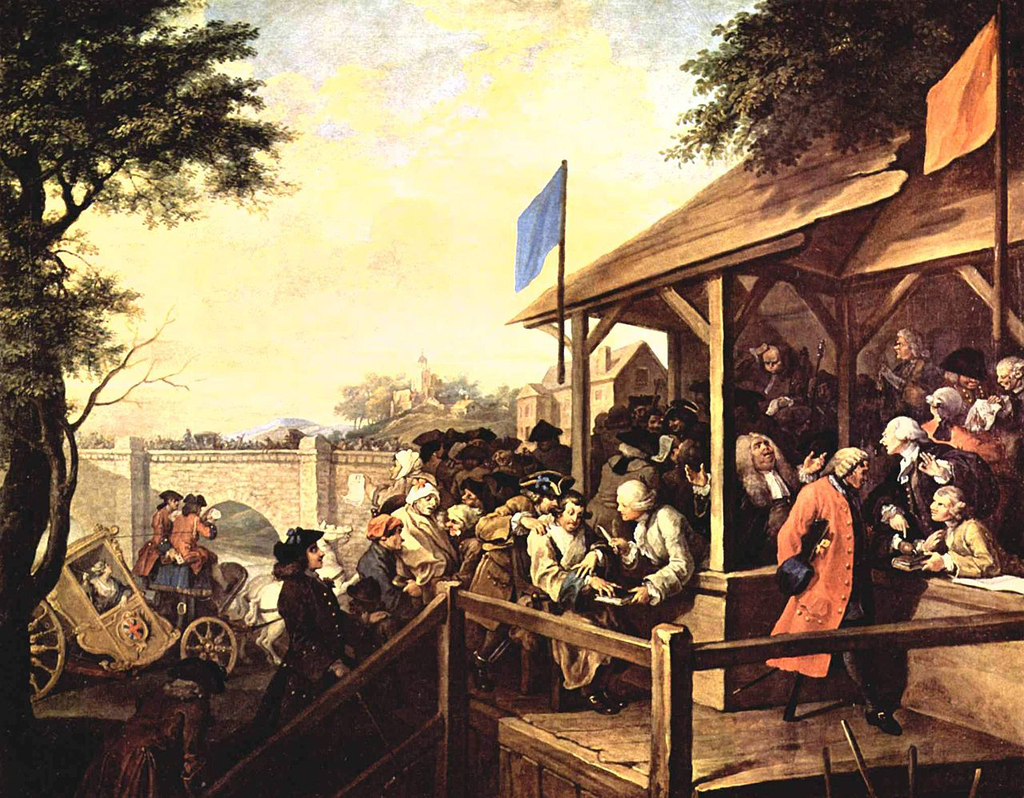
    White propertied men of the 18th century like Fielding Lewis, Augustine Washington, and George Washington would be surprised by our 21st century voting process. In early America, Election Day was an intensely public affair and oftentimes an excuse for everyone, whether permitted to vote or not, to travel to the county seat for the election. It was a chance to visit neighbors, conduct business, and simply have a good time.  There was a holiday atmosphere that could get quite uproarious!

    the-polling-by-william-hogarth
    “The Polling” by William Hogarth (1755), scene 3 in his Humours of an Election series. While Hogarth’s goal is to mercilessly satire English politics, his painting also hints at the festive atmosphere of an actual 18th century Election Day. Credit: Sir John Soane’s Museum / The Yorck Project / Wikipedia.

    The festival atmosphere was fueled by a common, although technically illegal, vote-getting technique: alcohol.  The law said that candidates could not provide drinks to voters from the time the election was announced until after votes were cast on Election Day.  To work around this restriction, candidates simply enlisted spouses, family, friends, or servants to distribute the spirits.

    George Washington first ran for a seat in the House of Burgesses in 1757. Each county sent two representatives to the house.  In this first election, Washington came in third in a field of three and garnered only 40 votes.  The next year, he stood again.  He won with 310 votes – the most of the four candidates.  While certainly not the sole reason for his victory, in 1758, Washington reimbursed friends £39 for 34 gallons of rum, 3 pints of brandy, 13 gallons of beer, 8 quarts of cider, and 40 gallons of rum punch served to voters.[1]  He wrote one of these friends, James Wood, saying “I am extreme thankly [sic] to you & my other friends for entertaining the Freeholders in my name—I hope no exception were taken to any that voted against me but that all were alike treated and all had enough it is what I much desird [sic]—my only fear is that you spent with too sparing a hand.”

    an-election-entertainment-by-william-hogarth
    “An Election Entertainment” (1755) by William Hogarth, scene 1 in his Humours of an Election series. The painting is a critical depiction of a candidate hosting a dinner for voters at a tavern. Credit: Sir John Soane’s Museum / The Yorck Project / Wikipedia.

    Although 18th century candidates couldn’t directly supply alcohol to voters, they were expected to be present during voting and were also expected to warmly greet all voters.  Today, in most states, there are restrictions against candidates or a candidate’s supporters from campaigning at or near a polling place while voting is taking place.  The candidate was present, in part, so that he could thank the voter for their vote.

    Voting in the 1700s was not secret. There were no ballots. Virginians practiced the long English tradition of a public voice vote. Before family, friends, neighbors, and the candidates themselves, a freeholder – a propertied white man allowed to vote – “came before the sheriff, his name was called out in a loud voice, and the sheriff inquired how he would vote.  The freeholder replied by giving the name of his preference.”  The freeholder’s name was recorded in the poll book in a column under the name of his choice.  “The candidate for whom he had voted, arose, bowed, and publicly thanked him.”

    While the secret ballot is sacred today, public voice votes of the 18th century and the poll books in which the votes were recorded provide historians with valuable knowledge about the elections of the time and about who voted for whom.  They also hint at personal connections within communities.  For example, we know that Augustine Washington, George Washington’s father, voted for William Fairfax, Esqr. and Colonel James Colvill for Prince William County’s two seats in the House of Burgesses in 1741.  We know that Fairfax won one seat with 246 votes and Colvill won the other seat with 175 votes.[2]  While we should be cautious about reading too much into Augustine’s support for Fairfax, George would go on to cultivate connections with William and other Fairfax family members.  After Augustine’s death, George aspired to be like William’s cousin Thomas Lord Fairfax, “socially prominent, well-connected, and involved in important affairs.”

    prince-william-county-polling-book
    Portion of a page from “The Poll for Election of Burgesses for the County of Prince William…” in 1741.

    Americans have been voting for an exceptionally long time. We were voting even before a United States of America existed.  The methods have changed over four centuries and although we no longer literally voice our vote, your vote is still your voice. Be heard today. Go vote!

    Zac Cunningham
    Manager of Educational Programs

    [1] Ron Chernow, Washington: A Life, New York: Penguin Press, 2010: 88.

    [2] Poll for Election of Burgesses in Prince William County, 1741, Deed Book E, pg. 524, Prince William County, Va.

  • Ten Pivotal Moments in George Washington’s Boyhood

    George Washington did not experience what we would now consider a normal childhood.  Life at Ferry Farm was filled with excitement, sadness, intrigue, and tragedy for young George. Here we present a list of “Ten Pivotal Moments of George Washington’s Boyhood.” This is by no means an exhaustive list but each of these events definitely helped shape Washington into a man capable of commanding the Continental Army and serving as the new nation’s first president.

    Moving to Ferry Farm

    chapman_GW HOME_overlay3_day1
    “View from the Old Mansion House of the Washington Family Near Fredericksburg, Virginia” (1833) by John Gadsby Chapman modified to depict the location and approximate appearance of the Washington family home, which was actually a complete ruin when visited and painted by Chapman in the early 1830s.

    In 1738, Augustine Washington moved his family to Ferry Farm.   He appears to have chosen this plantation situated across from Fredericksburg to be nearer to his iron ore interests located about seven miles away.  Ferry Farm was very different than the other Washington properties.  The proximity of Fredericksburg made it more urban.  Ferry Farm was also surrounded by transportation routes including the Rappahannock River, and two roads that crossed the plantation.  The bustling nature of Ferry Farm and its surroundings played a critical role in George’s development.

    strother-ad
    Announcement in the Virginia Gazette in April 1738 advertising “100 acres, lying about 2 miles below the Falls of Rappahannock . . . with a very handsome Dwelling house.” The property was being sold by  William Strother’s estate, would be purchased by Augustine Washington, and eventually come to be know as Ferry Farm.

    The Deaths of Mildred and Augustine
    George’s youngest sister Mildred was born shortly after the family moved to Ferry Farm.  She lived only 18 months, and her death when George was just seven years old was the first significant death of his youth, but not his last.

    Augustine Washington, George’s father, followed Mildred in death on April 11, 1743. George inherited Ferry Farm and ten slaves from Augustine. His mother, Mary, managed this inheritance until George turned 21 years old. Augustine’s death began a period of financial hardship for the family and probably prevented George from being educated in England, a lost opportunity he remained self-conscious about for the rest of his life. It also meant George had to scramble to find a mentor to introduce him to the complex requirements associated with gentry life.

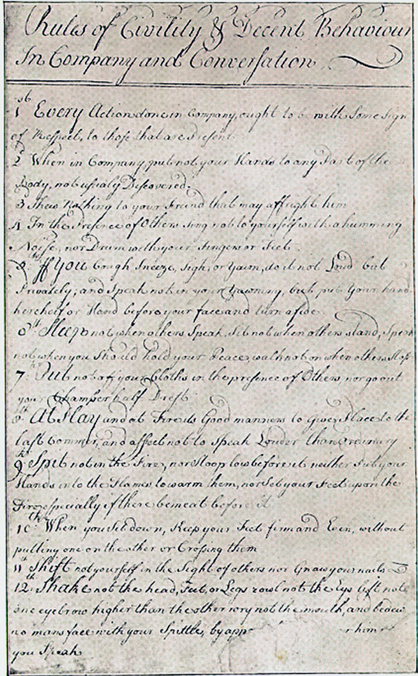
    rules-of-civility
    George Washington’s handwritten copy of The Rules of Civility and Decent Behavior in Company and Conversation.
    The Rules of Civility and Decent Behavior
    Young George copied The Rules of Civility and Decent Behavior, a guide to gentlemanly behavior in polite society, probably as a school assignment. This combination etiquette manual and moral code taught young George how to interact with his powerful and influential neighbors. By strictly following its advice, young Washington molded his character into that of a wealthy Virginia gentleman.

    His Gentry Education
    Washington’s diaries and accounts reveal how he mastered the pastimes of the gentry as a young man. He played for stakes at popular card games, took fencing lessons, and paid for his own dancing lessons. He frequented the theater in both Fredericksburg and Williamsburg. In a society obsessed with horse racing, equine bloodlines, and fox hunting, Mary Washington was well versed in horses and riding and appears to have been responsible for teaching George about riding.  By the time George was an adult, he was renowned as a “superb horseman.”  All of these skills, which remained with George for a lifetime, were acquired while he grew up at Ferry Farm.

    The Royal Navy Episode
    Following Augustine’s death, George’s eldest half-brother, Lawrence, took an interest in his future.  Lawrence conspired with Colonel William Fairfax, some of Augustine’s business associates, and George himself to convince Mary to allow 13-year-old George to join the Royal Navy. Mary eventually rejected the plan, a courageous act for a woman in male dominated colonial Virginia.  George turned to a career as a surveyor instead.  Imagine the future commander of the Continental Army serving on a King’s ship!

    schomberg-portrait
    Portrait of Frederick Herman  von Schomberg attributed to Adrian van der Werff. Public domain. Credit: Hampel Auctions / Wikipedia.

    Introduction to Military Adventurers
    On September 10, 1747, George purchased 3 books from his cousin Bailey for the combined price of 4 shillings 12 pence.  One of the books is listed as “Scomberg,” a reference to the 17th century German Protestant soldier of fortune, Duke Frederick Herman von Schomberg, who fought under the flags of France, Germany, Portugal, and England and died at the Battle of the Boyne fighting for William of Orange.  Schomberg wrote about his adventures which would have been of great interest and fascination to a young man of fourteen.  That George was willing to spend his hard earned money during a time of financial hardship reveals how enthralled he was by this subject.

    turnip-patch-survey
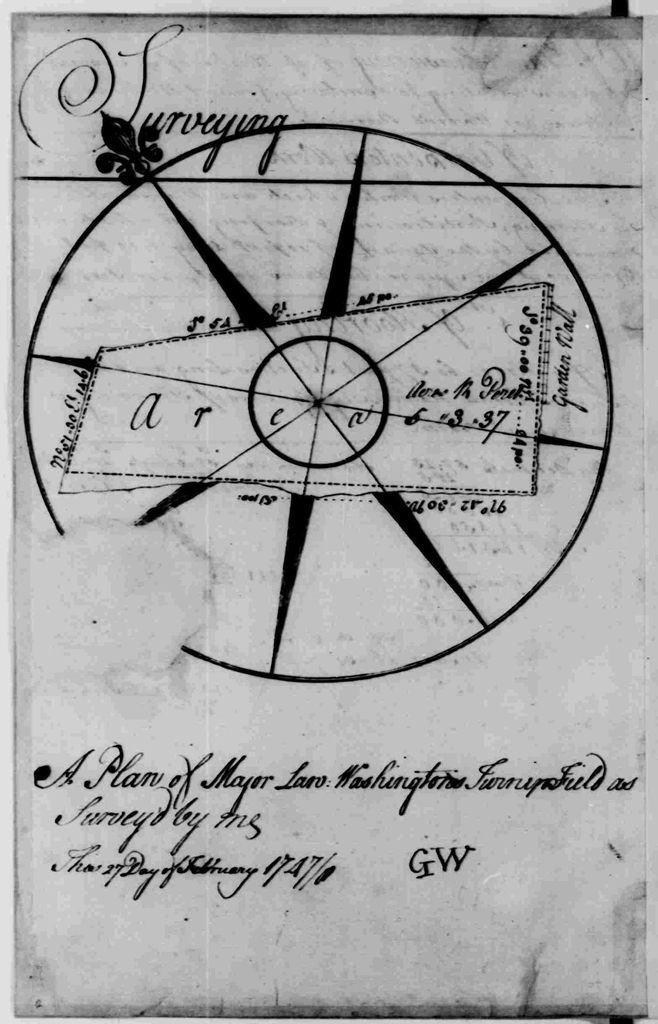
    “A Plan of Major Law. Washington’s Turnip Field as surveyed by me this 27 Day of February 1747 GW” Credit: Library of Congress

    Surveying: His First Job
    George Washington began surveying at about age 15. His father’s probate inventory included a set of surveyor’s instruments. In 1748, at age 16, George went with Lord Fairfax’s surveying party on his first expedition into the wilds of western Virginia.  At age 17, George Washington was appointed to his first public office as surveyor of nearby Culpeper County. Surveying, like his skills in mathematics and keeping accounts, helped him manage his properties profitably throughout his life.

    1749 – More Hard Times
    The financial safety net set up for Augustine’s wife and minor children had almost completely collapsed by 1749.  Before the monetary struggles were over, half of Ferry Farm would have been sold, and Mary’s land near the Accokeek Iron Furnace had been lost for failing to pay taxes.  George Washington in a letter to his brother wrote “…my Horse is in very poor order to undertake such a journey, and is in no likelihood of mending for want of Corn sufficient to support him…” He remembered these hard times well into adulthood writing in 1788, during another period of financial stress, that “I never felt the want of money so sensibly since I was a boy of 15 years old as I have done for the last 12 Months.”

    washington-barbados-painting
    “George Washington” (1997) by Walter Kerr Cooper

    Trip to Barbados
    In 1751, George Washington made his only trip abroad, traveling with his half-brother Lawrence to Barbados. Lawrence, suffering from tuberculosis, hoped the warm climate would prove beneficial to his health. He died from the illness, however, just a few months after his return to Virginia. Lawrence’s death set up the eventual inheritance of Mount Vernon by George.  The tropical island did little good for George’s health either.  He contracted a severe case of smallpox that left his skin scarred for life.


     GWs Request to be Appointed as the Virginia Militia Adjutant

    washington-portrait-1772
    Portrait of George Washington (1772) by Charles Willson Peale. The earliest authenticated portrait depicts Washington in the Virginia Militia uniform he wore during the French and Indian War. Credit: Washington and Lee University / Wikipedia

    In 1752, George Washington wrote a letter from Ferry Farm requesting that the Governor of Virginia appoint him as the militia adjutant position vacancy created by his half-brother Lawrence’s death.  The governor declined at this time, but one year later he did appoint George.  The 21-year-old Washington had no military experience at the time of his appointment.  This appointment eventually resulted in Washington igniting the Seven Years War between Britain and her colonies and France.

    Dave Muraca
    Director of Archaeology

    Zac Cunningham
    Manager of Educational Programs

  • Between the Lines: Teasing out Tame’s Story

    In this day and age, it is easy to discover the particulars of someone’s life simply with the click of a button.  Phone number, age, home address, professional resume and more can easily be obtained by searching through public records on the Internet or at the library. A treasure trove of current primary and secondary resources awaits the present-day researcher trying to uncover the facts of someone’s life in the 21st century.

    But what do you do when the person lived over 250 years ago? What public and private historical records are available that will tell us who a person was, how they lived, when they died, and who their family was? Time, circumstances, and the natural decay of paper all take a toll on the sources we use to study the history of the people who came before us.  But the amount and quality of available information about a person also depends on the status and role they played in their own time.

    In 1750, an enslaved person living at George Washington’s boyhood home, now called “Ferry Farm,” was murdered.  His name was Tame and he was killed by Harry, another enslaved man owned by the Washington family.  These bare facts were recorded at a King George County Court of Oyer and Terminer, with no further explanations given of the crime or of the motives involved.[1]

    What led to Tame’s death? For that matter, who was Tame? How old was he? Where did he come from? How long was he with the Washington family and how does his fateful story figure into the daily operations of the farm and household? Answers to these kinds of questions are hard to come by because the stories of the enslaved population in the historical record are limited, in many cases, to just a few documents spanning their lifetime.

    Excavated by archaeologist at Ferry Farm, this broad hoe, also known as a “weed hoe,” was used sometime in the mid-1700s by enslaved people to remove weeds and loosen soil around crops. Older slave children joined adults in the fields to do this difficult task.

    Discovering Tame’s story begins with finding him in the written records.  Augustine Washington, George’s father, died on April 12, 1743, seven years before Tame’s murder.  His will, written a day before his death, lists by name some of the slaves that belonged to him and to whom he gave them. Tame is not among those mentioned.[2]  The subsequent July 1, 1743 probate inventory of Augustine’s estate details the property and personal items he owned and their value, including a list of the enslaved population, but Tame, again, is not listed.[3]

    Since he was not mentioned in either of these two historical documents relating to Augustine’s property, it’s possible that Tame was acquired after Augustine died,  either by his estate, his heirs, or by his wife Mary and sometime between 1743 and 1750.

    There is another scenario to consider, however.  Perhaps Tame does not show up in the court documents surrounding Augustine’s death because Tame was actually the property of Mary, Augustine’s wife, instead.

    To burn efficiently and ensure a clean flame, the cotton wicks of candles needed to be trimmed frequently. This tool, known as a wick trimmer (above and below), was used for this purpose. Due to the mundane and constant nature of the task, household slaves were often charged with maintaining candle wicks.
    To burn efficiently and ensure a clean flame, the cotton wicks of candles needed to be trimmed frequently. These tools, known as wick trimmers (above and below), were used for this purpose and discovered during excavations at Ferry Farm. Due to the mundane and constant nature of the task, household slaves were often charged with maintaining candle wicks.

    FF20-325-1-2590-Wick Trimmer

    Mary Ball, who married Augustine Washington in 1731, was born to Mary Johnson and Joseph Ball in 1708 in Lancaster County, Virginia.  When her father Joseph died in 1711, he willed to her a young slave:   ”Item: I give to my daughter Mary my negro boy Tame…” (Lancaster County Will Book 10:88). Since Tame is described as a “boy” in the document, he could be roughly any age between 5 and 16 years.

    Is this boy, willed to Mary when she was but three years old, the same person who was murdered 39 years later in 1750 at Ferry Farm? As Mary’s property, the boy Tame would have been part of her household wherever she lived: with her mother in Northumberland County following her father’s death, with her as Augustine’s wife at Pope’s Creek, Westmoreland County, and then, finally, at Ferry Farm, where she lived mostly as a widow.  As Mary’s property, Tame would not have appeared in the will or probate lists of her husband.  What is also interesting is that both Tame and the man accused of murdering him were described in the 1750 court proceedings as “belonging to Mary Washington of this county widow.”

    Exactly what role Tame played on the Washington farm and within their enslaved community is unknown. If Tame is the same boy Mary received when she was 3, he would be in his 40s or 50s when at Ferry Farm, and thus someone Mary had known well her whole life. Did he work in or around the main household for the family or as a field laborer?  Did his age and long term relationship with Mary relate in any way to his unfortunate murder in 1750? What was his status within the slave community? Even Tame’s name adds an interesting aspect to his story that separates him from the other Washington slaves on the farm. “Tame” is a name of West African origin and is unlike the usual Anglicized names of contemporary Washington slaves, such as Jack, Ned, Tim, Steven and Adam, as recorded in Augustine’s will and probate inventory.

    Recent research shows cowry shells were used as currency as part of the slave trade. The modifications to our cowries facilitate stringing them into groups of 40. These shells, originally from the east Indian Ocean, traveled to Virginia with their enslaved owners. Evoking memories of their African homeland and heritage, such familiar emblems helped comfort those who remembered a life of freedom and helped them to maintain elements of their culture.
    Recent research shows cowry shells like this one were used as currency as part of the slave trade. The modifications to cowries discovered at Ferry Farm facilitated stringing them into groups of 40. These shells, originally from the east Indian Ocean, traveled to Virginia with their enslaved owners. Evoking memories of their African homeland and heritage, such familiar emblems helped comfort those who remembered a life of freedom and helped them to maintain elements of their culture.

    Tame’s existence in the historical documents is brief and mysterious. It may always remain a mystery but further research may yet illuminate this man’s story and his long association with Mary Washington. History is indeed an unending journey.

    Judy Jobrack, Archaeologist
    Assistant Lab Supervisor

    [1] King George County Order Book 2, p. 670

    [2] King George County Order Book 2, Part 1, p. 333

    [3] King George County Inventory Book, 1721-1744, p. 285