Lives and Legacies

Tag: baking

  • Bread Talk: A Slice of History in Colonial America

    In 2020, many of us spent a great majority of our time at home.  This gave us the opportunity to get creative and explore new hobbies.   One such hobby that became a viral sensation, plastered across social media, food blogs, and television news outlets, was that of baking bread.  Bread has been around in some form for nearly as long as human civilization, although before industrialization, it was a means to survive, not just a fun challenge for the amateur baker.  So here is a crumb of history on bread and what this glutinous baked good was like in Colonial America. 

    To start with the basics, bread is made up of 3 simple ingredients: Flour, water, and a leavening agent.  Typically salt and some kind of sweetening, like sugar or honey, are also added.  Everything else is extra.

    Wheat flour was (and still is) the most common ingredient used for bread.  Wheat quickly became a desirable crop in Colonial America.  We can infer wheat was grown on Lewis family land based on documentation of family members paying for goods in wheat.  Biological remains in the ground found by archaeologists at Ferry Farm suggest wheat was planted there too.  Wheat and other crops were planted, cared for, and harvested by enslaved laborers on both plantations.  Wheat specifically was a difficult crop to care for, requiring vast knowledge and careful timing to produce a fruitful harvest.  Wheat is a form of grass, usually not well digested or particularly nutritious to humans.  When wheat is ground into flour, put through the fermentation process of breadmaking, and baked, it becomes far more digestible, nutritious, and caloric for people to eat.  For most of Europe’s history, bread was about half of calorie intake for poorer classes, and wheat still makes up about 20% of people’s diets today. 

    Records of Betty Lewis’ accounts with Andrew Parks totaling £6.13.2. Payment by cash and wheat.
    Wheat kernel recovered from Ferry Farm.  Scale = 1mm grid. Credit: Justine McKnight.

    In the early 18th century, sieves made of fine Chinese silk that allowed for separating the bran from the wheat seed made whiter flour easier to obtain.  Although the bran is the most nutritious part of wheat, it quickly became associated with the poor and lower classes in many Western European cultures.  White bread was a sign of wealth.  This led to bakers putting additives like alum, lime, and chalk into bread to make it whiter.  Despite British Parliament passing laws regulating ingredients allowed in bread, it continued to be an ongoing issue throughout the 18th and 19th centuries.[1]  Even with contemporary knowledge about the benefits of whole grains, 70% of bread baked today is white, based on this century old principle of white flour’s superiority.[2]

    By the time Colonial America comes into the picture, bread is engrained into life.  This is so much so that most 18th century cookbooks do not have bread recipes in them as it is assumed everyone already knows how to make basic table bread. That’s right, Hannah Glasse does not have a simple bread recipe in The Art of Cookery.  It is just the three simple ingredients worked into a dough with the hands that is set aside to rise, then baked until a strong crust forms, after all.  This is something foreign to us in a time when sliced bread is $1.99 in the supermarket.  There is no need for us to spend hours baking bread ourselves in this modern age, but when you made bread every week or every day, it was something as simple as getting dressed or brushing our teeth is now. 

    Kneading bread dough in a wooden dough bowl.

    In urban areas, bakers were trained in the art of breadmaking, but in rural places, it was left to the individual household to make their own bread.  Trained or not, the science behind breadmaking on a molecular level was not understood until the 19th century.  What they did know was that they needed a leavening, or rising, agent in their bread to ensure it rose properly.  Leavened bread came into existence in Egypt about 6,000 years ago.  Bread could be made without a rising agent, but it would be a completely different texture.  In the 18th century, leavening agents came from a few different places.  Barm is the frothy substance on the top of beer after production and is the perfect rising agent for bread, making connections between bakers and brewers in urban areas imperative.  Also, just leaving dough to sit for a day or two to collect the bacteria in the air, from the kneader’s hands, and from the dough bowl with leftover dough bits can also be enough to leaven a batch of dough.[3]  This method of collecting bacteria from the dough’s surroundings is reminiscent of creating a sourdough starter.

    Loaves of bread were placed into a bake oven, a large cast iron Dutch oven, or on a hot hearth.  Regulating temperature was up to the expertise of the cook or baker, there was no temperature dial like we have on our modern oven.  And despite this, when the temperature is kept controlled, the baking process takes about the same amount of time as it does in a modern oven.  The physical baking process is about the same both ways. 

    Whether you prefer white or whole wheat bread, I hope this entry has given you a grain of insight on the importance of bread throughout history.  Breaking the bread down in this article may make it sound simple, but I will say from experience that getting the dough smooth, the crust tender, and the crumb coat correct is no easy task.  Put that loaf over coals from the hearth and you add a whole new element of challenge.  Reflect on the enslaved cook at Kenmore or Ferry Farm who was responsible for not only making bread, but three meals a day, along with planning and prepping ingredients for future meals.  Cooking and baking in an 18th century kitchen were physically and mentally challenging, making it one of many difficult jobs for those enslaved on southern plantations.  I suggest everyone try baking a loaf for themselves.  To me, it is a task that humanizes food production and reminds us of its delicate nature now and throughout time.

    Loaves of bread made on the hearth at Kenmore for Taste Through Time program.

    Allison Ellis

    Manager of Public Programs


    [1] Federation of Baking. “Fact Sheet No. 9 – the History of Bread.” Last modified 2011. https://www.fob.uk.com/wp-content/uploads/2017/01/FS-9-History-of-Bread.pdf.

    [2]  Pollen, Michael.  Cooked: A Natural History of Transformation. New York: Penguin Books, 2014.

    [3] Edlin, A. A Treatise on the Art of Bread-making. London: J/ Wright, St. John’s Square for Vernor and Hood Poultry, 1805.
  • Cooking up holiday treats: Gingerbread and Flip

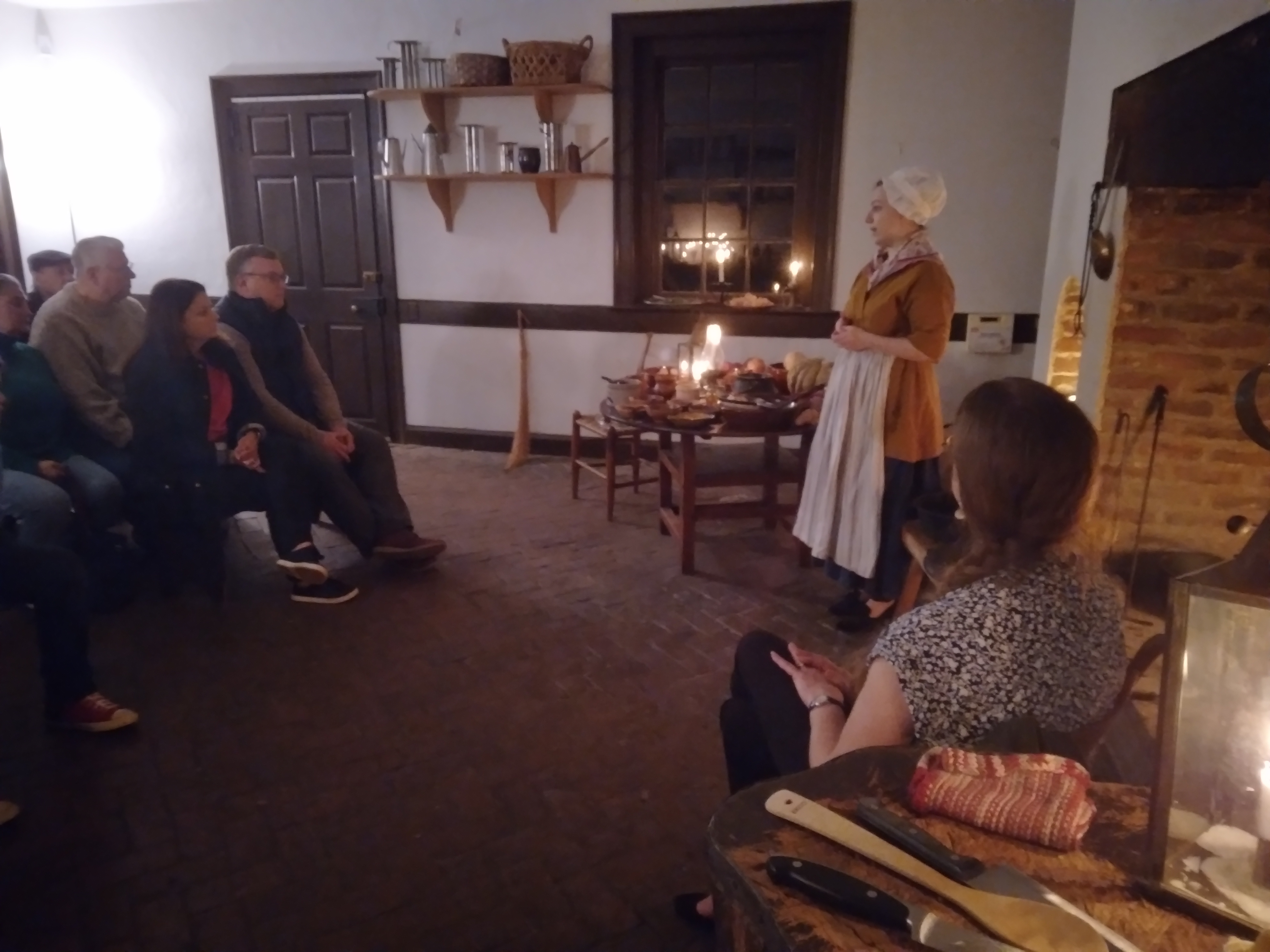
    This year at our annual Twelfth-Night celebrations, visitors could enter the kitchen for a short lecture and demonstration. The archaeology and curatorial teams gave the talks to explain two important food items that play a part in Kenmore’s history and the holiday, gingerbread and flip.

    Our first demonstration was done by Emma Schlauder, Research Archaeologist at the Foundation. She used a traditional recipe based on Mary Washington’s gingerbread. This is the recipe that the Kenmore Association and the Daughters of the American Revolution (DAR) would use in partnering with Hills Brothers Company to create the Dromedary Gingerbread Mix. The mix was sold in the gift shop and shipped around the country, raising money for the restoration of Kenmore.[1] 

    Emma Schlauder giving a presentation on gingerbread.

    Mary Washington’s Gingerbread Recipe

    3 cups all-purpose flour

    2 tablespoons ground ginger

    1 teaspoon cream of tartar

    1 teaspoon baking soda

    1 teaspoon ground cinnamon

    ¼ teaspoon ground nutmeg

    ⅛ teaspoon ground mace

    1 large orange

    ½ cup (1 stick) lightly salted butter, at room temperature

    ½ cup light brown sugar, firmly packed

    1 cup molasses

    ½ cup warm milk

    1 wineglass (2 ounces) brandy or coffee

    3 large eggs, beaten

    Gingerbread is a term applied to a wide-ranging selection of baked goods with combinations of spices such as ginger, cinnamon, cloves, and nutmeg and sweetened with honey, sugar, or molasses.[2]

    Ingredients and spices for gingerbread

    Emma’s gingerbread used the traditional American sweetener, molasses.[3]  Molasses was a commonly used sweetener in early American cooking until the increase of domestic sugar production. Molasses was cheap and a by-product of the refined white sugar produced for the wealthy.[4]

    After including all ingredients, it was mixed to create a runny batter. The batter was put into a cast-iron Dutch oven and hung over the fire to cook. Cooking and baking over the hearth was time-consuming and potentially dangerous. It was done with heavy cast-iron pots and pans, often hung over the fire by an iron bar in the back of the oven.[5]  Luckily for us, Emma had taken precautions for cooking over the open hearth and was able to bake the runny batter into a dense gingery cake. The cake was enjoyed by many and was determined to be a must-have for the season.

    Gingerbread cooking over the fire

    Flip

    Our next presentation was done by Mara Kaktins, our Archaeologist & Lab Manager, and explored the history and ingredients of a unique drink called flip that would have fit in quite well with the festive celebrations.

    The first known mention of flip is from a 17th-century play called “Love for Love” by William Congreve when a character mentions sailors, stating, “We’re merry folks, we sailors: we han’t much to care for. Thus, we live at sea; eat biscuit, and drink flip.”[6]  The play does not provide us with a recipe or ingredients for the drink.

    Flip –Universal Etymological English Dictionary

    Flip is mentioned in the Universal Etymological English Dictionary, first published in 1721. This definition offers more information about what the drink contains by stating, “Flip, a sort of Sailors Drink, made of Ale, Brandy and Sugar.”[7] Full recipes can be found in The Cook’s Oracle, published in 1822; How to Mix Drinks: Or The Bon-vivant’s Companion, published in 1862; and The Curiosity of Ale and Beer: An Entertaining History, published in 1889. These recipes contain spices and ingredients like eggs, rum, sugar, and orange juice.[8][9][10]

    Ingredients to make flip: Rum, Whiskey, Sugar, Nutmeg, Orange Juice, Eggs

    However, two things make flip different from other holiday drinks like eggnog. First, there is no cream used in the mixture[11] , and second, flip is traditionally mixed by pouring the drink between two different vessels to make sure all the eggs are combined with the alcohol and then plunging a hot iron into the drink to create froth.[12] [13] 

    Instructions state, “To make a quart of Flip: Put the Ale on the fire to warm, – and beat up three or four Eggs with four ounces of moist Sugar, a teaspoonful of grated Nutmeg or Ginger, and a quarters of good old Rum or Brandy. When the Ale is near boil, put it into one pitcher, and the Rum and Eggs, &c. into another; – turn it from one pitcher to another till it is as smooth as cream.”[14] After the mixture is properly combined, it is poured into a cup or tankard and finished off by plunging a hot iron which further mulled and froths the drink and gives it a slightly burnt taste.[15]

    Mara Kaktins finishing off a glass of flip with the hot poker

    This drink was mixed many times throughout the Twelfth night and was sampled by the staff. Unlike the gingerbread, the reviews for this frothy drink weren’t all that positive. Our modern palates might not be used to the amount of alcohol colonists use to consume. Sadly, while this drink was a hit during George’s festive season, traditional eggnog would be the best bet for the holidays. 

    These two demonstrations were quite a hit, with a sold-out crowd attending the show. With such a positive response, the archaeology and curatorial departments are looking for more ways to introduce living history to visitors. After gingerbread and flip, the possibilities are endless.       

    Heather Baldus, Collections Manager


    [1] Bryn, Ann. American Cake. Rodale Books, 2016, pg 26.

    [2] Goldstein, Darra. The Oxford Companion to Sugar and Sweets. Oxford University Press, 2015. pg 632

    [3] Bryn, Ann. American Cake. Rodale Books, 2016, pg 24.

    [4] Ibid, pg 12.

    [5] Ibid, pg 16.

    [6] Scene V, The Literature Network, http://www.online-literature.com/congreve/love-for-love/44/

    [7] Bailey, Nathan. Universal Etymological English Dictionary. London, T. Osborne, 1763

    [8] Kitchiner, William. The Cook’s Oracle and Housekeeper’s Manual. New York, J. & J. Harper, 1830

    [9] Thomas, Jerry. How to Mix Drinks: Or The Bon-vivant’s Companion. New York, Dick & Fitzgerald Publishers, 1862

    [10] Bickerdyke, John. The Curiosities of Ale and Beer: An Entertaining History. London, Swan Sonnenschein & Co., 1889

    [11] Garret, Dylan. The New York Flip, Wine Enthusiast, https://www.winemag.com/recipe/new-york-flip/

    [12] Thomas, Jerry. How to Mix Drinks: Or The Bon-vivant’s Companion. New York, Dick & Fitzgerald Publishers, 1862

    [13] Curtis, Wayne. And a bottle of rum: A history of the new world in ten cocktails. New York, Broadway Books, 2007

    [14] Kitchiner, William. The Cook’s Oracle and Housekeeper’s Manual. New York, J. & J. Harper, 1830

    [15] Curtis, Wayne. And a bottle of rum: A history of the new world in ten cocktails. New York, Broadway Books, 2007