Scenes from this past weekend’s Independence Day celebration at George Washington’s Ferry Farm!


Lives and Legacies
Scenes from this past weekend’s Independence Day celebration at George Washington’s Ferry Farm!

Writing to wife Abigail following Congress’s adoption of the Declaration of Independence, John Adams famously outlined his vision for how future generations would celebrate the historic moment. “I am apt to believe that it will be celebrated, by succeeding Generations, as the great anniversary Festival,” Adams wrote in an oft quoted passage. “It ought to be commemorated, as the Day of Deliverance by solemn Acts of Devotion to God Almighty. It ought to be solemnized with Pomp and Parade, with Shews, Games, Sports, Guns, Bells, Bonfires and Illuminations from one End of this Continent to the other from this Time forward forever more.”
Adams’ prediction was borne out immediately. News of independence spread from Philadelphia across the new American states like a circle of ripples on a great lake. By July 10, 1776, the first word arrived in Fredericksburg, Virginia, hometown of General George Washington and where his mother Mary still lived. Indentured servant John Harrower, who served as tutor for Colonel William Daingerfield’s family at Belvidera plantation about seven miles downstream from Fredericksburg on a bluff overlooking the Rappahannock, recorded the moment in his journal. [1]
“Wednesday 10th. At 6 pm went to Mrs. Battaile’s & teach’d until sunset and then returned home & soon after hea[r]d a great many Guns fired towards Toun. About 12 pm the Colo. Despatc[h]ed Anthy. Frazer there to see what was the cause of [it?] who returned, and informed him that there was great rejoicings in Town on Accott. of the Congress having declared the 13 United Colonys of North America Independent of the Crown of great Britain.” [2]

Some days later, on July 26, when the Declaration was officially read out in Williamsburg, Virginia’s capital, the proclamation was made “amidst the acclimations of the people, accompanied by firing of cannon and musketry, the several regiments of continental troops having been paraded.”
One year later, Adams prediction continued to bear fruit, as the infant nation celebrated its First Birthday. In Charleston, South Carolina, on July 4, 1777 “ringing of bells ushered in the Day” and “At sun-rise American colours were displayed from all the forts and batteries, and vessels in the harbour.” There was a parade of military troops and then “at one o’clock the several forts, beginning at Fort Moultrie on Sullivan’s Island, discharging seventy six pieces of cannon . . . and the militia and artillery fired three general vollies.” The new state’s leaders gave a banquet with thirteen toasts and “double the number [of guests] that ever observed the birthday of the present misguided and unfortunate King of Great Britain.” To end the day-long celebration, “the evening was concluded with illuminations, &c. far exceeding any that had ever been exhibited before.”.
Back north, in Philadelphia, Pennsylvania, ships were also “dressed . . . with the colours of the United States and streamers displayed.” The crews climbed into the rigging and stretched out across the yardarms to salute the day and each ship fired thirteen cannons. On land, a banquet was held for Congress during which “The Hessian band of music taken at Trenton the 26th of December last, attended and heightened the festivity with some fine performances suited to the joyous occasion, while a corps of British deserters, taken into the service of the continent by the State of Georgia, being drawn before the door, filled up the intervals with feux de joie.” A feu de joie, French for “fire of joy”, is the firing of guns into the air in quick succession. It is sometimes described as a “running fire of guns.”. The dinner also included many toasts. The late afternoon featured a parade of military troops and the ringing of bells. “At night there was a grand exhibition of firework, which began and concluded with thirteen rockets.”

Whether in Virginia in 1776 or South Carolina and Pennsylvania in 1777, all of these acts of celebration were quite traditional and had been used for decades to celebrate the monarch’s birthday each year. In 1727, Willliamsburg marked the king’s birthday.
“The colors were displayed at the Capitol and salvos fired from the cannon at the Palace, at the forts, and on board the king’s ships in Virginia waters at the time. In the evening the Capitol, the Palace, the College, and ‘most of the Gentlemen’s and other House of Note’ were illuminated and bonfires were sometimes set in public squares in the city. At the governor’s dinner the drinking of all the loyal healths consumed a great deal of time, a variety of choice wines and liquors, and a large store of gunpowder. The populace was sometimes treated to ‘plenty of liquor’ and drank the same healths outside the Palace or at one of the taverns. The day’s festivities closed with the governor’s ball for all the ladies and gentlemen in town.” [3]
More than two centuries later, we still celebrate the Fourth of July with decorations of red, white, and blue, ubiquitous American flags, military parades, cannon fire, large amounts of food, the enjoyment of spirited beverages, music, and fireworks. John Adams vision was far-reaching indeed!
Zac Cunningham
Manager of Educational Programs
Celebrate Independence Day where George Washington spent his boyhood years!

This year’s theme, “We The People” focuses on The Declaration of Independence with a variety of activities and entertainment for young and old alike. Learn about archaeology at Ferry Farm, enjoy a patriotic flag retirement ceremony,interact with colonial and Civil War re-enactors as well as members of the Patawomeck tribe, listen to patriotic music, and participate in educational programs, crafts and games, and hands-on activities for the whole family. Visit kenmore.org/events.html to learn more.
Cost: $1 per person
Parking: Eagles Lodge – 21 Cool Spring Road Fredericksburg, VA 22405
Shuttles will run between the Eagles Lodge and Ferry Farm.
[1] John Harrower, The Journal of John Harrower: An Indentured Servant in the Colony of Virginia, 1773-1776, edited by Edward Miles Riley, Williamsburg, VA: Colonial Williamsburg, 1963: xvi.
[2] Harrower, 158.
[3] Jane Carson, Colonial Virginians at Play, Williamsburg, VA: Colonial Williamsburg Foundation, 1989: 93.
This month marks the 284th anniversary of George Washington’s birth. Americans have celebrated our first president’s birthday since long before it became an official national holiday in the late 1800s. In fact, early Americans even marked George’s birth during his lifetime, most notably with “Birthnight Balls” that replicated the grand dances held in Britain to celebrate the monarch’s birthday. In 1879, an Act of Congress made February 22 a holiday within the District of Columbia. Six year later, Congress expanded the holiday to all federal offices across the country.
As with many American holidays, both officially recognized and otherwise, businesses created postcards and greeting cards to be used to send good wishes to family and friends on the holiday. We have four such Washington Birthday postcards in our collection. These cards date from around 1912-13, as a couple of the cards include cancelled postage stamps that note it being the 180th birthday of George Washington.


This year, you can celebrate George Washington’s Birthday at Ferry Farm by making your own birthday card for George!
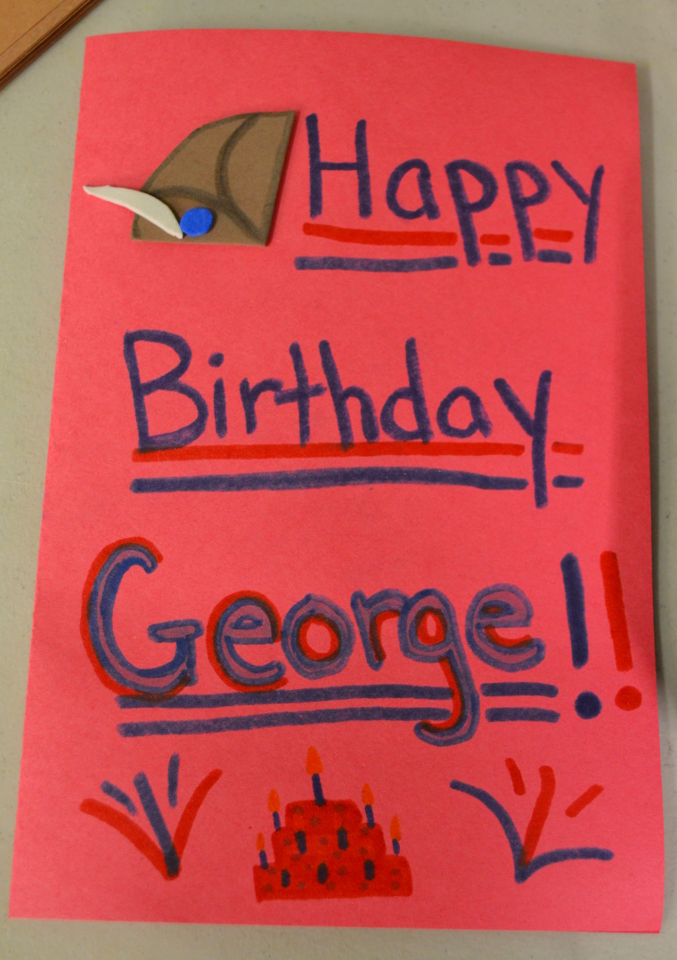
Visit his boyhood home on Saturday, February 13 from 10:00 a.m. – 4:00 p.m. for family fun, including games, crafts, exhibits, the Stone Throw Challenge (weather permitting), history theater, and birthday cake! “General Washington” will attend the Birthday Celebration to talk about his youth on the farm! You can see a short video of last year’s celebration here. $5 adults; 17 and under free.
Additionally, on Presidents’ Day, Monday, February 14 from 10:00 a.m. – 4:00 p.m., learn about archaeology at George Washington’s Boyhood Home. Enjoy crafts, theater performances, presentations by Muraca the Magnificent – Guru of Glues, tours of the archaeology lab, a scavenger hunt, and the Archaeology Artifact Challenge. Archaeology Day is a free event.
For more information call 540-370-0732 x22 or email [email protected].
Zac Cunningham
Manager of Educational Programs
Celebrate George Washington’s 284th birthday at his boyhood home with fun activities for the whole family, including games, crafts, exhibits, the Stone Throw Challenge (weather permitting), history theater, and birthday cake! “General Washington” will attend the Birthday Celebration to talk about his youth on the farm! The video below is a preview of the celebration.
This year’s celebration is Saturday, February 13 from 10:00 a.m. to 4:00 p.m.
For more information call 540-370-0732 x22 or email [email protected].
$5 adults; 17 and under free.
Each January, Historic Kenmore presents Twelfth Night at Kenmore, a dramatic theater presentation that imagines the first Christmas that Fielding and Betty Washington Lewis spent in their newly built home. The play is set in January 1776 and that year is not a time for the usual celebration. War brings fear, doubt, and frustration to the Lewis family and their friends.
The 2016 edition of Twelfth Night at Kenmore took place this past weekend. Here are photos from that performance.


This coming weekend — Friday, January 8, Saturday, January 9, or Sunday, January 10 — Historic Kenmore again presents Twelfth Night at Kenmore, a dramatic theater presentation set in January 1776. It is the first Christmas that Fielding and Betty Washington Lewis celebrate in their newly built home. It is not the usual celebration, however. War brings fear, doubt, and frustration to the Lewis family and their friends.
Here is a collection of photos from last year’s performances.


Immerse yourself in the experience the candlelight, music, and decorations of an eighteenth-century Christmas!
Performance Times: 3:00, 3:45, 4:45 and 5:30 p.m.
Reservations required. Call 540-370-0732 x24 or email [email protected]
Cost: $12.00 adults, $6.00 ages 3-17; free ages 3 and under.
On January 8, 9, and 10, Historic Kenmore presents “Twelfth Night at Kenmore,” a dramatic theater performance inside the 18th century home of Fielding and Betty Lewis. This short video previews the performance.
Immerse yourself in the experience the candlelight, music, and decorations of an eighteenth-century Christmas!
Performance Times: 3:00, 3:45, 4:45 and 5:30 p.m.
Reservations required. Call 540-370-0732 x24 or email [email protected]
Cost: $12.00 adults, $6.00 ages 3-17; free ages 3 and under.
Learn more about the event at http://kenmore.org/events.html.
The George Washington Foundation wishes everyone a joyous holiday season! Enjoy these photos of holiday decorations created by wonderful volunteers! The George Washington Foundation Garden Guild decorated at Kenmore and the Lake Anna Garden Club decorated at Ferry Farm.
There is still time to see Historic Kenmore and George Washington’s Ferry Farm adorned for the season as well as each site’s annual display of dollhouses, miniatures, and gingerbread creations. For details about these exhibits, visit kenmore.org/events. Finally, if you missed it, check out our most recent post A Christmas of Uncertainty, December 1775.


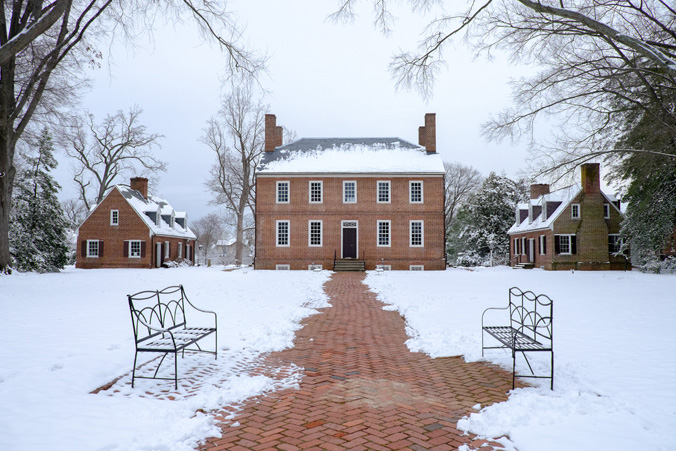
When Fielding Lewis moved his family into their new home – the magnificent brick house we call Kenmore – in late 1775 it was the culmination of years of hard work and planning. It might seem as though that year’s holiday season should have been one of continual joy. Unfortunately, the Lewis family’s first Christmas inside Kenmore was far from joyful. December 1775 was an extremely difficult time in their lives and for the American Revolution.
That December, the Revolution was in a frustrating state of limbo. Although declared to be in open rebellion by the King and Parliament, few colonies had yet to see any armed conflict. Fighting outside of Boston started in the spring but fizzled into stalemate following the Battle of Bunker Hill in June. Independence may have been discussed in taverns but was still far from being discussed at the Continental Congress in Philadelphia.
The colonies were still suffering economically and had been suffering for some time. In 1774, Congress passed the Non-Importation Agreement. These measures stopped all trade with Great Britain and other British-owned ports. The Association, as it came to be known, remained in effect in December 1775. Colonists lacked numerous supplies and goods. Fielding Lewis experienced a significant drop in his shipping business and the family’s finances began to suffer.
Even though it was the holiday season, the Non-Importation Agreement also discouraged…
To be loyal to the American cause, one could not delight in the revelries typically enjoyed during Christmas.
All levels of Virginia society felt the strain of war’s uncertainty that fateful December. John Murray, 4th Earl of Dunmore and Virginia’s Royal Governor, had been at odds with his colonists since he removed portions of the public stores of gunpowder to a Royal Navy ship back in the spring. Lord Dunmore’s most recent action, however, hit much closer to home for Fielding Lewis and his fellow planters. The Governor threatened to take their slaves, the precious private property, as they saw them, upon which they had built their livelihoods and wealth.
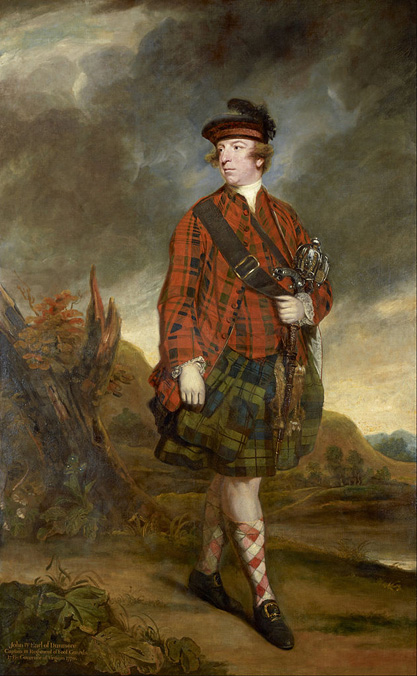
In November 1775, Dunmore had issued a proclamation in Virginia intended to swell his ranks and cripple the so-called ‘rebels’ by imposing martial law, raising the King’s standard, and declaring, most significantly,
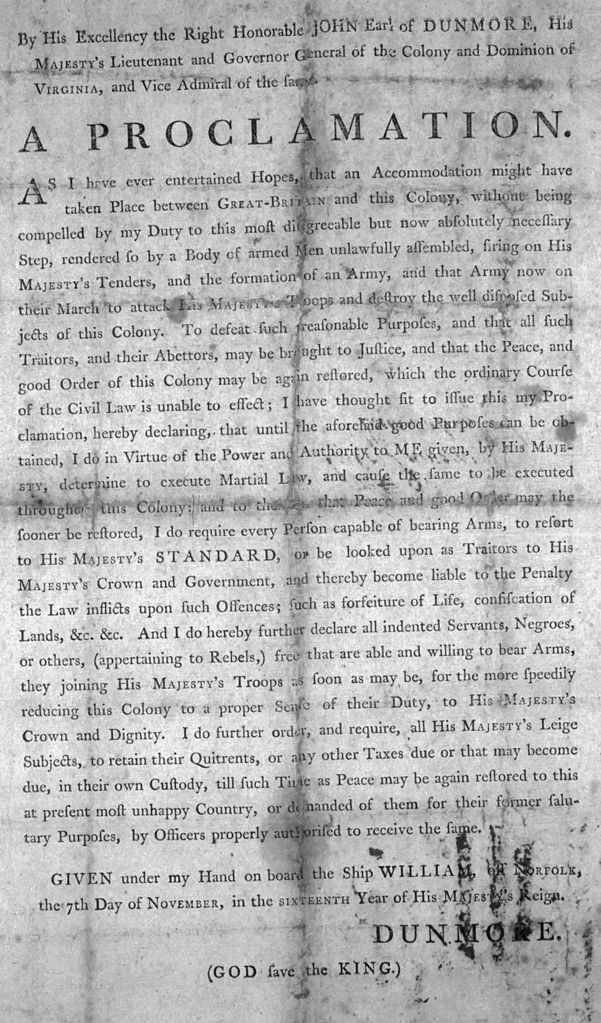
Dunmore’s Proclamation angered and frightened slave owners throughout Virginia and put the colony’s enslaved population in a difficult predicament. Achieving freedom was highly dependent on an enslaved person’s ability to get to Dunmore in Norfolk. Not surprisingly, the largest percentage of enslaved people who fled to the British came from the counties closest to that port city. While it is uncertain if any Lewis slaves ran away to the British, at least one indentured servant perhaps did. Joseph Smith, an a painter who had worked for George Washington and presumably for Fielding Lewis, saw the political schism in Virginia as an opportunity to free himself from his servitude and fled in the summer of 1775. In November, Fielding wrote to George, saying “I have never heard of your Painter tho’ suspected he was gone to Ld Dunmore[.] I do not expect he can be got as Dunmore wants Men.” Smith’s successful escape may have been on the mind of the other indentured servants and enslaved people in the Lewis household when word of Dunmore’s Proclamation arrived in Fredericksburg.
December 1775 in the Lewis family’s new home was an anxious one for many and yet for others it must have been a hopeful one as well. The American forces at Bunker Hill had proven to the British that the fight would not be easy or quick. The Fourth Virginia Convention met that December and ordered even more companies formed to support the Continental forces. Most hopefully, Dunmore’s forces were defeated in the Battle of Great Bridge on December 9. The Governor would leave the shores of Virginia in the early part of 1776 never to return. His forces did include a portion of enslaved people who had dared to hope for their own freedom, a hope that would be denied for many Christmases to come. A large portion were captured and returned to slavery, many more died from disease or lack of supplies, and others perished in battle. Few actually gained their freedom.
Back in Fredericksburg, the December of 1775 was most likely not what the Lewises had expected or hoped for. It was a Christmas of uncertainty, when war raged on Virginian soil. Yet, the future was not solely bleak for Fielding, Betty, and the Americans. As 1776 began, it begged the hopeful question: what may the new year bring?
Joe Ziarko
Manager of Interpretation & Visitor Services
Experience this Lewis family’s Christmas of uncertainty during Twelfth Night at Kenmore, a dramatic theater presentation at Historic Kenmore on Friday, January 8, Saturday, January 9, or Sunday, January 10. The year is January 1776. It is the first Christmas that Fielding and Betty Washington Lewis celebrate in their newly built home. It is not the usual celebration, however. War brings fear, doubt, and frustration to the Lewis family and their friends. Immerse yourself in the experience the candlelight, music, and decorations of an eighteenth-century Christmas!
Performance Times: 3:00, 3:45, 4:45 and 5:30 p.m.
Reservations required. Call 540-370-0732 x24 or email [email protected]
Cost: $12.00 adults, $6.00 ages 3-17; free ages 3 and under.
For the second year, Historic Kenmore presents “A Wee Christmas,” an exhibit for the holiday season of highly detailed, replica dollhouses – including the Kenmore mansion – and miniatures in the Crowninshield Museum Building. Come to Kenmore and share memories of your dollhouse with children and grandchildren as you explore the treasures in this festive display!
The dollhouses and miniatures of the “A Wee Christmas” remain on display until December 30. Historic Kenmore is open Monday – Saturday from 10:00 a.m. – 4:00 p.m and on Sunday from 12:00 p.m. – 4:00 p.m. Kenmore will be closed Christmas Eve and Christmas Day.
Admission cost for viewing the dollhouse exhibit only is $5 adults, $2.50 students, under 6 free. There is an additional fee for a guided tour of Kenmore. Visit www.kenmore.org for more details.


