Lives and Legacies

Tag: chamber pots

  • What’s the Scoop on the Poop?: Going to the Bathroom at Ferry Farm

    But seriously…. World Toilet Day – today, November 19 – is kind of a big deal, considering the vast numbers of people across the globe who do not have access to indoor plumbing.  According to the United Nations, 3.6 billion people in the world today do not have a toilet that is “not shared with other households, that either treats or disposes of human waste on site, stores it safely to be emptied and treated off-site, or connects to a functioning sewer.” Nearly 500 million people must practice “open defecation” (PDF) somewhere outside their homes. Ultimately, “life without a toilet is dirty, dangerous, and undignified.”  A lack of toilets also deeply impacts people with toilets because “poor sanitation contaminates drinking-water sources, rivers, beaches and food crops, spreading deadly diseases among the wider population.”

    Editor’s Note: Looking back in time, people’s personal hygiene, fashion choices, medical treatments, and more can seem disgusting.  When confronted with gross practices, our first reaction can be to dismiss our ancestors as primitive, ignorant, or just silly.  Before such judgments, however, we should try to understand the reasons behind these practices and recognize that our own descendants will judge some of what we do as gross.  Here at George Washington’s Ferry Farm and Historic Kenmore, we’ve come to describe our efforts to understand the historically disgusting as “Colonial Grossology.”

    At George Washington’s Ferry Farm, we’re frequently asked by visitors where the Washington family’s privy (what an outhouse was called in the 1700s) was located.  The fact is the Washingtons didn’t have a privy (or a well, for that matter.)  We’re often met with looks of disbelief when we pass on this bit of information. Ground penetrating radar conducted at Ferry Farm confirms the lack of a privy and a well, which would have been picked up immediately by this technology. As discussed here and here, the Washingtons and most colonial Virginians used chamber pots to go to the bathroom. Indeed, for this part of Virginia in the 18th century, many households didn’t need a privy.

    18th century chamber pot

    Sadly, this lack of a specific sanitary place for human waste was a familiar one for those who lived in the 1700s.  Because of their poor understanding of germ-caused diseases at the time, 18th century people did not fully appreciate the health dangers presented by human waste.  They did make obvious correlations, however. Noting how sick people were getting from drinking water, local colonial governments started enacting laws which prohibited privies from being dug too close to the water table. They also frequently ordered that wells be dug a safe distance from privies.

    Privies took many forms before modern plumbing.  They could be deep, brick-lined shafts that could go 30 feet or more into the ground with substantial above ground buildings.  They could also be made out of a simple wooden barrel placed in the ground with a humble structure above it.  Small privies could accommodate one person at a time.  Larger privies could potentially have eight seats or more (and not much privacy).

    Regardless, privies had to be emptied at some point and it was some nasty business.  Probably the most unglamorous job prior to indoor plumbing was that of the night soil men.  Sounds scary, and it is.  These workers descended into the depths of a privy and scooped the contents into wagons that were carted away.  They did this at night usually because most neighborhood citizens would rather be asleep when that terrible smell wafted around.  Usually, this human waste would be carted to local farms and sold as fertilizer (yep).
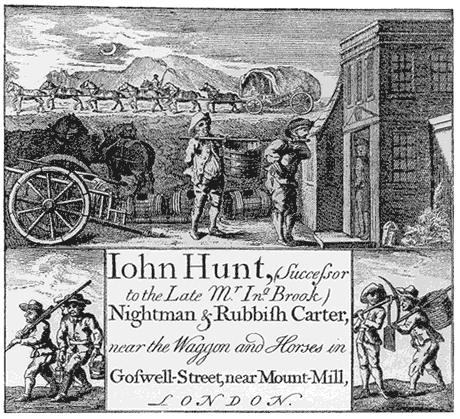
    Calling card advertisement for an 18th century night soil man in London. Credit: Public domain
    A night soil man in Baltimore. Credit: Public domain

    Who were the night soil men at Ferry Farm? Well, the Washingtons owned some 20 enslaved workers. Invariably, some enslaved, typically children, were tasked with emptying chamber pots and fetching water. They dumped chamber pots in the area behind the Washington house that archaeologists call the “midden.” This was a trash pile where everything from human waste to table scraps to broken household items was thrown away.  Enslaved workers also fetched water for the Washingtons from a spring and stream, not far from the Rappahannock River, at the base of the bluff where the house stood. Every day, these workers made multiple trips up and down the hill carrying heavy wooden buckets probably hanging from each end of a carrying pole or “milkmaid’s yoke.”  Hence no need for an outside toilet or well.

    But a privy was not just a toilet.  Like the Washington’s backyard midden, most privies were also used to dispose of any garbage from a house or institution.  This means food waste, broken pottery, bottles, and sometimes much more scandalous items were thrown into that void only to be brought up again by the night soil men.  Often, when a privy had degraded to the point where it was no longer draining properly or was falling in on itself, it was abandoned with all of the precious garbage sealed within.  Wells were treated the same way.  Once they had lived out their life, they were filled in with the lovely broken things that archaeologists love to look for. While unsanitary for their original users, historic privies plus wells can be a treasure trove of information for us today.
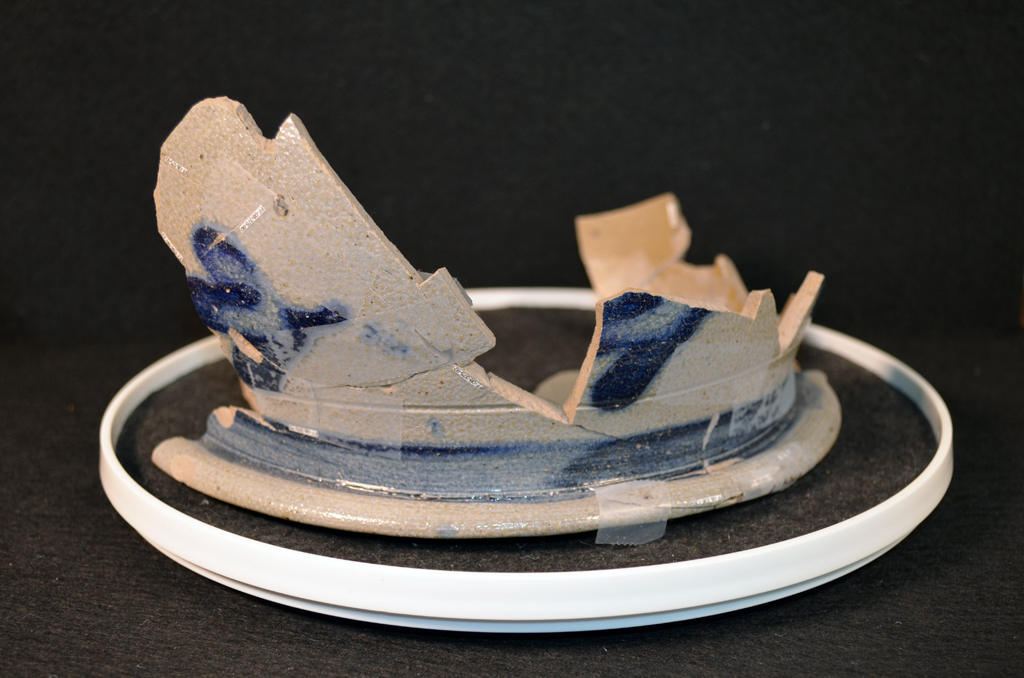
    Portion of a chamber pot excavated at George Washington’s Ferry Farm.

    Privies. Chamber pots. Thankfully, they were necessities for our ancestors but not for most of us today. That said, there are still many people in our 21st-century world who must go to the bathroom as if it were still the 18th century. On this World Toilet Day, let’s hope more can be done for the health and dignity of people without safe and sanitary toilets.

    Mara Kaktins, Archaeologist
    Ceramics & Glass Specialist

    Zac Cunningham
    Manager of Public Programs
  • Colonial Grossology [Video]

    Looking back in time, people’s personal hygiene, fashion choices, medical treatments, and more can seem disgusting.  When confronted with gross practices, our first reaction can be to dismiss our ancestors as primitive, ignorant, or just silly.  Before such judgments, however, we should try to understand the reasons behind these practices and recognize that our own descendants will judge some of what we do as gross.  Here at George Washington’s Ferry Farm and Historic Kenmore, we’ve come to describe our efforts to understand the historically disgusting as “Colonial Grossology.”  In this video, we examine three ways that daily life in the 18th century was sort of gross.

  • Ten Rarely-Displayed Objects from Kenmore’s Collection

    It is impossible for museums to exhibit the thousands of objects in their collections.  Historic Kenmore is no exception. While each of our objects is certainly unique and interesting, not every piece fits within our current interpretation of the life and times of the Lewis family.

    One reason museums might not display items is they are not from the time period being interpreted.  Our curator selects each object shown to the public after exhaustive study of primary resources like wills, probate inventories, letters and diaries and making sure it illustrates 18th century life in a wealthy Virginian home.  If we displayed pieces we have from the 1600s or 1960s, it would detract from the story of the Lewis family in the 1700s.

    A second reason museums might not display items is preservation and conservation.  Items that are two-hundred years old or more are very delicate and require special environments with proper temperatures, relative humidity, restricted lighting, and limited handling.  Material like textiles and papers don’t do well on display for long periods of time.  These items are better utilized in temporary exhibits in our visitors center or as digital content.

    In this list, I present ten of my favorite objects from Kenmore’s collection not often exhibited because they don’t quite match the history we’re trying to share or because they are too delicate for display. Besure to click on any of the photos for more detailed views of the objects.

    Ivory Silk Overdress and Petticoat

    overdress-and-petticoat
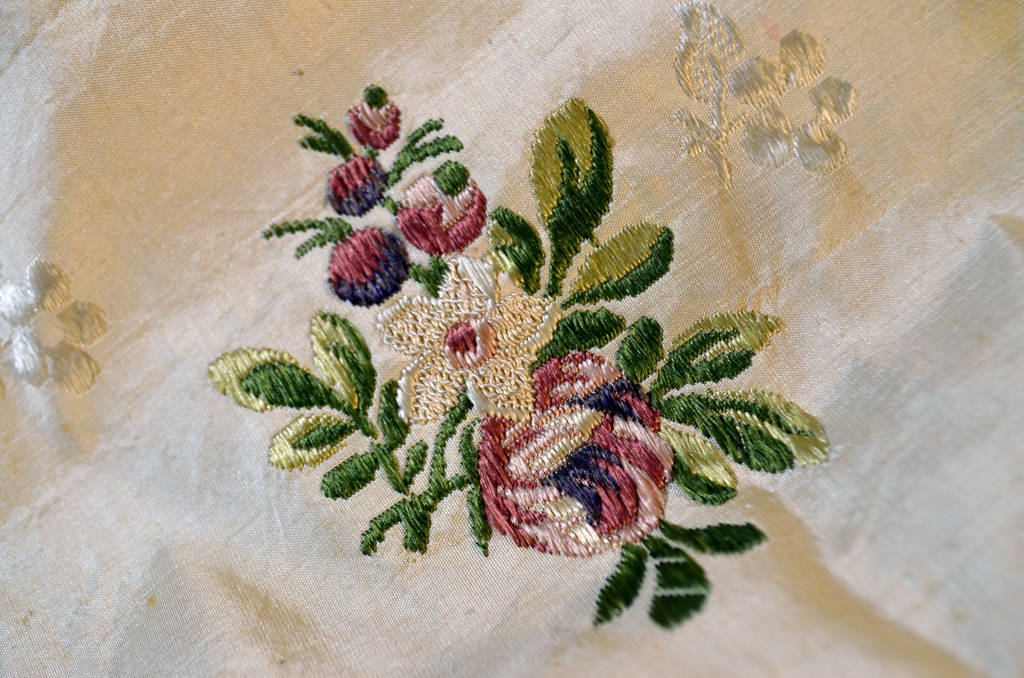
    One portion of the floral embroidery on the dress in Kenmore’s collection. The gown’s material is so delicate in some areas that we felt it best not to try and photograph the complete gown.

    robe-a-la-francaise-block-printed-cotton-c-1770
    Robe à la Française, c. 1770, similar in style to the dress in Kenmore’s collection. Credit: Los Angeles County Museum of Art / Wikipedia

    In Kenmore’s collection is an extremely delicate  overdress and petticoat with a brocaded multicolor floral pattern in the open robe style that dates from about 1775-1785. The particular cut of the open robe style was also known as “a la francaise” or “sack-back gown”.  This robe à la francaise is an illustration of the Rococo aesthetic that was popular during the eighteenth century.  I find clothing to be some of the most personal historic artifacts in any collection.  These pieces are not simply costumes but functional everyday garments that were used, stained, and mended by their owners.  Being able to see and handle this tangible historic link is as close to time-travel as we will get but, at the same times, textiles are extremely fragile and must be handled only rarely.

    empire-dress
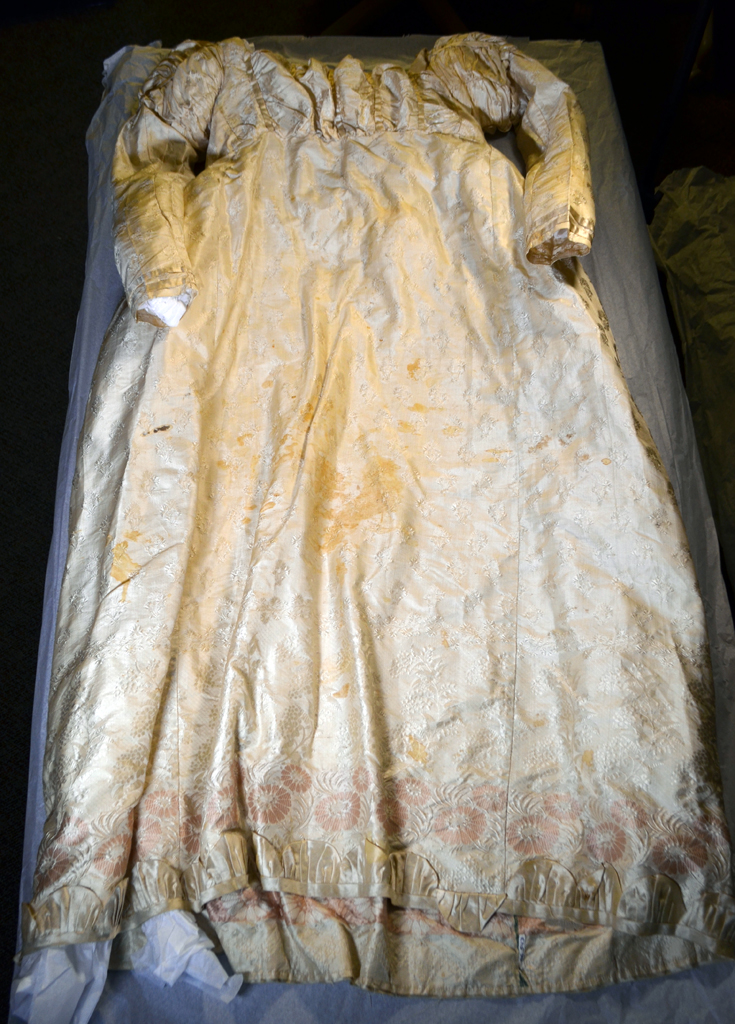
    Empire-style dress in Kenmore’s collection photograph while still laying in its storage box.

    Empire Waist Dress
    This cream-colored silk dress dates from between 1790 and 1820 and features a pattern of flower sprays and vines with row of pink brocaded flowers along bottom.  Cut in neo-classical style popular in the early nineteenth century with an “empire-style” waist, square neck and loose skirt.  Regency fashion is one of my favorite fashion epochs.  I find the empire-waisted silhouette to be flattering and probably the most comfortable of all historic women’s styles.  This piece doesn’t come out of storage much because it is a little too late for the Lewis era.

    “A New and Exact Map of the Dominions”
    new-and-exact-map-of-the-dominions
    Drawn by London cartographer Herman Moll in 1715, this map shows a fascinatingly detailed view of the Atlantic coastline from present-day South Carolina to Newfoundland, Canada indicating counties, mountains, towns, Indian settlements, rivers and bodies of water.  Insets along the bottom are maps of the Gulf of Mexico, the Carolinas, Charles-Town, and a small map of the “Principal Port of North America.” At right center is an inset showing a fully-colored view of Niagara Falls, with cute little beavers in the foreground building a dam.

    “View of London”

    view-of-london
    Close-up of a portion of Frederick de Wit’s “View of London.”

    This colored engraving done by Dutch cartographer Frederick de Wit shows a topographic view of the London with “The River Thames” across the center of map.  In the upper right corner there is a key with 148 streets, churches, wharves, theatres, and monuments listed and identified on the plan with a corresponding number. As an Anglophile who went to graduate school in London and spent over a year exploring that city’s streets,  I like seeing many familiar streets and sites on this map.  It shows that London city’s center has changed very little across the centuries.

    Bourdaloue
    bourdaloe
    This creamware bourdaloue is a smaller and more feminine version of a chamber pot circa 1780-1790.  In an era without public toilets, the bourdaloue provided a lady with a portable and relatively clean means of relieving herself away from home.  The vessel was oblong, rectangular, or oval in shape and a slightly raised lip at one end and a handle at the other and allowed usage from a squatting or standing position.  The bowl would then be given to the lady’s maid who disposed of the waste discretely.  Little everyday artifacts can get overlooked but they these fascinating little pieces give us a whole picture of colonial life. Plus, everyone loves chamber pots!

    The Gentleman’s Magazine
    gentlemans-magazine
    This March 1752 edition of The Gentleman’s Magazine includes articles on poetry, music, weather, gardening tips, criminal proceedings, history, and social services.  It’s amusing to read the various articles today and reflect on how similar they can be to our current news. There is a riveting report on the trial of Miss Blandy for poisoning her father, an account of the history of the Incas, and birth, marriage, and death announcements for the upper-crust of London society.  The Gentleman’s Magazine is digitized and can be read here. The Gentleman’s Magazine was founded in London in 1731 and remained in continuous print for 191 years.

    Homer’s The Iliad translated by Alexander Pope
    iliad
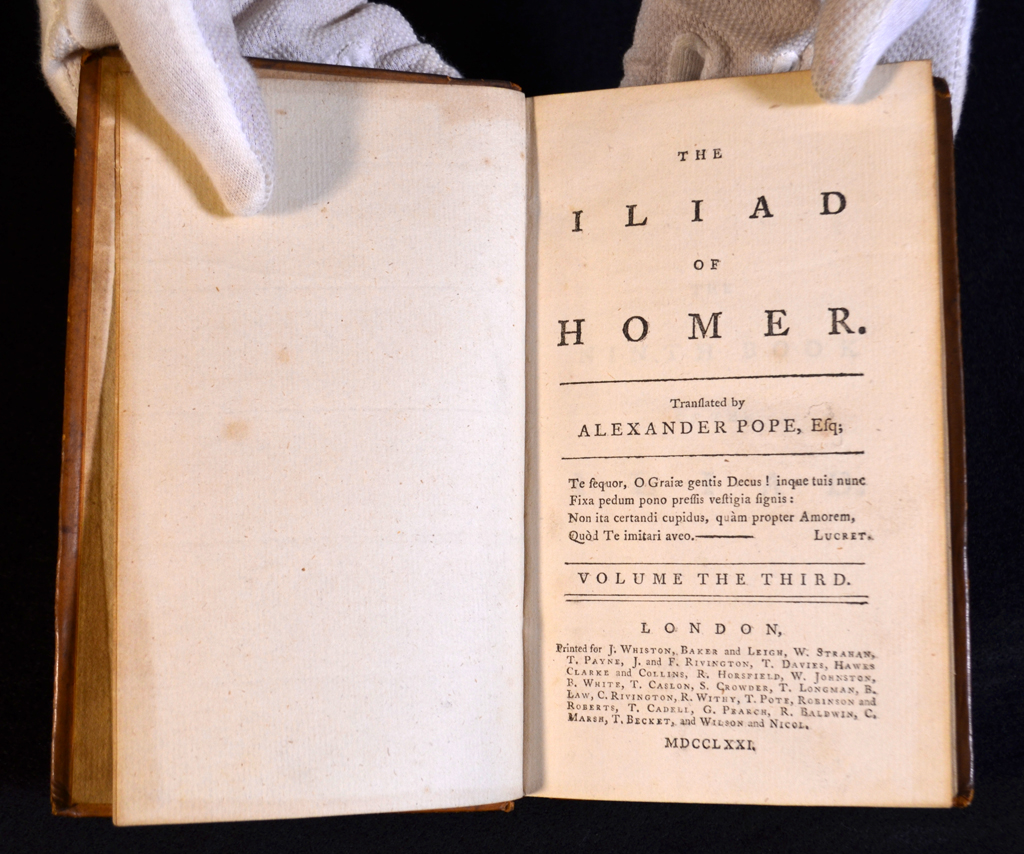
    These five volumes of Homer’s The Iliad were translated into English by the poet Alexander Pope between 1715 and 1720.  Written around the 8th century BC, Homer’s timeless story has influenced great artists for 2,000 years.  Pope was one of those artists.  He suffered from many health problems but was one of the few English poets able to earn a living from his literary works and I just think it’s cool that we have these special books in our collection.  Pope translated the epic verse for the publisher Bernard Lintot and earned the significant sum of £210.

    Marrow Spoon
    marrow-spoon
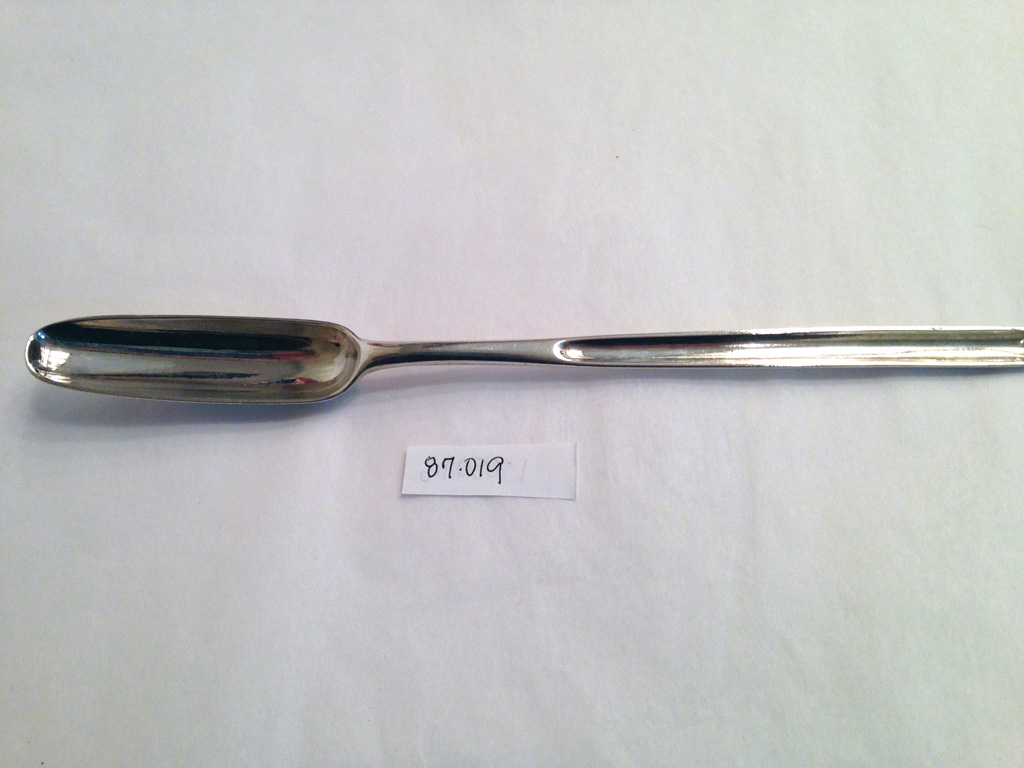
    This silver marrow spoon, circa 1722, features a long narrow scoop at one end and a broader spoon at the other.  Enjoying bone-marrow was so common that utensils were created to assist the diner in retrieving every morsel. These spoons were used at the table to get the tasty marrow out of the center of the bones without having to rudely gnaw, suck, slurp, bang, crack, or bite.  The fashionableness of certain food can be traced through the evolution of dining implements.  Today, our familiarity with the double scooped spoon and its purpose has waned just like roasted long-bone sprinkled with salt is no longer a prevalent dish on our tables.

    Mary Washington Monument Stone

    mary-washington-monument-stone
    Painted on this view of the stone are the ‘new’ [current] monument and the Mary Washington House.
    This is an Aquia sandstone fragment from the original Mary Washington Monument that was started in 1833 when President Andrew Jackson laid the cornerstone. The monument was never finished and was heavily damaged during the Civil war. In 1892, in order to raise money for a new memorial, the Mary Washington Monument Association began to sell off the original pieces painted by local women as “relics”.  While some felt this was desecrating Mary’s grave, the Association raised enough money for a new monument. In 1894, President Grover Cleveland dedicated the new monument, which still stands today. Although the way the group went about raising funds for the new memorial is not how it would be done today, these stones represent the beginning of the American preservation movement at the turn of the century.

    sampler
    The sampler’s poem has large faded from view. It read: “Learn to contemn all Praise betimes / For Flattery Is the Nurse of Crimes / With early Virtue plant thy Breast / The Specious Arts of Vice detest / Youth like softened Wax with Ease will take / Those Images that first Impressions make / If those be fair their Actions will be bright / If foul they’ll clouded be with Shades of / Night.”

    Sampler by Betty Washington Lewis
    This sampler was embroidered, signed, and dated by Betty Washington Lewis on February 25, 1805.  Betty was the daughter of Howell Lewis and the granddaughter of Fielding and Betty Lewis.  Girls demonstrated or tested their needlework skills by making samplers and often included the alphabet, figures, decorative motifs and, usually, a name and date.  This is one of the few textiles in our collection directly related to and created by a member of the Lewis family.  When an item is clearly marked with the date and who made it, it really doesn’t get much better for a historian!

    Heather Baldus
    Collections Manager

  • Of Chamber Pots and Close Stool Chairs

    Editor’s Note: Looking back in time, people’s personal hygiene, fashion choices, medical treatments, and more sometimes look, at the very least, bizarre, if not outright disgusting.  When confronted with these weird or gross practices, our first reaction can be to dismiss our ancestors as primitive, ignorant, or just silly.  Before such judgments, however, we should try to understand the reasons behind these practices and recognize that our own descendants will judge some of what we do as strange or gross.  Here at George Washington’s Ferry Farm and Historic Kenmore, we’ve come to describe our efforts to understand the historically bizarre or disgusting as “Colonial Grossology.”  The following is the latest installment in Lives & Legacies’ “Colonial Grossology” series.

    In over five years working in historic house museums, it has come up in conversations with visitors more than one might expect and far more than the 18th century Virginia gentry would have thought proper. After passing through drawing rooms, dining rooms, and bedrooms, the youngest in a tour group often realizes, with very little shyness, that “There’s no bathroom! Where did they go to the bathroom?” Veteran historic house visitors will often notice a certain object on the floor near a bed and, in hopes of not being overheard by others on the tour, quietly ask if the object is what they think it is. As a museum educator, I’ve come to embrace discussing how colonial Americans did their business because those acts are fundamental to being human. Discussing them reminds us that the larger-than-life characters who lived two centuries ago were just like us.

    Outhouse
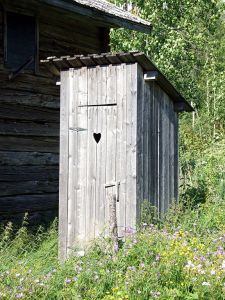
    A simple outhouse.

    So, just how did early Americans go to the bathroom? Many visitors imagine they used an “outhouse.” It seems that few colonial Virginians, however, had outhouses or privies, as the structures where known in the 1700s. These buildings were much more common in other colonies. A privy was a small wooden structure usually built behind the house with a floor built over a good-sized hole dug into the ground. Inside the structure, a wood plank served as the seat and a round hole cut in this plank allowed the waste to fall down into the pit. Privies sometimes featured multiple holes (including smaller holes to ensure children did not fall into the pit) but, of course, little privacy.

    While certainly important to their early American users, privies also yield important secrets to today’s archaeologists. Seeds ingested when colonial people ate passed from the people into their privies and actually survive to be excavated hundreds of years later. These seeds tell archaeologists what kind of fruits and vegetables people were eating. Even eggs from parasites that lived inside colonial people were deposited into the privy pit when they went to the bathroom. These eggs also survive and reveal what kind of illnesses people suffered from 200 years ago. A lot of people had stomach worms!

    When someone living in the 1700s woke to the call of nature in the middle of the night, that person didn’t necessarily want to go outdoors and use a privy. Who wants to walk outside when it’s raining, snowing, cold, and dark, after all? Instead, you simply used a chamber pot resting next to your bed. Chamber pots came in a variety of shapes and sizes and could be made from ceramic or metal.

    Chamber pot tucked under the bed in The Chamber at Historic Kenmore.

    Chamber Pot
    A porcelain child-sized chamber pot.

    It actually was quite common for the chamber pot to even be part of a special chair called a close stool, which looked like an ordinary chair but, in fact, its hinged seat lifted up to reveal a chamber pot.  The collection at Kenmore contains a chair originally made in the 1700s and then modified in the early to mid-1800s into a close stool chair.

    The chamber pot and the close stool chair were probably enough for most colonial Americans, a good majority of whom never bothered to build a privy. No privy dating from George Washington’s time has been found at Ferry Farm, which means he and his family probably used only chamber pots and/or close stool chairs. In fact, archaeologists found fragments of a stoneware chamber pot in the Washington house cellar during excavations in 2008 and 2009. It features hand-painted cobalt blue floral design and dates from the mid-18th century. In the photos below, the pot is upside down and resting on its rim.

    At Kenmore, Fielding Lewis’ probate inventory lists a “close stool chair and pan” among the house’s upstairs furniture. When George or Fielding used the pot or the chair, either they themselves or, more likely, their enslaved house servants tossed the waste outside. People emptied their pots in a variety of convenient places: into a pit for just that purpose, into the nearest body of water, onto their vegetable garden as a fertilizer known as “night soil,” or just out the nearest window. What could be more convenient!

    On plantations and farms, waste flying out of windows wasn’t necessarily an immediate danger to other humans. People living in crowded cities and towns throughout the colonies and Europe still emptied their pots in much the same way as their rural counterparts. They just tossed the waste into the street. Some localities did have rules about disposal. In Edinburgh, for example, residents could only empty their chamber pots “after 10:00 p.m., upon the sound of a drum, and only once they had shouted a warning of ‘Gardy-loo!’ (‘Mind the water!’) to passerby.”[1] The southern French city of Marseilles required residents to give three warnings before emptying. In nearby Avignon, however, people walking in the street at night had to make their presence known by shouting.  New York City passed an ordinance in 1724 making it illegal to dump waste into the street. Residents had to walk to one of the rivers to dispose of their waste.

    Privies, chamber pots, close stool chairs, night soil, rampant stomach worms, and waste lying in the street. Relative to today, the 18th century was not a terribly clean or healthy time. While not a pleasant topic, the ‘gross’ bathroom tools and customs of two centuries ago can teach us much about the everyday lives of early Americans and, ultimately, their most important lesson may simply be that our ancestors were human too.

    Zac Cunningham
    Manager of Educational Programs

    [1] A. Roger Ekirch, At Day’s Close: Night in Times Past, New York: W.W. Norton & Co., 2006, pg. 28.