Lives and Legacies

Tag: Cherry Tree

  • Pull Over!! The Virginia Highway Historical Markers of The George Washington Foundation

    As you drive down the road, sometimes, there are enough signs to make your head spin.  It can be tempting to just drive by these stark white cast iron road markers with black text when you see them.  Even so, sometimes you can’t help but let a word or a phrase catch your eye, sparking curiosity as you continue on with your travels.

    “Highway markers near Seven Pines, VA” courtesy of the Library of Virginia. (Virginia State Chamber of Commerce)

    The Virginia Highway Marker program is the oldest one of its kind in the United States (Virginia Department of Transportation, n.d.).  In 1927, State Route 1 was freshly paved and ready for new motor vehicles to coast down from Washington, DC to Richmond. (Virginia Department of Transportation, 2006).

    Drivers were given a red carpet to travel straight to what many viewed as the birthplace of our nation, George Washington’s Mount Vernon. Thousands began their pilgrimage. Hotels, motels, gas stations, and attractions began to pop up along the path.
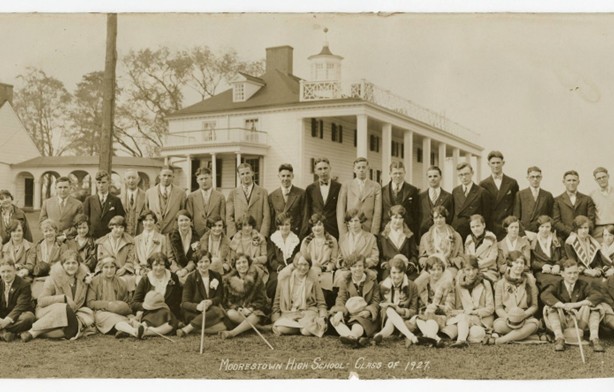
    “Moorestown High School Class of 1927” posing in front of Mount Vernon

    With all these new travelers who appreciated their state’s history, William E. Carson of the Conservation and Economic Development Commission erected several markers along the road, designating historic areas of interest and turning the roads into an attraction. (Virginia Department of Transportation, n.d.).

    Fabricating the markers was a beast to tackle since the traditional method of construction would have been granite.  Unfortunately, the stone was a bit too pricy and was also found to be difficult to read at the lightning-fast 25 mph speed limit.  Aluminum was an option for its lightweight and non-corrosive nature, and in fact, many early signs were manufactured from the metal, although they were quickly found to crack easily.  They were replaced with cast iron, and cast metal has been the preferred method of construction ever since (Rachal, 1949).

    Two of our three markers were first seen in the early years of the program. The oldest of our three was also the one that had the least amount of time in the light.  The Accokeek Iron Furnace marker (E-49) is located off Courthouse Rd in Stafford near an archaeological dig site owned by the George Washington Foundation. The modern iteration was erected in 1998.

    Accokeek Iron Furnace: The Principio Company constructed the Accokeek Iron Furnace nearby about 1726 on land leased from Augustine Washington (father of George Washington), who became a partner. After Washington’s death in 1743, his son Lawrence inherited his interest in the company and the furnace. When he in turn died ten years later, his share descended first to his brother Augustine Washington Jr. and later to William Augustine Washington. The archaeological site is a rare example of an 18th-century Virginia industrial enterprise. It includes the furnace location, the wheel pit and races, a retaining wall made of slag, an extensive slag dump, and mine pits.

    This text is not what was written prior to 1930. Those signs were brief, containing only a sentence or two for motorists to read as they drove by.  Between 1927 and 1930, though, cars sped up.  Where they were once going 25 mph, they were soon going 40 mph or even rocketing 50 mph down the highways!

    Trying to read the markers while driving quickly became impossible. The Commission’s solution? Publish a booklet with each highway marker printed and arranged neatly for passengers to read as they traveled.  All you had to remember was the marker’s number or title.  The first of these booklets were distributed in early 1930, free of charge (Rachal, 1949).

    This edition contains the earliest record of the Accokeek marker, then titled “Ancient Iron Furnace,” and reading only: “Here on Accokeek Run were iron mines and a furnace in which Augustine Washington, father of George Washington, began to smelt iron in 1727.”

    Unfortunately for our little marker, this was the last time it could be featured in the booklet. Disaster struck in late 1930. Engineer P. W. Snead wrote to the Commission on December 19th to report that the sign was found that morning, knocked from its post, and shattered.  The commission wrote back a few days later, asking for the aluminum pieces to be gathered and sent back since the factory would refund them for the parts.  (Library of Virginia Archives, 1930). The Accokeek marker was not restored until 1998, 68 years later, as part of a federal grant, according to the manager of the highway marker program, Jennifer Loux.

    The “Washington’s Boyhood Home” marker is also found in the booklet’s first edition, and its modern counterpart is now at the entrance to Ferry Farm.  Although there are no records of the sign being damaged prior to its replacement in 1997, after exposure to the elements for almost 70 years, it was probably time for a refresh.

    Alternatively, the motivation for the marker’s replacement (likely from the same federal grant) may have come from historical inaccuracies. The original text of the marker reads:

    “Washington’s Boyhood Home: At this place, the Ferry Farm, George Washington lived most of the time from 1739 to 1747. Here, according to tradition, he cut down the cherry tree. Washington’s father died here in 1743. The farm was his share of the paternal estate.”

    We now believe that the Cherry Tree story was likely an exaggeration or a myth, and so the verbiage was changed on the modern marker. Many old highway markers contained inaccurate information, as is often the case with many historical resources. As technology and research evolve over time, so does what we know. Another example of this never made it to the press, but early drafts of the marker’s text include his attendance at the “Old Field School.” We have since learned that there is no documentation of Washington ever attending a formal school in his life.

    The current marker was installed in 1997, the same year the George Washington Foundation obtained the property, and the sign continues to greet visitors to this day.
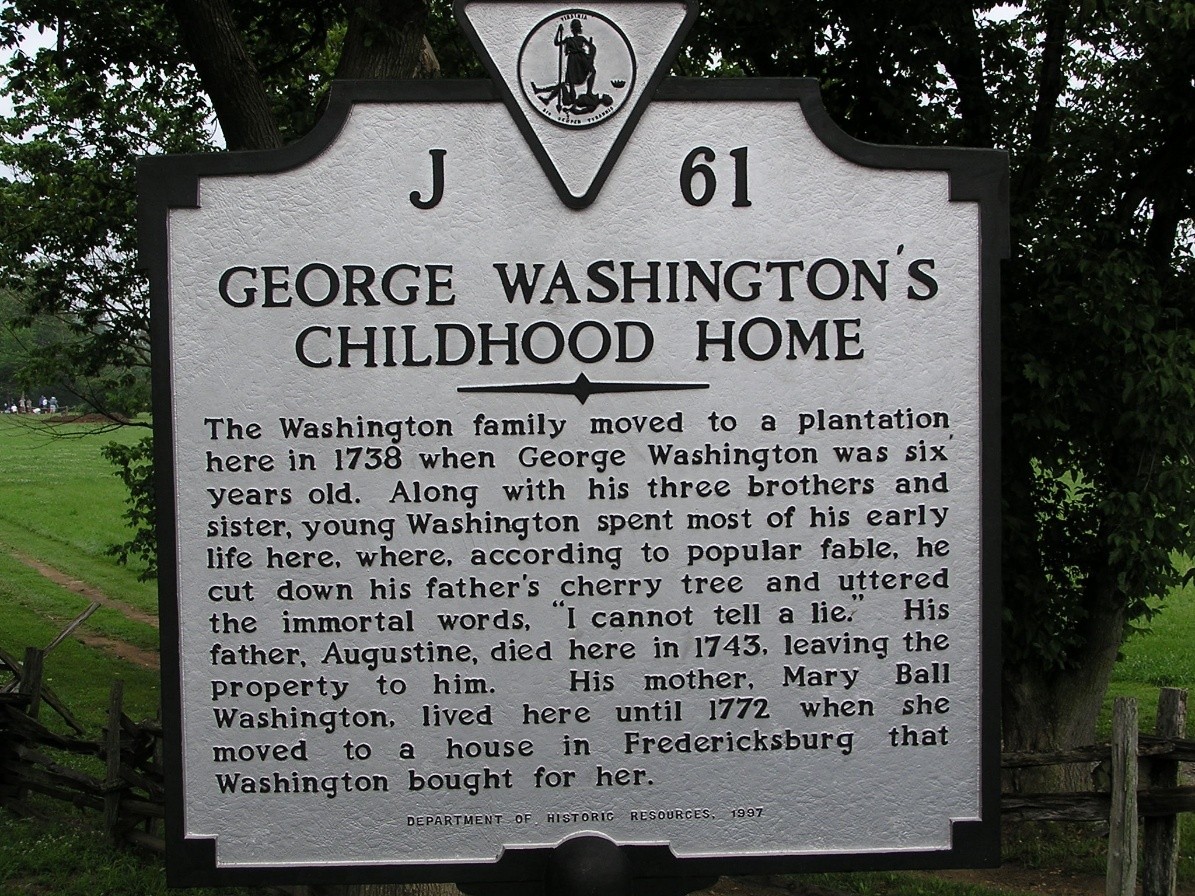
    George Washington’s Childhood Home: The Washington family moved to a plantation here in 1738 when George Washington was six years old. Along with his three brothers and sister, young Washington spent most of his early life here, where, according to popular fable, he cut down his father’s cherry tree and uttered the immortal words, “I cannot tell a lie.” His father, Augustine, died here in 1743, leaving the property to him. His mother, Mary Ball Washington, lived here until 1772 when she moved to a house in Fredericksburg that Washington bought for her.

    Our third marker is different, having not been placed until 1995.  At this point in time, the highway marker program had been passed around, with different organizations all bearing the burden of putting up new signs and maintaining the old ones.  It first passed hands in 1949 to the Virginia Department of Highways, who, after a year, handed the responsibility off to the Virginia State Library.  In 1966, it was traded again and is now operated by the Virginia Department of Historic Resources in collaboration with the Department of Transportation (Virginia Department of Historic Resources, n.d.).

    Former director of the Kenmore Association (now the George Washington Foundation) Vernon Edenfield wrote to the DHR proposing the marker. The Association paid for the manufacturing out of pocket. You can now visit it along Caroline St, four blocks from Kenmore, in front of Fielding Lewis’ storefront.

    Kenmore: Four blocks west stands Kenmore, built in 1775 by Col. Fielding Lewis for his wife, Betty, sister of George Washington. Near here, between Kenmore and the Rappahannock River, stood Lewis’s warehouses and docks. Kenmore’s intricate plasterwork is the finest in the country. Among 19th-century owners and occupants were Samuel Gordon, who named it Kenmore, and William Key Howard Jr., who restored and embellished the mansion’s plasterwork. Washington and other Revolutionary leaders often visited, and during the Civil War, Union troops used it as a hospital. The Garden Club of Virginia, starting in 1929, rehabilitated Kenmore’s gardens as its first restoration project.

    Although you might think after nearly 100 years of recording and presenting history that the Virginia Highway Marker program has run out of ideas, you can’t be further from the truth.  New markers are being planned constantly, and more gaps in history are being filled each year. In Fredericksburg alone, there are plenty more markers commemorating the city’s rich history.  If you feel there is an opportunity for a new marker somewhere, you can submit a proposal through the DHR’s website.
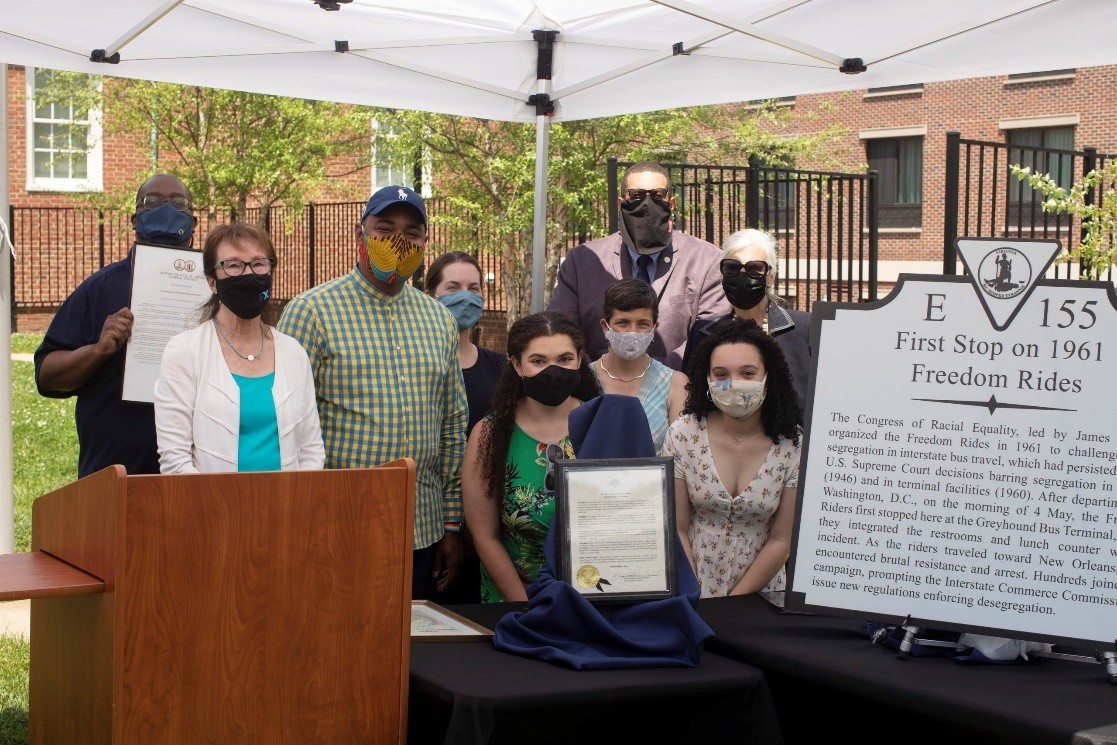
    The unveiling of the new Freedom Rides marker in 2021 at the site of the old Greyhound bus depot on Princess Anne St, which was proposed by staff and students from the University of Mary Washington

    History can be found anywhere if you know where to look, and the Virginia highway markers are a testament to that.  Be sure to keep an eye out for them on your next drive!

    Sarah Alden

    Manager of Visitor Services and Interpretation


    Bibliography

    Laiacona, J. (2021, May 4). Marker Furthers UMW Mission on Freedom Rides’ 60th Anniversary. Retrieved from University of Mary Washington: https://www.umw.edu/news/2021/05/04/marker-furthers-umw-mission-on-freedom-rides-60th-anniversary/

    Library of Virginia Archives. (1930). Virginia

    Mount Vernon. (n.d.). Historic Preservation at Mount Vernon. Retrieved from George Washington’s Mount Vernon: https://www.mountvernon.org/preservation/historic-preservation-at-mount-vernon#main-content

    Prats, J. J. (2010, October 23). State Historical Markers Numbering Plans. Retrieved from The Historical marker Database: https://www.hmdb.org/m.asp?m=2

    Rachal, W. M. (1949). Historical Markers on Virginia Highways. State and Local History News, 151-153.

    Virginia Department of Historic Resources. (n.d.). Historic Markers. Retrieved from Virginia Department of Historic Resources: https://www.dhr.virginia.gov/programs/highway-markers/

    Virginia Department of Transportation. (2006). A History of Roads in Virginia: “The Most Convenient Wayes”. Richmond: Virginia Department of Transportation Office of Public Affairs.

    Virginia Department of Transportation. (n.d.). Historical Markers. Retrieved from Directional Signing Program: https://vaidsp.com/historicalmarkers/

    Virginia State Chamber of Commerce, a. L. (n.d.). Highway markers near Seven Pines, Va. Picture Collection.

  • I Cannot Tell a Lie But I Can Tell a Fable: Aesop’s Fables and the Cherry Tree Tale

    If you’ve been to Historic Kenmore, you’ve likely been awestruck at the beauty of the plaster ceilings throughout the first floor. Although the identity of “The Stucco Man” is lost to history, he left behind a lesson above the fireplace in the Dining Room. The plaster work inlay there depicts several stories from Aesop’s fables, easiest to recognize is “The Fox and The Crow.”

    Aesop's Fox and Crow in Dining Room
    Plaster inlay depicting the Aesop’s Fable “The Fox and The Crow” above the fireplace in Kenmore’s Dining Room.

    Fables are as old as time itself. A type of story passed down in folklore, the fable appears all over the world and is often the stuff of myth, legend, or flat out falsehood. When exactly people began telling fables can’t be pinpointed. They appear in ancient Egypt, India, Rome, Greece, and many other early civilizations.

    Fables appear across religious boundaries too. They are prevalent in Christianity, Judaism, and Islam. These stories lend themselves to religious teachings because throughout history, fables were used to teach lessons and morals to children by pointing to a flaw or weakness in human behavior. These stories usually have characters who are not human; mainly animals that speak and behave like humans.

    Aesop, one of the most famous authors of fables, came from Ancient Greece and his fables have become so widely published that the man himself has become sort of legend. Aesop lived sometime around the 6th century BCE. There are over 700 stories accredited to him today, but we can’t truly be sure if he actually wrote any of them.

    Aesop has become a sort of fable himself. What little information about Aesop we have comes from an episodic called The Aesop Romance. According to this work of fiction, he was a Greek slave who was very clever. People like Aristotle wrote about Aesop’s cleverness being so great that he was able to overcome his enslavement and position himself in the company of kings.

    The stories known as Aesop’s Fables have changed a lot over the centuries.  They have been published countless times, each version a bit different than the last. Many editions have a completely different set of stories. This is because, again, no one is really sure what is or isn’t an Aesop’s fable.

    That has not stopped his stories from being used by almost every generation since to teach children moral lessons. In fact, a lot of familiar phrases come from the morals of Aesop’s fables. Anyone who has listened to the soundtrack from the Broadway musical Hamilton might recognize the line “I swear your pride will be the death of us all. Beware, it goeth before the fall.” This is the lesson from “The Eagle and the Cockerels,” a fable about two roosters who fought constantly. When it looked as though one had finally beaten the other, he crowed to tell the world of his victory, but an Eagle swooped down and took him. The once defeated rooster was now the king of the farm.  There are also stories that we all have learned that are attributed to Aesop that you may not realize, like: “The Tortoise and the Hare”; “The Ants and the Grasshopper”; and “The Wolf in Sheep’s Clothing.”

    Aesop’s fables were used during George Washington life to teach children as well. In fact, Aesop’s Fables by Sir Roger L’Estrange appears in two different inventories of Washington’s books, once in 1759, and again in 1764. Moreover, when doing the inventory in 1759, the book is listed twice meaning that George Washington owned a copy as did his step-son John “Jacky” Parke Custis.

    When inventory was done again in 1783, both copies are gone. Jacky’s copy was probably at his own estate, Abingdon, which was destroyed but would have rested on the property of Reagan National Airport today. Jacky died in 1781 from a camp disease he contracted at Yorktown and his probate inventory lists his copy of the fables, showing it was still part of his library at his death. Conversely, we do not know where George Washington’s copy went.

    While George learned much of his genteel behavior from his famous penmanship exercise of The Rules of Civility and Decent Behavior, we can also guess the lessons of Aesop’s fables impacted his life. Certainly, these fables were read and taught throughout his childhood in school and at home. The Rules of Civility focused more on proper physical behavior whereas the fables focused on moral behavior.

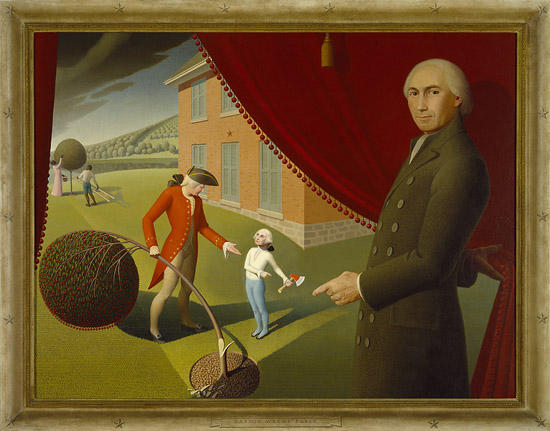
    Later in his life, as Washington grew from boy to man to legend, he too became inspiration for myths and parables that would teach lessons to others. The most famous of these stories was created by Parson Mason Weems about young George cutting down a cherry tree.  Even today visitors to Ferry Farm are sometimes surprised to hear this story is a made up tale to teach children not to lie.

    Parson Weems' Fable
    “Parson Weems’ Fable” (1939) by Grant Wood. Credit: Amon Carter Museum of American Art / Wikipedia

    Interestingly, an Aesop’s fable entitled “Mercury and the Woodman” has the same lesson. In this story, a woodman loses his axe in a pool of water. The Greek god Mercury comes and pulls a golden axe from the water, but the Woodman tells the god that it is not his axe. Mercury then pulls a silver axe from the water; again the Woodman denies owning such an axe. Finally, Mercury pulls the ordinary axe from the water and the Woodman takes the axe as his own. Mercury is impressed with the Woodman’s honesty and lack of greed, so as a reward; he gives the Woodman the gold and silver axes.

    The Woodman’s story spreads through town and several others attempt to summon Mercury by losing their axes. When they all greedily claim the golden axe, Mercury hits them over their heads and refuses to give any of them their own axes back.  As you can see, not only does this fable have the same moral (honesty is the best policy) as the cherry tree myth, Weems even used the same hand tool! Perhaps, this Aesop’s fable was the real muse for writing the cherry tree tale?

    Elizabeth Hosier
    Manager of Interpretation and Visitor Services


    References and Further Reading:

    “19 Everyday Expressions That Came from Aesop.” Mental Floss. September 03, 2014. Accessed January 18, 2019. http://mentalfloss.com/article/58530/19-everyday-expressions-came-aesop.

    An Ornate, 1551 Edition of Aesop’s Fables. Accessed January 18, 2019. https://wlu.edu/office-of-lifelong-learning/online-programs/from-the-collections/aesops-fables.

    Carlson, Greg. “Fables.” Creighton University. Accessed January 18, 2019. https://www.creighton.edu/aesop/.

    Clayton, Edward W. “Aesop’s Fables.” Internet Encyclopedia of Philosophy. Accessed January 18, 2019. https://www.iep.utm.edu/aesop/.

    “Custis, John Parke of Fairfax, VA 2/20/1782 — Elite.” GUNSTON HALL PLANTATION PROBATE INVENTORY DATABASE. Accessed January 18, 2019. http://www.gunstonhall.org/library/probate/wbvaxxtl.htm

    “Founders Online: Appendix D. Inventory of the Books in the Estate, C.1759.” National Archives and Records Administration. Accessed January 18, 2019. https://founders.archives.gov/documents/Washington/02-06-02-0164-0026#GEWN-02-06-02-0164-0026-fn-0002

    “Founders Online: List of Books at Mount Vernon, 1764.” National Archives and Records Administration. Accessed January 18, 2019. https://founders.archives.gov/documents/Washington/02-07-02-0216#GEWN-02-07-02-0216-fn-0008.

    “Search Results for Aesop.” Library of Congress. Accessed January 18, 2019. https://www.loc.gov/search/?in=&q=Aesop&new=true&st=

    Weems, Mason Locke, and Peter S. Onuf. The Life of Washington. Armonk, NY: M.E. Sharpe, 1996.

  • A History of Trees at Ferry Farm

    Cherry TreeThe moment anyone mentions trees and George Washington, you probably think of the famous Cherry Tree Story. However, this tale of young George taking a hatchet to his father’s cherry tree and, when confronted about the act, asserting “I cannot tell a lie” is probably just that — a story meant to demonstrate the integrity of the Father of Our Country. In reality, the trees of Ferry Farm have a much more fascinating history. Their story reflects, on a small local scale, vast environmental changes in eastern North America and shifting American attitudes toward the environment throughout the 18th, 19th, and 20th centuries.
    Today, we see wilderness as a good thing that needs protected and preserved. But in the 1700s, Europeans settlers saw wilderness as a bad thing. Preeminent environmental historian William Cronon notes, Europeans described wilderness as “’deserted,’ ‘savage,’ ‘desolate,’ ‘barren’—in short, a ‘waste,’.” People did not look at forests, deserts, or mountains as places to protect and visit. Instead, they were places to be feared and tamed.

    The opposite of wilderness was the managed landscape of Europe. In cities, towns, and farms, Europeans tried to control nature and make it follow humanity’s rules.  These efforts to tame the wilderness were transplanted to colonial plantations in the Americas.

    The first step in building a plantation and taming the wilderness was clearing the land for farming. Huge numbers of trees were cut down to do this.  On top of that, trees were cut down to make almost everything people of the 1700s and 1800s used and owned.  Furthermore, they were also cut down to do many everyday tasks.

    Throughout the 18th and 19th centuries, the wood from trees was…

    • used as the main architectural building material in houses, most other structures, farm buildings, fences, and more
    • used to build ships, boats, ferries, bridges, carriages and wagons that moved people and things from place to place
    • used to make everyone’s furniture (beds, chairs, tables, desks, cabinets, and trunks) as well as many household items and farming tools
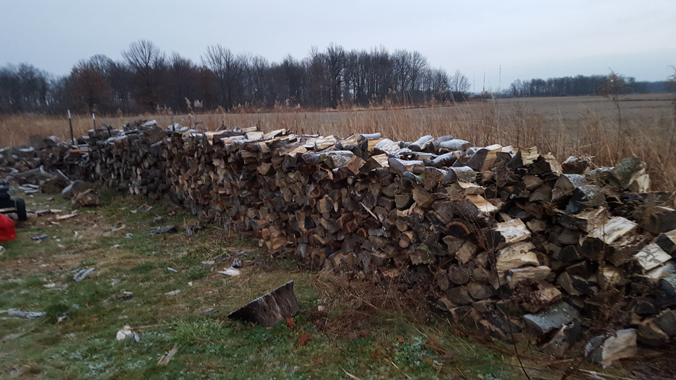
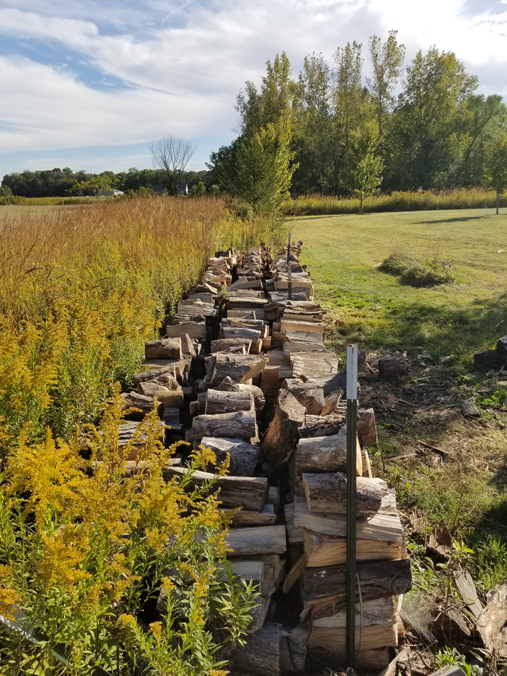
    • used as fuel for the fires needed to cook, heat, and even to make candles and soap. A colonial home needed at least 40 cords of wood for heating and cooking over the course of a year.

    5 cords of Firewood 1
    Five cords of firewood. A colonial home used 8 or 9 times this amount in a year for just heating and cooking. Credit: Chris Stevenson

    5 cords of Firewood 2
    Credit: Chris Stevenson

    According to the U.S. Forest Service, the area that would become the United States had just over 1 billion acres of forest before European settlement.  By 1910, the U.S. had a total of just over 700 million acres.  The 300 million acres of trees cut down was mostly in the eastern portion of the country.

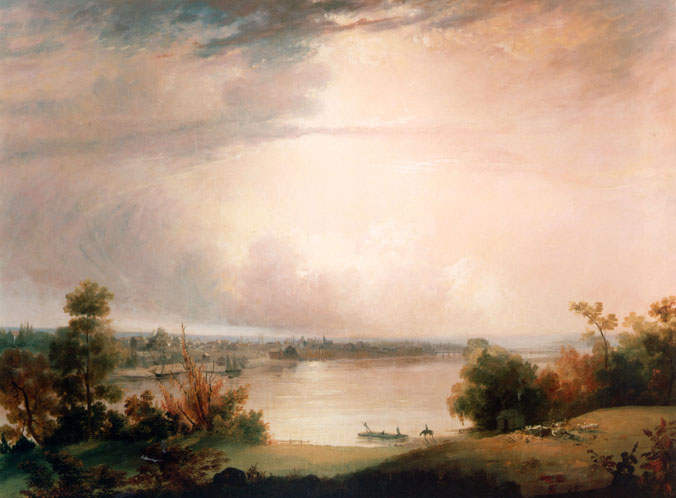
    These large scale trends can be seen on a small scale at Ferry Farm.  The European settlers who lived here, including the Washingtons, cut down a significant number of trees but not so many that there weren’t still quite a few standing when John Gadsby Chapman painted Ferry Farm’s landscape in 1833.

    1830s
    “The Old Mansion of the Washington Family” (1833) by John Gadsby Chapman shows the foundation stones of the house where George grew up at Ferry Farm and trees along the riverbank.

    We also have archaeological evidence showing the locations of trees during the Washington era.  This past summer in the yard north of the Washington house replica archaeologists uncovered “soil stains” left after trees fell in the past.  Soil stains are where the soil is a slightly different color than surrounding areas and indicate where people filled in holes created by uprooted trees. In other words, such soil stains indicate that a tree once stood there.

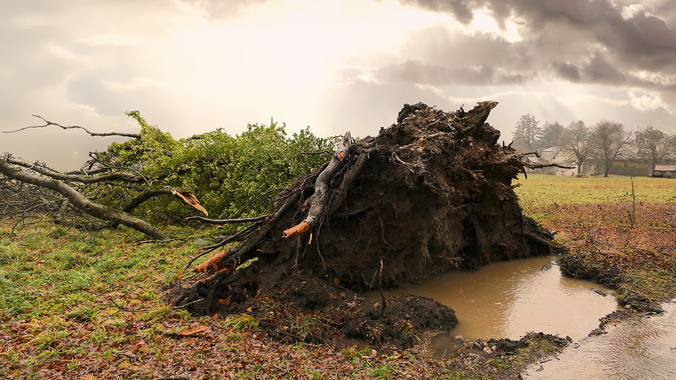
    Uprooted Tree
    A tree uprooted by a storm. Credit: ykaiavu / Pixabay

    In some cases, our archaeologists found that the holes were filled in multiple episodes, indicating that the soil settled and new dirt was later added or the person filling the hole borrowed different dirt of different colors from multiple locations. By excavating the soil from these soil stains and analyzing the artifacts, we can tell around when the holes were filled.

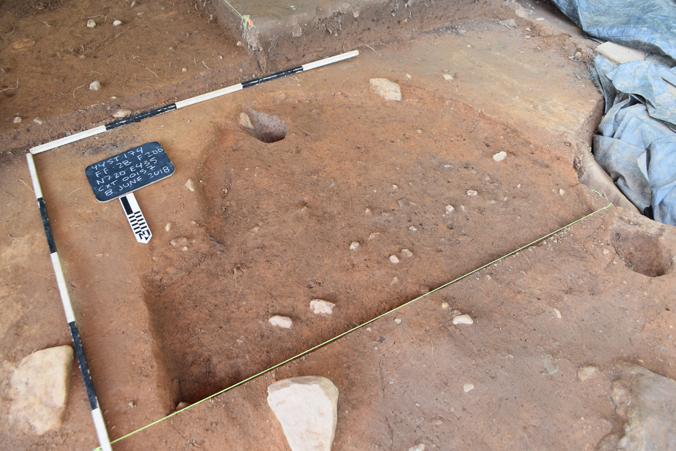
    Soil Stain
    Soil stain marking the site of an 18th and 19th century tree on the landscape at George Washington’s Ferry Farm.

    One very large tree left the sizable soil stain – almost 5ft x 5ft – pictured above.  Based on artifacts found in its soil, the hole was filled during the mid-19th century.  We can tell by the size of the stain that the tree was quite mature. Together, these facts are evidence of a tree that grew just 40 feet north of the original Washington house during the time George and his family lived at Ferry Farm. This discovery gives us another detail about the landscape so it can eventually be accurately recreated just as we did the main house.

    Finally, Ferry Farm archaeologists learned from these tree features and from the lack of other features in this yard that the area was well-kept. In the 18th century, this portion of the landscape was probably well-maintained because it was visible from Fredericksburg across the river.

    This tree fell sometime in the 19th century and it was not the only one at Ferry Farm or across the country. Indeed, deforestation at Ferry Farm and nationwide grew more rapid and widespread in the 1800s as “clearing of forest land in the East between 1850 and 1900 averaged 13 square miles every day for 50 years; the most prolific period of forest clearing in U.S. history.”

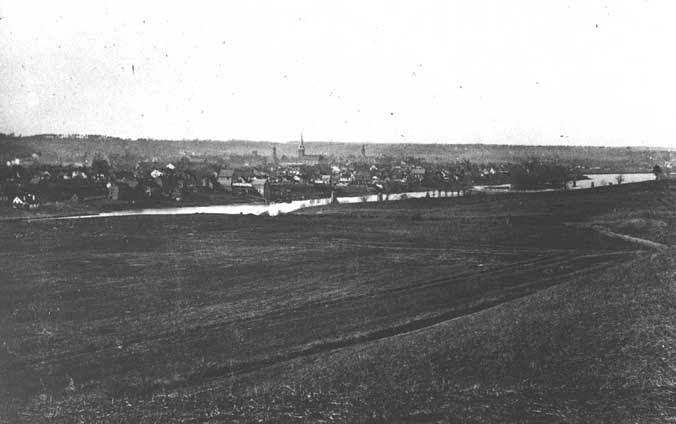
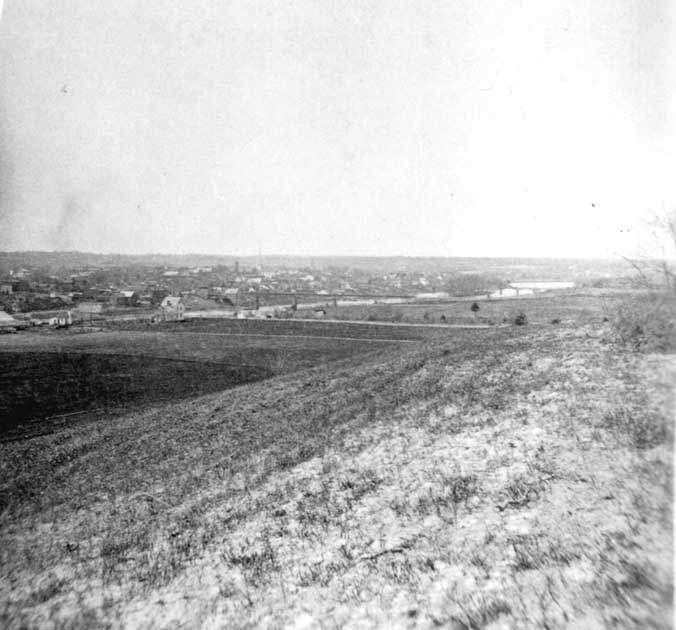
    In the 1860s, the Civil War exacerbated deforestation at Ferry Farm and throughout Stafford County.  Hundreds of thousands of Union Army soldiers radically altered the local environment to get the wood they needed for cooking and heating, to help build their fortifications and pontoon bridges, and even to build shelters.  During winter lulls in fighting, 18th and 19th century armies did not camp in tents. The soldiers built small log cabins.  By war’s end, Ferry Farm and Stafford County were nearly treeless as seen in the two photos of Ferry Farm below taken in the decades after the war ended.

    1870s
    View of Ferry Farm property in the 1870s.

    1880s
    View of the Ferry Farm property in the 1880s

    While deforestation sped up in the 1800s, that century also began a changing of people’s attitudes toward the environment.  As Cronon explains, “The wastelands that had once seemed worthless had for some people come to seem almost beyond price. That Thoreau in 1862 could declare wildness to be the preservation of the world suggests the sea change that was going on. Wilderness had once been the antithesis of all that was orderly and good—it had been the darkness, one might say, on the far side of the garden wall—and yet now it was frequently likened to Eden itself.” Wilderness was to be treasured, not feared.

    As the 19th century turned into the 20th, wilderness, nature, and the environment were increasingly seen as special and deserving of protection and preservation, sparking the creation of national and state parks, government agencies like the Forest Service, private conservation groups such as the Sierra Club, and, in 1872, the very first Arbor Day.

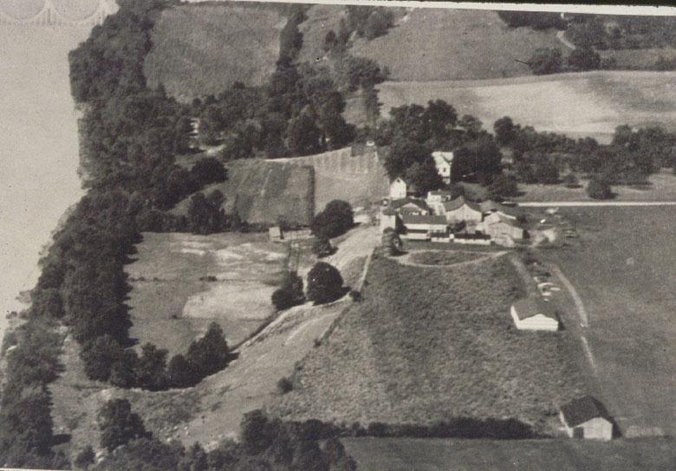
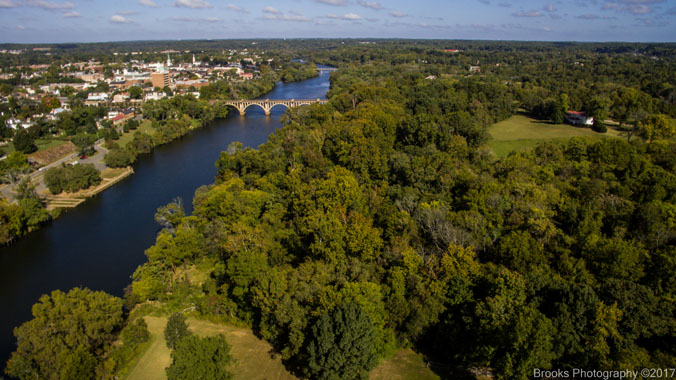
    We can see the impact of new attitudes toward the environment at Ferry Farm in photos below. The top one from the 1930s, a period of intense conservation efforts nationwide, shows trees starting to appear once again while the other from 2017 shows trees on a portion of Ferry Farm stretching out as far as the eye can see to the north.

    1930
    Aerial view of Ferry Farm taken in 1930.

    2017
    Aerial view of a portion of Ferry Farm and points north taken in 2017. Credit: Joe Brooks / Eagle One Photography

    The early 20th century saw the nadir of American deforestation in 1910. But since that year, forest acres in the U.S. have largely held steady [PDF].  The new conservation ethic symbolized in the practice of planting trees to replace those cut down, the reduced use of wood as a building material and fuel source, the need for less farm land, and the movement of people from rural to urban areas (all of which present their own challenges to the environment) have provided a reprieve for America’s forests.

    While George’s mythical chopping of the Cherry Tree is the most well-known tale about trees at Ferry Farm, the more important and fascinating story is how the 300 hundred year history of trees at Ferry Farm reflects broader post-settlement environmental changes in North America and how the Americans who made those changes grew to see the world differently.

    Zac Cunningham
    Manager of Educational Programs

    Elyse Adams, Archaeologist
    Archaeology Lab Technician

  • Ten Cool But Rarely-Exhibited Artifacts Found at Ferry Farm

    When you enter a museum you’re surrounded by cool stuff.  Be it paintings, fossils, or ancient artifacts, they’re all special items that you’d be hard pressed to find elsewhere.  But what if I told you that the cool objects you see on display in a museum are a mere fraction of what most museums actually have in their collections?  There is just never enough room, even for the biggest museums, to display everything.  Additionally, some items are just too delicate to make available to the public.  This is one of the reasons I love my job.  My fellow archaeologists and I get a daily backstage pass to all the incredibly cool things excavated at George Washington’s Ferry Farm.  Here’s our list of “Ten Cool But Rarely-Exhibited Artifacts Found at Ferry Farm.” Be sure to click on any of the photos for more detailed views of the artifacts.

    Wine Bottle Seal
    wine-bottle-seal
    Starting in the 17th century if you were a wealthy gentleman or tavern owner chances are you ordered at least a few custom wine bottles complete with your personal seal.  The seals were stamped in various ways, such as with names, initials, symbols, crests, and dates.  Archaeologists love them because they’re ‘talky,’ meaning the artifact yields lots of information.  A fragmentary bottle seal was found here in 2004 and bears the incomplete name of its owner. The letters visible are either a capital “I” or “J” (the English used the letter I for J), and below that are the letters “-bin”.   These few letters might refer to someone in the Corbin family, an extensive Virginia family with local ties. With a little investigation, perhaps we can flush out who was the mystery guest that brought his own bottle of wine for a visit to Ferry Farm!

    Lead Whistle
    lead-whistle
    Instruments and toys tend to grab our imagination because they make us think about who used them and how the object got lost to time and archaeology.  In our collection we have a simple lead whistle, measuring 1 7/8” long and 3/8” in diameter, with “U.S.A.” stamped on the side.  It’s cheaply made out of lead, which was a very inexpensive material that has, for obvious reasons, been phased out of the toy industry.  In the “Good Ol’ Days”, no one thought twice about making an instrument you put in your mouth out of lead.  Maybe it’s a good thing that the person who owned the whistle lost it.

    Chunkey Stone
    chunkey-stone
    Fun to say.  Fun to play.  Basically a prehistoric rock doughnut, this hand-ground stone was used in a Mississippian Indian game called “Chunkey.”  Warriors rolled disc-shaped stones across the ground and threw spears as close to the stone as possible.  Similar to the Italian game of bocce, but unlike the Italians who threw wooden balls, Chunkey players threw spears, which is pretty awesome.  It’s a bit of a mystery as to how it got to Ferry Farm because there is no evidence that Chunkey was played in eastern Virginia, however some of these gaming stones have been excavated in Maryland and Northern Virginia.   It is also possible that one of Ferry Farm’s colonial inhabitants collected this exotic looking artifact for their cabinet of curiosities.

    “Joseph” bottle fragment
    joseph-bottle-fragment
    Normally broken bottle glass would have trouble finding its way onto any top ten list, but this fragment is one of a kind.  Its owner inscribed his name “Joseph” and the date “174?” into the body of the bottle. That’s not an easy or common thing to do.  The inscription is carved in an elegant and beautiful form indicating a gentry status for its owner.  While no occupant of Ferry Farm was named Joseph, Mary Ball Washington’s older brother bore that name.

    Joseph Ball, though living in England, was heavily involved with Ferry Farm.  He absentee owned and operated a neighboring plantation.  Joseph was lavish in both his gifts and advice to the Washingtons.  He gave Betty, George’s sister, a beautiful silver tea set just before she married.  He offered Mary advice on how to keep George out of the Royal Navy when a plan was hatched to put the then 13-year-old onboard a ship. And maybe, just maybe, he sent over a special bottle of wine with his name engraved on it for the Washington family.

    Lead Toy Hatchet
    toy-hatchet
    More lead toys?  Yep.  This little beauty has special significance to Ferry Farm because of the cherry tree myth.  The 3-inch lead hatchet appears to be a souvenir made during the 20th century, possibly dropped during 1932’s anniversary celebration of George Washington’s birth.  Keepsakes associated with George and the cherry tree abound in Fredericksburg.  Previous private owners of Ferry Farm were known to capitalize on the history of the property, often selling fragments of the ‘original cherry tree’ and cherry seeds to visitors. This hatchet is an obvious symbol recalling the cherry tree story that is so closely associated with Washington’s childhood.

    Milk Glass Darning Egg
    darning-egg
    Recovered completely intact from an old burrow belonging to a groundhog, this artifact had multiple uses on a 19th and 20th century homestead.  The glass egg was a darning aid used to fill out a sock while it was repaired or could be placed in a henhouse to encourage the ladies to lay eggs in a particular spot. There is also a persistent myth that these eggs were used to kill snakes. The snake would eat the glass egg, it was believed, which would then shatter inside them.  This line of reasoning ignores the fact that snakes hunt by detecting chemical signatures of their prey and that snakes can’t really see the egg-like shape of our artifact because of their poor vision.  But it’s a story that highlights the mythology that surrounds some objects once they fade into obscurity.

    Tambour Hook
    tambour-hook
    The tambour hook falls into the category of artifacts that are a little too fragile to display.  Made of carved bone and metal, this exceptional object was used by a gentlewoman, probably George’s sister Betty, to adorn fabric with elaborate embroidery.  Recovered from the bottom-most soil level of the Washingtons’ root cellar where it was deposited sometime between 1741 and 1760, the carved designs that cover the bone handle feature a parrot, leaves, flowing vines, and numerous flowers and represent some of the most popular embroidery themes of the time.  This hook helps demonstrates the fashionability of the Washington women, which contradicts the portrait painted by many modern biographers.

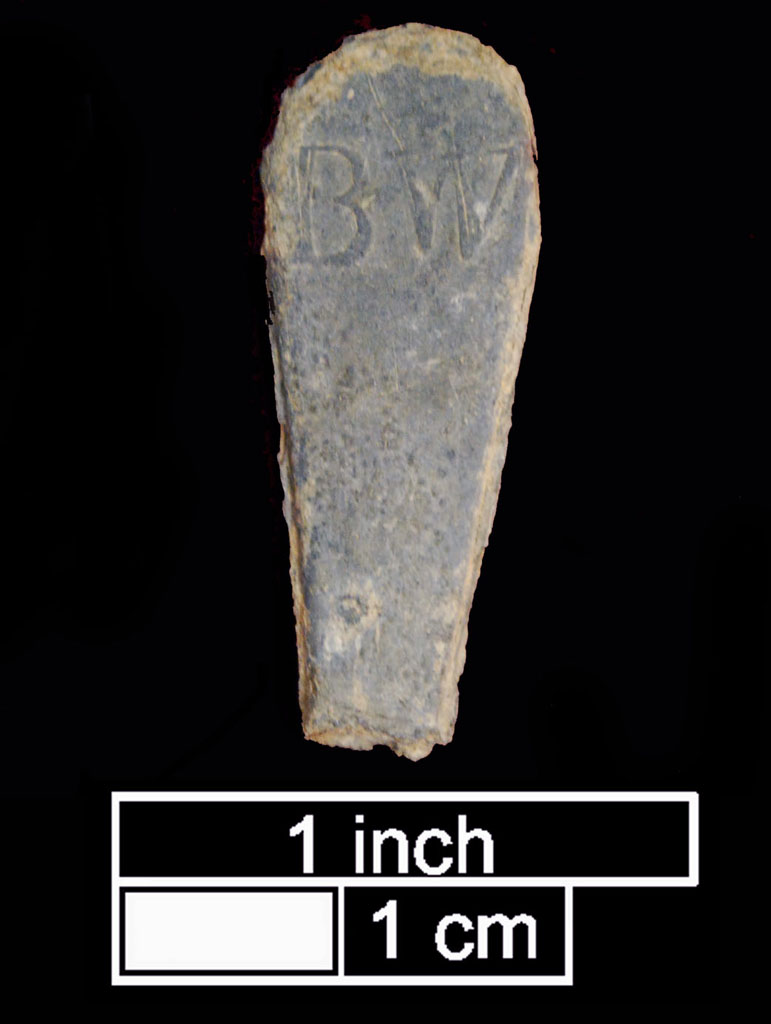
    Pewter Teaspoon with Betty Washington’s Initials
    teaspoon-fragment-with-betty-initials-1
    Betty had some of the coolest artifacts and this one literally has her name on it.  It was customary for tea to be dispensed by the wife or by the oldest daughter in the house and Betty, as the only daughter, was clearly groomed in this ceremony as is evidenced by her own teaspoons.  Pewter, an alloy containing a number of different metals including lead (yes, more lead), wasn’t as fancy as silver but the fact that it’s customized makes it special.  This tea set appears to be part of a “practice” set that Betty used before her uncle gave her a silver tea set  around her 16th birthday.

    Bartmann or Bellarmine Jug/Bottle
    bartmann-bottle-1
    Who doesn’t want to drink out of a jug exhibiting the large face of a crazy bearded man?  I do, and if you were a colonist in the 1700s and early 1800s, you did as well.  Originating in Germany, these face jugs depicted a ‘wild man’ of the woods character popular in Eastern European folklore. By the time these vessels made it to the English market that aspect seems to have been forgotten.  Subsequently, the English created their own story behind the bearded man revolving around their dislike for a similarly-bearded and unpopular anti-protestant cardinal by the name of Robert Bellarmine.  For more about this artifact, read this blog post.

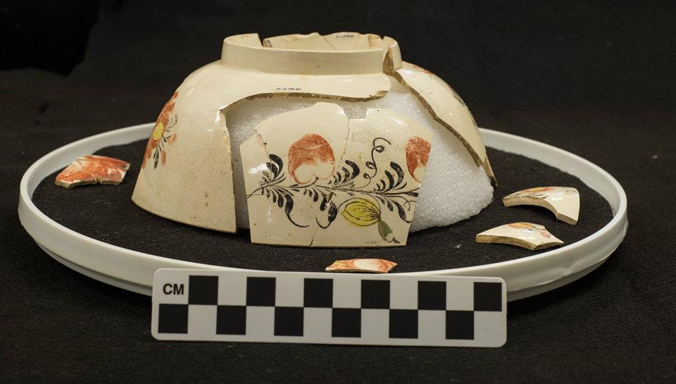
    Repaired Creamware Cherry and Flower Punchbowl
    punchbowl
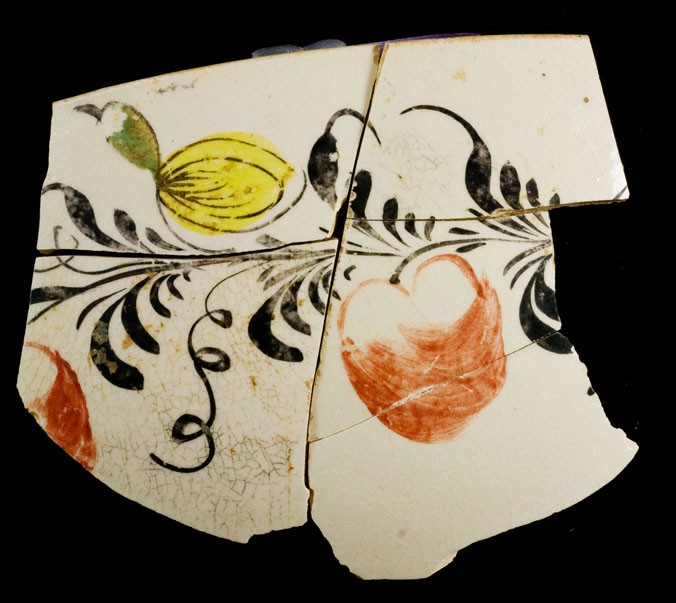
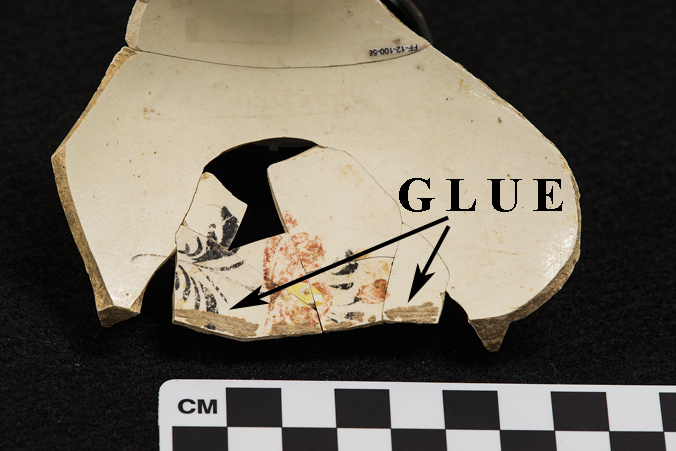
    This artifact is cool for so many reasons.  A beautiful bowl adorned with graceful hand painted flowers and cherries (remember, we love those here), it also exhibits a complicated and tortured use-life while highlighting the importance of punch drinking in the eighteenth century.  Written about here, this bowl was owned by Mary Washington, George’s mother.  Punch bowls vary in size and this one would have been called a ‘sneaker’, which denotes a bowl small enough for guests to take turns sipping out of it before passing it to the next person.  Mary clearly loved the bowl so much that, when it broke sometime between 1765 and 1772, she had it repaired with glue.  Although the hide or cheese-based glue used would not have resulted in a vessel capable of holding punch again, she could display it on her mantle or in her china cabinet…Oh, and the glaze? It has lead in it.

    Laura Galke, Site Director/Small Finds Analyst
    Judy Jobrack, Assistant Lab Supervisor
    Mara Kaktins, Ceramics & Glass Specialist
    Melanie Marquis, Lab Supervisor
    Dave Muraca, Director of Archaeology

  • Photos: Glue Through a Microscope

    While living at Ferry Farm, Mary Washington, mother of George, owned a creamware punch bowl with beautiful hand-painted enamel depicting a floral motif and cherry accents.  Archaeologists excavated pieces of this bowl from the cellar of the Washington home and subsequently discovered glue residue on the sherds.

    PunchBowl

    cherry-sherds

    interior-glue copy

    We’ve written about the importance of the bowl’s discovery here and even showed how we recreated a glue similar to the one used to repair the bowl here.

    As part of our continuing efforts to learn as much as we can about the punch bowl and these glue residues, we took the sherds to the archaeology lab at Dovetail Cultural Resource Group here in Fredericksburg, where they took photos using a microscope.

    Mara Kaktins, Archaeologist
    Ceramics & Glass Specialist

    Zac Cunningham
    Manager of Educational Programs


  • Glue: The Coolest Thing I’ve Ever Found

    As an archaeologist, I am often asked “What is the coolest thing you’ve ever found?”  The answer is complicated.  Although I’ve unearthed 10,000 year old Paleoindian hearths, elaborate porcelains, coins, long lost jewelry, and ancient stone tools, I say that the coolest thing I’ve ever found is …. glue.  This proclamation always elicits questioning looks from well-meaning folks who expect something a little more glamorous.  Let me tell you why, to date, glue is the “coolest thing I’ve ever found.”

    It’s not just the glue itself that is incredible but also the object on which the glue was found.  When I started working at George Washington’s Ferry Farm, my first assignment was to examine creamware associated with Mary Washington, George’s mother, which was excavated from the cellar of the Washington home.  I focused on a lovely punch bowl with beautiful hand-painted enamel depicting a floral motif with cherry accents.  Obviously, we adore cherries at Ferry Farm, being the setting of the fabled chopping down of a certain tree by young George, and we wanted to learn more about it.

    PunchBowl

    cherry-sherds

    The punch bowl was manufactured in the 1760s or early 1770s.  It exhibited a lot of use wear, indicating it was obviously a favorite of Mary’s.  The punch bowl was of a size designed to be passed around at a gathering for each guest to take a sip directly from it.  This was a time before germs were well understood.  Thankfully, for health’s sake, 18th century punch contained a hefty amount of alcohol.  This also meant that punch was not cheap.  Actually, the production and drinking of punch was very much a ceremonial form of conspicuous consumption.  Mary chose this special bowl as much for its beauty as for its function.

    After close inspection of the vessel, I noticed a strange substance adhering to many of the edges.  This unsightly brown stuff extended across the many breaks in the bowl and, upon microscopic examination, exhibited suspicious brush marks.  Furthermore, additional ceramics from the same cellar excavation revealed similar residues.  Could it be glue? If it were, this would shed light on a previously unknown behavior taking place in the Washington home – the breaking and subsequent repair of ceramics.  We had to know!  What followed was a multi-year study during which we tested the historic glue residue samples utilizing mass spectrometry courtesy of Eastern Michigan University. We spent months researching historic glues, replicating those glues, and then breaking and mending much thrift store pottery with the aforementioned glue in the name of science.  The conclusion?  We had indeed discovered eighteenth century glues!

    interior-glue copy

    While this may not seem like a ‘eureka’ moment, it was actually quite significant.  First of all, it’s amazing that 250-year-old glue survived in the ground for so long.  Second, the discovery improves our understanding of Mary Washington, a woman that gave birth to and shaped the young life of our first president.  By replicating period glues and mending modern pottery, we also learned that the vessels Mary had repaired probably were not used for anything other than display after mending.  They could not have held a liquid, which means that after it was broken and mended, the beloved punch bowl was probably relegated to mantle or shelf where the delicate hand-painted flowers and charming cherries could be admired but never used for its intended purpose ever again.

    We also concluded that Mary herself would probably not have made and applied the glues personally.  Turns out making eighteenth century glues involved a wide array of bizarre and often stinky ingredients including ox gall, animal hide, bull’s blood, garlic, eggs, cheese, isinglass (extracted from a fish’s swim bladder), and the slime from garden snails (yep). Watch the video below to see how colonial-era glue was made. You can also click here. It was a time consuming and messy endeavor that was likely undertaken by the enslaved people living at Ferry Farm rather than by the mistress of the house.

    To date, seven vessels belonging to Mary exhibit glue residue.  Interestingly, even though a professional mender was operating in the town of Fredericksburg just across the river from where she lived, Mary chose to have glue prepared at home with which to repair her ceramics. That, plus the fact that she had these pieces mended even though she could never use them again means Mary was a thrifty woman who saw the value in displaying the objects.  Perhaps demonstrating that she owned these highly fashionable ceramics took precedence over using them?

    What makes the glues even more exciting is that nowhere in the historic record does it mention that Mary was repairing ceramics at home.  Our only evidence for this activity is archaeological and it has revealed a previously unknown aspect of her life.  Perhaps now the question is not “Did George chop down the cherry tree?” but rather “Did George break the cherry punch bowl”?

    And all that is why glue is the coolest thing I’ve ever found.

    Mara Kaktins, Archaeologist
    Ceramics & Glass Specialist

  • Being Part of the Story: Collecting Oral Histories about Ferry Farm and Kenmore

    Have you ever seen ads for museums inviting you to “be part of the story”?  Well, at George Washington’s Ferry Farm and Historic Kenmore, many people are part of the story and have been for a long time.  Those who have played an integral part in the ownership, history, preservation, and work of the properties have long had a spot for these two places in their hearts.   Collecting and processing the oral stories of those people is an important part of understanding the historical scope of The George Washington Foundation’s properties.  In fact, oral history programs and collections have become an important component of many museums around the world.

    Our Foundation’s own oral history project officially began in 2007.  My requirement was to interview someone for a Historic Preservation Department course I was taking at The University of Mary Washington.  I was to record recollections of a person describing the layout of a house he or she previously lived in and detail how the rooms and landscape around the person’s home were used by its occupants.  Since I worked in the Archaeology Lab at Ferry Farm, I decided to ask David Muraca, director of archaeology, if he knew of someone I could interview associated with the property or who had lived at Ferry Farm during the 20th century.   He suggested Charles Linton, Jr, a local gentleman who had lived in the 1914 two-story frame house on the property as a boy with his large family from 1942 to 1956.

    ColbertHouse
    The Colbert House (right) built in 1914 by James Colbert, owner of Ferry Farm for much of the early 1900s

    In our oral history session, Mr. Linton and his wife, Pat recounted many specific remembrances of the Linton family’s time living on the very same river bank where George Washington grew up He told of the aftermath of the historic 1942 Fredericksburg Flood, rationing during World War II, and his parents’ efforts to house soldiers and provide medical supplies for the troops.  There were many tourists who visited the property during the time that the Linton’s lived at Ferry Farm. So many, in fact, that they kept a guest book!  People traveling through wanted to visit the place where the nation’s first president had spent his boyhood.  They wanted to buy tiny jars of homemade cherry preserves from Charles’s mother, postcards from his sister Barbara, and get a tour of where young George had cut down the cherry tree.  The visitors were not disappointed either as Charles and his brother, Tayloe, sold wood pieces cut from the trunk of a cherry tree (with a hatchet, no doubt) for one dollar each…not a bad income for two industrious boys at that time!  Tiny cherry wood carvings of hearts and hatchets were whittled and sold, too.

    Heart and Hatchet
    Carved cherry wood heart and hatchet (approx. 1” each) dating from the 1940s. Gift of the Linton family.

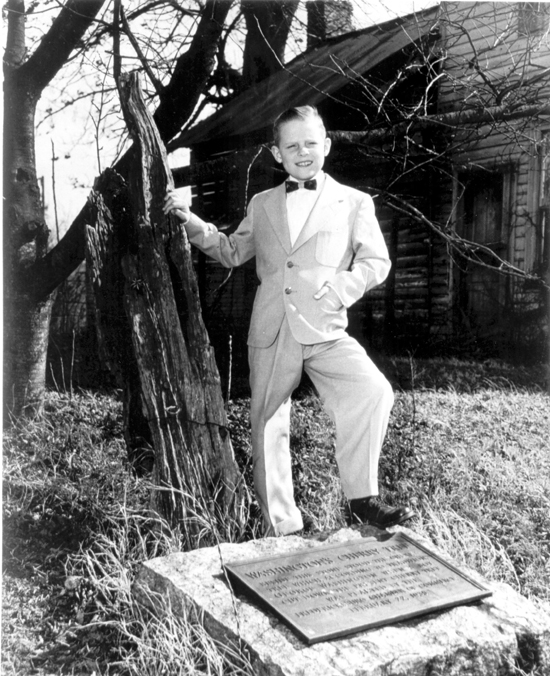
    The stump of a supposed scion of the cherry tree that Washington had barked was also on the property for visitors to see and was known as “The Shrine Tree.”  It was, no doubt, an important reminder to visitors of Washington’s honest character.    While those early 20th-century attractions no longer exist on the property at Ferry Farm, the Cherry Tree Story is still a subject that is inquired about by the visiting public just as it was in Linton’s day.

    BoyCherryTreeSign
    A young visitor stands next to “The Shrine Tree.”

    Some important revelations came to me as a result of doing this assignment for my class.    I began to really recognize the sacred nature of our presidential property and how deeply affected the public had become by that nature over time.  In the case of Ferry Farm, tourists and travelers have been fascinated by Washington’s boyhood home for 230 years mentioning it in diaries and letters over the centuries.  This realization spurred me on to research the publics’ fascination with Washington’s character via the Cherry Tree Story. Why do so many still ask about this tale?  Why do so many acknowledge that the story probably isn’t true but, in their heart of hearts, they want it to be?  To get the answers to these questions it would be necessary to ask more questions by collecting more oral histories and to begin a Foundation archive.  In doing so, it became clear that the recent past, brought to life by the personal stories of so many who have been involved with Ferry Farm, proved a new and fascinating way to look at our archaeologically-rich property and gain understanding of its social and cultural impact over the decades.  I got to work interviewing and, before I knew it, an archive of stories about Ferry Farm and Kenmore Plantation was created.  Not only did I discover more about the 20th century history of our Foundation properties, but documenting the preservation efforts associated with them proved critical to remembering the hard work of the many dedicated people who saved them.
    By creating a formal database with the mission of gathering oral histories, I saw that we could document much personal and institutional memory about our museum sites and couple the insightful perceptions collected about the Washington and Lewis Family’s with our scientific and historical research findings.  Eight years later, the archive is well on its way.  Samplings of some of the amazing stories collected so far will make their way into future blog postings so you can view for yourself the peoples’ passion for Ferry Farm and Kenmore’s historical treasures.   Anyone wishing to participate in this project is encouraged to contact the Foundation at (540) 370-0732 extension 14 or healy-marquis@gwffoundation.org.

    Melanie Marquis
    Archaeology Lab Supervisor
    Oral History Project Coordinator