Lives and Legacies

Tag: Colonial America

  • Colonial Scary Stories to Tell in the Dark

    We have reached the best time of the year. The summer heat has broken, the leaves are crispy, and the best holiday, Halloween, is coming up quickly. We all know Halloween was not celebrated in Colonial America, but that doesn’t mean we can’t incorporate a bit of Colonial America into Halloween. 

    To celebrate, I have compiled a list of scary stories, supernatural stories, ghost stories, folklore, and legends that were either written in or set in Colonial America.  This era provided a perfect setting for the development of American horror. Europe had ancient castles, ruins of abandoned abbeys, and moody wind-swept moors to inspire centuries of writers and storytellers.  America had isolated settlers, a strict, religiously controlled society, and an untamed wilderness where any evil could lurk. It was fertile ground for witches, devils, the supernatural, cryptids, and folklore. 

    Witches and the Devil

    The earliest stories date back to the start of America when Puritan communities were on constant guard for the devil, who was a very real and imminent threat.

    In his book Memorable Providences Relating to Witchcrafts and Possessions (1689), Cotton Mather tells stories about incidents involving witches, from the haunting of the children of Boston mason John Goodwin to the murder of Mr. Philip Smith to Mary Johnson and her dealings with the devil at Hartford. 

    Cotton Mather, Puritan minister, author, and no doubt a blast at parties. Columbia University

    Witch hysteria came to America while fading out across much of Europe, with the deadliest event being the notorious Salem Witch Trials in 1692/1693.   

    The Mather family (Father: Increase, Son: Cotton) again intervened after the trials to defend the judges’ actions, review the cases, and add further accounts of documented supernatural incidents. Cotton’s book Wonders of the Invisible World (1693) looks at the cases that eventually led to convictions and death and defends them by giving accounts of similar trials heard by Judge Sir Matthew Hale.
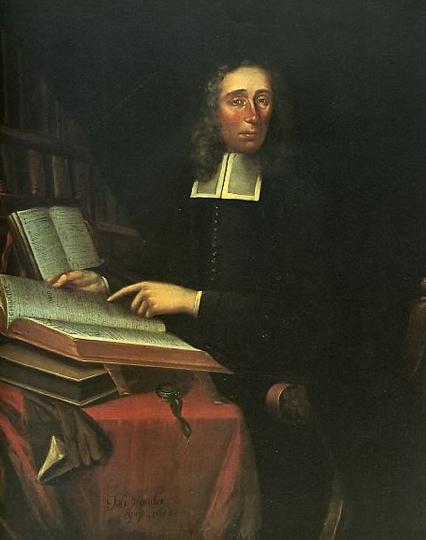
    Increase Mather, father of Cotton, a Puritan minister, Harvard graduate who is not mad just very disappointed in you celebrating Halloween. The University of Virginia

    Increase Mather’s An Essay for the Recording of Illustrious Providences (1694) provides a remarkable account of accidents, apparitions, and unaccountable phenomena.  Mather retells the tale of a woman being molested by spirits, a maid possessed by evil, and even a house haunted by a demon. 

    Lithobolia: or, the Stone-Throwing Devil (1698), written by Richard Chamberlayne, is a tale that is considered an early example of supernatural horror writing and what many say is the first documented incident of witchcraft in America. The story centers around incidents of witchcraft, demonic voices, and poltergeist activity that take place at a tavern in New Hampshire in 1682.  Increase Mather mentions the story in Illustrious Providence when documenting the spread of witchcraft before the Salem trials.

    The beginning of American supernatural horror

    Wieland: or, The Transformation: An American Tale (1798) by Charles Brockden Brown is often considered the first American “Gothic” novel.  Gothic means a story characterized by an atmosphere of fear, supernatural occurrences, and often a return of horrible past events and their effects on the present.

    Wieland takes place in Colonial America between the French and Indian War and the American Revolution.  It is a psychological horror story that involves religious fanaticism, family, the supernatural, mental illness, deception, and murder. 

    American Legends

    One of the most well-known legends often told at Halloween is Washington Irving’s The Legend of Sleepy Hollow (1820). Set in Sleepy Hollow, New York, in 1790, it involves pedagogue Ichabod Crane in his competition for the affections of Katrina Van Tassel.  After hearing the legend of the Headless Horseman at a harvest party, Crane makes his way home only to be confronted by the dead Hessian mercenary. 
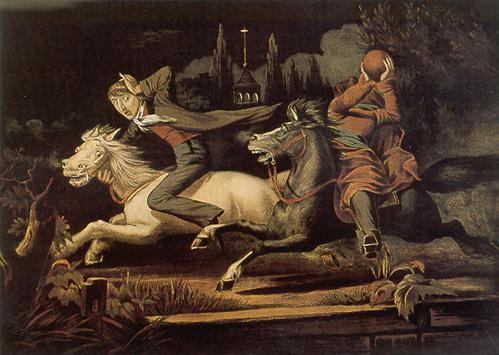
    Ichabod Crane being chased by the Headless Horseman. Historic Hudson Valley

    Another legend from Irving’s book Tales of a Traveller (1824) is that of Captain William Kidd. Captain Kidd was a Scottish privateer who lived in New York City. The governor of New York, Massachusetts Bay, and New Hampshire commissioned him to hunt down pirates and enemy French ships in the Indian Ocean.  Unfortunately, by the time he made it back to America, the political views had shifted, and he was arrested for piracy in Boston and shipped to England to stand trial.  There, in 1701, he was found guilty, hung not once but twice as the rope broke the first time, then gibbeted and displayed over the River Thames.  Kidd supposedly haunts many places around New York City, his beloved adopted city.
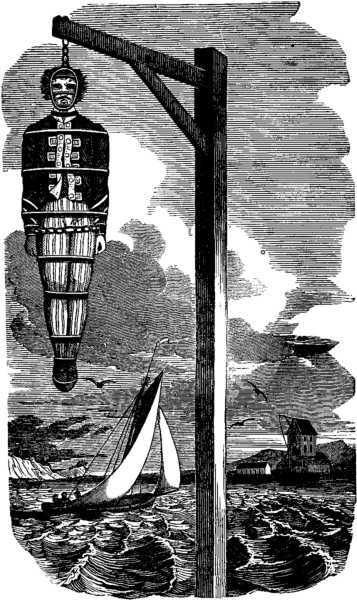
    Captain William Kidd gibbeted on London Dock. The Pirates Own Book

    Another of Irving’s tales, The Devil and Tom Walker, takes place in Massachusetts, where Captain Kidd supposedly buried some of his treasure.  In 1727, Tom Walker, the elderly miser, meets “Old Scratch” at the swamp while walking in an abandoned Wampanoag fortress.  “Old Scratch” offers Walker the riches in the swamp buried by Kidd for a price (his soul).  Then, it explores everything that happens when someone realizes their immortal soul no longer belongs to them and when it comes time to pay the price.
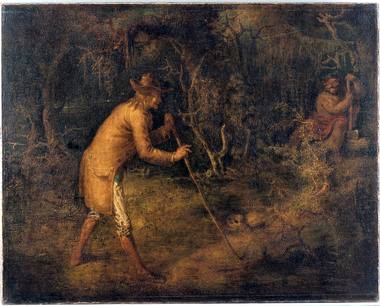
    The Devil and Tom Walker. The Cleveland Museum of Art

    Even George Washington is mentioned in one ghost story by Nathaniel Hawthorne in his book In Colonial Days when discussing the legends of Old Province House. Howe’s Masquerade follows Governor Howe as he throws a costume party on the eve of the siege of Boston (April 19, 1775)—guests dressed in rags representing Washington and his generals.  Howe and their guests are confronted with a ghostly funeral march of Puritan governors, illustrating the death knell of royal authority and a bad omen for the British in the upcoming battle.
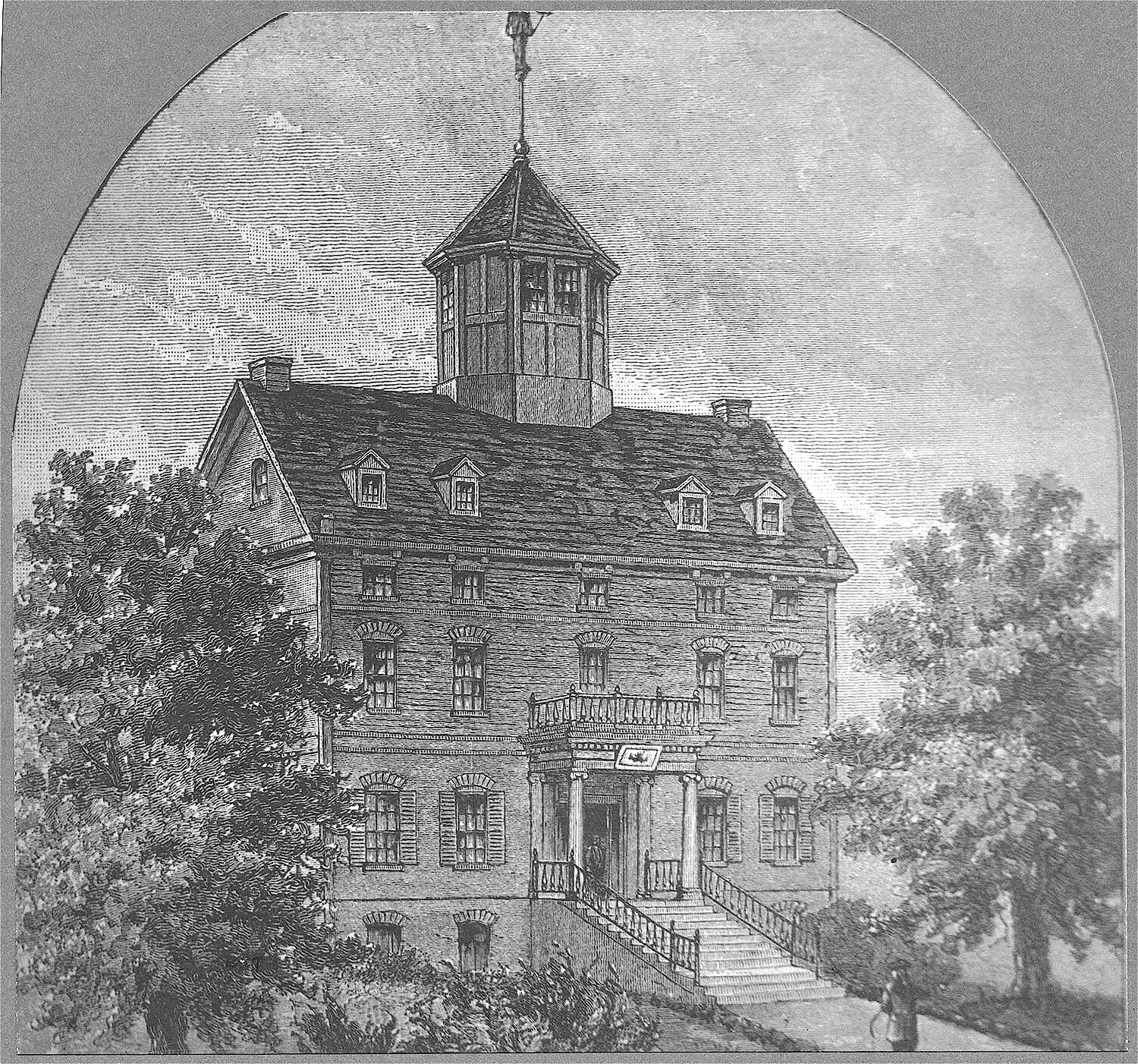
    Old Province House, Boston. The Memorial History of Boston

    American Cryptids

    W.F. Mayer’s In the Pines (1859) explores the beginnings of the Jersey Devil. Deborah Leeds’s thirteenth child was born in 1736 in the Pine Barrens in New Jersey. Soon after birth, the child suddenly turned into a horrible wyvern-like creature with a goat’s head, leathery bat-like wings, horns, small arms with clawed hands, legs with cloven hooves, and a forked or pointed tail.

    The Jersey Devil has haunted the Pine Barrens since being spotted in 1820, 1841, 1909, 1925, 1937, 1951, and as late as 1960.
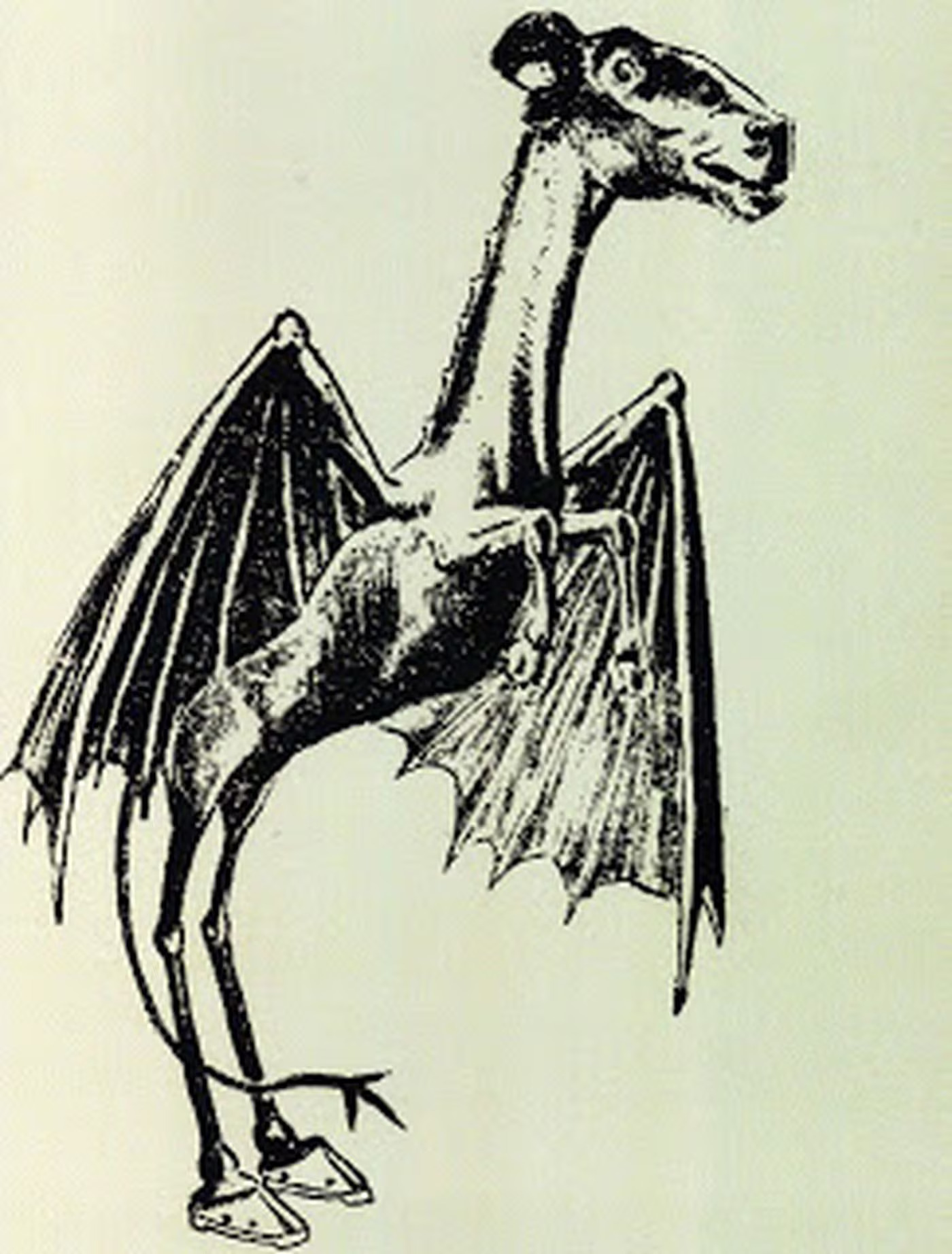
    The Jersey Devil as seen in 1904

    So, sit back with some Halloween candy and enjoy some scary colonial stories on this fine autumn evening. 


    Heather Baldus

    Collection Manager

  • Music from the Past: Jaw Harps and their Players

    What is a jaw harp, and what does it tell us? This little instrument likely looks familiar, but you may not know that much about it. That certainly proved the case for me when I decided to research the four we have in our collection.

    To start, a jaw harp is an extremely simple instrument to make and play. It only requires an iron or copper alloy frame and a flexible metal tongue, or lamella, which runs through the center. Manufacturing styles vary, but many undergo casting or forging to create the bow shape and arms. The lamella most often attaches by hammering it in place. This part is rarely preserved in the archaeological record, so only the frame remains for us to find.

    To play the instrument, one places it against their mouth and plucks the lamella while breathing out. Varying your breathing and the shape of your mouth cavity allows the sound to change. That said, while the instrument is easy to play, it proves difficult to play well, and many dislike its boings and buzzes. Those skilled at the jaw harp, however, went on to play for the likes of Frederick the Great and George IV. They even managed to play more than one jaw harp at once.

    Man playing a jaw harp (Mackinac State Historic Parks 2018)

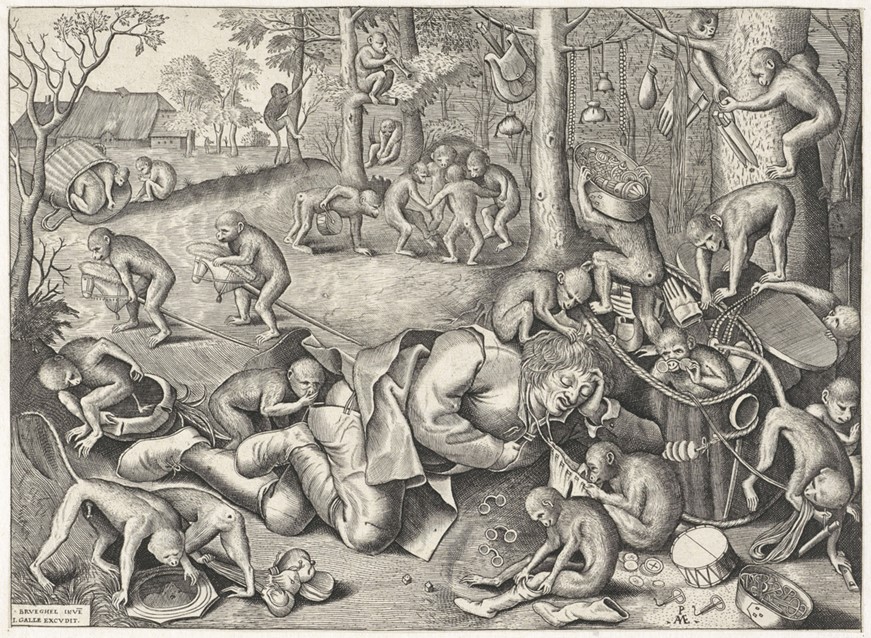
                The history of jaw harps dates beyond the fifth century BCE in Asia. Archaeological evidence places the instrument’s arrival in Europe around 1200, with the migration occurring along northern routes through the Baltic. Due to their mundane nature, jaw harps rarely appear in historic accounts or art. Two exceptions include Pieter Bruegel the Elder’s The Sleeping Peddler Robbed by Monkeys (1562), which helps identify peddlers as the main purveyors of jaw harps, and accounts of the North Berwick Witch Trials (1590-1592), where one of the accused performed for James VI of Scotland. Witches aside, the most common players at this time included the lower classes and soldiers.

                While jaw harps may not have generated the most attention, they played key roles in early trade deals in North America. Jaw harps likely first came to North America in the company of soldiers, but they soon gained popularity amongst indigenous groups, such as the Five Nations Iroquois. Confirmation of this occurred as early as 1595, with Robert Dudley reporting that the instrument made a successful trade item. As trade continued, the exchange of jaw harps frequently related to the fur trade, but some larger and more dubious, deals included the acquisitions of Staten Island and Maryland. That said, even the fur traders came under fire for using jaw harps of poor quality.

    Within established colonies, jaw harps appeared as an item frequently sold by merchants. Numerous adverts appeared in papers between the 1730s and 1780s. For Virginia, this included merchants in Williamsburg during the 1760s, as well as Alexandria and Gloucester in the 1770s. Production would have occurred in England with the then imported good available to all customers in the colonies. We know that soldiers played them during the French & Indian War and the American Revolution. This connection to soldiers would even continue through the Civil War. As for other players in Colonial times, a couple of adverts for runaway indentured servants placed in Benjamin Franklin’s Pennsylvania Gazette listed jaw harps as a special talent of the individual and amongst the items possibly carried by them.

    Aside from these individuals, the other most common players consisted of enslaved people. Evidence of this comes solely from the archaeological record. Excavations have uncovered jaw harps at a number of sites in Virginia, including Monticello, that date from the mid-1700s to early 1800s. In all of these cases, the instruments came from enslaved domestic quarters and work areas. Due to their nature, jaw harps would have proved an easy item for an enslaved person to hold on to, use, and share with others. In use, they would have been part of the enslaved music culture, which offered individuals a respite from work, a way to express themselves, and perhaps an outlet for the continuation of West African cultural practices.

    As I mentioned earlier, four jaw harps reside in our collection. Three came from the Washington cellar, while the fourth came from a Civil War trench that ran through the cellar. To understand their significance, an examination of the artifacts themselves and their contexts help us identify and date them.

    Physically, all four appear to reflect a design known as Gloucester. This means they consist of an iron frame and represent one of the most common designs in America during Colonial times and after the Revolution. We know that the ones that came directly from the cellar pre-date the 1830s due to the collapse of the house. A closer look at the artifacts accompanying them provide us with a range of the 1780s-1830s for the date of deposit.

    Depiction of a Gloucester-type jaw harp sans lamella

    As for the harp from the Civil War trench, while this may seem like an obvious identification, it remains tricky. A Union soldier may have played and discarded it while encamped here. However, when people filled the trench after the war, they may have used dirt that contained earlier artifacts from Ferry Farm. As the trench ran through the cellar, this harp ultimately lay close to the other three, and the dirt used to fill the trench may have come from that area. We may never know for sure on this particular piece, but it likely dates either to the war period or as a contemporary of the other three.

    Ferry Farm’s jaw harps

    While the dates provided occur after the Washington occupation of Ferry Farm, jaw harps existed on the market during their time, meaning the instrument may have had an earlier presence. As for who played them, these instruments likely reflect use by enslaved individuals. After the Battle of Princeton (1777) claimed the life of Hugh Mercer, who had purchased Ferry Farm from George Washington, the property passed through a series of renters. None occupied the site for long, but an enslaved population maintained a constant presence as each renter relied on enslaved labor. This continued up until the Civil War. With the evidence of enslaved people using jaw harps at other sites in Virginia and the fact that enslaved individuals constantly lived or worked at Ferry Farm, we can attribute these artifacts to them.

    One of our future projects involves reconstructing the enslaved quarters at Ferry Farm to better represent and tell the enslaved narrative. As jaw harps represents an activity that occurred during the limited down time allocated to enslaved people and reflects the importance of music in the culture, one will certainly be included upon completion of the project.  

    After all that history and archaeology, I leave those wondering what a jaw harp sounds like with the perfect piece. Fittingly titled “Washington’s Birthday,” this 1909 piece by Charles Ives utilizes the instrument to invoke the sound of country dances on a cold, dreary day in February. To hear the jaw harp, skip to 7:37. Enjoy!

    Emma Schlauder

    Research Archaeologist


    References

    Clyne, Anthony, 1928. The Jew’s Harp a Century Ago. The Musical Times 69(1024): 508-509.                                                                                        

    DAACS, 2022.Artifact Query 3, 8 August 2022. The Digital Archaeological Archive of Comparative Slavery (https://daacsrc.org/queries/aq_three_results).

    Kolltveit, Giermund, 2006. Jew’s Harps in European Archaeology. Archaeopress, Oxford, UK.

    2009, The Jew’s Harp in Western Europe: Trade, Communication, and Innovation, 1150-1500. Yearbook for Traditional Music 41: 42-61. 

    Samford, Patricia M.,1994. Searching for West African Cultural Meanings in the Archaeological Record. African Diaspora Archaeology Newsletter 1(3): 1-3.                                                                                                            

    Wright, Michael, 2008. The Jew’s Harp in the Law, 1590-1825. Folk Music Journal 9(3): 349-371.    

    2011, The Jew’s Harp Trade in Colonial America. The Galpin Society Journal 64: 209-218.