Lives and Legacies

Tag: colonial cooking

  • Ice Cream: A Scoop of History

    This time of year, I find it difficult not to reach into my freezer after dinner to get a cold, sweet dairy treat.  Ice cream in cartons and scooped from behind a counter has become a part of the American experience. Ice cream was not always so easy to come by, however, as the ingredients and tools to make it were reserved for the most elite part of the population. 

    Ice cream has a complicated past that is often exaggerated, misinterpreted, and associated with individuals that probably have nothing to do with the creation of the icy treat.  In the 20th century, companies fabricated a great deal of these origin stories to help sell this delicacy.  Stories range from Ancient Rome to Martha Washington and Dolley Madison, some of which contain bits of truth, but are now inflated into full blown myths.
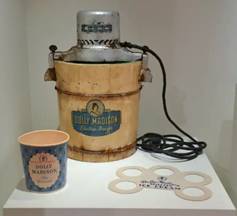
    Dolly Madison electric ice cream freezer on display

    Moving forward to Colonial North America, ice cream recipes were not hard to come by as even Hannah Glasse had a recipe “To Make Ice-Cream” in her popular book The Art of Cookery Made Plain and Easy.[ii]  Thomas Jefferson, extensive traveler that he was, even  recorded a recipe for vanilla ice cream, helping to establish its popularity in the English American colonies and new republic.[iii]  Ice cream flavors usually depended on seasonal fruits that were easy to mash, but more interesting and savory flavors like parmesan and oyster also made their way into recipe books of the period.
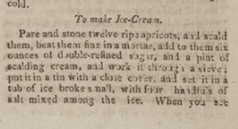
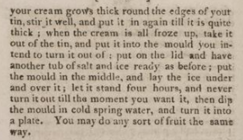
    text of how to make ice cream
    printed text of how to make ice cream

    “To Make Ice-Cream” from The Art of Cookery Made Plain and Easy by Hannah Glasse  Source: Library of Congress.
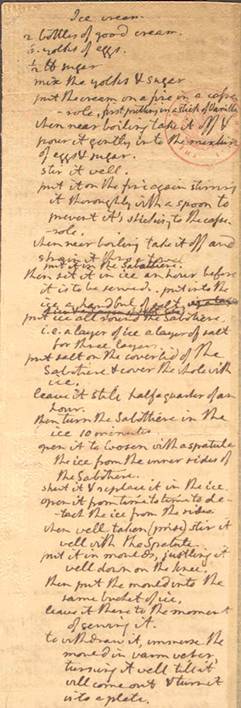
    Thomas Jefferson's written ice cream recipe

    Thomas Jefferson’s recipe for ice cream. Written in his hand.  Source: Library of Congress.

    So, if it wasn’t availability of recipes and the concept of freezing the cream to make the dessert that stopped Americans from making this treat to cool off in the summer, then what was it?  It was the capability of keeping ice, the labor it took to churn the cream by hand, the expensive imported ingredients, and the specialty serving pieces needed to put the frozen delight on the table for guests. 

    At this time, if you wanted ice, you had to harvest it from frozen lakes, ponds, or rivers in the winter. Anyone could do that, but preserving it was the challenge. Underground ice houses specifically built to preserve the ice until the warmer months were reserved for the elite.

    Also remember that colonists had to typically import both the sugar to sweeten the cream and the salt for the ice.  Both white sugar and salt were used sparingly.  So, a recipe meant to show off using a liberal amount of both was something many could not afford to waste resources on. 
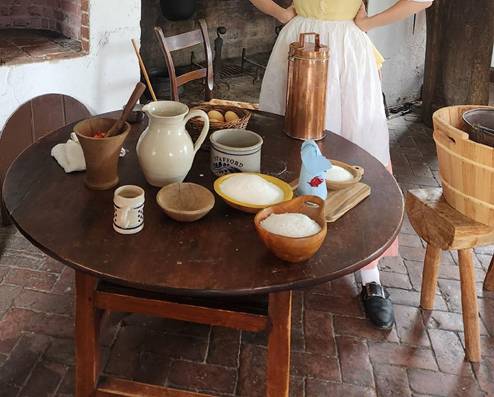
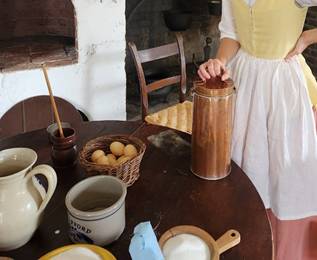
    ingredients laid on on a table for making ice cream

    Ingredients used to make strawberry ice cream.  Source: The George Washington Foundation.

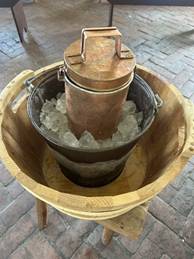
    Ice cream could be made using either a pewter vessel or a specialty sorbetiere.  A sorbetiere was a French invention made specifically for ice cream production that was essentially just a copper container with a lid.  Either the sorbetiere or pewter bowl with the ice cream mixture was placed into a container of ice and salt.  The container was then churned, occasionally stopping to scrape the mixture off the sides when it began to freeze.  This process is not unlike what happens in both hand crank and electric ice cream makers from modern times, but all done by hand.  On a Southern plantation wealthy enough to afford the ice, sugar, salt, and tools to make the ice cream, they’d also have to spare the time of an enslaved laborer for an hour or more to churn the dessert by hand. 
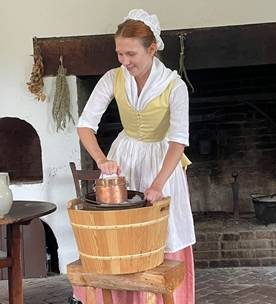
    woman hand churning ice cream in 18th century clothing
    a copper sorbetiere on table with ingredients
    copper sorbetiere sitting in bucket of ice

    (Left) Churning the ice cream. Source: Emma Schlauder. (Center & Right) Copper sorbetiere. Source: The George Washington Foundation.

    George and Martha Washington were possibly introduced to ice cream by the Royal Governor of Virginia, Lord Botetourt in 1770 at the Governor’s Palace in Williamsburg, where there is evidence of an ice house and ice molds used in the production of ice cream.[iv]  Following George’s introduction to ice cream, he ordered an ice house to be built at Mount Vernon  and he acquired a “cream machine for ice” and other items to help make and serve ice cream to guests.[v]  Martha Washington was known for hosting gatherings during George’s presidency where she served prestigious treats like Lemonade and ice cream, as noted by Abigail Adams  in 1789.[vi]

    Mount Vernon Ice House

    Ice house at Mount Vernon. Source: Mount Vernon Ladies’ Association.

    When I prepare for Taste Through Time Programs, I always look for evidence of what I am making at both Kenmore and Ferry Farm. Unfortunately, there is really no evidence of ice cream being served at either property during the occupation of the Washington and Lewis families. Despite the presence of The Art of Cookery Made Plain and Easy in Fielding Lewis’ probate inventory and loaves of white sugar in Betty Lewis’, there is currently no evidence of ice houses or ice cream making and serving equipage at either Kenmore or Ferry Farm from this period.

    Allison Burgess

    DAR Director of Education


    [i] Theobald, M. M. (Winter 2010). Some Cold, Hard Historical Facts about Good Old Ice Cream. Colonial Williamsburg Journal. https://research.colonialwilliamsburg.org/Foundation/journal/Spring10/icecream.cfm

    [ii] Glasse, H., Katherine Golden Bitting Collection On Gastronomy & Elizabeth Robins Pennell Collection. (1805) The Art of Cookery Made Plain and Easy; Excelling Any Thing of the Kind Ever Yet Published … Also, the Order of a Bill of Fare for Each Month in the Manner the Dishes Are to Be Placed Upon the Table, in the Present Taste. Alexandria: Printed by Cottom and Stewart, and sold at their Book-Stores, in Alexandria and Fredericksburg. [Pdf] Retrieved from the Library of Congress, https://www.loc.gov/item/05005034/.

    [iii] Berkes, A. (2013, June 28). Ice Cream. Monticello.org. https://www.monticello.org/research-education/thomas-jefferson-encyclopedia/ice-cream/

    [iv] Theobald, M. M., Some Stone Cold Historical Facts.

    [v] Ledger B (photostat, Mount Vernon Ladies’ Association), 198a.

    [vi] “Abigail Adams to Mary Smith Cranch, 9 August 1789,” Founders Online, National Archives, https://founders.archives.gov/documents/Adams/04-08-02-0214. [Original source: The Adams Papers, Adams Family Correspondence, vol. 8, March 1787 – December 1789, ed. C. James Taylor, Margaret A. Hogan, Jessie May Rodrique, Gregg L. Lint, Hobson Woodward, and Mary T. Claffey. Cambridge, MA: Harvard University Press, 2007, pp. 397–401.]


  • Betty Washington’s Cookbooks

    In the 18th century, more women began to publish cookbooks.  Previously, writing or compiling such books was the domain professional cooks or chefs, who were men.  Two of these women and their books, Hannah Glasse’s The Art of Cookery, Made Plain and Easy and Eliza Smith’s The Compleat Housewife, or, Accomplished Gentlewoman’s Companion, ended up in Betty Washington Lewis’s personal library.  She no doubt referenced these two useful books as much as I have referenced them in my blog posts about cooking here, here, and here.  Both Glasse and Smith were part of an innovative movement to create guide books on cooking for common people in a common language without pretense.

    Cookbooks on the Probate
    The “Compleat House Wife” and “Glasses Cookery” listed on the probate inventory made following Fielding Lewis’s death in 1782.

    Hannah Glasse was born in London in 1708 and had her first book Compleat Confectioner published in 1742. Her second book The Art of Cookery was published in 1747.  This book on cookery was so popular that it went through ten editions before her death in 1770.  It was reissued another sixteen times after 1770, including two American editions in 1805 and 1812. The book’s commercial success did not translate to personal success for Glasse, however.  Unfortunate business decisions eventually led to her declaring bankruptcy, selling the copyright to The Art of Cookery, and being sent to debtor’s jail.

    Hannah Glasse's 'Art of Cookery' frontispiece
    The frontispiece of Hannah Glasse’s The Art of Cookery Made Plain and Easy. Credit: Wikipedia

    Eliza Smith and her life are shrouded in mystery and, unfortunately, not much is known about her. She wrote only one book, The Compleat Housewife, or, Accomplished Gentlewoman’s Companion, which went through eighteen editions and became the first cook book published in Colonial America in 1742.  According to her own account, what she presented in the book was from her own experience.  Her recipes and tips came from a “space of thirty years and upwards during which time I have been constantly employed in fashionable and noble families.”

    Eliza Smith's 'The Compleat Housewife' frontispiece
    Frontispiece of Eliza Smith’s The Compleat Housewife: or Accomplish’d Gentlewoman’s Companion. Credit: Wikipedia

    When these two ladies were writing in the mid-18th century, more people were residing in urban areas as part of the emerging middle and gentry classes.  These new relatively or very affluent groups were desperate to keep up with fashions, manners, and lifestyle of the aristocracy.

    This often meant the middle-class housewife needed assistance with how to run a household or plan multi-course meals to keep her from committing embarrassing social faux paus.  The old commercial cook books were usually unhelpful since they were written by grand chefs for other cooks working in courts or mansions with large kitchen staffs. These books were filled with technical language and extravagant recipes with expensive ingredients.

    New writers like Glasse and Smith became popular because they offered practical advice, common sense recipes, and organization.  They wrote their books to help average middle and gentry class homes with small staffs, basic cooking equipment, and a limited budget. As Glasse stated, she wrote her book “in so full and plain a manner, that most ignorant Person, who can read, will know how to do Cookery well”[1] She only hoped her book would “answer the ends I intend it for; which is to improve the servants, and save the ladies a great deal of trouble.”[2]  Eliza Smith had a similar goal, writing that her book would be a guide for the housewife where “the receipts [recipes] are all suitable to English constitutions…wholesome, toothsome, all practicable and easy to be performed; here are those proper for a frugal, and also for a sumptuous table.”[3]

    Indeed, both women’s recipes had simple instructions, accessible ingredients, easy and practical help with weights, measurements, and cooking times.  Recipes had no French vocabulary, no complicated patisserie, and no confusing directions. They were just simple, delicious dishes any housewife could make or have servants make without formal culinary training.  Eliza Smith offered over a dozen different types of stew with everything from beef to eel and her pancake and apple fritter recipes sound delicious! Hannah Glasse included over 20 different types of pies, an easy and lovely syllabub, and even the first recorded recipe for curry.

    'To make a Currey the India Way' from Hannah Glasse
    Recipe for curry from Glasse’s “The Art of Cookery”. Credit: Wikipedia

    The 18th century middle or gentry class housewife and her staff, e.g. Betty and enslaved cook Rachel, could use these books to create meals that no longer consisted of just boiled meat and a vegetable. Now, they could create a range of dishes that would not be out of place on the table of a Lord or Lady.  Betty could have dinners prepared for the week, plan special dishes for a party, or undertake extravagant desserts for her Christmastime table.  All would delight guests who were using the same books.

    The Art of Cookery and The Compleat Housewife democratized cooking, which is something Betty Washington Lewis, sister of the first American president, would have appreciated.

    Heather Baldus
    Collections Manager

    [1] Hannah Glasse, The Art of Cookery Made Plain and Easy, T. Maiden for A. Lemoine & J. Roe, 1802: pg 3

    [2] Hannah Glasse, The Art of Cookery Made Plain and Easy, J. Rivington and Sons [and 25 others], 1788: pg 4

    [3] Eliza Smith, The Compleat Housewife: or, Accomplished Gentlewoman’s Companion, J. and J. Pemberton, 1739: Preface

  • Lecture – Foodways in the 18th Century [Video]

    On Tuesday, May 14, 2019, Park Ranger Deborah Lawton of George Washington Birthplace National Monument presented a lecture titled “Foodways in the 18th Century” that explored the new dishes and changing tastes of the time.

    Join us on Tuesday, May 21, 2019 for “The Social Role of Garbage in Colonial Virginia” with Dave Muraca, Director of Archaeology at The George Washington Foundation. Dave will explore some of the aspects of colonial waste disposal and put these practices into a larger context that in turn may make modern persons question their own sense of normalcy. Talk begins at 7:00 p.m. The lecture is FREE and hosted at the Fredericksburg branch of the Central Rappahannock Regional Library at 1201 Caroline Street, Fredericksburg, Virginia. To learn more, visit kenmore.org.

  • Video – The Colonial Kitchen: Making Switchel

    In this video, we make switchel, a summertime beverage popular in the 1700s. Its ingredients contain a lot of potassium which replenishes the body’s electrolytes. Learn more about switchel and other methods used to say cool in the 18th century on this blog post.

  • Summer Greens from the Colonial Garden

    Typically, when modern Americans think of summer barbecue food, they think of meat grilled over an open flame. While that would certainly appeal to an eighteenth century audience, it is not necessarily what they considered ‘typical’ summer fare. Large livestock like pigs and cattle were usually slaughtered and butchered in the late fall/early winter when the weather was far more conducive to task. This meant that large roasts (like mentioned in our earlier blog) were not the norm in the warmer months. Instead, people of the 18th century looked to the seasonality of ingredients to inspire their summer time fare.

    Eighteenth century diets were very dependent on the growing seasons. Summer was a bounty of fruits, vegetables, greens, herbs, and anything else that could not be had in the dead of winter. Much like today, there were a variety of methods, styles, and recipes used to please the numerous palates.

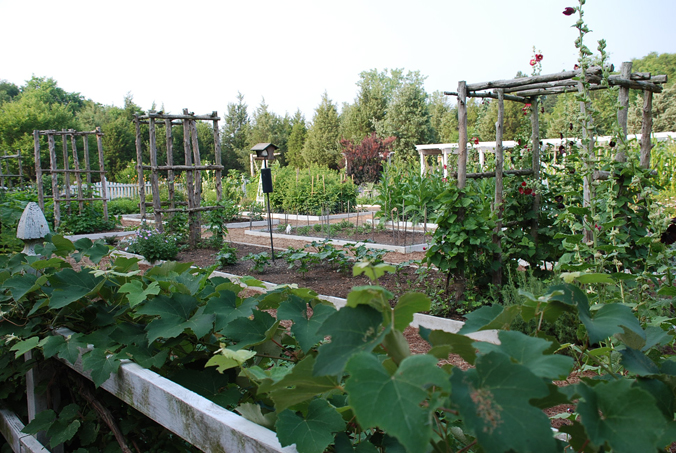
    Garden (1)
    The demonstration garden at George Washington’s Ferry Farm.

    With today’s weekend farmers markets and roadside stands, a salad seems the ubiquitous summer option. But what would our forefathers have thought of raw vegetables tossed in oil and vinegar? They certainly had all of the elements available to them but their tastes were different than ours. After all, we still have oysters and ice cream but most of us no longer enjoy oyster ice cream.

    While the oldest references to salad come from ancient Rome (usually referred to as sallet) it was not ubiquitous in English summer cuisine. While there are some references in cookbooks and menus of the time that called for ‘salad herbs’ like lettuce and spinach to be served raw, most of their English recipes called for cooking the vegetables in some way.

    The modern stereotype of English cooking insists that greens be boiled until no real flavor or texture remains. And while many of 18th century recipes for vegetables include boiling (and some for quite some time) there is also this warning in Hannah Glasse’s The Art of Cookery Made Plain and Easy.

    GardenThings2
    Hannah Glasse cautions her readers not to “over-boil” fresh garden greens.

    There was a clear appreciation for fresh vegetables even if they were prepared in some manner.  An appreciation that extended into George Washington’s own household. One recipe included in Martha Washington’s cookbook was for a ‘Lettis Tart’ which called for ‘cabbage lettis’ and prunes to be put in a crust with cinnamon and ginger and then baked like a pie.

    In addition to recipes calling for fresh fruits and vegetables, early Americans were very familiar with numerous preservation methods in order to enjoy vegetables and fruit out of season. In the summer they would pickle vegetables, dry herbs, and make preserves with fruits so they could enjoy them all year long.

    In September 1784, George Washington traveled west of the Allegany Mountains. He recorded some of his supplies in his diary and includeed a canteen filled with ‘Chery Bounce’. This was a drink made from cherries preserved in brandy and was a way for Washington to take the taste of Virginia summer with him on his travels.

    Cherries on the cherry trees in the Demonstration Garden.
    Cherries on the cherry trees in the Ferry Farm’s demonstration garden.

    This summer when you are contemplating your patriotic picnic options for your July Fourth festivities, don’t pass up the greener options. They have far more in common with the summer options of our founding fathers than you may have originally believed.

    Joe Ziarko
    Manager of Interpretation & Visitor Services

  • Video: The Colonial Kitchen – Drinking Chocolate

    In this video, we taste three different chocolate drinks from across the centuries and discover what ingredients went in them to make each taste so differently.

    Read about “Sweet-Toothed Colonials and Their Chocolate” here.


  • Thanksgiving in George Washington’s Virginia?

    As thanksgiving approaches we turn our thoughts to tradition, family, and feast. Thanksgiving traditions call to mind family around a table full of food, a roast turkey with cranberry sauce, or maybe even a romanticized recreation of New England meal from the 17th century. But what is the history behind that tradition? What would people of the 18th century Virginia thought of our feast? Would Betty and George Washington have sat down for a meal of turkey and mashed potatoes in late November?

    Thanksgiving as a national holiday wasn’t born until the 19th century and many modern American concepts of Thanksgiving come from legend and advertising.

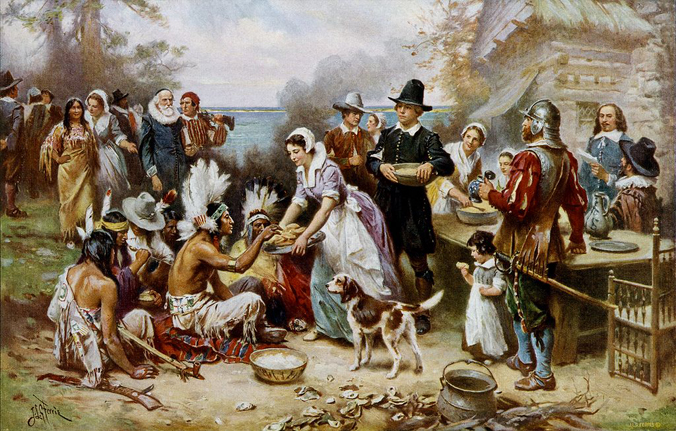
    The First Thanksgiving
    The First Thanksgiving 1621 by Jean Leon Gerome Ferris (1899). “The painting shows common misconceptions about the event that persist to modern times: Pilgrims did not wear such outfits, and the Wampanoag are dressed in the style of Native Americans from the Great Plains” says wikipedia.org. Public domain.

    But when you peel back the layers of myth and romance in the above painting, in the advertising, and in the legends, you find a history deeply rooted in the 18th century and just as at home in Virginia as in Massachusetts.

    While many people tend to look to colonial New England as the origin point for this late fall celebration, these bountiful autumn feasts have existed in places all over the world and for much longer. Many agrarian cultures have celebrated harvest festivals to mark the end of the harvest season. Families and communities came together, celebrated the bounty of the harvest, and gave thanks for all they had.

    In the 1700s, Virginian households were familiar with a large fall feast. Produce that hadn’t been preserved had to be eaten. Cooler weather meant it was time to butcher and preserve meat. Soon, winter weather would make travel impractical. Any farm that enjoyed a bountiful year could celebrate with a large feast in the late fall.

    But what would have been served at those feasts?

    The dishes typically associated with Thanksgiving are inherently American. Turkey, potatoes, pumpkins, and cranberries are indigenous to the Americas and were unknown to Europeans prior to the 1500s. By the 18th century, Atlantic trade changed this. Some American produce like cranberries and pumpkins did not enjoy popularity in England. However, other American food had been fully accepted into kitchens and cookbooks on both sides of the Atlantic.

    The Lewis family owned Hannah Glasse’s The Art of Cookery Made Plain and Simple, a cookbook from which Betty undoubtedly pulled many of her recipes. It contains multiple dishes modern Americans would consider typical Thanksgiving fare. It provides instructions for roasting a turkey complete with stuffing, making gravies for every kind of meat/preparation, and baking a plethora of desserts. It even contains a mashed potato recipe on page 193 that would be perfectly at home on any modern table.

    BOIL your potatoes, peel them, and put them into a sauce-pan, mash them well; to two pounds of potatoes put a pint of milk, a little salt, stir them together, take care that they don’t stick to the bottom, then take a quarter of a pound of butter, stir it in, serve it up.

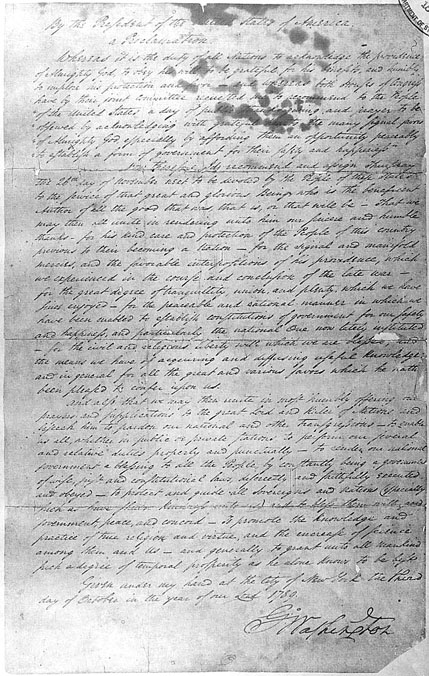
    But if we are going to study Thanksgiving’s historic details, what about the term itself? Thankfully, we have George Washington himself to look to. Seventeen months after the ratification of the Constitution the newly elected President put forth a proclamation at the request of the Congress and Senate that…

    … recommend[ed] to the People of the United States a day of public thanksgiving and prayer to be observed by acknowledging with grateful hearts the many signal favors of Almighty God especially by affording them an opportunity peaceably to establish a form of government for their safety and happiness.

    Portrait
    Thanksgiving proclamation of 1789 by President George Washington. Library of Congress photo.

    The day assigned was November 26, 1789, the last Thursday of the month.

    We may not know whether or not Mary Washington ever sat her family around a large turkey dinner at Ferry Farm in late November, but we do know that a large harvest meal would not have been uncommon. Since Hannah Glasse’s cookbook rested on her shelf, we can have confidence that Betty Washington Lewis would have approved of our present-day mashed potatoes and roast turkey. Finally, we can read the words of Thanksgiving proclaimed to Americans by George Washington, as the new nation’s first president. When you sit down with family next week, remember that you are part of long tradition and celebrating something truly American.

    Joe Ziarko
    Manager of Interpretation & Visitor Services

  • Video: The Colonial Kitchen – An Orange Fool

    In this video, we make a rare colonial-era treat known as “An Orange Fool” recently featured in a written blog post about where colonial Americans got their fresh fruit from. You can find the blog post and the “Orange Fool” recipe here.


  • Where Did the Fruit Come From?

    In our age of weekly farmers’ markets, drive-thru smoothie shops, and 24/7 grocery stores, it can be hard to truly understand the importance of fruit to the average colonial Virginian. They, however, would have been well aware of how rare it was and of what it meant to have it. Indeed, they were so aware of its rarity and luxury that they bought and used special dishes in which to serve the fruit. We recently wrote in “Fine and Fashionable Fruit Dishes” about just such white, salt-gazed fruit dish excavated at George Washington’s Ferry Farm.  Just how rare was fresh fruit in colonial America and, when it was available, where did it come from?

    Fruit Dish 2
    18th century fruit dish in Kenmore’s ceramics collection. The dish is white salt-glazed stoneware with a geometric design in the center surrounded by a variation of the basket-dot-diaper motif and an intricately pierced rim flanked by scroll-work.

    Historians have surveyed old records from stores, taverns, and ordinary households to figure out how often early Americans ate fruit. One such study ranked different foods according to the amount of money spent on them.  In this ranking, fruit came in eighth after meat/poultry, grains, alcohol, and other foods. Ultimately, paired with nuts, fruit accounted for less than 3% of the overall food expenses in Virginian households.[1]

    The same study examined the food expenses of people at all levels of society, whether an anonymous wigmaker or the royal governor.  From 1769 to 1770, fruit/nuts were nearly 8% of the royal governor’s food expenses while most other Virginians spent less than 1% of their food expenses on fruit/nuts.[2]  Fruit was for the wealthy and was a rare luxury in 18th century America.

    The rarity of this luxury was a direct result of where fruit grew and how people got it. There were two options when it came to fruit for the colonists; locally grown or imported.  For most, of course, locally-sourced seasonal produce was really the only option.

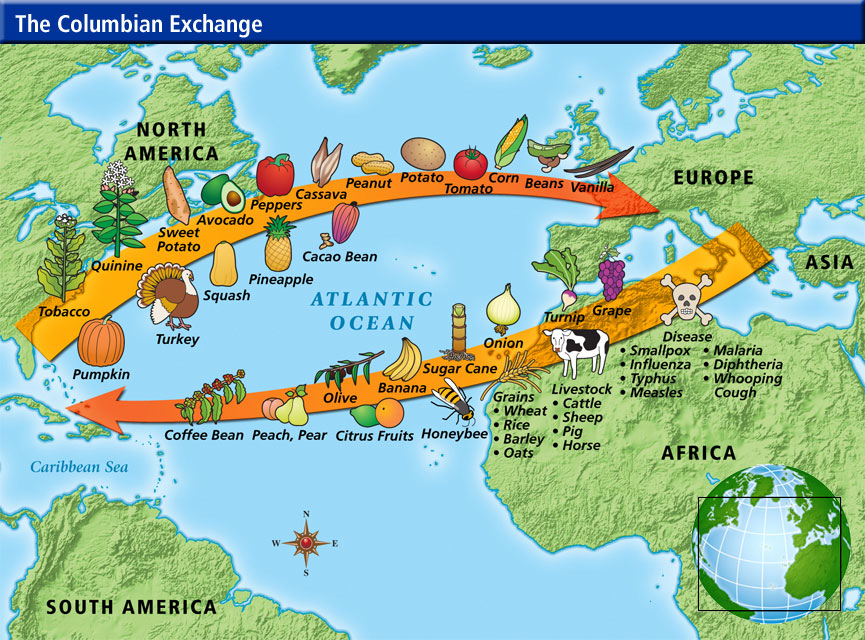
    A global exchange of livestock, diseases, fruits and vegetables sometimes called “The Columbian Exchange” began with European exploration of the Americas in 16th century. By the mid-1700s, the American colonies were a unique place for growing fruit. Europeans transplanted old favorites — quinces, apples and peaches — to the New World.  They enjoyed new varieties of fruits — strawberries, cherries, and grapes — in America that had closely related cousins in England and Europe.  Then, they added to their diet fruits naturally indigenous to the Americas.  These included fruits well-known today like cranberries and blueberries as well as fruits now largely forgotten like pawpaws. With all that variety, early Americans still had to settle for what could be grown in their specific climate and at a particular time of the year. Even local fruit, whether transplanted or indigenous, was an expensive luxury.

    Exchange

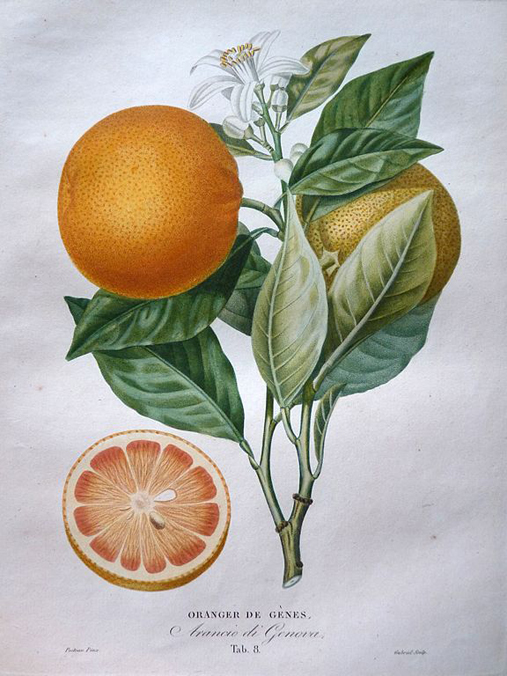
    Naturally, tropical species like citrus fruits and pineapples became the zenith of the colonial fruit hierarchy.  If someone really wanted to demonstrate their wealth, these imported fruits were the way to go. They could not be acquired locally and indicated the buyer had deep pockets as well as a more sophisticated palate. While wealthy Virginians attempted to grow some of these fruits in private “orangeries”, the precursor to modern greenhouses, they mostly came from islands in the Caribbean.  Transportation made them extraordinarily expensive but their expense did not mean there was any shortage of uses for them.

    Orange
    Illustration of an orange by Pierre Antoine Poiteau (1766-1854) and published in his Histoire naturelle des orangers or “Natural History of the Orange Trees” (1818).

    Because they symbolized wealth and simply had a short shelf life, fresh fruit was displayed on a fruit dish or epergne as a decoration and status symbol. Fruit’s value also came from its multiple uses within a home. Cookbooks of the time gave plenty of uses for fruit ranging from the familiar such as apple dumplings to the foreign like salt pickled lemon. The most commonplace recipes (or receipts as they were referred to in that period) concentrated on preserving fruits so that colonists could enjoy their flavors throughout the year.

    To conclude, we present a receipt from Hannah Glasse’s The Art of Cookery Made Plain and Easy, a book we know was part of the Lewis family library at Kenmore. The receipt’s colonial version comes from a first edition facsimile from 1747.

    An Orange Fool – Colonial Version

    TAKE the Juice of six Oranges and six Eggs well beaten, a Pint of Cream, a quarter of a Pound of Sugar, a little Cinnamon and Nutmeg; mix all together, and keep stirring over a slow Fire, till it is thick, then put in a little Piece of Butter, and keep stirring till cold, and dish it up.

    An Orange Fool – Version updated for today

    1 c Heavy Cream
    1 c Orange Juice (3 Fresh squeezed oranges or store brought)
    1/3 c Sugar + 1 tsp sugar
    ½ Orange zest
    ½ Tbs butter
    1 egg + 2 egg yolks
    ½ tsp Vanilla Extract
    ½ tsp Cinnamon
    ¼ tsp Nutmeg

    1. Preheat oven to 400 degrees
    2. Place four 6-ounce (or six 4-ounce) ovenproof cups or ramekins in a deep baking pan just large enough to hold them. Fill baking pan with enough water to come halfway up the pan.
    3. Add cream, orange juice, zest, and 1/3 c of sugar to a small saucepan and bring to medium heat until sugar has dissolved and the mixture starts to steam. Add butter.
    4. Meanwhile whisk the egg, yolks, and vanilla extract together in a separate bowl.
    5. Once the orange cream mixture has come to temperature remove from heat and use a ladle to slowly pour it into egg mixture while vigorously whisking the eggs.
    6. Once the cream and eggs are fully incorporated return them to the small saucepan and put back onto low heat. Let the custard steam but NOT simmer (approx. 175 degrees).
    7. Take off heat and pour into ramekins through a fine strainer.
    8. Mix the remaining sugar, cinnamon, and nutmeg together and sprinkle onto each cup.
    9. Bake for 30-35 minutes or until the custard is just set
    10. Let cool at room temperature for 1 hour and serve. OR chill in the refrigerator overnight for a cool summer dessert.

    Next time you pour yourself a fresh glass of orange juice, buy some fresh fruit at the grocery store, or stop a farm stand by the road for apples remember the luxury that you are enjoying. This aspect of our daily lives is an opportunity of which our forefathers would have been sincerely jealous.

    Joe Ziarko
    Manager of Interpretation and Visitor Services

    [1] Walsh, Lorena S., Ann Smart Martin and Joanne Bowen. Provisioning Early American Towns. The Chesapeake: A Multidisciplinary Case Study. Williamsburg: The Colonial Williamsburg Foundation, 1997: 141.

    [2] Ibid: 300.