Not every president gets their birthday celebrated every year with a federal holiday, but George Washington, a favorite of his countrymen and the first president, has had that privilege since 1879. But one year was a little different from the others: 1932. It marked Washington’s 200th birthday, and the United States was going to make a big deal about it.

In honor of the upcoming birthday, we decided to look at some of the memorabilia in our collection created to celebrate and educate the American public.
George Washington Bicentennial Commission
The planning for this celebration started early when Calvin Coolidge signed a joint resolution that established a commission to oversee the bicentennial ceremonies on Dec 2, 1924. The resolution was to mark the occasion of the birthday across the country and increase the understanding of Washington. (George Washington Bicentennial Commission, 1932) Under the direction of Representative Sol Bloom, an experienced entertainment promoter who got his start at the 1893 World’s Colombian Exposition, the committee initiated thousands of events, released educational resources for students, and had plays written in honor of Washington. (Larson, 2004)
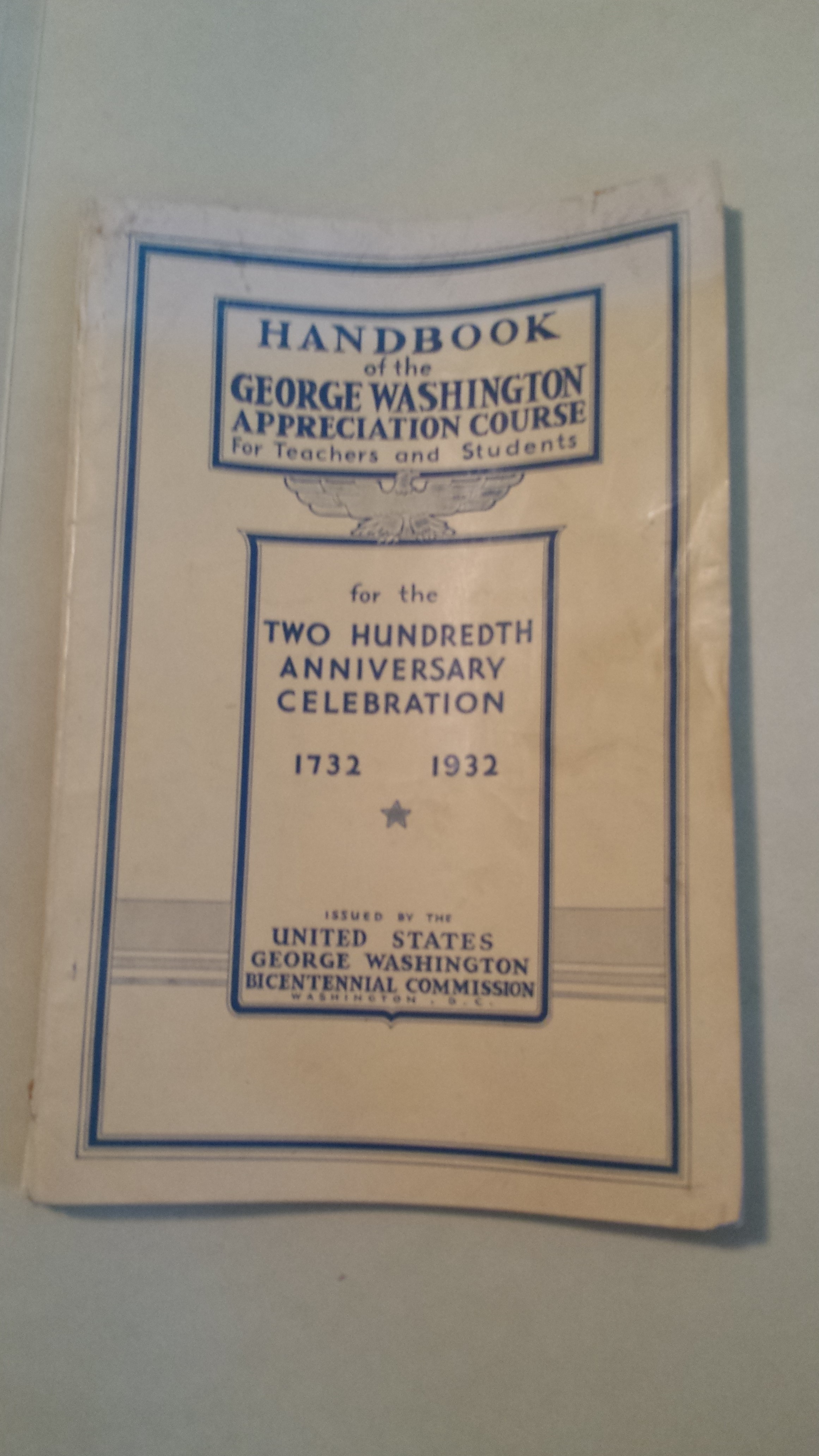

The commission additionally worked with over 250,000 local commissions to organize special events at not only a federal level but a state and city too. (The Washington Post, 1932) Special volunteers and prominent local people were often given commemorative metals as thanks for their service. We have one from the state of New York. It is a circular bronze medal attached to a blue and white ribbon. The back of the medal states, “1779 / Planned Sullivan / Clinton Campaign 1782 / Newburgh Temple Hill / Refused a crown / 1789 April 30th / New York City / Inaugurated first / President of the / United States.”
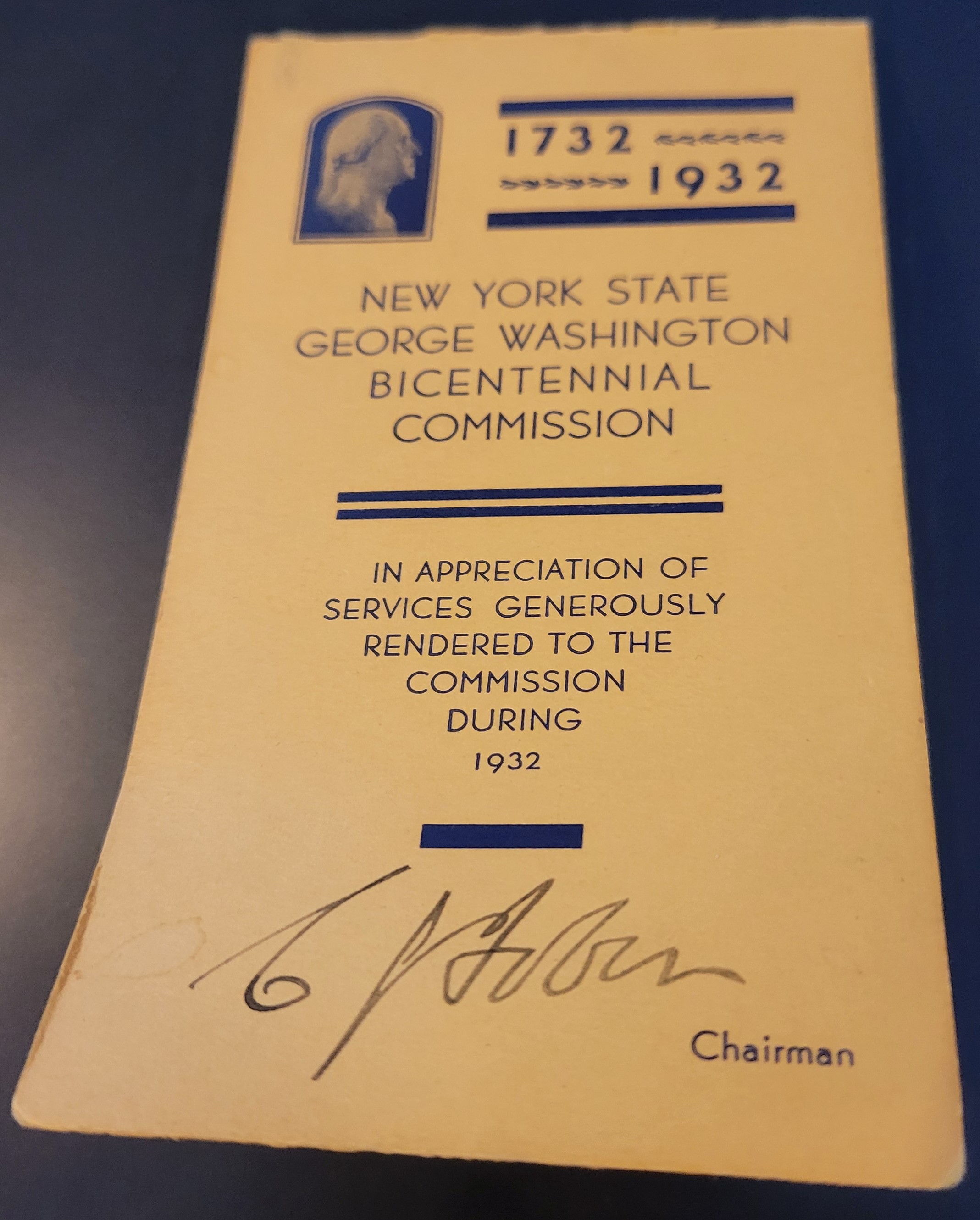
The medal is encased in a paper envelope with “New York State / George Washington Bicentennial Commission / In appreciation of / Services generously / Rendered to the / Commission / During / 1932” written on the front along with the signature Charles Tobin, chairman representing New York state on the Bicentennial Commission.
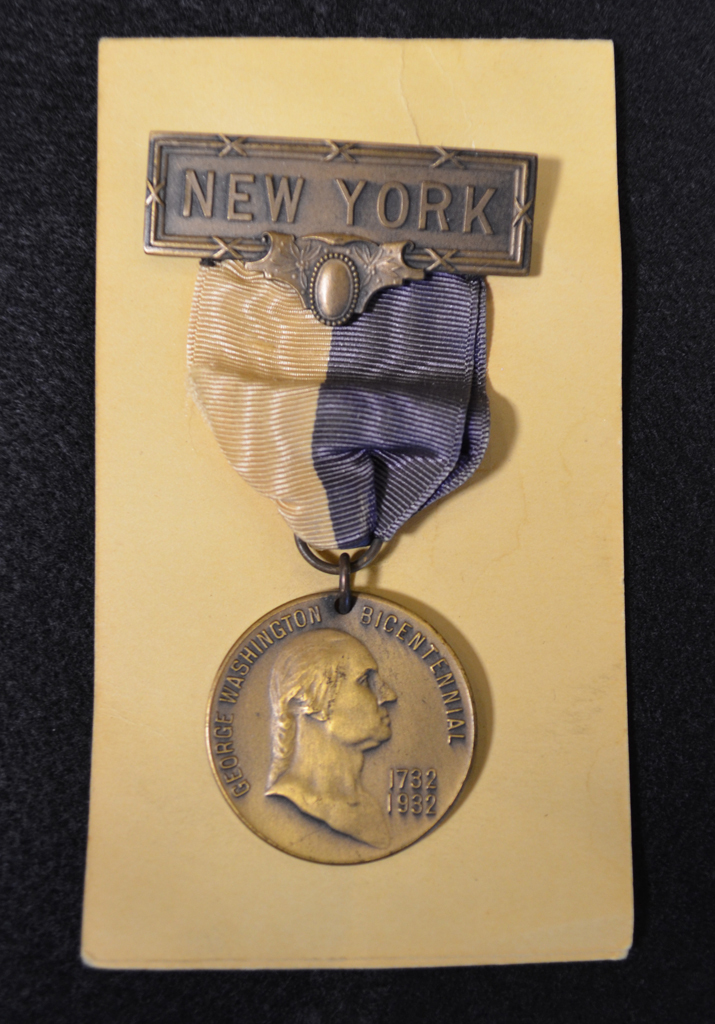

Historical Context Help: The Sullivan-Clinton campaign was ordered by George Washington in response to the 1778 attacks by the Iroquois and British in central New York. Newburgh Temple Hill was a Continental Army encampment near Washington’s headquarters, where he gave a speech to quell the mass of soldiers who were getting ready to mutiny and attack Congress to get their promised back pay and pensions. Finally, in 1789, George was sworn in as President at Federal Hall in New York City.
Calling All Philatelists

The U.S. Post Office became involved in the commemoration of George with the release of a dozen stamps celebrating his life. The stamps were incredibly popular, and when they were first released for sale in D.C., there was a crowd of 50,000 people waiting to get their set of stamps. (The Washington Post, 1932)


Marketing George
Private companies even got in on Washington-mania by releasing all types of souvenirs like postcards, pins, coins, bottles, calendars, cigar box covers, books and pamphlets, hat stands, billheads, stationary, cartes-de-visite, playing cards, and puzzles. (Subseries 5.8. Washington’s Birthday, Bicentennial Souvenirs, 1931-1932 , 2024)
We have two bottles created for the Bicentennial celebration. The green water bottle has a likeness of George with “Washington/Bicentennial” underneath the image and 1732 and 1932 written on the sides. The water bottle was produced by the Hemingway Glass Company in Muncie, Indiana.


The clear pear-shaped bottle is embossed on one side with a cherry tree and the dates “1732 and 1932”. On the other, with a profile of Washington. It was created by the Owens-Illinois Glass Co. of Huntington, West Virginia.


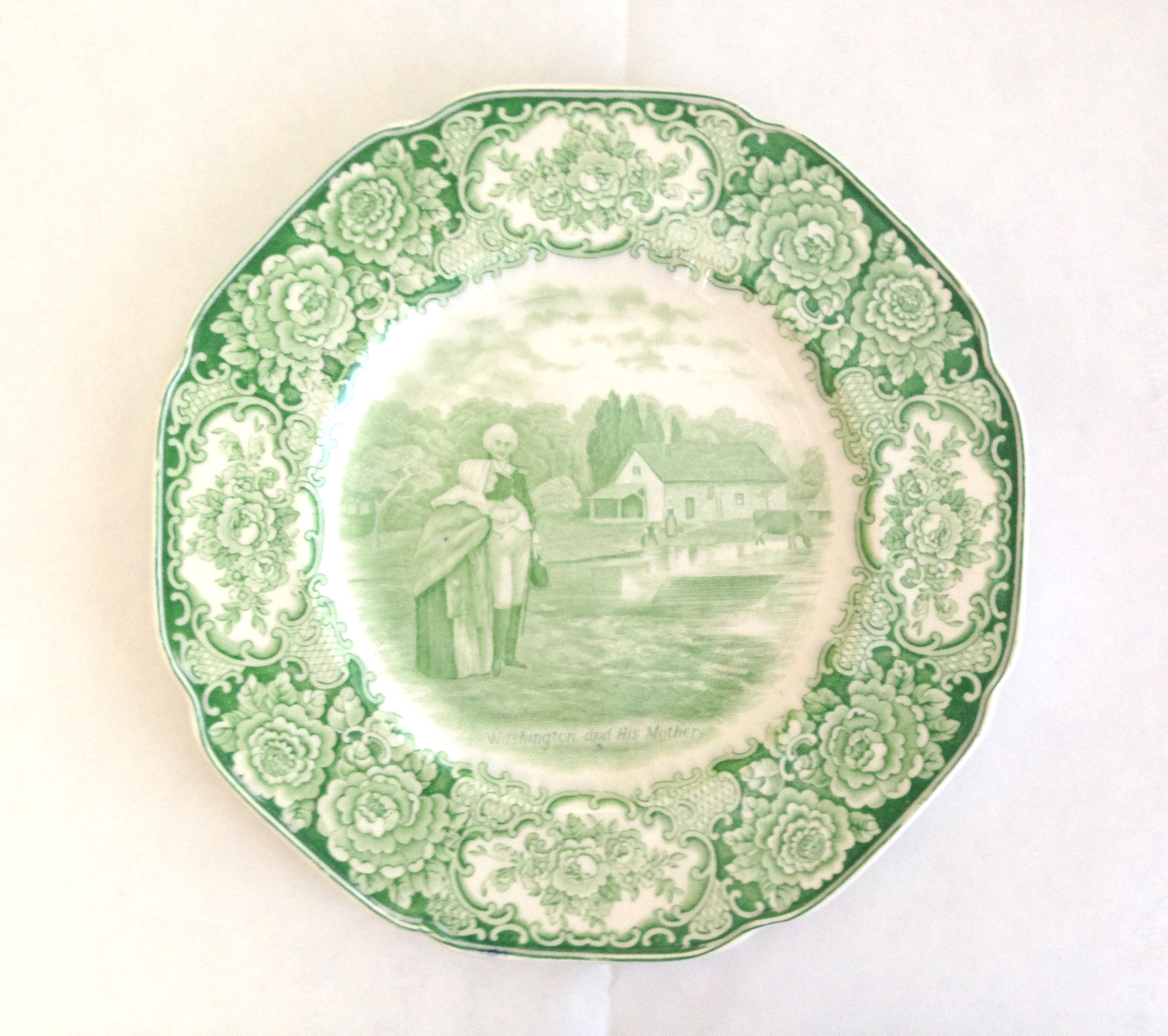
Plates were another big commemorative item. We have three plates issued by Crown Ducal, with the same scene of “Washington and his Mother” based on the print of the same name. On the back with the Crown Ducal crest, it says, “George Washington Bicentenary Memorial Plates / 1732-1932 / First in War / First in Peace / First in the hearts of his countrymen”. Crown Ducal released a series of twelve plates documenting Washington’s life. Of course, we are a little biased and like the one with his mother, Mary Ball Washington, the best.


Some companies even brought in Mrs. Martha Washington, like this set of plates from the Capital Souvenir Company. These are two round commemorative plates depicting George and Martha Washington, both with an elaborate floral gilded border.


Fun Bicentennial Fact: On the eve of the birthday, Sears Roebuck was awarded a commission by the U.S. government to create a full-scale replica of Mount Vernon at the Exposition Coloniale Internationale in Paris. The agreed-upon price was around $75,000, and every detail of the home was reproduced from brass hardware, mantelpieces, and even cabinets. After the exposition, the house was bought by an American doctor working in Paris, and it was relocated to Vaucresson (a western suburb of Paris). It still stands today as a private residence and was even on the market in 2012 for 27 million dollars.


Sears Roebuck also built the exact replica in Prospect Park, Brooklyn, NYC for the Bicentennial Commission. However, the house was not taken care of and boarded up and abandoned until it was eventually torn down. (The Brooklyn Daily Eagle, 1933)

Sears’ role in the reconstruction of Mount Vernon led to interest in their kit homes. In 1932, they offered a house in their catalog, loosely based on Mount Vernon. This model was oddly called “The Jefferson”.

While we may not have as many George souvenirs, we are still putting on a big birthday party to celebrate George Washington and his time at Ferry Farm.
The party is on Monday, February 19th from 10am – 3 pm. While enjoying the grounds of Ferry Farm, you can take a selfie with “George Washington,” participate in our annual stone-throwing contest, play colonial games, and eat birthday cupcakes (while supplies last).
Additionally, guests can enjoy several educational stations, take an abbreviated Washington House tour, and talk with archaeologists, historians, and other experts to learn about Ferry Farm and the Washington Family.
Heather Baldus
Collections Manager
References
George Washington Bicentennial Commission. (1932). History of the George Washington Bicentennial Celebration. Washington D.C.
Larson, E. (2004). The Devil in the White City: Murder, Magic, and Madness at the Fair That Changed America. New York City: Knopf Doubleday Publishing Group.
Subseries 5.8. Washington’s Birthday, Bicentennial Souvenirs, 1931-1932 . (2024). Retrieved from The George Washington Presidential Library at Mount Vernon: https://archives.mountvernon.org/repositories/3/archival_objects/14635
The Brooklyn Daily Eagle. (1933, June 14). Fate in Doubt On Park Replica of Mt. Vernon. The Brooklyn Daily Eagle, p. 5.
The Washington Post. (1932, January 2). 50,000 Stand In Line to Get New Stamps. The Washington Post, p. 1.
The Washington Post. (1932, January 5). Bicentennial Stamps Profit. The Washington Post, p. 6.