Lives and Legacies

Tag: conservation

  • From the Vaults: Rarely Seen Documents

    Some of the most delicate objects in our collection are our archives. Paper and other document materials like vellum and parchment are very sensitive materials that can be irreversibly damaged simply by light.  This makes it very difficult to display or put on exhibit for extended periods despite our comprehensive policies for conserving and preserving documents; exhibition has always been unfeasible.  To remedy this, we have been working on getting archival-safe, high-quality images of our important documents online for everyone to access.  So, while you might not see the documents in person, you can still explore, read, and learn about these important papers while we preserve them for future generations.     

    Until we launch our online archives, I wanted to give everyone a sneak peek at a few of our incredible pieces.

    One of our oldest documents in the collection is a Land Grant signed by William Gooch on September 28, 1730, written on vellum.  William Gooch was a colonial administrator who served as governor of Virginia from 1727 to 1749.  The grant is not in the best condition, but it reads that it grants 400 acres in Spotsylvania County to Paul Plunkepee.  This grant is officially recorded as Land Office Patents, No. 14, 1728-1732, page 40, and is available at the Library of Virginia.

    One of our most unique documents is a letter from George Washington to Lieutenant Governor Robert Dinwiddie, written on June 10, 1752, when he was twenty.  Robert Dinwiddie served as Lieutenant Governor of Virginia from 1751 to 1758.  In the letter, George requests his first military appointment to the open adjutancy of the Northern Neck or other district.  George’s half-brother Lawrence had been appointed Adjutant General of the colony in 1743.  Due to his illness and eventual death, the adjutant was to be divided into smaller districts (i.e., Northern Neck).

    Dinwiddie declined the appointment but assigned George to an envoy position that winter to confront the French, who had recently built a fort on what Dinwiddie considered British land.  Additionally, George met with the Iroquois Confederacy to make peace and obtain intelligence about the French.  

    This amazing letter pinpoints the beginning of George Washington’s illustrious military career, which would eventually culminate in him becoming the first President of the new United States of America.  The letter is in great condition after meticulous conservation work, which included repairs with Japanese tissue called tengucho and wheat starch paste called jin shofu.  It was then cleaned and flattened, and the iron gall ink stabilized.
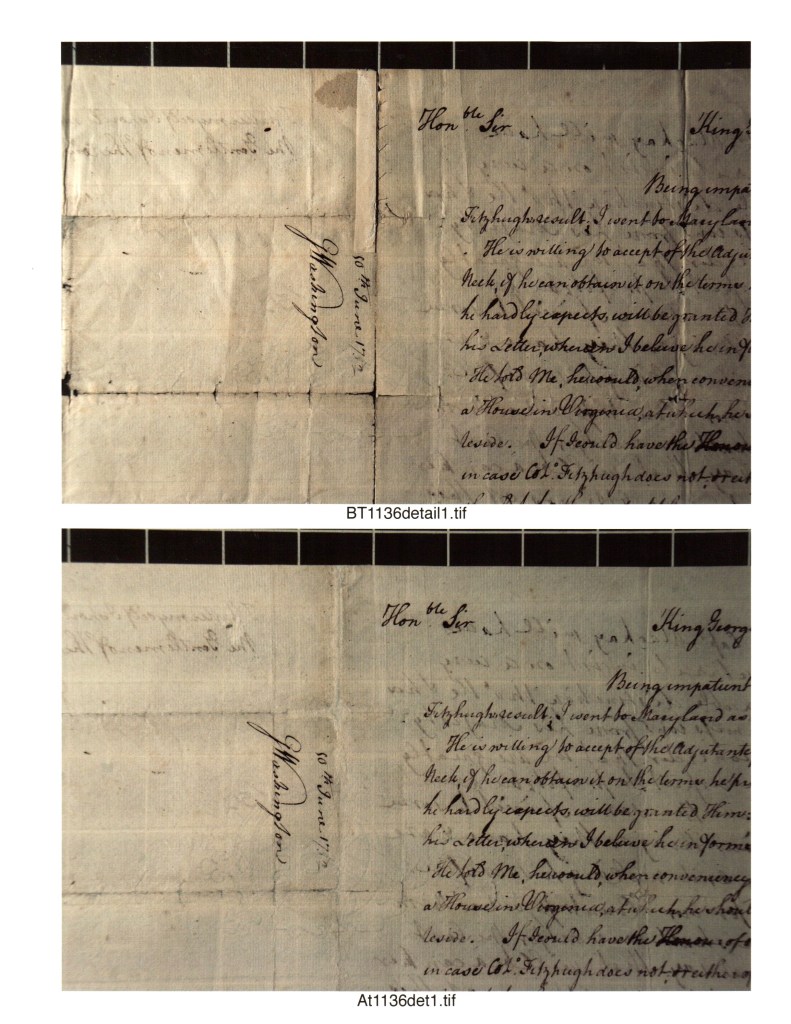
    A transcript of the letter can be found on the National Archives website at Founders Online.

    Next are two letters between George Washington and Irish-born publisher Matthew Carey.  Matthew Carey moved to America in 1784 and settled in Philadelphia, where he established a publishing business and bookshop with $400 given to him by the Marquis de Lafayette.  Carey’s first publication was The Pennsylvania Herald in 1785, followed by two of the first successful American magazines, The Columbian Magazine and The American Magazine in 1786 and 1787.

    In George’s first letter to Carey in 1785, he requests a subscription to Carey’s newspaper but asks him to send the newspaper disguised as an ordinary letter because George has been having problems with the post office delivering his newspapers .  George thinks his papers may not have been delivered because “persons who wishing to read News Papers without being of the expence [sic] of paying for them, make free with those which are addressed to others.”

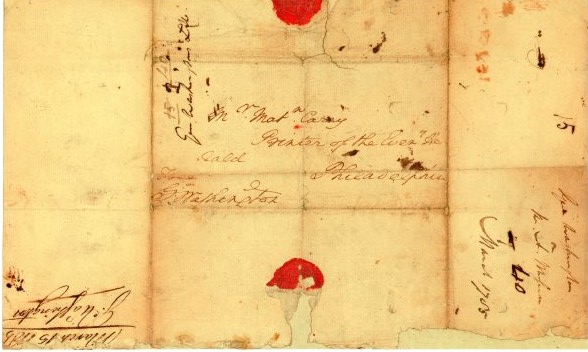
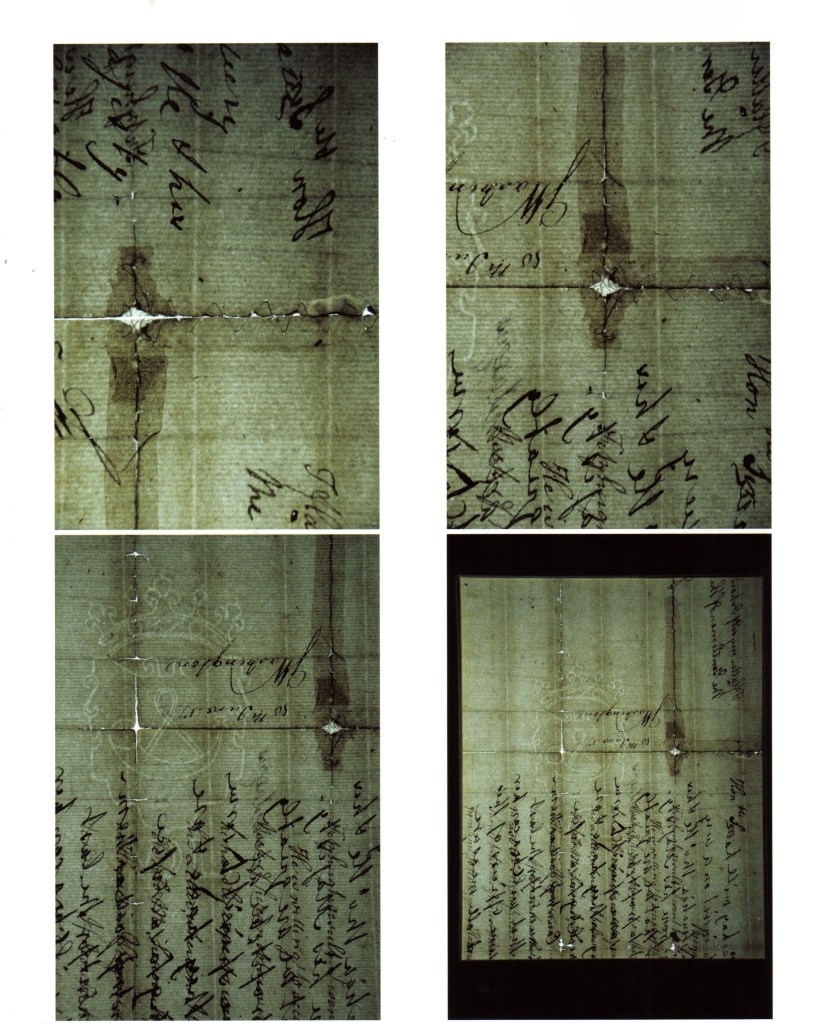
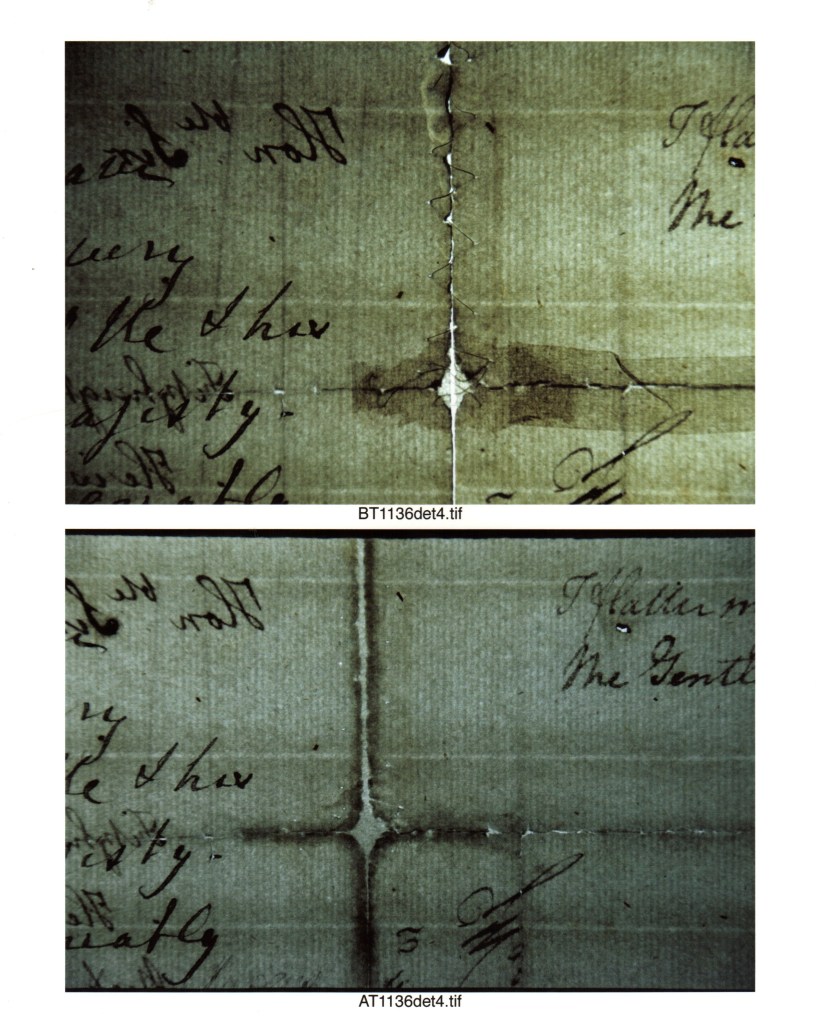
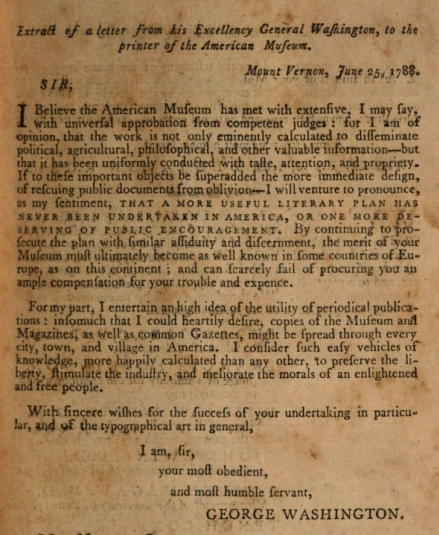
    The second letter between George and Matthew is dated June 25, 1788.  The year before, Carey launched “The American Museum” magazine.  It was a literary museum that reprinted significant historical documents on American history and original essays on politics, commerce, and culture.  The magazine got a positive response, but Carey was finding it expensive to distribute the magazine across the country, so he asked George, one of his first subscribers, to write an endorsement for the magazine that would help attract new subscribers.[2] 

    Washington responded immediately, seizing the opportunity offered by Carey to express his belief that the free dissemination of information and ideas was vital to preserving American liberty.  ‘I could heartily desire,’ Washington wrote, that ‘copies of the Museum and Magazines, as well as common Gazettes, might be spread through every city, town & village in America – I consider such easy vehicles of knowledge, more happily calculated that any other, to preserve the liberty, stimulate the industry and meliorate the morals of an enlightened and free People.”

    Carey published Washington’s endorsement in the next issue of his magazine—his marks for the typesetter can be seen in the original Washington letter.  The result was a flood of new subscriptions that allowed Carey to continue publishing The American Museum for another four years.

    Transcripts of the letters can be found on the National Archives website at Founders Online.

    These are just a few of the amazing documents in our collection, which we hope to bring you soon so that you can explore them yourself.  Check back often, and we will keep you updated on our progress with our digitization project.

    Heather Baldus

    Collections Manager


    Bibliography

    Edd Applegate (August 17, 2012). The rise of Advertising in the United States: A History of Innovation to 1960. Scarecrow Press. p.25.


  • Caring for Ferry Farm’s Flora and Fauna

    Step onto the grounds of George Washington’s boyhood home and, notwithstanding its famous connection, there’s no mistaking the feeling of being in a special place. A National Historic Landmark, Ferry Farm stretches along the Rappahannock River across from downtown Fredericksburg’s City Dock. The land is varied and rich, with native woodlands, a native grass meadow, walking trails, riverbeds, springs, a garden, and scenic Virginia rail fences. It has seen a significant share of American history from the activities of Native Peoples, to the colonial inhabitants, to Civil War Union encampments, and more.

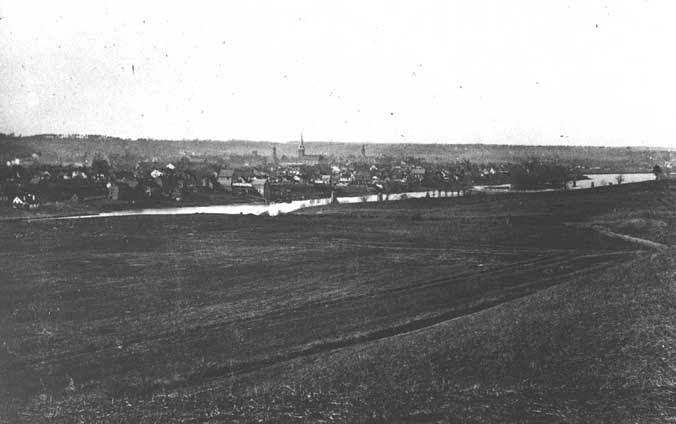
    View of Fredericksburg from Ferry Farm

    Historically significant land such as this ought to be carefully maintained and stewarded – and it is. With its variety of features, maintenance can become a challenge, as there is always the threat of erosion, the caring for trees, the need to ensure the grounds are safe and passable for visitors, and finding economical ways to use and reuse what’s available. Also, we cannot forget the residents that have first rights to be here – Ferry Farm’s numerous critters.

    Leaving natural habitats for flora and fauna promotes a healthy ecosystem

    “We try to keep a balanced ecosystem by only introducing native plants that would not interrupt the natural beauty of the site,” explains John Carmichael, Buildings and Grounds Director. “The land is kept as natural as possible to maintain a primitive ecosystem native to the area. Forests are kept healthy by mitigating the growth of invasives. Grasslands are maintained with tough turf, mainly natural growth. We’re not looking to keep up a pretty green lawn with no weeds; we maintain how it would have looked in Washington’s day, with natural growth, clover, and field grasses.”

    The grass in front of the House leading to the riverfront gets mowed sparingly in order to protect all of the embankments from erosion. Growing large strong roots helps keep the soil in place. Underbrush on the riverbank remains in place, for the same reasons, and fencing keeps visitors off of the area since it is unsafe footing.

    Grasses are kept long in front of the Washington House and along the Rappahannock River to protect the embankment from erosion.

    The entire flat nearest the water was created by the Corps of Engineers shortly after the conclusion of the Civil War. Sediment from erosion was threatening to make the river too shallow to navigate. To relieve the problem, the Corps built wooden retaining walls along the river’s edge and then dredged a channel to allow ships to resume operating on the river. They used the sand from the dredge to fill in behind the wooden retaining walls. With sand not being optimal land for growing trees, trees that happen to grow there are left because they’ve already proven their hardiness.

    Since no commercial fertilizers and minimal weed killers are used at Ferry Farm, composting and mulching are an essential part of stewardship. Large limbs, trimmings, and small branches are placed at the edges of woods to decompose and provide shelter for animals. Tree trimming partners will mulch downed limbs which in turn get spread onto walking paths and parking lots.

    Composting at Ferry Farm is a three-year process. New grass clippings, greens, weeds, manure, wood ash, and leaves go into an initial pile for decomposition. In year two, everything gets turned and sifted regularly. By the third season, it’s ready to be spread throughout gardens and flower beds. Green and cost-effective, composting keeps useable nutrients out of the landfill.

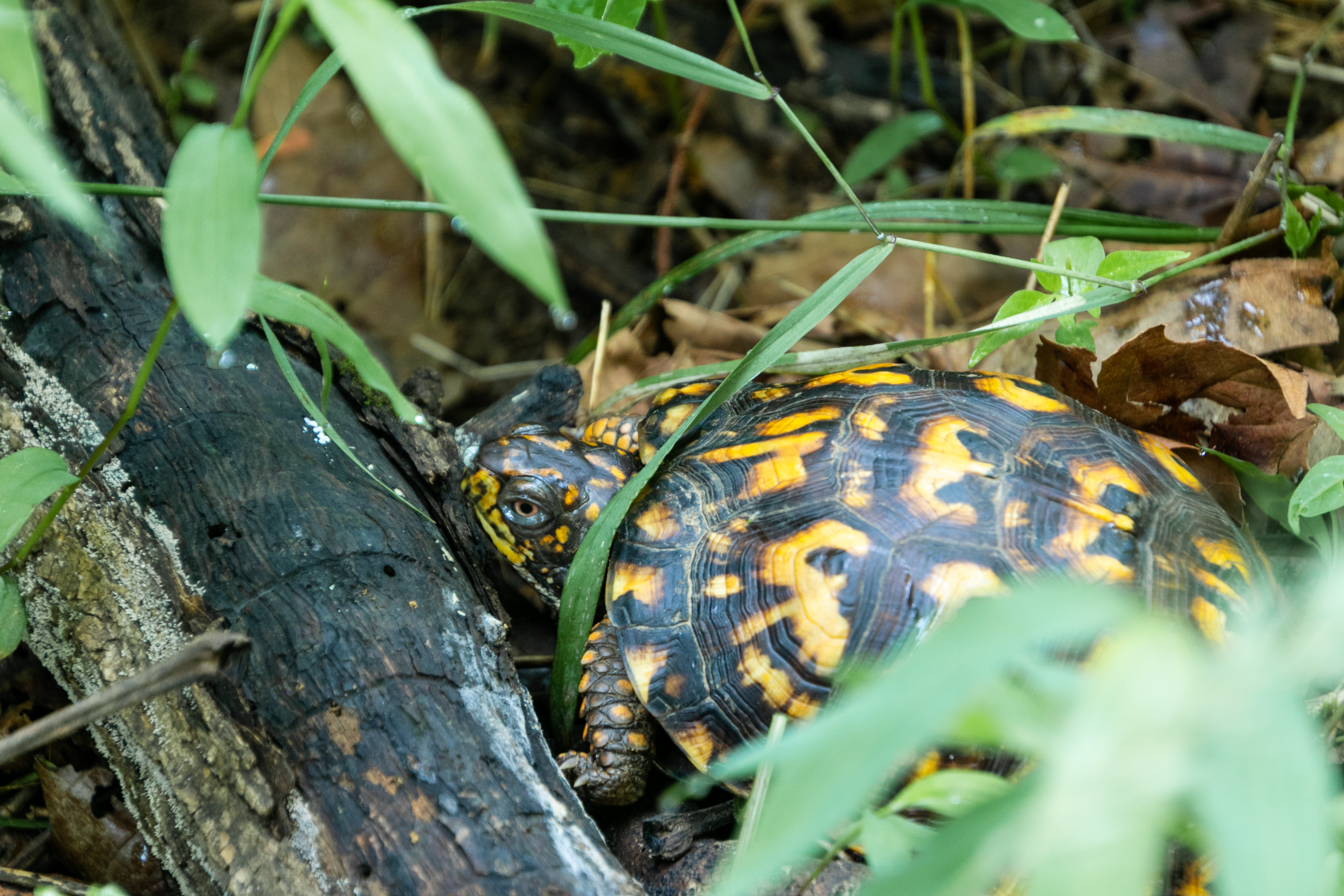
    Box turtles thrive in tall grasses in front of the Washington House. Source: Sharon Houston

    Surrounded by busy roads on two sides, Ferry Farm is a wild animal sanctuary for deer, rabbits, groundhogs, red and grey foxes, hawks, bald eagles, herons, opossums, raccoons, black and garter snakes, box turtles, bats, and hundreds of bird species. Leaving natural habitats for flora and fauna promotes a healthy ecosystem. The back meadow receives rejuvenate mowing in early spring to encourage it back to good health. It’s a birders’ paradise dotted with bluebird boxes along a mowed walking path. Over 125 different species of birds have been identified on the property over the years. Look closely, and flat patches of grass indicate where a deer has bedded for the night. Critters are welcome here. “As long as it poses no threat, it has a right to be here,” says Chris Lynn, Buildings and Grounds Technician.

    The flowers in the garden attract pollinators to the herbs and vegetables; fruit-bearing trees and shrubs do their part to attract as well. Gardens grow with the three sisters – corn, squash and beans – as well as tobacco, cotton, potatoes, and more.

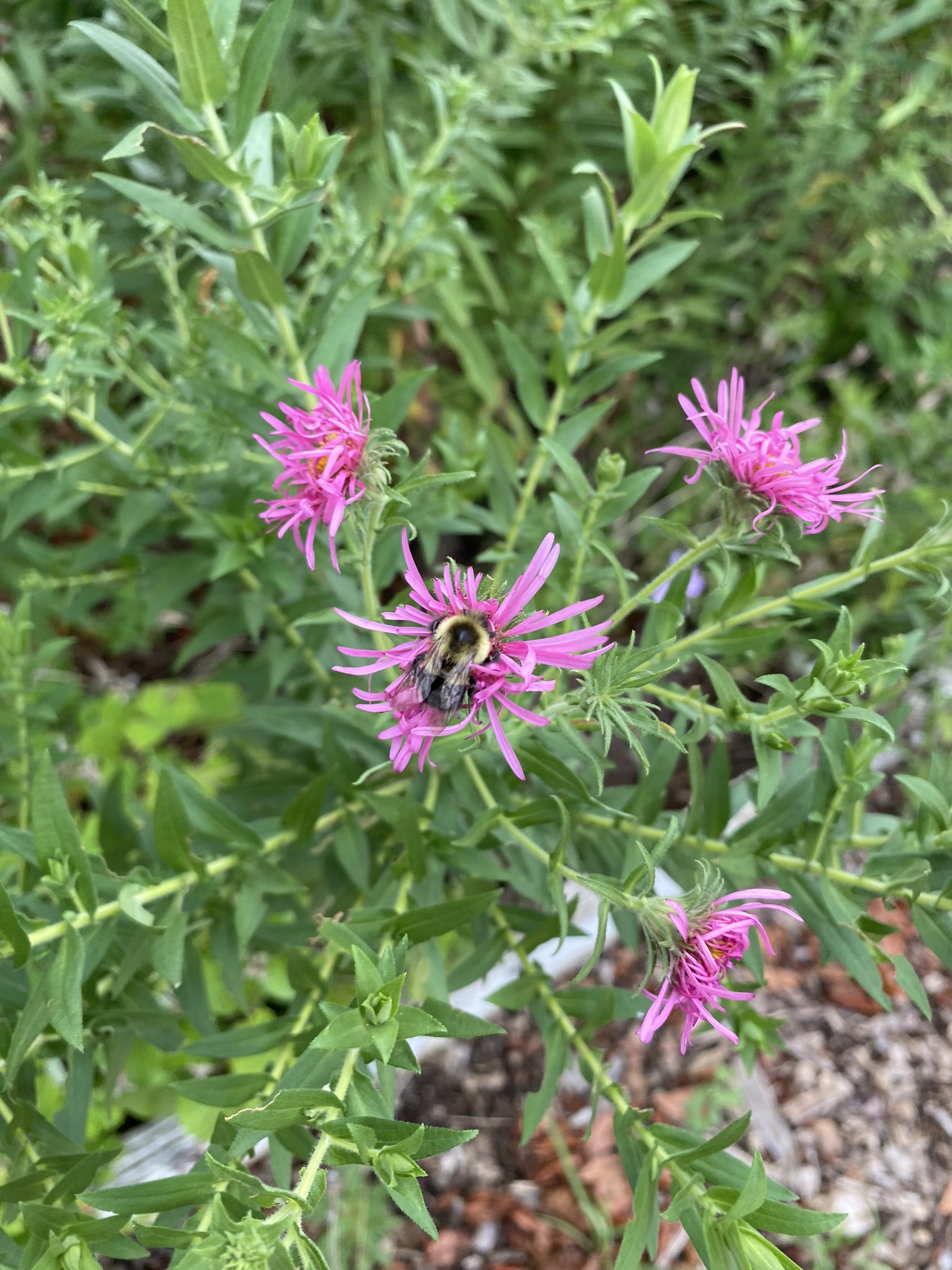
    A flower in the garden bed serves to attract pollinators for herbs and vegetables

    Ferry Farm’s beauty conjures up days of natural grasslands, mature forests, and living in harmony with the land’s resources. Knowing that the “Father of our Country” spent his childhood here evokes moments of contemplation. Absorbing the sights and smells of wild flora and fauna while walking where young George walked is a step back in time, where the present awakens the past.

    Lori Scott Pikkaart,

    Marketing & Communications Manager

  • A History of Trees at Ferry Farm

    Cherry TreeThe moment anyone mentions trees and George Washington, you probably think of the famous Cherry Tree Story. However, this tale of young George taking a hatchet to his father’s cherry tree and, when confronted about the act, asserting “I cannot tell a lie” is probably just that — a story meant to demonstrate the integrity of the Father of Our Country. In reality, the trees of Ferry Farm have a much more fascinating history. Their story reflects, on a small local scale, vast environmental changes in eastern North America and shifting American attitudes toward the environment throughout the 18th, 19th, and 20th centuries.
    Today, we see wilderness as a good thing that needs protected and preserved. But in the 1700s, Europeans settlers saw wilderness as a bad thing. Preeminent environmental historian William Cronon notes, Europeans described wilderness as “’deserted,’ ‘savage,’ ‘desolate,’ ‘barren’—in short, a ‘waste,’.” People did not look at forests, deserts, or mountains as places to protect and visit. Instead, they were places to be feared and tamed.

    The opposite of wilderness was the managed landscape of Europe. In cities, towns, and farms, Europeans tried to control nature and make it follow humanity’s rules.  These efforts to tame the wilderness were transplanted to colonial plantations in the Americas.

    The first step in building a plantation and taming the wilderness was clearing the land for farming. Huge numbers of trees were cut down to do this.  On top of that, trees were cut down to make almost everything people of the 1700s and 1800s used and owned.  Furthermore, they were also cut down to do many everyday tasks.

    Throughout the 18th and 19th centuries, the wood from trees was…

    • used as the main architectural building material in houses, most other structures, farm buildings, fences, and more
    • used to build ships, boats, ferries, bridges, carriages and wagons that moved people and things from place to place
    • used to make everyone’s furniture (beds, chairs, tables, desks, cabinets, and trunks) as well as many household items and farming tools
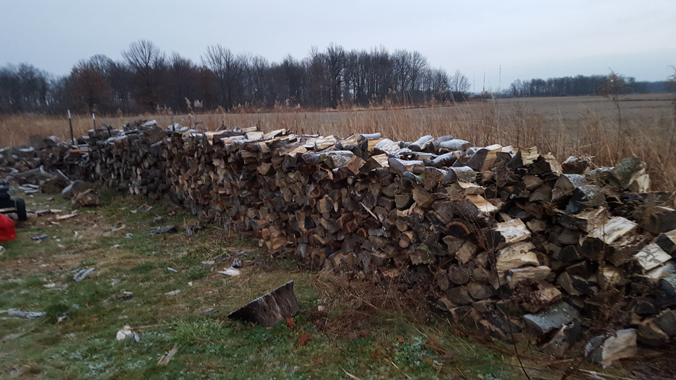
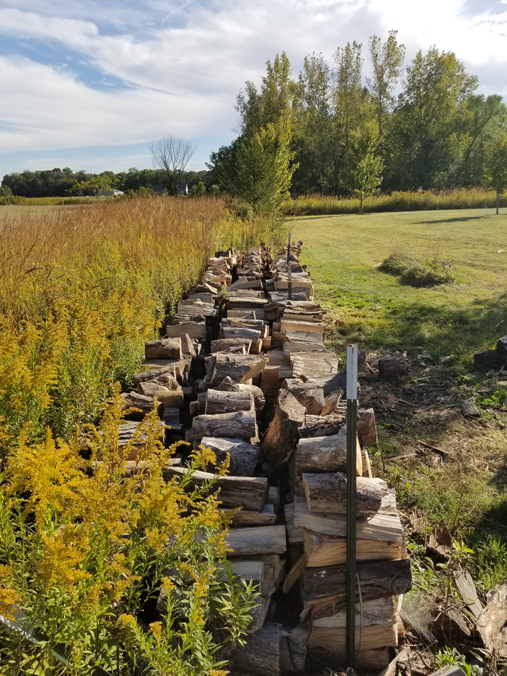
    • used as fuel for the fires needed to cook, heat, and even to make candles and soap. A colonial home needed at least 40 cords of wood for heating and cooking over the course of a year.

    5 cords of Firewood 1
    Five cords of firewood. A colonial home used 8 or 9 times this amount in a year for just heating and cooking. Credit: Chris Stevenson

    5 cords of Firewood 2
    Credit: Chris Stevenson

    According to the U.S. Forest Service, the area that would become the United States had just over 1 billion acres of forest before European settlement.  By 1910, the U.S. had a total of just over 700 million acres.  The 300 million acres of trees cut down was mostly in the eastern portion of the country.

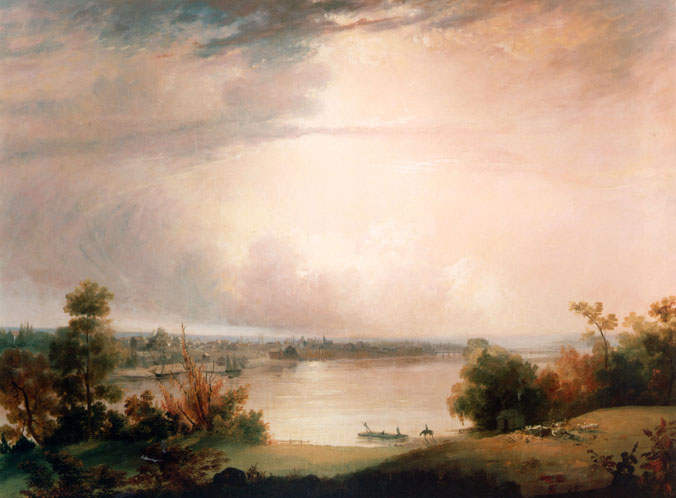
    These large scale trends can be seen on a small scale at Ferry Farm.  The European settlers who lived here, including the Washingtons, cut down a significant number of trees but not so many that there weren’t still quite a few standing when John Gadsby Chapman painted Ferry Farm’s landscape in 1833.

    1830s
    “The Old Mansion of the Washington Family” (1833) by John Gadsby Chapman shows the foundation stones of the house where George grew up at Ferry Farm and trees along the riverbank.

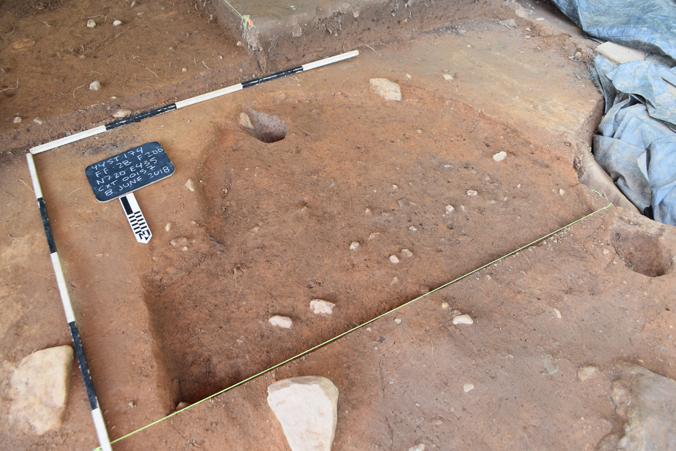
    We also have archaeological evidence showing the locations of trees during the Washington era.  This past summer in the yard north of the Washington house replica archaeologists uncovered “soil stains” left after trees fell in the past.  Soil stains are where the soil is a slightly different color than surrounding areas and indicate where people filled in holes created by uprooted trees. In other words, such soil stains indicate that a tree once stood there.

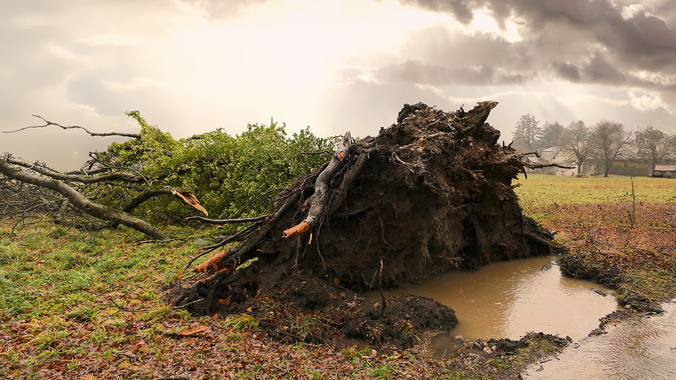
    Uprooted Tree
    A tree uprooted by a storm. Credit: ykaiavu / Pixabay

    In some cases, our archaeologists found that the holes were filled in multiple episodes, indicating that the soil settled and new dirt was later added or the person filling the hole borrowed different dirt of different colors from multiple locations. By excavating the soil from these soil stains and analyzing the artifacts, we can tell around when the holes were filled.

    Soil Stain
    Soil stain marking the site of an 18th and 19th century tree on the landscape at George Washington’s Ferry Farm.

    One very large tree left the sizable soil stain – almost 5ft x 5ft – pictured above.  Based on artifacts found in its soil, the hole was filled during the mid-19th century.  We can tell by the size of the stain that the tree was quite mature. Together, these facts are evidence of a tree that grew just 40 feet north of the original Washington house during the time George and his family lived at Ferry Farm. This discovery gives us another detail about the landscape so it can eventually be accurately recreated just as we did the main house.

    Finally, Ferry Farm archaeologists learned from these tree features and from the lack of other features in this yard that the area was well-kept. In the 18th century, this portion of the landscape was probably well-maintained because it was visible from Fredericksburg across the river.

    This tree fell sometime in the 19th century and it was not the only one at Ferry Farm or across the country. Indeed, deforestation at Ferry Farm and nationwide grew more rapid and widespread in the 1800s as “clearing of forest land in the East between 1850 and 1900 averaged 13 square miles every day for 50 years; the most prolific period of forest clearing in U.S. history.”

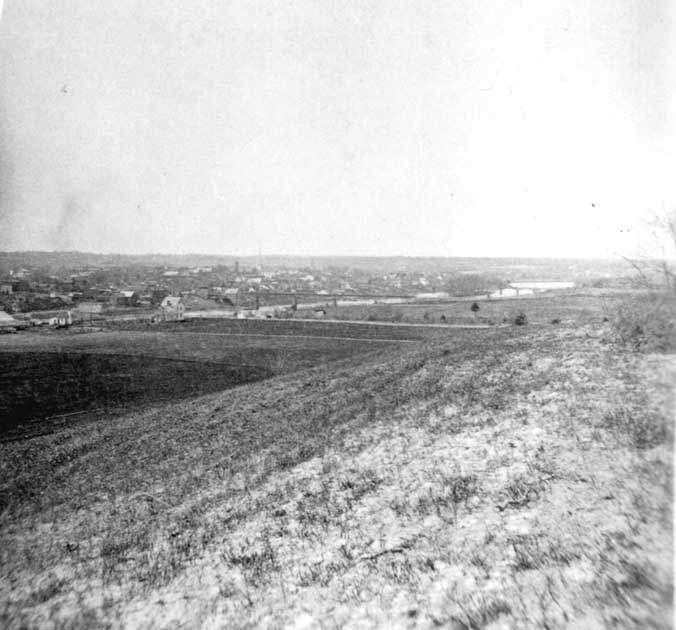
    In the 1860s, the Civil War exacerbated deforestation at Ferry Farm and throughout Stafford County.  Hundreds of thousands of Union Army soldiers radically altered the local environment to get the wood they needed for cooking and heating, to help build their fortifications and pontoon bridges, and even to build shelters.  During winter lulls in fighting, 18th and 19th century armies did not camp in tents. The soldiers built small log cabins.  By war’s end, Ferry Farm and Stafford County were nearly treeless as seen in the two photos of Ferry Farm below taken in the decades after the war ended.

    1870s
    View of Ferry Farm property in the 1870s.

    1880s
    View of the Ferry Farm property in the 1880s

    While deforestation sped up in the 1800s, that century also began a changing of people’s attitudes toward the environment.  As Cronon explains, “The wastelands that had once seemed worthless had for some people come to seem almost beyond price. That Thoreau in 1862 could declare wildness to be the preservation of the world suggests the sea change that was going on. Wilderness had once been the antithesis of all that was orderly and good—it had been the darkness, one might say, on the far side of the garden wall—and yet now it was frequently likened to Eden itself.” Wilderness was to be treasured, not feared.

    As the 19th century turned into the 20th, wilderness, nature, and the environment were increasingly seen as special and deserving of protection and preservation, sparking the creation of national and state parks, government agencies like the Forest Service, private conservation groups such as the Sierra Club, and, in 1872, the very first Arbor Day.

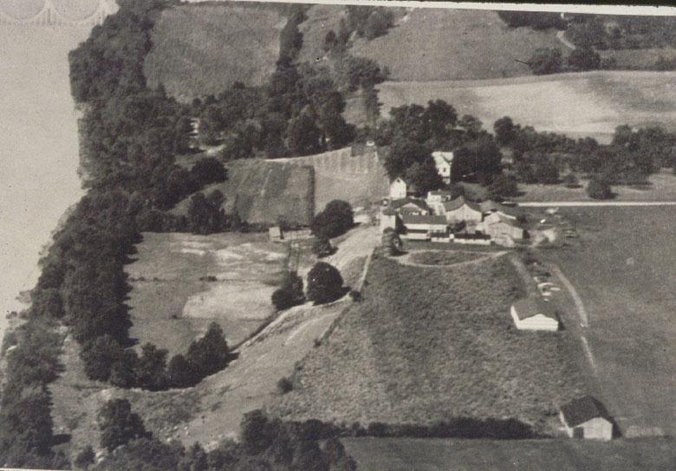
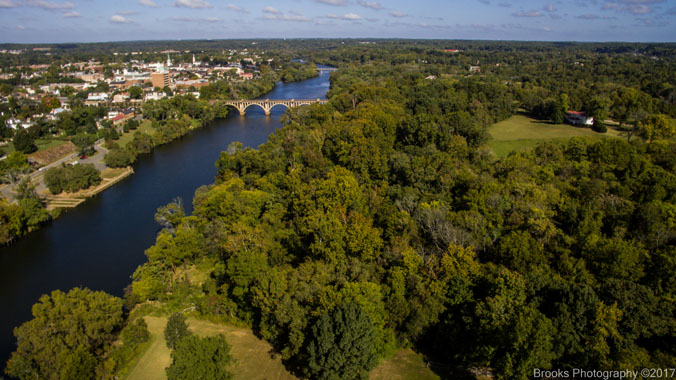
    We can see the impact of new attitudes toward the environment at Ferry Farm in photos below. The top one from the 1930s, a period of intense conservation efforts nationwide, shows trees starting to appear once again while the other from 2017 shows trees on a portion of Ferry Farm stretching out as far as the eye can see to the north.

    1930
    Aerial view of Ferry Farm taken in 1930.

    2017
    Aerial view of a portion of Ferry Farm and points north taken in 2017. Credit: Joe Brooks / Eagle One Photography

    The early 20th century saw the nadir of American deforestation in 1910. But since that year, forest acres in the U.S. have largely held steady [PDF].  The new conservation ethic symbolized in the practice of planting trees to replace those cut down, the reduced use of wood as a building material and fuel source, the need for less farm land, and the movement of people from rural to urban areas (all of which present their own challenges to the environment) have provided a reprieve for America’s forests.

    While George’s mythical chopping of the Cherry Tree is the most well-known tale about trees at Ferry Farm, the more important and fascinating story is how the 300 hundred year history of trees at Ferry Farm reflects broader post-settlement environmental changes in North America and how the Americans who made those changes grew to see the world differently.

    Zac Cunningham
    Manager of Educational Programs

    Elyse Adams, Archaeologist
    Archaeology Lab Technician

  • Video: UV Light in Museums

    Ultraviolet light is an important and useful tool within the museum world. In this video, we show you how archaeologists and curators use UV light in their work with artifacts and historic objects.