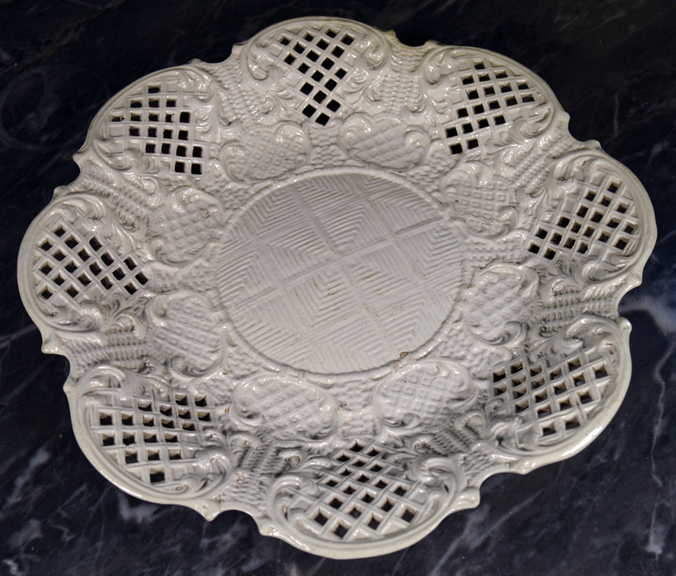
Want to see “in real life” the 18th century ceramic fruit dish we wrote about last August? You can see it and the matching sherds excavated by archaeologists on your next visit to George Washington’s Ferry Farm.
The dish sits inside the Ferry Farm visitor center in a museum display case now dedicated to Lives & Legacies. In this exhibit case, we will showcase some of the artifacts, objects, and stories that we write about on the blog for people visiting George’s boyhood home.
Along with taking the self-guided iPad tour “Uncovering George Washington’s Youth,” viewing the visitor center’s major exhibit “The Science of History at Ferry Farm,” and watching archaeologists at work at the dig site and in the lab, visitors can learn how archaeologists discovered fragments of the unique fruit dish and how the dish and its discovery connects three Washington sites – Ferry Farm, Kenmore, and Mount Vernon – together.
Future subjects for the display case include the glass base that may have been used as a spinning top, jewelry and personal accessories from the 18th century, and Westerwald ceramics found at Ferry Farm and Kenmore, among many others that you have seen on Lives & Legacies. The case will be rotated regularly – stop in to check it out!
For more information about visiting Ferry Farm, click here.
As an archaeologist, I am often asked “What is the coolest thing you’ve ever found?” The answer is complicated. Although I’ve unearthed 10,000 year old Paleoindian hearths, elaborate porcelains, coins, long lost jewelry, and ancient stone tools, I say that the coolest thing I’ve ever found is …. glue. This proclamation always elicits questioning looks from well-meaning folks who expect something a little more glamorous. Let me tell you why, to date, glue is the “coolest thing I’ve ever found.”
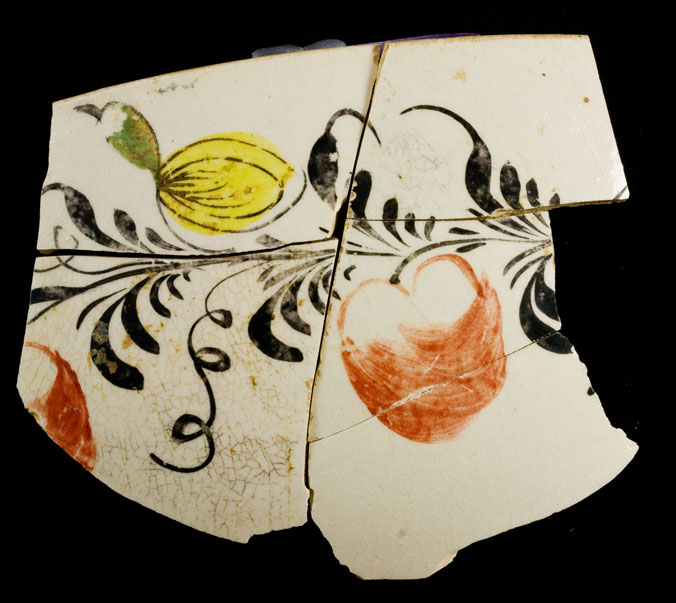
It’s not just the glue itself that is incredible but also the object on which the glue was found. When I started working at George Washington’s Ferry Farm, my first assignment was to examine creamware associated with Mary Washington, George’s mother, which was excavated from the cellar of the Washington home. I focused on a lovely punch bowl with beautiful hand-painted enamel depicting a floral motif with cherry accents. Obviously, we adore cherries at Ferry Farm, being the setting of the fabled chopping down of a certain tree by young George, and we wanted to learn more about it.
The punch bowl was manufactured in the 1760s or early 1770s. It exhibited a lot of use wear, indicating it was obviously a favorite of Mary’s. The punch bowl was of a size designed to be passed around at a gathering for each guest to take a sip directly from it. This was a time before germs were well understood. Thankfully, for health’s sake, 18th century punch contained a hefty amount of alcohol. This also meant that punch was not cheap. Actually, the production and drinking of punch was very much a ceremonial form of conspicuous consumption. Mary chose this special bowl as much for its beauty as for its function.
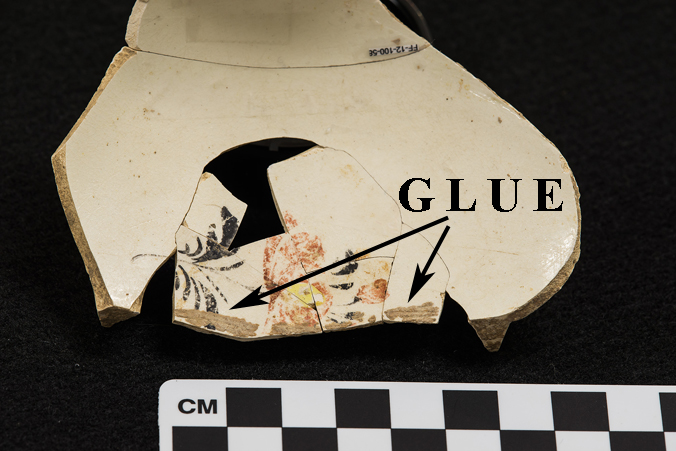
After close inspection of the vessel, I noticed a strange substance adhering to many of the edges. This unsightly brown stuff extended across the many breaks in the bowl and, upon microscopic examination, exhibited suspicious brush marks. Furthermore, additional ceramics from the same cellar excavation revealed similar residues. Could it be glue? If it were, this would shed light on a previously unknown behavior taking place in the Washington home – the breaking and subsequent repair of ceramics. We had to know! What followed was a multi-year study during which we tested the historic glue residue samples utilizing mass spectrometry courtesy of Eastern Michigan University. We spent months researching historic glues, replicating those glues, and then breaking and mending much thrift store pottery with the aforementioned glue in the name of science. The conclusion? We had indeed discovered eighteenth century glues!
While this may not seem like a ‘eureka’ moment, it was actually quite significant. First of all, it’s amazing that 250-year-old glue survived in the ground for so long. Second, the discovery improves our understanding of Mary Washington, a woman that gave birth to and shaped the young life of our first president. By replicating period glues and mending modern pottery, we also learned that the vessels Mary had repaired probably were not used for anything other than display after mending. They could not have held a liquid, which means that after it was broken and mended, the beloved punch bowl was probably relegated to mantle or shelf where the delicate hand-painted flowers and charming cherries could be admired but never used for its intended purpose ever again.
We also concluded that Mary herself would probably not have made and applied the glues personally. Turns out making eighteenth century glues involved a wide array of bizarre and often stinky ingredients including ox gall, animal hide, bull’s blood, garlic, eggs, cheese, isinglass (extracted from a fish’s swim bladder), and the slime from garden snails (yep). Watch the video below to see how colonial-era glue was made. You can also click here. It was a time consuming and messy endeavor that was likely undertaken by the enslaved people living at Ferry Farm rather than by the mistress of the house.
To date, seven vessels belonging to Mary exhibit glue residue. Interestingly, even though a professional mender was operating in the town of Fredericksburg just across the river from where she lived, Mary chose to have glue prepared at home with which to repair her ceramics. That, plus the fact that she had these pieces mended even though she could never use them again means Mary was a thrifty woman who saw the value in displaying the objects. Perhaps demonstrating that she owned these highly fashionable ceramics took precedence over using them?
What makes the glues even more exciting is that nowhere in the historic record does it mention that Mary was repairing ceramics at home. Our only evidence for this activity is archaeological and it has revealed a previously unknown aspect of her life. Perhaps now the question is not “Did George chop down the cherry tree?” but rather “Did George break the cherry punch bowl”?
And all that is why glue is the coolest thing I’ve ever found.
Mara Kaktins, Archaeologist
Ceramics & Glass Specialist
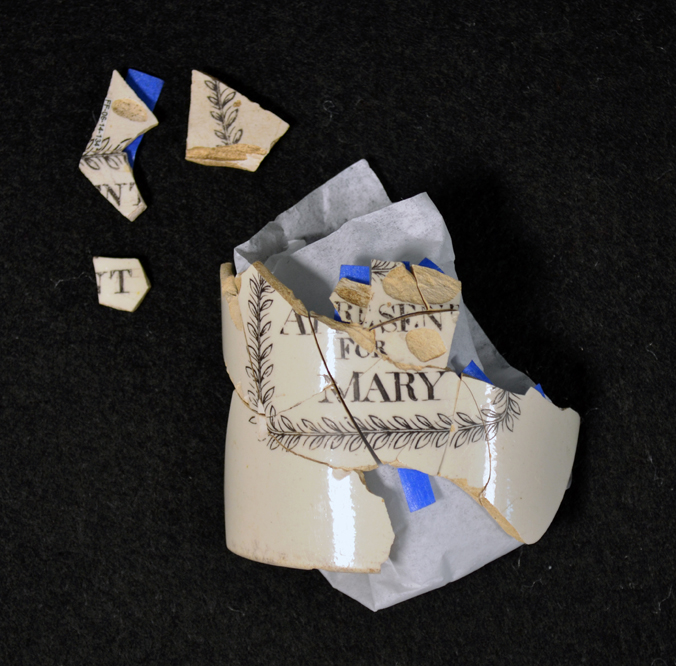
Child’s mug that reads “A Present for Mary” unearthed at George Washington’s Ferry Farm.
Archaeologists are always trying to link artifacts with the actual people who lived at the sites we study. As such, we get very excited when we find artifacts with people’s names on them. It makes our job easy, right? So, imagine our elation when a small creamware cup bearing the words “A Present For Mary” in black transfer print was unearthed at George Washington’s Ferry Farm. People immediately assumed it must have belonged to George’s mother Mary Washington, the most famous Mary to live here. However, upon closer inspection this theory totally unraveled. The small cup was in fact a child’s mug manufactured long after Mary had grown up and, for that matter, probably after her death. It could never have been owned by Mary Washington. What seemed an open and shut case got a little more interesting.
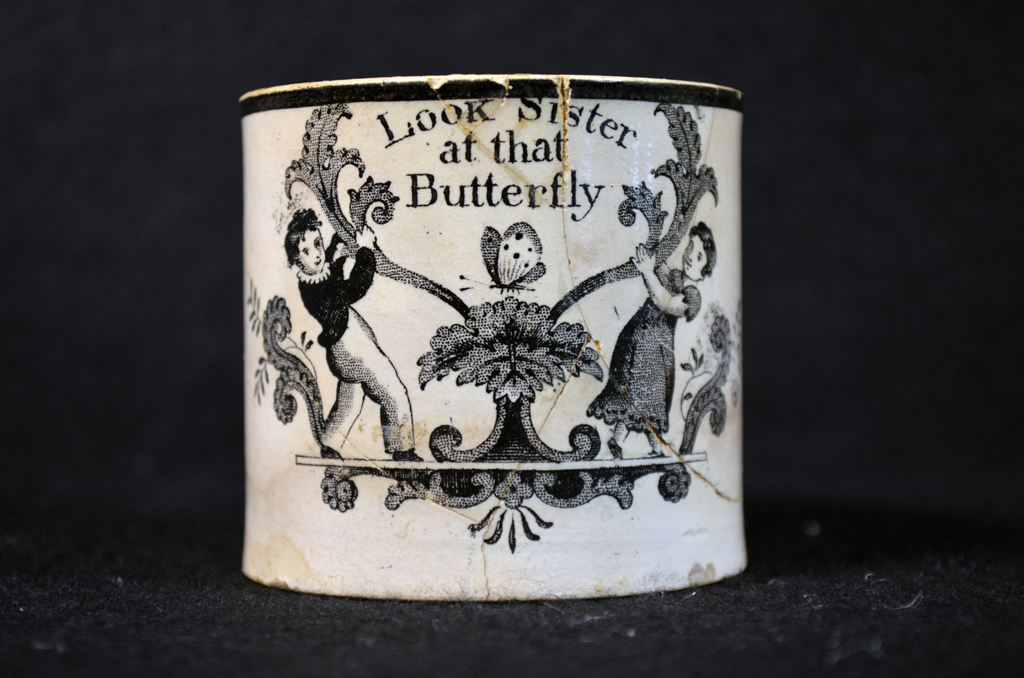
First off, what was a child’s mug? Well, it was a common and inexpensive small mug given to children as a reward for learning, doing well in Sunday school, or general good behavior. The mugs were fairly small and decorated with the child’s name, bible verses, images of play, or references to learning. Inspiration for these decorations came from the popular children’s books of the time. A few common sayings found on these mugs were:
A gift for___.
A present for ___.
A trifle for ____.
A present for a good girl/boy.
A present for writing well.
A reward for industry.
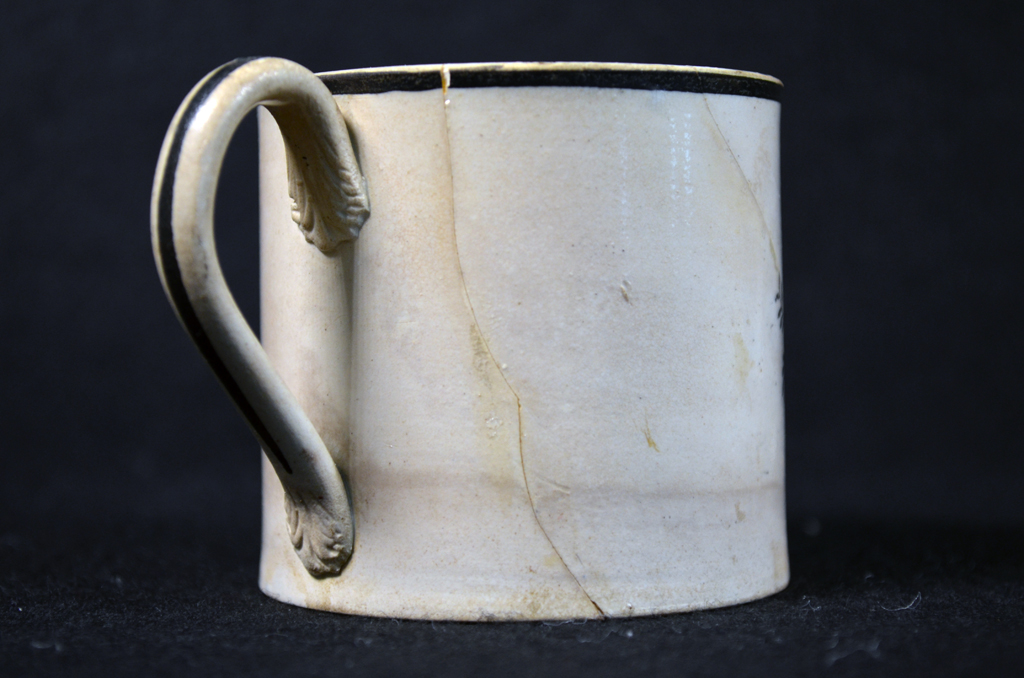
Example of a complete mended pearlware child’s mug with a whimsical phrase illustrated in black transferprint.
These mugs were similar to christening mugs, which are still common gifts today. While they have the same shape and are given to children, the two types of cup differ in material and purpose. A child’s mug was mass-produced in factories and made of relatively cheap ceramic. It would have been sold for a few pennies. In contrast, a christening mug was a fancier gift, often made of far more expensive silver or porcelain. Similar to our fine china today, these christening mugs weren’t meant for everyday use like the more ordinary child’s mugs. Indeed, excavated child’s mugs often exhibit extensive use wear from being handled by children.
Ceramic child’s cups were manufactured starting in the late 1700s and remained abundant by the mid-1800s. Their rise in popularity coincided with the emergence of a more modern concept of childhood. Prior to the 19th century, children were treated like tiny adults or pre-adults. They dressed like adults and the few toys that did exist reinforced social roles and instructed children how to perform adult tasks. It wasn’t until the 1800s that childhood became distinct from adulthood. With this change, children became a new marketing demographic with books, toys, and ceramics targeted just at them.
In our efforts to find more fragments of the mystery Mary mug, we scoured the Ferry Farm artifact database and not only discovered more of her mug but also sherds from three other child’s mugs! While two of these do not contain complete names, one pearlware mug clearly reads “A Present For Billy”.
Pearlware and Creamware sherds representing, clockwise, at least four child’s mugs. All include the phrase “A Present For…” Two names are visible. ‘Mary’ can be seen on far right mug in grouping 2 and the partial name ‘Billy’ is exhibited on the lower middle sherd marked 3.
Unfortunately, the dates during which these mugs were manufactured fall within a fifty year gap in our knowledge of who exactly was living at Ferry Farm. From the late 18th century to the first quarter of the 19th century, an absentee owner rented the land to tenants. Information on just who those tenants were has been lost to time. In a sense, this makes the discovery of the mugs even more special. Although we’ll probably never precisely know the Mary and Billy the mugs belonged to, we now know that two children with those names lived and played here. Anonymous no more, these simple sherds are likely all the evidence there is to proclaim their time at Ferry Farm. While the children may have been sad upon breaking their mugs, we’re very happy to have what remains and hope to one day expand upon their stories.
Archaeologists sometimes recreate technology from the past to understand how people lived. This is called experimental archaeology. When archaeologists at George Washington’s Ferry Farm found glue residue on sherds of Mary Washington’s china, they developed ways to recreate this glue. This video explains the glue making process and what recreating the glues revealed about Mary.