Lives and Legacies

Tag: Decorations

  • Mistletoe: More Than Christmas Kisses

    In the 17th and 18th centuries, colonial Virginians decorated their homes for Christmas with all manner of evergreens.  This greenery – holly, ivy, mistletoe, and more – were seen as symbols of everlasting life.  Each year at Historic Kenmore, we also decorate the house with greenery in this tradition.

    Mistletoe actually adorns Kenmore year round. The elaborate plaster ceiling in the drawing room depicts the four seasons and mistletoe is used to represent winter.  The mistletoe depicted, however, is not American mistletoe; the craftsman based this part of the ceiling on European mistletoe instead. This makes sense given that the artist was probably European. Having never seen American mistletoe, he would not know how to sculpt it.
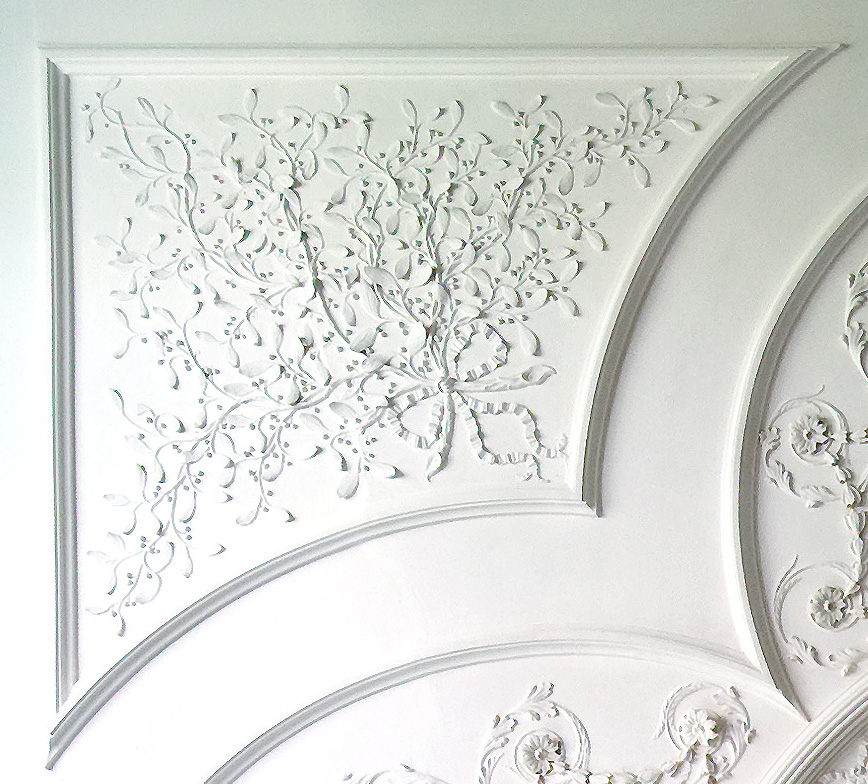
    mistletoe-on-kenmores-drawing-room-ceiling
    Mistletoe depicted in the ornate plaster ceiling of Kenmore’s drawing room.

    Regardless of whether American or European, how did mistletoe come to symbolize winter and hang in homes during the holiday season? How did these green branches with white berries become associated with the hope of a little fun and (possible) future romances? What is it about mistletoe that brings so much joy to the seasons’ festivities?

    Mistletoe (Phoradendron leucarpum) grows in the southern United States and is native to much of North America. It has more berries and shorter, broader leaves than English mistletoe (Viscum album). Like English mistletoe, the American plant is a semi-parasite; it digs its “roots” in the host tree and sucks sap and water from the tree, but it manufactures its own chlorophyll.  Mistletoe often grows in the tallest branches of the tree, making it very hard to harvest.

    The word “mistletoe” likely came from one of two sources.  Its origins may be from the Anglo-Saxon “misteltan;” “mistl” meaning different and “tan” meaning twig. Mistletoe is a very “different twig” indeed because of how and where it grows – something that would not have escaped the notice of the Anglo-Saxons.  The word’s other possible origin also translates “tan” as twig, but renders “mistel” as dung; making “mistletoe”  “dung twig.” This may have been because bird droppings contained the seeds that helped spread the plants to other trees.
    an-arch-druid-in-his-judicial-habit
    Imaginative illustration of ‘An Arch Druid in His Judicial Habit’ from The Costume of the Original Inhabitants of the British Islands by S.R. Meyrick and C.H. Smith (1815) Credit: Wikipedia.

    Druids, who served as priests and the learned class for the ancient Celts, valued mistletoe almost as much as they valued oak trees. These men (there is little evidence that there were women druids) climbed to the top of mistletoe-laden trees and harvested the sacred plant with a golden sickle. Those on the ground were careful to catch the plant as it fell because they believed the mistletoe would lose all of its power if it hit the ground.  Druids then used it to cure disease and promote fertility in humans and animals. It may be that the custom of hanging mistletoe stems from a Druidic tradition. Enemies who met under the mistletoe would lay down their arms and greet each other as if friends.

    Mistletoe also played a role in Norse mythology and some think that our modern views on mistletoe came from one particular Norse myth. Balder, a god of peace, was the son of Odin, chief of the gods, and the goddess Frigg.  Balder began to dream of his own demise and his father traveled to the underworld to learn of his son’s fate.
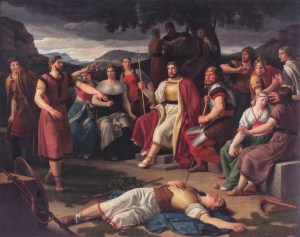
    baldr-dead-by-eckersberg
    Baldr’s Death (1817) by Christoffer Wilhelm Eckersberg. Credit: Royal Danish Academy of Fine Arts/Wikipedia.

    Odin returned and shared the bad news with Balder and the other gods and goddesses. Frigg went to everything in the cosmos and asked it to swear it would not hurt her son.  Everything swore loyalty but mistletoe.  Loki, the god of mischief, made some mistletoe into an arrow that killed Balder.  In the version of the story with a happy ending, Balder was brought back to life and Frigg makes mistletoe a symbol of love and kisses to those who pass under it.

    The English origins of kissing under the mistletoe aren’t well known. Historical records indicate that this merriment became popular in England sometime in the 16th century, but we don’t know if it was commonplace before that.  English mistletoe etiquette had some hard-and-fast rules: women under the mistletoe were not to refuse kisses; men could only kiss women (or girls) on the cheek; after the kissing transaction, the man removed a berry from the mistletoe ball; after the last berry was plucked, the kissing ended.
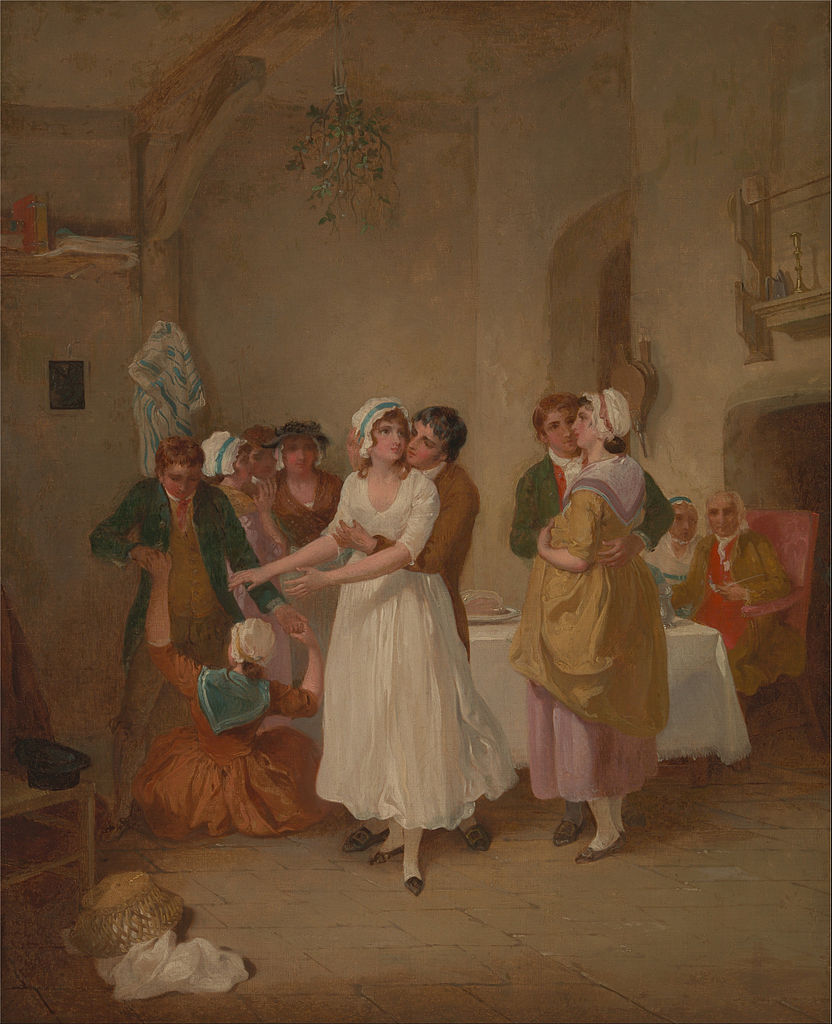
    the-mistletoe-bough-by-francis-wheatley
    The Mistletoe Bough (c. 1790) by Francis Wheatley. Credit: Yale Center for British Art/Wikipedia


    Harvesting mistletoe is a challenge, but 18th century Virginians came up with an ingenious way to quickly and easily gather the plant.  Instead of climbing up into the tree’s canopy, Virginian men shot the mistletoe out of the tree.  They then took the good sprigs home, fashioned them into mistletoe balls, and enjoyed the merriment of the season.  This tradition harvesting mistletoe through gunfire still continues today all over the American south.

    Ancient Druids. Mythical Norse gods. 18th century Virginians. Over the centuries, these people, whether real or imagined, contributed to the myths and traditions that have made mistletoe a symbol of winter, friendship, and love.  When you share a kiss with someone special under the mistletoe this season, you might want to take a moment to share mistletoe’s long history with that someone too.

    Kelly Brennan Arehart
    Manager of Interpretation and Visitor Services
  • Thirty Years of Gingerbread

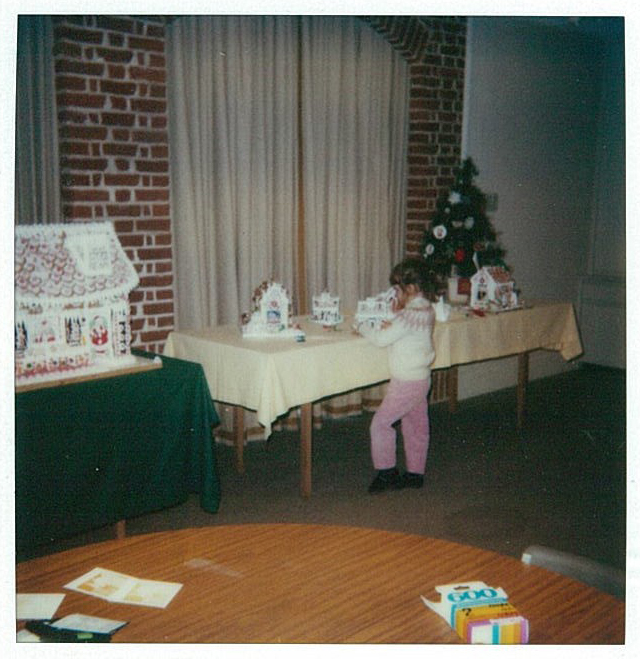
    It’s a long-standing holiday tradition. In fact, it’s so long-standing that this year, 2016, marks the tradition’s 30th year.  What tradition is that?  The annual Gingerbread House Contest and Exhibit at George Washington’s Ferry Farm!

    Since we are marking three auspicious decades for this event, we dug into the archives to present a look back here on Lives & Legacies.

    The contest began in 1987 and, for many years, took place at Historic Kenmore instead of Ferry Farm.  Our records are scant for the contest’s first year but we do know that the 2nd annual contest in 1988 saw middle schoolers Lisa Allen and Erika Paulson win best-in-show, according to a Free Lance-Star clipping in our files. Rev. Ed Boutchyard of Bowling Green’s Zion Full Gospel Church made a church with an ice cream cone steeple!

    1987-1
    A Polaroid from the first-ever Gingerbread Contest & Exhibit in 1987.

    Lisa Allen repeated her best-in-show victory in 1989 with the help of her sister Melanie and friends Theresa Stockdill and Courtney Lucado.

    In these early days of the contest, the German Club at James Monroe High School, one of the contest’s longest-running participants, began submitting regular entries and, in 1993, they won their first-ever best-in-show.

    In 1995, the Free Lance-Star (scroll up) profiled Claybourne, Emily, and Meredith Beattie, who, having entered the contest for nearly ten years, had only ever won a single 2nd place ribbon.  For this family, the “tradition of assembling and decorating the houses is far more important than winning prizes.” The kids, along with mom and dad, would visit their grandmother out-of-town over Thanksgiving break. They created their gingerbread houses there and then traveled the 300-miles back to Fredericksburg with the houses packed in the back of the car.  Clay explained that he entered year after year “because I like doing it with my sisters and my family.”

    1997-1
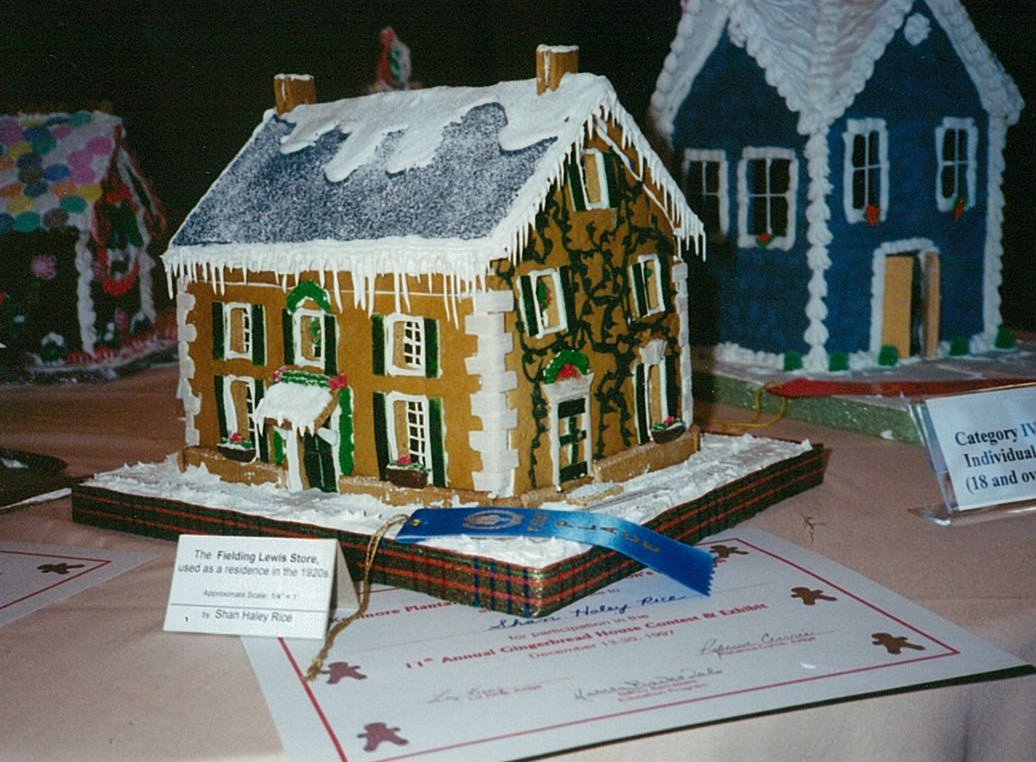
    A gingerbread version of the Fielding Lewis Store from 1997.

    In 2000, the contest and exhibit moved from Kenmore across the Rappahannock River to Ferry Farm, where it has been held every year since.

    There’s still time to enter a gingerbread house in this year’s contest and be a part of the tradition! Gather the family, start baking that gingerbread, and creatively decorate your house together. This year’s theme is “Home for the Holidays.”  Entries are being accepted now through Saturday, December 3 at Ferry Farm. Click here for rules and an entry form.

    The exhibit will open to the public on Sunday, December 4.  Ferry Farm is open Monday – Saturday from 10:00 a.m. – 4:00 p.m. and Sunday from 12:00 p.m. – 4:00 p.m.  General admission to Ferry Farm and the exhibit is $8 adults, $4 students, under 6 free. To view the gingerbread exhibit only, the cost is $4 adults, $2 students, under 6 free. For more details about this and other holiday events at Ferry Farm and Kenmore, visit kenmore.org/events.

    Zac Cunningham
    Manager of Educational Programs

  • Photos: Holiday Decorations at Ferry Farm & Kenmore

    The George Washington Foundation wishes everyone a joyous holiday season!  Enjoy these photos of holiday decorations created by wonderful volunteers!  The George Washington Foundation Garden Guild decorated at Kenmore and the Lake Anna Garden Club decorated at Ferry Farm.

    There is still time to see Historic Kenmore and George Washington’s Ferry Farm adorned for the season as well as each site’s annual display of dollhouses, miniatures, and gingerbread creations. For details about these exhibits, visit kenmore.org/events. Finally, if you missed it, check out our most recent post A Christmas of Uncertainty, December 1775.

  • Photos: 29th Annual Gingerbread House Contest at Ferry Farm

    It’s a long-standing holiday tradition! Adults and children alike will enjoy the sights and smells of the festive creations displayed at George Washington’s Ferry Farm!

    This year’s theme is “George Washington Slept Here” and a list of contest winners can be seen here (PDF). Visitors may vote for their favorite and this ‘people’s choice’ winner will be announce after the holidays. The gingerbread houses remain on display until December 30.

    Ferry Farm is open Monday – Saturday from 10:00 a.m. – 4:00 p.m and on Sunday from 12:00 p.m. – 4:00 p.m. The site will be closed Christmas Eve and Christmas Day.

    Admission cost for viewing the gingerbread exhibit only is $4 adults, $2 students, under 6 free. There is an additional fee for a self-guided iPad tour of Ferry Farm. Visit www.ferryfarm.org for more details.

  • Ferry Farm is “Home Sweet Home” for the Holidays

    Tradition says that Mary Ball Washington, mother of George Washington, was well-known for her excellent gingerbread. The story goes that she even served her gingerbread to the Marquis de Lafayette when he visited Fredericksburg as part of his postwar tour of America in 1784. Inspired by this tale and as Mary’s home for three decades from 1738 to 1772, George Washington’s Ferry Farm hosts a Gingerbread Contest and Exhibit each December. This year’s event is the 28th annual and features the theme “Home Sweet Home.”

    The photos in the gallery below show just a few of this year’s contest entries representing a variety of ages and skill-levels. We’re also sharing some photos of Ferry Farm decked out for the holiday season and want to thank the Ann Page Garden Club for beautifully decorating this year.

    To see all the gingerbread creations and to vote for your favorite, visit Ferry Farm before the exhibit ends on December 30. Check out the events page on http://www.kenmore.org for more information!


  • ‘A Wee Christmas’ Display Inspired by a ‘Wee’ Kenmore

    History of Kenmore Dollhouse (5)
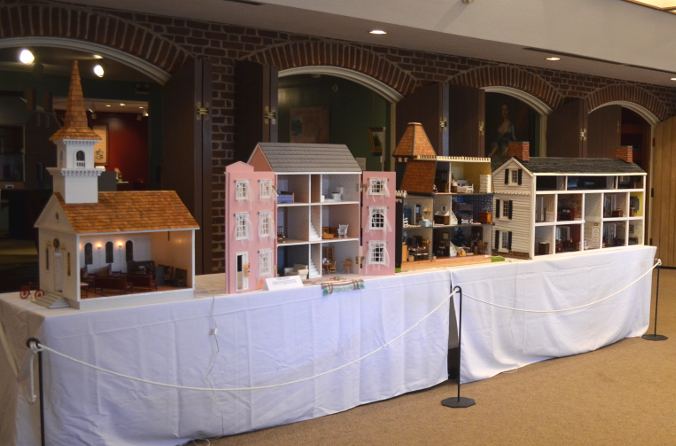
    Dollhouses on display as part of our first-ever “A Wee Christmas” Dollhouses & Miniatures Show.

    This holiday season, we’re excited to share with our visitors the many dollhouses and miniatures loaned by friends, neighbors, and staff to form our first-ever dollhouses and miniatures show that we’re calling “A Wee Christmas at Historic Kenmore”. A highly detailed, replica dollhouse of Kenmore on display in our Crowninshield Museum served as the inspiration behind this new exhibit. Like its real life counterpart, this unique Kenmore replica has a fascinating history all its own.

    While on a visit to Fredericksburg in the spring of 1984, Florence White, an enthusiast of Georgian architecture, fell in love with Kenmore. She had been searching for years to find just the right place to make into a grand historical dollhouse. Kenmore with its simple, symmetric windows and imposing brick walls was perfect.

    History of Kenmore Dollhouse (1)
    The dollhouse version of Historic Kenmore.

    However, Florence needed someone who would construct this dollhouse with the degree of detail and intricacy that would mimic the elegant original. After a long unsuccessful search there came a chance meeting with Jim Freytag, a retired railroad man turned miniature enthusiast, and she knew she had her builder.

    Jim’s first task was to visit the home that Florence wanted to replicate and gather as many details as he could. He wanted to make it as structurally authentic as possible from the number of bricks between the windows to the outside steps worn down with years of use. He toured the house taking notes on the particulars of each room, the furniture, the décor, and the layout. Photographs were not permitted inside the house so Jim purchased postcards in order to get better detail for the intricate plaster ceilings and mantels.

    Some 2700 hours of work, 18,929 bricks and over $4000 later Florence had her Kenmore dollhouse. Jim had completed four bedrooms, a dining room, living room, drawing room, and study. They are each equipped with miniature pieces of furniture from a large cherry-stained Queen Anne table in the dining room flanked by two portraits of Colonel Lewis and Mrs. Lewis to canopy beds, brass candlesticks and leather boots in the bedrooms.

    History of Kenmore Dollhouse (4)
    A view of the Chamber inside the Kenmore dollhouse.

    Over twenty-six years later, the dollhouse now sits in the museum gallery at Kenmore’s visitor center for all to view. Each room still has the exact furnishings so painfully and meticulously created by Jim and positioned to Florence’s specifications. The house is a time capsule which shows Kenmore before renovations completed nearly a decade ago. Visitors can see pieces of furniture that are no longer on display and can understand the dimensions of the upper floor rooms which are not currently open to the public.

    Florence’s devotion to detail and Jim’s immense skill leave us with a whimsical model of Kenmore which exudes all the elegance and beauty of the original that would have made the Colonel and Betty proud.

    You can see Florence and Jim’s replica of Kenmore as well as all the other wonderful dollhouses and miniatures that make up “A Wee Christmas at Historic Kenmore” until December 30.

    Heather Baldus
    Collections Manager

  • A Kenmore Christmas

    Historic Kenmore is decorated for the holidays, portraying what it may have looked like during the Christmas season of 1775.  At that time, the Lewis family would have just moved into Kenmore a couple of months earlier, and it would have been their first Christmas in the new house.  It was a time of some sadness, as well – their 15 year old son Charles had died that fall, of an unidentified illness.  Although unknown at the time, it also would be the last “normal” holiday before the Revolution began in earnest.

    The photos in the gallery below provide a glimpse of some traditional holiday decorations (a few have modern twists) and customs common to the 1700s.

    Want to see Historic Kenmore in all of its holiday splendor? Seasonal tours are offered daily through December (Closed Christmas Eve, Christmas Day, and New Year’s Eve).  Or reserve a spot for our dramatic theater presentation that re-creates a Twelfth Night celebration inside the house on Saturday, January 3 and Sunday, January 4 .  See the events page on www.kenmore.org for more information!