Lives and Legacies

Tag: excavations at Washington’s boyhood home

  • 2024 Dig Preview!

    Spring is in the air. The weather is warming up, flowers are blooming, bees are buzzing, and of course the dig season is about to start here at Ferry Farm, George Washington’s Boyhood Home.

    As part of the 2023 dig season, our team revisited the site of a colonial-era kitchen that had experienced a particularly destructive fire sometime in the middle of the 18th century. The kitchen’s foundation, as well as the surrounding landscape, had been compromised by the construction, and subsequent destruction, of two farmhouses that were built directly on top of everything. This site (FF-44) is located about 50 feet from the northeast corner of the Washington House.

    Location of this year’s dig at the colonial kitchen site (FF-44)

    The 18thC kitchen site was initially explored as part of an archaeological assessment of the Ferry Farm historic property in the early 1990s. The structure and its contents were originally interpreted as a house, but a reevaluation of the excavation notes and artifacts several years later reinterpreted this site as a kitchen, not a primary domestic dwelling. But research queries still exist, such as narrowing down the dates of construction and destruction of the structure, as well as determining the possibility that meaningful artifact deposits and landscape features that might help bolster the interpretation of the building still exist outside of the foundation.
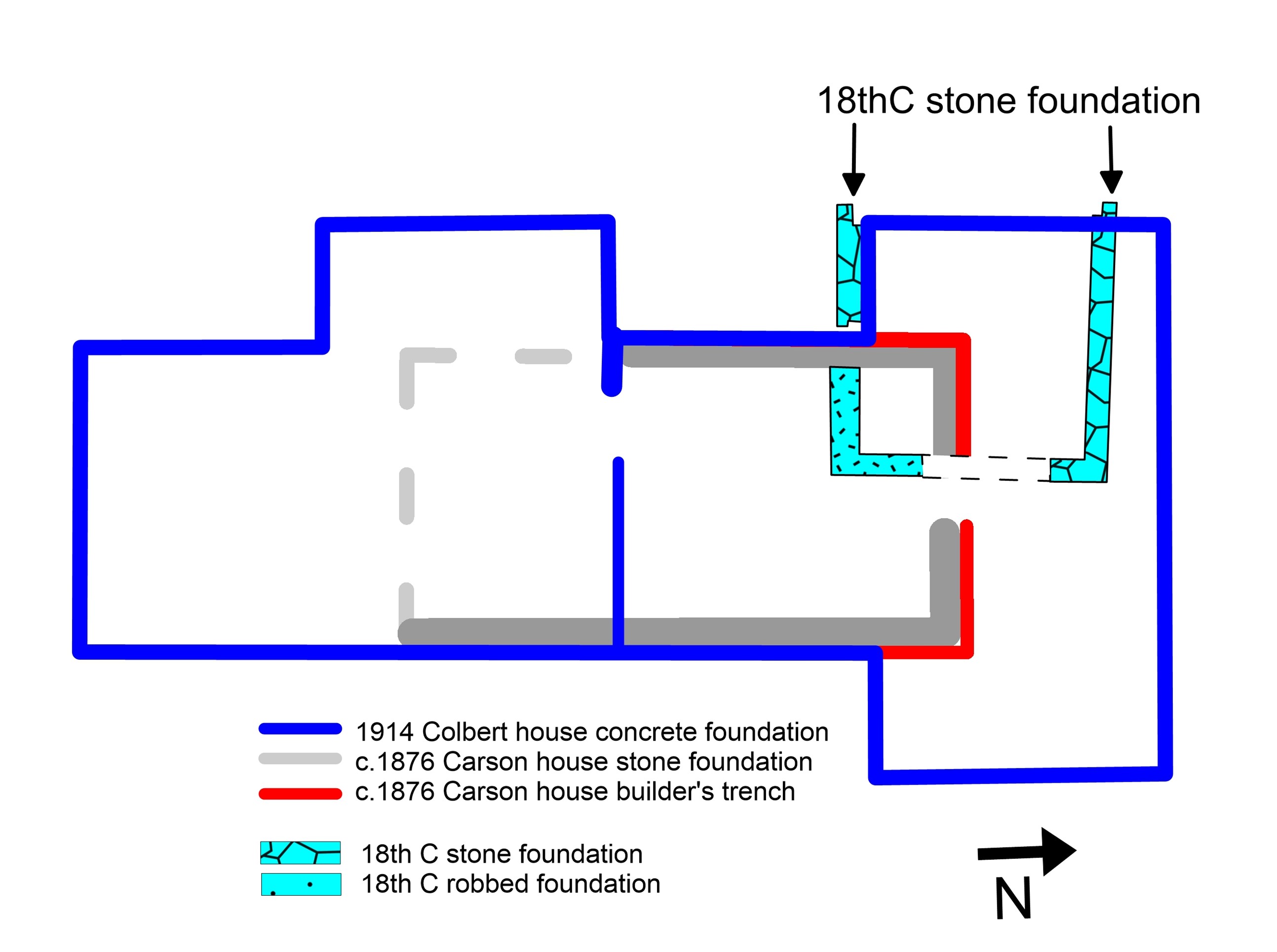
    Location of the 18thC kitchen in relation to later 19th and 20thC farmhouses

    With these questions in mind, our efforts last summer focused on working out a game plan for reexamining the site for our future excavations.  During our dig, we uncovered the southwest corner of the original kitchen as well as the foundation of the 20th-century farmhouse overlaying it. Re-locating the site and evaluating the amount and extent of fill were our primary goals. That completed, this year we will concentrate on investigating the landscape surrounding the foundation and reexamining the burnt fill within.

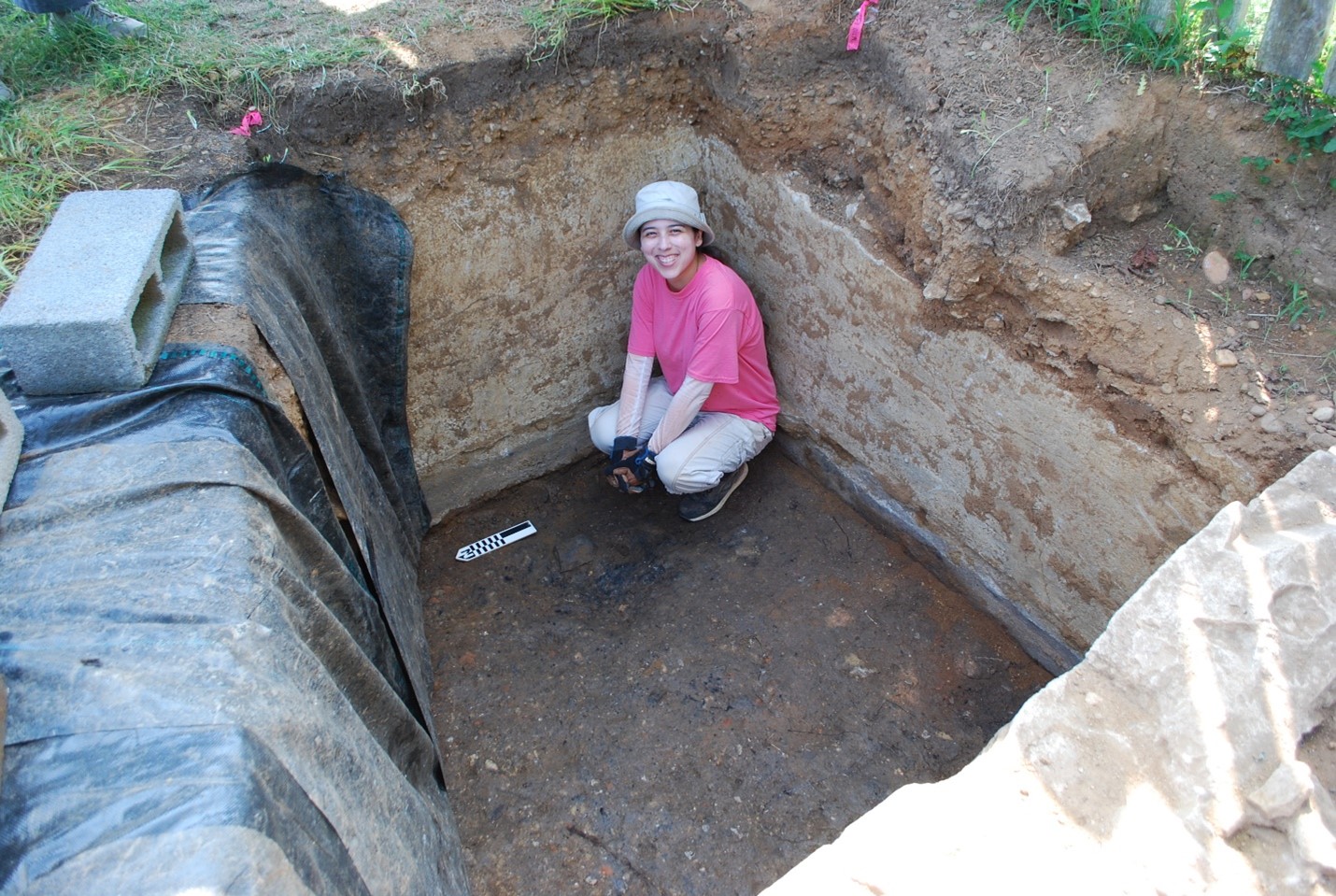
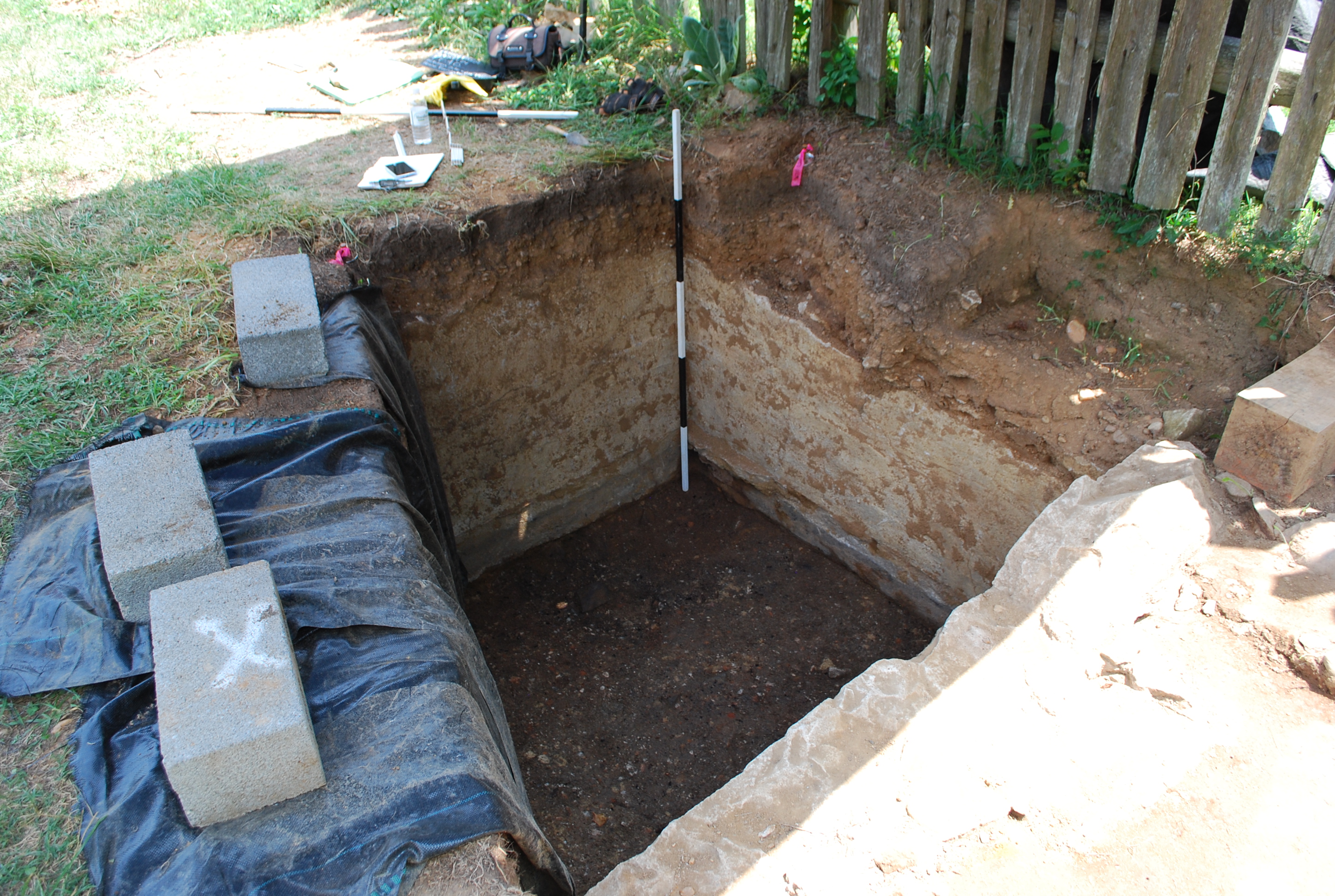
    Last year’s excavation. Red arrow points to area inside of the kitchen, white arrow points to area outside of the building. The stone and concrete wall is part of the 1914 farmhouse foundation, which sits atop the colonial kitchen fill.
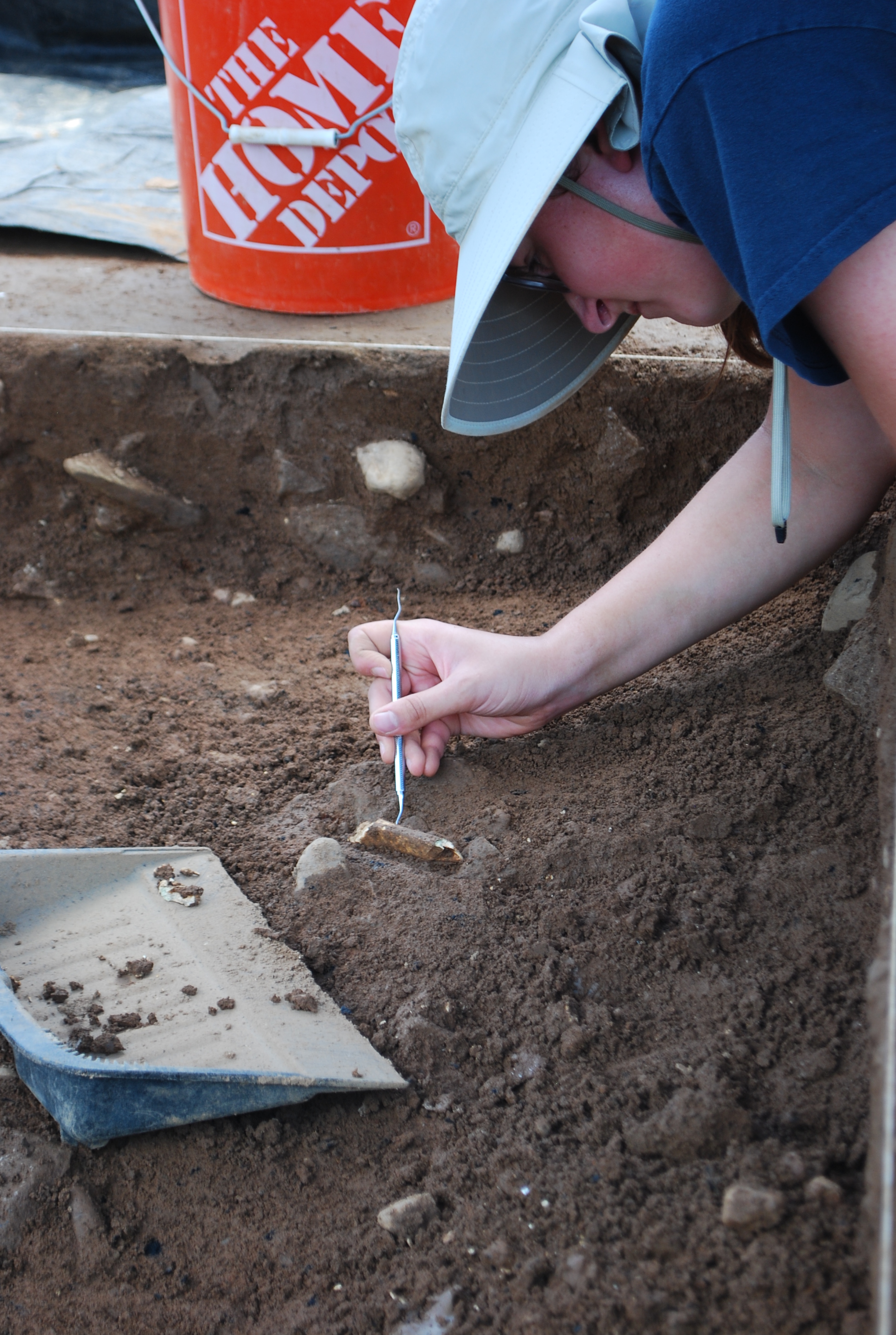
    Lead excavator Sarah on floor of kitchen cellar

    An honest question you might ask would be why would we want to learn more about what was outside of the foundation? Isn’t all the important stuff inside? In the archaeological world, a lot of valuable information can be learned from these outlying areas. Eighteenth-century trash middens are often found outside of a building because garbage was being thrown off of the porches and out the doors and windows. Studying this everyday disposal of trash can tell us how and when a building was being used, as well as traffic patterns by those using the building.

    Another interesting feature that can be found outside of a foundation is a builder’s trench. These trenches were dug by the individuals building the foundation, and as they worked and backfilled these trenches, items they were currently using were accidentally left behind. These artifacts can be excellent dating material and can really nail down a construction date.

    Other items we will be looking for are possible supplementary building features, such as post-in-the ground foundations and fences. Additionally, taking a second look at the site will help us better understand the previous archaeology that was done over thirty years ago.

    As for the exciting second site we started excavating last year, Feature 321, we are putting that project on hold for now and concentrating our efforts on the kitchen site. But work continues in the lab on all the interesting artifacts recovered during last summer’s dig.

    This year’s dig begins April 29thand ends July 12th.  Archaeologists are working on site from 8 am until 4 pm, Monday through Friday, and we gladly welcome questions from our site visitors.  So be sure to stop by and see what exciting things we uncover!

    Danielle Arens and Judy Jobrack

    George Washington Foundation Archaeologists

  • 2023 Dig Season Recap!

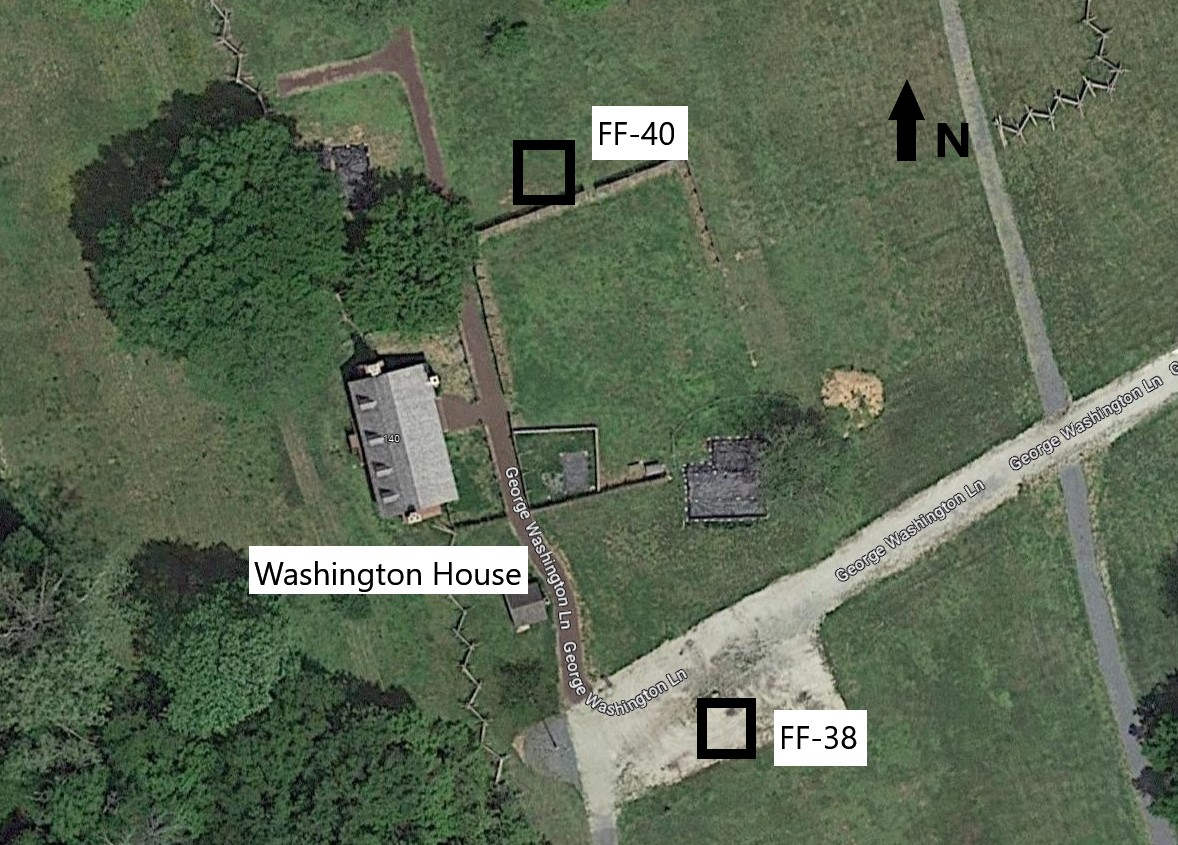
    It’s that time again! As we welcome Fall and the beautiful cool weather it brings, let’s take a look back at our Summer 2023 dig season here at Ferry Farm, George Washington’s Boyhood Home. This year’s dig actually involved excavating two separate areas, designated FF-38 and FF-40, within the historic area. 

    Location of the archaeological projects FF-38 and FF-40 at Ferry Farm.

    Project FF-38

    The FF-38 area contained a large, dark, soil stain that was discovered by accident during the monitoring of a utility trench in 2016.  Only a portion of this feature was visible at that time as it continued beneath the south wall of the trench. We had clues as to the approximate date of this partially-exposed feature, but we still needed to fully uncover the entire feature to establish its total dimensions and determine its age, function, and how it relates to the surrounding landscape.

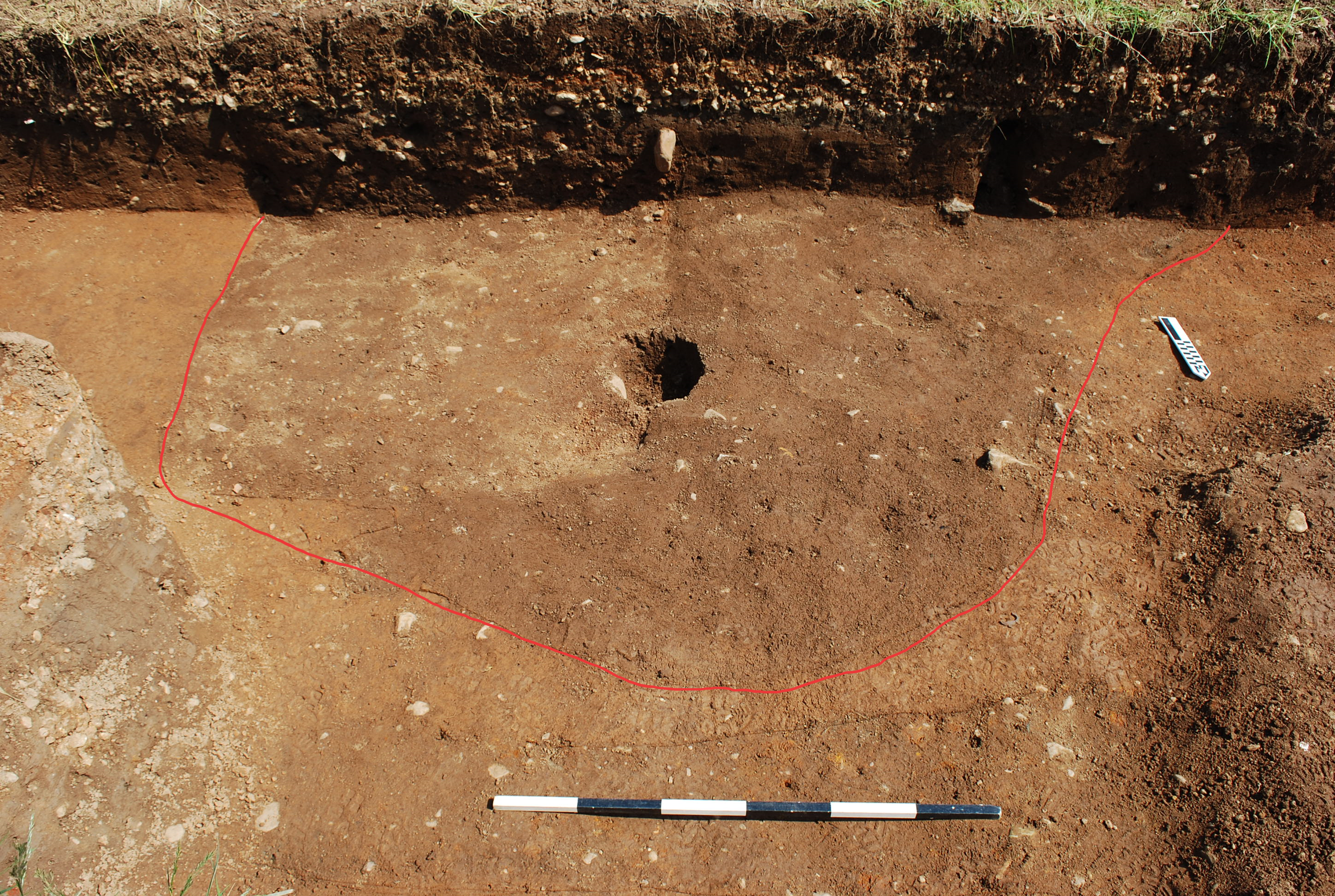
    F.321 as seen in 2016 within the utility trench. Only the northern portion of the feature was exposed at this time. F.321 is outlined in red, and is intruded by a square, lighter-colored 19th-century feature (F. 324).

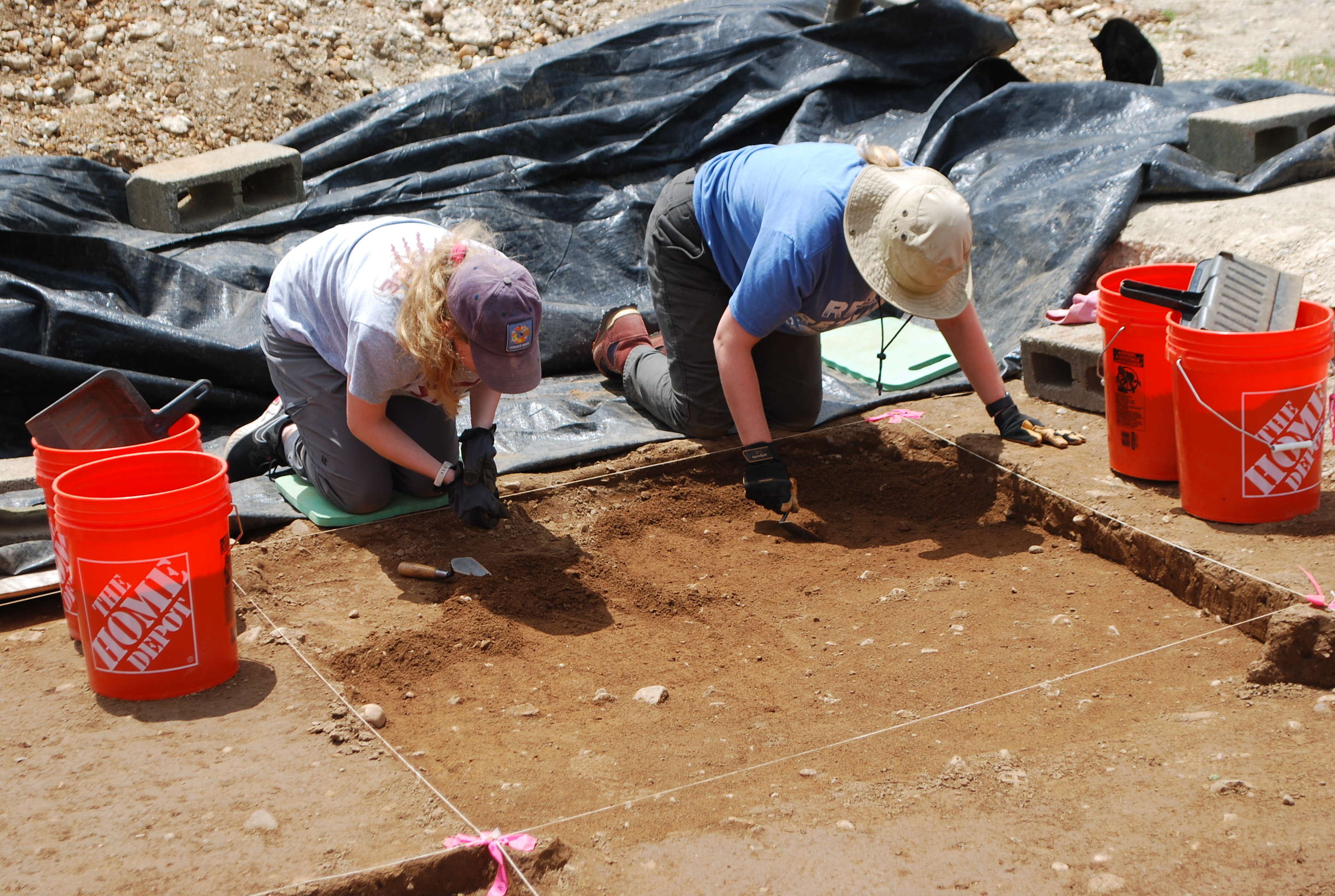
    Our excavation began by the machine removal of two modern layers of gravel that overlay a thick 19th-century layer of plowed soil. The excavation area measured approximately 16 ft. by 20 ft. Our crew of archaeologists then slowly excavated down through the plowed layer until we could identify the boundaries of Feature 321. Fully uncovered, the exciting discoveries began.

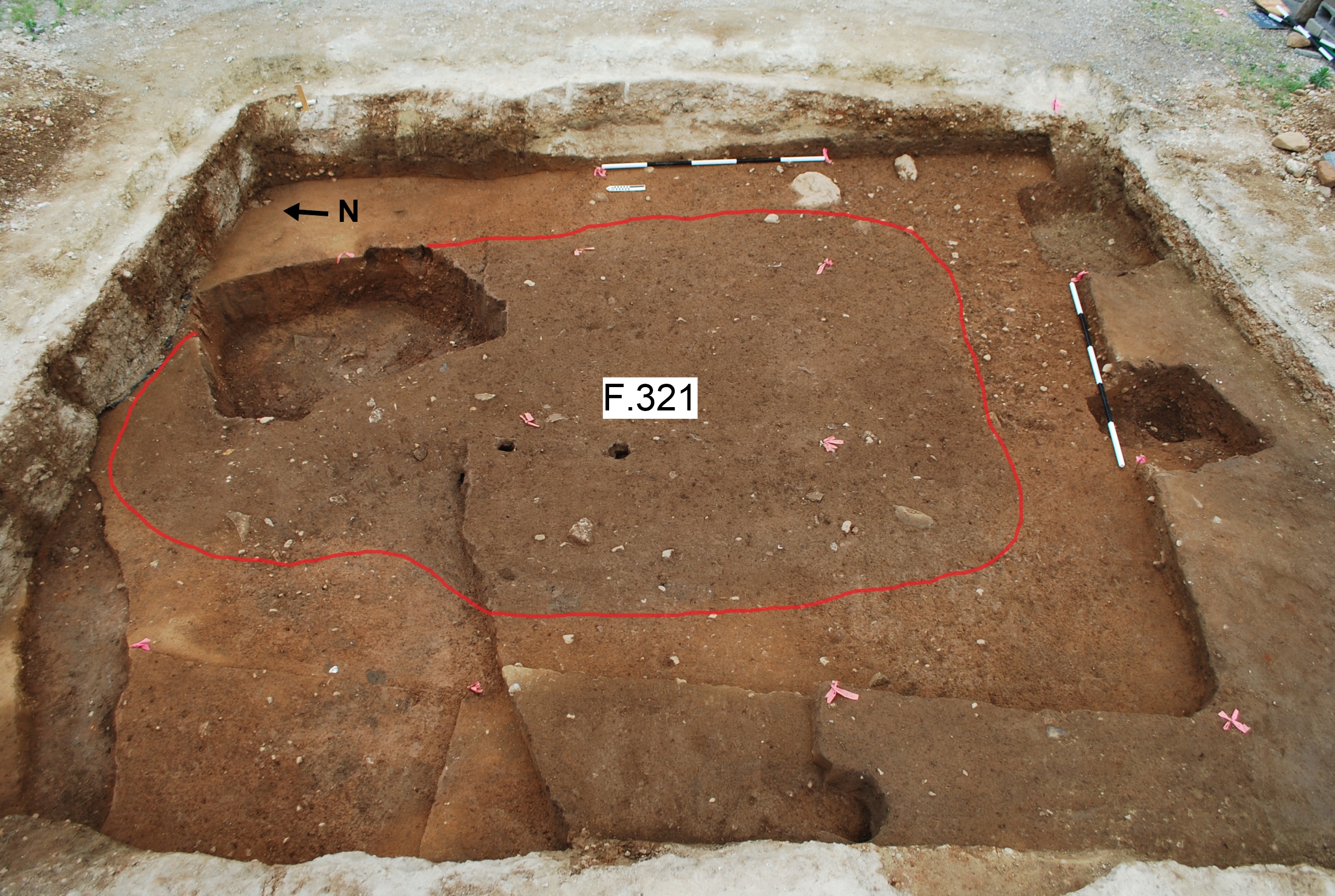
    First and foremost, we discovered the feature was much bigger than originally thought! What initially appeared in 2016 to be a 5’x7’ roundish feature turned out to be the northern tip of a large rectangle measuring 10’ by 16’. The size and shape alone of the feature shifted our interpretation from a small pit to something larger.

    F.321 fully exposed before excavation (outlined in red). The intrusive feature, F. 324, has been partially dug out at the north end of the site.

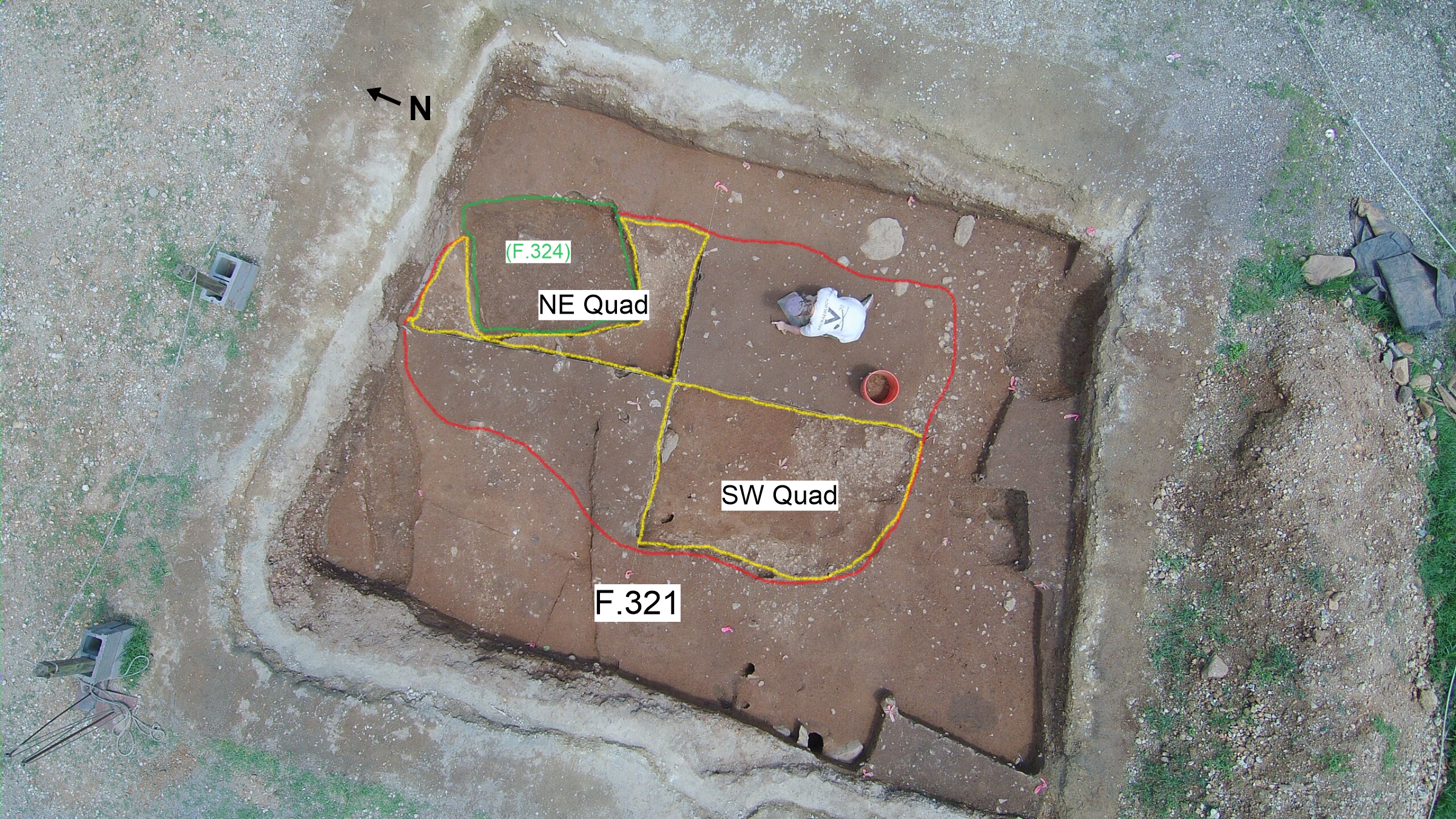
    Feature 321 was divided into four sections and our crew excavated both southwest and northeast quadrants. This excavation approach allowed us to determine that the feature was roughly 1’ deep at the center, with gently sloping sides, and filled with successive layers of soil and ash-filled deposits. These soil layers provided us with an awesome mix of artifacts which were used to nail down the feature’s end date to the middle of the 18th century.  But establishing a date is only part of the process: artifacts can further help us identify the function of the feature as well.

    F.321 after the southwest and northeast quadrants were excavated.  Intrusive Feature 324 is outlined in green.

    That being said, we are still unsure of what this feature actually is. Here is what we know so far.  There is no hearth of chimney remains. Lack of a fireplace suggests it wasn’t a domestic dwelling, but it could be another type of plantation outbuilding, such as a storage building, shed, or barn. The edges are almost vertical, and the floor is relatively flat.  There is no silt so the pit was covered while it was open.   It is too regular to be a quarry pit used to harvest clay as a building material.

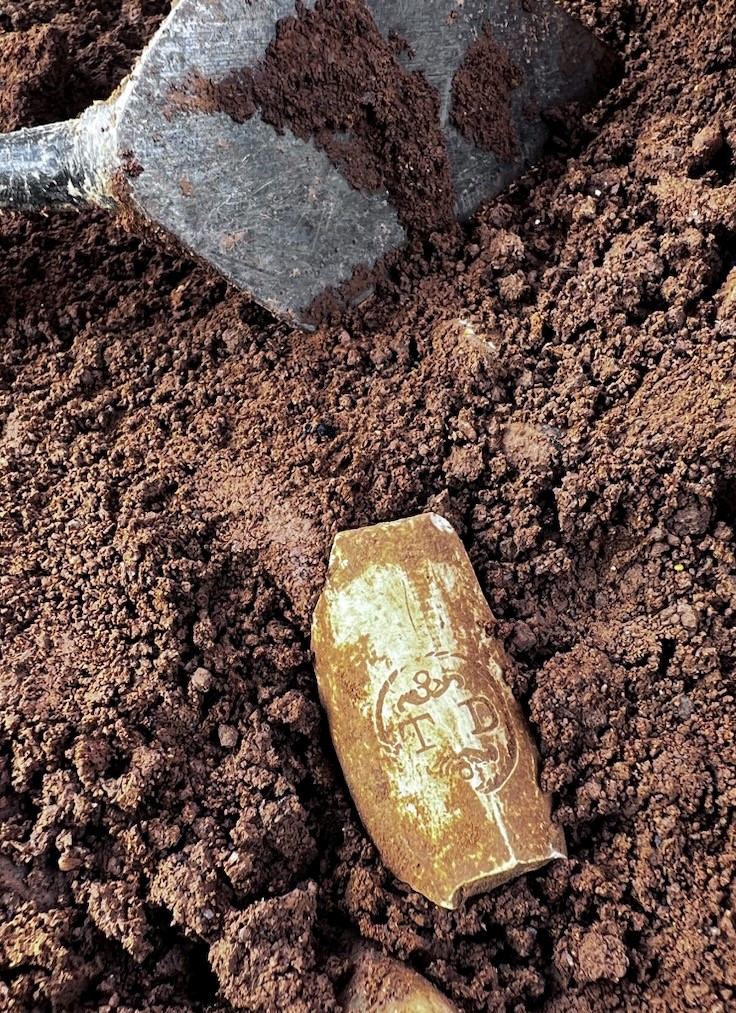
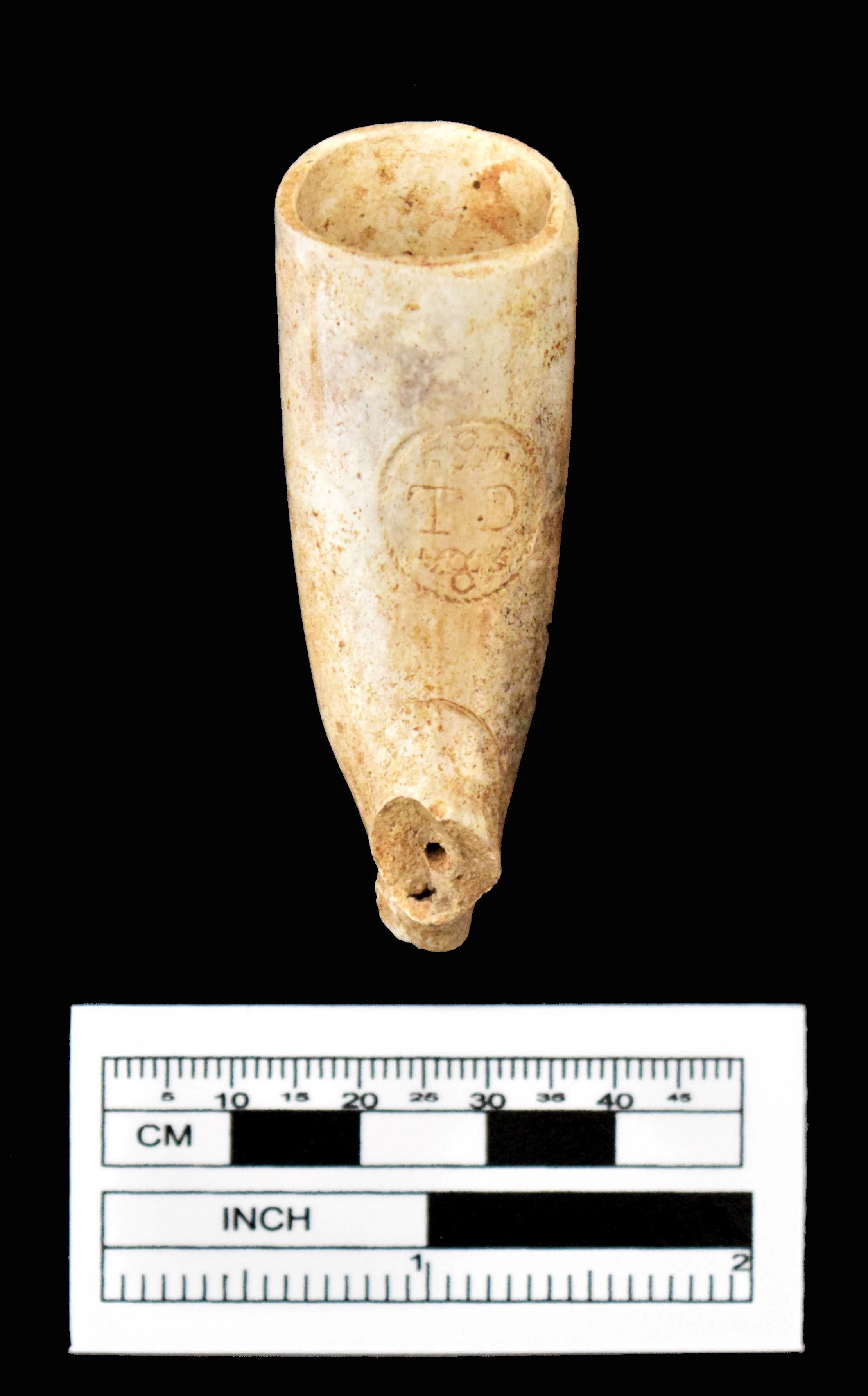
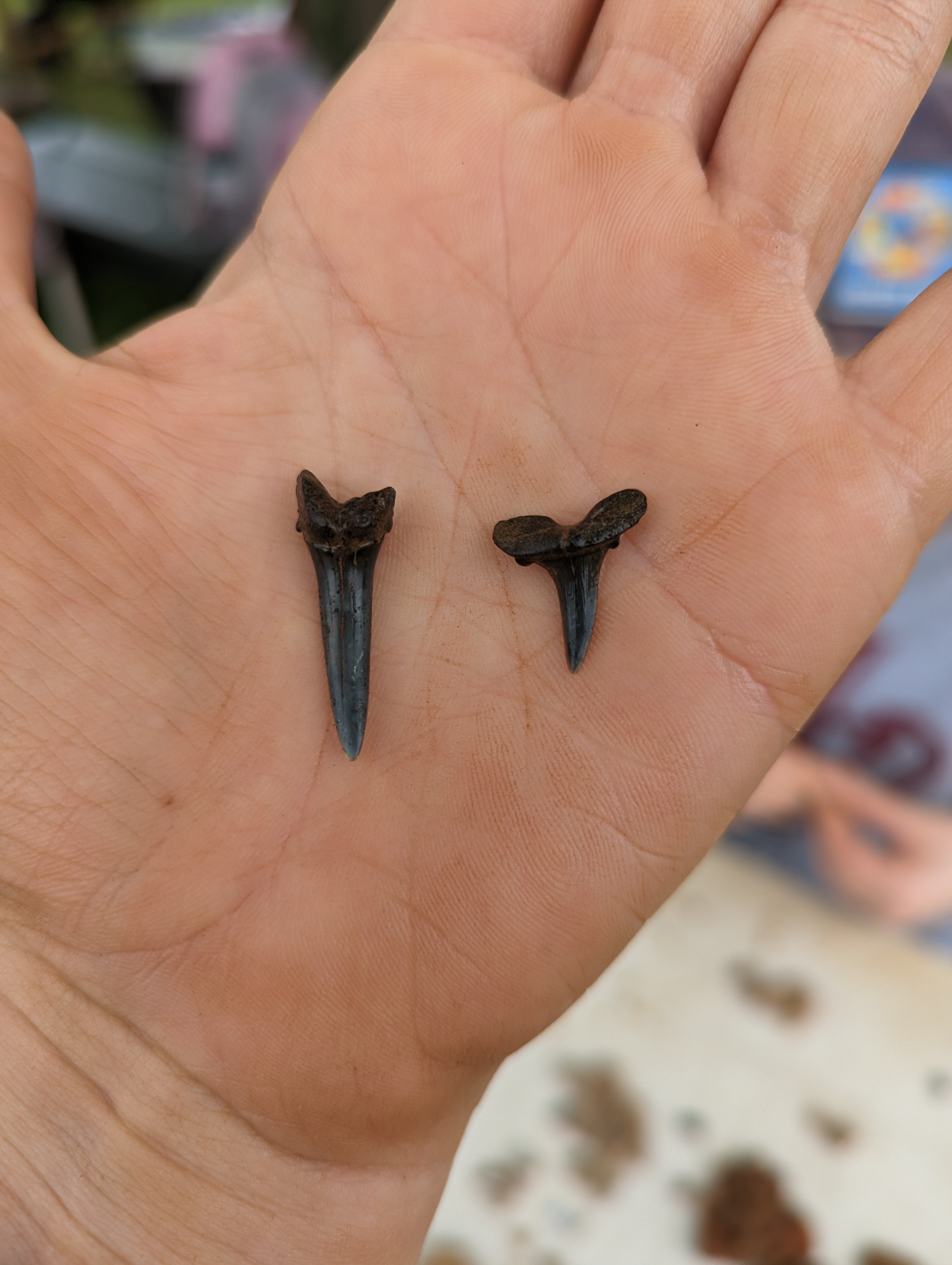
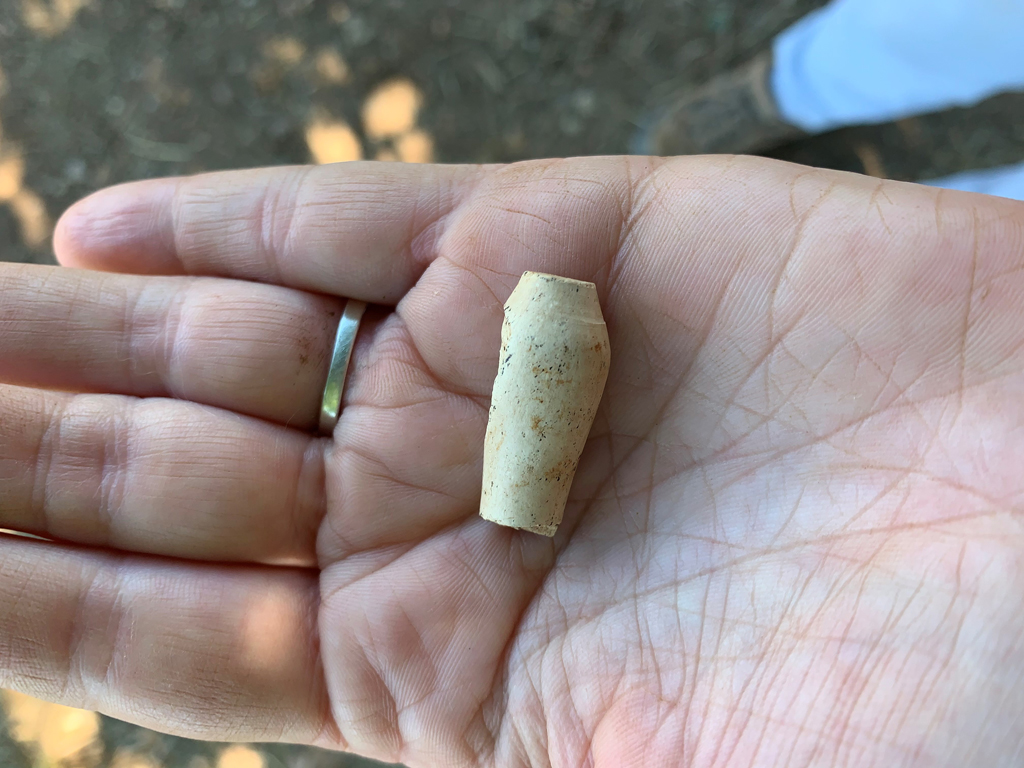
    Even though we are still in the early days of analyzing the artifacts, that doesn’t mean we can’t talk about a few great things we found. This feature had a little bit of everything: personal items, food-related items, architectural debris, domestic items, etc. The crowning glory of the excavation (in our humble opinion) would have to be the complete pipe bowl that was stamped with a maker’s mark that featured the letters “TD.” Other exciting finds include a clipped Spanish coin, sherds to a Westerwald ink well, shark teeth, and prehistoric pottery, just to name a few. This feature also contained a layer of ash that preserved delicate artifacts such as bone, fish scales, and straight pins – items that often don’t survive in the archaeological record.

    So what does this all mean? Well, this means that we will definitely be returning to the FF-38 site next season. While we have gathered a lot of information during this dig, there is still much left to find. Expanding our excavation beyond the limits of the feature and excavating one of the remaining two quadrants will help us interpret the feature’s function and how it relates to the 18th-century farm landscape of the Washington family.

    FF-40

    Wait, that’s not all for this year’s dig. Don’t forget that we had two excavation areas this year. Our second area was FF-40, which was the remains of an 18th century kitchen had experienced an intense fire. This kitchen was partially excavated in the 1990s, so this year’s excavation had more of an exploratory excavation designed to help us establish a game plan for future excavation. We knew the kitchen remains were below the foundations of two later farmhouses, and that the foundation walls of these farmhouses were still extant. Additionally, the interior of the foundations was filled with sand to protect the kitchen site. Our excavations confirmed the location of the farmhouse foundations and the existence of a protective layer of sand! Once our crew were able to get through this sandy fill, a quick clean of the kitchen fill uncovered artifacts that were absolutely toasty. Okay, toasty isn’t a technical term, but the artifacts showed evidence of a fire that burned at extremely high temperatures. This included a high number of architectural artifacts as well as charred ceramics and melted glass. Findings from this year will help guide the excavation in the future.

    The burned kitchen site is located beneath these concrete house foundations dating to 1914.  This picture was taken after protective sand fill was removed within the excavation unit.

    Phew, that was a lot! That sums up our 12-week dig season. We answered a lot of our initial questions and found many more questions to investigate. Archaeologists will be in the lab the rest of the year processing artifacts, researching our findings, planning next season’s dig, and enjoying the A/C. Stop by the lab in the Visitor’s Center and take a peek at what’s happening. See you all in the field next May!


    Danielle Arens

    GWF Archaeologist

  • We’re Digging! – A Preview of 2022 Archeological Excavations at Ferry Farm

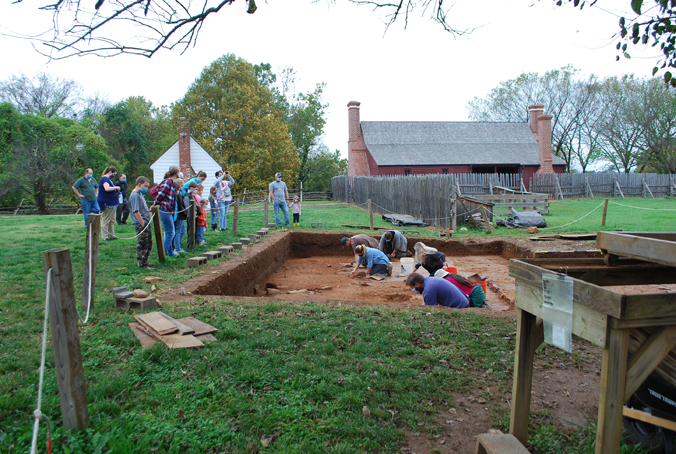
    Field archaeologists will once again be working outdoors at George Washington’s Boyhood Home at Ferry Farm from May 16th through July 29th.  Work hours will be Monday through Friday, 8 am to 4 pm.  The excavation site, located on the east side of the Washington House, is accessible to the public, and our staff will be happy to explain what we have been finding every day and what we hope to learn from this year’s dig.  Visitors can even help us sift our dirt and look for artifacts! 

    Visitors enjoy a turn at the sifting screen.

    The archaeological exploration of the Ferry Farm site has been ongoing for many years with great success.  The discovery of the two-story cellared home of the Washington family was announced in 2008, with its historic reconstruction completed in 2018.  Additional archaeological investigations around the house site have resulted in the identification of multiple outbuildings and work areas, adding to our analysis and recreation of the eighteenth-century farm landscape.  This summer, we will see two new outbuildings go up on the grounds – the enslaved quarters to the north of the house and a storage building in the work yard to the east.  Both buildings and their locations were found by means of our archaeological digs.

    Location of the 2022 archaeological dig at Ferry Farm.

    The site of this year’s dig is an extension of last year’s, during which we found a possible post-in-the-ground structure in the work yard area of the farm.  Opening up new units on the southern end of the dig site will allow us to determine the full size of this structure.   Artifacts found in the surrounding units are still being processed and analyzed and will help us determine the function of the building.

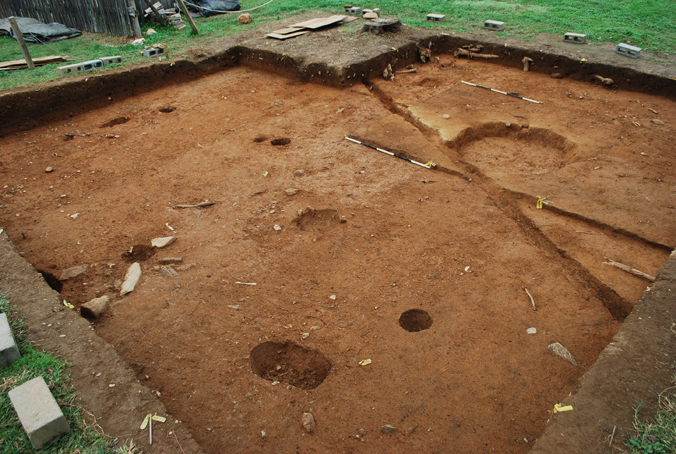
    Overall view of the 2021 dig shows modern utility trenches and eighteenth-century oval postholes.

    So be sure to stop by the dig when visiting Ferry Farm this summer and find out what we have learned so far from our excavations!

    Archaeologists cleaning the site in the Washington House workyard.

    Judy Jobrack

    Archaeology Field Director

  • “Have you found anything today?”: A Review of the 2021 Archaeological Excavation at Ferry Farm

    “Have you found anything today?” was (and always is) the most-asked question posed by our daily visitors who stopped by our archaeological site at George Washington’s Ferry Farm this summer. Everyone wants to understand what is going on in the very large square hole we have made in the lawn.  “Yes, we find something every day,” our crew happily answered, while showing the visitors all the small bits of ceramics, glass, metals, and other artifacts sifted out of the dirt that day. Not only did we find hundreds of artifacts during the course of the summer dig, but we also hope we found a building!

    This year’s archaeological dig at Ferry Farm began on June 7 and ended on August 21.  We opened twelve new 5-foot by 5-foot square units and reopened six previously excavated units just south of and adjacent to last year’s excavation site. Our site is located within the Washington house work yard, where activities such as food preparation and cooking, washing laundry, animal husbandry, dairying, household storage and wig maintenance took place.

    The direction of this year’s dig was prompted by the discovery during last season’s excavation of two large rectangular postholes with similar alignments and measuring ten feet from each other.

    Two postholes about 10-feet apart at the end of last year’s excavation.

    Finding additional postholes of similar size and properly distanced from each other would enable us to determine if our postholes were part of a fence line or one side of a post-in-the-ground building.

    After a lot of hard work, we uncovered two similar postholes on the same line as the first two. Unfortunately, we did not find a parallel line of postholes representing the opposite side of a building within the limits of our dig.

    Four postholes in a line at the end of this year’s excavations.

    The abundance of artifacts found on the north side of the posthole line, and the contrasting lack of artifacts to the south of them, indicates the presence of some physical barrier substantial enough to create a division preventing artifacts from passing. Our plan for next season is to hopefully expand the excavation block to the south and the west because that is where associated posts would be located. If there are no matching posthole features, we know we have a fence. If it is a building, we want to get the proper dimensions of that structure, which in turn will help determine its function on the landscape.

    Now that this year’s dig is over, our staff and volunteers are busy in the lab washing and cataloging the artifacts we found this season. As usual, we collected artifacts ranging from present day plastics to thousand-year-old prehistoric tools. Although our total artifact count was not as numerous as in former dig years, we did manage to find some interesting items.

    Our total wig curler count of over 200 continues to grow with the addition of seven wig curler fragments this year.  This may not necessarily sound like a lot, but the amount of curlers found this season alone surpasses the number most other domestic colonial sites have in Virginia.  Thirty wig curler fragments have been found within the 30-foot by 45-foot excavation block dug between from the years 2019 to 2021 in the work yard.

    Approximate Ferry Farm work yard area excavated between 2019 and 2021.

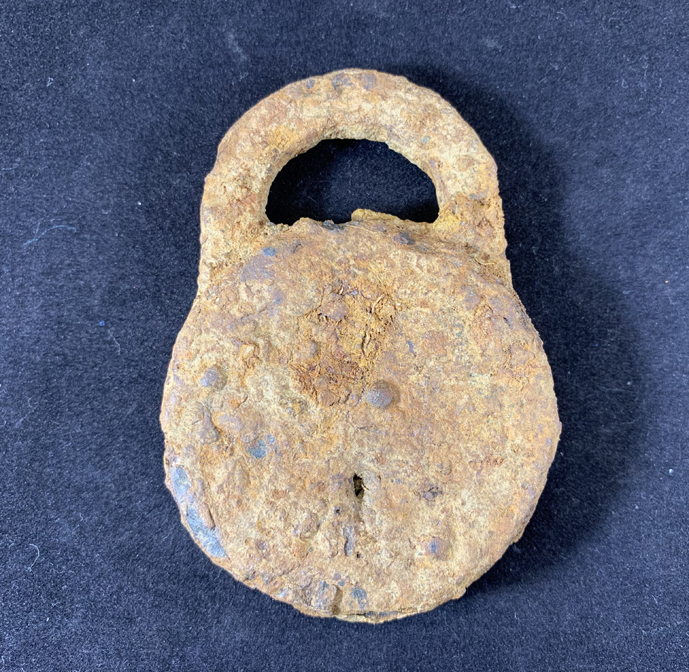
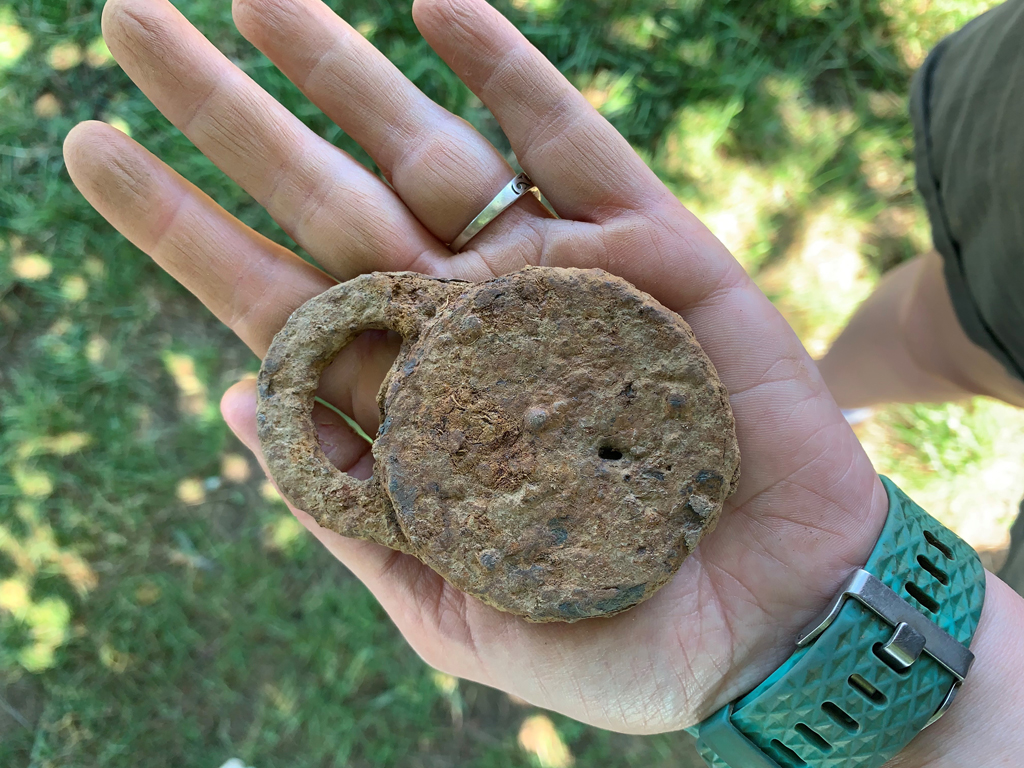
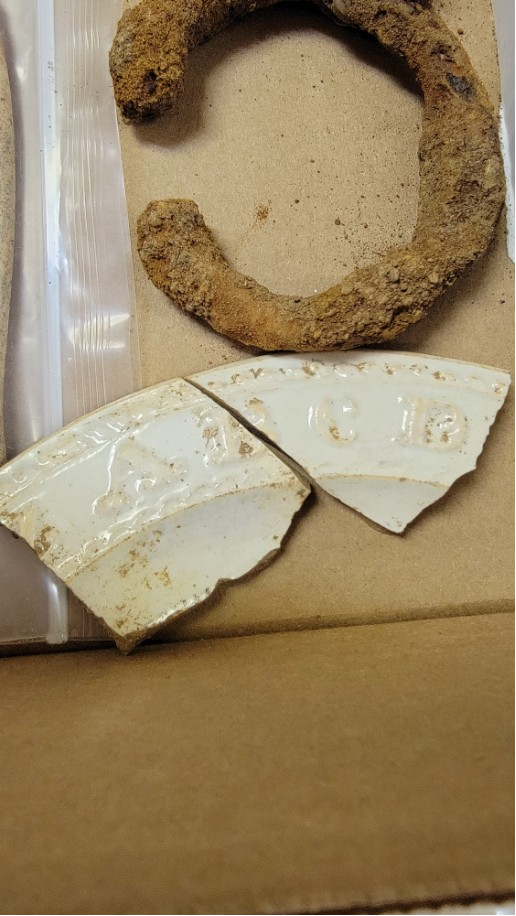
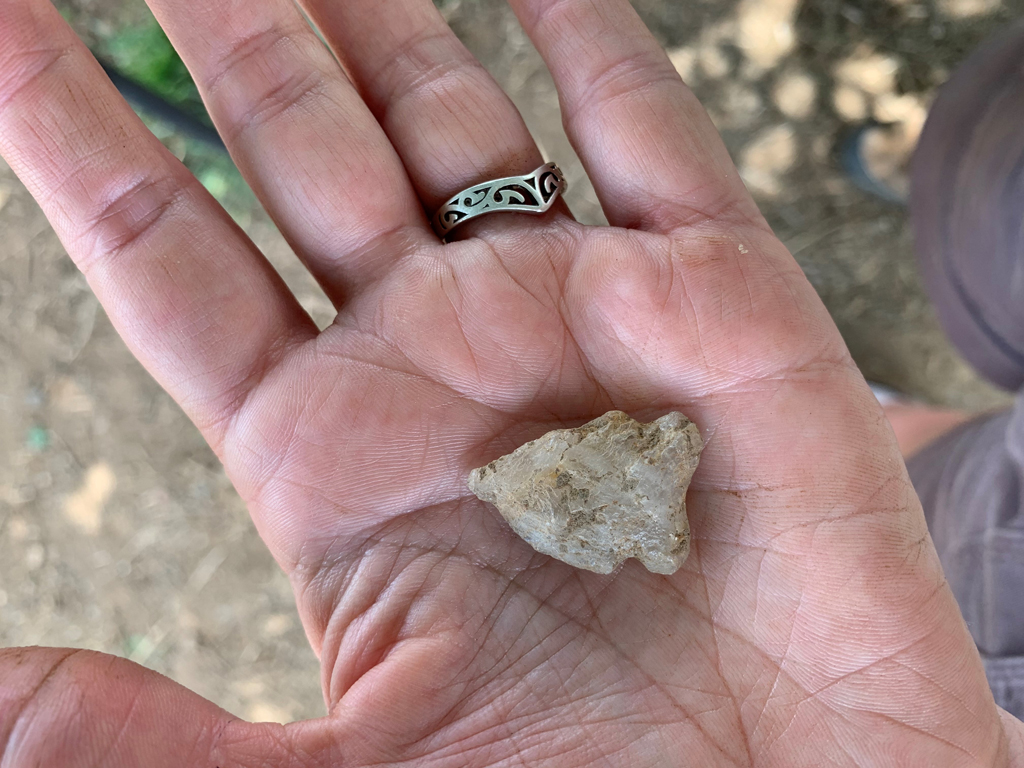
    Other artifacts of interest include a bone-handled toothbrush, children’s toys, a round rusty lock, delicate Chinese porcelain cup fragments, projectile points, buttons, and the rim of an alphabet plate.

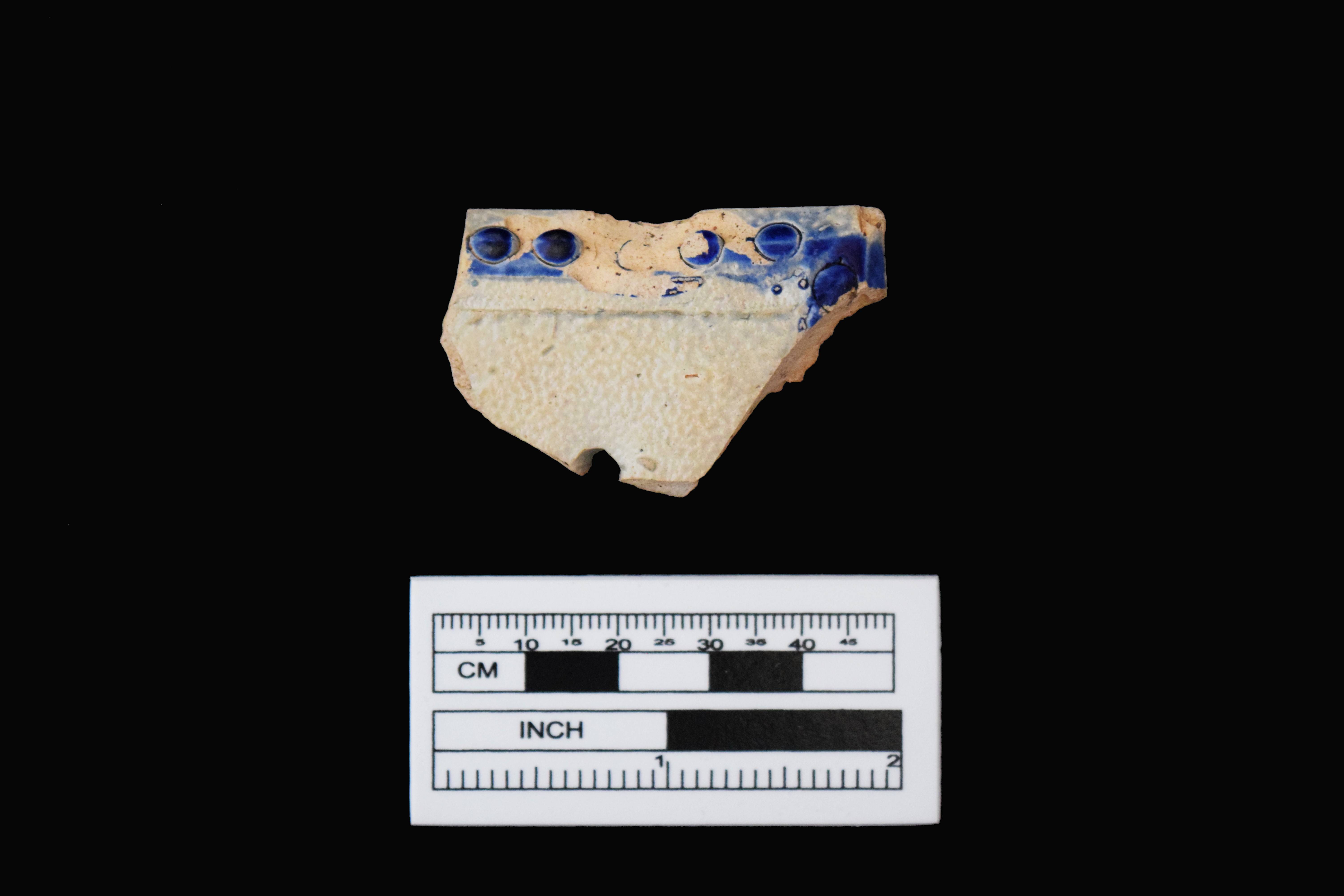
    The prettiest artifact prize goes to our blue paste gem button. Research has not yet started on this little gem, but we suspect it dates to the 18th century.

    Blue paste gem button

    For now, the excavation site is once again covered with tarp for protection against the winter elements until we open it again next year. Here on Lives & Legacies, we’ll keep you up-to-date about what we found this summer as we spend the next several months researching these 2021 artifacts in the lab.

    Judy Jobrack, Archaeologist
    Elyse Adams, Archaeologist
    Co-Field Directors

  • A Day at the Dig at George Washington’s Ferry Farm [Video]

    In this video, spend a day with the archaeologists digging at George Washington’s Ferry Farm this summer.
  • We’re Still Digging!: An Update on 2021’s Archaeological Excavation at Ferry Farm [Photos]

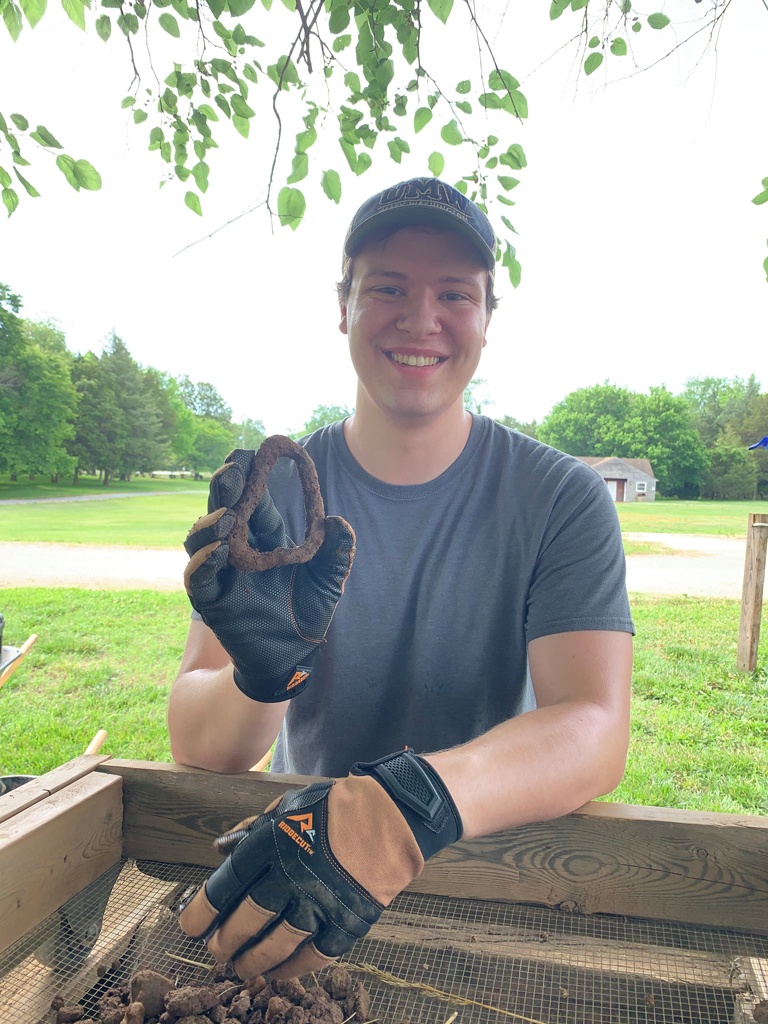
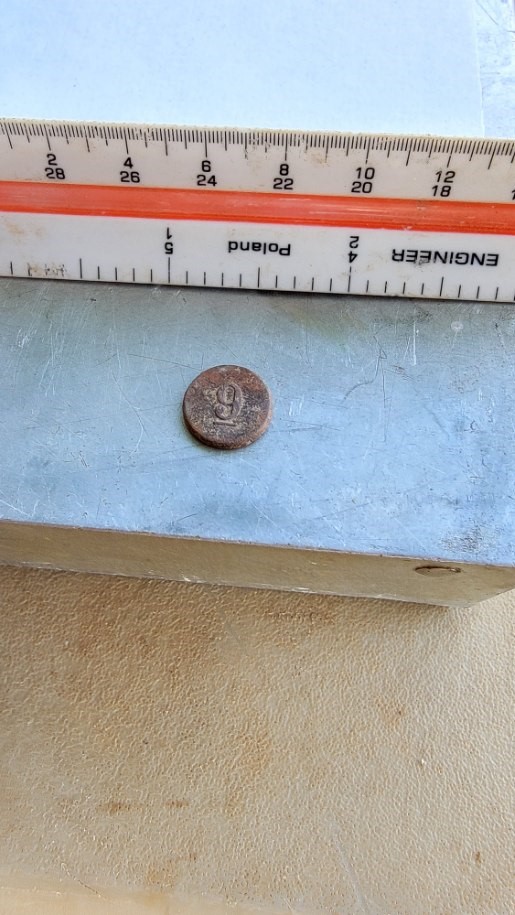
    The 2021 archaeological dig season at George Washington’s Ferry Farm is over two-thirds complete. Here’s a collection of photos taken in the field of a few artifacts discovered thus far.  You can read an overview of our expectations and goals for this year’s dig here.  Visitors can ask archaeologists questions and observe their work Monday through Friday at Ferry Farm. The dig continues until August 20.
    Elyse Adams, Archaeologist
    Co-Field Director

  • We’re Digging!: A Preview of 2021’s Archaeological Excavation at Ferry Farm

    Visitors to George Washington’s Ferry Farm will once again be able to meet and talk to our staff archaeologists as they work at our archaeological dig this summer. The dig opened this past Monday, June 7 and runs through Friday, August 20. Archaeologists dig Monday through Friday.
    Approximate location of the 2021 archaeological dig at Ferry Farm.

    The dig is located on the east side of the Washington house in the work yard.  The work yard is where the everyday activities associated with the running of an 18th-century household took place. These activities including food preparation, cooking and cleaning, washing laundry, animal husbandry, dairying, household storage and wig maintenance.  Eventually showing and interpreting these activities as well as incorporating our findings into Ferry Farm’s history are the reasons we dig.

    We are looking for the remains of outbuildings in this area of the site.  Luckily for us, last fall we uncovered a large post mold and hole which we suspect is a structural part of one such outbuilding. This first week we are opening up multiple 5’x5’ units to the south of our posthole feature in anticipation of finding more of this structure.   

    Large post mold and hole located at the southern edge of the 2020 site.

    Our crew will consist of four paid interns in addition to Elyse Adams and myself as co-site directors.  COVID-19 has again eliminated the possibility of university archaeology students joining us for a six-week field school this year, but we hope they can finally return next year. 

    The 2021 dig will be located directly beneath our visitor’s feet in this photo.

    Over the next 12 weeks, we’ll post some of our more interesting discoveries during on Ferry Farm’s Facebook and Instagram so everyone can stay up-to-date our progress.  When you visit Ferry Farm, please stop by the excavation site to ask questions and watch us at work. We are happy to share our daily findings and explain the process of digging into the Washington family’s past!

    Judy Jobrack, Archaeologist
    Co-field Director

  • We Really Dig History!: 2020 Excavation at Ferry Farm

    After a delay of five months due to the COVID-19 pandemic, archaeological excavations in the Washington house work yard at George Washington’s Ferry Farm got underway in mid-August and finished on October 30.  Despite the cancellation of a planned spring field school with archaeological students from the University of South Florida, a crew of four paid interns and two college students helped make up the labor difference and our work commenced.

    Our 2020 project continued last year’s exploration of the Washington-era work yard.  This area located to the east of the house is where the everyday activities of a busy colonial household took place.  Permanent structures such as a kitchen, dairy, smokehouse, storage sheds, office, laundry, temporary workspaces, and landscape features like gardens were concentrated in this area near the house but out of view of the public eye and the formal riverfront side of the house. Evidence of these buildings and work areas, in conjunction with the trash generated from their associated daily activities, is of the utmost importance in our planned authentic recreation of Ferry Farm’s Washington-era landscape. 

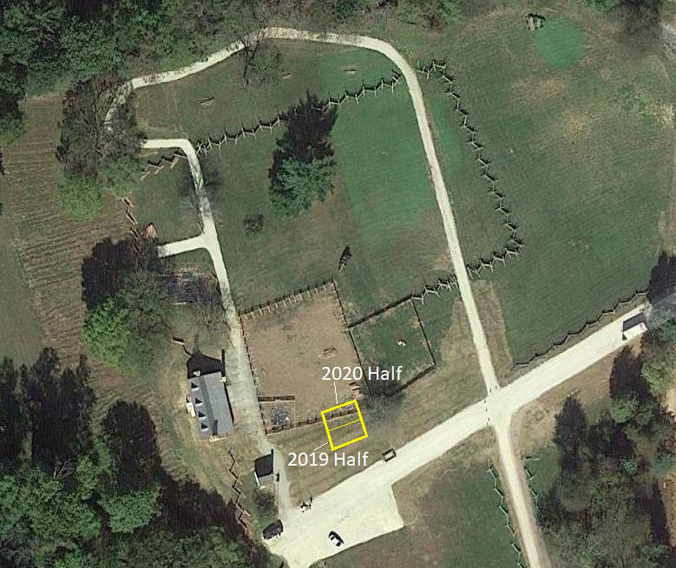
    Location of the 2019-2020 archaeological dig.

    In addition to reopening the unfinished 2019 excavation site, we opened fourteen new 5 foot x 5 foot units directly north, revealing a total of 800 square feet. Our approach to excavating was the same as in previous years – remove the 20th century layers, then the 19th century layers, and so on, across the entire site, allowing us to view related features at the same time.

    2019 and 2020 excavation site.
    Visitors to the site interact with the excavators.

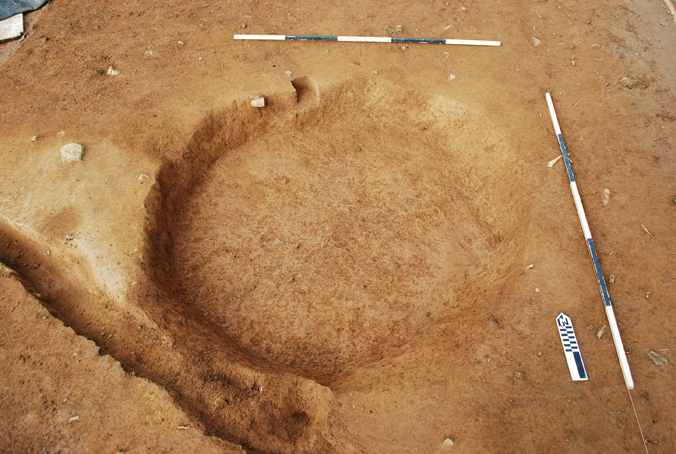
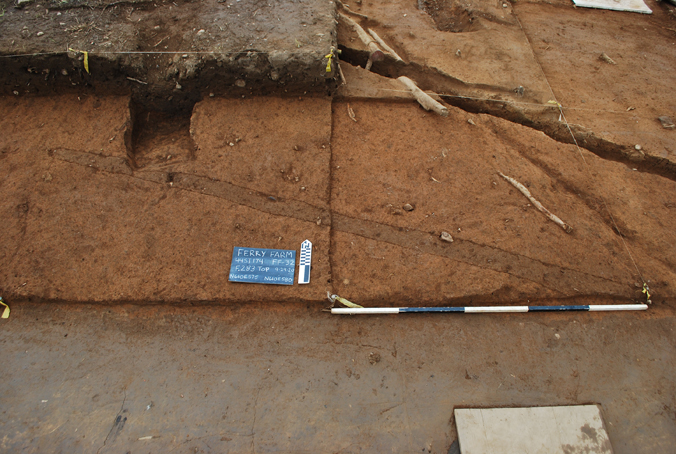
    We uncovered numerous new features dating from the 20th century back into prehistoric Native American times. Modern gas and electric lines crisscrossed the site on their way to a now-demolished early 20th century house. They cut through multiple historic layers and sometimes through intact earlier features.  Eighteenth century features we excavated included a large, circular, flat-bottomed pit, 5 feet in diameter. The pit’s purpose is still under investigation. A 10-foot long linear feature, obviously related to last year’s still unknown Features 274 and 275, was also found just to their northwest, adding to their mystery.

    Feature 285 – Historic large circular pit with a 5’ diameter
    Feature 283 – Historic linear feature, similar to Features 274 and 275 found in 2019
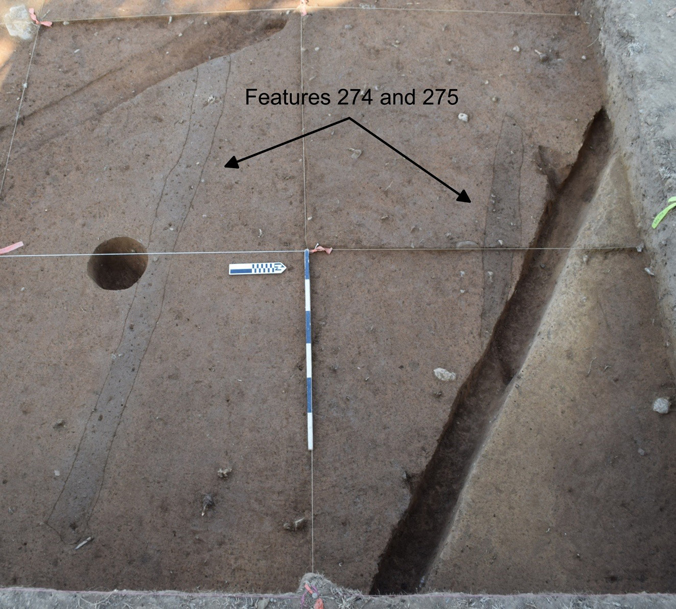
    2019 Features 274 and 275

    An especially exciting discovery this year was uncovering a large post mold and post hole in the southern end of the site.  The posthole indicates the presence of a post-in-ground structure and excavations next year will try to reveal more of this building. Adding another outbuilding to the Washington landscape would be very exciting.

    Feature 288 – Post mold and Posthole located at southern edge of the site

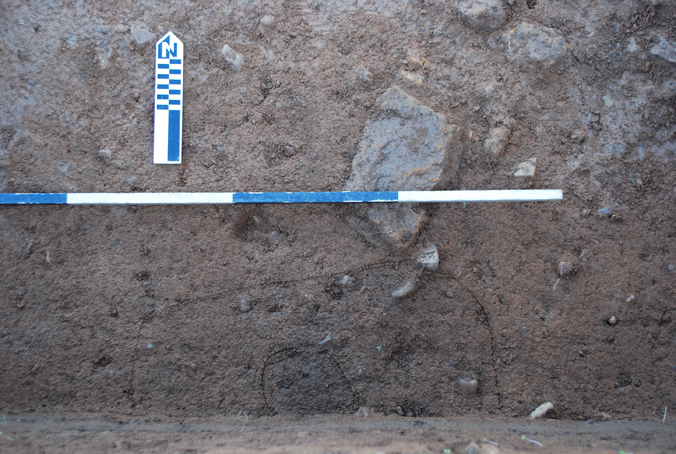
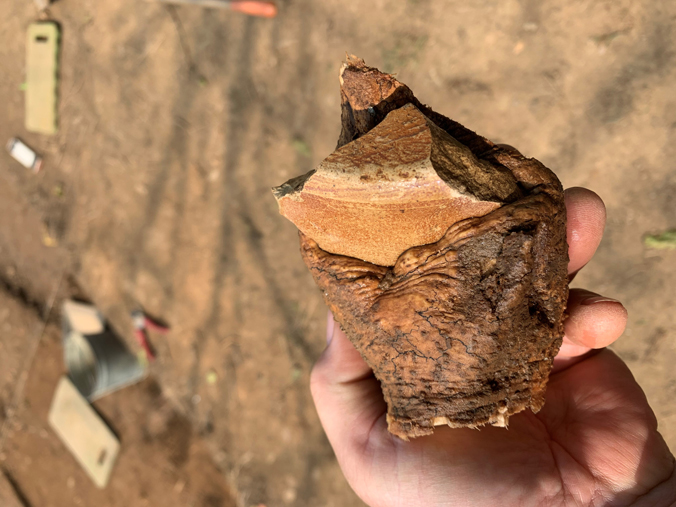
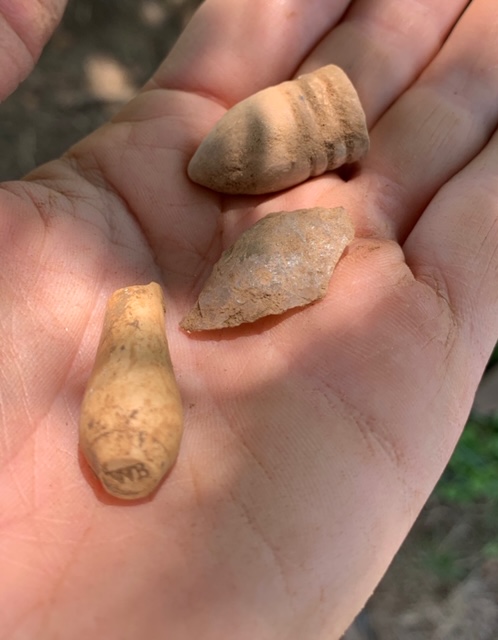
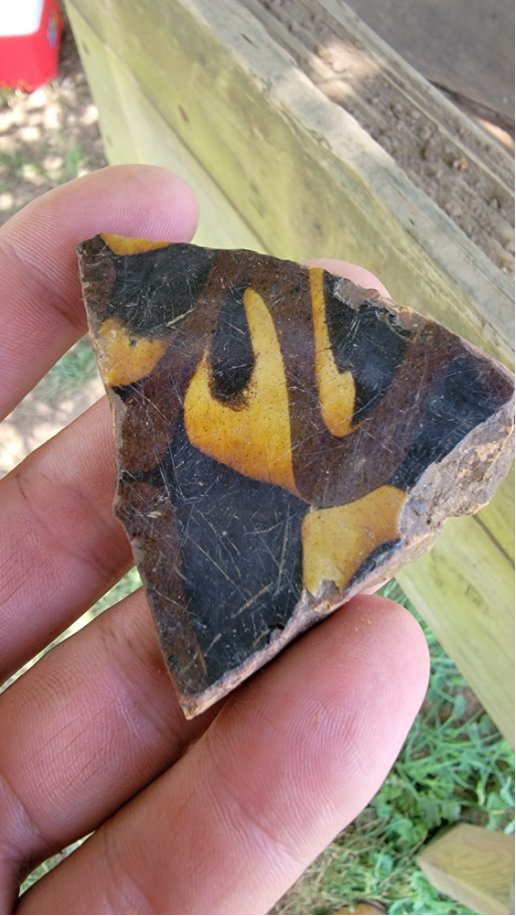
    Hundreds of artifacts, of course, were collected during our three-month dig, including wig curler fragments, Native American projectile points, and Civil War bullets. We also found lots of historic ceramics and glass and architectural items, including this stoneware pot base fragment wrapped within a large tree root pictured below. 

    Stoneware fragment encased within a root.
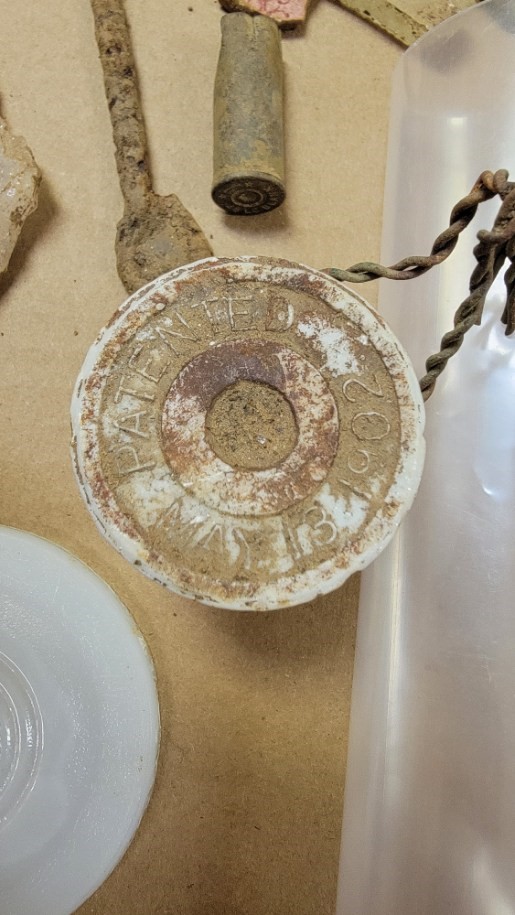
    A sample of artifacts found one day ranging in age from the 21st century to the Prehistoric era.
    One of eighteen wig curlers found during this year’s dig.

    The upcoming winter months will be spent washing and cataloging all the artifacts recovered across the site, drawing the features and site maps, and writing reports. The site is securely covered for the season and will wait for us until the next dig starts, hopefully in the spring.

    Judy Jobrack, Archaeologist
    Co-Field Director

  • We’re Digging!: A Preview of This Year’s Archaeology Excavation at Ferry Farm

    It’s that time of year again!

    Actually, it’s past that time of year but better late than never! The annual summer archaeological dig at George Washington’s Ferry Farm – delayed like so many other things by the COVID-19 pandemic – has finally begun!  Ferry Farm’s summer archaeological excavation has become a fall dig too as it runs from August to October this year, instead of in the more typical April to July window.

    In 2019, we began excavating a 30 foot by 30 foot square in the work yard in search of outbuildings from George Washington’s time. We know there was a kitchen, slave quarters, store houses, barns, and other buildings on the farm, but we have yet to locate them all. Without these outbuildings, which will eventually be reproduced like the Washington House, we can’t accurately represent what the landscape looked like during George’s childhood.

    Archaeologists Lizzie O’Meara and Frank Amico cleaning last year’s dig area for the final photo of 2019.
    Last year, we were tasked with excavating the 30 foot by 30 foot area, where we suspect there are still remains of and artifacts from undiscovered buildings. We completed about half of the total area. We dug the soil level down to the colonial-era level in half of our square before we had to close for the year. We also lost a few weeks of time last summer because of the nearly 2 feet of gravel that first needed to be removed. You read that right. 2 FEET! This gravel was from the construction of the Washington house replica in 2017 was leveled directly on top of the area where we needed to excavate.

    This summer, we begin the other half of the 30 foot by 30 foot square. We are very excited to continue to dig this area.

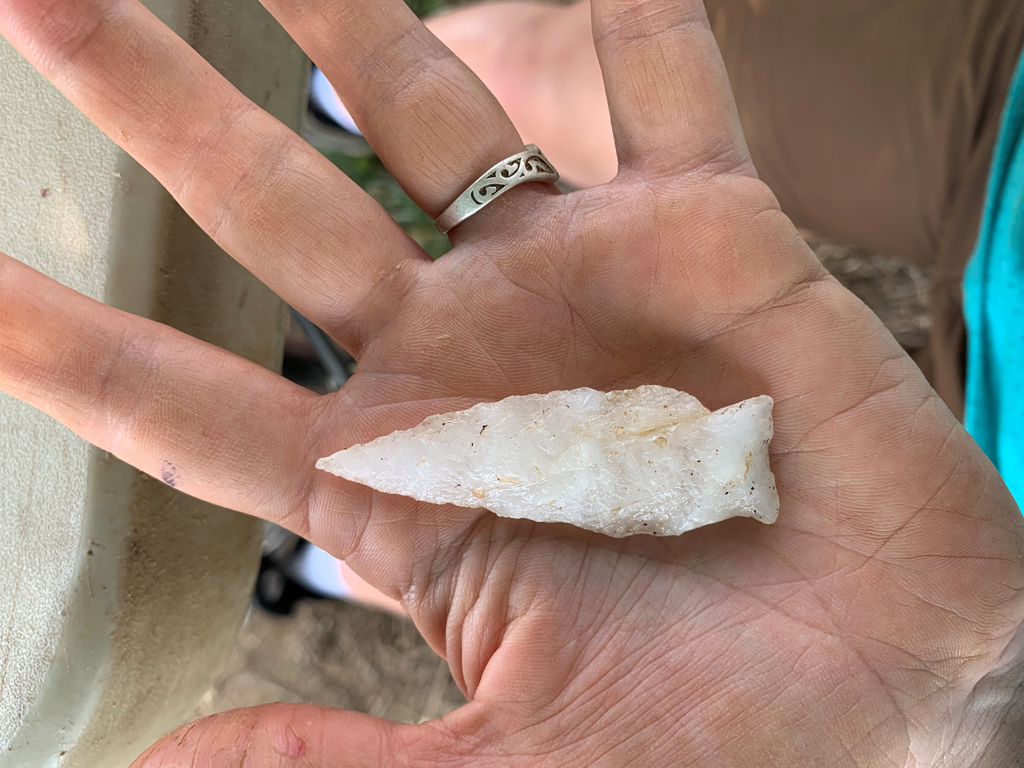
    Last year we excavated thousands of amazing artifacts including several Washington era wig curlers, Civil War bullets, and Native American projectile points of all shapes and sizes. You can read about last year’s discoveries here.

    If visit Ferry Farm during the next several weeks, you can watch us dig on weekdays. My fellow archaeologists and I will be happy to talk with you (while masked and at a 6-foot distance) about our excavation work and some of our recent discoveries.  There will also be occasional updates on the excavation’s progress on our Facebook and Instagram. Then, after the conclusion of the 2020 excavation, watch this space for a summary of our work!
    Elyse Adams, Archaeologist
    Co-Field Director

  • We Really Dig History!: Summer 2019’s Excavation at Ferry Farm

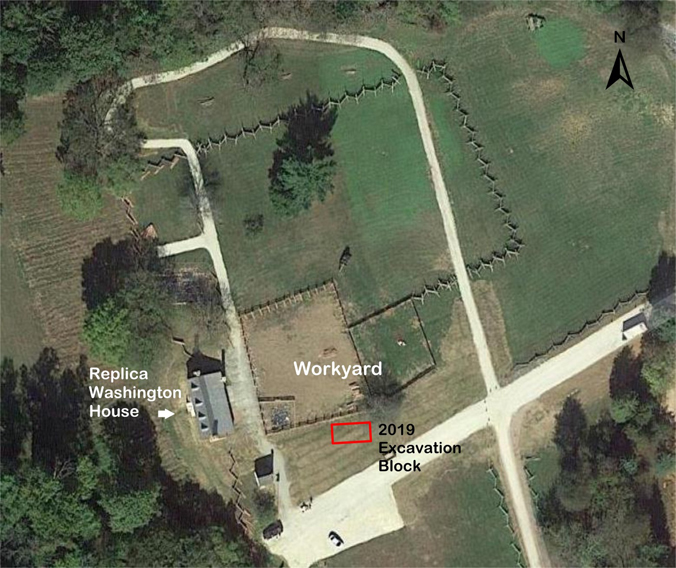
    From late May through early August of 2019, archaeologists at George Washington’s Ferry Farm were busy working in the field again, excavating a block of 18 5’x5’ units located on the east side of the Washington house. It’s not obvious today, but the area directly to the south and west of our 2019 block had previously been excavated between 2008 and 2018 down to sterile subsoil and back-filled with dirt. The grass grew back, leaving no signs of this previous activity, but the concentration and variety of artifacts found indicated something was going on in this area of the site when the Washington family was living here in the 18th century. This didn’t surprise us all that much though, as this area was the “workyard” of the Washington house, where most of the daily activities related to the running of the household were taking place.
    1
    Location of 2019 excavation block near the Washington house site.

    You might remember from last season’s dig blog, that we excavated the “north yard” of the house, which was visible from Fredericksburg, the river, and the ferry landing during the 18th century. Our excavations last year concluded that the north yard was actually quite clean of artifacts (garbage) and features, suggesting people valued the aesthetic look of this area and kept it very orderly and free of daily activities – likely because it was visible to the entire town across the river. In direct contrast to this clean space is the workyard – the fenced areas located behind the house. The workyard is where the daily household-related activities such as cooking, laundering, and dairying took place. Corresponding structures such as a kitchen, storage sheds, smokehouse, and temporary work spaces, were located here and doubled as living quarters for the enslaved people who worked in these spaces. With all these activities happening within this outdoor space, it’s not surprising that archaeologists have found an abundance of 18th century artifacts in this area over the years.
    2
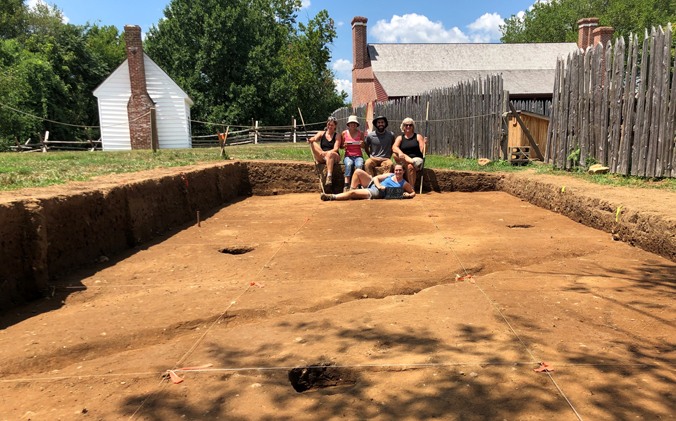
    The 2019 dig crew: (L-R) Elyse Adams, Sarah Perdue, Frank Amico, Judy Jobrack and (front) Lizzie O’Meara.

    The 2019 dig crew consisted of two field directors — Judy Jobrack and Elyse Adams — and three archaeologists — Frank Amico, Lizzie O’Meara, and Sarah Perdue. For a total of 11 weeks our five-person crew slowly excavated thin layers of dirt in the 15’ x 30’ block in search of evidence of activity areas and outbuildings related to the workyard. Our approach to excavating the area was to take down all the units in the entire block at the same time — removing all the 20th century layers, then the 19th century layers, and so on — instead of taking each individual unit down to the subsoil. This would allow us to view any related features, such as building foundations or post holes, at the same time.
    2a
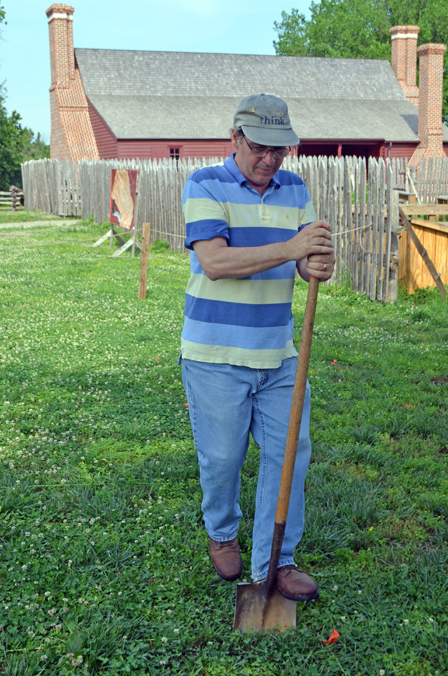
    Dave Muraca, director of archaeology at Ferry Farm & Kenmore, lends a hand in getting the excavation block started.

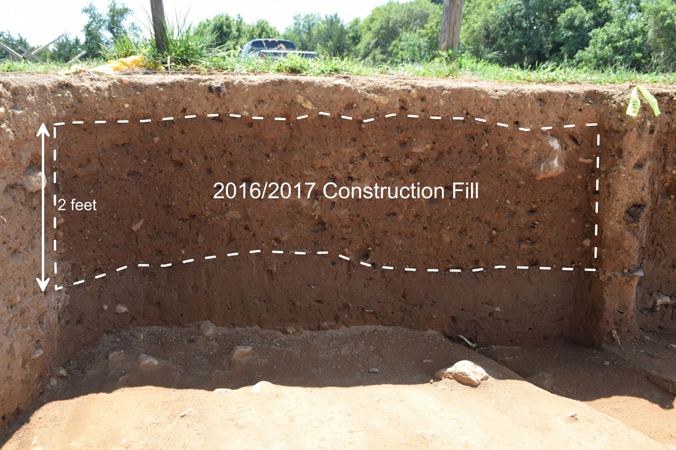
    The dig started with the removal of the grass and topsoil layers from all eighteen units. To our surprise, we were greeted with an obstacle that measured between 6 inches and 2 feet deep across the entire block. Remember the 2016-2017 construction of the Washington house? Well, as with any large project, there was a lot of disturbance to the surrounding lawn by vehicles and construction activities. A significant layer of dirt and gravel had to be laid down to grade the landscape and gravel access road leading up the house. It happened only two years ago, and yet we completely forgot about this fill activity! We dug this disturbed layer out with shovels and pick axes without screening the dirt until we revealed the 2016 grass and topsoil layers. Two weeks after starting, the real dig began.

    4
    Two feet of construction fill layer as seen in the sidewall of an excavated unit.

    The number of artifacts we found, especially those dating to the 18th century, was not disappointing. Ceramics such as Whieldon, tin-glazed earthenware, Westerwald, and white salt-glazed stoneware were abundant in the area, as were various types of redwares and stonewares typical to food storage and other utilitarian purposes. Other colonial-era artifacts included wrought nails, tobacco pipe stem fragments, and a total of 12 wig hair curler fragments. The amount of 18th century-dated artifacts definitely overshadowed the number of 19th and 20th century artifacts in the area.

    3
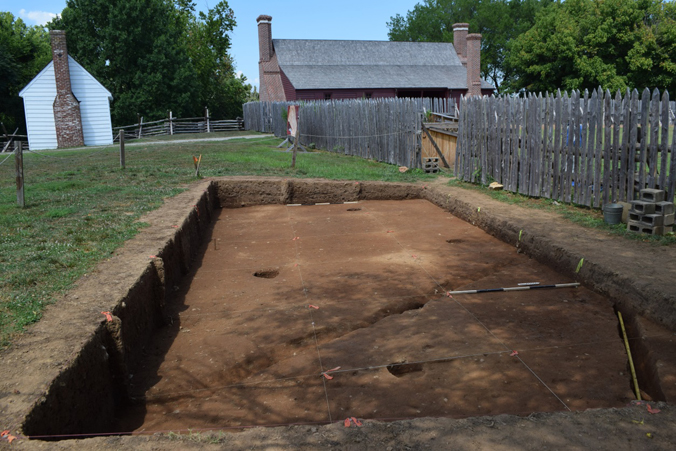
    FF30 block during excavation.

    4a

    9

    5
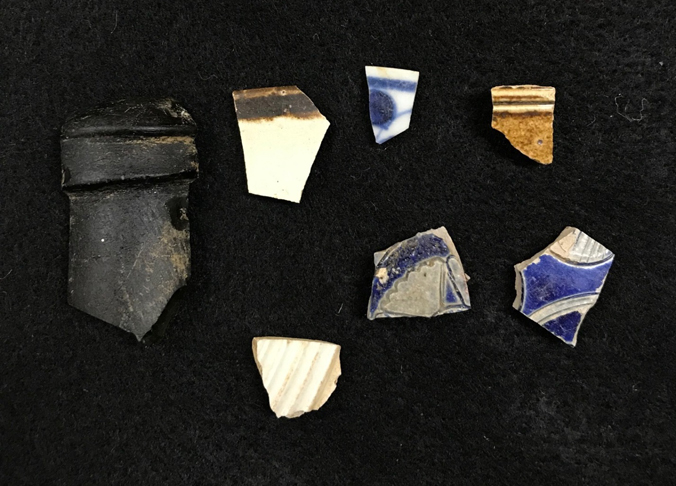
    18th century ceramics and a wine bottle neck found this summer.

    6
    Wig curler fragment found this summer.

    8
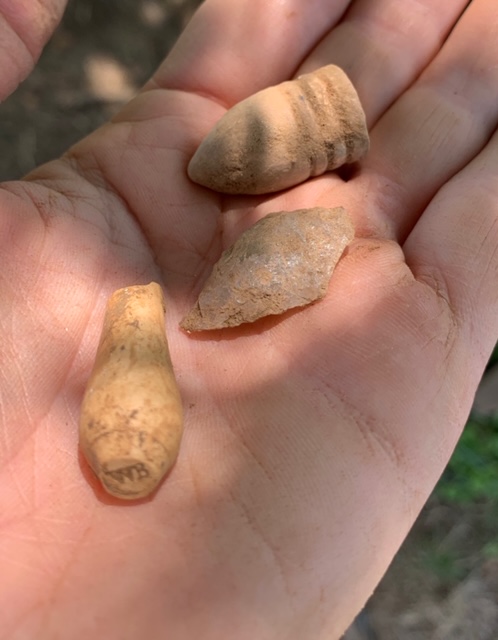
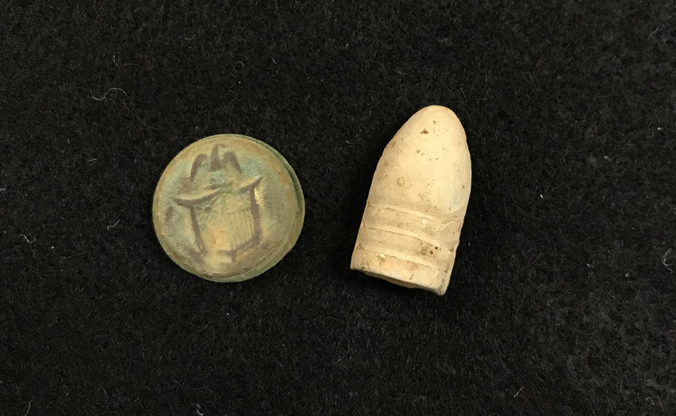
    Civil War uniform button and Minié ball found this summer.

    11
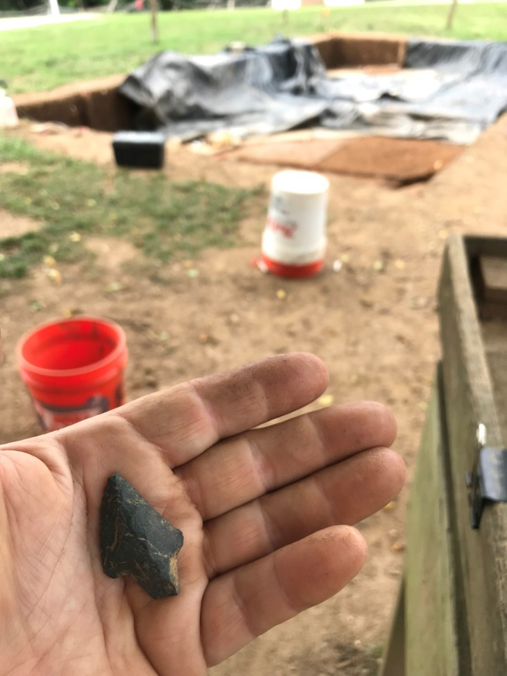
    Projectile point found this summer.

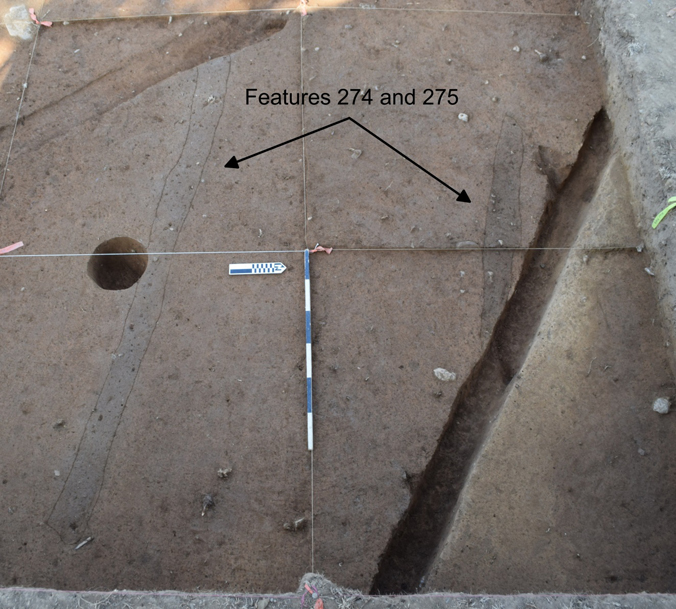
    In addition to artifacts, a number of 18th-century features were uncovered, including the “rut-like” parallel linear features (F274 and F275) in the photo below. Figuring out what these and other features found in the 18th century layers may be will take place over the coming months.

    12
    Two parallel, linear 18th century features.

    The excavation ended on August 9th within the 18th century level, and the site was covered by a tarp until next year. The 2020 season’s dig will continue excavations in this block until subsoil is reached, but will also expand by opening more 5’ x 5’ units to the north. After washing, researching, and cataloging the thousands of artifacts recovered this season, our staff will have a clearer idea of what activities were going on in this part of the work yard, so that we can reconstruct these areas accurately as we did the Washington house itself. It’s going to be a busy winter for the lab staff while we put together the pieces of the workyard puzzle.

    Judy Jobrack, Archaeologist
    Co-Field Director / Assistant Archaeology Lab Supervisor