In this video, stone and brick mason Ray Cannetti and his crew turn burnt oyster shells from last summer’s lime rick burn into powdered lime to use in mortar in the reconstructed Washington house chimneys.
Learn more about the Washington House here and view other videos, photos, and blog posts about the project at here.
In today’s electrically-lit world, we have very little notion of exactly how dark it can be in a house without any artificial light at all. In fact, our modern eyes have become so accustomed to bright lighting at all hours of the day and night, that we would probably have an even harder time adjusting to the candlelight of the 18th century, were we to magically time travel back to that period, than those who actually lived then. Our ancestors were used to it, though, and had a variety of ways to make the most of the light they had after the sun went down.
Sources of light after dark were the usual suspects – candles, fires in the fireplaces, maybe the occasional oil lamp. The best way to increase the light given off by each of these sources was reflection. Mirrors were placed behind candlesticks and lamps to double their light, and the lamps and candlesticks themselves were usually made out of reflective polished metal. Candelabra or girandoles, which were fixtures intended to hold multiple candles at a time, were often made of glass and decorated with quantities of hanging crystals or glass pendants, all intended to increase reflection of candlelight.
Candleabrum with glass pendants dating from the 19th century.
Being able to transport your source of light was also important. Without flashlights or anything else battery-operated, people in the 18th century had to find ways to carry flame with them when they moved from room to room or left the house after dark. Chamber sticks were candlesticks with handles on them, most commonly used to light a person’s way to bed (hence the name). Enclosed lanterns, made either of metal punched through with holes, or glass panes, were also used both indoors and outdoors.
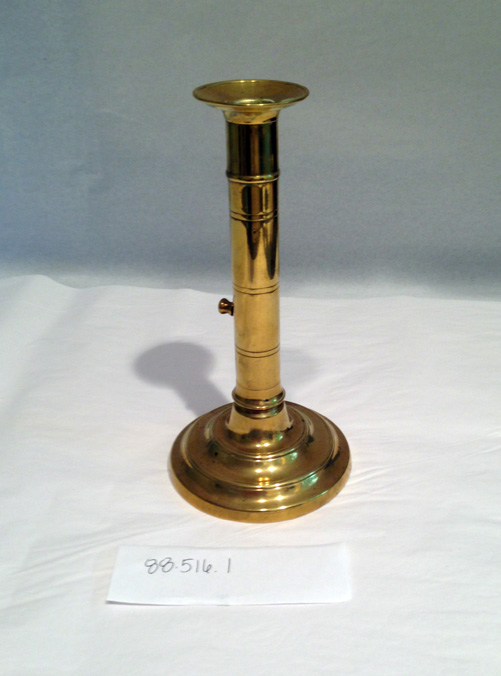
Of course, if most of your light is coming from candles, keeping those candles lit could be a challenge. Glass shades, or what we often call “hurricanes” today, were not simply decorative in the 18th century. They were intended to protect candles from drafts (and had the added benefit of providing another reflective surface). The beeswax or tallow candles most commonly used in the 18th century tended to melt quickly, and so candlesticks that could automatically push the candle up as it burned were invented. These candlesticks ensured that every last useable bit of candle was put to good use.
Brass push-up candlestick dating from the 18th century.
There were other secrets to bringing some light into a dark night during the 18th century. If you want to learn more about lighting, join us for Night in Washington’s Day, an evening program at George Washington’s Ferry Farm from 6:00-9:00p.m. on Saturday, November 12! For more details, visit www.kenmore.org/events
Meghan Budinger
Aldrich Director of Curatorial Operations
In this video, you’ll see a lime rick burn that recently took place at George Washington’s Ferry Farm and expert artisan Kenneth Tappan will explain the ins and outs of building and burning a lime rick.
Learn more about the Washington House here and view other videos, photos, and blog posts about the project here.
Recently, expert artisans Bill Neff and Kenneth Tappan along with staff from The George Washington Foundation built a lime rick — a large crib of wood and oyster shells — at George Washington’s Ferry Farm. This past Saturday, the rick was lit on fire to produce lime for stone and brick work as part of constructing the Washington house.
In eighteenth-century Virginia, near the coast, oyster shells were abundant and commonly burned in one-time-use oyster ricks – different than lime kilns constructed of brick – to yield the lime required for brick and stone masonry. After heating, the burnt shells are slaked with water, causing them to break apart into lime. Mixed with sand and water, as well as sometimes brick dust, clay, charcoal, and bits of shell, lime was the binder in early mortar.
Here are photos of the building and the burning of the lime rick.
Bill Neff bundles together small branches and other kindling into the lime rick’s wick around which all the larger wood will be placed.
Firewood ready to be assembled into the lime rick.
The oyster shells that will be burned.
Placing the wick.
With the wick set, work to build the rick itself began the next morning before dawn.
The first layer of wood is placed.
The first layer of shell is added.
Kenneth Tappan throws a log…
…onto the rick.
Bill Neff adds some smaller firewood.
Spreading out the top layer of oyster.
9:50 a.m. – The lime rick is ready to burn.
10:05 a.m. – The wick is lit and slowly burns down lighting the ends of the logs on fire.
10:40 a.m. – A lot of smoke at first.
10:50 a.m. – Flames appear.
Burning a lime rick of oyster shells to make mortar.
11:30 a.m. – As the rick burns, it collapses in on itself.
12:30 p.m. – As the wood burns, the pile gets ever smaller.
3:00 p.m. – The shell would smolder for hours and remain hot into the next day.
On the next day, the burned and brittle shells were ready to be sifted to remove the ash and stored in barrels. Water must be added to break the shell down into lime.
Read more about the lime rick burn in this article by The Free Lance-Star. Learn more about constructing the Washington house interpretive replica here, here, and here.