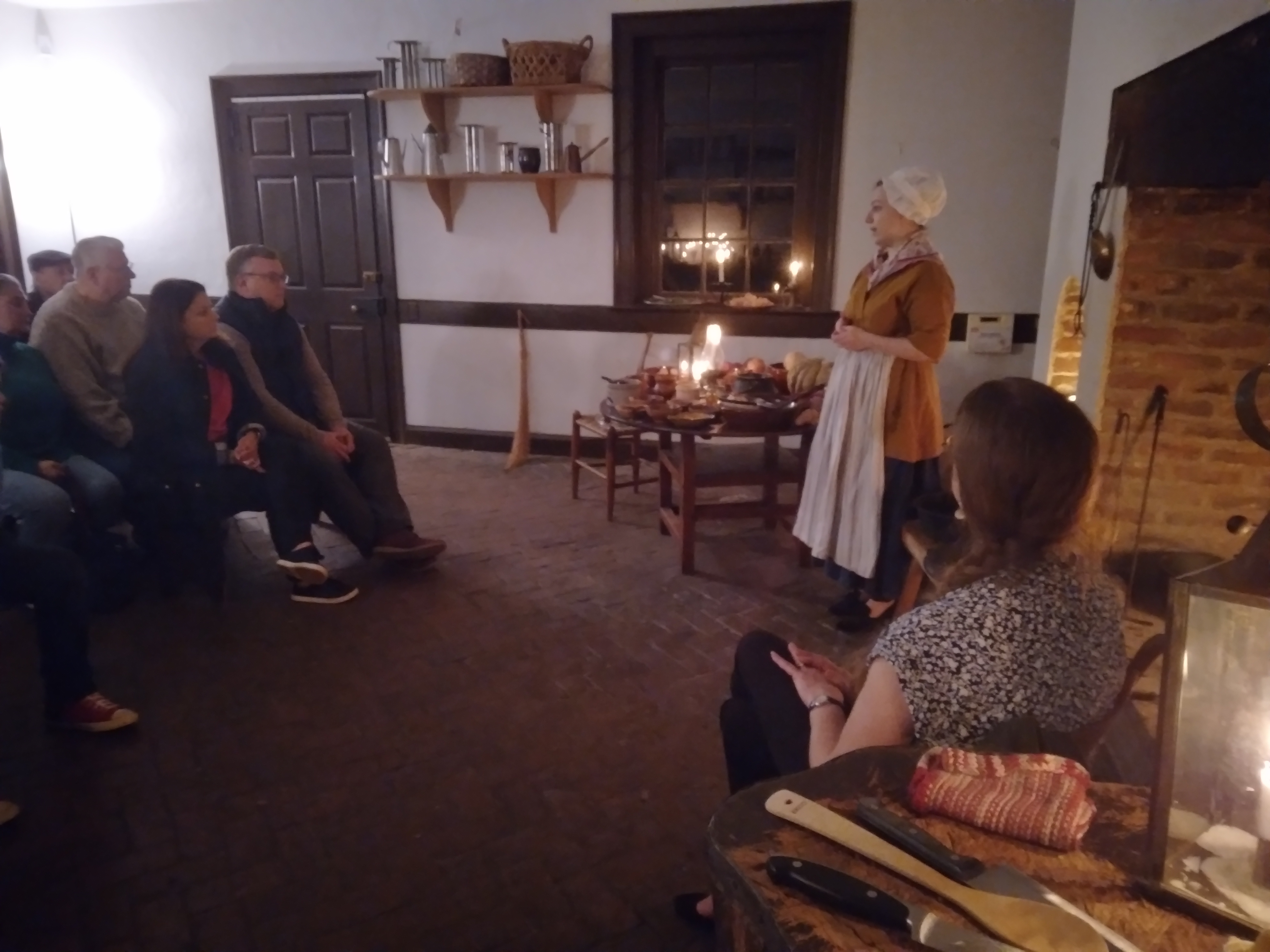
This year at our annual Twelfth-Night celebrations, visitors could enter the kitchen for a short lecture and demonstration. The archaeology and curatorial teams gave the talks to explain two important food items that play a part in Kenmore’s history and the holiday, gingerbread and flip.
Our first demonstration was done by Emma Schlauder, Research Archaeologist at the Foundation. She used a traditional recipe based on Mary Washington’s gingerbread. This is the recipe that the Kenmore Association and the Daughters of the American Revolution (DAR) would use in partnering with Hills Brothers Company to create the Dromedary Gingerbread Mix. The mix was sold in the gift shop and shipped around the country, raising money for the restoration of Kenmore.[1]
Mary Washington’s Gingerbread Recipe
3 cups all-purpose flour
2 tablespoons ground ginger
1 teaspoon cream of tartar
1 teaspoon baking soda
1 teaspoon ground cinnamon
¼ teaspoon ground nutmeg
⅛ teaspoon ground mace
1 large orange
½ cup (1 stick) lightly salted butter, at room temperature
½ cup light brown sugar, firmly packed
1 cup molasses
½ cup warm milk
1 wineglass (2 ounces) brandy or coffee
3 large eggs, beaten
Gingerbread is a term applied to a wide-ranging selection of baked goods with combinations of spices such as ginger, cinnamon, cloves, and nutmeg and sweetened with honey, sugar, or molasses.[2]

Emma’s gingerbread used the traditional American sweetener, molasses.[3] Molasses was a commonly used sweetener in early American cooking until the increase of domestic sugar production. Molasses was cheap and a by-product of the refined white sugar produced for the wealthy.[4]
After including all ingredients, it was mixed to create a runny batter. The batter was put into a cast-iron Dutch oven and hung over the fire to cook. Cooking and baking over the hearth was time-consuming and potentially dangerous. It was done with heavy cast-iron pots and pans, often hung over the fire by an iron bar in the back of the oven.[5] Luckily for us, Emma had taken precautions for cooking over the open hearth and was able to bake the runny batter into a dense gingery cake. The cake was enjoyed by many and was determined to be a must-have for the season.

Flip
Our next presentation was done by Mara Kaktins, our Archaeologist & Lab Manager, and explored the history and ingredients of a unique drink called flip that would have fit in quite well with the festive celebrations.
The first known mention of flip is from a 17th-century play called “Love for Love” by William Congreve when a character mentions sailors, stating, “We’re merry folks, we sailors: we han’t much to care for. Thus, we live at sea; eat biscuit, and drink flip.”[6] The play does not provide us with a recipe or ingredients for the drink.

Flip is mentioned in the Universal Etymological English Dictionary, first published in 1721. This definition offers more information about what the drink contains by stating, “Flip, a sort of Sailors Drink, made of Ale, Brandy and Sugar.”[7] Full recipes can be found in The Cook’s Oracle, published in 1822; How to Mix Drinks: Or The Bon-vivant’s Companion, published in 1862; and The Curiosity of Ale and Beer: An Entertaining History, published in 1889. These recipes contain spices and ingredients like eggs, rum, sugar, and orange juice.[8][9][10]

However, two things make flip different from other holiday drinks like eggnog. First, there is no cream used in the mixture[11] , and second, flip is traditionally mixed by pouring the drink between two different vessels to make sure all the eggs are combined with the alcohol and then plunging a hot iron into the drink to create froth.[12] [13]
Instructions state, “To make a quart of Flip: Put the Ale on the fire to warm, – and beat up three or four Eggs with four ounces of moist Sugar, a teaspoonful of grated Nutmeg or Ginger, and a quarters of good old Rum or Brandy. When the Ale is near boil, put it into one pitcher, and the Rum and Eggs, &c. into another; – turn it from one pitcher to another till it is as smooth as cream.”[14] After the mixture is properly combined, it is poured into a cup or tankard and finished off by plunging a hot iron which further mulled and froths the drink and gives it a slightly burnt taste.[15]

This drink was mixed many times throughout the Twelfth night and was sampled by the staff. Unlike the gingerbread, the reviews for this frothy drink weren’t all that positive. Our modern palates might not be used to the amount of alcohol colonists use to consume. Sadly, while this drink was a hit during George’s festive season, traditional eggnog would be the best bet for the holidays.
These two demonstrations were quite a hit, with a sold-out crowd attending the show. With such a positive response, the archaeology and curatorial departments are looking for more ways to introduce living history to visitors. After gingerbread and flip, the possibilities are endless.
Heather Baldus, Collections Manager
[1] Bryn, Ann. American Cake. Rodale Books, 2016, pg 26.
[2] Goldstein, Darra. The Oxford Companion to Sugar and Sweets. Oxford University Press, 2015. pg 632
[3] Bryn, Ann. American Cake. Rodale Books, 2016, pg 24.
[4] Ibid, pg 12.
[5] Ibid, pg 16.
[6] Scene V, The Literature Network, http://www.online-literature.com/congreve/love-for-love/44/
[7] Bailey, Nathan. Universal Etymological English Dictionary. London, T. Osborne, 1763
[8] Kitchiner, William. The Cook’s Oracle and Housekeeper’s Manual. New York, J. & J. Harper, 1830
[9] Thomas, Jerry. How to Mix Drinks: Or The Bon-vivant’s Companion. New York, Dick & Fitzgerald Publishers, 1862
[10] Bickerdyke, John. The Curiosities of Ale and Beer: An Entertaining History. London, Swan Sonnenschein & Co., 1889
[11] Garret, Dylan. The New York Flip, Wine Enthusiast, https://www.winemag.com/recipe/new-york-flip/
[12] Thomas, Jerry. How to Mix Drinks: Or The Bon-vivant’s Companion. New York, Dick & Fitzgerald Publishers, 1862
[13] Curtis, Wayne. And a bottle of rum: A history of the new world in ten cocktails. New York, Broadway Books, 2007
[14] Kitchiner, William. The Cook’s Oracle and Housekeeper’s Manual. New York, J. & J. Harper, 1830
[15] Curtis, Wayne. And a bottle of rum: A history of the new world in ten cocktails. New York, Broadway Books, 2007