This time of year, I find it difficult not to reach into my freezer after dinner to get a cold, sweet dairy treat. Ice cream in cartons and scooped from behind a counter has become a part of the American experience. Ice cream was not always so easy to come by, however, as the ingredients and tools to make it were reserved for the most elite part of the population.
Ice cream has a complicated past that is often exaggerated, misinterpreted, and associated with individuals that probably have nothing to do with the creation of the icy treat. In the 20th century, companies fabricated a great deal of these origin stories to help sell this delicacy. Stories range from Ancient Rome to Martha Washington and Dolley Madison, some of which contain bits of truth, but are now inflated into full blown myths.
A “Dolly Madison” branded electric ice cream freezer, along with packaging for commercially made Dolly Madison Ice Cream. Source: The Montpelier Foundation.
Here is what foodways historians believe to be true based on the evidence we do have. The earliest known description of a frozen dairy product comes from China in the 7th Century. It most likely was not the recipe for this specific dessert that traveled the Silk Road to Europe, but the concept of freezing liquids using a combination of ice and salt. This combination creates an endothermic effect which draws heat from outside air that lowers the temperature of the ice to the point that it is able to freeze liquids, not just keep them cold. To put this discovery into perspective, humans discovered how to utilize fire about 790,000 years ago, but it was only about 1,400 years ago that humans discovered how to use cold in a similar fashion.[i]
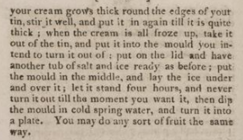
Moving forward to Colonial North America, ice cream recipes were not hard to come by as even Hannah Glasse had a recipe “To Make Ice-Cream” in her popular book The Art of Cookery Made Plain and Easy.[ii] Thomas Jefferson, extensive traveler that he was, even recorded a recipe for vanilla ice cream, helping to establish its popularity in the English American colonies and new republic.[iii] Ice cream flavors usually depended on seasonal fruits that were easy to mash, but more interesting and savory flavors like parmesan and oyster also made their way into recipe books of the period.
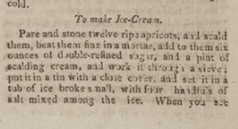
“To Make Ice-Cream” from The Art of Cookery Made Plain and Easy by Hannah Glasse Source: Library of Congress.
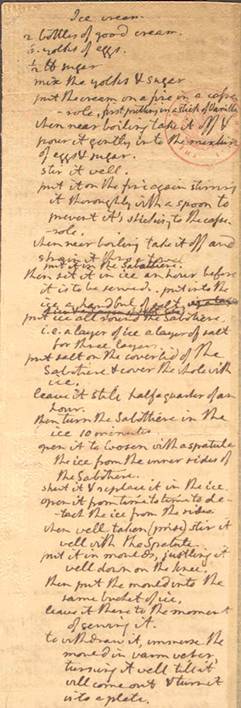
Thomas Jefferson’s recipe for ice cream. Written in his hand. Source: Library of Congress.
So, if it wasn’t availability of recipes and the concept of freezing the cream to make the dessert that stopped Americans from making this treat to cool off in the summer, then what was it? It was the capability of keeping ice, the labor it took to churn the cream by hand, the expensive imported ingredients, and the specialty serving pieces needed to put the frozen delight on the table for guests.
At this time, if you wanted ice, you had to harvest it from frozen lakes, ponds, or rivers in the winter. Anyone could do that, but preserving it was the challenge. Underground ice houses specifically built to preserve the ice until the warmer months were reserved for the elite.
Also remember that colonists had to typically import both the sugar to sweeten the cream and the salt for the ice. Both white sugar and salt were used sparingly. So, a recipe meant to show off using a liberal amount of both was something many could not afford to waste resources on.
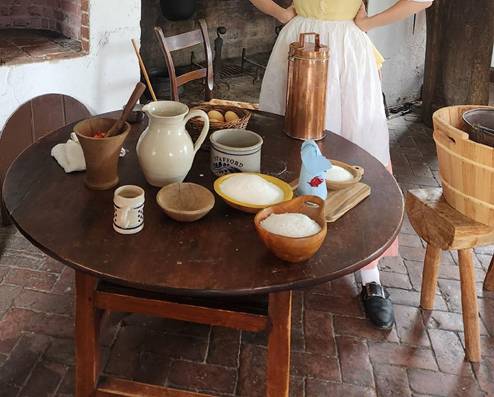
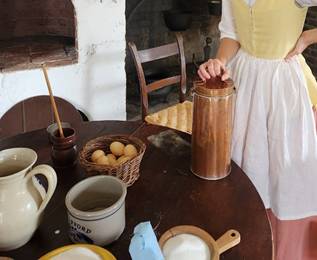
Ingredients used to make strawberry ice cream. Source: The George Washington Foundation.
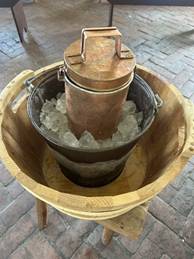
Ice cream could be made using either a pewter vessel or a specialty sorbetiere. A sorbetiere was a French invention made specifically for ice cream production that was essentially just a copper container with a lid. Either the sorbetiere or pewter bowl with the ice cream mixture was placed into a container of ice and salt. The container was then churned, occasionally stopping to scrape the mixture off the sides when it began to freeze. This process is not unlike what happens in both hand crank and electric ice cream makers from modern times, but all done by hand. On a Southern plantation wealthy enough to afford the ice, sugar, salt, and tools to make the ice cream, they’d also have to spare the time of an enslaved laborer for an hour or more to churn the dessert by hand.
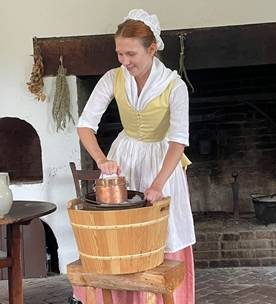
(Left) Churning the ice cream. Source: Emma Schlauder. (Center & Right) Copper sorbetiere. Source: The George Washington Foundation.
George and Martha Washington were possibly introduced to ice cream by the Royal Governor of Virginia, Lord Botetourt in 1770 at the Governor’s Palace in Williamsburg, where there is evidence of an ice house and ice molds used in the production of ice cream.[iv] Following George’s introduction to ice cream, he ordered an ice house to be built at Mount Vernon and he acquired a “cream machine for ice” and other items to help make and serve ice cream to guests.[v] Martha Washington was known for hosting gatherings during George’s presidency where she served prestigious treats like Lemonade and ice cream, as noted by Abigail Adams in 1789.[vi]
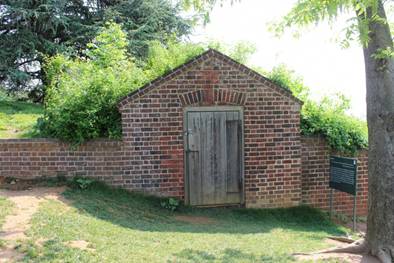
Ice house at Mount Vernon. Source: Mount Vernon Ladies’ Association.
When I prepare for Taste Through Time Programs, I always look for evidence of what I am making at both Kenmore and Ferry Farm. Unfortunately, there is really no evidence of ice cream being served at either property during the occupation of the Washington and Lewis families. Despite the presence of The Art of Cookery Made Plain and Easy in Fielding Lewis’ probate inventory and loaves of white sugar in Betty Lewis’, there is currently no evidence of ice houses or ice cream making and serving equipage at either Kenmore or Ferry Farm from this period.
[ii] Glasse, H., Katherine Golden Bitting Collection On Gastronomy & Elizabeth Robins Pennell Collection. (1805) The Art of Cookery Made Plain and Easy; Excelling Any Thing of the Kind Ever Yet Published … Also, the Order of a Bill of Fare for Each Month in the Manner the Dishes Are to Be Placed Upon the Table, in the Present Taste. Alexandria: Printed by Cottom and Stewart, and sold at their Book-Stores, in Alexandria and Fredericksburg. [Pdf] Retrieved from the Library of Congress, https://www.loc.gov/item/05005034/.
[iv] Theobald, M. M., Some Stone Cold Historical Facts.
[v] Ledger B (photostat, Mount Vernon Ladies’ Association), 198a.
[vi] “Abigail Adams to Mary Smith Cranch, 9 August 1789,” Founders Online, National Archives, https://founders.archives.gov/documents/Adams/04-08-02-0214. [Original source: The Adams Papers, Adams Family Correspondence, vol. 8, March 1787 – December 1789, ed. C. James Taylor, Margaret A. Hogan, Jessie May Rodrique, Gregg L. Lint, Hobson Woodward, and Mary T. Claffey. Cambridge, MA: Harvard University Press, 2007, pp. 397–401.]
If you have visited Ferry Farm recently or follow us on social media, you may have noticed the construction of two buildings near the Washington House. These new structures represent those that stood in these spots during George Washington’s time and were constructed using 18th-century methods. Identified through archaeology, their reconstructions allow us to tell better the stories of the people who lived and worked at Ferry Farm. We have previously blogged about the Quarter, a building for housing enslaved individuals owned by the Washingtons. For this blog, we will look at an integral structure located behind the Washington dwelling: the Cellar House.
The Cellar House
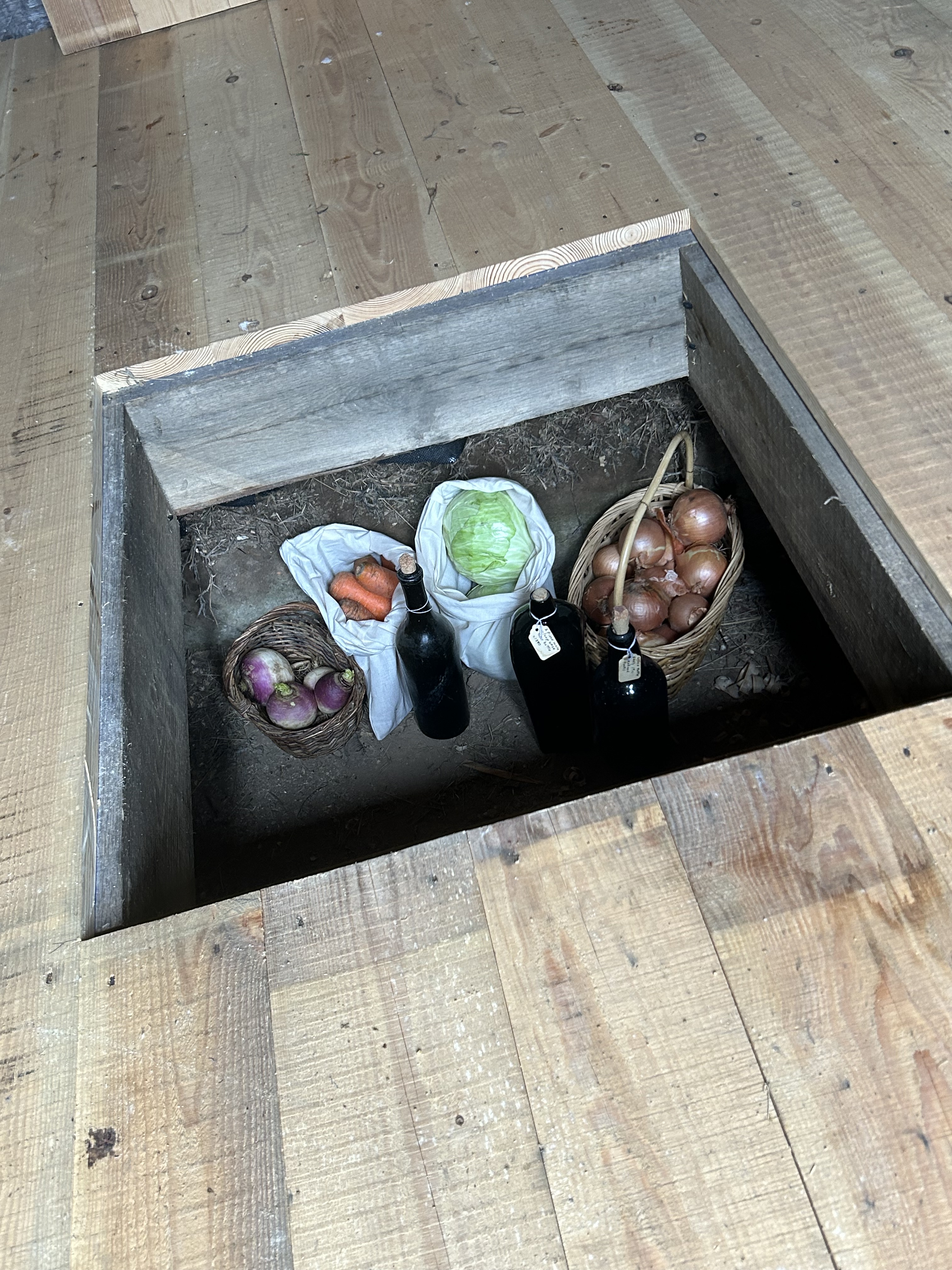
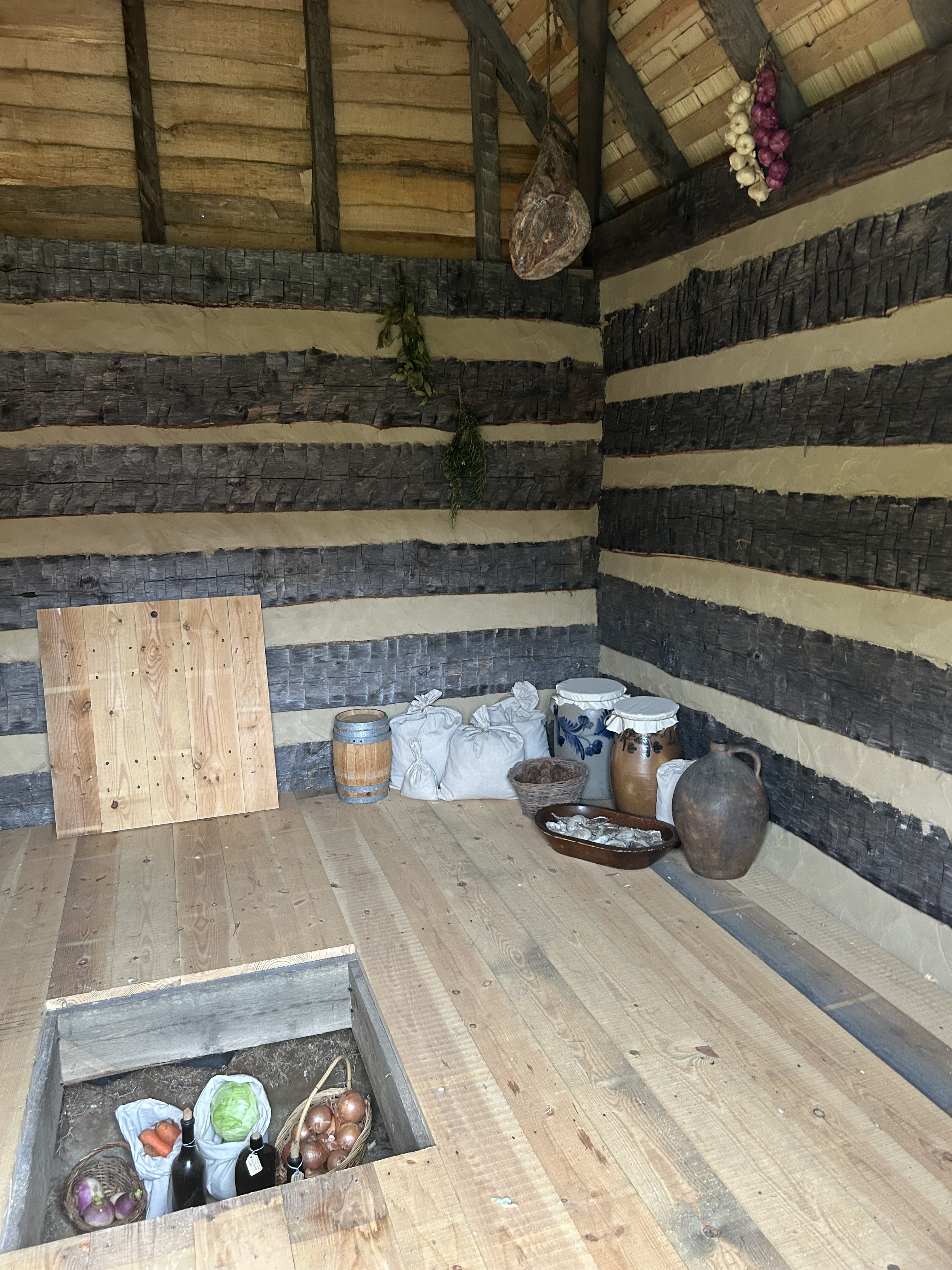
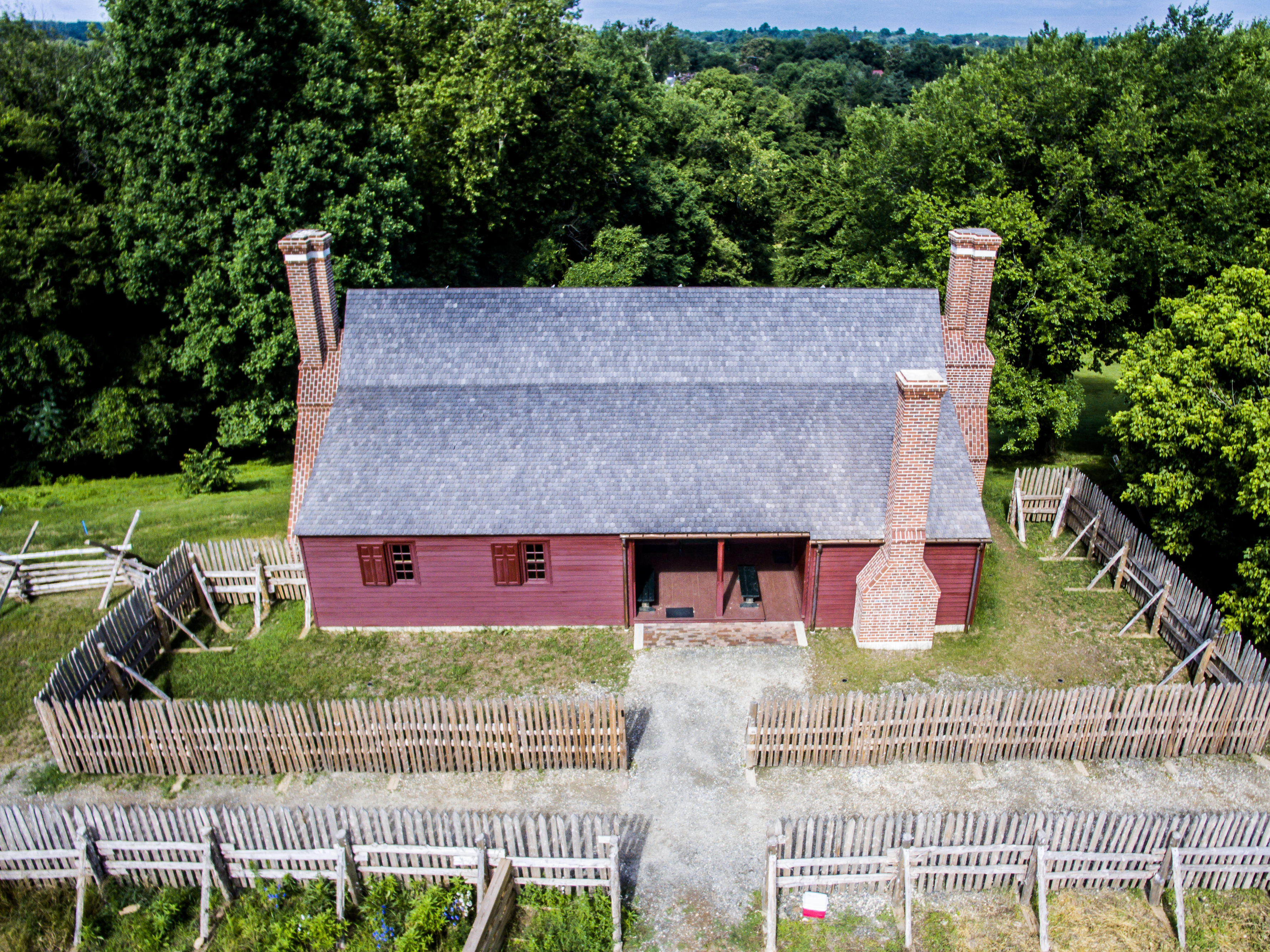
What is a cellar house, you may ask? While explaining it to my 7-year-old son, I told him it is neither a cellar nor a house (by modern standards). At this point, he threw up his arms and gave me up for an imbecilic parent. However, this structure was extremely important for large farms in the 18th century. Picture a simple timber and daub (fancy word for hardened clay) building with four walls, one door, high rafters, no windows, and a three-foot-deep pit beneath its floorboards. It is not fancy or decorative by any standards, yet this building holds preserved food that feeds dozens of people at Ferry Farm during seasons when fresh food is unavailable.
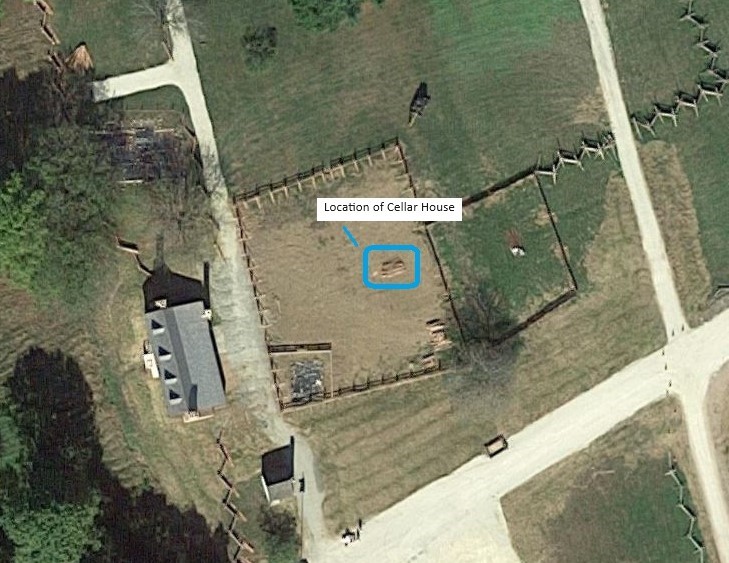
Location of the Cellar House on the Ferry Farm property
Let’s do a brief overview of food preservation during the Washington time period since it has already been touched on in previous blogs. Keeping food from going bad varies from region to region, depending on your climate (combinations of cold, wet, dry, or hot). The hot and humid months in Virginia posed quite a problem for colonists. These conditions do not lend themselves to easy food preservation. Plainly speaking, the East Coast Southern States drew the short straw when it came to keeping food consumable in the long term. As they say, “Where there’s a will, there’s a way,” and Virginians had a wide variety of cards in their deck for keeping food from rotting. Salt, sugar, wood ash, alcohol, vinegar (which was formerly alcohol), and other substances were utilized along with methods including smoking, fermenting, and dehydrating. However, even the best food preservation methods are useless if the resulting food is not stored correctly.
The cellar house could store many different types of foods and beverages, depending on where one kept them in the building. The rafters were ideal for cured meats such as hams, keeping them high and dry. Hooks on the walls held bunches of drying herbs, garlic, and onions. The shelves were perfect for baskets and small crocks of food, while the floor was sturdy for storing large casks or jugs of ale and cider, sacks of grain, and bushels of hardy vegetables and fruits. The pit beneath the floorboards, a glorified ‘cellar,’ was a few degrees cooler in the hot months and a few degrees warmer during the cold season. However, the difference between spoilage and edibility could hinge on maybe 10 degrees, making the subfloor pit essential for colonists who needed to keep some food cooler in summer but warmer (not freezing solid) in winter. Basically, the role the cellar house played varied by the seasons as a revolving door of foods came and went.
Inside of Cellar HouseInside of Cellar House
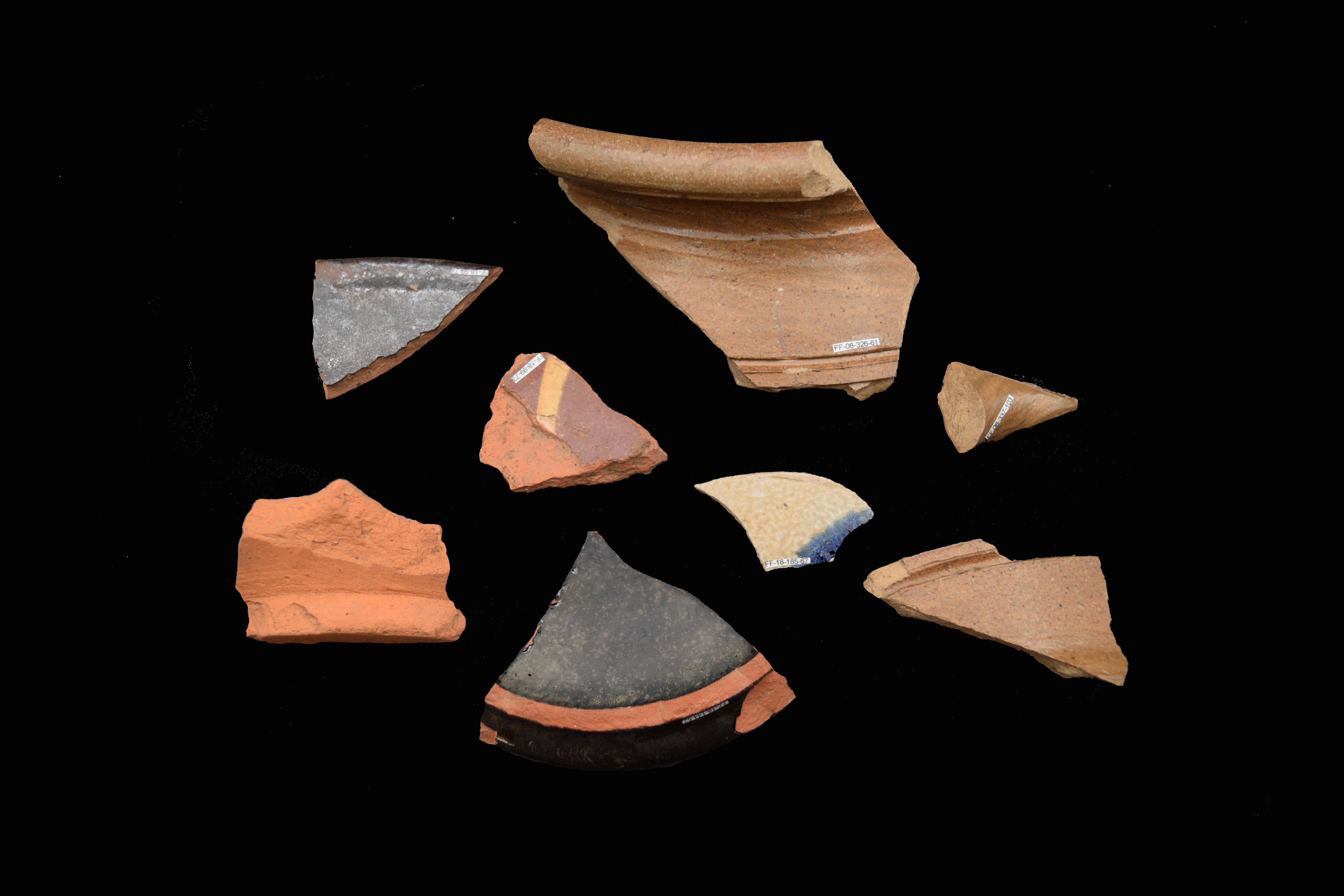
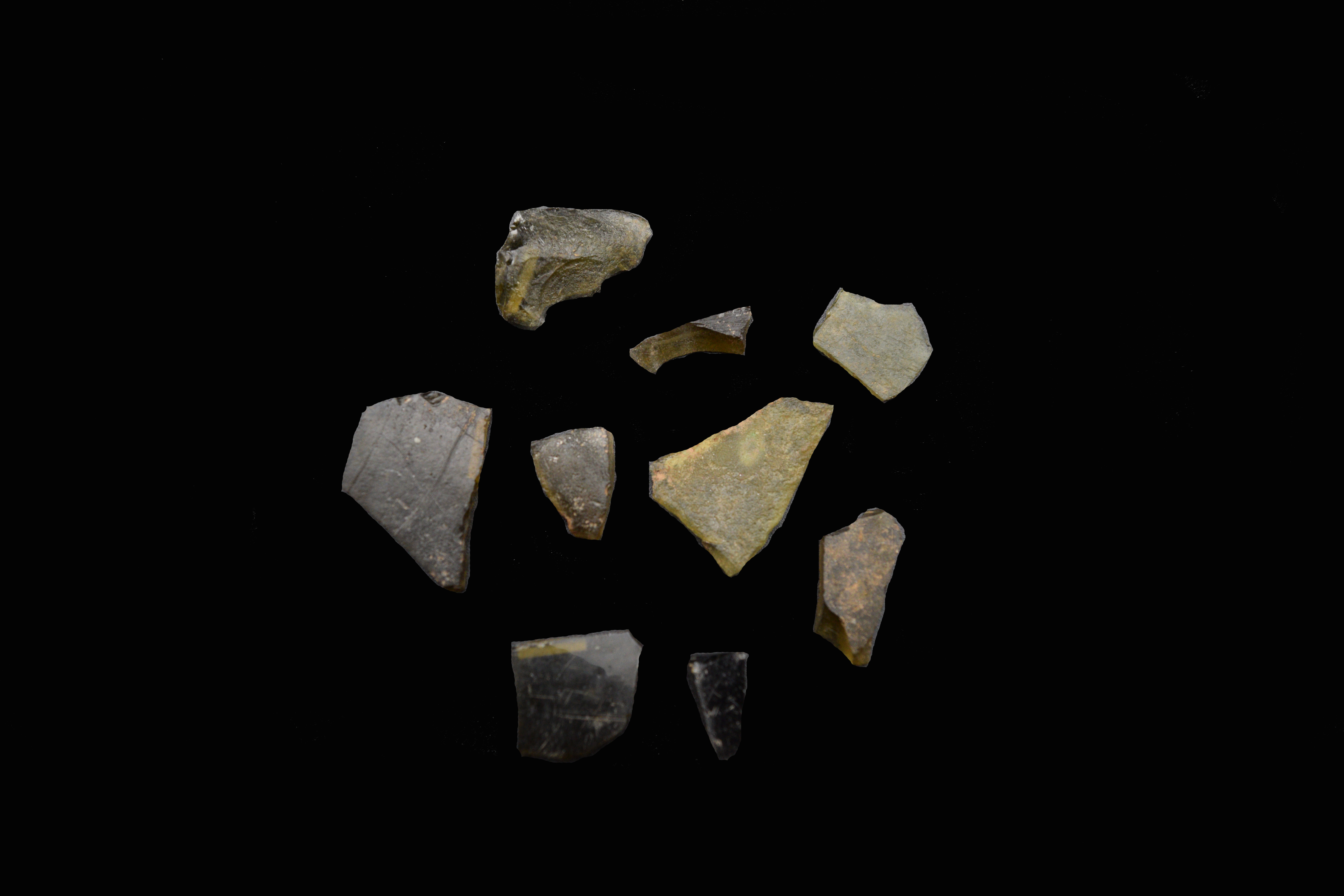
When archaeologists at Ferry Farm excavated the area underneath and around where the cellar house would have been, we found artifacts indicative of such a structure. Namely, very few items would have been found inside and around a dwelling, such as tea and tablewares, byproducts of meals, and valuable personal items. Large storage vessels, metal hooks for hanging food, and wrought nails and daub used to build the structure dominate the cellar house artifacts. The only notable personal items recovered were fragments of smoking pipes. That’s right, the smoke break was a thing even among enslaved workers stacking food inside the cellar house.
Ceramics from the Cellar HouseFaunal finds from the Cellar HouseGlass finds from the Cellar House
The cellar house is currently fully constructed, but we have yet to populate it with all of the storage vessels, food, smoking pipes, and other accouterments of a storage building. Eventually, visitors will be able to look into this building and take a trip back to the mid-eighteenth century with crocks, jugs, bottles, sacks, barrels, and baskets full of food and drink. All of which will be informed by the historic records and the artifacts recovered by our archaeologists, as with all the reconstructed buildings at Ferry Farm. Then, perhaps when I show the building to my son, he’ll see its importance: part pantry, part colonial refrigerator, and all cellar house.
In 2020, many of us spent a great majority of our time at home. This gave us the opportunity to get creative and explore new hobbies. One such hobby that became a viral sensation, plastered across social media, food blogs, and television news outlets, was that of baking bread. Bread has been around in some form for nearly as long as human civilization, although before industrialization, it was a means to survive, not just a fun challenge for the amateur baker. So here is a crumb of history on bread and what this glutinous baked good was like in Colonial America.
To start with the basics, bread is made up of 3 simple ingredients: Flour, water, and a leavening agent. Typically salt and some kind of sweetening, like sugar or honey, are also added. Everything else is extra.
Wheat flour was (and still is) the most common ingredient used for bread. Wheat quickly became a desirable crop in Colonial America. We can infer wheat was grown on Lewis family land based on documentation of family members paying for goods in wheat. Biological remains in the ground found by archaeologists at Ferry Farm suggest wheat was planted there too. Wheat and other crops were planted, cared for, and harvested by enslaved laborers on both plantations. Wheat specifically was a difficult crop to care for, requiring vast knowledge and careful timing to produce a fruitful harvest. Wheat is a form of grass, usually not well digested or particularly nutritious to humans. When wheat is ground into flour, put through the fermentation process of breadmaking, and baked, it becomes far more digestible, nutritious, and caloric for people to eat. For most of Europe’s history, bread was about half of calorie intake for poorer classes, and wheat still makes up about 20% of people’s diets today.
In the early 18th century, sieves made of fine Chinese silk that allowed for separating the bran from the wheat seed made whiter flour easier to obtain. Although the bran is the most nutritious part of wheat, it quickly became associated with the poor and lower classes in many Western European cultures. White bread was a sign of wealth. This led to bakers putting additives like alum, lime, and chalk into bread to make it whiter. Despite British Parliament passing laws regulating ingredients allowed in bread, it continued to be an ongoing issue throughout the 18th and 19th centuries.[1] Even with contemporary knowledge about the benefits of whole grains, 70% of bread baked today is white, based on this century old principle of white flour’s superiority.[2]
By the time Colonial America comes into the picture, bread is engrained into life. This is so much so that most 18th century cookbooks do not have bread recipes in them as it is assumed everyone already knows how to make basic table bread. That’s right, Hannah Glasse does not have a simple bread recipe in The Art of Cookery. It is just the three simple ingredients worked into a dough with the hands that is set aside to rise, then baked until a strong crust forms, after all. This is something foreign to us in a time when sliced bread is $1.99 in the supermarket. There is no need for us to spend hours baking bread ourselves in this modern age, but when you made bread every week or every day, it was something as simple as getting dressed or brushing our teeth is now.
Kneading bread dough in a wooden dough bowl.
In urban areas, bakers were trained in the art of breadmaking, but in rural places, it was left to the individual household to make their own bread. Trained or not, the science behind breadmaking on a molecular level was not understood until the 19th century. What they did know was that they needed a leavening, or rising, agent in their bread to ensure it rose properly. Leavened bread came into existence in Egypt about 6,000 years ago. Bread could be made without a rising agent, but it would be a completely different texture. In the 18th century, leavening agents came from a few different places. Barm is the frothy substance on the top of beer after production and is the perfect rising agent for bread, making connections between bakers and brewers in urban areas imperative. Also, just leaving dough to sit for a day or two to collect the bacteria in the air, from the kneader’s hands, and from the dough bowl with leftover dough bits can also be enough to leaven a batch of dough.[3] This method of collecting bacteria from the dough’s surroundings is reminiscent of creating a sourdough starter.
Loaves of bread were placed into a bake oven, a large cast iron Dutch oven, or on a hot hearth. Regulating temperature was up to the expertise of the cook or baker, there was no temperature dial like we have on our modern oven. And despite this, when the temperature is kept controlled, the baking process takes about the same amount of time as it does in a modern oven. The physical baking process is about the same both ways.
Bread cooking in dutch oven.Bread cooking in dutch oven on the hearth
Whether you prefer white or whole wheat bread, I hope this entry has given you a grain of insight on the importance of bread throughout history. Breaking the bread down in this article may make it sound simple, but I will say from experience that getting the dough smooth, the crust tender, and the crumb coat correct is no easy task. Put that loaf over coals from the hearth and you add a whole new element of challenge. Reflect on the enslaved cook at Kenmore or Ferry Farm who was responsible for not only making bread, but three meals a day, along with planning and prepping ingredients for future meals. Cooking and baking in an 18th century kitchen were physically and mentally challenging, making it one of many difficult jobs for those enslaved on southern plantations. I suggest everyone try baking a loaf for themselves. To me, it is a task that humanizes food production and reminds us of its delicate nature now and throughout time.
Loaves of bread made on the hearth at Kenmore for Taste Through Time program.
If you have followed the news of our excavations, you will have kept up to date with our building finds. The past two summers helped uncover evidence of one such structure, which we now believe represents a corncrib. While the name may seem self-explanatory, we have frequently heard the question, “What is a corncrib?” To answer this, we thought we would dedicate our newest blog to it.
Long cultivated by Native Americans, early colonists quickly adopted corn into their agricultural repertoire. As a crop, corn proved easy to cultivate due to its hardy and adaptable nature, and its high yield to seed ratio made it a prosperous choice. The corn season lasted from planting in early May to the September-October harvest. After this, collected corn, counted as barrels, lay in corncribs. Husking and shelling occurred as needed since home consumption only required a small amount at a given time. This process continued throughout the winter months.
As a food staple, corn became an important part of free and enslaved diets in Colonial Virginia. Corn grew in such abundance that it reportedly fed everything. This led to Virginia husbandry relying on the crop and any decline in quantity led to a state of distress. As for the enslaved, records of food rations allotted to enslaved communities often refer to “pecks” or “bushels” of corn. Corn served as a useful ration since small amounts went far and multiple uses for it existed. It also provided better nutrition, which did not go unnoticed by enslavers. Instances of enslaved rations excluding corn resulted in a decline in health, energy, and production. This made the inclusion of the staple essential.
Despite their forced labor, enslaved communities integrated corn harvesting into their culture. Annual so-called corn shucking festivities proved frequent sights on plantations, especially as corn production expanded. During this time, the harvested corn lay in heaps next to the crib. As the size of the harvest required many people for husking, this event provided time for socializing. A moment filled with music and dance, even neighboring enslaved individuals and relatives not attached to the property could attend under the guise of providing extra labor. This latter detail explains why such gatherings went ahead. Enslavers often encouraged corn-shucking festivities to speed up the process and at times offered rewards to the person who could shuck the most corn.
The expansion of corn production lies in the decline of tobacco. While tobacco served as the original cash crop of Virginia, its cultivation damaged soils, resulting in increasingly poor crop cycles. Some planters, including George Washington at Mount Vernon, opted to plant grains to avoid this trend and thus have more return each year. As tobacco prices fell in the late 1700s, due in part to the Revolution, more Virginia planters turned their focus to grains. This led to an expansion in corn cultivation, as it became a central part of the economy.
No longer used for just animal feed or local consumption, corn became a cash crop. In doing so, more structures related to grains appeared or underwent expansion. Gristmills became more common as did grain stores near wharfs. On plantations, the land devoted to grains increased to sustain production with additional or larger storage buildings, such as corncribs, appearing to accommodate the harvest. Corncribs would soon rank amongst the most common structures to appear on farmlands. Apart from buildings, husking and shelling additionally underwent a change as this now occurred over the course of a few weeks, thus allowing for enslaved gatherings, rather than throughout the winter.
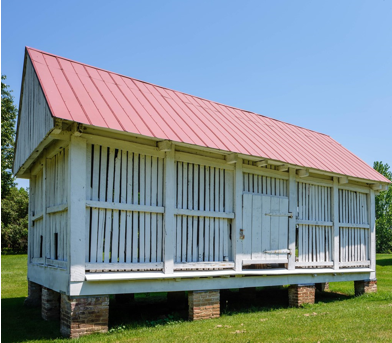
Corncrib
With corn holding such an important position in society, it required proper storage. Native Americans constructed the first corncribs with Europeans taking note of them shortly after arriving on the continent. The structure evidently held significance for indigenous tribes as many place and group names derive from the various words for a corncrib. Interestingly, our modern term “barbecue” comes from “barbacoa,” an indigenous term from present-day Georgia, which has several meanings including corncrib. Apart from ranging in size, the design of corncribs dating from pre-contact to present appear very similar, as several key elements remain consistent.
The main roles of a corncrib constitute storing harvested corn, protecting it, and keeping it dry. To that end, the most recognizable characteristic involves the floor of the structure resting at least a foot off the ground via posts or piles/piers. Raising the structure deterred vermin from accessing the crop and helped keep it dry. The design of the sides additionally helped with this latter desire as vertical slats or offset horizontal siding provided gaps for airflow. Vertical slats for “cribbing” proved the most common during the colonial period.
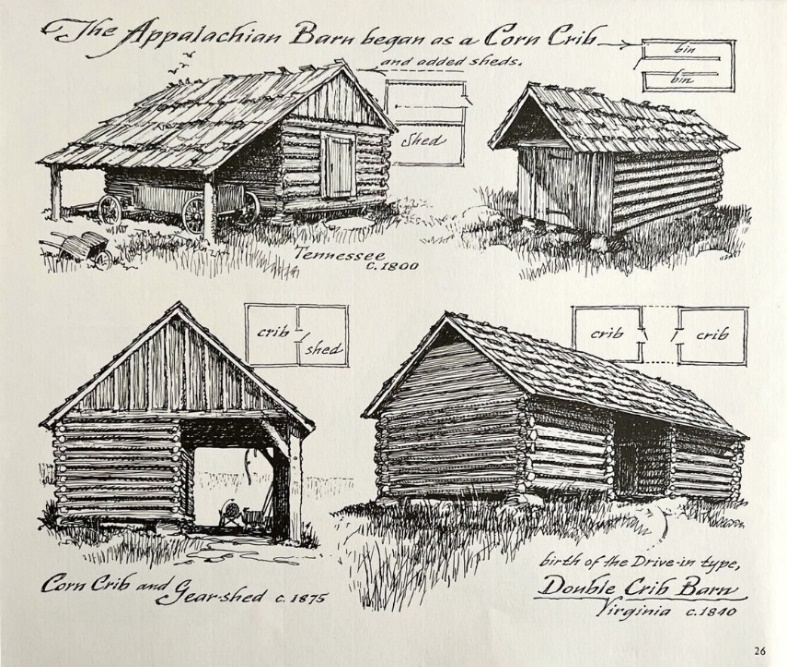
Overall, the structure required robust timbers and construction techniques that would allow it to carry dead loads and resist interior pressure. Once constructed, the building generally took on a rectangular shape with a gabled roof of shingles, boards, or thatch. This roof could extend over one or more sheds attached to the long sides of the building while a door, typically on a shorter side, provided interior access. The interior varied from an open plan to one with removable dividers to form cribs, hence the name of the structure. Post-colonial era designs could include an additional crib to form a double or “drive-thru” corncrib.
Corn Crib Designs Source: Sloane 1990: 26
Since its adoption by colonists, the building’s name has experienced some variation. While we have gone with “corncrib” at Ferry Farm, several other accurate terms exist. The most simple, and unhelpful for interpreting records, consists of “barn.” During colonial times, “barn” could refer to nearly any outbuilding, and corncribs fall under a barn style called “crib-barns.” This, in turn, may refer to the building. While no standard for outbuildings included on properties existed during this time, corncribs counted amongst the most common. Other name options include the similar “corn-house” and the term “stacks.” This latter term may or may not have “corn” attached to it, but referenced ability to relocate the structure. In the end, unless corn appears in the name, identifying the building requires context clues such as location, crop knowledge, structure design, and recorded narratives.
Our Findings
So what did we find to suggest we had a corncrib? To start, we know from documents dating to Washington occupation that corn constituted one of the crops grown at Ferry Farm. We knew little beyond this until archaeology provided an insight. Across our 2020 and 2021 field seasons, we uncovered four aligning postholes that each measured 10ft apart. At the same time, a decline in artifact count occurred, suggesting our dig lay on the outskirts of the work yard. In 2022, we expanded this dig area to determine if the postholes belonged to a fence or, as we hoped, a building. The low artifact count continued to support the theory of entering the agricultural world and we soon discounted a fence line, as our excavation revealed no further postholes on that line. Moving 20ft south from the postholes, we uncovered a line of three features, also 10ft apart, which aligned with the first three postholes. The issue? They came from piles/piers rather than posts, and one of the stones for that line remains in place (Fig. 5).
Image depicting the lines of 4 postholes and 3 pile/pier sites as of 2022
The two parallel lines evidently went together, but we now needed to identify a structure that used both building techniques. After perusing historic images and sources on 18th century agricultural buildings, we identified the corncrib as the only structure that fit this construction. While corncribs most often stand alone on piles/piers or posts, some examples include an open shed area for carts and temporary storage as discussed earlier. Neither part of the structure would have led to large artifact deposits as the crib merely stored corn while the shed area supported the act of storage.
So what did our corncrib look like? Well, apart from identifying the crib and shed portions, we can say the crib must have rested at least a foot off the ground. Furthermore, in keeping with standard construction, the siding, likely vertical slats, would have breaks in between to allow airflow. As for the basic dimensions of the corncrib, our emergency access road unfortunately runs through the unexcavated portion.
Since we cannot inhibit this access, we only have the complete outline of the shed and one side of the crib (Fig. 6). Still, we can make a few estimates for the structure’s dimensions. While we cannot determine height at this stage, the outline of the shed indicates this portion measured 20x30ft. This, in turn, tells us that the corncrib itself measures 30ft in length. As for the crib’s width, several details allow us to determine a range. One source stated that the length of a corncrib should be 2-3 times the width. Of the examples we identified, they generally had a length about twice the size of the width, with the widest one measuring 20ft. On top of this, shed portions do not appear much wider than the accompanying crib. With this in mind, our crib likely measures 15-20ft in width.
Overview of excavation site showing the 20x30ft shed outline and start of the crib
Future
By now, you must wonder when you will see a corncrib at Ferry Farm. One of our goals involves reconstructing the Washington landscape and this will include the corncrib. Currently, we have started construction on a root cellar and slave quarter. Once completed, these structures will be part of your visit and we will turn our attention to reconstructing more areas. This may include the corncrib, but will likely take a few years. In the meantime, continue to visit our ongoing construction projects and make sure to talk with the archaeologists and interpreters.
Our future corncrib may look similar to this small one at the Museum of Appalachia Source: Wikipedia
Historical Fact: Those familiar with the life of Harriet Tubman may recognize the term “corncrib” as she, her brothers, and several others briefly hid in one while she led them to freedom.
Emma Schlauder
Research Archaeologist
Belanger, Fergus & T. H. Warner 1934 Notes about Williamsburg and William and Mary College. The William and Mary Quarterly 14(3): 239-240.
Carson, Cary & Carl Lounsbury (editors) 2013 The Chesapeake House: Architectural Investigation by Colonial Williamsburg. The University of North Carolina Press, Chapel Hill, NC.
Carter, Landon 1908 Diary of Col. Landon Carter. The William and Mary Quarterly 16(3): 149-156.
Chandler, Dana 2000 The Prehistory of Randolph County, Alabama. Central States Archaeological Journal 47(1): 28-29.
Copeland, Pamela C. & Richard K MacMaster 1989 The Five George Masons. University of Virginia Press, Richmond, VA.
Harriet Tubman Underground Railroad Byway 2023 25. Choptank Landing: Site of Harriet Tubman’s Most Daring Rescues. Harriet Tubman Underground Railroad Byway < https://harriettubmanbyway.org/choptank-landing/>. Accessed 19 June 2023.
Herman, Bernard L. 1992 The Stolen House. University Press of Virginia, Charlottesville, VA.
Hollingsworth Jr., G. Dixon 1979 The Story of Barbecue. The Georgia Historical Quarterly 63(3): 391-395.
Katz-Hyman, Martha B. & Kym S. Rice (editors) 2011 World of a Slave: Encyclopedia of the Material Life of Slaves in the United States. Greenwood, Santa Barbara, CA.
Kimball, Fiske 1954 Gunston Hall. Journal of the Society of American History 13(2): 3-8.
Lanier, Gabrielle M. & Bernard L. Vlach 1997 Everyday Architecture of the Mid-Atlantic: Looking at Buildings and Landscapes. The John Hopkins University Press, Baltimore, MD.
Linebaugh, Donald W. 1994 “All the Annoyances and Inconveniences of the Country”: Environmental Factors in the Development of Outbuildings in the Colonial Chesapeake. Winterthur Portfolio 29(1): 1-18.
Lounsbury, Carl R. (editor) 1994 An Illustrated Glossary of Early Southern Architecture and Landscape. University Press of Virginia, Charlottesville, VA.
Morgan, Philip D. 1998 Slave Counterpoint: Black Culture in the Eighteenth-Century Chesapeake & Lowcountry. The University of North Carolina Press, Chapel Hill, NC.
NPS 2021 Barnyard Trail: Corn Crib. Fire Island National Seashore, NPS <https://www.nps.gov/ places/barnyard-trail-corn-crib.htm>. Accessed 24 May 2023.
Siener, William H. 1985 Charles Yates, the Grain Trade, and Economic Development in Fredericksburg, Virginia, 1750-1810. The Virginia Magazine of History and Biography 93(4): 409-425.
Sloane, Eric 1990 An Age of Barns, reprint of earlier edition. Henry Holt & Co., New York City, NY.
Speck, Frank G. 1907 Notes on the Chickasaw Ethnology and Folk-Lore. The Journal of American Folklore 20(76): 50-58.
Stilgoe, John R. 1982 Common Landscapes of America, 1580-1845. Yale University Press, New Haven, CT.
Wells, Camille 1993 The Planter’s Prospect: Houses, Outbuildings, and Rural Landscapes in Eighteenth Century Virginia. Winterthur Portfolio 28(1): 1-31.
Upton, Dell & John M. Vlach (editors) 1986 Common Places: Readings in American Vernacular Architecture. The University of Georgia Press, Athens, GA.
Vlach, John M. 1993 Back of the Big House: the Architecture of Plantation Slavery. The University of North Carolina Press, Chapel Hill, NC.
Washington, Augustine Jr. 1750 Record of Sale and Payment to Mary Ball Washington.
Washington, George 1749 Letter to Lawrence Washington dated 5 May 1749. Washington Papers, National Archives, Washington, DC.
Washington, George 1771 Survey of Ferry Farm.
Washington, Mary Ball Undated Letter to John Augustine Washington, undated no. 154. Box: 87, Folder: undated no. 154, Identifier: RM-904; MS-5404, The George Washington Presidential Library at Mount Vernon, Mount Vernon, VA.
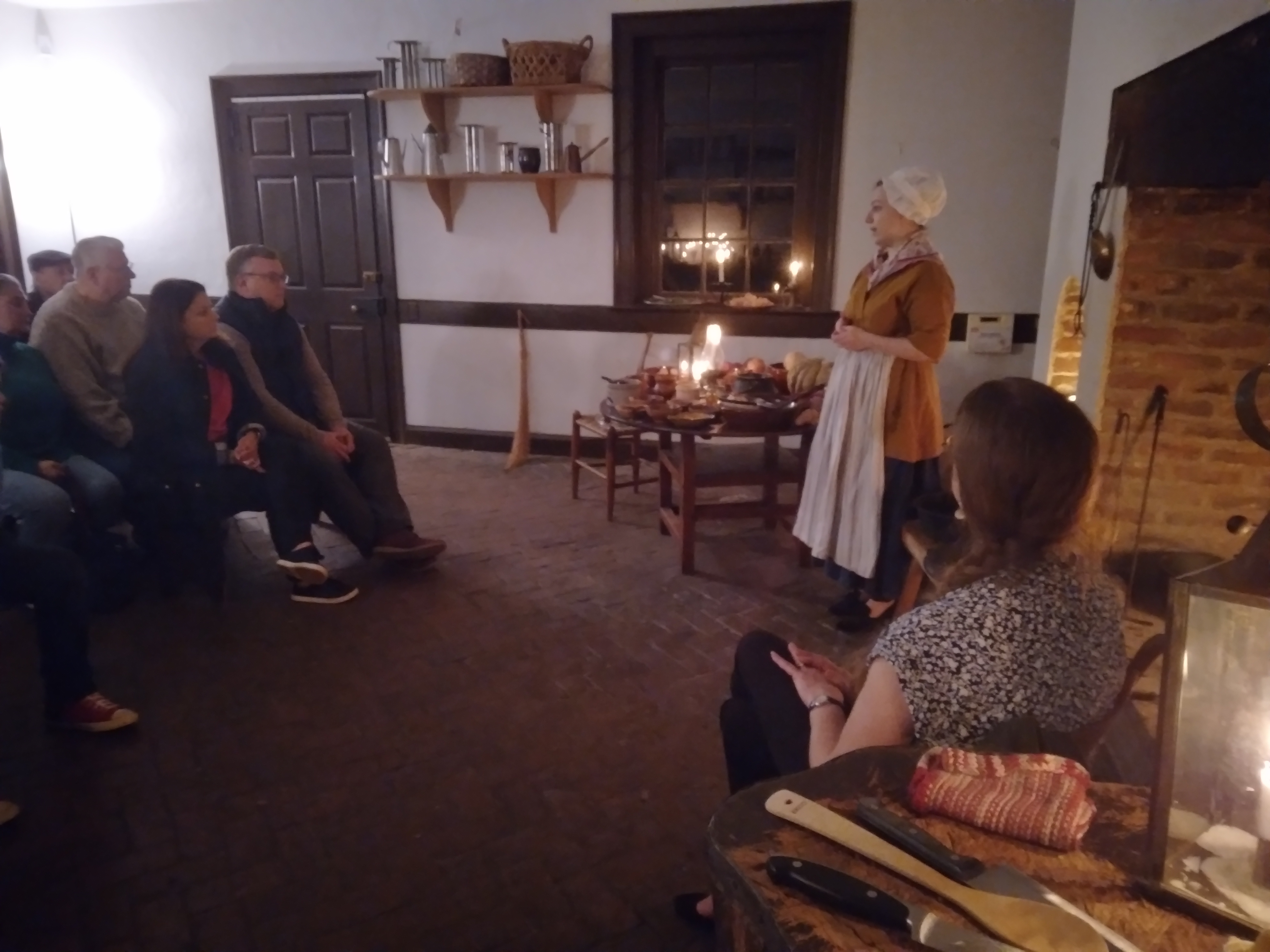
This year at our annual Twelfth-Night celebrations, visitors could enter the kitchen for a short lecture and demonstration. The archaeology and curatorial teams gave the talks to explain two important food items that play a part in Kenmore’s history and the holiday, gingerbread and flip.
Our first demonstration was done by Emma Schlauder, Research Archaeologist at the Foundation. She used a traditional recipe based on Mary Washington’s gingerbread. This is the recipe that the Kenmore Association and the Daughters of the American Revolution (DAR) would use in partnering with Hills Brothers Company to create the Dromedary Gingerbread Mix. The mix was sold in the gift shop and shipped around the country, raising money for the restoration of Kenmore.[1]
Emma Schlauder giving a presentation on gingerbread.
Mary Washington’s Gingerbread Recipe
3 cups all-purpose flour
2 tablespoons ground ginger
1 teaspoon cream of tartar
1 teaspoon baking soda
1 teaspoon ground cinnamon
¼ teaspoon ground nutmeg
⅛ teaspoon ground mace
1 large orange
½ cup (1 stick) lightly salted butter, at room temperature
½ cup light brown sugar, firmly packed
1 cup molasses
½ cup warm milk
1 wineglass (2 ounces) brandy or coffee
3 large eggs, beaten
Gingerbread is a term applied to a wide-ranging selection of baked goods with combinations of spices such as ginger, cinnamon, cloves, and nutmeg and sweetened with honey, sugar, or molasses.[2]
Ingredients and spices for gingerbread
Emma’s gingerbread used the traditional American sweetener, molasses.[3] Molasses was a commonly used sweetener in early American cooking until the increase of domestic sugar production. Molasses was cheap and a by-product of the refined white sugar produced for the wealthy.[4]
After including all ingredients, it was mixed to create a runny batter. The batter was put into a cast-iron Dutch oven and hung over the fire to cook. Cooking and baking over the hearth was time-consuming and potentially dangerous. It was done with heavy cast-iron pots and pans, often hung over the fire by an iron bar in the back of the oven.[5] Luckily for us, Emma had taken precautions for cooking over the open hearth and was able to bake the runny batter into a dense gingery cake. The cake was enjoyed by many and was determined to be a must-have for the season.
Gingerbread cooking over the fire
Flip
Our next presentation was done by Mara Kaktins, our Archaeologist & Lab Manager, and explored the history and ingredients of a unique drink called flip that would have fit in quite well with the festive celebrations.
The first known mention of flip is from a 17th-century play called “Love for Love” by William Congreve when a character mentions sailors, stating, “We’re merry folks, we sailors: we han’t much to care for. Thus, we live at sea; eat biscuit, and drink flip.”[6] The play does not provide us with a recipe or ingredients for the drink.
Flip –Universal Etymological English Dictionary
Flip is mentioned in the Universal Etymological English Dictionary, first published in 1721. This definition offers more information about what the drink contains by stating, “Flip, a sort of Sailors Drink, made of Ale, Brandy and Sugar.”[7] Full recipes can be found in The Cook’s Oracle, published in 1822; How to Mix Drinks: Or The Bon-vivant’s Companion, published in 1862; and The Curiosity of Ale and Beer: An Entertaining History, published in 1889. These recipes contain spices and ingredients like eggs, rum, sugar, and orange juice.[8][9][10]
Ingredients to make flip: Rum, Whiskey, Sugar, Nutmeg, Orange Juice, Eggs
However, two things make flip different from other holiday drinks like eggnog. First, there is no cream used in the mixture[11] , and second, flip is traditionally mixed by pouring the drink between two different vessels to make sure all the eggs are combined with the alcohol and then plunging a hot iron into the drink to create froth.[12][13]
Instructions state, “To make a quart of Flip: Put the Ale on the fire to warm, – and beat up three or four Eggs with four ounces of moist Sugar, a teaspoonful of grated Nutmeg or Ginger, and a quarters of good old Rum or Brandy. When the Ale is near boil, put it into one pitcher, and the Rum and Eggs, &c. into another; – turn it from one pitcher to another till it is as smooth as cream.”[14] After the mixture is properly combined, it is poured into a cup or tankard and finished off by plunging a hot iron which further mulled and froths the drink and gives it a slightly burnt taste.[15]
Mara Kaktins finishing off a glass of flip with the hot poker
This drink was mixed many times throughout the Twelfth night and was sampled by the staff. Unlike the gingerbread, the reviews for this frothy drink weren’t all that positive. Our modern palates might not be used to the amount of alcohol colonists use to consume. Sadly, while this drink was a hit during George’s festive season, traditional eggnog would be the best bet for the holidays.
These two demonstrations were quite a hit, with a sold-out crowd attending the show. With such a positive response, the archaeology and curatorial departments are looking for more ways to introduce living history to visitors. After gingerbread and flip, the possibilities are endless.
Heather Baldus, Collections Manager
[1] Bryn, Ann. American Cake. Rodale Books, 2016, pg 26.
[2] Goldstein, Darra. The Oxford Companion to Sugar and Sweets. Oxford University Press, 2015. pg 632
[3] Bryn, Ann. American Cake. Rodale Books, 2016, pg 24.
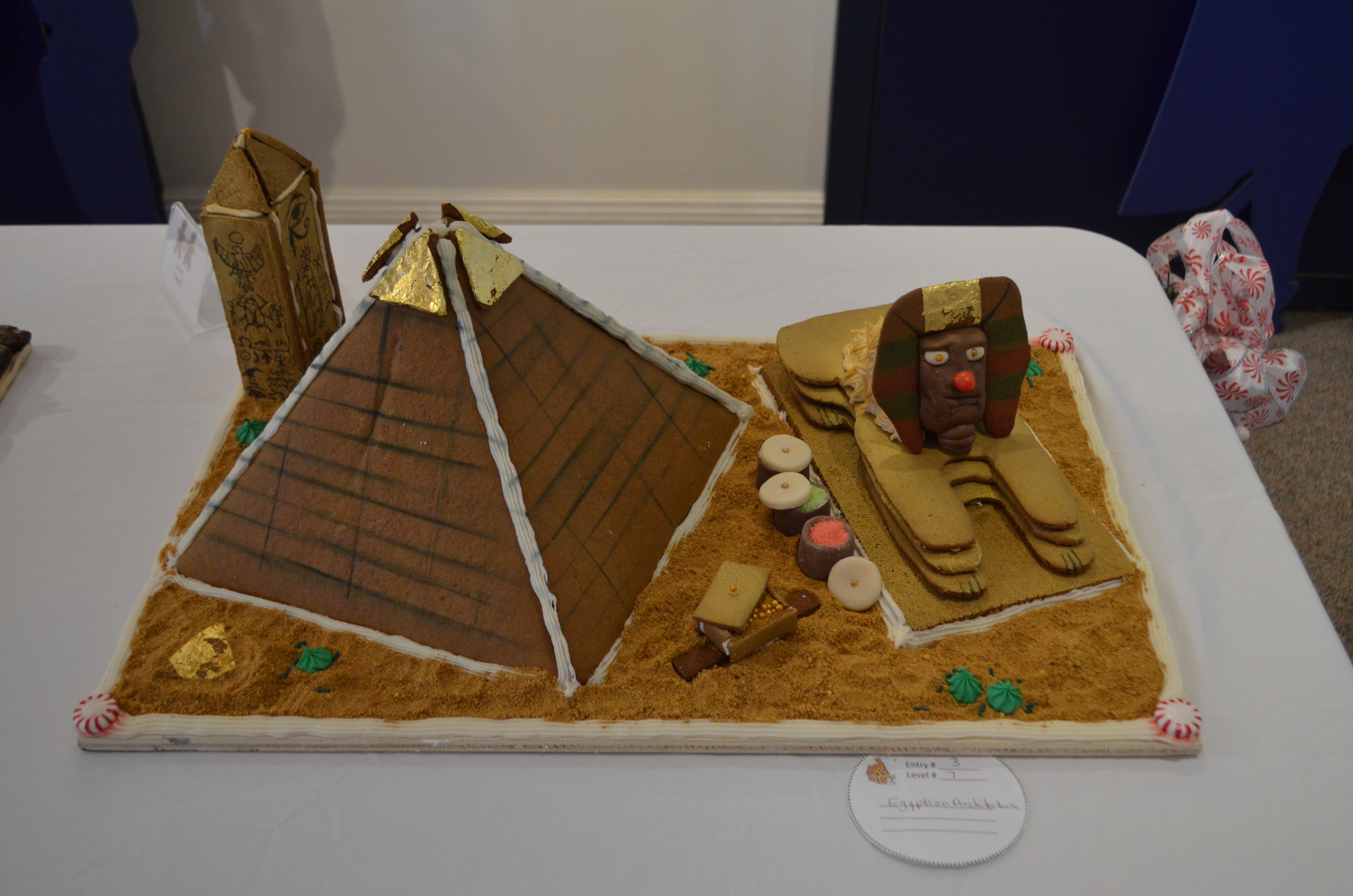
If you visit George Washington’s Ferry Farm this December, you’ll be greeted by the sweet smell of spiced gingerbread as soon as you walk through the door! During our annual Gingerbread House Contest and Exhibit, our gallery space is transformed into a showroom with entries reflecting this year’s theme: “architectural wonders of the world.” Unlike their real-life counterparts, these architectural wonders are all baked out of gingerbread and creatively decorated with icing and candies. Baking gingerbread is a great way to get in the holiday spirit, and in many cultures, gingerbread has long been associated with the holiday season. But where, exactly, did these gingerbread traditions originate?
The Tower Bridge on display at Ferry Farm
According to The Oxford Companion to Sugar and Sweets, the term “gingerbread” refers to a wide variety of baked goods ranging from rolled cookies to dense cakes that are “flavored with a combination of spices such as ginger, cinnamon, cloves, and nutmeg, and sweetened with honey, sugar, or molasses.” Some gingerbread variations can be traced back to antiquity, like the honey-sweetened cakes baked in ancient Egypt and Greece. Variations closer to what we consider gingerbread today (think gingerbread men and gingerbread loaves) became popular in northern Europe during the Middle Ages. Germany, in particular, became well known for its spiced gingerbreads, or lebkuchen.
German lebkuchen can trace its origins as far back as the 14th century, when gingerbread baking was associated with local monasteries and, later, professional bakers’ guilds. In Nuremberg, now world famous for its lebkuchen, honey was a locally accessible sweetener due to the city’s abundant forests and honeybee population. The medieval city was also at the crossroads of trade, which meant imported spices were readily available to Nuremberg monks and bakers. Before the invention of metal molds and cookie cutters, bakers used wooden molds carved with elaborate patterns to make and decorate gingerbread. Bakers shaped the cookies into different figures like animals and saints, and when intended as gifts for nobility, even added gilded decoration!
Today, although recipes vary, lebkuchen ingredients often incorporate some variation of honey, nuts, coriander, cloves, ginger, nutmeg, and candied fruit. “Nuremberg lebkuchen” has a higher nut content than any other variety. “Lebkuchenherzen” (or “Lebkuchen hearts”) are heart-shaped gingerbread decorated with written icing inscriptions. The hearts can be hung as decoration and are often sold at Christmas markets and during Oktoberfest.
By the 1800s, making gingerbread houses was a popular activity in Germany. Perhaps unsurprisingly, a tale involving a candy-coated house also began to circulate during this time. Originally published in 1812 by the brothers Jacob and Wilhelm Grimm, Hansel and Gretel tells the story of two children lost in the woods who stumble upon a witch’s house made of bread, cakes, and sugar. The evil witch captures the children when she discovers them munching on her house!
The story of Hansel and Gretel has remained popular to this day, and many different iterations of the tale exist. It’s unclear exactly which event precipitated the other (did the fairytale popularize gingerbread houses, or was an existing gingerbread house tradition simply incorporated into the story?) What is clear, however, is that gingerbread houses had become popular in Germany! When Germans immigrated to new places, they took these traditions with them, and the baking and making of gingerbread houses became popular elsewhere too. Today, whether created from a store-bought kit or handmade dough, gingerbread house-making is a popular activity for adults and children alike and is closely tied to the Christmas season.
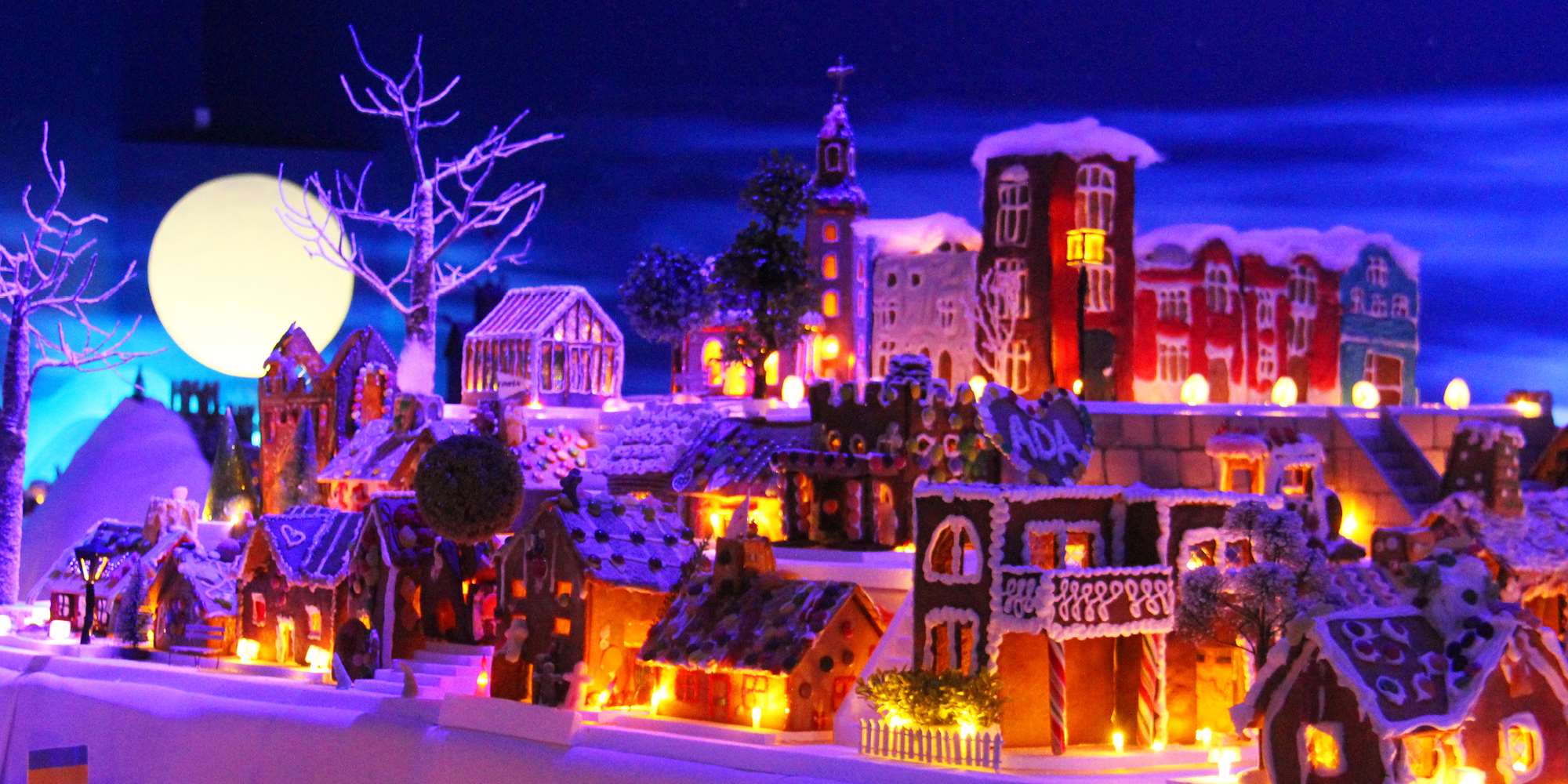
Beginning in 1991, the city of Bergen, Norway, constructed an entire city…out of gingerbread! The display is made up of more than 2000 gingerbread houses and buildings. Called pepper cookies or “pepperkaker” in Norwegian, the “Pepperkakebyen” Gingerbread Town is made up of pieces constructed by local school children, businesses, and volunteers. The city landscape includes local landmarks, trains, cars, and even boats. While not the only gingerbread town in existence, it is certainly one of the largest and is a testament to the enduring popularity of the gingerbread house!
If you’re interested in delving further into the history of gingerbread, check out two of our past Lives & Legacies blog posts where we’ve written about Mary Washington serving gingerbread to Lafayette and the Kenmore Association’s ties to the sweet treat. If you’re interested in seeing Ferry Farm’s own Gingerbread House Contest and Exhibit, be sure to stop in before the exhibit closes on December 30th and also vote on your favorite entry!
A pyramid and sphynx made of gingerbread on display at Ferry Farm
Further Reading: The Oxford Companion to Sugar and Sweets. (2015). United Kingdom: Oxford University Press.
This past week the curatorial and archaeology departments came together to fulfill a long-held dream to make oyster ice cream. Many people asked “why?” others said “gross,” and many just shook their heads at our endeavor. But we are not easily put off by odd things in history. In fact, many of us seek them out, and oyster ice cream is indeed an oddity.
But before we dive into oysters and ice cream, there are some common myths that need to be cleared up. Oyster ice cream was not mentioned in The Adventures of Tom Sawyer. Dolley Madison did not serve it during her time in the White House. Oyster ice cream was not served at the “first” Thanksgiving. And finally, no, it was not George Washington’s favorite creamy treat; in fact, there is no connection between the two.[1]
Now that we are all on the same page, let us begin because this will be a long one.
History of Oysters
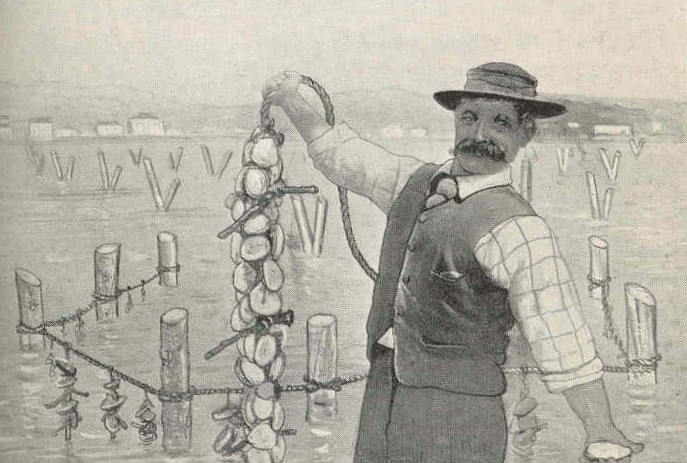
Oysters have been an easy and plentiful source of protein for humans since humans began. Prehistoric middens have been found in Australia containing the remnant of oysters used for food. They have been cultivated in Japan since at least 2000 BCE, and farming beds have been found in England since Roman times.[2] The period between the eighteenth and nineteenth centuries was known as the Golden Age of Oysters as an increase in production made them extremely affordable for the working class in the US and Europe.[3][4]
Oyster Culture in the Bay of Spezia, Italy. Wikicommons
The invention of railroad transportation, canning, and refrigeration in the nineteenth century meant that oysters could now be shipped to markets all over Europe and the US. With the growth in production oysters became a cheap source of protein compared to the pricier meat, poultry and fish. Soon cities like New York City, Philadelphia, Baltimore and New Orleans became hubs of large oyster markets.[5]
The history of ice cream is a bit obscure, but ice cream, as we would know, was not possible until the discovery of the endothermic effect. The endothermic effect is where a substance, like cream, can be made to freeze by immersing or surrounding it with a mixture of ice and salt. Surrounding the cream with ice alone only chills but does not freeze the cream. Adding salt to ice lowers the melting point and draws the heat out of the cream causing it to freeze. This process was described as early as the thirteenth century by Arab medical historian Ibn Abu Usaybia.[6] But it wasn’t until the latter part of the seventeenth century that Europeans made soberts and ice cream using this process.[7]
The first English recipe for ice cream was published in Mrs. Mary Eale’s Receipts in London in 1718[8]. It was again published in our blog’s favorite cookbook, The Art of Cookery made Plain and Easy, by Hannah Glasse.[9] How and when it came to America can be debated, but the Found Fathers regularly enjoyed it, with Washington, in the summer of 1790, purchasing around $200 worth of ice cream.[10] This did not mean that the common man or woman in the street would necessarily enjoy the frozen treat as it was still time-consuming and expensive to make, needing ice to be cut and stored in winter for use in summer.
By the nineteenth century, developments in ice cream production, like the hand-cranked churn and industrial refrigeration, allowed manufacturers to produce ice cream on a large scale. Mass production lowered the cost of ice cream, and its popularity has soared ever since.
So oyster ice cream, where did that come from?
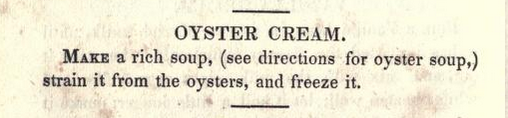
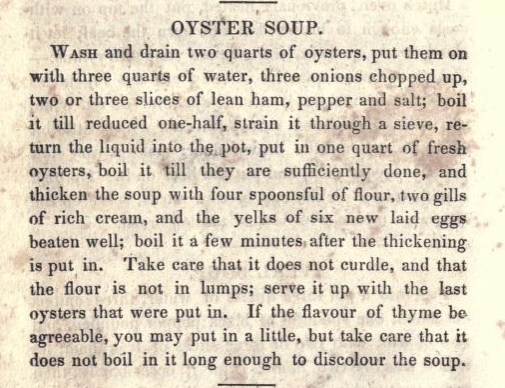
The first and only recipe for oyster ice cream was printed in Mrs. Randolph’s book The Virginia Housewife, published in 1824. The Virginia Housewife was a singular work focused on Virginia produce and cooking practice. It became a model of nineteenth-century Southern American cookery.[11] But the publication of the recipe and the subsequent disappearance of it from history has confused historians for ages. No one is sure why oyster ice cream or where it would be served during dinner. Was it a dessert or a palette cleanser, was it served in place of soup? Was it popular, and if not, then why include it in the cookbook?
Those are questions that will probably never be answered. However, through our little experiment, we could at least answer a few, like is it easy to make, what does it taste like, and should this be revived for our modern palettes? Note: we did pare down the recipe because, unfortunately, oysters are not as cheap as they once were, and we didn’t want gallons of oyster ice cream.
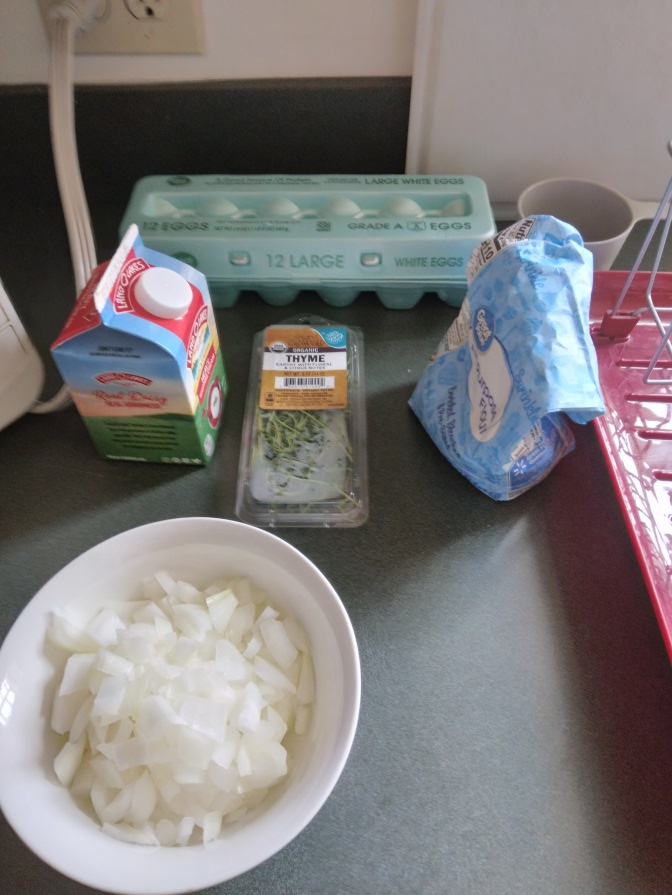
First Step: we gathered our ingredients, including onions, cream, flour, eggs, and oysters
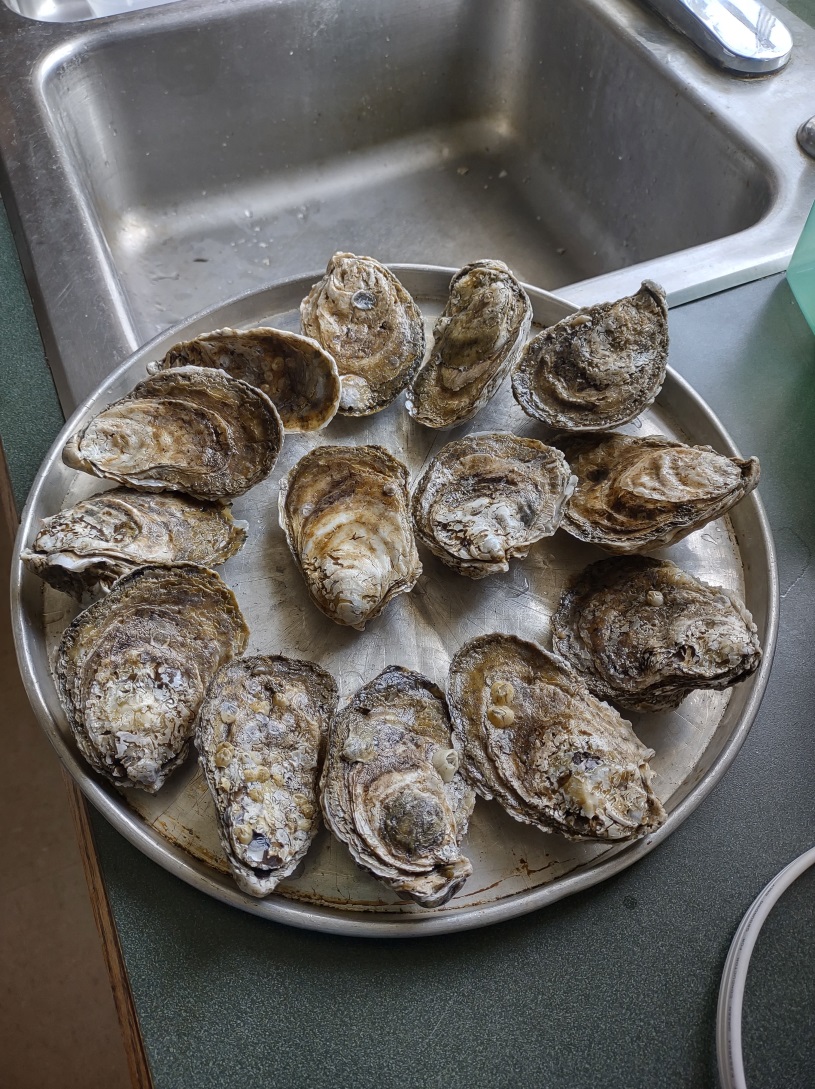
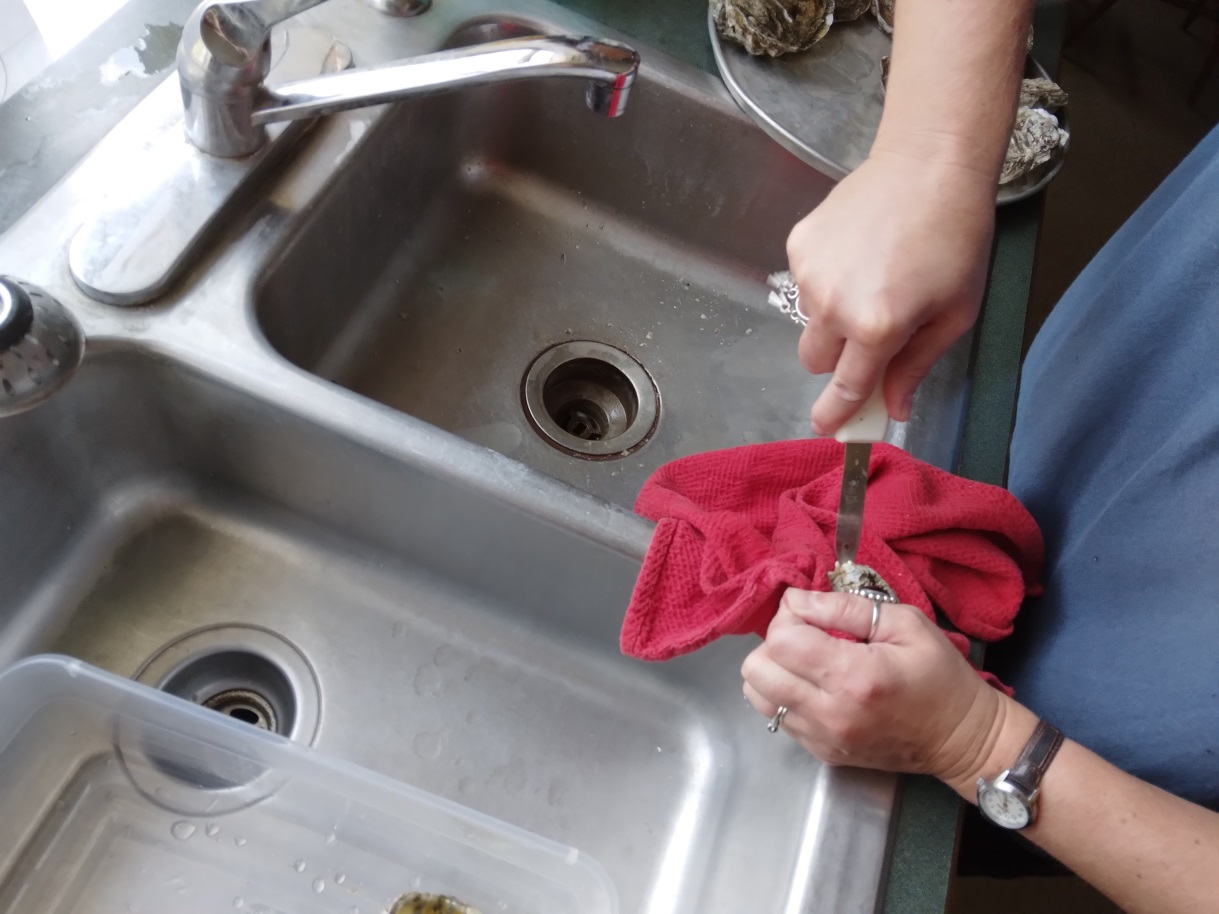
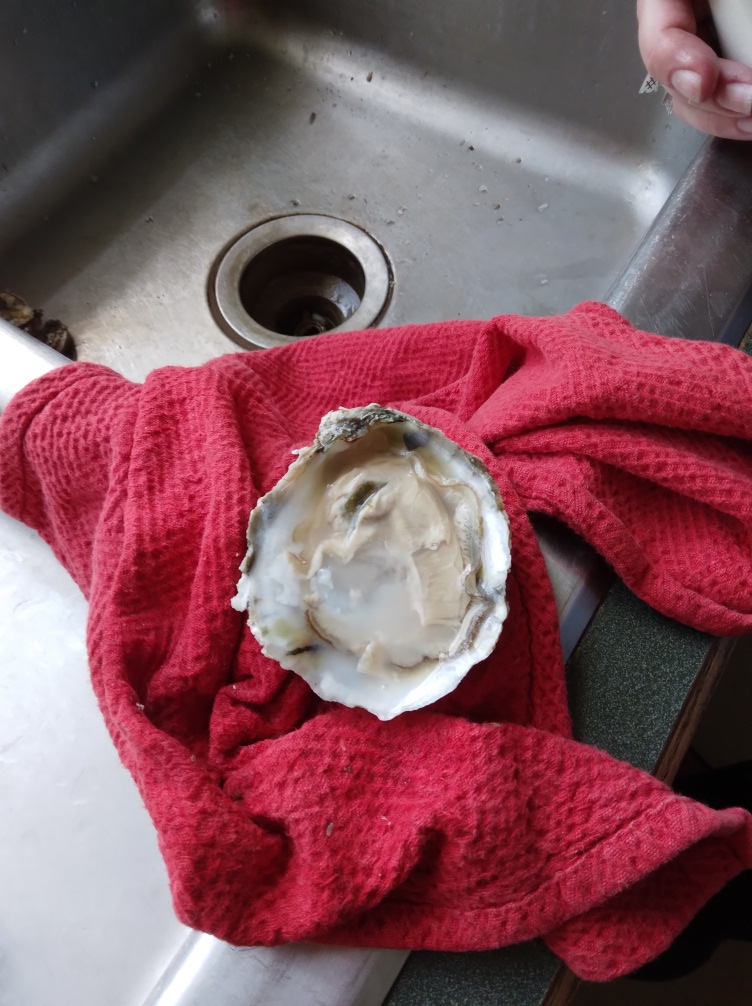
Second Step: shuck oysters. Luckily our fearless Archaeology Lab Manager and super fan of oysters, Mara Kaktins, and her deft hands were able to shuck the oysters in minutes.
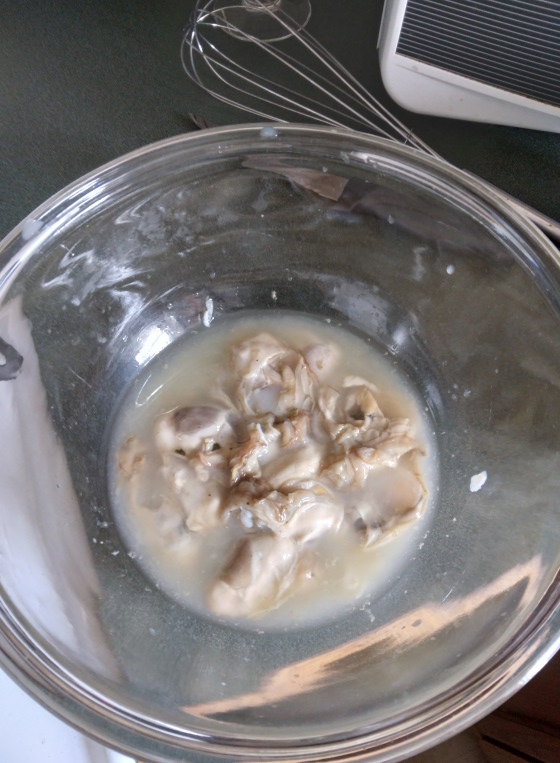
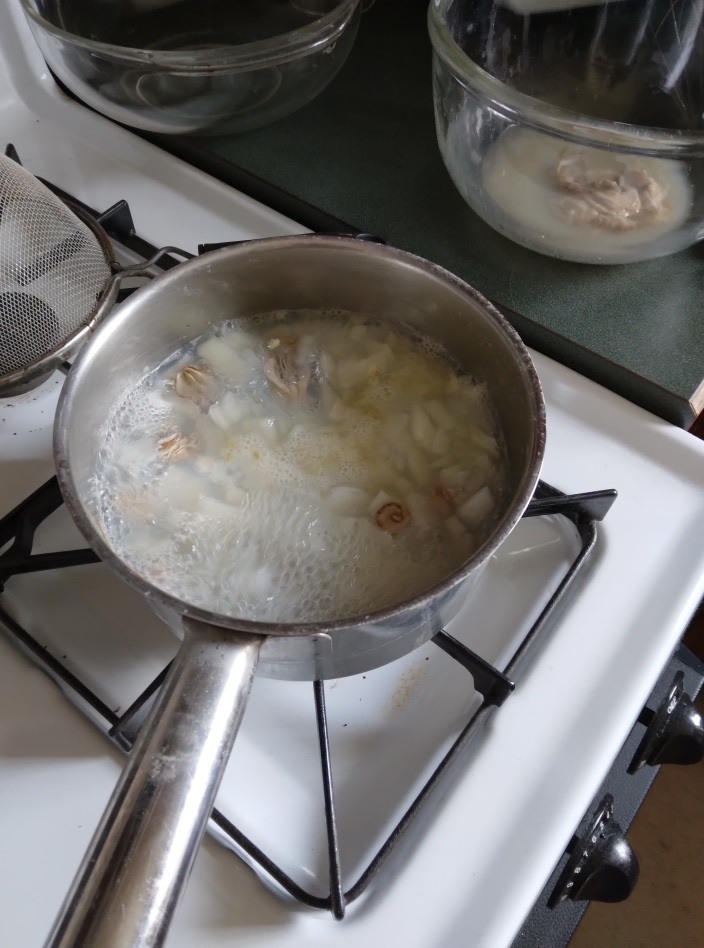
Third Step: We put 2/3 of the oysters in a boiling pot of water with ½ a yellow onion and let that simmer until the water was reduced by ½.
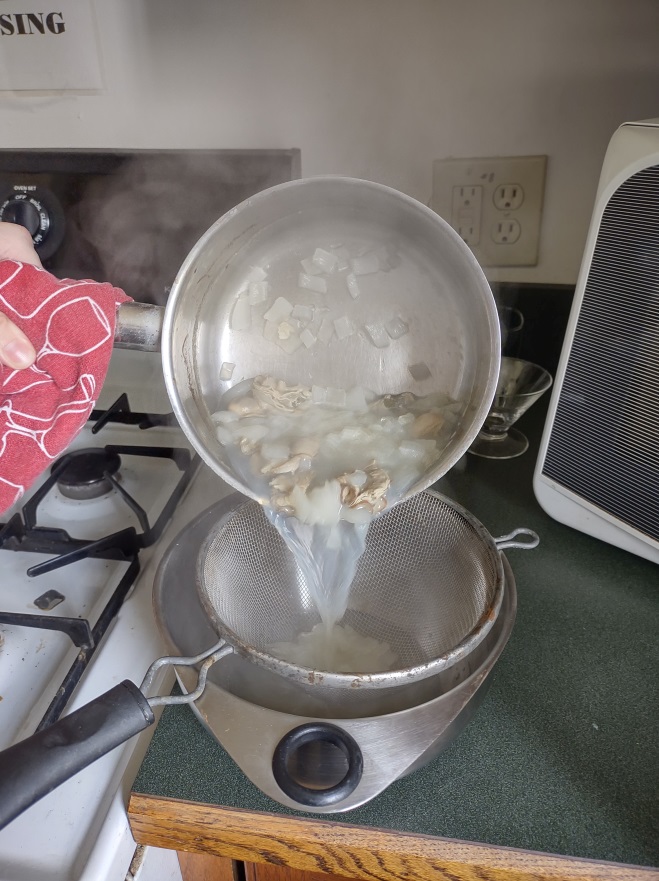
Fourth Step: Drain liquid, removing cooked oysters and chopped onions. Keep liquid and return it to the pot for the next Step.
Straining oysters and onion mix
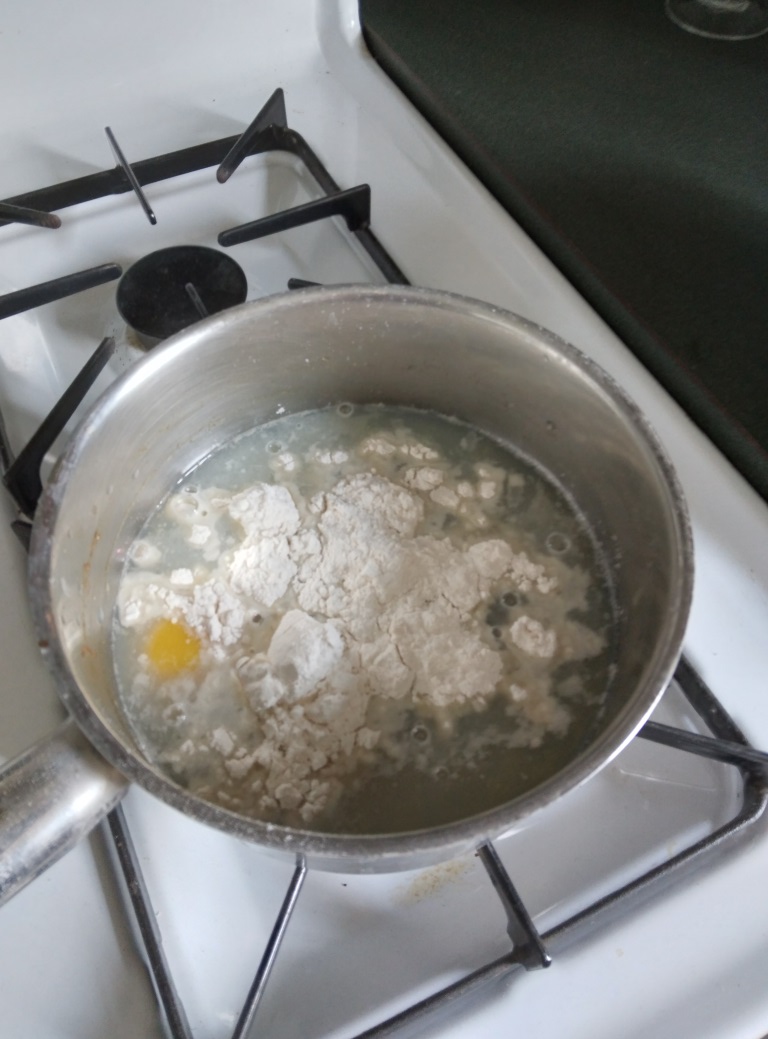
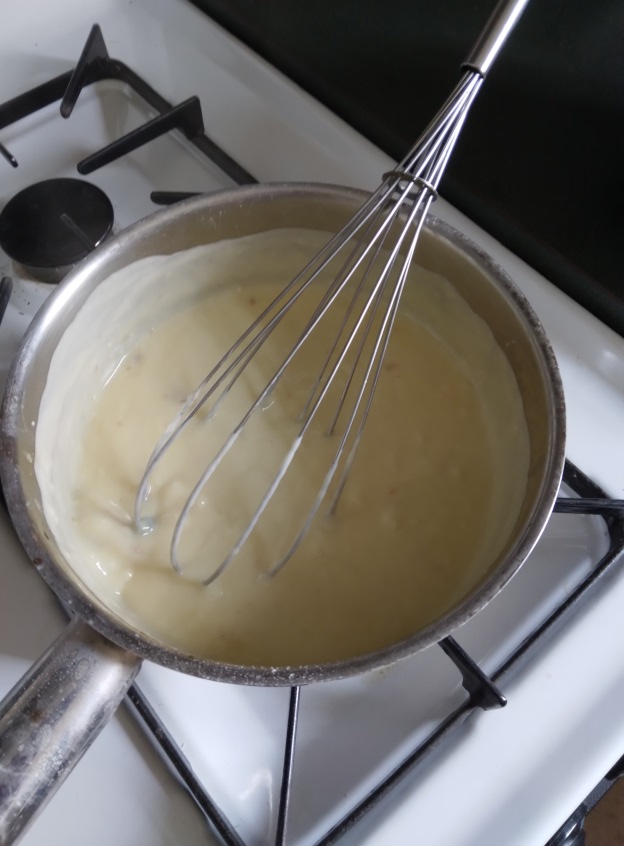
Fifth Step: add the other 1/3 of the oysters to the liquid, along with a few tablespoons of flour, eggs, and cream. Simmer until it thickens but make sure not to burn or let it curdle.
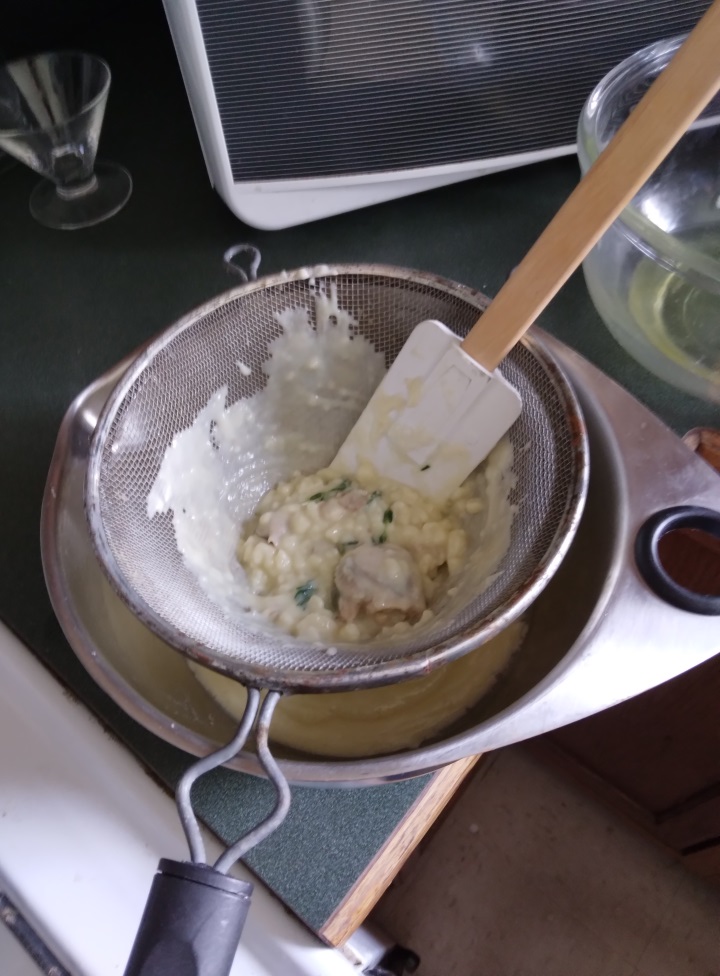
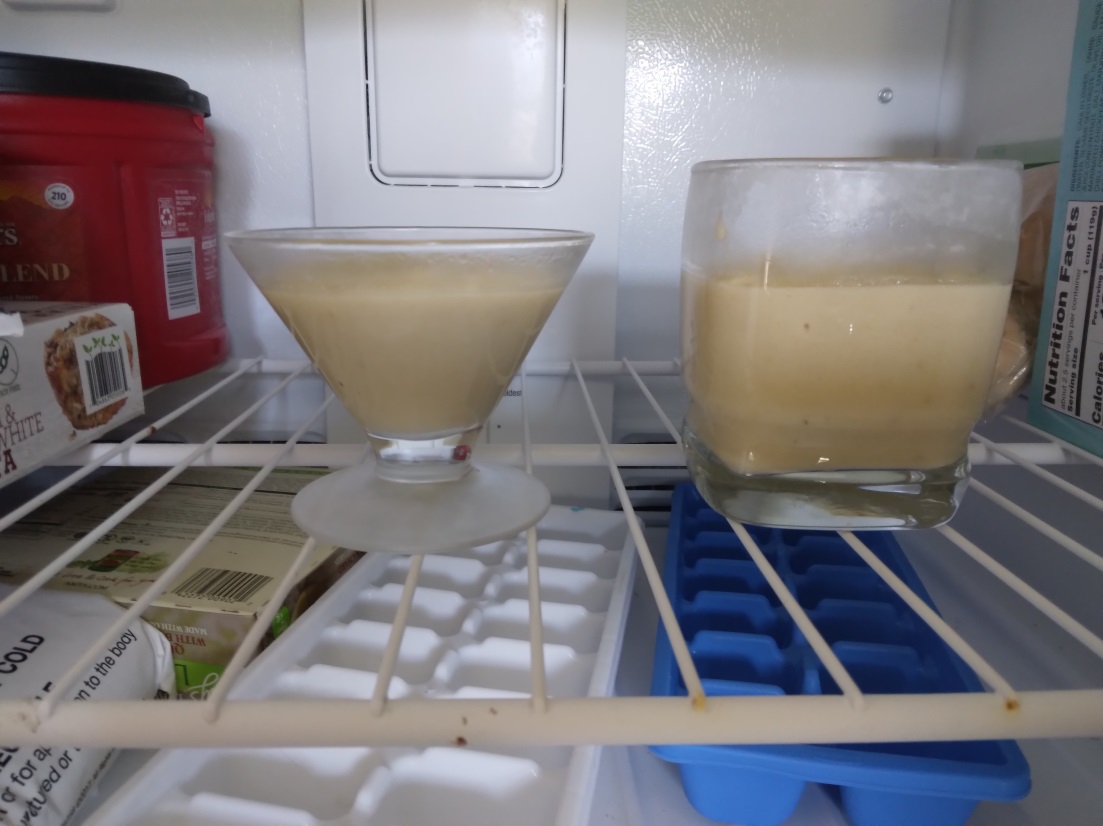
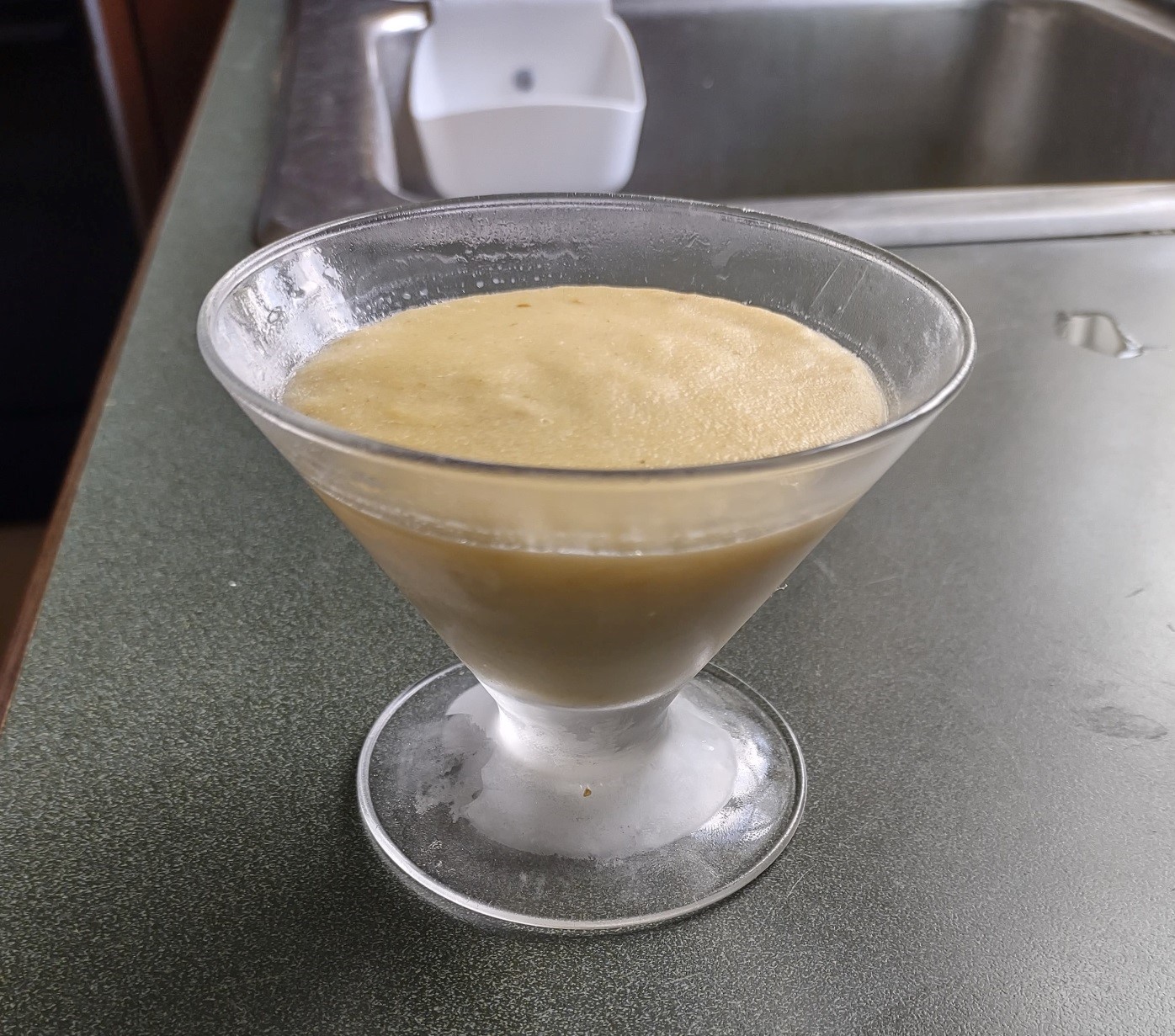
Sixth Step: Sieve the creamy soup, remove the last of the oysters and put into glasses, and freeze for a few hours.
Last Step: remove from freezer and enjoy?
Finished ice cream
Needless to say, after it was ready, we proceeded to run around the offices, and made everyone try a bit. Surprisingly, the reviews were mixed and pretty even, with slightly positive reviews at four and negative reviews at 4. Positive reviews overwhelmingly stated that “it was not as bad as I thought it would be” or “it’s not awful but would be better as a warm soup.” The negative reviews were a little more critical, with “ew, it tastes like oysters” being the primary feedback.
So what have we learned from this experiment? What were our conclusions? We discovered that it is easy, if expensive, to make. It requires neither specialty tools nor any particularly rare ingredients. We also concluded that it indeed tasted like frozen oyster soup, which many would have actually preferred. Not surprisingly, if the person did not like fresh oysters, they weren’t too keen on them frozen. But the most important question is, should this be revived for modern palettes? Does the world need oyster ice cream? I believe we answered that with a resounding “No.” It seemed to most that the ice cream basically ruined some delicious fresh oysters or spoiled a warm, comforting oyster stew.
Oyster ice cream will always be an enigma; it combines two things people enjoy: oysters and ice cream. But, while it may have worked for peanut butter and chocolate, sometimes two wonderful things just shouldn’t be mixed. And with that, we bid a fond farewell to oyster ice cream hoping that Mrs. Randolph’s The Virginia Housewife is the last we will ever see of this peculiar concoction.
School is out for summer…almost! Students are counting down the days until they are free from homework, but the learning does not have to stop!. The George Washington Foundation has been busy preparing fun-filled summer camps to encourage critical thinking through exploring the past.
In our Camp George v. George, students will be asked, “Would you be an American patriot or a British loyalist?” as they learn about George Washington and his family’s experience living under the rule of King George III.
The camp will alternate between George Washington’s Ferry Farm, his boyhood home, and Historic Kenmore, his sister’s later-in-life house. George lived at Ferry Farm from six years old until 22 years old. This was where George learned how to survey, dance, and petitioned for his first military office at Ferry Farm. His time at Ferry Farm shaped him into the man who navigated the battlefield and the political arena to pursue the American cause.
Similarly, George’s sister, Betty Washington Lewis, was shaped by her time at Ferry Farm. She was instructed in the customs of gentility, which included the tea ceremony.[1] While at Ferry Farm, her uncle, Joseph Ball, gifted a silver tea set and other tools so Betty could refine her skills as a future lady of the house. During this time, Betty was taught the expectations for young women in colonial Virginia.
Washington’s Ferry Farm
While Betty’s experience at Ferry Farm was significant, her story does not end there. The skills she acquired at Ferry Farm equipped her to marry Fielding Lewis, a wealthy merchant in town. Twenty-five years later, they moved into their new home at Kenmore in 1775. Fielding and Betty envisioned the mansion as the site of lavish social events filled with tea, dancing, and awe from their guests. However, that dream was never realized, and the couple sacrificed greatly for the American cause. Betty managed the household and attended to the needs of the Washington family, including her mother, Mary. Fielding could not fight in the war, but he voluntarily gave up his trading business with British merchants, donated supplies to the war effort, and financially supported a gunnery in Fredericksburg.[2] Fielding also collected debts and handled several land deals for his brother-in-law.[3] The stress of the financial strain took its toll on Fielding, and he passed on December 7, 1781. Betty struggled financially for the rest of her life due to Lewis’ sacrifices for the Patriot cause.
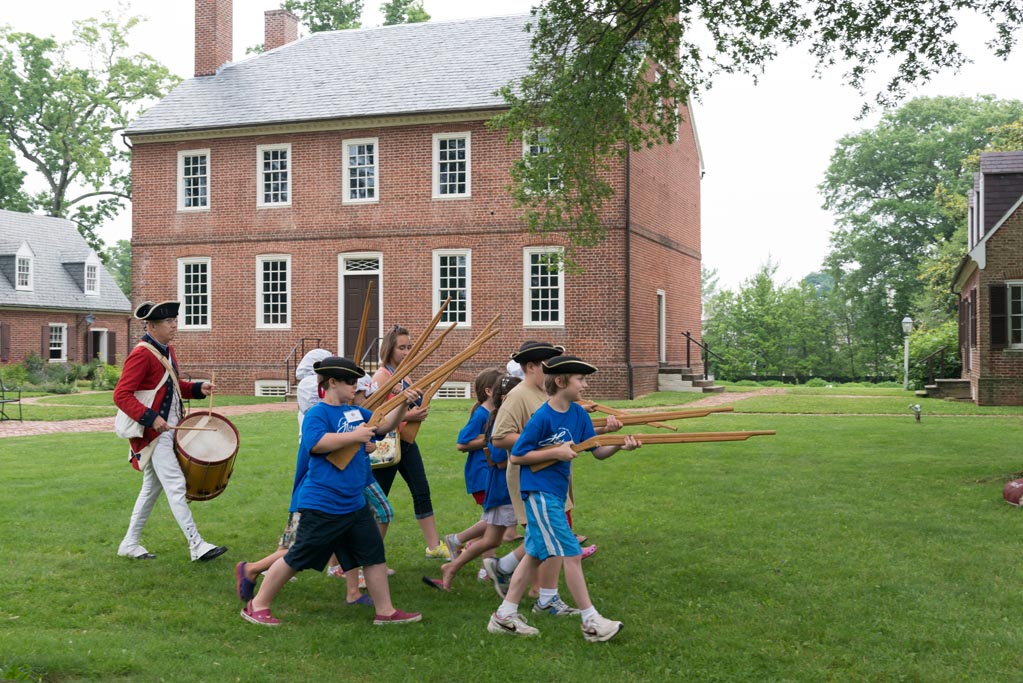
Historic Kenmore and Ferry Farm will be the sites where campers will learn about life in colonial America. Archaeologists, socialites, dancers, surveyors, and soldiers are just a few of the roles that the campers will embody as they explore the cultural, social, and military life of colonists during the Revolutionary War era. Activities will include a mock archaeological dig, a surveying hike, dancing lessons, militia drills, and more! This experience will provide insight into life before, during, and after the American Revolution. George, Betty, and Fielding, along with many others, had their lives transformed by society, government, and friendships. What would you do in such instances? That is the question campers will think about during their experiences, but don’t worry, plenty of fun, games, and activities will be included!
Kids learning about colonial food-waysMilitia drill at Kenmore
Camp George v. George will be offered in two sessions for families’ convenience. Session A will be June 13 – 17 from 9 am to 12 pm, and Session B will be from July 25 – 29 from 9 am to 12 pm. Please see our events page at Kenmore.org/events for more information!
Kaylie E. Schunk
Manager of School & Youth Programs
[1] Laura J. Galke, “The Mother of the Father of Our Country: Mary Ball Washington’s Genteel Domestic Habits,” in Northeast Historical Archaeology 38 (2009): 33.
[2] “Fielding Lewis;” Palmer, and McRae, eds. Calendar of Virginia State Papers, 456, 502-3; Duke, Kenmore and the Lewises, 94-96; Fleming, Story of Kenmore, 9; “To George Washington from Fielding Lewis, 14 November 1775,” Founders Online, National Archives, Source: The Papers of George Washington, Revolutionary War Series, vol. 2, 16 September 1775?–?31 December 1775, ed. Philander D. Chase (Charlottesville: University Press of Virginia, 1987), 371–373.
[3] “From George Washington to Fielding Lewis, 20 April 1773,” Founders Online, National Archives, Source: The Papers of George Washington, Colonial Series, vol. 9, 8 January 1772?–?18 March 1774, ed. W. W. Abbot and Dorothy Twohig (Charlottesville: University Press of Virginia, 1994), 221–224; “To George Washington from Fielding Lewis, 8–9 May 1773,” Founders Online, National Archives, Source: ibid., 229–230. “To George Washington from Fielding Lewis, 24 May 1773,” Founders Online, National Archives, Source: ibid., 235.
As a Historic Preservation major at the University of Mary Washington, I spend a lot of time studying objects from the past. Through my courses, I have learned that common, everyday objects are often able to reflect the values of the people that created and used them. I kept this in mind during my internship in the Archaeology Lab at Ferry Farm this semester. While looking through the collection, I came across one of these everyday items, an item that I use every day, the Mason Jar.
Though there are many uses for Mason jars today, these glass jars were originally designed for home canning and have been preserving food in America for over 150 years. Using the idea that everyday objects such as the Mason jar are able to reflect the values of the people using them, let’s take a look at the evolution of home canning and the Mason jar throughout its 150-year history to see how the value of the Mason jar may have changed.
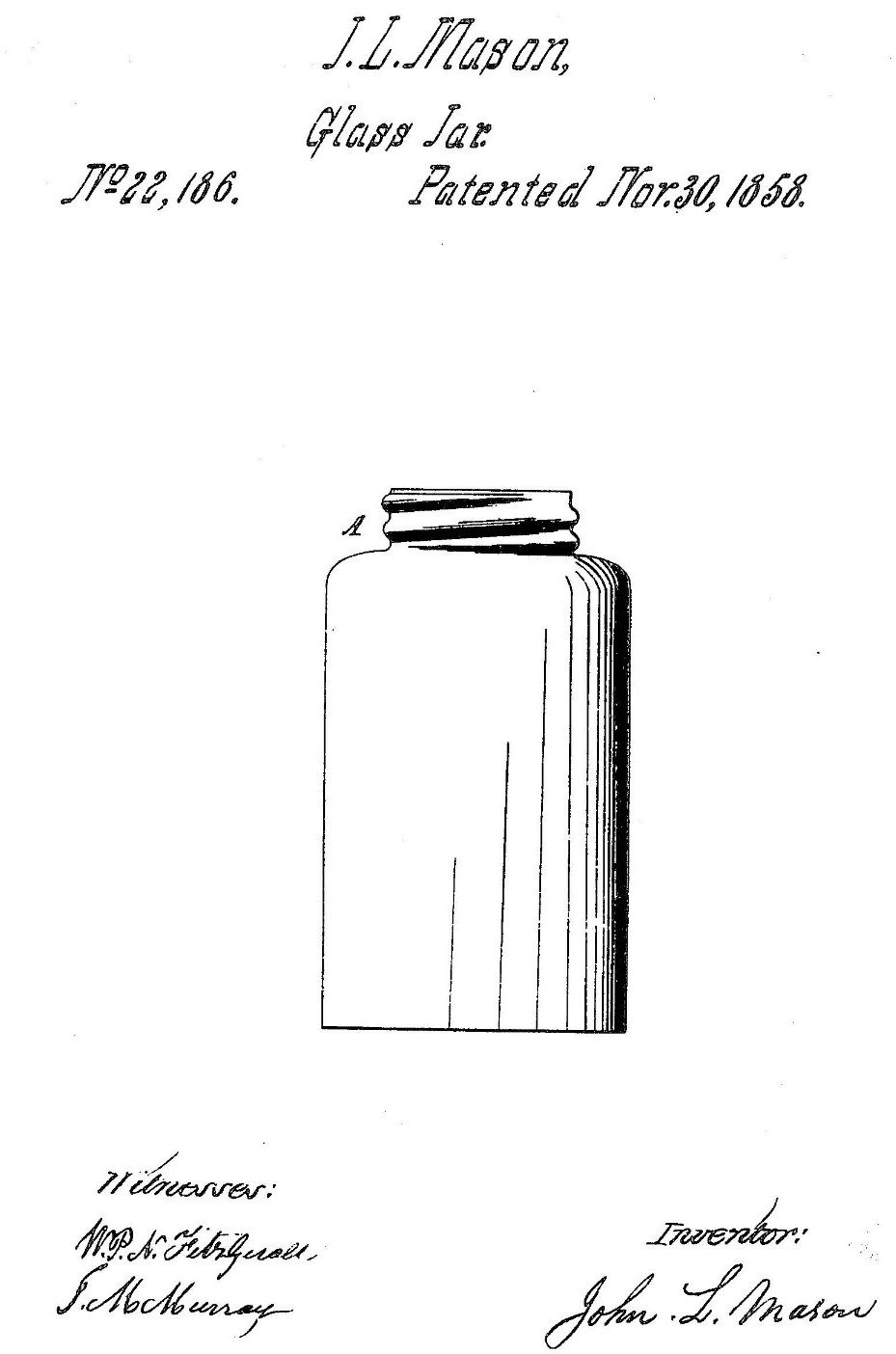
The 1850s marked the beginning of home canning’s popularity in America, and the glass canning jar as we know it today was first patented by John Landis Mason in 1858.[1] Mason’s first jars were sealed using a zinc screw-on lid. With this design, the zinc was able to come into contact with the contents of the jar, affecting the food’s taste.[2] This issue was remedied in 1869 when Mason sold his patents to Lewis Boyd the creator of milk glass lid liners.[3] Together Mason’s glass jar and screw-on lid with Lewis Boyd’s patented milk glass lid liner created an affordable canning jar that was able to be sealed without interfering with taste. Here at Ferry Farm, we have a few examples of these milk glass lid liners in our collection.
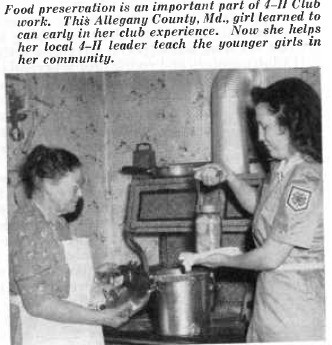
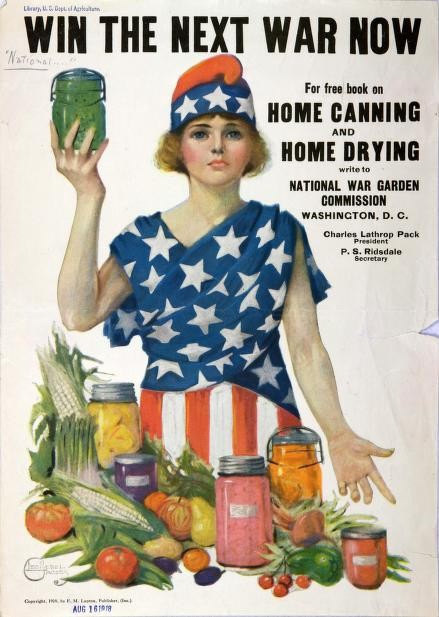
While canning food during this early period served as a practical way to preserve surplus food, during the early 20th century its value shifted to something a bit more patriotic. During World War I and World War II, home canning became a way for American’s, primarily women, to support their country and troops on the home front.[4] By growing and preserving food at home in their ‘war gardens’ (or ‘victory gardens’ as they were called after the war), they were ensuring that the available food supplies were able to get to the troops.[5] This also became a way for communities to band together and help support one another during periods of rationing food supplies.[6]
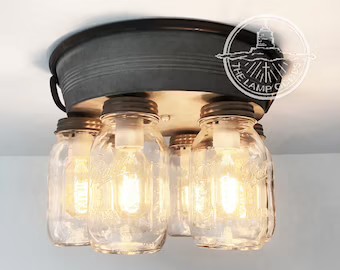
After World War II, canning at home decreased in popularity due to the increased accessibility of home refrigeration and the rise of the supermarket.[7] Though it may have lost its widespread popularity, canning continued to serve as a way for gardeners to preserve their pickles, jams, and other produce. During the beginning of the 21st century, the Mason jar became widely popular once again, but for its looks rather than its use in canning.[8] It became the symbol for the ‘rustic farmhouse’ aesthetic and a popular do-it-yourself crafting item for everything from wedding decor to light fixtures. Mason jars also became a more sustainable, economic replacement for plastic food storage and even drinkware.
Recently we have seen a revival in home canning in response to the pandemic. As people had more time at home, and supply issues caused produce scarcity in supermarkets, many turned to their gardens once again. The popularity of the Mason jar may ebb and flow, but it is an object that has been a staple for many Americans for over 150 years. Do you have a Mason jar at home? What do these canning jars mean to you?
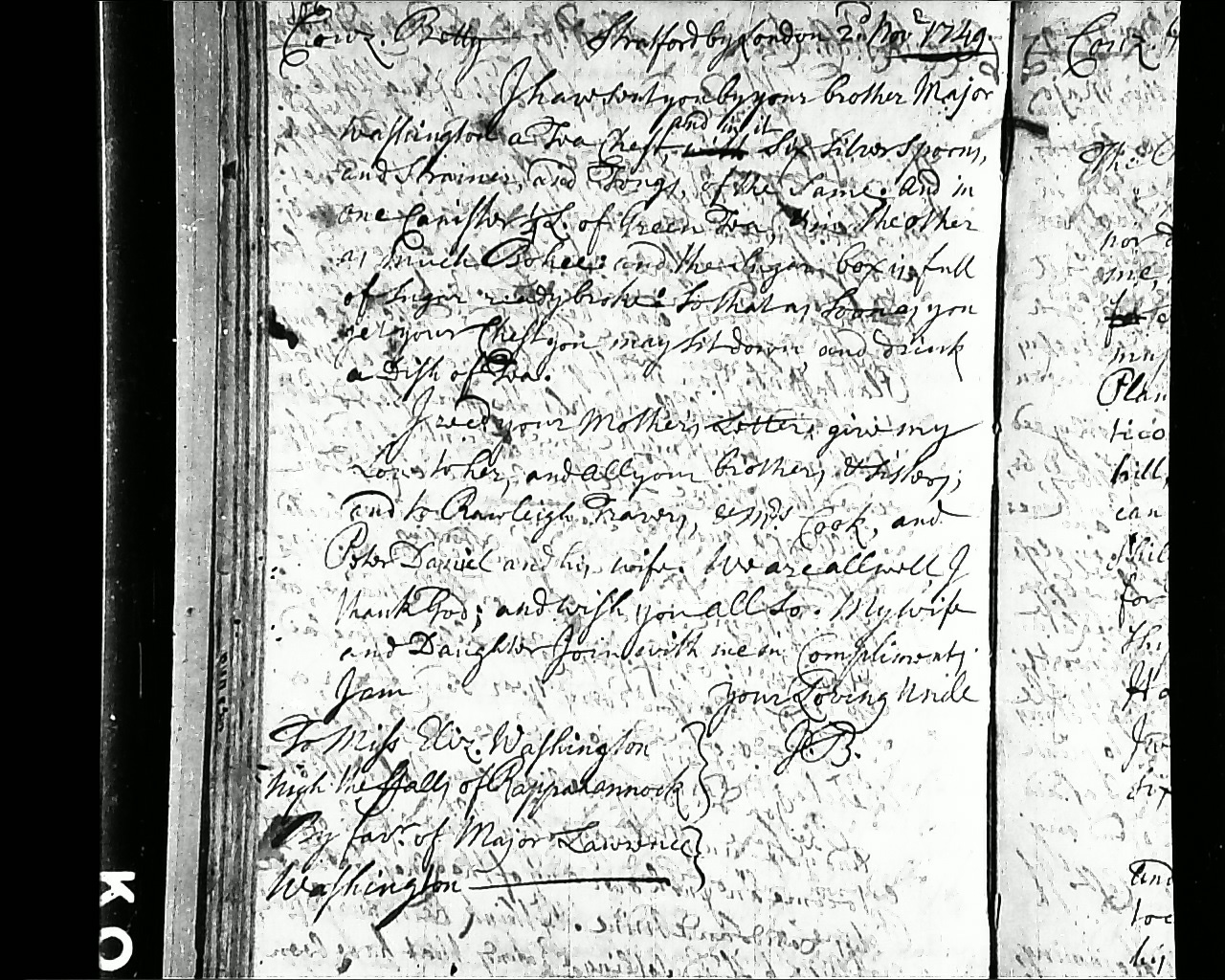
Couz. Betty Stratford by London 2nd [Nov] 1749 I have sent you by your brother Major Washington a Tea Chest; and in it Six Silver Spoons, and Strainer, and Tongs, of the Same. And in one Canister 1/2 L. [pound] of Green Tea, in The other a Pinch Bohee: and the Sugar box is full of Sugar ready broke: So that as Soon as you get your Chest you may Sit down and drink a Dish of Tea. I read your Mother’s letter, give my Love to her, and all your brothers, & sisters; and to Rawleigh Travers, & Mrs. Cook, and Peter Daniel and his wife. We are all well I thank God; and wish you allso. My wife and Daughter Join with me in Compliments. I am Your Loving Uncle J.B To Miss Eliz. Washington nigh the Falls of Rappahannock By [fav.] of Major Lawrence Washington
In 1749, one year before her marriage to Fielding Lewis, Betty Washington received a valuable gift – a silver tea set and other tea equipment – from her Uncle Joseph Ball in England. Tea equipment at this time was still expensive and the tea ceremony was reserved for upper class individuals. By providing Betty with equipment for such an important ceremony, Joseph Ball was helping prepare his niece for success in the gentry class. He provided silver teaspoons, a strainer, tongs, and a tea canister– four of the necessary pieces of equipment for the tea ceremony. Other items needed for the ceremony included a teapot, slop bowl, milk or cream container, sugar container, cups, and saucers.[i] Mary Washington provided these pieces for Betty while she lived at Ferry Farm, using them to teach her daughter how to host the important ceremony.
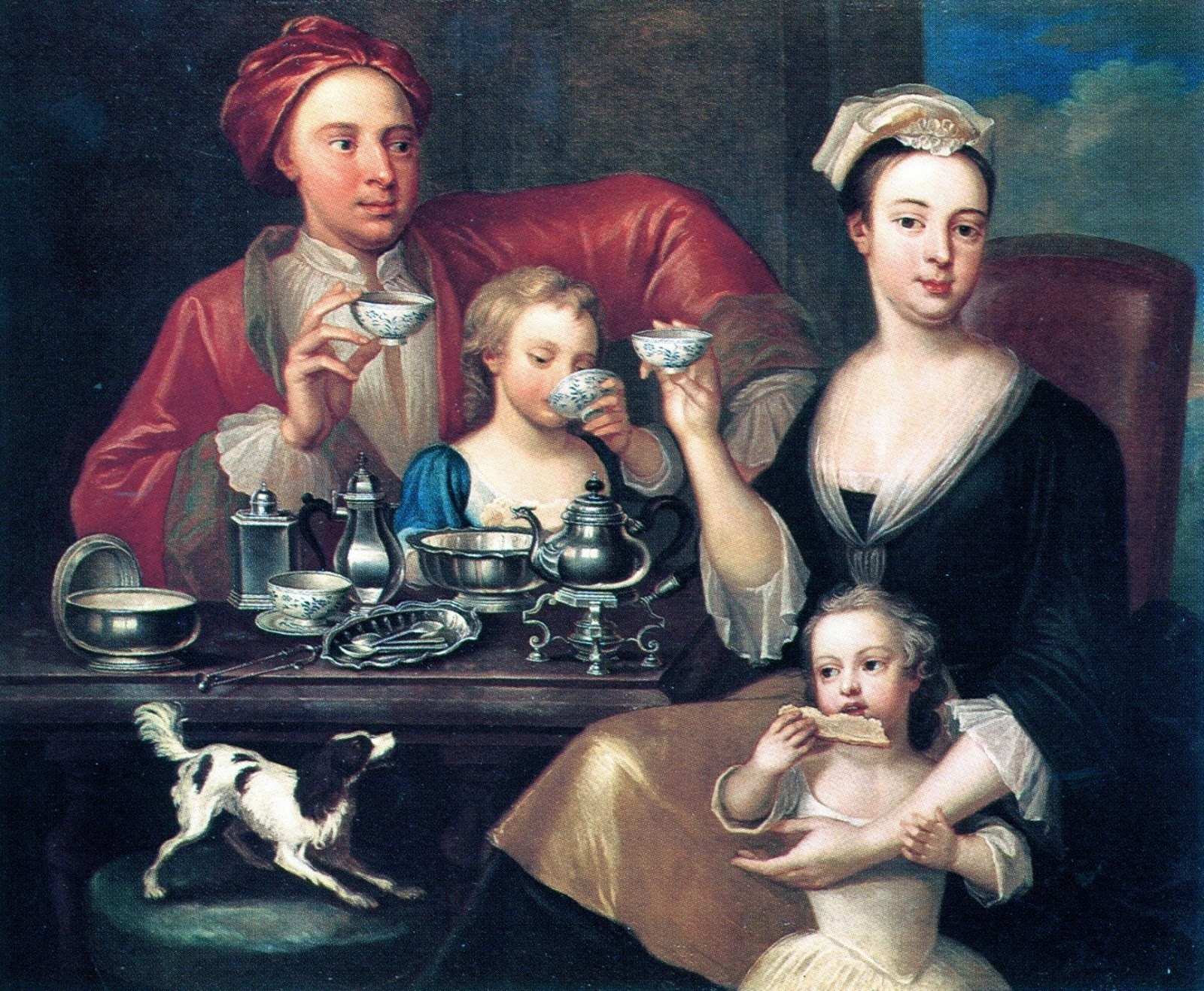
The tea ceremony was a popular social event in 18th-century American culture. First and foremost, hosting or attending a tea party was a symbol of class.[ii] It was typical for gentry class individuals to participate in this leisure activity as a way to deepen or forge relationships within their community. Only an individual who was part of this class could afford the time and money required to learn the social graces and equip the table for the ceremony. The Washingtons worked hard to project an image of gentility through their material consumption. Participation in the tea ceremony was essential for this image. Mary took the time to “bequeath gentry-level domestic culture and etiquette to her children,” keeping them in leisure class circles.[iii]
An English Tea Party (c. 1730) by Joseph Van Aken. Credit: Wikipedia
Within the leisure class the tea ceremony was considered, “as much an instrument of sociability as was a bit of music or conversation.”[iv] With its rules that dictated everything from table arrangement and conversation to order of events, the ceremony was complex. Mastery of the ceremony, especially for women, was key to one’s reputation within social circles. Mary and Betty Washington used the intricate event to maintain the family’s social standing and to interview suitors for Betty. As the oldest daughter, Betty was trained for this ceremony from a young age. She would likely have been the host of numerous tea parties at Ferry Farm before her marriage. Perhaps even using the silver tea set from her uncle during some of the events.
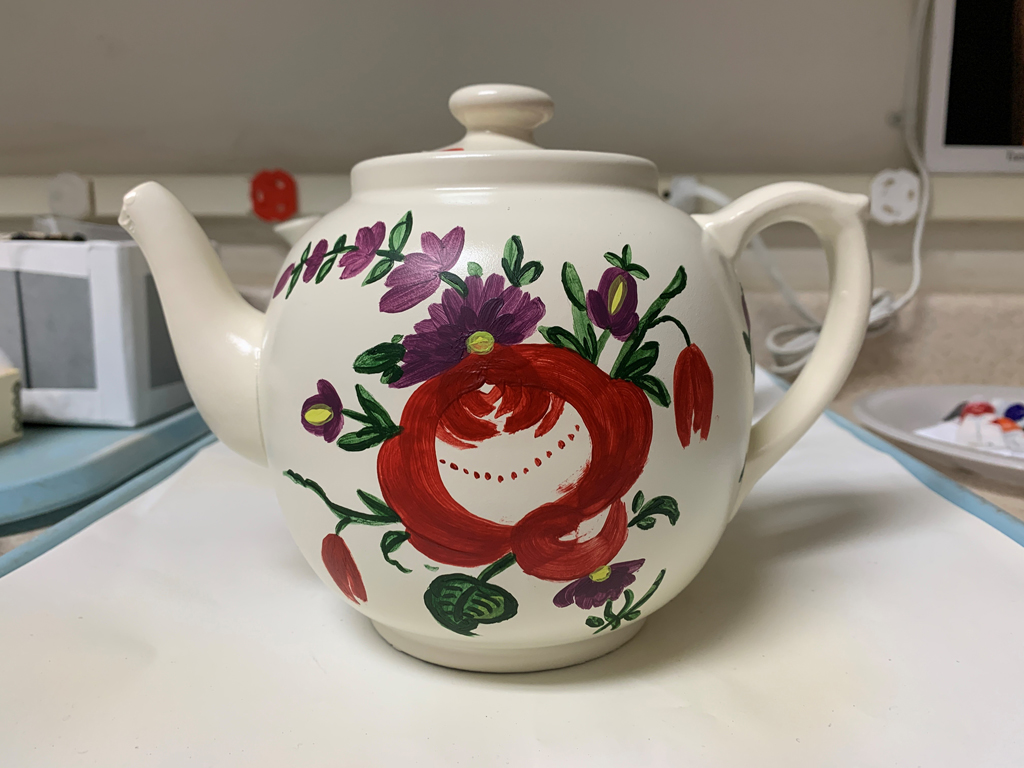
Replica teapot.
The social custom of the tea ceremony revolved around the teapot, thus earning it a spot at the center of the tray or tea table.[v] The archaeology department at Ferry Farm recently produced a replica teapot for display in an upcoming exhibit on 18th-century tea practices. This replica will serve as the centerpiece for the exhibit and be surrounded by archaeological artifacts and contemporary examples representative of the Washington family’s tea practices. The exhibit can be viewed through one of the windows into the Archaeology Lab starting December 1. Add George Washington’s Ferry Farm to your list of places to visit during the holiday season to see this small tea exhibit!
Gillian Both, UMW ‘22 Fall Fleming Smith Scholar
[i] Rodris Roth, Tea Drinking in 18th-Century America: Its Etiquette and Equipage (Washington: Tea Trade Mart Publishing Co., 2017), 24.
[iii] Laura J. Galke, “The Mother of the Father of Our Country: Mary Ball Washington’s Genteel Domestic Habits,” in Northeast Historical Archaeology 38 (2009): 33.