Lives and Legacies

Tag: Fredericksburg

  • 250 Years of Celebration

    250 Years of Celebration

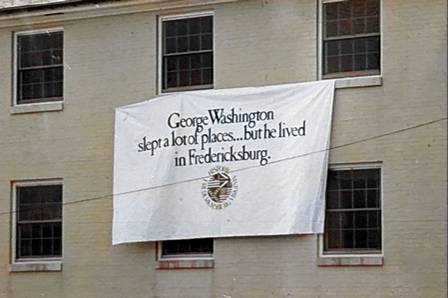
    A banner from the Market Square Fair of 1976, HFFI image collection.

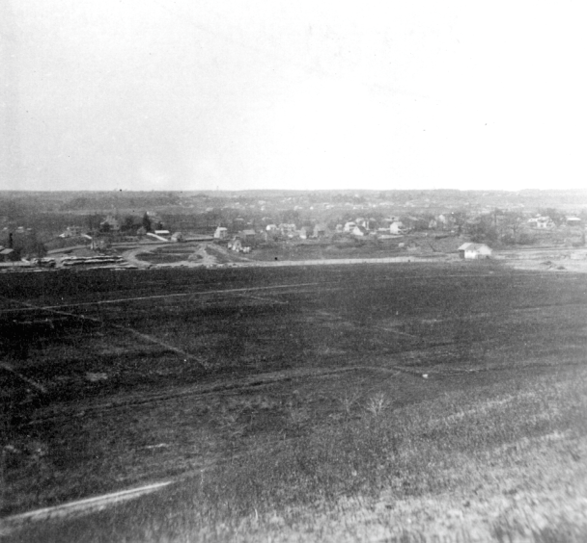
    View of Ferry Farm circa 1881. National Parks Service.

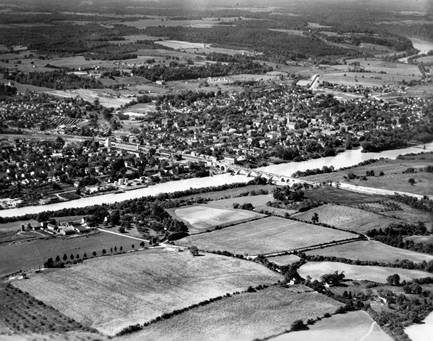
    Aerial view of Fredericksburg showing Ferry Farm in the lower left side, 1927. Fredericksburg Area Museum Collection.

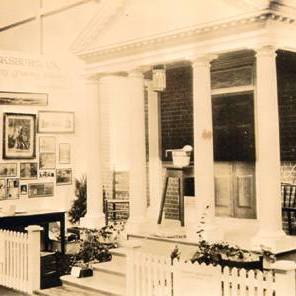
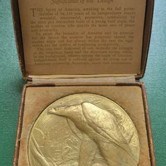
    Left: Kenmore’s exhibit at the Philadelphia Exposition, GWF Collection. Right: Kenmore’s medal of award, GWF Collection.

    American Revolution Bicentennial Logo, Wikimedia Commons.

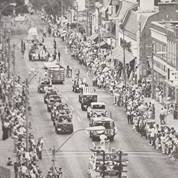
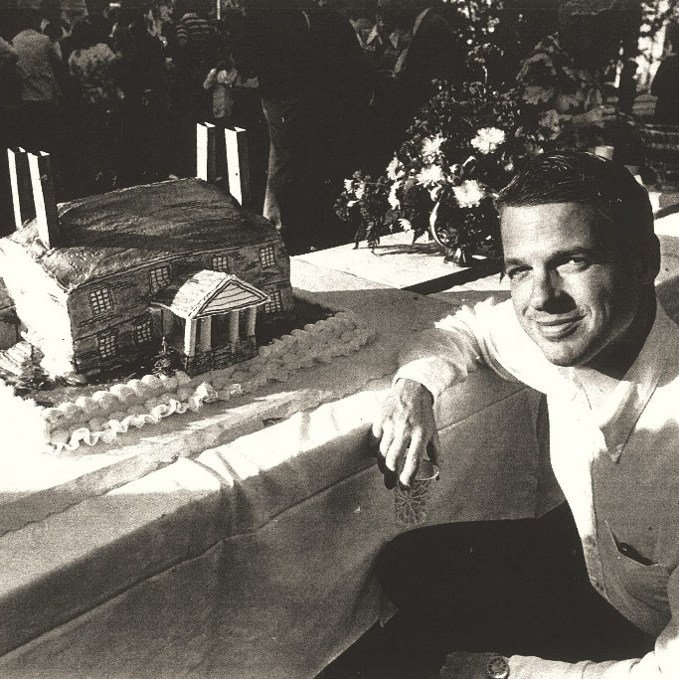
    Left: The Bicentennial Parade on Princess Anne Street, the Free Lance -Star. Right: Russell Bastedo, former director of the Kenmore Association, posing next to a Kenmore cake, Central Rappahannock Heritage Center collection.

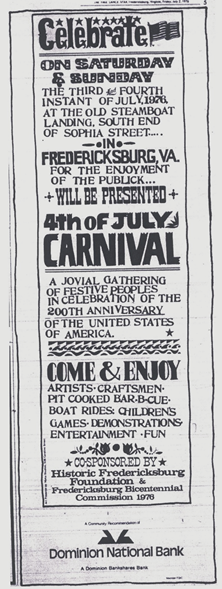
    Newspaper advertisement for the city dock carnival, The Free Lance-Star.

    America 250 logo.


    [1] (National Archives Foundation, 2025)

    [2] (The Fiftieth Anniversary of American Independence, 1826)

    [3] Mutual Assurance Society, plat for policy 4239, November or December 1822, to Samuel Gordon; plat for policy 6126, 31 December 1829, to Samuel Gordon; plat for policy 6126, 31 December 1829, to Samuel Gordon; and plat for policy 9313, 15 November 1836, to Samuel Gordon; Virginia State Library, Richmond, Virginia; reproduced in Troup, pp. 146-151.

    [4] (Chapman)

    [5] (National Archives Foundation, 2025)

    [6] (The Fourth of July, 1876, 1876)

    [8] (The Daily Star, 1926)

    [9] (Warren, 1999)

    [10] (National Archives Foundation, 2025)

    [11] (Nichols, 1976)

    [12] (Nichols, 1976)

    Special thanks to the team at Historic Fredericksburg Foundation, The Virginiana Room at the Fredericksburg Library, and Central Rappahannock Heritage Center for providing access to their collections and assisting in the research process.


  • “The Spirit of ’76”: Lafayette’s Visits Fredericksburg on His American Tour

    In 1824, the United States was approaching its national jubilee—50 years of independence. President James Monroe, looking to create a wave of patriotism and celebration, invited the last surviving General of the American Revolutionary War, an American hero and icon, to take a grand tour of the country revitalizing the “spirit of 1776.” That American hero was…a French aristocrat with a painfully long name of Marie-Joseph Paul Yves Roch Gilbert du Motier de La Fayette, the Marquis de Lafayette.

    1824 portrait of Lafayette by Ary Scheffer is currently in the U.S. House of Representatives

    I won’t go into General Lafayette’s exploits, heroism, and leadership during his time in the Continental Army, but the young man was impressive and quickly became an adopted countryman.

    Lafayette being heroic at the Battle of Brandywine, artist Charles Henry Jeens

    However, we will talk about his American tour, particularly his stop in Fredericksburg.

    Lafayette arrived in New York on August 15, 1824, after setting sail on a merchant packet Cadmus from Le Havre with much disapproval from Louis XVIII, the King of France.  But royal condemnation from Louis XVI (Louis XVIII’s elder brother) hadn’t stopped him from setting sail for America in 1777, and it didn’t stop him in 1824.

    Lafayette arrived in Fredericksburg on the evening of November 20th. He was first received at the parade grounds by two companies of Riflemen, the Washington Guards, and the whole Marine Band from Washington. Then they all commenced in a long column toward town, gaining excited townspeople on horses as they continued down Hanover Street toward Caroline.    (Merchant, 1824) (Levasseur, 1829)

    Cover page of the book by Rufus B. Merchant documenting Lafayette visit, 1825

    The procession made it to the Town Hall, which was festooned with evergreens and flowers. There, it was met by a battalion of little boys called Lafayette Cadets, dressed in sharp white uniforms with red trim. After a quick welcome speech from the mayor, the general was led into the Hall, where he was greeted by a group of garlanded young girls singing his praises. 

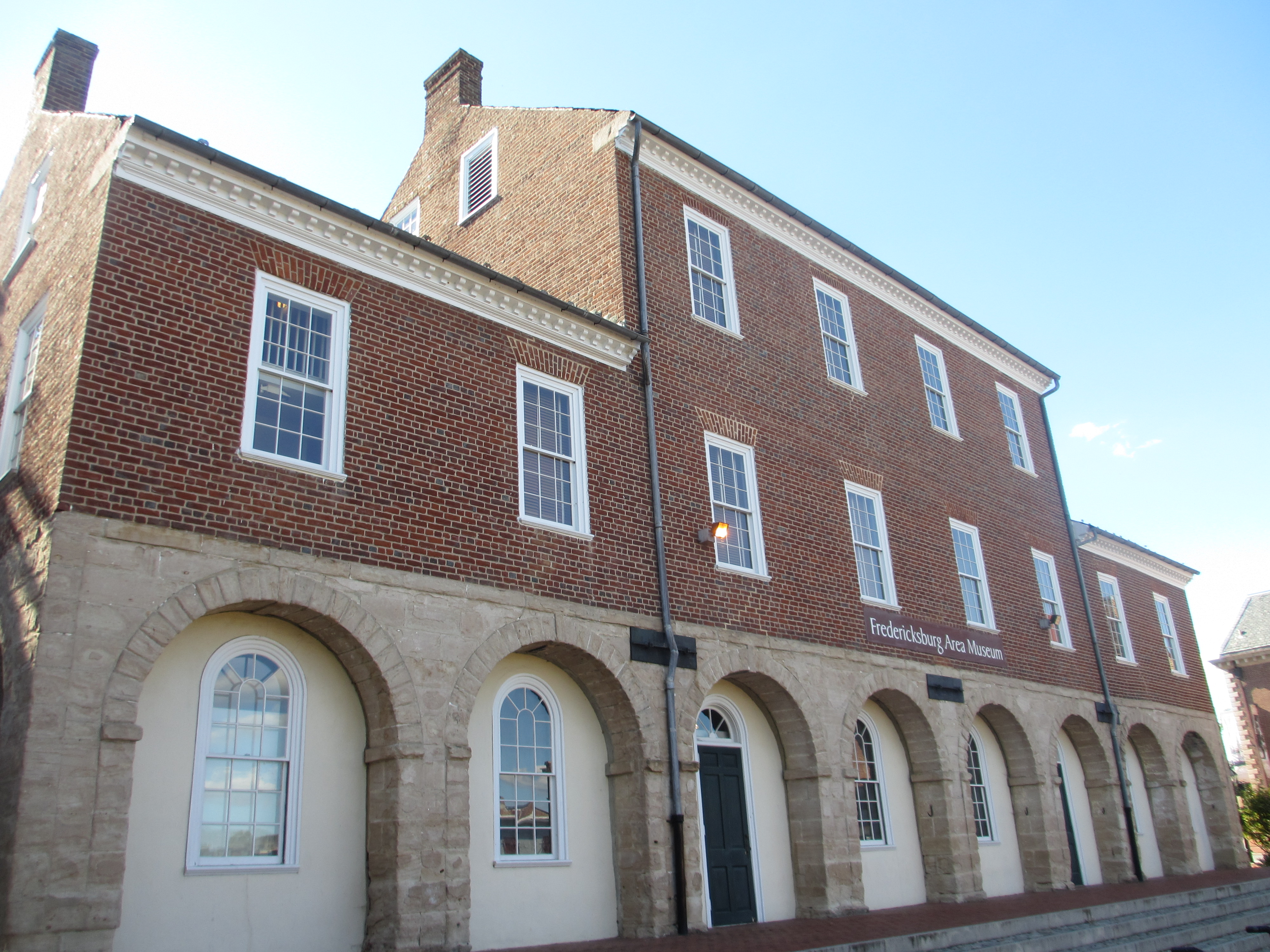
    Fredericksburg’s Town Hall, 1814-1816

    The general was then whisked off to his accommodations provided by Mr. James Ross to enjoy refreshments and a “handsome” dinner. At nine o’clock, Lafayette, the Mayor, and Colonel Mercer were taken to the Farmer’s Hotel (west corner of Caroline and Hanover Streets) to partake in a grand welcome ball for a few hours until he retired, presumably exhausted from the day’s activities. (Merchant, 1824) (Crookshanks, 2018)

    On Sunday, the general, his son, and Mr. La Vasseur visited the Freemasons at the Fredericksburg Lodge, No. 4. In addition to observing the solemn and profound ceremonies, Lafayette was elected an honorary member in the Old Lodge Room.  (Masonic Lodge No. 4, 2024)

    The assemblage of Masonic Brethren, civil authorities, military officers, Lafayette, and company was escorted to St. George’s Episcopal Church to enjoy an excellent discourse delivered by the Reverend Edward C. McGuire, also a Mason. 

    The general then spent the evening in the company of Washington relatives at Captain Robert Lewis’s, then retired to his lodging early at 9 o’clock.  As Monday morning arrived, Lafayette was paraded to the town hall in a chariotee drawn by four white horses, where he was greeted by a crowd of ladies who occupied his time until he was led away for a sumptuous dinner at Mr. Gray’s Tavern.  After a few hours of delicious food, songs, and speeches, the general was loaded into a carriage for the final time as he continued his journey to Washington. (Dovetail Cultural Resource Group, 2006)  

    Foundation of Mr. Gray’s tavern (Indian Queen Tavern) located on the current Marriott Hotel site.

    Lafayette’s time in Fredericksburg might have been short this trip, but it gave the city a last chance to thank and honor a valued friend who had been a champion for America and helped fight for this country’s freedom.

    The city will again celebrate General Lafayette’s visit with a Commemoration Weekend on November 23rd and 24th. The weekend will open with a recreation of Lafayette’s arrival at the Old Town Hall, including period music and costumed participants. A reception line with the General will follow it. There will also be a Lafayette Ball on Saturday night, where participants can dress in their finest Regency garb and dance the night away (until 9 p.m.) with the General and President Monroe. 

    Additional Saturday events include tours of the historic Masonic Lodge No. 4.  Learn about the history of George Washington’s Mother Lodge and the fraternity’s importance to the general and see rare artifacts like the original punch bowl used during Lafayette’s visit.  For more information and tour hours, visit the Masonic Lodge No. 4 website

    Sunday will start with recreating Lafayette’s Masonic welcome, with historical speeches and a unique ceremony. There will be additional Lodge tours from 1 to 4 p.m. At noon, a historic church service at St. George’s Episcopal Church will be reminiscent of that performed by Rev Edward McGuire. Lastly, back at the Masonic Lodge from 2 to 3 p.m., historian Chris Ruli will give a lecture discussing his forthcoming book, “Brother Lafayette,” which examines the Marquis’ connection to the ancient fraternity.

    Finally, if you have some extra time on the weekend, stop by the Fredericksburg Area Museum and see their exhibit “Lafayette’s World: Revolutionary Ideals and the Limits of Freedom,” which explores Lafayette’s ideas on freedom, democracy, and abolitionism. 

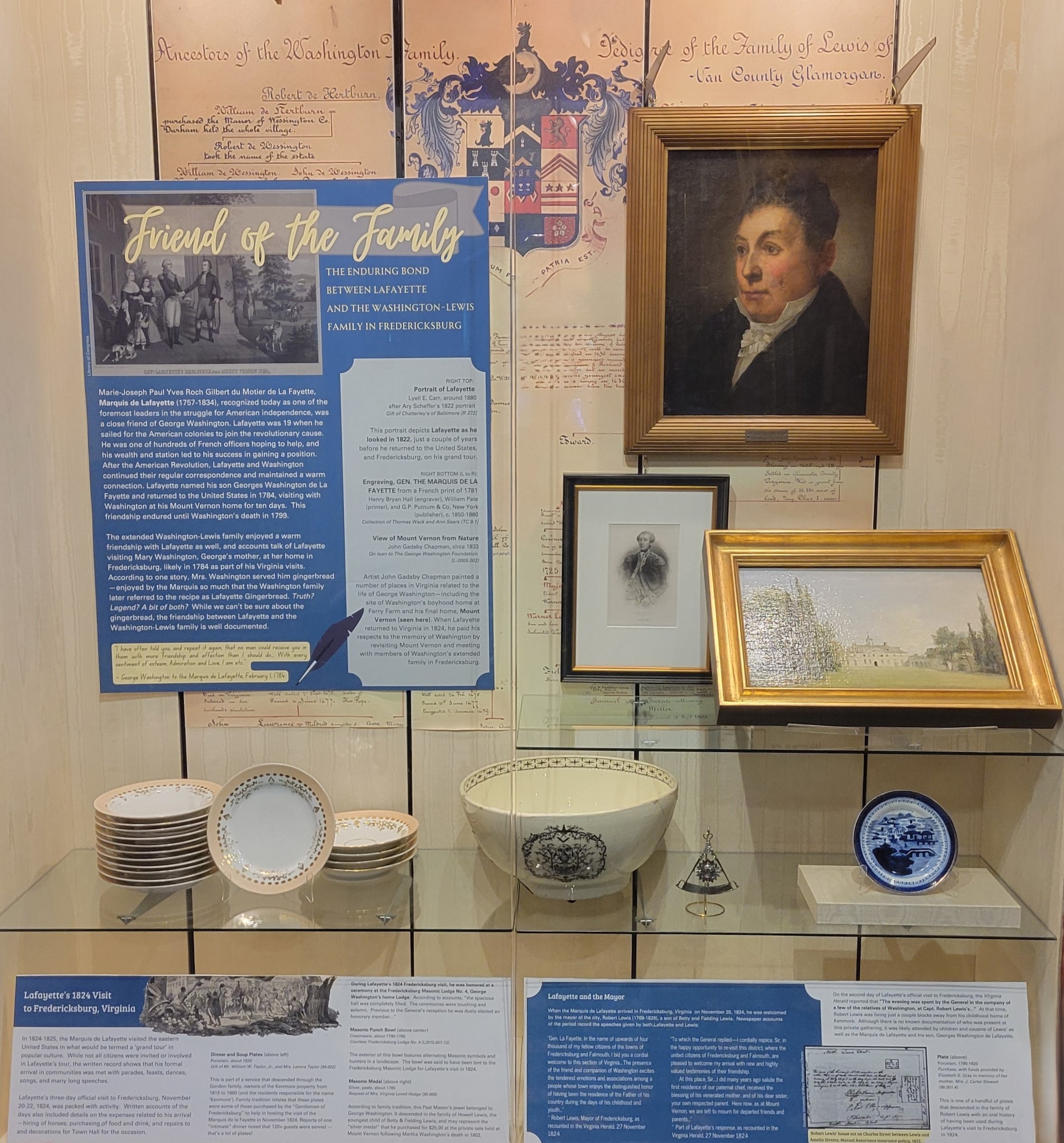
    If you can’t attend the weekend events but still want to see exclusive artifacts related to Lafayette’s visit, including the extraordinary punch bowl of Masonic Lodge No. 4, stop by the Kenmore Visitor’s Center, check out our new exhibit, take a tour of the house and learn all about Fielding and Betty Lewis. 

    Friend of the Family – Lafayette’s Visit to America, Kenmore Visitor’s Center

    Heather Baldus

    Collections Manager

  • Lecture – Credit and Coinage: The Economy in Colonial Virginia [Video]

    On Tuesday, May 8, 2018, Cash Arehart, Site Supervisor of the Capitol Building at Colonial Williamsburg presented a lecture titled “Credit and Coinage: The Economy of Colonial Virginia.” Using Kenmore’s Fielding Lewis as an example, he discussed currency, credit, the tobacco economy, and the Transatlantic trade and how they all converged to make Col. Lewis a successful and prominent businessman in Fredericksburg and Virginia a successful colony within the British Empire.

    Join us at the library on Tuesday, May 15, 2018 for “Curiosities of Kenmore,” when Meghan Budinger, the George Washington Foundation’s curator, will talk about some of the most exciting and unusual objects in Kenmore’s collection and that are rarely seen by the public. Talk begins at 7:00 p.m. The lecture is FREE and hosted at the Central Rappahannock Regional Library at 1201 Caroline Street, Fredericksburg, Virginia. To learn more, visit kenmore.org or livesandlegaciesblog.org.

  • Hessians and History: Learning Something New Every Day

    As an historian, one of the many things I find rewarding is constantly learning.  I truly learn something new every day.  It’s exciting.  Many people might find this curious since to them history perhaps seems stale, unchanging, and boring.

    In reality, history is incredibly dynamic.  Things historians thought we knew with certainty for years can be instantly tossed aside with the discovery of some hidden treasure trove of historical documents or archaeological artifacts.  It’s also impossible to know everything so, even as you’re researching familiar and well-used sources, you always learn things you did not know before.

    I’ve recently been researching the enslaved community at Historic Kenmore when I came across a completely unrelated bit of history that I did not know about before.  I learned that, at the end of October 1781, a group of Hessian prisoners of war passed through Fredericksburg.  This may be familiar history to life-long Fredericksburg residents and historians but perhaps there are some, like me, who were not aware of these prisoners’ brief visit to town.  For those unaware of the incident either in Fredericksburg or among our global readership, I thought I would share almost the entirety of the information I found in one afternoon about the Hessian prisoners in Fredericksburg.

    First, however, we should begin with a quick overview of who were these Hessians.  As explained on Mount Vernon’s George Washington Digital Encyclopedia, the British hired about 30,000 German soldiers to fight in the Revolutionary War.  These auxiliary troops came from several small states in pre-unification Germany then known as the Holy Roman Empire.  The largest contingent was from the state of Hesse-Cassel. Confusingly all German soldiers fighting in the colonies no matter their state of origin were often called Hessians.

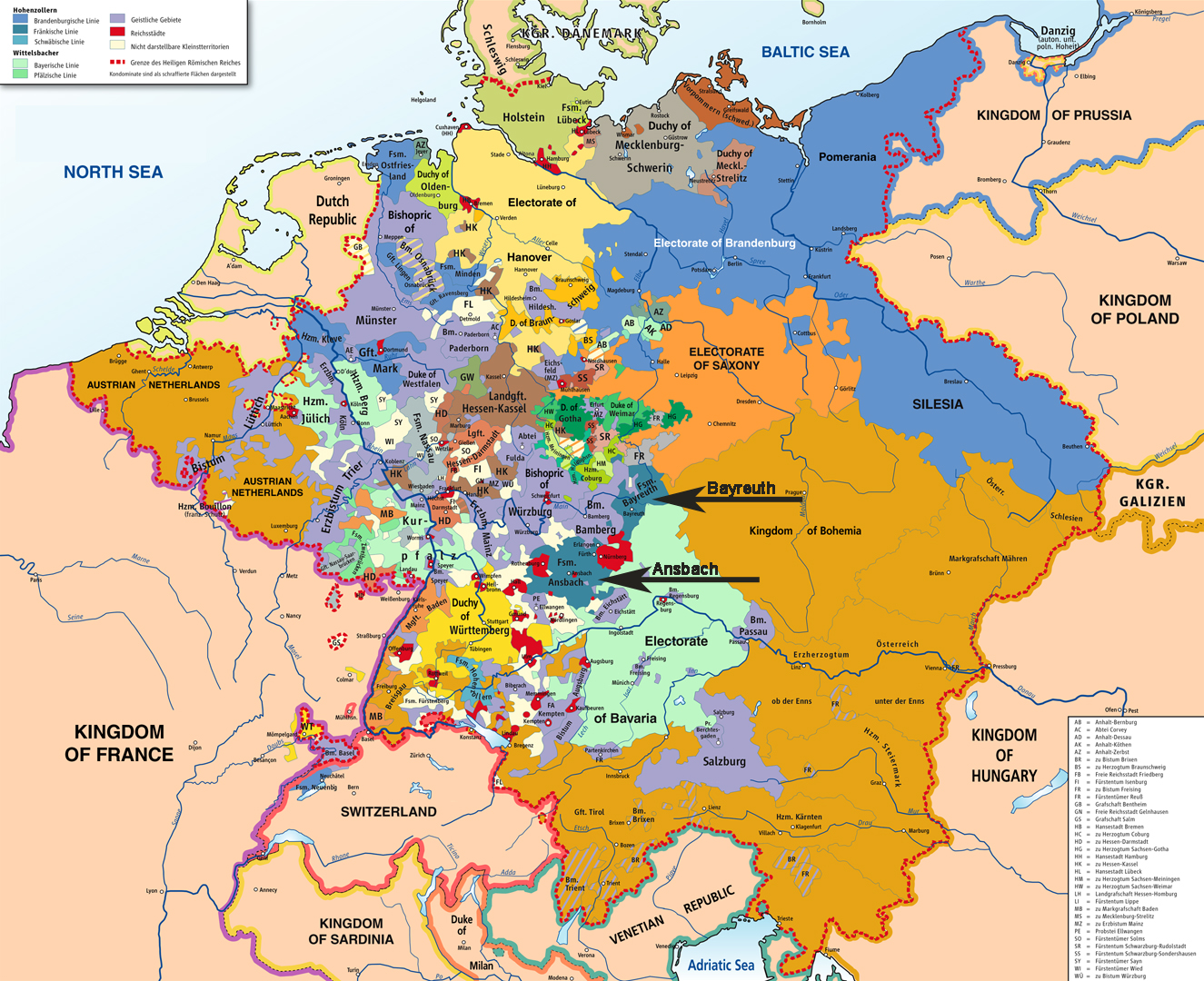
    Holy Roman Empire, 1789
    Map of the Holy Roman Empire as it existed in 1789. Arrows point at Ansbach and Bayreuth. Credit: English map by Robert Alfers based on a German original by Ziegel Brenner. / Wikipedia.

    The use of Hessians by the British Army was disliked enormously by the American colonists. Hessians were so disliked, in fact, that their use was listed in the Declaration of Independence as one of the king’s “repeated injuries and usurpations” aimed at “the establishment of an absolute Tyranny over these States.”  George III was “at this time transporting large Armies of foreign Mercenaries to compleat the works of death, desolation and tyranny, already begun with circumstances of Cruelty & perfidy scarcely paralleled in the most barbarous ages, and totally unworthy the Head of a civilized nation.”

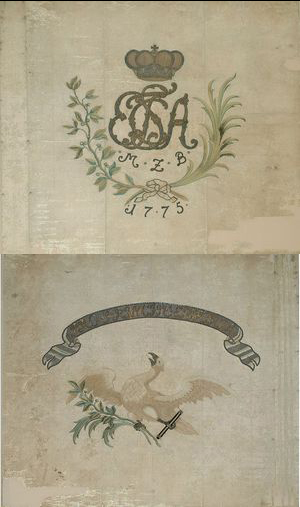
    Ansbach Bayreuth Regimental Flag
    Ansbach-Bayreuth Regimental Flag surrendered at Yorktown on October 19, 1781. Credit: National Museum of American History

    Who were the Hessian prisoners who visited Fredericksburg in the fall of 1781?  Well, they were prisoners taken as a result of the British surrender at Yorktown on October 19.[1]  Among them was Johann Conrad Dohla, a private in the 4th Company of the Bayreuth Regiment from the state of Ansbach-Bayreuth.  He kept a diary for his entire period of service in the war starting with his arrival in America in 1777 and ending after his return to the German states in 1783.[2] His diary titled A Hessian Diary of the American Revolution is still in print today.  The remainder of this blog post quotes extensively from Dohla’s entries describing Fredericksburg and its surroundings, which I found quite fascinating.

    After the surrender, Dohla and his fellow prisoners began a long journey north escorted by Virginia militia.[3]  They neared Fredericksburg after a ten day march.  On October 29, Dohla wrote, “We marched to within one and one-half miles of Fredericksburg, where we camped in an opening in the forest.  During our march today, we saw many individual houses built in a poor manner of wood and covered with clay and patched together. But inside they were richly and well appointed, and in part furnished with the finest articles….  Poultry was plentiful here and inexpensive.  There is no shortage of good tea in Virginia because everywhere, in the forest, on the heights, and meadows, there is an abundance of such tea herbs.”[4]

    The Hessian held up by General Washington on December 25, 1776 at Trenton are earned as prisoners of war in Philadelphia
    “The Hessian held up by General Washington on December 25, 1776 at Trenton are earned as prisoners of war in Philadelphia.” An engraving by Daniel Berger after a sketch by Daniel Chodowiecki created in 1784 showing Hessian soldiers captured during the Battle at Trenton marching to Philadelphia. It turns out that buildings located in Fredericksburg’s present-day Alum Springs Park housed both British and Hessian troops captured at Trenton. Credit: Library of Congress.

    The next day, Dohla and his compatriots entered Fredericksburg itself.  He wrote, “Our march passed through the small city of Fredericksburg and two miles beyond that place to a main river, the Rappahannock, where we camped. This river contains sweet water and was hardly 100 to 150 feet wide here, and also so shallow that it could be waded across….  It is not to be compared to the James and Potomac rivers.  It rises on South Mountain and is of little value for inland navigation. One to one and one-half miles above Fredericksburg, near Falmouth, it has a waterfall over the granite rocks and becomes navigable from that point to its mouth in the bat, which is a distance of ninety miles.  From its source, however, it might measure two hundred miles. Here it is about a half mile wide, and at its mouth, more than four miles wide. Large ships cannot sail as far as Fredericksburg….  In the region of Fredericksburg glass bottles can be sold at high prices because they are seldom to be had here.”[5]

    Dohla breaks from his daily record to make a several observations about Fredericksburg itself. He notes that “Fredericksburg is a medium-size city of rather long and wide layout. It lies in a valley and to the right and left, on heights, along the banks of the Rappahannock River. It has nearly four to five hundred houses and is heavily settled by Germans.  The public buildings lie in ruins, and for no other reason than because it was considered unnecessary to tend to them during the war period and therefore they were neglected, because no English troops came here who could have destroyed them.  They local tobacco industry is of great value and has many advantages.  The price of the best Virginia leaves was formerly twenty-five shillings per hundredweight. The hills surrounding Fredericksburg and on the Rappahannock River consist primarily of sandstone of various colors.  The bed of sand along the river between here and the bay contain, in many places, whale bones, sharks’ teeth, oysters and other shellfish.  Not far from Fredericksburg, in the vicinity of the Rappahannock Falls, one of the most important ironworks in all North America is to be seen because each year more than six to eight hundred tons of iron are said to be manufactured there….  Concerning grain, in addition to corn, much grain and wheat are grown here, although large fields are given over to the raising of tobacco.  Also in some regions below Fredericksburg, the most beautiful cotton is planted and harvested.  Six hundred Englanders are already in Fredericksburg in captivity.”[6]

    On the last day of the month, Dohla and his fellow prisoners “broke camp and had to wade through the Rappahannock River.  Some crossed in their shoes and socks; however, I and most of the others took them off and crossed barefoot.  The water was very cold and reached up to our thighs.  Our route went through Falmouth, a small but beautiful village of about thirty to forty houses on the left bank of the Rappahannock, with a German church and two prayerhouses….”[7]

    An officer and private in Hessen-Kassel Army's Fusilier Regiment von Knyphausen
    An officer (left) and private (right) in the Hessen-Cassel Army’s Fusilier Regiment von Knyphausen in 1783. Credit: Wikipedia

    Dohla and his comrades continued to Winchester where they were held as prisoners of war for about two months.[8]  Then, he was transferred to a prison camp in Frederick, Maryland, where he remained for 15 months.[9]  After the war’s end, Dohla’s band of Hessians were marched from Frederick to Long Island, New York, where they finally were released.  They set sail for home on August 1, 1783.[10]

    Dohla’s brief visit to Fredericksburg and his story in general fascinated me and is a great example of what I love most about history. Namely, that I get to learn something new every day.

    Zac Cunningham
    Manager of Educational Programs


    [1] Johann Conrad Dohla, A Hessian Diary of the American Revolution, Translated, edited, and with an introduction by Bruce E. Burgoyne, Norman, OK: University of Oklahoma Press, 1990, 174.

    [2] Dohla, x-xi.

    [3] Dohla, 182.

    [4] Dohla, 185.

    [5] Dohla, 185-6.

    [6] Dohla, 186-7.

    [7] Dohla, 187.

    [8] Dohla, 188.

    [9] Dohla, 196, 222.

    [10] Dohla, 232.

  • Video – Coming Soon: “Twelfth Night at Kenmore”

    A preview of “Twelfth Night at Kenmore,” a dramatic theater presentation at Historic Kenmore on January 5, 6, 7. Visit kenmore.org for event details.

  • George’s Hometown: Kenmore

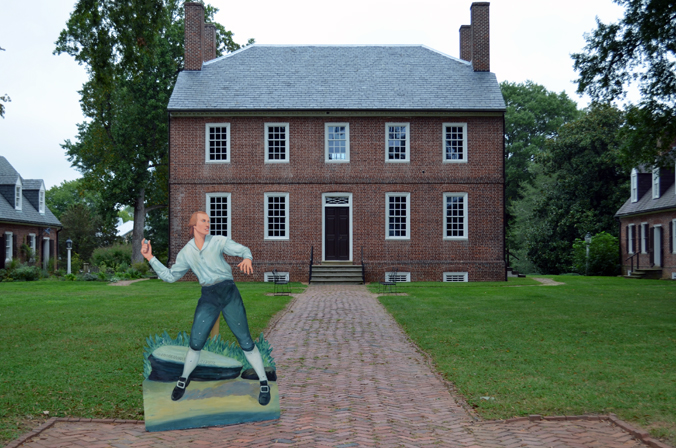
    As George Washington’s Ferry Farm prepares to celebrate the reconstruction of the Washington house, we traveled around George’s hometown – Fredericksburg, Virginia – to visit a few places important in the transformation of George from boy to man.

    Fredericksburg remained important to George Washington throughout his life. It was the home of Mary Ball Washington, his mother, until her death on August 26, 1789 at the age of 80 from breast cancer. It remained the home of Betty Washington Lewis, his sister, until 1795 when she was forced by financial circumstances to leave the grand house she and husband Fielding Lewis, a wealthy merchant, had built to live at Mill Brook, a farm in Spotsylvania County.  Washington visited his mother as well as his sister and brother-in-law regularly but, as the years passed, these visits became more and more infrequent as the Revolution and Presidency required all his time and attention.  George Washington visited Betty and Fielding at Kenmore once in 1784.

    George's Hometown 5
    Historic Kenmore

    Join us at the Washington House Celebration on Saturday, October 7, 2017 from 12:00 p.m. – 4:30 p.m. to celebrate the construction of the Washington house! A special ribbon-cutting ceremony will begin at 1:30 p.m. featuring notable speakers. After the ceremony, guests will be invited to view the reconstructed Washington house!

    Ferry Farm opens to visitors at noon on Saturday, October 7.

    DSC_3072
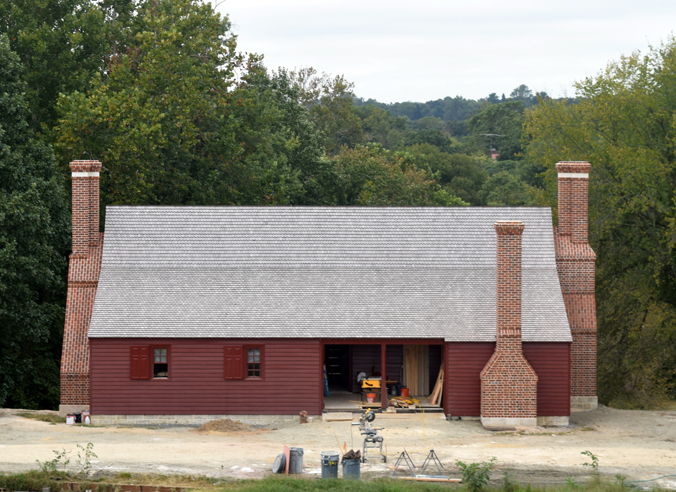
    The reconstructed Washington house at Ferry Farm.

    PLEASE NOTE: PARKING for the event is off site at the VRE Fredericksburg Park and Ride Lot G at the corner of Prince Edward Street and Frederick Street. Buses will transport guests to and from Ferry Farm—traveling from the VRE lot to Ferry Farm on a regular schedule from 11:45 a.m. to 1:15 p.m., and 3:00 p.m. to 4:15 p.m. Bus transportation will pause during the ribbon-cutting ceremony. The last bus will depart Ferry Farm at 5:15 p.m. Limited handicap parking is available at Ferry Farm.

  • George’s Hometown: Masonic Lodge

    As George Washington’s Ferry Farm prepares to celebrate the reconstruction of the Washington house, we traveled around George’s hometown – Fredericksburg, Virginia – to visit a few places important in the transformation of George from boy to man.

    In 1753, 21-year-old George Washington became a Master Mason having joined the Masonic Lodge in Fredericksburg the year prior.  In his encyclopedia on all things George, Frank Grizzard concluded that “For Washington, joining the Masons was a rite of passage, a formal entry into respectable and genteel if not elite society.”  The boy who arrived at Ferry Farm at the age of 6 was now an upper class Virginia gentleman.

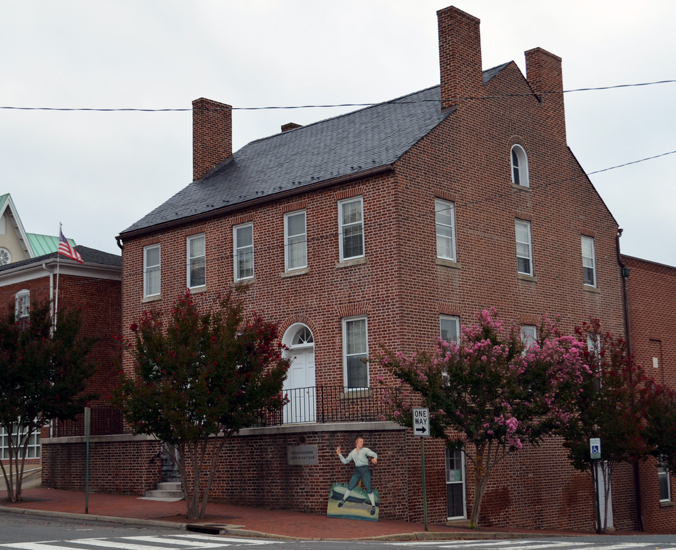
    George's Hometown 4
    The Masonic Lodge of Fredericksburg at the intersection of Princess Ann and Hanover Streets.

    The Fredericksburg lodge formed in 1753, the year Washington joined.  Its current building (pictured) was built in 1816.

    Join us at the Washington House Celebration on Saturday, October 7, 2017 from 12:00 p.m. – 4:30 p.m. to celebrate the construction of the Washington house! A special ribbon-cutting ceremony will begin at 1:30 p.m. featuring notable speakers. After the ceremony, guests will be invited to view the reconstructed Washington house!

    Ferry Farm opens to visitors at noon on Saturday, October 7.

    PLEASE NOTE: PARKING for the event is off site at the VRE Fredericksburg Park and Ride Lot G at the corner of Prince Edward Street and Frederick Street. Buses will transport guests to and from Ferry Farm—traveling from the VRE lot to Ferry Farm on a regular schedule from 11:45 a.m. to 1:15 p.m., and 3:00 p.m. to 4:15 p.m. Bus transportation will pause during the ribbon-cutting ceremony. The last bus will depart Ferry Farm at 5:15 p.m. Limited handicap parking is available at Ferry Farm.

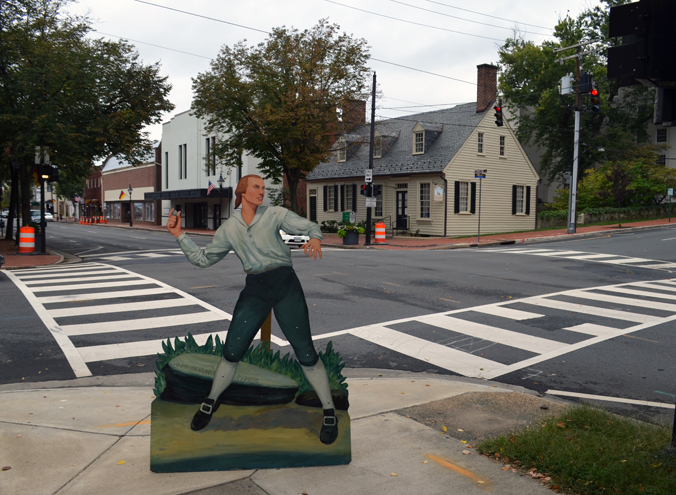
  • George’s Hometown: Julian’s Tavern

    As George Washington’s Ferry Farm prepares to celebrate the reconstruction of the Washington house, we traveled around George’s hometown – Fredericksburg, Virginia – to visit a few places important in the transformation of George from boy to man.

    Besides learning to survey and receiving his formal schooling, young George Washington also pursued an education in the social graces valued in gentry circles while a young man at Ferry Farm. These social graces included dancing, fencing, horseback riding, and gentlemen’s games like cards.  Card-playing was a popular pastime in the taverns that Washington frequented all across Virginia.

    On one occasion – Christmas Eve 1769 – adult George passed the evening at Julian’s Tavern in Fredericksburg with Edward Jones, the overseer of Ferry Farm.  This tavern was located at the corner of present-day Amelia and Caroline Streets.

    George's Hometown 3

    You can ready more about when Washington returned to his hometown for Christmas in 1769 by clicking here.

    Join us at the Washington House Celebration on Saturday, October 7, 2017 from 12:00 p.m. – 4:30 p.m. to celebrate the construction of the Washington house! A special ribbon-cutting ceremony will begin at 1:30 p.m. featuring notable speakers. After the ceremony, guests will be invited to view the reconstructed Washington house! Parking for the event is off site at the VRE Fredericksburg Park and Ride Lot G at the corner of Prince Edward Street and Frederick Street. Limited handicap parking is available at Ferry Farm. Buses will transport guests to and from Ferry Farm. The Washington House Celebration is a free event and RSVPs are not required.

  • George’s Hometown: St. George’s Church

    As George Washington’s Ferry Farm prepares to celebrate the reconstruction of the Washington house, we traveled around George’s hometown – Fredericksburg, Virginia – to visit a few places important in the transformation of George from boy to man.

    George Washington’s education as a boy at Ferry Farm included copying The Rules of Civility and Decent Behavior in Company and Conversation to learn the correct etiquette and moral code of Virginia’s gentry class. By strictly following its advice, young Washington molded his character into that of a wealthy Virginia gentleman.  Unable to attend school in England after his father’s death, George possibly studied with the Rev. James Marye, rector of St. George’s Parish across the river in Fredericksburg.

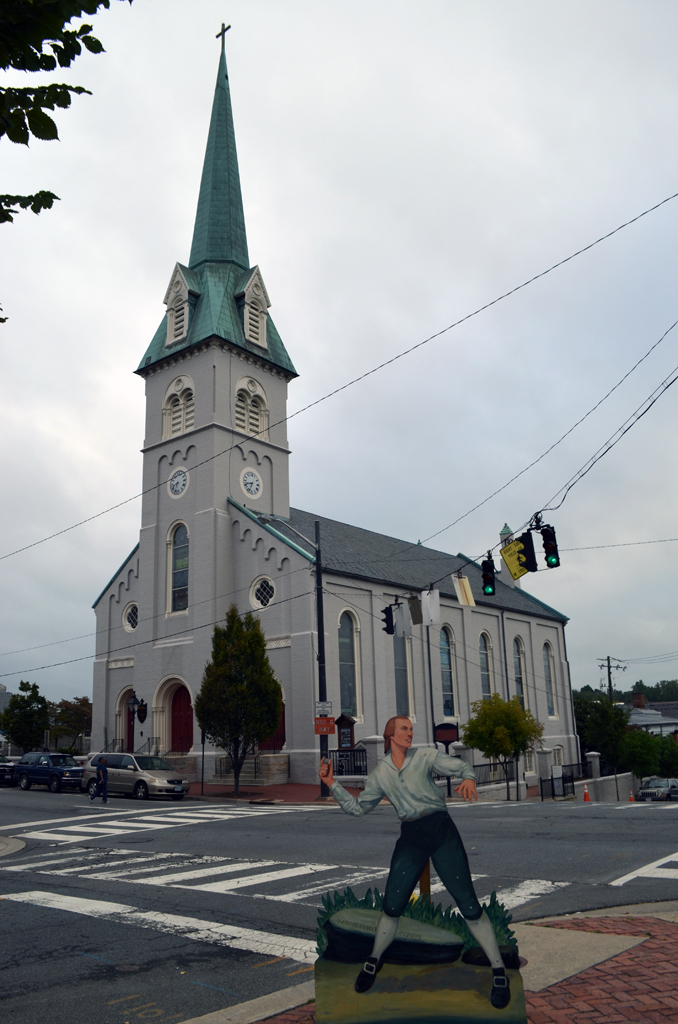
    George's Hometown 2

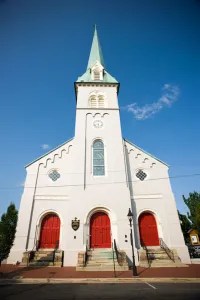
    St. George’s Church built their first church building in the 1730s. The current church building (pictured) dates from 1849.

    Join us at the Washington House Celebration on Saturday, October 7, 2017 from 12:00 p.m. – 4:30 p.m. to celebrate the construction of the Washington house! A special ribbon-cutting ceremony will begin at 1:30 p.m. featuring notable speakers. After the ceremony, guests will be invited to view the reconstructed Washington house! Parking for the event is off site at the VRE Fredericksburg Park and Ride Lot G at the corner of Prince Edward Street and Frederick Street. Limited handicap parking is available at Ferry Farm. Buses will transport guests to and from Ferry Farm. The Washington House Celebration is a free event and RSVPs are not required.


  • George’s Hometown: Ferry Farm

    As George Washington’s Ferry Farm prepares to celebrate the reconstruction of the Washington house, we traveled around George’s hometown – Fredericksburg, Virginia – to visit a few places important in the transformation of George from boy to man.

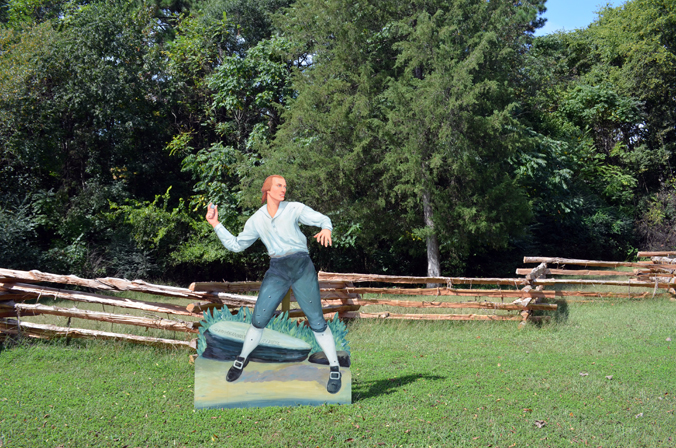
    George Washington lived at Ferry Farm from age 6 (1738) to around age 22 (~1754).  At Ferry Farm, he copied the Rules of Civility and Decent Behavior, read his first book about military adventures, joined the Masonic Lodge, and petitioned colonial Virginia’s British Governor for his first military office. Two hundred forty-six years ago, on September 13, 1771, George recorded in his diary that he “Returnd to my Mothers to Breakfast and Surveyd the Fields before Dinner, returnd to Town afterwards.”  The fields of Ferry Farm were pivotal to George Washington’s development into an extraordinary man.

    George's Hometown 1

    Join us at the Washington House Celebration on Saturday, October 7, 2017 from 12:00 p.m. – 4:30 p.m. to celebrate the construction of the Washington house! A special ribbon-cutting ceremony will begin at 1:30 p.m. featuring notable speakers. After the ceremony, guests will be invited to view the reconstructed Washington house! Parking for the event is off site at the VRE Fredericksburg Park and Ride Lot G at the corner of Prince Edward Street and Frederick Street. Limited handicap parking is available at Ferry Farm. Buses will transport guests to and from Ferry Farm. The Washington House Celebration is a free event and RSVPs are not required.

    We’ll have more from around George’s hometown over the next three weeks!