Over the last week on Lives & Legacies, we’ve been talking a lot about the Washington house corner cupboard! We’re obviously excited because not only is the cupboard beautiful and a beautifully-made piece but because it also represents a shift from building the structure of the Washington house itself to an increased focus on the interior details as well as the start of the furnishing process.
As you learned in last week’s video and written post, talented joiners from Colonial Williamsburg built the corner cupboard. They also painted it and, recently, shared a quick timelapse video of the painting on the Historic Trades & Skills of Colonial Williamsburg Facebook page. We wanted to share the video too!
Learn more about the Washington House here and view other videos, photos, and blog posts about the project here.
As construction of the Washington house at Ferry Farm continues, our attention is turning to the furnishings of the house. Our goal is to furnish the house entirely with reproductions of 18th century pieces, so that our visitors can fully interact with them, without fear of damage to an irreplaceable piece. Guests will be able to sit on the chairs, open drawers, pick up the utensils on the table, smell the smoke from real fires in the fireplaces, and feel the breeze coming through open windows. In short, the interior of the house will be as close to what the Washington family would have known as we can make it both in design and experience.
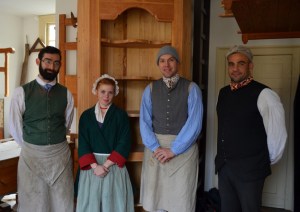
The joiners at Colonial Williamsburg (l-r): Peter Hudson, Amanda Doggett, Scott Krogh, Ted Boscana.
Fully furnishing the house will take several years, but the first piece in the process is already on its way to Ferry Farm! It is a corner cupboard, made for us by the talented craftsmen in Colonial Williamsburg’s joiners’ shop and based upon an original 18th century corner cupboard in the CW collection. The story of our corner cupboard is an interesting one, and embodies the work solving mysteries with both history and science that we do at Ferry Farm every day.
The story of the corner cupboard begins with Augustine Washington’s 1743 probate inventory, but not because the corner cupboard is listed in the document. Rather, the fact that it wasn’t listed in the inventory is what caught our attention. In the Parlor, the inventory lists a variety of furnishings, including 3 chairs, a table, a desk, a mirror and a set of window curtains. A value is given for each of these line items, as expected.
The document also lists a value for “lumber in the room and cubbord.” This phrase tells us several things. First, in the 18th century, “lumber” was the term used for what we might call junk today. Lumber was a group of odds and ends or a mish-mash of objects, none of which had much value, and usually lumped together and appraised as a group. “Lumber” did not mean wood. The Washingtons were not storing piles of wood in their Parlor.
Page from Augustine Washington’s probate inventory showing the “Lumber in the Room & Cubbord” as recorded by the inventory takers in 1743.
“Lumber in the room and cubbord” tells us that there was an assortment of junk in the room – not overly useful info, although maybe it does help us all relate to the family a bit since most of us have a junk drawer or closet somewhere in our homes. The important info that the phrase reveals is the existence of a “cubbord” (phonetic spelling for cupboard) in the room. The fact that the cupboard is only mentioned as a container for the lumber and not as a piece of furniture (it is not given a line item, and is not given a value of its own in the inventory) tells us that the people conducting the inventory felt that the cupboard was not a free-standing piece, but rather a part of the architecture of the house itself. In other words, it was what we would call a built-in.
In the 18th century, built-ins were not exactly common, but they were popular among the upper gentry, and usually took the form of corner cupboards. These corner cupboards served as storage places usually in the a cabinet section in the lower half of the piece covered by a pair of doors. More importantly, they were a place to display luxury goods, like fine ceramics or important silver pieces on the open shelves in the top half of the piece. Through this research, thorough knowledge of 18th century material culture, and some logic, we concluded with strong certainty that the Washington house had a corner cupboard in the Parlor.
Because corner cupboards were built in to the structure of a house in the 18th century, they usually were not constructed by the same furniture makers who produced the chairs and tables for a house. Instead, they were crafted by joiners, who specialized in more architectural work. It was decided to have our corner cupboard constructed off-site at Colonial Williamsburg, so that the historically trained craftsmen there would have ready access to the piece we were trying to reproduce. This original piece dates to approximately 1745 and was probably from the James River Basin region of Virginia.
Conservators at Colonial Williamsburg performed paint analysis on the remnants of original pigments still embedded in the wood of the original cupboard and determined that it was painted a light gray. As the purpose of corner cupboards was often to display fine ceramics, they were usually painted in subdued colors that would contrast with any bright or heavily-painted ceramics.
Unfortunately, most of the best ceramics found archaeologically at Ferry Farm are white or lightly-painted. Gray would not have done much for them. So, research was done by architectural historian Mark Wenger into the paint analysis of the trims and moldings in other Virginia homes of the time period. In the end, it was decided that the cupboard will be painted a dark red color, with a dark gray interior.
The finished reproduction corner cupboard for the Washington house at Ferry Farm.
A quirk of 18th century construction methods dictates that all the decorative trims and moldings in a house would be in place before plastering, and then plaster would be applied up to those trims, rather than the trim being applied over finished plaster. So, the corner cupboard will need to be in place inside the house before the plaster can be applied. The day when this special corner cupboard will take its place in the Washington house is fast approaching!
Meghan Budinger
Aldrich Director of Curatorial Operations
In this video, we learn from Curator Meghan Budinger about how we will furnish the Washington house reconstruction, we see a corner cupboard for the house being built, and talk with Master Joiner Ted Boscana from Colonial Williamsburg about making the cupboard.
Learn more about the Washington House here and view other videos, photos, and blog posts about the project here.
Tantalizing evidence of historic furniture use exists within the soils of George Washington’s Ferry Farm and that evidence gives us a more complete view of how the Washington family lived in the 1700s. The hundreds of items archaeologists and students have uncovered represent the remains of furniture broken or embellishments lost. The ruthless outdoor elements leave scant vestiges of furniture’s former glory. Wood disintegrates into soil, so these relics typically include only iron and brass hardware, such as drawer pulls, casters, bolts, keyhole escutcheons, or hinges. Over half of the hardware found consists of brass tacks. Such brass studs were often used in furniture upholstery, but were also popular for saddles, trunks, even antique wig stands: anytime a leather covering was added to a wooden frame or base.
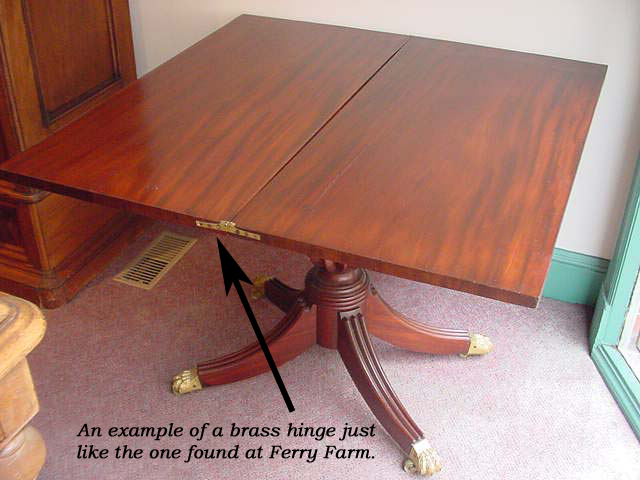
One particularly interesting brass hinge was unearthed in 2007 and boasts an exciting past. This hinge, part of a folding card table, was a crucial element in the popular Virginia domestic pastime of playing games such as backgammon, chess, and cards. Card tables provided a luxurious accessory for popular social entertaining and were part of a well-appointed home. Providing guests with such pleasant amusements reflected well upon the Washington family.
18th century card table hinge excavated at George Washington’s Ferry Farm.
Archaeological investigations sponsored by The George Washington Foundation have uncovered evidence that demonstrates that the Washingtons’ mid-1700s home was filled with fashionable accessories to enhance social bonding. These tools included tea wares, stemmed drinking glasses, glass decanters, fashionable dining utensils, and smoking pipes. The recovery of a card table hinge provides another element of their well-equipped home.
Gentleman often played card games together, but occasionally women joined the amusement as well (Porter and Porter 1782:466-467). Playing cards allowed ladies and gentlemen a refined form of amusement in a convivial atmosphere, without raising critical eyebrows from discerning social commentators in Virginia. These games were occasions in which mixed company – men and women – could enjoy companionship and pass the time in a genial way. It was one of the few entertainments in which men and women could directly compete (Sturtz 1996:169-171). Lucy Byrd’s acumen prompted her husband William to cheat on at least one occasion (Sturtz 1996:172-173, 175-176).
Such benign competition also allowed players to showcase their skills. William Byrd II thought that such games provided an effective antidote to “disagreeable” company, as it allowed the time spent with tiresome guests to pass quickly (Sturtz 1996:175). Tea or stronger beverages might lubricate such gatherings, which enhanced social bonds.
Card playing (group at card table in painting’s center) and tea drinking (group at table at painting’s right) provided elegant entertainment as depicted in The Assembly at Wanstead House (1728-31) by William Hogarth. Public domain. Credit: Philadelphia Museum of Art / Wikipedia
If card games included a little wager, they were all the more thrilling. Self-assured gambling and an indifference to losing money demonstrated a gentleman’s independence from monetary anxiety (Isaac 1974:352; Koda and Bolton 2006:100; Sturtz 1996:166). Such competitive confidence went a long way towards refuting any rumors of financial stress from which a gentleman might be suffering in the community.
In the years leading to the American Revolution, these occasions were increasingly viewed as a source of social disorder (Isaac 1974:358-359), but such amusements remained popular social events in Virginia.
Cards were a popular Virginia pastime and specific furniture such as folding card tables existed as luxurious accessories to support this pasttime (Isaac 1974:352). Hospitality was an important part of these occasions (Isaac 1974:352) and the folding card table made the game and the hospitality possible. Applying knowledge of the past to particular objects like a card table hinge excavated at Ferry Farm gives us a more complete picture of the lives led by the Washington family here in the 18th century.
Laura Galke, Archaeologist
Site Director/Small Finds Analyst
References Cited
Porter, James and William Porter
1782 Letters Addressed to Two Young Married Ladies, on the Most Interesting Subjects. The Critical Review, or, Annals of Literature. British Periodicals. Printed for J. Dodsley, London.
Goodison, Nicholas
1975 The Victoria and Albert Museum’s Collection of Metal-Work Pattern Books. Furniture History 11:1-30.
Issac, Rhys
1974 Evangelical Revolt: The Nature of the Baptists’ Challenge to the Traditional Order in Virginia, 1765-1775. The William and Mary Quarterly 31(3):345-368.
Koda, Harold and Andrew Bolton
2006 Dangerous Liaisons: Fashion and Furniture in the Eighteenth Century. The Metropolitan Museum of Art, New York.
In this video, we talk about how people, including George Washington, picnicked in the 18th century and take a closer look at one particular piece of furniture used while on a picnic 200 years ago.
You can read more about picnicking customs of the 1700s here.
In today’s world we keep our valuables, like money, important documents, jewelry, etc. locked safely in a bank vault or safety deposit box. These options for safe-keeping of valuables were not available in 18th century America, and so our ancestors had to be a bit more creative in hiding their important items from would-be thieves or prying eyes.
Probably the most romanticized method for securing valuables was the use of hidden or secret compartments in furniture. There is no shortage of novels or plays that use a secret compartment to hide the key to the mystery. In actuality, these secret compartments were fairly rare and usually reserved for only the wealthiest of people, those who could afford not only to commission custom furniture, and perhaps pay for the joiner’s silence about the location of the hidden drawer or concealed box. Still, when a curator encounters an 18th century case piece, one of the first things they look for is any sign of just such a feature.
Two candidates at Kenmore for hidden compartments have thus far revealed nothing. Betty Lewis’s desk, now on display in the Chamber, is a likely suspect because of how it would have been used during it’s time in the Lewis household. Betty’s desk was the hub of her “command central.” She ran every aspect of the household from that desk, including the management of funds and the storing of expensive foodstuffs, like spices and sugar. The spices were kept under lock and key and doled out to kitchen servants as needed, while money would have been kept under strict supervision. Either could be a candidate for storage in a secret compartment in the desk. Although the desk contains a multitude of tiny drawers and divided pockets, many with tiny key locks, we haven’t yet found a truly hidden space.
Betty’s desk in the Chamber at Kenmore.
Betty’s desk has numerous cubby holes and drawers.
While not a true secret compartment, one drawer of the desk is somewhat camouflaged.
Another, perhaps even more intriguing, possibility is the bookcase-on-desk currently displayed in Fielding’s Office. This piece does not have a Lewis family provenance, but its history includes a span of time when it was used in the back room of a store, as the proprietor’s desk. It, too, has a variety of drawers and doors, many of which were marked by the shopkeeper as to what went in each. Surely, this piece must have at least one hidden compartment, a place for the shopkeeper to hide the day’s earnings or extra cash. But sadly, nothing has surfaced yet, despite our best efforts.
The bookcase-on-desk in Fielding’s Office.
Drawers with the shopkeeper’s markings.
What Kenmore’s desks may lack in hidden compartments, is made up for by the house itself. During Kenmore’s most recent restoration, a group of painters made an exciting find. While stripping old paint from woodwork around a window on the second floor, a small section of paneling fell out of place. At first, the painters were concerned that they had inadvertently broken original material, but upon closer inspection it quickly became clear that the small panel was intended to come loose from the surrounding woodwork. Behind the panel was an open cavity between the decorative woodwork and the brick masonry of the wall. And, to everyone’s astonishment, embedded in that masonry was a tiny drawer-front, with a little handle. It turned out that during the original construction of the house, this small drawer had been built into the brick below the window in such a way that it could be accessed through a false panel in the woodwork.
The drawer was empty when the painters found it, but there are a variety of theories about what it might have originally held. Money or important documents are the most likely items, but suggestions have been made that Fielding might have concealed a gun there for personal protection, especially during the final months of the Revolution, when the Washington and Lewis family members were at risk of being kidnapped by the British for ransom. Other theories have suggested that because Fielding was a frequent correspondent with General Washington, he concealed their letters in the drawer so that they wouldn’t fall in to enemy hands.
Does the secret compartment’s location under a window that overlooks the town of Fredericksburg and all the way down to the riverfront where Fielding’s ships were docked provide a clue? And why would the compartment be placed in this particular room to begin with? It was simply a bedchamber, probably used by guests.
While we may never know what secrets the hidden drawer contained in Fielding’s time, we do know that today it has become a time capsule of sorts and holds the business cards of anyone who has worked on Historic Kenmore.
As with many aspects of Kenmore, there are many questions about this little drawer. While we may never know the true story behind it, it allows for some imaginative possibilities!
Meghan Budinger
Aldrich Director of Curatorial Operations

 Over the last week on Lives & Legacies, we’ve been talking a lot about the Washington house corner cupboard! We’re obviously excited because not only is the cupboard beautiful and a beautifully-made piece but because it also represents a shift from building the structure of the Washington house itself to an increased focus on the interior details as well as the start of the furnishing process.