Mara Kaktins, archaeology lab supervisor at George Washington’s Ferry Farm, explains the weird patination on some glass artifacts excavated by our archaeologists.
With building work on the reconstructed Washington family home at George Washington’s Ferry Farm nearly finished, our archaeologists are in the midst of identifying Washington-owned plates, bowls, glasses, and other household artifacts to be used to furnish the house once construction is finally complete.
While working to identify things, archaeologists sometimes encounter a “mystery artifact” that either can’t be identified or has been altered to serve an unknown purpose from what was originally intended. We wrote about one especially perplexing mystery artifact almost three years ago. With that mystery artifact, someone intentionally and for unknown reasons chipped away the edges of that 18th century leaded glass base from a cup or mug to form a disc .
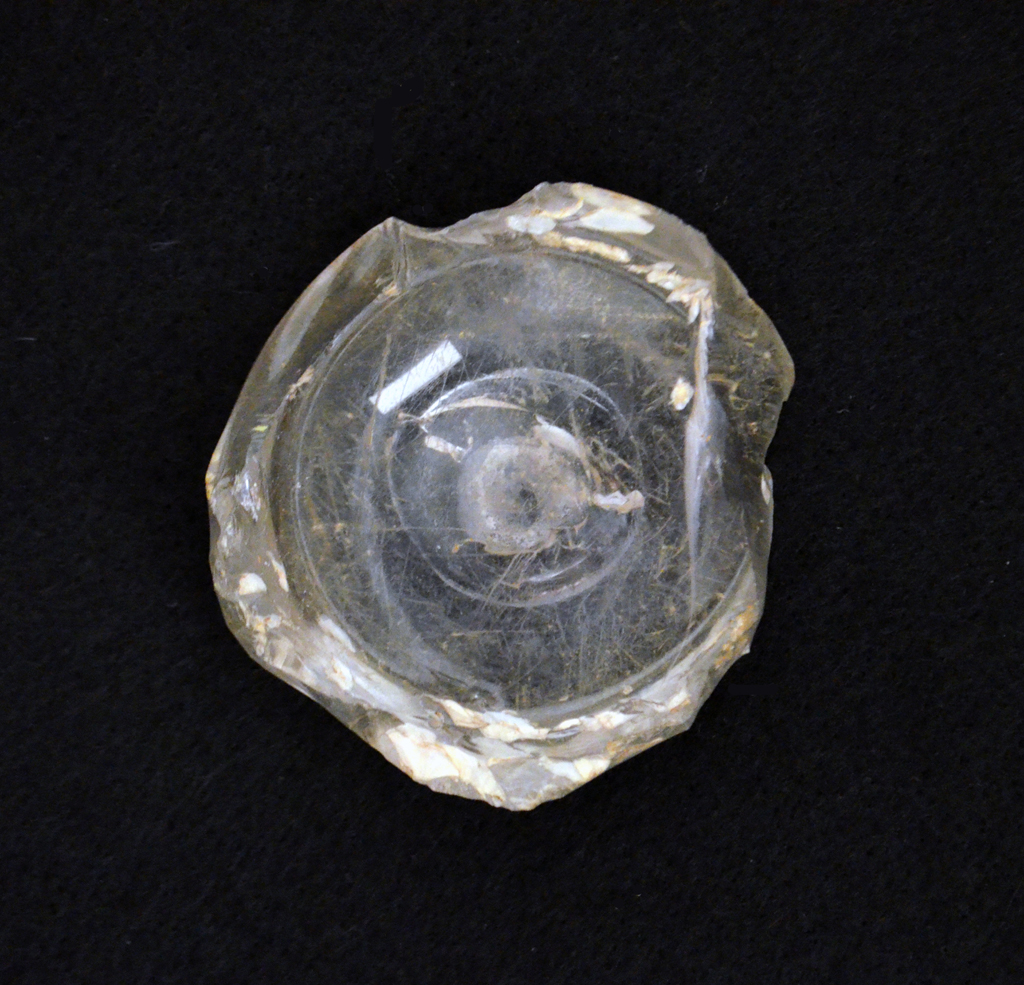
Recently, during analysis of the Washington family’s table glass, Ferry Farm archaeologists discovered another base from an 18th century drinking glass that someone tried to modify by actually breaking or knapping off flakes of glass. It was an apparent attempt to turn the base into a disc. As before, we don’t know for what reason.
To confirm the glass was knapped, Ferry Farm archaeologists got “science-y” and asked nearby Dovetail Cultural Resource Group in Fredericksburg to take photographs of the glass base using a microscope camera.
Using this microscope camera made the clear glass appear green in the resulting photos. More importantly, the photos helped us to see flake scars from knapping, which we’ve outlined in black in the photo below, and thus confirm that the glass was actually knapped by someone.
As often happens when studying the past, however, our analysis provided answers but also created many more questions. Who did the knapping? Was it perhaps the job of an enslaved worker? What was the goal? Why make these modifications? Although it’s the science of history, even archaeology can’t yet provide answers to these questions. In fact, we many never have the answers. In the end, sometimes not knowing is just as much a part of archaeology as knowing.
Several weeks ago, staff from George Washington’s Ferry Farm went hunting for objects to go into the reconstructed Washington house, which will be fully furnished with reproduction pieces to allow our visitors to sit on the chairs, open drawers, and pick up the plates on the table. Finding accurate, well-made reproductions of pieces from the Washington-era is no small feat but staff members have traveled to a variety of flea markets and consignment shops on the hunt for 20th century Colonial Revival objects that will pass as 18th century. Here are a few photos from one of these trips…
On a warm day in September, our intrepid band of archaeology and curatorial staff members set out into Virginia’s Northern Neck to hunt down modern stand-ins for the 18th century ceramics and glassware that were once used by the Washingtons at Ferry Farm. This is just one of the many flea markets and consignment shops that we visited that day.
A porcelain chamberstick, probably made in the 1970s or 1980s to mimic a colonial style. The decoration on this one is what really caught our eye – the blue and orange-red enamel with gilt highlights is known as the “Imari” palette and was often found on Chinese Export Porcelain teawares in the Washingtons’ time.
Ceramics and Glass Specialist Mara Kaktins examines some glass candlesticks for historical accuracy.
A baluster-stem wine goblet, perhaps from the 1930s, that is a pretty good approximation of a similar 18th century wine glass found archaeologically at Ferry Farm.
“Guys, whaddya think??”
A serving dish decorated in a great 20th century approximation of the rare “famille vert” palette found on very early 18th century Chinese Export Porcelain teawares. These dishes were made for Lord & Taylor in the 1980s.
A 20th century earthenware jug decorated in great Westerwald style. We found this one in a shop that specializes in Asian antiques. Go figure!
Did they have umbrellas in the 18th century?
A perfect example of a reproduction redware pitcher!
Archaeology Lab Technician Elyse Adams, Curator Meghan Budinger and Archaeology Lab Supervisor Melanie Marquis tally our haul at the Animal Welfare League thrift shop. Great repros for a great cause!
Another dish made for Lord & Taylor, this time in the “Imari” palette. Interestingly, we found 3 of these Lord & Taylor dishes at 3 different stores – clearly, we were meant to have them.
Bonus to shopping at thrift stores: there’s usually a friendly pooch or two around! Mara says hi to this store dog while holding two very nice 20th century tea bowls that will easily pass for the 18th century version once we remove some of the exterior decoration.
To learn more about the reconstructed Washington house furnishing effort, you might wish to read these blog posts…
As work continues on the reconstructed Washington family home at Ferry Farm, we archaeologists are identifying items that were owned by the Washingtons so we can eventually fill the reconstructed house with plates, bowls, glasses, and many other objects based on artifacts we’ve discovered. In a previous blog post, we looked at some of the fancy colorless glass that adorned the Washington family’s dining table. While this clear glass definitely dominates our collection, we’ve also discovered quite a few vessels of colored glass including deep cobalt blue, amethyst, smoky quartz, and milky white.
Glass is made from silica sand, soda ash, and lime. Its color is dictated, in part, by impurities in the silica sand such as iron which causes the glass to turn the dark shades of green seen in early colonial wine bottles.
Early glassmakers found ways to reduce the amount of this iron and created colorless glass. Colorless glass was by far the most common used as tableware. Much of the clear glass on Mary Washington’s table was also made with a lead oxide additive, which achieved the desired “crystal clear” look and produced heavier and more refractive table glass.
Early glassmakers also found that when other types of metal oxides were added to the silica sand, soda ash, and lime, the result was different colors of glass. This colored glass could still be infused with some amount of lead oxide to give it clarity.
The glass belonging to the Washingtons discussed below was handmade in the 1700s, meaning it was mouth-blown by a skilled glass blower and, in some cases, hand decorated.
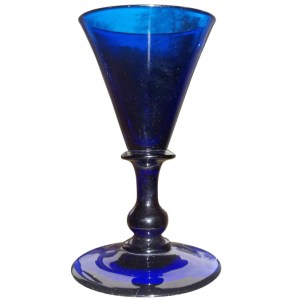
Cobalt Blue Goblet or Wine Glass Our first piece is a base sherd with partial stem. The beautiful sapphire color of this sturdy stemware was created using cobalt oxide as a coloring agent.
Cobalt Blue Goblet Base
Likely made in England, it has a rather hefty base compared to our other stemwares and belonged to a goblet or wine glass. Any number of beverages could have been held in this glass, although today we commonly associate goblets with water and wine glasses with, well, wine.
Cobalt Blue Goblet
Smoky Quartz Wine Rinser The wine rinser has passed out of use in modern society. It was used on the formal gentry table for washing wine glasses between uses or meal courses. When a new wine was brought to the table, the glasses would be placed in the rinser to flush the previous wine from the glass. The small spouts on either side are meant to support an upside-down wine glass by the stem in water.
Wine Glass Rinser with Wine Glass
Not only did tableware like this reflect wealth enough to afford multiple wines and meal courses, it was also a colorful piece that stood out among the colorless wine glasses on the table. The smoky-colored lip fragments and the thin, blue green fragments in our collection are believed to be from two different wine rinsers.
The smoky fragment is a rather unusual color but was created with similar metal oxides as the blue/green piece. Greys, greens, and colors-in-between are created using mixtures of iron, chromium, and copper. Adding cobalt to this mix created variations of blue/green.
Thin blue-green fragment of a wine rinser discovered at Ferry Farm.
Sherd of a Smoky Quartz Colored Wine Rinser excavated at Ferry Farm. A portion of the small spout is visible.
The amethyst rinser pictured below is from our own collection at Historic Kenmore. Amethyst glass was created using manganese and sometimes nickel.
Amethyst Wine Rinser from the Historic Kenmore collection.
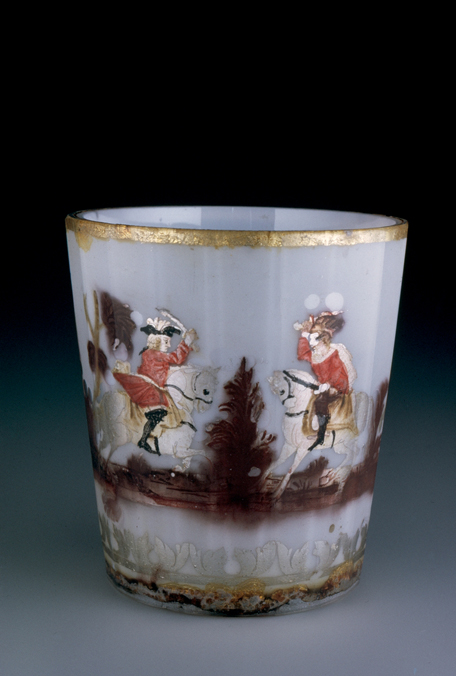
Enameled Milk Glass Tumbler This tumbler or beaker fragment is made from opaque white or ‘milk’ glass and was produced by adding tin or zinc oxides, fluorides, and phosphates to the glass. Germany was known for its production of milk glass but it was produced in other parts of Europe as well. In general, tumblers were used for mixed alcoholic beverages and, like other table wares, reflected the status the owner wanted to present to visitors. Although it is difficult to see, this vessel was hand-painted or ‘enameled’. Centuries in the dirt were not kind to the decoration, however, and we are left only with a ghost of the original painting known as a ‘fugitive design’.
Milk glass with fugitive design recovered by Ferry Farm archaeologists.
At one time, this glass was vibrant and colorful and was likely gilded with gold leaf like the German example pictured below.
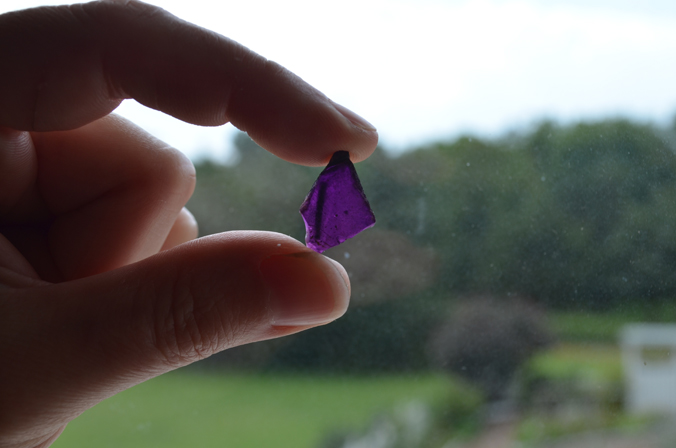
Amethyst Glass We only have a small fragment of deep purple amethyst glass, and cannot determine a vessel form without a bigger piece.
Small piece of amethyst glass recovered archaeologically at Ferry Farm.
Again, like with the other colored pieces of tableware, amethyst was for formal dining and a showpiece to visitors. The shape and faceting of this fragment may have resembled this circa 1800 amethyst goblet.One of the rarer table glass colors is Amethyst. As mentioned earlier, this color was created with the addition of manganese and sometimes nickel as a coloring agent.
As work continues on the reconstructed Washington family home at Ferry Farm, we archaeologists are continuing to identify items that were owned by the Washingtons so we can eventually fill the reconstructed house with plates, bowls, glasses, and many other objects based on artifacts we’ve discovered. Our latest mending project towards this goal involves glass tablewares. Piecing together thousands of fragments of clear tableglass is a special kind of agony but a wonderful amount of data has been collected from this painstaking exercise. And we’re not even close to being done yet! In this post, I’ve written about three of the glasswares we have identified in our study thus far.
LEAD GLASS BOTTLE
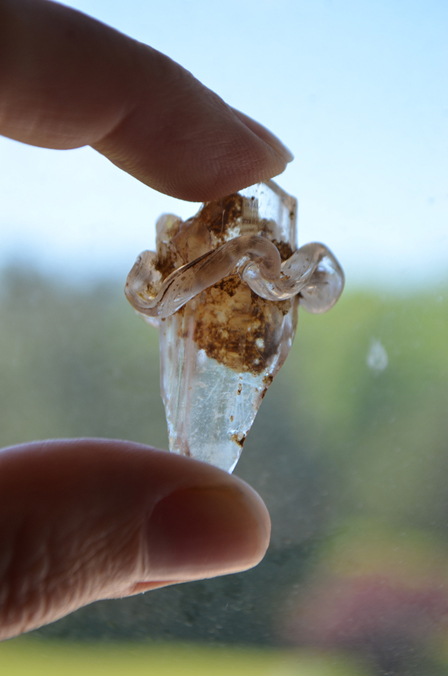
Fragment of the neck of a lead glass bottle excavated at George Washington’s Ferry Farm.
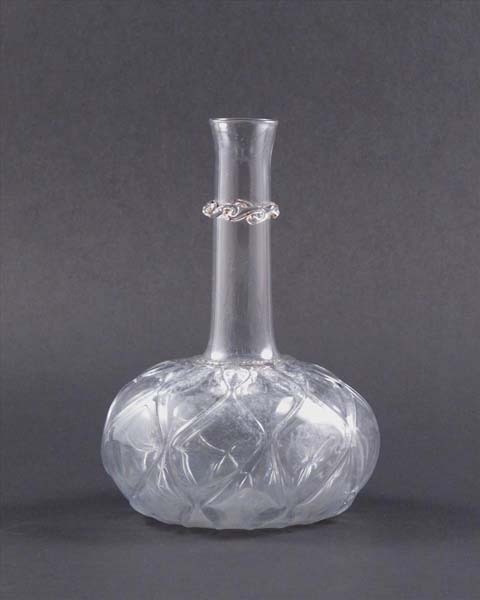
This particular fragment likely belonged to a small decanter or carafe. It could also possibly be part of a scent bottle, meant to hold perfumes. It was created using a pattern mold. The craftsman would have blown the glass into a simple mold with a ribbed pattern and then twisted it to get this diagonal line effect. He would finish the bottle by adding a separate piece of glass to create the delightful ‘ruffle’ on the neck. Below is an example of what the whole vessel may have looked like. Hopefully, we’ll find more fragments and know precisely what this piece is soon!
Lead glass bottle showing the ruffled neck on the fragment excavated at Ferry Farm.
FLIP CUP
Portions of a flip cup dug up by Ferry Farm archaeologists.
If you google ‘flip cup’, the first image result is a large red plastic cup commonly associated with college parties. The original flip cups were far more aesthetically pleasing. However, they too were used to enjoy recreational beverages. The drink called flip was the original cocktail and needed its own fancy glassware. Colonists loved flip and made it by combining a bizarre (by our modern standards) mixture of beer, hard liquor, spices such as nutmeg, a raw egg (a not uncommon ingredient in eighteenth century drinks), and then immersing a hot iron poker into the concoction. This resulted in a delightfully lukewarm eggy, boozy beverage that was then decanted into a decorative tumbler – the flip cup. While these cups were not only used for flip, the name has stuck. They are delicate and were often engraved with elaborate designs or scenes using a copper wheel. At Ferry Farm, we have a number of archaeological fragments of flip cups. Our examples are made of soda lime glass, not leaded glass, which is common.
Flip cup in the collection at Historic Kenmore. It features the same design as the fragments discovered at Ferry Farm.
VENETIAN GLASS
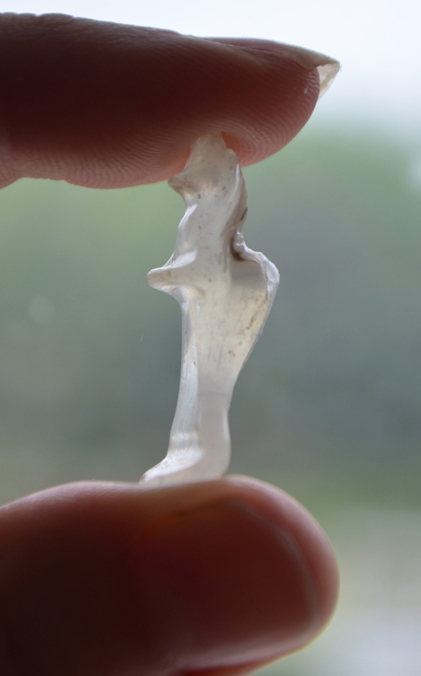
Archaeologists excavated this small fragment of Venetian glass at Ferry Farm.
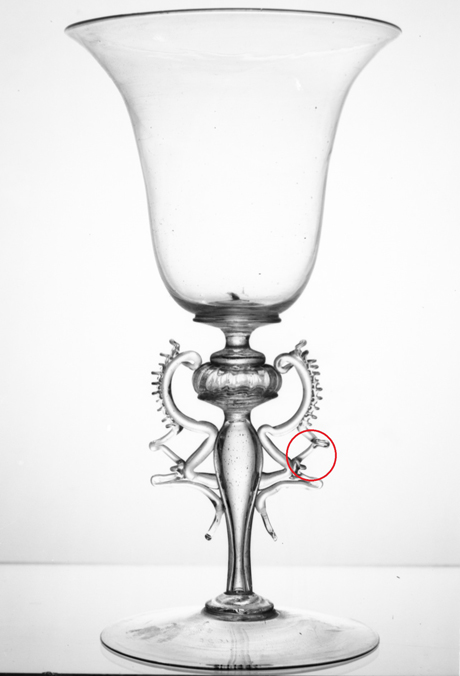
This fragment represents what may be the fanciest glassware owned by the Washington family during their time at Ferry Farm. It is a piece of a pincered and buttressed handle that belonged on a vessel such as the beautiful goblet pictured below. Although the sherd may appear unassuming, it is likely part of an elaborate hand-blown Venetian piece made of finely crafted colorless soda lime glass with a barely visible bead of opaque glass running through the center. This would certainly have been a show piece and displayed prominently within the house.
The portion of the handle circled in red on this 16th century Venetian glass goblet is similar to the fragment excavated at Ferry Farm. Credit: The Metropolitan Museum of Art
Follow Lives & Legacies for updates on the Washington family’s glasswares we are identifying at Ferry Farm. More discoveries await!
Mara Kaktins, Archaeologist
Ceramics & Glass Specialist
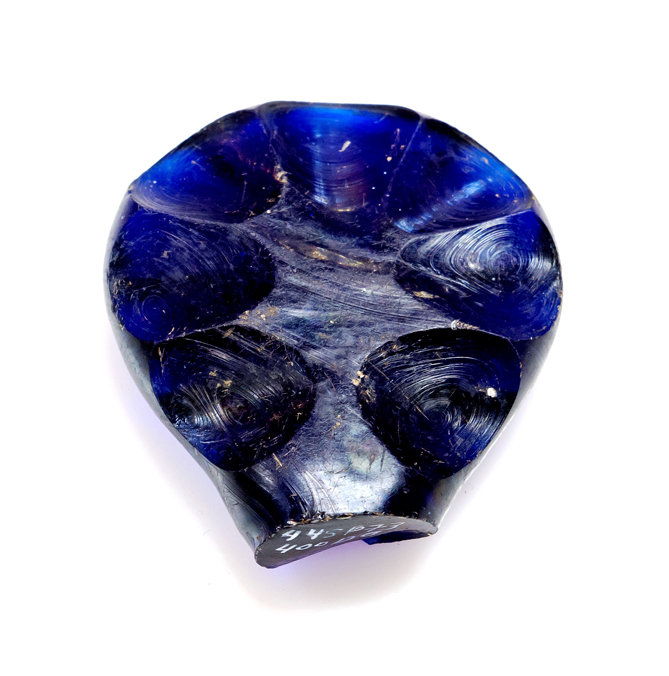
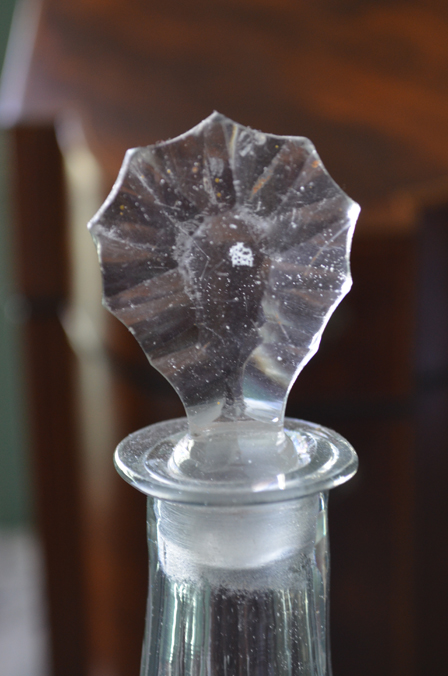
Archaeologists are somewhat unique in their appreciation for all things broken, mostly due to the coveted information discarded items can tell us about those who died long ago. However, occasionally a fragment is unearthed which is both informative and beautiful. Such is the case with a lovely cobalt blue decanter stopper excavated on the grounds of Historic Kenmore. Made from leaded glass to increase clarity, it seems quite heavy when placed in the hand. Six carefully hand-cut flutes adorn each side and when held up to a light it exhibits violet-colored highlights that accent the piece perfectly. Just the stopper alone is beautiful. Imagine how striking the entire decanter would have looked! Conveniently enough, that’s my job!
During the late 18th century, the decanter and its stopper graced one of the rooms at Kenmore and held either fortified wine like Madeira, Port, and Sherry or a stiffer spirit such as rum or gin. It may have been part of a set and adorned with gold gilding that spelled out which heady beverage was contained within. I picture the decanter being picked up by one of the Lewis family’s enslaved servants on a dark night and a glint of purple from deep within the cobalt bottle shining as it reflects off of a candle while dark burgundy Madeira is poured forth into a waiting cup.
All musings aside, however, the reality is that this stopper (which I am clearly obsessed with) also teaches us about how Fielding Lewis and his family lived. The decanter was a showy piece meant for display. It could be argued that, while it was a functional vessel, its primary purpose was to emphasize the wealth of the family and to impress guests.
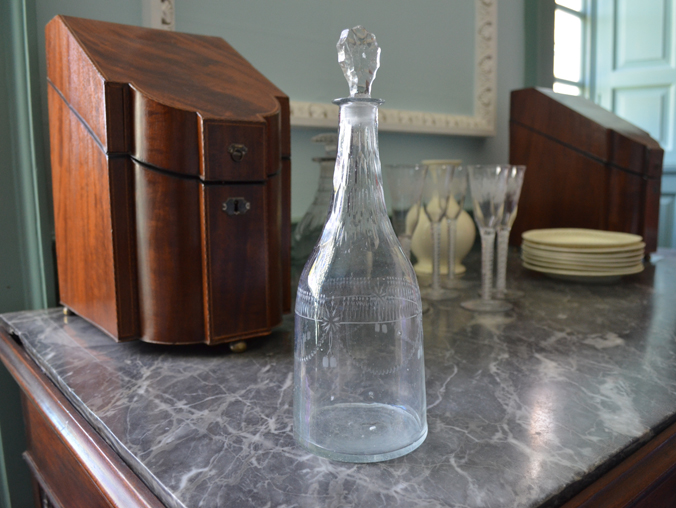
For us today, the stopper has a practical use. Meghan Budinger, Kenmore’s curator, was able to locate a similar vessel using the excavated stopper as a guide. While the decanter on display in Kenmore’s dining room is clear instead of cobalt blue, its shape and design closely match the cobalt decanter and stopper owned by the Lewises. Meghan continues her search for a blue decanter.
Still, visitors and obsessed archaeologists alike may marvel at its beauty. In fact, most of the ceramics and glass in that room have archaeological equivalents that have informed Meghan’s choices. Thus, when asked by visitors why we have selected the beautiful tablewares before them, we can confidently answer that it is not just because they are pretty (so very, very pretty!) but also because, thanks to the archaeological record, we know the Lewis family owned pieces like them!
You can see the clear glass decanter that is based on the cobalt blue stopper while also learning more about their ceramic cousins and about how archaeology has informed the choices of objects displayed inside Kenmore on a new specialty tour of the house called “Posh Pots and Decadent Dishes: The Lewis Family Life through their Ceramics.” Learn more about this new tour here. If antique glass is more your style, you can read more about Kenmore’s “Beautiful Glass” on The Rooms at Kenmore blog here.
Mara Kaktins, Archaeologist
Ceramics & Glass Specialist
Ultraviolet light is an important and useful tool within the museum world. In this video, we show you how archaeologists and curators use UV light in their work with artifacts and historic objects.


 Several weeks ago, staff from George Washington’s Ferry Farm went hunting for objects to go into the reconstructed Washington house, which will be fully furnished with reproduction pieces to allow our visitors to sit on the chairs, open drawers, and pick up the plates on the table. Finding accurate, well-made reproductions of pieces from the Washington-era is no small feat but staff members have traveled to a variety of flea markets and consignment shops on the hunt for 20th century