Lives and Legacies

Tag: grossology

  • What’s the Scoop on the Poop?: Going to the Bathroom at Ferry Farm

    But seriously…. World Toilet Day – today, November 19 – is kind of a big deal, considering the vast numbers of people across the globe who do not have access to indoor plumbing.  According to the United Nations, 3.6 billion people in the world today do not have a toilet that is “not shared with other households, that either treats or disposes of human waste on site, stores it safely to be emptied and treated off-site, or connects to a functioning sewer.” Nearly 500 million people must practice “open defecation” (PDF) somewhere outside their homes. Ultimately, “life without a toilet is dirty, dangerous, and undignified.”  A lack of toilets also deeply impacts people with toilets because “poor sanitation contaminates drinking-water sources, rivers, beaches and food crops, spreading deadly diseases among the wider population.”

    Editor’s Note: Looking back in time, people’s personal hygiene, fashion choices, medical treatments, and more can seem disgusting.  When confronted with gross practices, our first reaction can be to dismiss our ancestors as primitive, ignorant, or just silly.  Before such judgments, however, we should try to understand the reasons behind these practices and recognize that our own descendants will judge some of what we do as gross.  Here at George Washington’s Ferry Farm and Historic Kenmore, we’ve come to describe our efforts to understand the historically disgusting as “Colonial Grossology.”

    At George Washington’s Ferry Farm, we’re frequently asked by visitors where the Washington family’s privy (what an outhouse was called in the 1700s) was located.  The fact is the Washingtons didn’t have a privy (or a well, for that matter.)  We’re often met with looks of disbelief when we pass on this bit of information. Ground penetrating radar conducted at Ferry Farm confirms the lack of a privy and a well, which would have been picked up immediately by this technology. As discussed here and here, the Washingtons and most colonial Virginians used chamber pots to go to the bathroom. Indeed, for this part of Virginia in the 18th century, many households didn’t need a privy.

    18th century chamber pot

    Sadly, this lack of a specific sanitary place for human waste was a familiar one for those who lived in the 1700s.  Because of their poor understanding of germ-caused diseases at the time, 18th century people did not fully appreciate the health dangers presented by human waste.  They did make obvious correlations, however. Noting how sick people were getting from drinking water, local colonial governments started enacting laws which prohibited privies from being dug too close to the water table. They also frequently ordered that wells be dug a safe distance from privies.

    Privies took many forms before modern plumbing.  They could be deep, brick-lined shafts that could go 30 feet or more into the ground with substantial above ground buildings.  They could also be made out of a simple wooden barrel placed in the ground with a humble structure above it.  Small privies could accommodate one person at a time.  Larger privies could potentially have eight seats or more (and not much privacy).

    Regardless, privies had to be emptied at some point and it was some nasty business.  Probably the most unglamorous job prior to indoor plumbing was that of the night soil men.  Sounds scary, and it is.  These workers descended into the depths of a privy and scooped the contents into wagons that were carted away.  They did this at night usually because most neighborhood citizens would rather be asleep when that terrible smell wafted around.  Usually, this human waste would be carted to local farms and sold as fertilizer (yep).
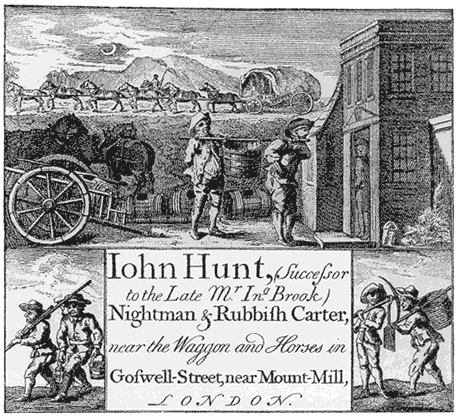
    Calling card advertisement for an 18th century night soil man in London. Credit: Public domain
    A night soil man in Baltimore. Credit: Public domain

    Who were the night soil men at Ferry Farm? Well, the Washingtons owned some 20 enslaved workers. Invariably, some enslaved, typically children, were tasked with emptying chamber pots and fetching water. They dumped chamber pots in the area behind the Washington house that archaeologists call the “midden.” This was a trash pile where everything from human waste to table scraps to broken household items was thrown away.  Enslaved workers also fetched water for the Washingtons from a spring and stream, not far from the Rappahannock River, at the base of the bluff where the house stood. Every day, these workers made multiple trips up and down the hill carrying heavy wooden buckets probably hanging from each end of a carrying pole or “milkmaid’s yoke.”  Hence no need for an outside toilet or well.

    But a privy was not just a toilet.  Like the Washington’s backyard midden, most privies were also used to dispose of any garbage from a house or institution.  This means food waste, broken pottery, bottles, and sometimes much more scandalous items were thrown into that void only to be brought up again by the night soil men.  Often, when a privy had degraded to the point where it was no longer draining properly or was falling in on itself, it was abandoned with all of the precious garbage sealed within.  Wells were treated the same way.  Once they had lived out their life, they were filled in with the lovely broken things that archaeologists love to look for. While unsanitary for their original users, historic privies plus wells can be a treasure trove of information for us today.
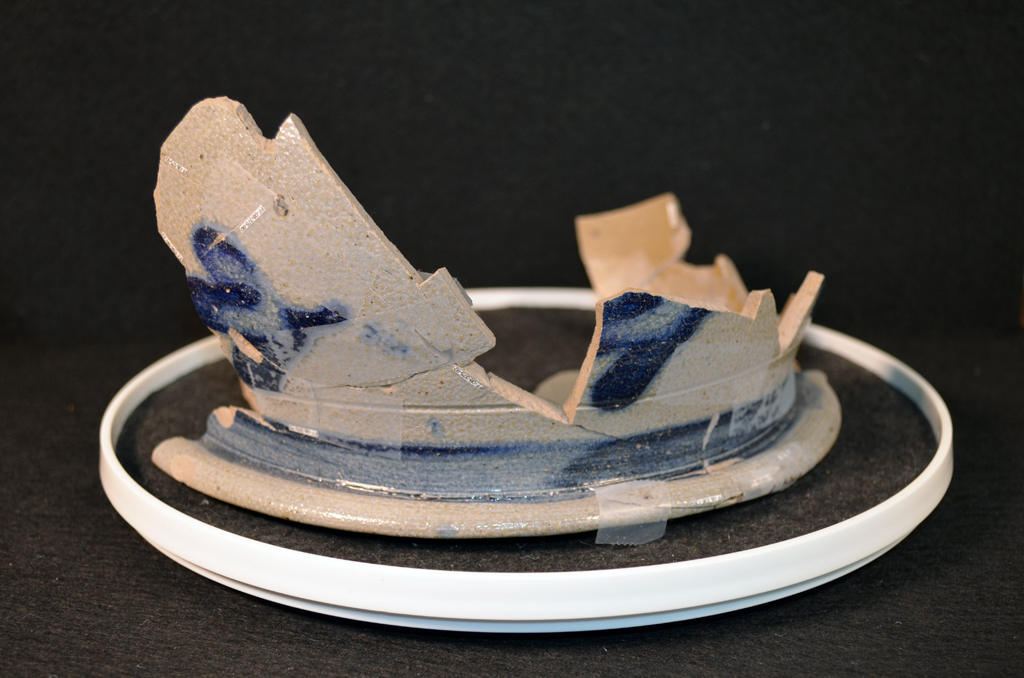
    Portion of a chamber pot excavated at George Washington’s Ferry Farm.

    Privies. Chamber pots. Thankfully, they were necessities for our ancestors but not for most of us today. That said, there are still many people in our 21st-century world who must go to the bathroom as if it were still the 18th century. On this World Toilet Day, let’s hope more can be done for the health and dignity of people without safe and sanitary toilets.

    Mara Kaktins, Archaeologist
    Ceramics & Glass Specialist

    Zac Cunningham
    Manager of Public Programs
  • Colonial Grossology [Video]

    Looking back in time, people’s personal hygiene, fashion choices, medical treatments, and more can seem disgusting.  When confronted with gross practices, our first reaction can be to dismiss our ancestors as primitive, ignorant, or just silly.  Before such judgments, however, we should try to understand the reasons behind these practices and recognize that our own descendants will judge some of what we do as gross.  Here at George Washington’s Ferry Farm and Historic Kenmore, we’ve come to describe our efforts to understand the historically disgusting as “Colonial Grossology.”  In this video, we examine three ways that daily life in the 18th century was sort of gross.

  • Ear Spoons, Ear Wax, and Their Uses

    Editor’s Note: Looking back in time, people’s personal hygiene, fashion choices, medical treatments, and more sometimes look, at the very least, bizarre, if not outright disgusting.  When confronted with these weird or gross practices, our first reaction can be to dismiss our ancestors as primitive, ignorant, or just silly.  Before such judgments, however, we should try to understand the reasons behind these practices and recognize that our own descendants will judge some of what we do as strange or gross.  Here at George Washington’s Ferry Farm and Historic Kenmore, we’ve come to describe our efforts to understand the historically bizarre or disgusting as “Colonial Grossology.”  The following is the latest installment in Lives & Legacies’ “Colonial Grossology” series.

    Ear wax, also as known as cerumen, is a wax produced by the outermost bit of the ear canal, in conjunction with the thousands of oil (sebaceous) and sweat glands.  It is a mixture of natural secretions and dead skin cells. Preferably, this cerumen makes it way out of the ear canal through talking, chewing or the otherwise moving of the jaw, where it then dries up and flakes away.

    There have been many imaginative explanations for why humans produce ear wax.  According to a 17th century The Resolver; or Curiosities of Nature Written in French, the accumulation of wax was to protect the ears from fleas, flies and other pesky insects that would like to curl up in your warm ear.  This idea of creepy crawlies working their way into the ear is a long standing folklore that can be found in many European legends.

    However, the actual reason we create this waxy substance is that it protects from dust, water and microorganisms entering the ear canal and causing problems.  However, wax build-up can cause some its own annoying difficulties like reduced hearing as well as trapping bacteria that lead to itchy or painful infections.

    Over the centuries, humans developed many creative ways to extract and utilize this sticky substance.  From ear scoops to the modern swab, people have long gone against doctors’ recommendations, shoving things in to their ears to extract the golden wax.

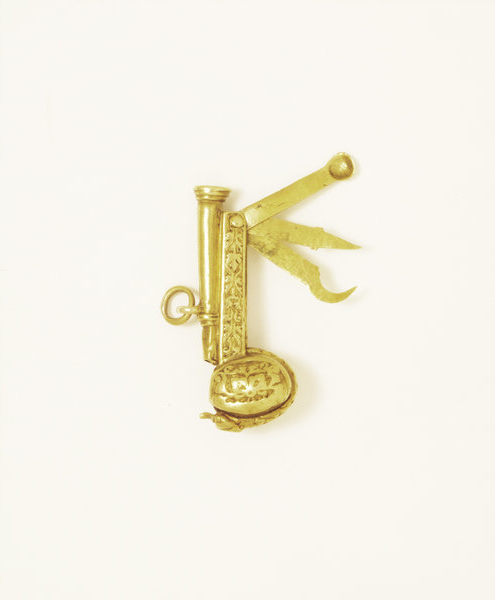
    Ear spoons, also known as ear scoops or ear picks, are a type of curette used to clean the ear canal of wax.  They are made from a wide range of material including bamboo, precious metals, stainless steel and plastic.  Ear spoons were commonly used throughout Eastern and Western history and many have been found at various archeological digs and are included in many museum collections. One of the more famous ear spoons was a golden pendant with a scoop it is believed, according to family tradition, that Henry VIII gave to Anne Boleyn during their courtship.

    Miniature whistle pendant, c. 1525-1530. Family tradition says this pendant with ear scoop was given to Anne Boleyn by Henry VIII. Credit: © Victoria and Albert Museum, London

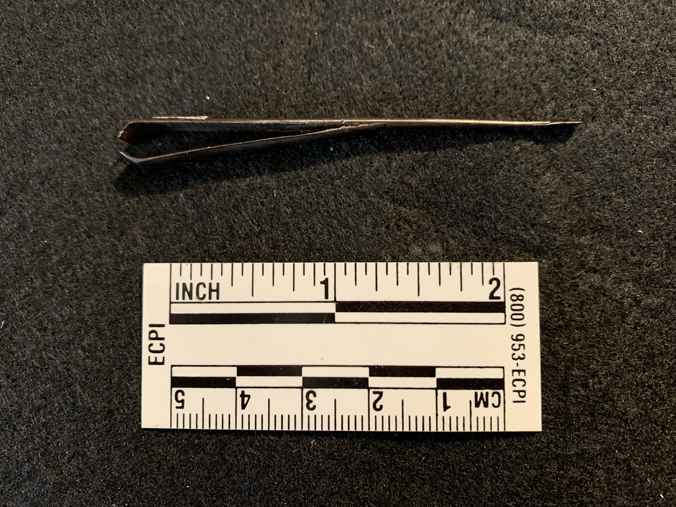
    As seen by this ear spoon from our archeological study collection (meaning it wasn’t excavated at Ferry Farm), many spoons were far simpler than Anne Boleyn’s gold one.  A more utilitarian, bodkin-style ear spoon in our own study collection dates from the 19th century and is made from steel and also functions as a set of tweezers.

    A bodkin is a small sharp pointed tool for making holes in cloth or leather or a thicker needle used for hand-sewing. Some bodkins used by seamstresses were up to 7 inches in length and actually had an ear scoop on one end. The scoop was used to gather wax that was then applied to sewing thread to keep the cut ends from unraveling.  People of means could afford to apply beeswax to their thread ends but the thriftier lady could just use the ready supply of wax from her ear.[1]

    Additionally, monks and scribes used ear wax along with urine in the production of pigments for their elaborate illustrated manuscripts.

    Finally, ear wax has many common medical uses.  Many health manuals such as Pliny the Elder’s The Natural History recommended using the “filth from the ears” on scorpion stings or serpent bites.  The Theatre of the World from 1663 stated every part the body is somewhat useful including ear wax, which “applied to the nostrils provoketh [sic] to drousinesse [sic] and sleep.”  Further, medicinal recipes from history state that adding “as much ear-wax as can be got” to oil of walnuts was a speedy way of curing wounds and keeping away putrefaction.

    Even as late as 1832, in The American Frugal Housewife still promoted ear wax as a way to protect wounds, stating “nothing was better than earwax to prevent the painful effects resulting from a wound by a nail [or] skewer.”  Additionally, it was recommend as a remedy for cracked and dried lips.[2]

    This historical medical uses of ear wax are not as bizarre as they sound. Recent studies show that ear wax has a bactericidal effect that can kill 99% of some bacteria strains. The wax contains around ten peptides that prevent bacteria and fungi from growing.

    So, this winter when you have chapped lips and don’t have any lip balm handy, you can reach for some of that lovely golden wax in your ear to help solve your problems …or maybe not.

    Heather Baldus
    Collections Manager


    [1] Mary C. Beaudry, “Bodkin Biographies” in The Materiality of Individuality: Archaeological Studies of Individual Lives, ed. Carolyn L. White, New York: Springer-Verlag, 2009, 97.

    [2] L.M. Child, The American Frugal Housewife, New York: Samuel S. & William Wood, 1841, 116, https://books.google.com/books/about/The_American_Frugal_Housewife.html?id=D3AEAAAAYAAJ

  • Lecture – The Social Role of Garbage in Colonial Virginia [Video]

    On Tuesday, May 21, 2019, Dave Muraca, Director of Archaeology at The George Washington Foundation, presented “The Social Role of Garbage in Colonial Virginia,” the final talk in this year’s annual lecture series. Dave presented three case studies in 18th century garbage disposal at George Washington’s Ferry Farm, Colonial Williamsburg, and Historic Kenmore.

    Thanks to the Fredericksburg branch of the Central Rappahannock Regional Library at 1201 Caroline Street in Fredericksburg, Virginia for hosting the series once again this year. To learn about other events and happenings, visit kenmore.org.