Each January, Historic Kenmore presents Twelfth Night at Kenmore, a dramatic theater presentation that imagines the first Christmas that Fielding and Betty Washington Lewis spent in their newly built home. The play is set in January 1776 and that year is not a time for the usual celebration. War brings fear, doubt, and frustration to the Lewis family and their friends.
The 2019 edition of Twelfth Night at Kenmore took place January 11 and 12. Here are a few photos from the performances.
Snow begins to fall on Kenmore.
Rachel Sargeant as Lucy Thorton Lewis greets visitors in the Passage.
Rae Ehlen as Fielding Lewis (L) and Wilson Johnson as George Weedon (R) share the latest war news.
Anne Lloyd as Mary Washington (L) and Corinn Keene as Nancy Alexander Lewis (R) discuss how the war endangers their loved ones.
Ashlee James as Rachel, the washerwoman (L), and Gladys Perkins as Hetty, the cook (R), talk about the wisdom of running away to freedom promised by the British.
Barbara Cochran as Betty Washington Lewis.
Michael S. Taylor as John Lewis.
Singing “God Rest Ye Merry Gentlemen.”
Marcus Salley as Pompey, the blacksmith, tends a fire.
Sam Fulton as Henry Mitchell, Fredericksburg merchant, alone in the Drawing Room.
On Friday, January 11, Saturday, January 12, and Sunday, January 13, Historic Kenmore will again present Twelfth Night at Kenmore, a dramatic theater presentation set in 1776.
This production depicts the first Christmas that Fielding and Betty Washington Lewis celebrate in their newly built home. It is not the usual joyous atmosphere, however. The Revolutionary War brings fear, doubt, and frustration to the Lewis family, their friends, and Kenmore’s enslaved community. Here are some photos from last year’s performance.
John Lewis (Michael S. Taylor) encourages Betty Washington Lewis (Barbara Escamilla Cochran) to reveal who the Twelfth Night king and queen shall be.
Betty Washington Lewis (Barbara Escamilla Cochran) welcomes guests to her home and offers a holiday toast.
Patriots George Weedon (L-Wilson Johnson) and Fielding Lewis (R-Rae Ehlen) worry about the latest war news.
Hetty, an enslaved washerwoman and house servant (Ashleé James), overhears Weedon and Lewis discussing Dunmore’s Proclamation, which promised freedom to slaves who fought for the British.
Mary Washington (Anne Lloyd) admonishes Nancy Alexander Lewis (Corinn Keene) to be mindful of her duty as a Patriot woman.
Rachel, an enslaved cook (Gladys Perkins), clears the dining room table after the ball’s grand meal is complete.
Having heard about Dunmore’s Proclamation, Hetty wonders how she might escape slavery and join the British cause in the hope of gaining freedom.
Fielding Lewis, Jr. (Sam Fulton) and George Weedon debate the wisdom of suspending horse racing in Fredericksburg as part of the effort to stay focused on the war effort.
The Lewis family sings “The First Noel.”
Henry Mitchell (Preston Simms) talks with Pompy, an enslaved blacksmith (Marcus Salley) and wonders whether he might as well become a Loyalist since his neighbors already seem to think that he is one.
Lucy Thorton Lewis (Cynthia Palmer), wife of John Lewis, acted as a guide for the evening and narrated our story.
Lucy Thorton Lewis (Rachel Sargeant), wife of John Lewis, acted as a guide for the evening and narrated our story.
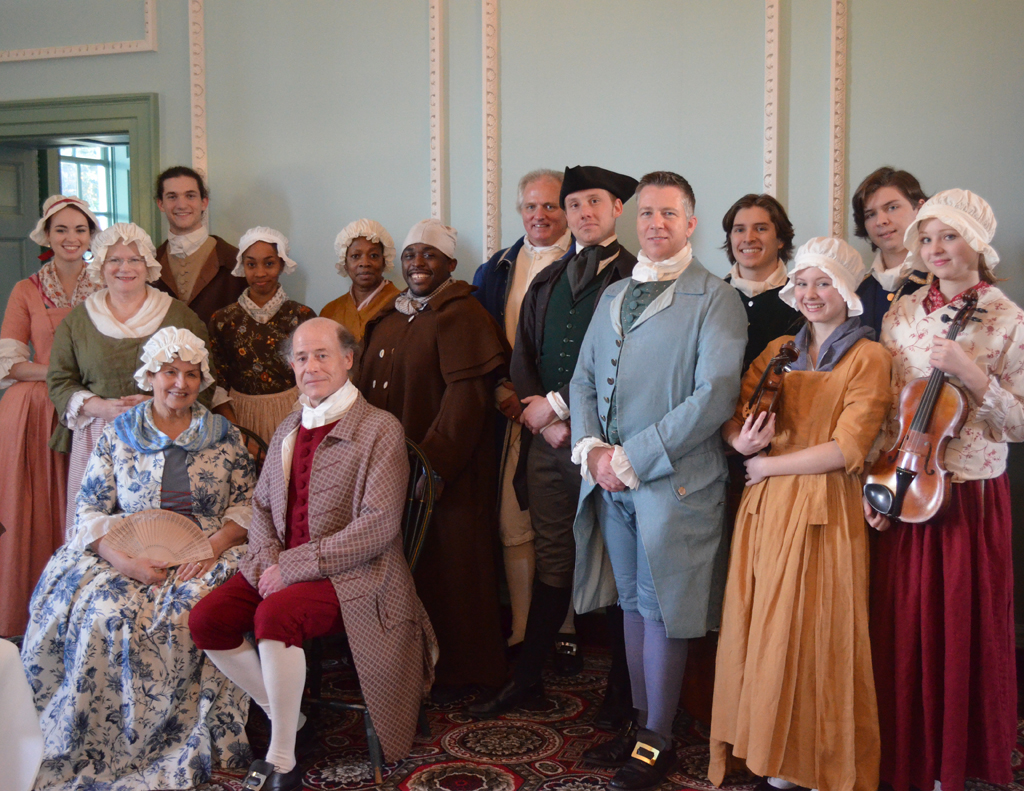
The “Twelfth Night at Kenmore” cast.
Performance dates: Friday, January 11, Saturday, January 12, Sunday, January 13
Performance times: 3:30 p.m., 4:00 p.m., 4:30 p.m., 5:30 p.m., 6:00 p.m. and 6:30 p.m.
Reservations required. Call 540-370-0732 x24 or email [email protected]
Cost: $12.00 adults, $6.00 ages 3-17; under age 3 free.
This past weekend at Historic Kenmore, the Fredericksburg Theatrical Society presented three performances of the 18th century play The Lying Valet at Historic Kenmore. Here are some photos of the play.
(l-r) Roody Labaze as Sir Gayless, Christian Humphrey as The Lying Valet Timothy Sharp, and Brianne Cook as Miss Kitty Prye
Brianne Cook as Miss Kitty Prye
Roody Labaze as Sir Gayless
Gabrielle Fox as Mistress Melissa
Christian Humphrey as Timothy Sharp, The Lying Valet
Brianne Cook as Miss Kitty Prye
(l-r) Christian Humphrey as The Lying Valet Timothy Sharp and Roody Labaze as Sir Gayless
Gabrielle Fox as Mistress Melissa disguising herself as a Frenchman
The cast of the Lying Valet: (l-r) Brianne Cook, Gabrielle Fox, Wilson Pezzuto (director), Christian Humphrey, and Roody Labaze
Brianne Cook as Miss Kitty Prye
(l-r) Christian Humphrey as The Lying Valet Timothy Sharp and Roody Labaze as Sir Gayless
Christian Humphrey as Timothy Sharp, The Lying Valet
Gabrielle Fox as Mistress Melissa disguising herself as a Frenchman
The cast of the Lying Valet: (l-r) Brianne Cook, Gabrielle Fox, Wilson Pezzuto (director), Christian Humphrey, and Roody Labaze
Gabrielle Fox as Mistress Melissa
(l-r) Roody Labaze as Sir Gayless, Christian Humphrey as The Lying Valet Timothy Sharp, and Brianne Cook as Miss Kitty Prye
Roody Labaze as Sir Gayless
Brianne Cook as Miss Kitty Prye
Check kenmore.org/events for event listings of future theater productions and other special tours, exhibits, and programs or follow us on Facebook.
Each January, Historic Kenmore presents Twelfth Night at Kenmore, a dramatic theater presentation that imagines the first Christmas that Fielding and Betty Washington Lewis spent in their newly built home. The play is set in January 1776 and that year is not a time for the usual celebration. War brings fear, doubt, and frustration to the Lewis family and their friends.
The 2018 edition of Twelfth Night at Kenmore took place January 5, 6, and 7. Here are a few photos from the performances.
John Lewis (Michael S. Taylor) encourages Betty Washington Lewis (Barbara Escamilla Cochran) to reveal who the Twelfth Night king and queen shall be.
Betty Washington Lewis (Barbara Escamilla Cochran) welcomes guests to her home and offers a holiday toast.
Patriots George Weedon (L-Wilson Johnson) and Fielding Lewis (R-Rae Ehlen) worry about the latest war news.
Hetty, an enslaved washerwoman and house servant (Ashleé James), overhears Weedon and Lewis discussing Dunmore’s Proclamation, which promised freedom to slaves who fought for the British.
Mary Washington (Anne Lloyd) admonishes Nancy Alexander Lewis (Corinn Keene) to be mindful of her duty as a Patriot woman.
Rachel, an enslaved cook (Gladys Perkins), clears the dining room table after the ball’s grand meal is complete.
Having heard about Dunmore’s Proclamation, Hetty wonders how she might escape slavery and join the British cause in the hope of gaining freedom.
Fielding Lewis, Jr. (Sam Fulton) and George Weedon debate the wisdom of suspending horse racing in Fredericksburg as part of the effort to stay focused on the war effort.
The Lewis family sings “The First Noel.”
Henry Mitchell (Preston Simms) talks with Pompy, an enslaved blacksmith (Marcus Salley) and wonders whether he might as well become a Loyalist since his neighbors already seem to think that he is one.
Lucy Thorton Lewis (Cynthia Palmer), wife of John Lewis, acted as a guide for the evening and narrated our story.
Lucy Thorton Lewis (Rachel Sargeant), wife of John Lewis, acted as a guide for the evening and narrated our story.
The cast of Twelfth Night at Kenmore in their period clothing. In our educational programming, we must dress staff and actors of different body types who portray a variety of social classes and time periods.
We have been working tirelessly to improve the accuracy of the costumes that actors and staff wear when performing for or interacting with the public at Historic Kenmore and George Washington’s Ferry Farm. This is no easy task, but it improves the visitor experience and helps them better understand the Washington and the Lewis families in the context of the 18th century.
This blog post addresses some of the challenges and successes we’ll continue to experience as we expand our costuming after the reconstructed Washington house and the new historic landscape at Ferry Farm opens to the public.
Some of the challenges we face are no different than what other sites face. The modern expense of this specialized clothing, the difficulty of fitting multiple wearers, questions of time period to portray and achieving the small true-to-life details of historic clothing are all important to the success of dressing the interpretive staff. But we’ve come a long way and are on the path to sustained success. We’ve been working on all of the pitfalls mentioned above and have made great headway. Below is an examination of some of the difficulties we’ve faced and the ways we have met them straight on.
Expense of this Historic Clothing
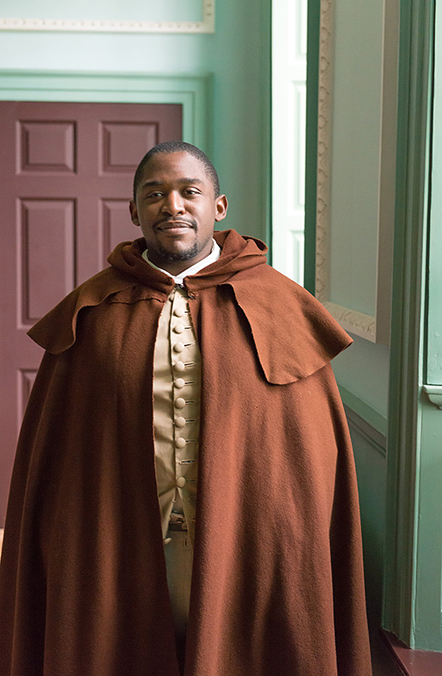
Cloaks are necessary to keep actors and staff warm but they are among the more expensive pieces of clothing needed to properly dress as someone from the 18th century.
The cost of well-made, accurate period clothing is one of the greatest hurdles we’ve or, for that matter, any historic site or museum experiences. Eighteenth century clothing is a highly specialized type of clothing that is often imitated with mixed success. For example, a good quality off-the-rack great coat costs about $325, while a custom-made high-end 18th century men’s great coat costs about $1,000. There were pieces in our costume stock that did not fit our criteria and had to be removed – meaning they had to be replaced with new (and more expensive) articles of clothing. Correcting past clothing choices is its own challenge, but it is far from insurmountable. We make very careful decisions about what was a priority and where we should spend resources first and we have begun acquiring garments that we deem priorities.
One-Size-Fits-No One
Because of the number of people we costume, we sometimes have to use the same costumes on different people (not at the same time, of course!). This is a challenge because both men’s and women’s 18th century clothing was fitted to the individual. A tailor would custom-make waistcoats, coats, and breeches to fit the wearer; even when the ensemble was fashioned out of a hand-me-down suit. Mantua makers (dress makers) would custom-make women’s gowns and petticoats to fit snugly. We must make our clothing fit a variety of wearers. We are now quite proficient in the art of pinning and mysteries of knot tying. It’s not perfect, but it goes a long way toward creating a more accurate fit.
Another important part of fit for women is the undergarments. Stays, bum rolls, and hoops create the ideal 18th century shape. Stays were 18th century support garments, much the way corsets were in the 19th century. We recently made acquiring stays a priority and purchased some in a variety of sizes. This has improved the actor’s appearance in addition to helping her achieve the proper 18th century posture. Bum rolls accentuate the behind (no, really!) and hoops accentuate the hips. These help create a period appropriate look that we are now pleased to share with visitors.
The True-to-Life Details
Small details like the fan, necklace, brooch, and hair style create a fully realized character with a stronger connection to the past.
Just as it is today, the small details make the 18th century outfit. Attention to men’s and women’s shoe buckles and hats, men’s knee buckles, and women’s jewelry and stays polishes the look that makes history come alive. Our men’s and women’s hats are correct to the period and we have a nice but limited collection of accouterments. Because 18th-century-style shoes are expensive and we can’t exactly buy a pair of shoes in every size, we have been using buckles on plain black shoes to disguise their modernity. As we move forward, we are working on better solutions to best achieve the small details needed to make a costume fully 18th century.
1750s vs. 1770s
Another challenge we face as the Washington house and Ferry Farm’s new historic landscape gradually come on-line is that we’ll have to costume staff for both the 1750s – the period we interpret at Ferry Farm – and the 1770s – the period we interpret at Kenmore. This is important for a number of reasons. First, we want to demonstrate clearly that the events that took place at the two sites took place in two different time periods. This sounds obvious, but visitors will better internalize the time difference between the sites with the aid of clothing. Secondly, it would be flat-out wrong to dress the staff portraying our historic figures at both places in clothing from the same period. As a museum, we have a responsibility to make the visitor experience as accurate as possible.
Despite the challenges, our devotion to accuracy in the period clothing worn by our staff will improve the visitors’ experience and help them better understand the Washington and Lewis Families.
Kelly Brennan Arehart
Manager of Interpretation & Visitor Services
Each January, Historic Kenmore presents Twelfth Night at Kenmore, a dramatic theater presentation that imagines the first Christmas that Fielding and Betty Washington Lewis spent in their newly built home. The play is set in January 1776 and that year is not a time for the usual celebration. War brings fear, doubt, and frustration to the Lewis family and their friends.
The 2017 edition of Twelfth Night at Kenmore took place this past weekend. Here are a few photos from that performance.
Historic Kenmore in the snow on Saturday night.
Betty Washington Lewis (Barbara Cochran) welcomes her Twelfth Night guests and toasts the season while stepson John Lewis (Michael Taylor) looks on with a smile.
Lucy Thorton Lewis (left-Sarah Hall) persuades Nancy Alexander Lewis (right-Corinn Keene), who is worried about the war, to rejoin the party.
The Lewis Family sings a carol in the Dining Room.
Betty, Lucy, and Nancy talk in the Dining Room.
Fredericksburg merchant Henry Mitchell (left-Preston Simms) laments to Pompy (right-Marcus Salley) about how his neighbors whisper about Mitchell’s alleged loyalty to the crown.
Rachel (left-Gladys Perkins) argues with Hetty (right-Ashleé James) about the future that war might bring for the enslaved community and if that future will include freedom.
On Friday, January 6, Saturday, January 7, and Sunday, January 8, Historic Kenmore will again present Twelfth Night at Kenmore, a dramatic theater presentation set in January 1776. It is the first Christmas that Fielding and Betty Washington Lewis celebrate in their newly built home. It is not the usual celebration, however. War brings fear, doubt, and frustration to the Lewis family and their friends. Immerse yourself in the experience the candlelight, music, and decorations of an eighteenth-century Christmas!
Each January, Historic Kenmore presents Twelfth Night at Kenmore, a dramatic theater presentation that imagines the first Christmas that Fielding and Betty Washington Lewis spent in their newly built home. The play is set in January 1776 and that year is not a time for the usual celebration. War brings fear, doubt, and frustration to the Lewis family and their friends.
The 2016 edition of Twelfth Night at Kenmore took place this past weekend. Here are photos from that performance.
Kenmore is ready for the party.
George Lewis (Joe Ziarko) gazes out the window and ponders enlisting in the Continental Army.
George Weedon (L-Rae Ehlen) and Fielding Lewis (R-John Hollinger) lament the burning of Norfolk and Dunmore’s Proclamation.
The dessert table includes a hedgehog cake.
Candles light the Passage
Betty Washington Lewis (L-Barbara Cochran) and Nancy Alexander Lewis (R-Corinn Keene) determine to smile through the troubles of war.
The Lewis family and guests sing “God Rest Ye Merry Gentlemen.”
The Payne Family provided music for the performance. (L-R) Zach, Kelsey, Kaylee, and Luke.
George Weedon explains to Captain Richard Taylor (Sam Fulton) why horse racing ought to be banned during the war.
Captain Taylor, John Lewis (Mike Taylor), and George Lewis play cards.
Wassail in a punch bowl.
Sausage cooking over the fire in the kitchen.
Rachel (Gladys Perkins), enslaved cook for the Lewis family, tends the fire.
Rachel ponders the future that war might bring for the enslaved community and if that future will include freedom.
This coming weekend — Friday, January 8, Saturday, January 9, or Sunday, January 10 — Historic Kenmore again presents Twelfth Night at Kenmore, a dramatic theater presentation set in January 1776. It is the first Christmas that Fielding and Betty Washington Lewis celebrate in their newly built home. It is not the usual celebration, however. War brings fear, doubt, and frustration to the Lewis family and their friends.
Here is a collection of photos from last year’s performances.
George Weedon (Sam Fulton) and Fielding Lewis (John Hollinger) remark upon the Christmas decorations.
Betty Washington Lewis (Amy Wolf) and daughter-in-law Nancy Alexander Lewis (Juliana Jones) ponder how the war might impact the family.
George Lewis (Will Goldstein) expresses his desire to enlist in the Continental Army.
George Weedon, a leading Fredericksburg patriot and tavernkeeper.
Our excellent musicians for the evening: Zach, Kelsey, Kaylee, and Luke Payne.
Two-hundred-year-old violin on display in Kenmore’s dining room
Violin is on loan by Wayne A. Hill, Violinist/Composer
Rachel (Gladys Perkins), enslaved cook, and Hetty (Ashlee James), enslaved washerwoman and house servant, ponder the future.
Immerse yourself in the experience the candlelight, music, and decorations of an eighteenth-century Christmas!
Performance Times: 3:00, 3:45, 4:45 and 5:30 p.m. Reservations required. Call 540-370-0732 x24 or email [email protected] Cost: $12.00 adults, $6.00 ages 3-17; free ages 3 and under.