Lives and Legacies

Tag: Mary Washington

  • The Last of Washington’s Horse Chestnut Trees?

    There once stood a large horse chestnut tree on the corner of Fauquier and Charles Street in Fredericksburg. It was noted as one of the thirteen legendary Washington horse chestnut trees planted by George himself. By the 1930s, it was becoming clear that the tree needed some help, so the Daughters of the American Revolution (DAR) took up the cause to protect this historic tree.

    The tree legend states that George, while visiting his mother in June 1788 in Fredericksburg, decided to plant thirteen horse chestnut trees from her house to his sister’s house, Kenmore, just a few blocks away. This provided a scenic path for his mother when she visited her daughter Betty. These trees commemorated the thirteen original states.

    It is a great story. It is patriotic and nostalgic, showing George as a man of the earth with his love of trees, gardening, and horticulture. He planted these trees for a future America to remember the struggles to create this country and the precious nature of our land that we must protect.
    But is it true? Did George plant that tree? What is the evidence?


    The horse chestnut tree is a native of the Balkans region (Albania, Bulgaria, Greece, and Northern Macedonia). It made its way to Europe and England during the seventeenth century, noted as growing in South Lambeth, London, and being planted by Sir Christopher Wren at Hampton Court.

    Horse chestnut trees Bush Park, Hampton Court, England planted by Christopher Wren in 1669-1670.

    There is documented evidence of some horse chestnut trees crossing the Atlantic to Mr. John Bartram, one of America’s first botanists in the 1740s. In a letter from Peter Collinson, an English botanist, dated September 16, 1741, he wrote to Bartram, “I have sent some Horse-Chestnuts which are ripe earlier than usual; hope they will come fit for planting.”. Bartram acknowledged receiving them and stated that most were blue-molded, and only one germinated and grew. Over twenty years later, Bartram updated Callison on the success of the lone seedling, writing, “But what delights me is that our horse chestnut has flowered. I think it must excel in America.”
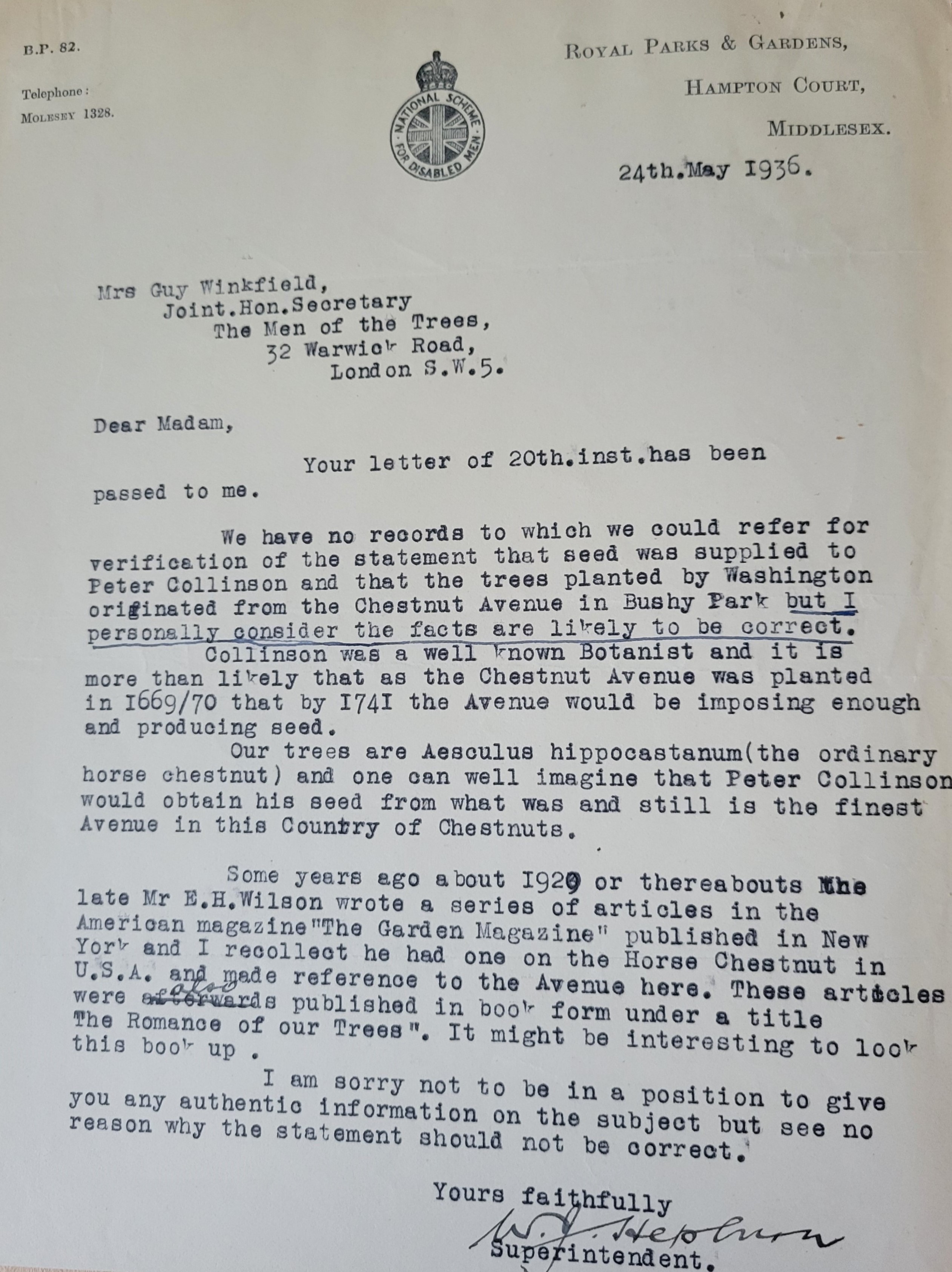
    Letter from Royal Parks and Gardens, Hampton Court, May 24 1936


    Bartram’s Gardens in Philadelphia was quite popular and visited by many founding fathers while working there. George visited the gardens twice in the summer of 1787 while in the town during the Constitutional Convention, noting, “Sunday, June 10, 1787, breakfasted at Mr. Powell’s and in company with him rid to see the Botanical Gardens of Mr. Bartram, which, though stored with many curious plants, shrubs, and trees, many of which are exotics, was not laid off with much taste, nor was it large.”
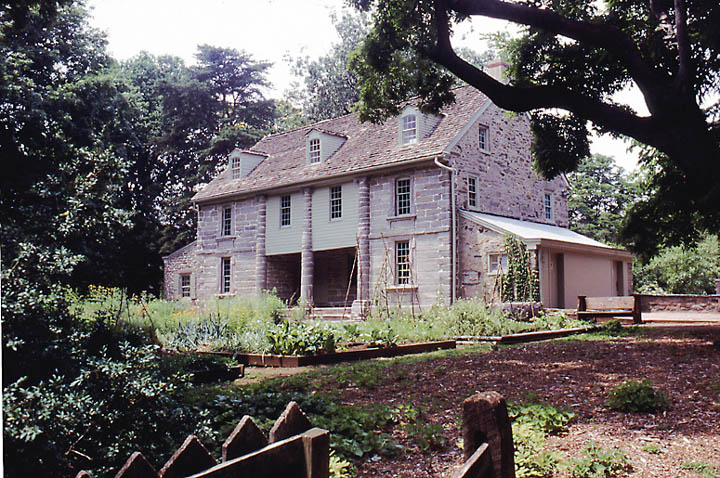
    John Bartram’s house and upper garden at Bartram’s Garden

    Why mention this? In some versions of the story, Washington got his horse chestnut trees from this garden, but there is no evidence that the legendary trees were obtained from this famous historic garden.
    George only made two diary entries about horse chestnut trees on April 13, 1785, writing, “Received from Col. Henry Lee of Westmoreland 12 horse chestnut trees (small) and an equal number of tree boxes. They appeared to have been some time out of the ground. Planted 4 of the Chestnuts on my serpentine walk – two on the east end and the rest in the vineyard.” And again, on April 2, 1788, wrote, “Transplanted from a box in the garden, thirteen plants of the horse chestnut into shrubberies by the garden walls.”

    The entry shows evidence of planting the famous Washington trees, right? No, because George was at Mount Vernon in April and didn’t leave for Fredericksburg to visit his mother until June 10, 1788.

    But could he have had them sent down and have them planted before he came to see his mother? Yes, but the story says that George planted these trees with his own hand. Additionally, it would be odd for George to mention planting the trees while in residence at Mount Vernon and not say that they were in his mother’s garden in Fredericksburg. Washington was a diligent diarist but never mentioned planting thirteen horse chestnut trees in his mother’s garden.
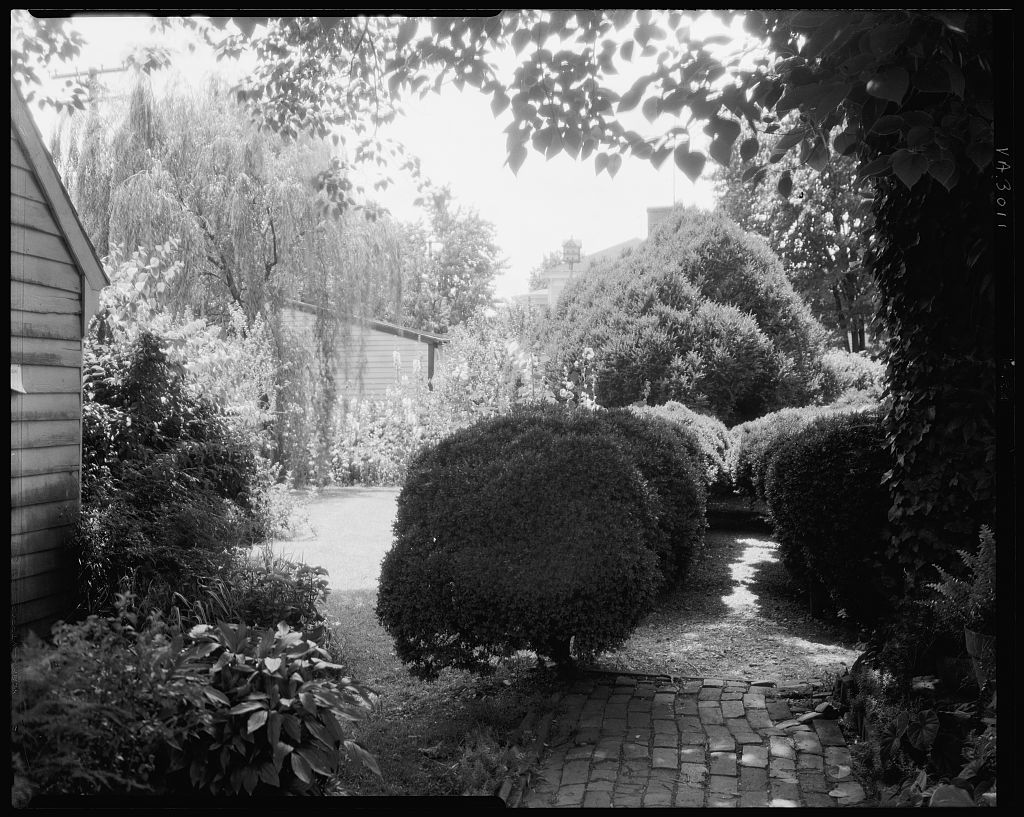
    Mary Washington’s house gardens, Fredericksburg.

    Further, no known letters from George, Mary, or Betty mention any horse chestnut trees between Mary’s gardens and Betty’s Kenmore.

    Spring time in the gardens at Kenmore Plantation (can you spot the cat?)

    This was all the primary source evidence I could find relating to George and any horse chestnut trees. So, I looked further into the story to see what other evidence was being used to verify that this tree was indeed one of the thirteen Washington trees.

    As I said in the beginning, by the 1930s, many, including the DAR, were trying hard to save this lone surviving chestnut tree. With their extensive reach, they got Fred H. Arnold, the Assistant Forester for the National Park Service, to do an age-determination test on the tree in May of 1934. Mr. Arnold noted some issues with the test, stating that the lower twelve feet of the tree was filled with concrete, so the coring sample had to be taken above this “repaired defect”. Even then, a complete coring sample could not be extracted due to decay in the interior of the main stem. Additionally, Mr. Arnold said that it was very difficult to count the annual rings due to their obscurity because the texture difference between the springwood and summerwood for the horse chestnut tree (genus Aesculus) is very slight. Taking into account all this, Mr. Arnold estimated the tree to be around 139 years old with as much as 10% in error, either plus or minus, which would put the date it was planted somewhere between 1781 and 1809, which means that the tree is indeed old and could have been planted during Washington’s time in Fredericksburg.
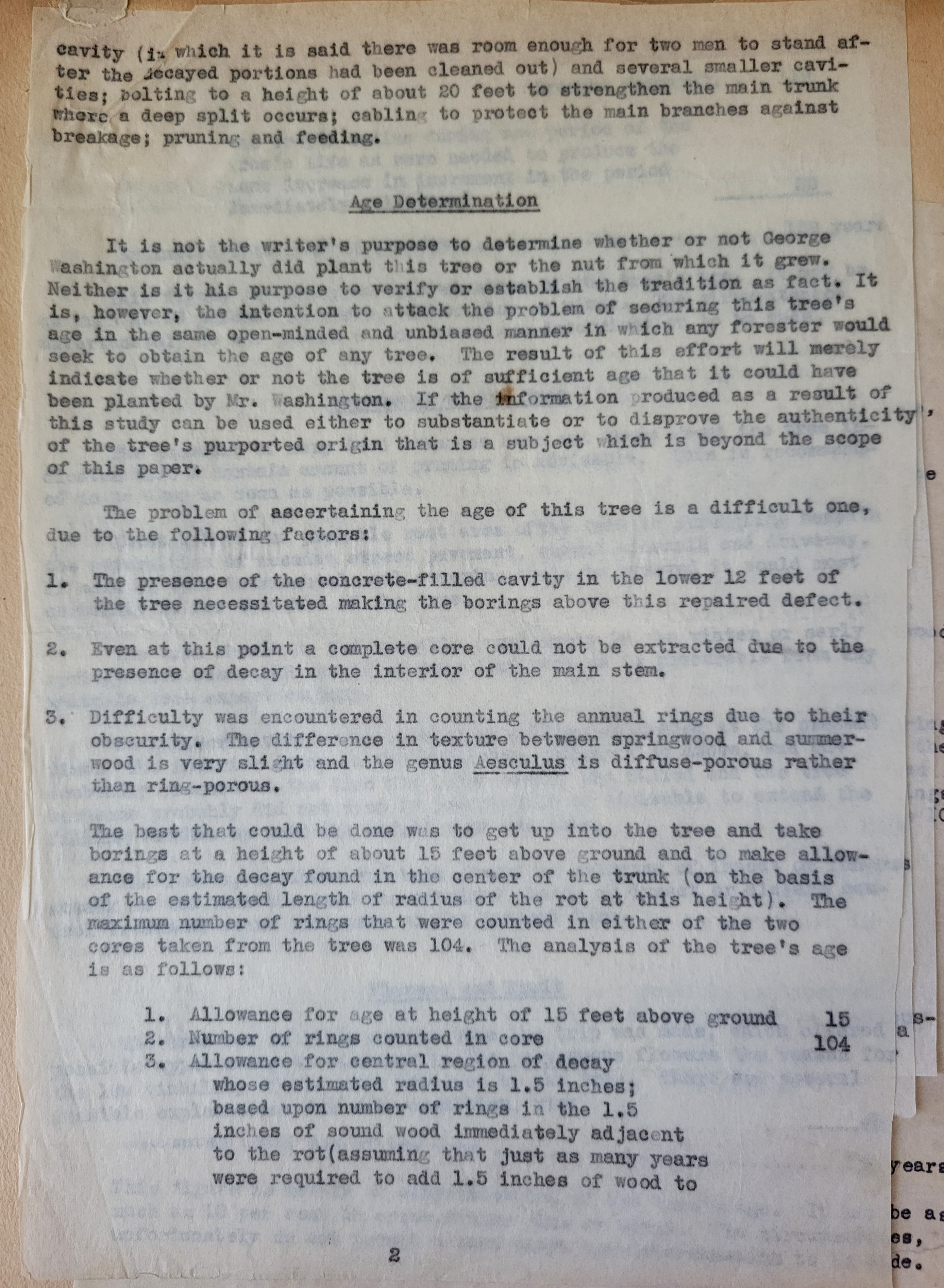
    Age Determination, May 6 1934

    Lastly, local historian James Henry Heron collected local citizens’ recollections of the tree and the story. Mrs. Lilias Hamilton Scott, the wife of Mr. John Scott, who owned the lot on which the tree stands, wrote that her grandmother (Mrs. Janet Scott Hamilton) stated her great-grandmother (Mrs. Francis Scott) resided in Fredericksburg in 1788 and was Mary Washington’s neighbor and intimate friend. She said the trees were planted by Washington.

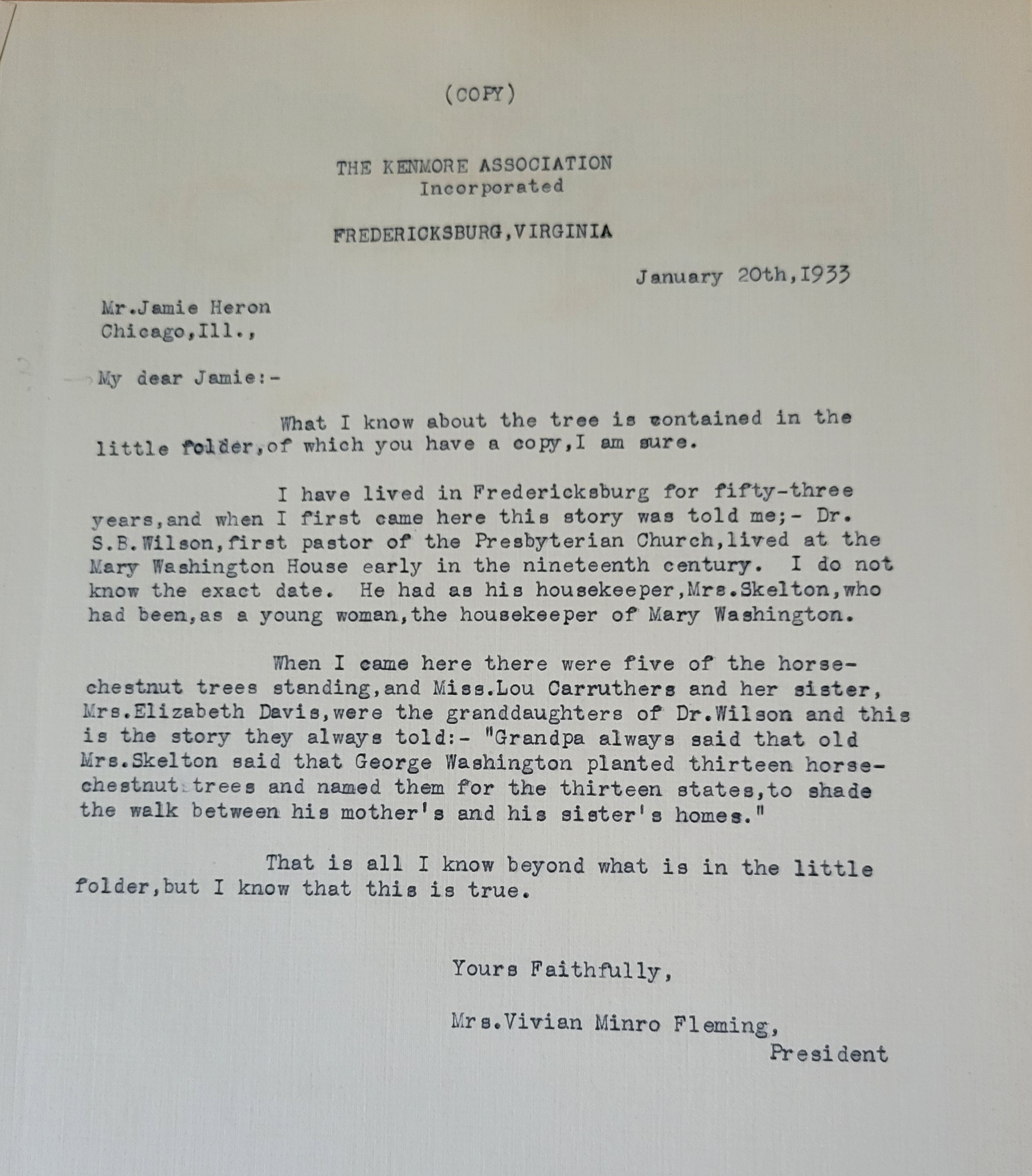
    Mrs. Vivian Minor Fleming traces the story back to Miss Lou Carruthers, her sister Mrs. Davis, and their grandfather Rev. S.B. Wilson’s housekeeper, Mrs. Polly Skelton, who had previously been a housekeeper for Mary.
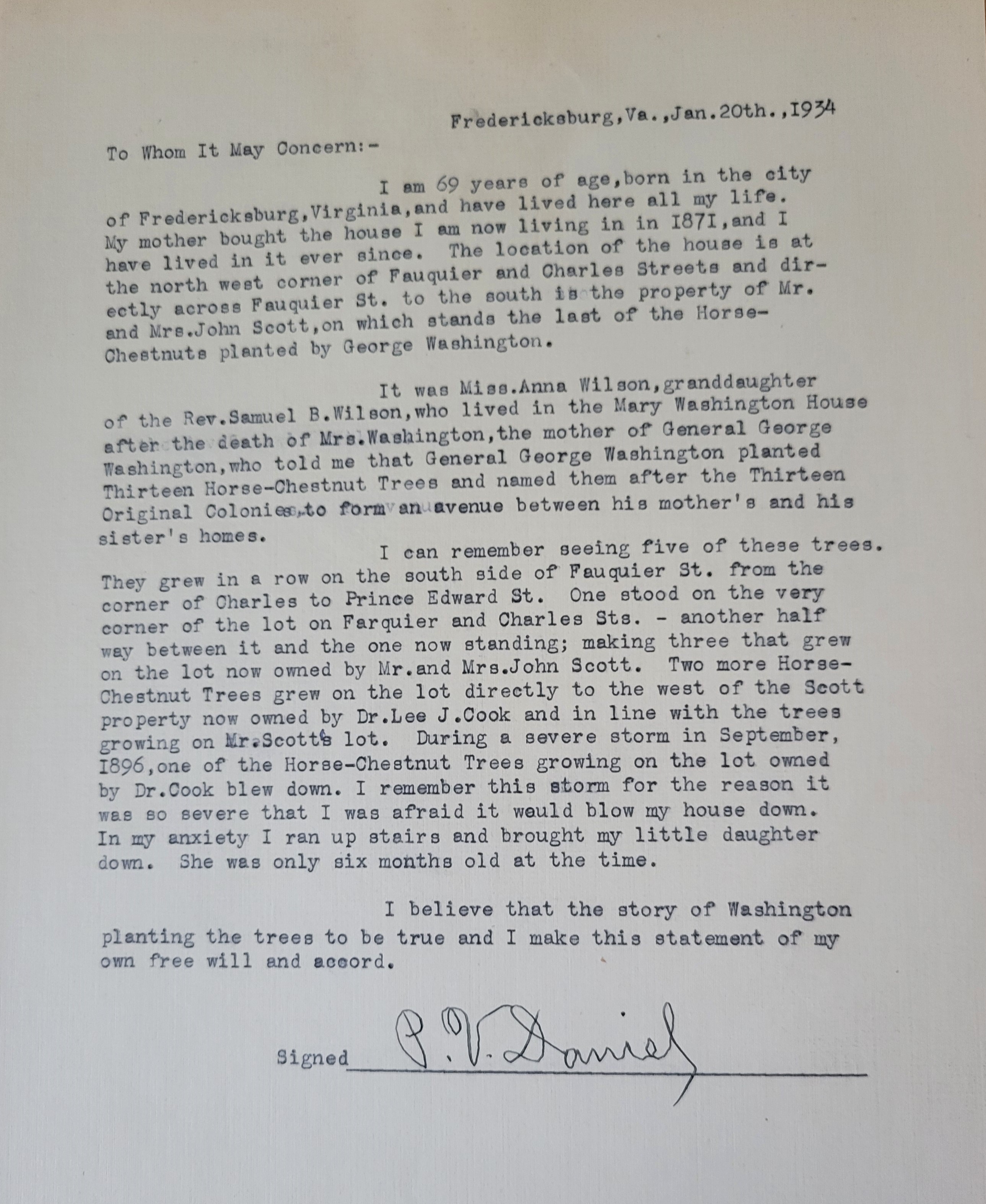
    Mr. P.V. Daniel, who remembers five of the original thirteen trees, lived across the street from the remaining one for over sixty years and said Miss Anna Wilson, granddaughter of Rev. S.B. Wilson, told him the story.
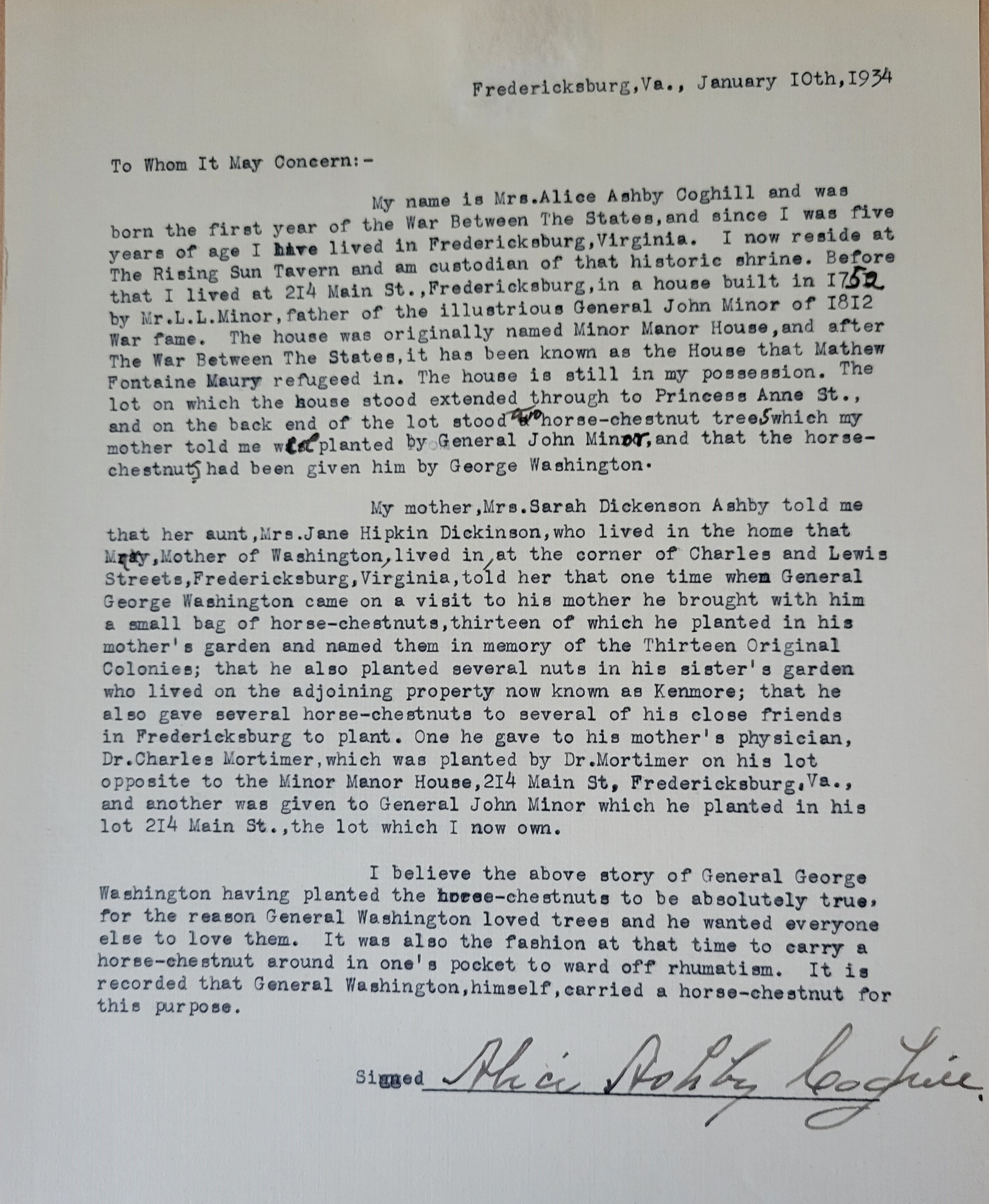
    Mrs. Alice Ashby Coghill says her aunt, Mrs. James Hipkin Dickinson, who lived at Mary Washington House after Rev. S.B. Wilson said Washington planted the trees and passed out horse chestnuts to friends.
    While I have no doubt these people are truthful in their recollections, they do not offer any definite evidence. They merely document that the legend was a well-known story but not that it was true.

    Regardless, the much-loved old tree was rightfully given proper emergency care with a donation and service from Senator Martin L. Davey from Ohio and The Davey Tree Expert Company. The famous tree lived happily for over another half century before being taken down in 2004.
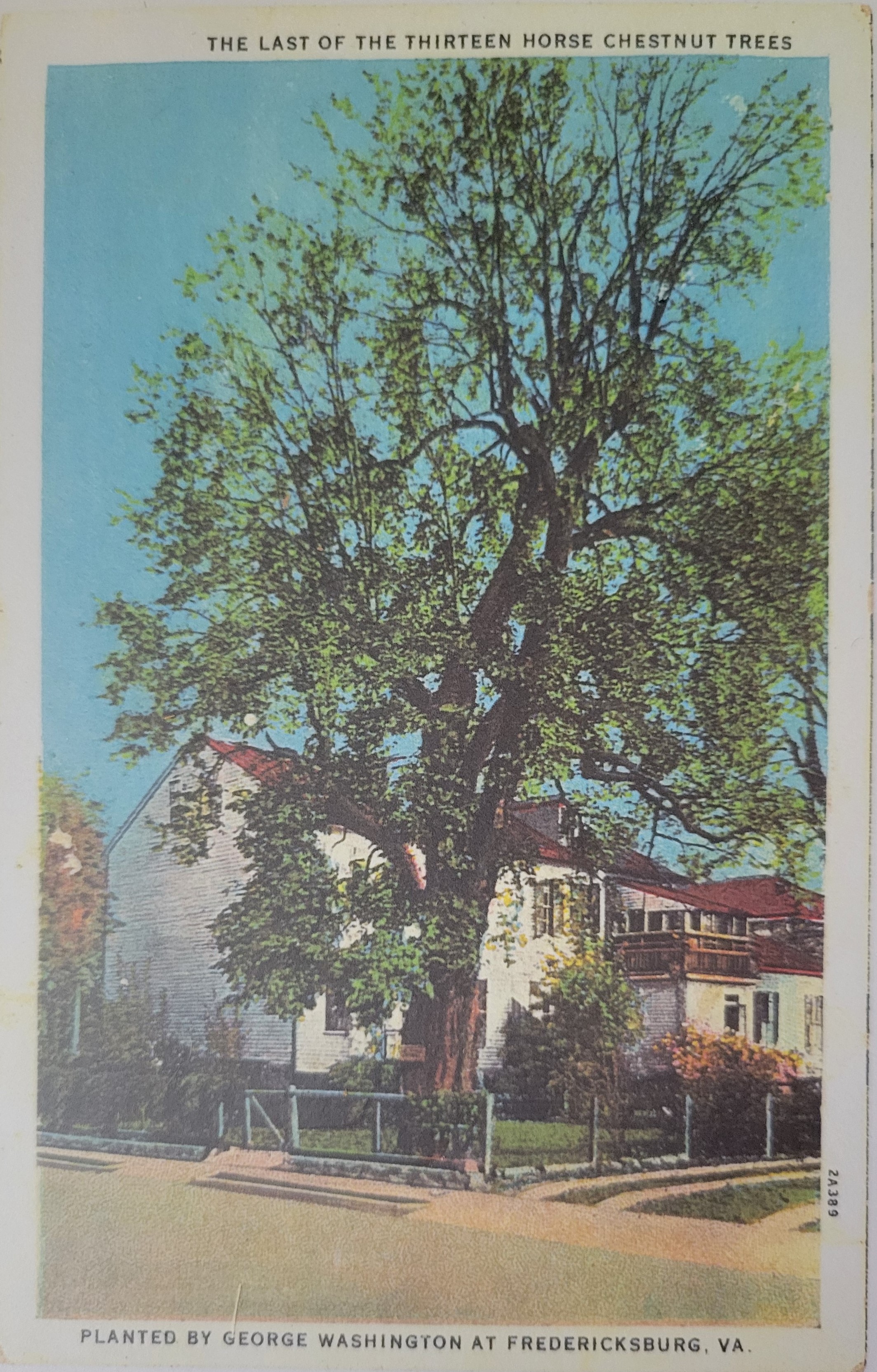
    Whether this tree was planted by George along with twelve others will probably never be conclusively proven. Were the people wrong to save the tree all those years ago without better evidence? Absolutely not. They saved a beautiful 200-year-old horse chestnut tree with a legendary attachment to George Washington, but they also saved a bit of their own past, nostalgia, and pride in their own town’s history.


    Heather Baldus

    Collections Manager
  • Where is Whieldon? Survey Says: Probably Not on Your Table

    Archaeologists tend to have strong feelings about ceramics. Ceramics can play a major role in interpreting a site, as their materials often reflect their function. This can be helpful when determining how a site was used. For instance, finding an abundance of redwares and stonewares could indicate a primarily utilitarian site like what would have been used in our Cellar House whereas porcelain and refined earthenwares may reflect a more domestic space.  So, it really isn’t surprising that we feel some type of way about these artifacts.

    But don’t let that fool you. Archaeologists have feelings about ceramics based solely on their appearance as well. It has come to my attention that Whieldon Ware just might hold the title as the most polarizing ceramic type as of late. These feelings were made very apparent during our recent acquisition of some Whieldon Ware pieces. Most either love or hate it; rarely is there an in-between.  Before we get into the ceramic and its distinct look that conjures images of either vomit or a work of art (depending on whom you ask), let’s go over a little background on its creator, Thomas Whieldon.

    Thomas Whieldon was an influential English potter producing examples of early creamware beginning in the mid-18th century. He gained popularity for his innovative shapes and decoration, which can be seen on various figurines, dishes, and other vessels. Whieldon is also well known for his partnership with the MVP of the ceramics world, Josiah Wedgwood, Mr. Creamware himself. Together, they developed advances in the realm of refined earthenware, like the perfecting of the green glaze as seen on the pineappleware we have found at Ferry Farm (Wedgwood & Ormsbee, 1947).

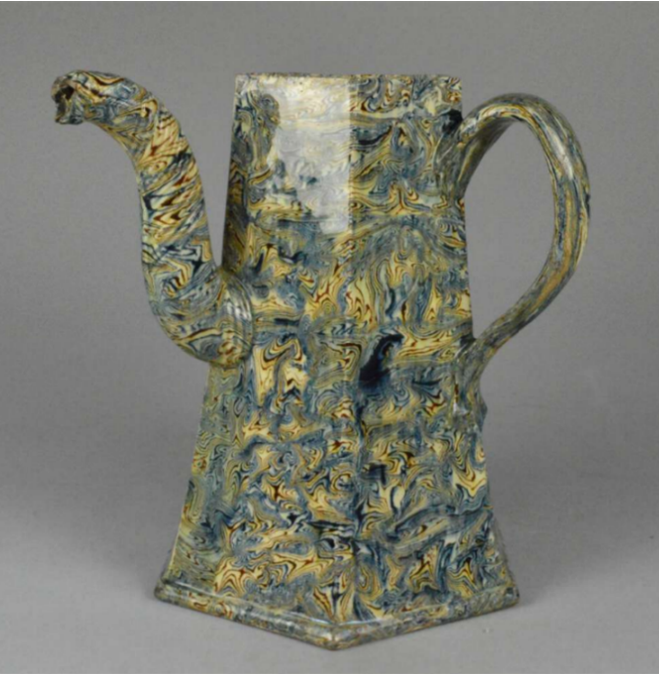
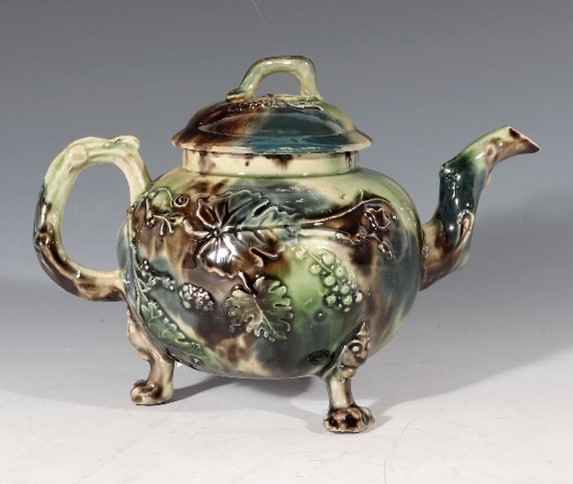
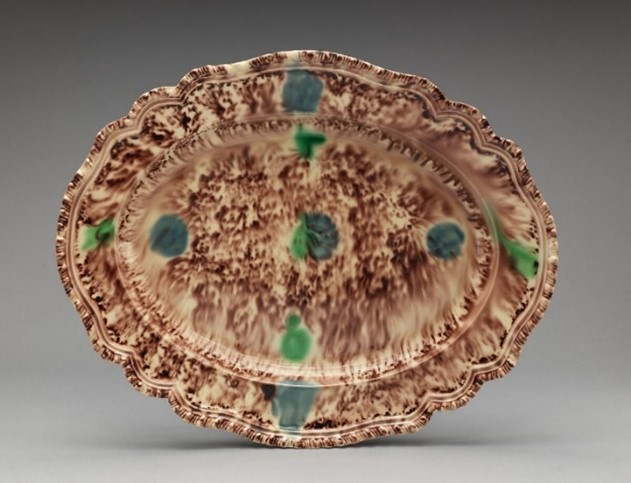
    With that said, what we commonly think of when referring to Whieldon Ware is Whieldon’s tortoiseshell or clouded wares. These were created by sponging metal oxides on cream-colored earthenware and then adding a clear lead glaze. The mixing of the metal oxides with the liquid glaze caused the colors to blend and streak, creating splotches of green, yellow, purple, blue, and brown, depending on the types of metal oxides used (Gallagher, 2015). This resulted in a clouded or tortoiseshell decoration. Due to the nature of the technique, no two pieces look exactly the same. For Whieldon lovers like myself, the uniqueness of each piece gives it its charm.

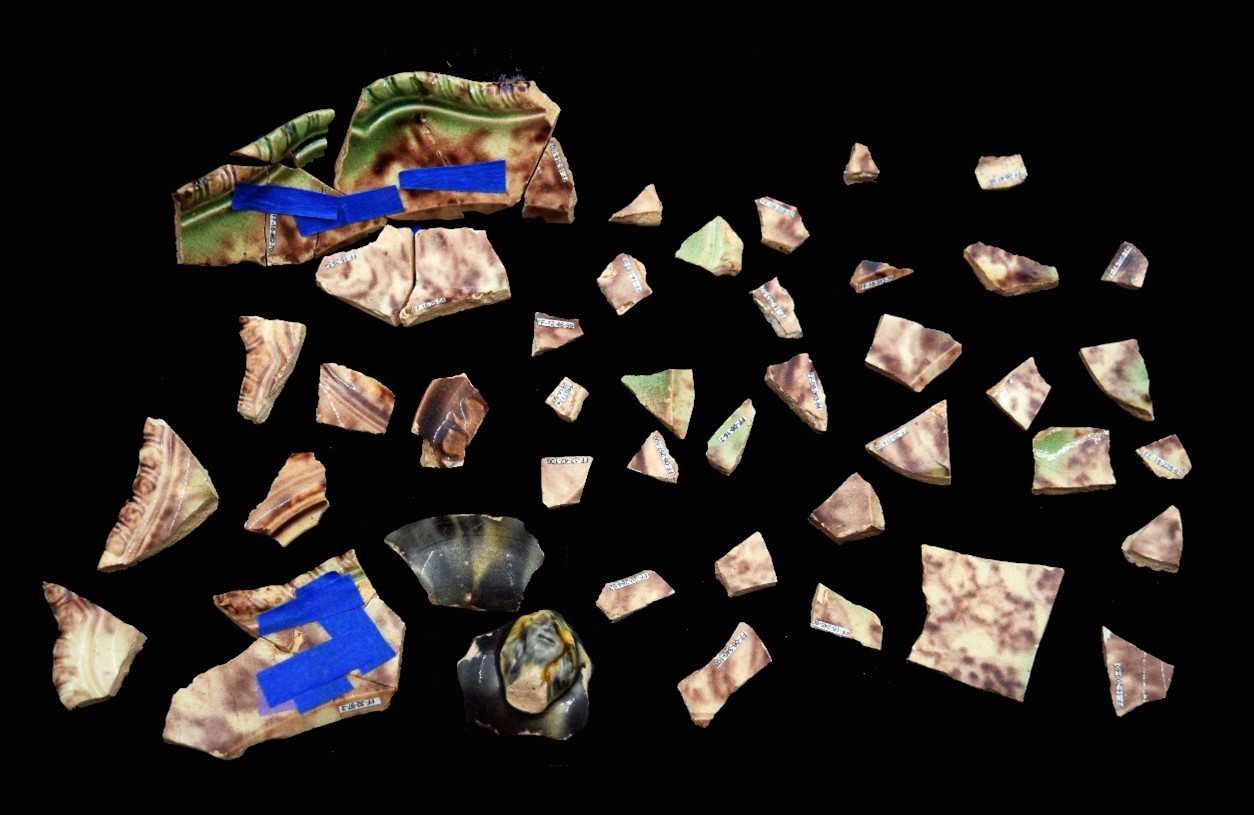
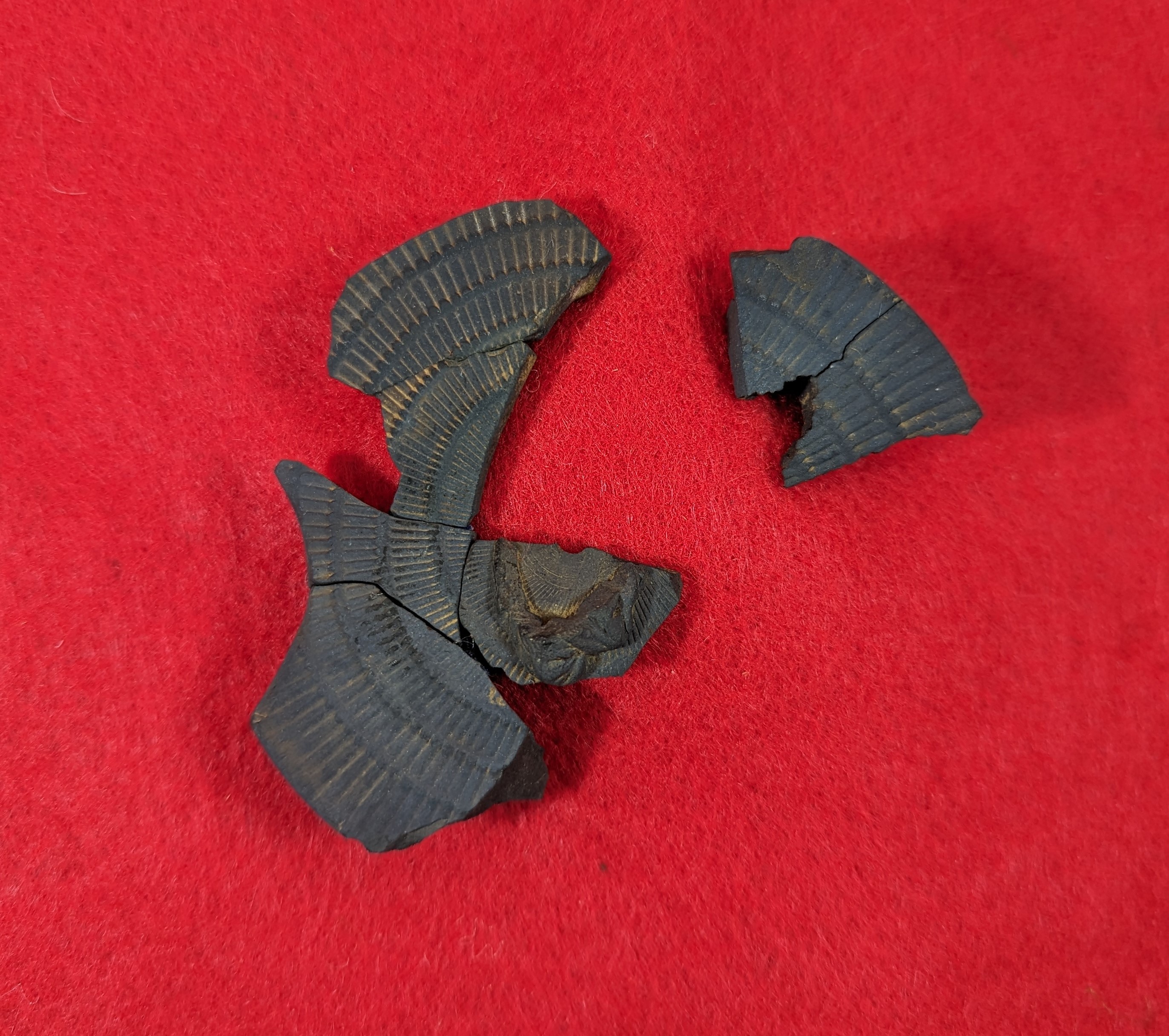
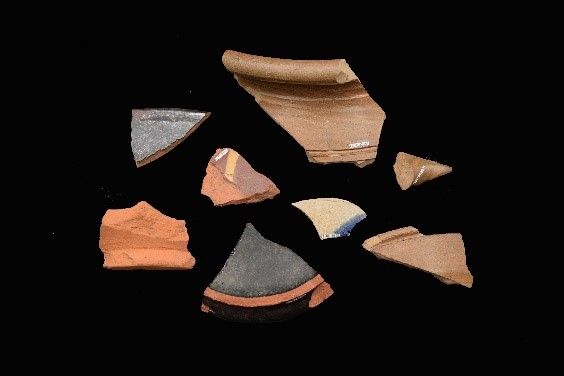
    Now that we know more about Whieldon Ware and how some of us feel about it today, let’s talk about how Mary Washington may have felt about it. I firmly believe that she was not team Vomit Ware and instead found the decoration quite desirable. Our excavations have found evidence of at least four Whieldon Ware plates, a teapot, teacup, and other medium-sized holloware vessels at Ferry Farm. Considering the short-lived popularity of the type, lasting only from 1740-1775, we can be quite certain that it was Mary who was buying these items.

    Some Whieldon Ware vessel mends and sherds excavated at Ferry Farm

    Toward the end of the 1770’s, Whieldon Ware quickly went out of style and was replaced by Wedgwood’s new, improved creamware and its more subtle decoration. While it may have gone out of style, potters continued to replicate the technique for many years, which makes it difficult to attribute all examples of the type to Whieldon himself. After 1780, he retired from the business, demolished his factory, built an ornamental garden in its place, and spent the rest of his years as a sheriff (Hildyard, 2005; The London Gazette, 1785).

    So, there you have it, the very brief story of Whieldon and his wares.

     While Mary Washington and a couple of us in the lab are Team Whieldon all day, every day (or at least the days concerning Whieldon), the majority are a hard pass.  Where do you stand? Are you Team Whieldon or team Whieldout?

    Danielle Arens

    GWF Archaeologist


    References

    Gallagher, B. (2015). British Ceramics 1675-1825: The Mint Museum. Charlotte: The Mint Museum.

    Hildyard, R. (2005). English Pottery 1620-1840. London: V&A Publications.

    The London Gazette. (1785, November 12). The London Gazette(12699), p. 522.

    Wedgwood, J., & Ormsbee, T. H. (1947). Staffordshire Pottery. New York: Robert M. McBride & Company.

    Images

    https://www.britishmuseum.org/collection/object/H_1938-0314-47-CR – figurine

    https://www.britishmuseum.org/collection/object/H_1923-0122-13-CR – coffee pot

    https://www.metmuseum.org/art/collection/search/237853?who=Whieldon%2c+Thomas%2c+factory%24Thomas+Whieldon+factory%2c+Stoke-on-Trent%2c+Fenton+Vivian%2c+Staffordshire&ao=on&ft=*&offset=0&rpp=20&pos=3  – platter

    https://vandekar.com/inventory/Ceramics/British%20Pottery/Whieldon/works/26486 – tea pot


  • Seeing The Big Picture:  How Excavated Ceramics Informed The George Washington Foundation’s Acquisition of Complete Pieces for Display

    The archaeology and curatorial departments for The George Washington Foundation have long worked together to furnish the reproduced Washington house with historically accurate items that resemble as closely as possible the ones that George and his family would have lived with daily. These pieces are not originals, which means visitors touring the house can handle them.

    Go ahead and touch everything.

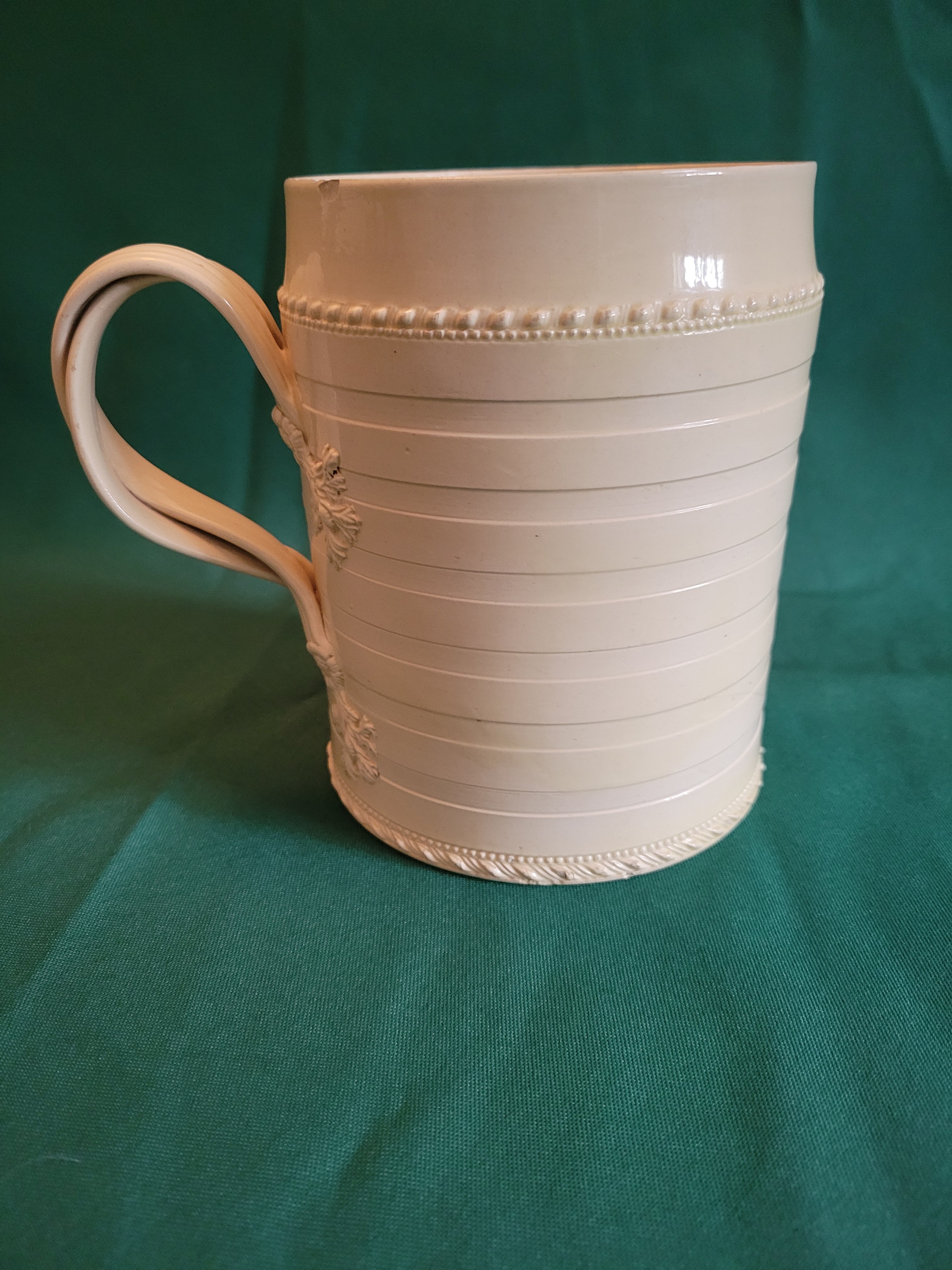
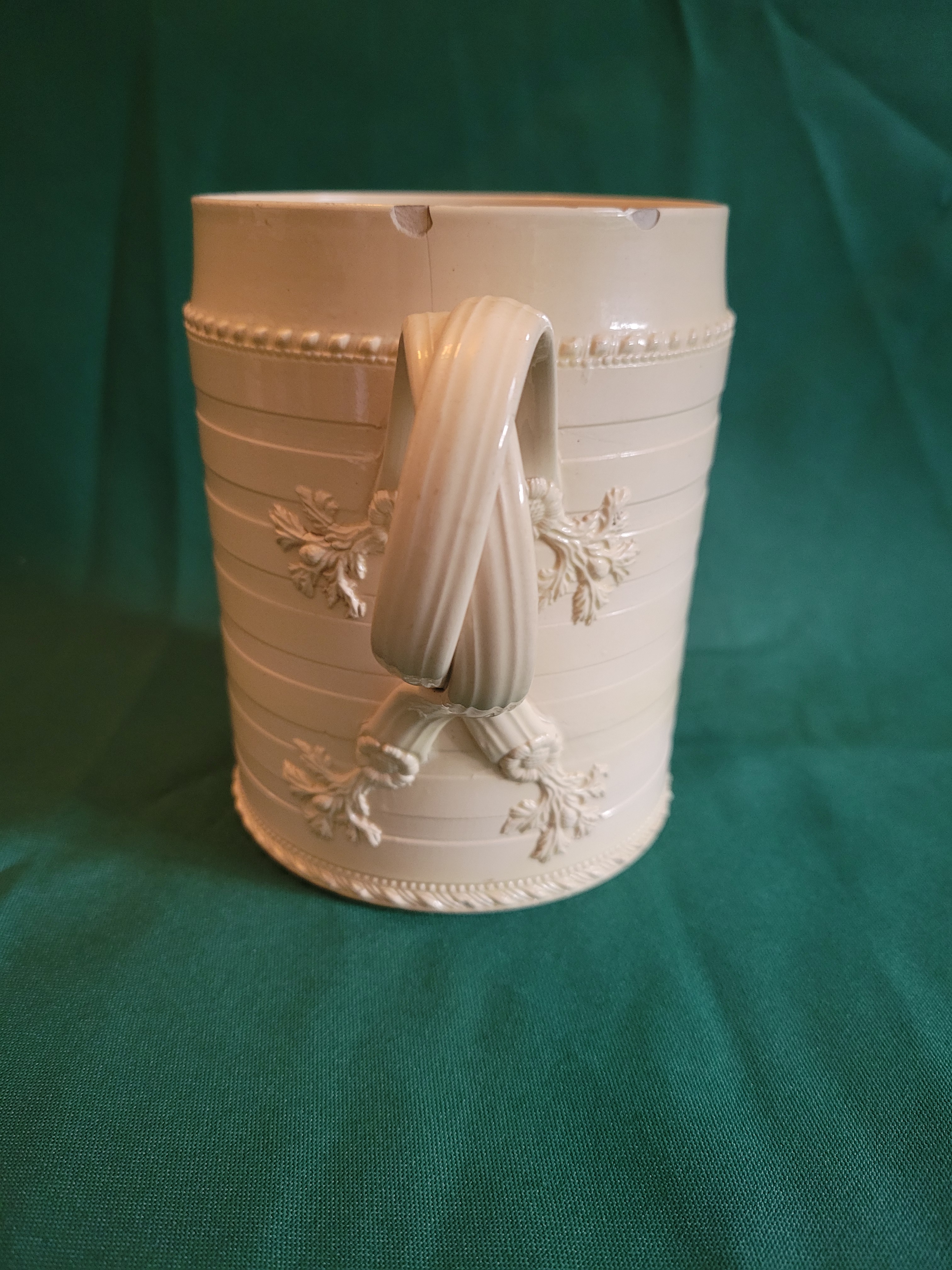
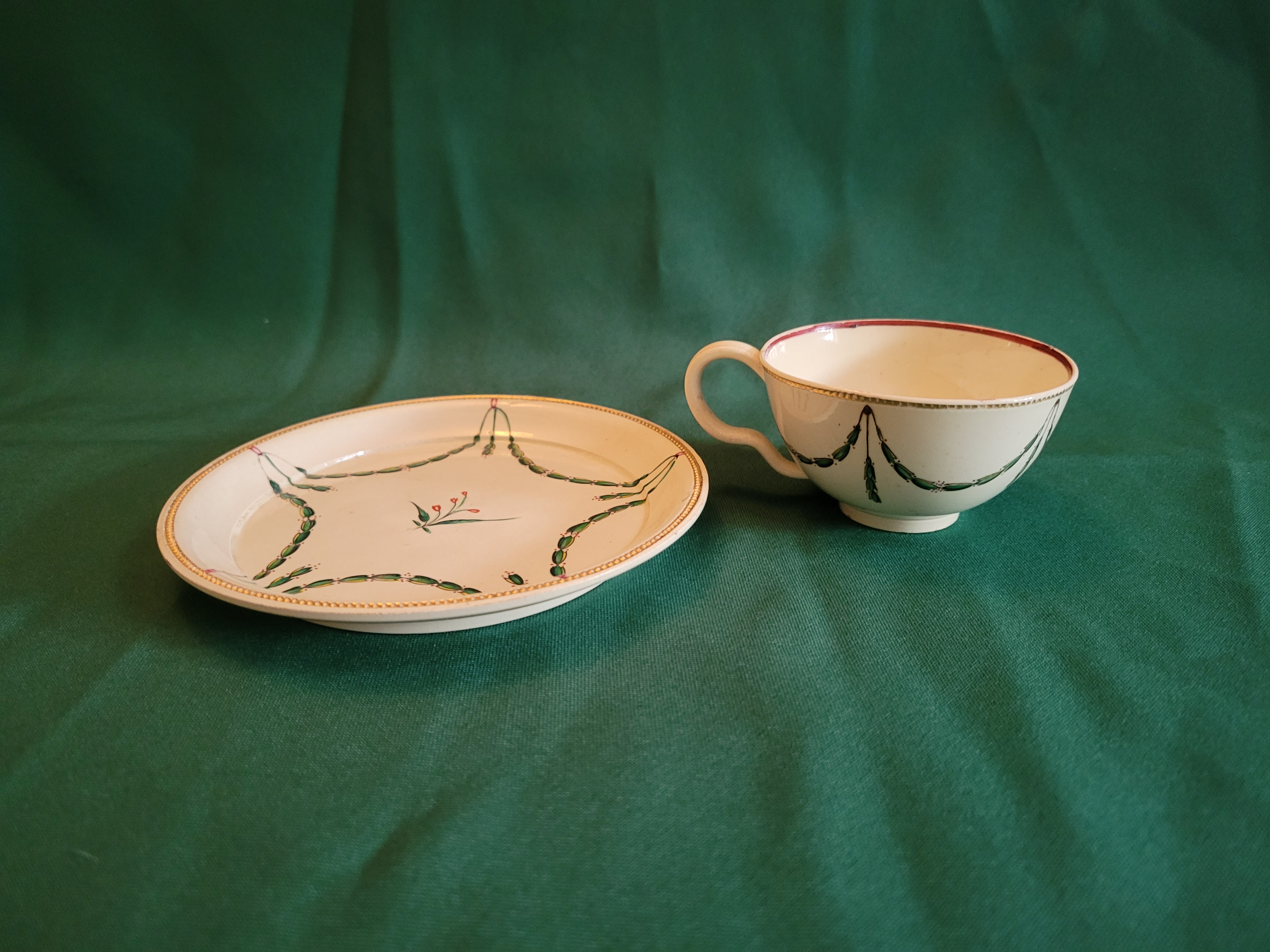
    In our latest collaboration we’ve been examining sherds of ceramic vessels owned by the Washington’s to obtain actual eighteenth-century dishes. We want to display these dishes in our gallery to give visitors an idea of what the whole vessels looked like. Four such ceramics have recently been acquired at auctions by the Foundation and you can see them first here along with the excavated remnants they resemble.

    Three of our acquisitions are a type of English ceramic called ‘creamware,’ which was invented in the early 1760’s and was very popular with George’s mother, Mary. Both this lovely pitcher and mug exhibit decorative elements represented by our excavated ceramics. Most prominent are the elegantly curved handles that terminate in delicate strawberry flowers. At least two vessels with these types of handles have been recovered at Ferry Farm. The first is a highly decorative creamware sauce boat and the second a petite teacup, both of which were considered quite fashionable for the time. The jug and teacup also share a common form of decoration called a ‘beaded rim.’

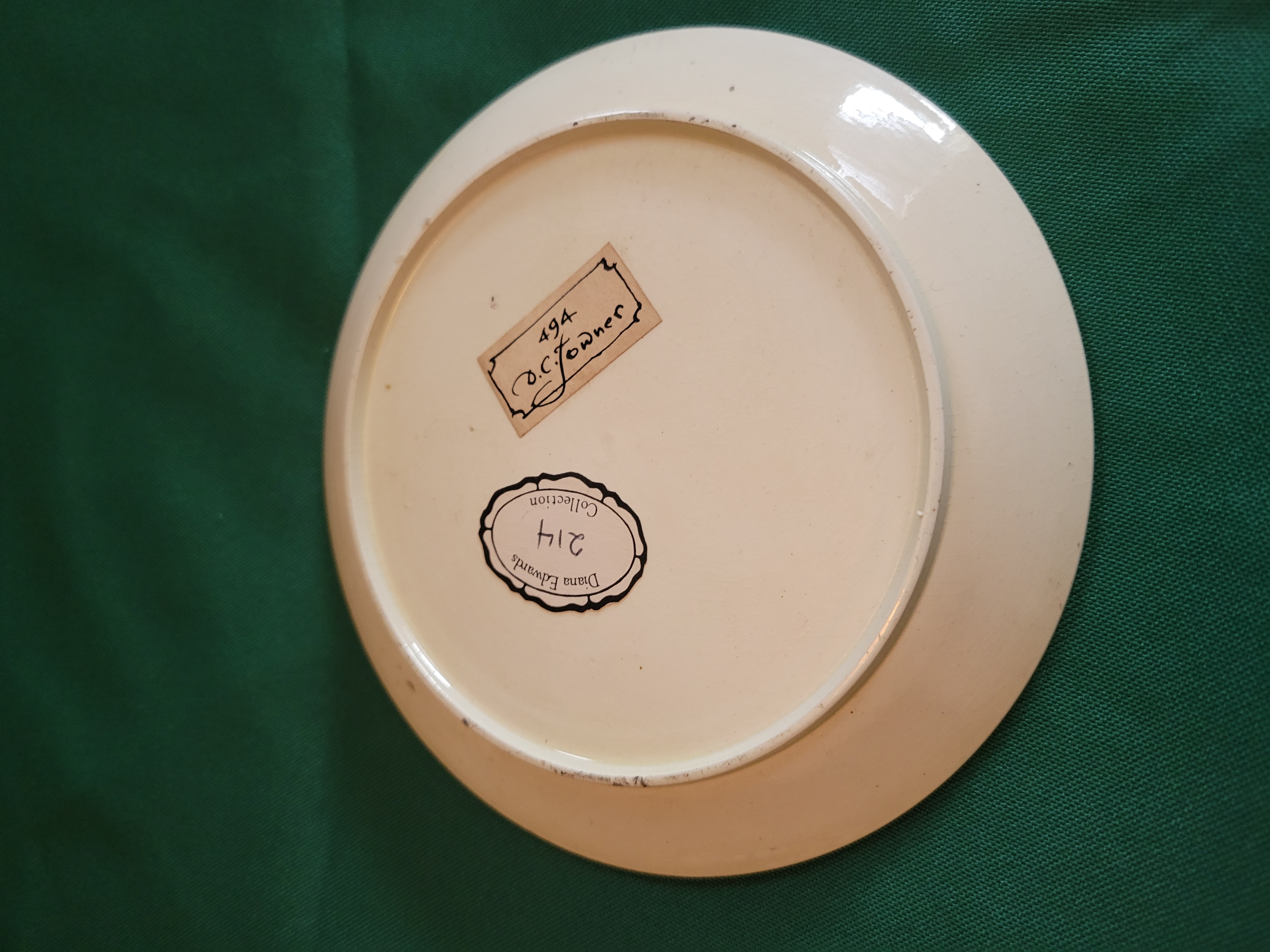
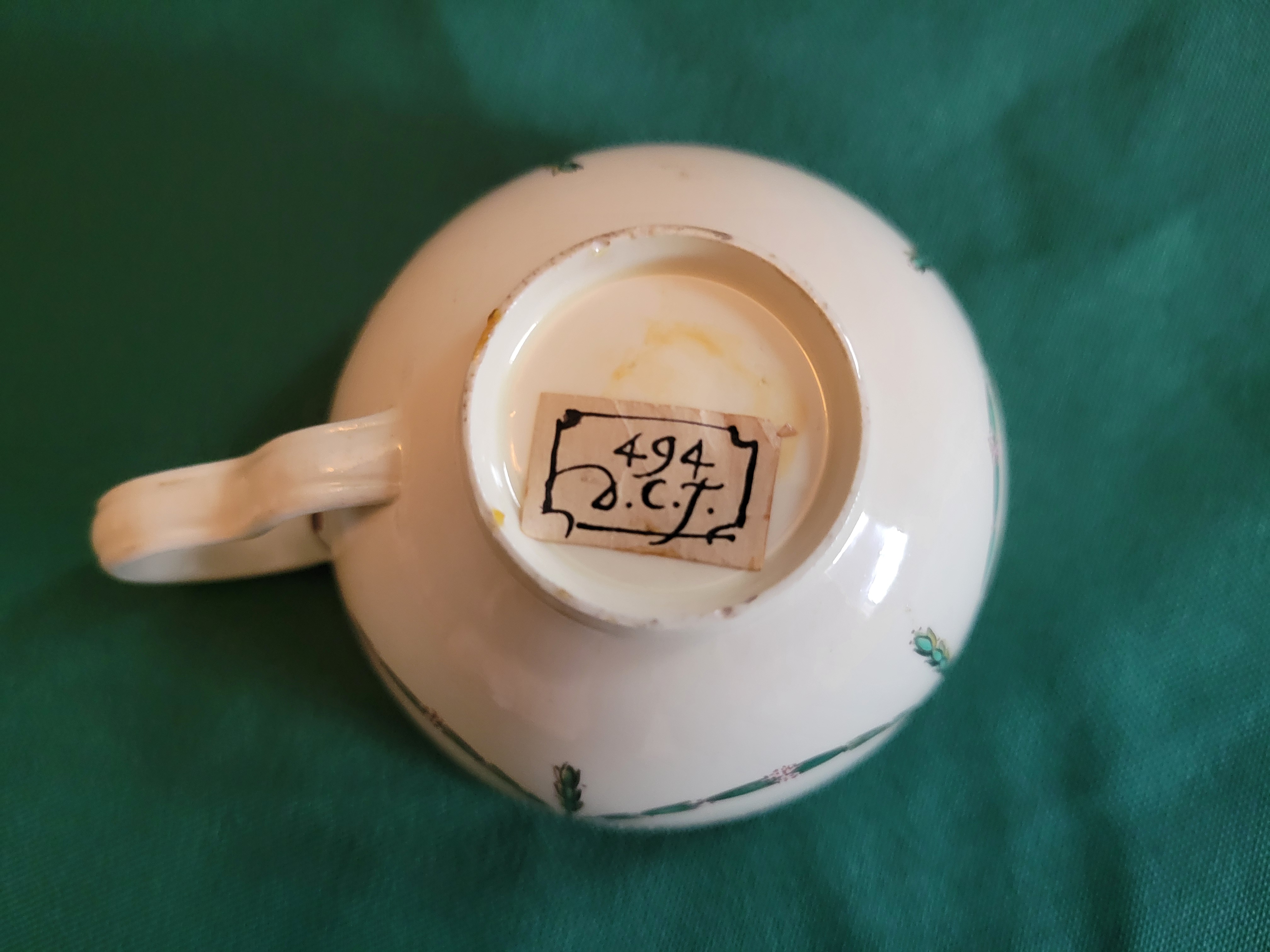
    Another teacup owned by Mary was this beautiful piece hand-painted with a detailed swag motif. But from the sherds it’s difficult to really appreciate how graceful this decoration is. Luckily, our curators hunted down a similar cup and saucer with the same decoration, which is unusual. The saucer also features a beaded rim that has been filled in with gold gilding, although we believe the gold to be a later addition to the piece. The cup and saucer also have handwritten tags affixed to the bases which indicate they had the distinction of having been in the collection of a well-known (at least to ceramics geeks like yours truly) collector of creamware. This man by the name of Donald Towner had written extensively on the topic of English ceramics and over his career had amassed a large study collection, of which this was one. His book on the Leeds Pottery in England features a catalogue from the pottery that includes many of the decorative elements and shapes discussed above (Towner, 1965).

    But my favorite is this delightfully potbellied creamer with three legs featuring lion’s heads and paws for feet. The ceramic type in question is called Whieldon and started to come on the market in England around 1749. Of note is the raised molded leaf decoration which resembles one sherd from our collection. While we may never know the exact type of vessel our leaf came from, the complete creamer gives one a better idea of how the decoration was placed and looked. Mary’s choice of ceramics played a large part in emphasizing her and her children’s place among the Virginia Gentry and we’re very pleased to have some whole examples now to help illustrate to visitors just how lovely some of these dishes were!

    Mara Kaktins, Archaeologist & Lab Manager


    Bibliography

    Towner, Donald.  The Leeds Pottery, 1965.  Taplinger Publishing Co., Inc., New York. 

  • Spoooooooooky Teapots?

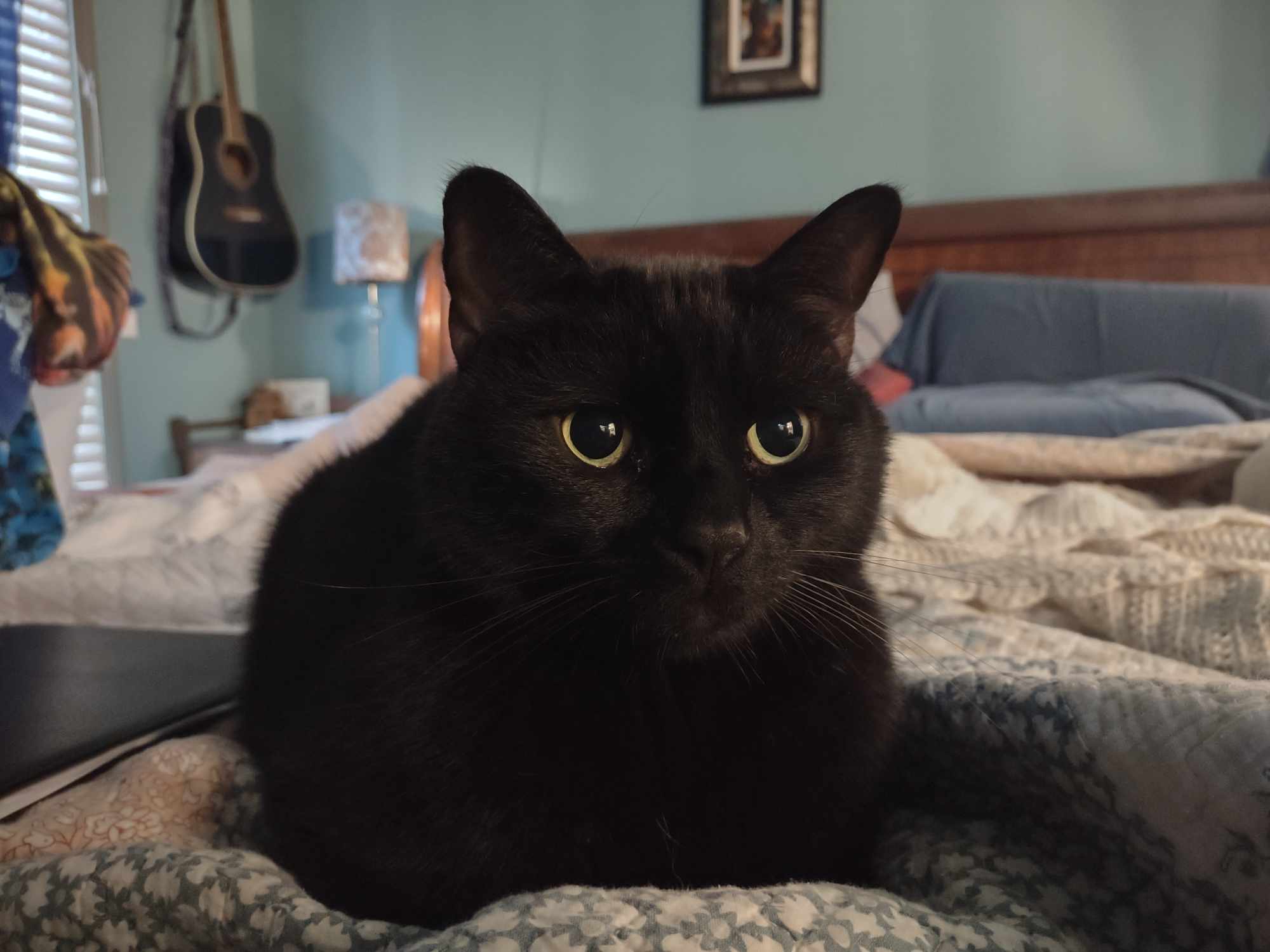
    There’s plenty to be frightened about in the colonial period. But teapots? Not exactly. However, aesthetics change as time passes. We see things through different lenses. As I type this, my substantial black cat with big yellow eyes stares at me, demanding attention.

    Poe, the big black cat with yellow eyes.

    Black animals are currently the least likely to be adopted in the United States, so black can be seen as a negative in pets…but what about black teapots?

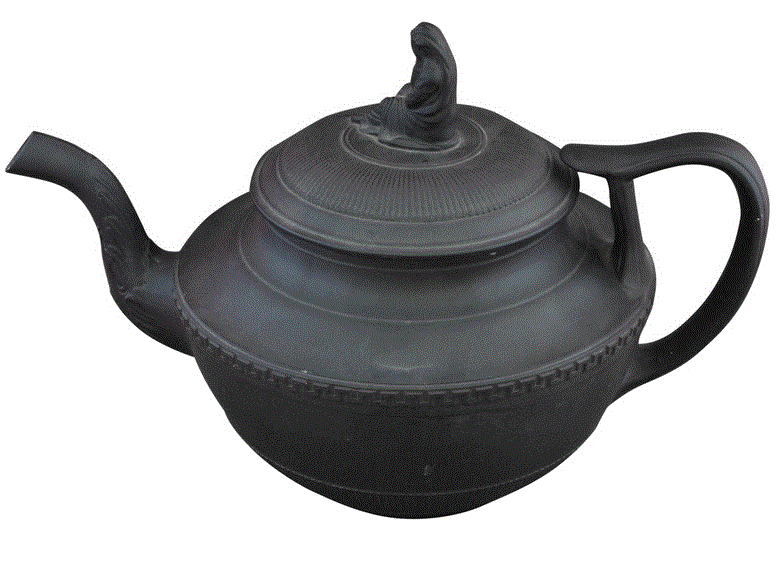
    Black Basalt Teapot, Turner, circa 1805

    Turns out, they were very much the rage during the middle of the 18th century and even into the early 20th century. 

    “Black is sterling and will last forever.”

    In 1767, Josiah Wedgwood started working with black basalts – a richly hued, glossy black stoneware medium – for his famous Etruscan vases. Wedgewood’s basalt is made from reddish-brown clay that burns black in the firing process; black basalt owes its color to the addition of manganese. [1]  [2]

    After Wedgwood perfected the fine-grained stoneware, it was soon being produced by other Staffordshire potters in England. It was called ‘Black Basalt’ or ‘Egyptian Black.’ [3] [4]  A matte black teaware that was striking and, by our modern estimations, quite possibly macabre. 

    Black Basalt teapots were decorated utilizing a new technology called ‘engine turning’ lathes. Simple turning lathes have been used for pottery production since the early 1700s. By the 1730s, virtually all hollow wares (mugs, jugs, cups, bowls, etc.) were being lathe-turned to shape and thin bodies. The engine-turning lathe further provided the ability to cut regular patterns in the clay bodies to create decorative elements. [5] The decorative elements at the time were heavily influenced by classical art from Ancient Greece and Rome. [6] 

    A striking finial accented the lovely neoclassical etches on the body of the matte black pot.

    Teapot, Circa 1800, Black Basalt, Mayer Manufacture, Staffordshire, England

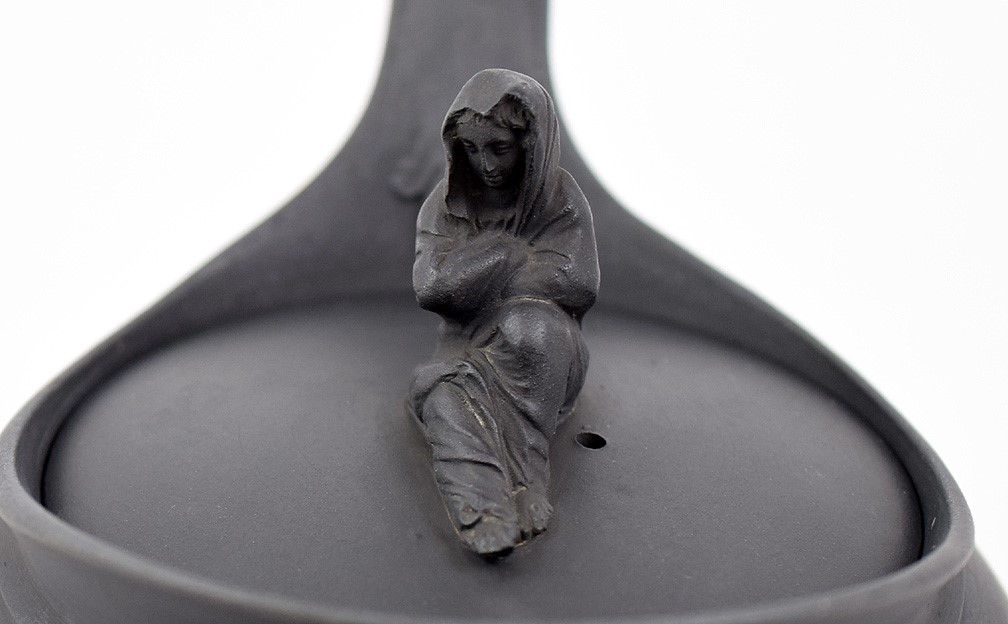
    What is a finial? The little knob on the top of the lid. This is where it gets weird for our modern-day eyes. Some looked like women hunched over, draped in mourning clothes or grieving widows. Add this to the black body, and the oddly shaped pots start to take on a dark tone. 

    Woman Finial

    Mary Washington owned an early iteration of these black basalt pots, but was it for mourning purposes? Not likely.

    Her husband Augustine died in 1743, early into the family’s occupation at Ferry Farm. This would have been before the invention of this style of pottery and well before strict (and quite frankly tedious) Victorian mourning rituals. A black teapot may seem to symbolize some outward decorative display of bereavement or grief (particularly with a sad woman finial). Yet, to Mary, it would have just been a neoclassical design in the latest black basalt trend. She was just being her fashionable self. Her teaware collection was pretty admirable, and the fact that she owned a black basalt teapot is not surprising. 

    But that shouldn’t stop us from enjoying beautiful and somewhat spooky teapots.


    Mara Kaktins, Archaeologist & Lab Manager

    Sources

      [1] M.S. Rau. (2019, December 11). Wedgwood: A collector’s guide to English ceramic treasures. https://rauantiques.com/blogs/canvases-carats-and-curiosities/wedgwood-collectors-guide

    [2] Todd, L. M. (2020, December 17). Rediscovering Black basalt one of Josiah Wedgwood’s first and most enduring inventions. Architectural Digest. https://www.architecturaldigest.com/story/rediscovering-black-basalt-one-of-josiah-wedgwoods-first-and-most-enduring-inventions

    [3] STONEWARE, BLACK BASALT – Type Index | Historical Archaeology Type Gallery. (n.d.). https://www.floridamuseum.ufl.edu/typeceramics/type/stoneware-black-basalt/

    [4] The Mint Museum. (2023, January 24). Classic Black: The Basalt sculpture of Wedgwood and his contemporaries – Mint Museum. Mint Museum. https://www.mintmuseum.org/exhibition/classic-black/

    [5] The Chipstone Foundation. (n.d.). https://www.chipstone.org/article.php/151/Ceramics-in-America-2004/The-Little-Engine-That-Could:-Adaptation-of-the-Engine-Turning-Lathe-in-the-Pottery-Industry

    [6] Portals to the Past: British ceramics 1675-1825 – Google Arts & Culture. (n.d.-b). Google Arts & Culture. https://artsandculture.google.com/story/portals-to-the-past-british-ceramics-1675-1825/GgUh1Et0LThYLw

  • A Short and Sweet History of the Gingerbread House

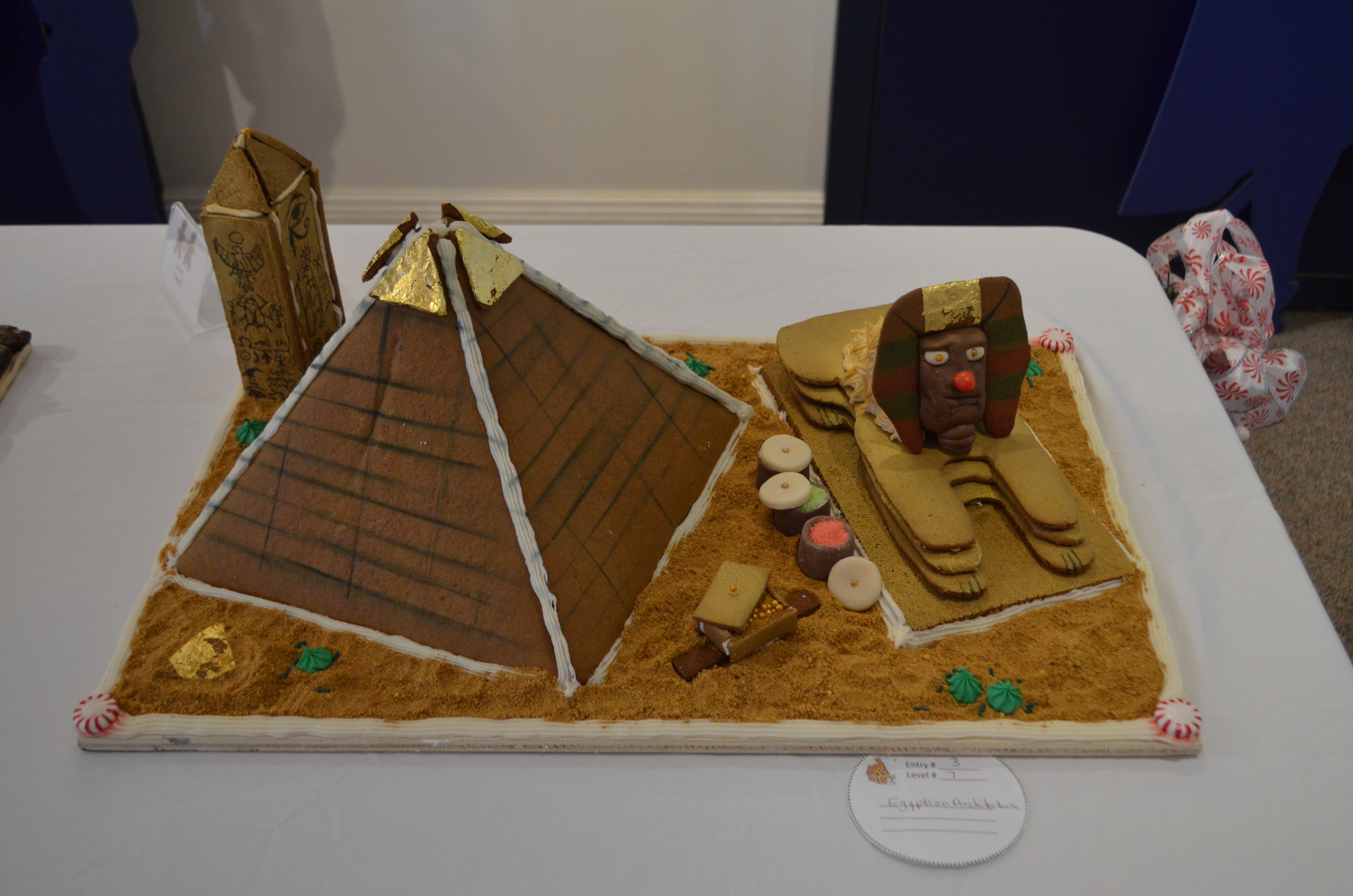
    If you visit George Washington’s Ferry Farm this December, you’ll be greeted by the sweet smell of spiced gingerbread as soon as you walk through the door! During our annual Gingerbread House Contest and Exhibit, our gallery space is transformed into a showroom with entries reflecting this year’s theme: “architectural wonders of the world.” Unlike their real-life counterparts, these architectural wonders are all baked out of gingerbread and creatively decorated with icing and candies. Baking gingerbread is a great way to get in the holiday spirit, and in many cultures, gingerbread has long been associated with the holiday season. But where, exactly, did these gingerbread traditions originate?

    The Tower Bridge on display at Ferry Farm

    According to The Oxford Companion to Sugar and Sweets, the term “gingerbread” refers to a wide variety of baked goods ranging from rolled cookies to dense cakes that are “flavored with a combination of spices such as ginger, cinnamon, cloves, and nutmeg, and sweetened with honey, sugar, or molasses.” Some gingerbread variations can be traced back to antiquity, like the honey-sweetened cakes baked in ancient Egypt and Greece. Variations closer to what we consider gingerbread today (think gingerbread men and gingerbread loaves) became popular in northern Europe during the Middle Ages. Germany, in particular, became well known for its spiced gingerbreads, or lebkuchen.

    Nuremberg Lebkuchen

    German lebkuchen can trace its origins as far back as the 14th century, when gingerbread baking was associated with local monasteries and, later, professional bakers’ guilds. In Nuremberg, now world famous for its lebkuchen, honey was a locally accessible sweetener due to the city’s abundant forests and honeybee population. The medieval city was also at the crossroads of trade, which meant imported spices were readily available to Nuremberg monks and bakers. Before the invention of metal molds and cookie cutters, bakers used wooden molds carved with elaborate patterns to make and decorate gingerbread. Bakers shaped the cookies into different figures like animals and saints, and when intended as gifts for nobility, even added gilded decoration!

    Today, although recipes vary, lebkuchen ingredients often incorporate some variation of honey, nuts, coriander, cloves, ginger, nutmeg, and candied fruit. “Nuremberg lebkuchen” has a higher nut content than any other variety. “Lebkuchenherzen” (or “Lebkuchen hearts”) are heart-shaped gingerbread decorated with written icing inscriptions. The hearts can be hung as decoration and are often sold at Christmas markets and during Oktoberfest.

    Lebkuchenherzen on display at a market.

    By the 1800s, making gingerbread houses was a popular activity in Germany. Perhaps unsurprisingly, a tale involving a candy-coated house also began to circulate during this time. Originally published in 1812 by the brothers Jacob and Wilhelm Grimm, Hansel and Gretel tells the story of two children lost in the woods who stumble upon a witch’s house made of bread, cakes, and sugar. The evil witch captures the children when she discovers them munching on her house!

    1909 Illustration by Arthur Rackham, Hansel and Gretel encounter the witch outside her house.

    The story of Hansel and Gretel has remained popular to this day, and many different iterations of the tale exist. It’s unclear exactly which event precipitated the other (did the fairytale popularize gingerbread houses, or was an existing gingerbread house tradition simply incorporated into the story?) What is clear, however, is that gingerbread houses had become popular in Germany! When Germans immigrated to new places, they took these traditions with them, and the baking and making of gingerbread houses became popular elsewhere too. Today, whether created from a store-bought kit or handmade dough, gingerbread house-making is a popular activity for adults and children alike and is closely tied to the Christmas season.

    This “real life” witch’s house inspired by Hansel and Gretel is located in Efteling, a fairy tale theme park in the Netherlands.

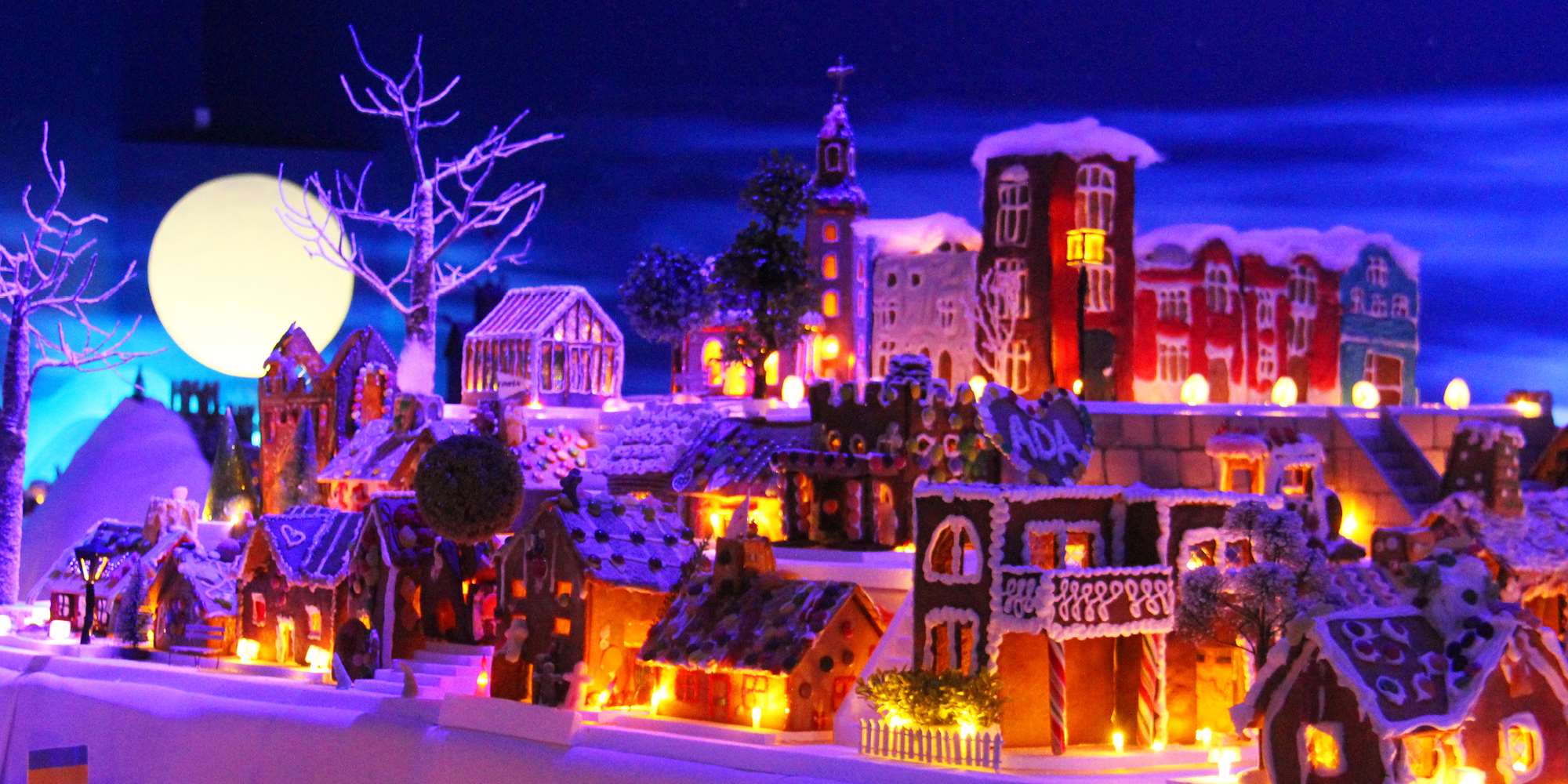
    Beginning in 1991, the city of Bergen, Norway, constructed an entire city…out of gingerbread! The display is made up of more than 2000 gingerbread houses and buildings. Called pepper cookies or “pepperkaker” in Norwegian, the “Pepperkakebyen” Gingerbread Town is made up of pieces constructed by local school children, businesses, and volunteers. The city landscape includes local landmarks, trains, cars, and even boats. While not the only gingerbread town in existence, it is certainly one of the largest and is a testament to the enduring popularity of the gingerbread house!

    The Pepperkakebyen Gingerbread Town

    If you’re interested in delving further into the history of gingerbread, check out two of our past Lives & Legacies blog posts where we’ve written about Mary Washington serving gingerbread to Lafayette and the Kenmore Association’s ties to the sweet treat. If you’re interested in seeing Ferry Farm’s own Gingerbread House Contest and Exhibit, be sure to stop in before the exhibit closes on December 30th and also vote on your favorite entry!

    A pyramid and sphynx made of gingerbread on display at Ferry Farm

    Further Reading: The Oxford Companion to Sugar and Sweets. (2015). United Kingdom: Oxford University Press.

    Ann Waters

    Manager of Interpretation & Visitor Services

  • Behind the Glass of the Archaeology Lab: Creating an Exhibit

    It can be daunting to look at a blank space and realize you are in charge of filling it. And not just filling it, you need to create something that will leave a lasting impression on the public. The process of creating an exhibit is much more complicated than it seems. From the initial idea to the final product, there are many steps that require careful attention.

    With countless artifacts in the Archaeology Lab, finding inspiration for a topic was easy. Once I settled on 18th Century tea practices, everything seemed to fall into place. There were many subjects I could have focused on from this topic. In order to connect the idea to Ferry Farm and the Washington legacy, I chose to focus on Betty Washington and what she would have learned from her mother growing up at Ferry Farm.

    This inspiration came from an archaeologically excavated pewter teaspoon handle with the initials ‘BW’ stamped into it. It is clear that Miss Betty Washington was the owner of this spoon. The spoon was likely part of a children’s tea set that Betty was given in order to teach her the intricacies of the American Tea Ceremony. This education was Mary’s legacy for Betty; it taught her how to be a proper gentry lady and interact with the upper-class circles in Virginia.

    Teaspoon handle with “BW” initials.

    Once I picked my topic, it was time to begin researching. Research is the backbone of any exhibit, though it might not be the most exciting part. I was able to obtain an understanding of the Tea Ceremony from my research that I applied to my specific topic. The biggest question on my mind throughout my research was: Why was this important for Betty?

    While working on research, I was simultaneously creating a reproduction 18th Century creamware teapot. With the help of the Archaeology Lab Forgeries Department, I quickly transformed a Goodwill find into delicate creamware with a rose motif. The pot is the centerpiece of the exhibit on 18th Century tea practices. Many scholars wrote that the teapot is the literal and figurative center of the ceremony, bringing people together and initiating the ceremony. This concept inspired my placement of the teapot for the exhibit.

    Hand painting of reproduction teapot.

    After concluding my research, writing the signs for the exhibit, and finishing the replica pot, I had to choose the artifacts to include in the exhibit. Throughout this process, I kept my thoughts on Betty. The BW teaspoon handle was set aside for the exhibit as well as the replica teapot. Including teaware from Ferry Farm and Kenmore displayed the continuity of Betty’s gentry practices throughout her life. A slop bowl excavated from Kenmore, as well as a teacup and a saucer excavated from Ferry Farm were both chosen for the exhibit in order to support that point.

    Once this was all completed, the excitement truly began. I saw my work come to fruition when I set up the display in the conservation window of the Archaeology Lab. Being able to share what I had learned with the public was an excited prospect. The exhibit is currently on display and can be seen in the Ferry Farm Visitor Center.

    Intern Gillian Both standing behind her exhibit.

    This process has taught me a lot about exhibit design and the research process. I couldn’t have completed the exhibit without the Archaeology Lab staff helping me along every step of the way. I encourage you to go and visit the lab to see the exhibit and learn more about archaeology at Ferry Farm.

    Gillian Both

    Fleming Smith Scholar, UMW Class of 2022

  • Mary’s Dishes [Video]

    In this video, archaeologist Mara Kaktins shares bits of Mary Washington’s dishes excavated at Ferry Farm and explains their significance.

    Read more about Mary’s dishes in this blog post.

  • Appearance is Everything: Mary Washington and Her Specialized Ceramics of Gentility – Some Seriously Fancy Dishes!

    The story of Mary Ball Washington is one of overcoming a lifetime of adversity.  Often overshadowed by her larger than life son George, Mary’s place in history fluctuated from saint to shrew with many historians ignoring the obstacles she faced and overcame.  The archaeological record sheds light on some of the strategies Mary used to navigate her way through mid-18th century life as a widow while trying to maintain her own social status and that of her children.  Fragments of highly-specialized ceramics excavated at Ferry Farm, the plantation Mary called home for much of her life, speaks to her efforts.

    Specialized dishes are those designed for a very specific job unlike, say, a bowl which is multi-purpose.  We have uncovered evidence of many dishes Mary owned that fulfilled single tasks.  These type of ceramics are a sign of gentility. Most households could not afford these items and likely did not possess the resources to make the food and drink that they were designed to hold. 

    As the 18th century progressed, so did dining habits. Increasingly, people of means gravitated toward dinners with multiple courses of entrees, appetizers, beverages, and deserts. Previously, most meals consisted of large one-pot creations with multiple ingredients.  In order to pull course cooking off, one required the specialized dishes designed for serving multiple courses. 

    One prime example of such specialized dishes from Ferry Farm is Mary’s elaborately decorated creamware sauce boats.  The sauce boats are a luxury in and of themselves. They’re highly decorated and were very fashionable at the time.  Not only were they expensive, but they showed that Mary had the refinement to serve her guests the fancy sauces being introduced into colonial cooking.  They also indicated that she had a trained kitchen staff of enslaved workers capable of executing these new and intricate recipes. You never thought a sauce boat could hold so much meaning, did you?

    Portion of a highly-decorated creamware sauce boat that belonged to Mary Washington.

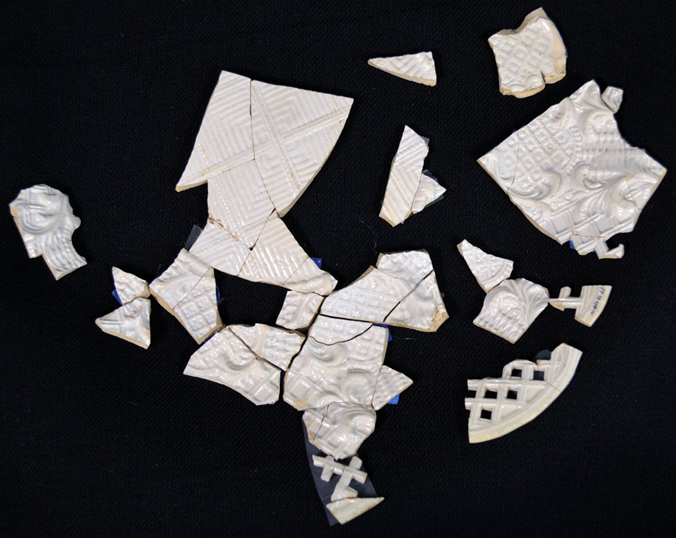
    Fragments of an extremely fancy white salt glazed fruit dish are further examples of Mary’s calculated purchasing of dishes.  Previously written about here and here, this dish was meant to display fruit, another luxury in the 18th century. Being able to afford non-local or out-of-season fruit was a status symbol and necessitated the proper dish to proudly display the fruit.  To put the rarity of fruit in perspective, in colonial America, pineapples were so expensive you could rent one for display at parties in the holiday season because most people couldn’t afford to buy one outright.  While renting a fruit may seem ridiculous to modern readers, the action highlights just how important being seen to own certain items was during the colonial era. Of course, we still engage in this same behavior today, but just not with pineapples.

    Fragments of a white salt-glazed fruit dish excavated at Ferry Farm and a complete example from the collection at Kenmore (above).

    Ferry Farm archaeologists also excavated fragments of two creamware condiment dishes.  Once again, the ability to serve various condiments to dinner guests conveyed status.  Condiments could include relishes, dips, mustards, ketchups (mushroom ketchup being the preferred type), and pickled vegetables such as capers.  Castor sets were also a way to serve other condiments such as olive oil, vinegar, pepper, etc. Generally, these castor sets were only owned by well-to-do households in the colonial period. The base of a creamware castor was recovered at Ferry Farm.

    Creamware castor base excavated at Ferry Farm.

    The fact that so many of Mary’s specialized ceramics are made of creamware should also be noted.  Creamware was invented in 1762 and wasn’t the most expensive type of ceramic (that was porcelain) but it was highly fashionable.  Mary, as a widow with five children and a diminished income following her husband’s death, likely couldn’t afford much porcelain. She opted for the less expensive but still highly-desirable creamware, instead.

    The Washington family went to great lengths to demonstrate their status and refinement to visiting friends, neighbors, and relatives.  At Ferry Farm, this burden fell solely on Mary after the death of her husband.  Her specialized ceramics served to illustrate her place within the gentry class despite her diminished income and refusal to remarry after being widowed.  Her goal was to remain independent while raising five children to be successful adults and members of the Virginia gentry class.  In doing so, she likely realized that the socioeconomic security of her children would ensure her own into the future as well. Consequently, it was important that Mary cultivate a refined household with appropriate table and teawares. Ceramic artifacts from Ferry Farm reveal a woman who carefully selected choice ceramics to perform very specific tasks, while at the same time not overextending her budget.  These ceramics contributed to her goal of remaining a part of the gentry class and teaching her children genteel habits so they could do the same. It was a task in which she overwhelmingly succeeded.

    Mara Kaktins, Archaeologist
    Ceramics & Glass Specialist

  • True or False? Test Your Knowledge of Mary Washington

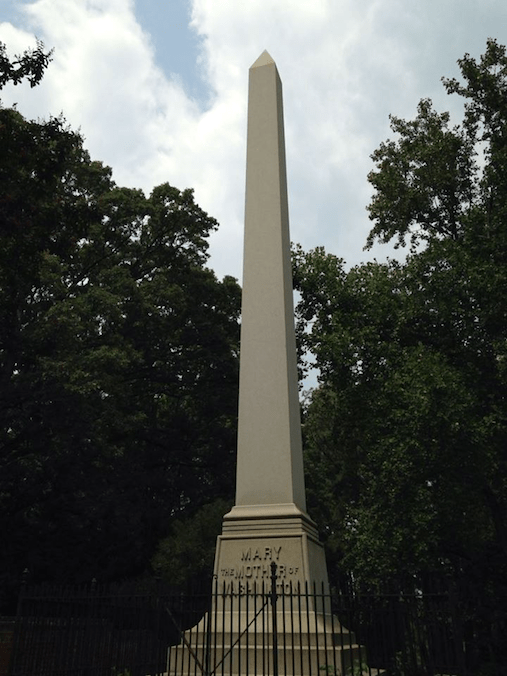
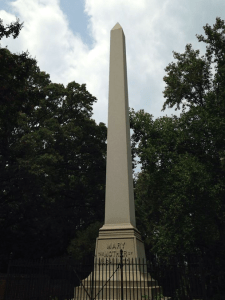
    Mary Washington Monument in Fredericksburg, Virginia. Credit: Beth Hosier/The George Washington Foundation

    True or False?

    Mary Washington had a set of false teeth like her son George?
    FALSE – Mary did not have a famous set of dentures like her son George.

    All of Mary’s children lived to adulthood?
    FALSE – Mary and Augustine Washington had six children together, five living to adulthood.  Their youngest child, Mildred, born in 1738, died at the age of 16 months and is buried at Ferry Farm.

    Mary often traveled to Mount Vernon for extended visits with her son George and his wife Martha?
    FALSE – In fact, George dissuaded his mother from living with them in her later years, arguing that Mount Vernon was much too busy with constant travelers and guests for someone such as his dear and aged mother who deserved peace and quiet.

    Mary lived in Virginia her whole life?
    TRUE – Born and raised on the Northern Neck, Mary moved with her husband throughout their marriage to different family farms located in Westmoreland County, Fairfax County, and then King George County. She lived at Ferry Farm, then called the “Home House”, from 1738 until 1772, when George purchased her a house – the Mary Washington House – in the town of Fredericksburg. She lived there until her death in 1789.

    Mary Washington’s Fredericksburg home was almost sold and moved in its entirety to Chicago for The Colombian Exposition of 1893?
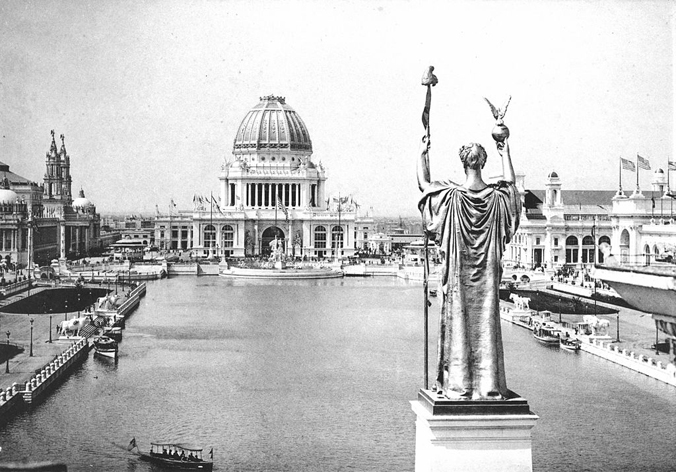
    TRUE – Plans were made to disassemble the Mary Washington House and rebuild it at the 1893 Chicago World’s Fair. The Association for the Preservation of Virginia Antiquities stepped in and purchased house in 1889. They restored and opened it up to the public.

    Chicago World’s Fair looking west from Peristyle, Court of Honor and Grand Basin, 1893. Credit: C. D. Arnold (1844-1927); H. D. Higinbotham; Wikipedia

    Mary remarried after her husband Augustine died in 1743?
    FALSE – It was commonplace during the Colonial era for women to remarry after the death of a spouse. Mary did not, however, preferring to manage the family properties and raise her five young children herself without committing to another marriage that might have restricted her parental control.

    Mary did not live to see her son George become president of the new United States of America?
    FALSE – George visited his mother at her home in Fredericksburg on the way to his presidential inauguration in April 1789 in New York City. Mary died later that same year in August at the age of 81.

    Mary died of breast cancer?
    TRUE – Two doctors treated Mary during the last months of her life in 1789. They could do nothing for her cancer beyond making her comfortable with palliative remedies.

    Mary did not know how to read or write?
    FALSE

    Mary Ball Washington had a ship named after her?
    TRUE – The SS Mary Ball was a “Liberty ship” built during World War II.  Liberty ships were a class of mass-produced cargo vessels simple in design, cheap in cost, and constructed in just a few months.  Built and launched in 1943 as a tank carrier and aircraft freighter, the SS Mary Ball was eventually sold for scrap in 1972.

    SS John W. Brown as an example of a “Liberty Ship” similar to the SS Mary Ball.
    Credit: Wikipedia

    Judy Jobrack, Archaeologist
    Co-Field Director

  • George Washington’s “Last Act of Personal Duty”

    The Presidential election of 1789 looked quite different than our current election day. For one, the election had to last almost a month to ensure that each state had time for their voters to choose their candidate. Then, in February, the Electoral College announced that Washington would be the first president with a resounding 69 electoral votes. Along with this victory, George Washington was unanimously chosen by the popular vote to lead our country. No other president has accomplished this feat. To most, Washington was the obvious choice. His status as a war hero, his strong self-will, and his determination to provide our new nation with solid-ground to build upon were just a few of the things that led him to victory.

    When George was first notified of his new job title, he was at Mount Vernon and knew he must prepare to travel to New York City, the nation’s first capital city, to be inaugurated. First, he started by preparing Mount Vernon for his departure. He ordered his overseers, farm managers, secretaries, and even nephews keep him up-to-date on all goings-on while he was away. Washington, like most landed-gentry in the new country, was land rich and cash poor. So he also wrote a letter to a friend and merchant, Richard Conway, asking to borrow money. “Five hundred pounds would enable me to discharge what I owe in Alexandria &ca;” he wrote, “and to leave the State (if it shall not be permitted me to remain at home in retirement) without doing this, would be exceedingly disagreeable to me.” From this letter, we can see that Washington apparently was not especially enthusiastic about his new appointment. Nonetheless, he saw undertaking the presidency as his duty as expressed in his first inaugural address.

    Among the other plans and arrangements he made, George visited his mother Mary in Fredericksburg. Once Richard Conway had agreed to lend him the needed funds, Washington thanked him and wrote that he would “set of tomorrow for Fredericksburg in order probably to discharge the last Act of personal duty, I may, (from her age) ever have it in my power to pay my Mother it would be very inconvenient for me.” Indeed, by 1789, Mary had fallen quite ill with breast cancer. She had been sick for a while, but only recently had the family realized she was ultimately nearing her end.

    Washington's Last Interview with his Mother
    “Washington’s Last Interview with his Mother” (1860) by an unknown artists, printed by H.E. Coates. Courtesy of Mount Vernon Ladies’ Association

    It had all started in April of 1787. George was heading to Philadelphia to join the Constitutional Convention when he received an urgent letter from Fredericksburg. He wrote to Henry Knox to inform him of his delay in reaching the convention, saying “I am summoned by an express who assures me not a moment is to be lost, to see a mother, and only Sister (who are supposed to be in the agonies of death) expire; and I am hastening to obey this melancholy call, after having just bid an eternal farewell to a much loved Brother who was the intimate companion of my youth and the most affectionate friend of my ripened age.” The previous few months had been rough for the entire family, as George’s letter suggests. John Augustine had passed away suddenly and it had taken its toll. George himself was complaining of arthritis, saying that he was “so much afflicted with a rheumatic complaint (of which I have not been entirely free for Six months) as to be under the necessity of carrying my arm in a sling for the last ten days”.

    Upon arriving in Fredericksburg, after a hasty pace of a ride, George found Betty to be doing much better. Mary, on the other hand, he said “left little hope of her recovery as she was exceedingly reduced and much debilitated by age and the disorder.” It is not certain that this bout of illness had anything to do with the cancer that would later take Mary’s life, but the illness certainly kept the children, especially Betty, watchful of Mary’s health.

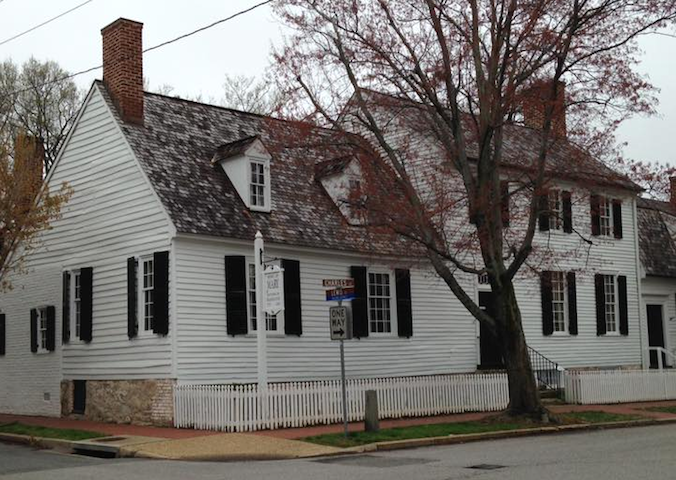
    Mary Washington House
    The Mary Washington House in Fredericksburg, Virginia. Credit: Beth Hosier/The George Washington Foundation

    Mary Washington Monument
    Mary Washington Monument in Fredericksburg, Virginia. Credit: Beth Hosier/The George Washington Foundation

    So in 1789, when Mary’s health was deteriorating once more, George knew that he had to visit her before he left for New York and the presidency. Later, he wrote Betty, “When I was last at Fredericksburg, I took a final leave of my Mother, never expecting to see her more.” Many say that when George visited Mary in March of 1789, it was to ask for a blessing on his new position as President of the United States. Unfortunately, there is no documentation of what their visit entailed other than Washington spending time with his sick mother. Furthermore, given his personal adversity to taking the position, it seems unlikely that he would have needed or wanted permission to take the job. However, I think it can be said that given Mary’s strong influence as a single parent, George’s sense of duty may have been all the blessing or permission he needed from his mother.

    Elizabeth Hosier
    Manager of Interpretation and Visitor Services