It’s the most wonderful time of the year! There’ll be dirt out for screening, ceramics for cleaning, and lots of good cheer…. Okay, sorry, that might be a little too far. But it is a super exciting part of the year here at Ferry Farm, George Washington’s Boyhood Home. We have officially started this summer’s dig season!
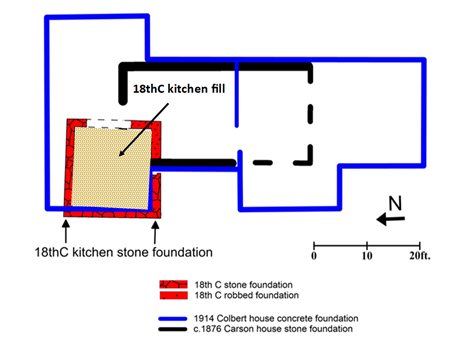
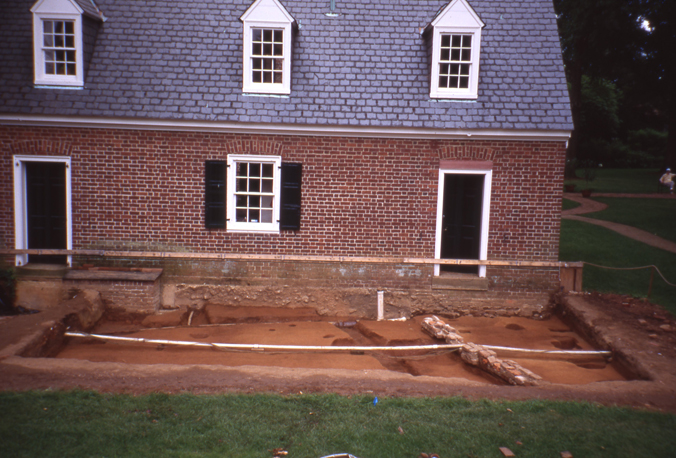
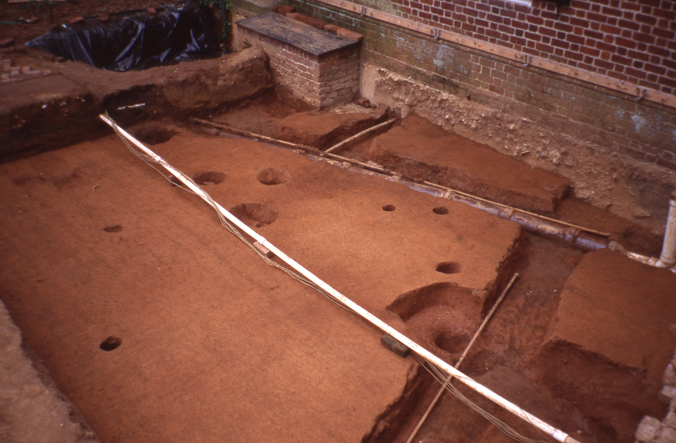
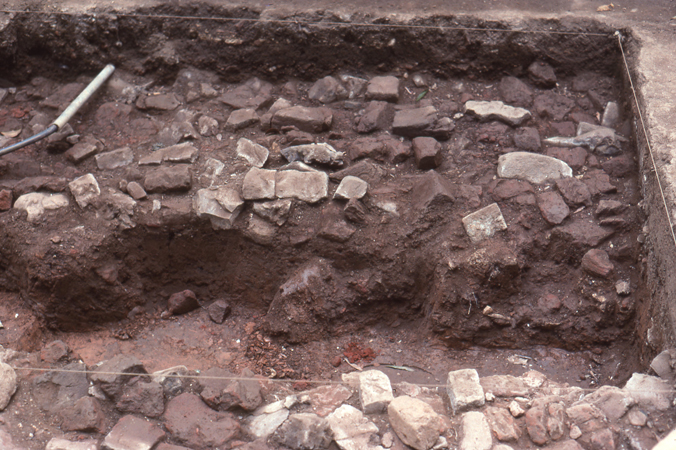
Building off of the previous two years’ exploration of the kitchen site, we are revisiting the 18th-century kitchen cellar again this year. While last year’s dig focused on locating and exposing the kitchen’s stone wall foundations, our focus this year will be excavating the fill within the cellar walls that had been deposited as a result of a fire sometime in the 1740s. The fire caused the building to collapse in on itself, filling the cellar space with ash and debris.
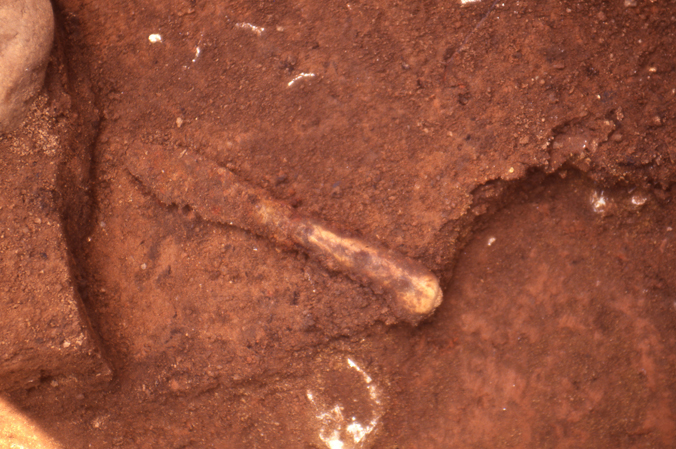
Excavating sites like this are very exciting because they represent preserved moments in time, leaving the possibility to find artifacts left in situ or in place, when the fire occurred. It is likely that most of the artifacts excavated will have evidence of the extreme heat caused by the fire. Toasty artifacts from the 2023 preliminary kitchen exploration have been washed and catalogued, showing damage to artifacts, such as glass bottles and ceramic storage vessels, ranging from being slightly charred and burnt to being completely melted. Toasty or not, these artifacts will help us nail down the date of the fire and what was being stored in the kitchen cellar when it went up in flames.
18thc kitchen cellar fill area within stone foundation to be excavated this seasonPortion of burnt cellar fill uncovered during the 2023 excavation season.
Our 18th-century kitchen, unfortunately, lies beneath the foundations of two farmhouses with full cellars dating from the 19th and 20th centuries. The construction of these homes severely impacted the kitchen structure and its burnt cellar fill, making it difficult for our archaeologists to accurately interpret the kitchen’s architectural features. A small portion of the kitchen cellar fill was also the subject of previous archaeological excavations in the 1990s, so we are not the first team to sample the fill. But in the interest of site preservation, the kitchen remnants were covered over twenty-five years ago with protective geofabric, and the farmhouse cellars backfilled completely with sand.
Luckily, we had the help of an excavator at the beginning of this season to remove the five feet of protective sand covering the kitchen cellar fill so we could get to the fun stuff sooner! But our fun isn’t restricted to the cellar, as we still have multiple 5” x 5” units around the outside of the kitchen foundations to investigate. Our team is still trying to locate the midden (trash deposits) and fireplace associated with the kitchen, as well as additional architectural evidence that would give an idea of the overall form and dimensions of the complete kitchen structure.
Excavator carefully removing the sand covering the cellar fill under the watchful eye of GWF archaeologists. The concrete wall foundations seen in the photo are the remnants of the 1914 farmhouse built atop the kitchen foundation. Exposing the cellar fill
Every excavation year brings new and exciting finds as we sift through thousands of years of site habitation. Come visit us while we dig weekdays from opening until 3:30 pm through July 11th. Hope to see you there!
Archaeology is trash. There, I said it. Before you call Mr. Jones and have me thrown in a pit of snakes, let me explain. Generally speaking, archaeology focuses on understanding the past through the items that people left behind, i.e., their trash. Most of the things we find are left around because they were broken or no longer needed. Disposal of these items looked much different before modern garbage collection as we know it today. Rather than trashcans and landfills, trash was often thrown outside of the home or workspace near windows and doors or any other designated disposal areas. These areas, also known as middens, usually have a high number of artifacts and are top-tier when it comes to understanding a site. So, in other words, archaeology is trash, and we love it.
Most people can get behind the archaeologists saving the trash that’s hundreds or thousands of years old, but things are a little different when it comes to saving more modern materials like plastic. When visitors or volunteers see things like plastic bottle caps or food wrappers in our bags to bring back to the lab, they usually have a few questions. Like, “Did you mean to keep this?” Or “Why are you keeping this trash?” Here at Ferry Farm, we don’t pick favorites, every bit of trash can tell us something about the site and how it has been used.
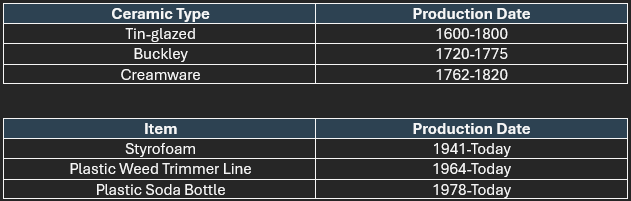
One-way modern materials can help us understand a site is by helping us determine the Terminus Post Quem (TPQ), or “time after which,” of a layer. The TPQ is determined by identifying the earliest production date of the most recently produced item. For layers deposited before the widespread use of plastics, ceramics are usually used for determining the TPQ because they are datable (temporally, not romantically) since most have very specific production dates, and they also hold up pretty well under ground. For example, when looking at the ceramics in a layer with tin-glazed wares, Buckley, and creamware, the TPQ would be 1762 since that is the earliest production date of the most recently produced ceramic (creamware). All the items in the layer had to have been deposited after that date.
The same idea works with modern synthetic materials like plastics, which are usually found at sites that have been used within the last 100 years. If there were to be some plastic soda bottles, weed eater line, and styrofoam in a layer, the TPQ would be 1978. While these materials may also be items you have in your home, not thought to be worth collecting and preserving, their presence in a layer helps provide a date. They can also tell us if an earlier layer was disturbed.
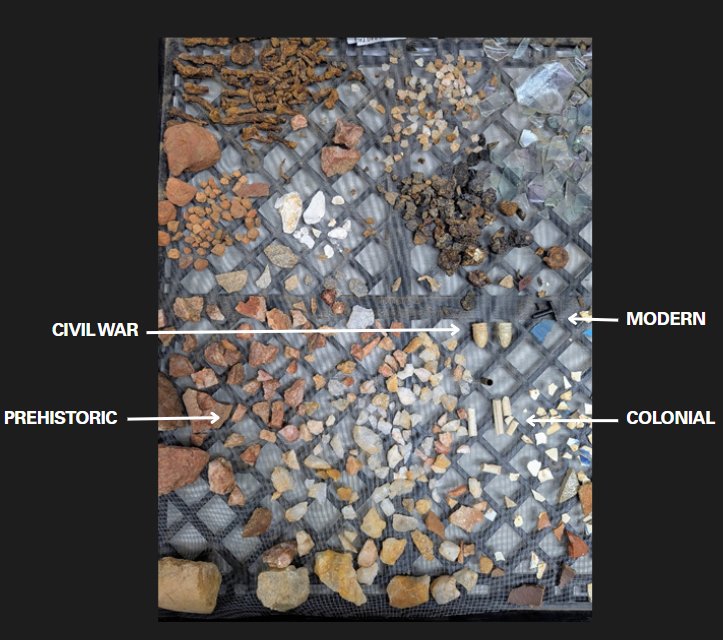
When archaeologists talk about disturbed layers, we aren’t judging their emotional state or love of 2000s heavy metal. Instead, when a layer is described as disturbed, that means there was some sort of activity happening after the initial deposition that affected that layer. During last season’s dig, there were layers with a mix of colonial, prehistoric, and modern materials that indicated that the area was disturbed by some subsequent activity. The information gathered by the presence of modern materials is important for the interpretation of the site and its use over time.
Example of a disturbed layer– Artifacts include prehistoric flakes and fire-cracked rock, colonial items like tobacco pipe stems, Civil War Minie balls, and modern-day plastics
Now that we know why we keep this so-called modern trash. Here are a few examples of how the presence of these items helped our archaeologists understand a part of our site.
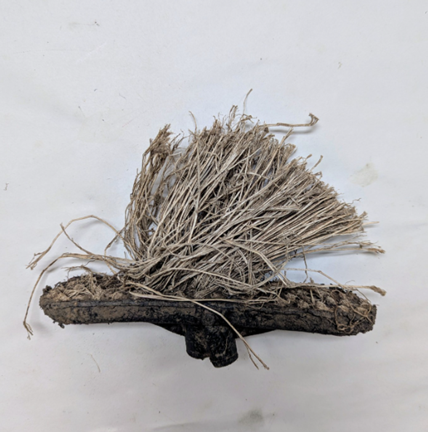
My favorite example happened during last year’s dig. One of our crew, Abbie, was preparing a feature for photographs and had to keep clipping pesky hairlike roots that were in the way. After a bit of excavating, it turns out the “roots” were bristles from a plastic broom. The broom dated the feature fill to the late 20th century and got to the root of the hairy soil issue.
Pesky broom in feature
Our staff has numerous examples of these modern materials being used to help identify previous archaeology as well, from candy wrappers at the bottom of shovel test pits and trenches to an entire trowel! While things like plastic trash bags and food containers aren’t the most exciting to find, they play a part in interpreting the history of activities on the site.
Once something is left behind, it becomes part of the archaeological record, whether it was 10,000 years ago or yesterday’s lunch. What does your trash say about you?
Editor’s Note: Looking back in time, people’s personal hygiene, fashion choices, medical treatments, and more sometimes look, at the very least, bizarre, if not outright disgusting. When confronted with these weird or gross practices, our first reaction can be to dismiss our ancestors as primitive, ignorant, or just silly. Before such judgments, however, we should try to understand the reasons behind these practices and recognize that our own descendants will judge some of what we do as strange or gross. Here at George Washington’s Ferry Farm and Historic Kenmore, we’ve come to describe our efforts to understand the historically bizarre or disgusting as “Colonial Grossology.” The following is the latest installment in Lives & Legacies’ “Colonial Grossology” series.
Today, we would find trash disposal in the 18th century to be pretty horrifying. Garbage of all sorts – sharp-edged broken household objects, putrefying food scraps, and odoriferous human waste – was simply dumped in the street, the back yard, or, when available, nearby holes or ravines. Often, it was literally tossed out the nearest window or the back door.
Believe it or not, archaeology is very concerned with the garbage disposal habits of people in the past. Sites of disposal called middens are treasure troves of artifacts that excite archaeologists the most because people’s trash can reveal so much about their lives and sometimes even a bit about their personalities.
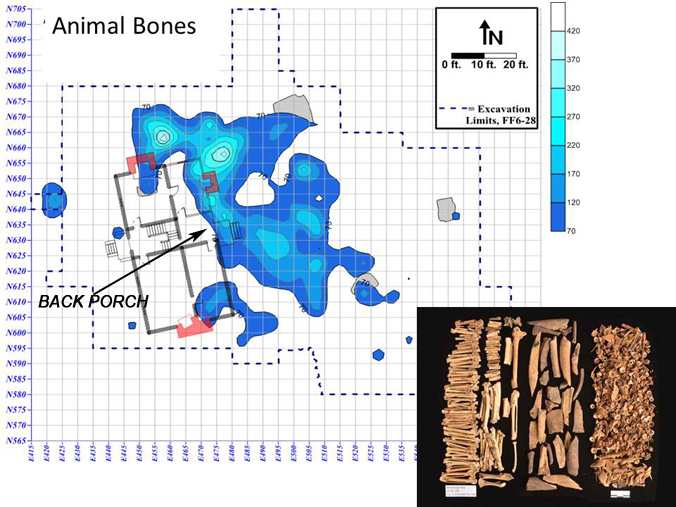
Archaeologists have excavated a sizable portion of George Washington’s Ferry Farm for decades. These excavations revealed how the Washington family and their enslaved workers disposed of household items, food scraps, and human waste in the area immediately behind the house. Color-coded maps showing the intensity of artifact concentrations illustrate how they simply stepped to the edge of the back porch and tossed trash into the back yard.
Map showing the concentration of animal bones excavated from the midden at the rear of the Washington house at Ferry Farm.
At Historic Kenmore, some archaeology has been done around the kitchen site and these excavations reveal more complex habits of trash disposal compared to Ferry Farm.
Fielding and Betty Washington Lewis successfully manipulated the landscape immediately surrounding the house and kitchen and designated certain areas for certain tasks.
An insurance plat of Kenmore from 1797 shows the house as well as the nearby outbuildings in relation to the house. In the 1700s, wood-built kitchen and laundry buildings stood on the spots were two recreated Colonial Revival-style brick outbuildings stand today.
A drawing done in 1797 for insurance purposes showing the location of outbuildings in relation to the main house at Kenmore.
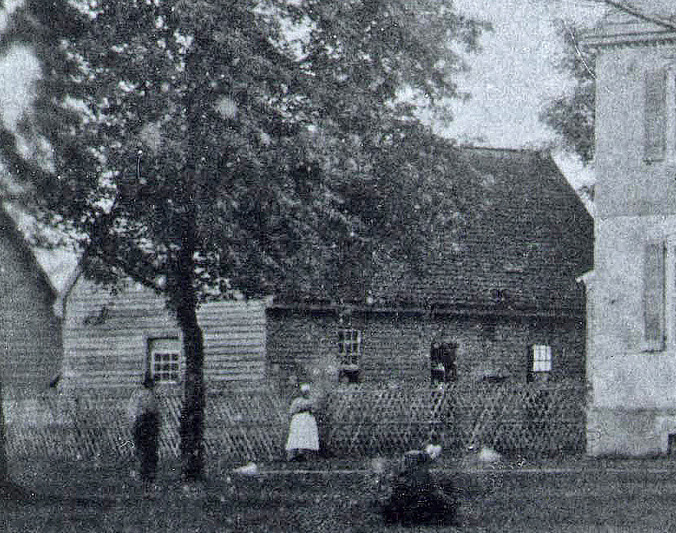
The earliest photo of the kitchen taken during the mid-1800s when Kenmore was owned the Harrison family shows a sizable wooden structure with two enslaved workers – a man named Cary and a woman named Brittania – in the front of the kitchen.
The earliest known photo of Kenmore’s wooden kitchen taken sometime in the mid-1800s and showing two enslaved workers believed to be a woman named Brittania and a man named Cary.
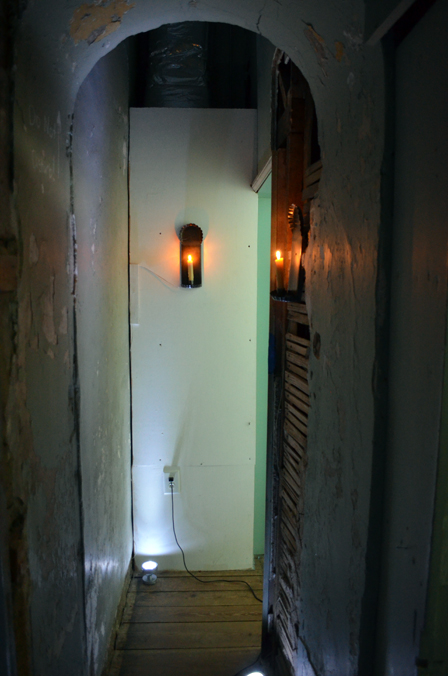
The kitchen was just 30 feet from the house. Rachel, an enslaved cook for the Lewises back in the late 1700s, carried food from the kitchen, across the kitchen yard, and entered the main house through an exterior door that opened into the slave passage, a short but extremely narrow hallway leading to both the master bedchamber and to the dining room. After a meal, enslaved house servants cleared the dining room table or wherever else in the house that the family might have taken their meal and reversed the trip, carrying food waste back outside through the slave passage.
Passage in Kenmore used by enslaved workers to travel between the kitchen, dining room, and master bedchamber.
As archaeology has shown us at Ferry Farm, it would not have been unusual for the enslaved workers to simply dump the food waste into the yard between the kitchen and the house. Excavations at Kenmore, however, show an extraordinarily clean kitchen yard with few artifacts. The things like animal bones and broken ceramic dishes or glass cups that you would normally find in an 18th century midden, or trash disposal area, are not there. The area is very clean, which indicates that it was kept very clean.
Yard at Kenmore between the kitchen (shown) and the house (behind photographer) under excavation.
The kitchen yard was relatively clean archaeologically.
Archaeologists at Kenmore did find the kitchen midden, however. It was located just to the west. While there is a window on the west side of the kitchen, there is no door. If the waste couldn’t be tossed out the window, enslaved workers walked over to that side of the building to dump it. This midden is full of artifacts: a pig jaw, for example, and an amazing amount of other animal bones, a knife with a bone handle, as well as architectural material and much more.
The midden discovered at Kenmore contained a large amount of architectural debris.
Pig jaw found in Kenmore’s midden.
Bone-handled knife found in Kenmore’s midden.
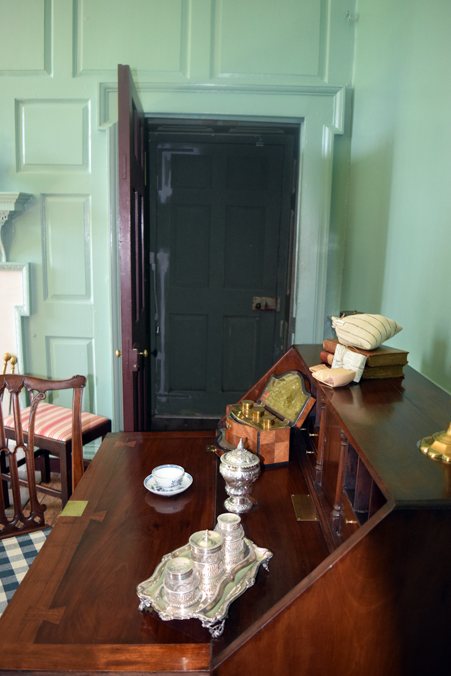
The relative lack of artifacts in the clean area between the house and kitchen along with the centralized location of artifacts in the midden gives some idea of the level of control and surveillance enslaved workers were subjected to by Fielding and Betty Lewis. Betty, for example, could sit at her desk in the master bedchamber (her “command central”) and with the slave passage doors open see directly into the kitchen yard. From her seat, she ran the household and, in Fielding’s absence and then after his death, the plantation itself.
View from Betty Washington Lewis’s desk into the slave passage. The closed door visible in the passage opened into the kitchen yard.
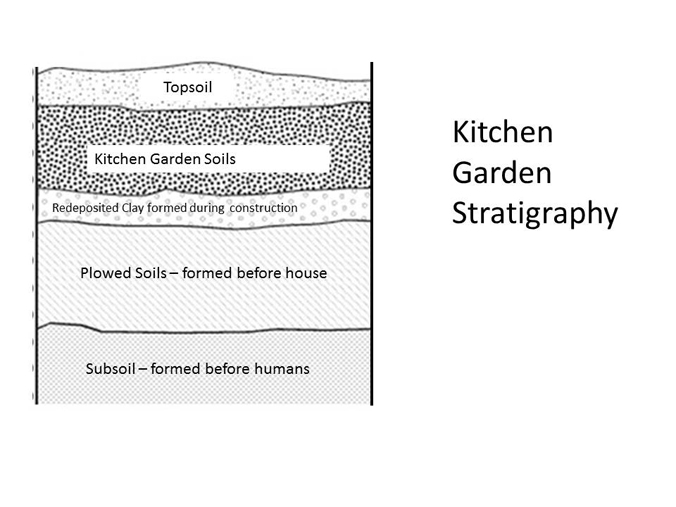
The land on the kitchen’s north side was used still another way. Excavations show it was a kitchen garden. A cutaway view of the soil layers or the soil stratigraphy reveal subsoil formed before humans, then plowed soil in a large field of corn before the house was built, followed by redeposited clay from the house construction between 1772 and 1775, and finally soil indicating a kitchen garden. Kitchen garden soil is marked by plow scars that go in all kinds of different directions as many different crops are planted over the years.
Diagram illustrating the soil layers excavated in the kitchen garden area at Kenmore.
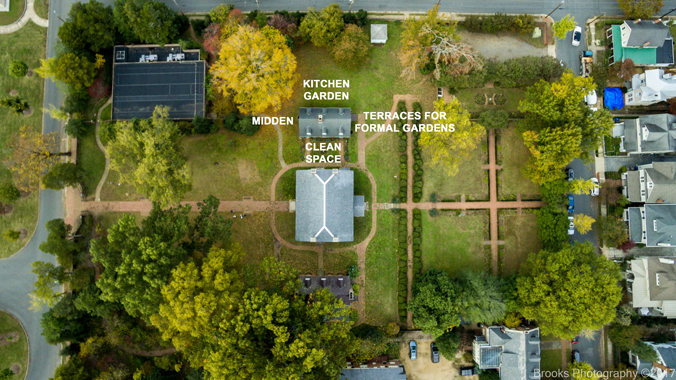
Finally, the kitchen’s east side was dominated by the formal gardens and terrace. While the present garden at Kenmore is Colonial Revival in style, archaeological clues to what the original 18th century garden looked like remain under the soil.
Archaeology has shown us that at Ferry Farm, the disposal of trash was something of a free-for-all within the area behind the Washington house. At Kenmore, however the yard on each side of the kitchen building was carefully controlled for a different use.
Aerial photo of Historic Kenmore with different land uses around the kitchen marked.
No matter where the garbage was disposed, however, finding the trash middens on the landscapes has revealed much about the free and enslaved residents of George Washington’s Ferry Farm and Historic Kenmore.
On Tuesday, May 21, 2019, Dave Muraca, Director of Archaeology at The George Washington Foundation, presented “The Social Role of Garbage in Colonial Virginia,” the final talk in this year’s annual lecture series. Dave presented three case studies in 18th century garbage disposal at George Washington’s Ferry Farm, Colonial Williamsburg, and Historic Kenmore.
Thanks to the Fredericksburg branch of the Central Rappahannock Regional Library at 1201 Caroline Street in Fredericksburg, Virginia for hosting the series once again this year. To learn about other events and happenings, visit kenmore.org.