Lives and Legacies

Tag: mourning jewelry

  • In Jewelry Remembered: Fashion as a Mourning Ritual

    Collections managers deal with a wide array of objects. Sometimes those objects can be quite odd and even a bit gross to the modern person.  One object that has always fascinated me is mourning jewelry and the hair of the deceased that jewelry contains.  Not many people nowadays think of collecting loved ones hair to keep in a locket or to weave into bracelets, but this was a widespread practice and even quite fashionable a relatively short time ago.  While perhaps odd to us today, mourning jewelry gives us a glimpse into rituals surrounding the dead and grieving at a time when death was a more prominent and ubiquitous part of life.

    The evolution of mourning jewelry began around the Middle Ages as part of the growth of Christian ideas on mortality and redemption called Memento Mori. These ideas found their way into literature, art, and even fashion.  Memento Mori jewelry reminded the wearer of their own mortality. These pieces, usually rings, incorporated macabre imagery like skulls, skeletons and coffins to create strong visual reminders of the transient nature of earthly life.

    It was not until the 17th century that the Memento Mori jewelry developed into what we know as mourning or memorial jewelry.  The imagery remained similar but the symbolism became more personal and served as a sentimental remembrance of a specific individual, instead of one’s own mortality.  Engraved names, dates of death and age of the deceased appeared on pieces.  Bereaved family presented these ornaments to friends and family as memorial to the individual.  They became a status symbol and many wealthy people actually included instructions of how the jewelry would be designed, and made in their will. For example, George Washington declared in his will: “To my Sisters in law Hannah Washington & Mildred Washington; to my friends Eleanor Stuart, Hannah Washington of Fairfield, and Elizabeth Washington of Hayfield, I give, each, a mourning Ring of the value of one hundred dollars. These bequests are not made for the intrinsic value of them, but as mementos of my esteem & regard.”

    GW Brooch 1
    The oval-shaped brooch above bears the 1798 Saint Memin likeness of George Washington in profile and dates from around 1799. The image is surrounded by gold and blue enamel and is under convex glass.  The brooch is trimmed by forty-four seed pearls.
    GW Brooch 3
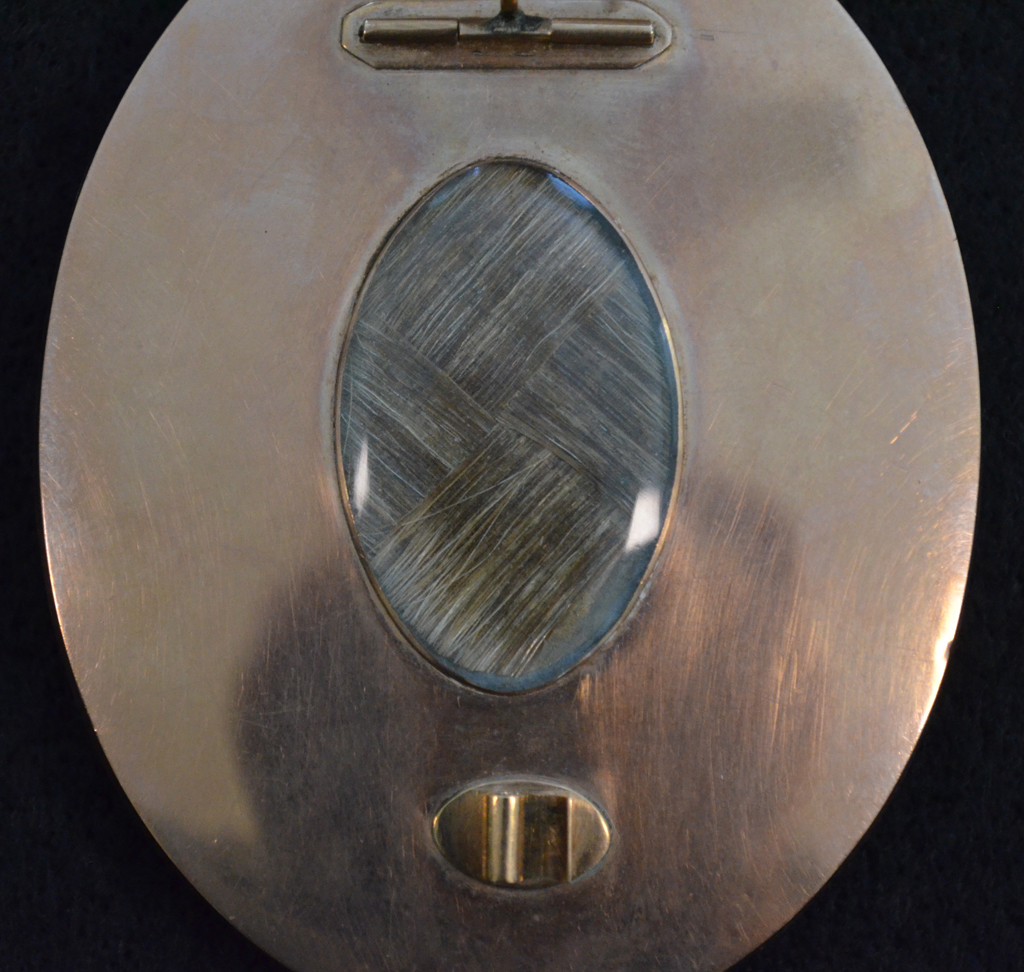
    The back of the brooch contains a plait of brownish-red hair under glass along with a pin fastening.  Tradition says the hair is General Washington’s cut after his death and sent from Mount Vernon by Martha to Mrs. R.B. Lee of the Sully Plantation, Fairfax Co., Virginia in December 1799.

    By the time Washington died, mourning jewelry had evolved with changing attitudes toward death and with a greater focus on sentiment.  The style changed to represent the lighter rococo styles and later Neo-classical designs became popular.  The skulls and coffins were replaced by sepia-toned women dressed in billowing robes lamenting at a tomb, inscribed urns, and weeping willow trees in bucolic landscapes.  Many rings and brooches were lined with pearls to represent tears and included a simple twist of the deceased’s hair.
    GW Locket Brooch
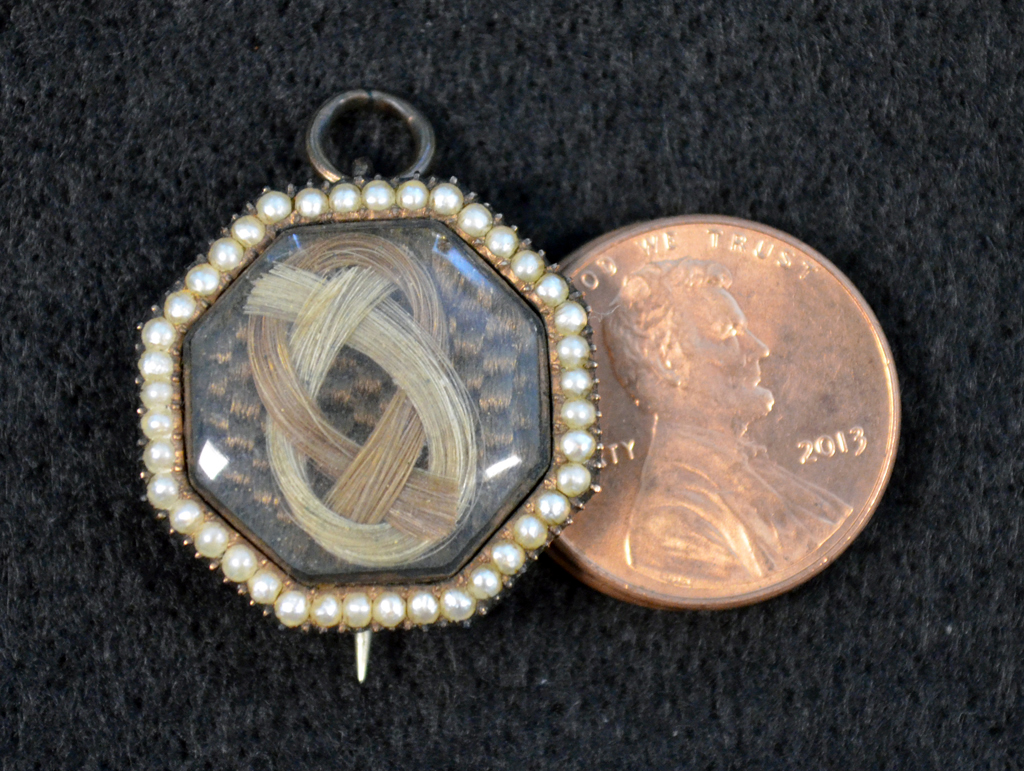
    The octagonal locket dates from between 1800 to 1825 and has been turned into a brooch. The lock of hair, believed to be that of George Washington, is tied in a figure eight type knot and rests on a mat of woven hair. The lock of hair was supposedly given to Captain Robert Smith who knew and served with George during the war. After Captain Smith lost his wife, he went to visit the Washingtons at Mount Vernon and became friends with Nelly Custis, who gave him this lock of her great-grandfather’s hair. When Captain Smith died, he willed the pendant to his cousin and it passed through the Smith family until donated by a relative to The George Washington Foundation in 1925.

    The decorative twist of a loved ones hair for memorial purposes was not new, but it did come into greater use in the 18th century and peaked during the Victorian era.  Hair is one of the few personal mementos people could keep from a loved one.  Human hair contains keratin which is fairly resistant to decomposition particularly when kept in a sealed environment.   The permanence of hair and memory is best summed up with a quote from a journal article of the time discussing female beauty, “Hair is at once the most delicate and lasting of our materials; and survives us, like love. It is so light, so gentle, so escaping from the idea of death, that with a lock of hair belonging to a child or a friend, we may almost look up to heaven, and compare notes with the angelic nature; may almost say, “I have a piece of thee here, not unworthy of thy being now.’” (Page 76)

    Much Brooch 1
    This traditional mourning brooch dates from 1790 to 1810. It contains many neoclassical imagery typical of the time including the weeping woman in classical dress sitting by a tomb, a willow tree, and a ceremonial urn carving. It is inscribed “Much Lov’d, Much Mourn’d”and is painted on ivory encased in a copper mount. The back contains a braid of brownish-blond hair under a glass cover.

    Much Brooch 2

    In the 19th century the use of more elaborate hair work became increasingly popular. The Victorians developed a strict etiquette for mourning rituals and dress.  The stages specified different colors, fabrics and even jewelry at different times during the mourning period, the length of which varied depending on the mourner’s relationship to the deceased.  Mourning jewelry made of hair was allowed during the second stage (usually about a year into the mourning ritual) creating a rise in not only unique hair jewelry but do-it-yourself guides to making pieces with loved one’s hair.

    Memorial jewelry and hair work began to wane at the turn of the 20th century and now these pieces have become curios, often found in antique shops and museum storage collecting dust on shelfs.   Sadly, most of the pieces have no information relating to who they were made for or the names of the mourned. Instead, we are left with an unidentified plait of hair or gold band symbolizing the only piece left from the life of a loved individual.

    Heather Baldus
    Collections Manager

  • Horror Artifacts of Ferry Farm: Myth, Disease, Vampires, and Dolls

    With Halloween just around the corner, we thought we would take our readers behind the scenes to look at some of the creepiest and macabre artifacts we have uncovered at Ferry Farm. Some may seem like obvious choices, but others have hidden connections and meanings. Be sure to let us know your favorite in the poll at the end.

    Bartmann Jug: The Wild Man and Witchcraft

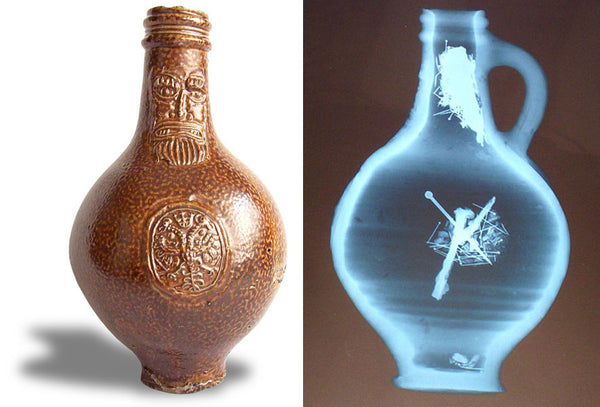
                This jug may look familiar to those who enjoy visiting Colonial sites. Made predominantly in Germany during the 16th and 17th centuries, these pieces of salt-glazed stoneware proved incredibly popular. Known as Bartmann Jugs, all pieces share the presence of a bearded face on the neck of the vessel. Some have additional designs, such as crests, on the body. The face lends the name to the jug as “Bartmann” translates from German to “bearded man.” Still, this begs the question of who the face belongs to?

    Bartmann Jugs
    Remnants of Bartmann Jug

                The bearded face depicts a figure known as the Wild Man. A character from Northern European folklore of the 14th-16th centuries, Wild Men reportedly flourished in remote, alpine regions. In characterization, Wild Men are similar to the satyrs and fauns of Greco-Roman tradition. They are covered in hair, hence the bearded face, and wear no clothes. The popular depiction of Wild Men began in the late Middle Ages when the figure became secular. They thus appeared in all art forms with males and females being depicted. The somewhat exaggerated face on the Bartmann Jug speaks the Wild Man’s untamed nature.

    Wild Man by Martin Schongauer, 1480s

                Aside from Wild Men, Bartmann Jugs have a role in witchcraft. At a time of religious turmoil and witch hunts, England saw a rise in the use of witch bottles in the 1600s. These bottles were white magic in nature and supposedly protected against black magic. Bartmann Jugs account for most witch bottles from this period and the abnormal face may have factored in to its use. To make a witch bottle, one filled the vessel with items such as nails, human hair, fingernail clippings, heart-shaped pieces of cloth, pins, and urine before sealing it. The bottle was then buried or submerged near the area it protected. No Bartmann witch bottles have been found in the America, but the Mathers of Massachusetts wrote about witch bottles in the late 1600s. Could ours have served such a purpose?

    X-Ray of Bartmann Witch Bottle

    Civil War Medicine

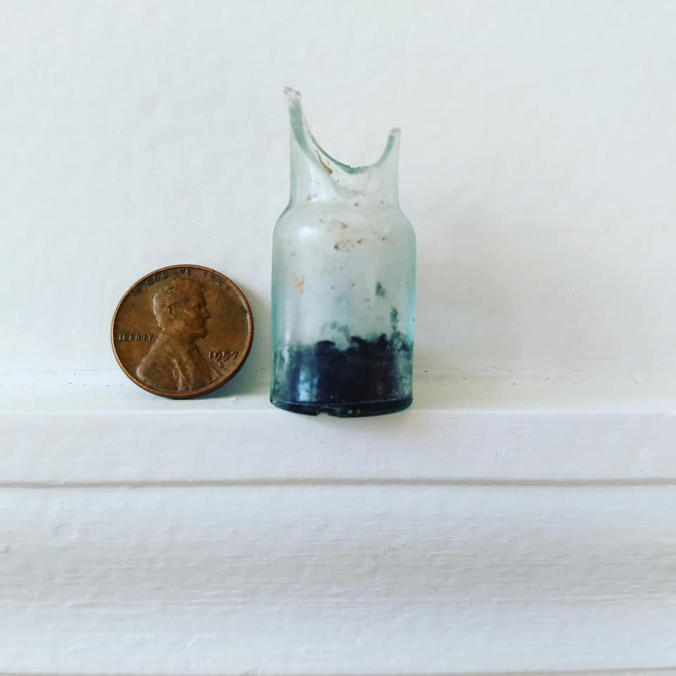
                Just the thought of Civil War medicine is typically enough to conjure scenes of horror, so this simple glass bottle may seem a bit disappointing. However, things are rarely what they seem. We recovered this artifact from a Civil War trench and quickly became interested in what it originally held. Scientific analysis of the remaining residue revealed that the bottle served a medicinal role and once contained liquid mercury. As mercury is known as extremely dangerous, this may come as a shock. Why would anyone have mercury on their person and how could it be medicinal? Believe it or not, mercury once served as a cure-all in the medical world and it was only in 20th century that its dangers were fully accepted. Those who used mercury medicinally viewed the topical burning, sweating, excess saliva, and diarrhea it produced as signs of successfully purging their body of their affliction. In reality, it was their body trying to rid itself of the mercury.

    Mercury Bottle

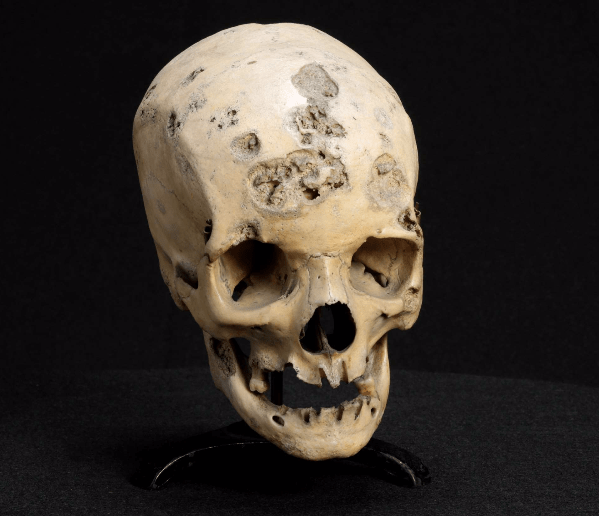
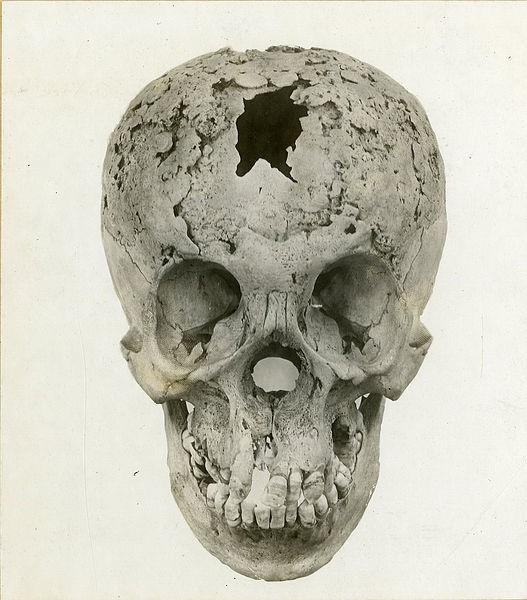
    As a cure all, people utilized mercury for all sorts of afflictions and pest control. Common uses in a Civil War camp may have included treatment for head lice, bed bugs, skin sores and lacerations, as well as parasitic infections. The most terrifying of all, however, would have been syphilis. The dominant strain of this disease is sexually transmitted, and was often ripe in military camps. A disease that did not kill quickly, a person could live with syphilis for years as it slowly ate away at the body. As it progressed, the afflicted would note rashes, open sores, and growths or bumps on their body. Neurological problems could occur and the loss of your nose was not uncommon. As the disease stayed with you until death, it had time to impact the skeleton, most notably leaving pitting on the skull, potentially an eaten away nose cavity, and other signs of deterioration. Overall, a horrible way to go and a wicked good topic for this blog.

    For further reading on this artifact and the scientific analysis, you can read a previous blog on it here.

    Dracula’s Jewelry

                Mourning jewelry became extremely popular during the mid to late 1800s. While pieces came in many forms, they mainly reflected somber colors, like black, or carried something of the deceased’s, such as hair. The rise in this trend first derived from Queen Victoria’s endless mourning for her husband Prince Albert in the United Kingdom. Her mourning set a fashion trend and, with the number of deaths that occurred in the American Civil War, Americans had a reason to adopt it. Alongside the somber tone of jewelry, the period approached the topic of death with a rise in the macabre, séances, and horror.

    Mourning Jewelry

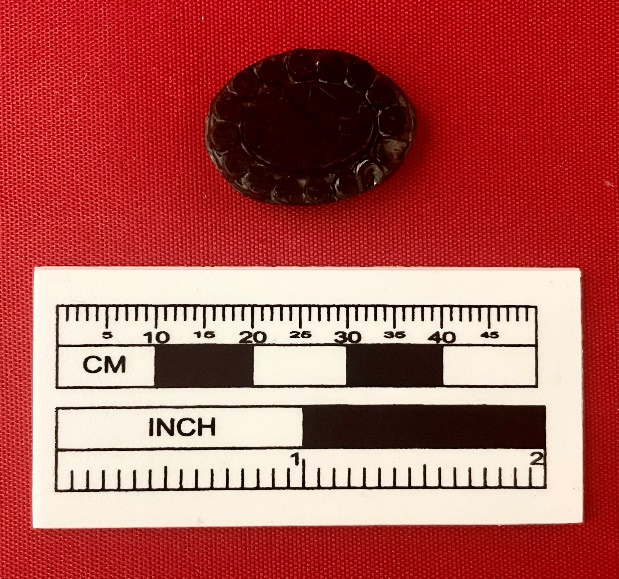
                At Ferry Farm, we have uncovered a single piece of mourning jewelry, which connects to one of the most famous Gothic novels and literary monsters of all time, DRACULA! This small piece may have once been set in a necklace or bracelet and belonged to someone who inhabited the property or visited after the war. While that is all very interesting, I am sure you want to know where the King of Horror fits in. The answer lies in the material. The pendant is made of jet, which accounted for much of the 1800s’ mourning jewelry. Sources of jet exist in various parts of Europe and the American Southwest, but the most prosperous jet production existed in Whitby, England during Victorian times.

    A seaside, port town in the north of England, Whitby is noted for the ruins of an impressive abbey that dominate the landscape. Fans of Bram Stoker’s novel will recognize the town as the location where Count Dracula first arrives in England, and Whitby Abbey even appears in the novel. Stoker wrote much of the book in Whitby, and he reportedly first came across the story of Vlad the Impaler in the local library. Today, Whitby embraces its vampiric legacy (they currently hold the record for the largest gathering of vampires at 1,369 people) and the jet business has seen a resurgence in popularity by aligning itself with this tourist draw. So what do you think of our piece? We highly recommend it for lovers of death, horror, and literature. Please note: Vampire not included.

    Whitby Abbey

    Creepy Dolls

                It goes without saying the most people find dolls creepy. They frequently feature in ghost stories and many serve as the malevolent force in horror movies. Here at Ferry Farm, I am not sure which is worse, finding a full doll or severed doll parts.

                With people living on the property through the 1990s, we have plenty of potential to uncover dolls. In fact, we found a severed doll hand this summer that we previously featured as a #FridayFind. Other parts include ceramic legs, broken arms, heads, and faces. Perhaps this is the most obvious choice for a scary artifact blog, but, then again, dolls will never stop being creepy.

    Creepy Doll Parts

    Emma Schlauder (she/her/hers)

    Research Archaeologist