Lives and Legacies

Tag: mourning

  • Spoooooooooky Teapots?

    There’s plenty to be frightened about in the colonial period. But teapots? Not exactly. However, aesthetics change as time passes. We see things through different lenses. As I type this, my substantial black cat with big yellow eyes stares at me, demanding attention.
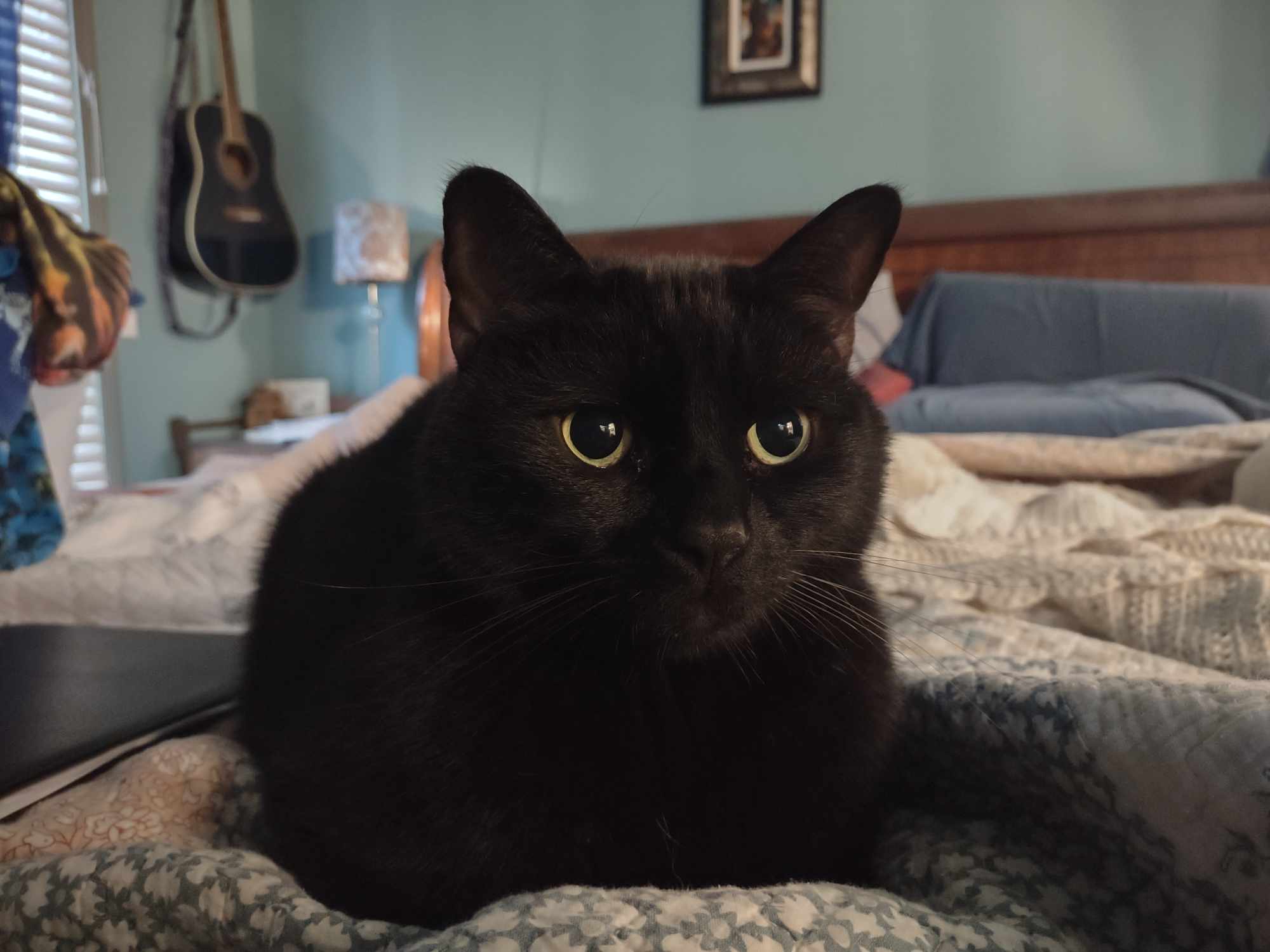
    Poe, the big black cat with yellow eyes.

    Black animals are currently the least likely to be adopted in the United States, so black can be seen as a negative in pets…but what about black teapots?
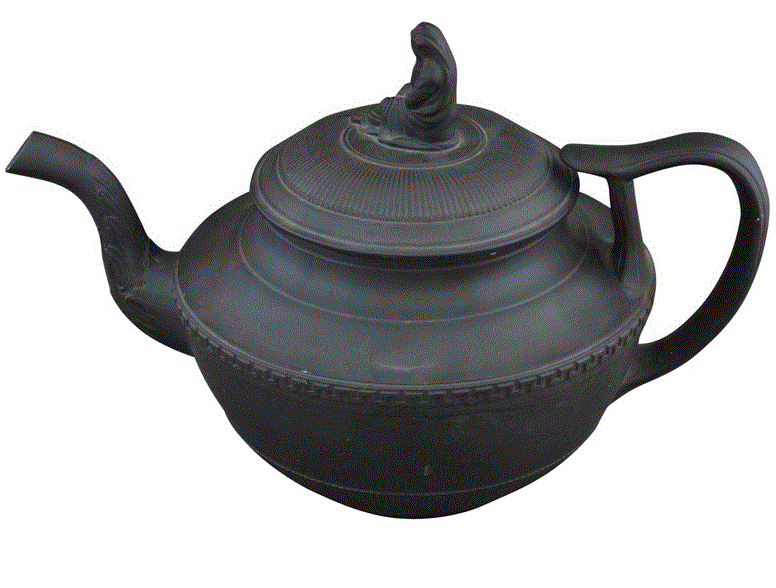
    Black Basalt Teapot, Turner, circa 1805

    Turns out, they were very much the rage during the middle of the 18th century and even into the early 20th century. 

    “Black is sterling and will last forever.”

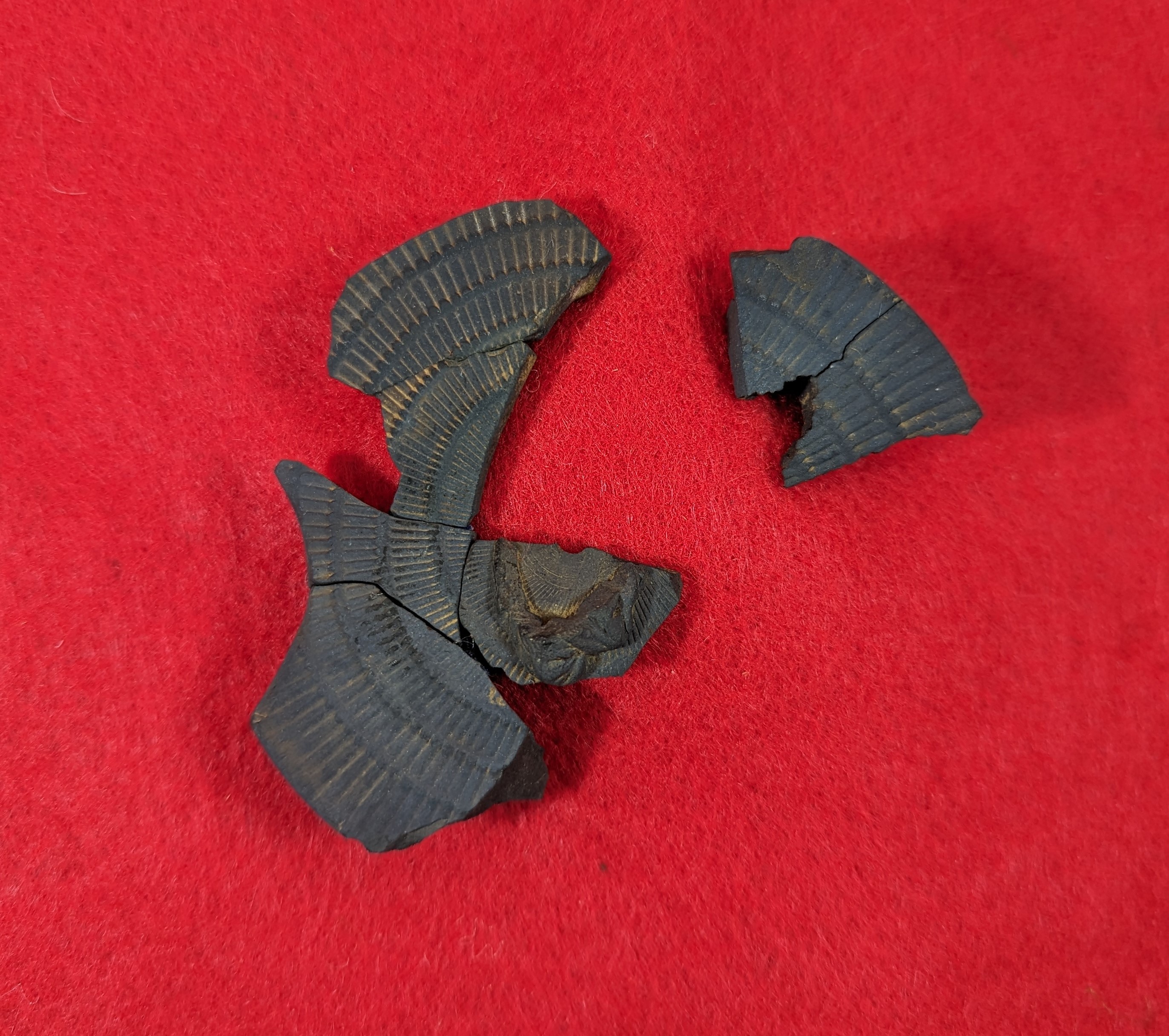
    In 1767, Josiah Wedgwood started working with black basalts – a richly hued, glossy black stoneware medium – for his famous Etruscan vases. Wedgewood’s basalt is made from reddish-brown clay that burns black in the firing process; black basalt owes its color to the addition of manganese. [1]  [2]

    After Wedgwood perfected the fine-grained stoneware, it was soon being produced by other Staffordshire potters in England. It was called ‘Black Basalt’ or ‘Egyptian Black.’ [3] [4]  A matte black teaware that was striking and, by our modern estimations, quite possibly macabre. 

    Black Basalt teapots were decorated utilizing a new technology called ‘engine turning’ lathes. Simple turning lathes have been used for pottery production since the early 1700s. By the 1730s, virtually all hollow wares (mugs, jugs, cups, bowls, etc.) were being lathe-turned to shape and thin bodies. The engine-turning lathe further provided the ability to cut regular patterns in the clay bodies to create decorative elements. [5] The decorative elements at the time were heavily influenced by classical art from Ancient Greece and Rome. [6] 

    A striking finial accented the lovely neoclassical etches on the body of the matte black pot.

    Teapot, Circa 1800, Black Basalt, Mayer Manufacture, Staffordshire, England

    What is a finial? The little knob on the top of the lid. This is where it gets weird for our modern-day eyes. Some looked like women hunched over, draped in mourning clothes or grieving widows. Add this to the black body, and the oddly shaped pots start to take on a dark tone. 
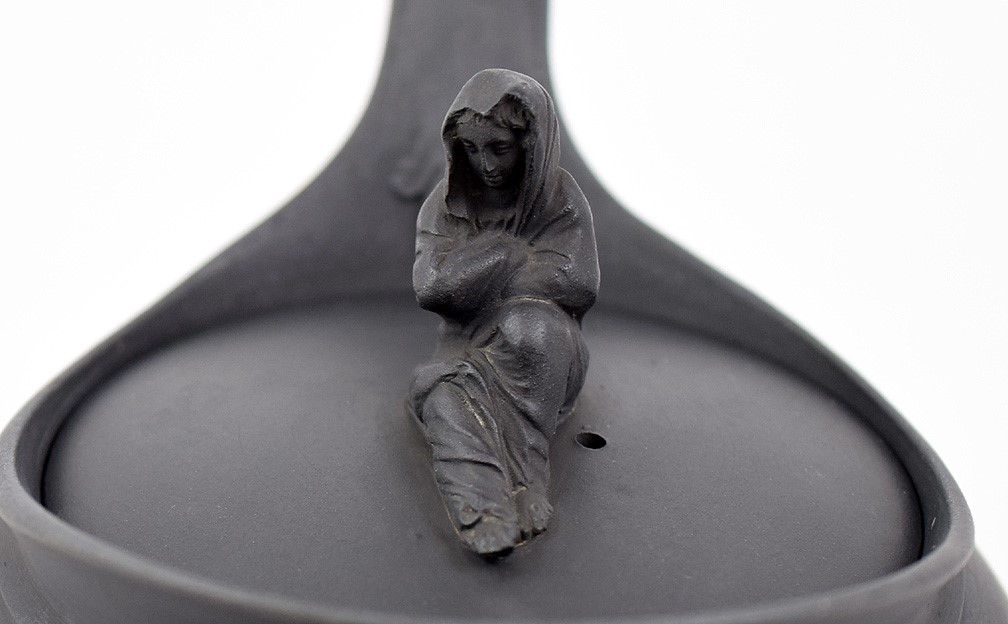
    Woman Finial

    Mary Washington owned an early iteration of these black basalt pots, but was it for mourning purposes? Not likely.

    Her husband Augustine died in 1743, early into the family’s occupation at Ferry Farm. This would have been before the invention of this style of pottery and well before strict (and quite frankly tedious) Victorian mourning rituals. A black teapot may seem to symbolize some outward decorative display of bereavement or grief (particularly with a sad woman finial). Yet, to Mary, it would have just been a neoclassical design in the latest black basalt trend. She was just being her fashionable self. Her teaware collection was pretty admirable, and the fact that she owned a black basalt teapot is not surprising. 

    But that shouldn’t stop us from enjoying beautiful and somewhat spooky teapots.


    Mara Kaktins, Archaeologist & Lab Manager

    Sources

      [1] M.S. Rau. (2019, December 11). Wedgwood: A collector’s guide to English ceramic treasures. https://rauantiques.com/blogs/canvases-carats-and-curiosities/wedgwood-collectors-guide

    [2] Todd, L. M. (2020, December 17). Rediscovering Black basalt one of Josiah Wedgwood’s first and most enduring inventions. Architectural Digest. https://www.architecturaldigest.com/story/rediscovering-black-basalt-one-of-josiah-wedgwoods-first-and-most-enduring-inventions

    [3] STONEWARE, BLACK BASALT – Type Index | Historical Archaeology Type Gallery. (n.d.). https://www.floridamuseum.ufl.edu/typeceramics/type/stoneware-black-basalt/

    [4] The Mint Museum. (2023, January 24). Classic Black: The Basalt sculpture of Wedgwood and his contemporaries – Mint Museum. Mint Museum. https://www.mintmuseum.org/exhibition/classic-black/

    [5] The Chipstone Foundation. (n.d.). https://www.chipstone.org/article.php/151/Ceramics-in-America-2004/The-Little-Engine-That-Could:-Adaptation-of-the-Engine-Turning-Lathe-in-the-Pottery-Industry

    [6] Portals to the Past: British ceramics 1675-1825 – Google Arts & Culture. (n.d.-b). Google Arts & Culture. https://artsandculture.google.com/story/portals-to-the-past-british-ceramics-1675-1825/GgUh1Et0LThYLw

  • In Jewelry Remembered: Fashion as a Mourning Ritual

    Collections managers deal with a wide array of objects. Sometimes those objects can be quite odd and even a bit gross to the modern person.  One object that has always fascinated me is mourning jewelry and the hair of the deceased that jewelry contains.  Not many people nowadays think of collecting loved ones hair to keep in a locket or to weave into bracelets, but this was a widespread practice and even quite fashionable a relatively short time ago.  While perhaps odd to us today, mourning jewelry gives us a glimpse into rituals surrounding the dead and grieving at a time when death was a more prominent and ubiquitous part of life.

    The evolution of mourning jewelry began around the Middle Ages as part of the growth of Christian ideas on mortality and redemption called Memento Mori. These ideas found their way into literature, art, and even fashion.  Memento Mori jewelry reminded the wearer of their own mortality. These pieces, usually rings, incorporated macabre imagery like skulls, skeletons and coffins to create strong visual reminders of the transient nature of earthly life.

    It was not until the 17th century that the Memento Mori jewelry developed into what we know as mourning or memorial jewelry.  The imagery remained similar but the symbolism became more personal and served as a sentimental remembrance of a specific individual, instead of one’s own mortality.  Engraved names, dates of death and age of the deceased appeared on pieces.  Bereaved family presented these ornaments to friends and family as memorial to the individual.  They became a status symbol and many wealthy people actually included instructions of how the jewelry would be designed, and made in their will. For example, George Washington declared in his will: “To my Sisters in law Hannah Washington & Mildred Washington; to my friends Eleanor Stuart, Hannah Washington of Fairfield, and Elizabeth Washington of Hayfield, I give, each, a mourning Ring of the value of one hundred dollars. These bequests are not made for the intrinsic value of them, but as mementos of my esteem & regard.”

    GW Brooch 1
    The oval-shaped brooch above bears the 1798 Saint Memin likeness of George Washington in profile and dates from around 1799. The image is surrounded by gold and blue enamel and is under convex glass.  The brooch is trimmed by forty-four seed pearls.

    GW Brooch 3
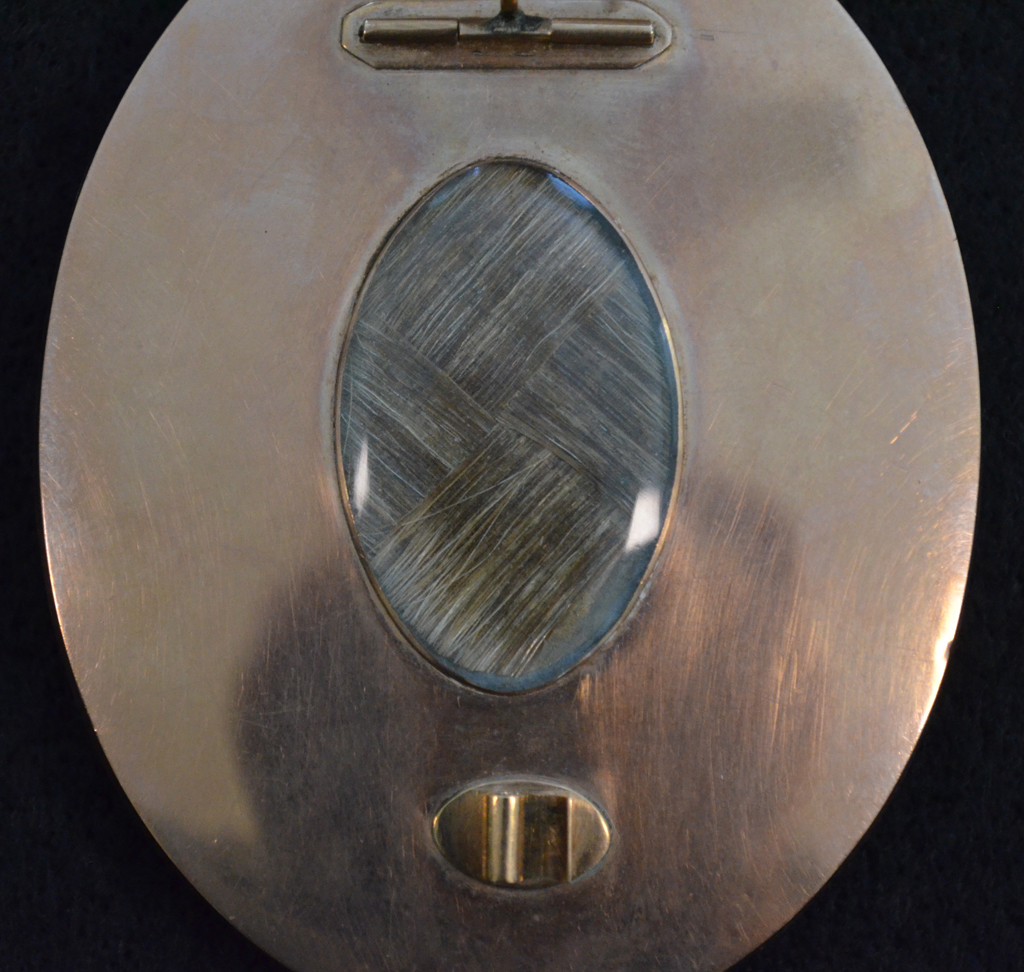
    The back of the brooch contains a plait of brownish-red hair under glass along with a pin fastening.  Tradition says the hair is General Washington’s cut after his death and sent from Mount Vernon by Martha to Mrs. R.B. Lee of the Sully Plantation, Fairfax Co., Virginia in December 1799.

    By the time Washington died, mourning jewelry had evolved with changing attitudes toward death and with a greater focus on sentiment.  The style changed to represent the lighter rococo styles and later Neo-classical designs became popular.  The skulls and coffins were replaced by sepia-toned women dressed in billowing robes lamenting at a tomb, inscribed urns, and weeping willow trees in bucolic landscapes.  Many rings and brooches were lined with pearls to represent tears and included a simple twist of the deceased’s hair.

    GW Locket Brooch
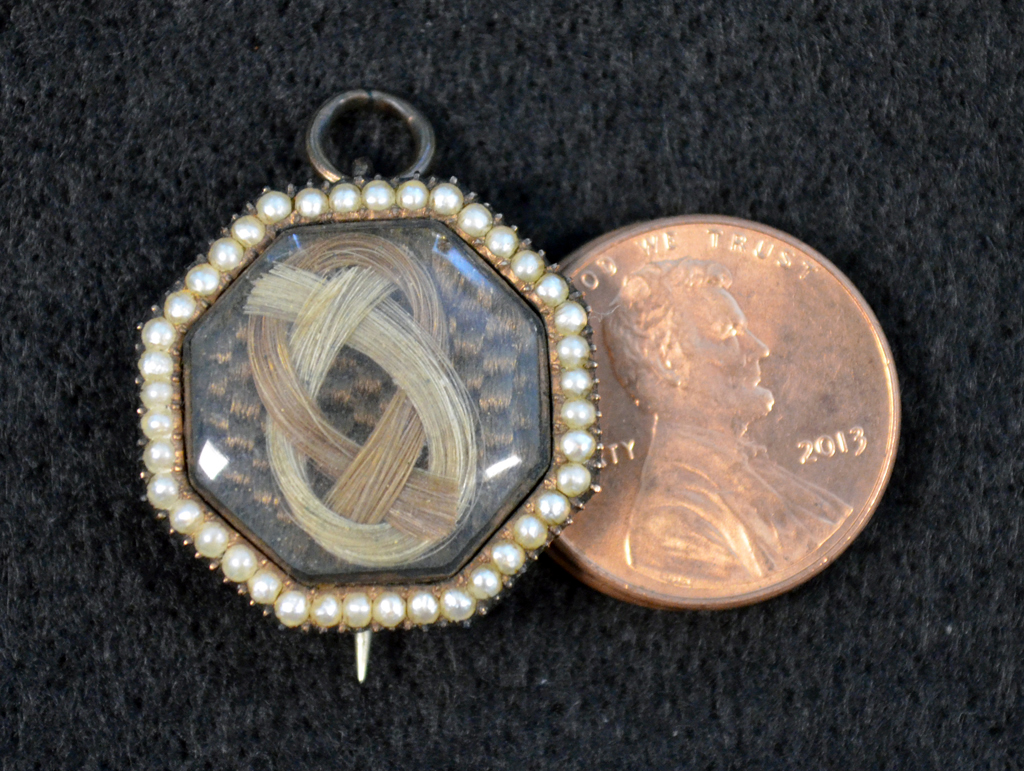
    The octagonal locket dates from between 1800 to 1825 and has been turned into a brooch. The lock of hair, believed to be that of George Washington, is tied in a figure eight type knot and rests on a mat of woven hair. The lock of hair was supposedly given to Captain Robert Smith who knew and served with George during the war. After Captain Smith lost his wife, he went to visit the Washingtons at Mount Vernon and became friends with Nelly Custis, who gave him this lock of her great-grandfather’s hair. When Captain Smith died, he willed the pendant to his cousin and it passed through the Smith family until donated by a relative to The George Washington Foundation in 1925.

    The decorative twist of a loved ones hair for memorial purposes was not new, but it did come into greater use in the 18th century and peaked during the Victorian era.  Hair is one of the few personal mementos people could keep from a loved one.  Human hair contains keratin which is fairly resistant to decomposition particularly when kept in a sealed environment.   The permanence of hair and memory is best summed up with a quote from a journal article of the time discussing female beauty, “Hair is at once the most delicate and lasting of our materials; and survives us, like love. It is so light, so gentle, so escaping from the idea of death, that with a lock of hair belonging to a child or a friend, we may almost look up to heaven, and compare notes with the angelic nature; may almost say, “I have a piece of thee here, not unworthy of thy being now.’” (Page 76)

    Much Brooch 1
    This traditional mourning brooch dates from 1790 to 1810. It contains many neoclassical imagery typical of the time including the weeping woman in classical dress sitting by a tomb, a willow tree, and a ceremonial urn carving. It is inscribed “Much Lov’d, Much Mourn’d”and is painted on ivory encased in a copper mount. The back contains a braid of brownish-blond hair under a glass cover.

    Much Brooch 2

    In the 19th century the use of more elaborate hair work became increasingly popular. The Victorians developed a strict etiquette for mourning rituals and dress.  The stages specified different colors, fabrics and even jewelry at different times during the mourning period, the length of which varied depending on the mourner’s relationship to the deceased.  Mourning jewelry made of hair was allowed during the second stage (usually about a year into the mourning ritual) creating a rise in not only unique hair jewelry but do-it-yourself guides to making pieces with loved one’s hair.

    Memorial jewelry and hair work began to wane at the turn of the 20th century and now these pieces have become curios, often found in antique shops and museum storage collecting dust on shelfs.   Sadly, most of the pieces have no information relating to who they were made for or the names of the mourned. Instead, we are left with an unidentified plait of hair or gold band symbolizing the only piece left from the life of a loved individual.

    Heather Baldus
    Collections Manager