Lives and Legacies

Tag: museum

  • Above Ground Archaeology – Cool Finds Revealed During Restoration

    While the house at Historic Kenmore has been faithfully restored to its circa 1775 appearance, the road to that final result was a pretty dirty one.  As in plaster dust, paint fumes, and all manner of dirt and debris.  Back in the late 1980s and early 1990s, the first forays into the research for and the subsequent writing of a Historic Structure Report (HSR) took place.  This project entailed a number of architectural historians selectively pulling up floorboards and peeking behind plaster walls to more fully understand how the house was originally built, its current condition, and its history of change over time.  This important document provided us with a clear understanding of Kenmore’s architectural history, was the guiding document for a decade-long restoration of the structure, and also gave us a collection of architectural fragments and individual artifact finds that continue to help us understand the material world of those who lived and labored at Kenmore through the centuries.

    In a past blog post, we learned a bit about rats as collectors and examined a rat’s nest that was discovered during that HSR investigative period. If you haven’t looked at the video of the unpacking of that nest, here it is. (In that nest, there were assorted papers, fibers, and other fluffy goodies dating to around the turn of the 20th century.)  But the nest wasn’t the only thing uncovered during that HSR peeking and prodding process.

    Of Mice and Men: A brief exploration of rodents’ history in America

    The Unlikely Curator: What a Rodent’s Nest Reveals about Historic Kenmore

    Exploring the Rat’s Nest

    Enter the “Above Ground Archaeology” or “Interior Archaeology” collection.  These eclectic artifacts were carefully collected, numbered according to their context or find location, bagged, documented on a list, and lovingly packed away in our ubiquitous Hollinger boxes.  Over the years, some of the artifacts were pulled by curators for exhibition in the Kenmore galleries, but most were stowed away in their boxes for long-term preservation and research purposes.

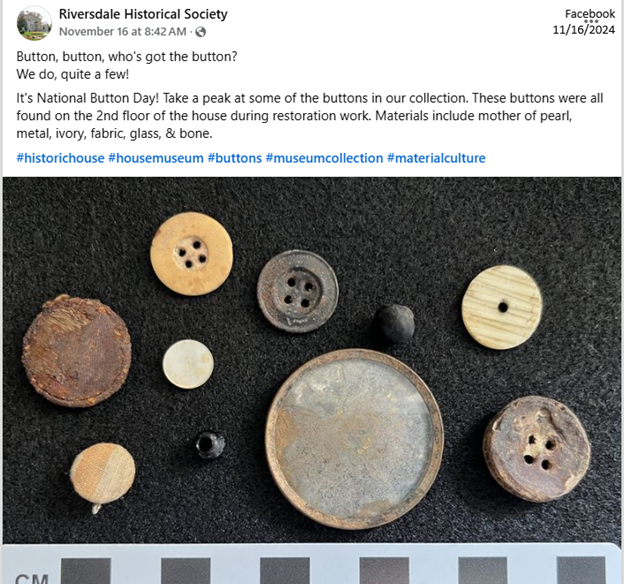
    The use of found objects in historic structures to help illuminate the material world of the building’s residents and workers is not a revolutionary concept.  Colonial Williamsburg, for instance, in their recent restoration of the historic Bray School, removed modern plaster walls, revealing not only structural information but also artifacts: “We are collecting building fragments and objects found in the walls…These items shed light on the building’s original finishes and various inhabitants since 1760.”  Riversdale Historical Society has been showcasing some of their “found” artifacts on Facebook — most recently posting a set of buttons for National Button Day.
    Colonial Williamsburg: The Bray School Project

    Riversdale Historical Society, Facebook Post, 16 November 2024

    Recently, we pulled a few of Kenmore’s artifacts into exhibit cases in our refreshed orientation exhibit in the Bissell Gallery of the Crowninshield Education Center at Historic Kenmore.  Together with in-ground archaeology, these exhibit cases help us illustrate the built environment and the wares known and used at the site.
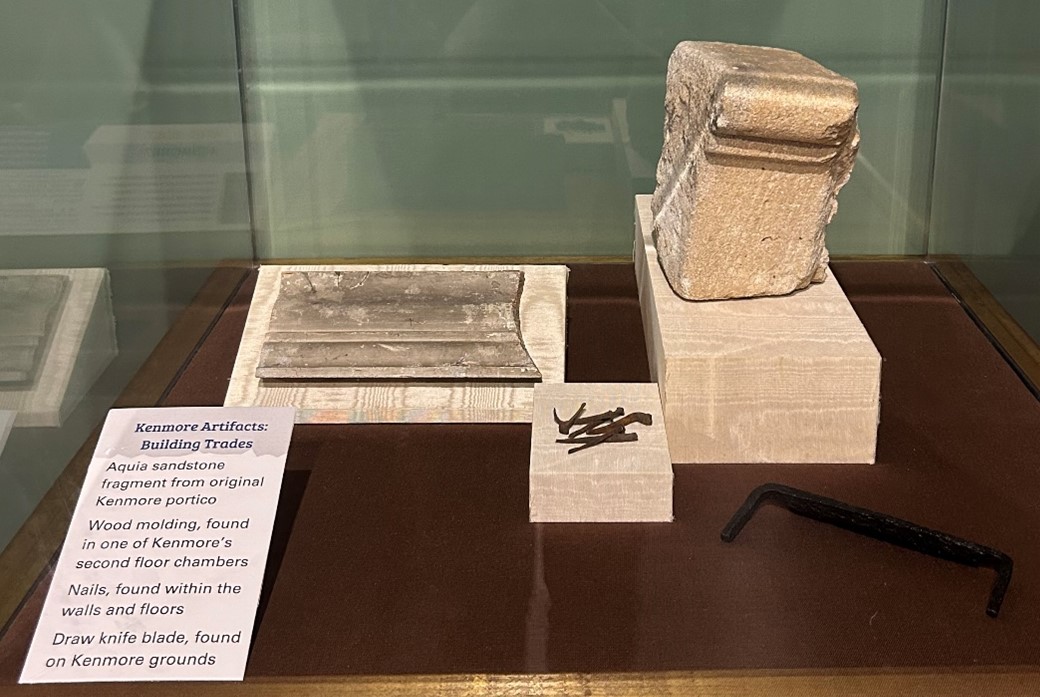
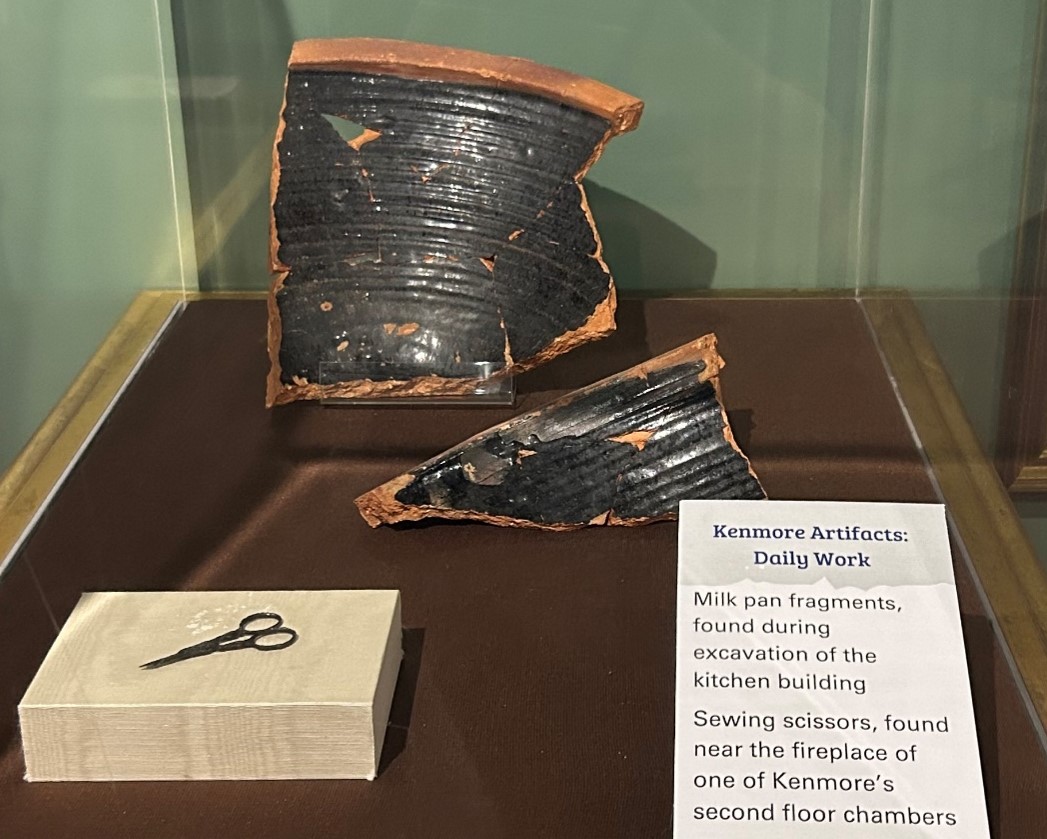
    In 2010, then Intern Ashley Dean (University of Mary Washington) was tasked with inventorying the three boxes of artifacts, and for that, we are extremely grateful.  What resulted from that inventory project was a 12-page list of artifacts that formed the center of this rejuvenated research initiative.  The artifacts in these boxes range from architectural elements (plaster fragments, nails, wallpaper bits) to broken household goods (bottle glass, ceramic pieces) to whole objects (beads and a pair of sewing scissors).  When first bagged and numbered, these artifacts were recorded by location context—based on the mapping system then being used in the architectural investigations of the house, with room numbers ranging from B001 in the cellar (or basement level) to 301 being the attic (or 3rd floor) of the house.

    Attic (Room 301) mapping

    Fast forward to 2024, the artifacts were again reviewed, and the idea blossomed to plan a textile assessment of all the small scraps of fabrics that had been collected.  According to our in-house review, we could tell that they dated to a variety of periods and ranged in their likely original use, from costumes to household linens. 

    Selection of textile fragments in the Kenmore Above Ground Archaeology collection (July 2024)

    One particularly large artifact proved the most intriguing — a pile of blue and white check fabric.  The indeterminate ball of checked fabric piqued the interest of staff and now serves as the starting point for a multi-year conservation assessment and interpretation project.  A few months after our in-house assessment, we hosted a textile conservator who conducted a baseline review of the textile fragments and more fully examined the artifact for potential treatment.  She had a rapt audience that morning!
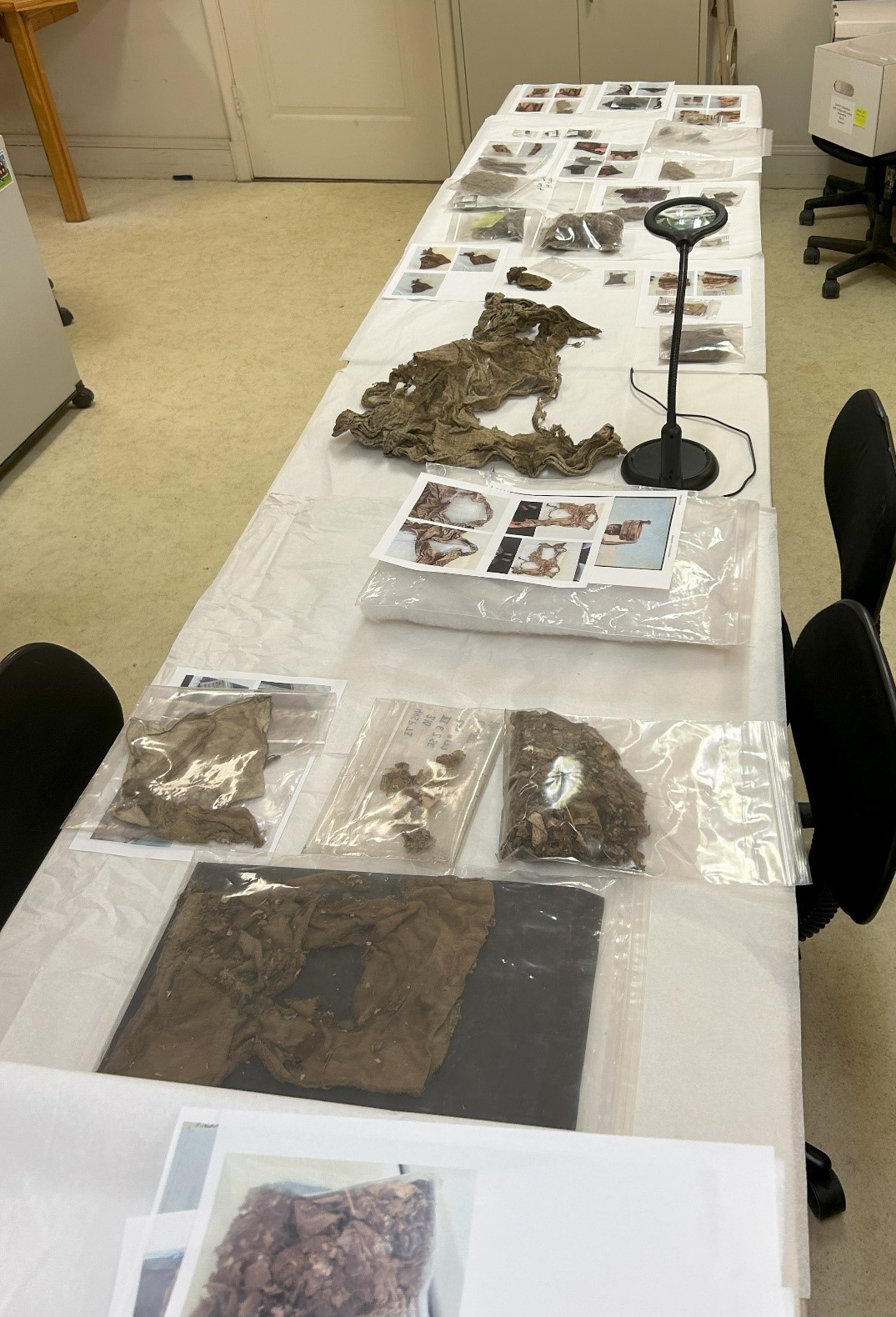
    And just a few weeks ago, the textile artifact, which looks to be a full child’s apron or pinafore, was transported to the conservation lab for treatment and further research. 
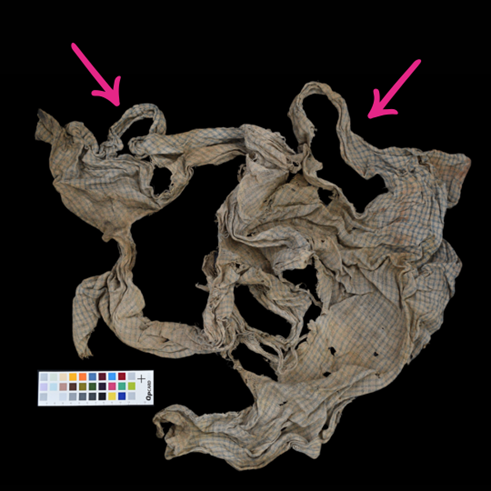
    Check fabric before conservation. Armholes visible along upper portion.

    The found artifacts from Historic Kenmore have not yet been able to fully share their stories.  We look forward to beginning to delve more into their manufacture, use, and re-use by the generations of people who wore them, worked with them, saved them, hid them, and otherwise interacted with the artifacts and the spaces in which they were found.


    Gretchen Pendleton

    Aldrich Director of Curatorial Operations

  • A Day in the Life of a Historic Interpreter at Ferry Farm [Video]

    In this video, we meet historic interpreter Gary Haynes and follow him during his workday at George Washington’s Ferry Farm.

  • National Parks, National Historic Landmarks, and the National Register of Historic Places, Oh My!

    Throughout my time as a museum professional, I have worked at several different museums each with different classifications, rules, and operating procedures. Before entering the museum world, I used to think that most museums operated in a similar way. However, that could not be further from the truth. One of the most common questions I have gotten since leaving the National Park Service for the private sector has been some variation of: “Why can’t I use my National Park Pass here?” It is an understandable question that I am here to answer.

    Museums can be categorized by many different subjects. For example, there are art museums, history museums, science museums, zoos, gardens and more! There are also different categories on how museums operate, fundraise, and are preserved. For example, George Washington’s Ferry Farm and Historic Kenmore are both historic house museums. They are owned by The George Washington Foundation, a private, non-profit organization that is charged with caring for the properties. Ferry Farm and Kenmore are funded by your donations, admission fees, and fundraising events. However, the Washington Monument in Washington, D.C. is a National Park Service (NPS) property, operated by the government and funded, in part, with tax-payer dollars.

    Aerial view of the Washington Monument

    In addition to the NPS sites, the United States government also created the National Register of Historic Places. The National Register of Historic Places is a list of places that are worthy of preservation but are not necessarily and, in fact, are not usually operated by the U.S. government. Sites on this list are able to apply for certain grants and funding through the NPS. They also receive certain tax breaks and can work towards becoming a National Park Site. Fun fact, there are almost 100,000 properties listed on the National Register of Historic Places!

    Of those 100,000 National Register properties, some also have the distinction of being National Historic Landmarks. Landmarks are sites that are again, not necessarily government-run, but have been recognized by the federal government as being nationally significant, meaning they correlate to a significant part of our nation’s history. These properties are also able to apply for certain grants and tax breaks. Not all properties on the National Register of Historic Places and not all properties listed as National Historic Landmarks are museums and not all of them are open for public visitation. However, being on these lists adds a layer of protection should the owners of that property need assistance in preserving the site.

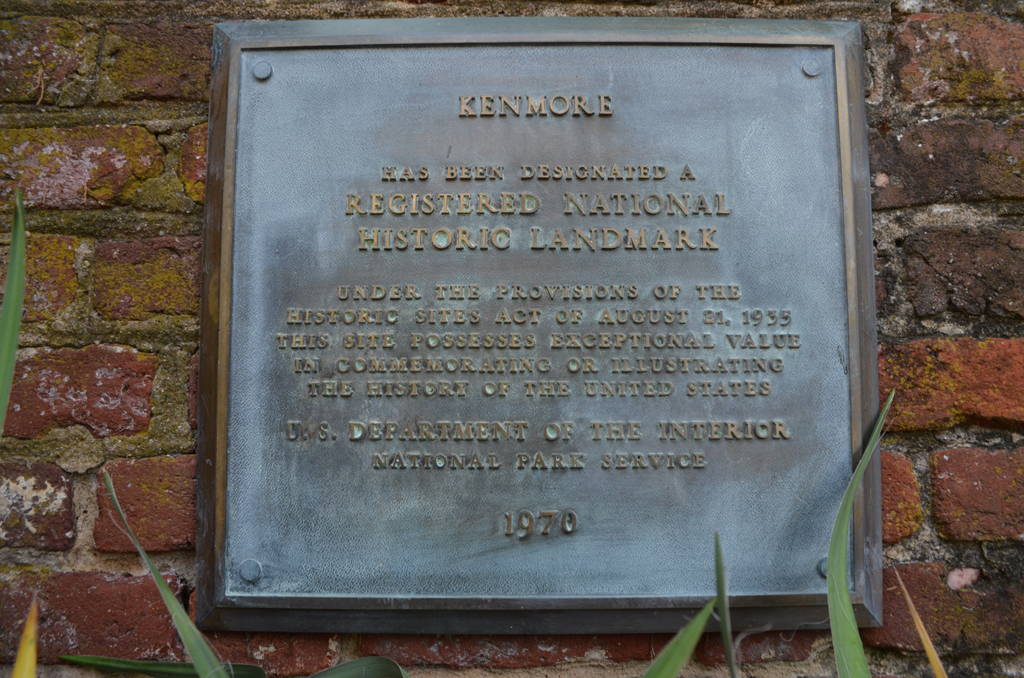
    Marker noting Historic Kenmore’s designation as a National Historic Landmark in 1970.
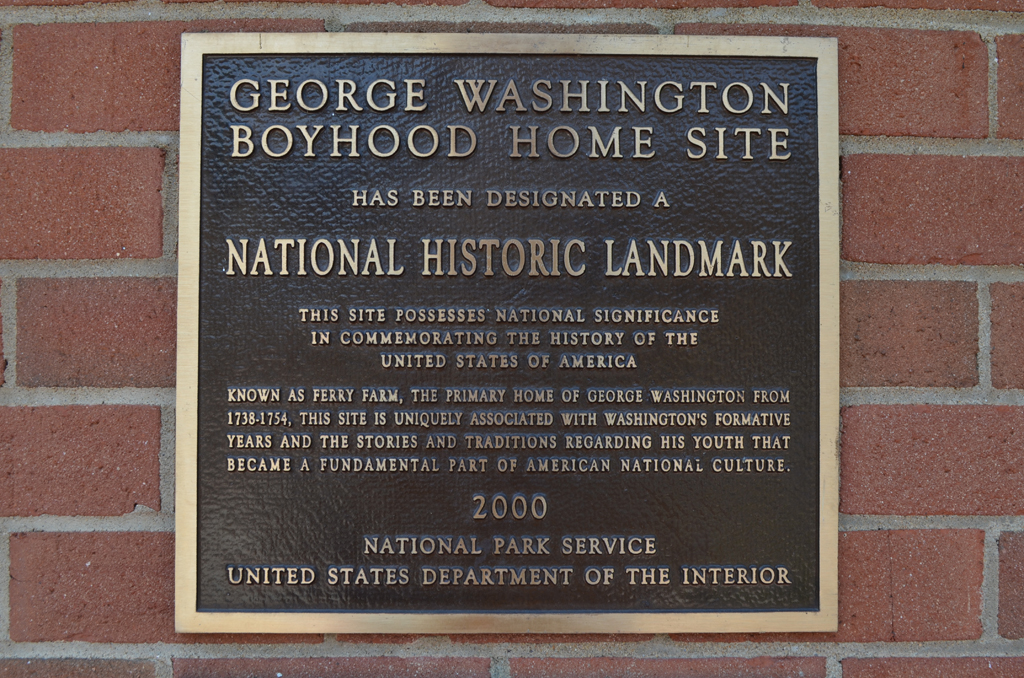
    Marker noting George Washington Ferry Farm’s designation as a National Historic Landmark in 2000.

    Along with National Register and National Historic Landmark status, there are also several types of Easements that can be put in place to protect historic sites. Two types of easements often used in the museum world are Conservation Easements and Preservation Easements. These easements are agreements between the government and a property’s stewardship organization that allow for the government to step in and take over the operation of a property if the private owners are not caring for it properly or it becomes endangered in some fashion. Easements also allow the government to have approval over major changes to the properties to ensure they maintain their historic or natural significance. Private easements can also be created between two parties such as a historic site and a local conservation organization to protect the natural areas of a historic site.

    The George Washington Foundation is a 503(c) (3) non-profit. This designation gives our organization certain tax exemptions. We are a private foundation that operates the two historic sites. These sites are not National Park Service sites and do not receive direct taxpayer funding from local, state, or federal governments. Both Historic Kenmore and George Washington’s Ferry Farm are on the National Register of Historic Places and also are both National Historic Landmarks. Additionally, Ferry Farm is under a conservation easement with the National Park Service. All of this means that while we still operate as a private foundation, there are several layers of protection to ensure these treasured historic properties are preserved and protected for decades to come.

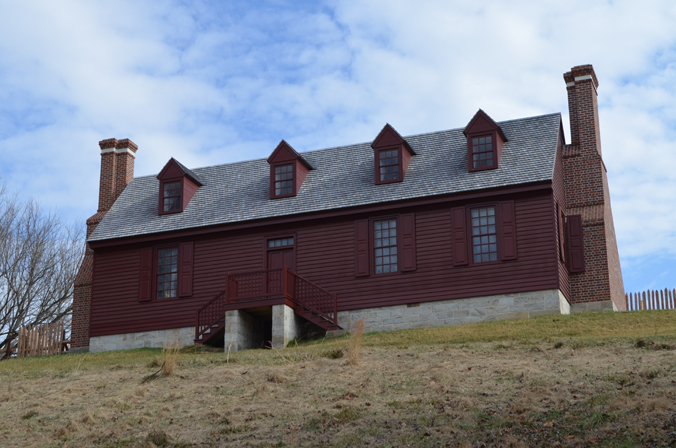
    Ferry Farm
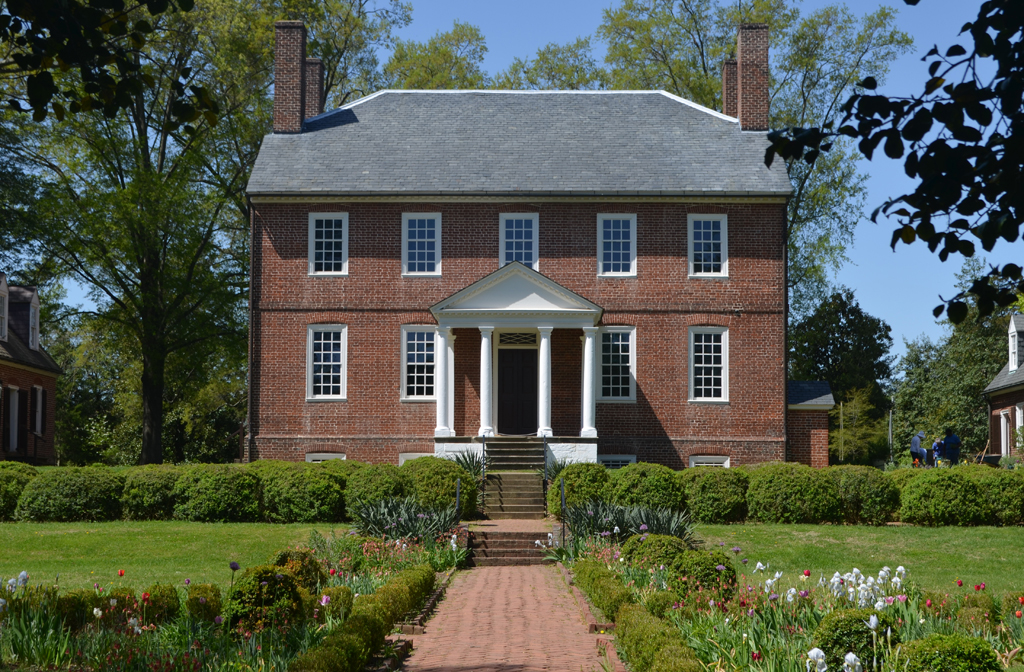
    Kenmore

    As a private organization, we rely on admission fees and your generous donations to fund our sites. We are not part of any National Park or state park pass system. Your ticket purchase helps preserve and promote the legacies of these two sites. Perhaps that is why we are so appreciative for each and every guest who visits. If you would like to support The George Washington Foundation, please consider a donation. We hope to see you at the National Historic Landmarks of Historic Kenmore and George Washington’s Ferry Farm soon!

    Elizabeth Hosier
    Manager of Interpretation and Visitor Services

  • Primary Sources: Interpreting the Past in the Present

    At George Washington’s Ferry Farm, we focus on archaeology as one way to learn about both the Washingtons and the other people who lived and worked on this landscape.  We rely on archaeology because many of these residents did not leave behind documentary primary sources for us to study.  A primary source is a “letter, speech, diary, newspaper article, oral history interview, document, photograph, artifact, or anything else that provides firsthand accounts about a person or event.”  Primary sources are the historian’s most essential tool and serve as windows into the past that allow us all to decipher meanings and draw conclusions about history’s people and events.

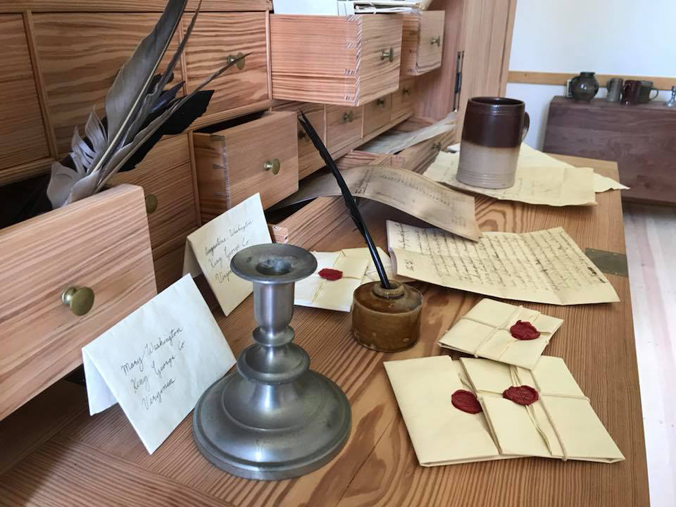
    Reproduction Washington family documents
    Reproduction Washington documents in the house at George Washington’s Ferry Farm. Credit: Brice Hart

    Even with our focus on archaeology, written primary sources have played a vital role in understanding Ferry Farm’s history and in helping us reconstruct and now interpret the Washington house.  For example, Augustine Washington’s probate inventory is helping us furnishing the recreated family home.  Basically, primary sources help The George Washington Foundation staff to understand the Washingtons and others so we can better inform the visitor. Most importantly, primary sources help us to remember that, while the past was certainly different from today, the people of the past were human just like us and, in a way, can bring them to life.  Let’s see how!

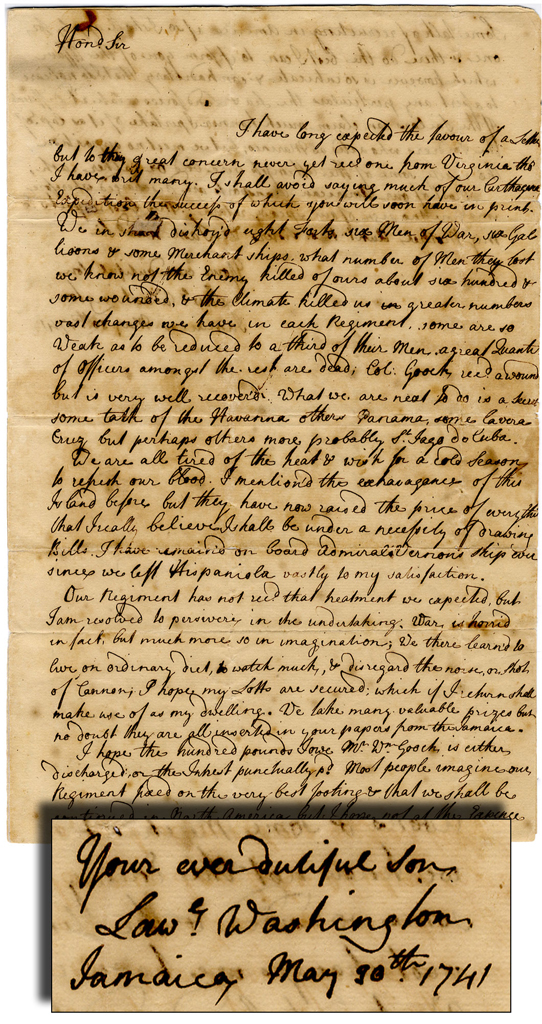
    Lawrence Washington to Augustine Washington - May 30, 1741
    The letter dated May 30, 1741 written by Lawrence Washington to his father Augustine Washington while fighting in the War of Jenkins’ Ear. Credit: Raynor’s Historical Collectible Auctions.

    The primary source we will use in this blog post is a letter written by Lawrence Washington (eldest son of the Washington family) to Augustine Washington (patriarch of the Washington family). The letter was written on May 30, 1741 from Jamaica where Lawrence was fighting as a loyal subject of English king against the Spanish, one of the other European powers competing for global dominance through colonization.

    The letter provides the reader pertinent details in how the Colonial Era differed from the 21st Century; yet it also contains clues on how the two time periods are similar. Lawrence begins by addressing his father with “Honored Sir” and ends with “Your ever dutiful Son,” a stark contrast in how we might address our parents or relatives today. This suggests that families in the Gentry class of the original English colonies addressed their elders with an air of formality and respect. This would have been much the same in their mother country of England and a practice carried over by the colonists.

    Lawrence also mentions that he had written many letters to his father, but “to [his] great concern, [he] [had] never yet received one from Virginia”. This gives us a closer look into the lives of military men of that time who were missing home and writing fervently to their families. A soldier’s timeless and ever-present homesickness can also be seen in Lawrence’s grumbling that “We are all tired of the heat & wish for a Cold season to refresh our blood.”

    Lawrence also comments to his father, “I hope my Lotts are secured; which If I return shall make use of as my dwelling”. As the eldest son, he would have received inheritance in the form of land from his father. Unlike today, land was everything to the people of the Colonial Era, and it is not unusual for Lawrence to remind his father of his intentions with his land once returning to Virginia from war abroad. Like us today, he also worries about a debt he owes. Even men at war abroad today make similar statements to loved ones about worries and plans after their service is complete.

    Lastly, another statement Lawrence makes to Augustine is that “War is horrid in fact.” He also relates how he and his compatriots have learned “to watch much & disregard the noise, or shot of a cannon”. This brief description of war could come from any century.

    Many living in 2018 can fail to recognize the many similarities they have with persons from history. In doing so, we can forget to see the people of history as individuals living lives similar to our own. We can easily turn them into a historic figure, and forget they are a person. This often happens with George Washington and the rest of his family. However, the beauty of primary sources is that they can bring someone who has passed long ago, back to life in our imaginations.

    Allison Burns
    Museum Educator

  • Video: The GWF in 2016

    Scenes from an exciting and memorable year at Historic Kenmore and George Washington’s Ferry Farm!