Lives and Legacies

Tag: Mythologizing

  • History in the Night Sky

    Night at Kenmore
    A lantern shines brightly in front of Historic Kenmore

    The night sky is the astronomer’s workspace, the explorer’s final frontier, and, perhaps surprisingly, the historian’s library of epic tales, myths, and legends.  This library of stars connects us to the cultures and civilizations of our past in a uniquely special way.  The Ancient Greeks, Native Americans, enslaved Africans, British colonists of the 18th century, and even George Washington himself all looked up at essentially the same night sky we can see two centuries later.

    Inspired by stories, myths, and legends, our ancestors gazed into the sky and connected the stars together into patterns they imagined were familiar objects, fierce animals, great heroes, or powerful gods. We call these patterns ‘constellations’ and the stories or ‘star lore’ they tell are as old as humanity itself.

    Imagine a clear, crisp early November night.  George Washington and his brother-in-law Fielding Lewis are walking home from a nearby tavern.  George is enjoying another of his occasional visits with his sister and her husband in Fredericksburg.  During their journey home, the two men’s path is lit only by the small flame in the glass lantern they carry. Once in a while, they see a feeble candle through a house window.  Otherwise, the Fredericksburg they walk through is far darker than we could imagine today.  Consequently, George and Fielding see millions of sparkling pinpoints of light over their heads.

    As educated men, George and Fielding could identify and name numerous constellations created by these pinpoints of light.  On their imaginary November walk, the two men no doubt spotted Orion, Cassiopeia, Bootes, and, of course, the distinctive Big Dipper pattern that forms part of the constellation Ursa Major or “The Great Bear.”

    Great Bear Big Dipper
    This map of the constellation Ursa Major. the “Great Bear,” highlights the asterism known as the Big Dipper. An asterism is a star pattern that can be found within an officially-recognized constellation. So, technically, the Big Dipper is not actually a constellation but is simply part of the Ursa Major constellation. The International Astronomical Union (IAU) officially designates which star patterns are constellations. Map by Rursus, https://commons.wikimedia.org/wiki/File:Plough_big_dipper.svg.

    They would have known the Greek myths attached to each of these constellations.  For example, the myth behind the Great Bear says that the goddess Hera turned Callisto, a maiden desired by Hera’s husband, the god Zeus, into a bear.  Zeus then lifted the bear into the sky by its tail, causing the tail to stretch. The three stars of the dipper’s handle represent this elongated tail.  Another Greek tale says Hercules threw a troublesome bear into the sky by grabbing its tail, swinging it above his head, and flinging it up to join the stars.  Probably even more familiar to plantation owners like George and Fielding was the idea – common throughout Britain – that the stars of the Dipper actually form a plow.

    In the basements, attics, and kitchens of some of the houses George and Fielding passed, enslaved men, women, and children slept. Literally brought in chains from their African homelands, they looked up at the night sky above the land of their enslavement and were reminded of home by the constellations they saw.  Some of these Africans may have seen what they termed “The Drinking Gourd.”  Indeed, there is speculation that our common use of the Big Dipper as the name for this distinct pattern comes directly from the African idea that the stars form a hollowed out gourd used for collecting and drinking water.  In the 1800s, the drinking gourd formed the basis of the African American folksong “Follow the Drinking Gourd,” which, it is claimed, contained thinly veiled instructions for slaves to follow when running north to freedom.  The Dipper pattern can assist someone navigating by stars to find the North Star.

    Before George, Fielding, and their slaves lived in Fredericksburg, Native Americans occupied the land along the Rappahannock River.  Interestingly, like the Greeks, certain Algonquian-speaking nations, also saw the Big Dipper as a bear.  Instead of a long tail, however, the three stars of the Dipper’s handle were three hunters who chased the bear across the sky.  This chase lasted until autumn when the hunters killed the bear and its blood fell to Earth and caused the leaves to change color.

    It is increasingly difficult for today’s Americans to see the library of epic tales, myths, and legends in our night sky.  The glow from streetlights, security lights, lighted signs, and other outdoor lighting is blotting out the stars from view.  Indeed, 2/3 of Americans – over 200 million people – can’t see the Milky Way from their own homes.  In 1994, an earthquake knocked out all the power to Los Angeles.  Many anxious residents phoned authorities to report a “giant, silvery cloud” in the dark sky.  They were seeing the Milky Way, normally obliterated by the urban sky glow.

    Light pollution
    Milky Way from Mount Saint Helens with light pollution from Portland, Oregon. Photo by Ray Terrill, https://www.flickr.com/photos/rayterrill/9230199139

    If we can’t see the stars, we may ultimately forget the stories they tell and even more tragically our ancestors – the Greeks, Africans, and Native Americans – who created those stories.  More and more, we are no longer looking up at the same night sky that George and Fielding beheld on their imagined walk home from the tavern.  The same sparkling stars are still there.  We just can’t see for the light.

    On Friday, November 13, learn more star lore during Night in Washington’s Day at Historic Kenmore!  Families and visitors of all ages can experience Kenmore lit only by methods available in the 1700s and witness a theater scene showing how enslaved people used their night hours to catch up on personal chores. Glenn Holliday from the Rappahannock Astronomy Club will share tales of great discoveries from astronomy’s past. Children may make a paper-bag ‘tin punch’ luminary and cookies and cider will be served to all! Please bring a flashlight to use in select activities.

    Cost: $12.00 adults, $6.00 ages 4-17, free ages 3 and under.
    Reservations required. Call 540-370-0732 x24 or email hayes@gwffoundation.org

    Zac Cunningham
    Manager of Educational Programs

  • Being Part of the Story: Collecting Oral Histories about Ferry Farm and Kenmore

    Have you ever seen ads for museums inviting you to “be part of the story”?  Well, at George Washington’s Ferry Farm and Historic Kenmore, many people are part of the story and have been for a long time.  Those who have played an integral part in the ownership, history, preservation, and work of the properties have long had a spot for these two places in their hearts.   Collecting and processing the oral stories of those people is an important part of understanding the historical scope of The George Washington Foundation’s properties.  In fact, oral history programs and collections have become an important component of many museums around the world.

    Our Foundation’s own oral history project officially began in 2007.  My requirement was to interview someone for a Historic Preservation Department course I was taking at The University of Mary Washington.  I was to record recollections of a person describing the layout of a house he or she previously lived in and detail how the rooms and landscape around the person’s home were used by its occupants.  Since I worked in the Archaeology Lab at Ferry Farm, I decided to ask David Muraca, director of archaeology, if he knew of someone I could interview associated with the property or who had lived at Ferry Farm during the 20th century.   He suggested Charles Linton, Jr, a local gentleman who had lived in the 1914 two-story frame house on the property as a boy with his large family from 1942 to 1956.

    ColbertHouse
    The Colbert House (right) built in 1914 by James Colbert, owner of Ferry Farm for much of the early 1900s

    In our oral history session, Mr. Linton and his wife, Pat recounted many specific remembrances of the Linton family’s time living on the very same river bank where George Washington grew up He told of the aftermath of the historic 1942 Fredericksburg Flood, rationing during World War II, and his parents’ efforts to house soldiers and provide medical supplies for the troops.  There were many tourists who visited the property during the time that the Linton’s lived at Ferry Farm. So many, in fact, that they kept a guest book!  People traveling through wanted to visit the place where the nation’s first president had spent his boyhood.  They wanted to buy tiny jars of homemade cherry preserves from Charles’s mother, postcards from his sister Barbara, and get a tour of where young George had cut down the cherry tree.  The visitors were not disappointed either as Charles and his brother, Tayloe, sold wood pieces cut from the trunk of a cherry tree (with a hatchet, no doubt) for one dollar each…not a bad income for two industrious boys at that time!  Tiny cherry wood carvings of hearts and hatchets were whittled and sold, too.

    Heart and Hatchet
    Carved cherry wood heart and hatchet (approx. 1” each) dating from the 1940s. Gift of the Linton family.

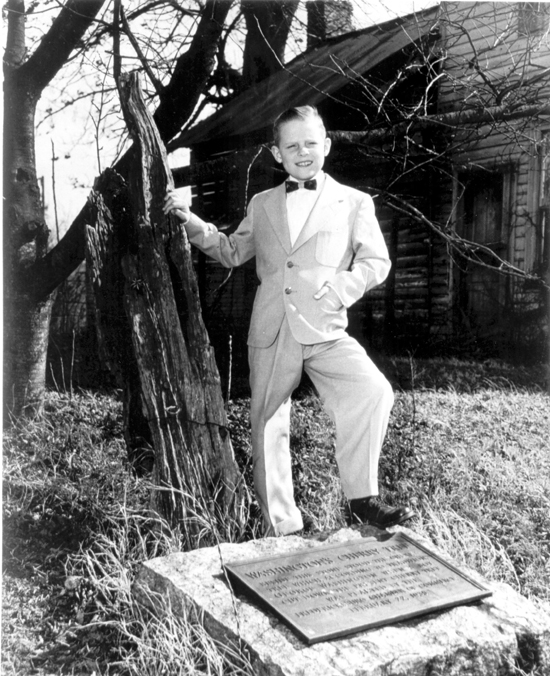
    The stump of a supposed scion of the cherry tree that Washington had barked was also on the property for visitors to see and was known as “The Shrine Tree.”  It was, no doubt, an important reminder to visitors of Washington’s honest character.    While those early 20th-century attractions no longer exist on the property at Ferry Farm, the Cherry Tree Story is still a subject that is inquired about by the visiting public just as it was in Linton’s day.

    BoyCherryTreeSign
    A young visitor stands next to “The Shrine Tree.”

    Some important revelations came to me as a result of doing this assignment for my class.    I began to really recognize the sacred nature of our presidential property and how deeply affected the public had become by that nature over time.  In the case of Ferry Farm, tourists and travelers have been fascinated by Washington’s boyhood home for 230 years mentioning it in diaries and letters over the centuries.  This realization spurred me on to research the publics’ fascination with Washington’s character via the Cherry Tree Story. Why do so many still ask about this tale?  Why do so many acknowledge that the story probably isn’t true but, in their heart of hearts, they want it to be?  To get the answers to these questions it would be necessary to ask more questions by collecting more oral histories and to begin a Foundation archive.  In doing so, it became clear that the recent past, brought to life by the personal stories of so many who have been involved with Ferry Farm, proved a new and fascinating way to look at our archaeologically-rich property and gain understanding of its social and cultural impact over the decades.  I got to work interviewing and, before I knew it, an archive of stories about Ferry Farm and Kenmore Plantation was created.  Not only did I discover more about the 20th century history of our Foundation properties, but documenting the preservation efforts associated with them proved critical to remembering the hard work of the many dedicated people who saved them.

    By creating a formal database with the mission of gathering oral histories, I saw that we could document much personal and institutional memory about our museum sites and couple the insightful perceptions collected about the Washington and Lewis Family’s with our scientific and historical research findings.  Eight years later, the archive is well on its way.  Samplings of some of the amazing stories collected so far will make their way into future blog postings so you can view for yourself the peoples’ passion for Ferry Farm and Kenmore’s historical treasures.   Anyone wishing to participate in this project is encouraged to contact the Foundation at (540) 370-0732 extension 14 or healy-marquis@gwffoundation.org.

    Melanie Marquis
    Archaeology Lab Supervisor
    Oral History Project Coordinator

  • George Washington, Baseball Player?

    I find that February, though it has the fewest days, can be the longest month of the year. The novelty of winter has worn off and, often, I simply seem to be enduring until the first glimpses of spring in March. I do, however, look forward with excitement to two moments in February: George Washington’s Birthday and the day that Major League Baseball’s pitchers start their spring training. In a way, these two events are connected by more than their close proximity to one another on the calendar.

    After the familiar cherry tree tale, the second most popular story about George Washington’s youth is the story of him throwing a rock the size of a silver dollar across a river. This legend has changed several times over the years but it may have some truth.

    The earliest version appears in The Life of Washington by Mason Locke Weems, who notes that George’s cousin remembered seeing him “throw a stone across [the] Rappahannock, at the lower ferry of Fredericksburg.”[1] George Washington Parke Custis, Martha’s son, provides a bit more detail for this toss, noting that the rock was actually “a piece of slate, fashioned to about the size and shape of a dollar, and which, sent by an arm so strong, not only spanned the river, but took the ground at least thirty yards on the other side.”[2] Archaeologist Phil Levy estimates “that could have been a distance of anywhere from a staggering 440 feet (professional baseball fields vary from 390 to 435 feet at the centerfield wall) to an impressive 340 feet.”[3]

    We’ll never have the evidence historians need to say with certainty that young George actually threw a rock across the Rappahannock. It is a plausible story, however. So, each February at Ferry Farm’s birthday celebration, visitors try and duplicate George’s feat, provided the day’s weather or any lingering snow on the ground doesn’t prevent us from traipsing down to the river.

    A visitor attempts to throw a rock across the Rappahannock River during the George Washington Birthday Celebration at Ferry Farm.

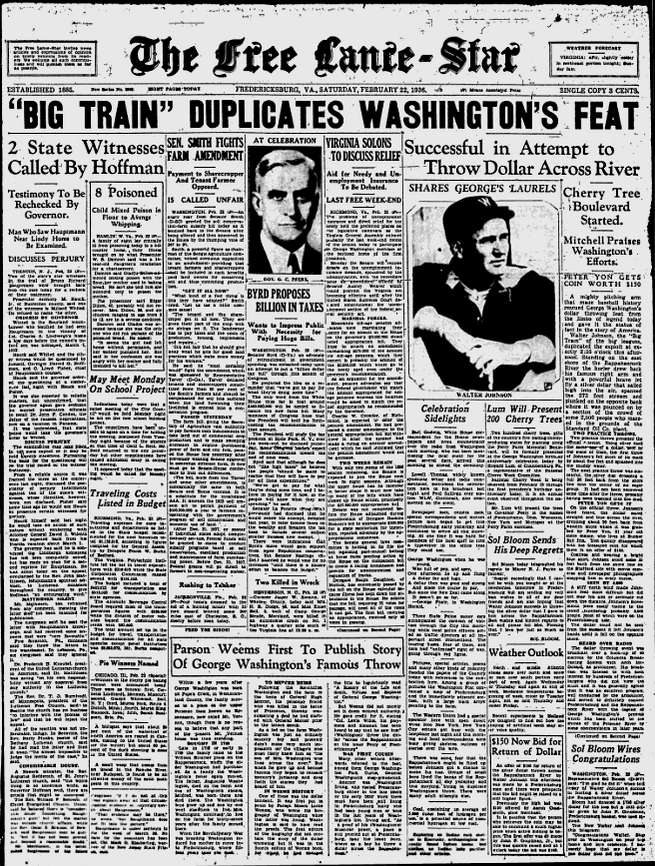
    The feat has actually been duplicated, most famously by Walter “Big Train” Johnson, celebrated pitcher for the Washington Senators, on a Depression-era February day in 1936. Officials in charge of that year’s birthday celebration at Ferry Farm challenged the retired Major League right-hander, raising the ire of Congressman Sol Bloom of New York, who believed the story of Washington’s toss, to be “preposterous.” Quoted in the February 18, 1936 edition of The Free Lance Star, Bloom felt the feat “physically impossible” because “Washington was about 10 years old when the miracle was supposed to have happened.” Perhaps, he forgot that George lived at Ferry Farm well into his late teens?

    A few days before the celebration, reporters found Johnson training for the toss by throwing a coin at the barn on his Germantown, Maryland farm. “‘Maybe I can’t throw that far,’ he drawled, ‘but there’s one thing certain—if George Washington did it, I can too.’”

    Walter Johnson poses as if in mid-throw on the icy bank of the Rappahannock.

    Finally, the day came. On the front page of the February 22, 1936 edition, The Free Lance Star’s banner headline trumpeted “‘Big Train’ Duplicates Washington’s Feat.” Standing on the Ferry Farm side of the river at 2:30 p.m. that day, Johnson took two practice tosses. The first plopped into the water just five feet short of the bank while the second made it across. Then, he attempted the official throw. Johnson “drew back his famous right arm and with a powerful heave let fly a silver dollar that sailed high into the air, spanned the 273 foot stream and plunked on the opposite bank.” Bloom graciously wired his congratulations and invited Johnson to stop in Washington and celebrate with him on his way back to Germantown.

    Front page of The Free Lance Star, February 22, 1936

    The attempt became something of a national sensation with newspapers in Michigan, Florida, Connecticut, Kansas, Missouri, and beyond reporting the story. A live radio program on the Columbia Broadcasting System beamed a description of the throw into countless homes across the nation.

    Although it doesn’t garner the attention it did in 1936, the Stone Throw Challenge remains a centerpiece of Ferry Farm’s annual Washington’s Birthday Celebration when the weather allows it. On that day, which is usually about the time that today’s aspiring Walter Johnsons are starting to prepare for their seasons, I think of a day during the Great Depression when a big league pitcher added to his own legend by duplicating the prodigious feat of the most legendary American of all. As I watch our visitors attempt their throws, I think of the “Big Train” and I also always wonder just what kind of ballplayer George Washington might have been.

    Zac Cunningham
    Manager of Educational Programs

    Join us at Ferry Farm on Saturday, February 14 for our George Washington’s Birthday Celebration, when – weather permitting – we’ll see if anyone else can throw a stone across the Rappahannock River. Along with the Stone Throw Challenge, enjoy crafts, games, exhibits, live history performances, and birthday cake! Visit www.kenmore.org/events.html for more details about the Birthday Celebration along with Archaeology Day on Monday, February 16!

    [1] Mason Locke Weems, A History of the Life and Death, Virtues and Exploits of General George Washington, Macy-Masius Publishers, 1927: 39.

    [2] George Washington Parke Custis, Recollections and Private Memoirs of Washington, Philadelphia, J.W. Bradley, 1861: 482.

    [3] Phil Levy, Where the Cherry Tree Grew: The Story of Ferry Farm, George Washington’s Boyhood Home, New York: St. Martin’s Press, 2013: 226.