Lives and Legacies

Tag: neoclassical design

  • Spoooooooooky Teapots?

    There’s plenty to be frightened about in the colonial period. But teapots? Not exactly. However, aesthetics change as time passes. We see things through different lenses. As I type this, my substantial black cat with big yellow eyes stares at me, demanding attention.

    Poe, the big black cat with yellow eyes.

    Black animals are currently the least likely to be adopted in the United States, so black can be seen as a negative in pets…but what about black teapots?
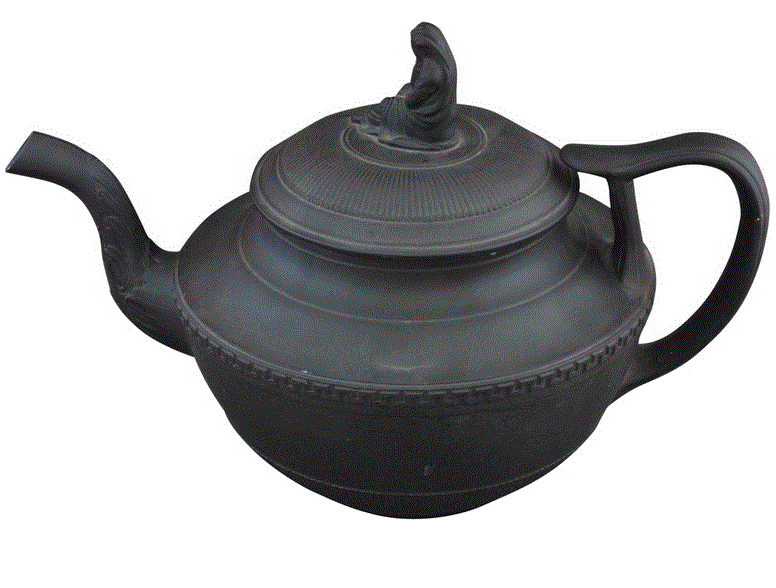
    Black Basalt Teapot, Turner, circa 1805

    Turns out, they were very much the rage during the middle of the 18th century and even into the early 20th century. 

    “Black is sterling and will last forever.”

    In 1767, Josiah Wedgwood started working with black basalts – a richly hued, glossy black stoneware medium – for his famous Etruscan vases. Wedgewood’s basalt is made from reddish-brown clay that burns black in the firing process; black basalt owes its color to the addition of manganese. [1]  [2]

    After Wedgwood perfected the fine-grained stoneware, it was soon being produced by other Staffordshire potters in England. It was called ‘Black Basalt’ or ‘Egyptian Black.’ [3] [4]  A matte black teaware that was striking and, by our modern estimations, quite possibly macabre. 

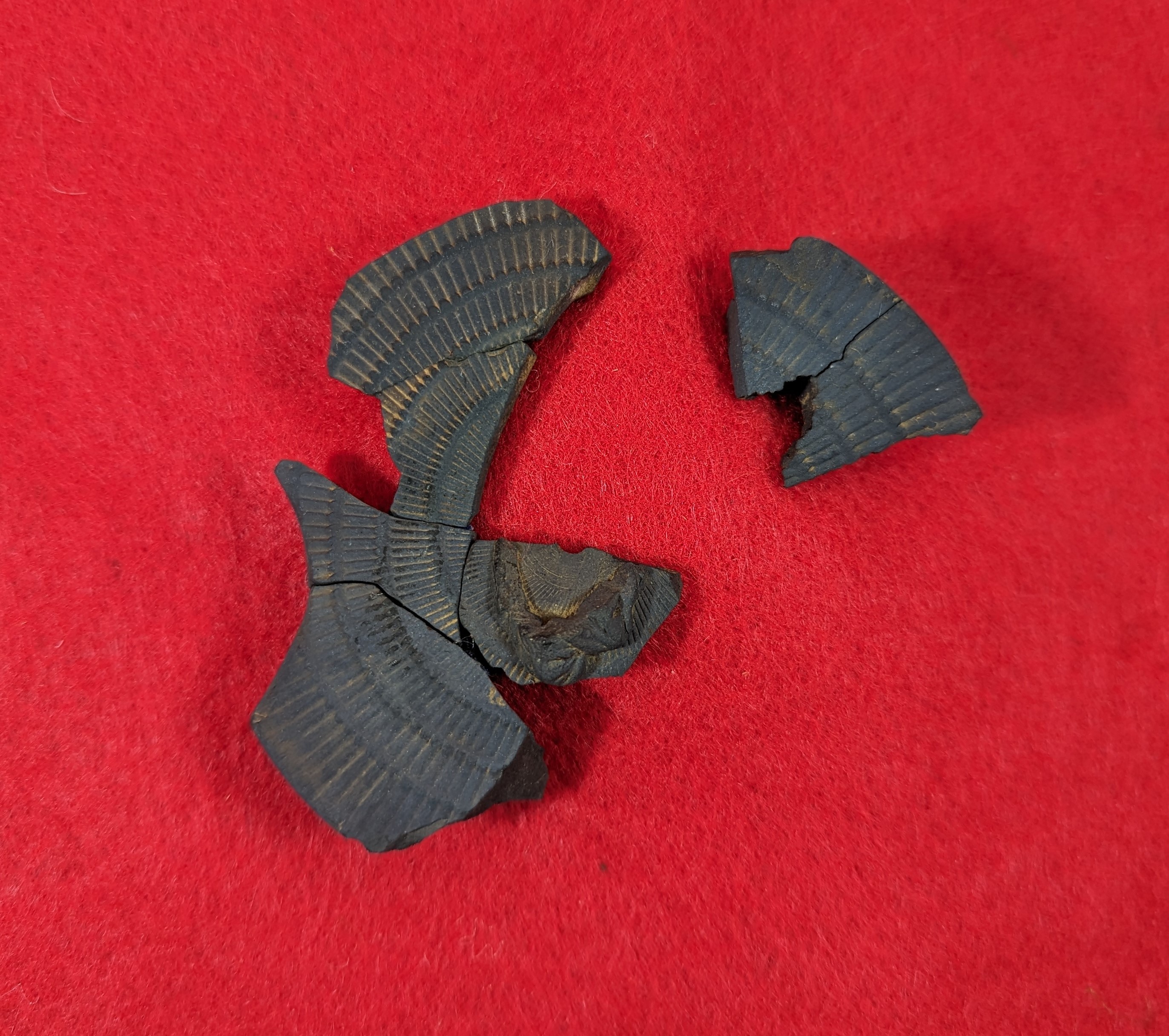
    Black Basalt teapots were decorated utilizing a new technology called ‘engine turning’ lathes. Simple turning lathes have been used for pottery production since the early 1700s. By the 1730s, virtually all hollow wares (mugs, jugs, cups, bowls, etc.) were being lathe-turned to shape and thin bodies. The engine-turning lathe further provided the ability to cut regular patterns in the clay bodies to create decorative elements. [5] The decorative elements at the time were heavily influenced by classical art from Ancient Greece and Rome. [6] 

    A striking finial accented the lovely neoclassical etches on the body of the matte black pot.

    Teapot, Circa 1800, Black Basalt, Mayer Manufacture, Staffordshire, England

    What is a finial? The little knob on the top of the lid. This is where it gets weird for our modern-day eyes. Some looked like women hunched over, draped in mourning clothes or grieving widows. Add this to the black body, and the oddly shaped pots start to take on a dark tone. 
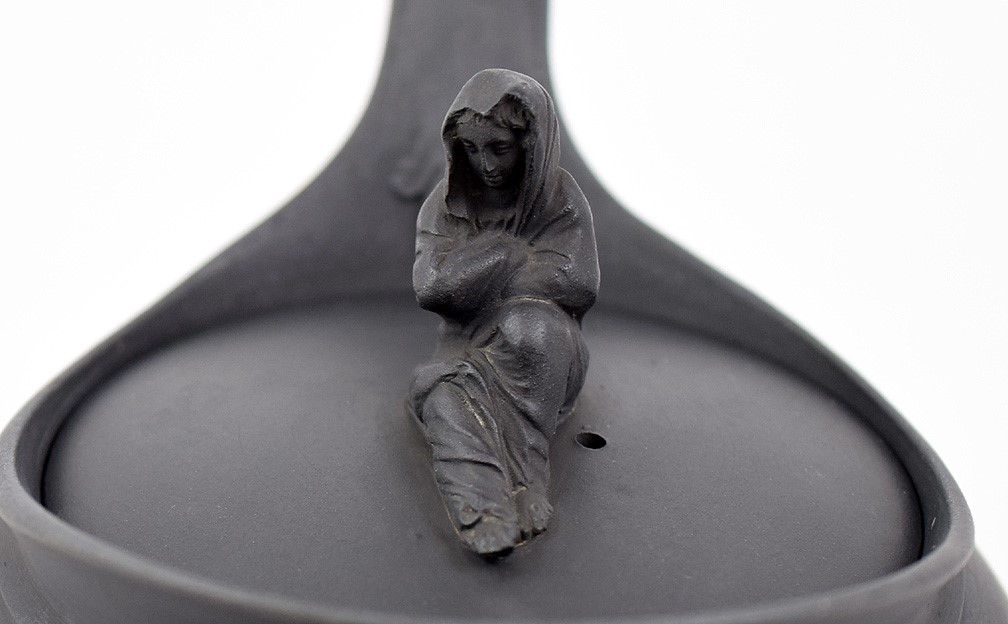
    Woman Finial

    Mary Washington owned an early iteration of these black basalt pots, but was it for mourning purposes? Not likely.

    Her husband Augustine died in 1743, early into the family’s occupation at Ferry Farm. This would have been before the invention of this style of pottery and well before strict (and quite frankly tedious) Victorian mourning rituals. A black teapot may seem to symbolize some outward decorative display of bereavement or grief (particularly with a sad woman finial). Yet, to Mary, it would have just been a neoclassical design in the latest black basalt trend. She was just being her fashionable self. Her teaware collection was pretty admirable, and the fact that she owned a black basalt teapot is not surprising. 

    But that shouldn’t stop us from enjoying beautiful and somewhat spooky teapots.


    Mara Kaktins, Archaeologist & Lab Manager

    Sources

      [1] M.S. Rau. (2019, December 11). Wedgwood: A collector’s guide to English ceramic treasures. https://rauantiques.com/blogs/canvases-carats-and-curiosities/wedgwood-collectors-guide

    [2] Todd, L. M. (2020, December 17). Rediscovering Black basalt one of Josiah Wedgwood’s first and most enduring inventions. Architectural Digest. https://www.architecturaldigest.com/story/rediscovering-black-basalt-one-of-josiah-wedgwoods-first-and-most-enduring-inventions

    [3] STONEWARE, BLACK BASALT – Type Index | Historical Archaeology Type Gallery. (n.d.). https://www.floridamuseum.ufl.edu/typeceramics/type/stoneware-black-basalt/

    [4] The Mint Museum. (2023, January 24). Classic Black: The Basalt sculpture of Wedgwood and his contemporaries – Mint Museum. Mint Museum. https://www.mintmuseum.org/exhibition/classic-black/

    [5] The Chipstone Foundation. (n.d.). https://www.chipstone.org/article.php/151/Ceramics-in-America-2004/The-Little-Engine-That-Could:-Adaptation-of-the-Engine-Turning-Lathe-in-the-Pottery-Industry

    [6] Portals to the Past: British ceramics 1675-1825 – Google Arts & Culture. (n.d.-b). Google Arts & Culture. https://artsandculture.google.com/story/portals-to-the-past-british-ceramics-1675-1825/GgUh1Et0LThYLw
  • The Man on the Ceiling: Neoclassical Decorating at Kenmore

    As with many things at Historic Kenmore, the reasoning behind the choices Fielding and Betty Lewis made for their masterpiece of a house remain a mystery to us.  Why are Aesop’s Fables the subject of the decorative plaster overmantel in the Dining Room? Why is there an old-fashioned paneled wall in the Chamber? Why did they cover the expensive Drawing Room wallpaper with artwork but didn’t hang any art in the Dining Room? We’ll probably never know why they made most of these choices…but it’s pretty fun to speculate!

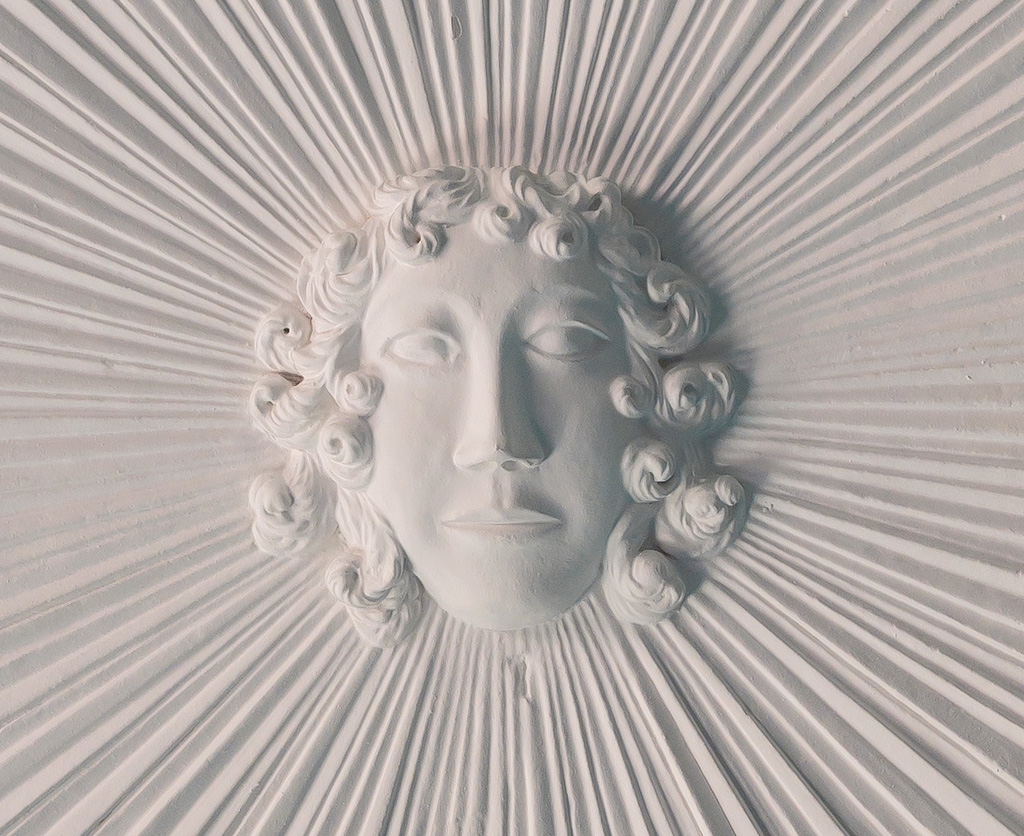
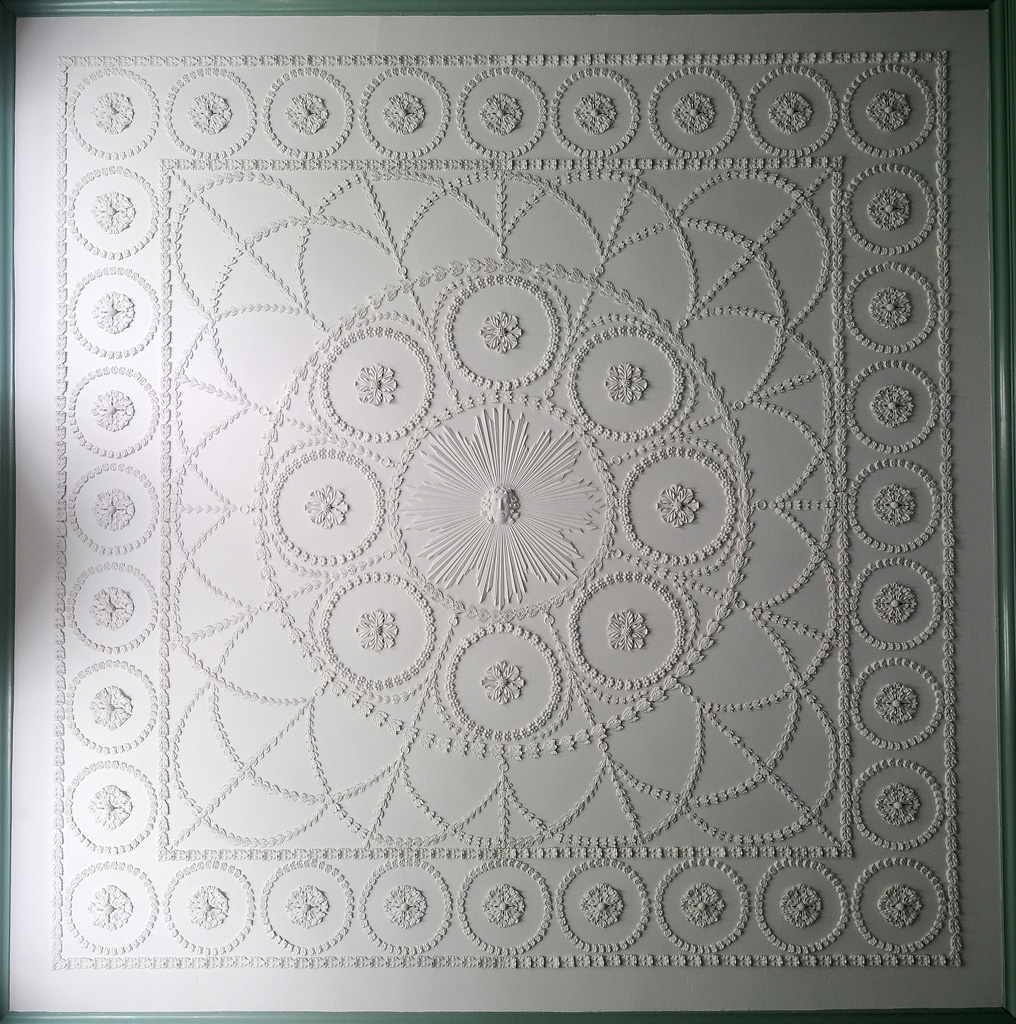
    One such stylistic choice is at the center of the plasterwork ceiling in the master bedchamber.  Visitors to Kenmore may recall the man’s face surrounded by rays or beams of light depicted there.  It is believed that this man is Apollo, the Greek god, and that the light beams emanating from his head, in this case, indicate that he is being depicted as Apollo the Sun God (one of many titles attributed to him).

    apollo-on-chamber-ceiling
    Apollo on the ceiling of the master bedchamber at Historic Kenmore.

    chamber-ceiling
    The entire bedchamber ceiling with Apollo at the center.

    When asked, we usually give visitors a fairly simple explanation for his position on the ceiling, something along the lines of “Apollo was a common symbol of the neoclassical style which was a popular decorating theme at the time.” That’s very true.  In the mid to late 18th century, the neoclassical style was all the rage throughout England and France, and much of the rest of Europe, as well.  As the story goes, the discoveries of the ruined ancient cities of Herculaneum and Pompeii created a fascination with the ancient world that showed up in everything from window curtains to tea pots.  Although the fashion arrived in the American colonies a bit later than in Europe, and despite far fewer options for incorporating it into their homes, the gentry tried to bring the neoclassical flare to their houses, as well.

    However, this explanation for Apollo’s presence in the Kenmore bedchamber may be a bit oversimplified.  After all, Apollo’s face is really the only identifiable neoclassical symbol in the entire house.  Why would Fielding and Betty choose to place this one symbol in this one room, and then completely ignore the neoclassical esthetic in the rest of the house?

    Much has been made of the mysterious craftsman who created Kenmore’s famous plaster ceilings – could the Stucco Man simply have chosen Apollo imagery at random for the bedchamber? Or, could there be another, less obvious, meaning behind the depiction? Maybe we should be looking at the 18th century concept of Apollo himself, rather than his use as a decorative motif.

    raleigh-tavern
    Exterior of the reconstructed Raleigh Tavern in Colonial Williamsburg. Credit: Maggie McCain/Wikipedia

    apollo-room
    Raleigh Tavern’s Apollo Room in Benson Lossing’s The Pictorial Field-Book of the Revolution published in 1860. Lossing visited the tavern in the late 1850s just prior to a renovation (thus the depiction of tools in the room’s center). The tavern was destroyed by fire in 1859. Public domain. Credit: Wikipedia.

    Kenmore’s bedchamber isn’t the only place that Apollo shows up in 18th century Virginia.  In fact, Apollo’s name is fairly common in the colony…especially in taverns.  Many inns and taverns had a room known as the Apollo Room.[1]  The most famous of these Apollo Rooms is probably the one at the Raleigh Tavern in Williamsburg, which was a well-known meeting space and the scene of large public gatherings, like balls or dinners.  When the House of Burgesses was disbanded by the royal governor in 1773, the burgesses simply moved themselves down the street to the Raleigh Tavern and conducted their business in the Apollo Room, drafting the non-importation act and other “treasonous” acts.  There is some thought that the Apollo Room in Williamsburg, and the other various Apollo Rooms in Virginia taverns, were named in honor of the Apollo Room at Hercules Pillars (or Pillars of Hercules, depending on who you talk to) in London.

    pillars-of-hercules
    The Pillars of Hercules pub as it appears today in Soho, London. Credit: Ewan Munro/Wikipedia

    The Hercules was a tavern established sometime before 1709, and is actually still in business today.  The Hercules was a leader among the several taverns in London that catered to the gentlemen’s “clubs” that were so popular at the time.  Much like modern-day college fraternities, these clubs were often known for one thing or another – some focused on scientific discourse, some were patrons of the arts, some met to read poetry, some were political in nature, some were more raucous than others, but they were all essentially drinking clubs.  For their monthly dues, members could meet at their club’s tavern and imbibe or enjoy a good meal, and take part in good conversation.  At the Hercules, the club met in the Apollo Room.[2]  Although it was a bit of a disconnect, Apollo was used in this case as a symbol of refined culture and knowledge, as opposed Bacchus, a god who symbolized wild partying and debauchery.  Whatever the reality, the Apollo Room was intended to be a place for polite discourse and companionship.

    Now, in a previous post on this blog, we discussed some archaeological evidence that Fielding may have had ties to a fraternal organization (that was essentially a drinking club, too) in England known as the Right Honorable Society of Bucks, and we know definitively that he was a member of the Fredericksburg masonic lodge, another fraternal, social organization.  Could that be the idea that Fielding was trying to express in putting Apollo’s head on the ceiling in the bedchamber – Apollo as a symbol of fraternity and knowledge? It would make sense, especially in light of the fact that Fielding was clearly trying to create the household of a proper English gentlemen when designing Kenmore.  Membership in these social clubs was probably prevalent among Fielding’s business associates in England, and certainly masonic membership was important for businessmen in Virginia.  Perhaps Fielding was subtly creating his own “Apollo Room.”

    chamber
    Kenmore’s master bedchamber

    Alas, there is a glitch in this theory.  If Fielding is trying to create his own Apollo Room, or at least convey the idea of an Apollo Room, why did he choose the bedchamber for it? As visitors to Kenmore have no doubt learned on tour, the master bedchamber in an 18th century household was considered an entertaining space, so that’s not the issue – people other than Betty and Fielding spent time there.  It’s more that the bedchamber is typically the domain of the lady of the house.  It was Betty’s command central, she spent most of her day there, running the household, keeping tabs on the enslaved servants and tending to her children.  If there were visitors to be entertained there, they were most likely Betty’s visitors.  The bedchamber tends to have a feminine connotation.  If Fielding wanted to make his business associates and social guests aware of his culturally refined and knowledgeable status, wouldn’t he put the Apollo symbol in the Dining Room or the Drawing Room?

    As I stated at the beginning of this post, there are many aspects of Kenmore that we might never fully understand, and the man on the ceiling is one of them.

    Meghan Budinger
    Aldrich Director of Curatorial Operations

    [1] Study of Taverns in Virginia in the 18th Century. Department of Research, Colonial Williamsburg Foundation, 1990.

    [2] Club Life of London with Anecdotes of the Clubs, Coffee-Houses and Taverns of the Metropolis, During the 17th, 18th and 19th Centuries, Vol. II. John Timbs, 1866.