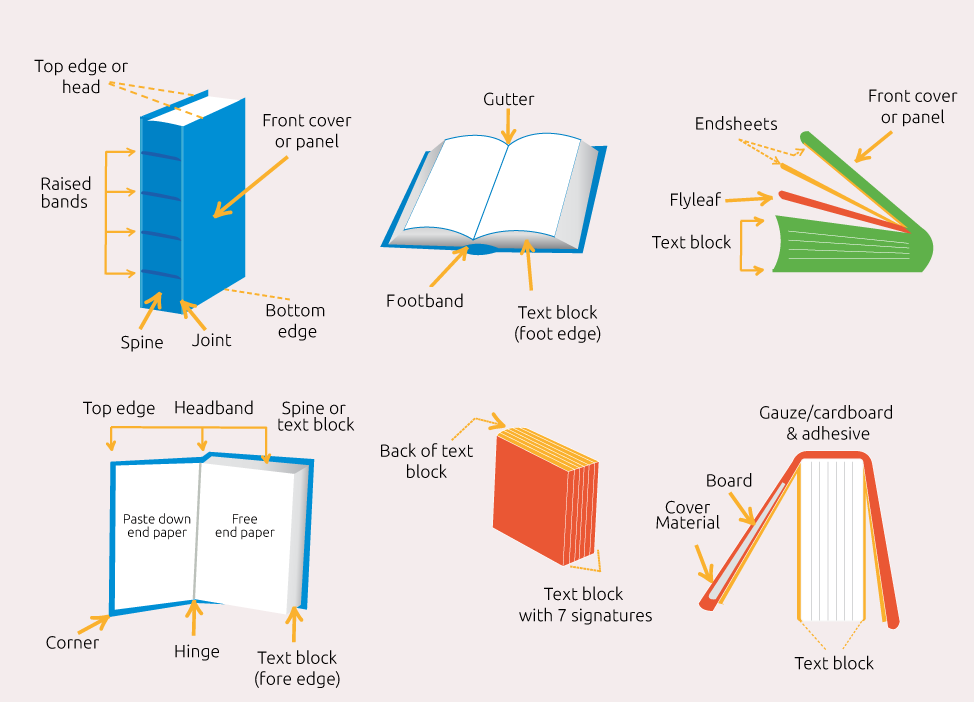
The design of books today is an art form. Think about it. What will catch the reader’s eye? What cover art will convey the theme or subject of the pages inside? If you’ve ever pulled an older book off a shelf, say one owned or used by George Washington (or a descendant of the family), you might notice a somewhat drab cover with the title stamped on the front, but otherwise very nondescript. You might notice if the bindings holding the pages together are tight or loose if there’s a crease in the spine (heaven forbid!), or even if there’s a bookplate denoting the ownership of said book.
Look at this book in our collection.
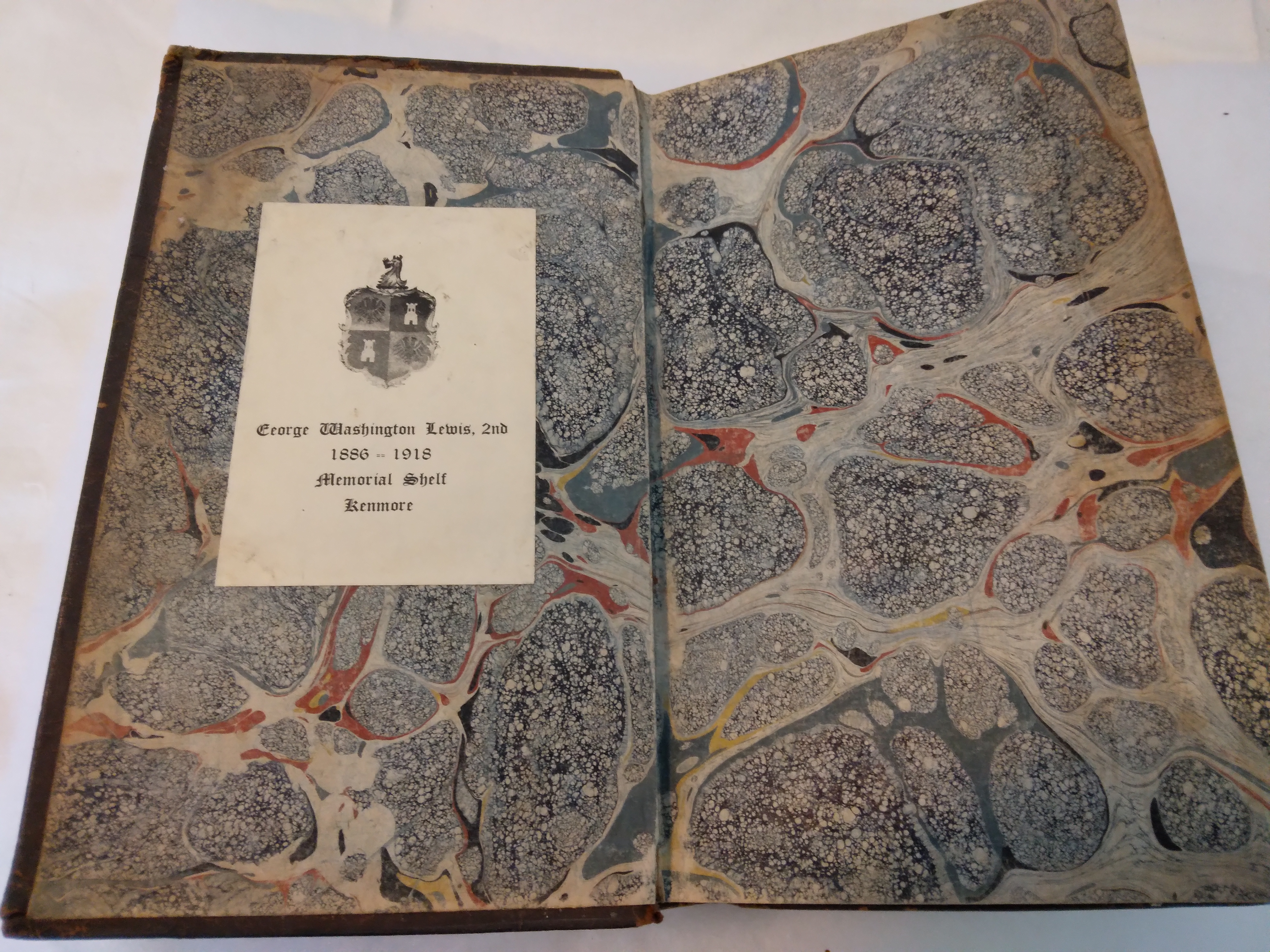
Do you see all the parts mentioned? Great! However, what about those paint blobs? What is that, and why do so many older books have those kinds of endpapers?
These papers are art in and of themselves. They are typically called “marbleized” paper (the process is “paper marbling”), and the earliest known use of the technique was in 10th century Japan. The process in Japan is known as Suminagashi, which literally translates to “floating ink”.[1] The process migrated to Turkey, where artisans began using paint rather than ink. Eventually, the art form arrived in Western Europe after the Crusades and took hold in France, the Netherlands, and Germany.[2] Most historians credit the French for taking this art form to the next level, using it for books. Imagine that fancy, leather-covered book without marbled end pages…what could possibly cover the strings and glue that holds the book together? Plain paper? Non, c’est horrible!
The art form rose to such a skill level that a specific guild was created to keep the secret from others. For those unfamiliar, a guild is an association that oversees a specific craft or trade. It is what our modern-day professional associations are to those in previous centuries. In this case, however, the marbling guild took great pains to keep their trade a secret since the technique was highly valued by bookbinders who wanted to streamline (read: make less expensive) the process. While the guild kept the process a secret for over a century, eventually, someone decided to publish a how-to guide. That person was Charles W. Woolnaugh, and his book is The Art of Paper Marbling.[3] The cat was effectively let out of the bag at this point (1851), and Woolnaugh followed up with a second book on the practice about 30 years after the first one.
The most interesting aspect of marbled paper is that no two designs are alike. There can be many similarities from the color scheme to a feathered design, but it is almost impossible to create the same image each time. When you think about it, it is neat because each endpaper is unlike any other.
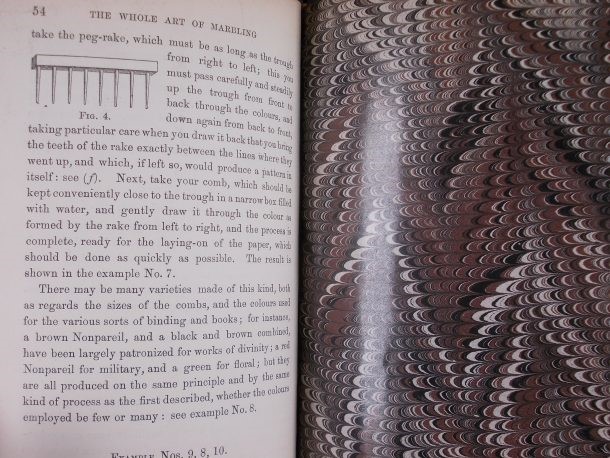
This image was created by using a comb (also shown) that, when gently pulled through the paint (which is floating on top), creates this arches. For single, larger arches, or even a more feathery technique, a quill or sharp-pointed device (a nail, for instance) could be used to gently manipulate the paint into a particular design. To transfer the image to paper, one would lay the paper on top of the floating paint, touch the four corners to ensure the entire surface made contact, and then gently pull up from one of the corners, letting the residual liquid drain back into the pan.
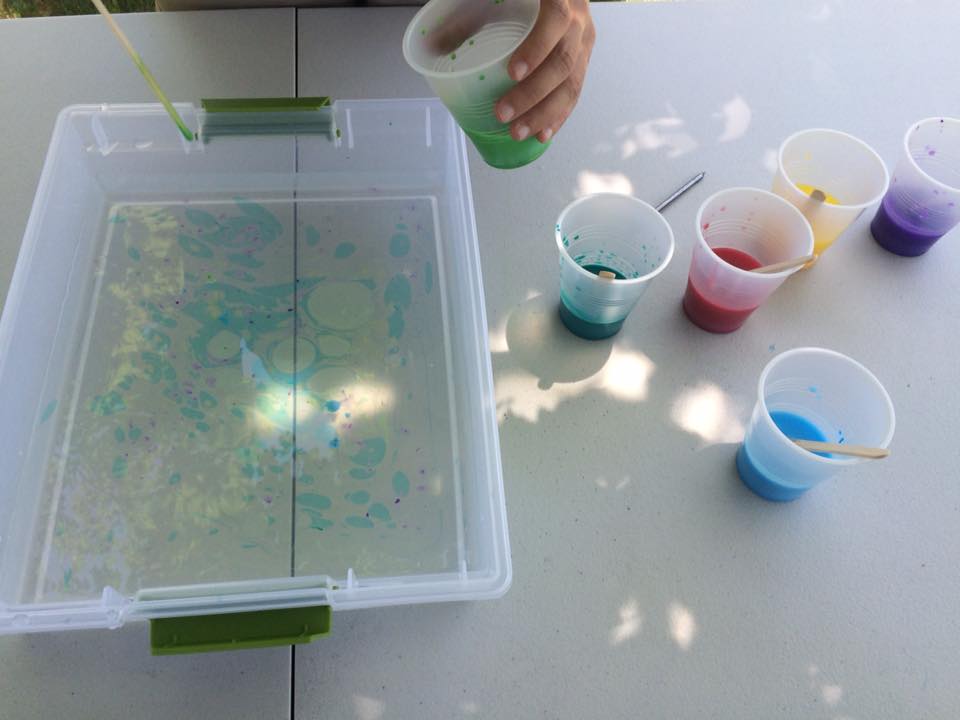

Want to try your hand at paper marbling? Join us for our annual Fabulous Fourth at Ferry Farm event on Monday, July 4, from 10 am to 4 pm. We will be using water, carrageenan (seaweed extract), and acrylic paint to recreate the marbleizing process. You can try the comb and feather technique in red, white, and blue hues. The product will result in a bookmark with the added bonus of one of GW’s “Rules of Civility” printed on it too. Fun fact: To practice his penmanship, GW copied those rules from a French etiquette book! However, one might wonder, did his book have marbled end pages? We can only hope.
Amy N. Durbin
Director of Education
[1] Ryan, L. (2021, February 18). Marbled Papers: A Brief History of an Endagered Bookcraft. UDC Library Cultural Heritage Collections. Retrieved June 21, 2022, from https://ucdculturalheritagecollections.com/2021/02/18/marbled-papers-a-brief-history-of-an-endangered-bookcraft/
[2] Berry, G. (n.d.). Some History of Marbling. The Ancient Art of Marbling on Paper and Fabric. Retrieved June 20, 2022, from https://marbleart.us/SomeHistory.htm
[3] Revell, S. (2016, November 2). Divers oiled colours: Exploring the history of marbled paper in the National Art Library •. V&A Blog. Retrieved June 20, 2022, from https://www.vam.ac.uk/blog/museum-life/divers-oiled-colours-exploring-the-history-of-marbled-paper-in-the-national-art-library