Lives and Legacies

Tag: Politics

  • “To Bigotry, No Sanction…:” Jewish Identity in Early America and Relations to Washington

    Figure 1: Washington’s words to the Newport congregation (George Washington Institute for Religious Freedom)

    The quote, “To Bigotry, No Sanction, To Persecution No Assistance” appears in a 1790 letter written by George Washington to the Hebrew Congregation in Newport, RI (Fig 1). Of all the words Washington committed to paper, these rank amongst the most important, yet he merely adapted them from a letter sent by the Congregation itself.

                By 1790, Jewish communities in the newly formed United States desired to confirm their place in society and the freedoms promised under the founding documents. Washington’s visit to Newport, RI, that year allowed direct access to a government representative for a community seeking reassurance. Their letter moved Washington, yet he was no stranger to the lives and likely concerns of the wider Jewish American community.

    The Jewish Diaspora and Settlement in the Americas

                For those unfamiliar with the Jewish diaspora (Def: the dispersion of a people from their original homeland, in this case, Israel, through forced or voluntary migration), the current Jewish population of the United States largely consists of Ashkenazi Jews whose ancestors settled in central and eastern Europe before immigrating to the States. While some Ashkenazim moved to the Americas during the colonial period, the majority emigrated during the late 1800s and early 1900s. Nonetheless, Jews have lived in the Americas since the 1500s, they simply belonged to another sect of the diaspora.

                Sephardic Jews descend from those who settled on the Iberian Peninsula. Infamously pushed out of the region or forced to convert during the Inquisition, many initially sought refuge in Portugal (briefly), North Africa, the Ottoman Empire, and the Netherlands. As restrictions in some of these areas increased, numerous families forged proof of Christian ancestry to emigrate to Brazil and the Spanish colonies before seeking more religious freedom in British territories.

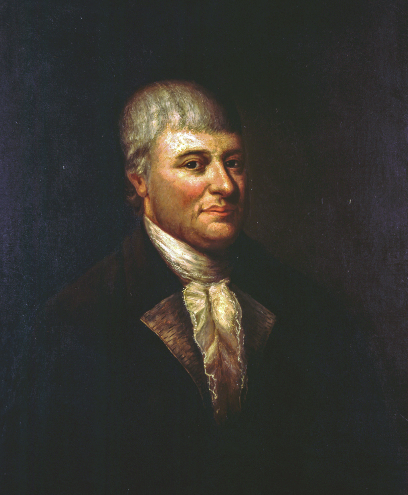
                Here, those who had seemingly converted, but continued to practice as Crypto-Jews, shed their Catholic personas and openly embraced their ethnoreligious identity. Aaron Lopez (1731-1782), called the “Merchant Prince of Newport,” serves as one example (Fig 2). Born Duarte Lopez in Portugal, he moved his wife Anna and daughter Catherine to Newport, RI, in 1752, where they reclaimed their Jewish identities under the names Aaron, Abigail, and Sarah.

    Figure 2: Aaron Lopez (American Jewish Historical Society)

                Several organized Jewish communities ultimately emerged in New York City, Newport, Philadelphia, Charleston, and Savannah. These areas proved ideal due to their nature as trade centers and rules, allowing more religious, political, and business freedom for non-Christians. Still, Jews lived and worked throughout the thirteen colonies as active members of the wider community, and many crossed paths with George Washington and those he knew.

    Colonial Virginia

    Jewish history in Virginian territory began when Joachim Gaunse, a Bohemian metallurgist, joined the Roanoke Colony in 1585. However, he escaped the fate of the Lost Colony by returning to England in 1586. A later instance of Jewish settlement occurred when Elias Legarde/o arrived in the Jamestown area in 1621. After that, small, scattered groups emerged throughout the colony, and the first Jews in the greater Fredericksburg area arrived by 1652. Nonetheless, they could not hold citizenship or public office as these statuses required oaths invoking the Christian faith.

    Jewish presence in Fredericksburg and other cities meant that Washington and his associates lived and worked alongside Jewish community members all their lives. In staying active in the community, many Jewish men, including the majority mentioned in this blog, joined the Masons. Specifically, (H)ezekiel Levy appears in Fredericksburg Lodge No. 4’s records as the sole Jewish member in 1776. As Washington maintained a life membership with his mother lodge from 1752 onwards, the two men potentially knew each other (Fig. 3).

    Figure 3: Masonic Lodge #4 – founded 1753, built 1816

    Other Jewish residents of Fredericksburg and businessmen likely crossed paths with Fielding Lewis. The Gratz brothers of Philadelphia, Barnard, and Michael, built a business network that spread across the colonies (Fig 4). They supplied Virginian troops during the French & Indian War and set up trade in Fredericksburg by 1776, where their associate Joseph Myers handled business affairs. Henry Mitchell, a one-time friend of the Lewises, counted amongst those who did business with the Gratzes and Myers. Like their gentile counterparts, however, Jewish merchants engaged in all aspects of the economy. This included the Atlantic and domestic slave trade, from which they profited, advanced, and purchased individuals.

    As Washington’s career took off, he came into closer contact with Jewish Virginians. Jacob Myer and Michael Franks served alongside Washington in the build-up to the French & Indian War, and the latter fought at the Battle of Fort Necessity (July 3, 1754). In 1769, Washington sought the services of Williamsburg’s Dr. John de Sequeyra for his stepdaughter Patsy Custis’ epilepsy (Fig. 5). Sequeyra, a well-respected physician, arrived in Virginia in 1745, wrote about diseases found in the region and served as the first visiting physician at, and later director of, Williamsburg’s Public Hospital. While Thomas Jefferson often receives credit for popularizing tomatoes as edible, Jefferson himself credited Sequeyra.
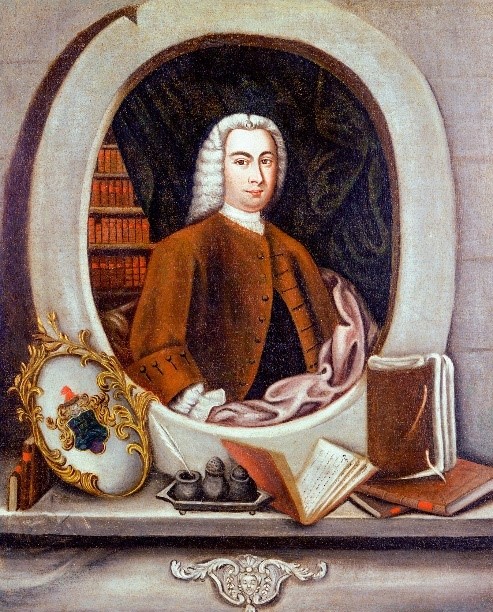
    Figure 5: Dr. John de Sequeyra (Winterthur Museum)

    American Revolution

                Like the colonists typically pictured during the war, the American Revolution brought turmoil to Jewish communities. The majority supported the cause of independence, with leading merchants voicing dissent from the 1765 imposition of the Stamp Act. Others remained loyal to the crown as they knew where they stood in society. Regardless of which side they chose, Jews aided their cause as soldiers, merchants, and suppliers. Still, the war brought division, death, and poverty to many families.         
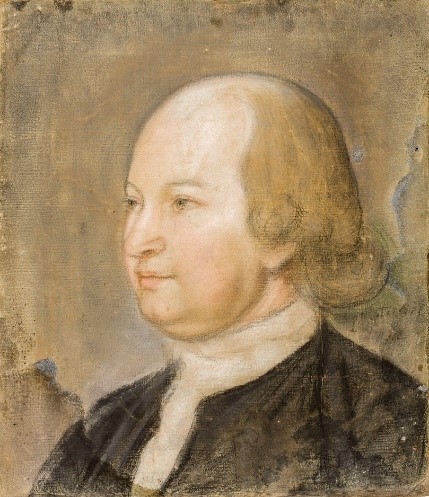
    The Touro-Hays family illustrates one such division. Issac Touro, head of the Newport Congregation, remained loyal to the British while his brother-in-law, merchant-banker Moses Michael Hays, sided with the Patriots (Fig 6). Despite holding opposing views, the two men used their positions to take a stand for the larger Jewish community. In 1775, Hays refused to sign a declaration of loyalty to the patriot cause until the authors removed the phrase “upon the true faith of a Christian.” When the British occupied Newport the following year, Hays, along with most of the congregation, fled while Issac remained behind. Using his connections, Touro ensured that the British left Newport’s synagogue largely untouched. Today, it stands as the oldest surviving synagogue in North America and answers to the name “Touro Synagogue” (Fig. 7). When it became clear that the British would lose, however, Touro moved his family to the Caribbean. The two sides of the family would only reunite after 1783, when Issac died, and his widow Reyna returned from Jamaica with their children to live with her brother Michael.
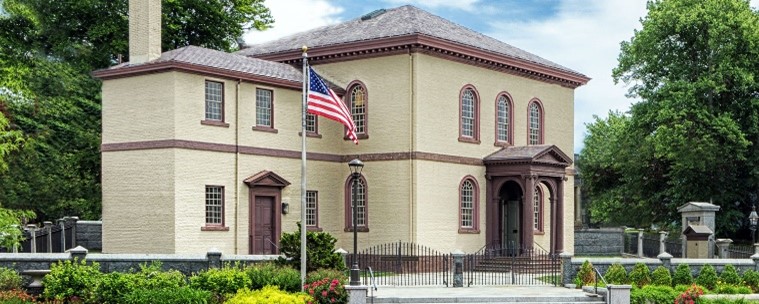
    Figure 7: Touro Synagogue (Touro Synagogue)

                In all, approximately a third of the Jewish population served during the American Revolution from Bunker Hill to Yorktown. This included the lowest positions up to the rank of Lieutenant-Colonel, which Solomon Bush of Philadelphia held. This period additionally saw public office open to Jews, with numerous individuals serving on committees. The first known Jewish fatality of the war occurred on August 1, 1776, in South Carolina when Francis Salvador fell to the British-allied Cherokee during a skirmish. Two years prior, the colony elected him a delegate to the Provincial Congress; the highest political position held by a Jew at the time.  

                Many who served as merchants and financiers devoted their assets, like Fielding Lewis, to the cause. As ship owners, many outfitted privateers and helped run blockades. Haym Salomon, a Polish-born Jew from Philadelphia, served as the Continental Congress’ main financier, an agent to the French consul, paymaster for the French forces, and worked closely with Superintendent of Finance, Robert Morris (Fig. 8). Salomon committed his entire fortune to the war effort, and his most significant contribution came when he raised the funds for the Yorktown campaign at the personal request of Washington. Like many individuals, he never received reimbursement from the government and ultimately died penniless.

    Figure 8: Haym Salomon (U.S. National Archives and Records Administration)

    Early America

                In the wake of independence, the United States faced uncharted territory. For minority groups, these uncertainties proved even more concerning. The arguments for revolution and documents written to establish the new nation spoke to religious freedom and social equality, but how far that stretched remained debatable.

                In 1786, Thomas Jefferson took steps to ensure these freedoms by writing the Virginia Statute for Establishing Religious Freedom. Passed into law, the bill affirmed the right to choose one’s faith along with the separation of church and state in Virginia. Several years later, in 1789, Kahal Kadosh Beth Shalome became Virginia’s first established Jewish congregation. Jefferson’s stance on religious freedom would ultimately inspire Commodore Uriah Levy to purchase and preserve Monticello.

                At this time, we return to where we started. In 1790, Washington made a trip to Rhode Island to acknowledge their ratification of the Constitution. On August 18, while Washington met officials and residents of Newport, Moses Seixas of the Jewish congregation read aloud a letter expressing gratitude to the President and government while expressing hope for tolerance and equality (Fig. 9). Its key passage reads:

    “…erected by the Majesty of the People – a Government, which to bigotry gives no sanction, to persecution no assistance – but generously affording to all Liberty of conscience, and immunities of Citizenship: deeming every one, of whatever Nation, tongue, or language equal parts of the great governmental Machine…”

    Figure 9: Letter from the Hebrew Congregation of Newport (Library of Congress)

    In writing the letter, the congregation wished to express their hopes for the future and receive assurance from their head of state that this future existed. On August 21, Washington replied to the letter thanking them for the “cordial welcome [he] experienced…from all…citizens” while reflecting on the difficulties of the past and how the future promised security. Then, using the congregation’s own words, he wrote that:

    “It is now no more that toleration is spoken of as if it were the indulgence of one class of people…for, happily, the Government of the United States…gives to bigotry no sanction, to persecution no assistance…”

     Washington closed his letter by wishing that “every one shall sit in safety under his own vine and fig tree and there shall be none to make him afraid.” The following year saw the ratification of the Bill of Rights, which further solidified religious freedom and equality.

    Despite efforts made during the founding era and successive periods, antisemitism has never gone away. Now, more than ever, we must work to uphold that the wishes, freedom, and security of those who served the United States since its founding.


    Emma Schlauder

    Research Archaeologist


    Bibliography


    Encyclopedia Virginia 2024 Virginia Statute for Establishing Religious Freedom (1786). https://encyclopediavirginia.org/entries/virginia-statute-for-establishing-religious-freedom-1786/#:~:text=As%20part%20of%20the%20revisal,physics%20or%20geometry.%E2%80%9D%20Jefferson%20was. Accessed 10 December 2024.
    Fort Necessity: National Battlefield Park 2015 Roster of Virginia Regiment. https://www.nps.gov/fone/learn/historyculture/roster.htm. Accessed 12 December 2024.
    Goldring/Woldenberg Institute of Southern Jewish Life N.D. Encyclopedia of Southern Jewish Communities – Virginia. https://www.isjl.org/virginia-encyclopedia.html. Accessed 9 December 2024.
    N.D. Encyclopedia of Southern Jewish Communities – Fredericksburg, Virginia. https://www.isjl.org/virginia-fredericksburg-encyclopedia.html#:~:text=Although%20there%20were%20Jews%20living,1850s%20and%20opened%20mercantile%20stores. Accessed 9 December 2024.
    Immigrant Entrepreneurship: German-American Business Biographies, 1720 to the Present 2018 Michael Gratz (1739-1811). https://www.immigrantentrepreneurship.org/entries/michael-gratz/. Accessed 11 December 2024.
    Jewish Virtual Library N.D. Virtual Jewish World: Virginia, United States. https://www.jewishvirtuallibrary.org/virginia-jewish-history. Accessed 9 December 2024.
    John L. Loeb, Jr.: Database of Early American Jewish Portraits N.D. Barnard Gratz. https://loebjewishportraits.com/biography/barnard-gratz/. Accessed 11 December 2024.
    N.D. Michael Gratz. https://loebjewishportraits.com/biography/michael-gratz/. Accessed 11 December 2024.
    N.D. Aaron Lopez. https://loebjewishportraits.com/biography/aaron-lopez/. Accessed 11 December 2024.
    My Jewish Learning N.D. The Revolutionary War and the Jews. https://www.myjewishlearning.com/article/the-revolutionary-war-and-the-jews/. Accessed 12 December 2024.
    National Jewish Outreach Program 2016 Revolutionary Doctors. https://njop.org/revolutionary-doctors/. Accessed 12 December 2024.
    The American Council for Judaism 1999 An Exploration of Four Hundred Years of Jewish History in Virginia. http://www.acjna.org/acjna/articles_detail.aspx?id=367>. Accessed 9 December 2024.
    Touro Synagogue: National Historic Site N.D. Jews in Early America. https://tourosynagogue.org/history/jews-in-early-america/#early-jews-american-history. Accessed 9 December 2024.
    N.D. George Washington Letter, 1790. https://tourosynagogue.org/history/george-washington-letter/. Accessed 10 December 2024.

  • You’ve Got Mail: Development of the Colonial Postal Service in Virginia

    The sending of a letter in Colonial America was more challenging than today.  The concept of post offices and regularly scheduled mail arrivals and departures evolved slowly in the colonies.  Colonial mail faced many obstacles.   Geography, political opposition, and a general lack of interest hindered a national system that serviced all the colonies. 

    How to Get a Letter Sent                                    

    While not impossible to get a letter sent, the question was, would it arrive?   There were two main ways to send your letter: send someone you know or pay someone else to deliver your correspondence for you.

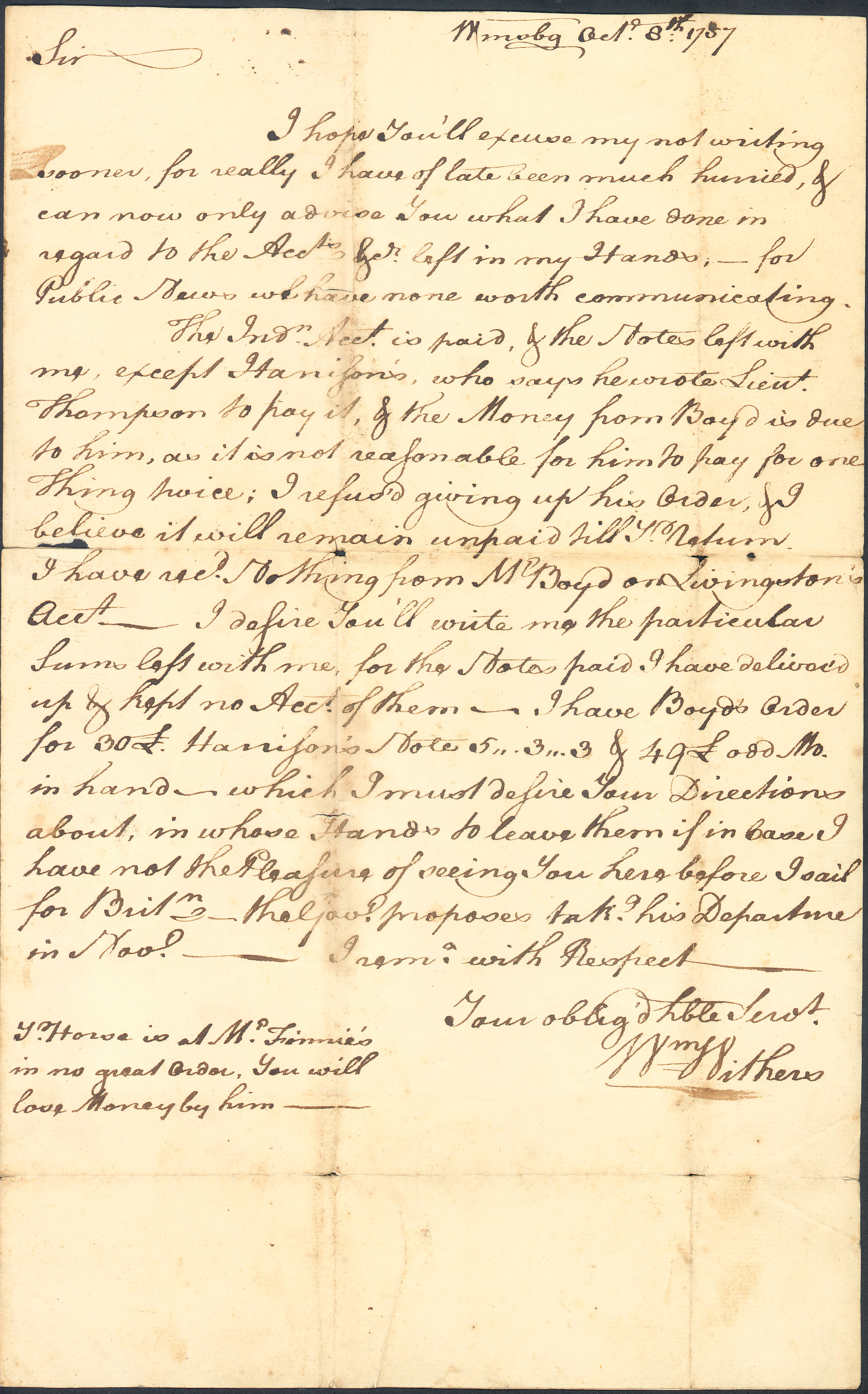
    We will call these two types of mail delivery private and public systems.  A private system means that the sender and the recipient knew the mailing source.  For example, you might entrust your letter to be delivered by an acquaintance, family member, or servant.  You would put your mail in the hands of someone you knew who happened to be traveling in the direction of the addressee, be it across town or the colonies.  In such cases, the letter was delivered free of charge.[1] 

    A public system consisted of a letter being passed through a series of people unknown to the sender, with postage paid by the sender.  This was an informal arrangement where strangers, for a fee, carried letters for people to specific destinations.   This would eventually evolve into what we now recognize as the postal system. 

    Artist Lloyd Branson depicts a colonial mail carrier in this partial view from his painting “Transporting Mail”.Credit: Smithsonian’s National Postal Museum

    English Colonies

    The history of mail service in America is complicated.  It took over one hundred years to evolve into a true American Postal System.  In the beginning, the English government established the “Royal Mail” in 1660.[2]    Under the Act of 1660, the price to send a single letter was two pence for “fower score English miles,” or threepence for greater distances.[3]  The colonies did not have an official postal service until King William and Queen Mary appointed Thomas Neale to create one in 1691.  This patent established an officially-designated letter depot or post office, but there was no inter-colony service until later.

    Mail in Virginia

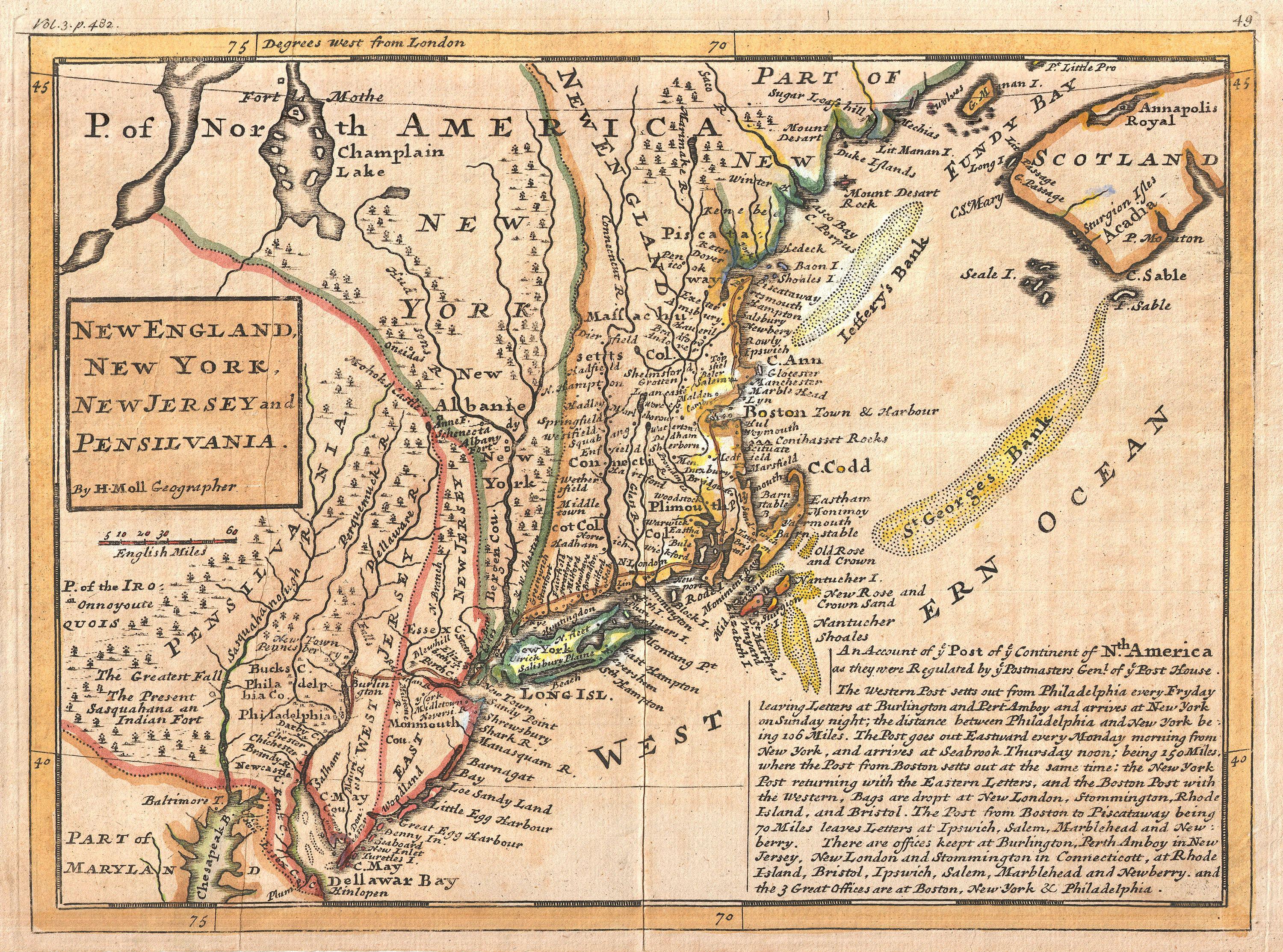
    Shortly after his appointment Thomas Neale chose Andrew Hamilton of New Jersey as a resident deputy.  Hamilton established regular service in the North between Boston, New York, and Philadelphia.[4]

    1729 Moll Map of New York, New England, and Pennsylvania (First Postal Map of New England). Credit: Wikimedia Commons

    Hamilton was eager to continue establishing service to the Southern states of Virginia and Maryland.  However, his application to extend the post to Virginia was not accepted with enthusiasm.  Virginia didn’t find a need to link up to a more costly overland inter-colonial mail service because their mail could travel by the schooners and tobacco ships.[5]

    Lieutenant governor Alexander Spotswood persisted in starting a post-service in Virginia.  In 1717, Spotswood announced that post offices had been “settled” throughout Virginia and that fortnightly (two weeks) post was established between Philadelphia and Williamsburg.[6] However, Spotswood’s works were not appreciated by many Virginians, particularly politicians, and there was still considerable resistance to the service. [7] The people’s main concern was that the postal service would become a monopoly where prices were controlled by the owner rather than by competition.[8]

    When the Assembly met in the spring of 1718, many counties complained about this postal monopoly.  The Burgesses and the (Governor’s) Council united in passing a bill that prevented the execution of the Act of Parliament establishing a mail service in the colony.  Spotswood subsequently blocked this bill, but the bill’s proponents were successful and promptly suspended official service in Virginia.  Because of this lack of co-operation as late as 1727, Annapolis was still the southern terminus for regular postal service.[9]

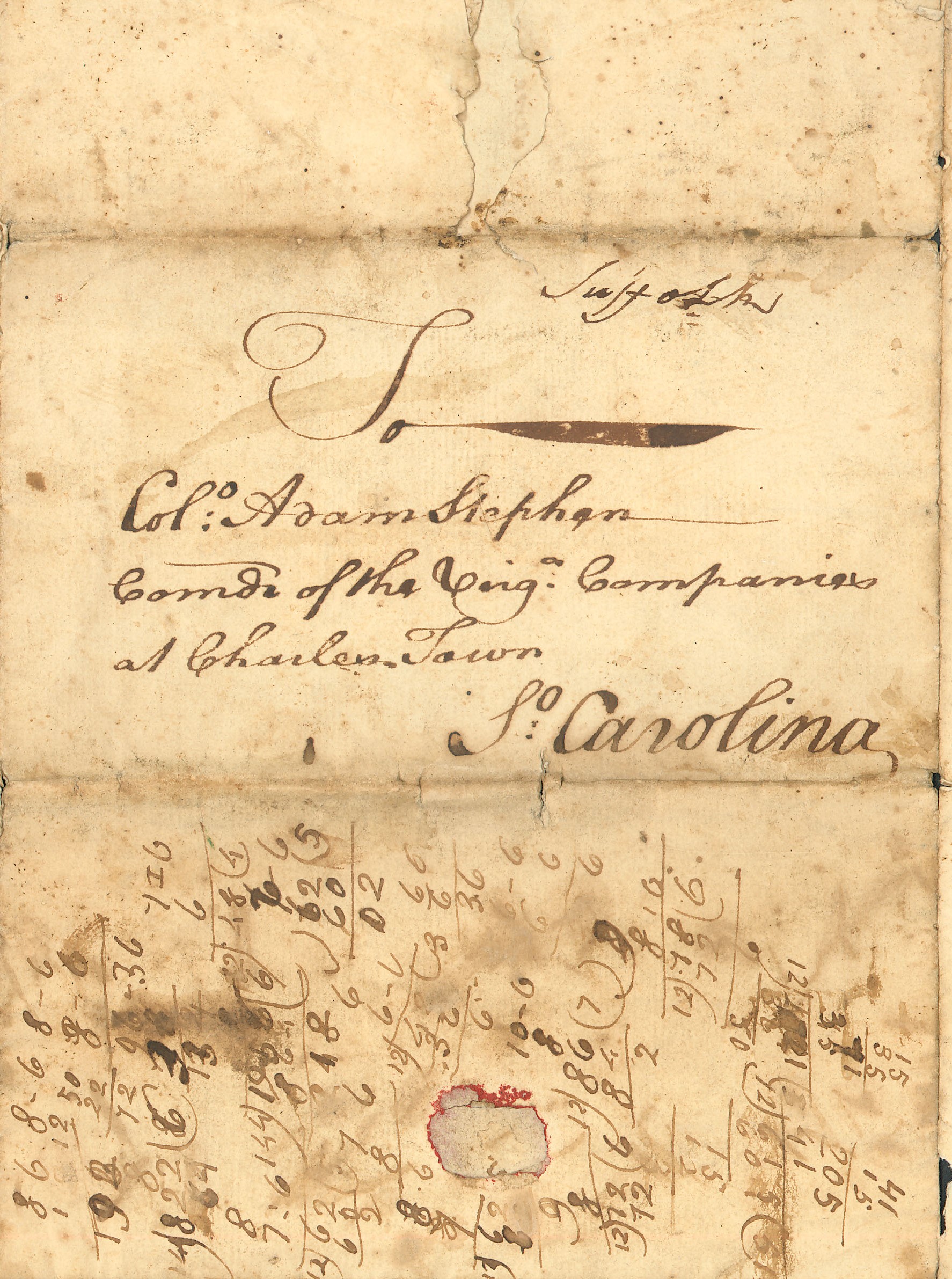
    In 1730, Spotswood took over the position of Deputy Post Master General after the resignation of John Hamilton for failing to turn a profit for the post office and suffering accusations of excessive spending.[10] His goal was to establish a better route between Annapolis and Williamsburg and eventually push that further south.  He succeeded and, by 1739, had created a route from Williamsburg to Charles Town, South Carolina. Spotswood’s post office was called “General Post Office at New Post” and was located near the Rappahannock River in Fredericksburg on land he owned.  After Spotswood’s death in 1740, the post office was maintained in New Post, Virginia, until Benjamin Franklin took office in 1753 and moved headquarters to his native Pennsylvania.[11]

    Revolution

    The postal system in the Colonies continued growing until British Parliament passed the Stamp Act of 1765.  The Stamp Act placed an official stamp on all printed material, including legal documents, magazines, playing cards, newspapers, and other types of paper used throughout the colonies.  [12] 

    Unsurprisingly, the Stamp Act was very unpopular among the colonists as many considered it a violation of their rights as Englishmen not to be taxed without their consent.   With the significant uproar and protests, the act was quickly repealed in March of 1766.  Still, Parliament continued to declare its power to legislate the colonies by passing the Declaratory Act.  Additionally, a new series of taxes and regulations were introduced, which fostered resentment to British rule and was the beginning of what would become a revolution in America. [13] 

    The post office symbolized British power, and a new system would have to be established if the colonists wished to overthrow the government and create an independent country.  The colonist began their postal service, the Constitutional Post, in May 1775 with Benjamin Franklin as the new postmaster general.  Subsequently, the Crown’s postal service in the colonies ceased by Christmas of the same year.[14]

    By July 1775, the Second Continental Congress ordered The United States Post Office (USPO) with Franklin overseeing its creation as department head.  In 1789, George Washington appointed Samuel Osgood as the first American postmaster general.  More than 75 official post offices and more than 2,000 miles of post roads.[15]

     Over America’s development as a new country, its postal system has continued to grow to accommodate its populations and postal needs.  Today, the United States Post Office has over 30,000 offices and delivers around 150 billion pieces of mail a year.[16]

    Heather Baldus

    Collections Manager


    [1] Butler, Nic. 2018. Mail Service in Colonial-Era Charleston, Charleston County Public Library, 2018 https://www.ccpl.org/charleston-time-machine/mail-service-colonial-era-charleston

    [2] Ibid

    [3] Harrison, Fairfax. “The Colonial Post Office in Virginia”, The William and Mary Quarterly, Apr 1924, 73.

    [4] Ibid, 74.

    [5] Ibid, 74-75.

    [6] Ibid, 78.

    [7] Ibid, 79.

    [8] Colonial Post Office N-10, Fredericksburg, Stafford, Spotsylvania Historical Markers, 2021 https://fredmarkers.umwblogs.org/2008/03/23/colonial-post-office-n-10/

    [9] Harrison, 79.

    [10] Colonial Post Office N-10, 2021

    [11] Ibid

    [12] Wood, S.G. “The American Revolution: A History.” Modern Library. 2002, 24.

    [13] Daniella Garran (19 July 2010). “Steps to the American Revolution”. Lesson Planet. Retrieved 21 July 2010.

    [14] Gavin, Alison M. “Hugh Finlay and the Postal System in Colonial America”, 2009 https://www.archives.gov/publications/prologue/2009/summer/finlay.html

    [15] The Early American Postal System”, https://www.constitutionfacts.com/founders-library/early-american-postal-system/

    [16] “Size and scope”. About USPS. United States Postal Service. Archived from the original on December 15, 2018. Retrieved December 8, 2018.

  • The Fox: A Bygone Symbol of Liberty

    There is no man who hates the power of the crown more, or who has a worse opinion of the Person to whom it belongs than I.” – Charles James Fox, letter to Edmund Burke, 24 January 1779. Quoted in L. G. Mitchell, Charles James Fox (1997:41).

    It is intolerable that it should be in the power of one blockhead to do so much mischief.” – Charles James Fox referring to King George III. From a letter to Mr. Fitzpatrick, 9 September 1781. Quoted in John Brooke, George III (1974:363-364).

    Charles_James_Fox00.ByJoshuaReynolds-1782jpg
    The Right Honourable Charles James Fox, MP, wore buff and blue apparel for this 1782 portrait by Joshua Reynolds. Credit: Wikipedia.

    Charles James Fox was contrary. He gambled excessively, drank heavily, and he was generally irreverent. He enjoyed resisting powerful people, supported unpopular causes, and expressed his disdain for high society by adopting a disheveled appearance later in life. His colorful British Parliamentary career spanned decades. He was a champion of liberty: including the abolition of slavery, religious freedom, the colonists’ struggles with King George III, and he supported the French people in their quest for democracy.

    Fox questioned King George III’s policies toward the American colonies and feared that the monarch was becoming tyrannical. It was parliament’s job to guard against such corruption. Fox and his supporters often wore apparel in the colors of buff and blue – the colors of Washington’s army – to show their support for American concerns. The Americans, in turn, honored their parliamentary champion with their own fashion accessory: they wore buttons that featured a fox, an obvious – and often used – stand-in for the controversial orator.[1]

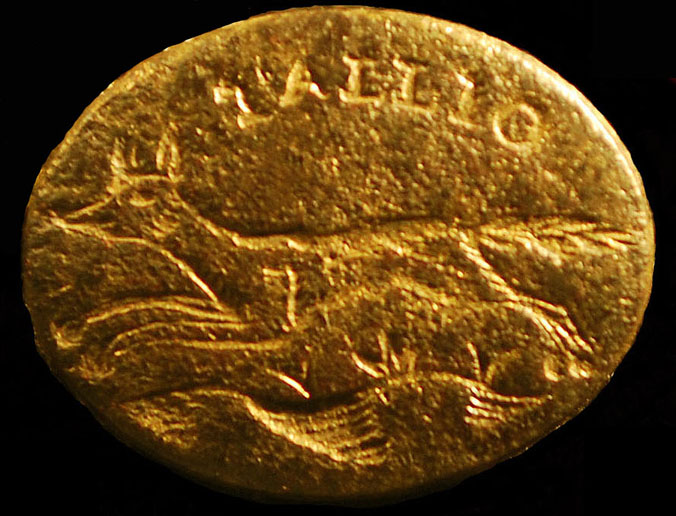
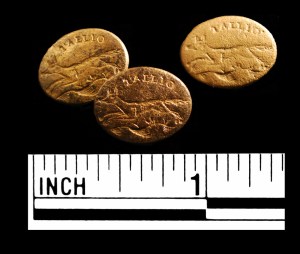
    Buttons featuring a fox racing across the landscape with the word “TALLIO” were intensely popular from the 1770s through at least the first quarter of the 1800s and they are common discoveries at archaeological sites. “Tallio,” “talley-o,” “talley-oh,” “talleo” and “talley ho” were all acceptable spellings for the traditional huntsmen’s shout upon spotting the fox during a chase. But this exclamation dates from the 1770s: well over a century after the sport had been brought to the Chesapeake. [2]

    TallioCLOSEUP
    A close-up of a “TALLIO” sleeve button from the Washingtons’ parlor cellar, c. 1766-1772.

    Fox hunting enjoyed wide popularity among Chesapeake gentlemen. The English Brook family brought their foxhound pack to Prince George’s County, Maryland when they immigrated in 1655.[3] Fox hunting continued in the Brook family for generations, and the popularity of this privileged recreational activity spread. Fox hunting on horseback was an amusement of the leisure class and the chase was considered more important than the capture of the prey. By the late 1760s, Washington himself maintained a pack of fox hounds at Mount Vernon.

    TallioLinksPC012a.300dpi
    Additional TALLIO sleeve buttons from the antebellum-era plowzone at Washington’s boyhood home. They are notably more weathered from its increased exposure to the elements given its shallow soil burial environment.

    Many who discover these buttons today attribute their imagery solely to the popularity of fox hunting as a sport. These buttons are often referred to as “hunt” buttons, a category that includes buttons which feature favored hobbies or athletic pursuits. Some assert that these sleeve links were widespread because fox hunting was so popular. And indeed, it was. These links – historically referred to as ‘sleeve buttons’ – enjoyed great popularity in the years surrounding the American Revolution, the Early Republic, and into the antebellum period.

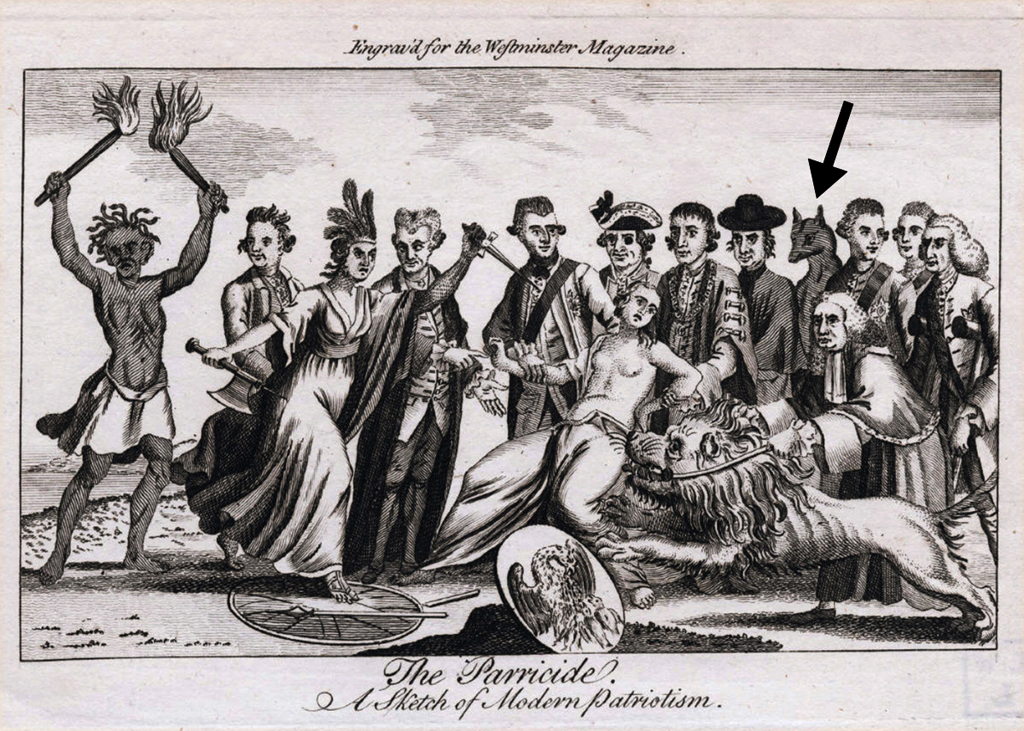
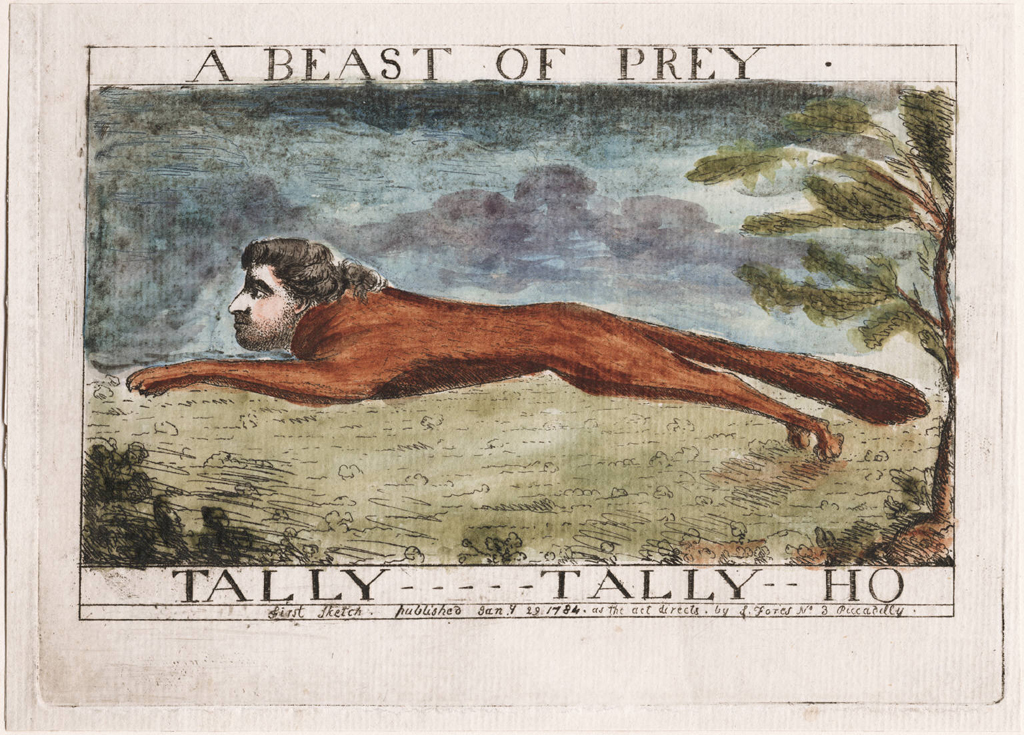
    I believe these buttons also achieved a deeper, political meaning, however, especially in the years around the American Revolution. Due to the support by Charles James Fox of the American cause, fox imagery came to represent resistance to tyranny. A number of contemporary British political cartoons used a fox to symbolize this politician. In addition to this documentary evidence, I believe the fox imagery used on these buttons came to symbolize the fight for liberty. For those recovered buttons for which we have context, it is evident that they are especially prevalent at sites associated with the Revolutionary War and with American patriots.

    LewisWalpoleLibrary.1776.TheParricideWithArrowAddedLJG
    Colonial discord is represented in this 1776 image showing America (symbolized as a woman in a feathered headdress, center left) attacking a defenseless Britannia (symbolized by the woman at center right). Charles James Fox is represented as a fox in the background (see arrow). Courtesy of the Lewis Walpole Library, Yale University.

    As the political difficulties between the British Crown and the American colonies intensified, Fox’s outspoken support of colonial concerns attracted attention on both sides of the Atlantic. In Britain, some called Fox a traitor for his disrespectful rhetoric against the crown. In Britain’s North American colonies, his stoic support for their cause provided colonists a crucial ally in an unexpected, but politically powerful position. Patriots and revolutionaries enthusiastically incorporated these fox hunting-themed buttons into a celebration of Fox’s ardent support.

    lwlpr05356-1784
    A 1784 image of a fox, featuring the head of British parliamentarian Charles James Fox. Courtesy of the Lewis Walpole Library, Yale University

    Tallio/fox buttons have been recovered from several American Revolution-era and Early Republic era forts in Tennessee and New York. Two domestic sites associated with George Washington have yielded these buttons as part of their archaeological discoveries. Signer of the Declaration of Independence, William Paca, proudly wore a tallio/fox button. Colonial towns such as Dumfries, Virginia and Jacksonborough, South Carolina have yielded these buttons from layers dating from the Revolutionary era.

    Harlem Heights Fox FolktaleAnthropologists – scholars who study people – make special efforts to identify such symbols in societies, both in contemporary studies and in analyses of past people.[4] Symbols are especially powerful because viewers do not need to be able to read, to understand language, to hear, or to speak, in order to comprehend a symbol’s message. These messages can summon strong emotional responses. Think about how you feel when you see an American flag and how your responses might change depending on how a flag might be used at a protest, funeral, or baseball game. During the last quarter of the eighteenth century, the fox symbolized resistance to tyranny, freedom, and the pursuit of liberty. Wearing a fox button proclaimed your support for American independence.
    The die struck fox image on these buttons was not originally created as a political symbol for Charles Fox, however. The meaning of these buttons was adapted to that purpose after their initial manufacture. As we have seen, fox hunting was indeed a common pastime for gentlemen, and these fashionable buttons were popular among those who “chased the hounds.”  As tensions between Britain and her North American colonies increased, Smith Quotebeginning by the 1760s, the fox symbolism present on tallio buttons was malleable[5], and provided a gentleman with leeway in a politically volatile climate: its meaning could change according to a gentleman’s situation.  Among unfamiliar company, such a multivocal symbol would allow an adroit – or perhaps even a vacillating – patriot some political latitude. Uncertain if the person with whom you’re dining is a Tory? Your innocent little TALLIO sleeve link merely celebrates a popular, recreational activity, whose roots in the Middle Atlantic region went back generations. But, at the same time, comrades in the struggle for American Independence recognized their solidarity in the symbolism of the fox: honoring their parliamentary advocate of colonial resistance to the King George III.

    Along with the tallio sleeve button, another apparel item as evidence for the Washington family’s burgeoning resistance to the Crown has been found at Ferry Farm. As I wrote in an earlier blog post, the Washingtons wore a mid-1700s William III sleeve button to display their resistance to George III: a monarch that many colonists deemed tyrannical in his exercise of power. On more than one occasion, Charles Fox himself compared America’s Declaration of Independence to William and Mary’s “Glorious Revolution,” and (fairly or not) drew parallels between the monarchical abuse of powers exercised by George III and James II. British subjects had the right to replace a tyrannical king with another: an example set by William and Mary, and an important precedent for the American colonists. The Washingtons’ support for the Leedstown Resolves in February 1766 provides documentary evidence for their concerns with Britain’s rule and (at the time) their loyalty to the Crown.[6]

    William III sleeve link
    Close-up of a mid-1700s sleeve button recovered at Ferry Farm. It features the image of King William III and reads “Gulielmus D. G.” which translates as “William by the grace of God King.” This button is another demonstration of growing resistance to George III from Washington’s boyhood home.

    Together, the symbolism on each of these buttons and the Washington brothers’ participation in the Leedstown Resolves demonstrates a long and growing frustration among Virginians with Britain’s colonial policies. The material expression of these sentiments can be traced back to the mid-1700s-era male apparel buttons at Washington’s childhood home. These discoveries were possible thanks to the preservation of this site, the thorough excavation of its layers, and a contextual understanding of the social and political landscape of this period.

    This fox/liberty symbolism apparently endured well into the 1800s in the United States. Archaeologists recovered a “TALLIO” sleeve button from the root cellar of a quarter for enslaved laborers in South Carolina:[7] strong circumstantial evidence that this symbol of the struggle for liberty and freedom continued beyond the American Revolution. As previous mentioned, Fox was an ardent abolitionist. The layer from which this particular button was recovered dated no earlier than 1845. In this context, this symbol of liberty underwent another change and now represented a reproach displayed by enslaved Americans to highlight the paradox of slavery in what was supposed to be a democracy. Though Charles James Fox died in 1806, the use of the fox as a symbol for the struggle for freedom endured.

    Laura Galke, Archaeologist
    Site Director/Small Finds Analyst

    Sites where such TALLIO links have been recovered

    Collectors and archaeologists have found TALLIO buttons from at least New York to South Carolina, and westward to Tennessee,[8] where they occur at a number of United States military forts, late 1700s-era towns, and at sites associated with patriots.

    Bledsoe’s Station, Tennessee (1783-1795) – “civilian fort” (Context dates from c. 1783-1795).

    British Officer’s Revolutionary War Hut in New York (Calver and Bolton 1950: 225, 227).

    Dumfries, Virginia, “Late 18th century.” (Sprouse 1988:119-120).

    Fort Southwest Point, Tennessee (1797-1807), federal military fort.

    Fort Blount, Tennessee – territorial militia post (1794-1797); federal post (1797-1798).

    George Washington’s Boyhood Home (1762-1772), parlor cellar and antebellum plowzone.

    H.M.S. DeBraak, Delaware (1798) shipwreck. (Cofield 2012:103-104, 113).

    Jacksonborough, South Carolina. Colonial town. (Smith, Dawson, and Wilson 2008:22-23, 30).

    Mount Vernon, Virginia, Washington’s home (1754-1799).  Recovered from a c. 1820s garden layer.

    Tellico Blockhouse, Tennessee – federal military post (1794-1807).

    University of North Carolina, Chapel Hill. Plowzone. (Fitts et al. 2012:35, 88-89).

    William Paca Garden, (c. 1763-1780) Annapolis, Maryland. http://annapoliscurator.blogspot.com/2014/09/william-pacas-sleeve-buttons_12.html

    Further Reading

    Boswell, James
    2008    Life of Johnson. Oxford University Press, Oxford.

    Calver, William L. and Reginald P. Bolton
    1950    History Written with a Pick and Shovel.  University of Virginia Press.

    Cofield, Sara Rivers
    2012    Linked Buttons of the Middle Atlantic, 1670-1800. Journal of Middle Atlantic Archaeology, 28:99-116. https://www.jefpat.org/diagnostic/SmallFinds/SleeveButtons-Cufflinks-Studs/Linked%20Buttons.pdf

    Fitts, Mary Elizabeth, Ashley Peles, and R. P. Stephen Davis, Jr.
    2012    Archaeological Investigations at the Vance Site on the University of North Carolina Campus, Chapel Hill, North Carolina. Research Report No. 34. The University of North Carolina, Chapel Hill.

    Hastings, Anne M.
    1997    Fox Hunting: History and Change in a Mountain Sport. Appalachian Journal 25(1):30-46.

    Mitchell, Leslie George
    1997    Charles James Fox. Penguin, London.

    Noël Hume, Ivor
    1961    Sleeve Buttons:  Diminutive Relics of the Seventeenth and Eighteenth Centuries.  In Antiques 79(4):380-383.

    Polhemus, Richard R.
    1979    Archaeological Investigations of the Tellico Blockhouse Site (40MR50): A Federal Military and Trade Complex. Report of Investigations 26, Department of Anthropology, University of Tennessee, Knoxville.

    Reich, Jerome R.
    1998    British Friends of the American Revolution. M. E. Sharpe, Armonk, New York.

    Smith, Kevin E.
    2000    Bledsoe Station: Archaeology, History, and the Interpretation of the Middle Tennessee Frontier, 1770–1820. Tennessee Historical Quarterly 59(3):175–187.

    Smith, Samuel D., and Benjamin C. Nance
    2000    An Archaeological Interpretation of the Site of Fort Blount, a 1790s Territorial Militia and Federal Military Post, Jackson County, Tennessee. Tennessee Dept. of Environment and Conservation, Division of Archaeology, Nashville, TN

    Smith, Steven D., Audrey R. Dawson, and Tamara S. Wilson.
    2008    The Search for Colonial Jacksonborough (38CN280) Colleton County, South Carolina. South Carolina Institute of Archaeology and Anthropology Report, Columbia. Presented to Lowcountry Council of Governments, Yemassee, and Francis Marion Trail Commission, Florence.

    Sprouse, Deborah A.
    1988    A Guide to Excavated Colonial and Revolutionary War Artifacts.  Heritage Trails, Turbotville, Pennsylvania..

    Steen, Carl
    2008    Archaeology on the Great Pee Dee River: The Johannes Kolb Site. http://38da75.com/professional.htm, accessed July 31, 2012. Diachronic Research Foundation, Columbia, SC.

    Notes

    [1] A generation earlier Fox’s father, Henry Fox – also a member of parliament – found himself represented as a fox on multiple occasions in political satire.

    [2] The recovery of this artifact from a layer created between 1766 and 1772 indicates that “tallio” was a term popular before it first appeared in print in 1773 (“tally-ho, int. and n.” OED Online. Oxford University Press, March 2017. Web. 31 May 2017). Since this “TALLIO” button was deposited before 1773, perhaps the Oxford University Press might consider updating their “tally-ho” entry.

    [3] A nice history of fox hunting is provided in Anne M. Hastings, 1997 article “Fox Hunting: History and Change in a Mountain Sport.” Appalachian Journal 25(1):30-46.

    [4] Archaeology is a subfield of anthropology. Archaeologists study past peoples.

    [5] Political sleeve buttons that said “Liberty” (revolutionary) or portrayed a Crown (Loyalist) provided their gentlemen no political leeway: they betrayed the political sympathies of their gentlemen quite directly. Did gentlemen who elected to wear TALLIO buttons lack commitment, perhaps coveting the ambiguous – and potentially innocent – message of the fox imagery?

    [6] Samuel, John Augustine, and Charles Washington all signed the Leedstown Resolves which, though it expresses concern, is nonetheless effusive in its expressed respect for the monarchy.

    [7] Carl Steen, Personal Communication, 15 April 2013.

    [8] http://annapoliscurator.blogspot.com/2014/09/william-pacas-sleeve-buttons_12.html; http://emuseum.history.org/view/objects/asitem/search@/0?t:state:flow=15c6b88c-4d16-46be-9dce-2bc1fc9f6420


  • Election Day in the 1700s

    It’s Election Day! From early morning until after dark, voters in Virginia and across the United States are walking into libraries, schools, firehouses, community centers, city halls and, occasionally, even private homes. Once inside, they are given a paper ballot, punch card or, although still relatively rare, may be directed to a touch screen. The voter steps up to or into a voting booth walled off with some type of barrier. There is an atmosphere of quiet deliberateness.  The individual voter alone marks the candidates of their choice. When finished, they place their ballot into a secure ballot box. The ballot requires no signature nor is the voter required to make a public declaration revealing who they support.

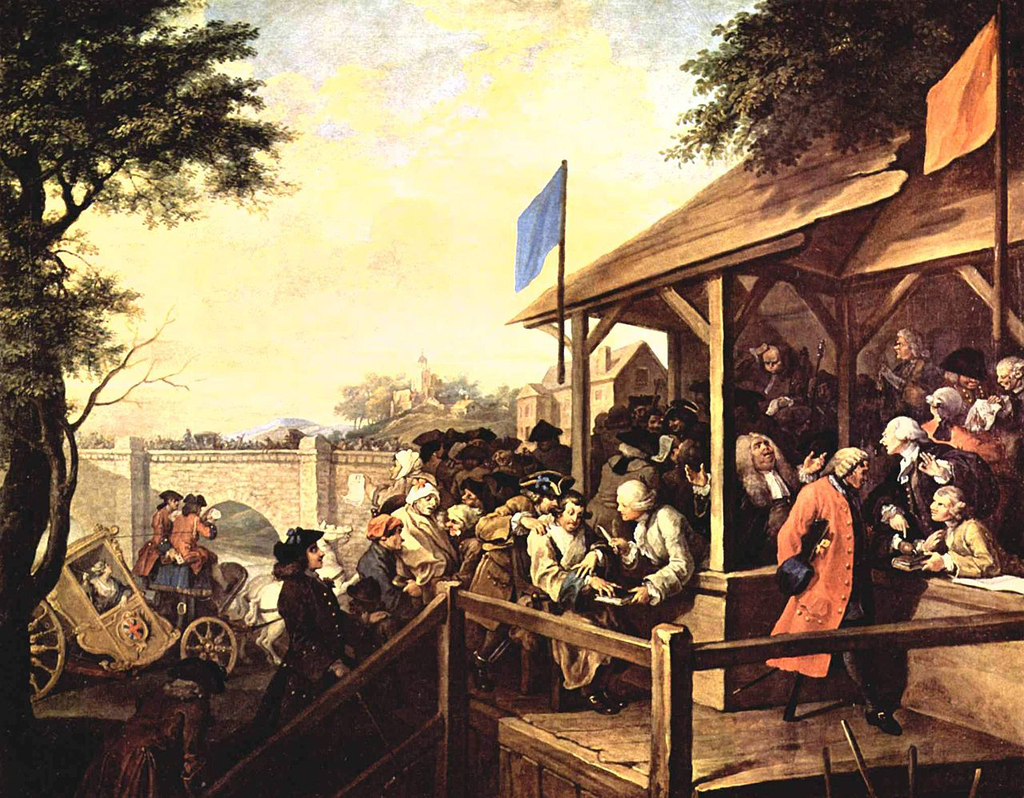
    White propertied men of the 18th century like Fielding Lewis, Augustine Washington, and George Washington would be surprised by our 21st century voting process. In early America, Election Day was an intensely public affair and oftentimes an excuse for everyone, whether permitted to vote or not, to travel to the county seat for the election. It was a chance to visit neighbors, conduct business, and simply have a good time.  There was a holiday atmosphere that could get quite uproarious!

    the-polling-by-william-hogarth
    “The Polling” by William Hogarth (1755), scene 3 in his Humours of an Election series. While Hogarth’s goal is to mercilessly satire English politics, his painting also hints at the festive atmosphere of an actual 18th century Election Day. Credit: Sir John Soane’s Museum / The Yorck Project / Wikipedia.

    The festival atmosphere was fueled by a common, although technically illegal, vote-getting technique: alcohol.  The law said that candidates could not provide drinks to voters from the time the election was announced until after votes were cast on Election Day.  To work around this restriction, candidates simply enlisted spouses, family, friends, or servants to distribute the spirits.

    George Washington first ran for a seat in the House of Burgesses in 1757. Each county sent two representatives to the house.  In this first election, Washington came in third in a field of three and garnered only 40 votes.  The next year, he stood again.  He won with 310 votes – the most of the four candidates.  While certainly not the sole reason for his victory, in 1758, Washington reimbursed friends £39 for 34 gallons of rum, 3 pints of brandy, 13 gallons of beer, 8 quarts of cider, and 40 gallons of rum punch served to voters.[1]  He wrote one of these friends, James Wood, saying “I am extreme thankly [sic] to you & my other friends for entertaining the Freeholders in my name—I hope no exception were taken to any that voted against me but that all were alike treated and all had enough it is what I much desird [sic]—my only fear is that you spent with too sparing a hand.”

    an-election-entertainment-by-william-hogarth
    “An Election Entertainment” (1755) by William Hogarth, scene 1 in his Humours of an Election series. The painting is a critical depiction of a candidate hosting a dinner for voters at a tavern. Credit: Sir John Soane’s Museum / The Yorck Project / Wikipedia.

    Although 18th century candidates couldn’t directly supply alcohol to voters, they were expected to be present during voting and were also expected to warmly greet all voters.  Today, in most states, there are restrictions against candidates or a candidate’s supporters from campaigning at or near a polling place while voting is taking place.  The candidate was present, in part, so that he could thank the voter for their vote.

    Voting in the 1700s was not secret. There were no ballots. Virginians practiced the long English tradition of a public voice vote. Before family, friends, neighbors, and the candidates themselves, a freeholder – a propertied white man allowed to vote – “came before the sheriff, his name was called out in a loud voice, and the sheriff inquired how he would vote.  The freeholder replied by giving the name of his preference.”  The freeholder’s name was recorded in the poll book in a column under the name of his choice.  “The candidate for whom he had voted, arose, bowed, and publicly thanked him.”

    While the secret ballot is sacred today, public voice votes of the 18th century and the poll books in which the votes were recorded provide historians with valuable knowledge about the elections of the time and about who voted for whom.  They also hint at personal connections within communities.  For example, we know that Augustine Washington, George Washington’s father, voted for William Fairfax, Esqr. and Colonel James Colvill for Prince William County’s two seats in the House of Burgesses in 1741.  We know that Fairfax won one seat with 246 votes and Colvill won the other seat with 175 votes.[2]  While we should be cautious about reading too much into Augustine’s support for Fairfax, George would go on to cultivate connections with William and other Fairfax family members.  After Augustine’s death, George aspired to be like William’s cousin Thomas Lord Fairfax, “socially prominent, well-connected, and involved in important affairs.”

    prince-william-county-polling-book
    Portion of a page from “The Poll for Election of Burgesses for the County of Prince William…” in 1741.

    Americans have been voting for an exceptionally long time. We were voting even before a United States of America existed.  The methods have changed over four centuries and although we no longer literally voice our vote, your vote is still your voice. Be heard today. Go vote!

    Zac Cunningham
    Manager of Educational Programs

    [1] Ron Chernow, Washington: A Life, New York: Penguin Press, 2010: 88.

    [2] Poll for Election of Burgesses in Prince William County, 1741, Deed Book E, pg. 524, Prince William County, Va.

  • Put That in Your Pipe and Smoke It: Tobacco & Politics in the 1700s

    Colonial American.  Think about that term.  What does it mean to you?  It refers to citizens of the American colonies prior to the Revolution.  In the minds of many of us in the present-day United States, however, it might denote a unique American identity, probably because our own identities as Americans are firmly set and celebrated.  But what if I told you that most of these colonial Americans considered themselves to be loyal British subjects for much of the colonial period and proudly displayed objects that confirmed their loyalty?

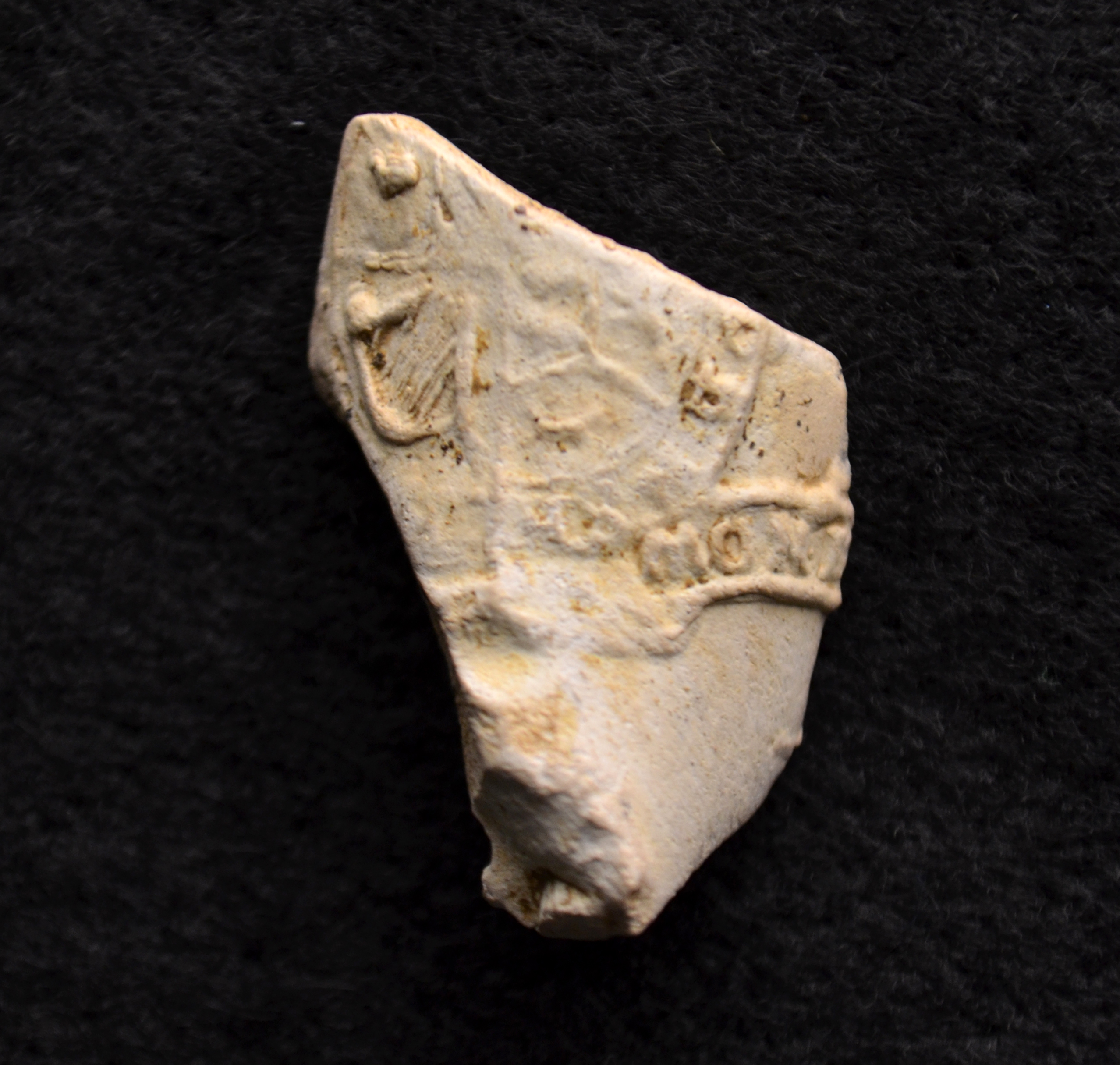
    One such object discovered at George Washington’s Ferry Farm is a small fragment from a white clay smoking pipe bowl.  The design on this tiny fragment includes a small harp and the letters “Mon D…”.

    Pipe Bowl Fragment
    Pipe bowl fragment excavated by archaeologists at George Washington’s Ferry Farm.

    Sometimes in archaeology we have genuine ‘Ah Ha!’ moments and, for me, this was one such instance.  I grew up with a suncatcher – a gift from an English family friend — in my bedroom that featured a rearing unicorn above the words ‘Mon Droit.

    Suncatcher

    I loved that suncatcher and, when I saw the pipe fragment, I recognized what the design was right away.  It was the British royal coat of arms!

    On pipe bowls like the one unearthed at Ferry Farm, the coat of arms wrapped around three quarters of the circular bowl. A lion, shield, and unicorn each filled their own quarter of the bowl above the full French phrase “Dieu Et Mon Droit” or “God and my right,” a claim that the right of the British monarch to govern was divine in nature.  This phrase has a long history in England.  It was first used as a battle cry by Richard I in the 12th century and picked up as a royal motto by King Henry V, who lived from 1386-1422.  The use of the French language for an English motto may seem odd but French was very fashionable and the official language of the English court.

    British Royal Coat of Arms
    The British royal coat of arms from 1714-1800 during the Hanover dynasty. Credit:  Sodacan/Wikipedia

    It is doubtful that anyone living at Ferry Farm after the America Revolution wanted to advertise their loyalty to the British crown so we can safely say this pipe was probably used between 1714, when the Hanover dynasty began under George I, and, at the latest, the 1770s. During most of this time period, the Washington family lived at Ferry Farm.The royal coat of arms is full of important symbols.  Grasping the center shield is a lion signifying England and a unicorn representing Scotland.  On the shield’s lower left is a harp symbolizing Ireland. The harp is clearly identifiable on the pipe fragment excavated at Ferry Farm.  The lower right section of the shield includes a columned monument and another lion. These symbols were added during the House of Hanover’s reign.  Monarchs regularly changed the coat of arms as each new king or queen sought to make their mark on the official emblem.  The monument and small lion were included on the shield to denote the Hanovers’ rule over their territory in what is now Germany.  The fragment found at Ferry Farm also contains these elements indicating that it was manufactured between 1714 and 1800.

    139_Masonic_pipe_NO_SCALE
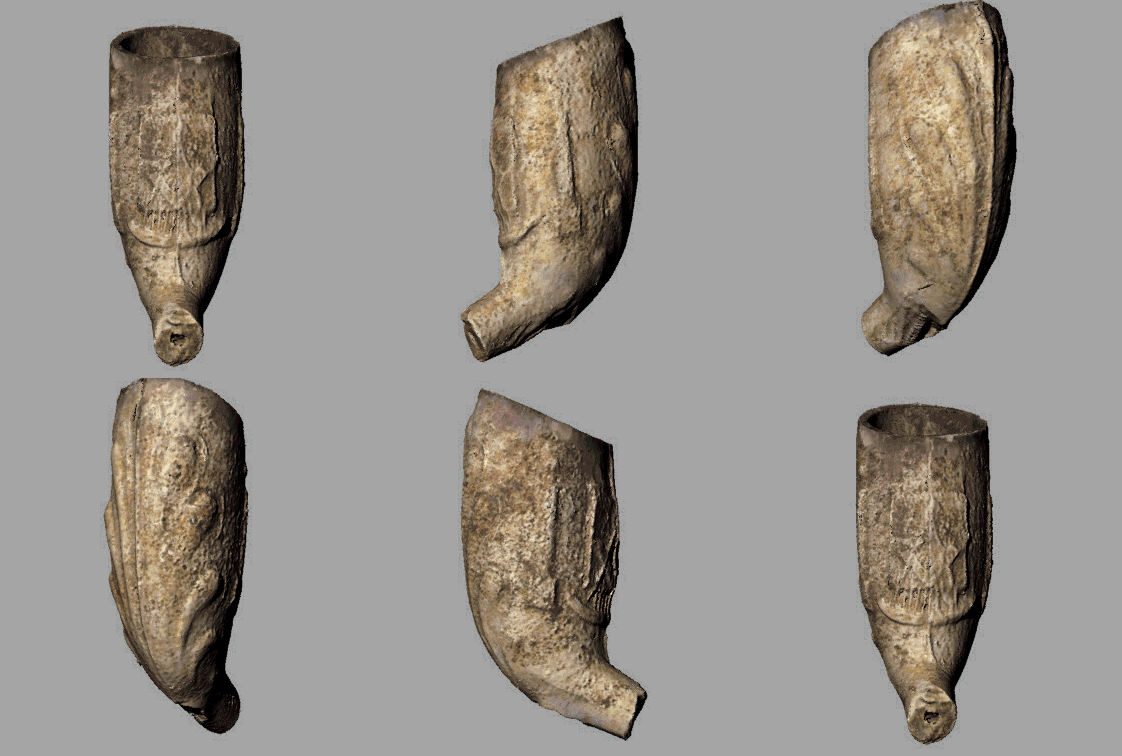
    Pipes featured more than political symbols. This is a 3D image of another smoking pipe bowl excavated at Ferry Farm decorated with a Masonic symbol. The pipe was probably made in the northeast of England between 1770-1810. You can read more about this pipe here.

    Why is this pipe fragment a big deal?  During the 18th century, smoking a pipe with a political symbol like the one we’ve found was the equivalent of slapping a candidate’s bumper sticker on your car, placing a political party’s sign in your yard, or sharing a favorite political meme on social media. The act was public, deliberate, and did not go without notice. The practice continued well into the 1800s when groups such as the Irish employed smoking pipes to advertise their support for causes such as a free Ireland.  It was a way to signal identity to others.

    During most of the colonial period in America, aligning yourself with the crown was not at all radical but rather what was expected of most subjects.  In fact, this pipe bowl fragment is not the only artifact excavated at Ferry Farm to hint at past occupants’ loyalty to Britain.  As noted in a previous blog, we have found several drinking vessels exhibiting the initials ‘G.R.’ for ‘George Rex’ or King George.  In another blog, we also discussed an artifact uncovered at Ferry Farm that points toward a growing resistance to the British crown. This mid-18th century sleeve button depicts William III, who, although he died decades before the button was manufactured, came to represent the right of subjects to resist a king who was abusing power.

    What we may be seeing in these three types of artifacts present at Ferry Farm is a fundamental shift of views within the Washington family as the political climate changed throughout the 1700s.  The objects hint at a swing from loyal British subjects to revolutionaries and the beginning of our identity as independent Americans.

    Mara Kaktins, Archaeologist
    Ceramics & Glass Specialist

  • George Toasts George?

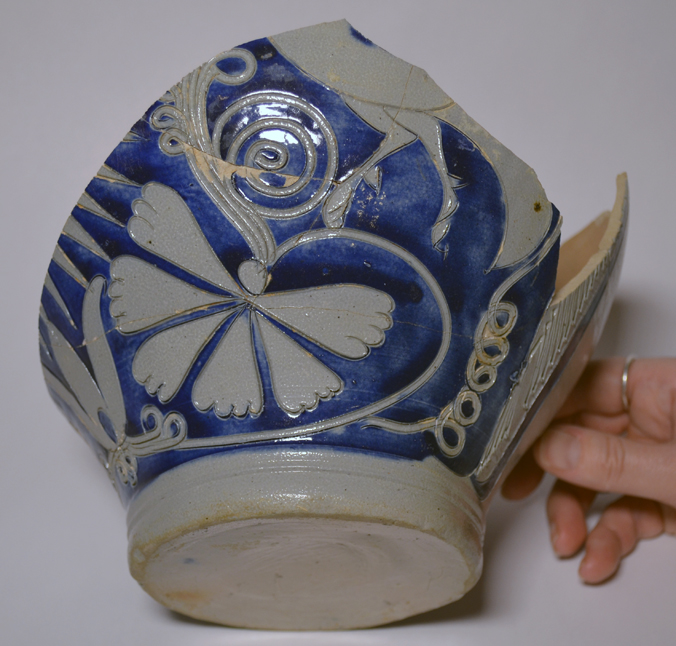
    At George Washington’s Ferry Farm we’ve just wrapped up a ceramic mending project.  We explain how and why we undertake these mending projects in this post.  Our most recent effort focused on Westerwald stonewares owned by the Washington family.  Stoneware is a high-fired, non-porous ceramic that is excellent for producing storage containers and drinking vessels.  But what is a Westerwald, you may ask?  Well, Westerwald stonewares were a ceramic produced in the Westerwald region of what is now Germany beginning in the 1500s.  Destined for the British Isles and British colonial markets, this particular ceramic is common to archaeological sites in the Chesapeake region.

    Westerwalds were salt-glazed, meaning that during the firing process large quantities of salt were introduced into the kiln.  The salt vitrified (converted into a glass-like substance) upon contact with the vessels, producing a shiny glaze and a characteristic ‘orange peel’ texture on the surface of the pots.  Decorated predominantly with molded and incised designs that are filled with bright cobalt blue and deep purple, Westerwalds are strikingly beautiful.

    Jug with a bird motif.

    We’ve learned a great deal from analyzing the Westerwalds used by the Washingtons.  Many of the vessels identified in the Ferry Farm assemblage were tankards, jugs, and other drinking vessels from which beverages such as ale and cider, a large part of the colonial diet, were consumed.  Some tankard handles we’ve excavated have small holes at the top, where a pewter lid — a distinguishing characteristic of German-made steins — was attached.  These lids often do not survive in the archaeological record because the metal had value.  Rather than being discarded, the pewter was often recycled.

    In addition to being aesthetically pleasing, Westerwald drinking vessels often served a political purpose.  An excellent example of this is to be found within our assemblage of Westerwalds in the form of multiple mugs emblazoned with the initials ‘G.R.’, meaning Georgius Rex, the Latin for King George.  During the time Westerwalds were produced in Germany, three British kings were named George.  Interestingly, however, all three came from the House of Hanover, a German royal family placed on the British throne in 1714.  For Americans, of course, the most famous of these Hanover kings was George III.

    Sprig decorated G.R. medallion on a jug fragment.

    Thus, a gentleman sporting a ‘G.R.’ on his tankard or jug advertised his loyalty to the Crown with every draught of ale.  A night of drinking involved numerous toasts “To the King’s Health!”  It was not unheard of for dozens of toasts to be recited for the king, his family, and anyone else of political interest the imbibers saw fit to honor.  Toasts and drinking vessels were also utilized to express disagreement with political powers.  Politics and drinking definitely went hand-in-hand in the colonies.  Once George Washington became a public figure, there were toasts such as “To General Washington, and victory to the American arms!” to honor him.

    The presence of these initialed Westerwalds at Ferry Farm show that until the Revolution the Washington family, like most Americans, viewed themselves as loyal subjects of the British Crown.  Indeed, many families in Fredericksburg would have owned such mugs and toasted their monarch prior to the war.  In fact, several ‘G.R.’ vessels have also been excavated at Historic Kenmore, the home of George Washington’s sister, Betty.  The people of Ferry Farm, Kenmore, and Fredericksburg found their daily lives governed by Britain’s global economy and imperial culture.  Colonial men – whether gentry, tradesman, or servants – pursued homes, professions, pleasures, and possessions that conveyed their status, wealth, and English identities.  One such possession that emphasized this identity was Westerwald drinking vessels.

    Hollowware fragments with an unknown motif.

    One has to wonder what became of these mugs once the Revolution began.  Did Loyalists quietly stash away some of their ‘G.R.’ mugs once the tide of war went against them?  Perhaps some tankards and jugs were smashed publically by Patriots in a ritual different from their intended purpose of toasting but no less a political act than those toasts had been.  Nevertheless, it is intriguing to picture a young George Washington drinking heartily from a ‘G.R.’ mug and toasting a king against whom he would lead a revolution.

    Mara Kaktins
    Archaeologist/Ceramics & Glass Specialist