Lives and Legacies

Tag: seamstress

  • No Buttons for the Ladies

    Whilst I costume actors, living historians, and myself from time to time in 18th century clothing, I find myself puzzled about the stark difference between the closures and attachments of ladies’ and men’s garb.  I have to lace myself into my stays, tie on layers of padding and petticoats around my waist, and finally pin my gown closed.  Men have the enjoyment of a few buttons on their breeches and waistcoat, but that is it.  It frequently makes me grumpy how long it takes me to dress in comparison to my male counterpart.  I did not understand this phenomenon, until recently. 

    To put 18th century clothing closures into perspective, you had hooks and eyes, buttons, and ties/laces.  Thomas Hancock created elastic for gloves, suspenders, and stockings in the 1820s, but it struggled to withstand heat and last through time.  The elastic we know and love in our garments today did not come around until the early 1900s.[1]  The modern zipper was patented in 1917 and was used mainly on boots and tobacco pouches.  It took another 20 years before the technology even made it to mass produced clothing.[2]  By comparison, the button first becomes functional over decorative around 1,000 BCE in Asia.  Buttons would eventually travel the Mediterranean during the crusades into European territories around the late 11th century CE.[3]  So George Washington did not have a zipper on his pants or elastic on his socks, but he definitely had buttons on his coat.   

    A eye from a hook and eye set. Source: Ferry Farm Archaeological Collections

    Hooks and eyes were sometimes used for gown closures for women in the 18th century.  They were not used as much as pins were because of the rigidity in size it created for the garment. 

    We have buttons from men’s garments in the archaeological collections here at Ferry Farm.  We also see buttons all around male portraiture in our curatorial collection.  The ladies, however, are stuck with laces, ribbons, and pins.  And boy, do we have the pins to prove it in the archaeology collections. 
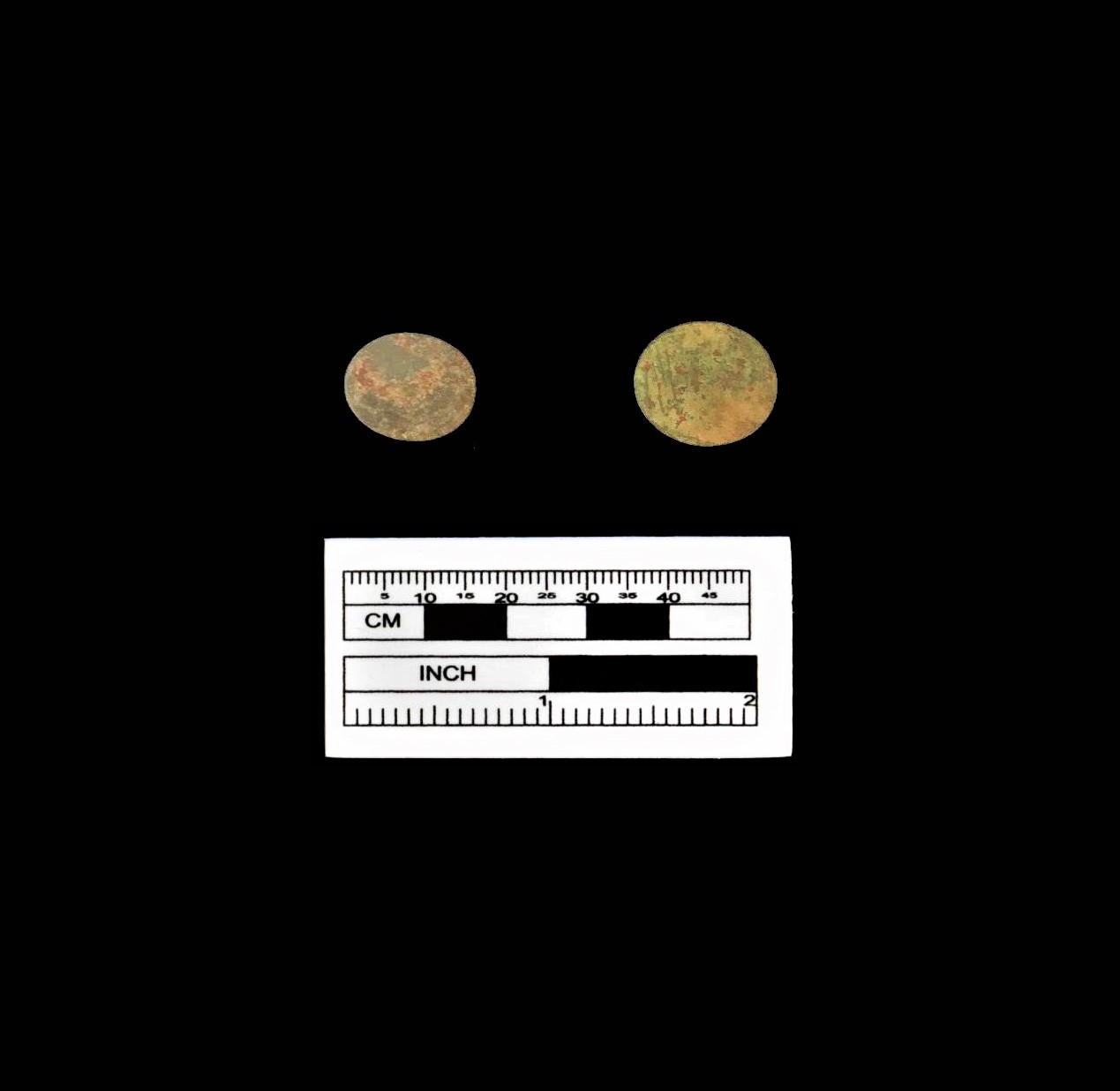
    Two metal buttons most likely from men’s garments.  Source: Ferry Farm Archaeological Collections
    Bone buttons Source: Ferry Farm Archaeological Collections
    Pins were used for pinning jackets closed and keeping caps pinned to your hair.  They were a necessary part of dressing. Source: Ferry Farm Archaeological Collections

    A small sample of the large collection of brass dress pins found at Ferry Farm.  Pins were not used for sewing, as basting before sewing was the regular practice.  Pins were used for pinning jackets closed and keeping caps pinned to your hair.  They were a necessary part of dressing.

    The answer to why this phenomenon is how it is hit me one day after rewatching a lecture given by a former staff member entitled “Betty Washington Lewis and Women’s Health.”  Dr. Kelly Brennen Arehart spoke about maternity wardrobes and how women wore their everyday clothing throughout pregnancy.  For my contemporary mind, this was shocking, but the more I thought about it the more it made sense. 

    Women go through a lot of fluctuations in body shape, weight, and proportions in their lifetime.  Between hitting puberty and development of curves, to many pregnancies, to the changes of menopause, women’s bodies go through so much.  Of course in between all of the big changes, there are also changes to the female body based on time in her menstrual cycle, metabolism fluctuations, or periods of eating more or less or different types of food that all change the body’s shape and size.  Unlike today, women of the past could not just go to the shop and buy a pair of pants in the size up.  Clothing was incredibly expensive and time consuming to make before sewing machines and mass production come into play.  In the 18th century, even the highest classes of women did not have the money or the time to go buy or have new clothing made when they gained a few pounds or got pregnant.  It was a matter of adjusting the clothing they already had.  And that is exactly what ties, pins, and laces allowed women to do. 

    The lacing, pinning, and tying made clothing far more adjustable compared to the rigidity of buttons.  Women tied their petticoats looser and simply covered the wider gap in the side with their jacket or gown.  Stays were either loosened significantly by the laces or they were left unlaced at the bottom entirely, especially in cases of late term pregnancies.  On top of the stays, jackets could be pinned further out to allow for more room in the bust and waist, or a stomacher could be added in the center opening of the jacket to expand the top even further.

    Whether these closures were intentionally created to be adjustable or if it was just a byproduct of lacking clothing technology, I am not entirely sure.  But the idea that buttons were only used on men’s not so fluctuating bodies (for the most part) says something.  A button is sewn down and cannot be easily moved or adjusted on a regular basis.  Once a button is sewn into place, there is no room for variation in body shape, unless one wanted to move the buttons every time he ate a large meal the previous day. 

    Even though Betty Washington Lewis had Charlotte, who we believe to be an enslaved woman acting as the seamstress of the Lewis household, Betty was pregnant on and off for twenty years.  If Charlotte or another enslaved seamstress had to make a maternity wardrobe for Betty every time she was with child, the seamstress would have no time to do any other tasks whatsoever.  It was not economical with precious time or expensive cloth for women to need new clothes every few weeks. 

    So to tie all this together, I am still not happy that it is so inconvenient for me to dress myself in 18th century clothing, but I understand why getting dressed was this way.  The adjustability of women’s clothing was so intentionally created to conform to their bodies in any season it was in.  It also opens my eyes to why pins were so important.  Without them, a woman could not dress. 
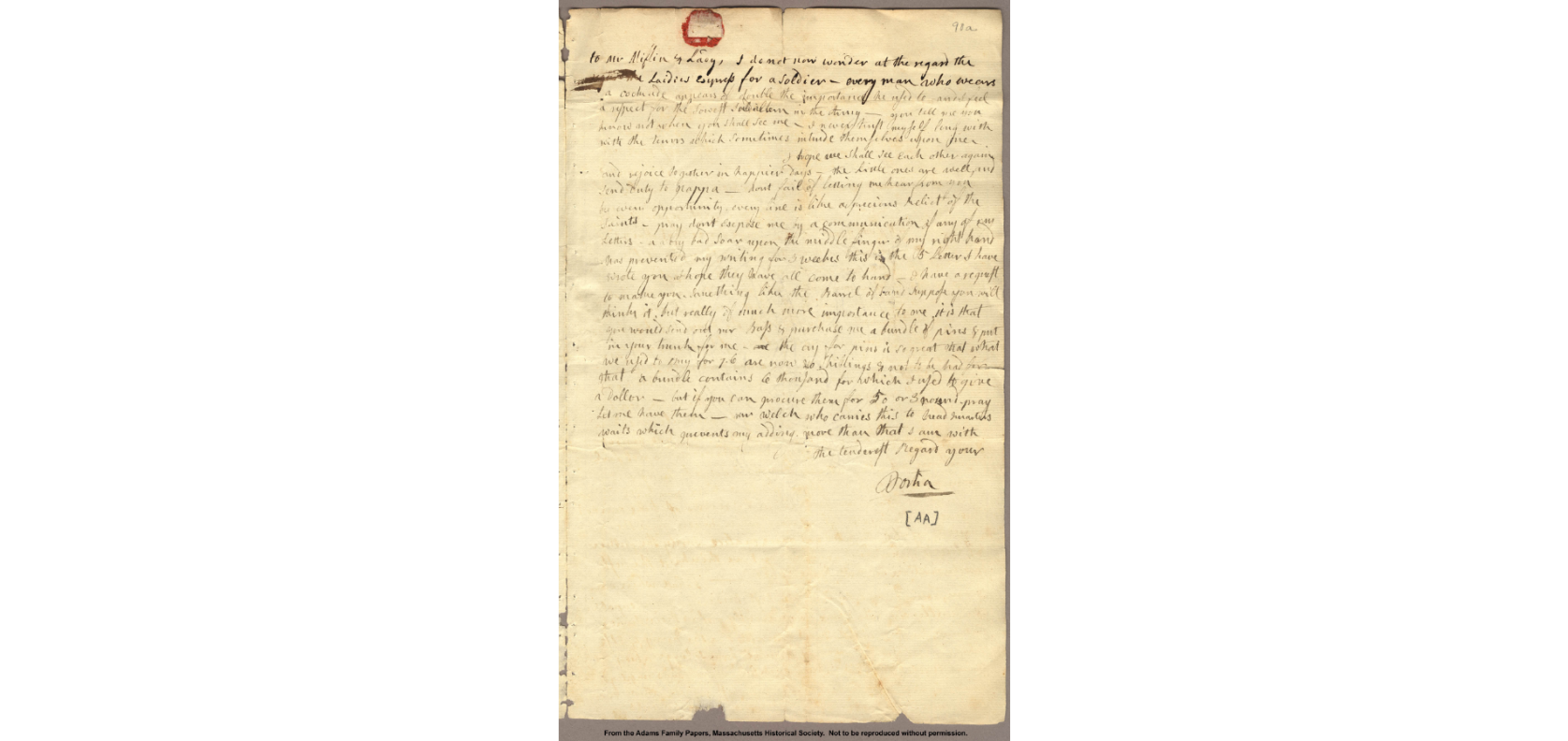
    Letter from Abigail to John Adams, June 14, 1775.  Source: Massachusetts Historical Society

    …I have a request to make you. Something like the Barrel of Sand suppose you will think it, but really of much more importance to me. It is that you would send out Mr. Bass and purchase me a bundle of pins and put in your trunk for me. The cry for pins is so great that what we used to Buy for 7.6 are now 20 Shillings and not to be had for that. A bundle contains 6 thousand for which I used to give a Dollor, but if you can procure them for 50 [shillings] or 3 pound, pray let me have them. Mr. Welch who carries this to head Quarters waits which prevents my adding more than that I am with the tenderest Regard

    your

    Portia


    Allison Ellis

    Manager of Public Programs


    [1] “Questions About Elastic,” Maggie May Clothing, Accessed July 10, 2023, https://maggiemayfashions.com/questions-about-elastic-2/.

    [2] Ninette Dean, “The Up and Down History of the Zipper,” The Smithsonian Libraries and Archives, Accessed July 10, 2023, https://blog.library.si.edu/blog/2010/05/03/the-up-an-down-history-of-the-zipper/.

    [3] Caroline Stone, “The Westward Journeys of Buttons,” AramcoWorld, Accessed July 10, 2023, https://www.aramcoworld.com/Articles/November-2020/The-Westward-Journeys-of-Buttons.
  • Charlotte and the Mercury Pills

    As part of our ongoing effort to research the enslaved communities that once lived and worked at Historic Kenmore and George Washington’s Ferry Farm, we recently came across some very unusual information pertaining to a young enslaved woman named Charlotte who resided at Kenmore.

    Charlotte, unfortunately, is a somewhat enigmatic figure. We know only a few things about her. She was about 11 years old in 1781, when Fielding Lewis died – her name appears as “Sharliot” in his probate inventory. She is also listed (along with her age) on a document called the Divvy List created by Betty Lewis shortly after her husband’s death and listing which slaves were to stay with her at Kenmore and which ones would eventually be given to her three youngest sons. Betty chose Charlotte to stay with her at Kenmore. Sixteen years later, Charlotte appears again on a list of slaves from the Lewis properties who were to be sold at vendu (public sale or auction). This document indicates that Charlotte worked as a seamstress in the Lewis household, and that she had both a young son named George, and a baby (although the baby was not identified by name or gender). One final reference to Charlotte in Kenmore’s manuscript collection is a notation that she was among 21 enslaved persons receiving textile rations sometime around 1796 (she received 5 yards of linen).

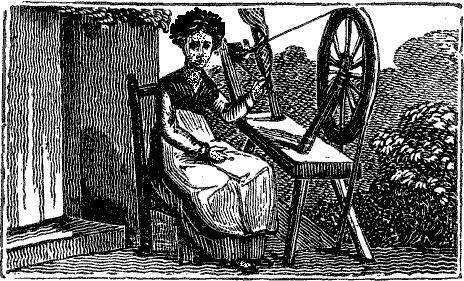
    enslaved seamstress
    Enslaved seamstress in the 18th century. Credit: Historical Images

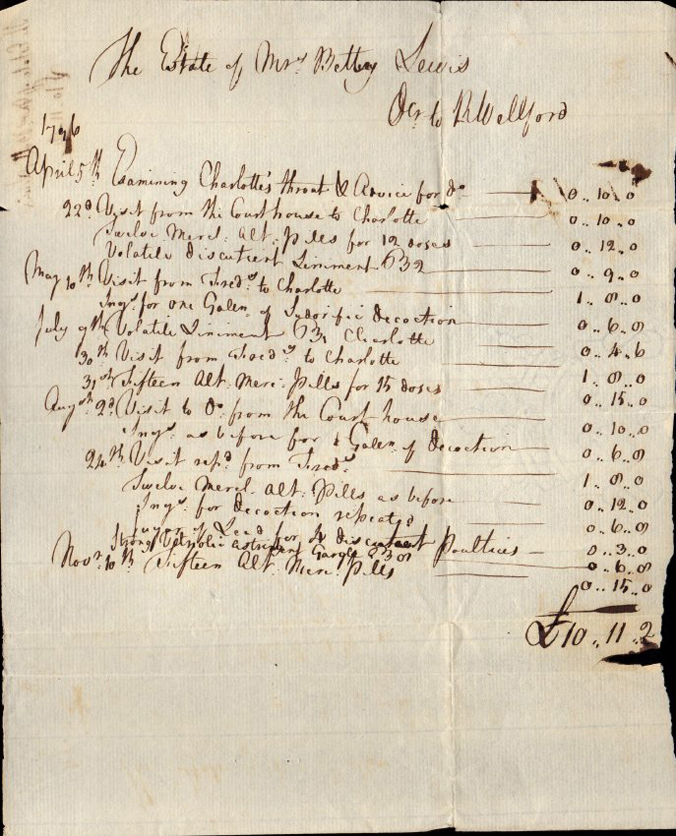
    As often happens in this kind of research, we can have very sparse detail about a subject’s life until we find a new document that provides incredible detail about a very specific moment in that person’s life. Such is the case with Charlotte. The new document is a list of charges for medical examinations and treatments “to Charlotte” submitted by an “R. Wellford”, a doctor, to Betty Lewis’s estate sometime after Betty’s death in 1797. It shows that from April through November of 1796, Betty Lewis paid over £10 to treat Charlotte’s unidentified ailment.

    ms 850

    Transcription of MS 850, Charges for Medical Expenses [1]

    The Estate of Mrs. Betty Lewis
    Dbt. To R. Wellford

    1796
    April 15th Examining Charlotte’s throat & advice for do . . . . . . . . . . . . . . . . . . . . . . 0.10.0
    22nd Visit from the Courthouse to Charlotte . . . . . . . . . . . . . . . . . . . . . . . . . . . . . . . . . 0.10.0
    Twelve Mercl. Alt. pills for 12 doses . . . . . . . . . . . . . . . . . . . . . . . . . . . . . . . . . . . . . . . . . 0.12.0
    Volatile discutrent Liniment @ 32 . . . . . . . . . . . . . . . . . . . . . . . . . . . . . . . . . . . . . . . . . . . 0.9.0

    May 10th Visit from Frdbg. To Charlotte . . . . . . . . . . . . . . . . . . . . . . . . . . . . . . . . . . . . . 0.10.0
    Ings. For one Galen of Sudorific decoction . . . . . . . . . . . . . . . . . . . . . . . . . . . . . . . . . . . 0.6.0

    July 9th Volatile Linament @3, Charlotte . . . . . . . . . . . . . . . . . . . . . . . . . . . . . . . . . . . . . 0.4.6
    30th Visit from Fredbg. To Charlotte . . . . . . . . . . . . . . . . . . . . . . . . . . . . . . . . . . . . . . . . . 1.0.0
    31st Fifteen Alt. Merc. Pills for 15 doses . . . . . . . . . . . . . . . . . . . . . . . . . . . . . . . . . . . . . . 0.15.0

    Aug. 2nd Visit to do from Courthouse . . . . . . . . . . . . . . . . . . . . . . . . . . . . . . . . . . . . . . . . 0.10.0
    Ings. As before for 1 Galen of decoction . . . . . . . . . . . . . . . . . . . . . . . . . . . . . . . . . . . . . . 0.6.0
    24th Visit refd. From Fredbg . . . . . . . . . . . . . . . . . . . . . . . . . . . . . . . . . . . . . . . . . . . . . . . . 1.0.0
    Twelve Mercl. Alt. pill as before . . . . . . . . . . . . . . . . . . . . . . . . . . . . . . . . . . . . . . . . . . . . . 0.12.0
    Ings. for decoction repeated . . . . . . . . . . . . . . . . . . . . . . . . . . . . . . . . . . . . . . . . . . . . . . . . .0.6.0
    Sugar of lead for 4 discontent poultices . . . . . . . . . . . . . . . . . . . . . . . . . . . . . . . . . . . . . . 0.3.0
    Strong vitriolic astringent gargle @3 or . . . . . . . . . . . . . . . . . . . . . . . . . . . . . . . . . . . . . . 0.6.0

    Novr. 10th Fifteen Alt. Merc. Pills . . . . . . . . . . . . . . . . . . . . . . . . . . . . . . . . . . . . . . . . . . . .0.15.0

    £10.11.2

    What can this new document tell us about Charlotte’s life? First, we can take a look at the medications prescribed to treat what we assume to be a respiratory ailment…

    To begin her treatments, Charlotte was given 12 doses of mercury tablets on April 15, 1796. When ingested mercury causes the body to sweat and salivate and, as was incorrectly believed at that time, to rid itself of excess moisture and any toxins causing the sickness. In reality, mercury is a poison and the sweating, salivating, and intense diarrhea is actually the the body trying to rid itself of the deadly mercury. Mercury can also stimulate the mucous membranes thus increasing congestion and actually making it more difficult for the body to expel the mercury.

    In the 18th century, much of medicine was still heavily based on a theory dating back to ancient Greece when it was believed that an imbalance of the body’s liquids or humors (black bile, yellow bile, phlegm, and blood) caused illness. While there were many medical voices in the 18th century who questioned the humors theory of illness, the idea persisted deep into the 19th century. Similarly, mercury in a drug called ‘calomel’ was still prescribed by doctors well into the 20th century.

    On April 15, Charlotte was also prescribed a ‘Volatile discutrent Liniment’. This was basically ammonia suspended in some kind of oil that was spread on her chest or face to open up her airways. Think of this liniment as a very early form of Vicks VapoRub that smelled of urine. This probably would work pretty well to temporarily ease congestion if you had a nasty cold.

    Then, on May 10, Charlotte receives a ‘sudorific decoction’ that, like the mercury tablets, was supposed to make her sweat a lot. If she had a fever, profuse sweating could possibly help bring down her body temperature by spurring the body’s natural cooling process of evaporating sweat from skin. The doctor may have been once again been trying to purge her body of supposed excess moisture. Regardless, with repeated purgings, Charlotte was in real danger of dehydration, a significant problem when you are ill.

    On July 9 and 31, Charlotte is given even more ammonia liniment and mercury. By now, you can’t help but wonder if these treatments were making her feel far more terrible than her underlying disease.

    Twice more in August, Charlotte is given more heroic amounts of mercury in addition to the ‘decoction’ to purge her system further. She is also given an ammonia gargle, probably for a sore throat, that would have tasted incredibly vile. For the first time, she is given sugar of lead poultices, which were placed on skin to dry up conditions that were ‘weepy’. Charlotte probably had some kind of sore that her doctor was trying to dry up. Perhaps it was a bed sore from being laid up for long periods by her treatments and by what we assume to be a prolonged respiratory condition?

    Finally, on November 10, long suffering Charlotte is dosed once again with mercury. Presumably she still has some excess moisture in her respiratory system but as this is the only treatment given on that day and the last of the treatments recorded, she must have been recovering somehow.

    Beyond the course of treatment that Charlotte underwent and clues to her what underlying illness may have been, the document also answers a few longstanding questions about the fate of many in Kenmore’s enslaved community at the end of the Lewis era. We have always wondered how many enslaved people Betty Lewis took with her when she left Kenmore and moved to Millbrook, the small farmhouse on the Po River south of town. It’s never been clear whether or not Millbrook was a large enough house to require much labor to keep it running, nor has it ever been clear how much of a farming operation Betty undertook on that land. And yet, the enslaved population that once worked at Kenmore went somewhere in 1795, when Betty left (a document in Kenmore’s collection shows that Betty paid tax on 17 slaves for the year of 1795[2]).

    The bill submitted to Betty’s estate by Dr. Wellford answers at least a bit of that question. Charlotte was with Betty at Millbrook, showing that Betty felt she needed the services of a seamstress in her new home, which may indicate that Betty intended to keep up a robust household. Additionally, we know that Betty’s financial situation was precarious by the time she moved to Millbrook. The £10 that she spent on Charlotte’s medical treatment was a sizable sum for her at the time. The willingness to pay out so much money for repeated treatments may indicate that Charlotte held favored status in the household, perhaps because of her particular skilled trade, but also perhaps because she had been in the Lewis household since she was just a small child.

    Interestingly, this document also tells us about the doctor prescribing Charlotte’s treatment. The “R. Wellford” shown at the top of the list of charges was almost certainly Dr. Robert Wellford, who was an interesting figure in American history. During the Revolution, Wellford began the war as a doctor in the British army, assigned to the care of American prisoners. Apparently, he was so moved by the plight of these prisoners, that he began advocating for more resources to better their living conditions. When his superiors refused, Wellford more or less “allowed” himself to be captured by the Continental Army. He informed his captors that he would provide intelligence on British movements if they sent him back to the British, which they did. Over the course of a year, Wellford spied for the Americans, smuggling out information to them, before he eventually fled to the American lines after his superiors began to question his loyalties.

    Following the war, Wellford chose to stay in America, although as a former British officer he had difficulty in attracting patients to his practice in Philadelphia. George Washington eventually recommended that he move to Fredericksburg, where Washington’s family and friends would be happy to have his services. Washington even wrote a letter of introduction for him to some of the leading citizens of the area. Wellford and his family remained in Fredericksburg for the rest of his life, and he continued to be a family physician to all of the various Lewis and Washington households in the area.

    Along with being a well-known physician to some of the most prominent families in Fredericksburg, Wellford seemed to take a special interest in the healthcare of the enslaved community in the area, as well. In addition to making the trip south of town to Millbrook to see Charlotte seven times over the course of his treatments, Wellford kept a diary detailing his treatments of various enslaved persons in Fredericksburg. One such treatment included a cranial surgery performed to relieve pressure on the brain of young man who had suffered a severe fall. [3]

    Healthcare for the enslaved in the antebellum south is a complicated topic. While lack of proper nutrition and housing, as well as harsh working conditions, plagued enslaved communities, slave owners often thought of their enslaved workers as significant investments of money, and therefore had a vested interest in keeping them at least healthy enough to work. It was often the plantation mistress who provided the majority of healthcare to the enslaved people on the property. She mixed medicines, provided first aid, birthed babies and directed the re-housing of those affected with contagious disease (outbreaks were a constant worry in the crowded confines of slave quarters). Actual physicians were only brought in when an injury or disease was beyond the mistress’s skill. The receipt for Wellford’s services in treating Charlotte shows us that this was indeed the case on Lewis properties.

    Remarkably, Charlotte survived both her ailment and the agonizing treatment for it. Unfortunately, in the 1798 document showing the final disposition of the Lewis family slaves put up for sale, we learn that Charlotte had to face another all-too-common occurrence in the lives of the enslaved. Charlotte was sold to Charles Carter for £103, while her son George was sold to Howell Lewis for £55. Carter resided in present-day Frederick County, Virginia at the time, while Lewis was still a resident of Fredericksburg, meaning that mother and son would probably see very little of each other again, and no mention is made of the listed baby. At the age of only 27, Charlotte had endured far more than horrendous illness and questionable 18th century medical treatments.

    Meghan Budinger
    Aldrich Director of Curatorial Operations

    Mara Kaktins, Archaeologist
    Archaeology Lab Surpervisor

    [1] Account, 5 April, 1796 – 10 November, 1796. Kenmore Manuscript Collection, MS 850.

    [2] Receipt, 5 September 1796.  Kenmore Manuscript Collection, MS 423.

    [3] Diary of Robert Wellford (Mss1 W4599 a6), Wellford Family Papers (1794-1940), Virginia Historical Society.

  • A Thimble of My Love

    FF06-Thimbles.copy
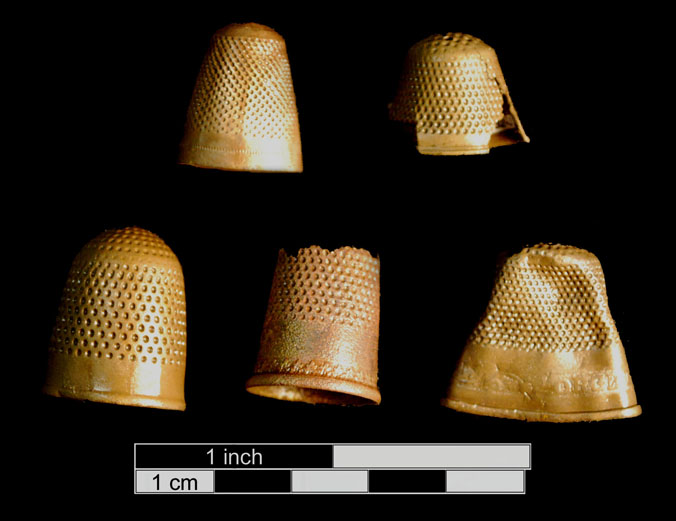
    A sample of the 30 historical thimbles found to date by archaeologists at George Washington’s Ferry Farm.

    Thimbles were once a popular token of affection given to ladies by family members, close acquaintances, or sanguine suitors. These essential tools formed an ideal gift for a beloved family member or an appropriate token of affection during those early, initial stages of a budding romance.  They were considered a less intimate gift than perfume or jewelry – all of which had more serious, romantic connotations. Gifting thimbles to cherished daughters or sweethearts developed as an esteemed tradition by the 1500s in Europe.

    Thimbles served as an emblem of female domesticity and skill.  Thimbles possessing a domed end were employed to protect the tip of the finger as a seamstress pushed a needle through cloth. Such thimbles typified domestic use, where tasks were dominated by sewing and mending. These duties were associated with a well-run home, and these skills grew to define womanhood.

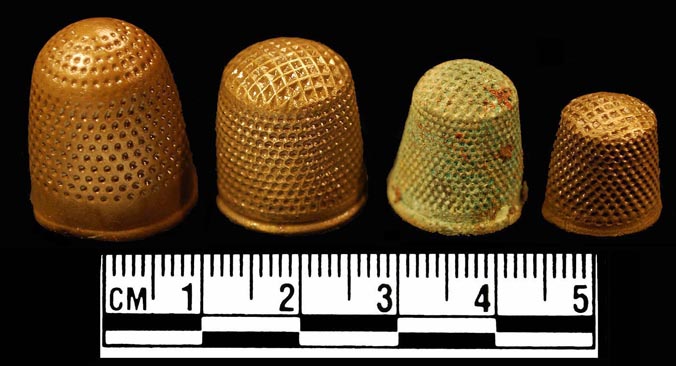
    Thimbles came in a variety of graduated sizes to accommodate the young as well as the experienced. Accomplished girls were expected to produce elaborate samplers and embroidery by the age of seven. The products of these young artisans were ostentatiously displayed throughout the house, where prospective suitors and visiting families could appreciate the budding skills and diligence of their daughters. Thimbles were such essential tools in the daily lives of women that they were part of everyday dress, often worn on the body as part of a chatelaine or belt-hung tool kit that included scissors, needles, and a thimble (think of Downton Abbey’s Mrs. Hughes).

    FF-Graduated Thimbles-shoptSmall
    A variety of sizes accommodated a child’s growth to adulthood. These examples were uncovered by archaeologists at Ferry Farm.

    Commercially-used thimbles were typically open ended and known as thimble rings. They proved to be popular amongst tailors who used these special thimbles “sideways” to protect the side of the finger. An open ended, ‘thimble ring’ provided a better option for use with thicker materials, such as leather. Such sturdy fabrics were associated with upholstery manufacture. Products that employed leather, such as saddles and tack, also required thimble rings. Tailors were often male, and many assert that thimble rings were used by men exclusively. Like all assumptions, they should be made with care: no doubt women who worked in industries associated with thicker materials employed thimble rings, and men who needed to mend their clothes in the absence of female family members made ready use of thimbles (soldiers in camp, for instance).

    Archaeologists have recovered over thirty functional (not souvenir) thimbles from the soils surrounding the Washington home. The majority date from the 18th and 19th centuries and – given their context – likely represent those used by women and girls for sewing hems, mending tears, and stitching. These historical examples from Ferry Farm were typically made from brass, reflecting both the popularity of that metal for manufacture, but also its durability and stability over time. A few examples feature copper sides with steel tips. Iron thimbles were also popular, but they decompose quickly and are rarely encountered by excavators.

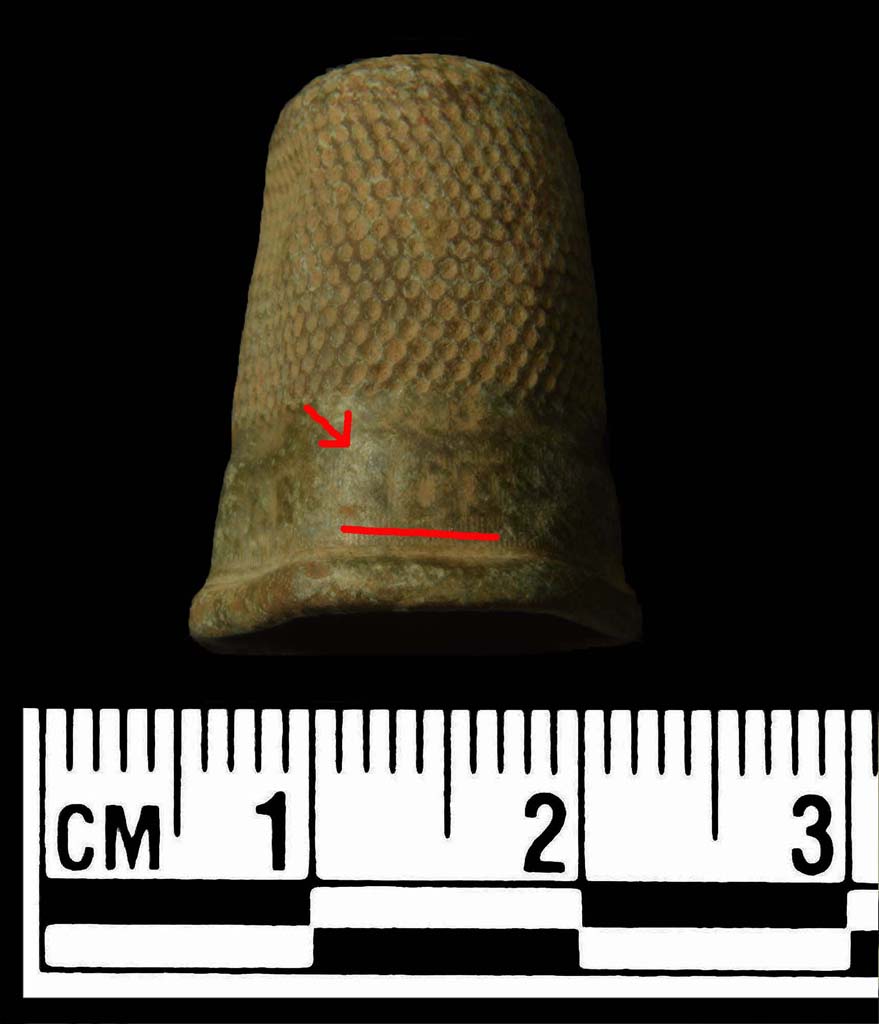
    Sometimes, when given as gifts, thimbles were enhanced with mottos, a tradition that was especially popular during the 1800s. They might be friendly, such as “Live Happy,” or didactic: “Pray and Work.” Slogans included “Remember Me,” “I Live to Die,” “A Friend’s Gift,” “Amor,” and “Pray and Prosper,” to mention a few. Two thimbles embossed with the sentimental idiom “Forget Me Not” were unearthed at Ferry Farm, each recovered from layers dating from the antebellum era (the time before the American Civil War). During this time, the ownership of the Ferry Farm lands was dynamic, and the property changed hands frequently.

    Chatham resident, and Commonwealth of Virginia Supreme Court of Appeals Judge, John Coalter purchased the property in 1829. However he never resided at Ferry Farm. Less than a decade later, in 1838, John Teasdale and Joseph Mann attained the property. Just five years after that, the land was transferred to Lewis G. Sutton. By mid-century, in 1846, John R. Bryan owned the farm and in December of that same year Winter Bray purchased Ferry Farm.

    FerryFarm20Dec1862
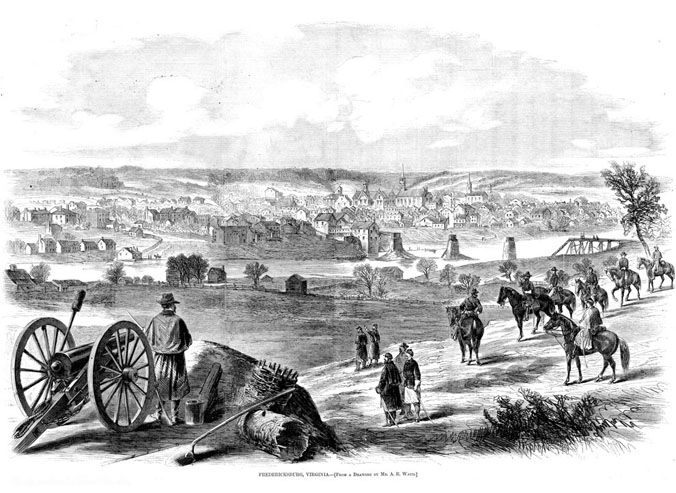
    “Fredericksburg, Virginia — [From a Drawing by Mr. A.R. Waud]” in the December 20, 1862 edition of “Harper’s Weekly.” This image was drawn on the Ferry Farm side of the Rappahannock looking across the river into Fredericksburg. Buildings of the Bray farmstead can be seen along the river bank in the image’s left middleground. Public domain.
    Bray engaged an overseer at Ferry Farm to manage the property. Importantly, they constructed a dwelling on the property in 1851, where the overseer resided. The George Washington Foundation’s archaeologists unearthed this structure as well as a kitchen related to this occupation in 2004. The construction of these dwellings is significant, since it demonstrates that people were residing on the land. Thimbles are more likely to derive from such a residential occupation as opposed to an absentee owner who devoted the land to pure farming.

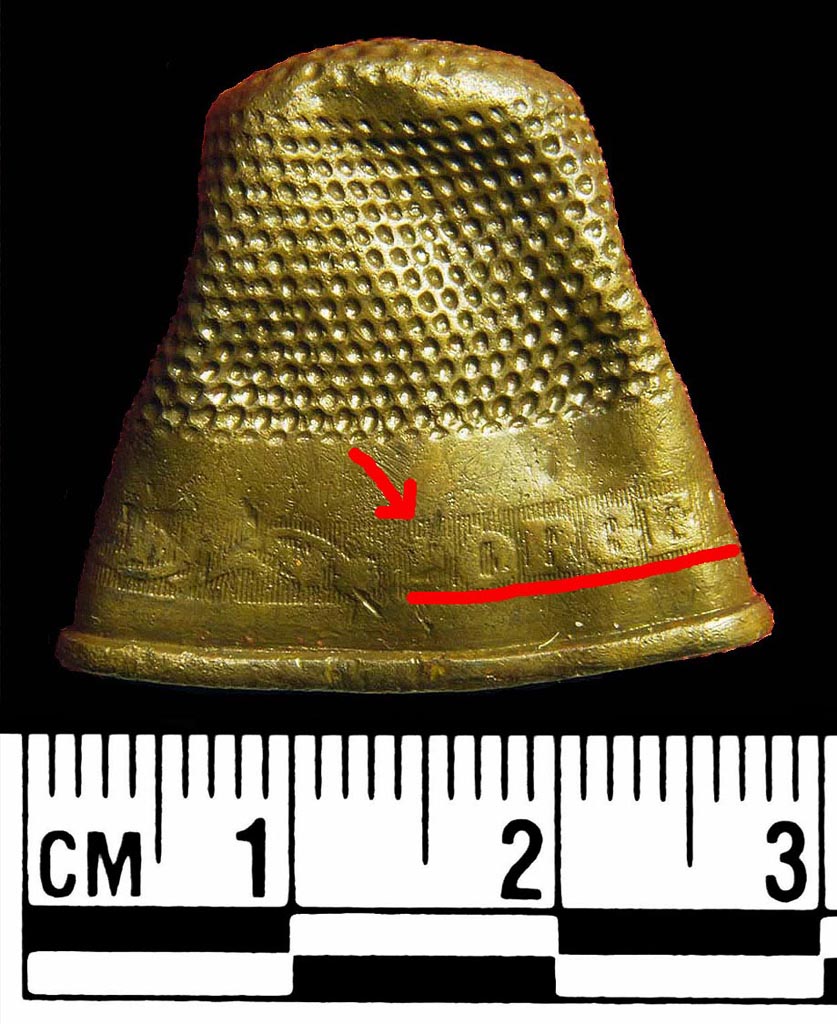
    We know from their method of manufacture that the “Forget Me Not” thimbles date from the 1800s. Given the dynamic history of property ownership and occupation that characterizes Ferry Farm at this time, it might at first seem challenging to determine which land owner – or rather which land owner’s family of resident workers – purchased these touching thimbles. However one thimble was found in the center of one of the Bray era dwellings, from a stratum dating from sometime between 1800 and 1860. The other thimble was discovered in the yard east of the Bray era structures, recovered from a layer that also dated from the antebellum era. It’s possible that both of these thimbles relate to the Bray era of ownership, and specifically to the overseers who occupied the property on the Bray family’s behalf.

    FF.2794-NOT-2SmallLines
    Look closely and you can read the word “NOT” upon this unconserved “Forget Me Not” thimble found in 2014. It was found in the yard east of the Bray era structures in a layer dating from sometime between 1800-1860.

    FFForgetThimbleBlogLines
    It’s easier to see the letters “FORGE…” of the phrase “FORGET ME NOT” upon this conserved Ferry Farm thimble. It was found in 2004 in direct association with one of the Bray era dwellings.

    Over the centuries, sentimental tokens similar to the thimbles excavated from the Bray dwelling cemented relationships, expressed affection, and inspired diligence among sisters, daughters, and sweethearts.

    Laura Galke, Archaeologist
    Small Finds Analyst