Lives and Legacies

Tag: textiles

  • Making our mark…on the laundry

    18th-century household linen management and its 21st-century historic house equivalent

    For the modern historic house museum collections staff, the care and cleaning of our spaces and objects are some of the most important tasks we do.  Proper dusting and routine cleaning helps preserve historic objects, vacuuming floors and wiping down woodwork help to maintain our historic interiors, and rotation of sensitive works help to prolong their life through limited light exposure and other environmental impacts.

    In January and February each year, when the Historic Kenmore and Ferry Farm sites are typically closed to the public, the curatorial staff is able to access the spaces to conduct inventories and condition assessments of objects…and to clean. Spring cleaning at the Washington House this year involved quite a bit of teamwork between our curatorial and buildings & grounds staff—fresh coats of whitewash went up on high-traffic areas of this historic recreation, and the wooden floors were vacuumed, spot-cleaned, and mopped to remove built-up dirt from tours and other activities.

    Low-post bedstead in the Hall Back Room piled high with reproduction bedding.

    Maintaining the bedsteads of the Washington House is an ongoing task for our interpretive staff, as they tidy and straighten the sheets and pillows that are moved about by visitors (something we encourage and celebrate!) during their immersive tour experiences.  This year, as we (the curatorial staff) conducted our spring-cleaning routine, we tightened the bedstead ropes and refreshed the bedding to prep the house for another busy year.  But as we went about conducting our room-by-room inventories and pulling bedding out for washing or airing, we uncovered an issue: many of our modern museum object labels for the sheets and pillowcases had become unreadable.

    White linen reproduction bedsheet with its twill tape label (sans number).

    Marking textiles in a museum collection typically entails a small length of twill (woven cloth) tape, a handwritten or applied object number, and small stitches to attach the tape to the textile object.  But for our reproduction bed linens on the bedsteads of the Washington House, these labels no longer were readable due to laundering—the “permanent” number used just didn’t last.  So what are our options?

    As we like to do, we turned to the past for an understanding of what might be a better, but still historically accurate method for marking our linens.  One such resource we turned to was cookery and household books of the period.  The Workwoman’s Guide, for example, includes a number of receipts (or instructions) for making marking ink as well as detailed instructions for marking household linens with thread.  In marking of linens, according to the author (A Lady), the textile would be marked with either the husband’s initials or the wife’s first name along with husbands initials, followed by an abbreviation of the type of article, and finally by the number and a date marker (last two digits of the year, for instance). 

    Receipt for “Permanent Ink for Marking Linen.” from The workwoman’s guide : containing instructions to the inexperienced in cutting out and completing those articles of wearing apparel, &c. which are usually made at home : also, explanations on upholstery, straw- platting, bonnet-making, knitting, &c. By A Lady (1838) via Smithsonian Libraries and Archives on Archive.org

    Existing household linens in museum collections and references in the written record indicate that some were in fact marked with numbers or initials/names (or both) to enable the items to be tracked and inventoried, although the exact combination of numbers and letters seem to vary, likely based on a complexities of the household and its linen inventory. The probate inventory taken after Augustine Washington’s death in 1743 records a variety of household textiles at Ferry Farm, including tablecloths, napkins, pillowcases, sheets, and towels.  The appraisers, however, make no note of whether these textiles were marked in any way (just noting materials or other descriptors and quantity). 
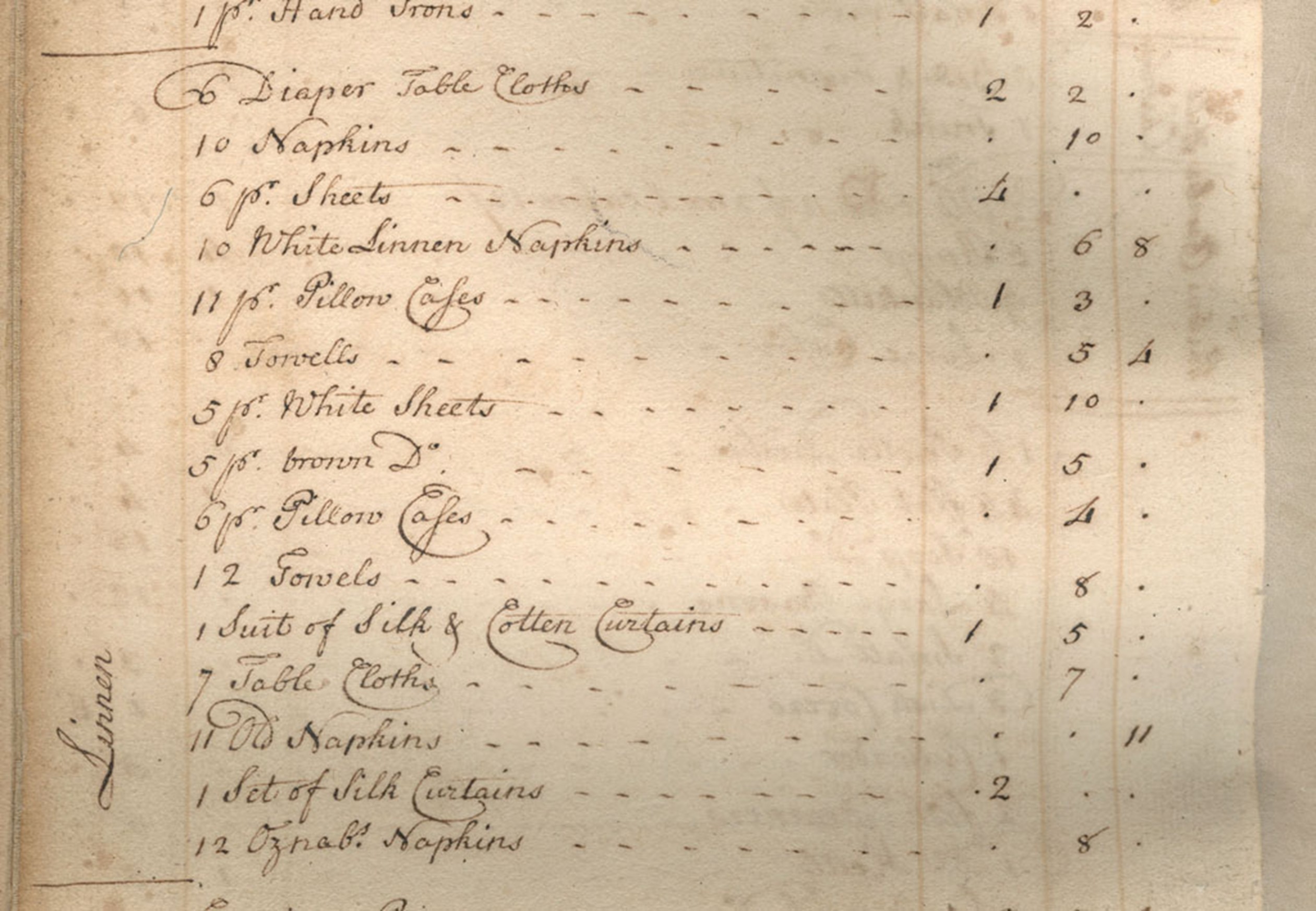
    Excerpt of 1743 probate inventory of Augustine Washington listing “Linnen,” including 6 Diaper Table Cloths, 10 Napkins, 6 pr Sheets, 10 White Linnen Napkins, 11 pr Pillow Cases, 8 Towells, 5 pr White Sheets, 5 pr brown Do. [Sheets], 6 pr Pillow Cases, 12 Towels, 7 Table Cloths, 11 Old Napkins, and 12 Oznabs Napkins. Inventory submitted 1 July 1743 to King George County court.

    The archaeological record of Ferry Farm includes a number of implements related to sewing, as touched upon in past blog posts such as this one or this one about thimbles.  Our own museum collections house a few 18th or early 19th century sheets or other household linens, some of which have been marked in ink or stitching with (unidentified) owners’ initials/names and dates, much in keeping with the instructions outlined in period references such as The Workwoman’s Guide and other household manuals.

    Sample layout and makeup of marks to include owner’s initials, item identification, number, and date. Excerpt from The workwoman’s guide (1838) via Smithsonian Libraries and Archives on Archive.org

    So, for our modern museum inventory management purposes, I think we’ll be skipping the caustic nitrate of silver or crunchy cochineal beetles for coloring and stick to the needle and thread method of marking our reproduction bedding and other textiles.  As suggested by A Lady, the Washington House marks will include both Mary and Augustine Washington’s initials along with notations of item type (such as WS for the five pairs of White Sheets listed in the 1743 inventory) and date of creation (for many of these reproduction linens, that would be 2018 or 2019).  I’ll be getting my needle and thread ready so that next year’s inventory and spring cleaning will hopefully be easy-breezy.

    Gretchen Goodell Pendleton

    Aldrich Director of Curatorial Operations

  • Washington House Blues

    Furnishings posts logo finalThe summer of 2019 was an especially hot one here in Virginia, but we managed to add some cool crispness to the Washington house interior.  It came in the form of some new textiles for the “best bed” in the Hall Back Room, in a refreshing blue and white color scheme.  As we’ve previously discussed here, blue and white bedroom textiles seemed to be a favorite of Mary Washington’s, throughout her life.  Both her will, written in 1788 many years after she had moved away from Ferry Farm and taken up residence in a cottage in downtown Fredericksburg, and the list of her belongings sold at vendu following her death in 1789 contain references to blue and white quilts, coverlets, counterpanes and curtains.
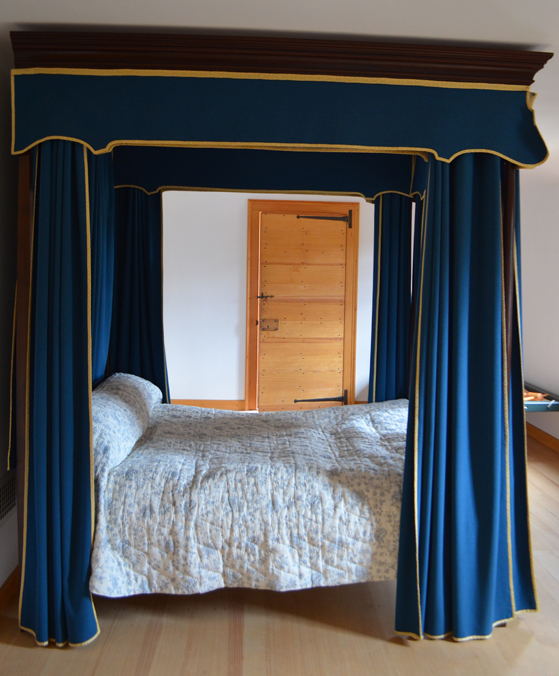
    Best Bed
    The “Best Bed” in the Hall Back Room of the Washington house at Ferry Farm.

    After the “best bed” arrived in 2018, we decked it out in blue wool bedcurtains and a white matelesse summer counterpane.  But for winter use, we really wanted to show the bed with the blue and white quilt that is mentioned several times in Mary’s documents, including a reference to it being willed to George Washington himself following Mary’s death.  Finding such a quilt turned out to be much more of a challenge than we anticipated, though.  The challenge was due to the increasing difficulty in finding ready-made period-appropriate fabric in our modern world.  And to understand that difficulty, we need to understand what Mary’s blue and white quilt (probably) looked like.

    The description of the quilt as being “blue and white” was not overly specific, but it was actually more descriptive detail than we have for most items in Mary’s household.  What could “blue and white” mean? First, it’s important to understand that a “quilt” in the 18th century is almost certainly NOT a patchwork quilt, or an appliqued quilt, both of which came into fashion much later.  Instead, an 18th century quilt was usually comprised of a solid piece of decorative fabric, on a layer of filler and a backing fabric, all of which was then quilted, or stitched with decorative patterns.  Sometimes the decorative fabric was a solid color, and the intricate stitching patterns were the real decoration, and sometimes the fabric itself had a pattern which was enhanced by the quilting.  The ‘blue and white” reference obviously indicates that the quilt was multi-colored, which indicates that the decorative fabric was patterned.  So what kind of blue and white patterns were available to Mary Washington in the mid-18th century?

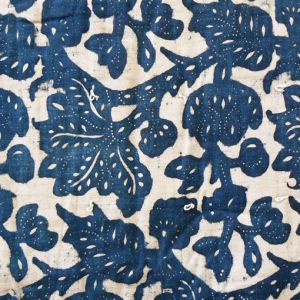
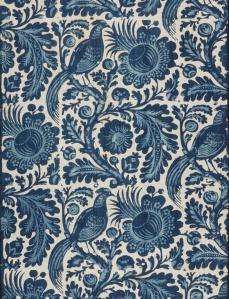
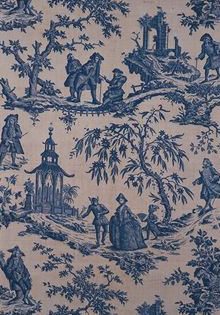
    By the mid-1700s, printed cotton textiles had become all the rage in England, and were being heavily imported into the American colonies.[1]  The technology for producing printed textiles at that point included resist dying, block printing with mordants and dyes, and copperplate printing (and combinations of all three).[2]  Resist dying (in which wax or some kind of dye-resistant substance was applied to sections of fabric meant to stay white, and then the entire fabric was submerged in dye) could produce bold colors and sharp contrast between dyed and undyed sections of fabric, but detail was hard to achieve.  Block printing improved the level of detail in patterns, but was still slow and tedious.  Copperplate printing allowed for great detail and eventually sped up the process of producing repeated patterns on yardage considerably.  Incorporating more than 1 color in the process was still hard to achieve, and so patterns are often monochromatic, with multiple layers of printing being used to create shades of color.  Most patterns, no matter the method of printing, involved floral and natural themes, sometimes including birds and other animals, and eventually entire landscape scenes.

    Quilt fabric resist
    Resist

    Quilt fabric resist block
    Block printed

    Quilt fabric copperplate
    Copperplate

    So, Mary’s blue and white quilt was most likely similar to one of these styles.  Our challenge was to find a modern fabric that accurately depicted one of these processes.  Unfortunately, not many modern fabrics are made using the same 18th century technologies, and are more likely to be machine printed using digital images.  As a result, these modern patterns usually look too perfect, without the minor imperfections of handmade textiles which actually reveal to us what type of historic process was used to make them.  The imperfections are a part of the overall look and feel of the pattern, and make the final product more authentic.  It’s a hard thing to achieve these days!

    The American textile industry is greatly reduced from what it once was in the early 20th century, and even in Europe, many of the textile factories that once created the patterns that Mary and her contemporaries used in their homes, are gone.  Most printed fabrics produced using historic methods these days are produced in small runs and come from small artisan shops – finding both the makers, and enough yardage (and at a price that isn’t prohibitive) of period-correct patterns, can be difficult.

    Quilt 1
    Quilt on the “best bed” in the Washington house.

    Quilt 2
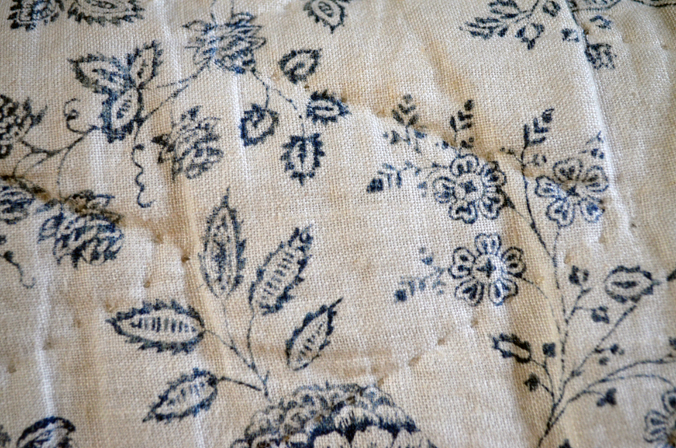
    Close-up view of “best bed” quilt.

    After months of searching, we were lucky enough to locate a blue and white printed cotton, reproduced from a mid-18th century French pattern by Chelsea Textiles in New York.  The original version was block printed, but also used wax or paste in the resist method.  The result was a detailed repeated floral pattern that also had the rounded edges of resist dying.  It was perfect for our uses.  The fabric was quilted onto filler and backing, and the entire quilt was cut in a T-shape, to fit around the bedposts of the Washington “best bed”, creating a fitted look which was also typical of the time.  Visitors to the Washington house can now see Mary’s favorite blues on display in her bedchamber.

    Meghan Budinger
    Aldrich Director of Curatorial Operations

    [1] Eaton, Linda.  Printed Textiles, British and American Cottons and Linens, 1700 – 1850. The Monacelli Press, New York. Pg. 65.

    [2] Ibid, Pgs. 17 – 41.

  • Finding Clues in Curtain Rings

    What do you think curtains look like after hundreds of years in Virginia’s soils? Naturally, the cloth portions of such tasteful textiles quickly erode away. But archaeologists do occasionally discover curtain rings. It’s likely that brass rings such as these became separated from their stylish drapery due to cloth tearing or – occasionally – because the ring itself breaks (see third ring from left in photo below).

    Curtain Rings
    Possible curtain rings recovered by archaeologists at Ferry Farm. These are made from solid brass. Such rings supported bed curtains, wall hangings, and window curtains.

    These archaeological gems from the soils that surround Washington’s boyhood home provide details regarding the Washington family’s decisions about the furnishing of their home. Drapery provided privacy, embellished an otherwise drab surface, enhanced warmth, and allowed occupants to control the amount of sunlight in a room. Despite these contributions to comfort and elegant style, window curtains remained somewhat uncommon in colonial households during the second quarter of the 18th century, when documents demonstrate that the Washington home had curtains.

    Curtains and wall hangings were noted in Augustine Washington’s 1743 probate inventory (see photo below). This document was created after Augustine, George’s father, died. It listed his possessions and their value. Probate inventories were created by gentlemen from the neighborhood who assessed the value of the recently deceased’s possessions for estate and tax purposes. Benjamin Berryman, Hancock Lee, and Adam Reid performed this task for the Washingtons in 1743.

    The window hangings recorded in Augustine’s probate in the hall back room, which served as Augustine and Mary’s bed chamber, were almost twice as expensive as those found in the parlor room. They were valued at two shillings six pence for a single window curtain. The probate inventory also notes two additional sets of fine curtains under the heading “linen.” These were even more expensive than those within the home’s rooms.  One pair was composed of silk while the other was made from cotton.

    ProbateP286HallBackRmCurtainsSmall copy
    This detail from Augustine Washington’s 1743 probate inventory indicates that the hall back room had two window hangings valued at 8 shillings.

    While the assemblage of curtain rings excavated at Ferry Farm may appear modest, it is worth noting that Foundation archaeologists have excavated over 900 five-ft.-by-five-ft. excavation squares! That’s well over 22,000 square feet of soil screened.[1] Every inch of soil is screened through ¼-inch mesh screen and artifacts from all time periods are cleaned, cataloged, and curated at Ferry Farm. It is only through such a thorough and extensive excavation strategy, that any evidence for brass rings that supported wall and window hangings can be discovered.

    If Ferry Farm was the homestead of a less famous family (whose records were less diligently preserved) or the home of a family who lacked the income level to warrant a probate inventory, these excavated rings would be the sole evidence of the existence of wall hangings, window hangings, or bed curtains. The few rings recovered from these extensive excavations alone allow us to infer that this family had hangings. Just how these rings were employed is not known with certainty using the material record alone but these archaeological remains alongside the probate inventory provide an exceptional opportunity for Foundation scholars to understand the mid-18th century Washingtons.

    The presence of brass rings at Ferry Farm illustrates the importance of thorough excavation to recover small finds artifacts. Together with the probate inventory, these rings allow archaeologists, curators, and material culture specialists to compare – and to appreciate – what the Washingtons owed in 1743 versus what was preserved in the ground after hundreds of years.

    Laura Galke, Archaeologist
    Site Director/Small Finds Analyst

    [1]Most excavation units extend to a depth of about one foot, though some proceed to even greater depths.

    Further reading
    Muraca, David, John Coombs, Phil Levy, Laura Galke, Paul Nasca and Amy Muraca
    2011 Small Finds, Space, and Social Context: Exploring Agency in Historical Archaeology. Northeast Historical Archaeology 40:1-20.