Lives and Legacies

Tag: tobacco

  • You Down with Old TD? Yeah, You Know Me!  

     TD Marked Tobacco Pipes That Is! 

    Clay tobacco pipes are a hallmark of historical archaeology. Grandma smoked, the enslaved smoked, the elite smoked, children smoked, just about everyone smoked. Smoking was one of America’s favorite pastimes, and there are plenty of pipes left in the archaeological record to prove it. Tobacco pipes were not only a vessel for a leisurely activity, they could also be a way to display one’s identity or beliefs.  

    Figure 1: A Smoking Club (NYPL)

    Because of this, the motifs and marks on tobacco pipes can tell us a lot about the people who used them.  

    Tobacco pipes can also be valuable tools for dating a site by using pipe bore diameters, typologies, and maker’s marks. This last one helps set the stage for our question of the hour.  

    Some makers would mark their pipes to indicate a product as theirs.  These marks can be found on different parts of a pipe, such as the bowl, heel, or stem. Finding a pipe with a maker’s mark can be very exciting as it allows a pipe to be attributed to a specific pipe maker and, thus, a time period. But that is not always the case. One of the more common maker’s marks in many archaeological sites is the mark “TD.” Remember the two we found during last summer’s dig?  

     So, you’re probably thinking, what’s the question again? Just go look up a pipe maker with the initials TD, and you will have your maker. Well, unfortunately, it’s not always that easy. 

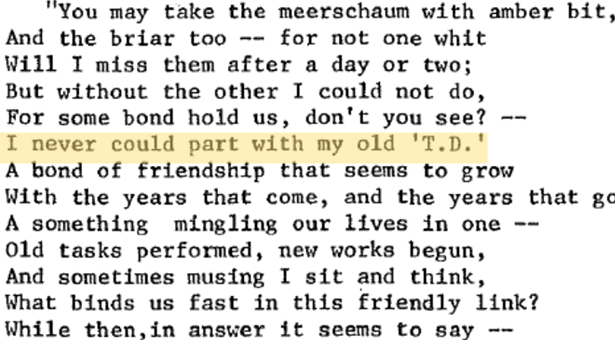
    There are multiple pipe makers with those initials, and the pipes with variations of the TD mark have been found at sites with occupation dates suggesting the mark was being produced from the mid-18th century all the way into the 20th century. At some point, the mark stopped representing a single maker and instead became a symbol used on pipes throughout the years, reflecting clay tobacco pipes themselves. Think of it as the Kleenex or Q-tip of its time. TD became synonymous with clay tobacco pipes. This can be seen in written records like a catalog from 1892 that touts their rendition of “the Celebrated “T.D.” pipe” (Zorn). An early 20th-century song referencing “the Old TD” also supports the lasting influence of the mark (Cooper, 1907, as cited by Walker, 1966).  

    Since there is no solid end date to help frame who the possible maker could be, archaeologists and historians have focused on looking at beginning dates to help find the original maker of the TD pipes, settling on a date in the middle of the 18th century. Archaeologists Adrian Oswald and Iain Walker are often cited as laying the foundations of the current TD lore. The combination of their findings identifies 18th-century London-based pipemaker Thomas Dormer as the most likely originator of the TD mark (Walker, 1966). With that said, Walker (1966) states that more information will have to be found to definitively give Dormer credit for originating the mark. 

    So, that brings us to the start of my research and a revisiting of the foundation of this theory, which was laid out as early as the 1930s.  Who is Thomas Dormer, and is he the original TD? Why were TD pipes so popular that they were copied and made for centuries? And can we find new information to crack the case of the elusive TD mark? 

    The first step of the investigation is reviewing the literature and identifying current thoughts on TD pipes and their maker. One of the earliest deep dives into TD pipe origins can be found in the article “A Theory Regarding TD pipes” in the November 1937 printing of Antiques magazine. In this article, Alfred Hopkins expresses the mystery surrounding the mark and suggests its possible meaning. At the time, Hopkins (1937) and his contemporaries were unable to find potential pipe makers with the initials TD that would indicate the mark was referring to a maker. Instead, he states that it was a trademark of sorts to identify a quality product (Hopkins, 1937). He also mentions that TD may represent the beginning of the Christian hymn Te Deum Laudamus (Hopkins, 1937). Now remember, folks, this was written in the 1930s, and at the time, they didn’t have easy access to information. While more information has since been shared, we now know that there were indeed pipe makers with these initials and look more toward a maker rather than a hymn; Hopkins’ article plays an integral part in our quest by illustrating that there was an interest in the TD mark as early as the 1930s.  

    Figure 7: 1937 Alfred Hopkins article 

    Moving away from the 1930s and into the 1960s, Adrian Oswald compiled an index of pipe makers, which Iain Walker (1966) refined to find three possible English pipe makers that could be the originator of the mark: Thomas Dennis, Thomas Darkes, and Thomas Dormer. Walker (1966) continued this search and identified London-based pipemaker Thomas Dormer as the most likely of the three. Nailing down their sources became the next part of the puzzle in an attempt to confirm this information through primary source research and examination of any sources referred to in support of the theory.  

    This is where the quest to find new information about Thomas Dormer begins. Through this investigation, I was able to identify the “OG TD,” some juicy 18th-century family drama, and the possible first plagiarizers of the TD mark. There are twists, turns, and, unfortunately, too much to tell you in just one blog, so be sure to check out part two, where we get to the bottom of this mystery that began nearly 100 years ago. 

    Danielle Arens

    GWF Archaeologist


    ​​References 

    ​​(2022). Retrieved from George-M-Woodward-mavcor.yale.edu.jpg 

    ​George Zorn & Co. (1892). Pipes & Smokers Articles. Philadelphia. 

    ​Hopkins, A. (1937, November). A Theory Regarding TD Pipes. Antiques, pp. 234-235. 

    ​National Pipe Archive. (n.d.). Retrieved from http://www.pipearchive.co.uk/images/how%20to/pipe_figure_1.jpg 

    ​Walker, I. (1966, June). TD Pipes – A Preliminary Study. Quarterly Bulletin Archeological Society of Virginia, pp. 86-102. 

    ​​​ 

  • What’s Growing in Ferry Farm’s Garden?

    As many of you know, the Washington house replica at George Washington’s Ferry Farm was reconstructed and furnished as accurately as possible using historic documents, paintings, letters, and, of course, archaeology. Now that the challenge of getting the house built and open to visitors has passed, it’s time to turn to the rest of our plan for interpreting Ferry Farm’s landscape. This will eventually include constructing outbuildings, finishing the work yard, and improving the garden.

    Even though the present garden is located at Ferry Farm’s Visitor Center and not yet near the Washington house replica, we used archaeological discoveries to decide what goes into the garden this spring. Using data from past excavations on Washington-era contexts, we drew some conclusions on what the Washington family and their enslaved workers cultivated here. While most organic material left behind over 250 years ago is long gone, as archaeologists, we sometimes get lucky and find biological and botanical remains that have withstood the time in the ground. We get especially lucky when we do find botanical remains like seeds and wood because, depending on the elements, they usually decompose easier and faster than bone.

    Visitor often ask how we find some of our tiniest artifacts such as seeds. For important contexts and Washington era features, we don’t want to miss a single (tiny) thing, so we use a water screen. Instead of the usual quarter-inch screen we use for dry sifting dirt, we use a gentle stream of water from a garden hose and spray away the dirt through a window screen. We then use tweezers to pick out the tiny artifacts left behind.  Objects like the straight pin in the photo below and seeds could otherwise fall through the standard quarter-inch screen.

    GWF_FF20-Waterscreen-Cate-Courtney-24May2013H
    Water screening

    GWF_FF20-Waterscreen-16May2013
    Picking out the artifacts after water screening.

    GWF_FF20-Waterscreen-StraightPin-17May2013
    Straight pin

    In 2015, we had flora remains from a mid-18th century storehouse cellar feature that had been captured by our fine mesh water screens sent to Justine McKnight, an archaeobotanical consultant for analysis.  Without getting extremely technical, I will say that we gained some very useful data to use to plant our garden this year. Seed specimens discovered archaeologically and used in cultivation consisted  of peas, green beans, wheat, and corn. Seeds included hackberry and, of course, cherry. The only nut uncovered was a hazelnut shell.

    Along with this archaeological evidence, we also know that some tobacco was grown on the Washington farm because of court records. In the 17th and 18th centuries, tobacco was Virginia’s premier export and most valuable cash crop but places along the Rappahannock River like Ferry Farm were not great tobacco land.  In these areas, as our excavated seeds show, planters moved onto corn, wheat, and other crops, knowing they would never get rich on tobacco.

    Using all of this information, we planted similar crops in the demonstration garden along with other crops widely grown in 18th century colonial America.

    While seemingly insignificant at first glance, these tiny charred remains of flora give us a snapshot in time of the diets of the Washington family and enslaved workers at Ferry Farm. These definitely are not the only plants they were eating, but we do know via archaeology that these were stored by the family in the mid-18th century. Using the other archival resources listed above, we will continue to fill in the gaps and enhance our garden and landscape according to the historical and archaeological records.

    Elyse Adams, Archaeologist
    Archaeology Lab Technician

  • Lecture – Credit and Coinage: The Economy in Colonial Virginia [Video]

    On Tuesday, May 8, 2018, Cash Arehart, Site Supervisor of the Capitol Building at Colonial Williamsburg presented a lecture titled “Credit and Coinage: The Economy of Colonial Virginia.” Using Kenmore’s Fielding Lewis as an example, he discussed currency, credit, the tobacco economy, and the Transatlantic trade and how they all converged to make Col. Lewis a successful and prominent businessman in Fredericksburg and Virginia a successful colony within the British Empire.

    Join us at the library on Tuesday, May 15, 2018 for “Curiosities of Kenmore,” when Meghan Budinger, the George Washington Foundation’s curator, will talk about some of the most exciting and unusual objects in Kenmore’s collection and that are rarely seen by the public. Talk begins at 7:00 p.m. The lecture is FREE and hosted at the Central Rappahannock Regional Library at 1201 Caroline Street, Fredericksburg, Virginia. To learn more, visit kenmore.org or livesandlegaciesblog.org.

  • Put That in Your Pipe and Smoke It: Tobacco & Politics in the 1700s

    Colonial American.  Think about that term.  What does it mean to you?  It refers to citizens of the American colonies prior to the Revolution.  In the minds of many of us in the present-day United States, however, it might denote a unique American identity, probably because our own identities as Americans are firmly set and celebrated.  But what if I told you that most of these colonial Americans considered themselves to be loyal British subjects for much of the colonial period and proudly displayed objects that confirmed their loyalty?

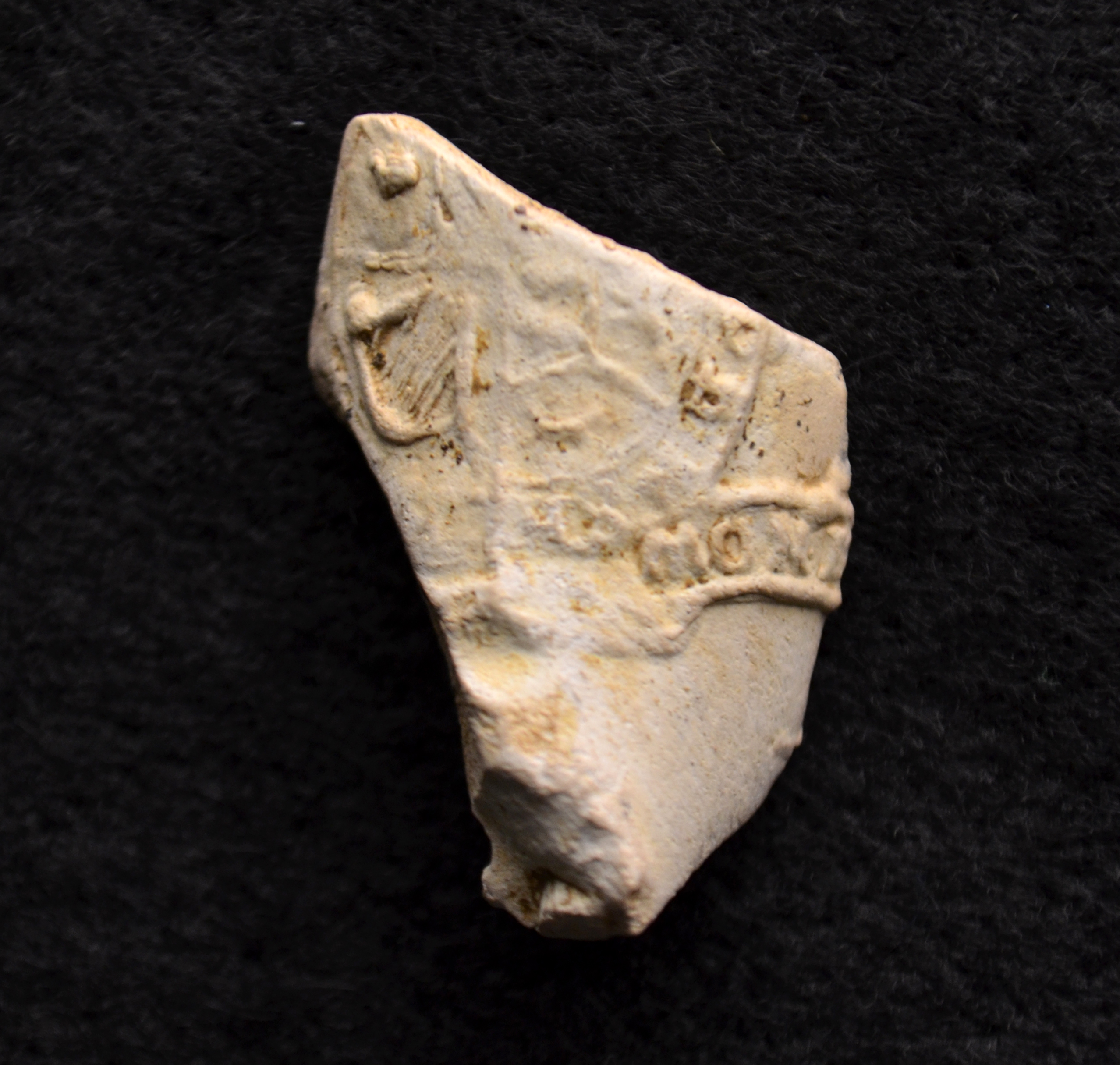
    One such object discovered at George Washington’s Ferry Farm is a small fragment from a white clay smoking pipe bowl.  The design on this tiny fragment includes a small harp and the letters “Mon D…”.

    Pipe Bowl Fragment
    Pipe bowl fragment excavated by archaeologists at George Washington’s Ferry Farm.

    Sometimes in archaeology we have genuine ‘Ah Ha!’ moments and, for me, this was one such instance.  I grew up with a suncatcher – a gift from an English family friend — in my bedroom that featured a rearing unicorn above the words ‘Mon Droit.

    Suncatcher

    I loved that suncatcher and, when I saw the pipe fragment, I recognized what the design was right away.  It was the British royal coat of arms!

    On pipe bowls like the one unearthed at Ferry Farm, the coat of arms wrapped around three quarters of the circular bowl. A lion, shield, and unicorn each filled their own quarter of the bowl above the full French phrase “Dieu Et Mon Droit” or “God and my right,” a claim that the right of the British monarch to govern was divine in nature.  This phrase has a long history in England.  It was first used as a battle cry by Richard I in the 12th century and picked up as a royal motto by King Henry V, who lived from 1386-1422.  The use of the French language for an English motto may seem odd but French was very fashionable and the official language of the English court.

    British Royal Coat of Arms
    The British royal coat of arms from 1714-1800 during the Hanover dynasty. Credit:  Sodacan/Wikipedia

    It is doubtful that anyone living at Ferry Farm after the America Revolution wanted to advertise their loyalty to the British crown so we can safely say this pipe was probably used between 1714, when the Hanover dynasty began under George I, and, at the latest, the 1770s. During most of this time period, the Washington family lived at Ferry Farm.The royal coat of arms is full of important symbols.  Grasping the center shield is a lion signifying England and a unicorn representing Scotland.  On the shield’s lower left is a harp symbolizing Ireland. The harp is clearly identifiable on the pipe fragment excavated at Ferry Farm.  The lower right section of the shield includes a columned monument and another lion. These symbols were added during the House of Hanover’s reign.  Monarchs regularly changed the coat of arms as each new king or queen sought to make their mark on the official emblem.  The monument and small lion were included on the shield to denote the Hanovers’ rule over their territory in what is now Germany.  The fragment found at Ferry Farm also contains these elements indicating that it was manufactured between 1714 and 1800.

    139_Masonic_pipe_NO_SCALE
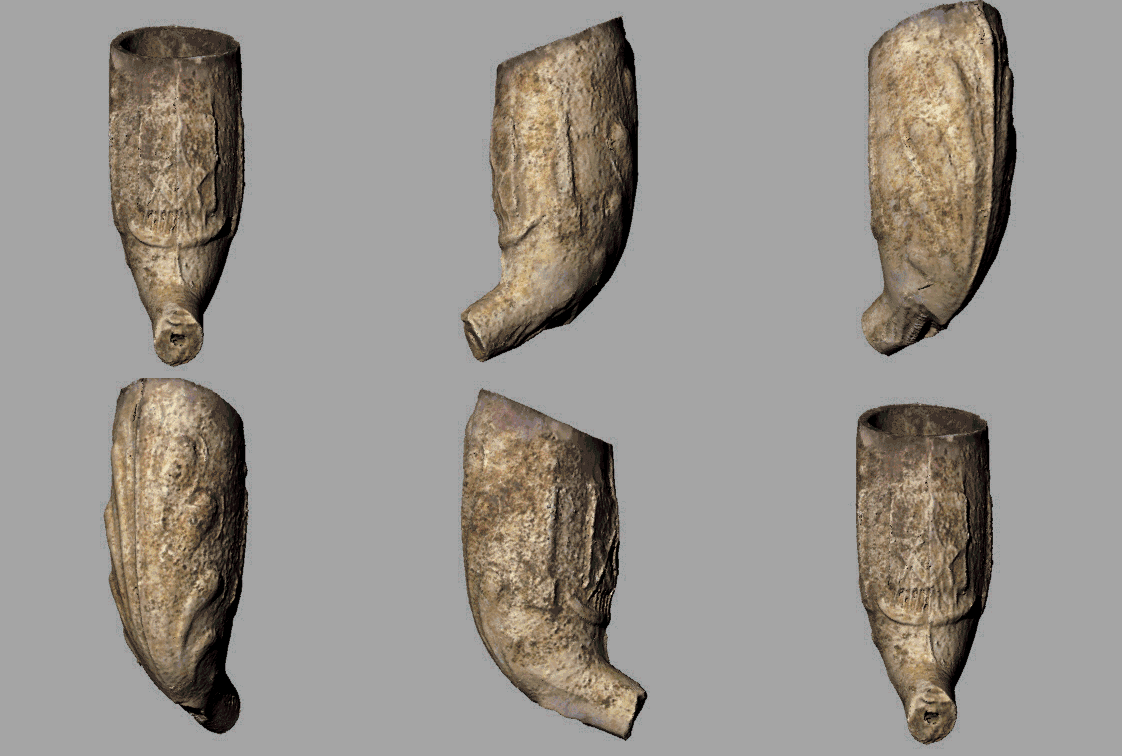
    Pipes featured more than political symbols. This is a 3D image of another smoking pipe bowl excavated at Ferry Farm decorated with a Masonic symbol. The pipe was probably made in the northeast of England between 1770-1810. You can read more about this pipe here.

    Why is this pipe fragment a big deal?  During the 18th century, smoking a pipe with a political symbol like the one we’ve found was the equivalent of slapping a candidate’s bumper sticker on your car, placing a political party’s sign in your yard, or sharing a favorite political meme on social media. The act was public, deliberate, and did not go without notice. The practice continued well into the 1800s when groups such as the Irish employed smoking pipes to advertise their support for causes such as a free Ireland.  It was a way to signal identity to others.

    During most of the colonial period in America, aligning yourself with the crown was not at all radical but rather what was expected of most subjects.  In fact, this pipe bowl fragment is not the only artifact excavated at Ferry Farm to hint at past occupants’ loyalty to Britain.  As noted in a previous blog, we have found several drinking vessels exhibiting the initials ‘G.R.’ for ‘George Rex’ or King George.  In another blog, we also discussed an artifact uncovered at Ferry Farm that points toward a growing resistance to the British crown. This mid-18th century sleeve button depicts William III, who, although he died decades before the button was manufactured, came to represent the right of subjects to resist a king who was abusing power.

    What we may be seeing in these three types of artifacts present at Ferry Farm is a fundamental shift of views within the Washington family as the political climate changed throughout the 1700s.  The objects hint at a swing from loyal British subjects to revolutionaries and the beginning of our identity as independent Americans.

    Mara Kaktins, Archaeologist
    Ceramics & Glass Specialist

  • Video: Summer in the Garden

    Scenes from the Demonstration Garden at George Washington’s Ferry Farm on a peaceful summer morning. The garden contains a variety of colonial-era plants that would have been grown by the Washington family like tobacco, corn, and squash.  There are also modern flower species plus birds and other wildlife.