Lives and Legacies

Tag: undergarments

  • Stay Informed About Historical Undergarments

    You have probably seen an enormous amount of corsetry imagery in your life. Whether it was the scene in Gone with the Wind where Mammy is lacing Scarlet into her corset as she holds onto the bedpost or a social media post about waist training using a modern piece of shapewear. Needless to say, you probably think that corsetry was restricting, painful, and dangerous for all women in the 18th, 19th, and 20th centuries. Enter me, a corsetry enthusiast, here to break the wall of misconceptions surrounding women’s boned undergarments. 

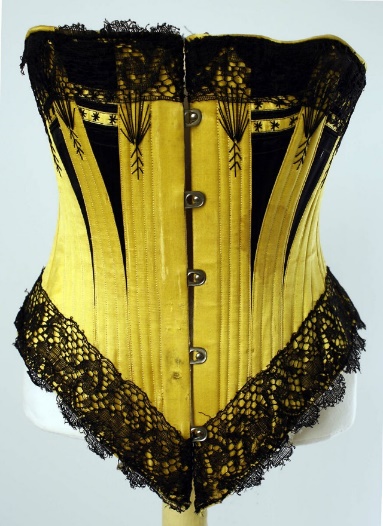
    I would like to start by differentiating between stays and corsets. Stays are the fully or partially boned shaping garments worn by women in the 18th century. Stays gave support to the bust and created an inverted conical shape by holding the shoulders back, trimming the waist, and supporting the mantua, or gown. Stays can be laced in the front, back, or both. Corsets became fashionable in the early to the mid-19th century. Corsets give the more famous hourglass shape, are laced in the back, and fastened in the front with hooks. I will be focusing on 18th-century stays, but know that many misconceptions about stays and corsets fall into similar categories. Some differences are the spark to the misconceptions, though. 
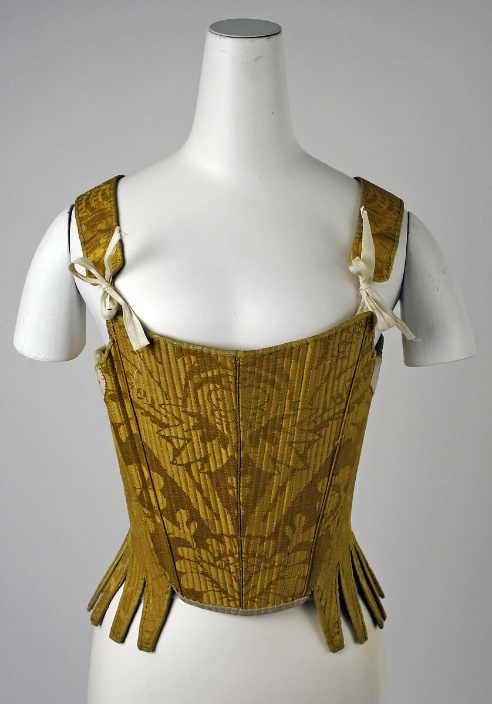
    Early 18th Century silk stays in collections of the Metropolitan Museum of Art

    1880s Silk Corset in the collection of the Metropolitan Museum of Art

    Take everything you think you know about stays and throw it out the window. The most common misconceptions about historical boned shapewear can be debunked if you step outside of the 21st century’s media-driven view of corsetry.

    Weren’t stays painful and hazardous to women’s health? No, actually. This misconception comes from the idea that women tight-laced their stays, meaning they pulled the laces tighter to force waste reduction. Most women did not practice tight lacing. Additionally, the boning was made of baleen (whalebone), which looks rigid but is quite flexible and molds to the wearer’s body over time. Stays were meant to be supportive, not restrictive. Organs were not squeezed, and ribs were not broken. Think of stays as a garment, not unlike a modern bra: snug, supportive, but wearable in an everyday setting. Women were able to work, eat, and breathe in their stays. It was probably more likely you would faint from the smells in the street than you would from the tightness of your stays in the 1700s. 

    1777 Satire of fashion print, British Museum

    Women of all classes in society wore stays. From the lowest of working classes to the highest of nobility, everyone wore them. You were not considered properly dressed without your stays on. Materials differed based on what you could afford, but some iteration was necessary for every woman. Working women often wore stays without straps so as not to restrict any movement of the arms or shoulders. Wealthier women who were not doing physical labor tended to enjoy the extra support the straps gave.

    Stays were not worn up against the skin. No matter what the covers of romance novels or the saucy scenes in period dramas portray, there was always a layer of clothing between the woman and her support garment. Laundry was not as simple as throwing everything into a machine and hitting start in the 18th century. Therefore, women wore foundational garments called shifts that were washed frequently and protected outer garments like gowns and stays that were not washed as often. A shift was a nightgown-like garment usually made of linen. This was considered your base layer. It absorbed sweat and oils, protecting the rest of the clothing and stays from the elements of the body. 
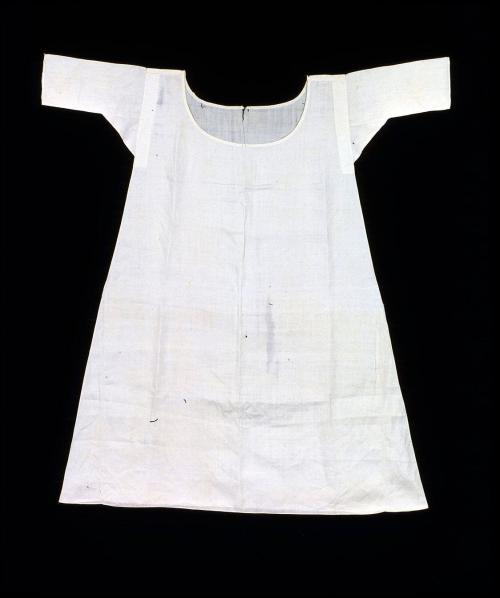
    Linen shift in the collections of Colonial Williamsburg

    Stays were never laced in a crossed pattern; they were always spiral laced.    That crisscross lacing that you see so often was not commonly used until 19th-century corsets. Spiral lacing was achieved by anchoring one end of the lacing chord at either the top or bottom and running it in a circular pattern through the offset laces until the other end of the stays were reached, then it was anchored off at that other end. This is a common mistake made in period films. If it isn’t spiral laced, it isn’t the 18th century. 

    Spiral-laced early 18th Century linen stays in the collection of the Metropolitan Museum of Art
    Cross-laced 1890s silk corset in the collection of the Metropolitan Museum of Art

    Another lacing myth is that women in the upper classes were the ones who wore back-lacing stays, and women in the lower classes wore front or front and back-lacing stays. This idea came to be from the thought that women needed help to get into back-lacing stays; therefore, they needed a servant or enslaved person to place them in while lower-class or poorer women could lace their own stays in the front. Experts know this is not true as stays in fancier fabrics, like silk, worn by wealthier women are often front lacing, and stays in common fabrics, like linen, are often back lacing and vice versa with no real correlation. This tells us that the lacings of stays were not exclusive to class. I can also confirm that this was most likely the case as I have worn and laced my own back lacing stays by myself. It is not a magic trick or due to any extreme flexibility. I do what I was shown: lace the stays loosely in front, then spin them around, so the lacing is on my back and tightens them up. Simple, fast, and effective. 

    Something surprising that I learned while constructing my stays is that stays were not made by the milliner or mantua maker. Stays were most frequently made by a specialty staymaker or the tailor. That’s right, and this is such a specific and complicated garment to construct that it was often made by a specific craftsman. It took many years for someone to master the art of stay-making. Despite mantua making and millinery work being a female dominated trade in the 18th century, stay making and tailoring was a male-dominated trade. It took a lot of strength to process the whalebone, a job more suited to men. Next time you hear an actress from a period drama complain about how tight the corsetry was and how she could barely breathe, know that her corset was most likely not fitted properly and made historically; therefore, it just did not fit. Stays were made to fit the wearer, which would take an enormous amount of time to do for a film’s costumes. Premade corsets are bound to be uncomfortable to wear. Staymakers knew exactly how to fit a set of stays to the wearer, an art that is now nearly lost to time. 

    1780s stays from the Victoria & Albert Museum Collections (linen)
    1780s stays from the Victoria & Albert Museum Collections (silk)

    Stepping back into our 21st-century lenses, what can you see? Do you see oppressed women fainting in the street or strong women working in their homes and out in the world going about their business? I hope this has made you think twice about regarding corsetry as the worst garment ever to grace the body, but also about appreciating the women who wore them and what they did to get us to where we are today. 

    Allison Ellis

    Manager of Public Programs
  • Drawers, Knickers, or Pants: Why Do We Call Them That?

    There truly is a National Day for absolutely everything and even a National Underwear Day! That’s right! Undergarments have their own appreciation day and, to be precise, it was August 5.  At first glance, National Underwear Day may seem rather silly but actually we probably don’t give enough thought to the importance of underwear. Before August ends, we want to remedy that by taking a look at underwear from a historical perspective.  Have you ever wondered why there are so many names for our various undergarments? It turns out that all the names we have for underwear today are rooted in the past.

    Cooling in Basement
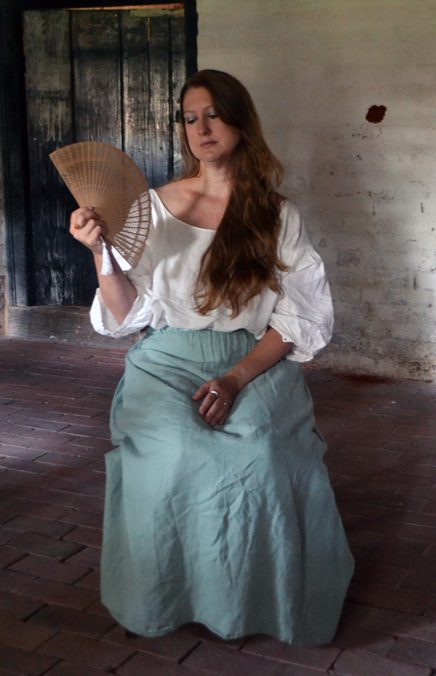
    Woman in a shift and petticoat.

    Underwear as we know it today didn’t really get its start until the 1800s.  Prior to that, people like the Washingtons and the Lewises actually didn’t wear much at all under their numerous layers of clothing.  Women wore nothing under their shifts (which were loose-fitting, waistless dresses that acted as the first layer of a woman’s wardrobe and were sometimes the outer layer in hot weather or workday situations).  Men’s shirts were initially similar to shifts in that they were all-purpose – base layer, outer layer, sleep shirts, etc.  But, men were actually the ones who began the trend toward true undergarments.

    In Washington’s day, men wore breeches on the outside, but they also wore a similar lighter weight garment underneath, which came to be known as “drawers.” Why drawers, you ask? The prevailing theory is that the name comes from the fact that early versions of this undergarment were actually two separate legs that had to be “drawn” up and tied in place, hence why we still refer to underwear as “pairs” even though they are single garments now – “a pair of drawers”, “a pair of underwear.”

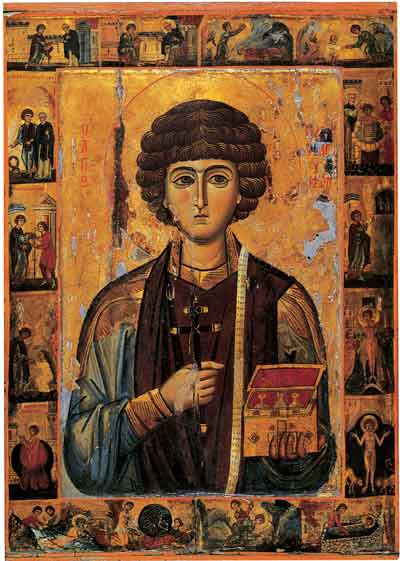
    St Panteleimon
    Icon of saint Panteleimon (Saint Catherine’s Monastery, Mount Sinai) dating from the 13th century. Credit: Wikipedia

    Eventually, women adopted men’s undergarments for themselves, with some modifications.  This is the point where the ubiquitous term “pants” has its beginnings.  “Pantaloons”, “pants”, and “panties” all come from the same remarkable origin, a Catholic saint, martyred in the 1st century A.D. named Saint Pantaleon. Now, Saint Pantaleon had nothing to do with pants himself but centuries after his death, he became a focus of religious zealotry in Venice, Italy, where many men wore a peculiar type of breeches that were rather poofy.  Because the men who were also a part of the cult of Saint Pantaleon wore these same poofy breeches, they came to be known as “pantalones.”  Additionally, because of their rather flamboyant behavior and dress, pantalones became the stereotypical way to depict Venetian characters in comedic plays, which travelled across Europe.  Eventually the most distinctive characteristic of these comedic characters, the poofy breeches, became iconic and took on the name “pantaloons.”

    Interestingly, pantaloons became a popular fashion accessory among women in France, as an undergarment that was intentionally meant to be seen under slightly shorter dresses.  When the fashion reached England, it was primarily among men, and eventually the word “pantaloons” was shortened to “pants” and applied to any outerwear bottoms generally.  Among women, they remained undergarments, which got continually shorter and smaller as the centuries passed, and are now referred to with the diminutive “panties.”

    The Italian Comedians by Antoine Watteau
    “The Italian Comedians” (c1720) by Antoine Watteau shows several characters in costumes with pantaloons typical of commedia dell’arte theater popular in European from the 16th to the 18th centuries. Credit: National Gallery of Art

    Alice Manfield, Guide Alice, Mt Buffalo c1900
    Portrait of Alice Manfield (Guide Alice) (1878-1960), mountain guide, naturalist, chalet owner, photographer, and early feminist figure based at Mt Buffalo, Victoria, Australia. Photographer: Unknown. Credit: State Library of Victoria.

    And now the term “knickers.” Although this name for both male and female underwear got its start in the United States, its current usage is much more common in Great Britain.  In 1809, Washington Irving wrote A History of New York under the pen name Dietrich Knickerbocker.  Knickerbocker was depicted in newspaper illustrations wearing loose-fitting, almost baggy, breeches tied or buckled at the knee.  This style of knee breeches had become highly fashionable among young men in America, and the press surrounding the book and Knickerbocker himself added to the trend.  Eventually, the style became known as “knickerbockers” but the breeches weren’t an undergarment.  Men wore them to play sports (one of the first professional baseball teams was called the New York Knickerbockers, and knickerbockers were standard baseball uniforms well into the 20th century) and for casual wear.

    Knickers or Drawers
    Kncikers or Drawers, 1880s, Credit: The Metropolitan Museum of Art

    Once again, though, women saw a handy piece of clothing, and altered it for their own purposes.  At this point in women’s fashion, hoops and cages were being used to hold skirts out and add volume.  Things were a bit drafty under those cages, and knickerbockers seemed like the perfect solution.  In order to capitalize on this trend, manufacturers had to differentiate the bottoms that men were wearing for manly pursuits from the bottoms that ladies were wearing under their hoop skirts, and so “knickers” were born.  Much like pantaloons, knickers kept getting shorter and smaller until they were basically the same thing as panties.

    And there you have our brief history of underwear for National Underwear Day!

    Meghan Budinger, Aldrich Director of Curatorial Operations