Lives and Legacies

Tag: World War II

  • Recreation and Racism: Fredericksburg’s Reception of Black Servicemen during WWII

    As the United States and historic sites across the country, including the George Washington Foundation, prepare to commemorate the nation’s 250th anniversary next year, it might be easy for the eightieth anniversary of the end of World War II to become an afterthought. After all, the interpretation of Historic Kenmore focuses on the Revolutionary era; the home was already the better part of 200 years old in 1945.  But the histories of Kenmore and Fredericksburg are as intricately intertwined with the Second World War as they are with the War of Independence, and the legacies of both conflicts resonate today.
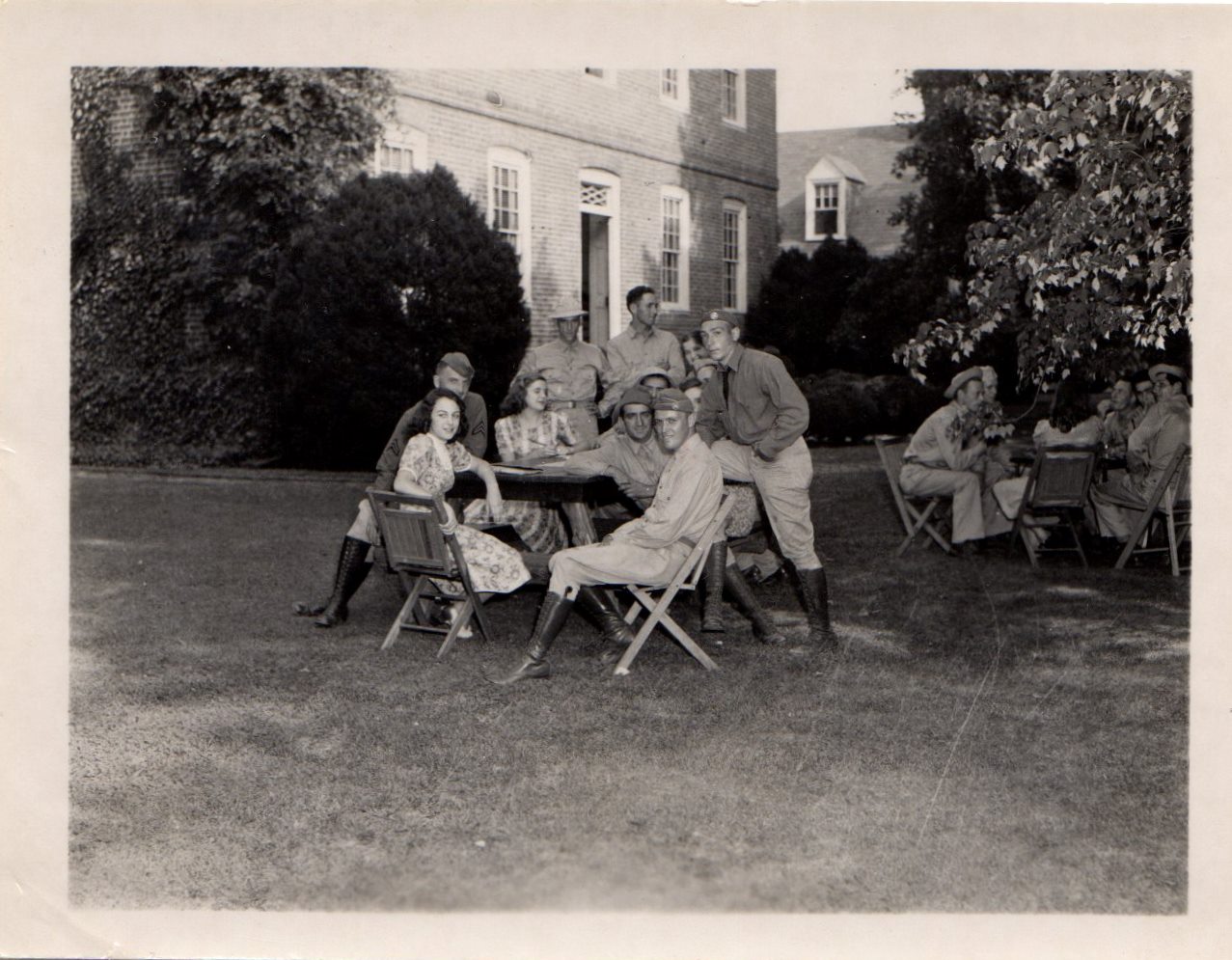
    Soldiers being hosted on lawn of Kenmore

    Like many Americans, the women of the Kenmore Association sought during the war years to demonstrate pride in their nation and support for its troops. Annie Fleming Smith, then national secretary of the Association, showed her appreciation for the country’s military by opening Kenmore’s doors to thousands of service members stationed in the Fredericksburg area. The Association took them “through the mansion and served them iced tea and gingerbread.” It hosted lawn parties and entertained soldiers early in the day and late at night. Hosts told everyone in uniform “who passed over the Kenmore steps…about George Washington, and other great men, passing over these very same steps.”
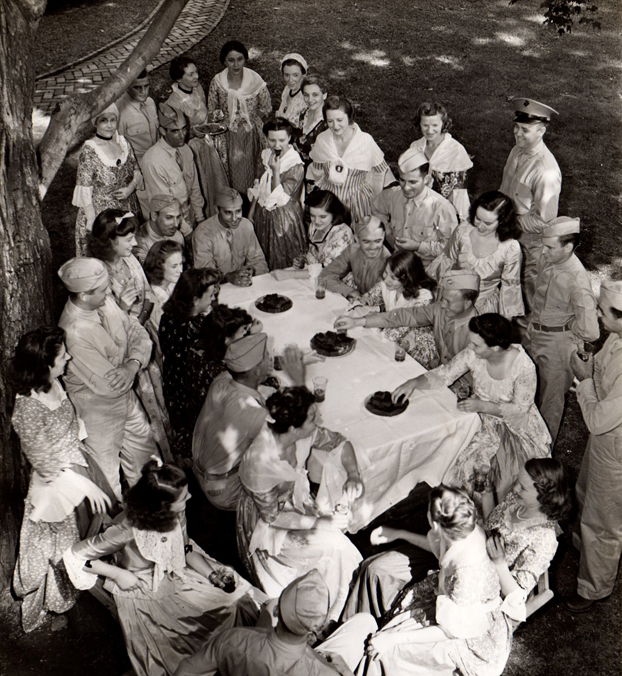
    Kenmore hosted soldiers with gingerbread and iced tea.

    Smith regarded the Association’s commitment to “making our American boys feel at home in a home of the Washingtons” as Kenmore’s way of contributing “to the defense of the nation.” She also hoped that visits to Kenmore would crystalize in servicemen a commitment to the U.S. ideals of freedom and democracy.

    The commitment to helping the recently transplanted soldiers feel comfortable in town was admirable; however, there are no records of Smith or Kenmore welcoming Black servicemen, stationed along with their white counterparts at what was then A.P. Hill Military Reservation and other nearby military installations.  Smith and other members of the Kenmore Association, along with whites across Fredericksburg, the South, and the country, apparently did not see any conflict between simultaneous support for liberty, as embedded in the founding documents of the United States, and a racist social system.

    The 366th Infantry Regiment

    So how, in segregated Fredericksburg, did Black service members spend their leisure time? If the city’s white-led institutions, including Kenmore, did not welcome African Americans serving their country, Black Fredericksburgers proved happy to host the men fighting the Double V campaign—victory over fascism abroad and victory over racism and discrimination at home. Indeed, at least two Black fraternal organizations in Fredericksburg provided recreational opportunities to African American soldiers during World War II.

    The 366th Infantry Regiment choir at Camp Atterbury, Indiana, on December 17, 1943. Source: Indiana State Library

    The city’s Black Odd Fellows lodge (located at 301 Charles Street), “under auspices of the Citizens Committee of Local Negros,” hosted at least one dance for African American soldiers from A.P. Hill. This dance, held in February 1942, came shortly after white officials implicated Black servicemen stationed at A.P. Hill and Fort Belvoir in a “near-riot” that began after a Fredericksburg police officer attempted to arrest a Black soldier for public intoxication. 

    Following the altercation between the soldiers and the city’s police, during which white officers beat a Black soldier and threw a tear gas grenade, the Free Lance-Star published a letter to the editor from local NAACP leaders calling for the establishment of a Black USO—since the white USO barred Black soldiers from entering— and more leisure opportunities for African American soldiers in the city.

    Other efforts to make the city more welcoming to Black service members followed. In May of that year, a group of Black Fredericksburgers requested that “the city furnish recreational facilities, showers, soap and towels for colored troops stationed at Camp A. P. Hill.” According to the letter containing this request submitted to the City Council, “there were slightly over a hundred colored soldiers now stationed at Camp A. P. Hill and that there were no recreational facilities at Camp A. P. Hill or in the City of Fredericksburg for these colored troops.”

    Eventually, the efforts of Black soldiers’ advocates succeeded: The Black USO sought by the NAACP leaders opened in June 1943 at Rappahannock Lodge 229 of the Independent Benevolent Protective Order Elks of the World (otherwise known as the African American Elks). Lodge 229 was at 1103 Winchester Street, just a block from Historic Kenmore. Across the world, USOs gave “troops somewhere to play cards, dance and socialize while taking a break from their duties.” Each USO facility was supposed to be “open to all men in uniform,” regardless of race, but in practice, centers were often segregated. Fredericksburg’s white USO opened in January 1942 at 408 Canal Street, which is today the Dorothy Hart Community Center.
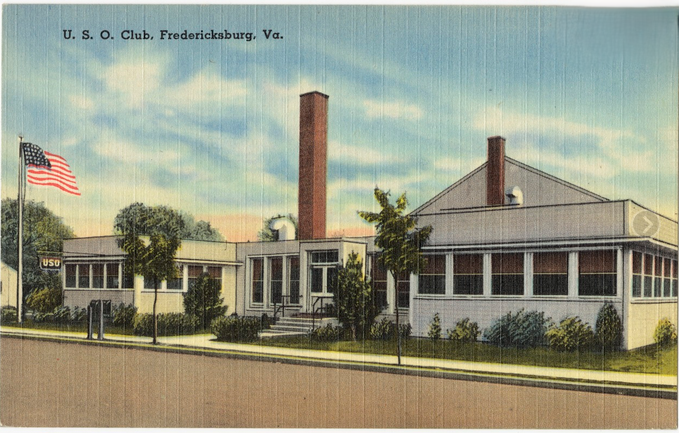
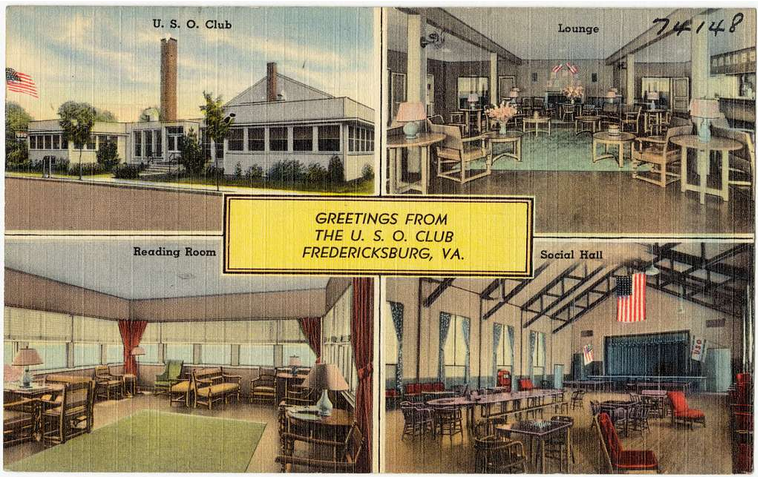
    Although Fredericksburg’s Black USO closed the following April, reportedly because of low attendance, another Black USO was completed in Caroline County in December of 1943 and was still operating in 1945.

    However, the presence of these recreational facilities did not resolve tensions between white area residents and visiting Black service members. In the fall of 1943, while the Fredericksburg USO was open, A.P. Hill Military Reservation was home to the 366th Infantry Regiment, a Black unit. When members of the 366th chaffed against racism—for instance, by evicting the driver of a bus who instructed the soldiers to move to the back of the vehicle and finishing the drive back to A.P. Hill from Fredericksburg themselves—local whites reacted with fear. By November, the city’s white residents worried that the soldiers planned to “‘clean up the town on the first’” of December in objection to Jim Crow laws and segregation. Whites expressed relief when the unit shipped out before that date. 

    During World War II, the Kenmore Association opened its doors to white soldiers to share the stories of those Americans “who planned the principles, which is the beacon light of the world today.” Eight decades ago, the world’s democracies fought for those principles and defeated the forces of totalitarianism abroad, but racism endured at home.  While progress has been made in the United States regarding the assertion “that all men are created equal,” the struggle against inequality continues.


    Adam Nubbe

    Manager of School & Youth Programs


    Bibliography

    Fredericksburg City Council. (1942, January). Fredericksburg City Council Minutes Vol 28. Fredericksburg, Virginia, USA.

    Hall, D. (1943, November 27). Fearful Whites Relieved as 366th Leaves Virginia. Baltimore Afro-American, p. 21.

    Johnson, S. (2022, February 7). How the USO Served a Racially Segregated Military Throughout World War II. Retrieved from USO: https://www.uso.org/stories/3001-how-the-uso-served-a-racially-segregated-military-throughout-world-war-ii

    Salter, K. (2014). The Story of Black Military Officers, 1861-1948. London: Routledge.

    Smith, A. F. (1941, December 26). Letter to Mrs. Barnum. Fredericksburg, Virginia, USA.

    Smith, A. F. (1941, November 4). Letter to Mrs. Mitchell. Fredericksburg, Virginia, USA.

    Smith, A. F. (1941, November 21). Letter to Mrs. Stone. Fredericksburg, Virginia, United States of America.

    The Baltimore Afro-American. (1942, March 31). Soldier, On Furlough, Finds Vs. Prejudice Ignores War. The Baltimore Afro-American, p. 9.

    The Free Lance-Star. (1942, February 9). Dance Friday Night for Negro Soldiers. The Free Lance-Star, p. 6.

    The Free Lance-Star. (1942, January 31). Soldiers Causing Disorder Jailed. The Free Lance-Star, p. 1.

    The Free Lance-Star. (1942, January 29). Tear Gas Quells Near-Riot Here. The Free Lance-Star, p. 1.

    The Free Lance-Star. (1943, December 2). Colored USO in Caroline Completed. Fredericksburg, Virginia, USA.

    The Free Lance-Star. (1943, June 3). New Colored USO is Dedicated Here. Fredericksburg, Virginia, USA.

    The Free Lance-Star. (1944, November 14). USO Club in City To Be Withdrawn. The Free Lance-Star. Fredericksburg, Virginia, USA.

    The Free Lance-Star. (1944, April 29). USO Cuts $7,200 Off Budget Here. Fredericksburg, Virginia, USA.

    Woodfork Genealogy. (2025, January 27). USO Highway Number 2 Club. Retrieved from Woodfork Genealogy: https://woodforkgenealogy.com/caroline-county-virginia/uso-highway-number-2-club/

    Wyatt, P. E. (1942, February 6). Negro USO is Seen as Need for City. The Free Lance-Star, p. 4.
  • The ‘Monuments Men’ of World War II Come to Kenmore

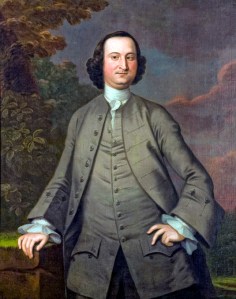
    Fielding Lewis by John Wollaston, ca. 1765. This portrait has been in the Kenmore Collection for many decades.  It was recently returned to the Drawing Room, where it would have hung when the Lewis family lived in the house 200 years ago. Watch a video of the hanging process here.

    Editor’s Note: This Memorial Day, we again remember ‘The Monuments Men’ and their invaluable work to locate and save European art looted by the Nazis during World War II as well as their continued efforts to conserve and preserve art after the war, including art at Historic Kenmore.  This post originally appeared on Lives & Legacies on May 20, 2015.

    Recently, while flipping through old files of the Kenmore Association dating back to the 1920s and looking for anything related to our portrait of Fielding Lewis by John Wollaston (ca. 1765), I spotted a familiar name: George Stout.  It took me only a moment to realize why the name was familiar.  Those of you who read Robert Edsel’s book The Monuments Men: Allied Heroes, Nazi Thieves and the Greatest Treasure Hunt in History or saw the movie The Monuments Men starring George Clooney, Matt Damon, John Goodman, and Bill Murray may also recognize the name.

    During World War II, George Stout was a member of the U.S. Army’s  Monuments, Fine Arts, and Archives unit, nicknamed the “Monuments Men.”  These soldiers volunteered to leave their jobs as curators, historians and conservators to travel the frontlines in Europe, documenting, cataloging and in some cases saving priceless cultural artifacts in harm’s way.  Along with serving as a Monuments Man, Stout is widely considered the father of modern methods in art conservation in the museum world.  He’s kind of a rock star to all of us who work in museums, as are all of the Monuments Men.  It is not often that curators get to be the hero, but those men were.

    Lieutenant George Stout, U.S. First Army and U.S. Twelfth Army Group. Age: 47. Born: Winterset, Iowa. A towering figure in the then obscure field of art conservation, Stout was one of the first people in America to understand the Nazi threat to the cultural patrimony of Europe and pushed the museum community and the army toward establishing a professional art conservation corps. As a field officer, he was the go-to expert for all the other Monuments Men in northern Europe and their indispensable role model and friend. Dapper and well-mannered, with a fastidiousness and thoroughness that shone in the field, Stout, a veteran of World War I, left behind a wife, Margie, and a young son. His oldest son served in the U.S. Navy. Walter Hanncock Collection, courtesy of the Monuments Men Foundation
    Lieutenant George Stout, U.S. First Army and U.S. Twelfth Army Group. Age: 47. Born: Winterset, Iowa. A towering figure in the then obscure field of art conservation, Stout was one of the first people in America to understand the Nazi threat to the cultural patrimony of Europe and pushed the museum community and the army toward establishing a professional art conservation corps. As a field officer, he was the go-to expert for all the other Monuments Men in northern Europe and their indispensable role model and friend. Dapper and well-mannered, with a fastidiousness and thoroughness that shone in the field, Stout, a veteran of World War I, left behind a wife, Margie, and a young son. His oldest son served in the U.S. Navy.  From the Walter Hancock Collection courtesy of the Monuments Men Foundation.

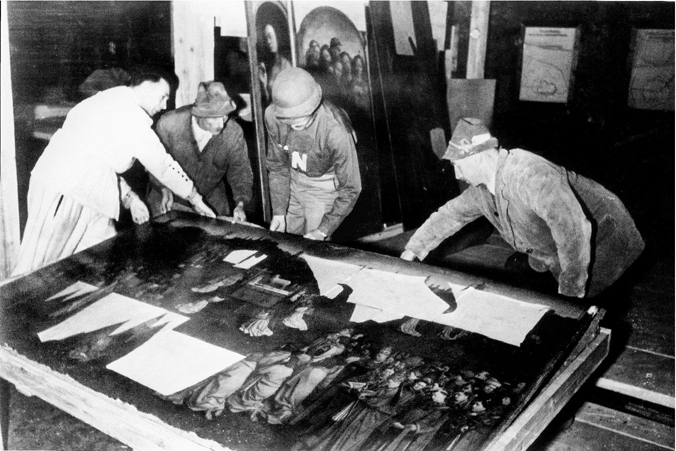
    ALTAUSSEE, AUSTRIA – JULY 10, 1945: Removal of priceless works of art from the salt mine at Alt Aussee posed problems for Monuments Man George Stout unlike any ever contemplated. Stout constructed a pulley to lift Michelangelo’s Bruges Madonna onto the salt cart to begin its long trip home to Belgium. Visible on the far left is Monuments Man Steve Kovalyak, an expert in packing art, who was a key assistant to Stout. National Gallery of Art photo courtesy of the Monuments Men Foundation.

    After the war, many of the Monuments Men returned to their museum jobs where they continued to work together, revolutionizing the care and conservation of artwork and historic objects.  They established standards for conservation practices, ethics for conservators, and tested new scientific methods for preserving all varieties of artwork.  Perhaps their greatest legacy was that many of them established schools for training conservators, ensuring the future of the field.  For the first time, American museums had a cadre of experts to turn to when masterpieces in their collections needed help.

    Kenmore’s old files perfectly reveal the post-war story of George Stout and the Monuments Men. It’s a story that also involves numerous other luminaries of the art conservation world such as John Walker, Harold Cross, Sheldon and Caroline Keck, and Russell Quandt.

    It all started in 1949, when John Walker, then Chief Curator of the National Gallery of Art, visited Kenmore.  His visit moved him to write a letter to Kenmore’s own Louise DuPont Crowninshield, praising the Kenmore Association for its work in saving the property and for its fine collection, which included the Wollaston portrait of Fielding Lewis.  Mr. Walker felt very strongly that the Wollaston portrait was in need of immediate conservation treatment.  He recommended a young man named Harold Cross, the new restorer at the Corcoran Gallery of Art in Washington, D.C., for the project.

    John Walker was not a Monuments Man but he was heavily involved in the complicated and tedious post-war effort to identify artwork looted by the Nazis.  This brought him in close contact with many of the Monuments Men over several decades.  He suggested the Kenmore Association contact George Stout, then at the Worcester Museum of Art, to get a personal testimonial as to Harold Cross’s abilities. Cross apprenticed under George Stout, receiving training in Stout’s scientific methodology.  Mrs. Crowninshield contacted Stout, who highly recommended his former student. Cross performed the first ever restoration of the ca. 1765 Wollaston portrait.  The post-war Monuments Men network had made its first mark at Kenmore by saving our only image of Fielding Lewis.

    keck_sheldon
    Lieutenant Sheldon Keck (kneeling), United States Army. Read Keck’s biography here. Courtesy of the Monuments Men Foundation.

    The next involvement of the Monuments Men with the Wollaston portrait came in 1952, when the ladies of the Kenmore Association became concerned that the portrait was warping at an alarming rate.  Through personal connections, they learned that Sheldon and Caroline Keck would be visiting Colonial Williamsburg in January.  Sheldon Keck was a former Monuments Man and the chief restorer at the Brooklyn Museum of Art; his wife Caroline was also a restoration specialist at the same museum.  Together, they trained more than 150 conservators before they retired.

    Their presence in Virginia was fortuitous, and the decision was made to pack up the Wollaston and have Executive Director Mary Mason take it directly to Williamsburg.  Mr. and Mrs. Keck agreed to take a look at the painting, and apparently performed their treatment of it in their hotel room, “re-keying” the wooden stretcher so as to tighten the canvas and reduce the warp.  The Kecks did not charge for their emergency services “in the field”, rather they indicated that it was their pleasure to assist in the preservation of such an important work.

    Finally, in 1957, the Wollaston portrait’s care was passed on to the capable hands of another heir to the Monuments Men legacy.  When new preservation issues surfaced, the Kecks recommended a former student of theirs, Russell Quandt, examine the painting.  Over the next decade, Mr. Quandt would be the primary conservator of the portrait, performing treatments on it both on-site at Kenmore, at his lab at the Corcoran, and eventually at his own private-practice studio.

    All told, the Monuments Men were either directly responsible, or had trained those responsible, for the preservation of Kenmore’s Wollaston portrait for almost 20 years.  It can be argued that they continue in that role today, as we hire conservators whose professional training has been a direct result of the methods, systems and institutions established by them.  Many of today’s conservators are still inspired by the wartime service of the Monuments Men.  As Memorial Day approaches, the museum world in both Europe and in this country owes them an immense debt of gratitude.

    Visit http://www.monumentsmenfoundation.org/ to learn more about George Stout and Sheldon Keck, their comrades, and their wartime work.

    Meghan Budinger
    Aldrich Director of Curatorial Operations

  • Kenmore’s Famed Gingerbread

    Historic Kenmore was associated with gingerbread for decades.  Many people’s first memories of Kenmore involve the square of gingerbread and a cup of tea that used to be served at the end of every tour.    The dessert welcomed visitors to the world of colonial Fredericksburg, it comforted soldiers on their way to war in Europe or the Pacific, and, most important of all, it helped save the historic house itself.

    The ladies of the Kenmore Association, which owned and operated the historic home in the 20th century, took on a great challenge when they accepted stewardship of Kenmore.  Raising the money to purchase the house was not the only obstacle they faced.  They also needed funds to restore and staff the house. Unfortunately, the ladies drive to save Kenmore coincided with the Great Depression and the Second World War.  Led by Annie Fleming Smith or “Miss Annie,” the ladies triumphed, kept Kenmore running, and even used the grounds to assist Fredericksburg in the war effort.  They did all this with their indomitable drive and patriotism and with a little help from gingerbread.

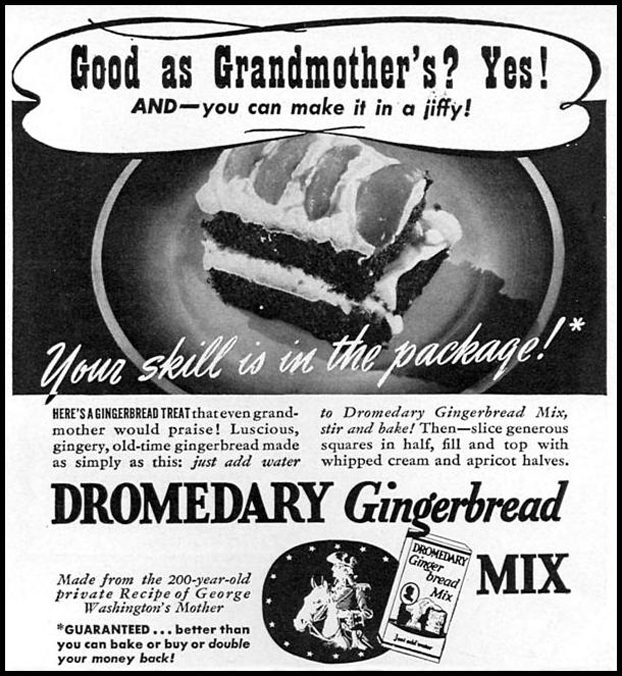
    The beneficial partnership between gingerbread and Kenmore began in the early 1930s when the Dromedary Cake Mix Company launched a nationwide search for gingerbread recipes new and old.  In the search, Mary Washington’s personal recipe was found in a cookbook owned by the Washington-Lewis Chapter of the Daughters of the American Revolution. It was tried and well-liked.  The firm approached the chapter about producing the recipe as one of their mixes.  Because the Washington-Lewis Chapter worked closely with the Kenmore Association in saving, restoring, and caring for Kenmore, Miss Annie and the ladies, being astute business women, brokered a deal with the company to benefit the historic home.

    Dromedary Ad
    An 1940s-era advertisement for Dromedary gingerbread mix “made from the 200-year-old Recipe of George Washington’s Mother.”

    The arrangement allowed Dromedary to produce gingerbread mixes based on Mary Washington’s recipe.  In exchange, the Kenmore Association got all the gingerbread they could serve to visitors.  The company also donated mixes to be sold by the Association and various DAR chapters for 25 cents a box.  The Association got half of the money realized from these sales minus the shipping costs.  This agreement, in the end, earned the Kenmore Association over $38,000 – a hefty sum in the mid-20th century – and provided countless visitors with a yummy Washington family treat.

    In 1941, the United States entered World War II.  Fredericksburg became a hub of activity with thousands of soldiers stationed at the A.P. Hill Military Reservation in Bowling Green visiting town to get a break from military life.

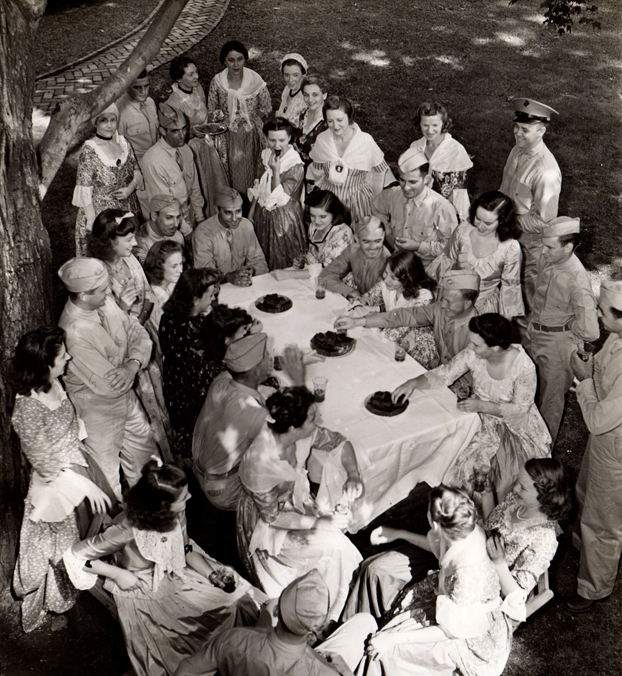
    The Association’s ladies knew that Kenmore, with its historical and patriotic legacy, had a unique opportunity to welcome soldiers who would be fighting for the country and ideals that the Lewis and Washington families helped create. So, they threw open the gates, set out the picnic tables, and recruited local women to put on their colonial best and greet the men of the United States military. At the heart of this hospitality was iced tea and Mary Washington’s gingerbread.

    Gingerbread (1)
    Servicemen enjoy gingerbread and tea on the grounds at Kenmore.

    During the war years, Kenmore hosted over 60,000 soldiers making sure each one was fed and knew his service was greatly cherished.  The ladies of the Washington-Lewis DAR even took time to write each serviceman’s mother, wife, or sweetheart about their loved ones.

    Gingerbread (2)
    C.R. Murphy, Sr. of Coolidge, Georgia wrote The Free Lance Star to express his gratitude for Annie Fleming Smith’s (identified in the letter as Mrs. H.H. Smith)  hospitality towards him and his son during a visit to Fredericksburg from a nearby military post where the son was stationed.

    The humble gingerbread recipe from Mary Washington’s cookbook gave Kenmore a perfect tangible link to its colonial past and bright future.  The gingerbread that resulted assisted the ladies in their community outreach, their historic preservation, and their national patriotic duty.   It was a sign of nostalgia, of hospitality, and most of all appreciation.

    Today, when you tour Kenmore, our guides will happily take you through the reconstructed colonial kitchen that functioned as the Kenmore Association’s tea room.  Regrettably, gingerbread and tea are no longer served to visitors because we do not have a fully-functioning kitchen.  Gingerbread mixes and teas specifically created for The George Washington Foundation are available for purchase by anyone who might wish to relive their first taste of Kenmore’s famed gingerbread.

    Heather Baldus
    Collections Manager