Lives and Legacies

Category: American Revolution

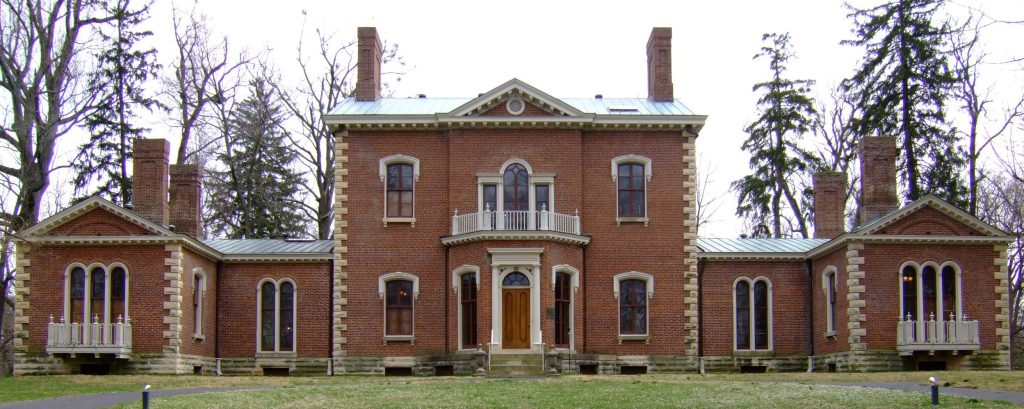
  • Kenmore Goes to Sea: Ship Naming in the US Navy

    On July 22, 1942, Annie Fleming Smith wrote a letter. Smith was a prolific letter writer—her innumerable missives had helped raise the funds that saved Kenmore two decades earlier—so it is not surprising that she put pen to paper on that summer day. What is surprising is that the intended recipient of that letter was not a prospective donor, a fellow regent of the Kenmore Association, or a friend. Instead, she addressed her epistle to Frank Knox, the Secretary of the Navy. Smith wanted “confirmation of the fact of the naming of the U.S.S. KENMORE” after the home and “any other information you can release” about the ship.[1]

    Letter that Annie Fleming Smith sent to Secretary of the Navy Frank Knox asking for confirmation that the first USS Kenmore had been named after the historic home. Smith, Annie Fleming to Frank Knox, July 22, 1942. The George Washington Foundation.

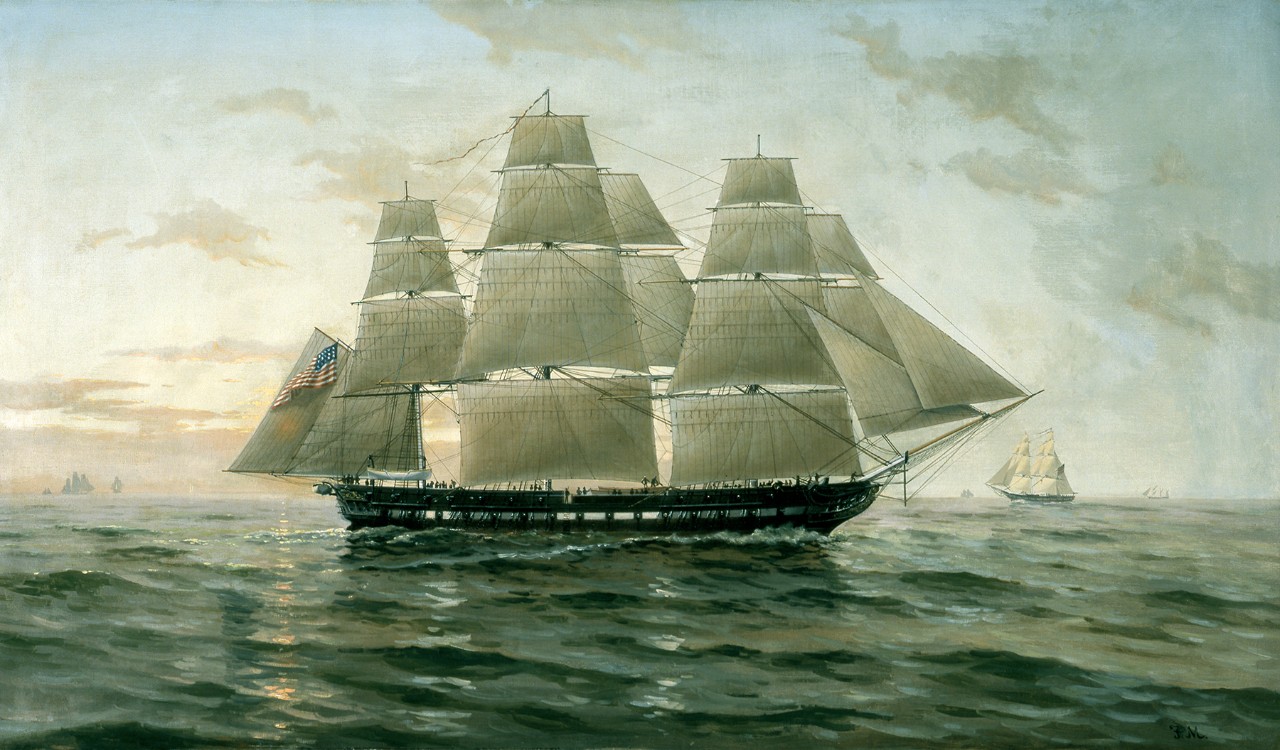
    Although there is no record that Knox responded to Smith (there was, after all, a war on), the USS Kenmore was, in fact, named for the historic estate. The Naval History and Heritage Command ship-naming file on Kenmore I (AP-62) includes an April 13, 1942, memo to the Secretary of the Navy from the chief of the Bureau of Navigation and prepared by Louis Emil Denfeld, then assistant chief of the Bureau of Navigation, recommending that the President Madison be renamed Kenmore, in honor of the “[h]ome of Betty Washington at Fredericksburg, Virginia, sister of George Washington who married Col Fielding Lewis.”[2] The recommendation was approved on April 16 of that year, and the newly renamed vessel was “commissioned at Baltimore, Md., on 5 August 1942, Cmdr. Myron T. Richardson in command.”[3]
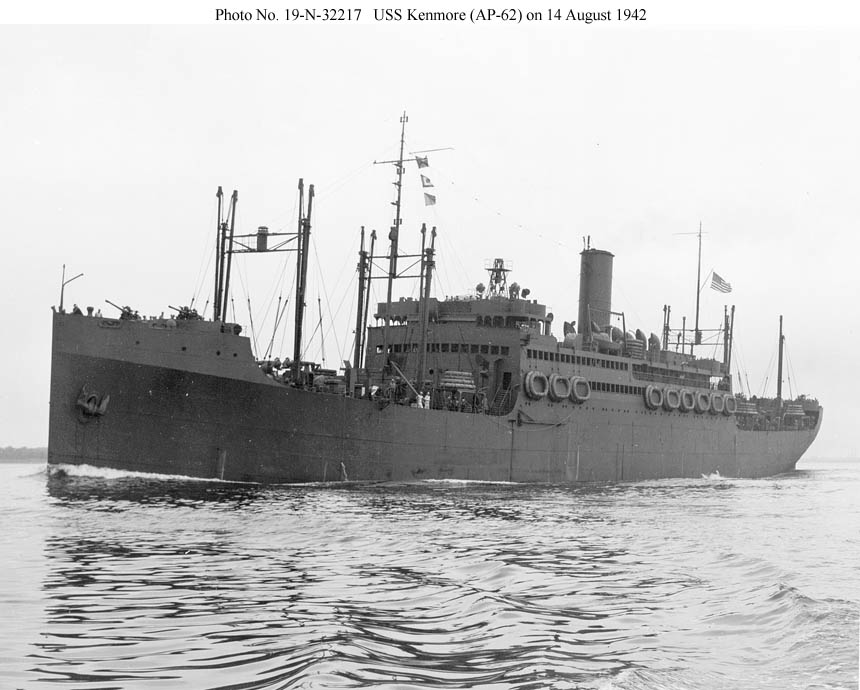
    USS Kenmore (AP-62) on trials in the Chesapeake Bay on August 14, 1942. Shipscribe

    Smith had learned of the ship during a mid-1942 visit to the estate from Lt. Commander William VanC. Brandt (USNR) of the Kenmore, who later wrote to “Miss Annie” to thank her for her hospitality.[4] “All the Officers of the Kenmore,” Brandt told Smith, “were most interested in learning the history and record of the beautiful estate for which our ship is named.”[5] Brandt planned to have framed and displayed in the ship’s wardroom photographs of the property given to him by Smith; later, the vessel’s captain requested a picture of the house for his room.[6] For her part, Smith was “thrilled” to meet Brandt and “to know about your ship,” although she was skeptical enough of the origin of the transport’s new name to write Knox.[7]
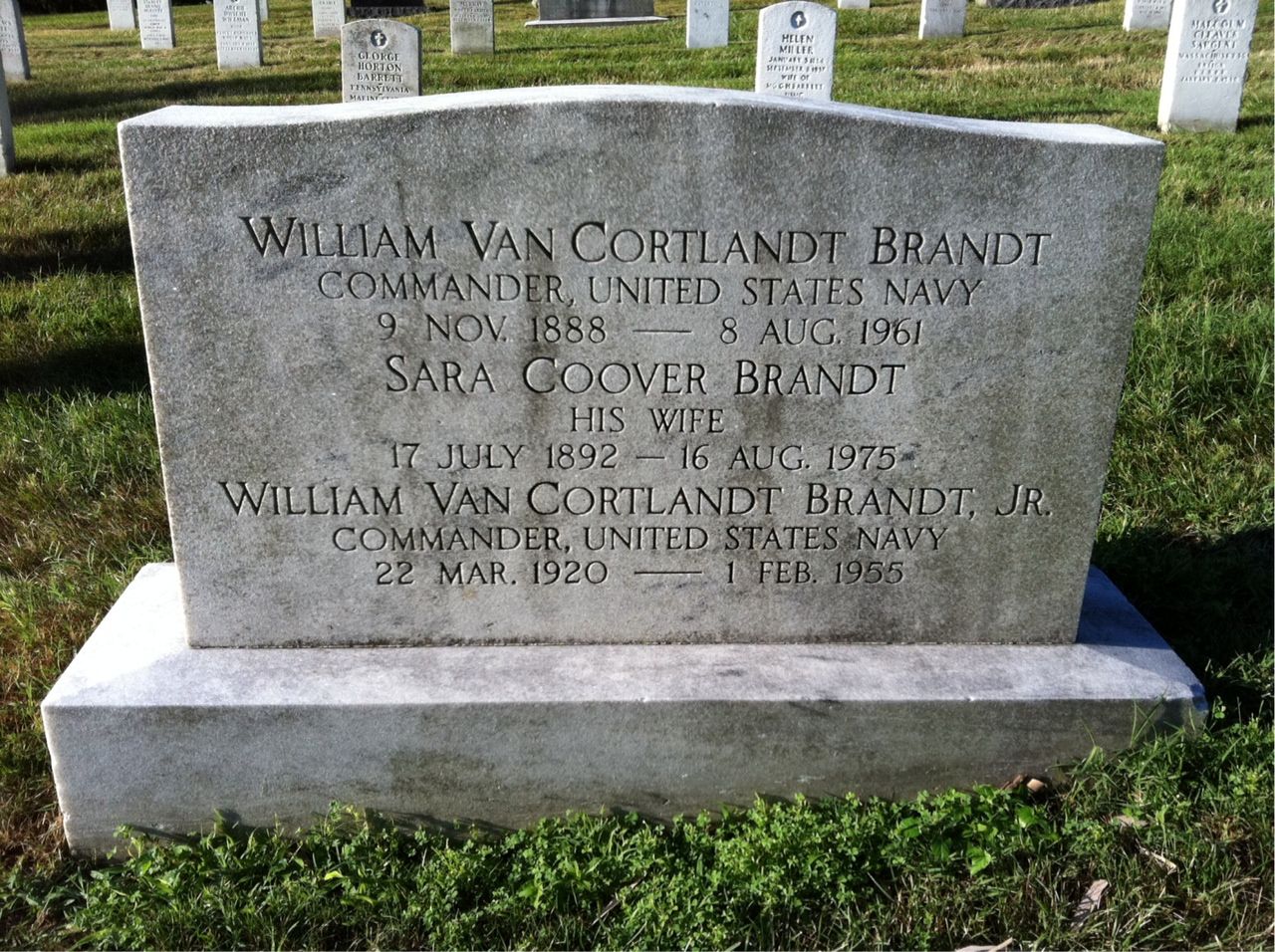
    The Arlington National Cemetery headstone of William VanC. Brandt, from whom Annie Fleming Smith learned that a Navy ship had been named after the historic home she had helped save from development in the 1920s.

    The Kenmore operated primarily in the Pacific until September 1943; she was then converted into a hospital ship and renamed Refuge.[8] The Navy must have liked the name Kenmore, as it was bestowed in October 1943 on another transport, originally called the James H. McClintock.[9] The Kenmore II also served in the Pacific Theater and, after “hostilities ended on 15 August 1945, [began] returning veterans to the U.S.”[10] She was decommissioned on February 1, 1946.[11]

    The Kenmores were not the only vessels named for properties associated with George Washington and his family. The Wakefield (AP-21) borrowed its name from the Westmoreland County birthplace of the first president, today owned by the National Park Service.[12] There have been five Mount Vernons; the first was built in 1859 and chartered by the Navy two years later, before they bought it later that year.[13] The most recent vessel named after Washington’s residence and plantation was a dock landing ship commissioned in 1972 and decommissioned in 2003.[14] The possible birthplace of Mary Ball, George Washington’s mother, lent its name to the Epping Forest, a dock landing ship launched in 1943.[15]

    The monikers of other ships are connected more tenuously to places tied to George Washington and his family. For example, a 1943 submarine chaser was rechristened the Abingdon in 1956.[16] The vessel’s new name came from the town of Abingdon, in Washington County, Virginia (named, yes, for George Washington).[17] According to the county’s official history, “myths claim that [the town] was named for Martha Washington’s ancestral home” in England.[18] While this may be a false etymology, were those who named the ship drawing on the tale when they chose to call the vessel Abingdon? Additionally, the many Arlingtons that have served the Navy over the years have each been named after Arlington County, which draws its appellation from Arlington House, built for George Washington Parke Custis, the step-grandson of his celebrated namesake.[19]

    Arlington Mansion was built by George Washington Parke Custis. Union soldiers posing on the lawn, June 28, 1864.

    The Navy’s infatuation with the commander in chief of the Continental Army has, of course, also been expressed by naming ships directly after Washington and his family, not just their properties. While a complete inventory of such vessels is beyond the scope of this post, it is worth noting that four ships have been named the George Washington, including CVN-73, an active nuclear-powered aircraft carrier, while several others have sailed under just his surname.[20] Martha, George’s wife and the nation’s first first lady, has inspired the names of at least two Navy ships: the Lady Washington and the Martha Washington.[21] Civilian shipbuilders have also found inspiration in the Washington family: the SS Mary Ball was a liberty ship active during World War II.[22]
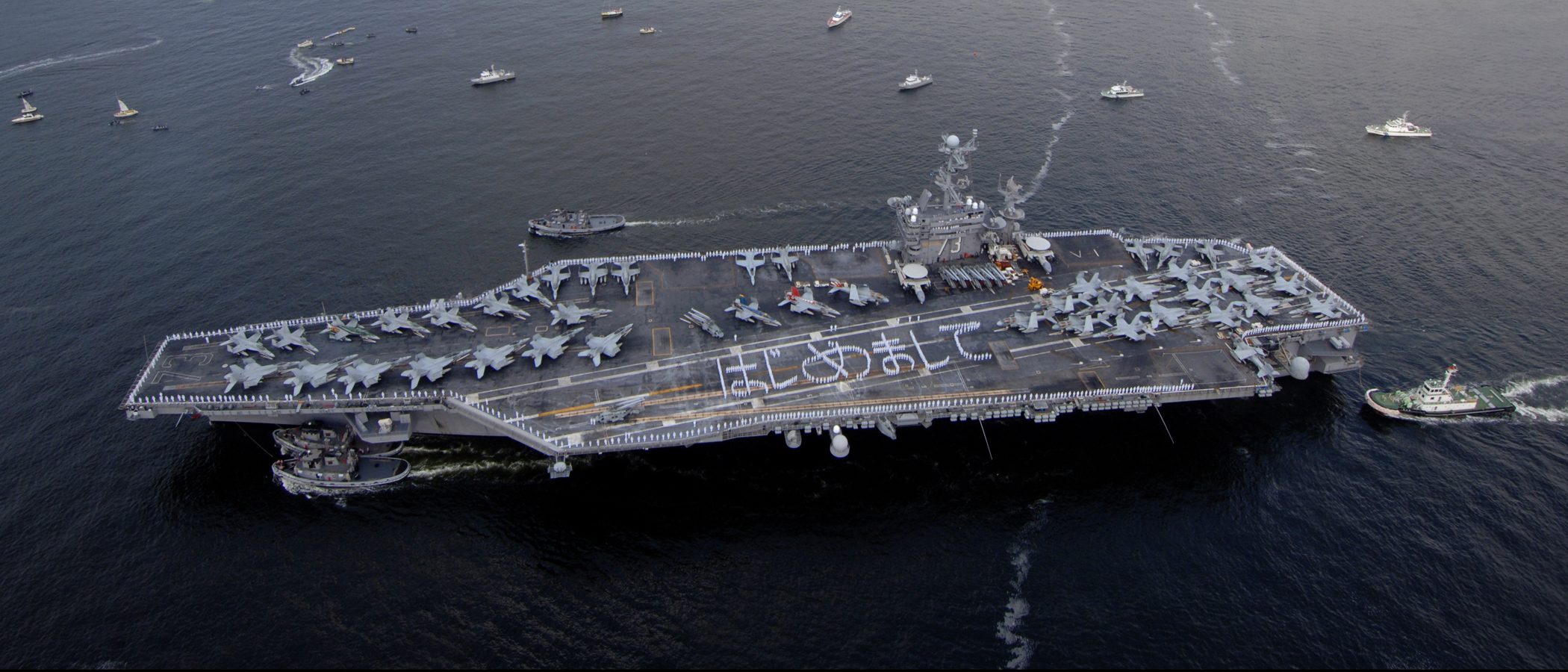
    Who was responsible for naming these ships? As hinted at above, while final authority for ship names was (and still is) the responsibility of the Secretary of the Navy, during World War II, it was the Bureau of Navigation (renamed the Bureau of Personnel on May 21, 1942) that researched and recommend ship names based on the traditional naming conventions associated with each class of vessels.[23]

    Typically, it was dock landing ships, or LSDs, that were named for “cities and places of historical interest of same name, or places of historical interest only.” [24] Epping Forest, Gunston Hall I (named for George Mason’s home), Ashland (for the boyhood home of Henry Clay), Carter Hall (after the Virginia estate), Oak Hill (for the home of President James Monroe), and Shadwell (for the birthplace of Thomas Jefferson) are all examples of LSDs whose names aligned with this convention.[25]

    But the Kenmores, the Mount Vernon IV, and the Wakefield were not LSDs; they were transports, classified AP, and anyone seeking consistency in the Navy’s naming of troop transports during World War II is bound to be disappointed. Some vessels in the AP class were named after celestial bodies, others after Revolutionary War heroes, and others, as we have seen, after historic estates.

    This lack of consistency is not surprising. After all, when Benjamin Stoddert named the Navy’s sixth ship, a frigate, he chose to call it the Chesapeake, despite President George Washington’s agreement with the recommendation that frigates be named after “principles or symbols found in the US Constitution.” Therefore, “the very first naming decision by the very first Secretary of the Navy resulted in the ‘corruption’ of the established naming convention.”[26] This tradition of flexibility regarding ship names has endured, and ship names continue to excite interest (and occasionally strong feelings) from many parties, including those who propose denominations for new vessels. If you are such a person, here’s an idea: how about another Kenmore, or maybe a Ferry Farm?  


    Adam Nubbe

    Manager of School & Youth Programs


    [1] Smith, Annie Fleming to Frank Knox, July 22, 1942. The George Washington Foundation.

    [2] Naval History and Heritage Command, Kenmore I, ship-naming file, April 13, 1942.

    [3] Ibid; Cressman, R. J. (2020, March 31). Kenmore I (AP-62). https://www.history.navy.mil/research/histories/ship-histories/danfs/k/kenmore.html

    [4] Brandt, William VanC. to Annie Fleming Smith, June 30, 1942. The George Washington Foundation.

    [5] Ibid.

    [6] Ibid; Smith, Annie Fleming to William VanC. Brandt, July 10, 1942. The George Washington Foundation.

    [7] Smith, Annie Fleming to William VanC. Brandt, July 10, 1942. The George Washington Foundation.

    [8] Naval History and Heritage Command, Kenmore I, ship-naming file, April 13, 1942.

    [9] Cressman, R. J. (2020, March 31). Kenmore II (AP-162). https://www.history.navy.mil/research/histories/ship-histories/danfs/k/kenmore-ii–ap-162-.html

    [10] Ibid.

    [11] Ibid.

    [12] Cressman, R. J. (2022, April 1). Wakefield (AP-21). https://www.history.navy.mil/research/histories/ship-histories/danfs/w/wakefield.html

    [13] Naval History and Heritage Command. (2015, August 11). Mount Vernon I (Gbt). https://www.history.navy.mil/research/histories/ship-histories/danfs/m/mount-vernon-i.html

    [14] Pike, J. (n.d.). LSD 39 Mount Vernon. https://www.globalsecurity.org/military/agency/navy/lsd-39.htm

    [15] Naval History and Heritage Command. (2015, July 8). Epping Forest. https://www.history.navy.mil/research/histories/ship-histories/danfs/e/epping-forest.html

    [16] Mann, R. A., & Cressman, R. J. (2023, November 27). Abingdon (PC-1237). https://www.history.navy.mil/research/histories/ship-histories/danfs/a/abingdon.html

    [17] Ibid; Hagy, J. W. (2019, June 10). A Brief History of Washington County, Virginia. Washington County, Virginia. https://www.washcova.com/history/

    [18] Ibid.

    [19] Parsons, L., & Cressman, R. J. (2023, December 13). Arlington I (AP-174). https://www.history.navy.mil/research/histories/ship-histories/danfs/a/arlington-i.html; Arlington, Virginia. (n.d.). History of Arlington. https://www.arlingtonva.us/Government/Topics/Welcome-Kit/History-of-Arlington; National Park Service. (2023, January 12). George Washington Parke Custis. https://www.nps.gov/arho/learn/historyculture/george-custis.htm

    [20] Naval History and Heritage Command. (2020, May 5). Washington VIII (BB-56). https://www.history.navy.mil/research/histories/ship-histories/danfs/w/washington-viii.html; US Navy. (n.d.). USS George Washington (CVN 73). https://www.airpac.navy.mil/Organization/USS-George-Washington-CVN-73/

    [21]  Naval History and Heritage Command. (2016, February 9). Martha Washington. https://www.history.navy.mil/research/histories/ship-histories/danfs/m/martha-washington.html; Naval History and Heritage Command. (2015, July 28). Lady Washington. https://www.history.navy.mil/research/histories/ship-histories/danfs/l/lady-washington.html

    [22] Jobrack, J. (2020, September 10). True or False? Test Your Knowledge of Mary Washington. https://livesandlegaciesblog.org/2020/09/10/true-or-false-test-your-knowledge-of-mary-washington/.

    [23] Calkins, W. F. (1958, July). Down to the sea in ships’–names. U.S. Naval Institute. https://www.usni.org/magazines/proceedings/1958/july/down-sea-ships-names; Naval History and Heritage Command. (2020, June 29). Denfeld, Louis Emil. Louis Emil Denfeld. https://www.history.navy.mil/research/library/research-guides/modern-biographical-files-ndl/modern-bios-d/denfeld-louis-emil.html

    [24] Department of the Navy, A Report on Policies and Practices of the U.S. Navy for Naming the Vessels of the Navy (2012, November), 63. https://apps.dtic.mil/sti/tr/pdf/ADA569699.pdf

    [25] DANFS – Naval History and Heritage Command. Dictionary of American Naval Fighting Ships — Index. (n.d.). https://www.history.navy.mil/research/histories/ship-histories/danfs.html

    [26] Department of the Navy, A Report on Policies and Practices of the U.S. Navy for Naming the Vessels of the Navy (2012, November), 7. https://apps.dtic.mil/sti/tr/pdf/ADA569699.pdf


  • “To Bigotry, No Sanction…:” Jewish Identity in Early America and Relations to Washington

    Figure 1: Washington’s words to the Newport congregation (George Washington Institute for Religious Freedom)

    The quote, “To Bigotry, No Sanction, To Persecution No Assistance” appears in a 1790 letter written by George Washington to the Hebrew Congregation in Newport, RI (Fig 1). Of all the words Washington committed to paper, these rank amongst the most important, yet he merely adapted them from a letter sent by the Congregation itself.
                By 1790, Jewish communities in the newly formed United States desired to confirm their place in society and the freedoms promised under the founding documents. Washington’s visit to Newport, RI, that year allowed direct access to a government representative for a community seeking reassurance. Their letter moved Washington, yet he was no stranger to the lives and likely concerns of the wider Jewish American community.

    The Jewish Diaspora and Settlement in the Americas

                For those unfamiliar with the Jewish diaspora (Def: the dispersion of a people from their original homeland, in this case, Israel, through forced or voluntary migration), the current Jewish population of the United States largely consists of Ashkenazi Jews whose ancestors settled in central and eastern Europe before immigrating to the States. While some Ashkenazim moved to the Americas during the colonial period, the majority emigrated during the late 1800s and early 1900s. Nonetheless, Jews have lived in the Americas since the 1500s, they simply belonged to another sect of the diaspora.

                Sephardic Jews descend from those who settled on the Iberian Peninsula. Infamously pushed out of the region or forced to convert during the Inquisition, many initially sought refuge in Portugal (briefly), North Africa, the Ottoman Empire, and the Netherlands. As restrictions in some of these areas increased, numerous families forged proof of Christian ancestry to emigrate to Brazil and the Spanish colonies before seeking more religious freedom in British territories.

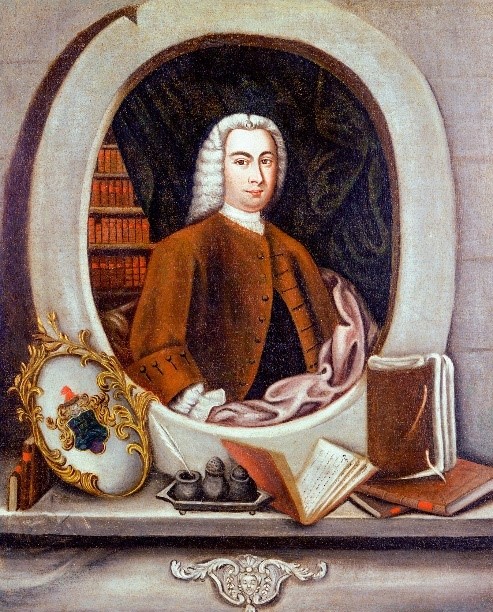
                Here, those who had seemingly converted, but continued to practice as Crypto-Jews, shed their Catholic personas and openly embraced their ethnoreligious identity. Aaron Lopez (1731-1782), called the “Merchant Prince of Newport,” serves as one example (Fig 2). Born Duarte Lopez in Portugal, he moved his wife Anna and daughter Catherine to Newport, RI, in 1752, where they reclaimed their Jewish identities under the names Aaron, Abigail, and Sarah.

    Figure 2: Aaron Lopez (American Jewish Historical Society)

                Several organized Jewish communities ultimately emerged in New York City, Newport, Philadelphia, Charleston, and Savannah. These areas proved ideal due to their nature as trade centers and rules, allowing more religious, political, and business freedom for non-Christians. Still, Jews lived and worked throughout the thirteen colonies as active members of the wider community, and many crossed paths with George Washington and those he knew.

    Colonial Virginia

    Jewish history in Virginian territory began when Joachim Gaunse, a Bohemian metallurgist, joined the Roanoke Colony in 1585. However, he escaped the fate of the Lost Colony by returning to England in 1586. A later instance of Jewish settlement occurred when Elias Legarde/o arrived in the Jamestown area in 1621. After that, small, scattered groups emerged throughout the colony, and the first Jews in the greater Fredericksburg area arrived by 1652. Nonetheless, they could not hold citizenship or public office as these statuses required oaths invoking the Christian faith.

    Jewish presence in Fredericksburg and other cities meant that Washington and his associates lived and worked alongside Jewish community members all their lives. In staying active in the community, many Jewish men, including the majority mentioned in this blog, joined the Masons. Specifically, (H)ezekiel Levy appears in Fredericksburg Lodge No. 4’s records as the sole Jewish member in 1776. As Washington maintained a life membership with his mother lodge from 1752 onwards, the two men potentially knew each other (Fig. 3).

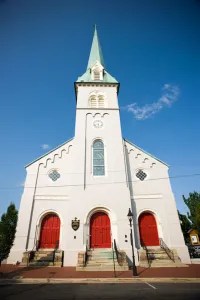
    Figure 3: Masonic Lodge #4 – founded 1753, built 1816

    Other Jewish residents of Fredericksburg and businessmen likely crossed paths with Fielding Lewis. The Gratz brothers of Philadelphia, Barnard, and Michael, built a business network that spread across the colonies (Fig 4). They supplied Virginian troops during the French & Indian War and set up trade in Fredericksburg by 1776, where their associate Joseph Myers handled business affairs. Henry Mitchell, a one-time friend of the Lewises, counted amongst those who did business with the Gratzes and Myers. Like their gentile counterparts, however, Jewish merchants engaged in all aspects of the economy. This included the Atlantic and domestic slave trade, from which they profited, advanced, and purchased individuals.

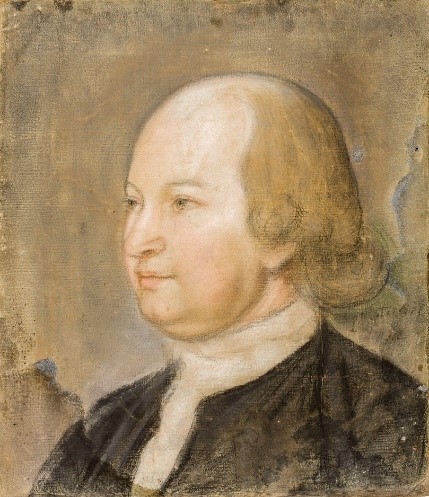
    As Washington’s career took off, he came into closer contact with Jewish Virginians. Jacob Myer and Michael Franks served alongside Washington in the build-up to the French & Indian War, and the latter fought at the Battle of Fort Necessity (July 3, 1754). In 1769, Washington sought the services of Williamsburg’s Dr. John de Sequeyra for his stepdaughter Patsy Custis’ epilepsy (Fig. 5). Sequeyra, a well-respected physician, arrived in Virginia in 1745, wrote about diseases found in the region and served as the first visiting physician at, and later director of, Williamsburg’s Public Hospital. While Thomas Jefferson often receives credit for popularizing tomatoes as edible, Jefferson himself credited Sequeyra.

    Figure 5: Dr. John de Sequeyra (Winterthur Museum)

    American Revolution

                Like the colonists typically pictured during the war, the American Revolution brought turmoil to Jewish communities. The majority supported the cause of independence, with leading merchants voicing dissent from the 1765 imposition of the Stamp Act. Others remained loyal to the crown as they knew where they stood in society. Regardless of which side they chose, Jews aided their cause as soldiers, merchants, and suppliers. Still, the war brought division, death, and poverty to many families.         

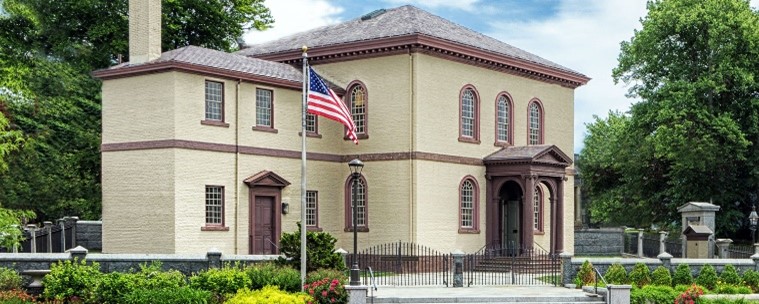
    The Touro-Hays family illustrates one such division. Issac Touro, head of the Newport Congregation, remained loyal to the British while his brother-in-law, merchant-banker Moses Michael Hays, sided with the Patriots (Fig 6). Despite holding opposing views, the two men used their positions to take a stand for the larger Jewish community. In 1775, Hays refused to sign a declaration of loyalty to the patriot cause until the authors removed the phrase “upon the true faith of a Christian.” When the British occupied Newport the following year, Hays, along with most of the congregation, fled while Issac remained behind. Using his connections, Touro ensured that the British left Newport’s synagogue largely untouched. Today, it stands as the oldest surviving synagogue in North America and answers to the name “Touro Synagogue” (Fig. 7). When it became clear that the British would lose, however, Touro moved his family to the Caribbean. The two sides of the family would only reunite after 1783, when Issac died, and his widow Reyna returned from Jamaica with their children to live with her brother Michael.

    Figure 7: Touro Synagogue (Touro Synagogue)

                In all, approximately a third of the Jewish population served during the American Revolution from Bunker Hill to Yorktown. This included the lowest positions up to the rank of Lieutenant-Colonel, which Solomon Bush of Philadelphia held. This period additionally saw public office open to Jews, with numerous individuals serving on committees. The first known Jewish fatality of the war occurred on August 1, 1776, in South Carolina when Francis Salvador fell to the British-allied Cherokee during a skirmish. Two years prior, the colony elected him a delegate to the Provincial Congress; the highest political position held by a Jew at the time.  

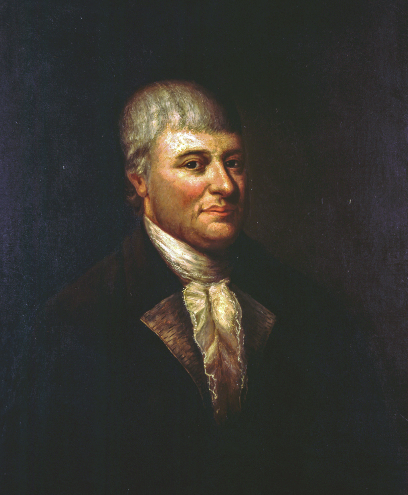
                Many who served as merchants and financiers devoted their assets, like Fielding Lewis, to the cause. As ship owners, many outfitted privateers and helped run blockades. Haym Salomon, a Polish-born Jew from Philadelphia, served as the Continental Congress’ main financier, an agent to the French consul, paymaster for the French forces, and worked closely with Superintendent of Finance, Robert Morris (Fig. 8). Salomon committed his entire fortune to the war effort, and his most significant contribution came when he raised the funds for the Yorktown campaign at the personal request of Washington. Like many individuals, he never received reimbursement from the government and ultimately died penniless.

    Figure 8: Haym Salomon (U.S. National Archives and Records Administration)

    Early America

                In the wake of independence, the United States faced uncharted territory. For minority groups, these uncertainties proved even more concerning. The arguments for revolution and documents written to establish the new nation spoke to religious freedom and social equality, but how far that stretched remained debatable.

                In 1786, Thomas Jefferson took steps to ensure these freedoms by writing the Virginia Statute for Establishing Religious Freedom. Passed into law, the bill affirmed the right to choose one’s faith along with the separation of church and state in Virginia. Several years later, in 1789, Kahal Kadosh Beth Shalome became Virginia’s first established Jewish congregation. Jefferson’s stance on religious freedom would ultimately inspire Commodore Uriah Levy to purchase and preserve Monticello.

                At this time, we return to where we started. In 1790, Washington made a trip to Rhode Island to acknowledge their ratification of the Constitution. On August 18, while Washington met officials and residents of Newport, Moses Seixas of the Jewish congregation read aloud a letter expressing gratitude to the President and government while expressing hope for tolerance and equality (Fig. 9). Its key passage reads:

    “…erected by the Majesty of the People – a Government, which to bigotry gives no sanction, to persecution no assistance – but generously affording to all Liberty of conscience, and immunities of Citizenship: deeming every one, of whatever Nation, tongue, or language equal parts of the great governmental Machine…”

    Figure 9: Letter from the Hebrew Congregation of Newport (Library of Congress)

    In writing the letter, the congregation wished to express their hopes for the future and receive assurance from their head of state that this future existed. On August 21, Washington replied to the letter thanking them for the “cordial welcome [he] experienced…from all…citizens” while reflecting on the difficulties of the past and how the future promised security. Then, using the congregation’s own words, he wrote that:

    “It is now no more that toleration is spoken of as if it were the indulgence of one class of people…for, happily, the Government of the United States…gives to bigotry no sanction, to persecution no assistance…”

     Washington closed his letter by wishing that “every one shall sit in safety under his own vine and fig tree and there shall be none to make him afraid.” The following year saw the ratification of the Bill of Rights, which further solidified religious freedom and equality.

    Despite efforts made during the founding era and successive periods, antisemitism has never gone away. Now, more than ever, we must work to uphold that the wishes, freedom, and security of those who served the United States since its founding.


    Emma Schlauder

    Research Archaeologist


    Bibliography


    Encyclopedia Virginia 2024 Virginia Statute for Establishing Religious Freedom (1786). https://encyclopediavirginia.org/entries/virginia-statute-for-establishing-religious-freedom-1786/#:~:text=As%20part%20of%20the%20revisal,physics%20or%20geometry.%E2%80%9D%20Jefferson%20was. Accessed 10 December 2024.
    Fort Necessity: National Battlefield Park 2015 Roster of Virginia Regiment. https://www.nps.gov/fone/learn/historyculture/roster.htm. Accessed 12 December 2024.
    Goldring/Woldenberg Institute of Southern Jewish Life N.D. Encyclopedia of Southern Jewish Communities – Virginia. https://www.isjl.org/virginia-encyclopedia.html. Accessed 9 December 2024.
    N.D. Encyclopedia of Southern Jewish Communities – Fredericksburg, Virginia. https://www.isjl.org/virginia-fredericksburg-encyclopedia.html#:~:text=Although%20there%20were%20Jews%20living,1850s%20and%20opened%20mercantile%20stores. Accessed 9 December 2024.
    Immigrant Entrepreneurship: German-American Business Biographies, 1720 to the Present 2018 Michael Gratz (1739-1811). https://www.immigrantentrepreneurship.org/entries/michael-gratz/. Accessed 11 December 2024.
    Jewish Virtual Library N.D. Virtual Jewish World: Virginia, United States. https://www.jewishvirtuallibrary.org/virginia-jewish-history. Accessed 9 December 2024.
    John L. Loeb, Jr.: Database of Early American Jewish Portraits N.D. Barnard Gratz. https://loebjewishportraits.com/biography/barnard-gratz/. Accessed 11 December 2024.
    N.D. Michael Gratz. https://loebjewishportraits.com/biography/michael-gratz/. Accessed 11 December 2024.
    N.D. Aaron Lopez. https://loebjewishportraits.com/biography/aaron-lopez/. Accessed 11 December 2024.
    My Jewish Learning N.D. The Revolutionary War and the Jews. https://www.myjewishlearning.com/article/the-revolutionary-war-and-the-jews/. Accessed 12 December 2024.
    National Jewish Outreach Program 2016 Revolutionary Doctors. https://njop.org/revolutionary-doctors/. Accessed 12 December 2024.
    The American Council for Judaism 1999 An Exploration of Four Hundred Years of Jewish History in Virginia. http://www.acjna.org/acjna/articles_detail.aspx?id=367>. Accessed 9 December 2024.
    Touro Synagogue: National Historic Site N.D. Jews in Early America. https://tourosynagogue.org/history/jews-in-early-america/#early-jews-american-history. Accessed 9 December 2024.
    N.D. George Washington Letter, 1790. https://tourosynagogue.org/history/george-washington-letter/. Accessed 10 December 2024.

  • “The Spirit of ’76”: Lafayette’s Visits Fredericksburg on His American Tour

    In 1824, the United States was approaching its national jubilee—50 years of independence. President James Monroe, looking to create a wave of patriotism and celebration, invited the last surviving General of the American Revolutionary War, an American hero and icon, to take a grand tour of the country revitalizing the “spirit of 1776.” That American hero was…a French aristocrat with a painfully long name of Marie-Joseph Paul Yves Roch Gilbert du Motier de La Fayette, the Marquis de Lafayette.

    1824 portrait of Lafayette by Ary Scheffer is currently in the U.S. House of Representatives

    I won’t go into General Lafayette’s exploits, heroism, and leadership during his time in the Continental Army, but the young man was impressive and quickly became an adopted countryman.

    Lafayette being heroic at the Battle of Brandywine, artist Charles Henry Jeens

    However, we will talk about his American tour, particularly his stop in Fredericksburg.

    Lafayette arrived in New York on August 15, 1824, after setting sail on a merchant packet Cadmus from Le Havre with much disapproval from Louis XVIII, the King of France.  But royal condemnation from Louis XVI (Louis XVIII’s elder brother) hadn’t stopped him from setting sail for America in 1777, and it didn’t stop him in 1824.

    Lafayette arrived in Fredericksburg on the evening of November 20th. He was first received at the parade grounds by two companies of Riflemen, the Washington Guards, and the whole Marine Band from Washington. Then they all commenced in a long column toward town, gaining excited townspeople on horses as they continued down Hanover Street toward Caroline.    (Merchant, 1824) (Levasseur, 1829)

    Cover page of the book by Rufus B. Merchant documenting Lafayette visit, 1825

    The procession made it to the Town Hall, which was festooned with evergreens and flowers. There, it was met by a battalion of little boys called Lafayette Cadets, dressed in sharp white uniforms with red trim. After a quick welcome speech from the mayor, the general was led into the Hall, where he was greeted by a group of garlanded young girls singing his praises. 

    Fredericksburg’s Town Hall, 1814-1816

    The general was then whisked off to his accommodations provided by Mr. James Ross to enjoy refreshments and a “handsome” dinner. At nine o’clock, Lafayette, the Mayor, and Colonel Mercer were taken to the Farmer’s Hotel (west corner of Caroline and Hanover Streets) to partake in a grand welcome ball for a few hours until he retired, presumably exhausted from the day’s activities. (Merchant, 1824) (Crookshanks, 2018)

    On Sunday, the general, his son, and Mr. La Vasseur visited the Freemasons at the Fredericksburg Lodge, No. 4. In addition to observing the solemn and profound ceremonies, Lafayette was elected an honorary member in the Old Lodge Room.  (Masonic Lodge No. 4, 2024)

    The assemblage of Masonic Brethren, civil authorities, military officers, Lafayette, and company was escorted to St. George’s Episcopal Church to enjoy an excellent discourse delivered by the Reverend Edward C. McGuire, also a Mason. 

    The general then spent the evening in the company of Washington relatives at Captain Robert Lewis’s, then retired to his lodging early at 9 o’clock.  As Monday morning arrived, Lafayette was paraded to the town hall in a chariotee drawn by four white horses, where he was greeted by a crowd of ladies who occupied his time until he was led away for a sumptuous dinner at Mr. Gray’s Tavern.  After a few hours of delicious food, songs, and speeches, the general was loaded into a carriage for the final time as he continued his journey to Washington. (Dovetail Cultural Resource Group, 2006)  

    Foundation of Mr. Gray’s tavern (Indian Queen Tavern) located on the current Marriott Hotel site.

    Lafayette’s time in Fredericksburg might have been short this trip, but it gave the city a last chance to thank and honor a valued friend who had been a champion for America and helped fight for this country’s freedom.

    The city will again celebrate General Lafayette’s visit with a Commemoration Weekend on November 23rd and 24th. The weekend will open with a recreation of Lafayette’s arrival at the Old Town Hall, including period music and costumed participants. A reception line with the General will follow it. There will also be a Lafayette Ball on Saturday night, where participants can dress in their finest Regency garb and dance the night away (until 9 p.m.) with the General and President Monroe. 

    Additional Saturday events include tours of the historic Masonic Lodge No. 4.  Learn about the history of George Washington’s Mother Lodge and the fraternity’s importance to the general and see rare artifacts like the original punch bowl used during Lafayette’s visit.  For more information and tour hours, visit the Masonic Lodge No. 4 website

    Sunday will start with recreating Lafayette’s Masonic welcome, with historical speeches and a unique ceremony. There will be additional Lodge tours from 1 to 4 p.m. At noon, a historic church service at St. George’s Episcopal Church will be reminiscent of that performed by Rev Edward McGuire. Lastly, back at the Masonic Lodge from 2 to 3 p.m., historian Chris Ruli will give a lecture discussing his forthcoming book, “Brother Lafayette,” which examines the Marquis’ connection to the ancient fraternity.

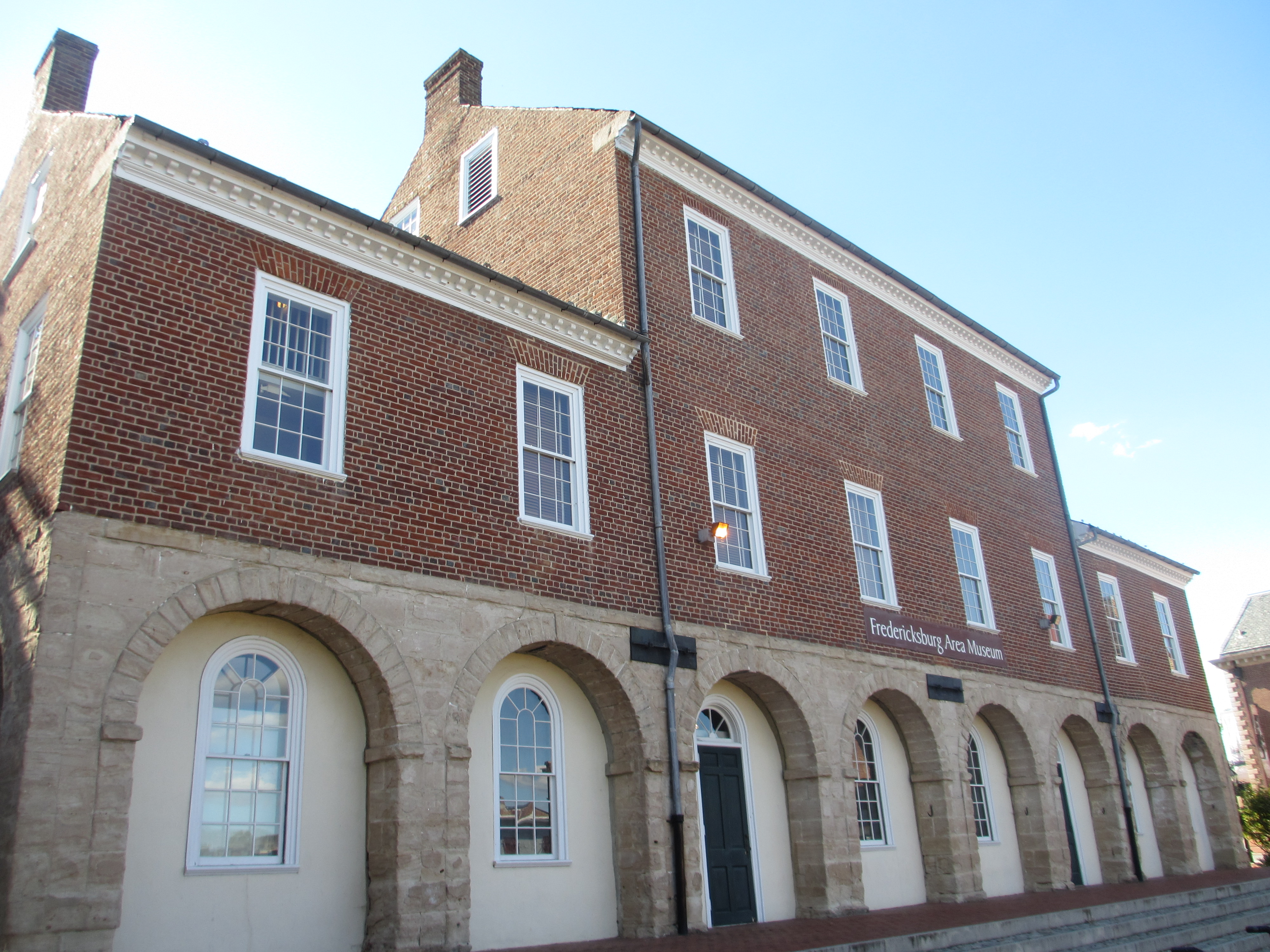
    Finally, if you have some extra time on the weekend, stop by the Fredericksburg Area Museum and see their exhibit “Lafayette’s World: Revolutionary Ideals and the Limits of Freedom,” which explores Lafayette’s ideas on freedom, democracy, and abolitionism. 

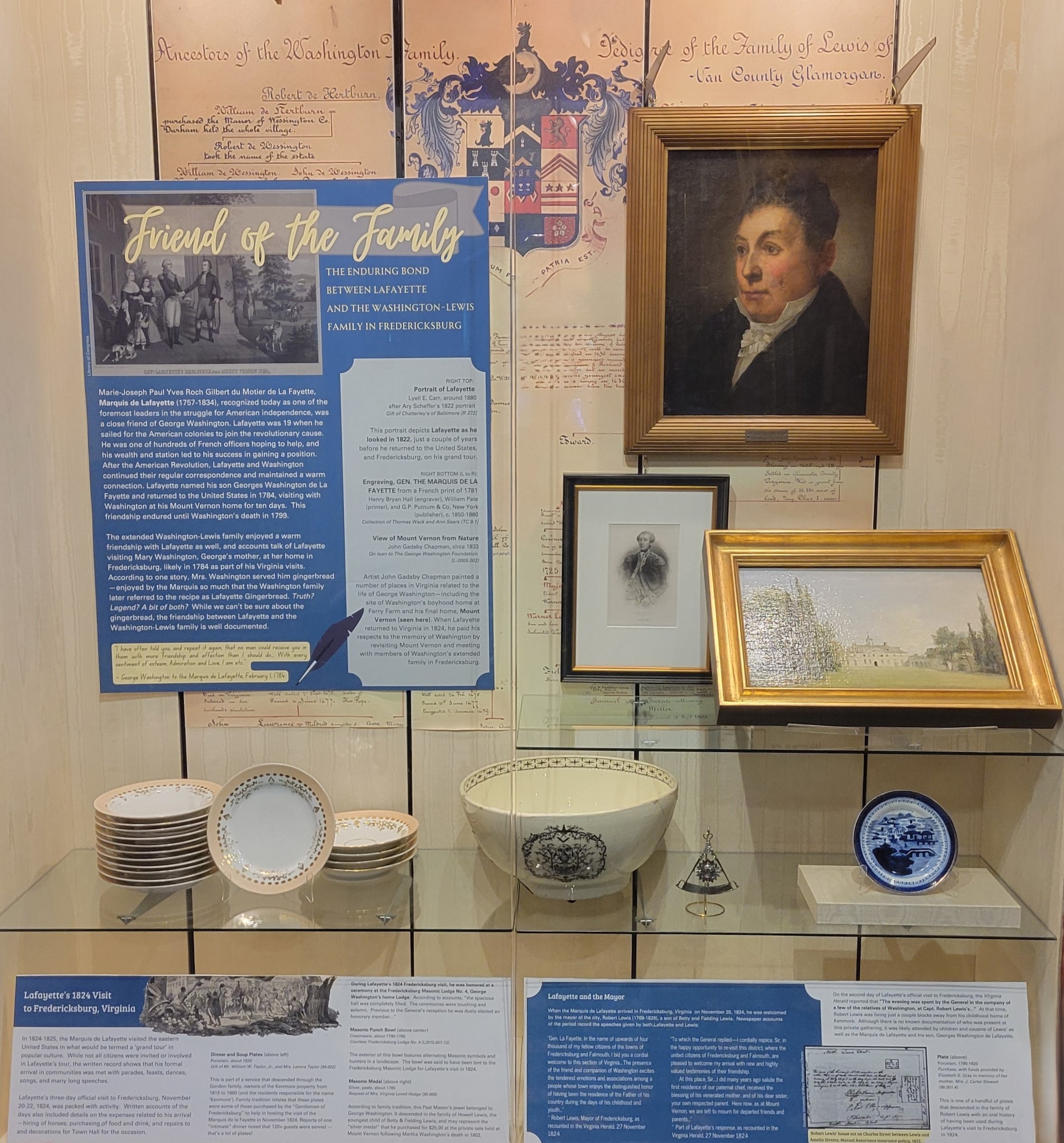
    If you can’t attend the weekend events but still want to see exclusive artifacts related to Lafayette’s visit, including the extraordinary punch bowl of Masonic Lodge No. 4, stop by the Kenmore Visitor’s Center, check out our new exhibit, take a tour of the house and learn all about Fielding and Betty Lewis. 

    Friend of the Family – Lafayette’s Visit to America, Kenmore Visitor’s Center

    Heather Baldus

    Collections Manager

  • Spilling the Tea: The Boston Tea Party at 250

    Author’s Note: This blog contains hyperlinks to primary documents related to the event.

    Figure 1: 250th Logo (Boston Tea Party Ships and Museum)

    Intro

    This year marks the 250th anniversary of the Boston Tea Party (Figure 1). Hailed as a defining moment in the quest for American independence and an act of patriotism, the event has inspired commemorations in many forms, and it remains a vital part of the American History curriculum. I, for one, thought it the epitome of achievement that I had the date memorized in kindergarten. Like much of our founding history, however, the story retains an element of myth. So, what exactly is the truth behind this event?  

    The Story

    A general account of the Boston Tea Party tells how patriotic Bostonians, angered by unfair taxes, boarded three ships in Boston Harbor on December 16, 1773. Disguised as members of the Mohawk or Narragansett tribes, Samuel Adams led the Sons of Liberty in protest by throwing crates of the King’s tea overboard. This act helped unite the colonies against Britain and started the chain of events that ended in the “Shot Heard Round the World” on Lexington Green on the morning of April 19, 1775, following Paul Revere’s ride.

    Sound familiar? In truth, this account covers the basics. It provides the “who,” “what,” “when,” “where,” and “why.” Nonetheless, it only scratches the surface of the complex event we know as the Boston Tea Party. To unpack this, let us look at what led to the event, how it happened, and the initial response.

    Truth of the Tax

    Taxes and tea sit at the heart of this story. The taxes that the colonies took issue with went into effect starting in the 1760s, with the ultimate goal of lessening the debt incurred by Britain during the Seven Years’ War. However, this set a new precedence as Britain had never taxed the colonists directly, and the passing of these tax laws occurred without consulting the colonies. The formal chant of “no taxation without representation” first appeared in 1768, and while the lack of representation presented a key reason for displeasure, the impact of taxes on merchants served as another.

    While the Tea Act of 1773 served as the catalyst for the Boston Tea Party, the Tea Tax had existed since 1767. Introduced under the Townshend Acts, the tax remained the only one in effect upon the Act’s repeal in 1770. General dislike for the tax persisted, but the Tea Act took the issue to another level. In an aim to bail out the East India Company (EIC), the Act granted a monopoly over the tea trade by opening the colonial market to the company as the sole supplier, waived their tax payment in favor of those paid by colonists, and mandated that only EIC company agents (consignees) could sell the tea (Figure 2). Many perceived this as a restriction on business, as merchants could no longer source tea from Britain and smugglers, freedom of choice and rights.  In truth, the protests against the tax and Tea Act occurred as a matter of principle since the cost of tea actually dropped, with consumers now able to buy directly from a supplier who faced no additional costs.

    Figure 2: EIC Seal (East India Company)

    Build Up

    With the Boston Tea Party story often told in a bubble, it appears as an impulsive act, but far more happened behind the scenes. By the end of 1773, displeasure with the Tea Act made attempts of preventing the unloading of tea and boycotts of its purchase common. When DartmouthBeaver, and Eleanor anchored at Griffin’s Wharf (November 28-December 15), locals had expected their arrival since October and had spent November demanding the resignations of the consignees. Many foresaw the risk of tensions coming to a head, including Abigail Adams, who, on December 5, wrote that “the Tea that bainfull weed is arrived…The flame is kindled…Great will be the devastation if not timely quenched or allayed by some more Lenient Measures.”

    After successfully chasing the consignees out of town, Bostonians urged Francis Rotch, whose family owned two of the ships, to depart without unloading the cargo. The Sons of Liberty stationed a guard at the docks to ensure that the tea remained onboard while Rotch decided. In response, Royal Governor Thomas Hutchinson ordered Rotch to unload the cargo within the standard twenty days of arrival or forfeit it and the ships. Rotch thus found himself in an impossible situation as Hutchinson and customs refused to let him leave while the Sons would accept nothing less.

    December 16th

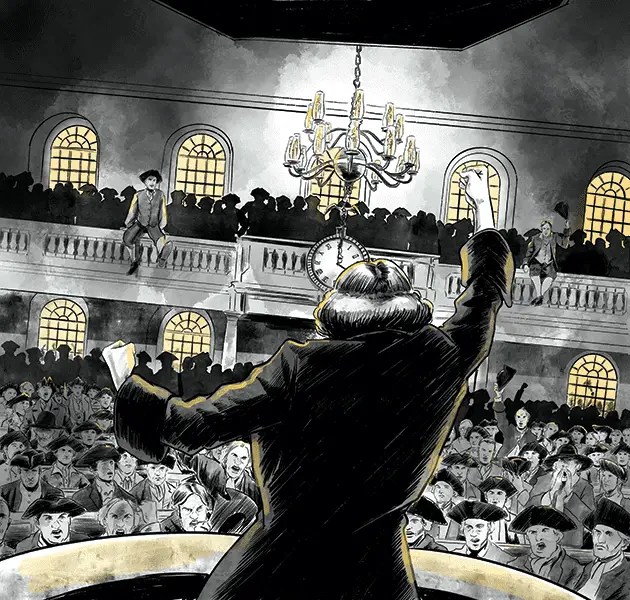
    Many awoke on December 16, knowing the crisis would come to a head. The date marked the deadline for unloading Dartmouth’s cargo, and Rotch would make one final attempt to plead his case to both sides. Hutchinson and customs refused to budge, which further incensed Bostonians when Rotch reported that the tea would not be leaving. This announcement came as Samuel Adams headed a meeting at the Old South Meeting House (Figure 3).

    Figure 3: Adams’ Speech at Old South (Revolutionary Spaces)

    Serving as a leading figure within the Sons of Liberty, Adams had led many of the meetings and attacks that occurred almost daily in the buildup to the 16th. This particular meeting drew 5,000-7,000 people who clamored to hear the latest developments in the tea crisis. When Rotch’s news broke, Adams stated, “This meeting can do nothing further to save the country.” While often billed as a signal to start the Tea Party, doubt remains over the statement’s significance. According to eyewitness accounts, many stayed another 15 minutes, and Adams tried to prevent people from leaving before the meeting concluded.

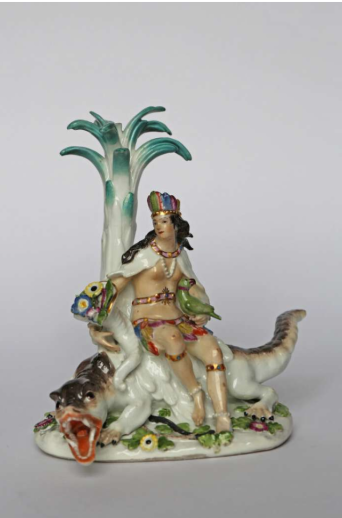
    Regardless of intent, hundreds of people made their way to Griffin’s Wharf. Along the way, some donned disguises that mimicked Native Americans. These disguises served both practical and symbolic purposes. First, donning a disguise shielded the identity of individuals carrying out the illegal acts, even if no one mistook them for actual tribal members. Secondly, the choice of a Native American-inspired look embraced an allegory of America and linked Indigenous resistance to colonization with the colonists’ struggle against Britain (Figure 4).

    Figure 4: “Allegory of the Continent of America,” c. 1750 (The Clark Museum)

    Interestingly, Adams never claimed or denied involvement with the Tea Party, yet, in contrast to popular depictions, he did not appear at the harbor that night. Instead, he remained at Old South. Of the participants, only the identities of 116 are known, and only one faced arrest.

    The day after, Samuel’s cousin, John Adams, described the event as “the most magnificent Movement of all. There is a Dignity, a Majesty, a Sublimity in this last Effort of the Patriots that I greatly admire. The People should never rise without doing something to be remembered—something notable And striking. This Destruction of the Tea is so bold, so daring, so firm, intrepid and inflexible, and it must have so important Consequences, and so lasting, that I cant but consider it as an Epocha in History.

    Reactions

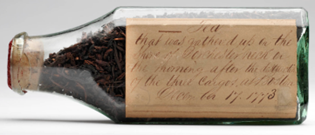
    Despite a post-independent America enshrining the Boston Tea Party in glory, most initial reactions proved far less enthusiastic than that of John Adams. The name “Boston Tea Party” did not emerge until the 1820s, and even then, “Party” referred to a group of people rather than something celebratory. Instead, mentions of the event usually identified it by what happened, such as “the destruction of the tea” (Figure 7).

    Figure 7: “Tea that was gathered up on the shore of Dorchester Neck on the morning after the destruction of the three cargos at Boston; December 17, 1773” (MHS)

    While Parliament’s taxes made many colonists unhappy, they also valued their right to private property. In the case of the Boston Tea Party, the ships that the Sons of Liberty trespassed on belonged to Americans, while the EIC owned the destroyed tea. The King and Parliament had no direct connection to the ships or their cargo. As such, many viewed the attack as one on private property rather than a true strike against Parliament. Those who spoke out against it included Founding Fathers. Benjamin Franklin felt “truly concern’d…that there should seem to any a Necessity for carrying Matters to such Extremity, as, in a Dispute about Publick Rights, to destroy private Property.” Meanwhile, George Washington supported taking a stand against taxation and felt the cause of Boston equated to the cause of America, but ultimately could not “approve their cond[uc]t in destroyg the Tea.”

    Impact

    In the short run, the Boston Tea Party did little to fan the flames of independence. It inspired a few more boycotts (i.e., the Annapolis, Edenton, and Yorktown Tea Parties) and furthered a decline in consumption, but the British response to the event served as the primary catalyst. By punishing all of Boston, and by extension, Massachusetts Bay Colony, rather than just those responsible, the British infringed upon the rights of the colonists. Under the Coercive (nicknamed “Intolerable”) Acts, the British closed the harbor, demanded Bostonians pay damages to the EIC, imposed martial law, and required citizens to house, or quarter, members of the military on their property at their own expense (Figure 8).

    Figure 8: “The Bostonians in Distress;” 1774 Satire of the Boston Port Act (LoC)

    Those living in the twelve other colonies did not take well to this, as they feared the implementation of these acts in their homes. In response, the First Continental Congress met in Philadelphia from September to October 1774. While some delegates saw the issue as a Massachusetts one, others pressed the need to take a stand against the overreaches of Parliament and sympathized with Massachusetts. They concluded Congress by issuing their Declaration and Resolves, which listed objections to Parliament and confirmed their commitment to a trade boycott. However, when news of Lexington & Concord broke in April 1775, and Massachusetts found itself at war, the other colonies quickly had to decide which side they would take.

    Legacy

    Two hundred fifty years on, the Boston Tea Party remains an iconic event in American history and a pivotal moment in the founding of the country (Figure 9). While not wholly embraced as such upon its occurrence, the retelling of the event over time came to enshrine it in lore and leave out details that complicated the narrative. This shows that one cannot study a singular event without contextualizing it within the bigger picture. Nevertheless, John Adams’ belief that the “Destruction of the Tea” would become an epoch in history proved correct.

    Figure 9: Robinson Tea Chest – 1 of 2 surviving chests (Boston Tea Party Ships and Museum)

    Emma Schlauder

    Research Archaeologist


    Bibliography

    Adams, Abigail. Abigail Adams to Mercy Otis Warren, 5 December 1773. Letter. From National Archives, Adams Papershttps://founders.archives.gov/documents/Adams/04-01-02-0065 (accessed Nov 13, 2023).

    Adams, John. [December 1773]. Diary. From National Archives, Adams Papers. https://founders.archives.gov/documents/Adams/01-02-02-0003-0008 (accessed Nov. 13, 2023).

    “Boston Tea Party History.” Boston Tea Party Ships & Museum (website). https://www.bostonteapartyship.com/boston-tea-party-history (accessed Nov. 14, 2023).

    Cooper, Samuel. To Benjamin Franklin from Samuel Cooper, 17 December 1773. Letter. From National Archives, Franklin Papershttps://founders.archives.gov/documents/Franklin/01-20-02-0266 (accessed Nov. 13, 2023).

    “Declaration and Resolves of the First Continental Congress.” American Battlefields Trust (website). https://www.battlefields.org/learn/primary-sources/declaration-and-resolves-first-continental-congress (accessed Nov. 14, 2023).

    Franklin, Benjamin. From Benjamin Franklin to the Massachusetts House Committee of Correspondence, 2 February 1774. Letter. From National Archives, Franklin Papers. https://founders.archives.gov/documents/Franklin/01-21-02-0023 (accessed Nov. 13, 2023).

    ““Made one of the celebrated Tea Party in Boston harbor:” Remembering the Boston Tea Party in 1826.” American Battlefields Trust (website). https://www.battlefields.org/learn/primary-sources/made-one-celebrated-tea-party-boston-harbor (accessed Nov. 14, 2023).

    ““No Taxation Without Representation:” The Evolution of the Historic Phrase.” American Battlefields Trust (website). https://www.battlefields.org/learn/articles/no-taxation-without-representation (accessed Nov. 14, 2023).

    “Participants in the Boston Tea Party.” Boston Tea Party Ships & Museum (website). https://http://www.bostonteapartyship.com/participants-in-the-boston-tea-party#participant-list (accessed Nov. 14, 2023).

    Schiff, Stacy. The Revolutionary Samuel Adams. New York: Little, Brown and Company, 2022. “Tea Act.” American Battlefields Trust (website). https://www.battlefields.org/learn/primary-sources/tea-act (accessed Nov. 14, 2023).

     “The Boston Tea Party.” Massachusetts Historical Society (website). https://www.masshist.org/revolution/teaparty.php (accessed Nov 14, 2023).

    “The Final Straw.” Boston Tea Party Ships & Museum (website). https://www.bostonteapartyship.com/the-final-straw (accessed Nov 14, 2023).

    “The Intolerable Acts.” Boston Tea Party Ships & Museum (website). https://www.bostonteapartyship.com/the-intolerable-acts (accessed Nov 14, 2023).

    The Massachusetts Gazette; and the Boston Post-Boy and Advertiser. “Philadelphia, September 29. Extract of a letter from London, August 4.” From Massachusetts Historical Society. https://www.masshist.org/database/viewer.php?pid=2&old=1&mode=nav&ft+Coming% &nbsp 20of%20the%20American%20Revolution&item_id=434 (accessed Nov. 13, 2023).

    “The Secret Plan.” Boston Tea Party Ships & Museum (website). https://www.bostonteapartyship.com/the-secret-plan (accessed Nov 14, 2023).

    “Townshend Act.” American Battlefields Trust (website). https://www.battlefields.org/learn/primary-sources/townshend-act (accessed Nov. 14, 2023).

    Washington, George. From George Washington to George William Fairfax, 10–15 June 1774. Letter. From National Archives, Washington Papershttps://founders.archives.gov/documents/Washington/02-10-02-0067 (accessed November 13, 2023).

  • Liberty vs. The King: National Identities in Two Lewis Family Drinking Vessels

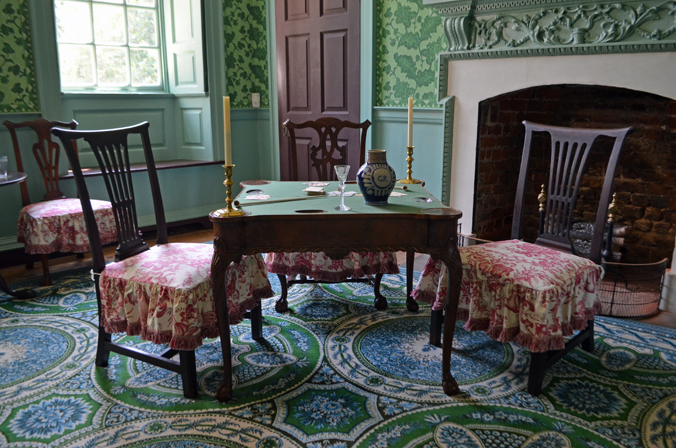
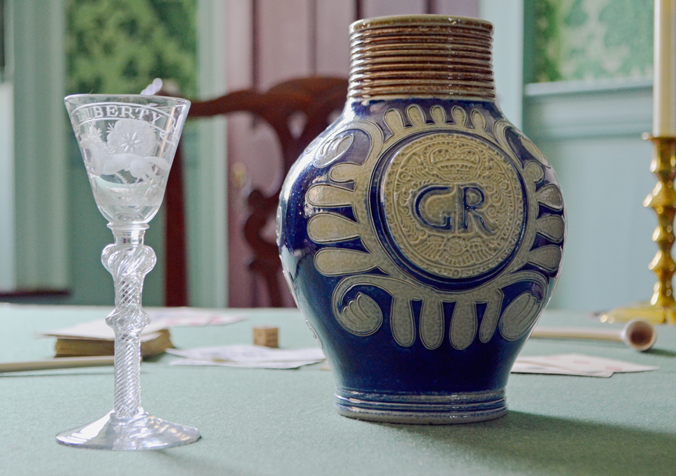
    Visitors to Kenmore’s Drawing Room may have noticed an unusual pairing of glassware and ceramic pieces displayed on the gaming table – a beautiful, air-twist stem wine glass sitting next to a Westerwald pottery jug. At first glance, this small vignette may simply appear to depict a wine jug at the ready, waiting to fill the glasses of those seated for the card game. But a closer inspection reveals that there’s more to the story.

    The gaming table in Historic Kenmore’s Drawing Room.
    Air-twist stem wine glass sitting next to a Westerwald pottery jug on the gaming table.

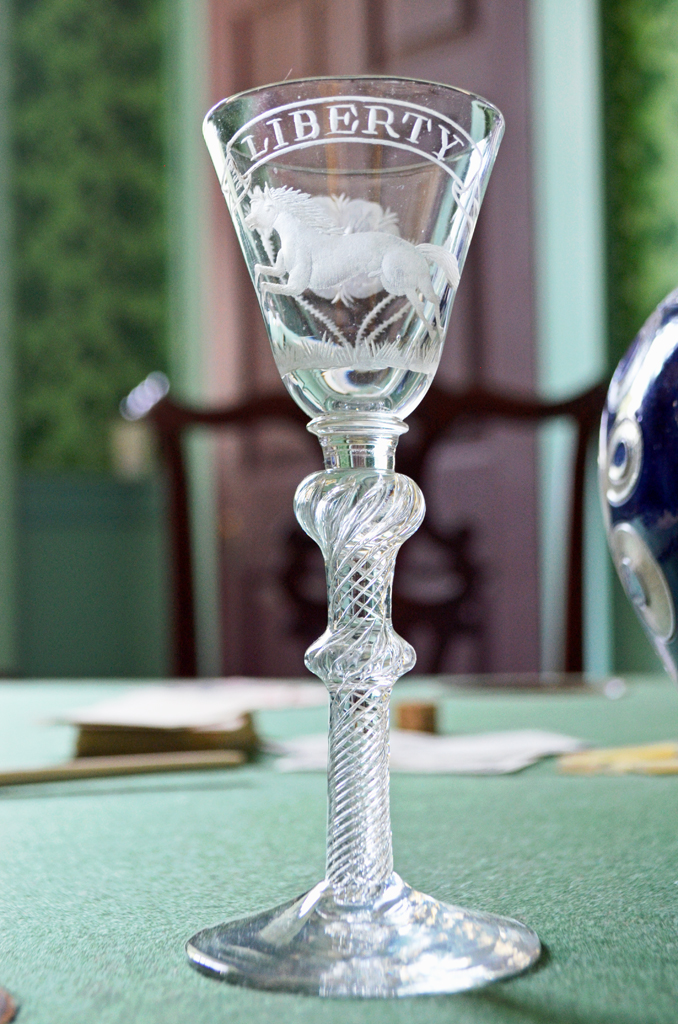
    In addition to its delicate air twists and balusters, the cup of the wine glass is etched with intricate designs. On one side, there’s a rose, and on the other is the word “Liberty.” The rose refers to the Scottish House of Stuart and their exiled claimant to the Scottish throne, the Bonnie Prince Charlie. The word “Liberty”, in this case, refers to the Jacobite Uprising of 1745 – 1746, in which the Scottish clans attempted to overthrow the English king and re-install the Bonnie Prince, thereby ending the English occupation of Scotland. The Uprising ended in a bloodbath for the Scottish forces at Culloden Moor, and the Bonnie Prince remained in exile for the rest of his life. The defeat at Culloden ushered in a period of extreme violence and repression of Scottish Highland culture known today as the Clearances. Thousands of Scots were forced from their homes and prosecuted in English courts for crimes against the Crown. Those found guilty were often sentenced to “transportation,” which meant they were crowded onto prison ships and sent to the American colonies.

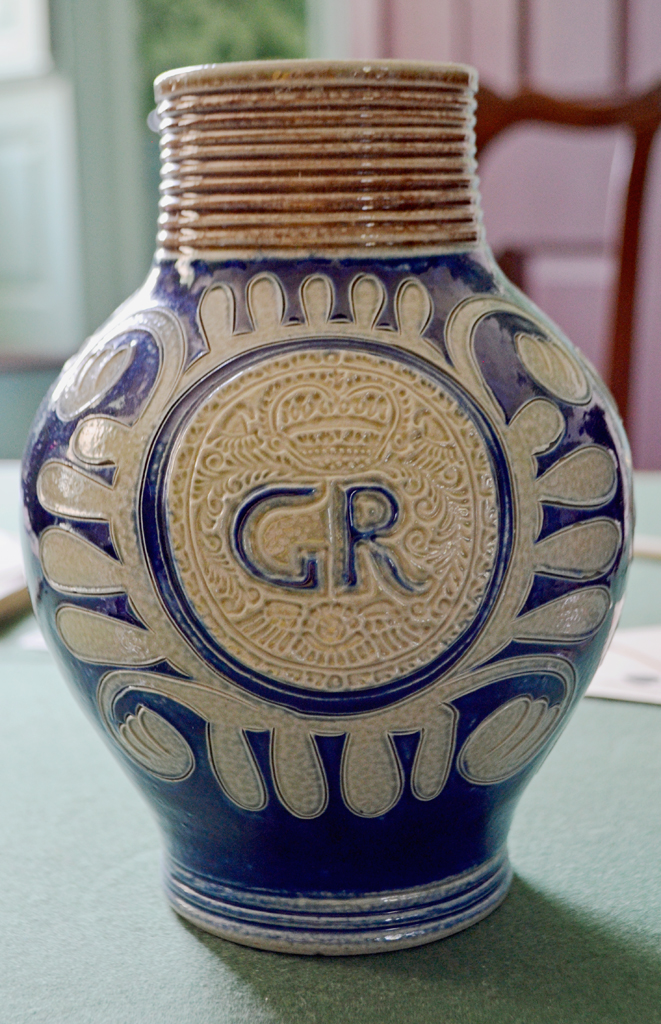
    The stoneware jug is decorated in typical Westerwald-style cobalt blue glaze patterns, with the addition of a sprigged central medallion bearing the letters “GR.” Those initials stand for Georgius Rex, the Latin for King George of Britain, probably George III in this case. Westerwald ceramics produced in what is now Germany for export to Britain in the 18th century were often decorated with the GR emblem in honor of King George. Most British households, including young George Washington’s home at Ferry Farm, would have had a piece or two exhibiting the GR motif.

    Both items are included in Kenmore’s furnishings today because fragments of similar pieces were found archaeologically on the site during excavations in the 1990s, so we know that both were used by the Lewis family at very nearly the same time. The juxtaposition of their messages, though, illustrates what a very strange and confusing time the Lewis family were living in. Literally up until the very eve of the American Revolution, Fielding Lewis saw himself very much as a proper English subject. His business relied almost entirely on good relations with English counterparts. He built Kenmore to emulate in every way the proper English manor house, and apparently he owned ceramics that honored King George.

    Almost overnight, however, the Lewis’s world completely changed. They were no longer English subjects, but rather traitors to the Crown. Fielding’s income and business were gone, and his very English house was now a liability. Those transported Jacobites living in the American colonies, many of them neighbors to the Lewises like Hugh Mercer, were among those who advocated for war with Britain. The symbols and ideals of the Jacobite Uprising were adopted into the American revolutionary movement. And so our placement of the Liberty glass next to the GR jug on the gaming table is both a wink and a nod to the idea of rebellion hidden in plain sight, and a recognition of the complicated times in which the Lewis’s found themselves.

    Celebrate the 245th anniversary of liberty from the King during the Fourth of July at George Washington’s Ferry Farm from 10 a.m. to 4 p.m., Sunday, July 4, 2021! Tour the Washington house, learn about archaeology at Ferry Farm, enjoy a patriotic flag retirement ceremony at 1:00 p.m., interact with historic reenactors, listen to festive music, view living history demonstrations and theatre performances, make crafts, play games, and enjoy other activities for the whole family. $5.00 per car for a combined parking and event admission pass. Advance purchase of parking and event admission pass is strongly encouraged. Visit kenmore.org/events to learn more and purchase pass.

    Meghan Budinger
    Aldrich Director of Curatorial Operations

  • “Rakes of Mallow/Yankee Doodle” by Colonial Faire [Video]

    Colonial Faire, an 18th century music group, recently performed at Historic Kenmore. In this video, they play a medley of “Rakes of Mallow” and “Yankee Doodle.” Read about the history behind “Yankee Doodle” in this blog post.

  • Washington and the Culper Spy Ring

    At George Washington’s Ferry Farm, we largely focus on George’s youth but also eagerly research and learn as much as we can about all periods of his life. During our unexpected closure due to COVID-19, some of our interpretive staff had the chance to study a little more about Washington and the Culper Spy Ring for a reading group we created.

    Early on during the American Revolution, it was apparent to George Washington that he would need a way to get information about British troop movements and, hopefully, their overall plans. The Siege of Boston was a huge success for Washington and his Continentals, but capturing New York proved to be much tougher. In fact, New York remained occupied by the British for the entire war but Washington continued to hope that he could liberate the city. And in that hope, he knew he needed intelligence from inside the city. Everyone who crossed the border, however, was searched by British soldiers and any direct letters were confiscated and the bearer convicted of treason.

    After a failed attempt by a young solider named Nathan Hale, Washington knew the intelligence would be very difficult to gather, and even more difficult to transmit. He called upon another young Yalie named Benjamin Tallmadge to help him with his goal. In November of 1778, Tallmadge began The Culper Spy Ring. He contacted operatives in New York City and they developed a complex system of routes to pass along information. The operatives in Manhattan passed the information to a carrier in Long Island and then eventually a second carrier brought the information to Tallmadge in Connecticut.

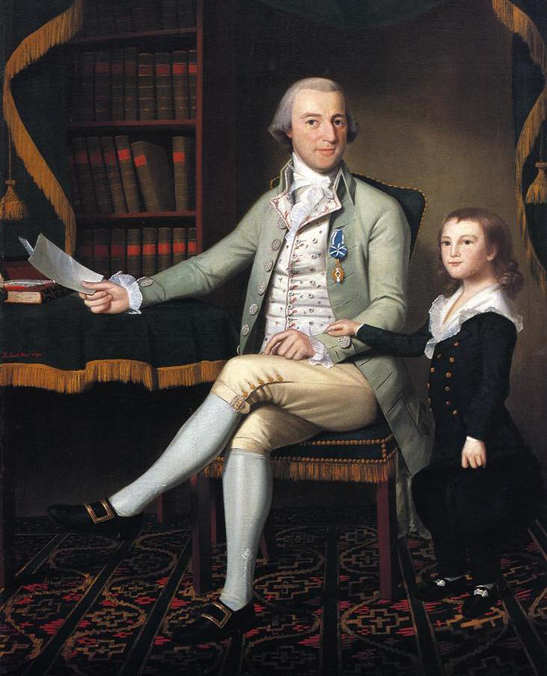
    Benjamin Tallmadge (1790) by Ralph Earl
    Portrait of Benjamin Tallmadge along with his son William painted after the war in 1790 by Ralph Earl. Credit: Wikipedia

    The identity of the spies was so restricted that of the five operatives known to have helped, at least one of their identities is still highly debated by historians. Washington himself did not want to know their real names thus the agents were given nicknames. For example, Benjamin Tallmadge was called John Bolton, Abraham Woodhull went by Samuel Culper, and Robert Townsend was referred to as Samuel Culper, Jr.

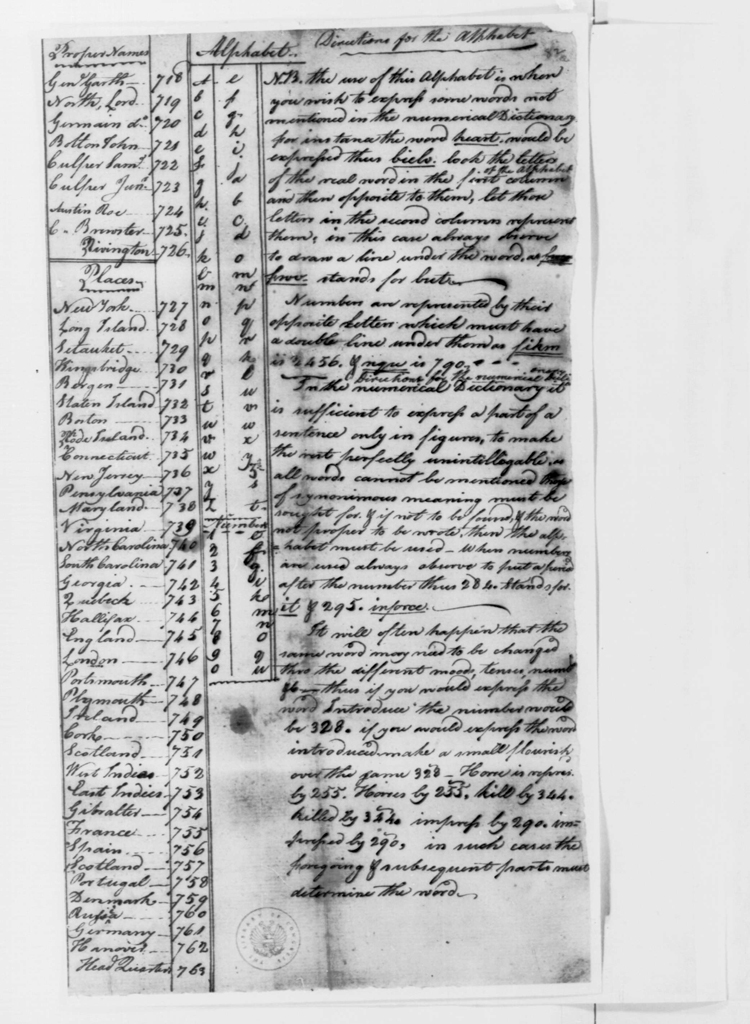
    The spy ring also developed a code that used over 760 combinations of numbers to represent people, places, and things. For example, Washington was 711, New York City was 727, and the lone female spy was referred to as 355. Of course, randomly filling a letter with numbers was a sure way to get caught, so they also used invisible ink and ciphers.

    Culper Code
    A page from the key to the Culper code. Credit: Library of Congress

    Even with all these precautions, the work was dangerous and risky. The news traveled to Washington too slowly to be of much use, and he pressured Tallmadge to speed up the process. The spies were constantly in danger of being found out.

    However, the Culper Spy Ring is credited with several key achievements. In 1780, the French Army arrived to reinforce Washington’s men and their ships landed in Rhode Island. The British knew they were coming and the spy ring passed that information along to Washington. He arranged a ruse to distract the British and allow the French to land without conflict. The Culper Spy Ring also unearthed some of the information that would lead to the discovery of Benedict Arnold’s treason as well as the capture of a major British intelligence officer, John André.

    So, after reading about the Culper Spy Ring, one historic interpreter who leads tours of the Washington house was happy to share the part of the story that made them most interested in the intricate spy ring that helped win the Revolution.

    Thanks to modern depictions, when I think of a spy the image that immediately comes to mind is someone with all the newest technology and an expensive taste in cars and clothes. Those that made up the Culper Spy Ring couldn’t be farther from the glamorized and romanticized depiction of spies that we have come so used to seeing. Though the five that made up the ring were from different walks of life and social statuses, they worked together (not always seamlessly) for a cause they believed to be worth more than their own lives. Through rather mundane means and careful exchanges, they were able to provide the key information for Washington under the nose of the enemy. The daring escapes across water by Caleb Brewster in a rowboat while taunting the most powerful naval force in the world were both hilarious and unbelievable. Brewster’s personality and general lifestyle makes him the odd one out in my mind. However, he also seems to be one of the most willing in many cases and jokes about the British not being able to catch him. Brewster’s personality more closely matches that classic spy image but his means are what really catch your attention. – Hunter Robinson

    Elizabeth Hosier
    Manager of Interpretation and Visitor Services

  • Josiah Wedgwood: Man of Pottery and Principles

    The 18th century was dominated by the ideas of the Enlightenment which gave rise to a range of principles like liberty, equality, constitutional government, and free enterprise.  It was a revolution in thought led not by politicians and soldiers, but by a handful of thinkers, scientists, artisans, and merchants. Josiah Wedgwood was a thinker, scientist, artisan, merchant all rolled into one. He became one of the founding fathers of the industrial revolution, creating a new artistic industrialism that used the division of labors, scientific experimentation, and commerce to make affordable yet quality products that democratized artistry.[1]

    Josiah Wedgwood (1780) by George Stubbs
    Josiah Wedgwood (1780) by George Stubbs. Enamel on a Wedgwood ceramic tablet at the Wedgwood Museum in Barlaston, Stoke-on-Trent, England. Credit: Wedgwood Museum / Daderot / Wikipedia

    In his heart, Wedgwood believed that man could create a better world through self-improvement, education, and commerce.   Although he lived in England, he saw the American colonists’ struggle against taxation imposed on them and America’s potential as a capital of finance and freedom smothered under a foreign ruler. He was naturally sympathetic to their plight. Wedgwood spent the Revolutionary War trying to walk the fine line between being a patriotic British merchant and a radical dissenter.

    Josiah Wedgwood was born in July of 1730 in Burslem, England to a family of potters that stretched back more than four generations.  When he was a child, he survived a bout of small pox that left his left leg too weak to work a potter’s wheel. This led him to focus his energies on design rather than the physical production of ceramics.[2]

    In 1759, he set up his own pottery called Ivory Works. The pottery had swift success and became one of the largest manufacturers of Staffordshire pottery, known particularly for fine earthen and stonewares.  Demand for quality minimalistic earthenware design was high among the English at the time. Wedgewood devoted himself to glaze development, kiln technology, and marketing to fulfill demand. He perfected a cream-colored earthenware which took over 5000 glaze tests to get the color just right. He developed a new colored unglazed body known as “jasper” that allowed for the production of two-color ornamental wares to match the public’s desire for minimalistic, neo-classical styling.[3]

    Wedgwood became a producer of fine ceramics and transformed pottery-making into an industry that rivaled European porcelain in elegance of shape, durability, and lightness of weight.  In 1765, shortly after opening his first London showroom, he got a huge break when he was invited to take part in a contest to design a tea set for Queen Charlotte.  It took months of experiments but his gilded tea set with green flowers won the competition.  With royal recognition, Wedgwood became a Georgian super brand, distinguished by quality while delivering artistic perfection on an industrial scale.[4]

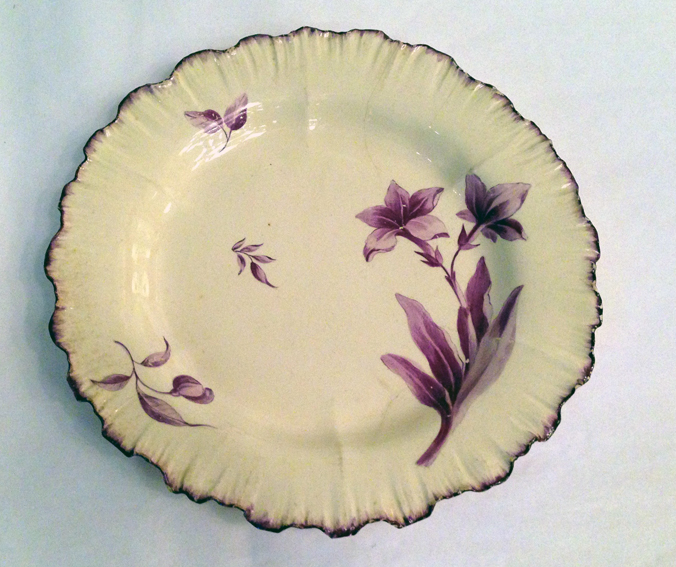
    860031
    Dating from about 1765, this circular Wedgwood plate has a molded shell edge and is finely painted in deep purple with flowers and leaves. The edge is feathered in purple.

    Why was America so important?

    In the middle of the 18th century, a new consumer group appeared: the middling class.  This middling class was particularly prevalent in the American Colonies.  They wanted British goods like sugar, coffee, chocolate, and tea and their accompanying accessories and ceramics to show off their new social status and refinement.[5]

    Pre-Revolutionary War, America did not have a single pottery manufacturer to create tea accoutrements like teapots and saucers capable of matching the quality and aesthetic of Wedgwood.  Thus, America became a good client in the booming British export trade and one of Wedgwood’s most important overseas markets.  The colonies, in fact, became such a huge market that “around half of all English exports of copperware, ironware, glassware, earthenware, silk goods, printed cotton and linen goods, and flannels were shipped to colonial consumers.” Josiah took advantage of this boom and packed as many crates as possible on Liverpool ships bound for the New World.[6]

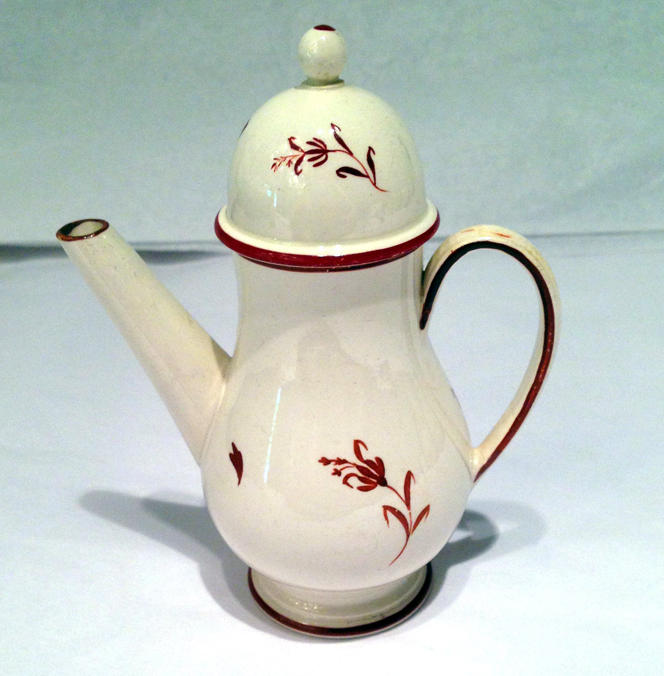
    85024 cd
    This miniature covered creamware Wedgwood coffeepot dates from between 1785-1800. It has a plain loop handle, straight spout, and knob finial and is painted with underglaze iron red scattered flower sprays and border stripes. The lid is dome-shaped.

    “All the world are with the Ministers & against the poor Americans…”

    There were two reasons why Josiah Wedgwood disagreed with the war against America, one was philosophical and one was financial.  Wedgwood enjoyed the American boom in ceramic exports and worried about what taxation and colonial unrest might have upon his trade.  Many businessmen with interests in America saw a threat to the market for British goods with undue taxes like the Stamp Act of 1765. They agreed with future Prime Minister Lord Pitt’s criticism “that this kingdom has not right to lay a tax on the colonies…Trade is your object with them and taxing was ill advised.  If you do not make suitable laws for them, they will make laws for you.”  Because of the strong opposition from merchants and American resistance, the Stamp act was repealed. However, that did not ease the anxieties of Wedgwood and other merchants.[7]

    Wedgwood knew he had much to lose if American markets became inaccessible because of war stating, “the bulk of our particular manufacture you know is exported to foreign markets for our home consumption is very trifleing [sic] in comparison to what is send aboard, …this trade to our Colonies.” He continued, “we are apprehensive of losing in a few years.”[8]

    Legislation continued to cut into Wedgwood’s trade and profits. Besides imposing an indirect tax on the colonists, the Townshend Acts of 1767 got rid of a refund on the duty that manufacturers paid, which meant it would cost more to export goods to the colonies.  In 1775, Parliament issued the New England Restraining Acts, restricting the Colonies’ trade and commerce to Great Britain, Ireland, and the British West Indies.  This was Parliament’s response to the declaration of the Continental Congress in the fall of 1774 instigating a “non-consumption agreement” and promising “we will not import, into British America, from Great Britain or Ireland, any goods, wares, or merchandise whatsoever.”  By the next year, diplomatic and commercial relations had broken down and, three months before the Declaration of Independence was signed, American ports were officially closed to British trading ships.[9]

    This all had a major effect on commerce for merchants and manufacturers like Wedgwood.   In 1770, customs and excise officers recorded over 1.2 million pieces of glass and earthenware shipped to America.  In 1775, less than 139,000 pieces had been shipped.[10]

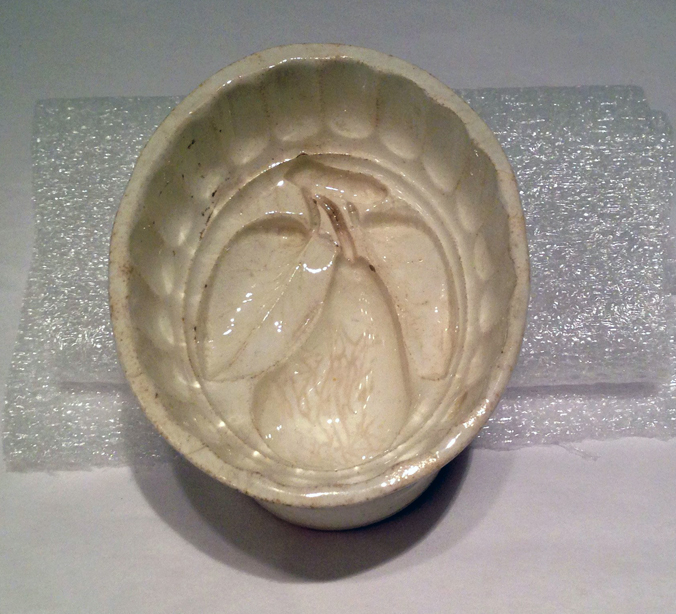
    840018
    An oval form with a tall, off-center oval foot rim. The inside is molded with fluted sides, a deep pear, and two flanking leaves on bottom. This Wedgwood form dates from between 1810 and 1820.

    Enlightenment Philosophy at Work

    While war took a large chunk out of Wedgwood’s bottom line, that was not the only reason he opposed war.  He was a man of the Enlightenment and held fast to many of the philosophical principles that formed the basis for this new America.

    Josiah was born and raised a Unitarian.  The seven principles of Unitarianism include the belief in the inherent worth and dignity of every person, the free and responsible search for truth, the use of democratic process, and peace, liberty, and justice for all.  Wedgwood grew up in a society that created its own culture distinct from the Anglican status quo, a culture with a strong sense of morality and responsibility. So his interests in the ideas of the Enlightenment were not too surprising.[11]

    Josiah delved into the Enlightenment, reading many of the writings from the great thinkers of the time including John Locke’s Treatise on Education, Adam Smith’s Wealth of Nations, and Thomas Paine’s Common Sense.  They all talked about concepts of self-improvement, education, liberty, and inalienable rights. Wedgwood truly believed in these principles and put them into practice in his own life and business by trying to use his company and wealth for the social good.  He reinvested profits back into the company to create a better standard of living for the employees in under his care.  Schools were started for the workers’ children, additional training was made available for workers, and work place safety was improved with the elimination of harmful lead glazes and the constant search for better environmental practices.  He believed that the people mattered more than the profit.[12]

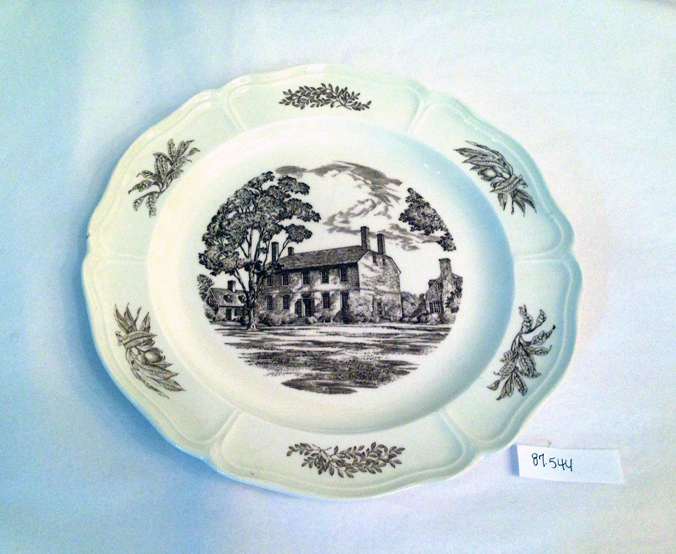
    87544
    A “Queen’s” shape Wedgwood plate from 1956 with a view of Kenmore as the center transfer-print. The six lobed rim is transfer-printed in brown with various leaves.

    With the American Revolution and then the French Revolution, he saw a chance to create societies built upon Enlightenment philosophies that could flourish without an authoritarian regime and without imposition of unnecessary taxation. A society ruled by reason, truth and free enterprise.  Wedgwood’s idealism was high.  Life does not always follow abstract principles, however, and he would struggle to balance his ideals with political, financial, and social realities.[13]

    He supported America’s right to self-rule and knew the colonists were a force to be reckoned with commercially. Yet, he was also a British businessman with a prominent reputation.  At home, he had to balance his principles with his need to seem patriotic.  He tried to stress to government ministers the economic devastation a war would have on Britain but he was clear in his opinion of “the absurdity, folly & wickedness of our whole proceedings with America.”[14]

    Wedgwood lived to see America’s victory in the struggle for independence, passing away in January 1795.  He and his business had survived the war with their Enlightenment ideals and financial success intact.[15]

    Heather Baldus
    Collections Manager


    [1] Wilson, A.N., The Genius of Josiah Wedgwood, BBC Two, April 19, 2013.

    [2] “Josiah Wedgewood (1730-95) ,” The Royal Collection Trust, rct.uk/collection/people/josiah-wedgwood-1730-95#/type/subject; Pirie, Madsen. “Josiah Wedgwood, An Industrial Revolution Pioneer.” Adam Smith Institute, The Adam Smith Institute, 12 July 2019, adamsmith.org/blog/josiah-wedgewood-an-industrial-revolution-pioneer

    [3] Perry, Mike. “WEDGWOOD (JOSIAH WEDGWOOD & SONS LTD),” Pottery Histories potteryhistories.com/page99.html; Wilson, The Genius of Josiah Wedgwood; “Josiah Wedgewood (1730-95) ,” The Royal Collection Trust.

    [4] “Josiah Wedgewood (1730-95) ,” The Royal Collection Trust; Wilson, The Genius of Josiah Wedgwood.

    [5] Berg, Maxine. “Men and Women of the Middling Classes: Acquisitiveness and Self-Respect.” Luxury and Pleasure in Eighteenth-Century Britain, Oxford University Press, 2007, 199-246; Dolan, Brian. Wedgwood: The First Tycoon. New York City, Viking, 2004, 74-75; Wilson, The Genius of Josiah Wedgwood.

    [6] Wilson, The Genius of Josiah Wedgwood; Dolan, 250, 75.

    [7] Dolan, 160-161.

    [8] Dolan, 161.

    [9] Dolan, 160, 254.

    [10] Dolan, 254.

    [11] “The Seven Principles.” Our Faith, Unitarian Universalist Association, 2020, uua.org/beliefs/what-we-believe/principles; Wilson, The Genius of Josiah Wedgwood.

    [12] Dolan, 253, 266.

    [13] Dolan, 314.

    [14] Dolan, 255.

    [15] Dolan, 323.

  • Siblings Strained by Revolution: George and Betty’s Wartime Letters

    George Washington was the oldest of Augustine and Mary Washington’s five children. The next oldest was daughter Betty, who was born 14 months after George and was his only sister. 

    George and Betty are immensely important to us at George Washington’s Ferry Farm & Historic Kenmore. They spent their formative years at Ferry Farm and Betty called Kenmore home for two decades.  As main characters in our historic sites’ stories, we often ponder what their relationship as siblings was like.

    The best and, frankly, only gauge of George and Betty’s relationship are the letters they wrote to one another later in their lives.  Twenty-four letters written between 1779 and 1796 have survived. They wrote more than just these two dozen but many have not been found.  The 24 that have survived depict a complex relationship of sibling love and camaraderie tempered by occasional conflict.  Let’s begin, on this National Siblings Day, a multi-post examination of George and Betty’s letters and what they may indicate about the relationship of this historically consequential brother and sister.

    In our first post, we look at the letters George and Betty wrote to one another during the Revolutionary War.  There are only two, both from the hand of Betty, but they are profoundly interesting, nonetheless.

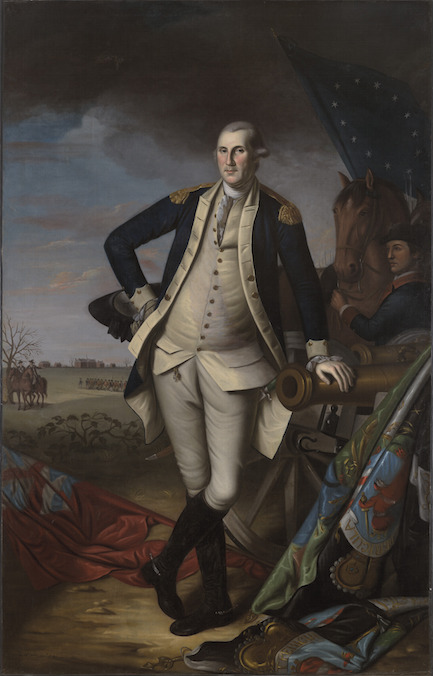
    The first surviving letter comes in 1779 while George was away commanding the Continental Army.  He had been commander-in-chief for four years by that time and, during the second half of 1779, his service found him headquartered at the highly-fortified and strategically important West Point, New York overlooking the Hudson River.  On September 21, Betty wrote her brother there to thank him for “the miniature Picture—for which I am much Indetted”.  The miniature was painted by Charles Willson Peale and was a small version of his portrait of Washington commemorating the American victories at Trenton on December 26, 1776 and Princeton on January 3, 1777. Peale painted s miniature copy of the portrait specifically for Betty indicating that either George wanted to share his likeness with his sister or that Betty had requested a likeness of her brother that she could have while he was away fighting.

    George Washington at the Battle of Princeton (1779) by Charles Willson Peale
    “George Washington at the Battle of Princeton” (1779) by Charles Willson Peale. Credit: Yale University Art Gallery

    Indeed, this letter shows that Betty cleared missed George.  In sharing that she, her husband Fielding, and their daughter also named Betty had recently visited George’s wife Martha, Betty noted her wish that she could have found George there upon their arrival at Mount Vernon. Doing so, she wrote, “would of Compleat’d My Happiness.”  It had been at least four long years since Betty had laid eyes on George.  Closing the letter, she wistfully expressed her longing for the war’s end, writing, “O when will that Day Come that we Shall meet again[?]—I trust in the Lord soon, till when you have the sincere Prayr’s and Good wishes for your helth [sic] and happiness.”

    The only other surviving wartime letter written between George and Betty comes towards the end of the Revolutionary War and reveals a bit more conflict in the sibling relationship than the first.  It is dated August 25, 1783 and is quite a confusing and unclear letter at times.

    Betty begins by congratulating George on “the happy Change in our Affairs” because she hoped “it will be the meanes of our Seeing you Soon”.  Betty may simply be congratulating George on the looming end of the war but, at the same time, throughout her letter she refers to more than one event that happened back at the end of 1781.  Indeed, much in the letter seems to indicate that their correspondence had lapsed for a substantial amount of time and that this is may be a catching up letter. If so, then perhaps her good wishes are for George’s victory at Yorktown and the surrender of General Lord Cornwallis back on October 19, 1781?

    Surrender of Lord Cornwallis (1820) by John Trumbull
    “Surrender of Lord Cornwallis” (1820) by John Trumbull. Credit: Architect of the Capitol

    Regardless, Betty is quite upset that she has not heard from George in an extraordinarily long time.  She starkly admonishes him for not writing, saying “I have been at a loss how to account for your long silence,[.] the multiplicity of Business you have on your mind is the only One I Can find that flatters me [that] I am not quite forgot[ten.]”  While acknowledging the pressures on his time as the army’s commander, Betty scolds her “Dear Brother” for not finding “one half [h]Our you Could Spare to write a few lines to an only Sister whoe [sic] was lab[o]ring under so mutch [sic] Affliction both of Body and mind.”

    The affliction faced by Betty was the deaths of both her brother Samuel and her husband Fielding, which she says took place within three weeks of one another.  Samuel died on September 26, 1781.  Fielding’s death did not actually take place until sometime between December 10, 1781, when he swore out a codicil to his will, and January 17, 1782, when his will and codicil were presented in court.  Perhaps Betty mistakenly wrote the word “weeks” when she actually meant “months”?  Perhaps time and grief caused her to misremember the length of the interval between the two deaths?  Perhaps she was attempting to make George feel guilty for his long silence?  Regardless, save for the Yorktown victory, late 1781 was indeed a grim time for Betty and it seemed to affect her physical health, if not also her mental health.  She told George that “the uneasiness of mind it Caus’d me to get in an Ill state of helth and I expect’d Shortly to follow them”.  She feared joining Samuel and Fielding.

    Betty writes that her illness “happen’d at a time when every thing Contributed to ad[d] to my uneasiness” including a failure to see George when he apparently passed directly through or close to Fredericksburg on his way north after Yorktown.  We’re not entirely sure George actually went through his hometown on this trip.  Betty’s opaque phrasing — “your being in Fredericksburg the only Chance we had of seeing you from the Commencement of the War” — is not terribly helpful in figuring it out.  She is upset because she missed seeing him during his visit or because this was his only visit since the war started or because he passed close to town without stopping at all.

    There is evidence, however, that George did travel directly through Fredericksburg but that Betty and his family were not in town at that moment and so did not see him.  In a letter written to George on March 13, 1782, Mary, his mother, laments not being at home “when you went through fredirecksburg [sic].”  She indicates that she was “over the Mountains”, perhaps meaning present-day Berkeley Springs, West Virginia, where the Lewis and Washington families often traveled to use the hot springs for pleasure and medicinal reasons.  Indeed, fearing targeted abduction by the British during the fighting in Virginia in the fall of 1781, Fielding took Mary and Betty and fled to a Lewis property probably in or near today’s Berkeley Springs.  With Fielding in exceedingly poor health, it is thought that this is where he ultimately died, which would put the family there until at least December 1781.  George passed through or near to Fredericksburg sometime in November.

    After her scolding and laments, Betty did end her letter to George with a bit of hope and expresses again how much she missed him.  She tells him that she is “Recovering my helth fast and Please my self with thoughts of Shortly Seeing you once more with us.”  But, in a postscript, she gives one more scolding to her beloved brother, saying “I Wrote you three Letters when you was in Virginia but never heard if you got One of them.”

    These two wartime letters written by Betty Lewis to her brother George Washington reveal a complex relationship between the two siblings.  It was a relationship characterized by love and by the deep sadness of absence.  It was also a relationship strained by the tensions and difficulties of war and by George’s all-consuming responsibilities as Commander-in-Chief of the Continental Army.

    Zac Cunningham
    Manager of Educational Programs

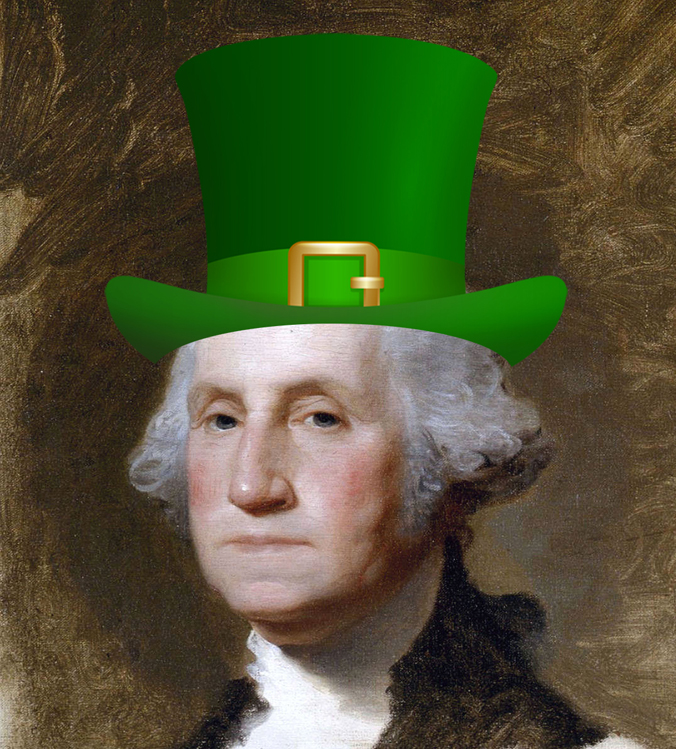
  • Washington’s St. Patrick’s Day General Order

    Saint Patrick’s Day honors St. Patrick, the patron saint of Ireland, who was born in England and lived during the 5th century. Early in life, he was kidnapped, sold into slavery, and ended up living in Ireland. He is credited with converting the Irish to Christianity, as illustrated in the legendary tale that says he drove the snakes (a metaphor for pagans and druids) from Ireland.  He established many churches and was honored with a feast day in his name.

    Over time, Saint Patrick’s Day shifted from a religious holiday to a secular celebration of Irish culture and history. The first St. Patrick’s Day parade was held in Boston in 1737. By the time the Revolutionary War started, there was also a parade in New York City and the holiday had become a meaningful celebration to Irish-Americans. Subsequently, during a cold winter encampment in 1780 in Morristown, New Jersey, General George Washington, then commander-in-chief of the Continental Army, noticed his men were having a bout of particularly low morale. The soldiers were low on food, had very shabby shelters, and the winter was harsh.

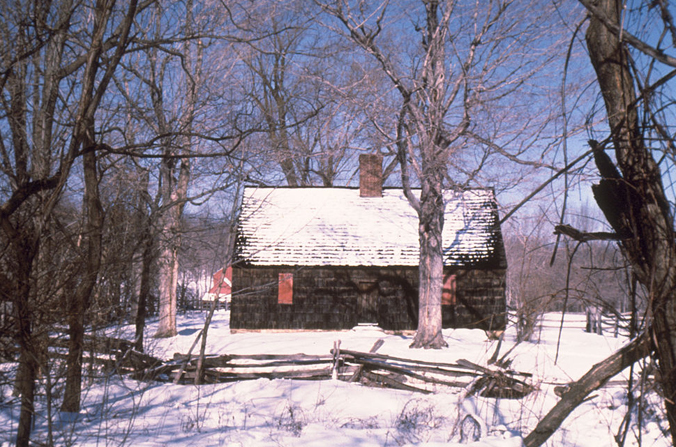
    Morristown National Historical Park
    The Wick House at Morristown National Historical Park. Credit: National Park Service/Wikipedia

    Washington, a man of many curiosities, became interested in the political goings-on in Ireland, which was also ruled by the British. He could see that Ireland, like the colonies at that time, was struggling to find common ground with the Crown in England. He found the Irish struggle relatable, and also useful. Perhaps, if England could be distracted enough by unrest in Ireland, they would falter in the war against the colonies.

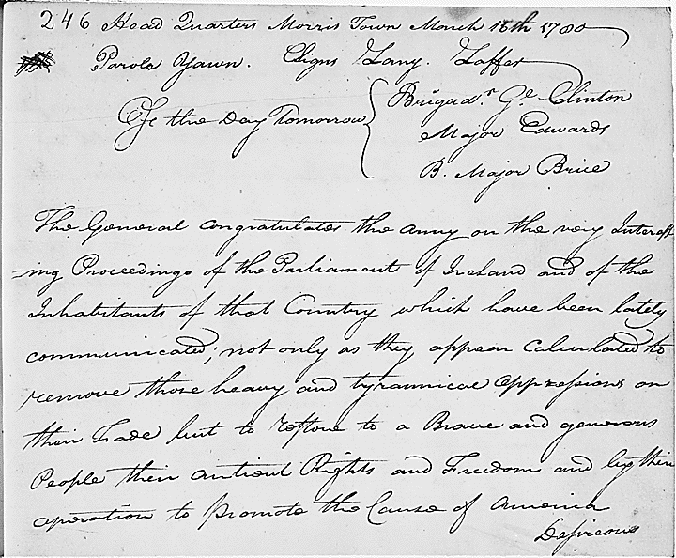
    Recognizing the need for a boost, and the opportunity to resonate with specific groups, Washington issued an order on March 16, 1780. Today, it is known as the St. Patrick’s Day General Order. It reads in full:

    Head Quarters Morris Town March 16th, 1780
    General Order

    The general congratulates the army on the very interesting proceedings of the parliament of Ireland and the inhabitants of that country which have been lately communicated; not only as they appear calculated to remove those heavy and tyrannical oppressions on their trade but to restore to a brave and generous people their ancient rights and freedom and by their operations to promote the cause of America.

     Desirous of impressing upon the minds of the army, transactions so important in their nature, the general directs that all fatigue and working parties cease for tomorrow the seventeenth, a day held in particular regard by the people of the nation. At the same time that he orders this, he persuades himself that the celebration of the day will not be attended with the least rioting or disorder, the officers to be at their quarters in camp and the troops of the state line to keep within their own encampment.

    St. Patrick's Day General Order
    Copy of Washington’s St. Patrick’s Day General Order. Credit: National Archives

    The celebration in the camp was the only day the men had off throughout the winter of 1780. According to Washington, the army was in a perilous state well into May. However, the day of rest and celebration certainly helped the troops soldier on. It seems that March 17th was meant to become a day of happenings for George Washington and his army, because 4 years previous to the Morristown order, Washington and his men watched the British retreat from Boston during the opening act of the Revolution.

    Irish George Washington

    So, this year as you don your shamrocks and green top hats, think of: Hercules Mulligan, a spy for the continentals born in Derry, Ireland; Henry Knox, artillery master extraordinaire and a Boston-native with Irish parents; General Richard Montgomery who before “he caught a bullet in the neck in Quebec” for the cause and had a father in the Irish Parliament; and all the other Irishmen who helped create a free and independent nation here before their own nation could gain that same freedom.

    Elizabeth Hosier
    Manager of Interpretation and Visitor Services