Lives and Legacies

Category: Colonial Grossology

  • Of Chamber Pots and Close Stool Chairs

    Editor’s Note: Looking back in time, people’s personal hygiene, fashion choices, medical treatments, and more sometimes look, at the very least, bizarre, if not outright disgusting.  When confronted with these weird or gross practices, our first reaction can be to dismiss our ancestors as primitive, ignorant, or just silly.  Before such judgments, however, we should try to understand the reasons behind these practices and recognize that our own descendants will judge some of what we do as strange or gross.  Here at George Washington’s Ferry Farm and Historic Kenmore, we’ve come to describe our efforts to understand the historically bizarre or disgusting as “Colonial Grossology.”  The following is the latest installment in Lives & Legacies’ “Colonial Grossology” series.

    In over five years working in historic house museums, it has come up in conversations with visitors more than one might expect and far more than the 18th century Virginia gentry would have thought proper. After passing through drawing rooms, dining rooms, and bedrooms, the youngest in a tour group often realizes, with very little shyness, that “There’s no bathroom! Where did they go to the bathroom?” Veteran historic house visitors will often notice a certain object on the floor near a bed and, in hopes of not being overheard by others on the tour, quietly ask if the object is what they think it is. As a museum educator, I’ve come to embrace discussing how colonial Americans did their business because those acts are fundamental to being human. Discussing them reminds us that the larger-than-life characters who lived two centuries ago were just like us.

    Outhouse
    A simple outhouse.

    So, just how did early Americans go to the bathroom? Many visitors imagine they used an “outhouse.” It seems that few colonial Virginians, however, had outhouses or privies, as the structures where known in the 1700s. These buildings were much more common in other colonies. A privy was a small wooden structure usually built behind the house with a floor built over a good-sized hole dug into the ground. Inside the structure, a wood plank served as the seat and a round hole cut in this plank allowed the waste to fall down into the pit. Privies sometimes featured multiple holes (including smaller holes to ensure children did not fall into the pit) but, of course, little privacy.

    While certainly important to their early American users, privies also yield important secrets to today’s archaeologists. Seeds ingested when colonial people ate passed from the people into their privies and actually survive to be excavated hundreds of years later. These seeds tell archaeologists what kind of fruits and vegetables people were eating. Even eggs from parasites that lived inside colonial people were deposited into the privy pit when they went to the bathroom. These eggs also survive and reveal what kind of illnesses people suffered from 200 years ago. A lot of people had stomach worms!

    When someone living in the 1700s woke to the call of nature in the middle of the night, that person didn’t necessarily want to go outdoors and use a privy. Who wants to walk outside when it’s raining, snowing, cold, and dark, after all? Instead, you simply used a chamber pot resting next to your bed. Chamber pots came in a variety of shapes and sizes and could be made from ceramic or metal.

    Chamber pot tucked under the bed in The Chamber at Historic Kenmore.
    Chamber Pot
    A porcelain child-sized chamber pot.

    It actually was quite common for the chamber pot to even be part of a special chair called a close stool, which looked like an ordinary chair but, in fact, its hinged seat lifted up to reveal a chamber pot.  The collection at Kenmore contains a chair originally made in the 1700s and then modified in the early to mid-1800s into a close stool chair.

    The chamber pot and the close stool chair were probably enough for most colonial Americans, a good majority of whom never bothered to build a privy. No privy dating from George Washington’s time has been found at Ferry Farm, which means he and his family probably used only chamber pots and/or close stool chairs. In fact, archaeologists found fragments of a stoneware chamber pot in the Washington house cellar during excavations in 2008 and 2009. It features hand-painted cobalt blue floral design and dates from the mid-18th century. In the photos below, the pot is upside down and resting on its rim.

    At Kenmore, Fielding Lewis’ probate inventory lists a “close stool chair and pan” among the house’s upstairs furniture. When George or Fielding used the pot or the chair, either they themselves or, more likely, their enslaved house servants tossed the waste outside. People emptied their pots in a variety of convenient places: into a pit for just that purpose, into the nearest body of water, onto their vegetable garden as a fertilizer known as “night soil,” or just out the nearest window. What could be more convenient!

    On plantations and farms, waste flying out of windows wasn’t necessarily an immediate danger to other humans. People living in crowded cities and towns throughout the colonies and Europe still emptied their pots in much the same way as their rural counterparts. They just tossed the waste into the street. Some localities did have rules about disposal. In Edinburgh, for example, residents could only empty their chamber pots “after 10:00 p.m., upon the sound of a drum, and only once they had shouted a warning of ‘Gardy-loo!’ (‘Mind the water!’) to passerby.”[1] The southern French city of Marseilles required residents to give three warnings before emptying. In nearby Avignon, however, people walking in the street at night had to make their presence known by shouting.  New York City passed an ordinance in 1724 making it illegal to dump waste into the street. Residents had to walk to one of the rivers to dispose of their waste.

    Privies, chamber pots, close stool chairs, night soil, rampant stomach worms, and waste lying in the street. Relative to today, the 18th century was not a terribly clean or healthy time. While not a pleasant topic, the ‘gross’ bathroom tools and customs of two centuries ago can teach us much about the everyday lives of early Americans and, ultimately, their most important lesson may simply be that our ancestors were human too.

    Zac Cunningham
    Manager of Educational Programs

    [1] A. Roger Ekirch, At Day’s Close: Night in Times Past, New York: W.W. Norton & Co., 2006, pg. 28.
  • ‘Not Having Been Wett All Over at Once, for 28 Years Past’: Bathing in Early America

    Editor’s Note: Looking back in time, people’s personal hygiene, fashion choices, medical treatments, and more sometimes look, at the very least, bizarre, if not outright disgusting.  When confronted with these weird or gross practices, our first reaction can be to dismiss our ancestors as primitive, ignorant, or just silly.  Before such judgments, however, we should try to understand the reasons behind these practices and recognize that our own descendants will judge some of what we do as strange or gross.  Here at George Washington’s Ferry Farm and Historic Kenmore, we’ve come to describe our efforts to understand the historically bizarre or disgusting as “Colonial Grossology.”  This the second in a series of “Colonial Grossology” posts that we’re offering on Lives & Legacies.

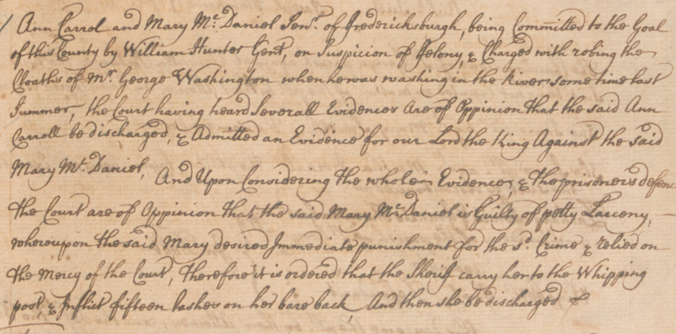
    At least once during his youth at Ferry Farm, probably in July 1750, George Washington went “washing in the river.”  We know this because Ann Carrol and Mary McDaniel were arrested and tried and one of them was even flogged for stealing valuables from his clothes while he was in the Rappahannock.  Of course, it seems quite safe to assume that young George swam in the river on many more occasions than this one moment chronicled in court records.

    The Rappahannock River at George Washington's Ferry Farm.
    The Rappahannock River at George Washington’s Ferry Farm.
    Document showing the outcome of a court case involving George Washington.  Ann Carrol and Mary McDaniel stole valuables from Washington's clothes while he was "washing in the river." Carol testified against McDaniel, who was convicted or petty larceny and "flogged fifteen lashes on her bare back."
    Document showing the outcome of a court case involving George Washington. Ann Carrol and Mary McDaniel stole valuables from Washington’s clothes while he was “washing in the river.” Carol testified against McDaniel, who was convicted of petty larceny and “flogged fifteen lashes on her bare back.”  Spotsylvania County Court Records, Order Book 1749-1755, Central Rappahannock Heritage Center.

    The court records say he was “washing in the river.” But was he bathing to get clean or swimming just for fun?  It’s hard to say.  In the 1700s, swimming was “rarely intended for hygienic purposes,” though, of course, it made a person clean.  Cleaning was not swimming’s intended purpose, however.  People went swimming largely to cool off during hot weather.  Still, the word “washing” in the court documents seems significant.  If Washington was bathing with the purpose of getting clean, his dip in the river was somewhat unusual for more than the fact that he fell victim to thieves.[1]

    How often did Washington and his fellow colonial Americans bathe to get clean?  The question’s answer is more complicated that you might imagine.

    First, the answer largely depends upon what we mean by the word bathing.  If we mean head-to-toe immersion in water and scrubbing with soap to get clean, then bathing was quite infrequent.  In the 1700s, many people feared immersing the body in water as a sure way to get sick.  American settlers came from Europe, where bathing occurred in public bathhouses for much of the early modern period.  Before the late 1800s, people did not understand that germs caused disease.  Instead, when they got sick, people sometimes blamed the bathhouses and bathing.  For much of the 18th century, this suspicion towards bathing “reflected medical theories about the dangers to a healthy body of extremes of heat, cold, wetness, and dryness.  Any extreme might disturb the delicate equilibrium of the body’s humors, temperature, and moisture.  Compared to the shock of immersion in water, dirt upon the skin seemed benign.”  In fact, some people believed dirt helped keep you healthy by “reinforcing the skin.”[2]

    Second, an immersive bath was simply a lot of hard work.  Unless you had servants or owned slaves to do that hard work, you carried water to the tub from your water source, perhaps a well, a spring, or a nearby stream, two buckets at a time.  Multiple trips would be necessary.  To warm the water, you had to use precious firewood to build a fire.  Building the fire and getting it started were not simple tasks either.  The incredible effort it took to bathe also explains why, when baths did actually occur, the same water was used by multiple people in the household.  The father bathed first, the sons next, then the mother and daughters, and finally the servants.[3]  To add to these practical difficulties, “tubs specifically made for bathing did not make an appearance in America” until the very late 18th century.[4]  As a result, daily cleaning for most of the colonial era was “accomplished by washing the face and hands . . . in one’s bed chamber, with a basin and a relatively small amount of water.”  We today might refer to this method as a sponge bath.

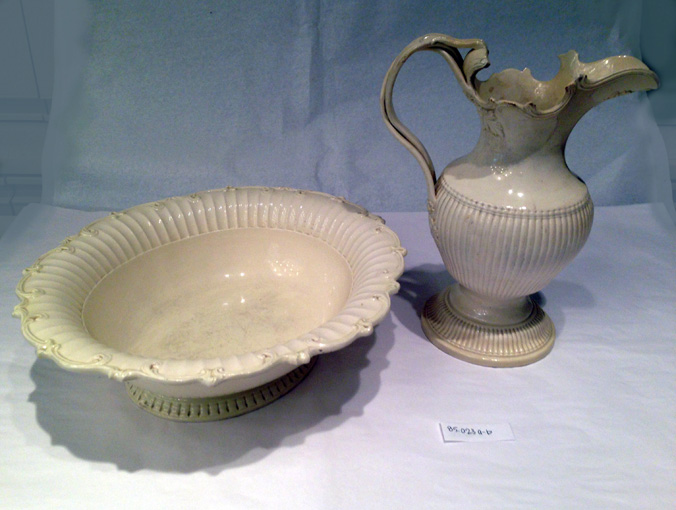
    Most early Americans washed daily using water from a pitcher and basin. Ornate sets similar to the one depicted would have been found in the homes of the wealthy like Fielding and Betty Lewis.
    Most early Americans washed daily using water from a pitcher and basin. Ornate sets similar to the one depicted would have been found in the homes of the wealthy like Fielding and Betty Lewis.

    “A bath in which the entire body was submerged, or showered with water, was generally taken for reasons of pleasure or preventive health maintenance, and in some cases, as a type of remedy for a particular affliction.”[5]  Immersive bathing for pleasure and health occurred in resort cities and towns at the sites of warm, mineral springs.  For example, George Washington, Fielding Lewis, and kin frequently trekked to Bath, Virginia (now Berkeley Springs, West Virginia) and both gentlemen owned property in the mountain resort.

    For most of the 1700s, washing from a basin remained the most common method for getting clean on a daily basis.  Indeed, it was so much the norm that when Elizabeth Drinker, a wealthy Philadelphia women, tried the new shower her husband built in the backyard, she wrote in her diary: “I bore it better than I expected, not having been wett all over at once, for 28 years past.”[6]

    Zac Cunningham
    Manager of Educational Programs

    [1] Dorothy A. Mays, Women in Early America: Struggle, Survival, and Freedom in a New World, Santa Barbara, CA: ABC-CLIO, 2004: 190

    [2] Kathleen M. Brown, Foul Bodies: Cleanliness in Early America, New Haven, CT: Yale University Press, 2009: 19-21.

    [3] Brown, 209.

    [4] Mays, 190.

    [5] “Bathing,” Thomas Jefferson Encyclopedia, Thomas Jefferson’s Monticello, www.monticello.org/site/jefferson/bathing [accessed February 10, 2015]

    [6] Richard L. Bushman and Claudia L. Bushman, “The Early History of Cleanliness in America,” Journal of American History, Vol. 74, No. 4 (Mar. 1988): 1214.

  • Perukes, Pomade, and Powder: Hair Care in the 1700s

    Editor’s Note: Looking back in time, people’s personal hygiene, fashion choices, medical treatments, and more sometimes look, at the very least, bizarre, if not outright disgusting.  When confronted with these weird or gross practices, our first reaction can be to dismiss our ancestors as primitive, ignorant, or just silly.  Before such judgments, however, we should try to understand the reasons behind these practices and recognize that our own descendants will judge some of what we do as strange or gross.  Here at George Washington’s Ferry Farm and Historic Kenmore, we’ve come to describe our efforts to understand the historically bizarre or disgusting as “Colonial Grossology.”  The following is the first in a series of “Colonial Grossology” posts that we’re offering on Lives & Legacies.

    Archaeologists at George Washington’s Ferry Farm have recovered a variety of hair care artifacts, including over 200 wig hair curlers.  These baked clay curlers were used exclusively to curl wig hair, and formed part of the Washington family’s regimen of wig maintenance.  The regimen included several practices that might seem strange or gross to us today.

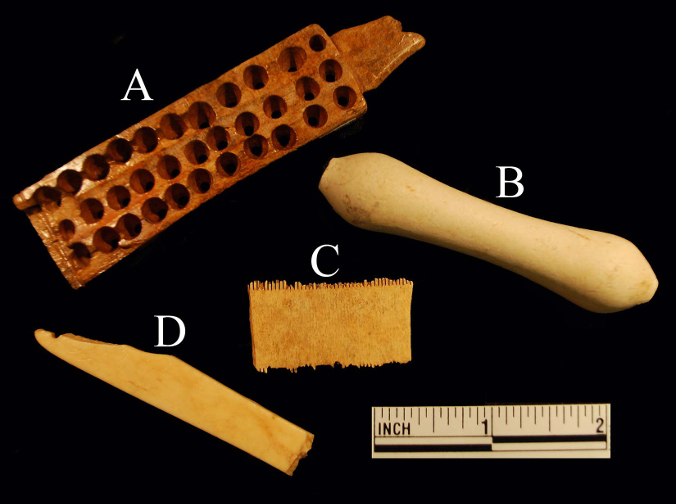
    Artifacts from Ferry Farm related to eighteenth-century hair care.  A) A woman’s bone hair brush, used on natural (not wig) hair.  B) An earthenware wig hair curler, made c. 1740-1780.  C)  A bone grooming or “lice” comb.  D)  A bone razor guard, used by men to shave their facial hair and to shave the head to accommodate a tight-fitting peruke.
    Artifacts from Ferry Farm related to eighteenth-century hair care. A) A woman’s bone hair brush, used on natural (not wig) hair. B) An earthenware wig hair curler, made c. 1740-1780. C) A bone grooming or “lice” comb. D) A bone razor guard, used by men to shave their facial hair and to shave the head to accommodate a tight-fitting wig.

    Powdered wigs, or ‘perukes’, were highly fashionable among gentlemen of the 1700s, and a few affluent households even insisted that their butlers and coachmen wear them.  Some gentlemen, including George Washington, opted not to wear a peruke.  To remain fashionable these men often styled their own hair to resemble a wig.

    George Washington, 1796, by Gilbert Stuart [Public Domain].  His hair was pomaded and powdered by his personal valet.
    George Washington, 1796, by Gilbert Stuart [Public Domain]. His own hair, not a wig, was pomaded and powdered by his personal valet to look as if he were wearing a wig.
    Human hair was often used to make these wigs, but horsehair, cow, goat, yak, and sheep hair provided economical options for consumers on a budget.  Owners of perukes made from human hair were often anxious about their quality:  it was a widespread concern that the hair of criminals, cadavers, prostitutes, or even plague victims was used to construct wigs.

    Throughout the 1700s, whether it was a person’s own hair or a peruke, pomade or pomatum was applied before wigs were powdered.  The word ‘pomade’ derives from the Latin word for apple, “pomum,” – since early recipes incorporated apples.   One recipe combined a pound of sheep suet (fat) with one pound of pig suet.  Sixteen rosewater-boiled apples were added.  Fragrance then enhanced this mixture, and might include some combination of rosewood oil, bay leaves, bergamot orange, or Macassar oil.  Such fragrances helped to lengthen the interval between hairdressing sessions and counteracted any rancid odors.

    Powder was typically made from wheat flour or dried white clay.  Beanmeal or cornflour was also used.  Powder was often enhanced by fragrances, such as those of orange flowers, rose petals, nutmeg, ambergris, jasmine, orris root, or lavender.

    A hairdresser or personal valet added the powder, which was freshly applied every morning, or each time a wig was donned.  The combination of lard and powder produced rigid curls and stiff hair styles.  Powder made hairstyles heavier: as much as two pounds heavier for the large periwigs popular until the 1730s[1]. A few households featured ‘powder rooms:’ a small room set aside for the application of powder.  A power bellows, a ‘carrot’[2], a swan-down puff, or comb was used to dust hair with powder.  White or grey powders were especially popular, but adventurous consumers might use black, blue, lavender, pink, red, or yellow.

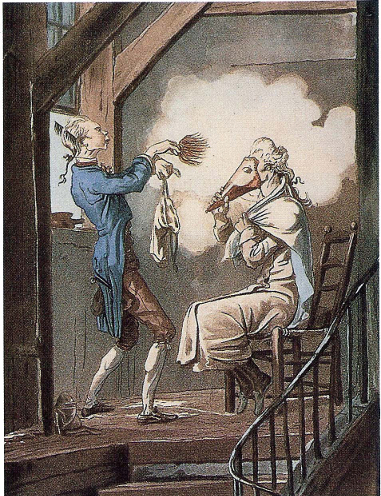
    A gentleman being powdered by his valet.  A cone protects the gentleman’s face during the process.  Powder was made from starch, often wheat flour, or powdered white clay.  The Toilette of the State Prosecutor’s Clerk, c. 1768 by Carle Vernet.
    A gentleman being powdered by his valet. A cone protects the gentleman’s face during the process. Powder was made from starch, often wheat flour, or powdered white clay. The Toilette of the State Prosecutor’s Clerk, c. 1768 by Carle Vernet.

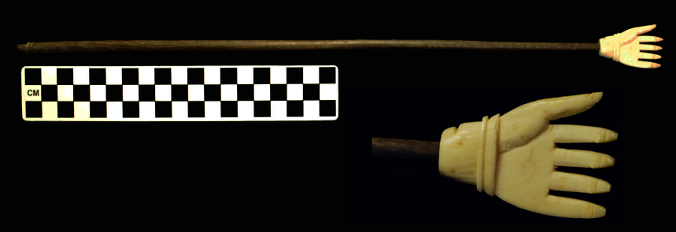
    Hairdressers could remove wigs to apply pomade and powder in a separate space, a convenience for wig wearers that men who only wore their own hair likely envied.  Men who did wear their own hair used a hairnet to preserve their pomaded locks overnight.  Each morning[3], a valet combed out the previous day’s pomade and dirty powder, before applying fresh pomade and powder.  This process could take an hour or more.  Many hairstyles remained undisturbed for weeks.  Headscratchers were kept close at hand: they allowed people to itch their scalps without disturbing their hairstyle too dramatically.

    An ivory-handled head scratcher and closeup [inset]. Personal collection. Used with permission
    The beginnings of this fashion trend were inspired by disease and lice.  Most people did not wash their hair very often.  Syphilis was rampant in Europe throughout the colonial period.  Symptoms such as hair loss, scabs, and rashes could be partially hidden beneath a voluminous wig.  The prevalence of highly contagious head lice, and the difficulty in exterminating them, also encouraged the adoption of false hairpieces.  In order to insure a good fit, gentleman shaved their heads, eliminating the hairs upon which lice thrived.  While cleaning lice from one’s own hair could be time-consuming, wigs could be conveniently removed – and boiled to eliminate pests and dirt.  However, if wigs were not properly maintained, they could become a haven for a variety of pests.

    To us today, the wearing of wigs covered in animal fat along with wheat flour or dried white clay may seem bizarre or disgusting or both.  Still, to the people of the time the reasons behind the practices made perfect sense.  Which of today’s perfectly sensible fashion choices might our descendants living 200 years in the future find strange or gross or both?

    Laura Galke
    Archaeologist, Site Director/Small Finds Analyst


    [1] Periwigs took as many as ten heads of hair to produce.
    [2] This was a carrot-shaped, wooden tube from which powder was blown onto the hair.
    [3] Ideally fresh pomade and powder were freshened each morning.  Frugal gentlemen might wait a week or more.