Lives and Legacies

Category: Developing America

  • Corncrib: A Building as Corny as it Gets

    If you have followed the news of our excavations, you will have kept up to date with our building finds. The past two summers helped uncover evidence of one such structure, which we now believe represents a corncrib. While the name may seem self-explanatory, we have frequently heard the question, “What is a corncrib?”  To answer this, we thought we would dedicate our newest blog to it.

    Indian Corn Source: Wisconsin Horticulture

    Corn as a Crop

                Long cultivated by Native Americans, early colonists quickly adopted corn into their agricultural repertoire. As a crop, corn proved easy to cultivate due to its hardy and adaptable nature, and its high yield to seed ratio made it a prosperous choice. The corn season lasted from planting in early May to the September-October harvest. After this, collected corn, counted as barrels, lay in corncribs. Husking and shelling occurred as needed since home consumption only required a small amount at a given time. This process continued throughout the winter months. 

                As a food staple, corn became an important part of free and enslaved diets in Colonial Virginia. Corn grew in such abundance that it reportedly fed everything. This led to Virginia husbandry relying on the crop and any decline in quantity led to a state of distress. As for the enslaved, records of food rations allotted to enslaved communities often refer to “pecks” or “bushels” of corn. Corn served as a useful ration since small amounts went far and multiple uses for it existed. It also provided better nutrition, which did not go unnoticed by enslavers. Instances of enslaved rations excluding corn resulted in a decline in health, energy, and production. This made the inclusion of the staple essential.  

    Despite their forced labor, enslaved communities integrated corn harvesting into their culture. Annual so-called corn shucking festivities proved frequent sights on plantations, especially as corn production expanded. During this time, the harvested corn lay in heaps next to the crib. As the size of the harvest required many people for husking, this event provided time for socializing. A moment filled with music and dance, even neighboring enslaved individuals and relatives not attached to the property could attend under the guise of providing extra labor. This latter detail explains why such gatherings went ahead. Enslavers often encouraged corn-shucking festivities to speed up the process and at times offered rewards to the person who could shuck the most corn.

    Corn Shucking, Virginia, 1840s Source: Slavery Images

                The expansion of corn production lies in the decline of tobacco. While tobacco served as the original cash crop of Virginia, its cultivation damaged soils, resulting in increasingly poor crop cycles. Some planters, including George Washington at Mount Vernon, opted to plant grains to avoid this trend and thus have more return each year. As tobacco prices fell in the late 1700s, due in part to the Revolution, more Virginia planters turned their focus to grains. This led to an expansion in corn cultivation, as it became a central part of the economy.

    No longer used for just animal feed or local consumption, corn became a cash crop. In doing so, more structures related to grains appeared or underwent expansion. Gristmills became more common as did grain stores near wharfs. On plantations, the land devoted to grains increased to sustain production with additional or larger storage buildings, such as corncribs, appearing to accommodate the harvest. Corncribs would soon rank amongst the most common structures to appear on farmlands. Apart from buildings, husking and shelling additionally underwent a change as this now occurred over the course of a few weeks, thus allowing for enslaved gatherings, rather than throughout the winter.

    Corncrib

                With corn holding such an important position in society, it required proper storage. Native Americans constructed the first corncribs with Europeans taking note of them shortly after arriving on the continent. The structure evidently held significance for indigenous tribes as many place and group names derive from the various words for a corncrib. Interestingly, our modern term “barbecue” comes from “barbacoa,” an indigenous term from present-day Georgia, which has several meanings including corncrib. Apart from ranging in size, the design of corncribs dating from pre-contact to present appear very similar, as several key elements remain consistent.

    The main roles of a corncrib constitute storing harvested corn, protecting it, and keeping it dry. To that end, the most recognizable characteristic involves the floor of the structure resting at least a foot off the ground via posts or piles/piers. Raising the structure deterred vermin from accessing the crop and helped keep it dry. The design of the sides additionally helped with this latter desire as vertical slats or offset horizontal siding provided gaps for airflow. Vertical slats for “cribbing” proved the most common during the colonial period.
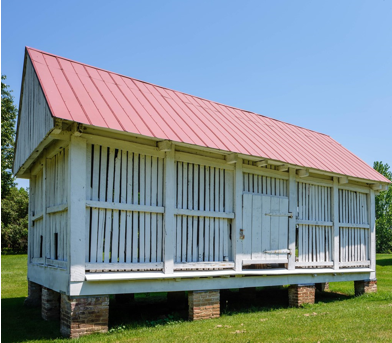
    Corncrib raised on piers with vertical slats Source: Thomas Stone National Historic Site

    Overall, the structure required robust timbers and construction techniques that would allow it to carry dead loads and resist interior pressure. Once constructed, the building generally took on a rectangular shape with a gabled roof of shingles, boards, or thatch. This roof could extend over one or more sheds attached to the long sides of the building while a door, typically on a shorter side, provided interior access. The interior varied from an open plan to one with removable dividers to form cribs, hence the name of the structure. Post-colonial era designs could include an additional crib to form a double or “drive-thru” corncrib.
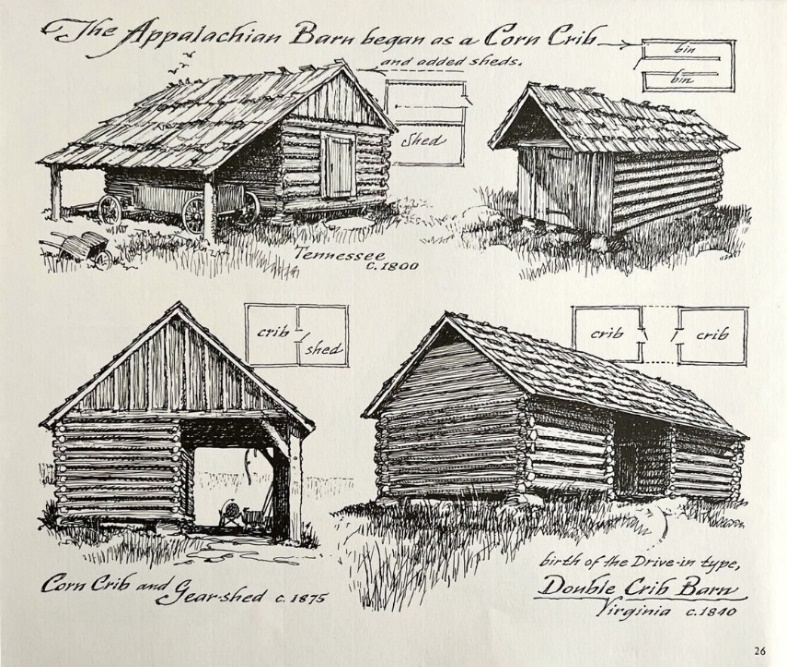
    Corn Crib Designs Source: Sloane 1990: 26

    Since its adoption by colonists, the building’s name has experienced some variation. While we have gone with “corncrib” at Ferry Farm, several other accurate terms exist. The most simple, and unhelpful for interpreting records, consists of “barn.” During colonial times, “barn” could refer to nearly any outbuilding, and corncribs fall under a barn style called “crib-barns.” This, in turn, may refer to the building. While no standard for outbuildings included on properties existed during this time, corncribs counted amongst the most common. Other name options include the similar “corn-house” and the term “stacks.” This latter term may or may not have “corn” attached to it, but referenced ability to relocate the structure. In the end, unless corn appears in the name, identifying the building requires context clues such as location, crop knowledge, structure design, and recorded narratives.

    Our Findings

                So what did we find to suggest we had a corncrib? To start, we know from documents dating to Washington occupation that corn constituted one of the crops grown at Ferry Farm. We knew little beyond this until archaeology provided an insight. Across our 2020 and 2021 field seasons, we uncovered four aligning postholes that each measured 10ft apart. At the same time, a decline in artifact count occurred, suggesting our dig lay on the outskirts of the work yard. In 2022, we expanded this dig area to determine if the postholes belonged to a fence or, as we hoped, a building. The low artifact count continued to support the theory of entering the agricultural world and we soon discounted a fence line, as our excavation revealed no further postholes on that line. Moving 20ft south from the postholes, we uncovered a line of three features, also 10ft apart, which aligned with the first three postholes. The issue? They came from piles/piers rather than posts, and one of the stones for that line remains in place (Fig. 5).

    Image depicting the lines of 4 postholes and 3 pile/pier sites as of 2022

                The two parallel lines evidently went together, but we now needed to identify a structure that used both building techniques. After perusing historic images and sources on 18th century agricultural buildings, we identified the corncrib as the only structure that fit this construction. While corncribs most often stand alone on piles/piers or posts, some examples include an open shed area for carts and temporary storage as discussed earlier. Neither part of the structure would have led to large artifact deposits as the crib merely stored corn while the shed area supported the act of storage.

                So what did our corncrib look like? Well, apart from identifying the crib and shed portions, we can say the crib must have rested at least a foot off the ground. Furthermore, in keeping with standard construction, the siding, likely vertical slats, would have breaks in between to allow airflow. As for the basic dimensions of the corncrib, our emergency access road unfortunately runs through the unexcavated portion.

    Since we cannot inhibit this access, we only have the complete outline of the shed and one side of the crib (Fig. 6). Still, we can make a few estimates for the structure’s dimensions. While we cannot determine height at this stage, the outline of the shed indicates this portion measured 20x30ft. This, in turn, tells us that the corncrib itself measures 30ft in length. As for the crib’s width, several details allow us to determine a range. One source stated that the length of a corncrib should be 2-3 times the width. Of the examples we identified, they generally had a length about twice the size of the width, with the widest one measuring 20ft. On top of this, shed portions do not appear much wider than the accompanying crib. With this in mind, our crib likely measures 15-20ft in width.

    Overview of excavation site showing the 20x30ft shed outline and start of the crib

    Future

                By now, you must wonder when you will see a corncrib at Ferry Farm. One of our goals involves reconstructing the Washington landscape and this will include the corncrib. Currently, we have started construction on a root cellar and slave quarter. Once completed, these structures will be part of your visit and we will turn our attention to reconstructing more areas. This may include the corncrib, but will likely take a few years. In the meantime, continue to visit our ongoing construction projects and make sure to talk with the archaeologists and interpreters.

    Our future corncrib may look similar to this small one at the Museum of Appalachia Source: Wikipedia

    Historical Fact: Those familiar with the life of Harriet Tubman may recognize the term “corncrib” as she, her brothers, and several others briefly hid in one while she led them to freedom.


    Emma Schlauder

    Research Archaeologist


    Belanger, Fergus & T. H. Warner   1934     Notes about Williamsburg and William and Mary College. The William and Mary Quarterly 14(3): 239-240.

    Carson, Cary & Carl Lounsbury (editors)   2013     The Chesapeake House: Architectural Investigation by Colonial Williamsburg. The University of North Carolina Press, Chapel Hill, NC.

    Carter, Landon  1908     Diary of Col. Landon Carter. The William and Mary Quarterly 16(3): 149-156.

    Chandler, Dana 2000     The Prehistory of Randolph County, Alabama. Central States Archaeological Journal 47(1): 28-29.

    Copeland, Pamela C. & Richard K MacMaster 1989     The Five George Masons. University of Virginia Press, Richmond, VA.

    Harriet Tubman Underground Railroad Byway  2023     25. Choptank Landing: Site of Harriet Tubman’s Most Daring Rescues. Harriet Tubman Underground Railroad Byway < https://harriettubmanbyway.org/choptank-landing/&gt;. Accessed 19 June 2023.

    Herman, Bernard L.  1992     The Stolen House. University Press of Virginia, Charlottesville, VA.

    Hollingsworth Jr., G. Dixon  1979     The Story of Barbecue. The Georgia Historical Quarterly 63(3): 391-395.

    Katz-Hyman, Martha B. & Kym S. Rice (editors) 2011     World of a Slave: Encyclopedia of the Material Life of Slaves in the United States. Greenwood, Santa Barbara, CA.

    Kimball, Fiske  1954     Gunston Hall. Journal of the Society of American History 13(2): 3-8.

    Lanier, Gabrielle M. & Bernard L. Vlach  1997     Everyday Architecture of the Mid-Atlantic: Looking at Buildings and Landscapes. The John Hopkins University Press, Baltimore, MD.

    Linebaugh, Donald W. 1994     “All the Annoyances and Inconveniences of the Country”: Environmental Factors in the Development of Outbuildings in the Colonial Chesapeake. Winterthur Portfolio 29(1): 1-18.

    Lounsbury, Carl R. (editor) 1994     An Illustrated Glossary of Early Southern Architecture and Landscape. University Press of Virginia, Charlottesville, VA.

    Morgan, Philip D.  1998     Slave Counterpoint: Black Culture in the Eighteenth-Century Chesapeake & Lowcountry. The University of North Carolina Press, Chapel Hill, NC.

    NPS 2021     Barnyard Trail: Corn Crib. Fire Island National Seashore, NPS <https://www.nps.gov/ places/barnyard-trail-corn-crib.htm>. Accessed 24 May 2023.

    Siener, William H. 1985     Charles Yates, the Grain Trade, and Economic Development in Fredericksburg, Virginia, 1750-1810. The Virginia Magazine of History and Biography 93(4): 409-425.

    Sloane, Eric 1990     An Age of Barns, reprint of earlier edition. Henry Holt & Co., New York City, NY.

    Speck, Frank G. 1907     Notes on the Chickasaw Ethnology and Folk-Lore. The Journal of American Folklore 20(76): 50-58.

    Stilgoe, John R. 1982     Common Landscapes of America, 1580-1845. Yale University Press, New Haven, CT.

    Wells, Camille 1993     The Planter’s Prospect: Houses, Outbuildings, and Rural Landscapes in Eighteenth Century Virginia. Winterthur Portfolio 28(1): 1-31.

    Upton, Dell & John M. Vlach (editors)  1986     Common Places: Readings in American Vernacular Architecture. The University of Georgia Press, Athens, GA.

    Vlach, John M. 1993 Back of the Big House: the Architecture of Plantation Slavery. The University of North Carolina Press, Chapel Hill, NC.

    Washington, Augustine Jr. 1750  Record of Sale and Payment to Mary Ball Washington.

    Washington, George  1749 Letter to Lawrence Washington dated 5 May 1749. Washington Papers, National Archives, Washington, DC.

    Washington, George  1771 Survey of Ferry Farm.                 

    Washington, Mary Ball Undated     Letter to John Augustine Washington, undated no. 154. Box: 87, Folder: undated no. 154, Identifier: RM-904; MS-5404, The George Washington Presidential Library at Mount Vernon, Mount Vernon, VA.
  • “To Rendezvous at Fredericksburgh”: The Washington-Lewis Family, Fredericksburg, and the World War of 1754-1763: Part I

    Editor’s Note: As the two-hundred-sixty-ninth anniversary of the skirmish of Jumonville Glen approaches this Sunday, May 28th, some recent and exciting discoveries have occurred at the battlefield.  The National Park Service (NPS) released an announcement this week stating that after a four-week archeological investigation, objects have been found to verify the location of the first skirmish, Jumonville Glen, of the French and Indian War.  Archeologists found a multitude of artifacts, including several eighteenth-century musket balls.    

    Check out the links for more information:

    NPS :Recent archaeology project uncovers first shots of the French and Indian War

    Archaeological dig in Fayette confirms location of Jumonville Glen skirmish

    Scientists find 1754 ballistics of first shots fired in French and Indian War

    On to the the history…


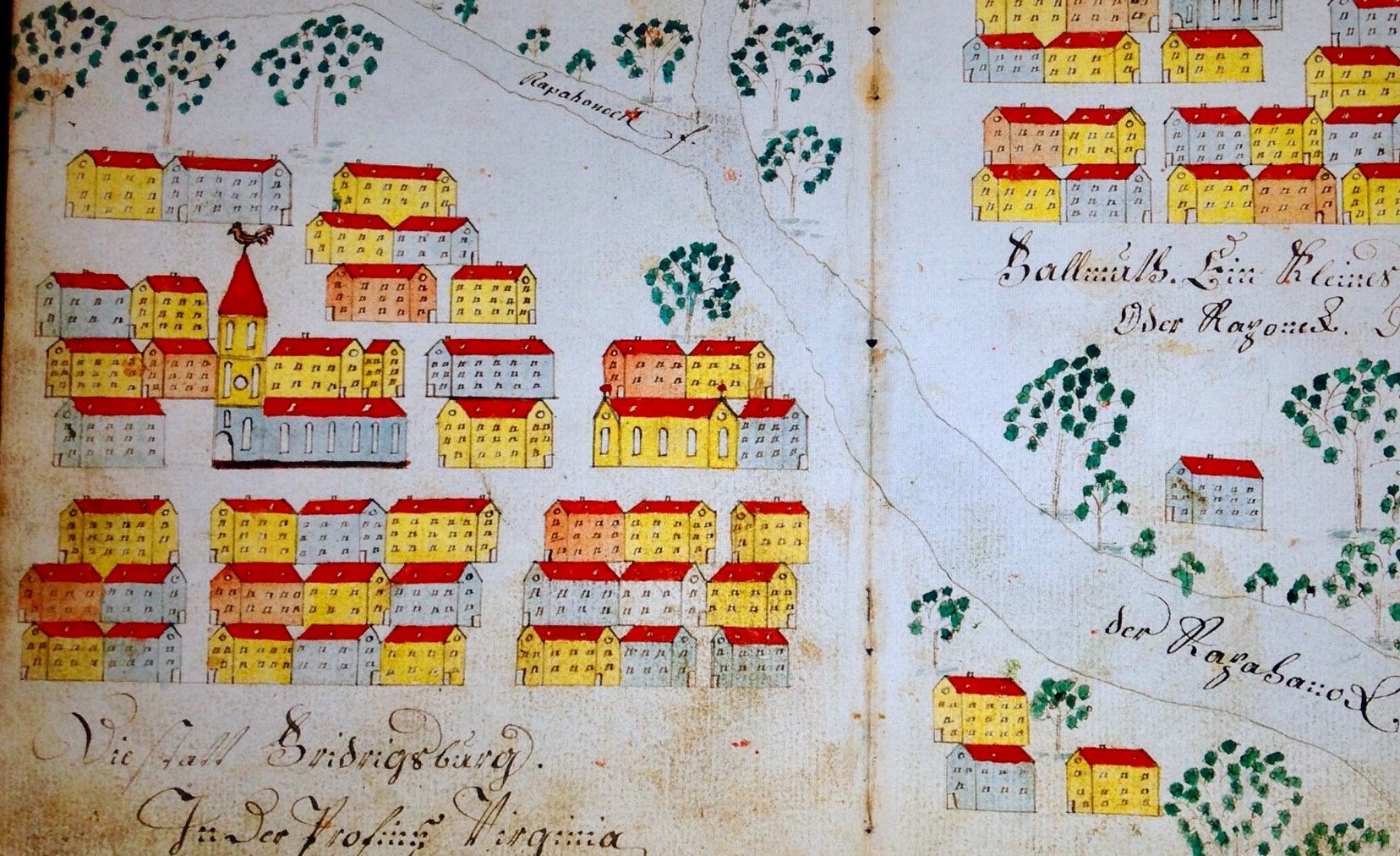
    Figure 1. Detail of a highly stylized depiction of Fredericksburg, VA by Fench soldier Georg Daniel Flohr, who visited in 1782. Despite the use of artistic license, the illustration conveys Flohr’s perception of the 18th Century town as a “rather large” port with “intense boat traffic.” Source: Account of the Land and Sea Expedition in America of the Acclaimed DeuxPonts Regiment from 1780 to 1784

    Crowding out the fresh spring air of a wooded countryside, the acidic scent of aerosolized gunpowder began to sting the interior of a nervous 22-year-old’s nostrils. His ears rang from the shock of dozens of nearby explosions. Smoke clouded his vision, and sensory overload likely clouded his judgment. Soon-to-be-familiar sounds followed rapidly: scurried movement, intense chatter, and groans of agony. Yet, the inexperienced youth had to make decisions on behalf of the crowd around him. He found himself at the center of a new form of chaos: the opening volleys of a world war.

    Lieutenant Colonel George Washington’s Virginia soldiers had just fired into a French military camp near the Monongahela River in western Pennsylvania at a moment (May 28th, 1754) when peace among European empires and Native American nations sat at a precarious equilibrium. Over the past several months, French forces had been busy erecting Fort Duquesne at the Forks of the Ohio River (the site of modern-day Pittsburgh, PA). Royal Governor Robert Dinwiddie of Virginia considered this commercially and strategically significant location part of the British Empire and sent Washington to the area to help re-establish British control. This was the context in which Washington’s Virginians and a party of Mingo warriors came upon the ill-fated French camp in a ravine soon to be known by the infamous moniker of “Jumonville’s Glen.”[1]

    After the first shots rang out around the glen, things only got worse. Washington’s cocommander, Tannagrison (a Seneca politician leading the party of Mingos), summarily executed the French officer in command, Ensign Joseph Coulon de Villiers, Sieur de Jumonville, and events escalated from there. In fact, this frontier skirmish grew into a world war that would not only give rise to the North America of the Revolutionary Era, but would forever alter the power dynamics of entire globe. Consider the growth of the British Empire, two centuries of exploitation and resistance in India, the birth of the United States, the creation of independent republics in Latin America, the French Revolution, English colonization of Australia, the American Civil War, the Assassination of Archduke Ferdinand, the rise of the Axis Powers, the Vietnamese independence movements of the 20th Century, and even the
    War on Terror. The conflict that Washington and Tannagrison started at Jumonville’s Glen, known as the“Seven Years’ War” or the “French and Indian War” (1754-1763), shaped all these events, along with countless others. And as residents of the Fredericksburg region, the Washingtons and Lewises sat at a crossroads of this worldwide upheaval.

    As the 250th anniversary of American nationhood approaches, understanding the Seven Years’ War’s social, martial, and political context is perhaps more important than ever. In anticipation of future posts related to this subject, I hope what is below will introduce you to how the stories of those associated with Kenmore and Ferry Farm intertwined with the larger story of the war.

    We’ll start with George. As an officer commissioned in the provincial (colonial) Virginia Regiment, George Washington not only helped initiate the Seven Years’ War but saw his first real military service at places like Fort Necessity or as a volunteer aid-de-camp in the ill-fated Braddock Expedition of 1755, where he nearly died during the famous British defeat at Battle of the Monongahela. Of course, historians have worn countless pens, pencils, and keyboards recording Washington’s involvement in the early stages of the war and documenting the future Commander-in-Chief’s first brushes with combat. However, George’s duties increasingly involved more independent responsibility after 1755. These events came on the heels of George’s formal relocation from his mother, Mary Washington’s, residence at Ferry Farm to his late half-brother’s estate at Mount Vernon.

    The two years that followed George Washington’s more well-known deeds at the Monongahela produced circumstances similar to those he would contend with during the American War for Independence (1775-1783). Throughout 1756 and 1757, the Virginia Regiment had to defend a string of small, isolated forts along Virginia’s vulnerable frontier to the west of the Blue Ridge Mountains.[3] The task of managing poorly-supplied posts that stretched from Winchester, VA, to the vicinity of modern-day Martinsville, VA, presented George with the opportunity to develop three aspects of leadership that would define his work in future years: military administration over vast geographical territory, long-term strategic planning, and the sustaining of volunteer troops despite strained logistical resources.

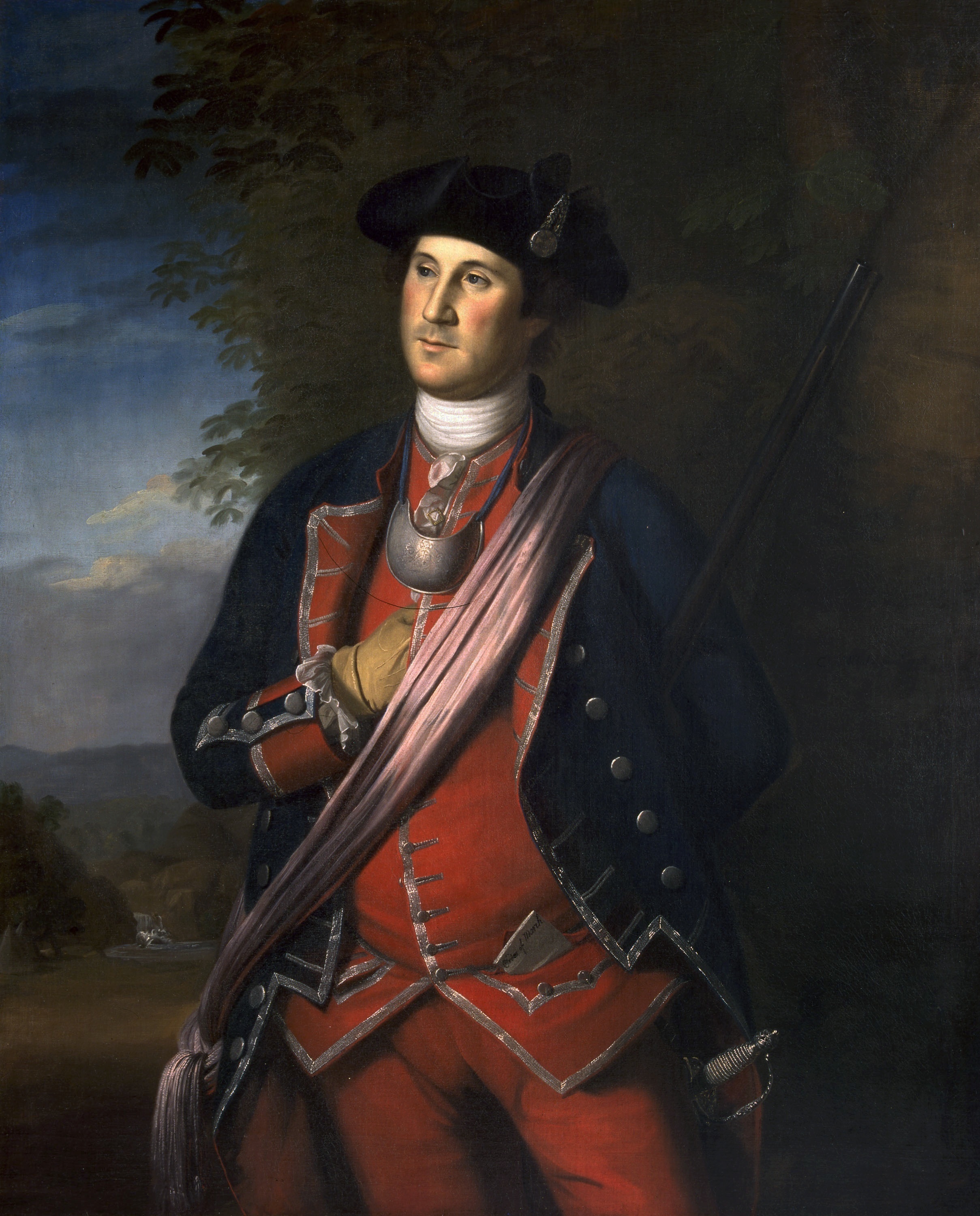
    Figure 2: a 1772 portrait Charles Wilson Peal depicting Washington in a uniform similar to those worn by officers of the Virginia Regiment Source:Washington and Lee University

    During a tour of Virginia’s frontier forts, the “bad regulation of the militia; the disorderly proceedings of the Garrisons; and the unhappy circumstances of the Inhabitants” shocked the young officer.[4] Washington filled his correspondence of this era with phrases such as “inconceivable trouble” and “unhappy Juncture” as he recorded innumerable instances of paucity, civilian death, and desertion.[5]

    Washington’s struggles continued into 1758 when the Virginia Regiment became involved in the Forbes Expedition, a laborious campaign that eventually resulted in the British capture of Fort Duquesne. Around that time, the needs of sick veterans of the past three years of fighting, marching, and garrison duty presented further challenges. None other than Fielding Lewis, a young Fredericksburg merchant and husband of George’s sister Betty, agreed to contract with his brother-in-law to provide for Virginia’s ill. That June, for instance, Lewis sent the material for 60 blankets to “Colo. Washington for the Country Dr.”[6]

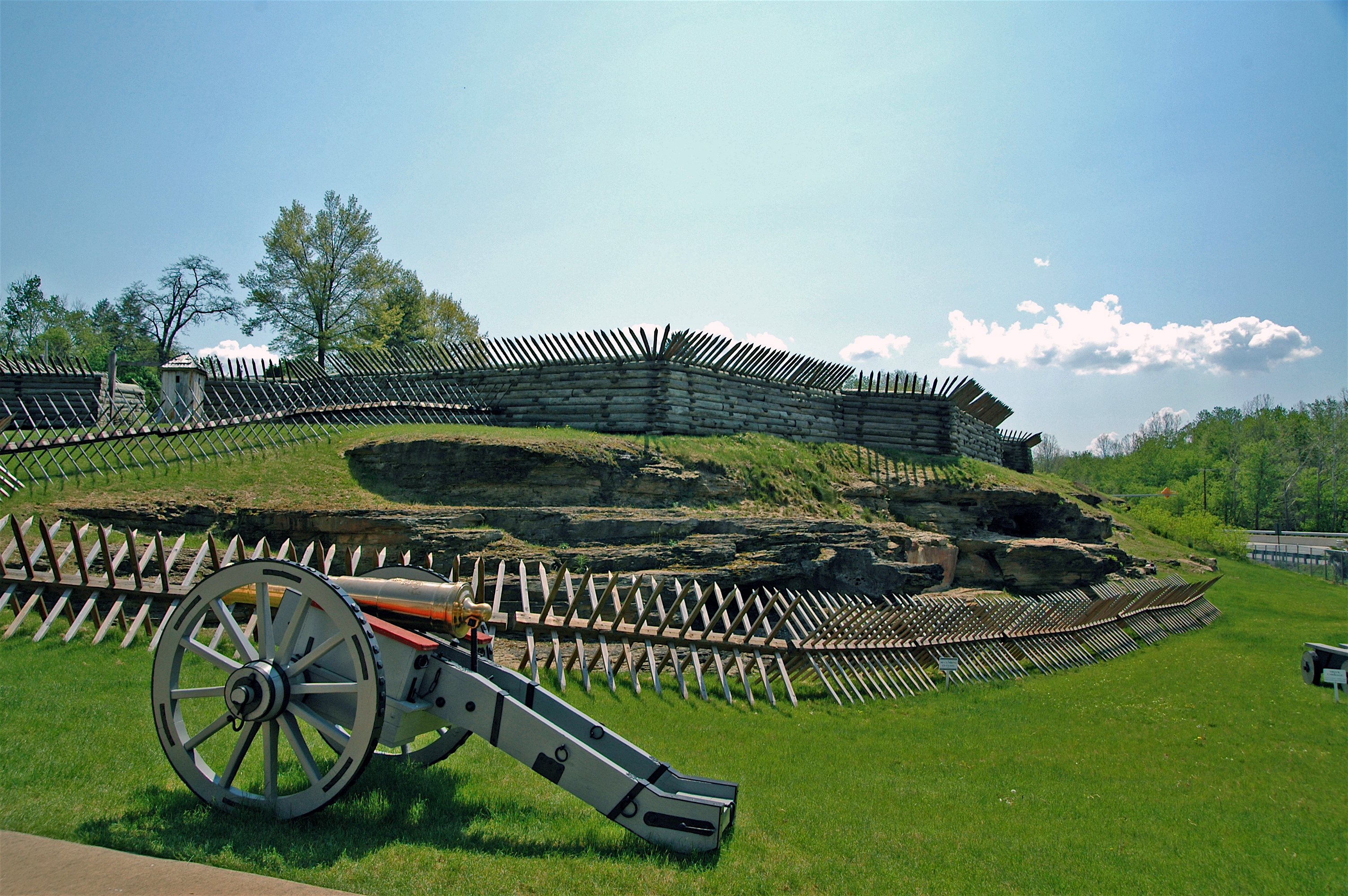
    Figure 3: View of reconstructed fortifications at Fort Ligonier, the centerpiece of the 1758 Battle of Loyalhanna, an important part of the Forbes Expedition. Source: Jeff Kubina via flickr

    As a businessman with a growing family, Fielding Lewis must have had more reason than most to fear the potential adverse effects of world war upon his trans-Atlantic commercial ventures. However, as British fortunes began to change for the better, Lewis reaped the benefits of citizenship in a growing empire. Before the war’s end, he was conducting a lucrative speculation business at a fair in Fredericksburg.[7] Lewis’s success eventually provided the means to commission the construction of Historic Kenmore.

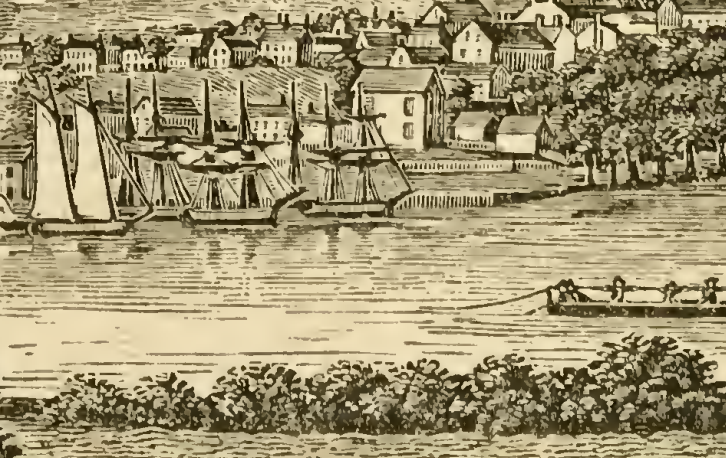
    Figure 4: Detail of an 1845 illustration of Fredericksburg as seen from Ferry Farm, showing tall ships by the town’s wharves.. Fielding and his father John invested in several merchant vessels, the towering masts of which were once common parts of Fredericksbrug’s cityscape. Source: Internet Archive

    Of course, learning about wealthy and influential men like Washington and Lewis is easy. However, countless individuals of all social standings played a part in the drama of the Seven Years’ War. Part II of this post will explore how those on the Homefront coped with world war and how the conflict transformed the community of Fredericksburg in ways still visible today.

    Stay tuned.

    Ethan Knick,

    School and Youth Programs Manager


    [1]David Lee Preston, Braddock’s Defeat: The Battle of the Monongahela and the Road to Revolution (Oxford University Press, 2015), 26-28.

    Fred Anderson, Crucible of War: The Seven Years’ War and the Fate of Empire in British North America, 1754-1766 (Knopf Doubleday Publishing Group, 2007), 18-23.

    [2] Preston, Braddock’s Defeat, 28-29.

    [3] George Washington, The Papers of George Washington: Colonial Series, vol. 4:November 1756 – October 1757, (University Press of Virginia, 1983).

    George Washington, The Papers of George Washington: Colonial Series, vol. 5: October 1757-September 1758, (University Press of Virginia, 1983).

    [4] George Washington, “Founders Online: From George Washington to Robert Dinwiddie, 9 November 1756” (University of Virginia Press), accessed February 7, 2023, http://founders.archives.gov/documents/Washington/02-04-02-0001-0001.

    [5] George Washington, “Founders Online: From George Washington to Robert Dinwiddie, 11 July 1757” (University of Virginia Press), accessed February 2, 2023, http://founders.archives.gov/documents/Washington/02-04-02-0193.

    [6] Fielding Lewis, “Founders Online: To George Washington from Fielding Lewis, 10 June 1758” (University of Virginia Press), accessed February 6, 2023, http://founders.archives.gov/documents/Washington/02-05-02-0154.

    [7] Martha Saxton, The Widow Washington: The Life of Mary Washington (Farrar, Straus and Giroux, 2019), 192.

    George Washington, “Founders Online: Cash Accounts, 1761” (University of Virginia Press), accessed January 30, 2023, http://founders.archives.gov/documents/Washington/02-07-02-0001.

  • You’ve Got Mail: Development of the Colonial Postal Service in Virginia

    The sending of a letter in Colonial America was more challenging than today.  The concept of post offices and regularly scheduled mail arrivals and departures evolved slowly in the colonies.  Colonial mail faced many obstacles.   Geography, political opposition, and a general lack of interest hindered a national system that serviced all the colonies. 

    How to Get a Letter Sent                                    

    While not impossible to get a letter sent, the question was, would it arrive?   There were two main ways to send your letter: send someone you know or pay someone else to deliver your correspondence for you.

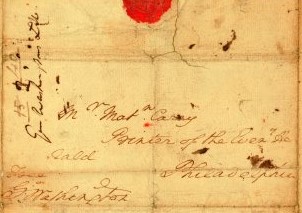
    We will call these two types of mail delivery private and public systems.  A private system means that the sender and the recipient knew the mailing source.  For example, you might entrust your letter to be delivered by an acquaintance, family member, or servant.  You would put your mail in the hands of someone you knew who happened to be traveling in the direction of the addressee, be it across town or the colonies.  In such cases, the letter was delivered free of charge.[1] 

    A public system consisted of a letter being passed through a series of people unknown to the sender, with postage paid by the sender.  This was an informal arrangement where strangers, for a fee, carried letters for people to specific destinations.   This would eventually evolve into what we now recognize as the postal system. 

    Artist Lloyd Branson depicts a colonial mail carrier in this partial view from his painting “Transporting Mail”.Credit: Smithsonian’s National Postal Museum

    English Colonies

    The history of mail service in America is complicated.  It took over one hundred years to evolve into a true American Postal System.  In the beginning, the English government established the “Royal Mail” in 1660.[2]    Under the Act of 1660, the price to send a single letter was two pence for “fower score English miles,” or threepence for greater distances.[3]  The colonies did not have an official postal service until King William and Queen Mary appointed Thomas Neale to create one in 1691.  This patent established an officially-designated letter depot or post office, but there was no inter-colony service until later.

    Mail in Virginia

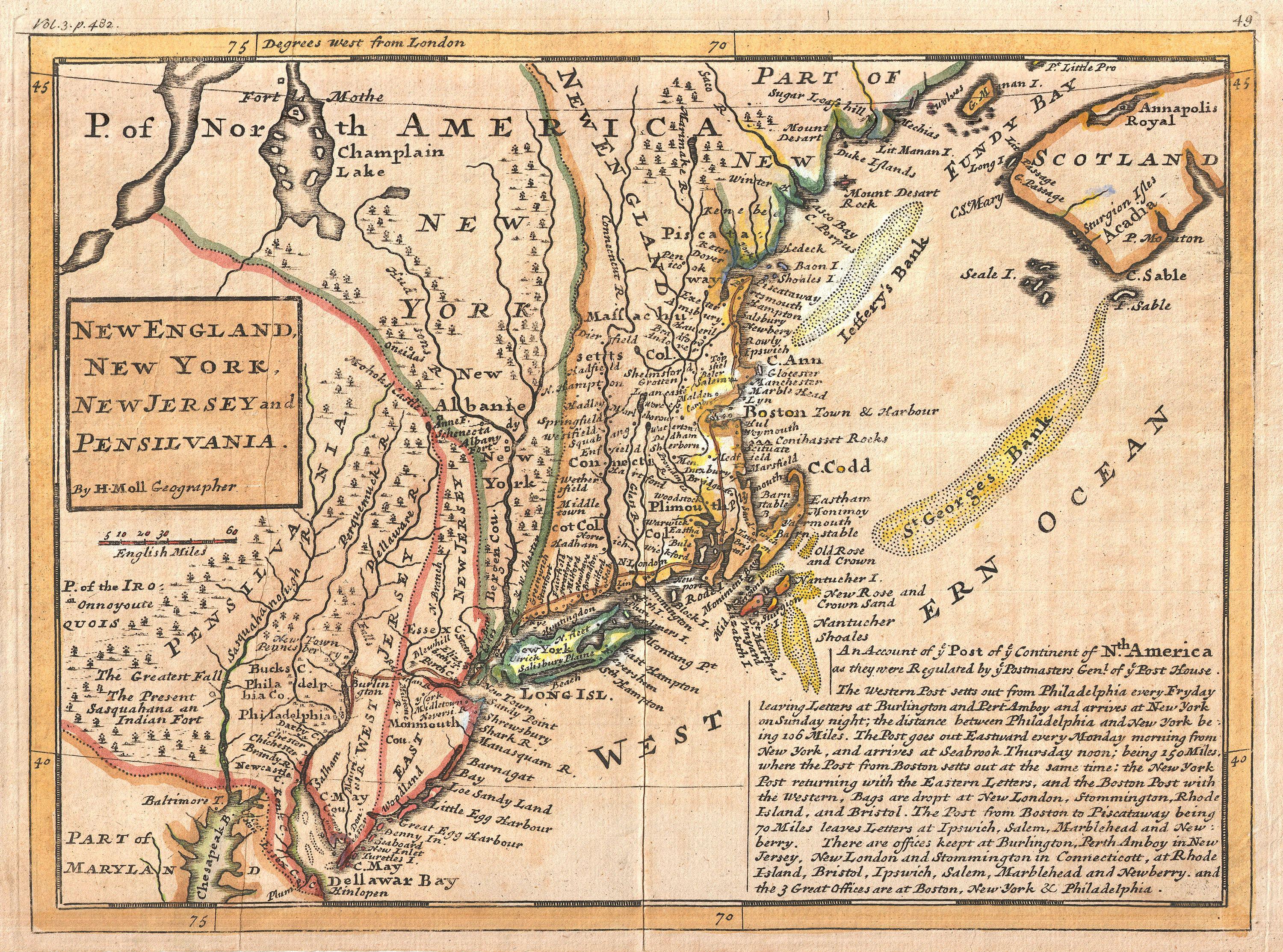
    Shortly after his appointment Thomas Neale chose Andrew Hamilton of New Jersey as a resident deputy.  Hamilton established regular service in the North between Boston, New York, and Philadelphia.[4]

    1729 Moll Map of New York, New England, and Pennsylvania (First Postal Map of New England). Credit: Wikimedia Commons

    Hamilton was eager to continue establishing service to the Southern states of Virginia and Maryland.  However, his application to extend the post to Virginia was not accepted with enthusiasm.  Virginia didn’t find a need to link up to a more costly overland inter-colonial mail service because their mail could travel by the schooners and tobacco ships.[5]

    Lieutenant governor Alexander Spotswood persisted in starting a post-service in Virginia.  In 1717, Spotswood announced that post offices had been “settled” throughout Virginia and that fortnightly (two weeks) post was established between Philadelphia and Williamsburg.[6] However, Spotswood’s works were not appreciated by many Virginians, particularly politicians, and there was still considerable resistance to the service. [7] The people’s main concern was that the postal service would become a monopoly where prices were controlled by the owner rather than by competition.[8]

    When the Assembly met in the spring of 1718, many counties complained about this postal monopoly.  The Burgesses and the (Governor’s) Council united in passing a bill that prevented the execution of the Act of Parliament establishing a mail service in the colony.  Spotswood subsequently blocked this bill, but the bill’s proponents were successful and promptly suspended official service in Virginia.  Because of this lack of co-operation as late as 1727, Annapolis was still the southern terminus for regular postal service.[9]

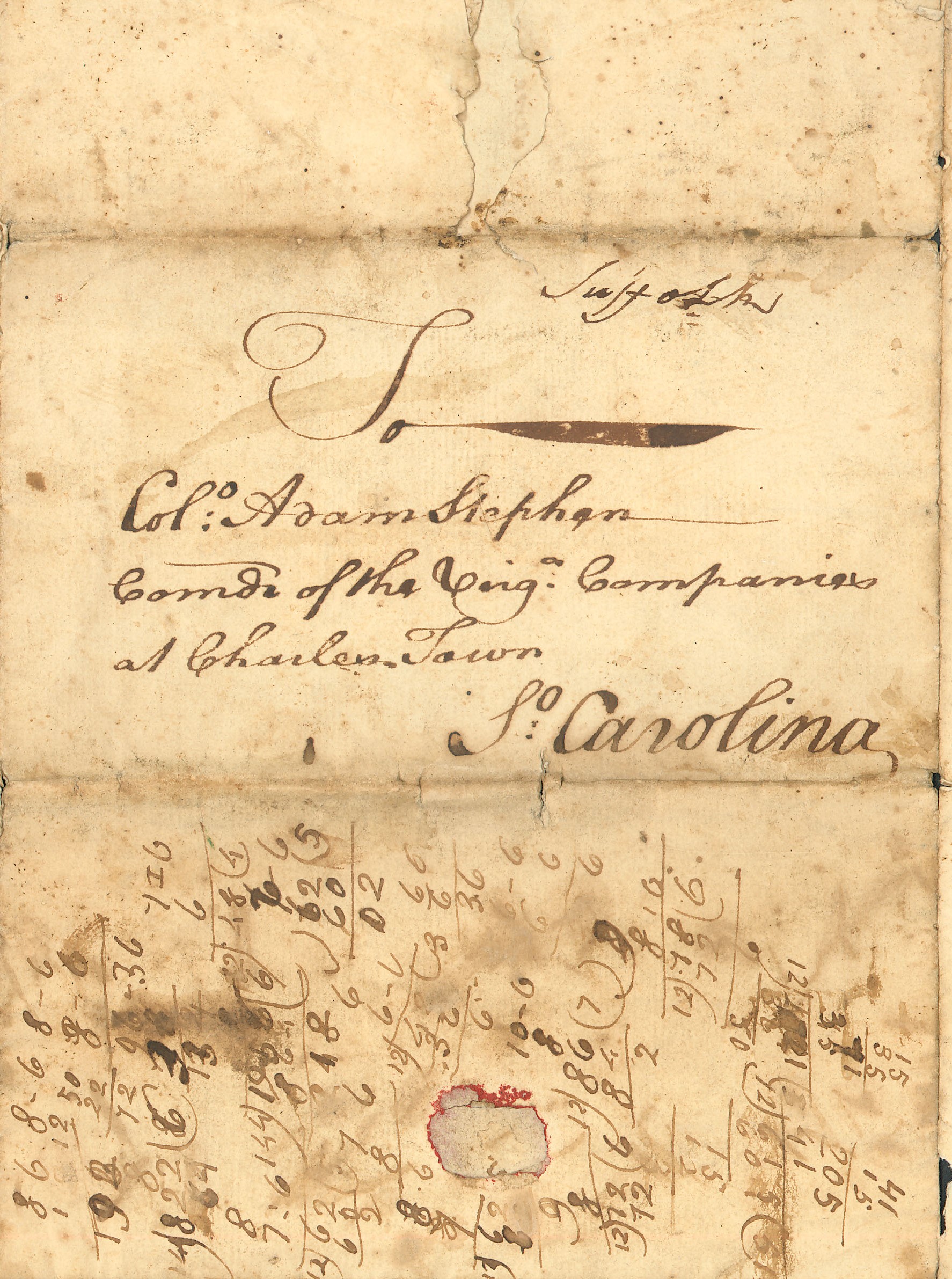
    In 1730, Spotswood took over the position of Deputy Post Master General after the resignation of John Hamilton for failing to turn a profit for the post office and suffering accusations of excessive spending.[10] His goal was to establish a better route between Annapolis and Williamsburg and eventually push that further south.  He succeeded and, by 1739, had created a route from Williamsburg to Charles Town, South Carolina. Spotswood’s post office was called “General Post Office at New Post” and was located near the Rappahannock River in Fredericksburg on land he owned.  After Spotswood’s death in 1740, the post office was maintained in New Post, Virginia, until Benjamin Franklin took office in 1753 and moved headquarters to his native Pennsylvania.[11]

    Revolution

    The postal system in the Colonies continued growing until British Parliament passed the Stamp Act of 1765.  The Stamp Act placed an official stamp on all printed material, including legal documents, magazines, playing cards, newspapers, and other types of paper used throughout the colonies.  [12] 

    Unsurprisingly, the Stamp Act was very unpopular among the colonists as many considered it a violation of their rights as Englishmen not to be taxed without their consent.   With the significant uproar and protests, the act was quickly repealed in March of 1766.  Still, Parliament continued to declare its power to legislate the colonies by passing the Declaratory Act.  Additionally, a new series of taxes and regulations were introduced, which fostered resentment to British rule and was the beginning of what would become a revolution in America. [13] 

    The post office symbolized British power, and a new system would have to be established if the colonists wished to overthrow the government and create an independent country.  The colonist began their postal service, the Constitutional Post, in May 1775 with Benjamin Franklin as the new postmaster general.  Subsequently, the Crown’s postal service in the colonies ceased by Christmas of the same year.[14]

    By July 1775, the Second Continental Congress ordered The United States Post Office (USPO) with Franklin overseeing its creation as department head.  In 1789, George Washington appointed Samuel Osgood as the first American postmaster general.  More than 75 official post offices and more than 2,000 miles of post roads.[15]

     Over America’s development as a new country, its postal system has continued to grow to accommodate its populations and postal needs.  Today, the United States Post Office has over 30,000 offices and delivers around 150 billion pieces of mail a year.[16]

    Heather Baldus

    Collections Manager


    [1] Butler, Nic. 2018. Mail Service in Colonial-Era Charleston, Charleston County Public Library, 2018 https://www.ccpl.org/charleston-time-machine/mail-service-colonial-era-charleston

    [2] Ibid

    [3] Harrison, Fairfax. “The Colonial Post Office in Virginia”, The William and Mary Quarterly, Apr 1924, 73.

    [4] Ibid, 74.

    [5] Ibid, 74-75.

    [6] Ibid, 78.

    [7] Ibid, 79.

    [8] Colonial Post Office N-10, Fredericksburg, Stafford, Spotsylvania Historical Markers, 2021 https://fredmarkers.umwblogs.org/2008/03/23/colonial-post-office-n-10/

    [9] Harrison, 79.

    [10] Colonial Post Office N-10, 2021

    [11] Ibid

    [12] Wood, S.G. “The American Revolution: A History.” Modern Library. 2002, 24.

    [13] Daniella Garran (19 July 2010). “Steps to the American Revolution”. Lesson Planet. Retrieved 21 July 2010.

    [14] Gavin, Alison M. “Hugh Finlay and the Postal System in Colonial America”, 2009 https://www.archives.gov/publications/prologue/2009/summer/finlay.html

    [15] The Early American Postal System”, https://www.constitutionfacts.com/founders-library/early-american-postal-system/

    [16] “Size and scope”. About USPS. United States Postal Service. Archived from the original on December 15, 2018. Retrieved December 8, 2018.