Lives and Legacies

Category: Historic Kenmore

  • An Image Captured: The Development of Photography through Lewis Family Descendants

    One of my favorite historical objects in the collection are photographs.  Not particularly for artistic reasons, but as a documentation of a moment, a time, a person, a world that no longer exists.  During the Victorian era (1837-1901), there were extraordinary developments in the field of photography. In a span of forty years, photographs went from complicated metal plates, harsh chemicals, and long exposure times to inexpensive images on cardboard that could be taken, processed, and given to the sitter in minutes. 

    We have many pictures in our collection, and we can trace the development of photography through images of Lewis family descendants. 

    A Pleasant View of Burgundy

    The widely accepted creator of photography as we know it was French inventor Joseph Nicéphore Niépce.  He produced the first surviving photograph around 1826 showing the scene from his window in Burgundy.  After Niepce’s death, his former associate, Louis-Jacques-Mandé Daguerre, continued improving Niepce’s photographic process, introducing the “daguerreotype” in 1839. (The University of Texas Austin, 2024)  To create an early daguerreotype, a polished silver-plated copper sheet was treated with iodine vapor to make it light-sensitive. After exposure, the plate would be developed with mercury vapor and fixed with sodium chloride.  This was a tedious and complex process that required the subject to remain entirely still for three to fifteen minutes. (Stewart, 2018) (The Library of Congress, 2024) (Department of Photographs, 2004) The process was amended and, by the 1850s, used large glass-plate negatives, allowing for a crisper picture and a much shorter exposure time. (Department of Photographs, 2004)

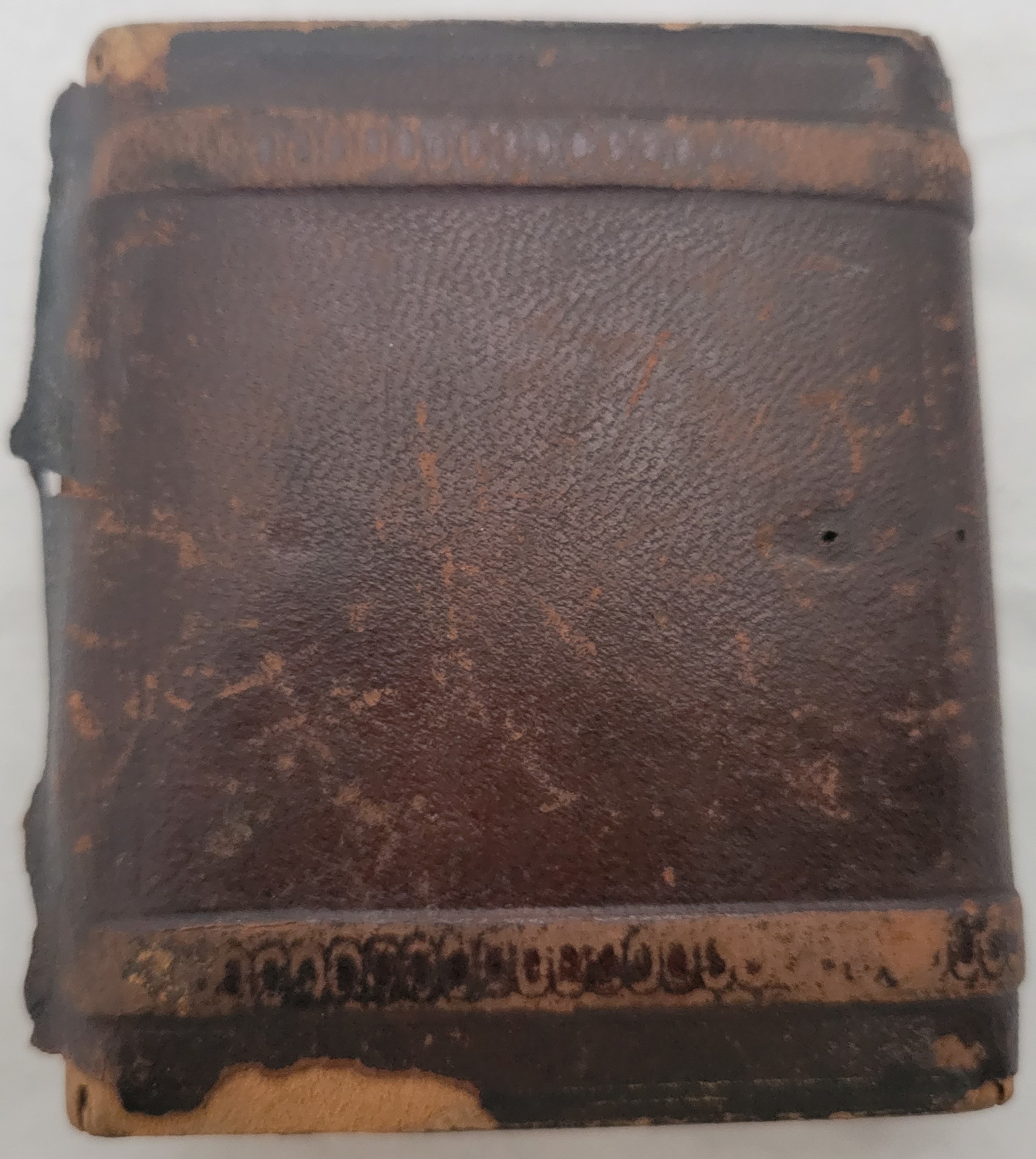
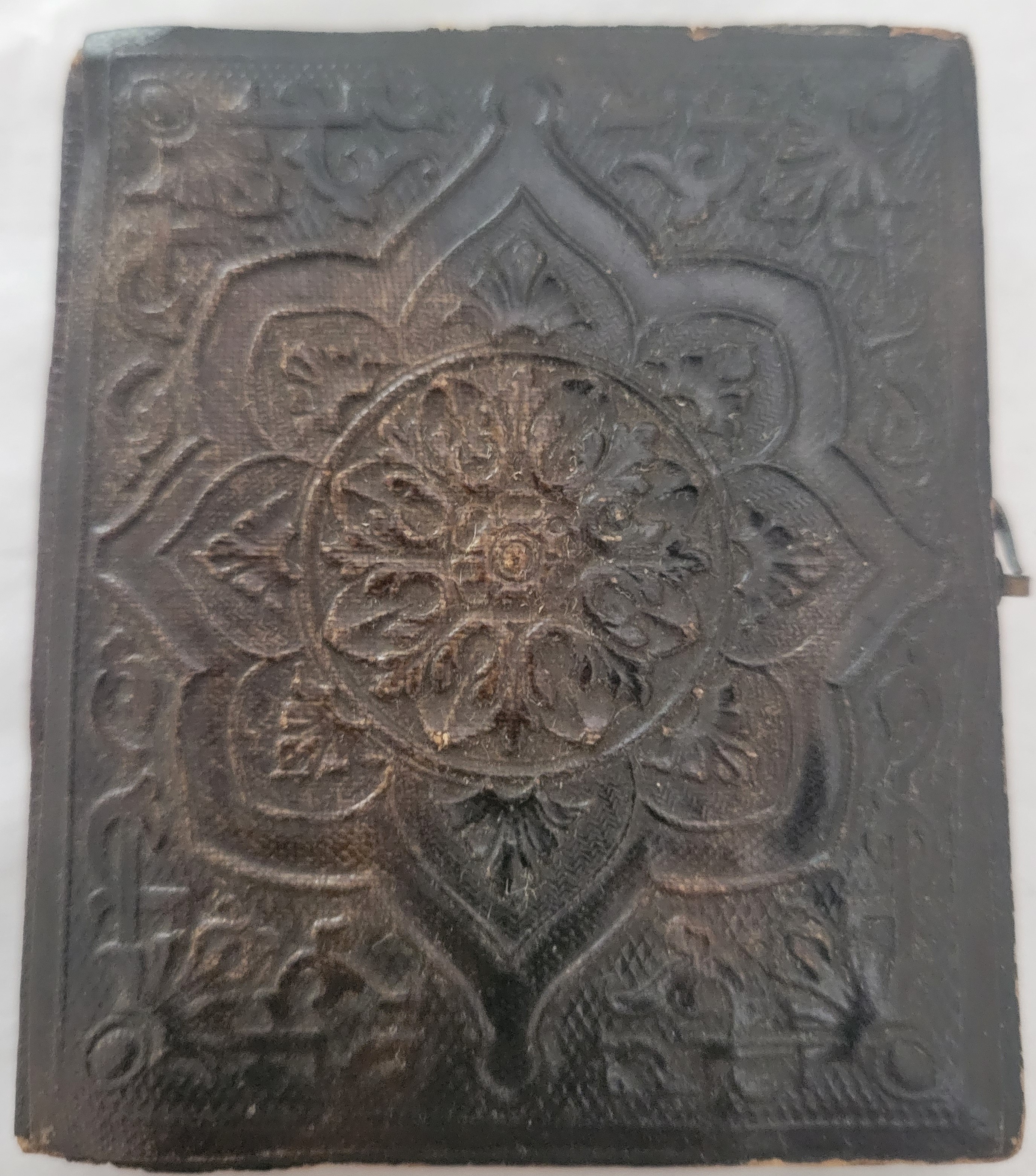
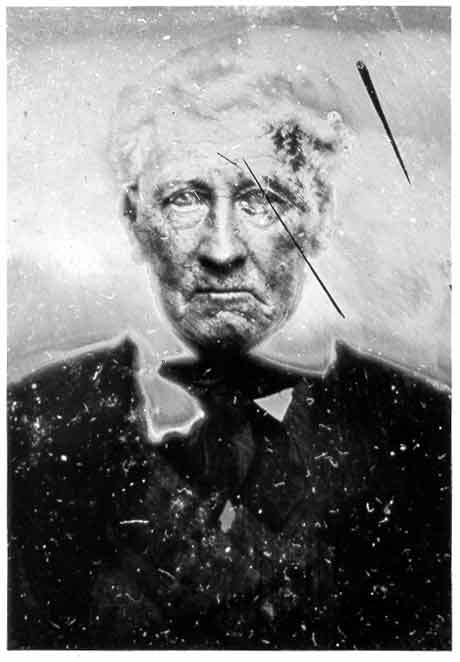
    We have three daguerreotypes in the collection dating circa 1850s.  They are all portraits housed in elaborate leather cases with gilt-metal frames.  The larger photograph is called a sixth-plate daguerreotype portrait of John Taliaferro Lewis (1785-1862), who was the grandson of Charles Lewis, Fielding Lewis’s brother.  John was a Methodist minister and lived at “Stepney” near Manassas.  Through his wife, Francis Tasker Ball, he became the owner of “Portici,” also near Manassas. The two smaller ninth-plate daguerreotypes are both portraits of Ellen Lewis Nye (1834-1886), the granddaughter of Howell Lewis, the ninth son of Fielding and Betty.  She married Anselm Tupper Nye, and they resided in Ohio, where they were both buried.

    Images for Loved Ones

    The daguerreotype was soon replaced in popularity by the ambrotype and tintype, which were both cheaper and easier to develop. (Harding, 2013). 

    An ambrotype is comprised of an underexposed glass negative placed against a dark background. The dark backing material creates a positive image. They were sold in either cases or ornate frames to provide an attractive product and to protect the negative with a cover glass and brass mat. (Library of Congress, 2024)

    We have three ambrotypes in the collection: a landscape and two portraits.  The landscape dates to circa 1855 and shows a group of people gathered around Washington’s tomb at Mount Vernon. Two of the figures were Thomas Coatsworth (1821-1887) and his wife Electra Weller Coatsworth (1832-1869). It is housed in an embossed leather case.

    One portrait is of John Taliaferro Lewis and is almost identical to his daguerreotype. The other portrait is of Daingerfield Lewis (1785-1862).  It dates from the same time and is held in a leather case. Daingerfield Lewis was the son of Captain George Lewis, the fourth son of Fielding and Betty, who served in the Continental Army under his uncle George Washington.

    Tintypes became especially popular because the photographer could take a picture and develop it within just a few minutes. It was called the new “instant photo.”  This “instant photo” could be found at fairs, carnivals, and on the boardwalk, not just professional studios. Due to the tintype price, weight, and unbreakable nature, they became extremely popular during the Civil War because soldiers were able to mail them back to loved ones. (Stewart, 2018)

    The three tintypes in the collection are a group of siblings, two brothers, and one sister (there were eight total siblings).  George Lewis (1832-1883), Fielding Lewis (1839 – 1863) and Betty Fitzhugh Lewis (1847-1920).  Their father was Howell Lewis Jr. (1808-1883), the son of Howell Lewis and grandson of Fielding and Betty.  Howell Lewis Jr. was one of the earliest settlers of Henry County, Missouri, and established Lewis Station (now called Lewis, Missouri).  There is not much information on the siblings besides the basics.  George Lewis, the eldest, was born in West Virginia, died in Nevada, and is buried at the Lewis Station Cemetery.  Fielding Lewis was born in Missouri and died young during his service with the Confederate army in Texas.  Betty Fitzhugh Lewis was born in Missouri as well; he married Milton D Finks, had at least three children, and is buried in Calhoun cemetery.

    Paper, Cardboard, and Formality

    By the later part of the nineteenth century, paper photos mounted on cardboard became more popular. Carte-de-visite became quite a fad after carte portraits of Queen Victoria with her husband and children were published. (Harding, 2013).  Part of why they became popular is they were cheaper to produce because multiple images (eight) could be taken with the same photographic plate, cut into small portraits, and mounted to heavy cardboard. (The Editors of Encyclopedia Britannica, 1998) 

    Two of our carte-de-visites are portraits of two young ladies around 1860.  One is Ellen Lewis Nye, who previously appeared in daguerreotype around the same time.  The second is Mary Ellen Lewis Hogan (1834-1874), who was the daughter of Howell Lewis, Jr. and sister to George, Fielding, and Betty Lewis.  She was born in West Virginia, married Robert Henderson Hogan, and is buried in Illinois.   

    The carte-de-visite was gradually superseded by the cabinet card, which remained popular until the introduction of the Kodak Box Brownie camera in 1900. (City Gallery, 2005)  The cabinet card marked a transition from more formal portraiture to amusing, personal, and even candid images.  They were taken in studios that were equipped with lights, props, and sometimes even hair and makeup. The average price was around $1.50 for a dozen cards, which is around $45 today. (Salvesen, 2021)

    Our cabinet cards date from 1850 to 1897 and are portraits of three females who, like all the others, are descendants of the Lewis family.  The oldest is of Francis Fielding Lewis Gwathmey (1808-1888), and it was taken around 1850, putting her in her early forties.  Her father was Howell Lewis, son of Fielding and Betty and sister to Howell Lewis Jr.  Francis married Rev. John “Parson” Blair and had twelve children, of which only three outlived her.  She is buried in Richmond, Virginia. 
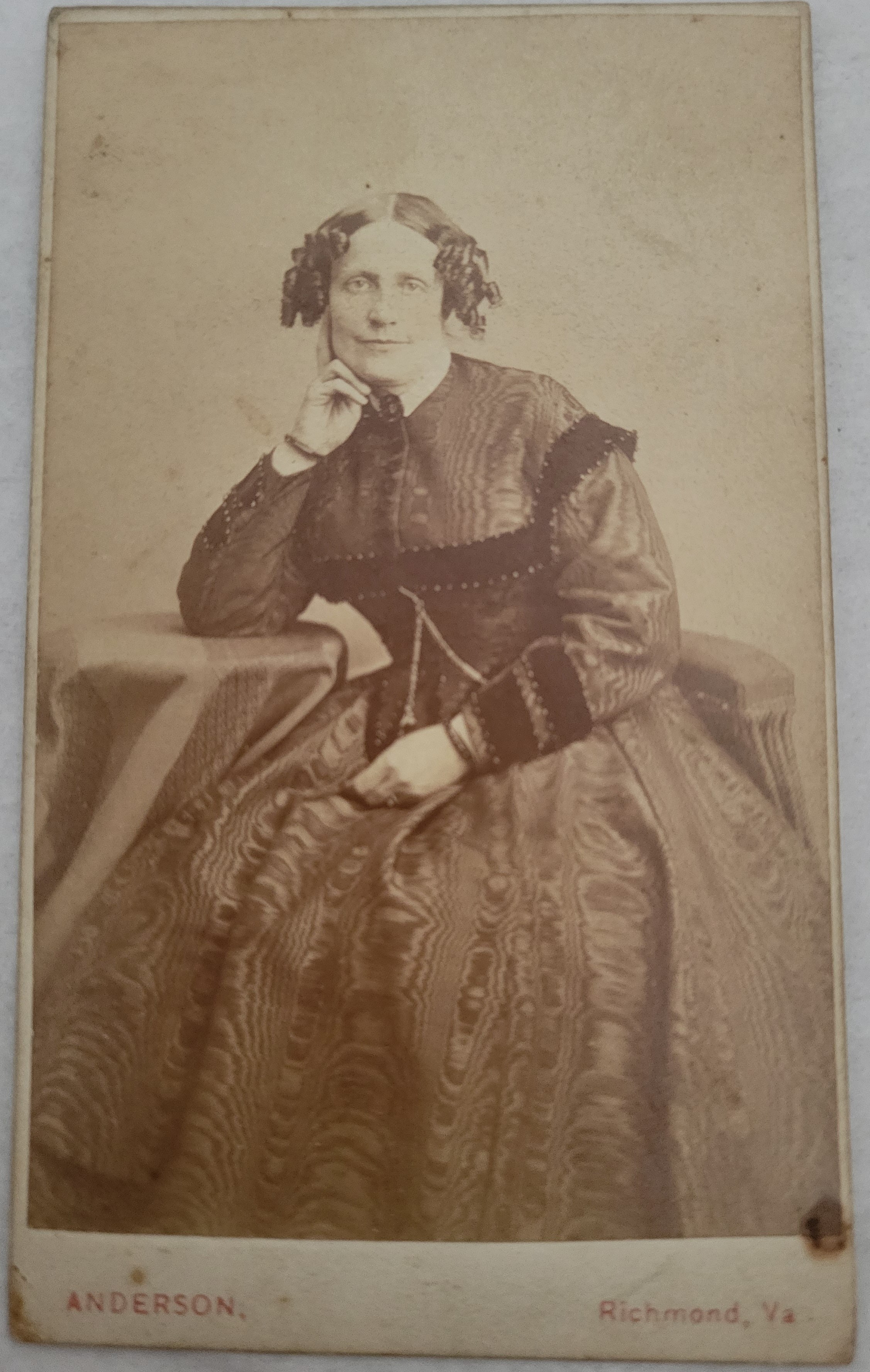
    We have another picture of Ellen Lewis Nye, who has previously been represented in daguerreotype and carte-de-visite.  The card was taken in 1885, shortly before her death. The last one is Virginia Tayloe Lewis (1842-1916), taken during the Christmas season of 1897.  She was born in Washington, D.C., at The Octagon House.  She was the daughter of Captain Henry Howell Lewis and great-granddaughter to Fielding and Betty. 

    Money and the Magic Lantern

    This is a brief history of photography seen through the descendants of the Lewis family. But make no mistake, these are not the only important pictures in our collection.  There are still trays of glass slides that belong to a curious device called the “lanterna magica,” which became an invaluable tool that, along with gingerbread, helped restore Kenmore.

    Magic lantern glass slide of Kenmore before the restoration

    Heather Baldus

    Collections Manager


    Bibliography

    City Gallery. (2005). Cabinet Card. Retrieved from City Gallery: http://www.city-gallery.com/learning/types/cabinet_card/index.php

    Department of Photographs. (2004, October). The Daguerreian Era and Early American Photography on Paper, 1839–60. Retrieved from The Metropolitan Museum of Art: https://www.metmuseum.org/toah/hd/adag/hd_adag.htm

    Harding, C. (2013, June 27). How to spot a carte de visite (late 1850s–c.1910). Retrieved from The National Science and Media Museum: https://blog.scienceandmediamuseum.org.uk/find-out-when-a-photo-was-taken-identify-a-carte-de-visite/

    Harding, C. (2013, May 25). How to spot a ferrotype, also known as a tintype (1855–1940s). Retrieved from The National Science and Media Museum: https://blog.scienceandmediamuseum.org.uk/find-out-when-a-photo-was-taken-identify-ferrotype-tintype/

    Library of Congress. (2024). Liljenquist Family Collection of Civil War Photographs. Retrieved from Library of Congress: https://www.loc.gov/collections/liljenquist-civil-war-photographs/articles-and-essays/ambrotypes-and-tintypes/

    Salvesen, B. (2021, June 28). The Return of Cabinet Cards. Retrieved from Los Angeles County Museum of Art: https://unframed.lacma.org/2021/06/28/return-cabinet-cards

    Stewart, J. (2018, December 31). Tintype Photography: The Vintage Photo Technique That’s Making a Comeback. Retrieved from My Modern Met: https://mymodernmet.com/tintype-photography/

    The Editors of Encyclopedia Britannica. (1998, July 20). Carte-de-visite. Retrieved from Encyclopedia Britannica: https://www.britannica.com/technology/carte-de-visite

    The Library of Congress. (2024). The Daguerreotype Medium. Retrieved from The Library of Congress: https://www.loc.gov/collections/daguerreotypes/articles-and-essays/the-daguerreotype-medium/

    The University of Texas Austin. (2024). The Henry Ranson Center. Retrieved from The University of Texas Austin: https://www.hrc.utexas.edu/niepce-heliograph/

  • Of Mice and Men: A brief exploration of rodents’ history in America

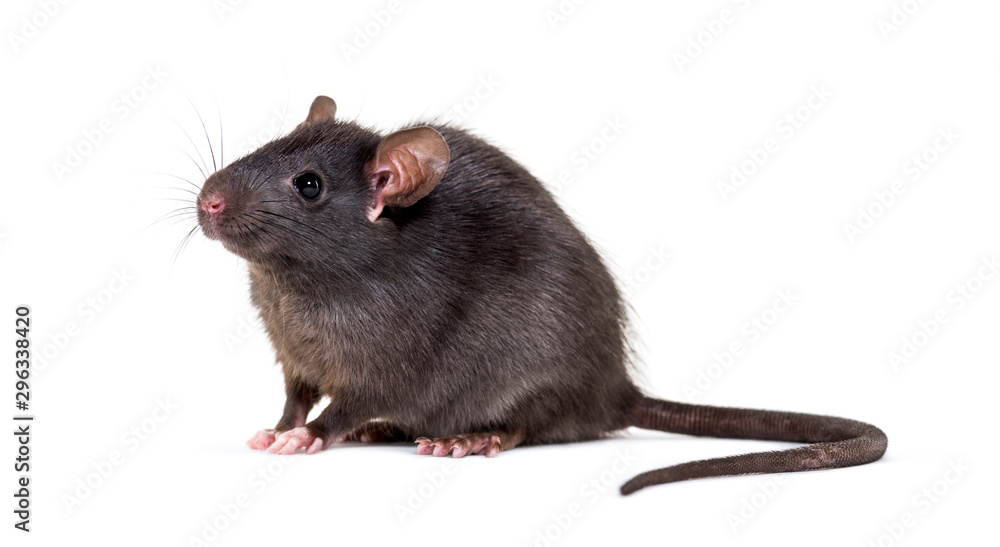
    A pest is a broad term for any organism that spreads disease, causes destruction, or is generally a nuisance. In the 21st century, we still constantly battle pests from squirrels who chew through your internet cables or spiders who set up house in the high corner of the ceiling, watching and judging you to evil mosquitoes that ruin outdoor activities and leave you with itchy red welts that no amount of calamine lotion will help. It is a fight as old as time. 

    I wanted to investigate one pest in particular: rodents. Why were mice and rats present in colonial homes? Why this was an issue? What were some of the methods the Washington’s would have used to combat these furry creatures? And how we know without a doubt that Kenmore and Mount Vernon had rodent tenants.

    The Suspects

    The house mouse, or Mus Musculus, originating on the Asian and Indian subcontinent, has become the most successful invasive species in recent history. [1] They arrived in this country with the trading ships and settlers that came to the New World in the 16th century. [2][3]

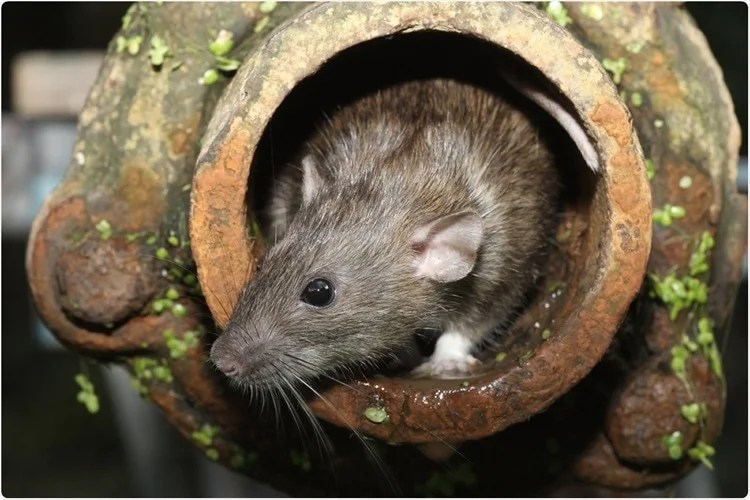
    Similarly, the black rat, aka roof rat, boarded ships for their westward journey around the same time as the seafaring mouse. [4]  Their presence is noted by the residents of Jamestown in November of 1608, stating, “When the shippes departed al the provision of the store but that the President had gotten was so rotten with the last somers rain, and eaten with rats and wormes” [5] The notorious brown rat or sewer rat, who seems to currently enjoy the cities of Chicago, Los Angeles, and New York, arrived a little later than their brethren setting foot in the new country around the 1750s.[6]

    America, the land of plenty…of garbage

    There is no nice way to say it, but living in colonial America was usually gross. Housing wasn’t always the greatest, sometimes being very rudimentary. Food storage was typically simple and easily accessible. But one of the biggest problems (or benefits if you are a rodent) was the lack of systematic waste disposal. [7] [8] Garbage (including human waste) was a personal problem often solved by opening the window and chucking out.

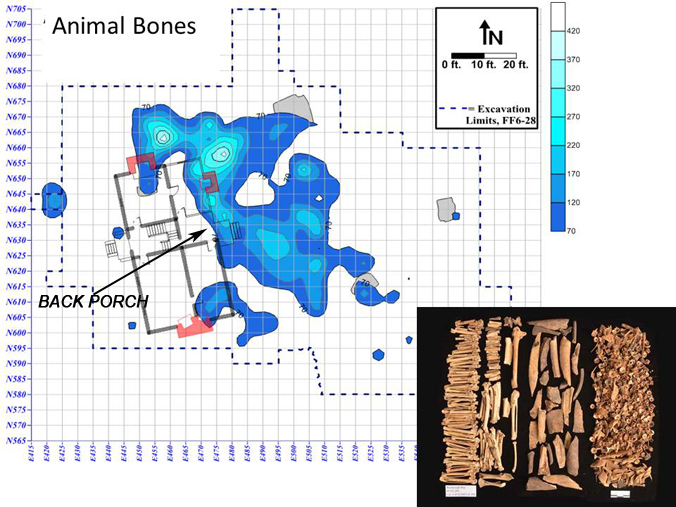
    We have abundant archeological information from Ferry Farm and Kenmore that supports these habits. A large part of Ferry Farm has been excavated over the decades, leaving clear evidence that the Washington family and their enslaved workers disposed of waste right in the backyard…off the porch.    Large amounts of artifacts were discovered and mapped, showing the proximity to the house, meaning the garbage was close, and rodents love trash.

    Map showing the concentration of animal bones excavated from the midden at the rear of the Washington house at Ferry Farm.

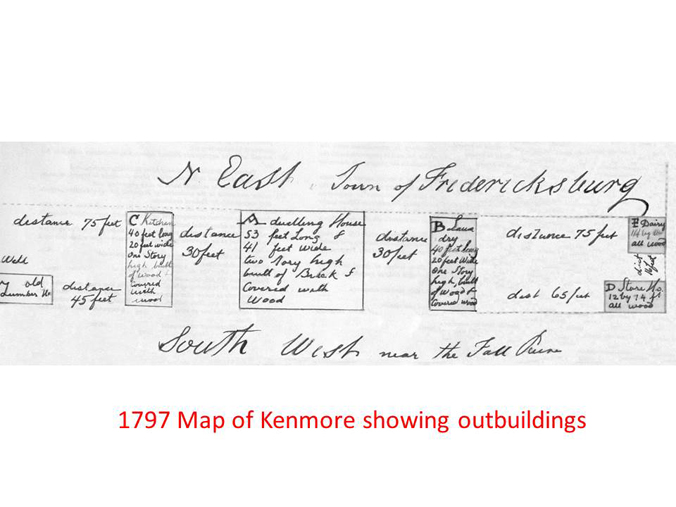
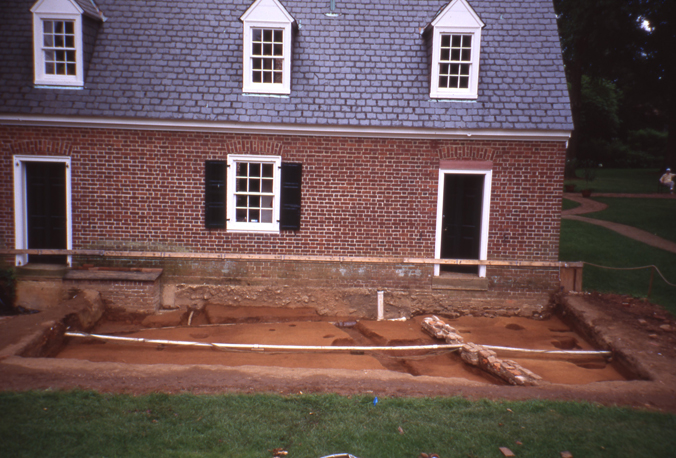
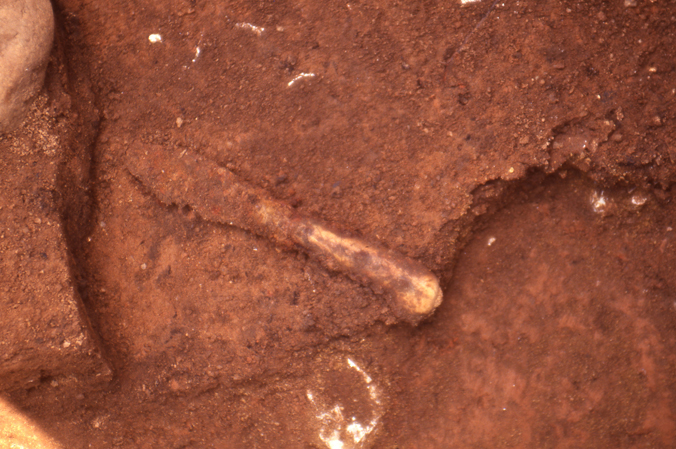
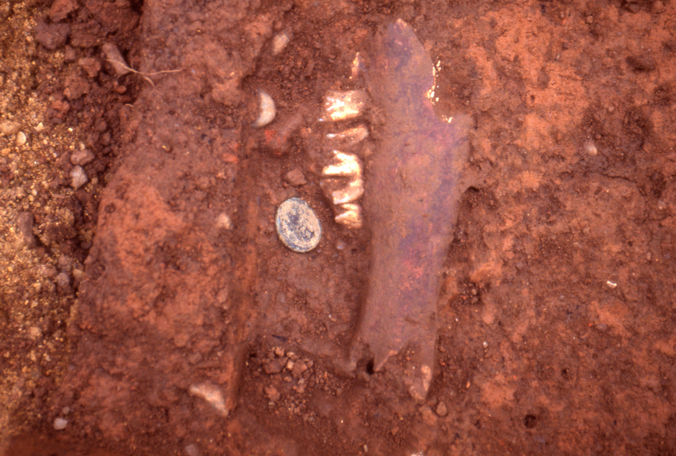
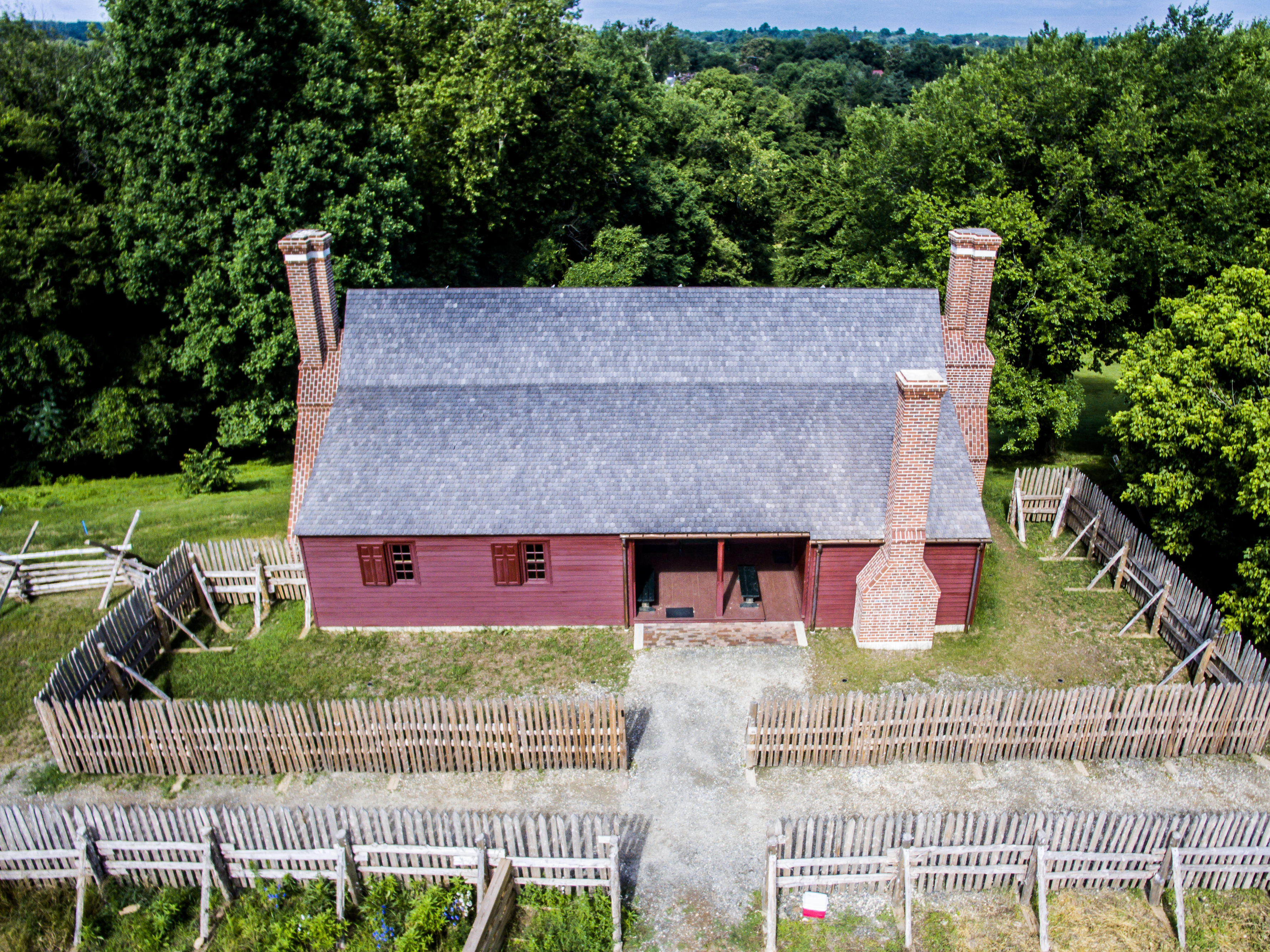
    At Kenmore, the garbage situation seemed to be a little more regulated because the grounds and buildings were planned. The main house was made of brick, surrounded by two wood-built structures containing the kitchen and laundry. During excavations of the kitchen yard (between the house and kitchen), there were minimal artifacts, but a dump site was found west of the kitchen. The location could be accessed by the window or by walking around the side of the building and contained a pig jaw, animal bones, bone-handled knife, and other objects. The kitchen is about 30 feet from the house, with the slave passage doors opening right onto the kitchen yard…plenty close enough for an enterprising rat or mouse. 

    Bad House-guests

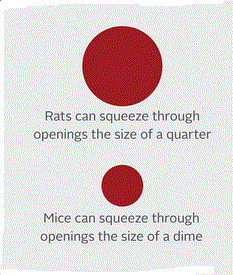
    So, why are rodents bad to have in your house? Disease, contamination, destruction, smells, and lots of poop. [9]  Rats can squeeze through an opening the size of a quarter. Mice only need the size of a dime…so they will be everywhere in your house and will bring friends. [10] Rats and mice are spreaders of disease from rat-bite fever that spreads through bacteria in the rodent’s saliva, urine, or droppings to the bubonic plague transmitted by the lice hitching a ride on their fluffy friend.[11][12]  While today, rodents are relatively low on the list of dangerous disease spreaders in an era of limited medical knowledge and treatments, it could be a matter of life or death.

    Contamination and destruction are these creatures’ modus operandi. They get into everything, period. They will eat almost any human food, chewing through any storage system, leaving behind chaos; they have even been known to eat soap and glue. [13]  While venturing through the house, they are constantly urinating and pooping, which is smelly, can create mold growth, and should never be consumed. [14] In their quest for food, they often destroy household items, eating books, chewing clothes, gnawing on mattresses, and even nesting in furniture. All of which is not only annoying but expensive to fix or replace. [15][16]

    But one of the most offensive things a mouse or rat can do is die in your walls. Take it from Colonel Landon Carter, who had to deal with a rat dying behind his wainscoting, informing everyone, “Wainscoted rooms have their conveniences [inconveniences?] as a dead rat has been stinking behind mine in the hall at least six days and is now intolerable in spite of burning tar…this dead rat stunk prodigiously.” [17] 

    Colonel Landon Carter, not too fond of rats. Source: Wikipedia

    Fighting Back

    Surprisingly, colonists used many of the same techniques we do today to eliminate these pests. Pesticides or chemical warfare was widespread, with many recommendations and recipes dating back to the 15th century. I found recipes containing helliberry leaves, bitter almonds, “seade of wild cowcumbers,” colluentida, hemlock seed, aconite or wolfsbane, and arsenic.[18]   I don’t know many of those ingredients, but apparently, they kill rodents nicely. 

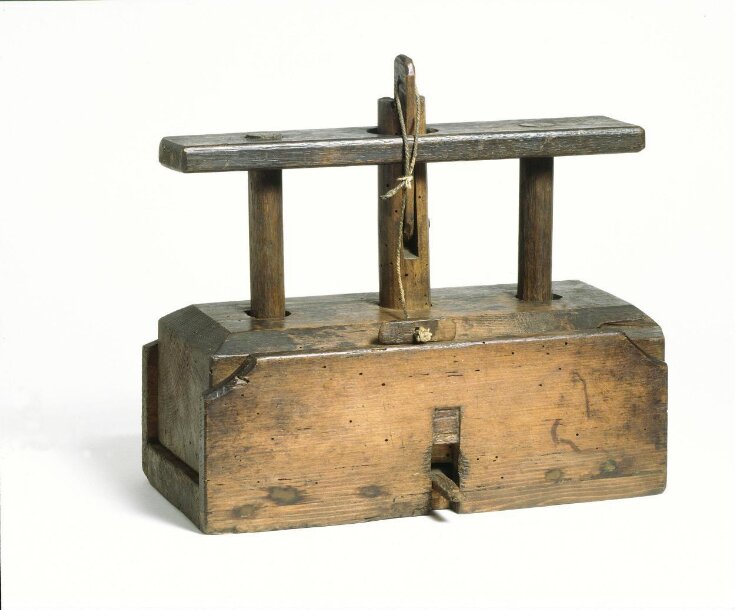
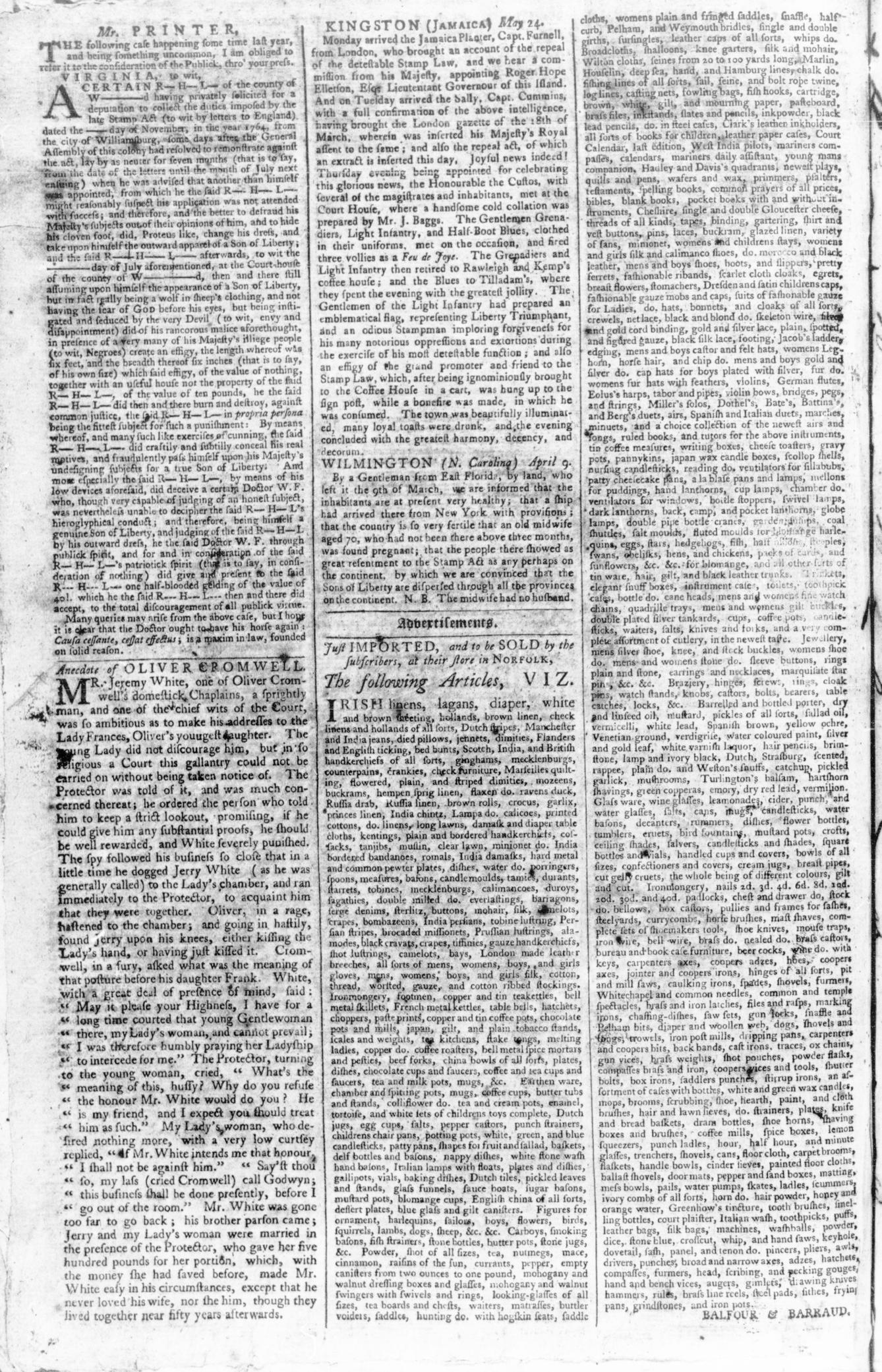
    Another method was traps, which are common today. They were pretty popular, and there were many advertisements in the Virginia Gazette from sellers touting that their mouse traps just arrived from England. [19] There are also many instructions for building easy mouse traps like the “deadfall” or “noose” traps, which are as horrible as you imagine. [20][21]

    Deadfall mouse trap, c. 1800-1850 Source: V&A Collection

    Lastly, one method that is making a comeback is animals, both cats and dogs.[22][23] Cats have been used for ages as rodent killers and are good at their job. [24]  A 14th-century manual suggests that if you have problems with vermin, “have as a good supply of cats.”[25]  The famous diarist Samuel Pepys wrote in December 1660, “my boy taking a catt home with him from my Lord’s, which Sarah hath given him for my wife, we being much troubled with mice.”[26]  There are even modern programs like Barn Buddies that save feral and skittish cats and adopt them out as “rodent control technicians.”[27]

    And dogs, mainly terriers, have been used to clear mice and rat infestations for centuries, just like cats. Ever the dog lover, George Washington had terriers at Mount Vernon, which probably helped immensely around the plantation.[28]  Today, cities like Chicago and New York use these canines in modern rat hunts.[29] It seems the skills of the terrier will always be in demand. 

    Little Historians

    Lastly, how do we, without a doubt, know that there were rodents at Kenmore and Mount Vernon? Rat nests. Rat nests are usually found in walls or under floorboards, and they not only prove these guys resided in the houses as long as the families themselves, but also provide a fascinating historical glimpse into the material lives of the occupants.

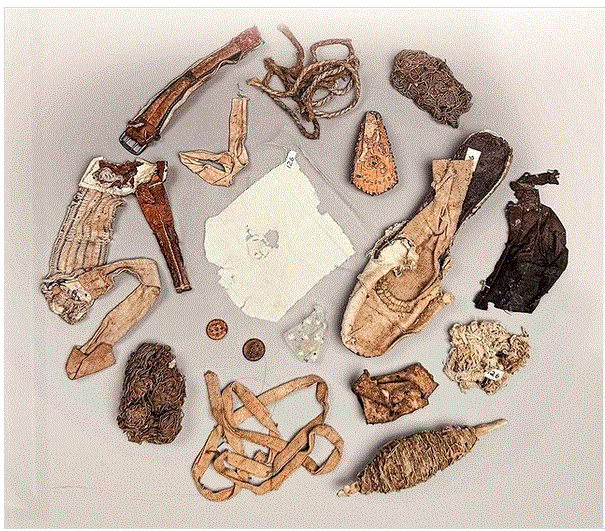
    Mount Vernon documented the finding of a rat nest in 1949 behind the wall in Washington’s bedchamber. When dissected, it included buttons, paper, rope, yarn, a whole woman’s shoe, and fabric matching Washington’s bed curtains.[30]  

    Objects from rat nest found in the wall of Washington’s bedchamber, 1949. Source: Mount Vernon Instagram

    Similarly, in 1989, a rat nest was found in Kenmore while investigating the walls and floorboards. We recently picked apart the bundle to find fabrics, fibers, thread, yarn, newspapers, bones, nutshells, and wood splinters. The remnants in the nest were dated no later than the early 20th century due to dates on newspaper fragments and the absence of plastics.

    In conclusion, rats and mice have been a constant annoyance since they first set foot in this country; unfortunately, that is still somewhat true. These enterprising rodents have adopted America as their own and we as fellow citizens must learn to live together despite our often distaste for each other.

    Fun Fact – We don’t want to malign rats more than they have been throughout history so we would like to add that rats make good pets.  They are quick learners, highly trainable, very clever, and have excellent memories.  They are now being trained to detect land mines, diseases like tuberculosis, and even rescue earthquake survivors.


    Heather Baldus

    Collections Manager


    [1] Agwamba, K. D., & Nachman, M. W. (2023). The demographic history of house mice (Mus musculus domesticus) in eastern North America. G3 Genes|Genomes|Genetics, 13(2). https://doi.org/February 2023

    [2] Agwamba, K.D., & Nachman, M.W. (2023)

    [3] Agwamba, K.D., & Nachman, M.W. (2023)

    [4] Newman, M. H. (2001). The vermin -killers: Pest control in the early Chesapeake [Doctoral Dissertation, Willam & Mary University]. https://scholarworks.wm.edu/etd/1539623387/, pg 111.

    [5] Newman, M.H. (2001), pg. 47.

    [6] Tapia, A. (2021, October 23). America’s 10 Most Rat-Infested Cities. Newsweek. Retrieved September 7, 2023, from https://www.newsweek.com/americas-10-most-rat-infested-cities-1638136

    [7] Newman, M.H. (2001), pg. 17.

    [8] Newman, M.H. (2001), pg. 46.

    [9] (2014, January 6). Of Mice and Men: Rodent Infestations Plague Nearly A Third of Americans. National Pest Management Association. Retrieved September 7, 2023, from https://www.pestworld.org/news-hub/press-releases/of-mice-and-men-rodent-infestations-plague-nearly-a-third-of-americans/
    [10] (2014, January 6). Of Mice and Men.

    [11] (2019, January 18). Transmission. Centers for Disease Control and Prevention. Retrieved September 7, 2023, from https://www.cdc.gov/rat-bite-fever/transmission/index.html

    [12] (2019, July 31). Ecology & Transmission. Centers for Disease Control and Prevention. Retrieved September 7, 2023, from https://www.cdc.gov/plague/transmission/index.html

    [13] Introduced Species Summary Project

    [14] (2022, December 27). How a Mouse Infestation Can Cause You Thousands in Damage. Spidexx. Retrieved September 7, 2023, from https://www.spidexx.com/blog/2022/december/5-things-you-need-to-know-about-mouse-infestatio/

    [15] Newman, M.H. (2001), pg. 17.

    [16] (2022, December 27). How a Mouse Infestation Can Cause You Thousands in Damage

    [17] Newman, M.H. (2001), pg. 84.

    [18] W, W. (1680). The Vermin-Killer (pp. 4-9). London: Samuell Lee.

    [19] Unknown, U. (1766, July 25). Just Imported and to be Sold by the subscribers at their store in Norfolk. Virginia Gazette. https://research.colonialwilliamsburg.org/CWDLImages/VA_GAZET/Images/PD/1766/0084hi.jpg

    [20] Newman, M.H. (2001), pg. 119.

    [21] Feild, Rachael. 1984. Irons in the Fire: A History of Cooking Equipment. Ramsbury,

    Marlborough, Wiltshire: The Cromwood Press

    [22] Pasley, J. (2023, March 18). How the rat population in New York City grew by 800% and infested the city in less than 65 years. Yahoo News. Retrieved September 7, 2023, from https://news.yahoo.com/rat-population-york-city-grew-143000754.html

    [23] Cass, J. (2017, November 10). Chicago needs good dogs to handle the rat epidemic The Chicago Way. Chicago Tribune. Retrieved September 7, 2023, from https://www.chicagotribune.com/columns/john-kass/ct-met-rats-terriers-kass-1112-story.html

    [24] Newman, M.H. (2001), pg. 115.

    [25] Bayard, T. (1991). A Medieval Home Companion Housekeeping in the Fourteenth Century (1st ed., pp. 97-98). Harper Collins Publishers.

    [26] Pepys, S. (1983). The diary of Samuel Pepys : A new and complete transcription (p. 325). London: Bell.

    [27] (n.d.). Adopt a Barn Cat. Barn Cat Buddies. https://www.barncatbuddies.org/

    [28] (n.d.). Dogs. George Washington’s Mount Vernon. http/www.mountvernon.org/library/digitalhistory/digital-encyclopedia/article/dogs/

    [29] Cass, J. (2017, November 10). Chicago needs good dogs to handle the rat epidemic The Chicago Way. Chicago Tribune. Retrieved September 7, 2023, from https://www.chicagotribune.com/columns/john-kass/ct-met-rats-terriers-kass-1112-story.html

    [30] Mount Vernon [mount_vernon]. “In 1949, preservation staff removed a rat’s nest from behind a wall in the Washingtons’ bedchamber..”* Instagram, May 19, https://www.instagram.com/p/CsbIc9sOO_2/.

  • Camp George v. George: A Summer Camp to Travel Back to Colonial Virginia

    School is out for summer…almost! Students are counting down the days until they are free from homework, but the learning does not have to stop!. The George Washington Foundation has been busy preparing fun-filled summer camps to encourage critical thinking through exploring the past.

    In our Camp George v. George, students will be asked, “Would you be an American patriot or a British loyalist?” as they learn about George Washington and his family’s experience living under the rule of King George III.

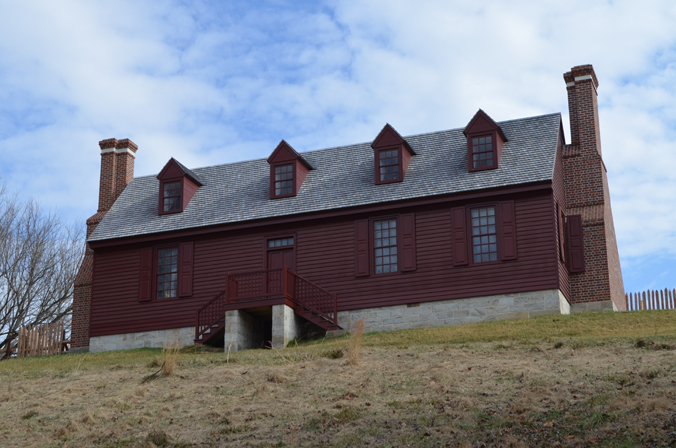
    The camp will alternate between George Washington’s Ferry Farm, his boyhood home, and Historic Kenmore, his sister’s later-in-life house. George lived at Ferry Farm from six years old until 22 years old. This was where George learned how to survey, dance, and petitioned for his first military office at Ferry Farm. His time at Ferry Farm shaped him into the man who navigated the battlefield and the political arena to pursue the American cause.

    Similarly, George’s sister, Betty Washington Lewis, was shaped by her time at Ferry Farm. She was instructed in the customs of gentility, which included the tea ceremony.[1] While at Ferry Farm, her uncle, Joseph Ball, gifted a silver tea set and other tools so Betty could refine her skills as a future lady of the house. During this time, Betty was taught the expectations for young women in colonial Virginia.

    Washington’s Ferry Farm

    While Betty’s experience at Ferry Farm was significant, her story does not end there. The skills she acquired at Ferry Farm equipped her to marry Fielding Lewis, a wealthy merchant in town. Twenty-five years later, they moved into their new home at Kenmore in 1775. Fielding and Betty envisioned the mansion as the site of lavish social events filled with tea, dancing, and awe from their guests. However, that dream was never realized, and the couple sacrificed greatly for the American cause. Betty managed the household and attended to the needs of the Washington family, including her mother, Mary. Fielding could not fight in the war, but he voluntarily gave up his trading business with British merchants, donated supplies to the war effort, and financially supported a gunnery in Fredericksburg.[2] Fielding also collected debts and handled several land deals for his brother-in-law.[3] The stress of the financial strain took its toll on Fielding, and he passed on December 7, 1781. Betty struggled financially for the rest of her life due to Lewis’ sacrifices for the Patriot cause.

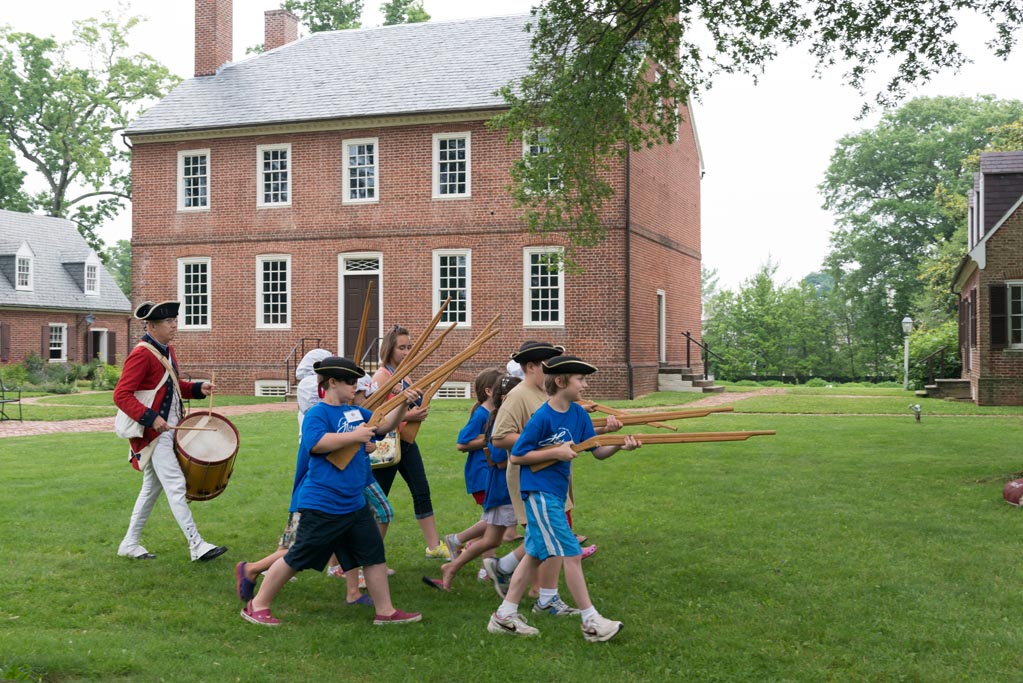
    Historic Kenmore and Ferry Farm will be the sites where campers will learn about life in colonial America. Archaeologists, socialites, dancers, surveyors, and soldiers are just a few of the roles that the campers will embody as they explore the cultural, social, and military life of colonists during the Revolutionary War era. Activities will include a mock archaeological dig, a surveying hike, dancing lessons, militia drills, and more! This experience will provide insight into life before, during, and after the American Revolution. George, Betty, and Fielding, along with many others, had their lives transformed by society, government, and friendships. What would you do in such instances? That is the question campers will think about during their experiences, but don’t worry, plenty of fun, games, and activities will be included!

    Camp George v. George will be offered in two sessions for families’ convenience. Session A will be June 13 – 17 from 9 am to 12 pm, and Session B will be from July 25 – 29 from 9 am to 12 pm. Please see our events page at Kenmore.org/events for more information!

    Kaylie E. Schunk

    Manager of School & Youth Programs


    [1] Laura J. Galke, “The Mother of the Father of Our Country: Mary Ball Washington’s Genteel Domestic Habits,” in Northeast Historical Archaeology 38 (2009): 33.

    [2] “Fielding Lewis;” Palmer, and McRae, eds. Calendar of Virginia State Papers, 456, 502-3; Duke, Kenmore and the Lewises, 94-96; Fleming, Story of Kenmore, 9; “To George Washington from Fielding Lewis, 14 November 1775,” Founders Online, National Archives, Source: The Papers of George Washington, Revolutionary War Series, vol. 2, 16 September 1775?–?31 December 1775, ed. Philander D. Chase (Charlottesville: University Press of Virginia, 1987), 371–373.

    [3] “From George Washington to Fielding Lewis, 20 April 1773,” Founders Online, National Archives, Source: The Papers of George Washington, Colonial Series, vol. 9, 8 January 1772?–?18 March 1774, ed. W. W. Abbot and Dorothy Twohig (Charlottesville: University Press of Virginia, 1994), 221–224; “To George Washington from Fielding Lewis, 8–9 May 1773,” Founders Online, National Archives, Source: ibid., 229–230. “To George Washington from Fielding Lewis, 24 May 1773,” Founders Online, National Archives, Source: ibid., 235.

  • 1925 Dedication Day: A (Block) Party from the Past

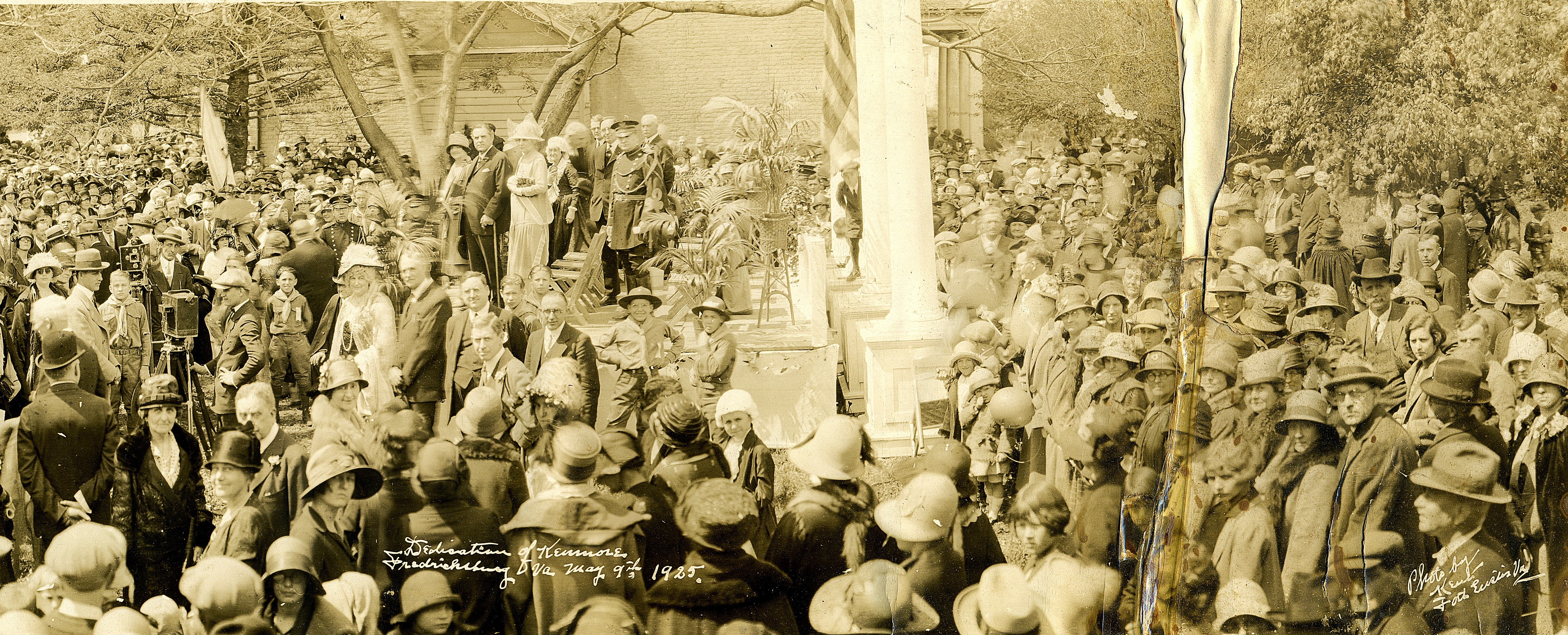
    Spring is a busy time of year for historic house museums, as we see an influx of school groups, vacationers, and families taking advantage of the beautiful weather. This spring is an especially exciting year at Historic Kenmore since we are preparing to celebrate our centennial anniversary! As discussed in our previous blog post, it is thanks to the efforts of Emily White Fleming, her daughter Annie Fleming Smith, and the Washington Lewis DAR chapter, that Kenmore was saved from development in 1922. In honor of the centennial, we have installed a new exhibit in the Crowninshield Building Visitor Center that explores Kenmore’s preservation history. One image currently on display is a photograph from May 9, 1925, Kenmore’s dedication day.

    Dedication Day 1925

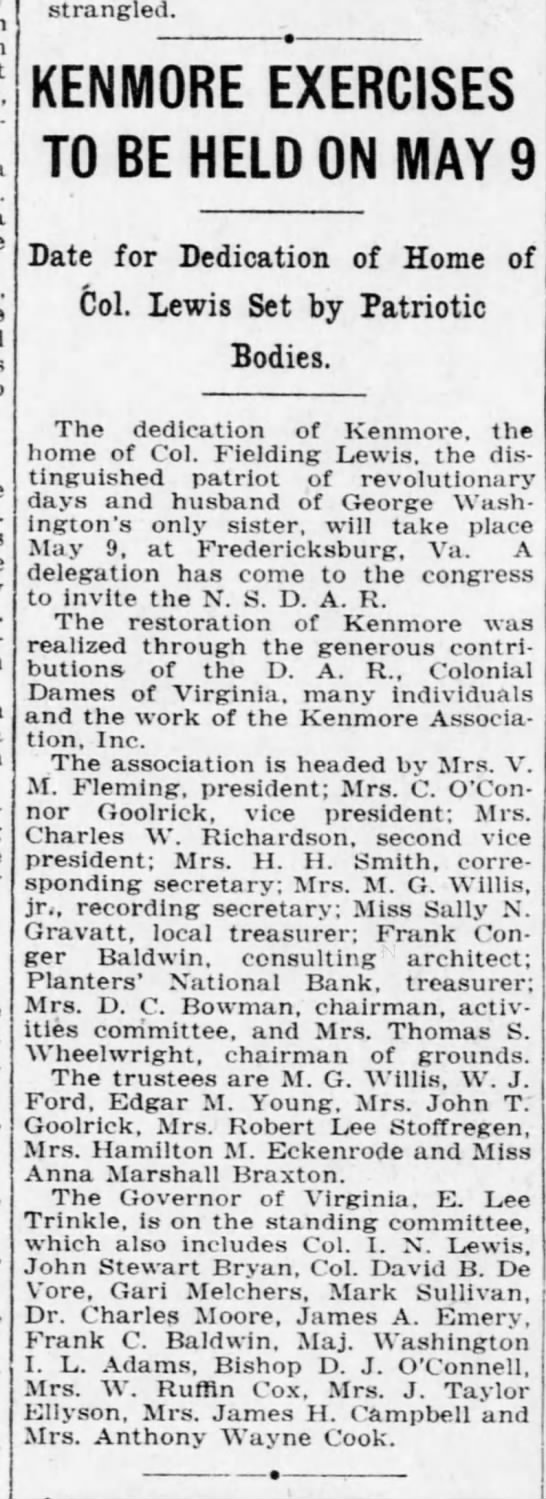
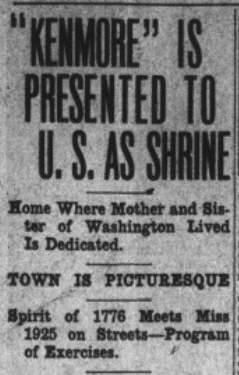
    On May 9, 1925, a dedication was held to celebrate Kenmore opening to the public. People flocked to Washington Avenue for the day’s festivities. According to the Richmond News Leader, “automobiles from all parts of the state and from other states” brought people to Fredericksburg, and “every train was crowded.”[i] Articles advertising the event can be found in local papers ranging from The Evening Star (Washington, D.C.) to the Gloucester Gazette and Northern Neck News, as well as in larger publications like The New York Times. In large block print, the Times declares: “BETTY WASHINGTON’S HOME HAS BEEN SAVED; Women of Fredericksburg, Va., Will Dedicate Kenmore on May 9.”[ii] Dedication day activities included a large parade, costume contest, and brass tunes played by the United States Marine Band. Fredericksburg school children danced the minuet; students from the Virginia State Teachers College hosted a maypole dance, and the mayor and governor gave remarks. The widespread publicity that Kenmore’s reopening received was a reflection of Americans’ growing interest in the historic preservation movement of the day. Notably, many of these early twentieth-century preservation efforts were led almost entirely by women.

    As part of our centennial celebrations (and reminiscent of Kenmore’s original dedication day), we will host a Centennial Block Party at Kenmore on Saturday, April 9th, from 10:00 am to 2:00 pm. This community event will feature tours of the house, games, crafts, stories in the garden, and more! Many of the activity tables will highlight different elements of the house that, thanks to twentieth-century preservation efforts, we are still able to appreciate today.

    Stucco Ceilings:

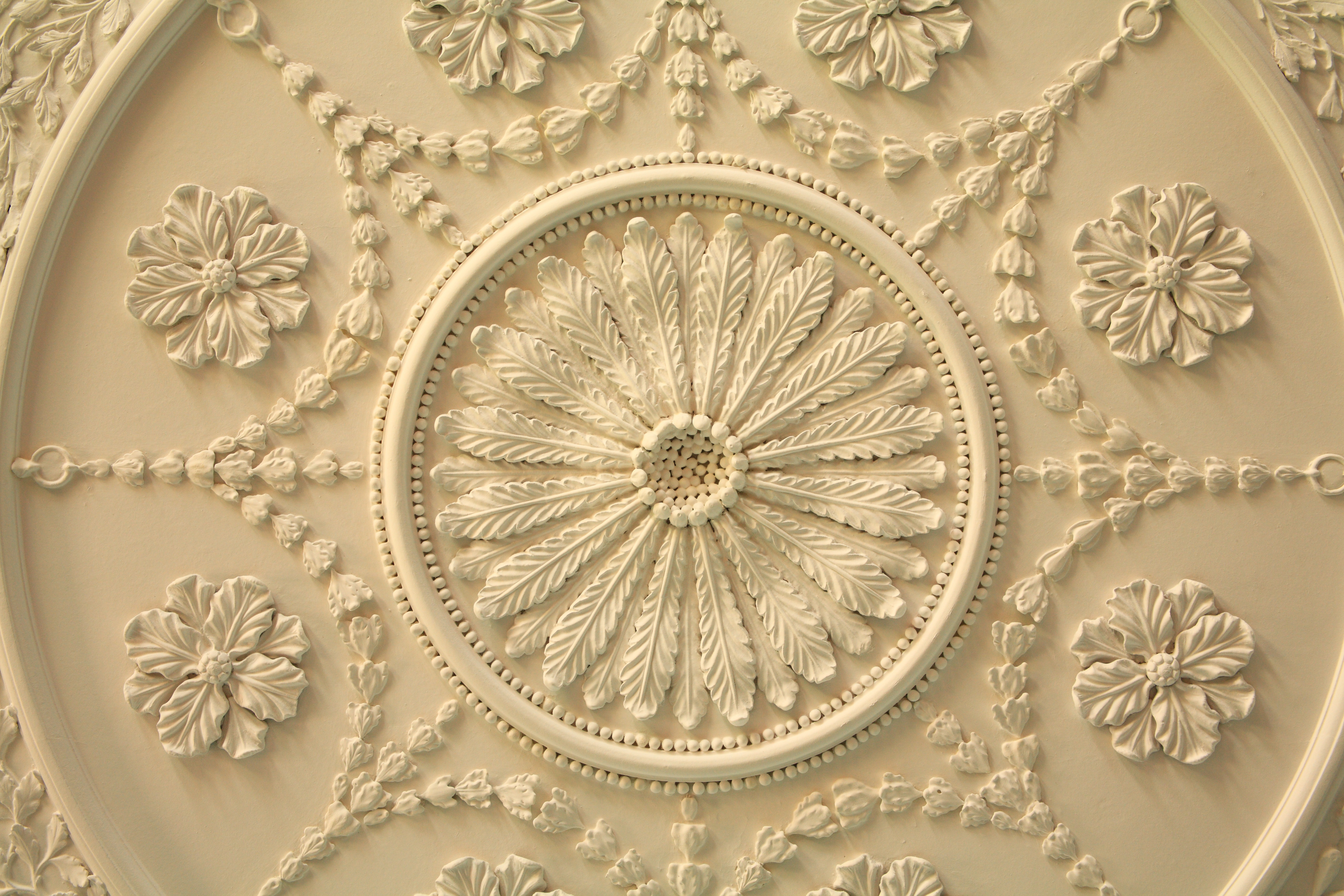
    Stucco Ceiling at Kenmore

    Referred to in Lewis family letters simply as “The Stucco Man,” not much is known about the craftsperson who created Kenmore’s beautiful stucco ceilings. “The Stucco Man” is responsible for the three elaborate plasterwork ceilings and two over-mantel inlays at Kenmore. In 1882, Kenmore resident William Key Howard, Jr. lay on his back atop scaffolding to clean and repair extensive damage to the original plasterwork ceilings. At our plaster activity table, visitors can try their hand at making their own “plaster” impressions or, like Howard, tracing the intricate ceiling patterns. (Scaffolding not included!)

    Flocked Wallpaper

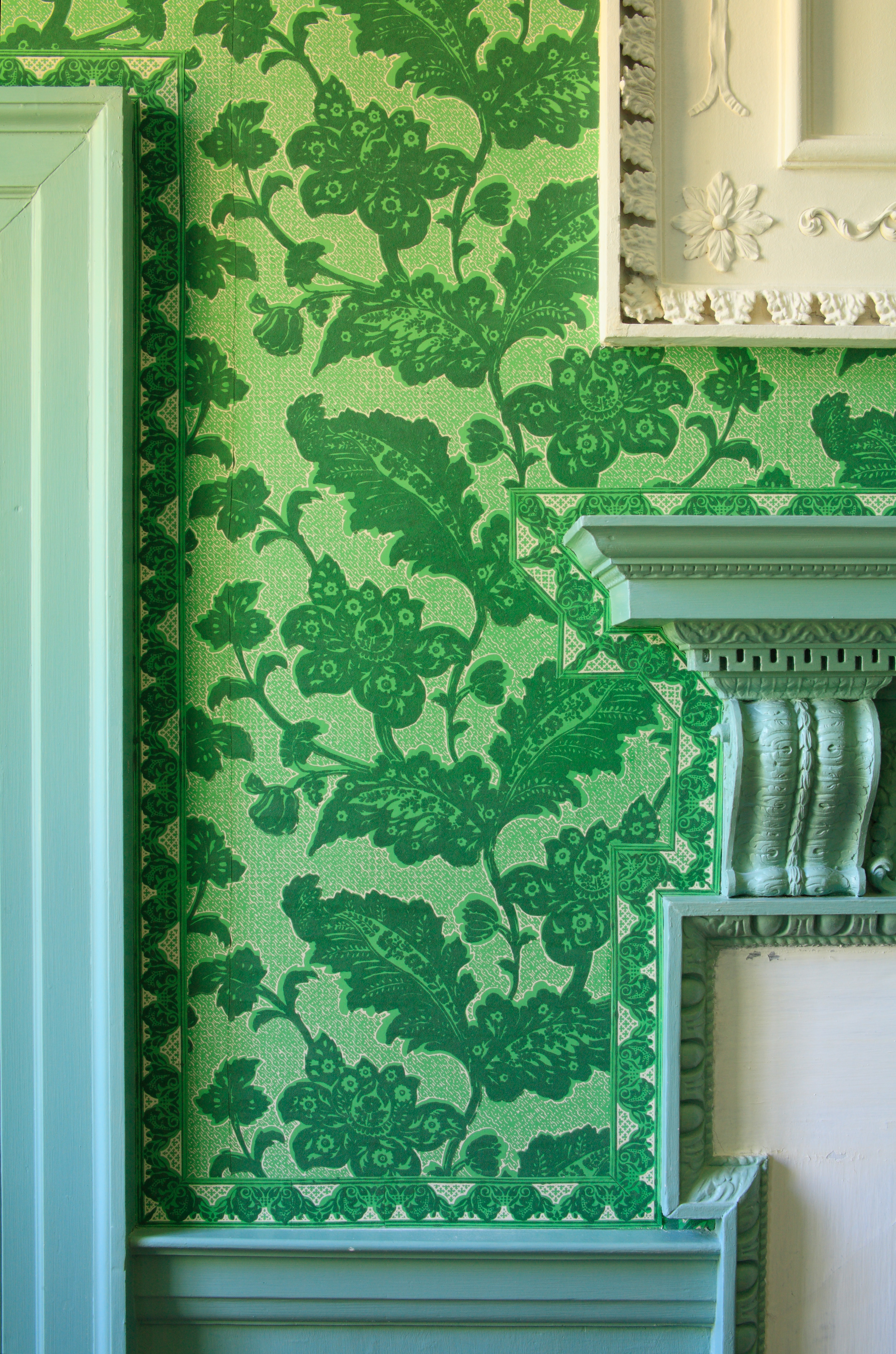
    Flocked wallpaper in Drawing Room at Kenmore

    Vibrant green flocked wallpaper covers the walls of Kenmore’s drawing room. “Flocked” wallpaper was supposed to imitate the look of expensive damask or velvet hangings. The raised velvet-like texture was created by adhering small powdered textile particles called “flock” to the wallpaper.[iii]  At our wallpaper activity table, visitors can design their own wallpaper swatch using stamps and stencils to mimic eighteenth-century block printing techniques.

    In addition to these and other activities, throughout the event, visitors can engage with historic interpreters, curators, and archaeologists to learn more about preservation history, the Lewis and Washington families, and the enslaved men and women who lived and worked at Kenmore.

    Kenmore has a long history with many different stories to tell, and it is thanks to the twentieth-century preservation movement that we still have the physical spaces in which to bring these stories to life. Peopling these spaces is important, and our goal is to continue to preserve, uncover, and interpret the histories of all those who have passed through Kenmore. While the historic preservation field has grown and evolved since Kenmore’s dedication day in 1925, we hope that our community block party will spark a similar interest in preservation efforts and will encourage visitors to reflect on why historic preservation still matters today. What places in your own community have special meaning to you? What stories would you choose to preserve and protect for future generations?

    Ann Waters

    Manager of Interpretation and Visitor Services


    [i] ”Kenmore” is presented to U.S. as shrine. (1925, May 9). The Richmond News Leader, Number 8690 Page 1.

    [ii] Betty Washington’s home has been saved: Women of Fredericksburg, Va., Will Dedicate Kenmore on May 9. (1925, May 3). The New York Times, Section XX, Page 6. https://www.nytimes.com/1925/05/03/archives/betty-washingtons-home-has-been-saved-women-of-fredericksburg-va.html

    [iii] Victoria and Albert Museum. (n.d.). Flock Wallpaper. https://www.vam.ac.uk/articles/flock-wallpaper

  • Kenmore’s Centennial: How the Ladies of the Kenmore Association Saved the Lewis Family Home

    The year 2022 is significant for The George Washington Foundation as it is the centennial of the saving of Kenmore.  We have begun the new year with a new exhibit exploring the saving of Kenmore by The Kenmore Association and the beginning of the restoration of the house and turning it into a treasured historic site.

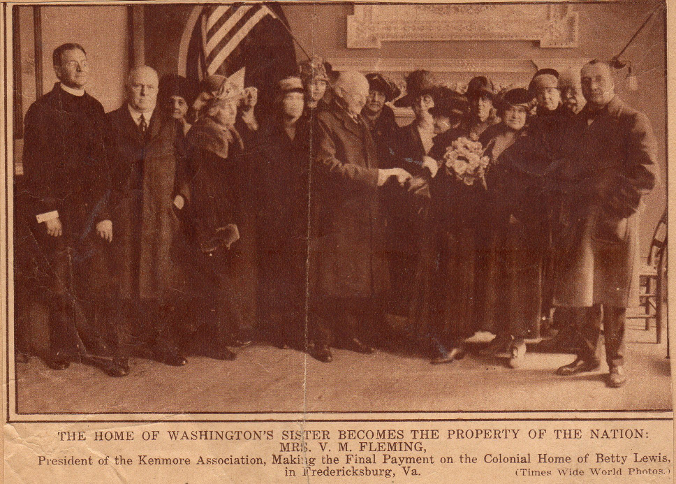
    On January 1, 1925 — ninety-seven years ago — a group of well-dressed women in hats and long fur coats assembled at Kenmore to hand over the final $1,000 payment and gain full possession of the house and land.  This meeting was the culmination of thirty-two months of persistent work and determination by the ladies of The Kenmore Association to save the historic property from destruction.

    Emily White Fleming (identified in the newspaper caption by her husband Vivian Minor Fleming’s initials) makes the final payment to purchase Historic Kenmore on January 1, 1925.

    This crusade began four years earlier with a brief notice in the Fredericksburg Daily Star from Mr. E. G. Heflin, the owner of the Kenmore property.  The announcement stated: “I have decided to build at once…6 or more modern, up-to-date residence [sic] on Kenmore.”  Built on a section of the plantation property, these houses prompted concern among many local citizens at the thought of further loss to the historic site.

    By 1922, the destruction of the old Lewis home seemed imminent.  Mr. Heflin placed an advertisement for the sale of the house itself and cut up much of the original estate into smaller building lots to be sold to developers.  If the house was sold, it might be remodeled into apartments or just razed to the ground.  This escalation increased the alarm even more, and some tried to raise funds to purchase Kenmore.  This attempt proved unsuccessful, and the house did look to be lost.  However, salvation appeared in the form of Kate Waller Barrett and the National Society of the Daughters of the American Revolution (DAR).

    In March of that year, Mrs. Barrett, Virginia Regent of the DAR, came to Fredericksburg with the purpose of organizing a new chapter in the town.  Emily White Fleming and a group of intrepid ladies proposed this turn of events as a potential way of saving Kenmore.  Mrs. Fleming was 68 years old and, though seemingly small and fragile, she, in reality, had a tenacious and determined spirit.  She accepted the position and, with the help of her daughter Annie Fleming Smith, known as “Miss Annie,” began their campaign to save the old Lewis house from destruction.

    The ladies approached Mr. Heflin and negotiated an agreement to the purchase the property.  The group had to make a first payment of $10,000 within four months, or the deal would be off.  Furthermore, if Mr. Heflin got a satisfactory offer within those four months, he could go ahead and sell the property outright. It was a tough deal, but the ladies rose to the challenge spectacularly.

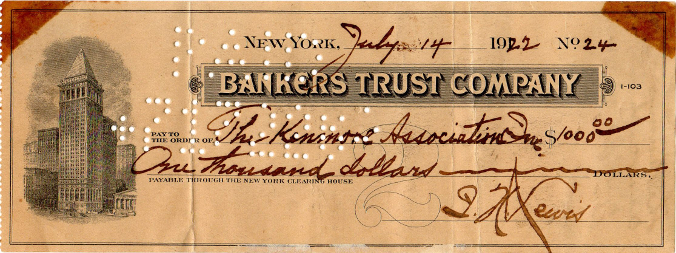
    Mrs. Fleming and Miss Annie began fundraising immediately.  They wrote hundreds of letters by hand, stating facts about Kenmore in a simple, forceful style and then making appeals for help. Mrs. Fleming recalled, “I could write thirty-nine letters a day and Annie forty-nine. We never had a typewriter until the campaign was over.” In response to one of Mrs. Fleming’s letters, Colonel Isaac Newton Lewis, maker of the Lewis machine gun and a descendant of Fielding Lewis, contributed the first $1,000. Not to be outdone, The Colonial Dames of America in the State of Virginia gave a substantial donation of a $1,000 as well.

    Donation from Colonel Isaac Newton Lewis donated the first $1,000 to the Kenmore Association.

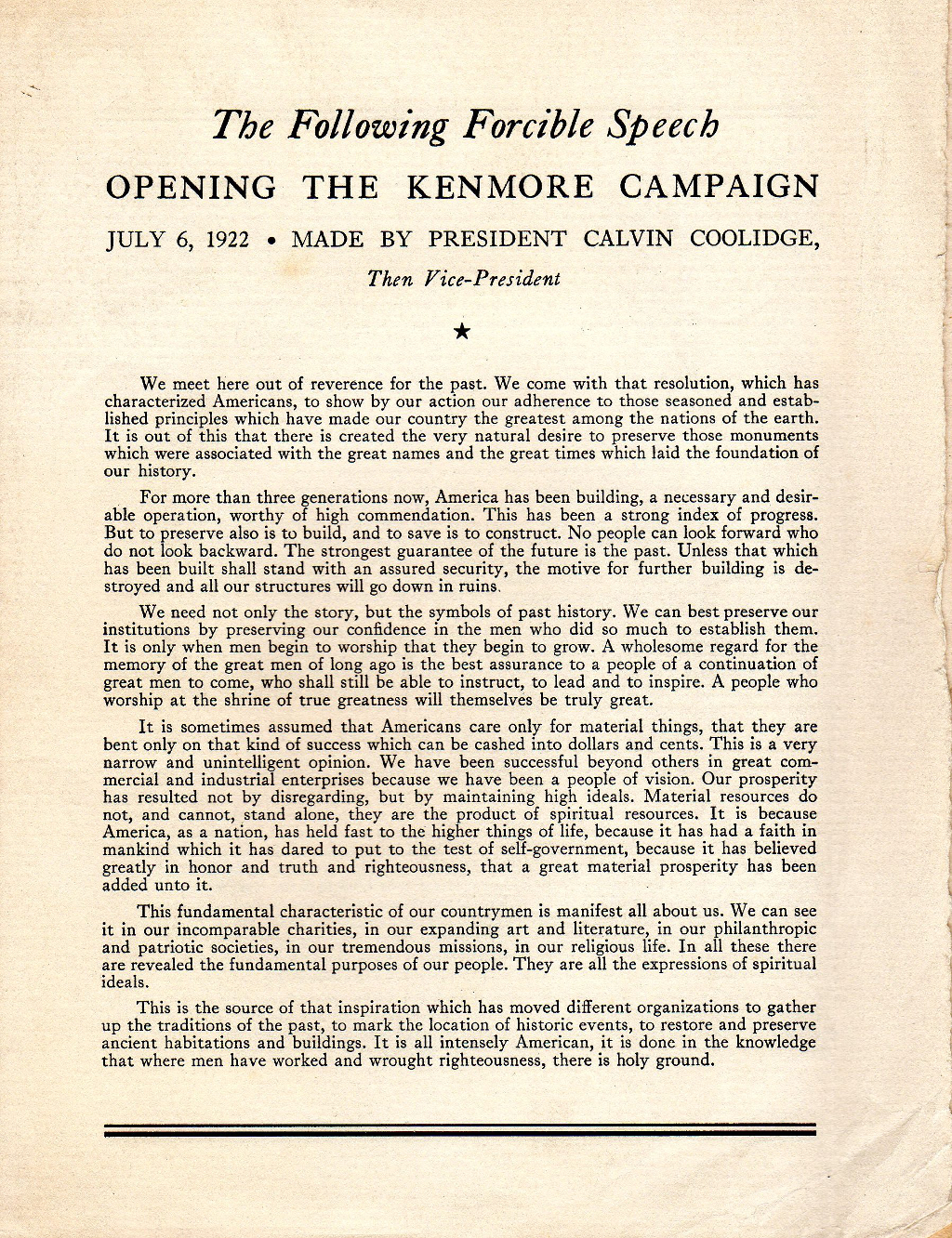
    In July 1922, the Kenmore Association launched a public fundraising drive with a host of distinguished men and women coming to Fredericksburg for the start of the campaign. Even Calvin Coolidge, then the vice president under Warren G. Harding, made a speech (see below) pleading for patriotic Americans to save this home that was so critical in the history of the country.  “It ought to be preserved for its own sake,” Coolidge demanded, “It must be preserved for the sake of patriotic America.”

    Speech made by Vice President Calvin Coolidge in support of the Kenmore Association’s effort to save the historic home.

    Through the efforts of this determined group of women, by the first of September 1922, they were able to pay an initial installment of $12,000 on the account.  Impressed with the Kenmore Association’s work, Mr. Heflin made his own gift of $2,000.   By New Year’s Day 1925, the hard work paid off, and the ladies made the final payment and took possession of the property.  Historic Kenmore was saved!

    Although the saving of Kenmore one hundred years ago certainly marked a new beginning, transforming the house into a historic site for the public to enjoy required many more years of work.  Indeed, in many ways, the work begun by Mrs. Fleming, Miss Annie, and the Kenmore Association continues even as 2022 begins.  In the New Year at Kenmore, we will focus celebrating the establishment of the Kenmore Association and the ladies’ work to save this national treasure.  You can follow the year’s celebration here of the “Lives and Legacies” blog and The George Washington Foundation website.  Like in 1922, the year 2022 should prove an exciting time.

    Heather Baldus
    Collections Manager

  • What in the World is Twelfth Night?: A Visit with the Ghost of Twelfth Night Past

    Usually, at this time of year preparations are well underway for our annual Twelfth Night at Kenmore: A Dramatic Performance.  The play takes place in January 1776, during the first Christmas season celebrated at Kenmore. Unfortunately, this year’s celebration of Twelfth Night at Kenmore is canceled due to winter weather.  However, if you are familiar with the performance, or have read some of our past blog posts, you might already know a thing or two about this once popular Christmastide holiday. While traces of Twelfth Night still exist today, the celebration is much diminished, if not entirely eclipsed, by Christmas and New Year’s. Why is this, exactly? When did we stop celebrating Twelfth Night?

    There is no single, short answer as to why Twelfth Night celebrations fell out of fashion. Rather, attitudes surrounding the Christmas season changed throughout history, and old traditions were often absorbed or re-imagined into something new. A very brief look into the history of the season sheds some light on why today’s Christmas traditions rose in popularity, while Twelfth Night celebrations became part of Christmas Past.

    Historic Kenmore on the eve of Twelfth Night. Credit: GWF Photo

    Many Christmas and Twelfth Night traditions are rooted in holidays celebrating the winter solstice. For example, Saturnalia, a holiday honoring the Roman god Saturn, took place in mid-December. During Saturnalia, the normal social order was temporarily overturned. Romans closed schools and businesses, held grand feasts, and in some families, a king or “Lord of Misrule” was chosen to rule over the household’s festivities.[1] In Scandinavia, people celebrated the winter solstice during the Nordic festival, Yule. Festivities included bonfires (or yule logs), evergreen decorations, and feasts. It wasn’t until the 4th century that the Roman church officially observed December 25th as Jesus’s birth date. Historians speculate that church officials chose this date precisely because so many popular winter celebrations occurred around that same time.[2]

    Saturnalia by Antoine Callet. Credit: Wikipedia

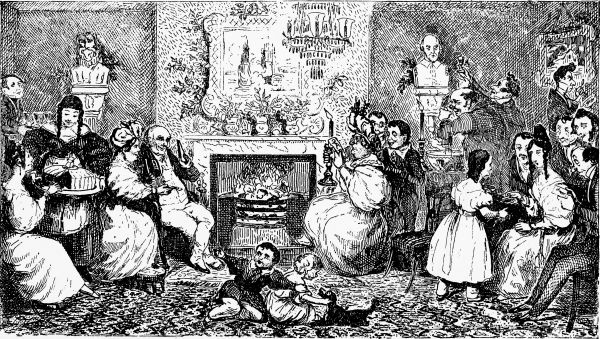
    If we fast forward in time, we see how some of these winter rituals were absorbed into the festivities of Twelfth Night. But first- what exactly is Twelfth Night? Typically celebrated on either January 5th or 6th, Twelfth Night, or Epiphany, is a Christian holiday that marks the end of the Twelve Days of Christmas and commemorates the Magi’s visit to Jesus. During the colonial era, the holiday season kicked off on December 25th and culminated on Twelfth Night. The twelve days after Christmas were full of games, music, dancing, feasts, and visiting with family and friends. Families often celebrated the season with a Twelfth Night Cake. Recipes called for a dried bean and pea to be baked into an elaborately decorated fruit filled cake. The man who found the bean was declared King for the night, while the woman who found the pea was declared Queen.

    Illustration of a Twelfth Night party by Robert Seymour. The woman on the far left serves pieces of a large Twelfth Cake. Credit: The Project Gutenberg

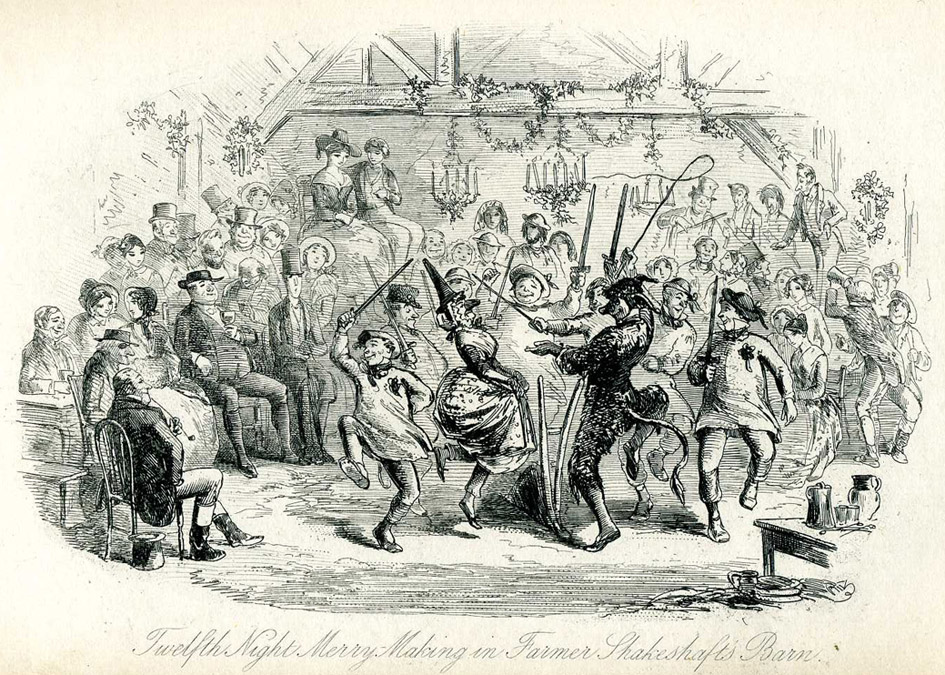
    Of course, there has always been debate surrounding how the Christmas season should be celebrated, and practices varied from place to place and person to person. In the 17th century, New England Puritans (echoing sentiments from Cromwellian England) viewed Christmastime celebrations as rowdy, excessive, and downright bacchanalian. Massachusetts went as far as to outlaw celebrations between 1659 and 1691.[3]

    The Twelfth Night party’s “King” and “Queen” sit on chairs overlooking the crowd. Dancing, drinking, and mumming (costumed acting) are in full swing. Puritans disapproved of these festive antics. Credit: Wikipedia

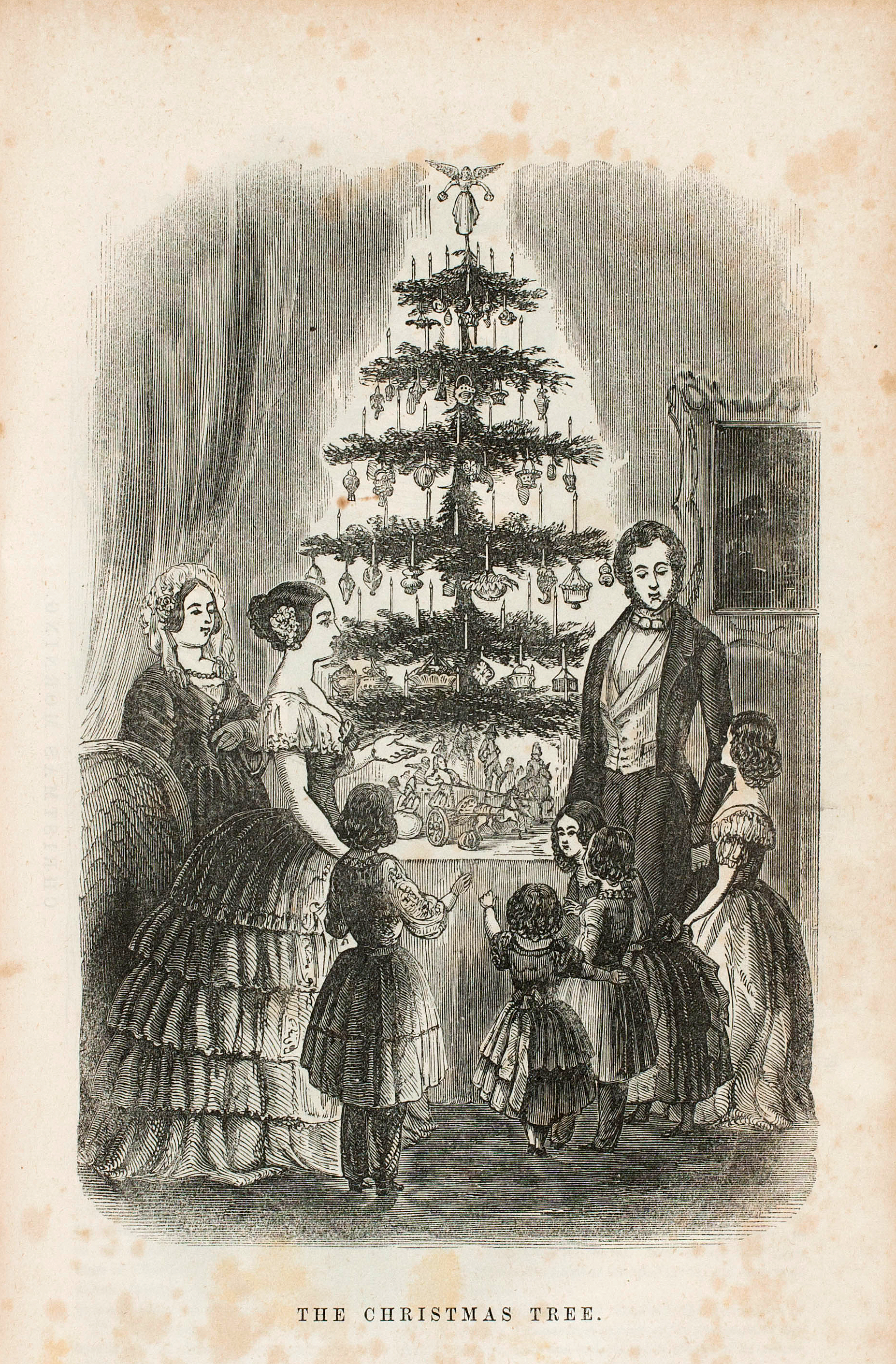
    During the 19th century, Queen Victoria influenced a shift in popular opinion towards a more family-focused Christmas season. In 1850, Godey’s Lady’s Book, a popular American magazine, published an image of the royal family gathered around a Christmas tree. While German immigrants had already introduced the Christmas tree tradition to America, this image fascinated the English and American public alike, and it further popularized the practice. In the American version of the print, editors removed Victoria’s tiara and Albert’s royal sash, and the group came to embody the ideal American family at Christmas.[4]

    Godey’s Lady’s Book illustration. Credit: Wikimedia Commons

    These changing ideals shaped the Christmas season during the Victorian era, and combined with rapid industrialization and commercialization, they sparked the beginning of a number of now familiar traditions. For example, improvements in mass printing technology popularized the practice of sending Christmas cards. In 1843, Charles Dickens published A Christmas Carol, a tale promoting charity, good will, and the virtues of a domestic family Christmas. Thomas Nast, who made popular the modern image of Santa Claus, published his first Santa cartoons in the 1863 edition of Harper’s Weekly.

    You might be asking, where then, does this leave the Twelve Days of Christmas and our Twelfth Night celebrations? As we’ve seen, changing ideals during the 19th century promoted a holiday season focused on children and family. Modern industry and commercialization further bolstered shopping and gift giving habits, and a twelve day holiday certainly didn’t fit within the parameters of the new industrialized era. The once twelve day celebration now culminated on one, and it was celebrated with visits from Santa and gifts for children, rather than with feasts and parties for adults.

    However, some Twelfth Night traditions live on during the modern Christmas season, albeit under new guises. Between Christmas and New Year’s, people may decorate their homes with greenery, raise a toast with a glass of wassail, or host extravagant parties with family and friends. If you visit New Orleans during the carnival season (beginning with Epiphany and ending on Mardi Gras) you might celebrate by eating “King Cake,” where the lucky person who finds the plastic baby figurine inside their piece of cake is crowned “king” for the day! That sounds a little familiar, doesn’t it?

    Ann Waters

    Manager of Interpretation and Visitor Services


    [1]“Saturnalia,” HISTORY, A&E Television Networks, Last modified December 18, 2020, Accessed December 22, 2021, https://www.history.com/topics/ancient-rome/saturnalia

    [2] Stephen Nissenbaum, The Battle for Christmas (New York: Knopf Doubleday Publishing Group, 2010), 4.

    [3] Bruce David Forbes,“Christmas,” In America’s Favorite Holidays: Candid Histories, 1st ed. (University of California Press, 2015), 28.http://www.jstor.org/stable/10.1525/j.ctv1wxrr3.5

    [4] Ibid., 34.

  • A National Treasure’s Life: A History of The Declaration of Independence

    Join us for our first Movie on the Lawn event at Historic Kenmore on Friday, September 17 as we show National Treasure starring Nicholas Cage and the Declaration of Independence!

    FACT: George Washington’s Culper Spy Ring used codes, ciphers, and invisible ink (among other tactics) to outwit the British during the American Revolution.

    FICTION: There is a map in invisible ink on the back of the Declaration of Independence. 

    You are probably wondering what the connection to George Washington is, right? He did not write the Declaration. He did not debate it. He did not sign it.  Ah, but he read it and more importantly, he read it to his troops on July 9, 1776. He was sent a copy hastily printed by John Dunlap, a printer in Philadelphia.

    Much like Washington, the document is one of America’s treasures. The Declaration has a fascinating history on its journey to the National Archives, where, in National Treasure, Nicholas Cage’s character steals it in order to save it. Think about it! Just how did the document we all celebrate every July survive these past 200+ years?

    National Treasure poster. Credit: Disney/Fandom

    After it was signed, sealed, and distributed, the official version remained with Charles Thompson, Secretary to the Congress, until he retired in 1789.  The person who next took responsibility for the document was Roger Alden, deputy secretary of foreign affairs (The U.S. briefly has a Department of Foreign Affairs before it became the Department of State).  By March of 1790, Thomas Jefferson would become Secretary of State and protector of the document he spearheaded in drafting.  Talk about full circle!

    In August 1800, the Declaration was moved to newly-built Washington, D.C., residing briefly in the Treasury building.  It was sent to the War Office in May 1801 where it would stay until 1814.  Thanks to the quick thinking of Stephen Pleasonton, a senior clerk at the State Department, the Declaration (among other critical documents. Ahem! The Constitution!) were secreted out of the City to a farmhouse in Virginia during the British attack on Washington on August 24, 1814.  The documents were returned to the Capital after three weeks, once the British had left town. 

    While at the State Department, the document was mounted and displayed (with Washington’s Continental Army commission!) at the Patent Office (today the National Portrait Gallery) at the suggestion of then Secretary of State Daniel Webster in 1841. Preservation techniques were not considered, as the document was placed in direct sunlight and exposed to all manner of elements.  It remained on display for the next 35 years!

    Memorial certificate attesting that the holder visited the Centennial Exhibition in Philadelphia in 1876. Credit: Picryl

    When it traveled to Philadelphia for the 1876 Centennial Exhibition, the public was exposed to the dire state of the parchment caused by sunlight.  The good news was that it was better cared for during this time and was even kept in a fireproof safe. The bad news was that its condition was widely reported in the newspapers. In response to the resulting public outcry, Congress adopted a joint resolution that the Secretary of the Interior, Secretary of the Smithsonian, and Librarian of Congress figure out a way to save the Declaration.

    Despite the commission, nothing was done for 17 more years. The document was exposed to even more light until 1894, when the State Department decided to shield it in a steel case. The Declaration was then examined by the National Academy of Science in 1904 to determine how best to preserve it.  The conclusion?  Keep it in a dark and dry place, never to be displayed again.  So, the State Department did just that and locked the document up for the next twenty years!

    Between1904 and 1920, Herbert Putnam, then the Librarian of Congress, campaigned for the State Department to turn over the founding documents to the Library of Congress (LOC), with no luck. He would not see any movement on his mission to preserve and house the Declaration until Secretary of State Bainbridge Colby formed a committee to review necessary preservation steps and recommended the Declaration be sent to the LOC. President Warren Harding issued and signed an Executive Order on September 29th, 1921 to that effect. Putnam was ecstatic and used the official library vehicle, a Model T mail wagon, to transfer the document from the State Department to the LOC.

    The question remains, though. How did it eventually end up at the National Archives?

    During the tumultuous years of World War II, Librarian of Congress Archibald MacLeish was on a mission to protect the documents from potential damage. His solution? Stored them at Fort Knox!  It was perhaps one of the most “hush-hush” operations ever carried out by the LOC. George Washington probably would have been very proud to witness the operation carried out with a military precision worthy of Henry Knox’s (the Fort’s namesake) mission to move cannons from the Great Lakes to Dorchester Heights in Boston during the American Revolution.

    Finally, the documents were transferred from the LOC to the National Archives building on December 13, 1952 (the cornerstone was laid in 1933). Congress created the Archives in the 1930s to care for government records and made the Declaration the Archives’ responsibility in 1952. Representatives of all the armed forces carried out the transfer, including military police, a color guard, the U.S. Army Band, the U.S. Air Force Drum and Bugle Corps. They used a Marine Corps armored personnel carrier, two light tanks, and a motorcycle escort.  Lining Pennsylvania and Constitution Avenues were members of all the service branches. At the National Archives since 1952, the Declaration has been (and continues to be) preserved so that visitors can view it daily. Ultimately, it also inspired a fun action-adventure film!

    Film footage of the transfer of the Declaration of Independence from the Library of Congress to the National Archives on December 13, 1952. Credit: National Archives.
    The Declaration of Independence on display at the National Archives in Washington, D.C. Credit: National Archives

    While mostly fiction, National Treasure is one of those movies that excites people about History.  The number of times visitors to the National Archives have asked “Is there actually a map on the back of the Declaration of Independence?” and they hear “Nope” is not a bad thing.  It is clear that something brought them to that museum and it shows they took an interest and asked a question, which is a great start to studying History.

    Interestingly, a line of the riddle from the movie:

    The legend writ, the stain affected, the key in Silence undetected, fifty-five in iron pen, Mr. Matlack can’t offend

    refers to Timothy Matlack, who while considered a “boisterous, swashbuckling personality,” was also known to be “a man of intellectual vigor, a fine writer and public speaker.” He was selected by the Continental Congress to write out the official document (the one now residing in the National Archives) that measures 24.25 by 29.75 inches.  He also — fun fact! — wrote out George Washington’s commission to lead the Continental army!

    So, gather some friends, grab chairs, blankets, and whatever movie snacks will make you happy, purchase a ticket and join us on the lawn of Historic Kenmore on Friday, September 17 for an epic adventure starring the Declaration of Independence! Oh, and that guy Nicholas Cage too.

    Amy N. Durbin
    Director of Education


    Puleo, Stephen. American Treasures: The Secret Efforts to Save the Declaration of Independence, the Constitution, and the Gettysburg Address. Picador, 2017.

  • National Parks, National Historic Landmarks, and the National Register of Historic Places, Oh My!

    Throughout my time as a museum professional, I have worked at several different museums each with different classifications, rules, and operating procedures. Before entering the museum world, I used to think that most museums operated in a similar way. However, that could not be further from the truth. One of the most common questions I have gotten since leaving the National Park Service for the private sector has been some variation of: “Why can’t I use my National Park Pass here?” It is an understandable question that I am here to answer.

    Museums can be categorized by many different subjects. For example, there are art museums, history museums, science museums, zoos, gardens and more! There are also different categories on how museums operate, fundraise, and are preserved. For example, George Washington’s Ferry Farm and Historic Kenmore are both historic house museums. They are owned by The George Washington Foundation, a private, non-profit organization that is charged with caring for the properties. Ferry Farm and Kenmore are funded by your donations, admission fees, and fundraising events. However, the Washington Monument in Washington, D.C. is a National Park Service (NPS) property, operated by the government and funded, in part, with tax-payer dollars.

    Aerial view of the Washington Monument

    In addition to the NPS sites, the United States government also created the National Register of Historic Places. The National Register of Historic Places is a list of places that are worthy of preservation but are not necessarily and, in fact, are not usually operated by the U.S. government. Sites on this list are able to apply for certain grants and funding through the NPS. They also receive certain tax breaks and can work towards becoming a National Park Site. Fun fact, there are almost 100,000 properties listed on the National Register of Historic Places!

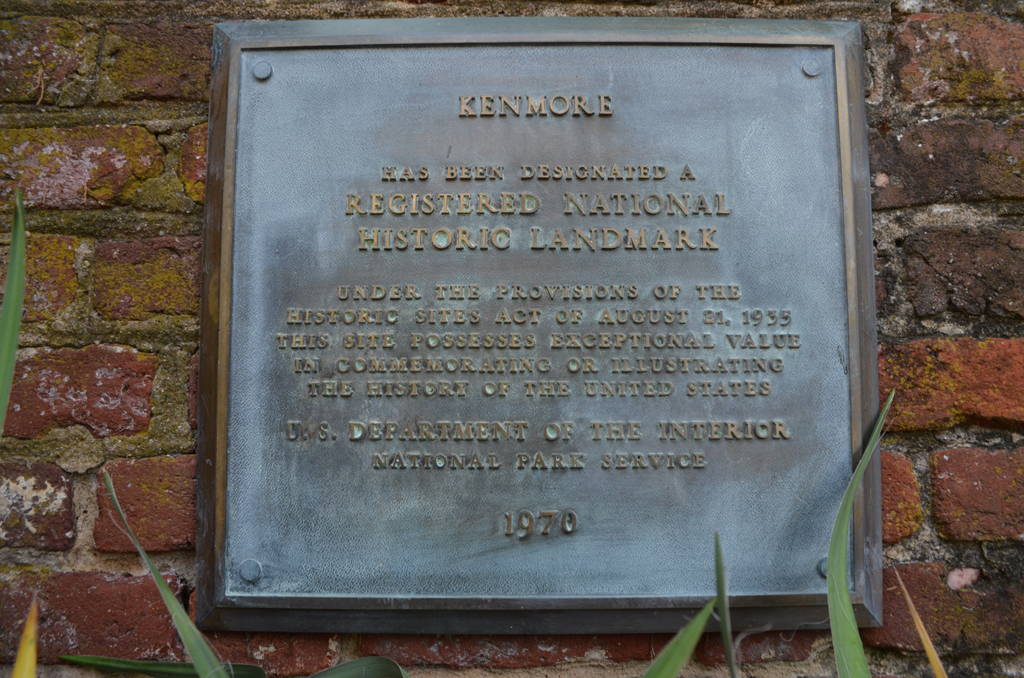
    Of those 100,000 National Register properties, some also have the distinction of being National Historic Landmarks. Landmarks are sites that are again, not necessarily government-run, but have been recognized by the federal government as being nationally significant, meaning they correlate to a significant part of our nation’s history. These properties are also able to apply for certain grants and tax breaks. Not all properties on the National Register of Historic Places and not all properties listed as National Historic Landmarks are museums and not all of them are open for public visitation. However, being on these lists adds a layer of protection should the owners of that property need assistance in preserving the site.

    Marker noting Historic Kenmore’s designation as a National Historic Landmark in 1970.
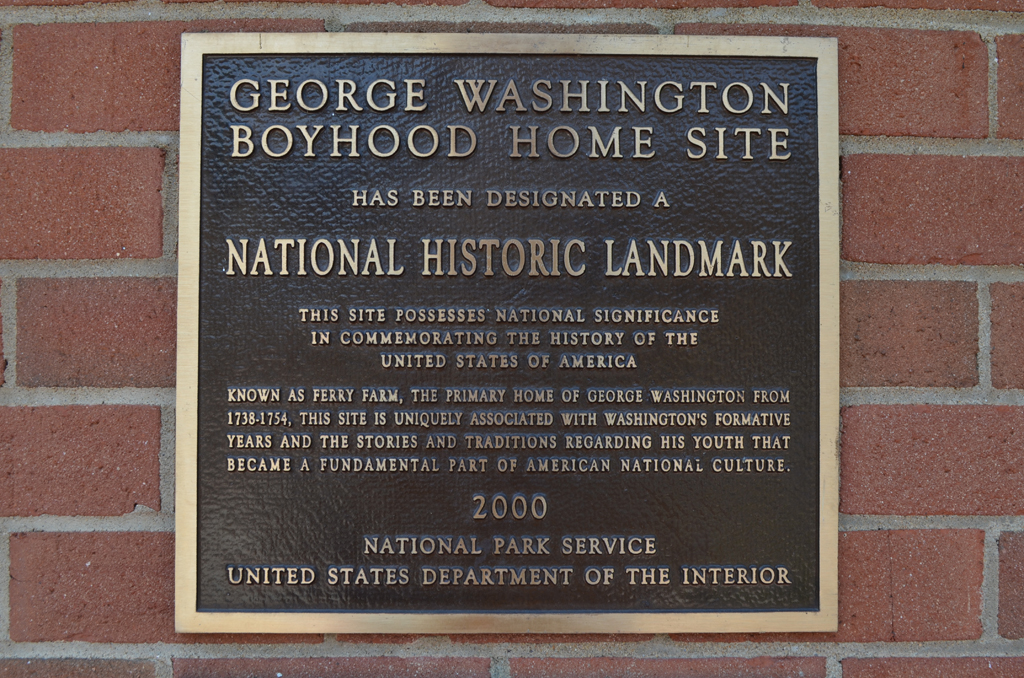
    Marker noting George Washington Ferry Farm’s designation as a National Historic Landmark in 2000.

    Along with National Register and National Historic Landmark status, there are also several types of Easements that can be put in place to protect historic sites. Two types of easements often used in the museum world are Conservation Easements and Preservation Easements. These easements are agreements between the government and a property’s stewardship organization that allow for the government to step in and take over the operation of a property if the private owners are not caring for it properly or it becomes endangered in some fashion. Easements also allow the government to have approval over major changes to the properties to ensure they maintain their historic or natural significance. Private easements can also be created between two parties such as a historic site and a local conservation organization to protect the natural areas of a historic site.

    The George Washington Foundation is a 503(c) (3) non-profit. This designation gives our organization certain tax exemptions. We are a private foundation that operates the two historic sites. These sites are not National Park Service sites and do not receive direct taxpayer funding from local, state, or federal governments. Both Historic Kenmore and George Washington’s Ferry Farm are on the National Register of Historic Places and also are both National Historic Landmarks. Additionally, Ferry Farm is under a conservation easement with the National Park Service. All of this means that while we still operate as a private foundation, there are several layers of protection to ensure these treasured historic properties are preserved and protected for decades to come.

    Ferry Farm
    Kenmore

    As a private organization, we rely on admission fees and your generous donations to fund our sites. We are not part of any National Park or state park pass system. Your ticket purchase helps preserve and promote the legacies of these two sites. Perhaps that is why we are so appreciative for each and every guest who visits. If you would like to support The George Washington Foundation, please consider a donation. We hope to see you at the National Historic Landmarks of Historic Kenmore and George Washington’s Ferry Farm soon!

    Elizabeth Hosier
    Manager of Interpretation and Visitor Services

  • Liberty vs. The King: National Identities in Two Lewis Family Drinking Vessels

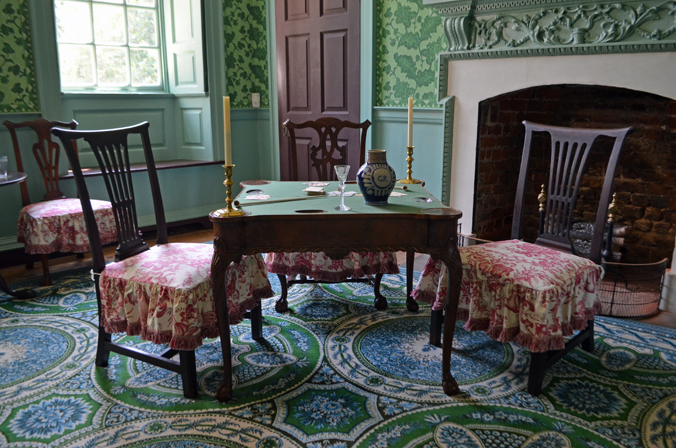
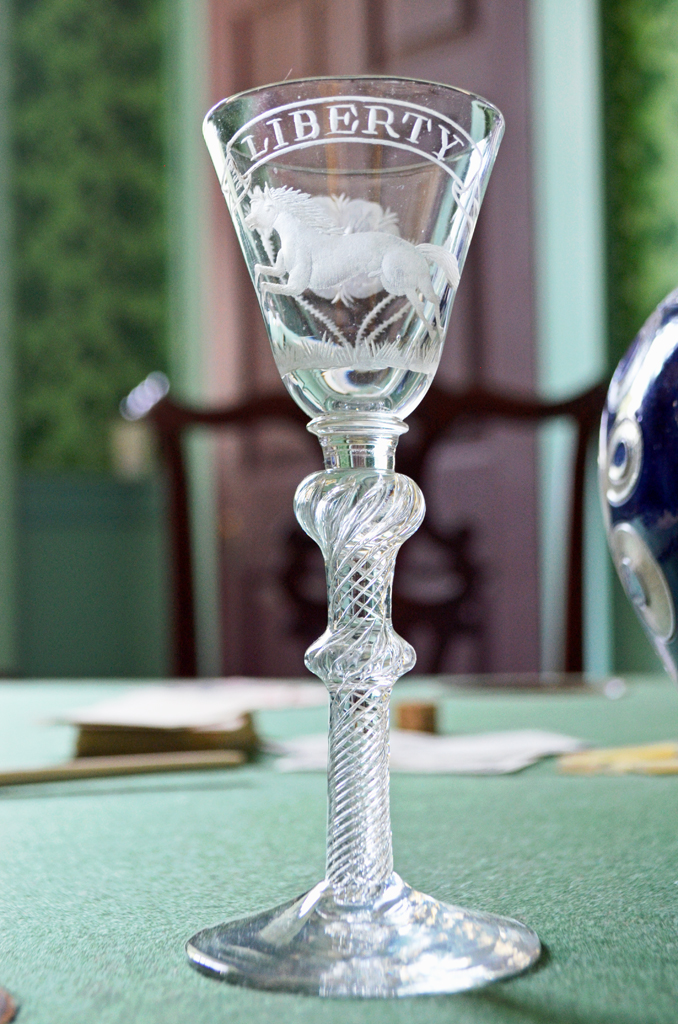
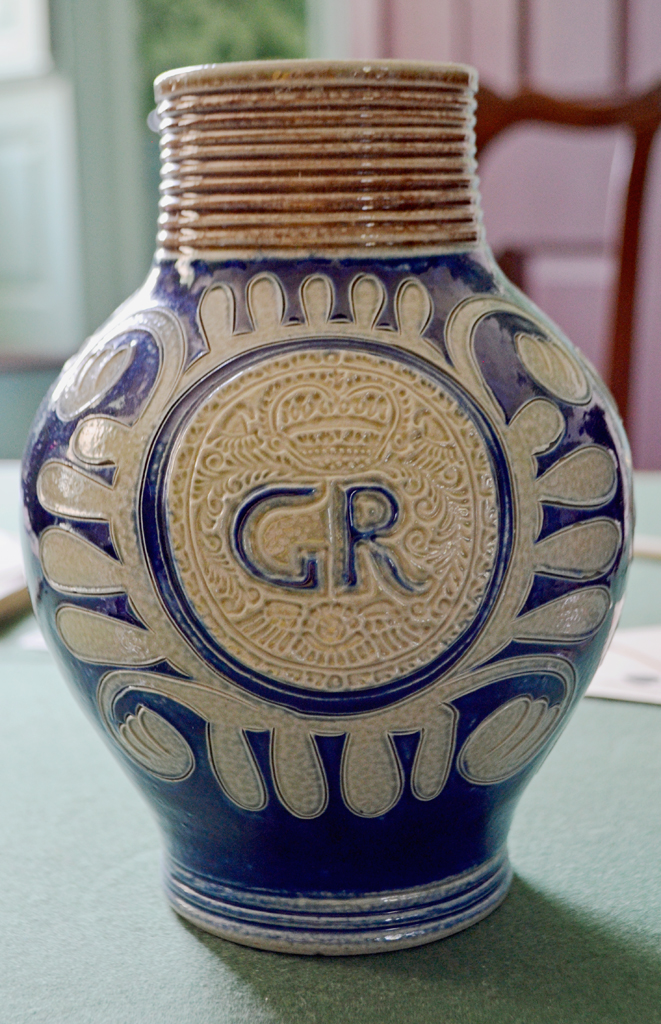
    Visitors to Kenmore’s Drawing Room may have noticed an unusual pairing of glassware and ceramic pieces displayed on the gaming table – a beautiful, air-twist stem wine glass sitting next to a Westerwald pottery jug. At first glance, this small vignette may simply appear to depict a wine jug at the ready, waiting to fill the glasses of those seated for the card game. But a closer inspection reveals that there’s more to the story.

    The gaming table in Historic Kenmore’s Drawing Room.
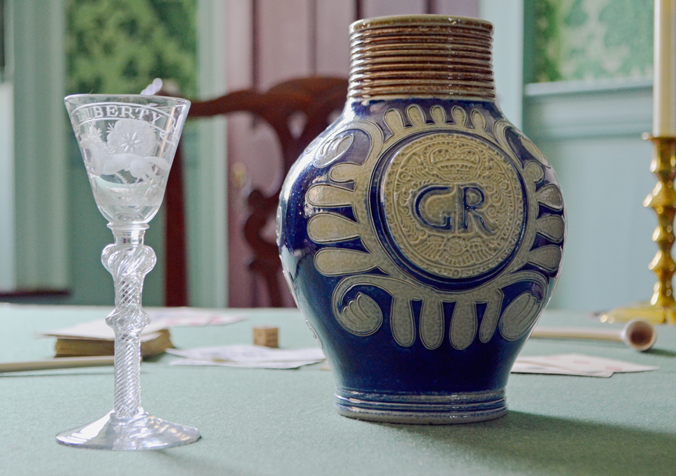
    Air-twist stem wine glass sitting next to a Westerwald pottery jug on the gaming table.

    In addition to its delicate air twists and balusters, the cup of the wine glass is etched with intricate designs. On one side, there’s a rose, and on the other is the word “Liberty.” The rose refers to the Scottish House of Stuart and their exiled claimant to the Scottish throne, the Bonnie Prince Charlie. The word “Liberty”, in this case, refers to the Jacobite Uprising of 1745 – 1746, in which the Scottish clans attempted to overthrow the English king and re-install the Bonnie Prince, thereby ending the English occupation of Scotland. The Uprising ended in a bloodbath for the Scottish forces at Culloden Moor, and the Bonnie Prince remained in exile for the rest of his life. The defeat at Culloden ushered in a period of extreme violence and repression of Scottish Highland culture known today as the Clearances. Thousands of Scots were forced from their homes and prosecuted in English courts for crimes against the Crown. Those found guilty were often sentenced to “transportation,” which meant they were crowded onto prison ships and sent to the American colonies.

    The stoneware jug is decorated in typical Westerwald-style cobalt blue glaze patterns, with the addition of a sprigged central medallion bearing the letters “GR.” Those initials stand for Georgius Rex, the Latin for King George of Britain, probably George III in this case. Westerwald ceramics produced in what is now Germany for export to Britain in the 18th century were often decorated with the GR emblem in honor of King George. Most British households, including young George Washington’s home at Ferry Farm, would have had a piece or two exhibiting the GR motif.

    Both items are included in Kenmore’s furnishings today because fragments of similar pieces were found archaeologically on the site during excavations in the 1990s, so we know that both were used by the Lewis family at very nearly the same time. The juxtaposition of their messages, though, illustrates what a very strange and confusing time the Lewis family were living in. Literally up until the very eve of the American Revolution, Fielding Lewis saw himself very much as a proper English subject. His business relied almost entirely on good relations with English counterparts. He built Kenmore to emulate in every way the proper English manor house, and apparently he owned ceramics that honored King George.

    Almost overnight, however, the Lewis’s world completely changed. They were no longer English subjects, but rather traitors to the Crown. Fielding’s income and business were gone, and his very English house was now a liability. Those transported Jacobites living in the American colonies, many of them neighbors to the Lewises like Hugh Mercer, were among those who advocated for war with Britain. The symbols and ideals of the Jacobite Uprising were adopted into the American revolutionary movement. And so our placement of the Liberty glass next to the GR jug on the gaming table is both a wink and a nod to the idea of rebellion hidden in plain sight, and a recognition of the complicated times in which the Lewis’s found themselves.

    Celebrate the 245th anniversary of liberty from the King during the Fourth of July at George Washington’s Ferry Farm from 10 a.m. to 4 p.m., Sunday, July 4, 2021! Tour the Washington house, learn about archaeology at Ferry Farm, enjoy a patriotic flag retirement ceremony at 1:00 p.m., interact with historic reenactors, listen to festive music, view living history demonstrations and theatre performances, make crafts, play games, and enjoy other activities for the whole family. $5.00 per car for a combined parking and event admission pass. Advance purchase of parking and event admission pass is strongly encouraged. Visit kenmore.org/events to learn more and purchase pass.

    Meghan Budinger
    Aldrich Director of Curatorial Operations

  • Stories that Demand to be Told: Fielding Lewis and the Bray School for Educating Enslaved Children

    During the 18th century, the city of Fredericksburg was described as “a considerable town of trade, furnishing the country around.”[1] As such, it was deemed a rather important town and was the site of one of two schools for enslaved children established in Virginia during the Colonial period. The school was located somewhere downtown, likely near St. George’s Church. Two of the trustees in charge of operating the school were the Reverends James Marye, Sr. and later his son James Marye, Jr. Another trustee was none other than Historic Kenmore’s own, Fielding Lewis.

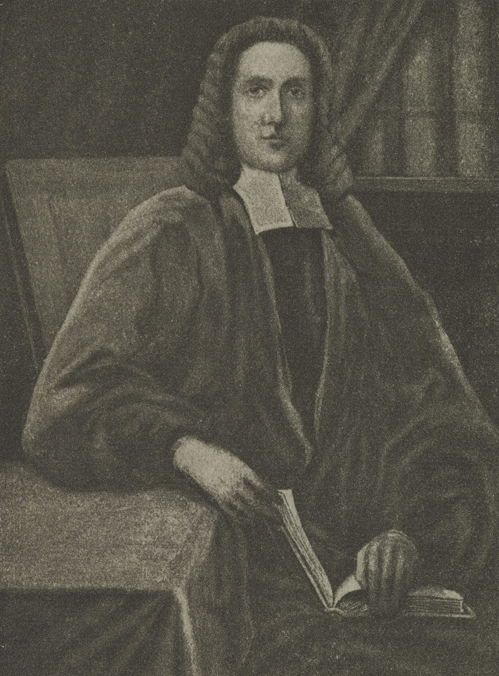
    The school was funded and established by a group of English clergymen and philanthropists known as the Associates of Dr. Bray. Thomas Bray was an Anglican minister who had grown up without wealth. Due to his family’s financial situation, Bray found certain doors, specifically education, closed to him. Through his time in the ministry, however, he was able to gain the knowledge needed to become a great influence and practitioner of philanthropy. Towards the end of his life, he established The Associates of the Reverend Dr. Bray. Its eventual goal was to create avenues of religious and secular education for black children. While never condemning slavery, Bray felt that the souls of enslaved people needed to be saved in the Anglican faith. In order to be able to worship properly, they would need to be able to read and write. By the end of the 18th century, the Bray Associates had founded 41 libraries, donated over 22,000 books to different Anglican parishes in the colonies, and established a handful of schools across British North America.

    Thomas Bray as depicted in The Founders: Portraits of Persons Born Abroad Who Came to the Colonies in North America Before the Year 1701; With an Introduction, Biographical Outlines and Comments on the Portraits. E 187.5 .B69. Special Collections, University of Virginia, Charlottesville, Va. Credit: encyclopediavirginia.org

    The first Bray Associates colonial school was established in 1758 in Philadelphia. Pennsylvania’s Quaker population was decidedly anti-slavery even in the 18th century so Philadelphia already had a sizable population of free blacks. By 1780, the state of Pennsylvania completed the process of gradual emancipation and did not allow slavery, though there were loopholes in the law, one of which allowed President George Washington to use enslaved men and women at the executive mansion situated in Philadelphia. Slavery in an urban setting like Philadelphia looked different than on plantations in southern colonies. Most urban enslaved people typically performed domestic labor. This meant different expectations for enslaved people in cities, i.e. knowing how to read and write was more important. Due to these circumstances, the Bray school in Philadelphia operated quite successfully. A location for the school was procured without much effort, and a schoolmistress was also easy to come by. The school’s trustees reported full enrollment to the Bray Associates throughout its operation. The school was so successful that it reopened after the American Revolution, and the Bray Associates opened two additional schools in Philadelphia during the 19th century.

    After the school in Philadelphia was established, the Associates were eager to create additional schools in the colonies. At this time, Benjamin Franklin was in London and became an Associate. He suggested several potential locations and even trustees for the next school. This second school was established in 1760 in Williamsburg. The Associates sought an enrollment number of 30, and the school opened with 24 pupils. The trustees deemed this quite successful and thought the number was a fair amount for one schoolmistress to manage. In fact, the trustees had a difficult time finding a schoolmistress at all. Their solution was that the Associates would provide additional funding for a few years but, in turn, the Associates encouraged the trustees to find charitable citizens in the town to help supplement the endowment.

    The Bray-Digges House in its original location on Prince George Street, c. 1928
    Credit: Special Collections, John D. Rockefeller Jr. Library, The Colonial Williamsburg Foundation
    . Credit: The Colonial Williamsburg Foundation [PDF]

    Another issue at the Williamsburg school was that pupils, even those who belonged to the small free black population in town, were unable to attend regularly. They often stayed for no longer than it took to gain basic reading and writing knowledge. The goal of the Bray Associates, however, was to bring black children to the Anglican faith. This could not be realized if they left school too soon. The trustees attempted to draw up formal rules and a desired curriculum that would encourage the children to remain in the school longer, but it didn’t help the situation.

    The Williamsburg school operated for a little over 13 years and was closed in 1774. The closure likely stemmed from the financial difficulties of securing a new schoolmistress after the first one had passed away as well as from the frustration over the lack of returning students year-to-year. There was not an overall lack of students, however, because a report in 1769 said the school still had a full 30 enrolled.

    Due to the measured success of the Williamsburg school, the Associates began to search for other southern towns in which to continue their mission. Fredericksburg was suggested by a local minister and the supplies for the school were sent in 1764. From the start, Rev. James Marye, Sr., and Fielding Lewis were pessimistic about the school’s outlook. When the idea was presented to prominent members of the town, there was no enthusiasm. Nonetheless, in September of 1765, Fielding Lewis sent a letter to the Bray Associates informing them that the school had been opened the previous April.

    There are three letters (14 September 1765, 31 October 1768, and 1 February 1772) written by Fielding to the Bray Associates that survive. They provide what little information we have about the Bray school in Fredericksburg. It appears that Fielding followed the rules and curriculum that the Williamsburg school had established. It also seems as though he faced similar problems to the Williamsburg school. He had a difficult time securing a schoolmistress for the low wages offered. Unlike Williamsburg, the Bray Associates did not offer additional money. Again, enslaved children were only permitted to attend until basic literacy was obtained, and then they were removed back to work by their owners. The school in Fredericksburg struggled with enrollment numbers. It opened to 16 pupils and dropped to nine by 1768 with only four of those attending in summer. A smaller population of black children (whether enslaved or free) and even less support from local slave owners probably affected the school’s attendance more than Williamsburg. In Fielding’s final letter to the Associates, he stated “learning them to read is rather a disadvantage to the owners, we having had some examples of that sort.” These concerns hint at what led to Virginia passing extremely restrictive ‘slave codes,’ which included a law forbidding enslaved people to be taught to read and write, throughout the 18th and 19th centuries.

    Virginia historical marker W-109 at the original site of the Bray School. Credit: Virginia Department of Historic Resources

    It is unfortunate that more information regarding the Bray schools throughout the colonies did not survive. What is clear though is that these schools led to the literacy of a significant number of enslaved and free blacks throughout the colonies. Recently, Colonial Williamsburg determined that the building that housed the school is still intact and had been moved to William & Mary’s campus. They added a historical marker honoring the school and the children who attended it. As we gain knowledge and rediscover the past, stories like those of the enslaved and free children who gained a new foothold in a literate world are stories that demand to be told.

    Elizabeth Hosier
    Manager of Interpretation and Visitor Services


    [1] Oscar H. Darter, Colonial Fredericksburg and Neighborhood in Perspective, (New York: Twayne Publishers, 1957), 62-63.