It’s the 30th year of a a long-standing holiday tradition: the Gingerbread Contest & Exhibit at George Washington’s Ferry Farm! This year’s theme is “Home for the Holidays.” Read about Thirty Years of Gingerbread.
Adults and children alike will enjoy the sights and smells of the festive creations displayed at Ferry Farm! Ferry Farm’s hours are Monday – Saturday 10:00 a.m. – 4:00 p.m. and Sunday from 12:00 p.m. – 4:00 p.m. Ferry Farm is closed Christmas Eve and Christmas Day. The gingerbread exhibit ends on December 30. General admission to Ferry Farm and the exhibit is $8 adults, $4 students, under 6 free while admission to the exhibit only is $4 adults, $2 students, under 6 free.
For more information, call (540) 370-0732 x24 or email [email protected].
“Christmas on Clifton Boulevard” by Valerie Jackson and family
“Holiday Friends & Snowtime Adventures” by Parkside Elementary ECSE Classe
“The Mouse Family at the New George’s Ferry Farm House” by Carrie Szlyk and family
“The Marker’s Lodge” by Carol Gick and family
“Home for Christmas” by Aileen Roark and family
“The Dog Always Finds the Best Place to Nap” by Susan Bosco
“Hickory Dickory Clock!” by Susan Dodson
“Gingerbread Caroling” by Julie Jennings
“A Christmas Eve Return” by John & Florence Simmers
In the 17th and 18th centuries, colonial Virginians decorated their homes for Christmas with all manner of evergreens. This greenery – holly, ivy, mistletoe, and more – were seen as symbols of everlasting life. Each year at Historic Kenmore, we also decorate the house with greenery in this tradition.
Greenery along the banister in the Passage at Kenmore.
A replica Westerwald jug containing holiday greenery inside Kenmore.
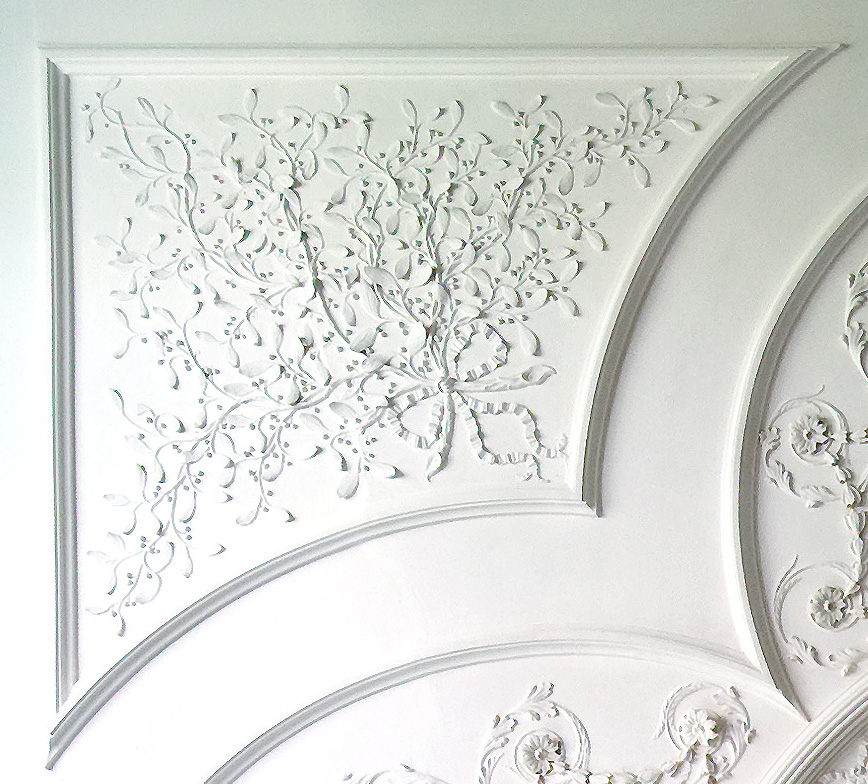
Mistletoe actually adorns Kenmore year round. The elaborate plaster ceiling in the drawing room depicts the four seasons and mistletoe is used to represent winter. The mistletoe depicted, however, is not American mistletoe; the craftsman based this part of the ceiling on European mistletoe instead. This makes sense given that the artist was probably European. Having never seen American mistletoe, he would not know how to sculpt it.
Mistletoe depicted in the ornate plaster ceiling of Kenmore’s drawing room.
Regardless of whether American or European, how did mistletoe come to symbolize winter and hang in homes during the holiday season? How did these green branches with white berries become associated with the hope of a little fun and (possible) future romances? What is it about mistletoe that brings so much joy to the seasons’ festivities?
Mistletoe (Phoradendron leucarpum) grows in the southern United States and is native to much of North America. It has more berries and shorter, broader leaves than English mistletoe (Viscum album). Like English mistletoe, the American plant is a semi-parasite; it digs its “roots” in the host tree and sucks sap and water from the tree, but it manufactures its own chlorophyll. Mistletoe often grows in the tallest branches of the tree, making it very hard to harvest.
American Mistletoe (Phoradendron leucarpum) by Mary E. Eaton in “Our State Flowers: The Floral Emblems Chosen by the Commonwealths”, The National Geographic Magazine, XXXI (June 1917), p. 514. Credit: Wikipedia.
Mistletoe in a tree. Credit: Feťour/Wikipedia.
The word “mistletoe” likely came from one of two sources. Its origins may be from the Anglo-Saxon “misteltan;” “mistl” meaning different and “tan” meaning twig. Mistletoe is a very “different twig” indeed because of how and where it grows – something that would not have escaped the notice of the Anglo-Saxons. The word’s other possible origin also translates “tan” as twig, but renders “mistel” as dung; making “mistletoe” “dung twig.” This may have been because bird droppings contained the seeds that helped spread the plants to other trees.
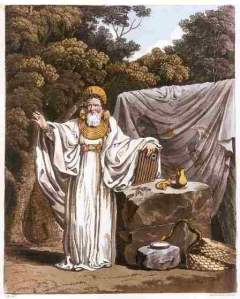
Imaginative illustration of ‘An Arch Druid in His Judicial Habit’ from The Costume of the Original Inhabitants of the British Islands by S.R. Meyrick and C.H. Smith (1815) Credit: Wikipedia.
Druids, who served as priests and the learned class for the ancient Celts, valued mistletoe almost as much as they valued oak trees. These men (there is little evidence that there were women druids) climbed to the top of mistletoe-laden trees and harvested the sacred plant with a golden sickle. Those on the ground were careful to catch the plant as it fell because they believed the mistletoe would lose all of its power if it hit the ground. Druids then used it to cure disease and promote fertility in humans and animals. It may be that the custom of hanging mistletoe stems from a Druidic tradition. Enemies who met under the mistletoe would lay down their arms and greet each other as if friends.
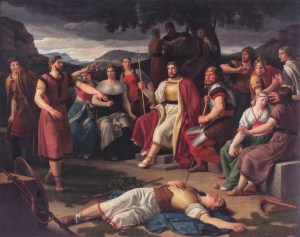
Mistletoe also played a role in Norse mythology and some think that our modern views on mistletoe came from one particular Norse myth. Balder, a god of peace, was the son of Odin, chief of the gods, and the goddess Frigg. Balder began to dream of his own demise and his father traveled to the underworld to learn of his son’s fate.
Baldr’s Death (1817) by Christoffer Wilhelm Eckersberg. Credit: Royal Danish Academy of Fine Arts/Wikipedia.
Odin returned and shared the bad news with Balder and the other gods and goddesses. Frigg went to everything in the cosmos and asked it to swear it would not hurt her son. Everything swore loyalty but mistletoe. Loki, the god of mischief, made some mistletoe into an arrow that killed Balder. In the version of the story with a happy ending, Balder was brought back to life and Frigg makes mistletoe a symbol of love and kisses to those who pass under it.
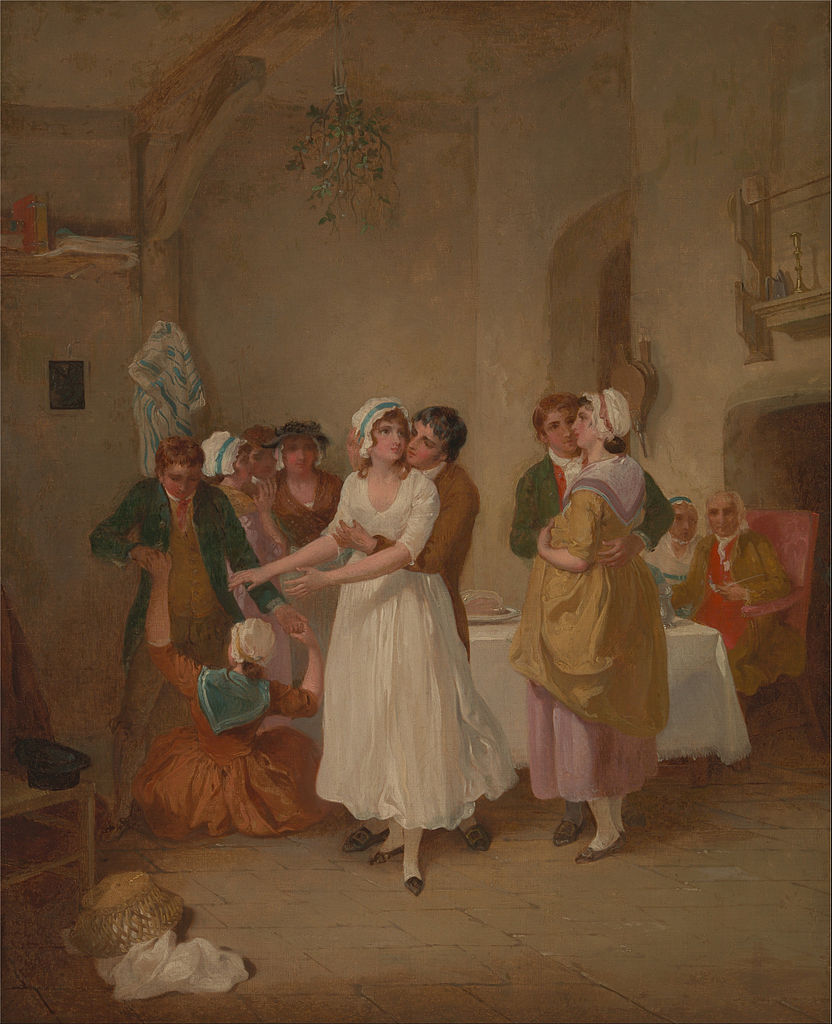
The English origins of kissing under the mistletoe aren’t well known. Historical records indicate that this merriment became popular in England sometime in the 16th century, but we don’t know if it was commonplace before that. English mistletoe etiquette had some hard-and-fast rules: women under the mistletoe were not to refuse kisses; men could only kiss women (or girls) on the cheek; after the kissing transaction, the man removed a berry from the mistletoe ball; after the last berry was plucked, the kissing ended.
The Mistletoe Bough (c. 1790) by Francis Wheatley. Credit: Yale Center for British Art/Wikipedia
Harvesting mistletoe is a challenge, but 18th century Virginians came up with an ingenious way to quickly and easily gather the plant. Instead of climbing up into the tree’s canopy, Virginian men shot the mistletoe out of the tree. They then took the good sprigs home, fashioned them into mistletoe balls, and enjoyed the merriment of the season. This tradition harvesting mistletoe through gunfire still continues today all over the American south.
Ancient Druids. Mythical Norse gods. 18th century Virginians. Over the centuries, these people, whether real or imagined, contributed to the myths and traditions that have made mistletoe a symbol of winter, friendship, and love. When you share a kiss with someone special under the mistletoe this season, you might want to take a moment to share mistletoe’s long history with that someone too.
Kelly Brennan Arehart
Manager of Interpretation and Visitor Services
It’s a long-standing holiday tradition. In fact, it’s so long-standing that this year, 2016, marks the tradition’s 30th year. What tradition is that? The annual Gingerbread House Contest and Exhibit at George Washington’s Ferry Farm!
Since we are marking three auspicious decades for this event, we dug into the archives to present a look back here on Lives & Legacies.
The contest began in 1987 and, for many years, took place at Historic Kenmore instead of Ferry Farm. Our records are scant for the contest’s first year but we do know that the 2nd annual contest in 1988 saw middle schoolers Lisa Allen and Erika Paulson win best-in-show, according to a Free Lance-Star clipping in our files. Rev. Ed Boutchyard of Bowling Green’s Zion Full Gospel Church made a church with an ice cream cone steeple!
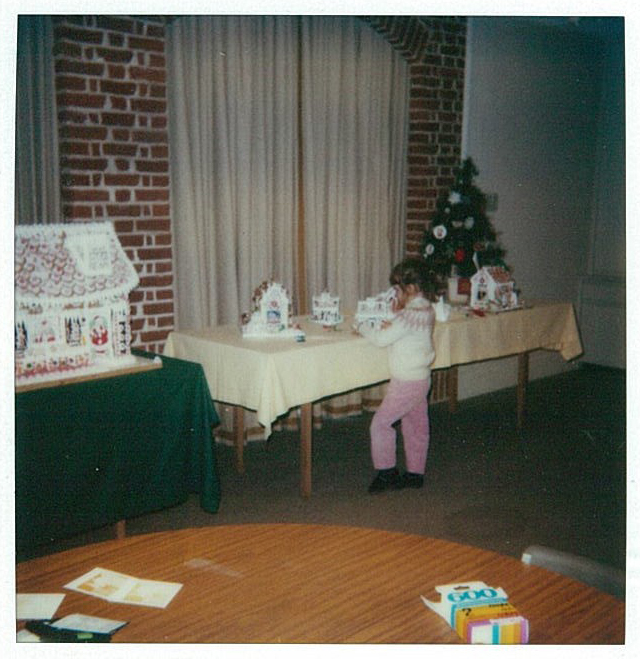
A Polaroid from the first-ever Gingerbread Contest & Exhibit in 1987.
Three entries from the 1988 contest.
Lisa Allen repeated her best-in-show victory in 1989 with the help of her sister Melanie and friends Theresa Stockdill and Courtney Lucado.
In these early days of the contest, the German Club at James Monroe High School, one of the contest’s longest-running participants, began submitting regular entries and, in 1993, they won their first-ever best-in-show.
A few entries from 1993.
In 1995, the Free Lance-Star (scroll up) profiled Claybourne, Emily, and Meredith Beattie, who, having entered the contest for nearly ten years, had only ever won a single 2nd place ribbon. For this family, the “tradition of assembling and decorating the houses is far more important than winning prizes.” The kids, along with mom and dad, would visit their grandmother out-of-town over Thanksgiving break. They created their gingerbread houses there and then traveled the 300-miles back to Fredericksburg with the houses packed in the back of the car. Clay explained that he entered year after year “because I like doing it with my sisters and my family.”
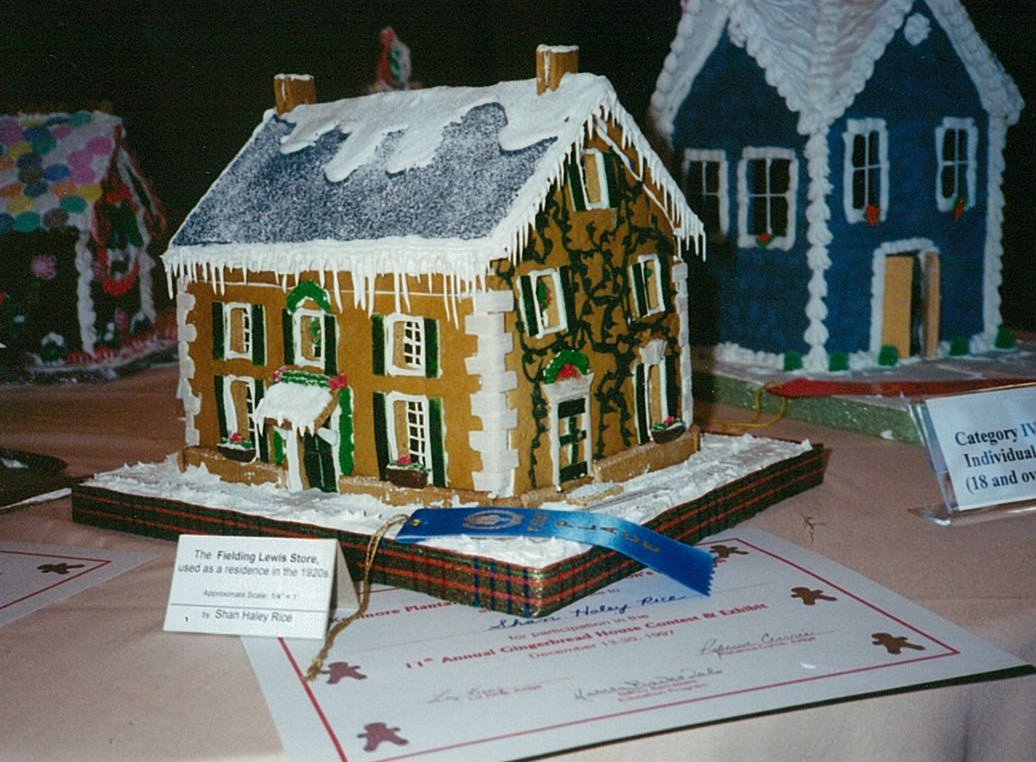
A gingerbread version of the Fielding Lewis Store from 1997.
In 2000, the contest and exhibit moved from Kenmore across the Rappahannock River to Ferry Farm, where it has been held every year since.
Some entries, including this gingerbread version of Kenmore, from 2001.
There’s still time to enter a gingerbread house in this year’s contest and be a part of the tradition! Gather the family, start baking that gingerbread, and creatively decorate your house together. This year’s theme is “Home for the Holidays.” Entries are being accepted now through Saturday, December 3 at Ferry Farm. Click here for rules and an entry form.
The exhibit will open to the public on Sunday, December 4. Ferry Farm is open Monday – Saturday from 10:00 a.m. – 4:00 p.m. and Sunday from 12:00 p.m. – 4:00 p.m. General admission to Ferry Farm and the exhibit is $8 adults, $4 students, under 6 free. To view the gingerbread exhibit only, the cost is $4 adults, $2 students, under 6 free. For more details about this and other holiday events at Ferry Farm and Kenmore, visit kenmore.org/events.
Pulling Down the Statue of King George III, NYC (ca. 1859) by Johannes A. S. Oertel. Painting in the mid-1800s, Oertel created a thrilling but historically inaccurate depiction of New Yorkers destorying a statue of George III after hearing news of the Declaration of Independence. The event did happen but much of Oretel’s painting is fanciful. Public domain. Courtesy: Wikipedia.org
Writing to wife Abigail following Congress’s adoption of the Declaration of Independence, John Adams famously outlined his vision for how future generations would celebrate the historic moment. “I am apt to believe that it will be celebrated, by succeeding Generations, as the great anniversary Festival,” Adams wrote in an oft quoted passage. “It ought to be commemorated, as the Day of Deliverance by solemn Acts of Devotion to God Almighty. It ought to be solemnized with Pomp and Parade, with Shews, Games, Sports, Guns, Bells, Bonfires and Illuminations from one End of this Continent to the other from this Time forward forever more.”
Adams’ prediction was borne out immediately. News of independence spread from Philadelphia across the new American states like a circle of ripples on a great lake. By July 10, 1776, the first word arrived in Fredericksburg, Virginia, hometown of General George Washington and where his mother Mary still lived. Indentured servant John Harrower, who served as tutor for Colonel William Daingerfield’s family at Belvidera plantation about seven miles downstream from Fredericksburg on a bluff overlooking the Rappahannock, recorded the moment in his journal. [1]
“Wednesday 10th. At 6 pm went to Mrs. Battaile’s & teach’d until sunset and then returned home & soon after hea[r]d a great many Guns fired towards Toun. About 12 pm the Colo. Despatc[h]ed Anthy. Frazer there to see what was the cause of [it?] who returned, and informed him that there was great rejoicings in Town on Accott. of the Congress having declared the 13 United Colonys of North America Independent of the Crown of great Britain.”[2]
Young members of the Continental Army recreate a charge during Fourth of July at Ferry Farm!
Some days later, on July 26, when the Declaration was officially read out in Williamsburg, Virginia’s capital, the proclamation was made “amidst the acclimations of the people, accompanied by firing of cannon and musketry, the several regiments of continental troops having been paraded.”
One year later, Adams prediction continued to bear fruit, as the infant nation celebrated its First Birthday. In Charleston, South Carolina, on July 4, 1777 “ringing of bells ushered in the Day” and “At sun-rise American colours were displayed from all the forts and batteries, and vessels in the harbour.” There was a parade of military troops and then “at one o’clock the several forts, beginning at Fort Moultrie on Sullivan’s Island, discharging seventy six pieces of cannon . . . and the militia and artillery fired three general vollies.” The new state’s leaders gave a banquet with thirteen toasts and “double the number [of guests] that ever observed the birthday of the present misguided and unfortunate King of Great Britain.” To end the day-long celebration, “the evening was concluded with illuminations, &c. far exceeding any that had ever been exhibited before.”.
Back north, in Philadelphia, Pennsylvania, ships were also “dressed . . . with the colours of the United States and streamers displayed.” The crews climbed into the rigging and stretched out across the yardarms to salute the day and each ship fired thirteen cannons. On land, a banquet was held for Congress during which “The Hessian band of music taken at Trenton the 26th of December last, attended and heightened the festivity with some fine performances suited to the joyous occasion, while a corps of British deserters, taken into the service of the continent by the State of Georgia, being drawn before the door, filled up the intervals with feux de joie.” A feu de joie, French for “fire of joy”, is the firing of guns into the air in quick succession. It is sometimes described as a “running fire of guns.”. The dinner also included many toasts. The late afternoon featured a parade of military troops and the ringing of bells. “At night there was a grand exhibition of firework, which began and concluded with thirteen rockets.”
After flying for a year over Washington’s boyhood home, one U.S. flag is retired replaced with a new flag during the Patriotic Flag Retirement Ceremony at Ferry Farm’s Fourth of July celebration.
Whether in Virginia in 1776 or South Carolina and Pennsylvania in 1777, all of these acts of celebration were quite traditional and had been used for decades to celebrate the monarch’s birthday each year. In 1727, Willliamsburg marked the king’s birthday.
“The colors were displayed at the Capitol and salvos fired from the cannon at the Palace, at the forts, and on board the king’s ships in Virginia waters at the time. In the evening the Capitol, the Palace, the College, and ‘most of the Gentlemen’s and other House of Note’ were illuminated and bonfires were sometimes set in public squares in the city. At the governor’s dinner the drinking of all the loyal healths consumed a great deal of time, a variety of choice wines and liquors, and a large store of gunpowder. The populace was sometimes treated to ‘plenty of liquor’ and drank the same healths outside the Palace or at one of the taverns. The day’s festivities closed with the governor’s ball for all the ladies and gentlemen in town.” [3]
More than two centuries later, we still celebrate the Fourth of July with decorations of red, white, and blue, ubiquitous American flags, military parades, cannon fire, large amounts of food, the enjoyment of spirited beverages, music, and fireworks. John Adams vision was far-reaching indeed!
Zac Cunningham
Manager of Educational Programs
Celebrate Independence Day where George Washington spent his boyhood years!
See more photos from last year’s Fourth of July at Ferry Farm here.
This year’s theme, “We The People” focuses on The Declaration of Independence with a variety of activities and entertainment for young and old alike. Learn about archaeology at Ferry Farm, enjoy a patriotic flag retirement ceremony,interact with colonial and Civil War re-enactors as well as members of the Patawomeck tribe, listen to patriotic music, and participate in educational programs, crafts and games, and hands-on activities for the whole family. Visit kenmore.org/events.html to learn more.
Cost: $1 per person Parking: Eagles Lodge – 21 Cool Spring Road Fredericksburg, VA 22405 Shuttles will run between the Eagles Lodge and Ferry Farm.
[1] John Harrower, The Journal of John Harrower: An Indentured Servant in the Colony of Virginia, 1773-1776, edited by Edward Miles Riley, Williamsburg, VA: Colonial Williamsburg, 1963: xvi.
Each January, Historic Kenmore presents Twelfth Night at Kenmore, a dramatic theater presentation that imagines the first Christmas that Fielding and Betty Washington Lewis spent in their newly built home. The play is set in January 1776 and that year is not a time for the usual celebration. War brings fear, doubt, and frustration to the Lewis family and their friends.
The 2016 edition of Twelfth Night at Kenmore took place this past weekend. Here are photos from that performance.
Kenmore is ready for the party.
George Lewis (Joe Ziarko) gazes out the window and ponders enlisting in the Continental Army.
George Weedon (L-Rae Ehlen) and Fielding Lewis (R-John Hollinger) lament the burning of Norfolk and Dunmore’s Proclamation.
The dessert table includes a hedgehog cake.
Candles light the Passage
Betty Washington Lewis (L-Barbara Cochran) and Nancy Alexander Lewis (R-Corinn Keene) determine to smile through the troubles of war.
The Lewis family and guests sing “God Rest Ye Merry Gentlemen.”
The Payne Family provided music for the performance. (L-R) Zach, Kelsey, Kaylee, and Luke.
George Weedon explains to Captain Richard Taylor (Sam Fulton) why horse racing ought to be banned during the war.
Captain Taylor, John Lewis (Mike Taylor), and George Lewis play cards.
Wassail in a punch bowl.
Sausage cooking over the fire in the kitchen.
Rachel (Gladys Perkins), enslaved cook for the Lewis family, tends the fire.
Rachel ponders the future that war might bring for the enslaved community and if that future will include freedom.
This coming weekend — Friday, January 8, Saturday, January 9, or Sunday, January 10 — Historic Kenmore again presents Twelfth Night at Kenmore, a dramatic theater presentation set in January 1776. It is the first Christmas that Fielding and Betty Washington Lewis celebrate in their newly built home. It is not the usual celebration, however. War brings fear, doubt, and frustration to the Lewis family and their friends.
Here is a collection of photos from last year’s performances.
George Weedon (Sam Fulton) and Fielding Lewis (John Hollinger) remark upon the Christmas decorations.
Betty Washington Lewis (Amy Wolf) and daughter-in-law Nancy Alexander Lewis (Juliana Jones) ponder how the war might impact the family.
George Lewis (Will Goldstein) expresses his desire to enlist in the Continental Army.
George Weedon, a leading Fredericksburg patriot and tavernkeeper.
Our excellent musicians for the evening: Zach, Kelsey, Kaylee, and Luke Payne.
Two-hundred-year-old violin on display in Kenmore’s dining room
Violin is on loan by Wayne A. Hill, Violinist/Composer
Rachel (Gladys Perkins), enslaved cook, and Hetty (Ashlee James), enslaved washerwoman and house servant, ponder the future.
Immerse yourself in the experience the candlelight, music, and decorations of an eighteenth-century Christmas!
Performance Times: 3:00, 3:45, 4:45 and 5:30 p.m. Reservations required. Call 540-370-0732 x24 or email [email protected] Cost: $12.00 adults, $6.00 ages 3-17; free ages 3 and under.
On January 8, 9, and 10, Historic Kenmore presents “Twelfth Night at Kenmore,” a dramatic theater performance inside the 18th century home of Fielding and Betty Lewis. This short video previews the performance.
Immerse yourself in the experience the candlelight, music, and decorations of an eighteenth-century Christmas!
Performance Times: 3:00, 3:45, 4:45 and 5:30 p.m. Reservations required. Call 540-370-0732 x24 or email [email protected] Cost: $12.00 adults, $6.00 ages 3-17; free ages 3 and under.
The George Washington Foundation wishes everyone a joyous holiday season! Enjoy these photos of holiday decorations created by wonderful volunteers! The George Washington Foundation Garden Guild decorated at Kenmore and the Lake Anna Garden Club decorated at Ferry Farm.
There is still time to see Historic Kenmore and George Washington’s Ferry Farm adorned for the season as well as each site’s annual display of dollhouses, miniatures, and gingerbread creations. For details about these exhibits, visit kenmore.org/events. Finally, if you missed it, check out our most recent post A Christmas of Uncertainty, December 1775.
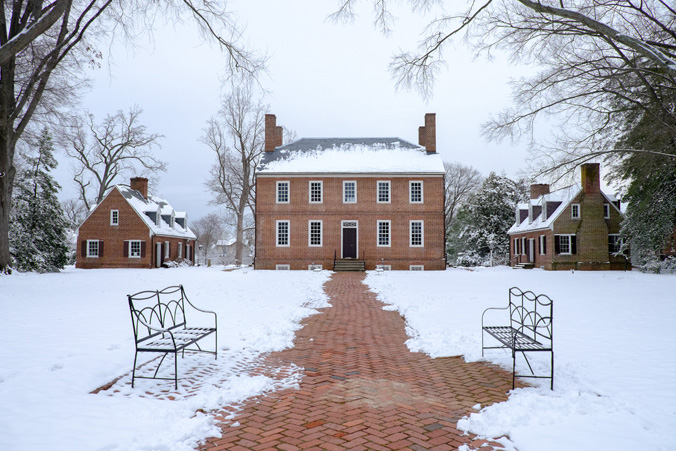
When Fielding Lewis moved his family into their new home – the magnificent brick house we call Kenmore – in late 1775 it was the culmination of years of hard work and planning. It might seem as though that year’s holiday season should have been one of continual joy. Unfortunately, the Lewis family’s first Christmas inside Kenmore was far from joyful. December 1775 was an extremely difficult time in their lives and for the American Revolution.
That December, the Revolution was in a frustrating state of limbo. Although declared to be in open rebellion by the King and Parliament, few colonies had yet to see any armed conflict. Fighting outside of Boston started in the spring but fizzled into stalemate following the Battle of Bunker Hill in June. Independence may have been discussed in taverns but was still far from being discussed at the Continental Congress in Philadelphia.
The colonies were still suffering economically and had been suffering for some time. In 1774, Congress passed the Non-Importation Agreement. These measures stopped all trade with Great Britain and other British-owned ports. The Association, as it came to be known, remained in effect in December 1775. Colonists lacked numerous supplies and goods. Fielding Lewis experienced a significant drop in his shipping business and the family’s finances began to suffer.
Even though it was the holiday season, the Non-Importation Agreement also discouraged…
To be loyal to the American cause, one could not delight in the revelries typically enjoyed during Christmas.
All levels of Virginia society felt the strain of war’s uncertainty that fateful December. John Murray, 4th Earl of Dunmore and Virginia’s Royal Governor, had been at odds with his colonists since he removed portions of the public stores of gunpowder to a Royal Navy ship back in the spring. Lord Dunmore’s most recent action, however, hit much closer to home for Fielding Lewis and his fellow planters. The Governor threatened to take their slaves, the precious private property, as they saw them, upon which they had built their livelihoods and wealth.
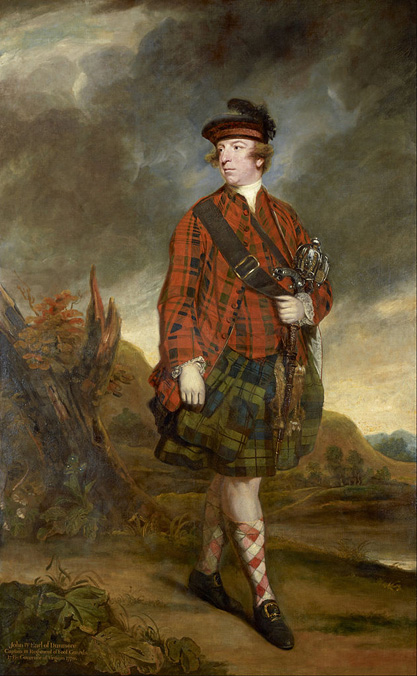
Portrait of John Murry, 4th Earl of Dunmore by Joshua Reynolds (1765)
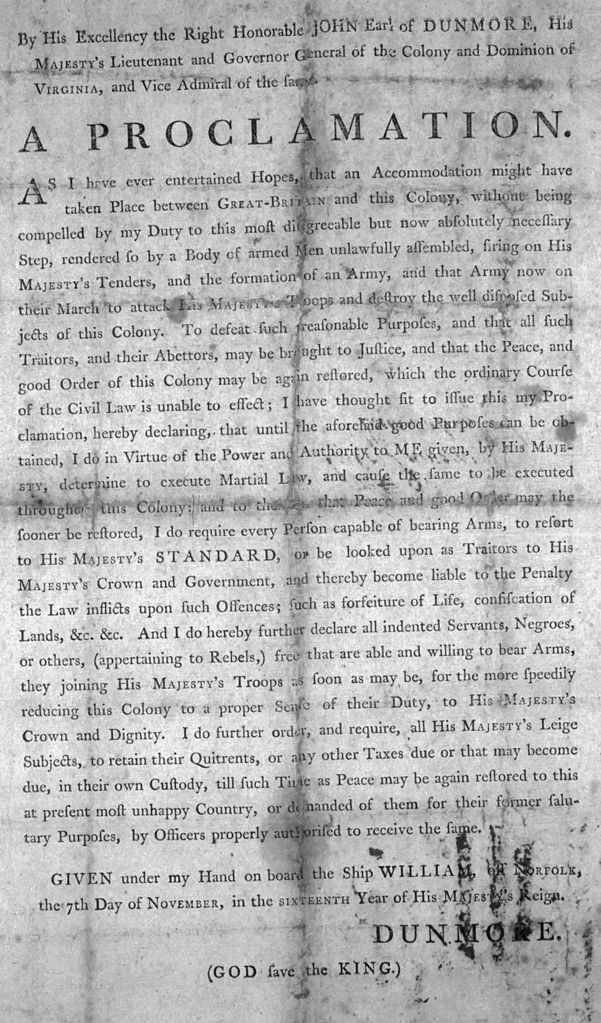
In November 1775, Dunmore had issued a proclamation in Virginia intended to swell his ranks and cripple the so-called ‘rebels’ by imposing martial law, raising the King’s standard, and declaring, most significantly,
A copy of Dunmore’s proclamation. Library of Congress photo
Dunmore’s Proclamation angered and frightened slave owners throughout Virginia and put the colony’s enslaved population in a difficult predicament. Achieving freedom was highly dependent on an enslaved person’s ability to get to Dunmore in Norfolk. Not surprisingly, the largest percentage of enslaved people who fled to the British came from the counties closest to that port city. While it is uncertain if any Lewis slaves ran away to the British, at least one indentured servant perhaps did. Joseph Smith, an a painter who had worked for George Washington and presumably for Fielding Lewis, saw the political schism in Virginia as an opportunity to free himself from his servitude and fled in the summer of 1775. In November, Fielding wrote to George, saying “I have never heard of your Painter tho’ suspected he was gone to Ld Dunmore[.] I do not expect he can be got as Dunmore wants Men.” Smith’s successful escape may have been on the mind of the other indentured servants and enslaved people in the Lewis household when word of Dunmore’s Proclamation arrived in Fredericksburg.
December 1775 in the Lewis family’s new home was an anxious one for many and yet for others it must have been a hopeful one as well. The American forces at Bunker Hill had proven to the British that the fight would not be easy or quick. The Fourth Virginia Convention met that December and ordered even more companies formed to support the Continental forces. Most hopefully, Dunmore’s forces were defeated in the Battle of Great Bridge on December 9. The Governor would leave the shores of Virginia in the early part of 1776 never to return. His forces did include a portion of enslaved people who had dared to hope for their own freedom, a hope that would be denied for many Christmases to come. A large portion were captured and returned to slavery, many more died from disease or lack of supplies, and others perished in battle. Few actually gained their freedom.
Back in Fredericksburg, the December of 1775 was most likely not what the Lewises had expected or hoped for. It was a Christmas of uncertainty, when war raged on Virginian soil. Yet, the future was not solely bleak for Fielding, Betty, and the Americans. As 1776 began, it begged the hopeful question: what may the new year bring?
Joe Ziarko
Manager of Interpretation & Visitor Services
Experience this Lewis family’s Christmas of uncertainty during Twelfth Night at Kenmore, a dramatic theater presentation at Historic Kenmore on Friday, January 8, Saturday, January 9, or Sunday, January 10. The year is January 1776. It is the first Christmas that Fielding and Betty Washington Lewis celebrate in their newly built home. It is not the usual celebration, however. War brings fear, doubt, and frustration to the Lewis family and their friends. Immerse yourself in the experience the candlelight, music, and decorations of an eighteenth-century Christmas!
Performance Times: 3:00, 3:45, 4:45 and 5:30 p.m.
Reservations required. Call 540-370-0732 x24 or email [email protected]
Cost: $12.00 adults, $6.00 ages 3-17; free ages 3 and under.
For the second year, Historic Kenmore presents “A Wee Christmas,” an exhibit for the holiday season of highly detailed, replica dollhouses – including the Kenmore mansion – and miniatures in the Crowninshield Museum Building. Come to Kenmore and share memories of your dollhouse with children and grandchildren as you explore the treasures in this festive display!
The dollhouses and miniatures of the “A Wee Christmas” remain on display until December 30. Historic Kenmore is open Monday – Saturday from 10:00 a.m. – 4:00 p.m and on Sunday from 12:00 p.m. – 4:00 p.m. Kenmore will be closed Christmas Eve and Christmas Day.
Admission cost for viewing the dollhouse exhibit only is $5 adults, $2.50 students, under 6 free. There is an additional fee for a guided tour of Kenmore. Visit www.kenmore.org for more details.
“Baxter House” submitted by James Opher, Julie Silvester, owner of Lilliput’s Doll House Shop, and Traci Haden, president of Virginia Minature Enthusiast Region E-1. Originally built by Mr. & Mrs. Baxter the house has over 16 rooms including a Grand Ballroom.
“Harris Farm” submitted 6-year-old collector Emily Jane Harding, who received the house from her grandmother.
“Smaller Home and Garden” submitted by Fernanda L. Kain.
“Petite Princess Collection” submitted by Jessica and Nancy Burger features dollhouse furniture that first appeared in the Sears Christmas Wish Book in 1964.
“Santons” submitted by Anna Jennings. A Santon is a small hand-painted terracotta Nativity scene figure made in France’s Provence region.
“Teapot Tea Room (at the North Pole)” submitted by Joanna Borgman even includes tiny bags of “Kenmore-blend” tea.
“Bartlett House” submitted by Katherine S. Opdycke.
“Place of Worship” submitted by James Opher has features to represent the Catholic, Islamic, Methodist, and non-demoninational faiths.
“The Apple Blossom” submitted by David Budinger is the childhood dollhouse of Kenmore’s Curator Meghan Budinger.
“Georgian Court” submitted by 8-year-old collector Elizabeth Harding, who was given the house by her mother.
“A Collection” submitted by Gail Steffey includes a display of leather furniture and a glass conservatory.
“Antique Dollhouse” submitted by Susan Larson
“Santa’s Slumber” submitted by Jessica Waltz
“Lost But Not Forgotten” submitted by James Opher is a diorama of a Japanese castle.
“Santa’s Workshop” submitted by Peggy Severson
Some of the dollhouse exhibitors: (l-r) Meghan Budinger, James Opher, Joanna Borgman, Fernanda L. Kain, Gail Steffey, Peggy Severson, (front) Elizabeth and Emily Jane Harding.