As the United States and historic sites across the country, including the George Washington Foundation, prepare to commemorate the nation’s 250th anniversary next year, it might be easy for the eightieth anniversary of the end of World War II to become an afterthought. After all, the interpretation of Historic Kenmore focuses on the Revolutionary era; the home was already the better part of 200 years old in 1945. But the histories of Kenmore and Fredericksburg are as intricately intertwined with the Second World War as they are with the War of Independence, and the legacies of both conflicts resonate today.
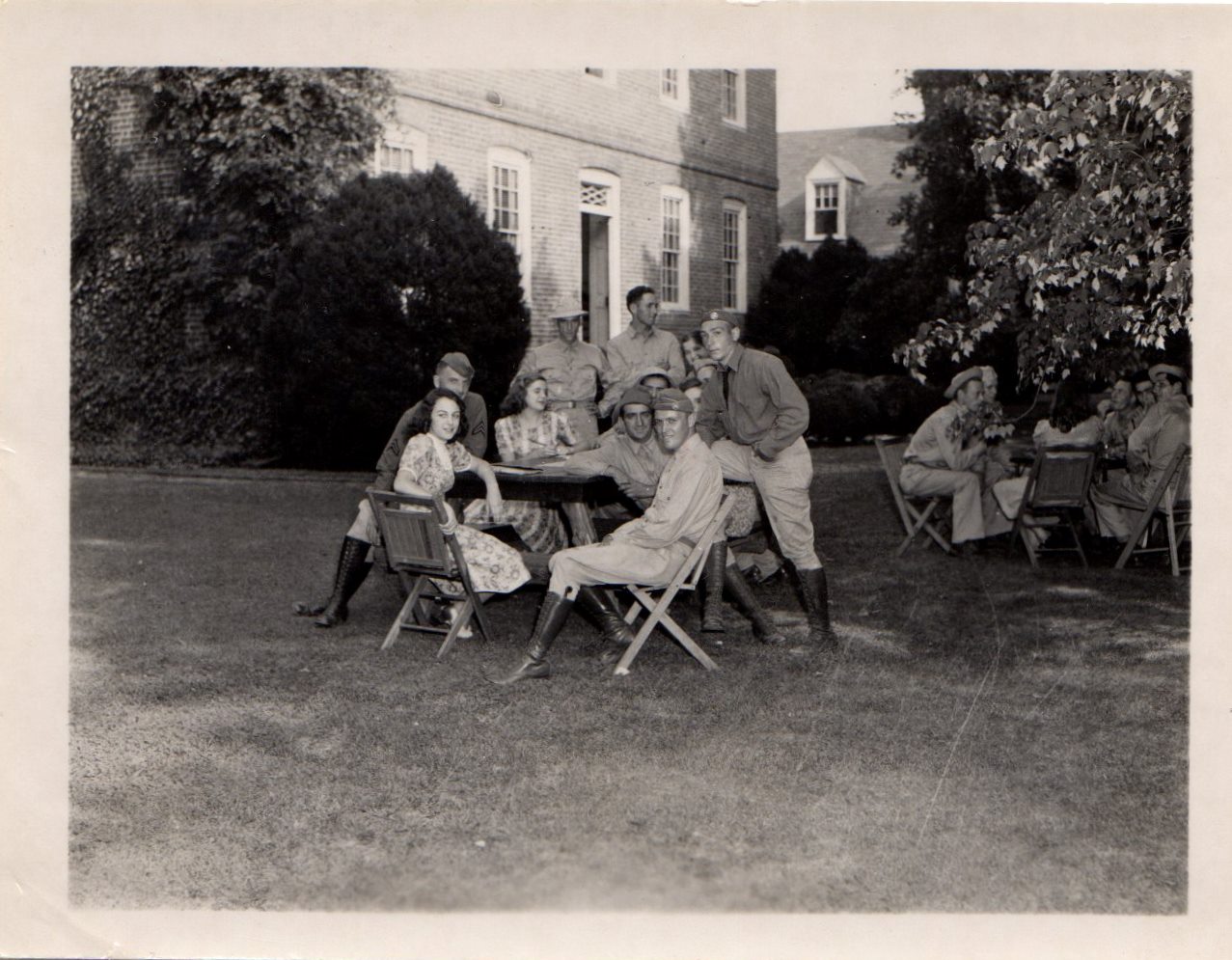
Soldiers being hosted on lawn of Kenmore
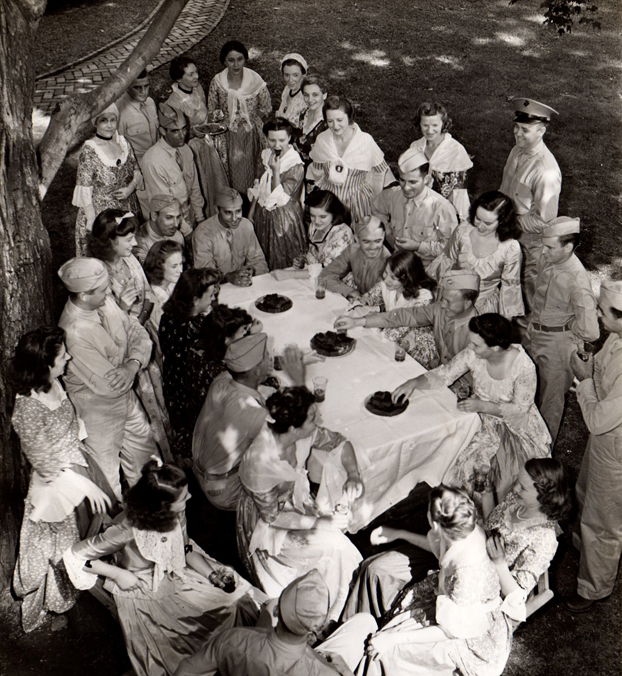
Like many Americans, the women of the Kenmore Association sought during the war years to demonstrate pride in their nation and support for its troops. Annie Fleming Smith, then national secretary of the Association, showed her appreciation for the country’s military by opening Kenmore’s doors to thousands of service members stationed in the Fredericksburg area. The Association took them “through the mansion and served them iced tea and gingerbread.” It hosted lawn parties and entertained soldiers early in the day and late at night. Hosts told everyone in uniform “who passed over the Kenmore steps…about George Washington, and other great men, passing over these very same steps.”
Kenmore hosted soldiers with gingerbread and iced tea.
Smith regarded the Association’s commitment to “making our American boys feel at home in a home of the Washingtons” as Kenmore’s way of contributing “to the defense of the nation.” She also hoped that visits to Kenmore would crystalize in servicemen a commitment to the U.S. ideals of freedom and democracy.
The commitment to helping the recently transplanted soldiers feel comfortable in town was admirable; however, there are no records of Smith or Kenmore welcoming Black servicemen, stationed along with their white counterparts at what was then A.P. Hill Military Reservation and other nearby military installations. Smith and other members of the Kenmore Association, along with whites across Fredericksburg, the South, and the country, apparently did not see any conflict between simultaneous support for liberty, as embedded in the founding documents of the United States, and a racist social system.
The 366th Infantry Regiment
So how, in segregated Fredericksburg, did Black service members spend their leisure time? If the city’s white-led institutions, including Kenmore, did not welcome African Americans serving their country, Black Fredericksburgers proved happy to host the men fighting the Double V campaign—victory over fascism abroad and victory over racism and discrimination at home. Indeed, at least two Black fraternal organizations in Fredericksburg provided recreational opportunities to African American soldiers during World War II.
The city’s Black Odd Fellows lodge (located at 301 Charles Street), “under auspices of the Citizens Committee of Local Negros,” hosted at least one dance for African American soldiers from A.P. Hill. This dance, held in February 1942, came shortly after white officials implicated Black servicemen stationed at A.P. Hill and Fort Belvoir in a “near-riot” that began after a Fredericksburg police officer attempted to arrest a Black soldier for public intoxication.
Following the altercation between the soldiers and the city’s police, during which white officers beat a Black soldier and threw a tear gas grenade, the Free Lance-Star published a letter to the editor from local NAACP leaders calling for the establishment of a Black USO—since the white USO barred Black soldiers from entering— and more leisure opportunities for African American soldiers in the city.
Other efforts to make the city more welcoming to Black service members followed. In May of that year, a group of Black Fredericksburgers requested that “the city furnish recreational facilities, showers, soap and towels for colored troops stationed at Camp A. P. Hill.” According to the letter containing this request submitted to the City Council, “there were slightly over a hundred colored soldiers now stationed at Camp A. P. Hill and that there were no recreational facilities at Camp A. P. Hill or in the City of Fredericksburg for these colored troops.”
Rappahannock Lodge 229 of the Independent Benevolent Protective Order Elks of the World in April 2008. The lodge was home to Fredericksburg’s Black USO in 1943 and 1944. Rappahannock Lodge 229 of the Independent Benevolent Protective Order Elks of the World in March 2024. 1103 Winchester Street is just a block from Historic Kenmore.Historic plaque at former Rappahannock Elks Lodge 229
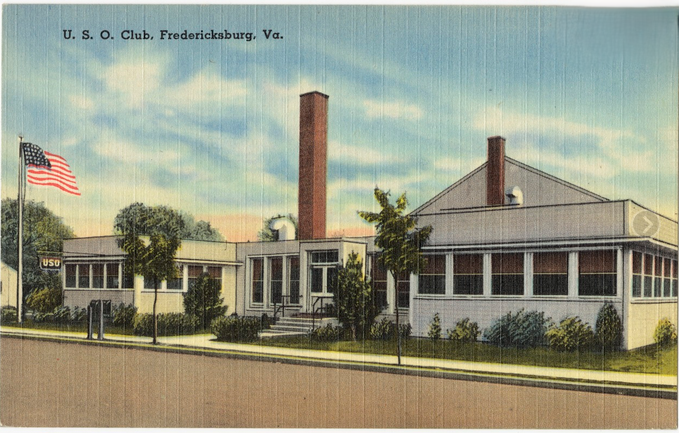
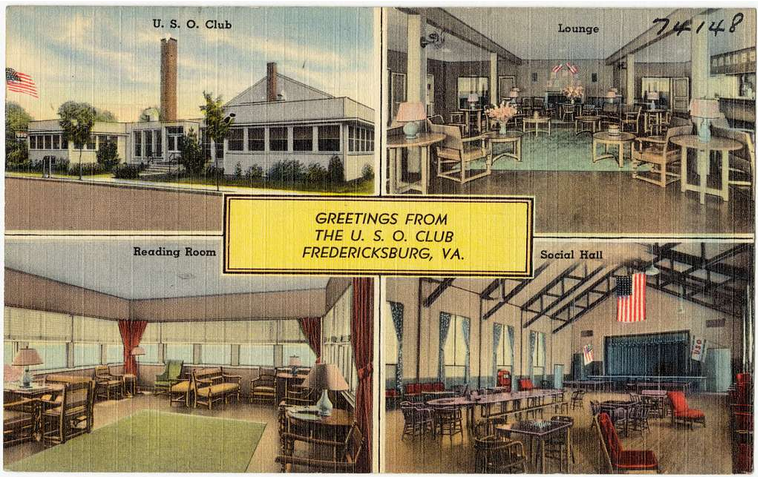
Eventually, the efforts of Black soldiers’ advocates succeeded: The Black USO sought by the NAACP leaders opened in June 1943 at Rappahannock Lodge 229 of the Independent Benevolent Protective Order Elks of the World (otherwise known as the African American Elks). Lodge 229 was at 1103 Winchester Street, just a block from Historic Kenmore. Across the world, USOs gave “troops somewhere to play cards, dance and socialize while taking a break from their duties.” Each USO facility was supposed to be “open to all men in uniform,” regardless of race, but in practice, centers were often segregated. Fredericksburg’s white USO opened in January 1942 at 408 Canal Street, which is today the Dorothy Hart Community Center.
USO Club, Fredericksburg, VaUSO Club, Fredericksburg, Va
Although Fredericksburg’s Black USO closed the following April, reportedly because of low attendance, another Black USO was completed in Caroline County in December of 1943 and was still operating in 1945.
USO, Caroline County USO, Caroline County
However, the presence of these recreational facilities did not resolve tensions between white area residents and visiting Black service members. In the fall of 1943, while the Fredericksburg USO was open, A.P. Hill Military Reservation was home to the 366th Infantry Regiment, a Black unit. When members of the 366th chaffed against racism—for instance, by evicting the driver of a bus who instructed the soldiers to move to the back of the vehicle and finishing the drive back to A.P. Hill from Fredericksburg themselves—local whites reacted with fear. By November, the city’s white residents worried that the soldiers planned to “‘clean up the town on the first’” of December in objection to Jim Crow laws and segregation. Whites expressed relief when the unit shipped out before that date.
During World War II, the Kenmore Association opened its doors to white soldiers to share the stories of those Americans “who planned the principles, which is the beacon light of the world today.” Eight decades ago, the world’s democracies fought for those principles and defeated the forces of totalitarianism abroad, but racism endured at home. While progress has been made in the United States regarding the assertion “that all men are created equal,” the struggle against inequality continues.
Adam Nubbe
Manager of School & Youth Programs
Bibliography
Fredericksburg City Council. (1942, January). Fredericksburg City Council Minutes Vol 28. Fredericksburg, Virginia, USA.
Hall, D. (1943, November 27). Fearful Whites Relieved as 366th Leaves Virginia. Baltimore Afro-American, p. 21.
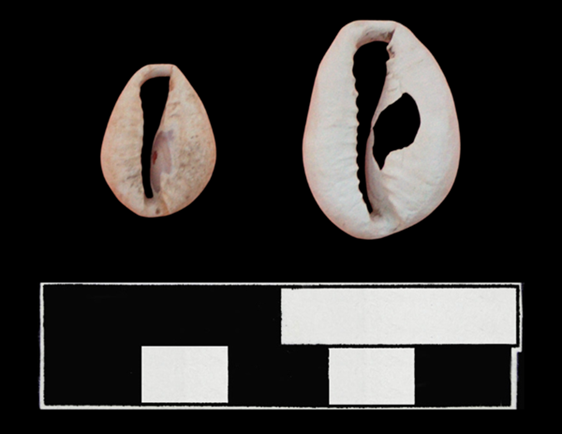
Many readers will undoubtedly recognize these two artifacts (Fig. 1). Known as cowrie shells, these artifacts have become synonymous with slavery and serve as identifiers for the presence of free and enslaved Black individuals in the Americas. Still, the role of cowries in the 18th century goes far beyond that of a marker.
Origin
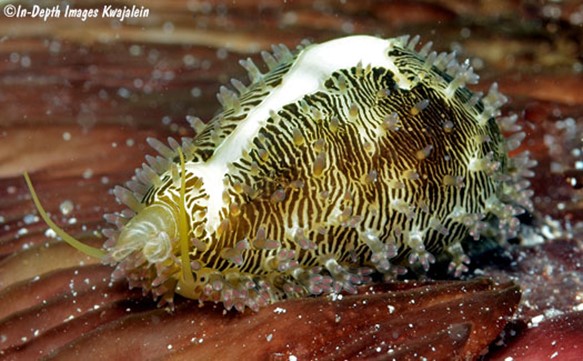
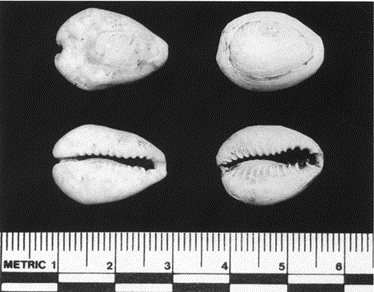
Cowries (Cypraeidae), a taxonomic family of sea snail, live throughout the world (Fig. 2). However, the species with the most relevance to the 1700s reside in the Indo-Pacific region, particularly in the waters around the Maldives. They include Monetaria annulus (alt. Cypraea annulus, Annulus Linnaeus) and Monetaria moneta (Fig. 3). Even if your Latin proves non-existent, each species’ genus, along with M. moneta’s epithet, easily identifies the original role cowries played in human hands – money.
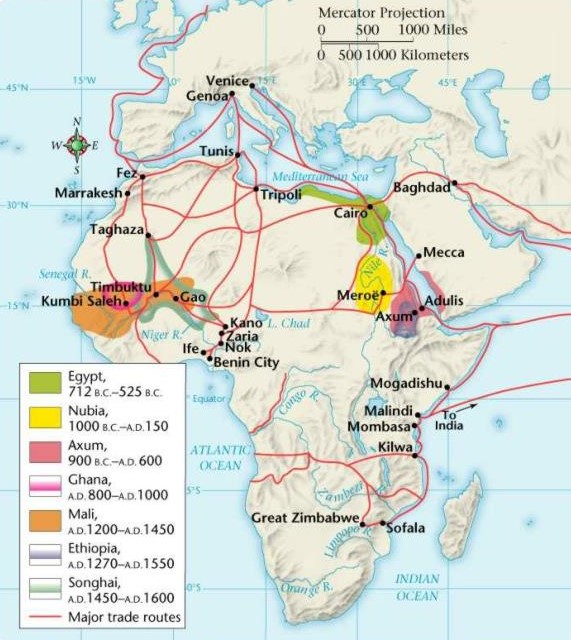
Centuries before the 1700s, West Africa thrived as a region of independent kingdoms and tribes. With these groups engaged in trade, they required a shared currency that served as a medium of exchange and a store of value. In choosing cowries as currency in the fourteenth century, West Africa continued a long history of groups throughout the world using shell money. Through pre-existing trade routes to the Indo-Pacific, West Africans could easily import the shells via other parts of Africa and had them transported across the Sahara. As the cowries used did not reside in West Africa and proved difficult to forge, the market had built in protections against hyperinflation and counterfeits.
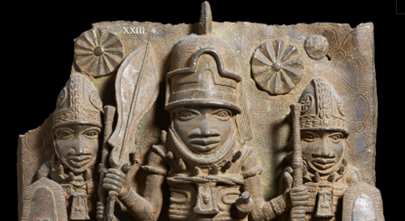
Once in West Africa, the shells served as the basis of the region’s economies. Still, the shells took on several cultural roles. To keep cowries on hand, the shells often underwent modifications, including slicing off the rounded side of the shell or piercing them (Fig. 4). This allowed for stringing them together and weaving into hair or onto clothing. While done for practical reasons, this led cowries to enter the world of personal adornment. With this, their role expanded to symbols of status, fertility, and beauty while further appearing on ceremonial garb (Fig. 5).
Figure 5: Benin Bronze plaque; 16th-17th century. The warriors on either side of the central figure wear helmets decorated with cowries British Museum
Atlantic Trade Routes
Europe and Africa had a long history of trade and exchange networks prior to the late 1400s, but the boom of global exploration led to an immediate escalation of these market connections. With European nations expanding their territories abroad and seeking to gain resources not found within their borders, they developed a need to break into the African markets while establishing permanent trade posts in the region. To achieve this, Europeans needed to supply goods that were in demand, and their minds set upon cowries.
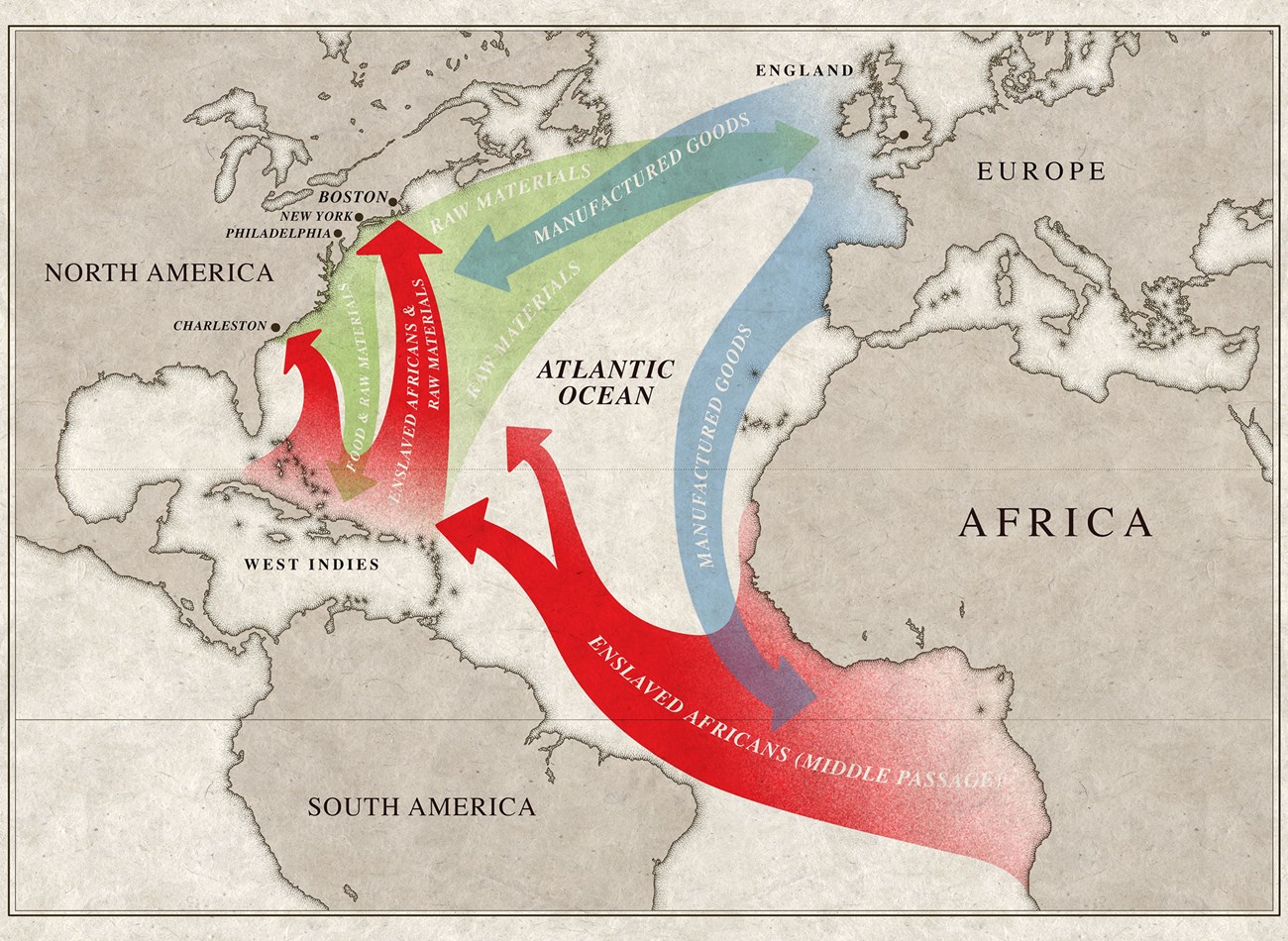
Map by Adrian Kitzinger from Sahel: Art and Empires on the Shore of the Sahara West African Kingdoms and Trading StatesMap centered on the Atlantic Ocean with colored arrows showing movement of Enslaved Africans to the Americas, Raw Materials from Americas, and Manufactured goods from Europe Map showing the primary movement of Enslaved Africans, raw materials, and manufactured goods
While an item of currency and self-adornment to West Africans, cowries became a commodity in the hands of European, and later American, merchants. With cowries, merchants could navigate the local economy and barter for desired goods. Inevitably, this included kidnapped Africans. In his memoir, Olaudah Equiano (c. 1745-1797), a famed writer and abolitionist, recalled how one enslaver sold him to another for 172 “little white shells” while still in Africa. An examination of eighteenth-century shipping records reveals that cowries ranked amongst the most common goods transported to West Africa and used to trade for captives (Fig 6). For Africans who then faced the Middle Passage, they forcibly traveled aboard these same ships that in turn provided West Africa with the currency driving the economy and their enslavement — cowries.
Figure 6: List of goods imported to the Isle of Man via Rotterdam for trade in Africa, 1761 Manx National Heritage
Cowries in the Americas
Indo-Pacific cowries arrived in the Americas through several carriers, but ultimately all traveled on slave ships. In trading cowries to West Africa, foreign merchants supplied both types even though the market preferred M. moneta. As such, they often had leftover M. annulus which remained onboard as cargo and ballast when the ships continued their trans-Atlantic journeys. Once in the Americas, some captains elected to dump or sell off the remaining cowries rather than transport them back across the Atlantic. Cowries additionally arrived in the Americas on the bodies of kidnapped Africans. While common practice involved stripping captives in Africa, primary accounts report individuals retained beads and shells in their hair and as necklaces. Enslavers further distributed beads, and likely shells, as pacifiers during the Middle Passage.
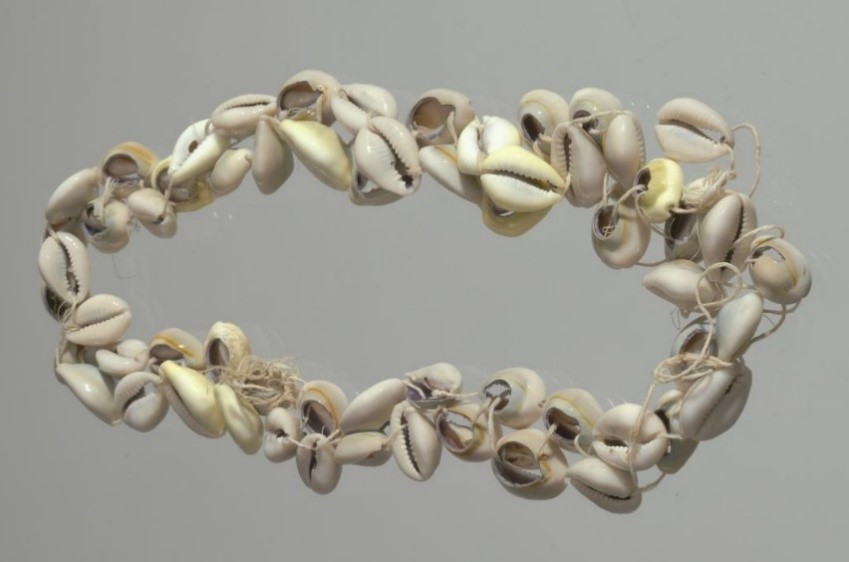
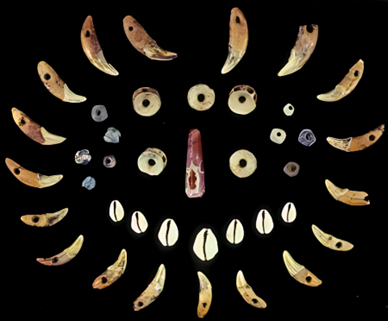
Once in the Americas, cowries largely remained within Black communities though they did face geographical restrictions. For Virginia, archaeological distribution of the shells, mainly M. annulus, places them within the Tidewater region. Higher counts of shells appear in urban areas (Yorktown = 252) while plantations typically only have a few. Although Virginia’s current archaeological cowrie count falls above 353, this remains too few to support the traditional role as currency. Instead, the shells continued in roles of adornment and ritual with added symbolism of cultural loss, memory, and survival. Outside random finds in areas associated with enslavement, cowries recovered in the Americas have derived from burials, spirit caches, and sub-floor pits (Fig. 7).
Figure 7: Necklace recovered from an enslaved burial ground at Newton Plantation, BarbadosJerome Handler
At Ferry Farm
Over the course of our twenty-plus year excavation, two cowries have appeared at Ferry Farm. Found in contexts located around the Washington House, including one in a root cellar, our shells represent M. annulus and have undergone modification to allow for stringing or weaving (Fig. 8). As with findings in previous studies, we believe these shells took on cultural roles through self-adornment. Despite not knowing the identity of the shells’ owner(s), the cowries provide enough information to form an interpretation of who they belonged to and how they arrived at Ferry Farm.
Figure 8: Ferry Farm cowries with modifications visible
As their contexts of origin line up with the Washington House, the enslaved individuals who left them behind likely lived and worked close to the Washington family. This places them within the working realm of the house or the nearby work yard. For accommodation, the owner(s) may have occupied the Quarter adjacent to the Washington house or lived in one of the work yard’s support buildings.
Regarding the arrival of cowries on the plantation, this likely happened through the movement and exchange of people and goods. To provide the labor required to meet their goals, enslavers moved those they enslaved between different plantations as needed and expanded their workforce through the enslavement of more people or hiring of persons enslaved by others. This could account for the arrival of cowries at Ferry Farm. Alternatively, Ferry Farm’s proximity to the (port) city of Fredericksburg meant the enslaved community had access to a regional economy and trans-Atlantic vessels. Either network may have transported cowries to the city, but it additionally meant that Fredericksburg served as a meeting and trade point for those enslaved in the region.
Legacy
Cowries have a long and nuanced history in the Atlantic World. Beginning as a unit of currency and cultural symbol, cowries fell prey to the demands of the market, taking on a new role in the hands of foreign merchants. What once served to strengthen economies and nations suddenly worked to strip away the very people who inhabited West Africa. For those who endured enslavement, the cowries that accompanied them became symbols of a stolen home, a continuation of culture, and a determination to survive. Today, cowries remain important items in African and African American cultures by symbolizing their history as currency, continuing in self-adornment and ritual roles, and appearing prominently in works of art (Fig. 9-11).
Alpern, Stanley B.                                                                                                                                                  1995     What Africans Got for Their Slaves: A Master List of European Trade Goods. History in Africa 22: 5-43

Equiano, Olaudah                                                                                                                                    1789     The Interesting Narrative of the Life of Olaudah Equiano, Or Gustavus Vassa, The African. Written By Himself. London, UK

Handler, Jerome S.                                                                                                                                                            2006     On the Transportation of Material Goods by Enslaved Africans During the Middle Passage: Preliminary findings from Documentary Sources. African Diaspora Archaeology Newsletter 9 (4): 1-22 (Article 16).

2007     From Cambay in India to Barbados in the Caribbean: Two Unique Beads from a Plantation Slave Cemetery. African Diaspora Archaeology Newsletter 10(1): 1-10 (Article 1)

Heath, Barbara J.                                                                                                                                                2016     Cowrie Shells, Global Trade, and Local Exchange: Piecing Together the Evidence for Colonial Virginia. Historical Archaeology 50 (2): 17-46.

National Museum of African American History & Culture                                                                        n.d.     Cowrie Shells and Trade Power. National Museum of African American History & Culture, Smithsonian, Washington D.C. <https://nmaahc.si.edu/cowrie-shells-and-trade-power>. Accessed 3 June 2024.

Ogundiran, Akinwumi                                                                                                                                                            2002     Of Small Things Remembered: Beads, Cowries, and Cultural Translations of the Atlantic Experience in Yorubaland. The International Journal of African Historical Studies 35 (2/3): 427-457.

Pallaver, Karin                                                                                                                                                 2023     Cowries, the currency that powered West Africa. ReThink Quarterly 7 <https://rethinkq.adp.com/artifact-cowries-west-africa/>. Accessed 3 June 2024.

Pearce, Laurie E.                                                                                                                                              1992     The Cowrie Shell in Virginia: A Critical Evaluation of Potential Archaeological Significance. Master’s thesis, Department of Anthropology, College of William & Mary. University Microfilms International, Ann Arbor, MI.

Radburn, Nicholas J.                                                                                                                                       2009     William Davenport, the Slave Trade, and Merchant Enterprise in Eighteenth-Century Liverpool. Master’s thesis, Department of History, Victoria University of Wellington, Wellington, New Zealand.

Samford, Patricia                                                                                                                                              1994     Searching for West African Cultural Meanings in the Archaeological Record. African Diaspora Newsletter 1 (3): 1-3 (Article 2).
As part of our ongoing effort to research the enslaved communities that once lived and worked at Historic Kenmore and George Washington’s Ferry Farm, we recently came across some very unusual information pertaining to a young enslaved woman named Charlotte who resided at Kenmore.
Charlotte, unfortunately, is a somewhat enigmatic figure. We know only a few things about her. She was about 11 years old in 1781, when Fielding Lewis died – her name appears as “Sharliot” in his probate inventory. She is also listed (along with her age) on a document called the Divvy List created by Betty Lewis shortly after her husband’s death and listing which slaves were to stay with her at Kenmore and which ones would eventually be given to her three youngest sons. Betty chose Charlotte to stay with her at Kenmore. Sixteen years later, Charlotte appears again on a list of slaves from the Lewis properties who were to be sold at vendu (public sale or auction). This document indicates that Charlotte worked as a seamstress in the Lewis household, and that she had both a young son named George, and a baby (although the baby was not identified by name or gender). One final reference to Charlotte in Kenmore’s manuscript collection is a notation that she was among 21 enslaved persons receiving textile rations sometime around 1796 (she received 5 yards of linen).
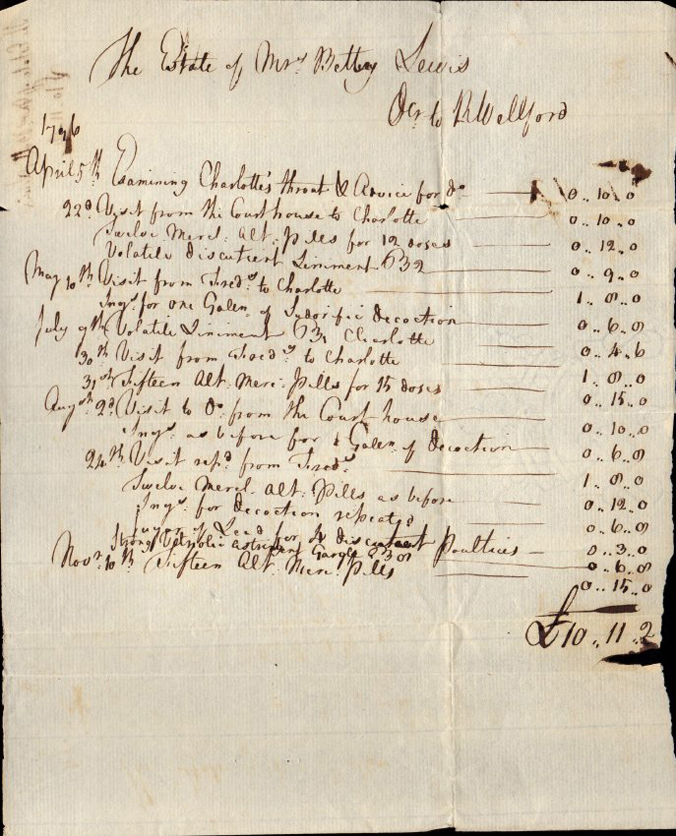
As often happens in this kind of research, we can have very sparse detail about a subject’s life until we find a new document that provides incredible detail about a very specific moment in that person’s life. Such is the case with Charlotte. The new document is a list of charges for medical examinations and treatments “to Charlotte” submitted by an “R. Wellford”, a doctor, to Betty Lewis’s estate sometime after Betty’s death in 1797. It shows that from April through November of 1796, Betty Lewis paid over £10 to treat Charlotte’s unidentified ailment.
Transcription of MS 850, Charges for Medical Expenses [1]
The Estate of Mrs. Betty Lewis Dbt. To R. Wellford
What can this new document tell us about Charlotte’s life? First, we can take a look at the medications prescribed to treat what we assume to be a respiratory ailment…
To begin her treatments, Charlotte was given 12 doses of mercury tablets on April 15, 1796. When ingested mercury causes the body to sweat and salivate and, as was incorrectly believed at that time, to rid itself of excess moisture and any toxins causing the sickness. In reality, mercury is a poison and the sweating, salivating, and intense diarrhea is actually the the body trying to rid itself of the deadly mercury. Mercury can also stimulate the mucous membranes thus increasing congestion and actually making it more difficult for the body to expel the mercury.
In the 18th century, much of medicine was still heavily based on a theory dating back to ancient Greece when it was believed that an imbalance of the body’s liquids or humors (black bile, yellow bile, phlegm, and blood) caused illness. While there were many medical voices in the 18th century who questioned the humors theory of illness, the idea persisted deep into the 19th century. Similarly, mercury in a drug called ‘calomel’ was still prescribed by doctors well into the 20th century.
On April 15, Charlotte was also prescribed a ‘Volatile discutrent Liniment’. This was basically ammonia suspended in some kind of oil that was spread on her chest or face to open up her airways. Think of this liniment as a very early form of Vicks VapoRub that smelled of urine. This probably would work pretty well to temporarily ease congestion if you had a nasty cold.
Then, on May 10, Charlotte receives a ‘sudorific decoction’ that, like the mercury tablets, was supposed to make her sweat a lot. If she had a fever, profuse sweating could possibly help bring down her body temperature by spurring the body’s natural cooling process of evaporating sweat from skin. The doctor may have been once again been trying to purge her body of supposed excess moisture. Regardless, with repeated purgings, Charlotte was in real danger of dehydration, a significant problem when you are ill.
On July 9 and 31, Charlotte is given even more ammonia liniment and mercury. By now, you can’t help but wonder if these treatments were making her feel far more terrible than her underlying disease.
Twice more in August, Charlotte is given more heroic amounts of mercury in addition to the ‘decoction’ to purge her system further. She is also given an ammonia gargle, probably for a sore throat, that would have tasted incredibly vile. For the first time, she is given sugar of lead poultices, which were placed on skin to dry up conditions that were ‘weepy’. Charlotte probably had some kind of sore that her doctor was trying to dry up. Perhaps it was a bed sore from being laid up for long periods by her treatments and by what we assume to be a prolonged respiratory condition?
Finally, on November 10, long suffering Charlotte is dosed once again with mercury. Presumably she still has some excess moisture in her respiratory system but as this is the only treatment given on that day and the last of the treatments recorded, she must have been recovering somehow.
Beyond the course of treatment that Charlotte underwent and clues to her what underlying illness may have been, the document also answers a few longstanding questions about the fate of many in Kenmore’s enslaved community at the end of the Lewis era. We have always wondered how many enslaved people Betty Lewis took with her when she left Kenmore and moved to Millbrook, the small farmhouse on the Po River south of town. It’s never been clear whether or not Millbrook was a large enough house to require much labor to keep it running, nor has it ever been clear how much of a farming operation Betty undertook on that land. And yet, the enslaved population that once worked at Kenmore went somewhere in 1795, when Betty left (a document in Kenmore’s collection shows that Betty paid tax on 17 slaves for the year of 1795[2]).
The bill submitted to Betty’s estate by Dr. Wellford answers at least a bit of that question. Charlotte was with Betty at Millbrook, showing that Betty felt she needed the services of a seamstress in her new home, which may indicate that Betty intended to keep up a robust household. Additionally, we know that Betty’s financial situation was precarious by the time she moved to Millbrook. The £10 that she spent on Charlotte’s medical treatment was a sizable sum for her at the time. The willingness to pay out so much money for repeated treatments may indicate that Charlotte held favored status in the household, perhaps because of her particular skilled trade, but also perhaps because she had been in the Lewis household since she was just a small child.
Interestingly, this document also tells us about the doctor prescribing Charlotte’s treatment. The “R. Wellford” shown at the top of the list of charges was almost certainly Dr. Robert Wellford, who was an interesting figure in American history. During the Revolution, Wellford began the war as a doctor in the British army, assigned to the care of American prisoners. Apparently, he was so moved by the plight of these prisoners, that he began advocating for more resources to better their living conditions. When his superiors refused, Wellford more or less “allowed” himself to be captured by the Continental Army. He informed his captors that he would provide intelligence on British movements if they sent him back to the British, which they did. Over the course of a year, Wellford spied for the Americans, smuggling out information to them, before he eventually fled to the American lines after his superiors began to question his loyalties.
Following the war, Wellford chose to stay in America, although as a former British officer he had difficulty in attracting patients to his practice in Philadelphia. George Washington eventually recommended that he move to Fredericksburg, where Washington’s family and friends would be happy to have his services. Washington even wrote a letter of introduction for him to some of the leading citizens of the area. Wellford and his family remained in Fredericksburg for the rest of his life, and he continued to be a family physician to all of the various Lewis and Washington households in the area.
Along with being a well-known physician to some of the most prominent families in Fredericksburg, Wellford seemed to take a special interest in the healthcare of the enslaved community in the area, as well. In addition to making the trip south of town to Millbrook to see Charlotte seven times over the course of his treatments, Wellford kept a diary detailing his treatments of various enslaved persons in Fredericksburg. One such treatment included a cranial surgery performed to relieve pressure on the brain of young man who had suffered a severe fall. [3]
Healthcare for the enslaved in the antebellum south is a complicated topic. While lack of proper nutrition and housing, as well as harsh working conditions, plagued enslaved communities, slave owners often thought of their enslaved workers as significant investments of money, and therefore had a vested interest in keeping them at least healthy enough to work. It was often the plantation mistress who provided the majority of healthcare to the enslaved people on the property. She mixed medicines, provided first aid, birthed babies and directed the re-housing of those affected with contagious disease (outbreaks were a constant worry in the crowded confines of slave quarters). Actual physicians were only brought in when an injury or disease was beyond the mistress’s skill. The receipt for Wellford’s services in treating Charlotte shows us that this was indeed the case on Lewis properties.
Remarkably, Charlotte survived both her ailment and the agonizing treatment for it. Unfortunately, in the 1798 document showing the final disposition of the Lewis family slaves put up for sale, we learn that Charlotte had to face another all-too-common occurrence in the lives of the enslaved. Charlotte was sold to Charles Carter for £103, while her son George was sold to Howell Lewis for £55. Carter resided in present-day Frederick County, Virginia at the time, while Lewis was still a resident of Fredericksburg, meaning that mother and son would probably see very little of each other again, and no mention is made of the listed baby. At the age of only 27, Charlotte had endured far more than horrendous illness and questionable 18th century medical treatments.
Meghan Budinger
Aldrich Director of Curatorial Operations
Mara Kaktins, Archaeologist
Archaeology Lab Surpervisor
[1] Account, 5 April, 1796 – 10 November, 1796. Kenmore Manuscript Collection, MS 850.
[2] Receipt, 5 September 1796. Kenmore Manuscript Collection, MS 423.
[3] Diary of Robert Wellford (Mss1 W4599 a6), Wellford Family Papers (1794-1940), Virginia Historical Society.
The staff of Historic Kenmore & George Washington’s Ferry Farm regularly conducts research into the enslaved communities that existed at both Kenmore and Ferry Farm during the Lewis and Washington family occupations. Most of the surviving information about the enslaved is of a statistical nature – numbers, ages, locations, and luckily, names. In comparison to the amount of documentation surviving about the Lewis family at Kenmore, however, the records pertaining to that site’s enslaved residents are scant. And yet, Kenmore’s enslaved community is remarkably well-documented in comparison to other historic sites. At Kenmore, we started our project with four known primary documents which survive in our manuscript collection:
“The Probate” – Fielding Lewis’s probate inventory, conducted in 1781
“The Divvy List” – a list written by Betty Lewis, outlining the division of slaves between her children as directed by Fielding Lewis’s last will and testament (list is dated 1782 and provides the age of each enslaved person listed, as well as some familial relationships)
“The Vendu List” – a page from an account book that lists the names of enslaved people, as well as the skill or trade for some, and some familial relationships, on the Kenmore property that are to be sold at vendu (public auction or sale) following Betty Lewis’s death in 1797 (list is dated 1798, the author is unknown)
“The Final Disposition” – a similar page from an account book that lists the names of slaves who were actually sold at the vendu in 1798, as well as the price paid for each and in some cases, the person who purchased them (the author is unknown)
Fielding Lewis’s Probate Inventory, 1781 , pg. 1
Fielding Lewis’s Probate Inventory, 1781 , pg. 2
The Divvy List, 1782
The Vendu List, 1798
Initially, these documents provided us with a timeframe for slavery at Kenmore, and a way to calculate the number of people owned by the Lewis family (in total, we believe that Fielding Lewis owned approximately 132 people in 1781, spread between his two primary plantations in Fredericksburg and in Frederick County, Virginia). But, as we began to read the documents with a more critical eye, other details began to emerge – tiny notations and symbols, words crossed out by an unseen hand 200 years before, and abbreviations with an unknown meaning. We noted every single one of these pen strokes. There was actually a great deal of information hidden in plain sight on these documents – we just had to decipher it.
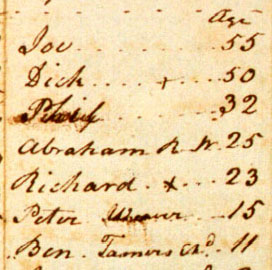
Portion of The Divvy List showing Abraham with an “R.W.” after his name.
One such mysterious notation appeared on the document we refer to as the Divvy List. One name, Abraham, appeared in the column for enslaved persons going to Robert Lewis. Abraham was listed as being age 25, and the letters “R.W.” were written after his name. What did R.W. mean? No other name in the document showed the same notation, and there didn’t appear to be any other clues in the Divvy List, so the mysterious “R.W.” was simply noted in Abraham’s file (we have developed a file for each enslaved person identified in the project) and we moved on. But Abraham’s odd notation would come up again, with some interesting significance.
In the Vendu List, we were presented with unambiguous, cut and dry information. Names of the enslaved, their skills, and children identified with their mothers. It didn’t require a great deal of interpretation. However, there were three enslaved people who showed some rather unusual skillsets. Bob, George, and Randolph were all listed as being “ropemakers.” While ropemaking was certainly an important trade in the 18th century, having three people with that skill in a group of 25 adults seemed somewhat unusual. Again, the information was noted in each individual’s file and we made a mental note to come back to it at some point.
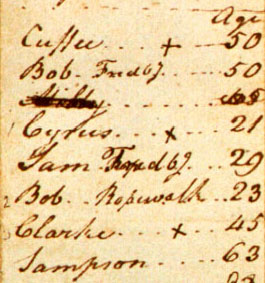
Portion of The Divvy List showing Bob #2 with “Fredbg” after his name and Bob #2 with “Ropewalk” after his name.
The enslaved individual named Bob in the Vendu List was one of three Bobs who showed up throughout the four original primary documents, but only in the Divvy List did all three Bobs show up at the same time, which afforded us the chance to distinguish between the three individuals. Bob #1 was age 27, Bob #2 was age 50 and Bob #3 was 23 years of age. Bob #2 and #3 were listed as going to Lawrence Lewis, while Bob #1 was to stay with Betty. Using a device that she employed throughout the Divvy List to differentiate between people with the same name, Betty added a word after each Bob. Bob #1 had “(long)” written after his name, probably referring to a physical characteristic as “long” often meant “tall.” Bob #2 had “Fredbg” after his name. Obviously, this is simply an abbreviation for Fredericksburg where Bob lived (as opposed to the Lewis property in Frederick County). Bob #3 had “ropewalk” written after his name. Initially, we thought it was a misprint and that Betty had intended to write “ropemaker”, since one of the ropemakers on the Vendu List was a Bob. But, what if it wasn’t a misprint? What if, like “Fredbg”, “ropewalk” indicated the place where Bob 3 lived? And if that was the case, what if the notation of “R.W.” following Abraham’s name also indicated a place? What if that place was a “ropewalk”?
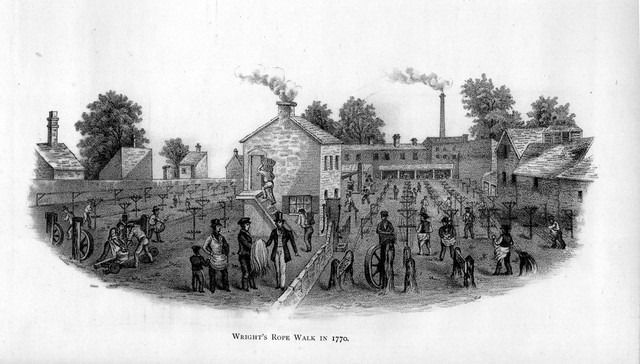
Prior to the invention of steam power, ropewalks were quite literally the places where rope was handmade throughout the 17th, 18th, and 19th centuries. They were most often found in port cities, like Liverpool, England, Norfolk, Virginia, and Boston, Massachusetts (where the earliest colonial ropewalk is documented in 1642)[i], to serve the endless need of maritime vessels for incredible lengths of rope (the British Navy required that a single rope be no less than a 1,000 feet and the HMS Victory required 26 miles of rope).[ii] Once the American Revolution was in full swing, and the fledgling American Navy had come into existence, the colonies were on their own for producing enough cordage to supply the fleet, and smaller ropewalk operations began popping up in river towns and military supply centers.
Wright’s Rope Walk in Birmingham, England about the year 1770.
Large commercial ropewalks, like those in Boston, were comprised of low, one-story, incredibly long sheds (Gray’s Ropeworks in Boston was 934 feet long – more than 3 football fields), usually with only a roof. These structures housed a ditch in the ground, in which long hemp fibers were laid out and twisted together by “spinners” who had to walk the length of the building, backwards, while twisting and pulling hemp fibers, hence the name “walk.” A ropemaker could walk the equivalent of 20 miles in one day’s work.[iii] Spinners wore bundles of hemp fibers wrapped around their waists, which they fed into the twisting rope in front of them. Spaced at regular intervals along the ditch were wooden posts, with hooks mounted on them. The spinners would loop the freshly spun rope over the hooks as they proceeded down the ditch, to keep the tightly wound fibers from snapping backwards or coiling in on itself. Ropewalks were also known as incredibly dangerous places, as the air was filled with the fine dust of hemp fibers which easily ignited and could cause uncontrollable fire.
This back breaking work was done mostly by free tradespeople in northern cities. In fact, one of the first three men killed in the Boston Massacre was Samuel Gray, a ropemaker at Gray’s, who had been involved in several street fights with British soldiers, along with a gang of his fellow ropemakers, in the days leading up to the Massacre. Ropemakers were known agitators for the revolutionary cause and fomented sedition in the ropewalks of Boston.
In a complete contrast, in southern ports, ropemaking was performed almost entirely by enslaved labor. In Virginia, there were at least 18 ropewalks in operation by the end of the war. Three of them were government-sponsored and used public funds to purchase hemp from local farmers. The rest were private ventures, run by merchants and entrepreneurs who saw the growing need.[iv] The largest of the public operations was the Public Rope Walk in Warwick, near Richmond. It had become the primary rope producer for the Continental Navy after the British destruction of their own ropewalks at Norfolk, which had been confiscated by American forces after the war began.[v] At its height, Warwick employed 28 enslaved laborers. In 1781, Benedict Arnold led British forces against Richmond, with one of their main objectives being the destruction of the Warwick ropewalk, which they achieved. Fifteen of the enslaved workers were captured (or perhaps chose to leave with British forces). The Virginia government sold the remaining 13 ropemakers to private ropewalks around the colony.[vi] The catastrophe at Warwick was a huge blow to Virginia naval forces and for the duration of the war it was up to the smaller ropewalks to meet demand.
So, if Fielding Lewis owned enslaved persons who appeared to be living at or employed in a ropewalk, was there a ropewalk in Fredericksburg? Fredericksburg was a primary depot for supplies being shipped out to the Continental Army and to the Virginia militia. Fielding Lewis himself oversaw many supplies distributed out of Fredericksburg and, of course, he was one of the two owners of the Fredericksburg Gunnery, which manufactured and supplied weapons to the Continental Army. Additionally, Fielding owned several transatlantic trade ships, which he converted into naval patrol vessels once the war broke out. Those ships required rope before and during the war. Perhaps ropemaking was another war-time activity that Fielding participated in?
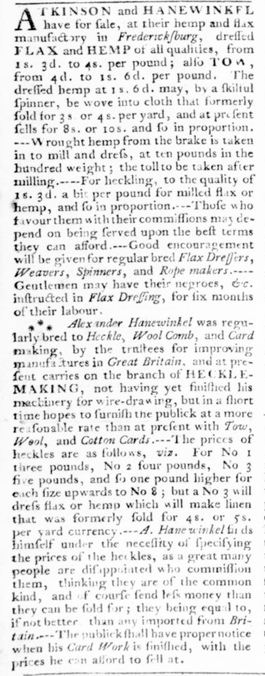
Advertisement for “dressed FLAX and HEMP” placed by John Atkinson and Alexander Hanewinkel in the September 6, 1776 edition of Purdie’s Virginia Gazette.
It turns out that there was indeed a local ropemaking industry with three separate ropewalks documented in the Fredericksburg area. According to an ad placed in the Virginia Gazette in September of 1776, Alexander Hanewinkel and John Atkinson had opened a hemp and flax factory that made textiles, sail cloth and rope, and included a school to train laborers to break and dress hemp for rope. It read, in part, “Gentlemen may have their negroes, etc. instructed in Flax Dressing, for six months of their labour.”[vii] However, it appears that Hanewinkel and Atkinson ran out of money for their venture by the end of the year and petitioned the House of Delegates to provide them funding. Hanewinkel and Atkinson specifically mentioned the high wages charged by laborers skilled in ropemaking and weaving as being among the reasons they were running short of money.[viii] Another ad in the Virginia Gazette in 1777 indicates that another ropewalk had been set up in nearby Falmouth by John Richards and James Long, who were seeking to hire a manager, but almost no record of this ropewalk exists beyond the ad.[ix] Lastly, John Frazer started the Fredericksburg Ropewalk, which appears to be the largest of all the local ventures. In fact, the Fredericksburg Ropewalk is documented as sending cordage north to supply the rope merchants in Alexandria, despite the presence of several ropewalks in that city.[x] Additionally, James Hunter (Fredericksburg merchant and business rival of Fielding Lewis) purchased 11,000 pounds of cordage from the Fredericksburg Ropewalk in 1779, indicating a rather large operation.[xi]
Likely because of the chaos of war and the ad hoc way in which the Americans were trying to supply the war effort, documentation for these ventures is hard to find, and therefore we don’t even know where in Fredericksburg the ropewalks were located. The smaller ropewalk operations begun to help the war effort were usually much less formal than their pre-war counterparts, like Gray’s Rope Works in Boston. Instead of actual sheds or roofed buildings, most were just the long, straight ditch in the ground, bordered by occasional wooden posts on either side, situated on flat stretches of land, like fields or flood plains. With so little actual structure, archaeological evidence for these sites is sparse. The Jones Point Ropewalk site in Alexandria, Virginia has been excavated, but archaeology revealed only post holes in long rows, with a stained stretch of ground between them (the stain may have been caused by the tar that was poured over the rope to make it resistant to rot).[xii] Such a site would be hard to locate without any indication of where to look.
The Fredericksburg Ropewalk probably did not have actual sheds or roofed buildings. It was most likely just a long, straight ditch in the ground, bordered by occasional wooden posts on either side, situated on a flat stretch of land similar to this Dutch ropewalk.
The likeliest candidates for the places where the Lewis family’s enslaved ropewalkers Abraham, Bob, George and Randolph were employed are either the Hanewinkel & Atkinson factory and school, where Fielding might have sent them to learn a profitable (for him) trade, or the Fredericksburg Ropewalk, which was clearly the largest operation in the area. But, the petition for funds put before the House of Delegates by Hanewinkel seems to indicate that he and his business partner were having no luck in attracting owners to provide slave labor to their ropewalk. On the other hand, would Fielding have been willing to supply labor at his own expense to business rivals like James Hunter and John Fraser?
Interestingly, it may be that a major clue about enslaved ropemakers at Kenmore was right in front of us all along. Among the “odds and ends” of assets and instructions for their disposition listed at the very end of Fielding Lewis’s will is “my share in the Chatham rope walk in Richmond” (which Fielding directs to be sold and the proceeds divided between his sons). Prior to learning that three, and possibly four, of the enslaved persons at Kenmore were ropemakers, this reference seemed to be just one of many rather insignificant business matters. But suddenly it became a more important notation. What was the Chatham ropewalk? Obviously it was in Richmond, but could we learn anything more about it? In fact, we could.
The Chatham ropewalk (sometimes called the Chatham Rope Company, sometimes the Chatham Rope Yard, and also the Chatham Ropery) was owned by a consortium of businessmen led by Archibald Cary, who also had part ownership in one of the ropewalks destroyed by the British at Norfolk in 1776.[xiii] It didn’t take him long to regroup however, and less than a year later, in August 1777, Cary and associates were advertising in the Virginia Gazette for trained spinners to work at the Chatham site, which was located on Shockoe Hill. Fielding Lewis is not mentioned as one of the founding investors in the venture, but he certainly knew Cary, as they served in the House of Burgesses together and both were tasked with procuring military supplies in central Virginia.
Rope, or line, was an 18th century essential, rather on Atlantic sailing vessels or a Virginia farm.
There appears to be some debate about the fate of the Chatham ropewalk. In January of 1781, when Benedict Arnold and his British forces raided Richmond, many industrial buildings were intentionally destroyed, aimed at critically injuring the American war machine. Arnold identified a ropewalk as being among the facilities that he and his men destroyed in Richmond (in addition to the ropewalk at Warwick, outside of Richmond), and since most of their destruction took place in and around Shockoe Hill, some historians maintain that the Chatham ropewalk seems the likely candidate.[xiv] However, the Marquis de Lafayette apparently quartered his troops inside the ropewalk “on the east side of the city”[xv] (which would also describe the location of the Chatham ropewalk) when they marched through Richmond a few months later, which would seem to indicate that the ropewalk structure was still standing. And of course, Fielding Lewis seemed to feel that his share in the Chatham ropewalk was still worth something when he wrote his will in October of 1781. No additional family documents shed any light on whether or not the share was sold as directed.
So, the question now becomes, did Fielding Lewis send Abraham, Bob, George, and Randolph to work and possibly live at the local Fredericksburg ropewalks or did he send them all the way to Richmond to work and live at a ropewalk in which he had a financial stake? Arguments for both can be made, but at the moment we haven’t found any documentation to conclusively say which it was. One final clue, although its meaning is still unclear, was discovered in a fragmented receipt in the Kenmore archival collection. The receipt, dated 1794, shows that Betty Lewis paid off her account with the Fredericksburg general mercantile store Callender & Henderson by hiring out the labor of Bob, George, and Randolph for one year to David Henderson.[xvi] As all three were ropemakers, we have to assume that Henderson was interested in them for that skill and was aware that they had it.
As to the ultimate fates of Abraham, Bob, Randolph, and George, we know some things. Abraham was intended to go to Robert Lewis when he came of age, and so we assume that he did. However, estate records for Robert Lewis show no Abraham on his property at the time of Robert’s death. Bob was apparently intended to go to Lawrence Lewis, but instead he must have stayed with Betty Lewis, as his name and occupation of ropemaker appear on the Vendu List in 1797. However, his name does not appear on the Final Disposition, so we do not know with any certainty who purchased him at the sale. Randolph also stayed at Kenmore and is listed on the Final Disposition document as being sold to George Lewis for £121. As property of George Lewis, he would have gone to Marmion Plantation on the Northern Neck. Interestingly, George was also sold to George Lewis in the Final Disposition, for £122, meaning that Lewis had purchased two of the three ropemakers listed.
Abraham’s mysterious “R.W.” notation was initially just a fragment of information to be cataloged as part of the larger project to research the enslaved communities at both Kenmore and Ferry Farm. While we know almost nothing else of this man, that tiny two-letter notation revealed a story that he was a large part of – what trade he may have had, where he may have lived, and which members of his community he may have been closest to. We will continue to search for these larger stories in the smallest of details.
Meghan Budinger
Aldrich Director of Curatorial Operations
[v] Ward, Harry M. and Harold E. Greer, Jr. Richmond During the Revolution: 1775 – 1783. University Press of Virginia, Charlottesville, VA. Pg. 136.
[vi] Herndon, G. Melvin. A War-Inspired Industry: The Manufacture of Hemp in Virginia During the Revolution. The Virginia Magazine of History & Biography, Vol. 74, No.3 (July, 1966). Pg. 309.
[vii] Ibid, Pg. 305. Virginia Gazette, September 5, 1776.
[viii]Journal of the House of Delegates, Anno Domini 1776. Library of Virginia. Pg. 8.
[ix] Herndon, 307. Virginia Gazette, June 6, 1777.