Lives and Legacies

Tag: animal bones

  • Meet the Crew 2025

    We are heading into the final stretch of this year’s exploration of the 18th-century kitchen at George Washington’s Ferry Farm, and it definitely hasn’t disappointed! The finds are getting bigger and better as we continue excavating deeper into the cellar and expand our look into the surrounding area. We have made a ton of progress that wouldn’t have been possible without the help of our crew of the George Washington Foundation staff, interns, and University of South Florida field school students. While there are still a few weeks before the official end of the dig on July 11. Just in case you missed them, here are some quick introductions and fun finds from the 2025 field school and crew.

    Left to right: Judy, Danielle, Abby, Sarah, Alaina, Alaina S., Sofia, Addie

    Field School

    “Hi, my name is Alaina Scapicchio, and I am a Ph.D. candidate in the Department of History at the University of South Florida. This is my third summer digging at Ferry Farm. My favorite moment of the summer was excavating a partially intact pig jaw!” 

    -Alaina

    “Hi! My name is Addie, I am a history and anthropology student at the University of South Florida. My favorite artifact to find are the animal bones.”

    -Addie

    “Hi, my name is Alaina. I am studying history at USF. My favorite part of the field school was digging in the kitchen because of how many cool artifacts we found. My favorite artifact was the piece of the Bartmann jug!”

    -Alaina

    “Sofia Almeida is a first-year History PhD student at the University of South Florida. Her research focuses on historic cemeteries, public history, and memory. One of her favorite parts of field school was digging in the kitchen cellar. One of her favorite artifacts this season was a decorated fragment of Staffordshire ceramic.”

    -Sofia

    GWF Interns

    “Hey! My name is Abby! I am a recent graduate from UVA and am planning to pursue a career in archaeology. I enjoy reading and playing Ultimate Frisbee in my free time. My favorite artifact that I helped find this season was a projectile point with jagged edges.”

    -Abby

    “Hey all, my name’s Max Puckett. I’m a senior at the University of Mary Washington, currently pursuing a BA in Historic Preservation. In my spare time, I like to cook, research, and read. I’ve really loved this field season so far- we are pulling out a ton of interesting and exciting artifacts.”

    -Max

    Sarah came to Ferry Farm as a VCU student in the summer of 2014 and has been in over half a dozen summer digs since then. This year’s dig is very special to her because it is focused on the cellar of the Washington kitchen. Her favorite artifacts from this dig are the ones that can actually be paired and mended with each other because much of what collapsed in the kitchen fire was left in place and not scattered or missing.

    -Sara

    GWF Staff  

    I have been involved with the Ferry Farm Archaeology Department since 2012, when my youngest twins graduated from high school. I started out as a volunteer but then took on a part-time position cataloguing artifacts from the summer digs, which then turned into a full-time job as a lab assistant.  I have been co-field director since 2019.  I have a BA in Anthropology and an MA in Historical Archaeology, with past jobs in cultural resource management and historic sites, such as Mount Vernon.  Though I really enjoy pulling out the handfuls of wine bottle necks and bases, I do find it more awe-inspiring when we pick out the tiniest and fragile eggshell fragments among the rubble and debris inside the kitchen cellar.

    -Judy Jobrack

    “Hello! I’m Danielle, and I have been at Ferry Farm since 2022, first as an intern and then lab assistant and co-field director. As a UMW Historic Preservation alum, I love all things old, both above ground and below, so this year’s dig has been particularly exciting with all the architectural bits we have been finding. With that said, I think my favorite artifact so far has been a brass/copper button –metal with verdigris is just so cool!”

    -Danielle Arens

    Though some of our crew is leaving, the rest of us will be digging every weekday until July 11, so be sure to come say hi and see what new things we have uncovered!


    Danielle Arens

    GWF Archaeologist

  • The Wild Game on the Washingtons’ Table

    The holiday season is beginning!  No matter how you celebrate the next several weeks, you’re likely spending extra time thinking about food. We archaeologists are no different, only we also want to know what the Washingtons and their enslaved laborers ate, whether at the harvest, the holiday season, or simply a regular meal. Historians know about the past because people wrote things down in diaries, letters, receipts, legal records, and other documents.  Of course, not everything was written down, especially when the things as mundane as what people ate for dinner. To find out more about the diets of those living at George Washington’s Ferry Farm in the 18th century, along with research in historical documents, we also turn to archaeological analysis.

    We previously published a blog post detailing floral remains excavated in 2015 from a storehouse cellar abandoned in the mid-1700s. This cellar feature contained floral remains (seeds and wood) which were analyzed by a microbotanical expert.  We are currently using this information to recreate the Washington era landscape and to plant in our garden examples of what the Washingtons grew.

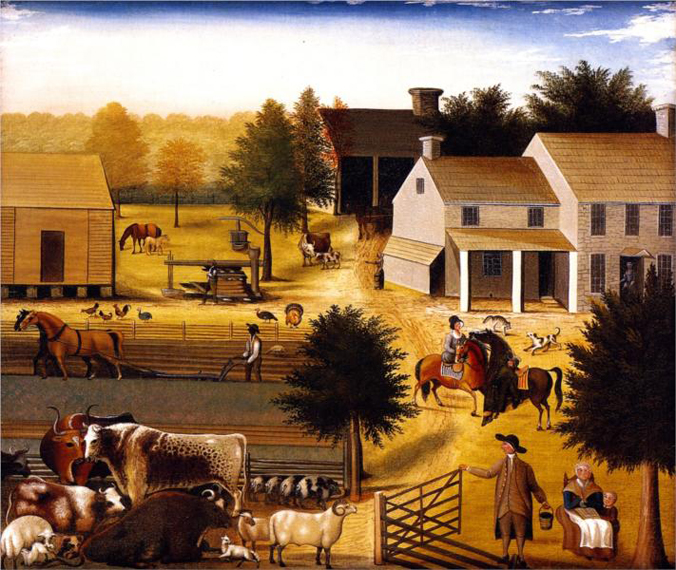
    Historical documents, namely the probate inventory of Augustine Washington compiled in July 1743, show that the livestock owned by the Washingtons included 6 oxen, 29 cattle, 19 pigs, and 11 sheep. Rather than consume this livestock themselves, however, the Washingtons most likely raised most of these animals for market.  Many of them would be butchered by enslaved workers, the meat loaded onto small ocean-going vessels ported at Fredericksburg, and then shipped to the British West Indies or even to England.

    The Residence of David Twining, 1785 by Edward Hicks
    “The Residence of David Twining, 1785′ by Edward Hicks. Although Twining’s farm was located near Newtown, Pennsylvannia, this painting includes great example images of livestock typically found on a colonial farm or even on a plantation like Ferry Farm. Credit: The WikiArt Visual Art Encyclopedia

    To add to the probate inventory’s livestock picture, we also explored a root cellar feature under the Washingtons’ house as well as a root cellar feature associated with a nearby enslaved laborer’s dwelling.  In these cases, we hoped to determine what kinds of animals – or fauna – each group actually ate. These diets would be revealed by archeologically recovered animal remains, usually bones, called “faunal remains.” Then, we had an expert in faunal remains analyze what came out of these two root cellars.

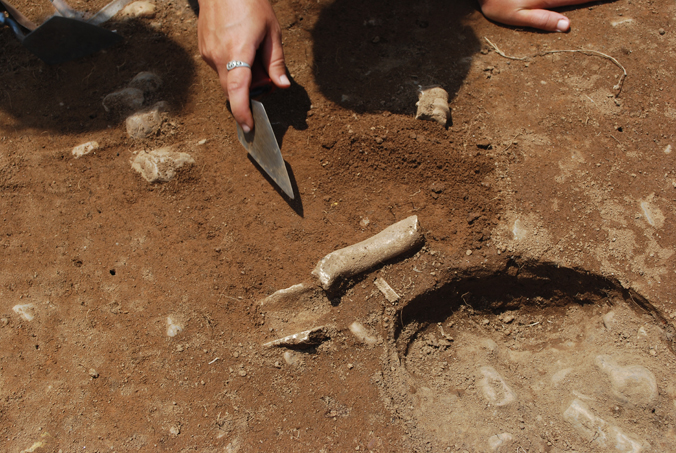
    Excavated Bone
    Archaeologist excavating an animal bone at George Washington’s Ferry Farm.

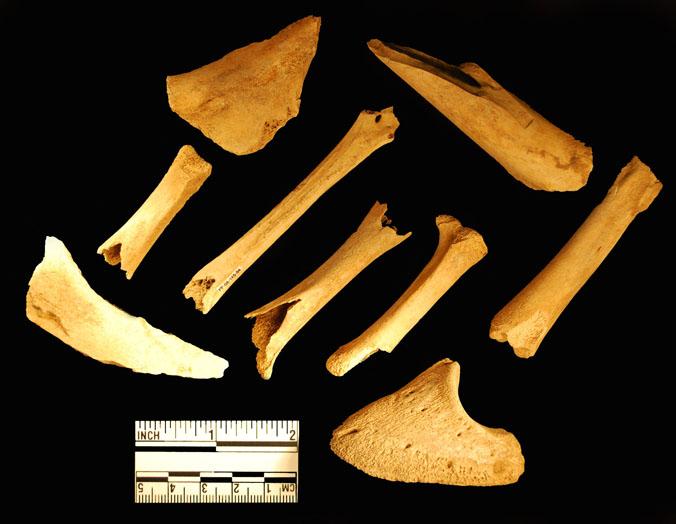
    Assortment of Faunal Remains
    An assortment of faunal remains excavated at Ferry Farm.

    The results for Ferry Farm were unusual compared to other 18th century sites.  The Washingtons weren’t only dining on typical domestic livestock like cows and pigs, they ate a variety of wild game and in much higher amounts than expected. Results from other studies show that typical 18th century Virginia households consumed a little under 4% wild game on average. Another study of planter households in Maryland and Virginia showed faunal remains only ranging from 4-15% wild game. The percentage of wild game recovered from the Washington house root cellar was a whopping 25%.

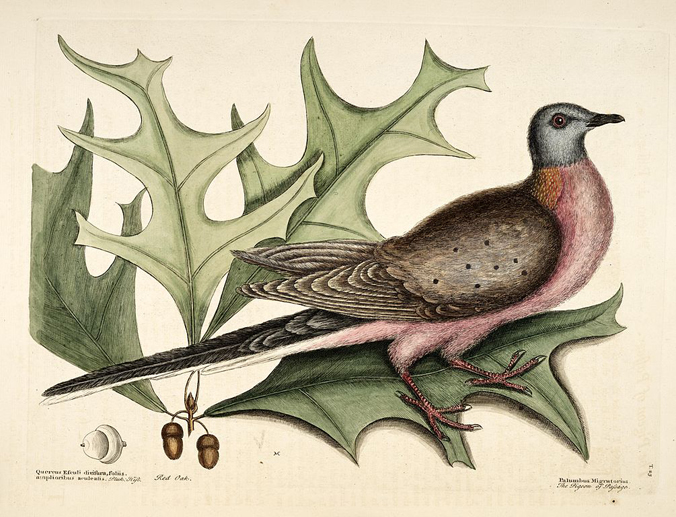
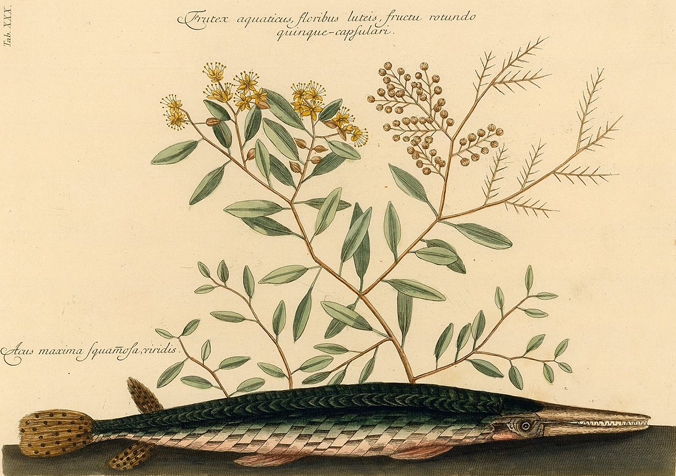
    Mammal remains recovered from the Washington family root cellar include cows, pigs, sheep, rabbits, raccoon, white-tailed deer, fox squirrels, and grey squirrels.  Birds that were prepared and eaten include chicken, turkey, Canada geese, mallards and other ducks, bobwhite, and the now-extinct passenger pigeon. Fish eaten include longnose gar, stripped bass or rockfish, white perch, yellow perch, and carp. Shellfish consumed include oysters and crabs. The Washingtons also ate turtles, which were 18th century delicacies.

    Passenger Pigeon by Mark Catesby
    Passenger Pigeon by Mark Catesby from his famed Natural History of Carolina, Florida and the Bahama Islands published 1729-1747. Credit: Wikipedia

    Longnose Gar by Mark Catesby
    Longnose Gar by Mark Catesby from his famed Natural History of Carolina, Florida and the Bahama Islands published 1729-1747. Credit: Wikipedia

    The species recovered from the slave quarter root cellar include cow, pig, chicken, possum, four types of fish, and an unidentified bird. Beef and pork account for almost 78% of the faunal remains.  What meat Ferry Farm’s enslaved people consumed came in the form of mostly beef, pig, and chicken. The relative absence of wild animals, with the exception of fish, shows that the occupants of the slave quarter did not significantly supplement their diet using hunting or trapping.  No lead shot, gunflints, or fish hooks were recovered in the slave quarter, the lack of which supports this conclusion. The enslaved laborers however were providing food for themselves by raising chickens, which account for over 7% of the meat recovered in the slave dwelling.

    The prevalence of wild animals being served on the Washington table may be related to the makeup of the four Washington boys: George, Samuel, John Augustine, and Charles.  The youngest Washington male, Charles, left home around 1761, meaning that the Washington boys hunted, fished, and trapped for up to 23 years at Ferry Farm. Farm life meant there were also frequent opportunities requiring the dispatching of varmints. At the time, hunting and fishing were considered fun and great practice for adult gentry life. There was also an economic benefit to provisioning one’s table with game. This supplemental meat source replaced domestic animals that could be steered toward the market, increasing the profits of selling livestock and poultry.

    Elyse Adams, Archaeologist
    Co-Field Director / Archaeology Lab Technician