Lives and Legacies

Tag: Annie Fleming Smith

  • Kenmore Goes to Sea: Ship Naming in the US Navy

    On July 22, 1942, Annie Fleming Smith wrote a letter. Smith was a prolific letter writer—her innumerable missives had helped raise the funds that saved Kenmore two decades earlier—so it is not surprising that she put pen to paper on that summer day. What is surprising is that the intended recipient of that letter was not a prospective donor, a fellow regent of the Kenmore Association, or a friend. Instead, she addressed her epistle to Frank Knox, the Secretary of the Navy. Smith wanted “confirmation of the fact of the naming of the U.S.S. KENMORE” after the home and “any other information you can release” about the ship.[1]

    Letter that Annie Fleming Smith sent to Secretary of the Navy Frank Knox asking for confirmation that the first USS Kenmore had been named after the historic home. Smith, Annie Fleming to Frank Knox, July 22, 1942. The George Washington Foundation.

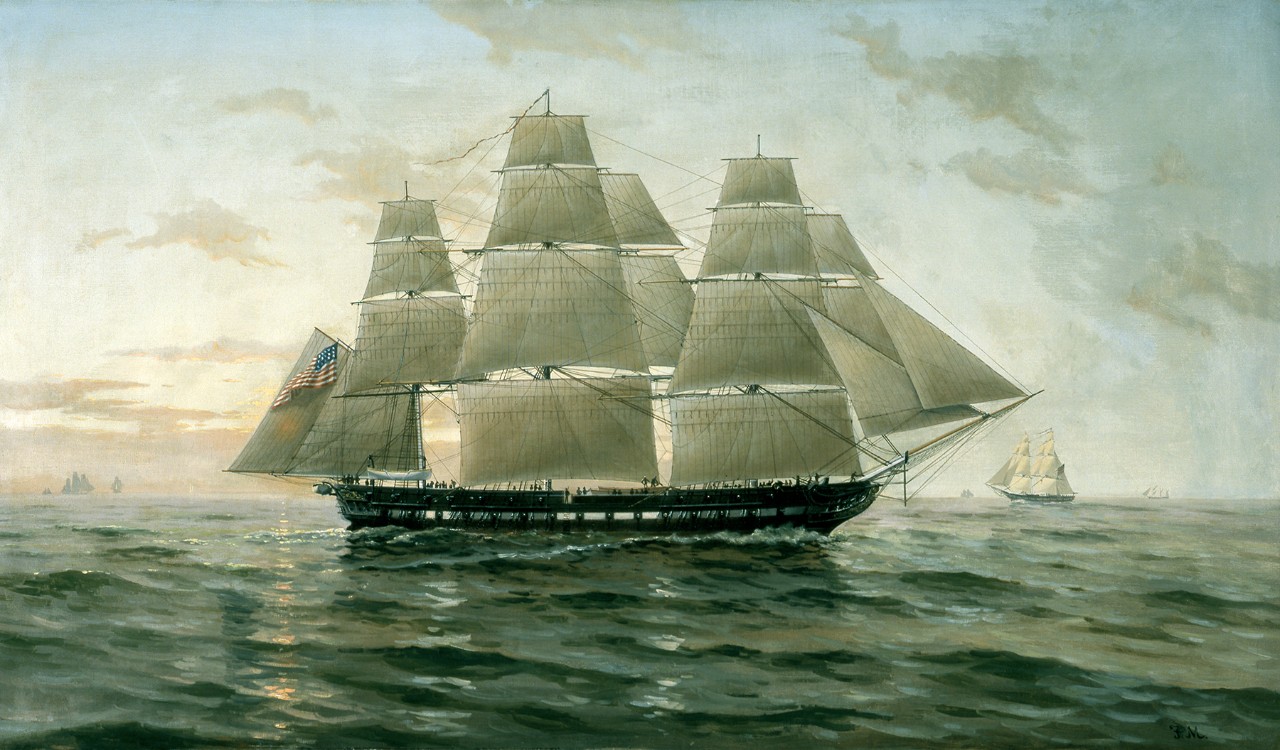
    Although there is no record that Knox responded to Smith (there was, after all, a war on), the USS Kenmore was, in fact, named for the historic estate. The Naval History and Heritage Command ship-naming file on Kenmore I (AP-62) includes an April 13, 1942, memo to the Secretary of the Navy from the chief of the Bureau of Navigation and prepared by Louis Emil Denfeld, then assistant chief of the Bureau of Navigation, recommending that the President Madison be renamed Kenmore, in honor of the “[h]ome of Betty Washington at Fredericksburg, Virginia, sister of George Washington who married Col Fielding Lewis.”[2] The recommendation was approved on April 16 of that year, and the newly renamed vessel was “commissioned at Baltimore, Md., on 5 August 1942, Cmdr. Myron T. Richardson in command.”[3]
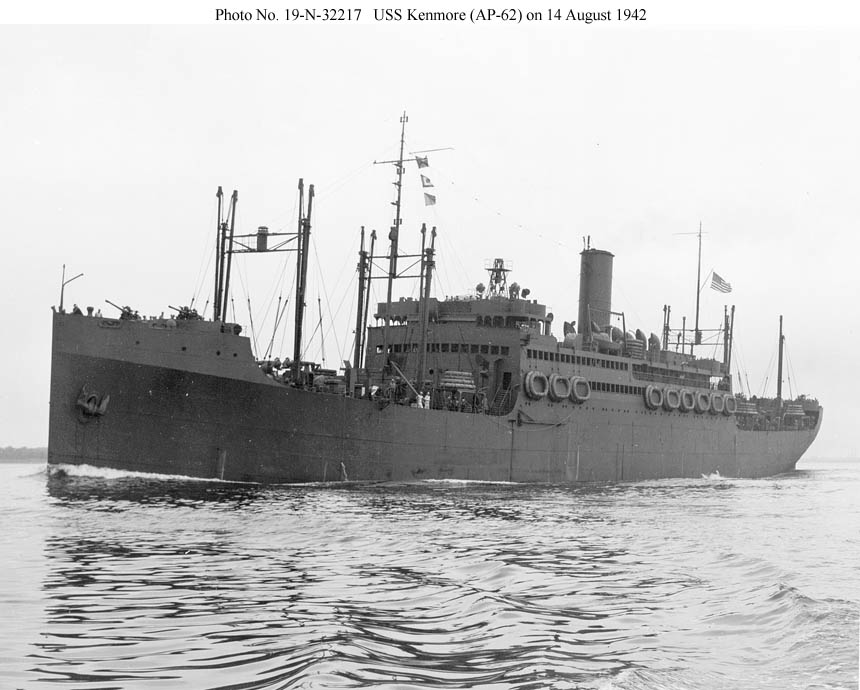
    USS Kenmore (AP-62) on trials in the Chesapeake Bay on August 14, 1942. Shipscribe

    Smith had learned of the ship during a mid-1942 visit to the estate from Lt. Commander William VanC. Brandt (USNR) of the Kenmore, who later wrote to “Miss Annie” to thank her for her hospitality.[4] “All the Officers of the Kenmore,” Brandt told Smith, “were most interested in learning the history and record of the beautiful estate for which our ship is named.”[5] Brandt planned to have framed and displayed in the ship’s wardroom photographs of the property given to him by Smith; later, the vessel’s captain requested a picture of the house for his room.[6] For her part, Smith was “thrilled” to meet Brandt and “to know about your ship,” although she was skeptical enough of the origin of the transport’s new name to write Knox.[7]
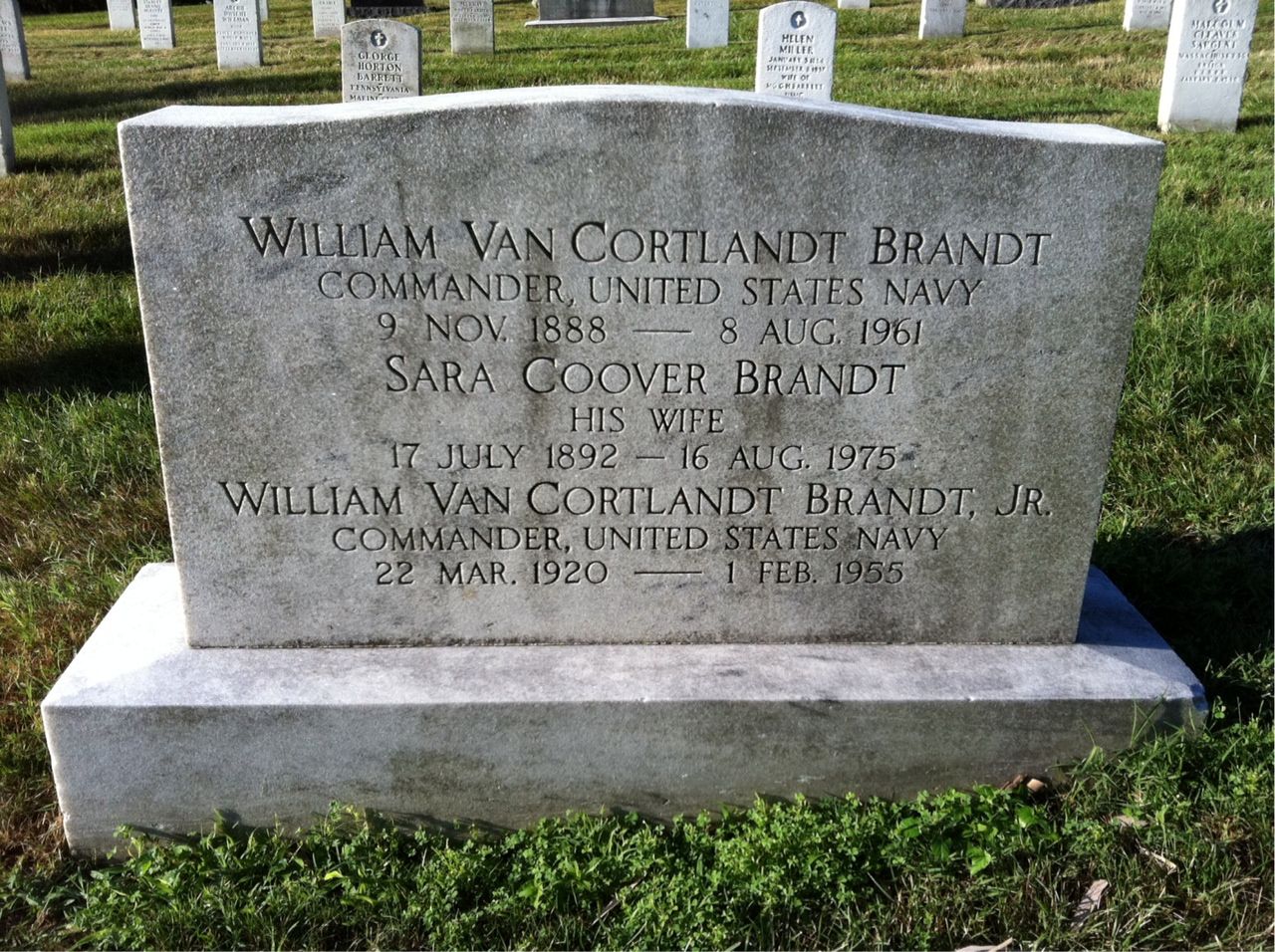
    The Arlington National Cemetery headstone of William VanC. Brandt, from whom Annie Fleming Smith learned that a Navy ship had been named after the historic home she had helped save from development in the 1920s.

    The Kenmore operated primarily in the Pacific until September 1943; she was then converted into a hospital ship and renamed Refuge.[8] The Navy must have liked the name Kenmore, as it was bestowed in October 1943 on another transport, originally called the James H. McClintock.[9] The Kenmore II also served in the Pacific Theater and, after “hostilities ended on 15 August 1945, [began] returning veterans to the U.S.”[10] She was decommissioned on February 1, 1946.[11]

    The Kenmores were not the only vessels named for properties associated with George Washington and his family. The Wakefield (AP-21) borrowed its name from the Westmoreland County birthplace of the first president, today owned by the National Park Service.[12] There have been five Mount Vernons; the first was built in 1859 and chartered by the Navy two years later, before they bought it later that year.[13] The most recent vessel named after Washington’s residence and plantation was a dock landing ship commissioned in 1972 and decommissioned in 2003.[14] The possible birthplace of Mary Ball, George Washington’s mother, lent its name to the Epping Forest, a dock landing ship launched in 1943.[15]

    The monikers of other ships are connected more tenuously to places tied to George Washington and his family. For example, a 1943 submarine chaser was rechristened the Abingdon in 1956.[16] The vessel’s new name came from the town of Abingdon, in Washington County, Virginia (named, yes, for George Washington).[17] According to the county’s official history, “myths claim that [the town] was named for Martha Washington’s ancestral home” in England.[18] While this may be a false etymology, were those who named the ship drawing on the tale when they chose to call the vessel Abingdon? Additionally, the many Arlingtons that have served the Navy over the years have each been named after Arlington County, which draws its appellation from Arlington House, built for George Washington Parke Custis, the step-grandson of his celebrated namesake.[19]

    Arlington Mansion was built by George Washington Parke Custis. Union soldiers posing on the lawn, June 28, 1864.

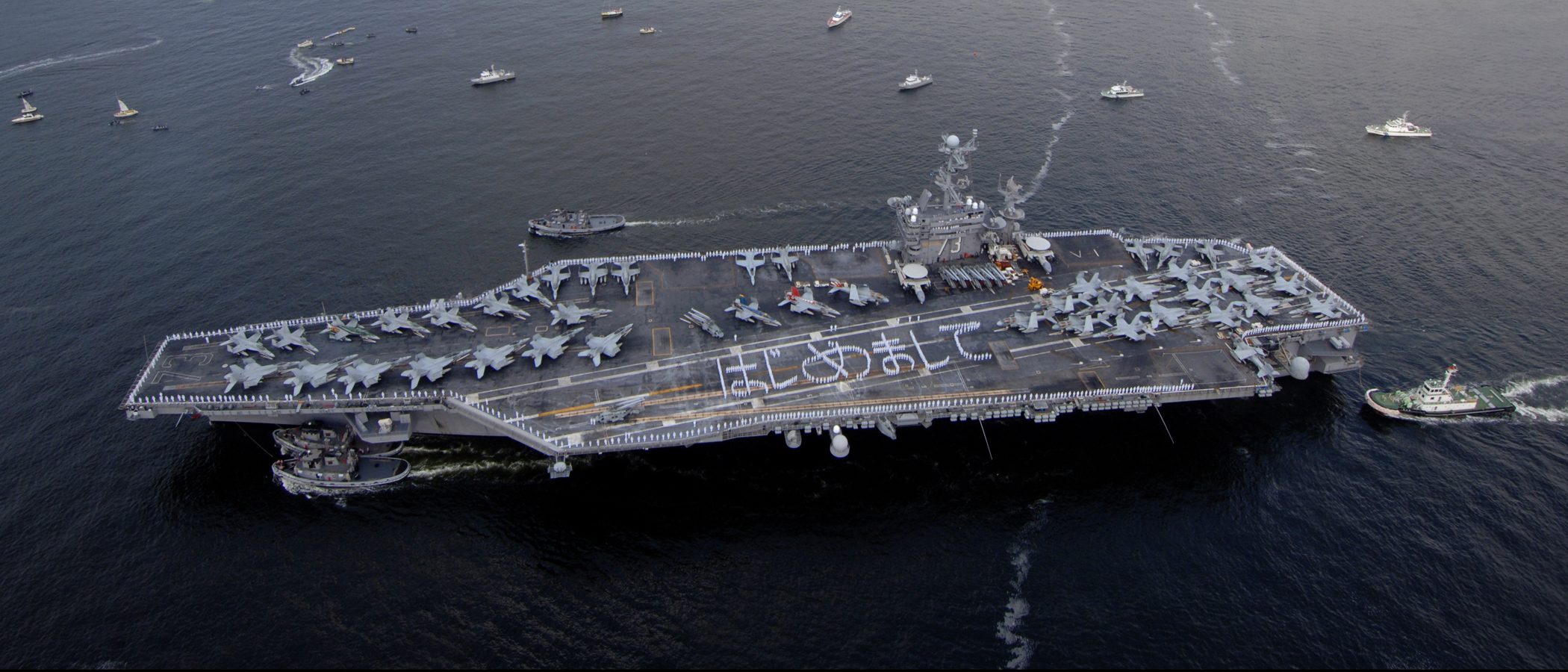
    The Navy’s infatuation with the commander in chief of the Continental Army has, of course, also been expressed by naming ships directly after Washington and his family, not just their properties. While a complete inventory of such vessels is beyond the scope of this post, it is worth noting that four ships have been named the George Washington, including CVN-73, an active nuclear-powered aircraft carrier, while several others have sailed under just his surname.[20] Martha, George’s wife and the nation’s first first lady, has inspired the names of at least two Navy ships: the Lady Washington and the Martha Washington.[21] Civilian shipbuilders have also found inspiration in the Washington family: the SS Mary Ball was a liberty ship active during World War II.[22]
    Who was responsible for naming these ships? As hinted at above, while final authority for ship names was (and still is) the responsibility of the Secretary of the Navy, during World War II, it was the Bureau of Navigation (renamed the Bureau of Personnel on May 21, 1942) that researched and recommend ship names based on the traditional naming conventions associated with each class of vessels.[23]

    Typically, it was dock landing ships, or LSDs, that were named for “cities and places of historical interest of same name, or places of historical interest only.” [24] Epping Forest, Gunston Hall I (named for George Mason’s home), Ashland (for the boyhood home of Henry Clay), Carter Hall (after the Virginia estate), Oak Hill (for the home of President James Monroe), and Shadwell (for the birthplace of Thomas Jefferson) are all examples of LSDs whose names aligned with this convention.[25]

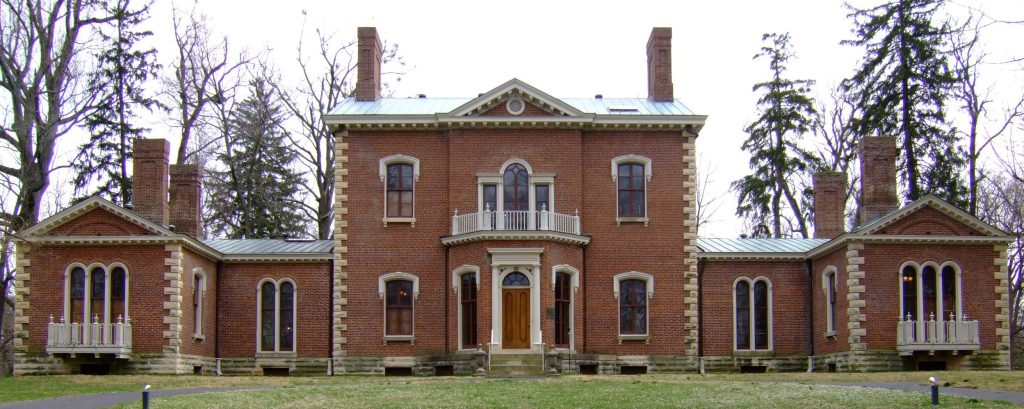
    But the Kenmores, the Mount Vernon IV, and the Wakefield were not LSDs; they were transports, classified AP, and anyone seeking consistency in the Navy’s naming of troop transports during World War II is bound to be disappointed. Some vessels in the AP class were named after celestial bodies, others after Revolutionary War heroes, and others, as we have seen, after historic estates.

    This lack of consistency is not surprising. After all, when Benjamin Stoddert named the Navy’s sixth ship, a frigate, he chose to call it the Chesapeake, despite President George Washington’s agreement with the recommendation that frigates be named after “principles or symbols found in the US Constitution.” Therefore, “the very first naming decision by the very first Secretary of the Navy resulted in the ‘corruption’ of the established naming convention.”[26] This tradition of flexibility regarding ship names has endured, and ship names continue to excite interest (and occasionally strong feelings) from many parties, including those who propose denominations for new vessels. If you are such a person, here’s an idea: how about another Kenmore, or maybe a Ferry Farm?  


    Adam Nubbe

    Manager of School & Youth Programs


    [1] Smith, Annie Fleming to Frank Knox, July 22, 1942. The George Washington Foundation.

    [2] Naval History and Heritage Command, Kenmore I, ship-naming file, April 13, 1942.

    [3] Ibid; Cressman, R. J. (2020, March 31). Kenmore I (AP-62). https://www.history.navy.mil/research/histories/ship-histories/danfs/k/kenmore.html

    [4] Brandt, William VanC. to Annie Fleming Smith, June 30, 1942. The George Washington Foundation.

    [5] Ibid.

    [6] Ibid; Smith, Annie Fleming to William VanC. Brandt, July 10, 1942. The George Washington Foundation.

    [7] Smith, Annie Fleming to William VanC. Brandt, July 10, 1942. The George Washington Foundation.

    [8] Naval History and Heritage Command, Kenmore I, ship-naming file, April 13, 1942.

    [9] Cressman, R. J. (2020, March 31). Kenmore II (AP-162). https://www.history.navy.mil/research/histories/ship-histories/danfs/k/kenmore-ii–ap-162-.html

    [10] Ibid.

    [11] Ibid.

    [12] Cressman, R. J. (2022, April 1). Wakefield (AP-21). https://www.history.navy.mil/research/histories/ship-histories/danfs/w/wakefield.html

    [13] Naval History and Heritage Command. (2015, August 11). Mount Vernon I (Gbt). https://www.history.navy.mil/research/histories/ship-histories/danfs/m/mount-vernon-i.html

    [14] Pike, J. (n.d.). LSD 39 Mount Vernon. https://www.globalsecurity.org/military/agency/navy/lsd-39.htm

    [15] Naval History and Heritage Command. (2015, July 8). Epping Forest. https://www.history.navy.mil/research/histories/ship-histories/danfs/e/epping-forest.html

    [16] Mann, R. A., & Cressman, R. J. (2023, November 27). Abingdon (PC-1237). https://www.history.navy.mil/research/histories/ship-histories/danfs/a/abingdon.html

    [17] Ibid; Hagy, J. W. (2019, June 10). A Brief History of Washington County, Virginia. Washington County, Virginia. https://www.washcova.com/history/

    [18] Ibid.

    [19] Parsons, L., & Cressman, R. J. (2023, December 13). Arlington I (AP-174). https://www.history.navy.mil/research/histories/ship-histories/danfs/a/arlington-i.html; Arlington, Virginia. (n.d.). History of Arlington. https://www.arlingtonva.us/Government/Topics/Welcome-Kit/History-of-Arlington; National Park Service. (2023, January 12). George Washington Parke Custis. https://www.nps.gov/arho/learn/historyculture/george-custis.htm

    [20] Naval History and Heritage Command. (2020, May 5). Washington VIII (BB-56). https://www.history.navy.mil/research/histories/ship-histories/danfs/w/washington-viii.html; US Navy. (n.d.). USS George Washington (CVN 73). https://www.airpac.navy.mil/Organization/USS-George-Washington-CVN-73/

    [21]  Naval History and Heritage Command. (2016, February 9). Martha Washington. https://www.history.navy.mil/research/histories/ship-histories/danfs/m/martha-washington.html; Naval History and Heritage Command. (2015, July 28). Lady Washington. https://www.history.navy.mil/research/histories/ship-histories/danfs/l/lady-washington.html

    [22] Jobrack, J. (2020, September 10). True or False? Test Your Knowledge of Mary Washington. https://livesandlegaciesblog.org/2020/09/10/true-or-false-test-your-knowledge-of-mary-washington/.

    [23] Calkins, W. F. (1958, July). Down to the sea in ships’–names. U.S. Naval Institute. https://www.usni.org/magazines/proceedings/1958/july/down-sea-ships-names; Naval History and Heritage Command. (2020, June 29). Denfeld, Louis Emil. Louis Emil Denfeld. https://www.history.navy.mil/research/library/research-guides/modern-biographical-files-ndl/modern-bios-d/denfeld-louis-emil.html

    [24] Department of the Navy, A Report on Policies and Practices of the U.S. Navy for Naming the Vessels of the Navy (2012, November), 63. https://apps.dtic.mil/sti/tr/pdf/ADA569699.pdf

    [25] DANFS – Naval History and Heritage Command. Dictionary of American Naval Fighting Ships — Index. (n.d.). https://www.history.navy.mil/research/histories/ship-histories/danfs.html

    [26] Department of the Navy, A Report on Policies and Practices of the U.S. Navy for Naming the Vessels of the Navy (2012, November), 7. https://apps.dtic.mil/sti/tr/pdf/ADA569699.pdf
  • Kenmore’s Centennial: How the Ladies of the Kenmore Association Saved the Lewis Family Home

    The year 2022 is significant for The George Washington Foundation as it is the centennial of the saving of Kenmore.  We have begun the new year with a new exhibit exploring the saving of Kenmore by The Kenmore Association and the beginning of the restoration of the house and turning it into a treasured historic site.

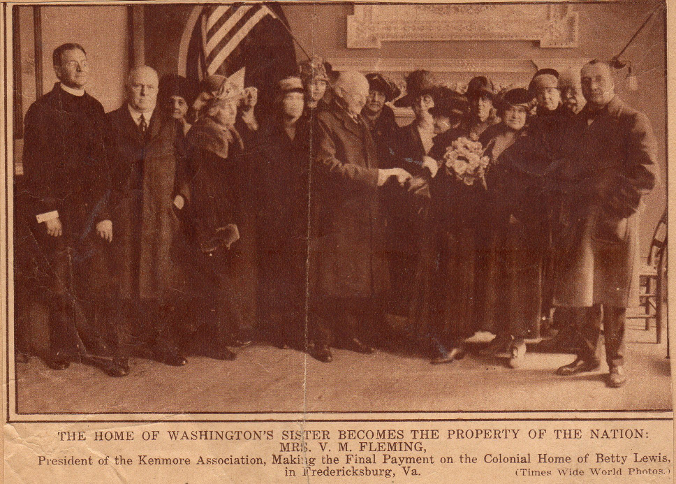
    On January 1, 1925 — ninety-seven years ago — a group of well-dressed women in hats and long fur coats assembled at Kenmore to hand over the final $1,000 payment and gain full possession of the house and land.  This meeting was the culmination of thirty-two months of persistent work and determination by the ladies of The Kenmore Association to save the historic property from destruction.

    Emily White Fleming (identified in the newspaper caption by her husband Vivian Minor Fleming’s initials) makes the final payment to purchase Historic Kenmore on January 1, 1925.

    This crusade began four years earlier with a brief notice in the Fredericksburg Daily Star from Mr. E. G. Heflin, the owner of the Kenmore property.  The announcement stated: “I have decided to build at once…6 or more modern, up-to-date residence [sic] on Kenmore.”  Built on a section of the plantation property, these houses prompted concern among many local citizens at the thought of further loss to the historic site.

    By 1922, the destruction of the old Lewis home seemed imminent.  Mr. Heflin placed an advertisement for the sale of the house itself and cut up much of the original estate into smaller building lots to be sold to developers.  If the house was sold, it might be remodeled into apartments or just razed to the ground.  This escalation increased the alarm even more, and some tried to raise funds to purchase Kenmore.  This attempt proved unsuccessful, and the house did look to be lost.  However, salvation appeared in the form of Kate Waller Barrett and the National Society of the Daughters of the American Revolution (DAR).

    In March of that year, Mrs. Barrett, Virginia Regent of the DAR, came to Fredericksburg with the purpose of organizing a new chapter in the town.  Emily White Fleming and a group of intrepid ladies proposed this turn of events as a potential way of saving Kenmore.  Mrs. Fleming was 68 years old and, though seemingly small and fragile, she, in reality, had a tenacious and determined spirit.  She accepted the position and, with the help of her daughter Annie Fleming Smith, known as “Miss Annie,” began their campaign to save the old Lewis house from destruction.

    The ladies approached Mr. Heflin and negotiated an agreement to the purchase the property.  The group had to make a first payment of $10,000 within four months, or the deal would be off.  Furthermore, if Mr. Heflin got a satisfactory offer within those four months, he could go ahead and sell the property outright. It was a tough deal, but the ladies rose to the challenge spectacularly.

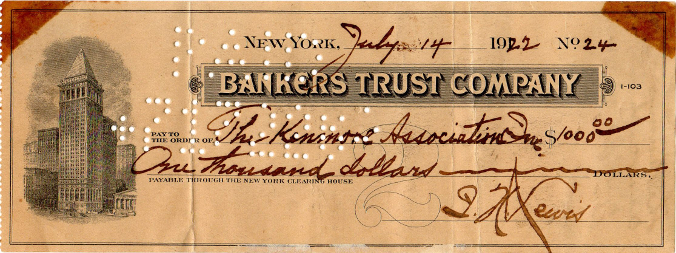
    Mrs. Fleming and Miss Annie began fundraising immediately.  They wrote hundreds of letters by hand, stating facts about Kenmore in a simple, forceful style and then making appeals for help. Mrs. Fleming recalled, “I could write thirty-nine letters a day and Annie forty-nine. We never had a typewriter until the campaign was over.” In response to one of Mrs. Fleming’s letters, Colonel Isaac Newton Lewis, maker of the Lewis machine gun and a descendant of Fielding Lewis, contributed the first $1,000. Not to be outdone, The Colonial Dames of America in the State of Virginia gave a substantial donation of a $1,000 as well.

    Donation from Colonel Isaac Newton Lewis donated the first $1,000 to the Kenmore Association.

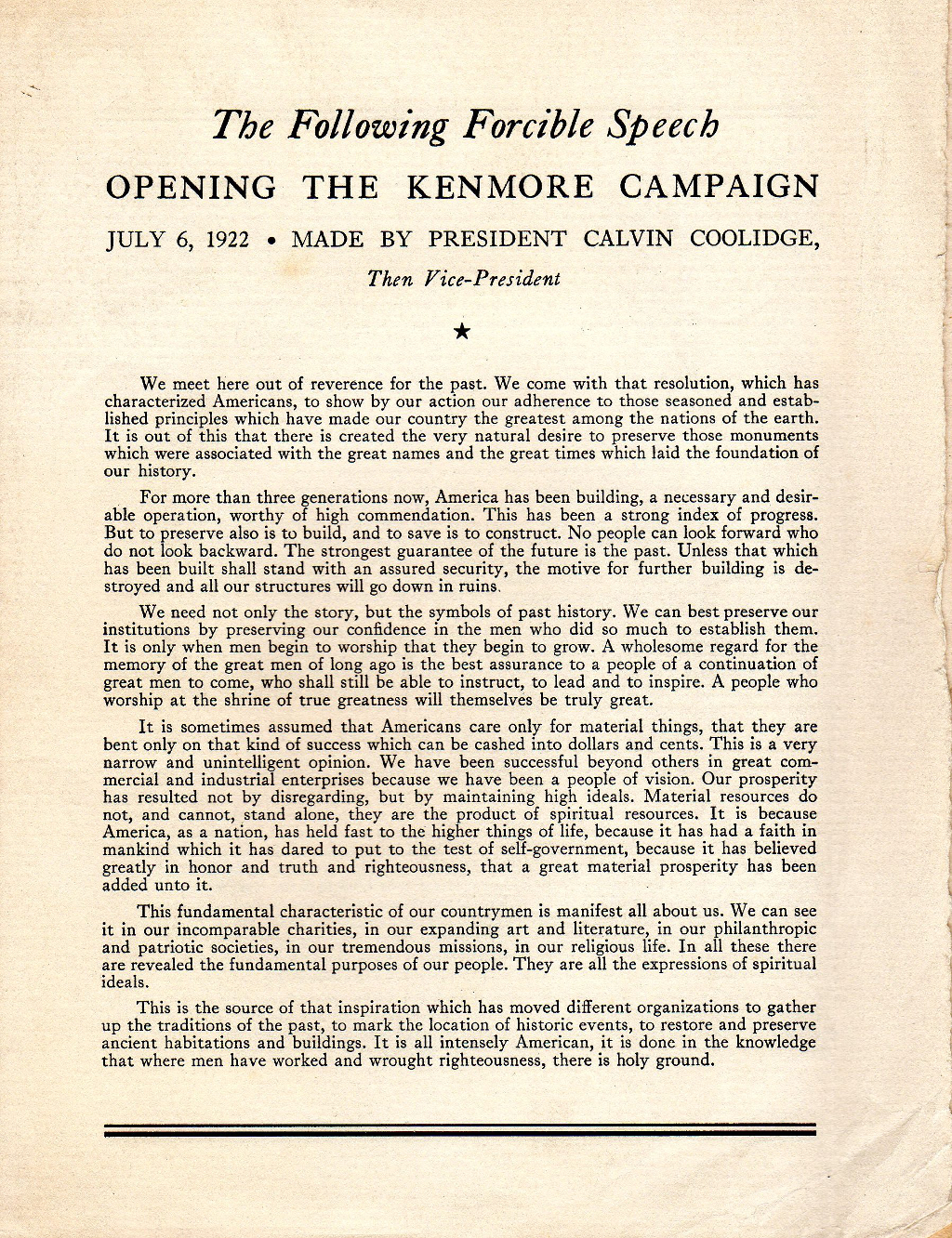
    In July 1922, the Kenmore Association launched a public fundraising drive with a host of distinguished men and women coming to Fredericksburg for the start of the campaign. Even Calvin Coolidge, then the vice president under Warren G. Harding, made a speech (see below) pleading for patriotic Americans to save this home that was so critical in the history of the country.  “It ought to be preserved for its own sake,” Coolidge demanded, “It must be preserved for the sake of patriotic America.”

    Speech made by Vice President Calvin Coolidge in support of the Kenmore Association’s effort to save the historic home.

    Through the efforts of this determined group of women, by the first of September 1922, they were able to pay an initial installment of $12,000 on the account.  Impressed with the Kenmore Association’s work, Mr. Heflin made his own gift of $2,000.   By New Year’s Day 1925, the hard work paid off, and the ladies made the final payment and took possession of the property.  Historic Kenmore was saved!

    Although the saving of Kenmore one hundred years ago certainly marked a new beginning, transforming the house into a historic site for the public to enjoy required many more years of work.  Indeed, in many ways, the work begun by Mrs. Fleming, Miss Annie, and the Kenmore Association continues even as 2022 begins.  In the New Year at Kenmore, we will focus celebrating the establishment of the Kenmore Association and the ladies’ work to save this national treasure.  You can follow the year’s celebration here of the “Lives and Legacies” blog and The George Washington Foundation website.  Like in 1922, the year 2022 should prove an exciting time.

    Heather Baldus
    Collections Manager

  • Kenmore’s Famed Gingerbread

    Historic Kenmore was associated with gingerbread for decades.  Many people’s first memories of Kenmore involve the square of gingerbread and a cup of tea that used to be served at the end of every tour.    The dessert welcomed visitors to the world of colonial Fredericksburg, it comforted soldiers on their way to war in Europe or the Pacific, and, most important of all, it helped save the historic house itself.

    The ladies of the Kenmore Association, which owned and operated the historic home in the 20th century, took on a great challenge when they accepted stewardship of Kenmore.  Raising the money to purchase the house was not the only obstacle they faced.  They also needed funds to restore and staff the house. Unfortunately, the ladies drive to save Kenmore coincided with the Great Depression and the Second World War.  Led by Annie Fleming Smith or “Miss Annie,” the ladies triumphed, kept Kenmore running, and even used the grounds to assist Fredericksburg in the war effort.  They did all this with their indomitable drive and patriotism and with a little help from gingerbread.

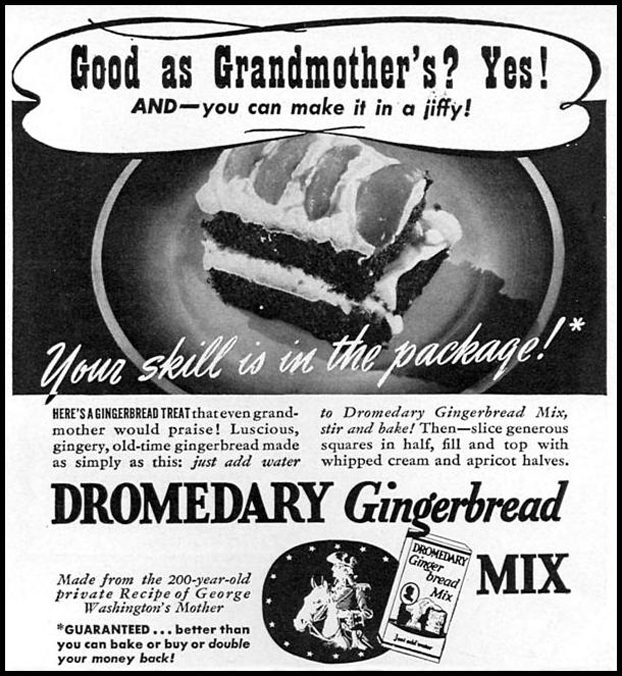
    The beneficial partnership between gingerbread and Kenmore began in the early 1930s when the Dromedary Cake Mix Company launched a nationwide search for gingerbread recipes new and old.  In the search, Mary Washington’s personal recipe was found in a cookbook owned by the Washington-Lewis Chapter of the Daughters of the American Revolution. It was tried and well-liked.  The firm approached the chapter about producing the recipe as one of their mixes.  Because the Washington-Lewis Chapter worked closely with the Kenmore Association in saving, restoring, and caring for Kenmore, Miss Annie and the ladies, being astute business women, brokered a deal with the company to benefit the historic home.

    Dromedary Ad
    An 1940s-era advertisement for Dromedary gingerbread mix “made from the 200-year-old Recipe of George Washington’s Mother.”

    The arrangement allowed Dromedary to produce gingerbread mixes based on Mary Washington’s recipe.  In exchange, the Kenmore Association got all the gingerbread they could serve to visitors.  The company also donated mixes to be sold by the Association and various DAR chapters for 25 cents a box.  The Association got half of the money realized from these sales minus the shipping costs.  This agreement, in the end, earned the Kenmore Association over $38,000 – a hefty sum in the mid-20th century – and provided countless visitors with a yummy Washington family treat.

    In 1941, the United States entered World War II.  Fredericksburg became a hub of activity with thousands of soldiers stationed at the A.P. Hill Military Reservation in Bowling Green visiting town to get a break from military life.

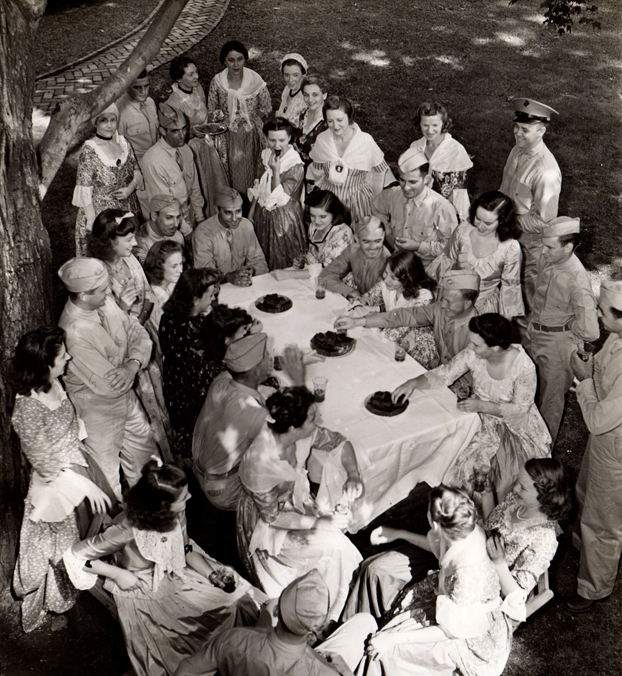
    The Association’s ladies knew that Kenmore, with its historical and patriotic legacy, had a unique opportunity to welcome soldiers who would be fighting for the country and ideals that the Lewis and Washington families helped create. So, they threw open the gates, set out the picnic tables, and recruited local women to put on their colonial best and greet the men of the United States military. At the heart of this hospitality was iced tea and Mary Washington’s gingerbread.

    Gingerbread (1)
    Servicemen enjoy gingerbread and tea on the grounds at Kenmore.

    During the war years, Kenmore hosted over 60,000 soldiers making sure each one was fed and knew his service was greatly cherished.  The ladies of the Washington-Lewis DAR even took time to write each serviceman’s mother, wife, or sweetheart about their loved ones.

    Gingerbread (2)
    C.R. Murphy, Sr. of Coolidge, Georgia wrote The Free Lance Star to express his gratitude for Annie Fleming Smith’s (identified in the letter as Mrs. H.H. Smith)  hospitality towards him and his son during a visit to Fredericksburg from a nearby military post where the son was stationed.

    The humble gingerbread recipe from Mary Washington’s cookbook gave Kenmore a perfect tangible link to its colonial past and bright future.  The gingerbread that resulted assisted the ladies in their community outreach, their historic preservation, and their national patriotic duty.   It was a sign of nostalgia, of hospitality, and most of all appreciation.

    Today, when you tour Kenmore, our guides will happily take you through the reconstructed colonial kitchen that functioned as the Kenmore Association’s tea room.  Regrettably, gingerbread and tea are no longer served to visitors because we do not have a fully-functioning kitchen.  Gingerbread mixes and teas specifically created for The George Washington Foundation are available for purchase by anyone who might wish to relive their first taste of Kenmore’s famed gingerbread.

    Heather Baldus
    Collections Manager

  • Kenmore’s Kitchen: Then & Now

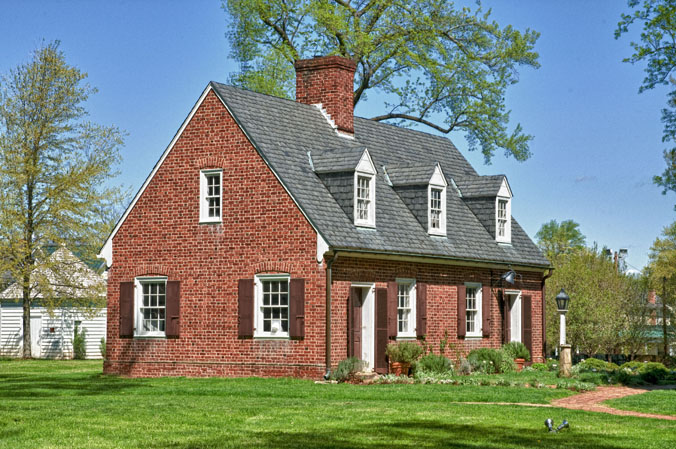
    The brick kitchen building next to Historic Kenmore is not original to the property. It was built in the 1930s in the colonial revival architectural style popular at that time.

    Kitchen01

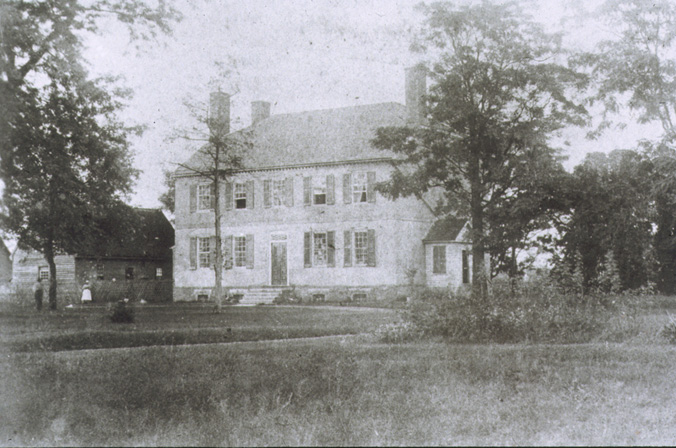
    The brick construction does not reflect the kitchen building seen in the earliest known photo of such a building at Kenmore.  That image, taken around the time of the Civil War, shows a large wooden kitchen to the north of the house as well two enslaved people standing in the kitchen yard.

    pre-1862kitchen02
    The wooden kitchen can be seen to the left of the house in this Civil War-era photograph.

    The Kenmore Association, a group of women who saved the mansion and transformed the property into a historic site open to the public, built the brick kitchen in the 1930s.

    ms 1687
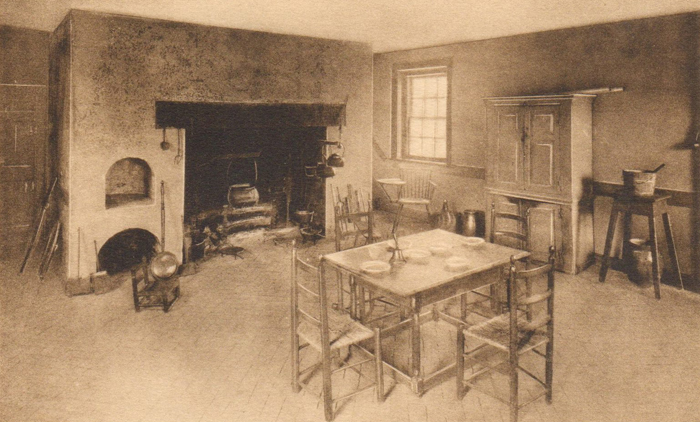
    Inside the brick kitchen just after construction was completed in the 1930s.

    Throughout much of the 20th century, visitors sat around the table in the photo above to enjoy gingerbread and tea served by the ladies of the Kenmore Association.

    Recently, we decided to highlight these ladies and their efforts to preserve Kenmore even more during our tours. We felt the most logical of places to do this was in the kitchen where they served their famed gingerbread and tea.

    We placed a tea set and faux gingerbread on the same table used to serve visitors for so many years. We surrounded that table with many of the same ladderback chairs, though most of their seats have been re-caned. We returned some of the china and the china cupboard that had stood for so long in the kitchen back to that space.

    While we cannot serve actual gingerbread and tea – modern-day museum guidelines prohibit food service inside historic structures – we can discuss the Kenmore Association’s monumental efforts to save Kenmore and make the mansion accessible to the public. You can read about these efforts here.  Although it does not date back to Kenmore’s very beginning, the 80-year-old brick kitchen is still a part of the site’s centuries-long story.

  • Kenmore’s New Beginning: How the Ladies of the Kenmore Association Saved the Lewis Family Home

    January and the start of the year are always a time of new beginnings.  Recently, while digging through archival material, I came upon an exciting collection of newspaper clippings and photographs that detailed the New Year’s purchase of Kenmore and the beginning of the old home’s transformation into a historic site to be enjoyed by all.

    On January 1, 1925 — ninety years ago — a group of well-dressed women in hats and long fur coats assembled at Kenmore to hand over the final $1,000 payment and gain full possession of the house and land.  This meeting was the culmination of thirty-two months of persistent work and determination by the ladies of The Kenmore Association to save the historic property from destruction.

    Emily White Fleming (identified in the newspaper caption by her husband Vivian Minor Fleming’s initials) makes the final payment to purchase Historic Kenmore on January 1, 1925.

    This crusade began four years earlier with a brief notice in the Fredericksburg Daily Star from Mr. E. G. Heflin, the owner of the Kenmore property.  The announcement stated: “I have decided to build at once…6 or more modern up-to-date residence [sic] on Kenmore.”  Built on a section of the plantation property, these houses prompted concern among many local citizens at the thought of further loss to the historic site.

    By 1922, the destruction of the old Lewis home seemed imminent.  Mr. Heflin placed an advertisement for the sale of the house itself and cut up much of the original estate into smaller building lots to be sold to developers.  If the house was sold, it might be remodel into apartments or just razed to the ground.  This escalation increased the alarm even more and some tried to raise funds to purchase Kenmore.  This attempt proved unsuccessful and the house did look to be lost.  However, salvation appeared in the form of Kate Waller Barrett and the National Society of the Daughters of the American Revolution (DAR).

    In March of that year, Mrs. Barrett, Virginia Regent of the DAR, came to Fredericksburg with the purpose of organizing a new chapter in the town.  She asked Emily White Fleming to lead the proposed chapter, which would work to save Kenmore.  Mrs. Fleming was 68 years old and, though seemingly small and fragile, she, in reality, had a tenacious and determined spirit.  She accepted the position and with the help of her daughter Annie Fleming Smith, known as “Miss Annie,” began their campaign to save the old Lewis house from destruction.

    The ladies approached Mr. Heflin and negotiated an agreement to the purchase the property.  The group had to make a first payment of $10,000 within four months or the deal would be off.  Furthermore, if Mr. Heflin got a satisfactory offer within those four months, he could go ahead and sell the property outright. It was a tough deal but the ladies rose to the challenge spectacularly.

    Mrs. Fleming and Miss Annie began fundraising immediately.  They wrote hundreds of letters by hand, stating facts about Kenmore in simple, forceful style and then making appeals for help. Mrs. Fleming recalled, “I could write thirty-nine letters a day and Annie forty-nine. We never had a typewriter until the campaign was over.” In response to one of Mrs. Fleming’s letters, Colonel Isaac Newton Lewis, maker of the Lewis machine gun and a descendant of Fielding Lewis, contributed the first $1,000. Not to be outdone, The Colonial Dames of America in the State of Virginia gave a substantial donation of a $1,000 as well.

    Donation from Colonel Isaac Newton Lewis donated the first $1,000 to the Kenmore Association.

    In July 1922, the Kenmore Association launched a public fundraising drive with a host of distinguished men and women coming to Fredericksburg for the start of the campaign. Even Calvin Coolidge, then the vice president under Warren G. Harding, made a speech (see below) pleading for patriotic Americans to save this home that was so critical in the history of the country.  “It ought to be preserved for its own sake,” Coolidge demanded, “It must be preserved for the sake of patriotic America.”

    Speech made by Vice President Calvin Coolidge in support of the Kenmore Association’s effort to save the historic home.

    Through the efforts of this determined group of women, by the first of September 1922, they were able to pay an initial installment of $12,000 on the account.  Impressed with the Kenmore Association’s work, Mr. Heflin made his own gift of $2,000.   By New Year’s Day 1925, the hard work paid off and the ladies made the final payment and took possession of the property.  Historic Kenmore was saved!

    Although the purchase of Kenmore nine decades ago certainly marked a new beginning, transforming the house into a historic site for the public to enjoy required many more years of work.  Indeed, in many ways, the work begun by Mrs. Fleming, Miss Annie, and the Kenmore Association continues even as 2015 begins.  In the new year at Kenmore, we will focus on refurnishing Fielding’s office and will soon hang portraits of Fielding Lewis, Betty Washington Lewis, and other family members in the Drawing Room.  You can follow the year’s work here on the “Lives & Legacies” blog and on “The Rooms at Kenmore” blog, which is solely dedicated to the refurnishing project, at www.kenmore.org/wordpress.  Like 1925, the year 2015 should prove to be an exciting beginning!

    Heather Baldus
    Collections Manager